Carl Jung, a pioneer of western psychology, is renowned for his extensive studies of different cultures, religions, and mythologies. He was able to integrate the knowledge from these diverse fields into his theories, making him a unique figure in the field of psychology. One area that had a particularly profound impact on Jung’s thinking was Buddhism, and in particular, Zen Buddhism.
Jung conducted a deep study of Zen Buddhism, and even wrote a foreword for a book by D.T. Suzuki (“An Introduction to Zen Buddhism”), a pioneering Buddhist teacher who introduced Zen Buddhism to the west. In his foreword, Jung used his western perspective and psychological insights to explain the concepts of Zen Buddhism, offering a fresh and new perspective on this ancient tradition.
Could any of us boast that he believes in the possibility of a boundlessly paradoxical transformation experience to the extent moreover of sacrificing many years of his life to the wearisome pursuit of such a goal? And finally , who would dare to take upon himself the responsibility for such an unorthodox transformation experience – except a man who was little to be trusted, one who, maybe for pathological reasons has too much to say for himself? Just such a person would have no cause to complain of any lack of following among us. But let a ‘Master’ set us a hard task, which requires more than mere parrot-talk, and the European begins to have doubts, for the steep path of self-development is to him as mournful and gloomy a the path to hell.
(Psychology and the East by C. G. Jung – Forward to D.T. Suzuki’s Introduction to Zen Buddhism, pub. Ark 1978)
One of the key concepts in Zen Buddhism that fascinated Jung was the idea of enlightenment. In Zen, enlightenment is seen as a state of perfect awareness and understanding, where one transcends the limitations of the ego and experiences a deep connection with the universe. Jung was intrigued by the way that Zen Buddhists achieved this state through meditation and other spiritual practices, and saw parallels between their experiences and his own ideas about the unconscious mind.
Jung’s understanding of Zen enlightenment was different from the way that western religions typically view spiritual enlightenment. In western religions, enlightenment is often seen as a state of moral perfection or divine union, and is usually achieved through faith and devotion to a higher power. In contrast, Zen enlightenment is seen as a direct experience of the true nature of reality, and is achieved through introspection and self-realization.
Jung believed that the concepts of Zen Buddhism could offer valuable insights into the human psyche, and he incorporated many of these ideas into his own theories of psychology. He saw the practice of meditation and mindfulness as a way to access the unconscious mind and achieve greater self-awareness, and he believed that the teachings of Zen Buddhism could help people to find inner peace and balance in their lives.
However, many Buddhist masters, experts, and scholars have their own unique understanding of Zen, which often comes from their own experiences. The contemporary Buddha, H.H. Dorje Chang Buddha III has expounded a dharma titled “The Great Dharma of Zen Practice.” In this teaching, the Buddha used perfect wisdom to profoundly explain what Zen is, how the ancient patriarchs practiced Zen and realized the way, and the specific methods of Zen meditation. If you want to understand Zen and practice Zen meditation, this is a must-read classic. Readers will surely gain great benefits and guidance from it.
Albert Einstein and Charlie Chaplin were two of the most iconic figures of the 20th century, known for entirely different reasons. A memorable exchange from early in their friendship perfectly and humorously illustrates these differences.
Einstein once expressed his admiration for Chaplin’s art, saying, “What I most admire about your art is its universality. You don’t say a word, yet the whole world understands you!”
Chaplin’s response, delivered with impeccable comedic timing, was, “True. But your glory is even greater! The whole world admires you, even though they don’t understand a word of what you say.”
I find myself in agreement with Chaplin. While I may not grasp the intricacies of Einstein’s scientific achievements, I admire him as a profound thinker who grappled with life’s deepest questions. His reflections on the universe and our place within it have been particularly inspiring to me since my youth.
Einstein’s curiosity and search for meaning are traits that many of us can relate to. He once expressed a desire to ask God about the origins of the universe, believing that such knowledge would lead to a deeper understanding of life’s purpose. He said, “I used to think that if I could ask God one question, it would be about how the universe began, because then all the rest would be just equations. But as I got older, I became less concerned with how the universe began. Instead, I would want to know why he started the universe. If I knew that, then I would know the purpose of my own life.”
Furthermore, Einstein pondered the nature of the universe and our perception of it, stating, “The most important decision we make is whether we believe we live in a friendly or hostile universe.” This quote underscores the power of our beliefs and attitudes in shaping our experiences and interactions with the world around us. A friendly universe is one where we see opportunities for growth and connection, while a hostile universe may lead to fear and isolation.
The Einstein quote that resonates with me the most is, “A human being is a part of the whole, called by us ‘Universe,’ a part limited in time and space. He experiences himself, his thoughts and feelings as something separated from the rest, a kind of optical delusion of his consciousness. This delusion is a kind of prison for us, restricting us to our personal desires and to affection for a few persons nearest to us. Our task must be to free ourselves from this prison by widening our circle of compassion to embrace all living creatures and the whole of nature in its beauty. Nobody is able to achieve this completely, but the striving for such achievement is in itself a part of the liberation and a foundation for inner security.” In this quote, Einstein alludes to the Buddhist concept of interconnectedness and the illusion of separateness. However, Einstein likely only grasped the theoretical concept and did not experience the oneness with the universe. The Buddha, on the other hand, has seen the truth, experienced the oneness, and achieved inner realization.
Over two thousand five hundred years ago, Shakyamuni crossed the Nairanjana River and sat under a Bodhi tree, where he was immersed in deep inner contemplation. At that time, he was tormented by worldly desires, hunger, craving for sleep, and fear and doubt. But he triumphed over these internal demons and continued his inner quest.
Then, like a limitless, penetrating beam of light, Shakyamuni experienced a moment of clarity in which he gained profound insight that life is eternal and one with the vast cosmos. He became a Buddha—a person awakened to the supreme truth of the Law of life.
The Buddha, Siddhartha Gautama, achieved enlightenment under the Bodhi tree, and the first words he spoke were: “How amazing, how amazing, all sentient beings possess the wisdom and virtue of the Tathagata. However, due to delusions and attachments, they cannot realize it. “
In the eyes of the Buddha, all sentient beings inherently possess the wisdom, the characteristics, and the blessings of the Tathagata within their minds that are troubled by afflictions, defilements, and the cycle of birth and death. Through this teaching, we know that Buddha-nature is inherently present in all sentient beings.
Einstein’s words resonate with the teachings of Buddha, who attained enlightenment and taught that all beings are interconnected. Buddha’s teachings emphasize compassion and understanding for all living beings, recognizing that we are all part of the same universe. Unlike Einstein, who believed that complete compassion was unattainable, Buddha demonstrated that it is possible to embrace all living beings and the universe in its entirety with love and kindness.
However, Buddhism is much deeper and vaster than just these concepts. All Buddhas possess three bodies and four wisdoms. The Mahāyāna theory of the three bodies—the dharma-body, the reward-body, and the response-body—is most common. The dharma body (法身) is considered to be the eternal, indestructible true principle, the Buddha’s original body. The response body (應身) is considered to be the Buddha’s manifest body, but in Mahāyāna Buddhism, it is regarded as the personification body, which manifests from the true principle according to the temperaments and abilities of sentient beings in order to save them.
The reward body (報身) is manifested as a combination of the other two and is therefore not simply the eternal true principle, nor simply an impermanent personality. Rather, it is an ideal body possessed by those who have awakened to the true principle based on meritorious practice. It is the living form of the eternal principle, possessing individuality. This is a general explanation, and there have been many interpretations of the Buddha-body theory in the history of Buddhism, among which there are significant differences. The three bodies are not separate entities but three integral aspects of a single Buddha.
The four wisdoms of Buddha are: Great Mirror Wisdom, which is still and void—motionless; Universal Wisdom, which is capable of facing mind-defilements without attaching to them through love or aversion; Wonderful Observing Wisdom, which has the ability to discriminate and discern the wide field of sensory impressions, while at the same time never experiencing unbridled and reactionary patterns of thought; and Perfecting Wisdom, which can direct all the sense faculties into observing phenomena without being constrained by dualism.
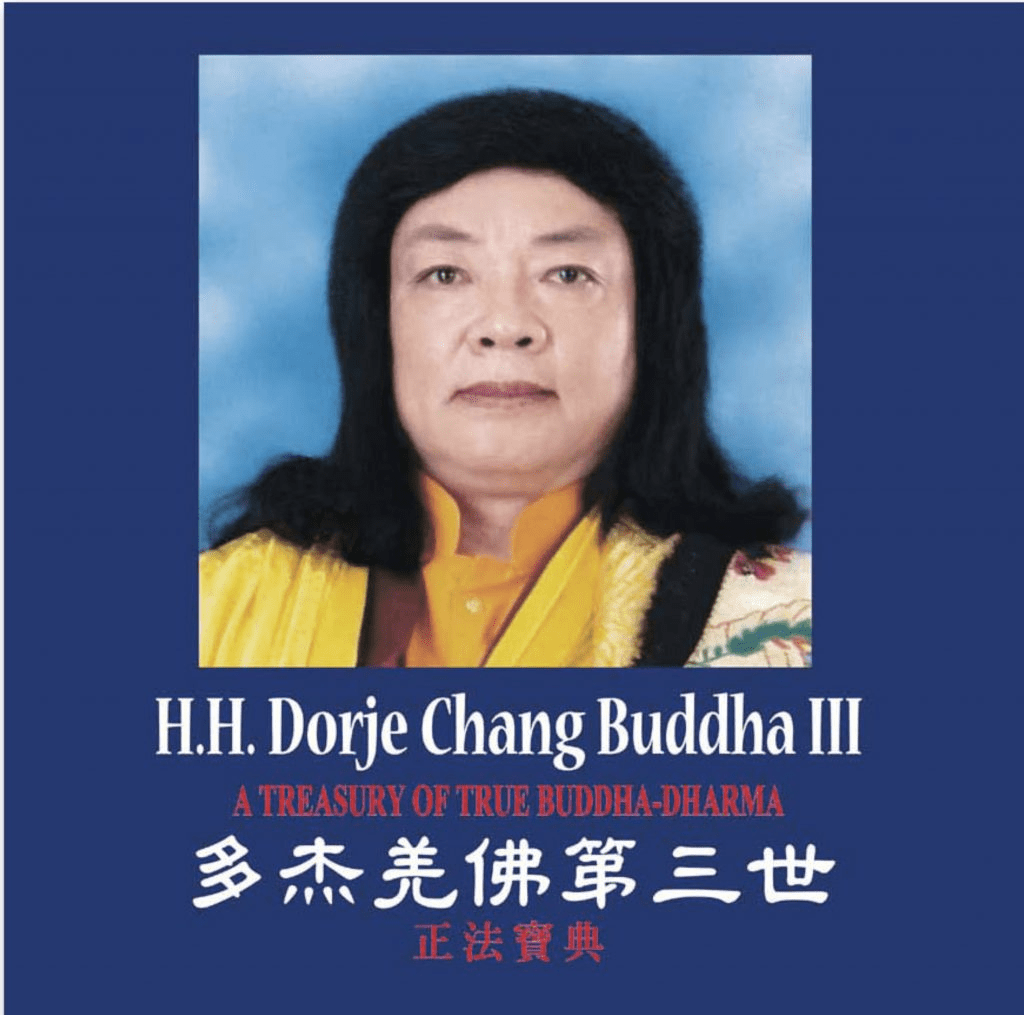
Buddha possesses vast knowledge, superb skills, magnificent supernormal power, and comprehensive wisdom of the universe. The treasure book, “H.H. Dorje Chang Buddha III,” stands as a testament to this statement. However, this book contains only a drop of water from the vast ocean of Buddha’s teachings and wisdom.
The video below showcases the boundless compassion and highlights the extraordinary accomplishments of H.H.Dorje Chang Buddha III. It was published by China Educational Channels TV and features interviews with Buddhist disciples from around the globe.
Discovering the Root of Buddhism, Propagating True Buddha Dharma(H.H. Dorje Chang Buddha III)
Tantra is the secret or esoteric part of Buddhist practice. It is often referred to as the vajrayana or Diamond Path. It is also used as a term for the secret scriptures or esoteric writings. Although it includes the highest dharma within the Buddha-dharma, you should not consider it to be superior or that the exoteric Buddhism practiced by other sects should be considered a low level of dharma. The Buddha-dharma is not divided into high and low as comparisons. All 84,000 dharma methods came into being in response to the different innate faculties of living beings. The Buddha-dharma has only one truth no matter how it is expressed.
Exoteric Buddhism and vajrayana Buddhism are not two separate schools. Exoteric Buddhism is half of a dharma system. True vajrayana Buddhism includes the teachings of the various schools of exoteric Buddhism plus mantras, mudras, visualization, mandala offerings practiced either as a group or alone, and inner and outer tantric initiations. It includes a foundation in the cultivation of the “dharmakaya” from exoteric buddhism as well as the more advanced cultivation of the “sambhogakaya” and the “nirmanakaya.” In vajrayana or tantric practice one strives to realize all three kayas in one lifetime. However, this is ONLY possible if one is able to follow a true vajra master and receive authentic inner tantric initiation.
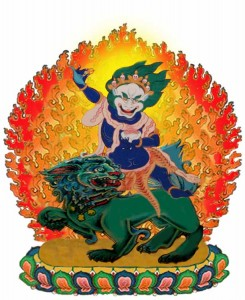
Lion Vajra, an important dharma protector in the Buddha School
True esoteric Buddhism includes all the teachings of the exoteric schools as well as the secret teachings and practices. There are those who claim to be esoteric teachers who can only offer intricate hand movements or mudras, chant mantras, make mandala offerings, or lead the disciple through elaborate visualizations, but who teach or know little of the exoteric sutras. This is not true esoteric Buddhism. Without the foundation in the essential doctrine of the Buddha as found in the Tripitaka, one should not even do the esoteric practices, let alone teach them. That is why the authentic temples which has holly masters teach meditation practices from the Theravadan and Zen or Ch’an Schools, along with certain Pure Land Practices and those of the Hua-yen and Fa-hsiang Schools and others as well as the esoteric methods. Disciples are taught according to their particular karmic affinity with the dharma.
Sometimes these exoteric techniques are taught concurrently with certain esoteric or tantric practices and sometimes they must be mastered prior to introduction to tantra. Not all students are able to receive tantra, which in its highest forms can bring liberation in this lifetime. However, everyone can progress and reach high levels of achievement, according to their efforts and karma. All of the teachings of our temples are to lead beings to liberation from the suffering of the cycle of life and death. That is the only purpose in practicing Buddhism! This is an important point!
Those who learn exoteric Buddhism exclusively are learning only the foundational aspect (some of the theoretical or doctrinal part) of Buddhism. The esoteric vehicle contains the lessor vehicle teachings AND the complete and unsurpassed mahayana teachings of both exoteric and the esoteric Buddhism AND the esoteric practices and rituals.
Tantric initiation is a ceremony within vajrayana Buddhism whereby dharma is transmitted according to tantra by means of a master’s limitless merit and power. During the ceremony, the master visualizes that he or she becomes one with a Buddha or Bodhisattva. During this ceremony the disciple is empowered by the master to carry out specific meditation practices. The student is ritually entered into a mandala of a particular tantric deity by his or her vajra master. He or she is thus empowered to practice the spiritual practices (sadhana) or associated mantras, mudras, and visualization of that deity.
There are three classes of initiation: Outer-tantric initiations, inner-tantric initiations and secret or supreme-tantric initiations (also called “holy” initiations). Each of these three classes is further divided into various dharma methods. During the highest and greatest inner-tantra and secret-tantra initiations there must be supernormal states that are manifested in front of the disciple at the Buddhist altar area (mandala). These miraculous states must be in accordance with the Tibetan tantra laid down by the Buddhas. The disciple is actually turned over to the Buddhas and Bodhisattvas during these initiations. You must remember that unless you personally see the manifestation of supernatural dharma powers, then you have not received an inner-tantric initiation. Most initiations given today are outer-tantra initiations. The supreme or holy initiations are rarely given with very few masters having the ability to perform this type of practice. Vajra masters must undergo certain tests that demonstrate their level of realization to be able to perform this type of ceremony.
Transmission of the greatest dharma requires true nectar during the initiation. For example, the highest dharma within vajrayana Buddhism, the initiation of Ati-yoga, Great Perfection of the Vajra division, requires nectar as an indispensable holy element for cleansing one’s negative karma and is the resource for planting the “Seeds of Vajra.” Other forms of inner trantric initiations can also eliminate karmic obstructions. Disciples can deeply penetrate into the dharma through inner-tantra initiations.
One must have accumulated considerable merit from past practices and good deeds to be able to receive tantra. There are certain preliminary practices that must be performed which can vary depending on the karma of the disciple. There are exceptions possible for 1) those who have completed these steps in a past life; 2) those with exceptional merit due to extraordinary offerings or actions in this life; and 3) through the grace of the guru.
Tantra requires the initiation or empowerment of a qualified teacher or master who provides specialized teachings, rituals, and practices to enable the disciple to root out or eliminate the dark side of his/her psyche and thus become like the Bodhisattvas and Buddhas. Supernormal powers are viewed as the natural outcome of realization and are used by qualified teachers. However, ordinary disciples are not allowed to discuss or display their supernormal powers. Only very highly evolved Bodhisattvas and Buddhas dare to display such powers and then only to help living beings. A person seeking initiation must demonstrate an understanding of emptiness, exhibit high moral conduct, and have developed an altruistic desire to help all beings. Any empowerment will have limited impact without a proper foundation of preliminary practices or Prayogas. It recognizes that supernormal powers cannot be given to one who has not eliminated the negative aspects of the self.
Today as in times past, the highest tantric teachings and practices are only transmitted orally and are held in great secrecy between the teacher and the disciple. Because of the power of these teachings, it is recognized that the student must be thoroughly prepared to receive them. A true master will usually test a disciple for six to twelve years or longer before transmitting the higher teachings.
A Zen practitioner was meditating by the river when he heard struggling sounds. Upon opening his eyes, he saw a scorpion struggling in the water.
He reached out to lift it up, only to be stung by the scorpion’s raised stinger. He placed the scorpion on the bank and continued meditating.
After a while, he heard struggling sounds again. Opening his eyes, he saw the scorpion had fallen back into the water.
He rescued it again, and of course, was stung once more. He continued meditating.
After a while, he had the same unfortunate encounter.
A nearby fisherman said, “You’re so foolish, don’t you know that scorpions sting people?”
The Zen practitioner replied, “I know, I’ve been stung three times.”
The fisherman asked, “Then why do you still save it?”
The Zen practitioner said, “Stinging is its nature, compassion is mine. My nature will not change because of its nature.”
At that moment, he heard struggling sounds again. Looking down, it was the same scorpion.
He looked at his swollen hand, then at the struggling scorpion in the water, and without hesitation, reached out to it again.
This story beautifully illustrates the Buddhist principle of compassion and loving-kindness towards all living beings, regardless of their actions. It embodies the teachings of the Buddha, who emphasized the importance of cultivating a heart full of compassion.
The practice of compassion is central to the Buddhist path. In Mahayana Buddhism, the Bodhisattva ideal embodies the ultimate expression of compassion. A Bodhisattva is one who, motivated by great compassion, has generated bodhicitta, the spontaneous wish to attain Buddhahood for the benefit of all sentient beings.
Moreover, the story reminds us of the great sacrifices made by Siddhartha Gautama, who later became known as Shakyamuni Buddha. He renounced his life of luxury and privilege to seek the ultimate truth of life and the universe. His journey was fueled by the desire to find a way to liberate all beings from the cycle of birth and death, known as samsara.
However, after two and a half millennia, the profound teachings of Shakyamuni Buddha have been gradually forgotten. To revive and propagate the Dharma once more, the primordial Tathagata Buddha, Dorje Chang Buddha, incarnated as H.H. Dorje Chang Buddha III in our world.
H.H. Dorje Chang Buddha III has not only brought the highest form of Buddha Dharma to this world but also set a remarkable example for all disciples through his boundless compassion and humility.
In the past decade, H.H. Dorje Chang Buddha III has endured significant suffering due to long-term persecution for his religious activities. A member country of Interpol once requested that the organization issue a warrant for his arrest. This request was later voluntarily withdrawn by the member country after several years. Following a thorough investigation, in October of 2008, the 72nd session of the Commission for the Control of Interpol’s Files withdrew the arrest warrant and dismissed the entire case against H.H. Dorje Chang Buddha III. Interpol also issued a document stating unequivocally that the arrest warrant against H.H. Dorje Chang Buddha III has been canceled and all member countries have been informed of the cancellation.
Although H.H. Dorje Chang Buddha III received official notification of the withdrawal of the arrest warrant and the removal of the entire case, he has never publicly displayed such documents to prove his innocence. Despite enduring slander, H.H. Dorje Chang Buddha III chose not to disclose this irrefutable evidence. When the World Peace Prize Awarding Council inquired about this, he responded by explaining that his duty is to bear all of the karmic offenses committed by living beings and to bestow upon them all of the good karma and merit that he has cultivated. He expressed concern that if he were to prove his innocence using those documents, those who slandered him would be perceived as guilty. He questioned, “Who, then, will bear their karmic offenses?”
There have been many instances that highlight his holiness’s profound compassion. For example, some of his disciples once left and defamed him, but he still welcomed them back with open arms and treated them no differently than before.
H.H. Dorje Chang Buddha III often reminds his disciples that he harbors no enemies and that all sentient beings are his dearest relatives. He encourages everyone to reflect on their own actions and to strive to lead a life filled with kindness, patience, and understanding.
His Holiness Dorje Chang Buddha III embodies the essence of selflessness and serves as a moral beacon for all to follow. He has also demonstrated how peace can be achieved through determination, humility, and the perseverance to champion its cause even in the face of adversity.
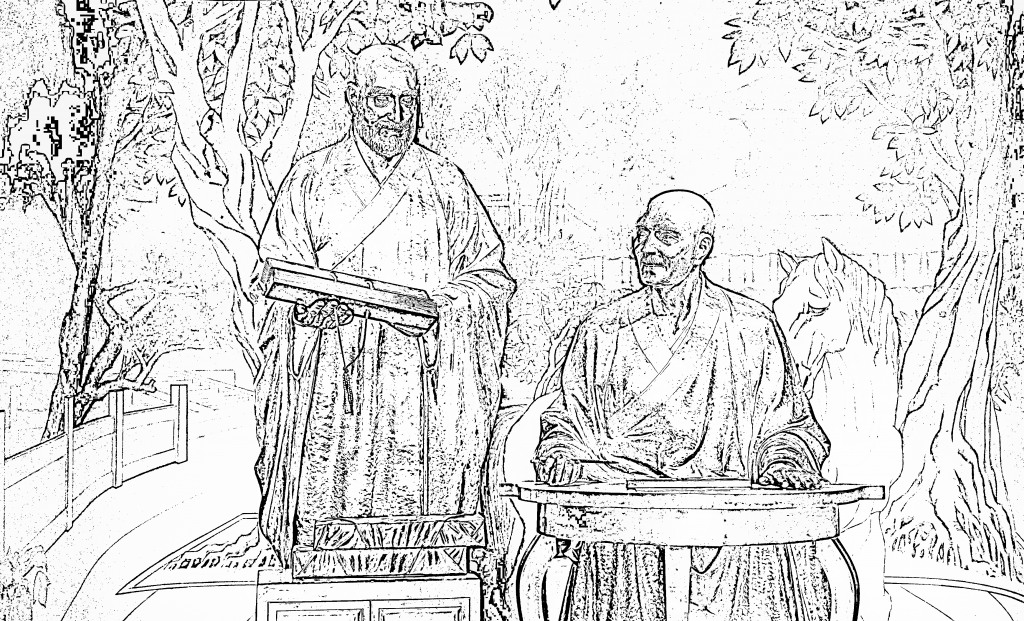
In 64 AD, Emperor Ming of the Eastern Han Dynasty sent Cai Yin and others on a mission to the Western Regions to retrieve Buddhist scriptures. The following year, in 65 AD, Cai Yin, Qin Jing, and others met the esteemed Indian monks She Moteng and Zhu Falan in Greater Yuezhi (present-day Afghanistan), where they were introduced to Buddhist scriptures and statues for the first time. In 67 AD, the Han envoy team returned to Luoyang with the high monks She Moteng, Zhu Falan, and the Buddhist scriptures and statues carried by a white horse. The two high monks were welcomed with a grand reception by Emperor Ming, who also commissioned the construction of China’s first temple, the White Horse Temple in Luoyang, especially for them.
White Horse Temple
On the first day of the first month in the fourteenth year of Yongping, Taoists from the Five Sacred Mountains submitted a petition requesting a competition with the Brahmin monks to determine the superiority of China’s native Taoism versus the foreign Buddhism. Emperor Ming granted the Taoists’ request. In 71 AD, a historic Buddhist-Taoist debate and contest unfolded in Chinese Buddhist history.
As the competition began, the Taoists said, “Let’s start with debating. You monks pride yourselves on eloquently explaining the Dharma, don’t you? So, let’s have a debate! If you can make one point, we will make two; if you raise one, we will counter with three. Go ahead and present your profound arguments!”
She Moteng slowly lifted one foot and raised it towards the sky, smiling, and said, “Amitabha, I have raised one, now it’s your turn to raise three!”
The Taoists looked at each other, stumped, and couldn’t think of a way to counter for a long time. They then changed the subject: “Let’s compare theories. You Buddhists call yourselves ‘Inner Learning,’ while you call us ‘Heterodox.’ But throughout history, when discussing inner and outer, inner has always been smaller than outer. So, your Inner Learning is small, and cannot compare to our great Heterodox!”
She Moteng brought his palms together in a gesture of respect and slowly explained: “The emperor resides in the inner palace, while the common people live in the outer city; although the inner palace is small, the emperor is great. The heart is inside the body, while the hands and feet are outside, the activity of the heart is boundless, while the movements of the hands and feet are limited. This is another example of how the inner is superior to the outer. Think carefully, the Inner Learning of Buddhism is much greater than the Heterodox!”
The Taoists, unable to win the debate, finally said, “Let’s compare magical powers!” How to compare? By placing the scriptures spoken by the Buddha and the scriptures spoken by the Taoist tradition together and burning them with fire. If one’s scriptures burn, then they are false; if one’s scriptures don’t burn, then they are true.
So, in the south of White Horse Temple, two high platforms were set up, one in the east and one in the west. The east platform held the Buddhist scriptures, images, and relics, while the west platform held the Taoist scriptures.
At that time, five hundred Taoist priests gathered the Taoist scriptures and magical texts together and prayed to the Supreme Lord Laozi, saying: “Oh, Taoist Virtuous Sage! Please show great divine power, and make our Taoist scriptures not burn, and let the Buddhist scriptures burn.”
Many of the Taoist priests at that time had supernatural powers – some could ride clouds and fog, some could fly in the sky and hide underground, and some could become invisible. Invisible means that you could see him right in front of you, and then suddenly he’s gone! There were Taoist priests with such abilities. They could use evasion techniques – Qimen Dunjia, to escape, and with Taoist spells and incantations, they had great supernatural powers.
But what happened when the fire was lit? The Buddhist scriptures did not burn; they emitted light! The Buddha’s relics also emitted a five-colored light, and the scriptures emitted light up into the sky, as if the sun was shining upon the world.
What about the Taoist scriptures? They caught fire as soon as they were burned and were completely destroyed by the fire. Those who could ride clouds and fog could no longer ride clouds or exhibit supernatural powers; those who could fly in the sky could no longer fly; those who could hide underground could no longer hide; those who could become invisible could no longer become invisible. Their spells and incantations also lost their effectiveness and had no power.
She Moteng and Zhu Falan, the two venerable monks, were responsible for overseeing this scripture contest, which was of great significance for the rise or fall of Buddhism. To strengthen the faith of the masses, She Moteng and Zhu Falan displayed eighteen divine transformations, levitating in the sky and reciting the following verses:
“The fox is not of the lion’s kind, a lamp is not as bright as the sun and moon; a pond cannot hold the vast sea, a hill cannot match the towering mountain. The Dharma cloud descends upon the world, the Dharma rain nourishes all beings. Supernatural powers are rare, manifesting everywhere to transform sentient beings.”
“The fox is not of the lion’s kind” means that, although the fox spirit is cunning and can change shape, it is far inferior to the lion. The fox and the lion cannot be compared; they are not of the same kind. This is saying that the breadth of Taoism is like the smallness of the fox, different from Buddhism, which has the grandeur of a lion.
“The lamp is not as bright as the sun and moon” refers to how the light of a lamp or a candle, which were small in the past, is far less bright than the light of the sun and moon. This means that the scriptures and teachings of Taoism are like the light of a lamp, while the Buddhist scriptures and teachings are like the light of the sun and moon, incomparable.
“A pond cannot hold the vast sea” means that a small pond has a limited capacity and can only hold a small amount of water, while the vast sea can accommodate many rivers. The pond and the sea cannot be spoken of in the same breath. This is a metaphor comparing the theories of Taoism to a small pond, while the teachings of Buddhism are like the vast and boundless sea.
“A hill cannot match the towering mountain” means that a small hill cannot compare to the grand and towering Mount Song, one of the Five Sacred Mountains of China. If the practice of Taoism is like a small hill, then the profound teachings of Buddhism are like the towering cliffs and deep ravines of ancient trees.
“The Dharma cloud descends upon the world, the Dharma rain nourishes all beings” means that when Buddhism spread to China, it was like a cloud of Dharma, like sweet dew, pervading the world and nourishing all beings.
“Supernatural powers are a rare thing” means that I have now shown supernatural powers, which is a rare and precious thing in the world.
“Everywhere transforming sentient beings” means that in reality, I did not want to show supernatural powers, and I did not want to compete with you. This is a last resort, for the purpose of guiding you and leading you to a brighter path, I am doing this as a convenient means.
After this contest, Buddhism took deep roots in China, not only producing a succession of talented individuals but also establishing a glorious foundation. White Horse Temple became the first and foremost temple in Chinese Buddhist history, and temples began to be built one after another. Ever since then the marvelous fruits and wondrous flowers of Chinese Buddhism have continued to flourish from generation to generation.
The True Story of Khenchen Tsewang Rigdzin (Khenpo Chaiwan Runzheng)
Article provided by Jinghan
There have been great practitioners who attained the accomplishment of the Rainbow-Light Body (the ability of moving one’s body anywhere at will without being blocked or stopped by any material or force) in our current era. This is a true story. A Khenpo who cultivated at the Zhuqing Temple, in order to liberate himself at the time of Cultural Revolution in China and in order to inspire the later generations to believe in the Buddha-dharma, manifested his entering of nirvana in the form of demonstrating his Rainbow-Light Body.
There really have been great practitioners with the accomplishment of Rainbow-Light Body! Khenpo Chichengluozhu once investigated and reported such an event.
Under Shining Daylight and in Front of Many People’s Eyes, a Person Vanished with His Body into Nowhere
Investigation on a person’s mysterious disappearance 44 years ago
Time can erase people’s memory on many things in the past. As each day slipped by us, we may suddenly realize that the past would never come back. Only some very special events will pass the filtering of time to remain at the bottom of our hearts and coalesce into unforgettable scenes in our memory.
I am certain that, to many people who live in Tongde County, Huangnan Region, Qinghai Province, Khenchen Tsewang Rigdzin (Khenpo Chaiwan Runzheng) is such a treasured memory in their minds. This great accomplished practitioner of the Nyingma Sect who suddenly flew away and disappeared into the sky in September, 1958, in front of the soldiers who escorted him, has evolved from a topic of after-dinner chat among local people into a legendary character in people’s minds. He was eventually elevated into the status of a spiritual leader and source of confidence. During the time of over 40 years that the story has been spread by word of mouth, a question exists. Is this an image created by people’s illusion for resting their fragile hearts, or is this a living drama of freedom from birth and death performed by a truly accomplished practitioner with the achievement of flying and vanishing away? Many people, including myself, had thought about, analyzed, and even doubted this matter. However, we all based our thinking on a simple and self-evident truth: we cannot rule out the possible existence of something we did not see. Insisting on seeing-with-my-own-eyes and hearing-with-my-own-ears may still lead to hearing “true stories” from other people. In analyzing a complex event, respecting the facts is the best way in finding the underlying truth. Only time can provide the most fair and eventual testing and judgment. With such a motive, I stepped onto the legendary land of Huangnan in Qinghai Province. My sole purpose was to depict a true picture of and provide the true story about Khenchen Tsewang Rigdzin (Khenpo Chaiwan Runzheng), for benefiting the people, especially the future generations.
1. Brief Introduction on the Life of Khenchen Tsewang Rigdzin (Khenpo Chaiwan Runzheng)
Before I describe the process and findings from my investigation, let me first give an introduction on the life of this Master of the Nyingma Sect to the readers. I’d like to stress the following: the information and materials I collected were all from reliable sources.
Khenchen Tsewang Rigdzin (Khenpo Chaiwan Runzheng) was born in 1883, in Maiwa Village of Hongyuan County, Sichuan Province. At the age of 10, he entered the Zhaxiquenang (meaning auspicious dharma bell) Temple to study the dharma. When he was 15, he had a formal ceremony to receive the precepts and became a monk. Then, he immediately went to the Zhuqing Temple, one of the six major temples of the Nyingma Sect to study the Tripitaka and took refuge with a number of great accomplished masters. At the age of 25, he received the perfect and complete precepts of Bhiksu to become a monk. Since then, he strictly abided by the precepts and carefully avoided violations as if protecting his own eyes. Eventually, his clothing, waist belt, meditation mattress and other things used daily all had a clear and pure scent coming out of them. During this long period of cultivation and questing for the dharma, he received many initiations within the lineage of the Nyingma Sect, and demonstrated many times that he had above-normal character, including being conversant in the Sutra and Tantra teachings and superlative wisdom. When he was 30, he was accepted by Maipeng Rinpoche to learn the profound dharma. When the Master taught him the dharma with the linage from Manjushri Bodhisattva, he was instantly enlightened by the essence of the Bright and Great Perfection. From then on, he easily commanded many Sutras and the classic books of Esoteric Buddhism (tantras).
Khenchen Tsewang Rigdzin (Khenpo Chaiwan Runzheng) then went to the mountains to cultivate ascetic practices. His ascetic practices can truly be regarded as representative and a role model among all ascetic practitioners. First, because of the living conditions at the time, the external environment for practicing asceticism was extremely challenging and tough. On the other hand, Khenchen Tsewang Rigdzin’s (Khenpo Chaiwan Runzheng’s) will and determination through his persistence and devotion under the cruel conditions were very moving and inspiring to other people. Every meal, he just ate a little roasted barley flour along with a bowl of water. Such a daily intake of thin flour soups had made a small bag of roasted barley flour last for a whole year. He lived such a life without sufficient food throughout the long period of ascetic practices. At one time, when roasted barley flour and cooking oil was used up, he had to cook the cow-skin container bag for cooking oil as food to sustain his life. The lack of food was not the only major hindrance for Khenchen Tsewang Rigdzin (Khenpo Chaiwan Runzheng). With no oil for light at night, he could only study books by moonlight. While climbing the hill following the movement of moonlight, he would eventually reach the summit peak. There was such scenery at the place he was cultivating: when the sunlight began to shine on the summit peak, his shadow would be there to see off the last ray of moonlight. During the nights without moonlight, he would use the almost lightless light from the ashes of the cooking bonfire to read the Sutras.
To Tsewang Rigdzin (Chaiwan Runzheng), his sleeping at night had almost been completely substituted by meditation. He had no additional clothing to what he wore during the day for keeping warm at night. Through such ascetic practices, one night in his dreams, he met the founding master of Tibetan Esoteric Buddhism, Guru Padmasambhava, who was wearing an amber necklace. Since then, his wisdom was so stimulated that he was able to memorize and recite Sutras that are as long as 24,000 words.
While cultivating inside the snow mountain near the Zhuqing Temple, Khenchen Tsewang Rigdzin (Khenpo Chaiwan Runzheng) ate only one meal a day. Sometimes, he might be without food for three days in a row. To make himself more alert and to keep from falling asleep during meditation, he sat on the snow-covered ground with bare-feet, wearing only one short skirt! Due to the long-time exposure to ice and snow, his feet suffered permanent damage and since then he could only walk with the aid of two walking sticks.
That is how this genuine practitioner cultivated himself under all types of hardships and stress. He applied all aspects of his three karmas of body, voice, and mind to quest for and to experience the essence of the dharma. At the same time, his life demonstrated, to people in this world, the possibility and pathway in attaining enlightenment in one’s current life. Even the side effects he suffered in the form of bodily handicaps (he needed to be carried in order to move) was just an indication of not being attached to worldly affairs from an accomplished practitioner with the achievement of the Rainbow-Light Body. Huadan, the care-taker of Khenchen Tsewang Rigdzin (Khenpo Chaiwan Runzheng), had in-depth knowledge on this. Once, Huadan was tying the waist belt for his master. Unexpectedly, the whole belt completely penetrated the waist of the Master and came back to his hand. Huadan was totally surprised. He did the tying one more time and made a tight knot. However, when he started to use a little force to tighten the belt, the whole belt again completely penetrated the Master’s body. Only then Huadan realized the real reason for what happened.
With the achievement of the Rainbow-Light Body, there was no shadow from the body of Khenchen Tsewang Rigdzin (Khenpo Chaiwan Runzheng) under light during evenings and at night. Another indication of the Rainbow-Light Body achievement is that the body cannot be blocked or stopped by any worldly material or force. Another care-taker of Khenchen Tsewang Rigdzin (Khenpo Chaiwan Runzheng), Arluo, had personally witnessed the penetrating capability of the Master’s body.
One day, Arluo was leaving home to run an errand. As usual, he left the Master resting in the bedroom and locked the door when leaving the house. When he was returning home from the errand, he was totally shocked to see the Master sitting outside the house. Normally, the Master would be carried to get out of the house for sunlight. How could he get out this time, with the door being locked? Arluo verified that the door was still locked and without any damage. Then he checked the window, which was also closed from the inside. Besides, the size of the window would not even allow a person to get through. The only possible answer was that Khenchen Tsewang Rigdzin’s (Khenpo Chaiwan Runzheng’s) body had become a Rainbow-Light Body or Vajra-immortal body.
Khenchen Tsewang Rigdzin (Khenpo Chaiwan Runzheng) had pushed away all worldly attachment to concentrate on cultivating the path toward the supreme Buddha-dharma. However, due to certain causes and affinity, in 1951, at the elderly age of 68, he was respectfully invited to be in change of the Shangdan Temple in Tongde County, Huangnan Region of Qinghai Province. At that time, Khenchen Tsewang Rigdzin (Master Chaiwan Runzheng) was quietly cultivating in the Yellow-Dragon Holly Mountain in Jiuzhaigou area of Sichuan Province. The invitation came from Jinmei-deqing-duojie, the reincarnated third-generation Zhongwuo Rinpoche, who was the founding master of the Digan Temple in Tongde County. At that time, the construction of the Shangdan Temple was not completed yet. With the help of Jinmei-deqing-duojie Rinpoche, Master Tsewang Rigdzin (Chaiwan Runzheng) oversaw the completion and opening of Shangdan Temple at the end of 1951. Since then, I have been the abbot of the Shangdan Temple. Before 1958, Shangdan Temple had been the home base of Khenchen Tsewang Rigdzin (Khenpo Chaiwan Runzheng) for propagating the dharma and benefiting living beings.
Another event that occurred during this period can be regarded as a footnote to the later mysterious disappearance of Khenchen Tsewang Rigdzin (Khenpo Chaiwan Runzheng). After he had settled in Shangdan Temple, his hometown Hongyuan kept sending people to ask him to come back. Khenchen Tsewang Rigdzin (Khenpo Chaiwan Runzheng) declined all their invitations. Once, after going to the toilet, he called his disciples over and said, “These (people from Hongyuan) insisted on getting me back there, but I will not go. Through the years, my practice of the Phowa Dharma has reached a very high level. I am able to reincarnate myself. The temple here is still relatively new, you all must manage everything well. If they force me to go back, I will reincarnate myself on the way back.”
This story tells us that Khenchen Tsewang Rigdzin (Khenpo Chaiwan Runzheng) was able to control his life or death using the Phowa Dharma. There were more examples that provided explanations to what he did later on. Here is another.
Three people, Dawa, Wangqin and Nanda, who currently still live in Tongde County, remember to this day an event that occurred shortly before Khenchen Tsewang Rigdzin’s (Khenpo Chaiwan Runzheng’s) flying away. At the time, they and the Khenpo were to be sent to prison. Before starting their prison terms, the four and some other detainees were temporally held in a military camp. Dawa was 21 years old and Wangqin and Nanda were about the same age. The three all witnessed a scene of the Khenpo’s practicing the Phowa Dharma in front of people.
When the Khenpo chanted the first sound of “Ho”, they all saw that his hair pointed upward and his ears were growing and expanding, until reaching the forehead. At that time, an officer quickly came and pointed his pistol toward the Khenpo’s head. The Khenpo was not at all affected by this. He spitted another “Ho.” The three then saw that all his hairs were pointing up and the ears had grown to the top of his head. The officer then yelled to the Khenpo for a while, as if telling him not to make the sound of “Ho” again. The Khenpo calmly accepted the officer’s instruction and stopped the Phowa Dharma. He said OK to the officer.
44 years after that, the elderly Dawa was still very moved when talking about that event: “I was very close to the Master at the time. There were only two people between him and me. I clearly saw the entire process from beginning to the end. Now I understand. If the Master wished to leave, he could have done that right away but he chose to stay for the time being.”
2. Flying Away into the Sky
Let’s end here the brief introduction about Khenchen Tsewang Rigdzin’s (Khenpo Chaiwan Runzheng’s) life before his flying-away. What is described below is one popular version of the event that was commonly known to the elder local people in Tongde County. This version was known to most people and believed by most people. Our investigation, witness interviewing, analysis and verification were conducted around this version.
According to local people, one day in September of 1958, a mass assembly was to be held near the Digan Temple in Tongde County to criticize and interrogate Khenchen Tsewang Rigdzin (Khenpo Chaiwan Runzheng). At that time, he was already in jail in the County Prison. Several small hills must be crossed from the prison to the site of the mass assembly. Several soldiers were escorting the Khenpo after taking him from the prison. Because of his handicap, the Khenpo was allowed to ride on the back of a red yak. When the group of five or six people were approaching their destination, an extremely strong and violent whirlwind (cyclone) suddenly took place. The wind was so strong that none of the soldiers could open their eyes. Their location at the time was close to the top of a hill, with a distance of several kilometers from the Digan Temple. After the wind had gone away, the soldiers started to look around. However, Khenchen Tsewang Rigdzin (Khenpo Chaiwan Runzheng) was no longer on the yak. Before starting the trip, to prevent an accident, the soldiers had tied the Khenpo tightly on the back of the yak with rope. All their efforts were proven to be in vain, because the Khenpo had flown into the sky, accompanied by several auspicious colored clouds. This event was witnessed by many people at the scene.
3. My Investigation
If you come to Tongde County and mention the name of Khenchen Tsewang Rigdzin (Khenpo Chaiwan Runzheng) to people, almost anyone will tell the above story to you in similar details. Even though the story is so commonly known, I still decided to do my investigation from the start. My first goal was to clarify the doubt many people may have. On the other hand, I wanted to have the facts recorded truthfully. I wished to find out: did people put their feelings into the story so the truth got covered by kind lies? Also, between legend and fact, to what degree and scope can the truth be re-manifested?
The people I interviewed in my investigation included some who were escorting the Khenpo at the time; those who were near the location when the Khenpo was flying away, including some eye witnesses; and a number of people who listened to the entire story from eye witnesses. When putting their words into text, I wrote down exactly what they said almost without editing a word. My goal was to let the readers draw their own conclusions naturally, without being influenced by the subjective and, possibly, already fixed thinking in my mind. I believe that this style of truthfully presenting the original narration would be convincing to the readers.
My first interview was with the elderly Zhimei, who is 77 years old now. He was a local shepherd in Tongde County. He told me:
“On the day when Master Tsewang Rigdzin (Chaiwan Runzheng) was taken from the prison to the site of the mass meeting, I was watching cattle on one of the hills he must pass. I saw several soldiers passing by with the Master. They tied the Master onto the back of a red yak. When they went over the top of the hill, I was with the cattle half way on the hill. Then, I suddenly saw the Master, in monk’s clothing, started to ascend from the other side of the hill. At the beginning, he was flying up slowly. Eventually he disappeared into the clouds. Many people said that there was a strong swirling wind and auspicious colorful clouds appeared in the sky but I did not see those scenes. This may be because I was half way up this side of the hill, while the Master had already gone to the other side. All I saw was that the Master flew into the sky. I saw that with my own eyes. I was still young then with good eye sight. It would be impossible that what I saw was some illusion. Years later, the charges to those jailed in 1958 were dropped. The Master’s hometown Hongyuan also sent people to request the Master’s remains from Tongde County. I knew that they would not get them because the Master flew away into the sky. I saw that with my own eyes. I told this to my family members but I dare not to tell the people from Hongyuan. After all these years, now as an elderly person of almost 80 years old, I am telling this story again from my memory. Do you think I would fabricate it to deceive you? I absolutely do not have any false statement in it. I do not have any reason to lie on this. In general, there are two possible motives for one to lie. One is trying to reap benefits from doing so. The other is being forced to lie and under pressure. My situation has nothing to do with either of these. That’s why I can guarantee you that I did not make any false statement in what I said.”
The elderly Zhimei was an eye witness of the event. The next person I met, Chongpeier, provided detailed collaborating materials in many aspects. Also, he was the most talkative person among those I interviewed.
Chongpeier is over 60 now. He is a local resident and currently stays at home after retiring from his job. He was a middle-level cadre of Tongde County. He described to me, in great detail, what he learned on this event:
“I remember that it was a day in October of 1988. I was the director of the Bureau of Industry and Commerce Management of Tongde County then. On that day, when it was near the end of workday, a Han (mandarin) person came to see me and invited me to have dinner with him. At the dinner table, he told me his purpose of looking for me. His name was Li Desheng and he was from the Shangchun Village of Huangzhong County in Qihai Province. He came to Tongde County to buy about 500 head of cattle and lambs from local people. He wanted to ask me a favor of collecting less taxes and fees from him. He told me that he knew many senior officials in Tongde County very well, but not me. I asked him where he had worked before. He said that he has been a soldier in the security force of Tongde County and had risen to the position of a squad leader. While we were enjoying wine and dining, he told me a miraculous experience of his that was beyond imagination:
‘I saw a person who flew away in front of my own eyes. At that time, I and several soldiers of my squad were escorting that Lama from the prison to the mass meeting site near the Digan Temple. We tied him tightly onto the back of a yak and surrounded him as we were on our way. While we were climbing the hill and close to the top, he started to chant something that we could not understand. At the top of the hill, we ordered him to stop making the sound. Then we saw that the other side of the hill was flat land. Suddenly, many pieces of colored clouds flew over. The Lama got carried away by the clouds!
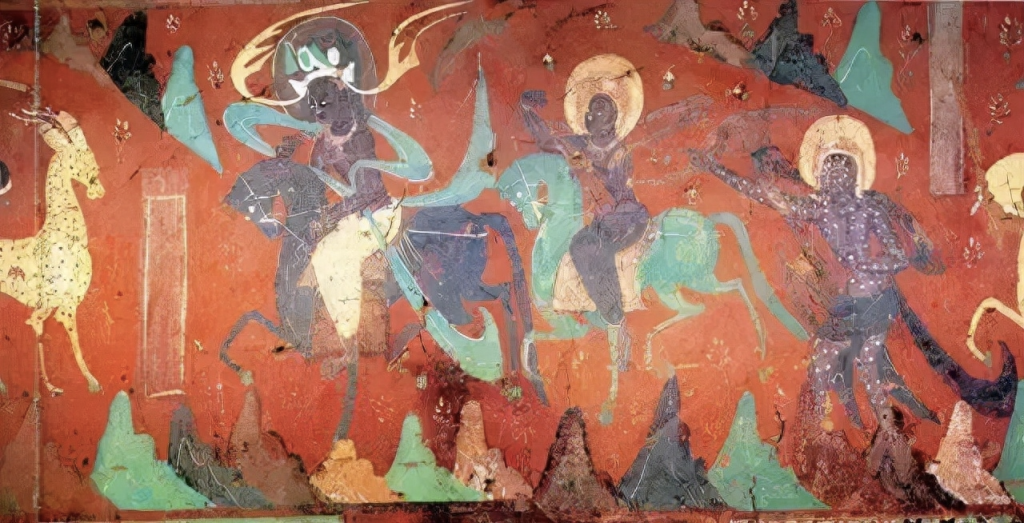
“The Story of the Nine-Colored Deer King” is the main theme of the murals in Cave 257 of the Mogao Caves. It unfolds in a long horizontal scroll, narrating many stories from the past life of the founder of Buddhism, Siddhartha Gautama.
Legend has it that long ago, on the banks of the Ganges River in India, there lived a beautiful and kind nine-colored deer king (the previous incarnation of Siddhartha Gautama)…
One day, as the nine-colored deer king was leisurely strolling by the river, he suddenly heard a pitiful cry from the water. Without hesitation, the brave nine-colored deer leaped into the river, risking its own safety, and rescued the drowning person. The saved individual, overwhelmed with gratitude for a second chance at life, repeatedly bowed in thanks to the nine-colored deer.
The nine-colored deer king said, “No need for thanks; just go on your way. My only request is that you do not reveal my whereabouts to anyone.” The drowning person solemnly swore, “Kind benefactor, rest assured. If I ever betray this promise, may my body be covered in sores and my mouth emit a foul odor.” With that, the person departed.
Before long, the queen of that country dreamt of a deer—one with nine colors and silver-like antlers. She told the king about her dream and requested that he order the capture of such a deer. She had a strong desire to use its colorful hide for clothing and its antlers for earrings. Consequently, the king issued a proclamation and offered a substantial reward.
Upon seeing the proclamation, the person who had been saved reported to the king, leading soldiers to the mountain to hunt down the nine-colored deer.
When the nine-colored deer was surrounded by the king’s troops… it spotted the person it had rescued from drowning, tears of sorrow welled up in its eyes…
The nine-colored deer leaped in front of the king and recounted the story of how it had saved the person from drowning and how that person had broken his promise. The king and the soldiers were deeply moved by the deer’s account. The king ordered the soldiers to clear a path, allowing the nine-colored deer to regain its freedom. He also issued a decree: “From now on, people are not allowed to shoot deer.”
As for the person who had broken his promise, in an instant, sores covered his body, and a foul odor emanated from his mouth. From that moment on, he was despised and reviled by the people.
The story of the nine-colored deer is vividly portrayed in Cave 257 of the Dunhuang Grottoes, which is what we now see as “The Story of the Nine-Colored Deer King.” While the mural is not particularly large in size, it holds significant importance in Chinese art history.
This artwork takes the form of a horizontal scroll with the story unfolding from both ends and converging in the middle. It consists of multiple scenes depicting various stages of the story, such as its origin, development, climax, and conclusion, all seamlessly connected to create a cohesive narrative.
“The Story of the Nine-Colored Deer King” is composed of nine panels, illustrating five key plot points: the person drowning, the nine-colored deer rescuing the drowning person, the drowning person expressing gratitude to the deer, the queen’s desire to capture the deer, the informant revealing the deer’s whereabouts to the king, and the confrontation between the king and the deer.
The story progresses from both ends of the mural towards the center, placing the pivotal conversation between the king and the deer in the middle. This unique composition style captures the essence of continuous horizontal scroll art from the Wei and Jin dynasties, showcasing the distinctive historical aesthetics of the era.
In the artwork, the depiction of mountains, rocks, and rivers occupies a significant portion. The rendering of the landscape primarily serves to fill the space and delineate the composition, providing a brief description of the specific environment, thereby enhancing the visual impact of the artwork and its storytelling function.
“The Story of the Nine-Colored Deer King” places the climax of the story—the moment when the nine-colored deer recounts the events—at the center of the composition. At the same time, both nine-colored deer on the left and right sides turn their bodies toward the center, serving as visual guides.
This is precisely the turning point in the storyline of the nine-colored deer, where the drowning person’s affliction receives its retribution. It places the Buddhist concept of rewarding goodness and punishing evil at the visual forefront, narrating the sequence of events step by step to gradually reveal the story’s progression to the viewer.
The entire process is rhythmic, marked by the ebb and flow of the narrative, skillfully aligning the chronological order with the spatial arrangement, showcasing the artist’s unique conceptualization of the composition.
In terms of color usage, “The Story of the Nine-Colored Deer King” appears to be very vibrant, but in reality, it uses a limited color palette, consisting of only six colors. The earthy red color dominates the entire painting, which is a prominent color characteristic of the Wei, Jin, Northern and Southern Dynasties period.
Complementing this are touches of stone blue and stone green, along with the harmonious blending of black, white, and gray. This blending softens the strong contrast between earthy red and stone green and blue, achieving a harmonious contrast of warm and cool tones. At the same time, it also accentuates the brightness of contrasting colors.
The introduction of Buddhism had a significant impact on the development of portraiture in China, introducing a set of strict conventions for Buddhist iconography. During the Northern Wei dynasty, the Dunhuang murals began to emphasize body proportions and adopted more attention to three-dimensionality after incorporating color shading techniques.
In “The Story of the Nine-Colored Deer King,” most of the figures on the canvas have slender bodies, with their clothing belts fluttering in the wind. Their gestures and movements exude a graceful dance-like elegance, evoking the style of figures that “float like wandering dragons and are delicate as startled swans.”
In the murals of the Northern Wei period in Dunhuang, Jataka stories are an important theme. Jataka stories refer to the countless events and experiences in the past lives of Siddhartha Gautama, who would later become the founder of Buddhism. In history, there are numerous Jataka stories related to Siddhartha Gautama.
Within Buddhist art themes, there are many Jataka story paintings, and “The Story of the Nine-Colored Deer King” is just one of them. Story paintings are used to promote the Buddhist concept of karmic retribution and to praise the spirit of self-sacrifice displayed by the Nine-Colored Deer King.
In reality, all Jataka paintings ultimately convey one message: that by performing good deeds, selflessly giving, and enduring hardships, one can achieve positive outcomes, whereas engaging in wrongful actions will lead to self-destruction.
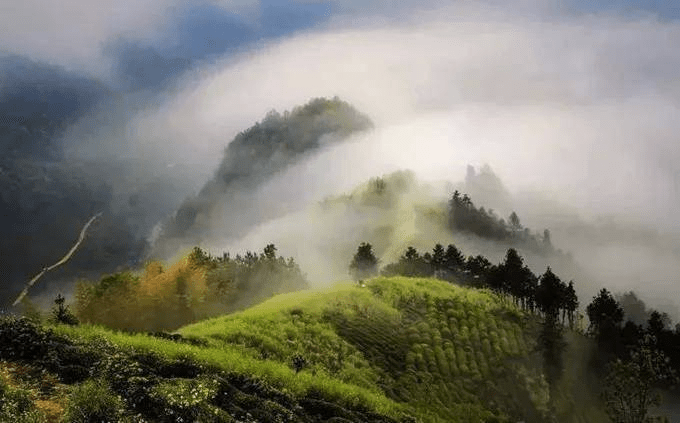
The Mount Wuzhong, also known as Misty Mountain and formerly referred to as Daguangming Mountain, Tiancheng Mountain, and Wushan, is a significant Buddhist pilgrimage site situated along the ancient Sichuan-to-India trade route, often referred to as the Southern Silk Road, within ancient China. It is located in Wushan Township, north of Dayi County, 25 kilometers from the county seat, and 80 kilometers from Chengdu. To its east lies Qinglong Mountain, to the south it connects with Daping, to the west it borders Wayao (also known as Baihushan), and to the north, it meets Longwo. The primary peak elevates to 1638 meters, with Jiulong Mountain and Jingang Mountain to the north and Hongyan Mountain to the west. Covering an expansive area of several square kilometers, it is aptly known as the “72 peaks” due to the constant presence of clouds and mist, hence earning its moniker as the “Misty Mountain.”
Historical records, such as the Ming Dynasty’s “Kaihuasi Stele Inscription” and the “Records of Misty Mountain,” reveal that as early as the Western Han Dynasty, Mount Wuzhong was renowned for its breathtaking natural beauty and mysterious wonders that left people in awe. It was described as a “land adorned in golden cloth and adorned with jade-like peaks, filled with endless wonders that inspired astonishment and amazement.” It was even considered “the place where the ancient Buddha Amitabha performed miracles.” In the 16th year of Emperor Ming of the Han Dynasty, responding to recommendations from the imperial court, Emperor Ming dispatched the courtier Fu Ying, accompanied by two distinguished monks from ancient India – the venerable monks Kashyapa Matanga and Zhu Falan – to establish a Buddhist temple on the mountain. Their mission was to propagate Buddhism and disseminate its teachings, thereby benefiting people far and wide with the nectar of Buddhist wisdom.
During the Ming Dynasty, Buddhism at Misty Mountain reached its zenith. The mountain boasted a total of seventy-two peaks, nine passes, and one hundred and eight winding paths, accommodating one hundred and eighty temples and forty-eight hermitages. According to the “Records of Misty Mountain,” it was described as a place “spanning dozens of square miles north of the two rivers and south of Longwo, with buildings scattered like black houses, without overcrowding.” “Monasteries and temples were as numerous as stars in the sky, surrounding the mountain from all sides, too numerous to count.” In modern terms, the total constructed area exceeded 400,000 square meters, equivalent to the size of a medium-sized city. During the Ming Zhengtong era, the emperor established the Dugang Institute at Misty Mountain, with the venerable monk Yuanxi serving as the official historian, overseeing all temple affairs. The temples at Misty Mountain were so prosperous and grand in scale during that period that a local saying emerged: “There are 25 thousand great monks, and the number of ordinary monks is beyond count.”
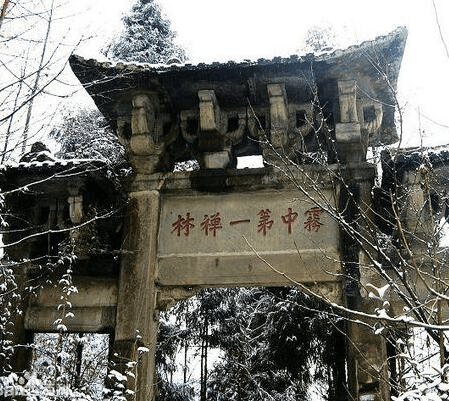
Eminent scholar Yang Sheng An, during his travels in Misty Mountain, inscribed a couplet on the “Heavenly Mountain” archway, proclaiming, “There is no match in the world; Misty Mountain is the number one.” With Yang Shen’s profound insight, he boldly asserted that Misty Mountain was unrivaled, and in the “Inscription of Kaihuasi temples at Misty Mountain,” he referred to this place as the “supreme stronghold of Chan (Zen) Buddhism.” This attests that during the Ming Dynasty, the prestige of Buddhism at Misty Mountain remained unmatched by other mountains in the region.
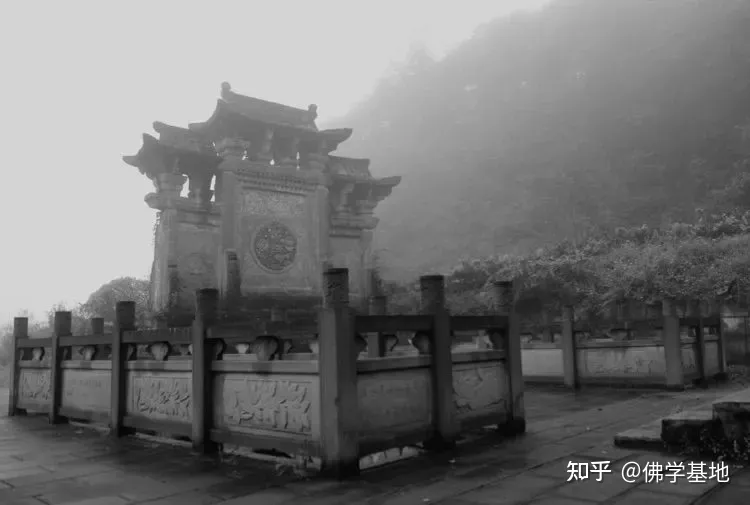
The Buddhist temple – KaihuaSi – established by the venerable monks Kashyapa Matanga and Zhu Falan was erected just six years after the White Horse Temple, often regarded as the first temple in Chinese Buddhist history. Therefore, it holds the distinction of being the second temple in the annals of Chinese Buddhism’s history and the first temple for the transmission of Buddhism from the south. Emperor Ming of the Han Dynasty bestowed upon it the name “Daguangming Puzhao Temple.”
KaiHuaSi Temple
Since the Han Dynasty, Mount Wuzhong has been home to renowned monks who have propagated and practiced the Buddhist teachings. During the Yonghe period of the Jin Dynasty, the esteemed Western monk Faxian revitalized Misty Mountain, renaming the temple as Tiancheng Mountain Xianying Temple. In the reign of Emperor Gaozong of the Tang Dynasty, two great masters, Sangha and Senghu, resided here and, by imperial decree, restored the original name of Daguangming Mountain Puzhao Temple. In the reign of Emperor Xiaozong of the Song Dynasty, Master Yuanze Laochang expanded and embellished the temple, bestowing it with splendor. During the reign of Emperor Xuanzong of the Ming Dynasty, Tibetan monks Pudashaye and Shigaba were once again appointed by imperial decree to rebuild the temple and requested the imperial name “KaiHuaSi at Misty Mountain.” This name has endured for the temple ever since.
Throughout its long history, Kaihuasi at Misty Mountain has withstood nearly two thousand years, bearing witness to the rise and fall of temple structures, yet it persists to this day. In this enduring history, one can discern the resilience of Buddhism, the steadfastness of human hearts, and the enduring nature of faith.
.
JiewangSi
In more recent times, two esteemed monks resided within the temples of Misty Mountain: Master PuGuan and Master Guozhang. Both were disciples of H.H. Dorje Chang Buddha III, receiving profound Dharma initiations from Him and achieving liberation. In 1998, Master Pu Guan passed away while in meditation, having attained mastery over his life and death. Remarkably, even eight years after his passing, his remains rest within a stupa, preserved in the meditation posture without any signs of decay.
Master Guozhang, a renowned Chinese Buddhist monk, embarked on his monastic journey at a young age on Mount Emei, one of China’s four famous Buddhist mountains. In his middle years, he ventured to Kangding in Tibet, where he received empowerment from the Supreme Vajradhara, H.H. Dorje Chang Buddha III, who became his fundamental guru. Subsequently, he served as the abbot of Jiulao Cave on Mount Emei. Master Guozhang was celebrated for his unwavering commitment to monastic precepts, profound spiritual realization, and his extraordinary ability to tame wild animals on the mountain. Legends even spoke of his capacity to hear conversations between heavenly beings and humans.
In 1992, both Master Puguan and Master Guozhang were appointed to key positions at Misty Mountain’s Kaihuasi Temple by the government of Dayi County. Master Puguan assumed the role of abbot and oversaw Buddhist affairs within the mountain, while Master Guozhang was entrusted with overseeing the temple. Later on, Master Guozhang became the abbot of Jiewangting temple, which also located in the Misty Mountain.
Master Guo Zhang once shared with his disciples a remarkable experience: he received the Great Dharma initiation from H.H. Dorje Chang Buddha III in Tibet when His Holiness was less than 5 years old.
In 2015, Master Guo Zhang passed away at the age of 108. Eleven days later, local government officials visited Jiewangting Temple and, doubting the profundity of the master’s practice, pierced his body with needles, causing blood to flow.
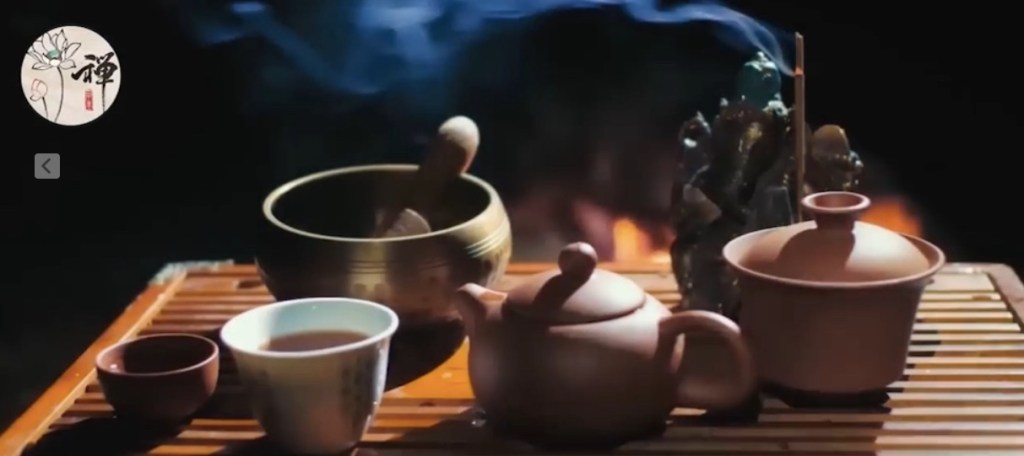
In China, there exists a saying that “famous temples produce famous tea since ancient times,” and the tea from Misty Mountain gained renown as early as the Tang and Song dynasties. Throughout history, the monks of Misty Mountain have often been involved in tea cultivation, using tea as sustenance, and blending Zen and tea culture. Within Misty Mountain’s expanse, ancient tea tree groves flourish, some so immense that it takes two people to encircle them. The tea leaves harvested from these trees emit a fragrant aroma and are considered the highest-quality Misty Mountain tea.
The fusion of Zen and tea culture embodies three virtues: “During Zen meditation, one stays awake all night, when one is full, tea aids in digestion, and tea is not consumed when not needed.” Tea serves to quench thirst, invigorate the senses, alleviate stress, purify the mind, nurture virtuous qualities, and has thus become an invaluable aid in Zen practice. The spiritual essence of Misty Mountain’s Zen and tea culture is encapsulated as “upright, pure, harmonious, and elegant,” with the purpose of “expressing gratitude, embracing inclusivity, sharing, and fostering connections.”
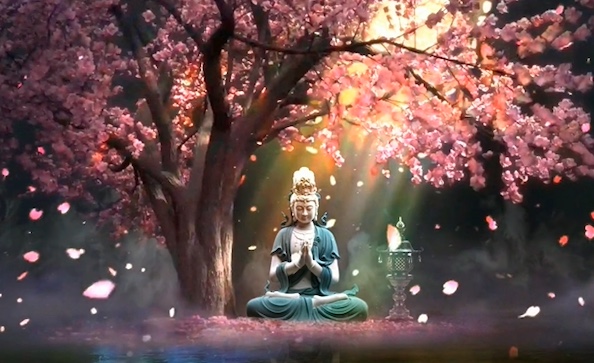
The belief in Bodhisattva Ksitigarbha is deeply rooted in Asian folk religions, offering a profound message of compassion and salvation. Ksitigarbha, also known as “Earth Treasury” or “Earth Store,” is revered for his extraordinary vows and his unwavering commitment to alleviating suffering, particularly in hellish realms. In China, alongside Manjusri, Samantabhadra, and Avalokiteshvara, Bodhisattva Ksitigarbha is honored as one of the “Four Great Bodhisattvas.”
The “Sutra of the Bodhisattva Ksitigarbha’s Fundamental Vows” is a sacred scripture, attributed to Shakyamuni Buddha himself, that highlights the remarkable vow power of Bodhisattva Ksitigarbha. In this sutra, Ksitigarbha’s magnificent vow is eloquently praised: “Until the hells are empty, I will not attain Buddhahood, and I will only achieve enlightenment after saving all beings.” The text also provides insights into Ksitigarbha’s exemplary actions and deeds along his spiritual path.
A Tale of Filial Piety and Redemption: In one of his past lives, Bodhisattva Ksitigarbha incarnated as a woman named Guangmu. She exemplified unparalleled filial devotion, but her mother’s disbelief in karma led to her descent into hell after death. Learning of her mother’s plight, Guangmu selflessly sacrificed her most cherished possessions to accumulate merits on her mother’s behalf. Before the Buddha, she made a solemn vow: to secure her mother’s permanent liberation from the three evil paths and, only then, seek her own enlightenment. Through Guangmu’s selfless acts and immense vow, her mother swiftly attained liberation and ultimately achieved Buddhahood.
People place their faith in Bodhisattva Ksitigarbha due to his profound aspiration: “To save all sentient beings and attain enlightenment; I will not achieve Buddhahood until hell is empty.” This resolute vow has made him a beacon of hope for those seeking liberation in the afterlife.
The holy birthday of Bodhisattva Ksitigarbha falls on the last day of July in the Chinese lunar calendar, which corresponds to September 14th this year. Buddhists worldwide come together to honor and memorialize Bodhisattva Ksitigarbha during special assemblies held in Buddhist temples. These gatherings serve not only to pray for the well-being of all living beings but also to beseech blessings for departed relatives and friends, hoping they will ascend to higher realms through the benevolent influence of Bodhisattva Ksitigarbha. This year, a special assembly was held at Hua Zang Si temple in San Francisco on September 10th.
Every year, my participation in the Ksitigarbha Dharma assembly evokes a mix of emotions. On one hand, I feel a deep sense of joy as I pray for the protection and blessings of the Buddhas and Bodhisattvas for all beings. On the other hand, a profound sadness envelops me as I witness my loved ones departing from this world one by one. The list of those to be transferred to a better realm, through prayers and rituals, continues to grow. This year, the passing of my uncle, the youngest brother of my father, added to the somber realization of life’s brevity and the swift nature of impermanence.
As I age, I keenly experience various illnesses, physical decline, and a slowing of my movements. These experiences have deepened my understanding of why H.H. Dorje Chang Buddha III continually reminds us to cultivate the awareness of impermanence. In “What is Cultivation?” and in many pre-recorded Dharma discourses, His Holiness emphasizes that being mindful of impermanence is the cornerstone of our spiritual development. Without this awareness, one cannot establish the sincere commitment required to practice Buddhist Dharma earnestly and break free from the cycle of life and death.
Life has presented me with numerous unpredictable natural disasters and personal sufferings. Unless I persistently dedicate myself to spiritual practice, the looming specter of death may catch me unprepared, leading to a fate that is both pitiable and terrifying.
I earnestly pray that all Buddhas and Bodhisattvas, with a special invocation to Bodhisattva Ksitigarbha, bless all living beings with the wisdom to grasp the impermanence of life. May we all diligently cultivate ourselves, seeking liberation in this lifetime and guiding the departed souls to higher realms, where they can encounter the profound teachings of Buddhism and ultimately break free from the cycle of birth and death.
Choosing forgiveness makes it easier to forget pain
A scientific study published on May 21, 2014, in the journal ‘Psychological Science’ found that people who choose to forgive are more likely to forget the details of past hurts. This is because the act of forgiveness triggers a mechanism that helps in forgetting painful memories.
Researchers from the University of St. Andrews in the United Kingdom had 30 participants read content describing various scenarios, including severe harm to others and theft. They then asked each participant to rate the extent of harm caused by each behavior and to consider how likely they would be to forgive the perpetrator if they were the victim.
Two weeks later, the same group of participants read the same content, but this time it was color-coded, with some portions in red and others in green. Researchers instructed participants to recall the content in green while avoiding thinking about the red portions.
Dr. Saima Noreen, the lead author of the paper, explained that participants who initially chose to “forgive” had difficulty recalling the details when they later tried to remember the events. In contrast, those who initially chose “not to forgive,” even when instructed not to recall the details during the experiment, still had vivid memories.
The research findings suggest that when people make the decision to “forgive,” the brain activates a forgetting mechanism that helps them forget painful memories that were once detrimental to them. While achieving true forgiveness may still be challenging at times, simply choosing forgiveness can make it easier to forget those memories.
Dr. Noreen stated, “The relationship between forgiveness and forgetting is bidirectional and becomes more complex over time. Over the long term, we have known that forgiving others has positive effects on personal health.”
The Lifelong Disasters of Unforgiveness
In recent years, researchers have conducted numerous experiments to explore the relationship between ‘forgiveness’ and health. They have discovered that forgiveness, as a psychological activity, can improve cardiovascular function, reduce chronic pain, alleviate stress, and enhance the quality of life. It is indeed a potent remedy for maintaining good health.
On the other hand, individuals who harbor unresolved conflicts and refuse to forgive often experience constant psychological tension. The inner turmoil, when left unresolved, can lead to heightened brain and nervous system activity. This can result in nervous tension, blood vessel constriction, elevated blood pressure, gastrointestinal spasms, and inhibited digestive secretions, thereby increasing the risk of heart disease, mental health issues, and other ailments.
Practical life experiences have also demonstrated that individuals who react impulsively and are unable to forgive others tend to escalate minor issues into major conflicts, intensifying contradictions, and causing long-term consequences for themselves.”
In the book Midnight Conversations in Medicine (醫山夜話)compiled from real-life cases, the chapter titled “Financial Ruin Caused by Unforgiveness” narrates the life catastrophe resulting from “unforgiveness.”
In the story, the patient’s name is Rui, who sought treatment at a Traditional Chinese Medicine clinic for Parkinson’s Disease. In Chinese medicine, Parkinson’s Disease is referred to as “tremor paralysis.” Rui had been suffering from this condition for nearly three years, experiencing tremors in both of her hands. She often struggled to eat because of her severe tremors, with her food falling to the ground before reaching her mouth. After a period of treatment with traditional Chinese medicine, her condition showed little improvement, with symptoms frequently recurring. Perplexed, the Chinese medicine practitioner inquired about her life, leading Rui to recount the events that had unfolded:
“My husband and I run a container shipping company for ships. We own a villa on an island, sharing a private road with our neighbors. On the island, it’s just our two families. Due to the poor condition of the road, we proposed that both families contribute money to repair it. However, our neighbors opposed the idea, so we had to foot the bill for repairs ourselves. Unfortunately, the workers we hired were careless and dumped the road repair stones in the middle of the road, causing inconvenience to our neighbors’ traffic. They suspected that we did this out of spite and sealed off a gate that belonged to their property but was more convenient and closer to our home. This meant that we had to take a much longer route to get home.
“My husband, in his anger, turned off the main water valve. We had installed the water system first, and to save money, they connected their water supply from ours. Turning off the valve cut off their water source. This infuriated them, and they retaliated by pouring cement and piling stones on our driveway, completely blocking our way home. And so, over a mere 2,000 yuan road repair cost, we became bitter enemies. What’s even more unbearable is that both sides hired lawyers, and this legal dispute has been going on for nearly three years, costing us a whopping 2 million yuan in legal fees. During these three years, we couldn’t go home, and they couldn’t live there either. Now our conflict has escalated to a life-and-death struggle. The house cannot be sold due to the unresolved lawsuit, it’s uninhabitable, and it needs repairs…”
As Rui continued her narrative, she became increasingly emotional, her hands trembling, her face turning red, and her emotions nearly reaching the breaking point. The Chinese medicine practitioner realized the underlying cause of her recurring illness was rooted in her inability to forgive.
Psychologists have found that when people can view conflicts from the other person’s perspective, there are significant physiological changes. Both heart rate and blood pressure decrease, there is less frowning, and skin conductance (a measure of sympathetic nervous system activity) also decreases – all of which are good indicators of the sympathetic nervous system functioning.
Religions also emphasize the practice of forgiveness. In Christianity, it is taught that forgiveness towards others is essential for God to forgive one’s own sins. Buddhism, on the other hand, encourages a comprehensive approach to forgiveness. In the core process of self-cultivation, true Buddhist practitioners are guided to embrace the Four Limitless States of Mind, which encompass virtues such as Equanimity, Loving Kindness, Compassion, and Sympathetic Joy.
A profound illustration of forgiveness is exemplified by the contemporary Buddha, H.H. Dorje Chang Buddha III,. One of His Holiness’ disciples, Hongxi Fazang, engaged in numerous defamatory actions against H.H. Dorje Chang Buddha III, through social media and within Buddhist temples. Later, he came to realize the gravity of his actions and was overwhelmed with remorse. Desiring to return to the guidance of the Buddha Master, he sought reconciliation.
Remarkably, the profoundly compassionate Buddha welcomed him back as a disciple with the same love and teachings as before. When other disciples found it hard to believe Hongxi Fazang’s return, His Holiness simply said, “If I don’t forgive him, who can?” The following video showcases Hongxi Fazang’s heartfelt repentance and deep gratitude towards H.H. Dorje Chang Buddha III, at the Holy Miracle Temple.















 Peace LiLy