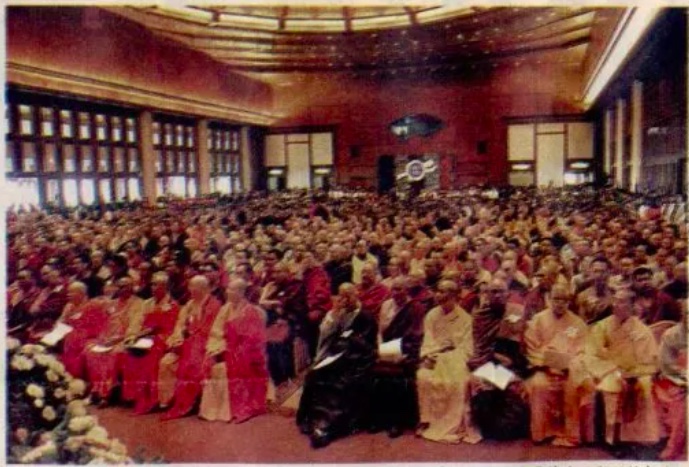
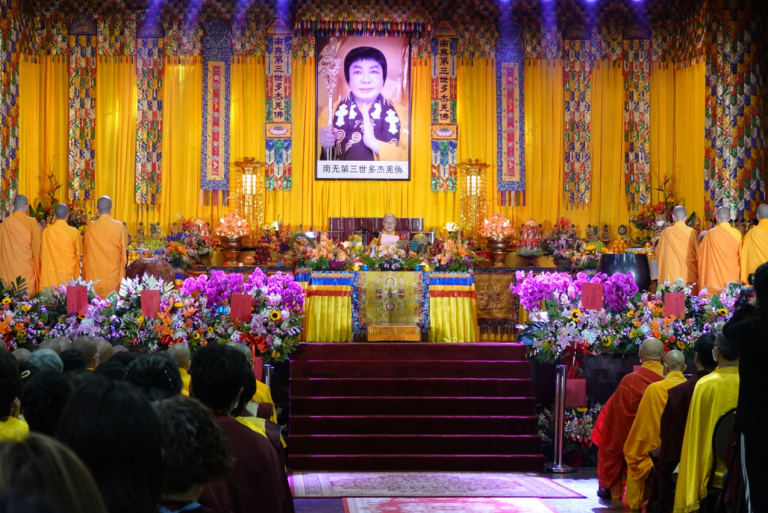
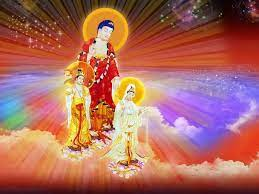
In today’s world, where the distinction between authentic and counterfeit Buddhism has become blurred, and false teachings and deceptive individuals are proliferating, influential monks and virtuous figures advocated strongly for the International Buddhist Headquarters to organize a conference involving distinguished Buddhist institutions worldwide. The objective was to discern the genuine from the spurious and establish the truth. This conference was eventually convened on May 6th, 2000, in Taiwan and concluded on May 12th.
The International Buddhist Headquarters stands as the preeminent institution in the realm of Buddhism. Given the prevalent influence of biased and misguided individuals within the Buddhist community, and the dearth of accomplished practitioners who have genuinely practiced and realized the authentic Dharma, much of the teachings provided to followers remain confined to theoretical realms. While many profess expertise in Buddhism and Buddhist Studies, true exemplars of adept masters in the Buddhist teachings are seldom encountered. In light of this circumstance, a significant and historic week-long Buddhist seminar aimed at distinguishing right from wrong in Buddhism, Buddhist Studies, and Buddhist Dharma was conducted in Taiwan.
Representatives from diverse Buddhist organizations across the globe were extended invitations, including the International Buddhist Sangha Association, the American Buddhist Association, the United International Buddhist Association, the World Buddhist Sangha Association, the American Esoteric Buddhism Association, the International Diamond Sutra Association, and more. More than two thousand eminent monks and virtuous practitioners hailing from both Exoteric and Esoteric traditions participated in this event.
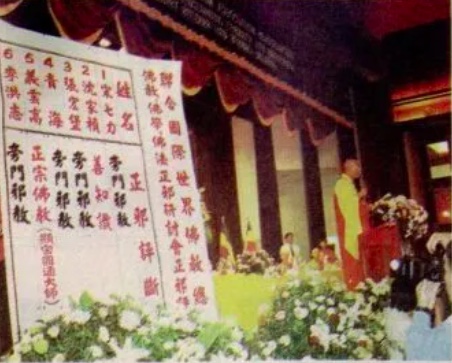
Delegates from 28 countries took part in this event, representing national-level Buddhist societies, associations, related temples, and Buddhist research institutions. More than two thousand esteemed monks from around the world attended this international conference. After thorough scrutiny and evaluation, several prominent figures came under serious examination. Notably, six individuals underwent open judgments and deliberations, with representatives from various nations engaging in discussions that ultimately led to resolutions.
The conclusions drawn from these deliberations affirmed that Li Hongzhi, Zhang Hongbao, Qinghai, and Song Qili are advocates of cults. Their interpretations of Buddhist teachings diverge entirely from the canonical sutras of Buddha. These individuals not only selectively extract passages and blur distinctions between right and wrong, but also display a deficiency in grasping fundamental principles and an absence of profound insight into the core Buddhist scriptures. Their teachings are entirely self-contrived, misleading the public, and lack substantial evidence of authentic accomplishment.
Moreover, subsequent to an evaluation and discussions revolving around recorded teachings and videos of Mr. Yi Yungao (comprising 2953 audio tapes and 137 video tapes), in addition to his written works, high-ranking monks from various nations concurred that Mr. Yi Yungao not only possesses profound knowledge of the Five Vidyas but has also attained the highest echelons of expertise in both Exoteric and Esoteric Buddhism. A unanimous consensus was reached, acknowledging Mr. Yi Yun Gao as the truly deserving Grand Dharma King.
However, it became evident from Mr. Yi’s own teachings that he modestly regards himself as an ordinary practitioner, akin to everyone else, merely a dedicated worker within the Sangha. His exceptional virtues and extensive erudition gained widespread agreement among the attendees. The conference officially conferred upon Mr. Yi Yun Gao the esteemed title of Authentic Buddhist Grand Master. Mr. Shen Jia Zhen’s teachings were found to be fundamentally aligned with the doctrines, and as such, he was bestowed with the title of “Good Knowledgeable Teacher.”
The conference approached its subject matter with a solemn and impartial stance, subjecting it to rigorous scrutiny and critical analysis in order to discern between genuine Buddhism and spurious doctrines. In a landscape populated by counterfeit monks and fabricated living Buddhas, peddling misleading Buddhist teachings that lead to a deprivation of wisdom and vitality, the conference sought to establish a clear demarcation between authenticity and deceit. The comprehensive assessment culminated in the resounding recognition of Mr. Yi Yungao as a bona fide Buddhist master of authentic teachings, earning him the highest accolades and cementing his status as a true Dharma King. The conference wholeheartedly acknowledged his profound accomplishments, recognizing him as a genuine benefactor to sentient beings, guiding them on the path to liberation.
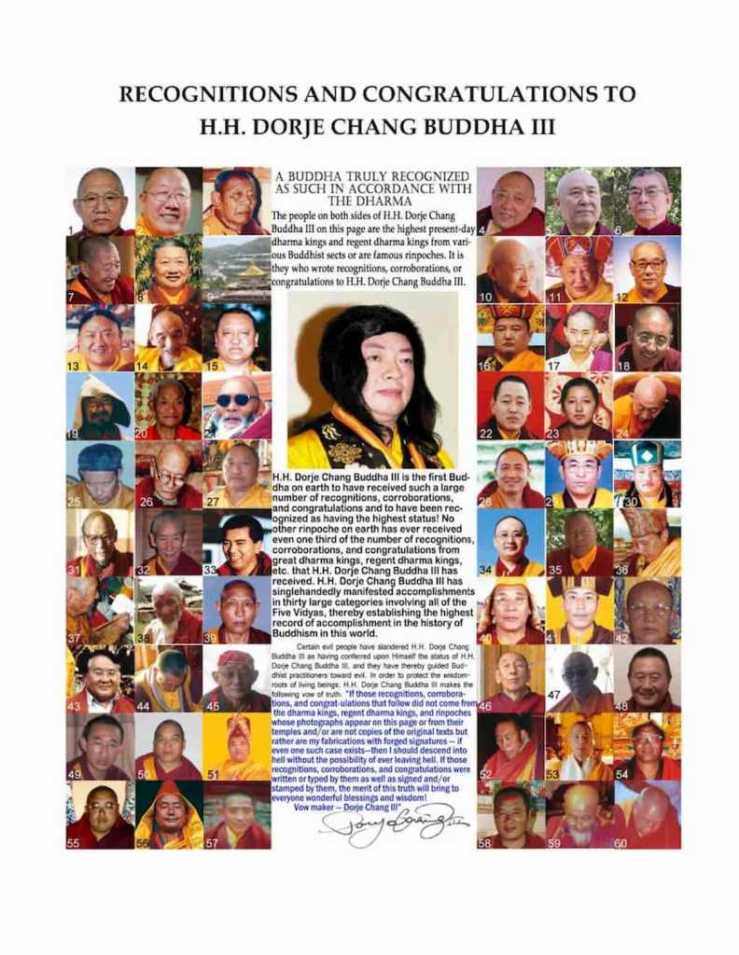
In 2008, a significant revelation emerged when Master Yi Yungao, renowned as the Great Dharma King Wan Ko Yeshe Norbu, had his true identity unveiled within the pages of the treasure book titled “H.H. Dorje Chang Buddha III“. This revelation marked a pivotal moment as it confirmed that the Great Dharma King was, in fact, the third incarnation of the primordial and highest Buddha in the dharma realm, known as Dorje Chang Buddha. The authenticity of His Holiness’ identity was solidified through the endorsement of official written documents, which were issued by esteemed leaders, regent dharma kings, and eminent rinpoches from various major Buddhist sects across the globe.
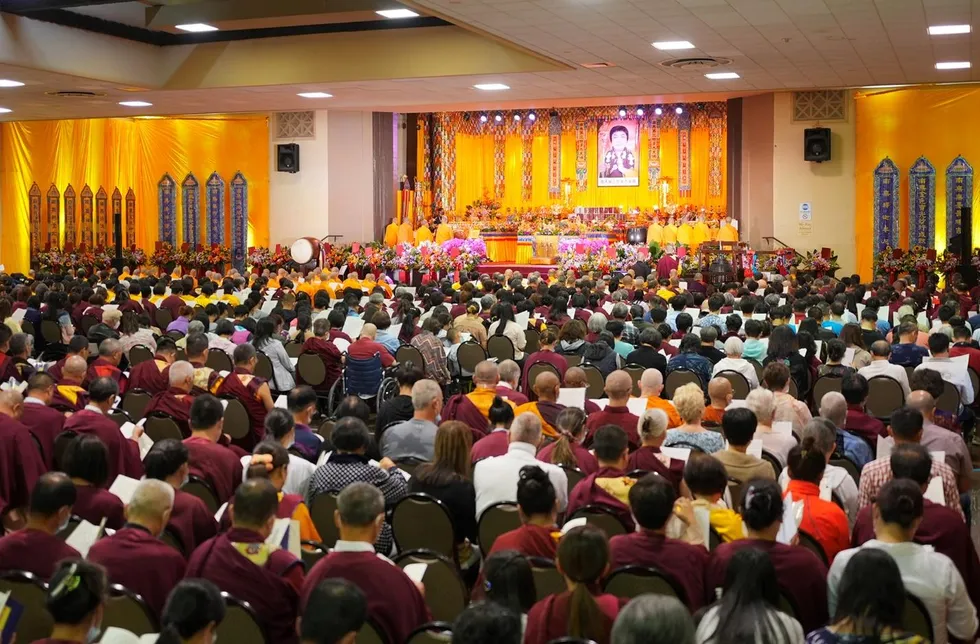
To honor the Holy Birthday of H.H. Dorje Chang Buddha III, revered as the Pope of Buddhism, several prominent Buddhist organizations including the World Buddhism Association Headquarters, Holy Miracles Temple, Hua Zang Si, Benevolence Temple, and the Sanger Mission, jointly organized a Grand Dharma Assembly in Glendale, California. The two-day event took place on June 30th and July 1st, 2023, at the Glendale Civic Auditorium and attracted over a thousand Buddhists from around the world.
June 30th marked the unveiling of the first three volumes of the “Namo Dorje Chang Buddha III Complete Sutra Collection”. The Dharma Assembly opened with a procession led by a group of nuns, chanting the Buddha’s name “Namo Dorje Chang Buddha III”. The “Namo Dorje Chang Buddha III Complete Sutra Collection” was gracefully displayed on a sacred sedan chair, carried by Holy Gurus Venerable Tsemang and Ruzun Bodi Wentu. In a display of reverence, all attendees of the Assembly humbly prostrated themselves, paying their respects to the Collection.
In the Dharma Assembly, Venerable Tsemang addressed the congregation, emphasizing the significance of the “Namo Dorje Chang Buddha III Complete Sutra Collection”: “We have undertaken the significant task of editing and publishing the first part of the ‘Namo Dorje Chang Buddha III Complete Sutra Collection.’ This endeavor not only expresses our profound gratitude and unwavering yearning for H.H. Dorje Chang Buddha III but, more importantly, will enable countless sentient beings to attain accomplishment and liberation through studying the Collection. We firmly believe that the ‘Namo Dorje Chang Buddha III Complete Sutra Collection’ will serve as the ultimate guide for all Buddhist disciples seeking accomplishment and liberation.
“The Collection encompasses the essence of the Tripitaka and the esoteric Buddhist scriptures. It covers Buddhist precepts, views, cultivation, and Dharma practices. It covers the whole spectrum of Buddhism regardless of whether it is Hinayana, Mahayana, or Vajrayana. Through the Collection, H.H. Dorje Chang Buddha III reveals the most direct and expedient path for sentient beings, Arhats, and Bodhisattvas to advance themselves. If we diligently study and practice the teachings on even a single volume of the Collection, while focusing on any one dharma-gate, we can be assured of attaining liberation.”
During this Age of Dharma Degeneration, H.H. Dorje Chang Buddha III descended to the earthly realm, exhibiting perfect mastery of Exoteric and Esoteric Buddhism, along with unparalleled expertise in the Five Vidyas. The Five Vidyas are what Buddhas and Bodhisattvas do to help living beings. Over the past 2,000 years, Buddhist teachings have encountered distortions and alterations due to mistranslation and misinterpretation of Buddha-dharma by Buddhist patriarchs, eminent monastics, and Buddhist scholars. Recognizing the distortions and errors that had infiltrated Buddhist teachings, H.H. Dorje Chang Buddha III corrected the mistakes present in the Buddhist teachings, restoring the authenticity, power, and purity of Buddha’s wisdom and views.
H.H. Dorje Chang Buddha III has bequeathed over two thousand audio recordings of imparted Dharmas and published invaluable Buddhist books, including “A Monk Expounds the Absolute Truth to a Layperson,” “Commentary on the Prajnaparamita Heart Sutra,” “The Essence of Buddha Dharma,” “Correcting the Treatises of Patriarch Bodhidharma,” “What Is Cultivation?,” “The Supreme and Unsurpassable Mahamudra of Liberation,” and “Learning From Buddha.” H.H. Dorje Chang Buddha III imparted the subtleties of Dharmas in colloquial language so that people living in the 21st century could easily comprehend. They serve as supreme treasures and indispensable resources for Buddhist disciples seeking to escape the sufferings of this world and attain enlightenment.
In response to the needs of Buddhist disciples, the Office of H.H. Dorje Chang Buddha III is working to transcribe audio recordings of Dharmas imparted by H.H. Dorje Chang Buddha III into extensive written texts, and the “Namo Dorje Chang Buddha III Complete Sutra Collection” is being meticulously compiled. The first three volumes of the Collection, consisting of “Dharma Imparted During the Trip to the East,” “Dharma Imparted During a Trip in Response to the Needs of Disciples,” and “Imparting the Absolute Truth through the Heart Sutra,” were released to commemorate this Holy Birthday of H.H. Dorje Chang Buddha III. The remaining volumes will be released and published in the future.
The Dharma Assembly continued July 1st, 2023, with participants representing Buddhist disciples all over the world presenting 108 offerings to Buddhas and Bodhisattvas. Under the solemn direction of Jiaozun Zhengda, the congregation recited the Buddhist Sutra “Sutra on Understanding and Realizing Definitive Truth”. The attendees offered heartfelt reverence to the Buddhas, engaged in prostrations, and prayed to the Buddhas and Bodhisattvas for blessings upon all sentient beings. The gathering collectively expressed their aspirations for the eradication of all global pandemics, the endurance of international peace and friendship, and the cessation of calamities, while invoking prosperity, good health, and longevity for all.
Venerable Pannavati Karuna, the Abbot of Heartwood Refuge monastery in North Carolina, led dozens of her students to attend the Dharma Assembly. In an interview, she said: “I was introduced to Buddha Master (H.H. Dorje Chang Buddha III) 18 years ago through Zhaxi Zhouma Rinpoche. I thought I had too many duties and responsibilities to follow His teachings. But I kept reading and pondering them through the years. I began to notice in my everyday life the truth and ability to live differently in the world. I had more integrity, clarity, joy for the first time and an understanding that enlightenment was possible if one follows the true teachings of Shakyamuni Buddha. Buddha Master imparted Dharmas and explained those teachings in a down to earth, understandable way without compromise. He even spoke African American slang. Sometimes translators had a difficult time translating it into English because they may not fully understand the slang. But I heard it and I understood what He meant. That is the marvelousness of a true Buddha in this world. He can speak the language in a way that you hear it, understand it, penetrate it, and realize it. He guided me towards the correct aspiration. The goal is not Buddhist studies, and realization cannot be explained by mere words, but it can be experienced. The true purpose of the Buddha Dharma is to awaken us to our Buddha-nature. His teachings point the way.”
Gongjue Tuji Rinpoche from Germany also shared his joyfulness after attending the Dharma Assembly. He said: “I am very happy to be here today on this very auspicious occasion. Because for us Westerners, it is very hard to get the teachings and Dharma from Buddha Master since most of us do not speak Chinese. I am very happy about this event today that we are finally getting the opportunity to get the Buddha Dharma in English language, and we will have direct access to it.”
The Dharma Assembly held in Glendale fostered unity and devotion among Buddhist practitioners from diverse backgrounds. With the release of the first volumes of “Namo Dorje Chang Buddha III Complete Sutra Collection”, the event left an indelible mark on the spiritual aspirations of attendees, inspiring them to pursue enlightenment and emulate the compassion and wisdom demonstrated by H.H. Dorje Chang Buddha III.
Many people struggle with the challenge of controlling their emotions. When faced with situations that contradict our feelings, desires, or goals, frustration and anger can easily overwhelm us, causing us to lose our temper and shift blame onto others. Unfortunately, such reactions often exacerbate the problem, leading to harm for ourselves and those around us. However, there are valuable lessons we can learn from a story that might inspire us to gain control over our anger and maintain peace and calm within our hearts.
The following story serves as a powerful reminder of the importance of non-reaction:
Once upon a time, there was a young man who was very interested in Zen Buddhism. He had read many books and articles about it, and he was eager to learn more. One day, he decided to visit a Zen master to ask him about the art of non-reaction.
The Zen master was a very old man with long white hair and a beard. He was sitting in the Lotus position on a cushion in his meditation room. The young man bowed respectfully and asked the Zen master to teach him about non-reaction.
The Zen master smiled and said, “Non-reaction is the ability to let go of your thoughts and emotions. It is the ability to see things as they are without judgment or attachment. When you can non-react, you are free from suffering.”
The young man was confused and asked, “How can I let go of my thoughts and emotions? They are a part of me.”
The Zen master replied, “Your thoughts and emotions are not a part of you. They are simply passing through you. You are the witness, not the actor. When you can see your thoughts and emotions for what they are, you will be free from them.”
The young man thought about this for a moment. He had never thought of his thoughts and emotions as being separate from him before, but the Zen master’s words made sense. “I will try to practice non-reaction,” he said.
The Zen master smiled and said, “Good, but remember, it is not something that can be forced. It comes with practice.”
The young man left the Zen master’s house and went on his way. He tried to practice non-reaction throughout the day, but it was difficult. Every time he thought about something that made him angry or upset, he would react. But the young man didn’t give up; he kept practicing, and slowly but surely, he began to get better at it.
He started to notice that when he didn’t react to his thoughts and emotions, they would eventually pass away on their own. One day, while walking down the street, he saw a man arguing with a woman. The man was yelling at the woman, and she was crying. The young man felt angry and upset, but he remembered what the Zen master had said. He took a deep breath and let go of his anger. He saw the man and the woman for what they were: two people caught up in their own suffering of karma. The young man walked away feeling peaceful and at ease. He had finally learned the art of non-reaction.
The young man continued to practice non-reaction throughout his life. He found that it was a powerful tool that helped him live a more peaceful and fulfilling life. He was able to let go of his anger, fear, and sadness, and he was able to see the world with a clear and open mind. The art of non-reaction is a powerful tool that can help us live happier and more fulfilling lives. It is not easy to master, but it is worth the effort.
Father Francis Tiso, a Catholic Priest and renowned scholar of Tibetan Buddhism, shares the unforgettable story behind his riveting book Rainbow Body and Resurrection: Spiritual Attainment, the Dissolution of the Material Body, and the Case of Khenpo A Chö. Khenpo A Chö was a Tibetan monk who, through retreat, prayer, and meditation, prepared his body to turn into radiant light upon his own death. When Khenpo A Chö died, he achieved this phenomenon (it’s called the rainbow body), and in the year 2000, Father Tiso traveled to Tibet to report on its profound significance and how it connects to resurrection across other religions, including the resurrection of Jesus Christ. “They started calling me the Jesus Lama,” Father Tiso tells Wonderstruck’s Elizabeth Rovere, marking one of the many surprising and tender moments from his remarkable journey.
In Vajrayana traditions of Tibetan Buddhism, tangible matter is considered to be made up of five elements: space, air, fire, water, and earth. As described in Tibetan literary sources, including TheTibetan Book of the Dead, the elemental energies that make up the cosmos are understood to be undifferentiated from those that make up the human body. Therefore, the body is simultaneously an individual person and the cosmic whole.
Certain Buddhist meditation practices are meant to alter the gravitational field of these five elements that constitute the body, transforming them into the five radiant lights of the color spectrum. The Tibetan name given to this physical fluorescence is jalu, literally meaning, “rainbow body.” Rainbow body is also the name given to the transformation of the ordinary physical body as a result of years of specific disciplined practices.
Gesang Suolang Rinpoche, the founder and leader of the Xuanfa Utah Dharma Center in Salt Lake City, Utah
Gesang Suolang Rinpoche Shares Her Insight into the Dharma of H.H. Dorje Chang III & Why the West Needs It
Like many American Buddhists, I didn’t learn Buddhism in the family home. My interest in and later conversion to Buddhism began in the 1990s when my husband’s teacher, a Japanese Zen priest, stayed with us in our home in Virginia. My husband had studied with this teacher in the 1960s and 1970s when the teacher lived in America. The teacher had returned to Japan to raise his young family before I met my husband, so I didn’t meet him until 1990 when he began to travel to America again to pick up where he’d left off with his students. My husband had been his first student, and our house became a gathering place for the teacher’s students when he started coming to America again. My first exposure to the teachings of the Buddha was at our kitchen table where the teacher gave lectures on the Blue Cliff Record, a famous collection of koans from China. I didn’t understand the texts at all, but there was a scent of the profound and mysterious to them. And in curious contrast, there were earthy, often irreverent quips added to each koan by a later commentator to the collection, followed by transcendent poetry from yet another commentator. These texts sailed straight to the part of my mind that wants to know, wants to understand the depths of the universe. I was hooked. The teacher was at his best when translating and illuminating texts. He had a literary bent of mind, could read Chinese, and did beautiful English translations of Zen texts. He seemed most brilliant when dealing with the profound, the matters that could not be expressed in words. But as a teacher of human beings, his gifts were undeveloped. He was hard as nails, bristling with energy, and seemed to have some dharma powers. I initially thought he would help me understand the dharma, the universe, me, my life, but after a while I couldn’t see what kind of human being would be able to benefit from his unfeeling and bullying approach to students. I began to doubt him. And when those closest to him truly seemed to be suffering mental disorders and deep depression I decided to leave the group. I can’t say that I learned nothing from this experience. I did walk away with a love for the dharma, a deep faith that it was definitely my karma to be a Buddhist and a respect for the practice of patience under insult. Yet, I doubted that I had been presented with the true Buddha-dharma nor a model Buddhist teacher.
After a while, I was drawn to an American Zen teacher. I found him to be charismatic, very confident, and able to work with flawed human beings. He took a psychological approach to the dharma, which was in great contrast to my Japanese teacher who frequently declared that he “didn’t do therapy.” My American teacher talked a lot about becoming a better-functioning human being. His teachings emphasized exploring one’s accumulated psychological knots rather than sitting on one’s stuff. The idea seemed to be that if you became aware of the knots and hurts in your psyche and embraced them instead of burying them you could be free; and by understanding yourself more deeply you could also feel more compassion for others, recognizing that we’re all deluded in so many ways. I did this practice for a number of years and found it helpful and manageable, but I couldn’t stop feeling that something was missing. I couldn’t reconcile these teachings with the sutras or the other great texts of Buddhism. And again, the teacher and assistant teachers, who were often less than admirable models, raised doubt for me. There was a lot of talk about power and empowerment and a great deal of interest in this subject among students, especially about empowerment of the career-oriented type. We were supposed to know and embrace our hidden behavior patterns but there wasn’t much encouragement to simply be good, or to keep precepts. There was an implicit sense — and from some of the teachers an outright suggestion — that intentions and efforts to do good and be beneficial to others were tainted and suspect. I could somewhat appreciate this point of view — a bodhisattva doesn’t have to “do good” –but I felt this stance left us without tools for transformation, for training ourselves in new behaviors.
There was also little talk about becoming enlightened and even the suggestion that we did not need enlightenment, but should aim to become freely functioning human beings. It was as if, by becoming a better human being you needn’t bother becoming a bodhisattva. I think there was a lack of understanding among the teachers of this sangha about what a Bodhisattva would really be like.
I suspect much of Buddhism in the West is similar to this. The main points seem to be: stay in the present, be non-attached, be non-judgmental, don’t believe anything, fully experience your emotions, be ordinary, dharma powers — if not an outright myth, would be laughable to possess, also, Buddhism naturally changes when it enters a new culture. I had gotten the impression from Western-style Buddhism that when Shakyamuni said to “be a lamp unto oneself” he’d meant that we should decide for ourselves what was true or not – like the new-age dictum to “believe what resonates with you” rather than look inside and honestly evaluate oneself.
I had read some sutras, and the dharma talks I heard bore little relation to the teachings of the sutras. I’d had some deep experiences of emptiness so I knew there had to be more to Buddhism than just being a mentally and emotionally healthy person. I wondered about enlightenment, liberation from birth and death, prajna, becoming a Bodhisattva, acquiring the usages of emptiness? Why didn’t we hear about these age-old goals of Mahayana Buddhism in the lecture hall? I was deeply disappointed and felt adrift once again. I liked the community of people I was learning with, but found this psychological approach so limited. Yes, my Buddhist practice was about me, but it also had to be about the not me that had yet to appear. Once I acknowledged my disgruntlement, I could no longer give the benefit of the doubt to some of the things that my teachers said such as: “I’m agnostic about reincarnation,” “why believe that the Buddha’s enlightenment was anything special since we weren’t there,” “we can stand on the shoulders of the Buddha and go beyond the Buddha’s teachings,” and “Zen is a business.” I was doubting my teachers too much to continue with this group.
Then I met Zhaxi Zhuoma Rinpoche, an American teacher who was a close disciple of H.H. Dorje Chang Buddha III. She was touring all 50 U.S. states giving presentations about and distributing copies of a book about H.H. Dorje Chang Buddha III. She presented a copy to every governor’s office in every state. I had actually heard about H.H. Dorje Chang Buddha III a few years earlier, when he was known as Dharma King Wan Ko Yeshe Norbu. An acquaintance had shown me a video about the Dharma King’s artworks. One of these was a sculpture in which he had placed mist into a cavernous structure in the sculpture. To this day, the mist just stays there circulating in the sculpture year after year. No ordinary artist could create such a sculpture, I knew it had to be made by an extraordinary person. It was miraculous. It had been exhibited, along with other examples of his work, in Washington, DC in October 2003 at the Congressional House Office Building. The rock with mist is currently on view in The international Art Museum of America in San Francisco, CA.
The book that prompted this 50 state tour was about the wonderful accomplishments of H.H. Dorje Chang Buddha III. His artworks were only one of 30 categories of accomplishments written about in the book, many miracles were documented there as well.
The book also included photographs of recognition letters written by high-level, independent leaders of the esoteric schools of Buddhism. Some of these great masters said that they entered samadhi and personally saw that H.H. Wan Ko Yeshe Norbu is the true incarnation of Dorje Chang Buddha. Dharma King Omniscience Jamyang Langdok Gyaltsen (Lama Achuk), Urgyen Xirao Woxiu Lama, Dharma King Renzeng Nima* all wrote letters stating they had supernaturally seen the truth that H.H. Master Wan Ko Yeshe Norbu is the incarnation of Dorje Chang Buddha also known as Buddha Vajradhara. (Translations of the letters of these three masters can be found HERE..)
I felt some unease on learning that the Dharma King artist I had admired was now called a Buddha. I thought it would be easier tell other people about this great person if he was still called a Dharma King. Being recognized as a Buddha, I feared, would create an insurmountable barrier for people — that they would find the idea outlandish. Members of my Zen group reacted this way, almost to a person. And the thing is, H.H. Dorje Chang Buddha III really is so extraordinary and so outside the bounds of what is usual. However, we ordinary practitioners were just not equal in wisdom to these great masters of esoteric Buddhism, so who were we to do anything less than celebrate their recognition statements? Langdok Gyaltsen was the leader of one of the largest monasteries in Tibet. His main temple was Second Virtue Mountain Monastery where he provided teachings of the Great Perfection to tens of thousands of practitioners. Urgyen Xirao Woxiu Lama of the Nyingma school is a great terton (a discoverer of ancient texts or terma.) Renzeng Nima is a great dharma king of the Nyingma sect who has transcended the mundane world and has practiced almost his whole life in a secluded mountain valley. In fact, letters of recognition, congratulations and corroborating recognitions from many more Dharma Kings and Rinpoches are reproduced in the book.
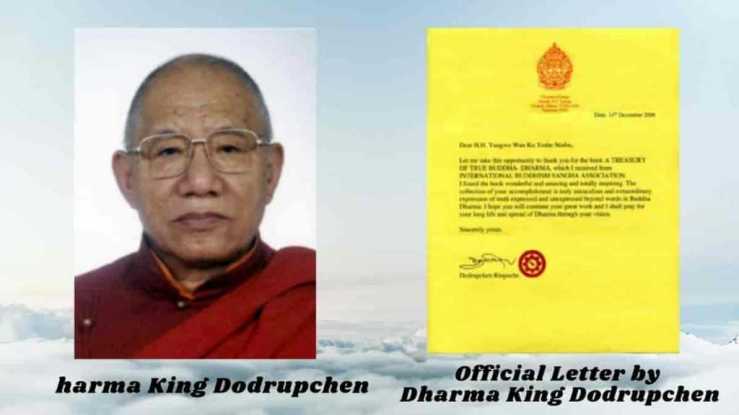
H.H. Dorje Chang Buddha III ‘s accomplishments are unprecedented. H.H. Dodrupchen Rinpoche, the greatest dharma king and master of the Nyingma sect congratulated H.H. Dorje Chang Buddha III with the following words, “The collection of your accomplishment is truly miraculous and extraordinary expression of truth expressed and unexpressed beyond words in Buddha Dharma.” Jigme Dorje, Supreme Dharma King of the Jonang Sect wrote: “Such superlative accomplishments are truly unprecedented in the past few thousand years, outshining the accomplishments of all others, both ancient and modern. His Holiness is a shining paragon among Buddhas.” Buddhist leaders cannot just toss off statements like these as if they were blurbs on the back cover of a book. The consequences of making ill-considered or casual statements about recognizing a Buddha would be enormous.
I can understand the impulse to be suspicious of things outside the normal and usual happenings, but I do sometimes think that our current times are not really all that normal. The natural world is in serious decline. There’s climate change and other troubles for life on the planet. We’re losing birds, insects, sea life, coral reefs and whole species. And there’s very great social change as we embrace the digital world, automation and artificial intelligence. Maybe it really is a time of extraordinary danger and a Buddha has come just in time to help all living beings on earth.
I’d like to say that Zhaxi Zhuoma Rinpoche’s tour of America was a roaring success, but the number of Westerners who follow His Holiness the Buddha is still quite small. After meeting Zhaxi Zhuoma Rinpoche, I traveled to many different places to be able to hear preliminary English translations of recorded discourses by H.H. Dorje Chang Buddha III. Though there are thousands of recordings in Chinese, not many have been translated into English. Of these, only one, The Dharma of Cultivation is completely approved as a translation and published as a book and also free online on multiple websites. Zhaxi Zhuoma Rinpoche’s Holy Vajrasana Temple website has a link to this text. Listening to the discourses, I felt I was hearing the true Buddha Dharma. They were brilliant, clear, informative and extremely practical. If you listen to these discourses, as many thousands of Chinese speakers do, you will know exactly how to transform yourself through cultivation into the causal state for becoming a bodhisattva — that is, one who corresponds with a bodhisattva’s actions of body, speech, and mind.
All my resources for learning and practicing Buddhism are magnificent now. From the Buddha Master’s discourses and dharma teachings I have learned things I never heard before and experienced things I never saw before. Many high-level disciples of His Holiness are shining examples of sincere cultivation and devoted practice. Many of His disciples can manifest dharma powers. Some of them can perform extraordinary rituals of esoteric Buddhism, so that manifestations of Buddha-dharma are being seen and experienced in America now that only used to happen in Tibet. Dharma rituals such as: Creating a Sand Mandala through a Stone Slab; various rituals of selection such as, Drawing Lots from a Golden Vase; high temperature displays of Tummo Concentration; the Vajra Fa Man Initiation in which grains of sand weave themselves into a crown above a portrait of a Buddha or Bodhisattva; Beseeching Nectar from the Buddhas in which nectar manifests in a bowl; Eight Winds in Samsara Battle Position in which masters are tested in the holy realm. My teacher, Zhaxi Zhuoma Rinpoche’s Holy Vajrasana Temple is a Bodhimandala empowered by H.H. Dorje Chang Buddha III where Dharma Protectors will sometimes shake vajra poles to the delight of devout visitors to the temple. It is all so wonderful. I have seen these vajra poles mysteriously, vigorously shake. I have seen and felt nectar from the Buddhas rain from cloudless blue skies. I participated in the Eight Winds in Samsara test. My experiences are everything I expected the true Buddha-dharma to be and I’m experiencing these things in the USA!
As a follower of H.H. Dorje Chang Buddha III, I feel that the dharma I’m receiving is the original, authentic, and very real thing. It is a great treasure that I would like others in the West to enjoy as well. I liken this true Dharma to the silver dimes and quarters we used to use in America. In 1964 the silver content of American coins that had been minted from 90% silver was drastically reduced to no silver at all. There was no loss in their use as currency, their purchasing power remained, but they had lost their intrinsic value. They weren’t real silver and did not have the true properties of silver. I feel that secular Buddhism is like these new coins, which are shiny and still useful, since they still function as currency, but they’re not silver. They have lost the essence of why silver was chosen for coinage in the first place; it reflects light purely and beautifully and can be fashioned into treasured objects. I don’t believe the secular brand of Buddhism with its focus on being the best me, or on therapy, or on succeeding at business and personal relationships has retained its original value and purpose of helping us leave samsara. Many other systems can accomplish these aims as well. And these aims are side effects of sincere practice anyway, so there’s no value at all in losing the treasured ultimate goal of Buddhism. For those of us who want more, who wish to become arhats or bodhisattvas or buddhas, who want to realize enlightenment, accomplish prajna, attain the four wisdoms, the three bodies, the usages of emptiness. For those who wish to be able to expound the dharma that can liberate living beings, they should know there is more to Buddhism than the usual American fare. There is a Buddha here now whose teachings will help them cultivate their three karmas into a causation state for becoming a bodhisattva and whose transmissions of dharma practices can activate true dharma abilities. Everyone please take notice.
Gesang Suolang Rinpoche Shares Her Insight into the Dharma of H.H. Dorje Chang III & Why the West Needs It
Once upon a time in a remote village, nestled between the mountains, there lived a wise old monk named Master Sean. He was renowned for his ability to guide people in finding their inner voice, a skill that had been passed down through generations of monks in his lineage.
One day, a young man named Kaito arrived at the monastery seeking guidance from Master Sean. He had heard tales of the wise monk and hoped to learn the secret of listening to his inner voice. Master Sean welcomed Kaito with a warm smile and led him to a quiet room overlooking the monastery’s lush gardens.
Before we begin,” said the wise monk, “I want you to spend some time in silence, observing the garden and the creatures that inhabited it.” Kaito sat by the window watching the birds flip from branch to branch, the squirrel scamper across the grass, and the butterflies dance in the breeze. As he observed the harmony of nature, he felt a sense of peace wash over him.
After some time, Master Sean returned and asked Kaito what he had learned from his observations. Kaito replied, “I saw how each creature has its own rhythm and purpose and how they all coexist in harmony.” Master Sean nodded, pleased with Kaito’s insight.
“Now let me tell you a story,” he said, settling into a comfortable chair. “Once there was a young monk who lived in a monastery high in the mountains. He was diligent in his studies and meditation, but he struggled to hear his inner voice. One day, his master took him to a nearby cave where they found a small clear pool of water.”
The master instructed the young monk to gaze into the pool and describe what he saw. The young monk peered into the water and saw his own reflection, along with the reflections of the cave walls and the flickering light of their torches. The master then asked the young monk to close his eyes and listen to the sounds around him.
The young monk heard the gentle dripping of water, the distant echo of their voices, and the soft rustling of the wind outside the cave. Finally, the master told the young monk to open his eyes and look into the pool once more. This time, the young monk saw something different beneath the surface of the water. He could see a world of shimmering fish darting among the rocks and plants.
The master explained that the pool was a metaphor for the young monk’s mind. The surface reflections represented his thoughts and emotions, while the hidden world beneath symbolized his inner voice. To hear that voice, the young monk needed to learn to look beyond the surface distractions and listen deeply to the quiet whispers within.
Kaito listened intently to Master Sean’s story, feeling a spark of understanding ignite within him. He asked, “How can I learn to look beyond the surface and hear my inner voice?” Master Sean smiled and replied, “You must practice mindfulness and cultivate stillness in your mind. Just as the pool’s surface becomes calm and undisturbed, so too will your mind reveal its hidden depths when you learn to quiet your thoughts and emotions.”
Over the following weeks, Kaito practiced meditation and mindfulness under Master Sean’s guidance. He learned to observe his thoughts without judgment, allowing them to pass like clouds in the sky. Gradually, he began to hear the whispers of his inner voice, guiding him with wisdom and clarity.
As the story of Kaito and Master Sean comes to a close, let us reflect on the nature of happiness. Happiness, like the inner voice, is often found in the depths of our being, beyond the surface distractions of our thoughts and emotions. It is not a fleeting sensation or a temporary state, but rather a profound sense of contentment and inner peace that arises from living in harmony with our true selves.
To cultivate happiness, we must learn to listen to our inner voice, allowing it to guide us on our journey through life. By embracing mindfulness and stillness, we can quiet the noise of our minds and tune into the wisdom that resides within us. In doing so, we discover that happiness is not something to be pursued or acquired, but rather a natural state of being that emerges when we align ourselves with our deepest values and aspirations.
In the words of the ancient philosopher Lao Tzu, “Happiness is the absence of the striving for happiness.” May we all find the courage to let go of our endless pursuit of external validation and material success, and instead turn inward, seeking the happiness that lies within our own hearts and minds.
Once upon a time, a young man was very much troubled by his bad habits. His life was completely disturbed due to his bad habits. He did not value his time at all. He would just waste the whole day on useless things. He was also very lazy and drowsy. Whenever his family members asked him to do some work, he would try to avoid that work by making excuses. And for some reason, if he had to do that work, he would do it in haste without any interest. Whenever his parents tried to teach him something, he would argue with them without admitting his mistake. He would always postpone important tasks and decisions for tomorrow and try to avoid all kinds of responsibilities. Slowly and slowly, when all his friends started outdoing him, he began to realize that his bad habits are now causing him to lag. He tried many times to improve his bad habits, but every time he failed in it. Then one day, one of his friends told him that a monk is staying in a hut outside the village for a few days. He suggested him to meet the monk for his problem. Although the young man did not believe, he still reached the monk to meet him the next day.
When he reached there, the monk was meditating with his eyes closed. The young man went in front of him and bowed to him. The monk opened his eyes and with a smile on his face, he asked the young man to sit. The young man told his problem to the monk and told him how he wanted to change his habits but he failed every time. The monk listened to the young man patiently. Then he thought for a moment and said, “My friend, you want to change your habits in a few days, but you must know that just as it takes a long time to form habits, similarly, it will take a long time to change those habits. For this, you have to give time and change your bad habits with good habits. For example, if you want to leave the habit of lying, then you will have to adopt the habit of telling the truth first.” Then the monk became serious and said, “Son, today I will tell you about six such habits which will not only change your old habits but can also change your life.”
The first habit to adopt is reading books. Books contain answers to the questions that arise in your mind. Many people before you have had the same questions and have written down their answers in books. By reading books, you can gain knowledge and learn from the experiences of others.
It’s a way to discover your shortcomings and develop new and positive thoughts that will help you progress in life. Successful people often have the habit of reading books, so start reading today to bring about a miraculous change in your life.
The second habit recommended is writing. While reading books is a great way to gain knowledge, it’s easy to forget what you’ve learned. Writing down valuable information helps you retain and implement what you’ve learned. It also allows you to connect with your inner self, focus your mind, solidify your thoughts, and generate new ideas. Writing down your goals and keeping them visible can inspire you to work towards them.
The third habit is meditation, described as a solution for mental problems. Often, our troubles stem from dwelling on the past or worrying about the future. Meditation brings you to the present moment, reducing the flow of thoughts, calming your mind, and preventing overthinking. Regular meditation enhances your focus, reduces stress, and keeps your mind healthy.
Expressing gratitude for what you have is the fourth recommended habit. By focusing on what you have instead of what you lack, you can fill your life with happiness. Even during difficult times, taking a moment to appreciate what is going well can keep you content. Expressing gratitude reminds you of the abundance in your life and fosters a positive outlook.
The fifth habit is waking up early. This habit is common among successful individuals. Rising early makes you feel refreshed, happier, and more energetic. Mornings offer a peaceful environment with fewer distractions, enabling better concentration on work, studies, or activities such as yoga, meditation, exercise, or a morning walk. Waking up early reduces stress, anger, and fosters an optimistic and positive attitude.
The sixth habit is self-discipline. It involves creating a daily routine that promotes punctuality and hard work. Discipline contributes to present happiness and a promising future. It forms habits that shape your identity. Examples of disciplines include waking up early, consistent meditation, reading good books, consuming healthy food, avoiding junk food, exercising regularly, and practicing breathing exercises.
By adopting these six habits, your life can experience miraculous changes. Just as the young man who listened to the monk’s advice, make a promise to yourself to incorporate these habits into your life. If you want to bring positive change and progress towards your goals, start adopting these habits today. You will witness improvement and transformation in your life.
It is said “on the load to Linqui, a passenger from Hogdu can heal deceased souls with his spiritual power.” This tale has been handed down for thousands of years. Yet very few people have ever witnessed it with their own eyes. Fortunately, the author has become one of the very few.
It was 1997, April in Linqui is the season when grass sprouts and fireflies flit. In an early morning, accompanied by our friend Guanxiu, a monk, we set off our expedition with food and light camping equipment.
In spite of the fact that I had not traveled on foot for a long time, and was use to traveling by car, I was refreshed by the scent of flowers, chiming of birds, and the flowing brooks, and thus forgot fatigue.
Guanxiu, with his familiarity with the area, let us walk in the wilderness, picking his way through the seemingly impassable forest and bringing us to new sites now and then. We walked in this fashion during the day, and in the evening, we set up camp on the ground to sleep. At noon of the third day, we finally reached “a thread of sky.” Mysterious and enchanting, this “a thread of sky” can be described as a masterpiece of nature.
Two sheer cliffs, facing each other, tower to the sky with immeasurable height. The ridges are so steep, it is as if they were cut deliberately. There are no trees except some vines growing attached to the surface of the ridges. The sunlight in the middle of the day pours down through the narrow ravine which is barely two feet wide which gives travelers a little bit of relief in such a perilous atmosphere.
While my mind was wandering, Guanxiu said something loudly which I could not understand. Shortly thereafter, a chant of “Amitabha Buddha” was heard. Looking up I saw a spot in the middle of the mountain ridge where vines were poked apart, and from that opening a hanging ladder made of vine descended slowly. A monk came down with the ladder. “This is Guanxin, the servant of the Master,” Guanxiu introduced him to me. I presented my name card hastily to Guanxin. But he waved his hand and said, “You didn’t come at a right time and may not be able to meet the Master.” “Then, how about tomorrow?” I asked eagerly. “It’s difficult to tell. The Master has been in meditation for two days already. He usually remains in meditation for a half or even one month.” Noticing my anxiousness, Guanxiu tried to comfort me by saying, “Whatever is going to happen, let up go up to pay respect to the Master.”
We climbed up the ladder and at its end entered into a cave whose space was about twenty square meters. In the middle of the cave, an old man sat cross-legged, motionlessly like a rock. His face was elegant with a long and beautiful beard. He looked more dignified than Damuo (Patriarch Bodhidharma), the Master of Zen, as portrayed in a movie. I took out my camera and began to take pictures. Seeing this, Guanxiu stopped me immediately and pushed me to pay respect to the Master. As soon as we knelt down, a voice sounding like a bell echoed to my ears, “Get up quickly. You have walked for three days. Your right shoe was broken and your toe is bleeding.” Hearing the voice, I was shocked, partly because the voice was so loud, and partly because on the afternoon of the first day of our journey my right foot hit a rock which cut a long cut in the sole and wounded by toe. It had started bleeding and was still painful at this moment. I could not imagine how this Master can point out my problems immediately. I raised my head to him. Looking at my amazement, the Master smiled and said, “It’s all right. You will be fine soon.” And then he asked us to sit on the chairs.
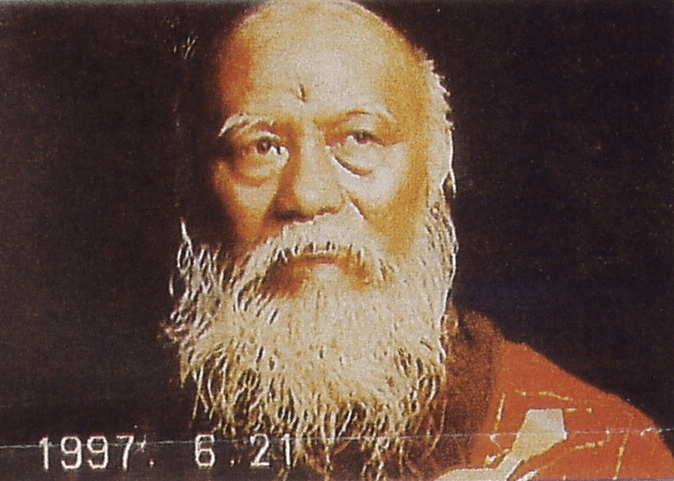
Elder Dharma King Dorje Losang in 1997 at age of 89 when his vajra hair and beard started to grow.
The chair was so old that sitting on it I began to worry that it might collapse. Looking around I noticed that the furnishings in the cave were very simple, yet very clean. A stone table and four stone stools shined like mirrors. The stool on which the Master sat was a little bit larger with a straw cushion laid on the top. There was no bed, nor what we city folks call “furniture.” In a stone niche were a couple of bowls, and at the entrance of the cave there was a wok supported by three rocks. A teapot, which could have been several decades old, was placed on the stone table. There was nothing else in the cave.
Guanxiu was a student of the Master. I could not quite understand their conversation, and thus felt that I was not in the position to join the conversation but should listen quietly while watching carefully. I was told that the Master’s name was Lao Na Monk. For many years he had practiced the Buddha-dharma and attained the inner power of Vajra (Jin Gang). He never slept during the year. Although 89 years old, his voice was strong and clear, and his bearing and demeanor possessed more vitality than a middle aged person. More amazing was that a tuft of hair which was a mixture of black and white grew on his forehead between his two eyebrows, curling upward, about one inch long. I noticed that during his conversation with Guanxiu the hair flashed three times. Unable to resist my curiosity, I started asking questions about this mystery. But the Master ignored my questions.
Seeing that I was digging out answers, Guanxiu, with the approval of the Master, provided me some background information about the Master. When the Master was born, a tuft of black hair, several inches long, grew from his forehead between his eyebrows. His parents believed it was an ominous sign and pulled the hair out completely. Furthermore, in order to ensure that the boy would grow up smoothly, the parents entrusted him to the care of a Buddhist temple. Probably because this was a predestined cause, the boy was initiated into monkshood at a very early age, and became a senior monk when he was still a young boy. He had apprenticed under Master Taixi and Xuyun, and afterwards went to Tibet to study Tibetan esoteric Buddhism. There, he studied Esoteric Dharma and received blessings and initiations of empowerment from a number of world renowned great Masters including the Honored Deng-bashiming, Ah Wang Kan Bu, the Master of Dharma of the Sakya-pa sect, Jiangba Gexi of Paoma Mountain, the living Buddha Zhangjia, Ahuqing Rinpoche of Zhuqing Temple where the Ning-ma-pa sect was originated, and Kangsa Rinpoche. The Honored Chiming Chisong once predicted: “If the hair on your forehead grows again, you will attain limitless achievement and save numerous sentient beings.” However, during the time Lao Na Monk enlightened his practice the hair never appeared. Eventually when the predestined causes were met, he met H.H. Master Yisinubu (Wan Ko Yeshe Norbu who was later recognized as H.H. Dorje Chang Buddha III), the Supreme Master of Dharma of the White sect of Exoteric Buddhism. This Supreme Master was thoroughly knowledgeable in the Sutras, Canons, and Commentaries of Buddhism and achieved outstanding accomplishments in the five illustrious arts (five vidyas)
His remarkable abilities were peerless among the world famed experts in these five areas. Lao Na Monk begged the Supreme Master for transmitting Dharma and the initiation of empowerment. The Supreme Master, before transmitting Dharma to him, made a prediction: “After you practice the Dharma, I am going to transmit to you, the Vajra hair on your forehead will grow again. Then, you will not need to sleep. Every year the hair will grow about three to five inches. When the hair grows to the length of two to three feet you will achieve extraordinary super-natural power, and the highest degree of wisdom and empowerment.” As a result, 36 hairs suddenly grew on the forehead, and now they were nearly one inch long.
Vajra Hair beginning to grow out of Elderly Dharma King Dorje Losang’s forehead
Before Guanxiu completed the story, Lao Na Monk interrupted him and said seriously:
“You should not advocate these mysterious and strange things. Since it’s not easy for you to come, you should return with some result. As a Buddhist disciple and a person who has already devoted himself to Buddhism, you should have correct knowledge and perceptions of Buddhism. Yes, there are mysterious empowerments. But they are only illusory, and one should not stick to them. When you return home you should read more and practice the Dharma I taught you, and not to believe the nonsense of Living Buddhas and Dharma Masters. Nowadays, in both the region inhabited by the Han people and the region inhabited by Tibetans most so called Living Buddhas (rinpoches) are fake, even some Dharma Masters are highly questionable. It is because these Living Buddhas and Dharma Masters are but ordinary people found by ordinary people, not selected according to the Dharma essence. Many people believe that someone is the reincarnation of someone simply based on the legend of reincarnation, or on an inherited legacy. This is completely wrong. This practice is not in conformity with the teaching of the buddhas and bodhisattvas and the meaning of Esoteric Buddhism. Yes, reincarnation of buddha does occur. Nevertheless, most reincarnations today are false, and even a Buddhist legacy can be fabricated. Someone uses a skull or tooth to claim that they are the relics of such and such Master in such and such generation, so on and so forth.
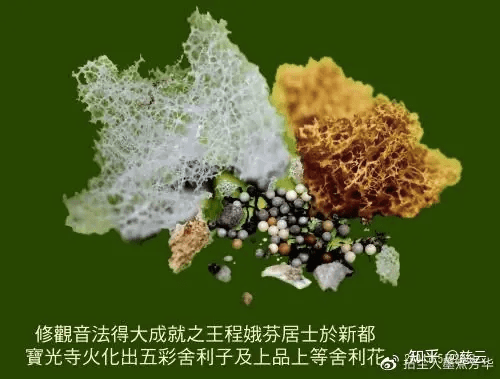
If you think about it carefully you will find out the truth. Any authentic Master of Dharma is the rebirth of a Buddha or Bodhisattva. A Buddha or Bodhisattva, if authentic, shall leave the world by either turning himself into a flash of red light, or turning his entire body into everlasting Buddhist relics when passing way, or leave the three letters “OM AH HUNG.” Lastly, his body, after being cremated, shall turn into “sheli” Buddhist relics (sharira) usually in a form of colored stones, and never leave such a fiendish skull to horrify sentient beings. All these things are fabricated by the false Living Buddhas and Masters for the purpose of cheating sentient beings. They by no means represent Buddha-dharma. What truly represents the Dharma is Tibetan’s “Doctrines of Knowing Truth.” You should read it carefully when you return home. You must learn how to identify an authentic master, authentic Living Buddhas, and authentic buddhas and bodhisattvas. The method is to find out whether one is thoroughly knowledgeable in the five commentaries of Buddhism, and whether one possesses real supernormal spiritual powers and abilities.
Sakyamuni Buddha Finger Sharira at Famen Temple Shanxi China
Layperson Wang left beautiful Sheli Flower and Sharira at Xindu BaoGuang Temple SiChuan China
You must devote yourself to Buddhism only according to the meaning of Dharma. Just think about it: how can someone who can’t master both Esoteric and Exoteric Buddhism, who can’t achieve the mastery of the five illustrious arts (vidyas), and who doesn’t possess supernormal spiritual powers, claim to be a great Living Buddha (Rinpoche)? If someone who is not able to write good articles, not able to paint excellent pictures, and not able to invite buddhas and bodhisattvas to descend to bless sentient beings in front of people, is not a master of Buddha-dharma, and he is not even qualified to be a master of laws of the earthly world. He is no different from and maybe even less capable than an ordinary person. How can he claim himself to be a buddha? Is it a big joke? Can it be that the wisdom of a Buddha is even inferior to the cleverness of an ordinary person? Master Wan Ko Yee(H.H. Dorje Chang Buddha III), Supreme Master of Dharma, and my paramount master who bestowed me with great kindness said to me, “You should perform all the virtues, not commit any evil deeds, and practice Buddhism wholeheartedly. Should you maintain absolute faith, accept the transmission of Dharma, and practice according to Master’s instructions you will benefit unlimitedly and liberate yourself by entering the Land of Supreme Happiness.”
Honestly, I could not fully comprehend what the Master had said. However, seeing that Guanxiu was repeatedly prostrating himself to the Master with palms held together, I began to follow him. Finally, the Master said, “You better leave now. I won’t keep you and you are not used to the lifestyle here.” When we were ready to leave, another surprising miracle happened: the crack on my right shoe disappeared, my toe no longer felt painful, and the wound was completely healed. While I was shocked, Lao Na Monk smiled to me. “Come next time if there is a predestined cause.” He said.
Before our departure, I presented one thousand US Dollars as an offering to the Master, but the Master rejected it. With a smile he said, “I never take any offering. As a matter of fact, I live here on vegetables, fruits and mountain water. At dawn I watch clouds in the sky and in the evening I listen to the wind whistling in the forest. What use does money have to me?” I then offered the money to Guanxiu who, again rejected it and said, “My Master has taught me to practice with a mind of humbleness, and not to take any offerings from anyone.” He then walked us out several miles and repeatedly urged us not to report the whereabouts of the Master so that his practice would remain undisturbed.
We returned through the original route. Now retreating to a corner of this busy and noisy city to write this article, I still feel very much confused and seek in vain for explanations. The experience in those several days were dreamlike. Should I disbelieve it? But the Master did know that my shoe was broken and that my toe was injured. And he fixed by shoe and healed my wound without me noticing it.
Furthermore, he has been in meditation for years without sleep! Should I believe it? Yet I can’t reason out how the hair between his eyebrows which is now merely one inch long would grow to two to three feet. At least, up to this date there hasn’t been any report of such a thing in the world. Since a reporter must provide stories based on facts, I am obliged to write this story based on my true experience although feeling confused. However, to respect the advice of the Master, his whereabouts is not revealed.
Perhaps, the best way to answer all these questions would be to visit him again two or three years from now to find out whether Lao Na Monk’s Vajra hair has grown.
When Sakyamuni Buddha first established Buddhist theories, there was no dual character of Buddhist theories. There was only the sameness of theories and nature (the essence of everything). The theories in the Tripitaka expounded by the world-honored Sakyamuni Buddha came from the Buddha’s state of realization. They are a kind of explanation of the ways to realize the holy state and attain liberation and nirvana. They can be called objective writings. Such Buddhist theories were born from true holy realization. They are not groundless writings based on assumptions that arose from the level of consciousness. This is recorded in the Buddhist scriptures.
In the beginning, Buddhist theory and Buddha-dharma realization were one integral body. At first, a complete body of dharma theories and rituals were born from true realization of the Buddha-dharma holy state. Later, people attained the holy state of true realization from this complete body of dharma theories and rituals. Theory and dharma were in harmony. Theory was used to further the dharma. The dharma was manifested to further theory.
“The sect of theories and true holy realization” is in accord with the sutras and abhidharma. Those of this sect apply cognition based on correct views to directly understand cultivation, the nature of the mind, and ultimate reality. They truly realize holiness that transcends intelligence and theories. Moreover, they manifest their actual realization and thereby prove that they have attained the ultimate nirvana.
This sect uses the orthodox theories contained in the Tripitaka and esoteric scriptures as its foundation. However, its goal is not the useless speaking of theories. Those in this sect must manifest their holy state of realization.
However, as the karmic connection living beings had with the dharma changed and as a large amount of dharma and rituals were lost, Buddhism’s sameness of theories and nature (essence) imperceptibly and gradually generated a dual character. One aspect was the complete retention of theory and holy realization where each brought out the best in the other. The other aspect was pure theory that arose out of a fundamental separation from the holy state of realization. The advent of this dual character of Buddhist theories objectively caused Buddhism to form two main sects. No matter what the sect or school may be within Buddhism—whether it be Mahayana, Hinayana, exoteric or esoteric Buddhism—all sects or schools ultimately belong to one of these two main sects. The first is “the sect of theories and true holy realization.” The second is “the sect of theories, views, and understanding.” Of course, the theories I am referring to here are Buddhist theories based upon correct understanding and correct view. I am not bringing up a third category of misunderstandings and heretical views that go against the sutra teachings.
The purpose of cultivation and practice for this sect is to actually transcend, in both body and mind, the fetters of samsara. This sect has an integral lineage, integral teachings, and integral rituals. Those of this sect are able to manifest supernatural wisdom powers that transcend both the material and mental spheres. It is a sect that truly accords with the essence of the Tipitaka, the esoteric scriptures, and the various commentaries and treatises. This is the sect of perfect Buddha-dharma where theory and nature (essence) are in accord. This was the original characteristic of Buddhist theory. Such Buddha-dharma played a decisive role in the liberation and accomplishment of living beings. Included in this Buddha-dharma is the Buddha-dharma of Sakyamuni Buddha during the True Dharma Age, the Buddha-dharma transmitted by Guru Padmasambhava, the Buddha-dharma transmitted by Venerable Atisha, Master Marpa, Master Milarepa, Master Tsongkhapa, Master Nairatmya, Master Rigdzin Jigme Lingpa, Bodhidharma, Xuan-zang, Hui-neng, Master Xu-yun, and the Buddha-dharma transmitted by other truly holy beings and patriarchs throughout history. All such Buddha-dharma is the Buddha-dharma of “the sect of theories and true holy realization.” Unfortunately, at this present time on earth, this sect is very rare and very seldom seen. “The sect of theories, views, and understanding” has taken its place and become the mainstream.
“The sect of theories, views, and understanding” also uses the orthodox theories contained in the Tripitaka and esoteric scriptures as its foundation. Those of this sect apply cognition based on correct views to approach and directly understand the nature of the mind in the hope that in the end they will realize nirvana. The Buddha-dharma of this sect is only able to express theories and that which arises out of mental processes. Those in this sect do not have actual holy realization that they can display. Consequently, all they can do is use the realization states and achievements of patriarchs in earlier generations as cases in point. Most present-day Buddha-dharma belongs to this sect. This is a prevalent phenomenon in current Buddhism.
However, we must see that although the theories of this sect are also based on correct understanding and correct view, it is very difficult for this sect to produce complete liberation. It is easy for this sect to fall into meaningless intellectual frivolity. It is still a question as whether those of this sect can truly attain the liberation of ultimate nirvana. That is because it is extremely difficult to lead people into the state of holy beings by relying solely upon theories. Moreover, these theories were expressed by different people and therefore vary. For example, the views expressed in the prajna writings and Middle School (Madhyamaka) writings are not the same. The “other emptiness view” also has its own way of explaining things.
I will use the modern terms of “software” and “hardware” to give an analogy. Which one of these schools of theories is practical software that can attain the positive results that hardware can attain? It is very difficult to determine this by relying only on software itself. Only when the positive results of hardware are actually produced can it be shown whether a certain theory (software) is right or wrong. Furthermore, that which is called the dharma of Buddha-dharma should be dharma that transcends the ordinary and leads to liberation. Theories alone cannot express this extraordinariness.
This phenomenon of seeking liberation from theories and views alone is mainly the result of the loss of many dharma teachings and rituals in the course of passing down the Buddha-dharma. In the case of Tibetan esoteric dharma, there has not been much change in the theoretical part since the initial stage of esoteric dharma until now. The greatest change has been in the true realization part. When the patriarchs of Tibetan esoteric Buddhism transmitted dharma in the past, there were countless manifestations of supernatural realization powers. These astounding supernatural realization powers caused people of the world to regard Tibetan esoteric dharma as holy and special. Guru Padmasambhava and Venerable Atisha displayed a great many supernatural powers. Master Marpa practiced a dharma whereby he brought back to life animals that had already died. Patriarch Milarepa flew in the air and entered the horn of a bull to avoid hail. Guwen Rinpoche flew into the air and took with him his entire family, including the tent and domestic animals. Both of the 4th Dodrupchen Dharma Kings displayed wondrous realization powers, and so on and so forth. One can give endless examples of such holy realization powers.
The original special quality of the Buddha-dharma was that it was of “the sect of theories and true holy realization,” which manifests actual realization powers. However, with the arrival of the Dharma Ending Age, many dharmas are no longer whole. The practice of them will not produce realization powers. Much Buddha-dharma, especially the esoteric dharma, has begun to devolve toward “the sect of theories, views, and understanding.”
Take, for example, the colored sand used to form a mandala during an inner-tantric initiation in the holy form. During the time of Guru Padmasambhava, this inner-tantric initiation dharma required that certain things be done. On the surface of a large flat stone, colored sand would be used to form the shape of a mandala or a vajra seed character. A person would then apply holy realization powers, causing that design on the surface of the stone to penetrate the stone and form the same design on the sand in the mandala plate underneath that large flat stone. Such sand design in the mandala plate thereby became vajra sand that went through a stone.
However, at this present time, there is no integral dharma. People cannot produce holy realization powers through dharma practice. Thus, inner-tantric initiations in the holy form cannot be performed. The above-described process of using colored sand to form a mandala has already devolved into sprinkling colored sand directly into the mandala plate to form a mandala design. As such, there is not the slightest manifestation of holy power.
Another example is vajra pills used in inner-tantric initiations. Sixty or seventy years ago, most of the people of true and holy virtue within Tibetan esoteric Buddhism were able to make a vajra pill come to life by telekinetically making it shake or even move around. However, in present-day Tibetan esoteric dharma, a vajra pill is nothing more than a medicinal pill that is a symbolic expression of dharma.
Another example is secret-division initiations relating to gods of wealth. This is a dharma source of inner-tantric dharma in the holy sense. The practitioner receiving such an initiation will generate a holy stage right then and there in the mandala. Moreover, gold dollar treasures or a treasure-spitting mongoose made of three white things and roasted barley flour will turn over and jump into the air before the practitioner, demonstrating a holy state of physics not produced by humans. The practitioner receiving the initiation will right then and there ingest a “dharma mother seed.” Out of this practice of dharma, the god of wealth will naturally descend, thereby accomplishing the completion stage. However, this type of dharma has also been lost.
It is not just these few dharmas. Most inner-tantric initiation dharmas have already deteriorated. Accomplished ones who attained the rainbow body basically cannot be found, even in the Kathok Monastery, which was the monastery of Padmasambhava and the place where more people attained the rainbow body than anywhere else. In modern times, many dharma kings did not transform into the rainbow body and fly away at death. There are many people now who at every opportunity leave their handprints or footprints on stones to show their realization powers. However, such realization powers were not manifested under the observation of masters and witnesses there at the time. What credibility do they have?
In an interview, the famous Kasuo Rinpoche of the Longwu Monastery of the Geluk sect talked about the special societal circumstances that existed in Tibet during the fifties and sixties. As a result of those circumstances, a large number of sutras, treatises, and dharma manuals were burned. Many people of great virtue were unable to pass down integral dharma before they were forced to die. Those people of great virtue who fled to India did not take with them many dharma manuals. After that, at most only twenty or thirty percent of Tibetan esoteric dharma still remained in the world. Most such dharma has been lost forever.
It is because of this type of loss of dharma that most present-day Buddha-dharma does not produce people who can show actual realization powers. Candidly speaking, people do not understand dharma and get bogged down in hollow theories over a long period of time. Many people even misunderstand the Buddha-dharma as simply something to comprehend that is theoretical or mental in nature. Of course, they are apathetic to the matter of realization powers or even feel that it is very normal not to have realization powers. This way of thinking is actually very wrong. Theories can be used to distinguish the holy ones from the ordinary ones. However, the most important way to distinguish the genuine ones from the false ones is seeing who actually manifests holy realization powers.
Take, for example, emptiness. Even practitioners with a little knowledge are able to speak copiously about theories related to emptiness. However, are those well-organized and impressive theories, understandings, and views right or wrong in the end? This is something that understandings and views alone cannot determine. It is also something that no conscious experience born of causes and conditions can determine. Only when one abides in emptiness and true such-ness and generates supernatural wisdom powers can one truly know whether an understanding or view is right or wrong.
There was a time when Ananda had not yet realized holiness. The Arhats excluded him from the hall where they were assembling the sutras. After he realized true such-ness, returned to that hall, and stood outside its door, Venerable Mahakasyapa asked him to enter the door through the keyhole to prove that he had become enlightened. Ananda then entered the hall through the keyhole. Those who have realized emptiness and untied the knot must have supernatural holy powers enabling them to enter another dimension that ordinary human ability cannot reach. Additionally, they must have this “software accomplishment” in the form of actual and extraordinary holy powers. Only then can they prove whether a given “theory software” is correct and practical.
Thus, as for this issue, the difference between “the sect of theories, views, and understanding” and “the sect of theories and true holy realization” is that the former stops at theoretical understanding. Whether people of “the sect of theories, views, and understanding” actually realize and enter the holy state that is beyond consciousness and thereby attain liberation is something unknown. It is not that people of such sect feel secure and therefore do not manifest holy powers. Rather, they do not manifest holy powers born of enlightenment because the incomplete dharma of that sect has resulted in its followers being unable to realize such powers from their practice. “The sect of theories and true holy realization” also propagates correct dharma theories. However, it definitely does not stop at purely theoretical, quick, sharp, and incisive repartee on the dharma, nor does it get entangled with theories on understanding emptiness. Rather, by following integral dharma and rituals, the people of this sect truly realize the essence or nature of true such-ness, transcend the level of consciousness, untie the knot of suffering, attain holiness and the resulting structural transformation of body and mind, and actually reach the dimension of holiness that is beyond the cycle of reincarnation.
Although both “the sect of theories, views, and understanding” and “the sect of theories and true holy realization” strive for nirvana based upon orthodox Buddhist theories, nonetheless, due to the Buddha-dharma of each of these two sects, there are great differences in the time it takes to become accomplished and the level of accomplishment. Furthermore, because “the sect of theories, views, and understanding” is limited to purely theoretical understanding and inquiry, it is often very difficult for its followers to see things from the standpoint of the pure, liberated state of holiness in order to understand the original meaning of some super-mundane (other-worldly) dharmas. This leads them to easily adopt mistaken views and understandings. If they are slightly careless, they can even slide toward heretical views.
In this Dharma Ending Age, it is very rare to be able to learn the integral dharma of “the sect of theories and true holy realization.” Moreover, this sect is not something that is fixed. Rather, it is something that evolves. It is like those Buddha-dharmas I mentioned above. When the patriarchs transmitted Buddha-dharma, they were still part of “the sect of theories and true holy realization” in which theory and nature (essence) were one. At that time, there were numerous manifestations of true realization states. The mandala dharma rules were strict. There was an orderly distinction between what was inner-tantric, outer-tantric, and inner-tantric in the holy form. However, dharmas gradually became lost. Dharmas passed down to later generations devolved into the hollow theories of “the sect of theories, views, and understanding.”
Many people of great holiness and virtue think that because of the loss of Buddha-dharma “the sect of theories and true holy realization” composes only about one or two percent of Buddhism in the world today as compared with “the sect of theories, views, and understanding.” So-called “greatly virtuous ones” within Buddhism who have heretical understanding and views are cropping up everywhere. It is distressing to see this trend in present-day Buddhism.
From a young age, many of us were taught by our parents about the importance of cultivating good habits. Whether it was going to bed early, exercising regularly, or refraining from negative behaviors, these habits were instilled in us with the belief that they would pave the way for success and a fulfilling life. Charles Duhigg, in his influential book “The Power of Habit,” sheds light on the mechanisms of habit formation and transformation. Drawing from scientific discoveries and captivating narratives, Duhigg offers fresh insights into human nature’s capacity for profound change. In addition, religious teachings, such as those found in Buddhism, also emphasize the significance of good habits in leading a virtuous and enlightened life.
“The Power of Habit” explores the scientific foundations behind habit formation. Duhigg introduces the concept of the habit loop, consisting of cues, routines, and rewards, which shape our behaviors and become deeply ingrained in our lives. By comprehending this loop, we gain a better understanding of how habits are formed and how they can be consciously modified or replaced.
Duhigg highlights the power of keystone habits, pivotal behaviors that have the potential to ignite positive transformations in various aspects of our lives. Through real-life examples, such as the habits of Olympic swimmer Michael Phelps, Starbucks CEO Howard Schultz, and civil-rights icon Martin Luther King Jr., the book demonstrates how cultivating keystone habits can lead to remarkable achievements. These habits act as catalysts, triggering a chain reaction of positive changes in other areas of our lives.
In Buddhism, there is a strong emphasis on discipline and the cultivation of good habits. Buddhist monks and nuns follow a set of precepts—more than 200 rules—that guide their daily lives. These precepts serve as a framework for moral conduct, urging practitioners to refrain from harmful behaviors and cultivate virtuous habits. By adhering to these precepts, disciples develop good habits in all aspects of life, fostering mindfulness, compassion, and ethical behavior.
In the pre-recorded Dharma discourse delivered by H.H. Dorje Chang Buddha III, His Holiness expounded on the profound concept that habits can become second nature, highlighting the transformative potential of consistent practice. Through consistent meditation, individuals develop a habit of introspection and mindfulness, leading to increased concentration and ultimately enlightenment. Similarly, the habit of performing good deeds accumulates positive merits, shaping one’s character and promoting spiritual growth.
“The Power of Habit” by Charles Duhigg reveals the malleability of habits and their potential for transformative change. By understanding the science behind habit formation and exploring keystone habits, individuals can consciously shape their behaviors and make positive changes in their lives. Additionally, Buddhism provides valuable insights into the significance of good habits in fostering moral conduct and spiritual development. By embracing these teachings, we can harness the power of habits to lead more fulfilling, successful, and enlightened lives.