Once upon a time in a remote village, nestled between the mountains, there lived a wise old monk named Master Sean. He was renowned for his ability to guide people in finding their inner voice, a skill that had been passed down through generations of monks in his lineage.
One day, a young man named Kaito arrived at the monastery seeking guidance from Master Sean. He had heard tales of the wise monk and hoped to learn the secret of listening to his inner voice. Master Sean welcomed Kaito with a warm smile and led him to a quiet room overlooking the monastery’s lush gardens.
Before we begin,” said the wise monk, “I want you to spend some time in silence, observing the garden and the creatures that inhabited it.” Kaito sat by the window watching the birds flip from branch to branch, the squirrel scamper across the grass, and the butterflies dance in the breeze. As he observed the harmony of nature, he felt a sense of peace wash over him.
After some time, Master Sean returned and asked Kaito what he had learned from his observations. Kaito replied, “I saw how each creature has its own rhythm and purpose and how they all coexist in harmony.” Master Sean nodded, pleased with Kaito’s insight.
“Now let me tell you a story,” he said, settling into a comfortable chair. “Once there was a young monk who lived in a monastery high in the mountains. He was diligent in his studies and meditation, but he struggled to hear his inner voice. One day, his master took him to a nearby cave where they found a small clear pool of water.”
The master instructed the young monk to gaze into the pool and describe what he saw. The young monk peered into the water and saw his own reflection, along with the reflections of the cave walls and the flickering light of their torches. The master then asked the young monk to close his eyes and listen to the sounds around him.
The young monk heard the gentle dripping of water, the distant echo of their voices, and the soft rustling of the wind outside the cave. Finally, the master told the young monk to open his eyes and look into the pool once more. This time, the young monk saw something different beneath the surface of the water. He could see a world of shimmering fish darting among the rocks and plants.
The master explained that the pool was a metaphor for the young monk’s mind. The surface reflections represented his thoughts and emotions, while the hidden world beneath symbolized his inner voice. To hear that voice, the young monk needed to learn to look beyond the surface distractions and listen deeply to the quiet whispers within.
Kaito listened intently to Master Sean’s story, feeling a spark of understanding ignite within him. He asked, “How can I learn to look beyond the surface and hear my inner voice?” Master Sean smiled and replied, “You must practice mindfulness and cultivate stillness in your mind. Just as the pool’s surface becomes calm and undisturbed, so too will your mind reveal its hidden depths when you learn to quiet your thoughts and emotions.”
Over the following weeks, Kaito practiced meditation and mindfulness under Master Sean’s guidance. He learned to observe his thoughts without judgment, allowing them to pass like clouds in the sky. Gradually, he began to hear the whispers of his inner voice, guiding him with wisdom and clarity.
As the story of Kaito and Master Sean comes to a close, let us reflect on the nature of happiness. Happiness, like the inner voice, is often found in the depths of our being, beyond the surface distractions of our thoughts and emotions. It is not a fleeting sensation or a temporary state, but rather a profound sense of contentment and inner peace that arises from living in harmony with our true selves.
To cultivate happiness, we must learn to listen to our inner voice, allowing it to guide us on our journey through life. By embracing mindfulness and stillness, we can quiet the noise of our minds and tune into the wisdom that resides within us. In doing so, we discover that happiness is not something to be pursued or acquired, but rather a natural state of being that emerges when we align ourselves with our deepest values and aspirations.
In the words of the ancient philosopher Lao Tzu, “Happiness is the absence of the striving for happiness.” May we all find the courage to let go of our endless pursuit of external validation and material success, and instead turn inward, seeking the happiness that lies within our own hearts and minds.
At February 2019, the solo art exhibition of Dr. Yuhua Shouzhi Wang was held at the Ratchadamnoen Contemporary Art Center of the Department of Culture of Thailand. Dr. Yuhua Shouzhi Wang is a distinguished international art master of world renown who is highly recognized by the art world both in the East and in the West.
I am very pleased to have the opportunity to appreciate Dr. Wang’s ink paintings which are truly refreshing. I feel like I have entered an art sanctuary of wonderful colors where I can stroll slowly, appreciate silently, and savor the details thoroughly. As I am strolling along, I notice that I have left the noise of the world behind, and I sense the clarity, peacefulness and serenity in my mind.
Great masters specializing in painting flowers and fruits in the recent 100 years are such as Wu Changshuo and Qi Baishi. As I view Dr. Wang’s works, I feel that her artworks are of the top quality in the free hand style of liberal expressivity.
Professor Wang’s paintings contains the brushwork of traditional Chinese ink painting while incorporating the strategies of Western painting. Her art, honoring tradition and breaking new grounds at the same time, is unique and unfathomable, sophisticated and powerful.
From the paintings, we can see how Professor Wang especially pursues and places emphasis on the spirit, the sensibilities, and artistic conception of ink painting through which she shows the different characteristics of Chinese and Western paintings. She merges these characteristics into her distinguished style.
Professor Wang’s ink paintings are leading me into the refreshing and beautiful nature, allowing my restless soul to rest peacefully.
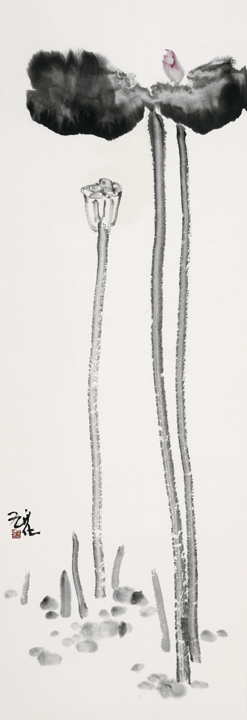
In one of the paintings, three lotuses stand elegantly and the pods have just become fully grown. The stems created by seal-script brushstrokes have a pure and dignified presence.
The composition is clean, simple and effective; echoing the legacy of Bada Shanren. The painting seems to symbolize noble qualities of a lotus that grows out of the sledge yet remains pure, sending off its refreshing fragrance.
Standing in front of the Vitality at the Lotus Pond, I am drawn to the full composition of the ink-wash pastel flowers and the carefree, other-worldly artistic conception. The painting is enlivening a wondrous scenery of lotus in misty rain where the flowers can be compared to the renown classic beauty Xishi who was known to look elegant whether she adorned her face with rich or simple colors.
In a loquat painting, the fruits are painted in a semi-abstract manner. Powerful brushstrokes are used to depict the leaves and the stems. Under Dr. Wang’s sophisticated, forceful and unrestrained brushwork, the leaves of the loquat tree appear robust and energetic. The round and perfect yellow fruits depicted by Dr. Wang in the style of realism look adorable and delicious. There is a sense of classic elegance throughout the composition which also leads one to think of prosperity, peacefulness, and a big family with many children and grandchildren.
A painting depicting cockscomb flowers is inscribed with the verse “Red and white cockscombs are cherished delights. A few strokes of the brushes capture the pleasantness.” The color contrast of the red and white cockscomb flowers seems ordinary yet it is most exceptional. This is truly an extraordinary conception. The upstanding, bright and red flowers with heads held high give a sense of positivity, upward mobility, and vigorous passion.
In another painting, the plum blossoms are energetic and full of power, with slanting branches that are charmingly graceful. The composition of this painting is audacious, lively, and untainted by the mundane, giving a unique sense of spirituality. In this painting, the rich colors are not garish, the faint colors are not cold. The artistic conception is truly transcendent in depicting the subtle fragrance and gentle movement of the flowers.
The five petals of a plum blossom symbolize the five good fortunes including happiness, joy, longevity, wellbeing, and peace. There is a saying that goes, “The plum blossoms give out a sweet fragrance after enduring the bitter cold.” Plum blossom symbolizes strong and noble character.
In the painting Plum Blossoms, Professor Wang has penned the inscription that says, “The charm of the ink and brush is in the spirit, the way of painting plum blossoms is just the same.” The inscription speaks of how vivaciousness and the highest state of artistry can be achieved through the ink, the brush, the color and the lines.
With a faithful mind, I appreciate the paintings one by one silently. I read each and every classic inscription carefully. I feel as if I am taken into a brand-new state of being where I experience poetry in the paintings, paintings in the poetry, and wonderful melodies in praise of the nature’s embrace.
German philosopher Goethe once described art in this way: Beauty is the highest principle of art. It is also the highest goal.”
Professor Yuhua Wang’s paintings are extraordinary. The excellence of her art does not lie in how the artist represents the form of nature, but in how she uses the form to express her mind, and how she brings out the spirit within the form. Her paintings express humanity’s wishes for peace and happiness; they express humanity’s praise to the qualities of freshness, transcendence, nobility and elegance; and they also express humanity’s gratitude to the selfless beneficence of flowers, trees and plants.
In this sanctuary of art, we have enjoyed a precious experience of beauty. Our souls are cleansed and transformed by beauty.
I wish that Professor Yuhua Wang’s exhibition will tour different parts of the world, so more people may enjoy the beauty of nature, the beauty of art, the beauty of life, and the beauty of character.
We also look forward to seeing more of the art of Dr. Yuhua Wang that is of the style of ease.
Tucked away in the idyllic town of San Marino, California, lies a captivating destination that continues to enthrall visitors from all corners of the globe—the Huntington Library, Art Museum, and Botanical Gardens. Boasting breathtaking landscapes, vast collections, and a harmonious fusion of nature, culture, art, history, and science, the Huntington Library is a place of awe-inspiring wonder that leaves an indelible mark on the hearts of those who venture within its gates. This July 4th holiday, we had the pleasure of revisiting this remarkable institution, once again succumbing to its irresistible allure.
Stepping foot into the Huntington Library is like entering a world where nature and culture intertwine harmoniously. The lush botanical gardens stretch across 120 acres, offering a mesmerizing collection of plants, flowers, and trees from all corners of the globe. As you stroll along the meandering paths, you’ll encounter a kaleidoscope of colors and fragrances, inviting you to immerse yourself in the serenity of nature. The carefully manicured landscapes provide the perfect backdrop for contemplation, relaxation, and exploration.
Chinese Garden
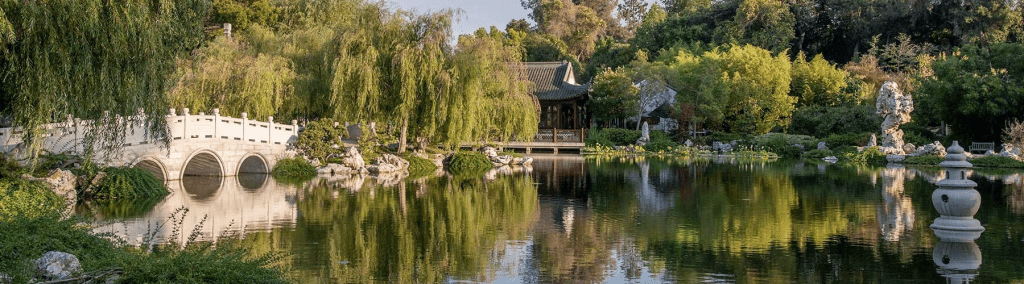
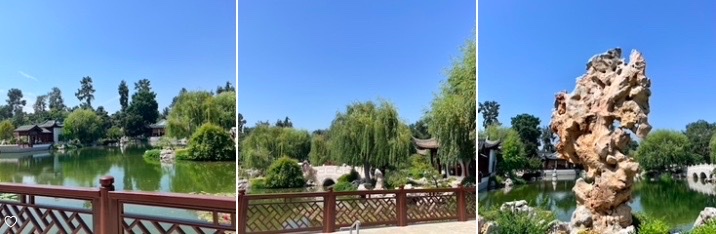
Among the many wonders that grace the Huntington Library, the Chinese Garden stands out as a true gem. This tranquil oasis, known as the Garden of Flowing Fragrance (Liu Fang Yuan), transports visitors to the essence of traditional Chinese landscaping. With its tranquil ponds, graceful pavilions, and meandering pathways, the Chinese Garden evokes a sense of peace and serenity. Every element, from the meticulously arranged rocks to the delicate architecture, conveys the rich insights of Chinese culture, inviting visitors to appreciate its profound beauty.
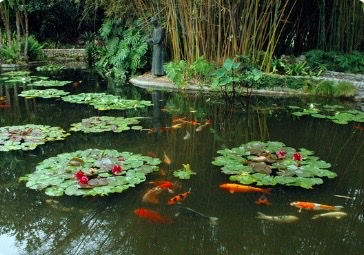
Nestled within the captivating grounds of the Huntington Library, Art Museum, and Botanical Gardens, the Lily Ponds stand as a timeless testament to the beauty and tranquility of nature. Established in 1904 as the first garden on Henry E. Huntington’s property, the Lily Ponds have become a beloved destination for visitors seeking solace and respite. Surrounded by bamboo groves and the majestic conifer tree collection, this serene haven features five picturesque ponds and an open grass meadow. With the presence of lotus blossoms, graceful koi fish, and elegant papyrus, the Lily Ponds offer a truly enchanting location for relaxation and the staging of unique events.
Beyond its mesmerizing gardens, the Huntington Library boasts an extensive collection of art, rare books, manuscripts, and historical artifacts. Art enthusiasts will find themselves immersed in masterpieces that span centuries, from the Renaissance to contemporary works. History buffs can delve into rare documents that shed light on pivotal moments in human civilization. Moreover, the Huntington Library offers an incredible array of scientific resources, including an impressive collection of botanical specimens, which serve as invaluable tools for researchers and scholars.
Peter Verstille’s diary and memorandum book, pages 19 and 20. Verstille was dismayed by the political corruption and misdirection he perceived in London. Throughout his diary, he worried what “the Deplorable Degeneracy of our present Times” would mean for the fate of the British Empire and America. | The Huntington Library, Art Museum, and Botanical Gardens.
The Huntington Library’s existence as a public treasure is owed to the foresight and generosity of Henry E. Huntington and his second wife, Arabella. The couple amassed an extraordinary collection of books, art, and manuscripts throughout their lifetimes. Instead of keeping these treasures confined to private quarters, they made the decision to establish the Huntington Library, ensuring that future generations would have the opportunity to experience the world’s wonders firsthand. Their philanthropic vision has created a lasting legacy that continues to enrich the lives of countless individuals today.
Visiting the Huntington Library is an experience that lingers in the hearts and minds of all who venture within its gates. The seamless integration of nature, culture, art, history, and science makes it a truly remarkable place. Whether you find solace in the tranquil Chinese Garden, lose yourself in the captivating art collections, or immerse yourself in the wealth of knowledge held within its walls, the Huntington Library offers a journey of discovery and inspiration. The selfless act of the Huntington couple in preserving this treasure for the public to enjoy is a testament to the power of sharing and the immense value of fostering a deeper understanding of our world. So, if you ever find yourself in California, make sure to visit the Huntington Library, where beauty, culture, and knowledge come together in perfect harmony.
Chinese calligraphy has transcended its role as a mere communication tool and has become an art form highly esteemed even in an era dominated by ballpoint pens and computers. No longer limited to intellectuals and officials, calligraphy is now practiced by professional artisans and enthusiastic amateurs. Calligraphers employ brushes to beautifully ink five distinct styles of script: ‘seal’, ‘official’, ‘cursive’, ‘running’, and ‘regular’. While calligraphy can be found on various surfaces, even adorning the rocky walls of cliffs, it is most commonly seen on letters, scrolls, literary works, and fan coverings.
Throughout history, the Chinese have believed that no art form or field of study can truly reflect a person’s moral character and knowledge as effectively as calligraphy. The accomplishments or creations in other arts or fields often overshadow one’s shortcomings in knowledge and character. However, calligraphy stands apart from this convention. It functions as a three-dimensional mirror, projecting the depth of knowledge, moral character, and mental strength with each brushstroke. There is no hiding or concealing these qualities. When examining an individual’s ordinary handwriting of Chinese characters, one can often discern their level of education. This is even more evident when examining their calligraphy.
In the annals of history, there is no account of an unknowledgeable person making significant contributions to calligraphy. Profound and extensive knowledge does not necessarily guarantee expertise in calligraphy. However, great calligraphers possess both knowledge and skillful brushwork. Without exception, the renowned calligraphers of past generations were literary masters who possessed deep knowledge. Notable examples include Xizhi Wang, Su Huai, Shaoji He, Huaiguan Zhang, Fei Yue, and in more recent times, Youren Yu. Each of them was an erudite literary figure and exemplar of virtue.
Knowledge serves as the pillar and cornerstone of calligraphy, while moral character is reflected in the style and allure of the art form. Thus, calligraphy demands a combination of knowledge and moral character.
When one appreciate the calligraphy of H.H. Dorje Chang Buddha III, one can understand that why chinese believe that calligraphy combines one’s knowledge, moral character and mental strength .The calligraphy of H.H. Dorje Chang Buddha III Wan Ko Yeshe Norbu Holiest Tathagata is not bound by worldly conventions and is devoid of unnecessary flamboyance. It is highly refined and based upon ingenious artistic conception. His Holiness’s strokes are sometimes written in a swift curling style. However, in an instant, His Holiness can express the innocent and natural charm of a child. There is wonder in even common strokes. His calligraphy is naturally graceful, exhibiting depth and brilliance. The calligraphy of His Holiness contains an invisible force that makes the characters seem much grander than they appear on a superficial level. His strokes look harmoniously smooth and unbroken. The Chinese characters may appear strong and vigorous, like a soaring dragon or mighty tiger. They may appear clear and gently elegant, like slowly floating clouds, cranes flying among pine trees, or dancing swans. They may appear simple and unadorned, like the free heart of a child. They are gracefully understated and completely devoid of any mundane quality. The calligraphy of H.H. Dorje Chang Buddha IlI is natural in quality and resonates with the true nature of the universe. A deep power underlies His Holiness’s strokes.
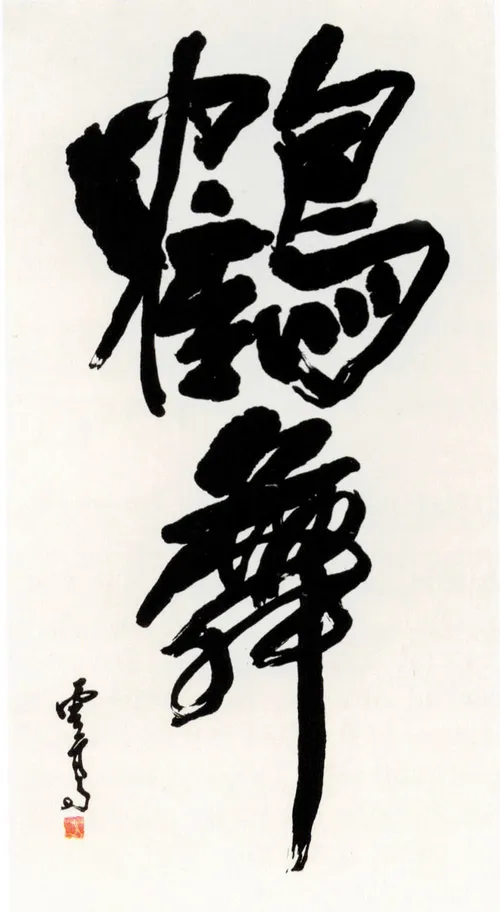
Crane Dance by H.H. Dorje Chang Buddha III at 1990
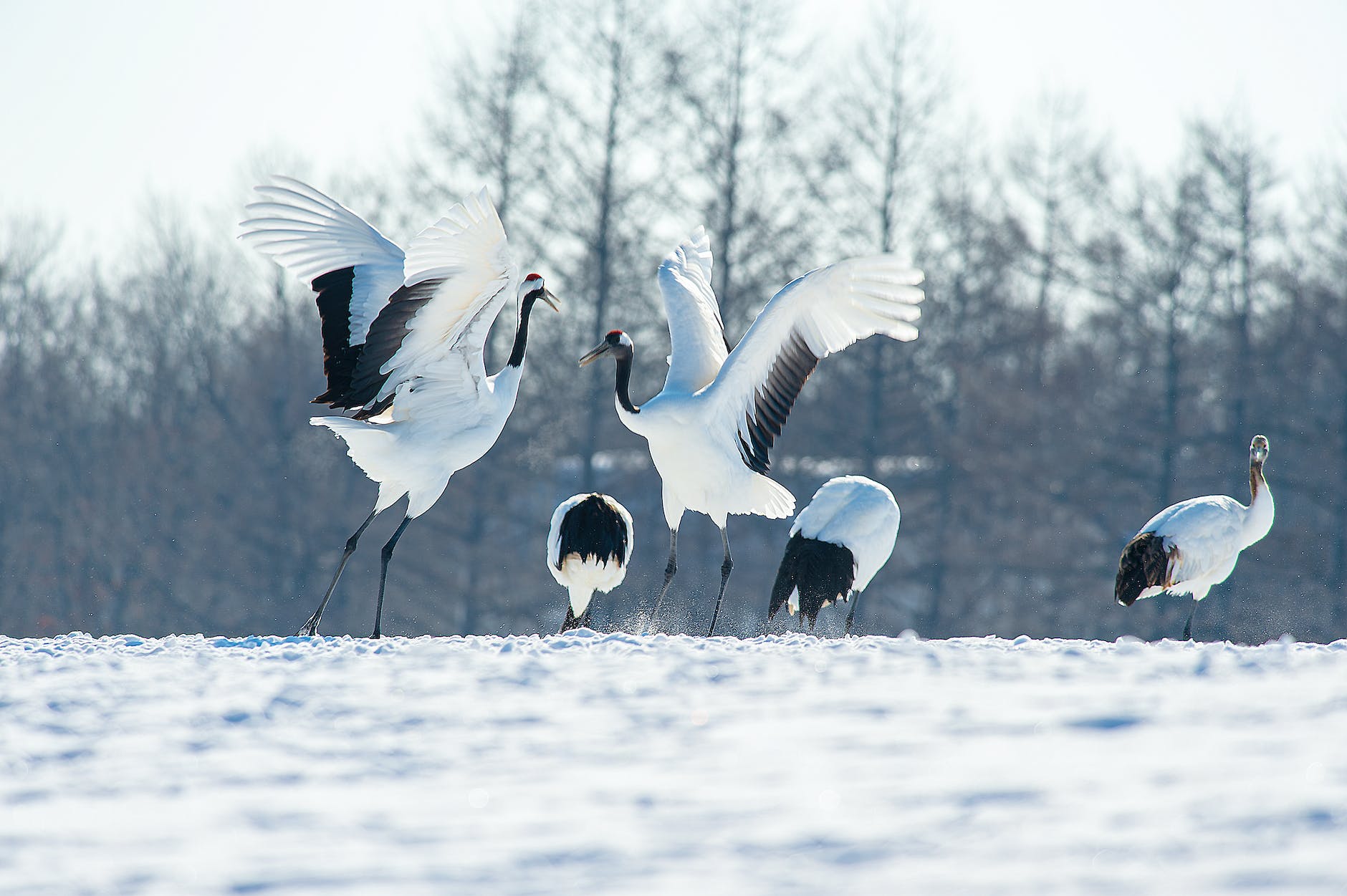
Red-crowned cranes tend not to build ness for themselves since they often stay in various places. When quiet, they frequently engage in meditational observation. When in motion, they frequently dance. Their nature is noble, pure, elegant and simple. They develop their virtue, are not attached to a specific abode, and take care of themselves so as to enjoy their natural lifespan. That is why since ancient times they have been praised for their longevity.
The ability of H.H. Dorje Chang Buddha III to reach such great heights in calligraphy is completely due to His Holiness’s vast knowledge and profound talents. Of course, His Holiness is extremely adept at learning from the styles of others since this is a simple matter for a Buddha. For example, even in the initial stage of learning calligraphy, H.H. Dorje Chang Buddha III had solid skills in the traditional cursive style of writing and also had extensive learning.
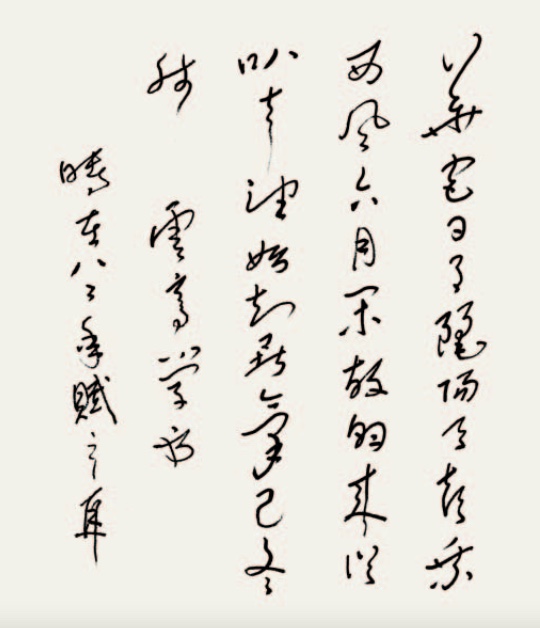
Calligraphy : A Qi jue poem (Thin Gold Cursive Style of Calligraphy)
Above is a qi jue poem written by H.H. Dorje Chang Buddha IIIat 1982. A qi jue poem is a four-line poem with seven characters to a line and a strict tonal pattern and rhyme scheme. The phonetic reading of the poem is as follows: “hua gong ri yue li yang tian, xi cheng xi feng liu yue xian, gu peng lai cong ba sheng wang, shi zhi shu qi yi dong can.” One can see that this work has surpassed all traces of the mundane and has transcended all earthly impurities. Its style is lofty and pure. When that poem was written, H.H. Dorje Chang Buddha III was living in the seclusion of an ancient temple. His Holiness used his extraordinary realization to express his thoughts and feelings. The first line expresses that although His Holiness lived alone and secluded in the room of a temple, He governed the universe and bestowed blessings upon living beings. The next line, “xi cheng xi feng liu yue xian,” conveys the scene that during the idle month of June H.H. Dorje Chang Buddha III bathed in the Buddha-state of coolness while under the scorching sun. His Holiness was free of all worldly cares and attachments, and his body merged with the universe. When friends came, His Holiness heard the horns of their cars, but He had already transcended the world, residing in quietude and non-action. H.H. Dorje Chang Buddha III kept no notion of the date, and His Holiness’s mind did not abide in anything whatsoever. The people of the world were ignorantly attached to the changing seasons and came in their cars and horses to inform H.H. Dorje Chang Buddha III that summer had long passed and the winter was about to end. The ancient Buddha acknowledged this and smiled.
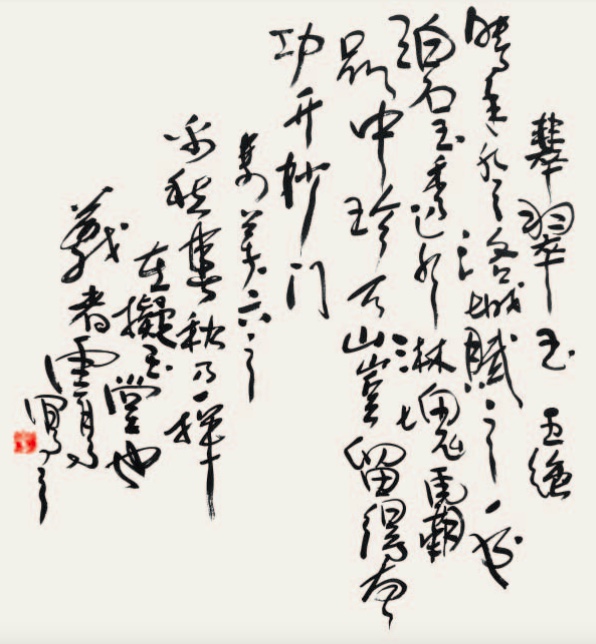
In recent years, there are works of H.H. Dorje Chang Buddha III that have been written in the cursive mode of calligraphy, showing a flowing and unobstructed style, and expressing even more than before the charm of this writing technique. For example, the work Fei Cui Jade expresses the spirit of an immortal or Buddha, thoroughly transcending the three worlds of reincarnation, standing proudly above the five elements of the universe. It is truly calligraphy beyond the category of calligraphy, expressing a feeling that incorporates the whole universe.
Fei Cui Jade: Created with an unfettered hand and unattached mind, it has the appearance of a celestial writing accomplished with a childlike mind and steady strokes of the brush.
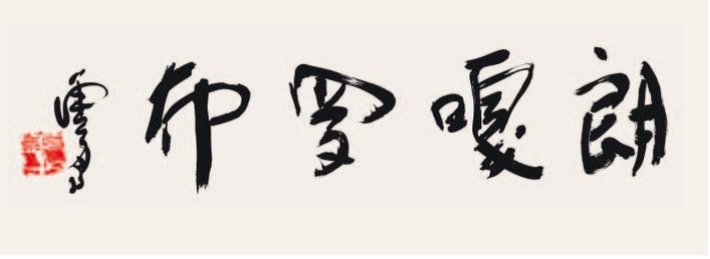
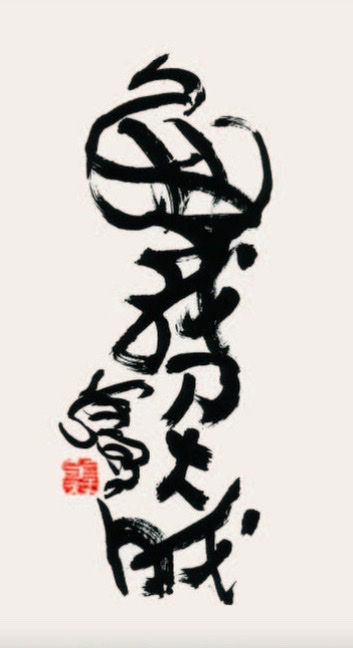
His Holiness’s calligraphy of the Chinese characters lang ga luo bu (Treasure of Heaven) excels the writing of calligraphers throughout history. It transcends all traces of worldliness. It expresses deep strength, like that which can break jade. The style of another calligraphic work called wu wo nai da cheng (No-Self Is Great Accomplishment), conveys the firmness and simplicity of steel and the vigor of a sharp knife. However, these same characters also contain delicate beauty. That calligraphic style truly surpasses styles of the past and present.
Lang ga luo bu (Treasure of Heaven)
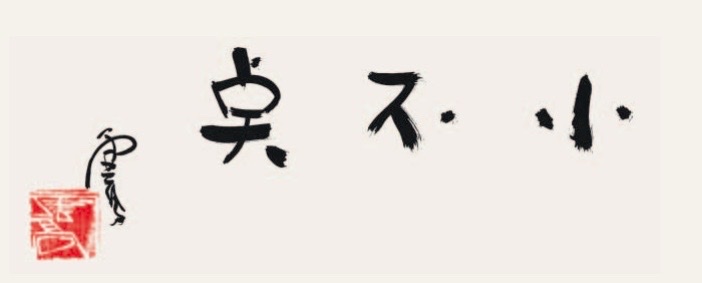
Another calligraphic style of H.H. Dorje Chang Buddha III is revealed in the writing of the Chinese characters xiao bu dian (Tiny). Such calligraphy shows the childlike innocence of a very old man, and its arrangement expresses the utmost ease and lack of rigid constraints. It is high-class calligraphy that does not even seem to be calligraphy. It is so elegant and refined that it completely transcends the mundane.
Tiny (Xiao bu dian)
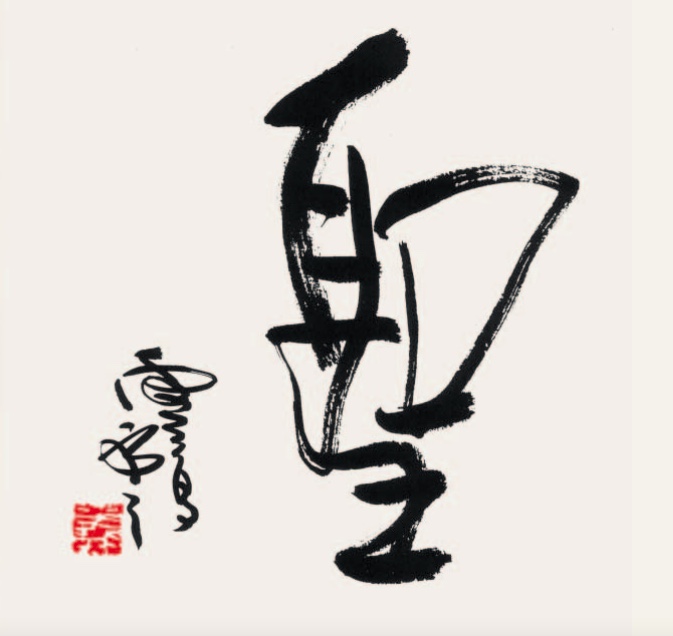
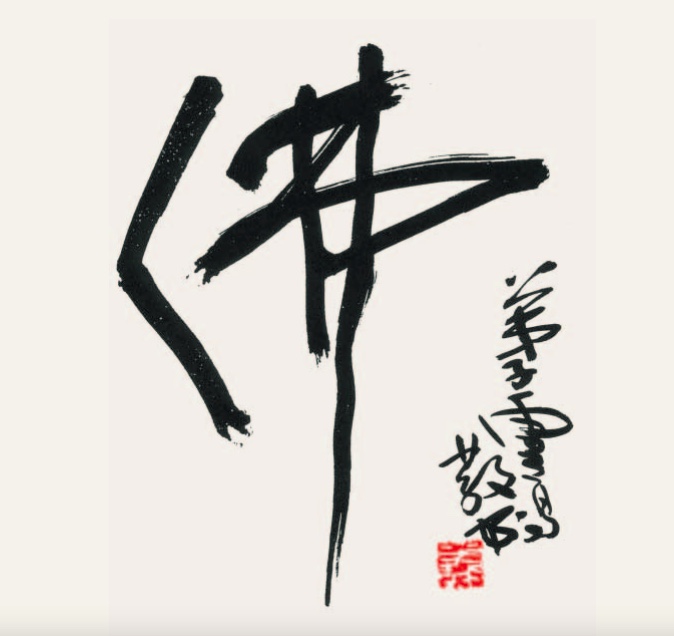
Beholding the character sheng (holy) written by His Holiness, one can see that it simultaneously embodies both the softness of ribbons and the inner-firmness of steel. Its inner beauty flows to the surface. Another example is the character fo, which means Buddha. The writing of that character demonstrates that His Holiness has truly attained the summit of calligraphic skills that the ancients extolled in the old saying, “the old pine branch cannot be weighed down by heavy snow; the might of a brush will lift a thousand-pound bronze cauldron.”
The Chinese character “sheng,” which means “holy.”
The Chinese character “fo,” which means “Buddha.”
In fact, the calligraphy of H.H. Dorje Chang Buddha III has a deep foundation and an internal richness. It embodies the manifold sensations that one could possibly experience in one lifetime. The essence of all things in the universe converges at the tip of His Holiness’s brush. With such a transcendent state of realization, the myriad things of the universe are in the palm of this Buddha. The calligraphy of H.H. Dorje Chang Buddha III is like a treasury. It can be vigorous, smooth, or naturally beautiful. His Holiness incorporates the best techniques of all of the schools of calligraphy. No words can really describe this! His Holiness’s calligraphic skills have reached the highest degree of proficiency and naturalness that only a Buddha could reach!
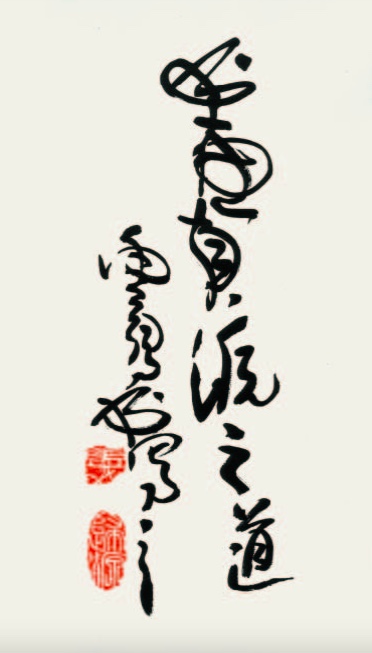
The Way to the True Source of Calligraphy and Painting
No-Self Is Great Accomplishment
Hua Zang Si (Inscription of a Buddhist temple in San Francisco)
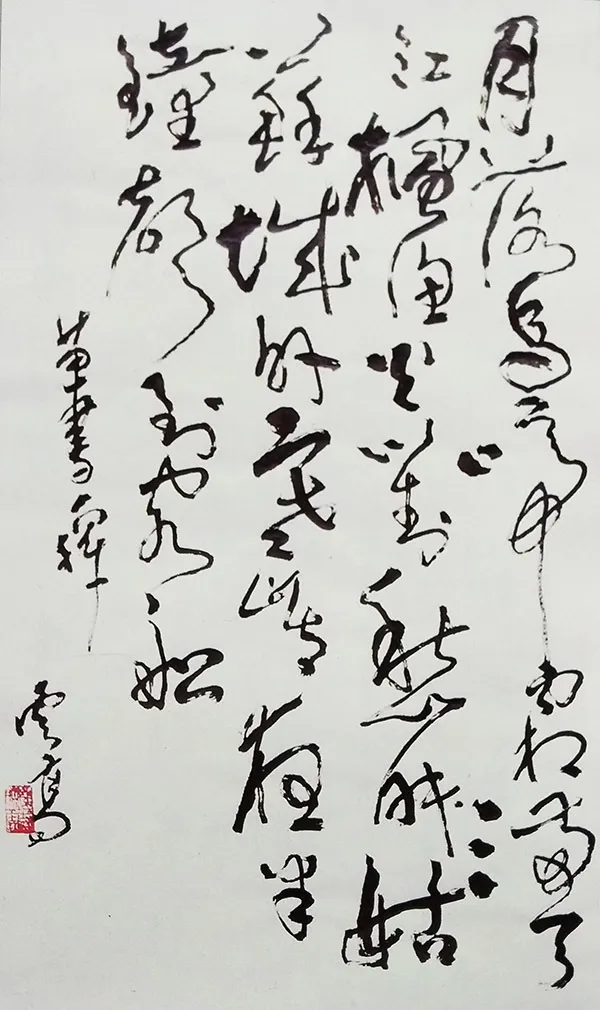
Chinese ancient poem Han Shan Si Temple in rapid cursive style by H.H. Dorje Chang Buddha III
In the annals of ancient wisdom, tales of great insight and philosophical musings have been passed down through generations. One such tale is that of Sai Weng, a man living on the northern frontier whose experiences teach us a valuable lesson about the unpredictability of life. This story illuminates the idea that blessings and curses often come disguised, and it reminds us of the importance of embracing life’s ups and downs with equanimity and resilience.
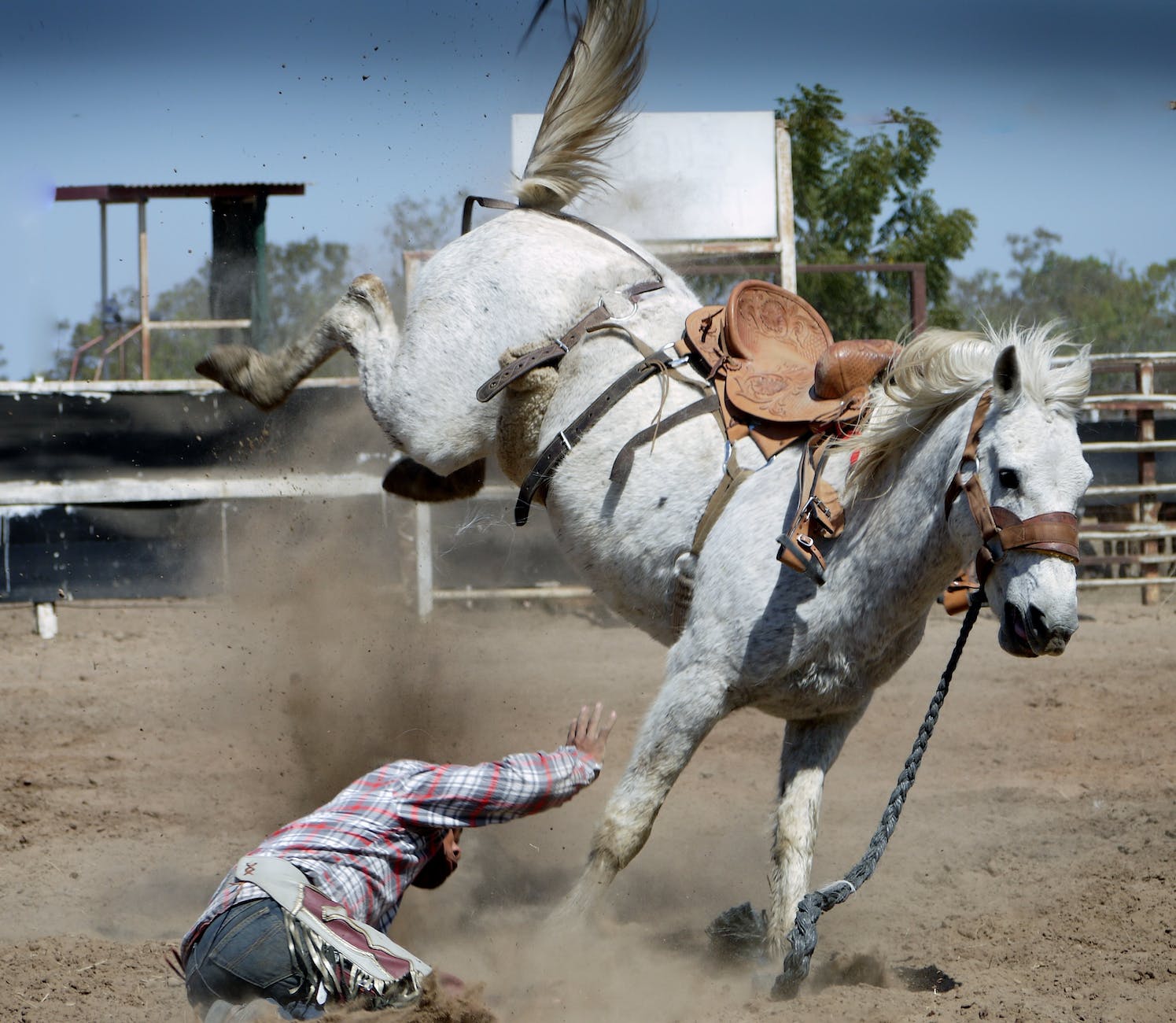
A long time ago, there lived a man named Sai Weng on the northern frontier of China. One day, his beloved white stallion ran off into the territory of the northern people, leaving Sai Weng without his cherished companion. His son was heartbroken. Naturally, his neighbors sympathized with him, considering it a great misfortune. Surprisingly, Sai Weng remained unperturbed and uttered these words: “Perhaps this will soon turn out to be a blessing.”
After a few months, the horse returned to Sai Weng, accompanied by another magnificent horse from the north. The neighbors were amazed by his good fortune and congratulated him on his newfound wealth. Yet, Sai Weng, ever wise, cautioned them by saying, “Oh, of course I am pleased…. but who knows if this is lucky or unlucky?.”
And so it did, for Sai Weng’s son, who grew fond of horse riding, had a terrible accident and broke his leg while riding the new horse. Once again, the neighbors expressed their sympathies, believing it to be an unfortunate turn of events. However, Sai Weng responded with his characteristic insight, saying, “I cannot know if these injuries will turn out to be something good or something bad.”
In due time, war broke out along the border with the northern people. The able-bodied men from Sai Weng’s village were called to arms to defend their homeland. Tragically, most of them perished in the battle. But Sai Weng and his son were spared, as the son’s injury prevented him from joining the fight. It was then that the true meaning of Sai Weng’s words became apparent – what seemed like a curse had, in fact, saved their lives.
Sai Weng’s story offers us profound insights into the nature of life and the ever-changing circumstances we encounter. It teaches us that appearances can be deceiving and that our judgments based on surface-level observations may not reflect the true nature of a situation. It urges us to refrain from hasty conclusions and remain open to the possibilities that lie ahead.
The concept of predestination is introduced in this tale, highlighting the idea that some things in life are beyond our control and are determined by fate. While we cannot alter the hand we are dealt, we can choose how we respond to it. Sai Weng’s calm acceptance and his ability to find hidden good opportunities in apparent setbacks demonstrate the importance of adapting to circumstances with grace and wisdom.
When fortune smiles upon us, it is essential to remain humble and vigilant, aware that circumstances can change unexpectedly. Gratitude for our blessings should be accompanied by a sense of preparedness for potential challenges. Similarly, when faced with adversity, we must remember that it is temporary and maintain hope and optimism for the future.
Sai Weng’s tale serves as a timeless reminder of the unpredictable nature of life and the need for a balanced perspective. It teaches us not to be overly complacent during favorable times and not to be disheartened by setbacks and obstacles. By embracing the ebb and flow of life, we can cultivate resilience, wisdom, and gratitude. As we navigate our own journeys, let us remember the lessons of Sai Weng and approach life with equanimity. By seeing beyond the surface and embracing both the blessings and the challenges.
Jataka tales are fascinating narratives that shed light on the past lives of the Buddha. These captivating stories unveil the incarnations preceding Prince Siddhartha Gautama’s birth and illustrate the ways in which he accumulated virtuous karma through selfless acts of sacrifice.
Before his existence as Prince Siddhartha Gautama, the Buddha’s soul had already amassed immense virtue from numerous previous lifetimes, embodying various selfless beings.
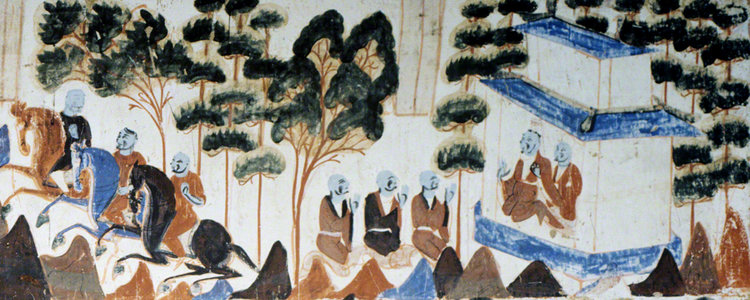
One remarkable representation of these Jataka tales can be found in a Dunhuang mural. Located on the eastern wall of Mogao Cave 428, this mural intricately portrays a renowned Jataka tale featuring Prince Mahasattva. The entire narrative is depicted across three registers, capturing the essence of the story within its captivating artwork.
Detail of the three princes paying their respects to the king and queen before they leave for the forest. First register, right section. Mogao Cave 428. Northern Zhou, 557-581 CE. Dunhuang. Image courtesy of the Dunhuang Academy.
The mural commences on the right-hand side of the first register, where a captivating scene unfolds. Three young men, their hands pressed together in a gesture of genuflection, kneel before a majestic blue pagoda. Inside the pagoda, two figures exuding regal aura can be identified as the king and queen, bidding a heartfelt farewell to their sons, the three young men.
As the story progresses, the mural transitions to subsequent scenes, unveiling the brothers’ journey into the forest for a hunting expedition. Within this vibrant forest setting, an array of deer and tigers roam, coexisting with the majestic presence of towering trees and majestic mountain ranges. The undulating mountains, adorned with a multitude of colors, gracefully assume a smaller scale compared to the trees, animals, and human figures, harmoniously framing each scene of the narrative.
Detail of the three princes hunting in the forest. First register, middle section. Mogao Cave 428. Northern Zhou, 557-581 CE. Dunhuang. Image courtesy of the Dunhuang Academy.
The story unfolds on the second register, commencing from the left-hand side. As the three brothers venture deeper into the forest, they eventually dismount from their horses, seeking respite at the foothills of towering mountains.
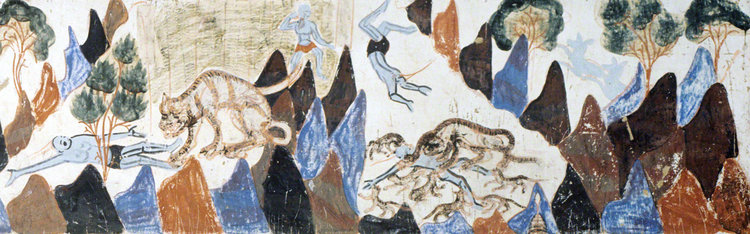
While taking a moment to rest, the brothers catch sight of a tigress accompanied by seven adorable cubs. The tigress is portrayed with her mouth agape, and her painted figure exudes a somber aura with limbs hanging low. Her gaze fixates upon the playful cubs frolicking around her, creating an illusion of impending maternal aggression, as if she were poised to devour her own offspring.
Detail of the starving tigress and her baby cubs. Second register, middle-left section. Mogao Cave 428. Northern Zhou, 557-581 CE. Dunhuang. Image courtesy of the Dunhuang Academy.
The brothers convene to discuss the matter of the tigress. Not wanting to watch a mother devour her own children, the brothers resolve to help her find food. However, there does not appear to be any food nearby.
Prince Mahasattva suddenly comes up with an idea. He keeps it to himself and tells his two brothers to leave the forest to find some food while he stays behind to watch over the tigers.
After his brothers leave, Prince Mahasattva strips off his clothes and lies down in front of the tigress, offering himself to the tigress. He decides to offer himself as food for the tigress so that she wouldn’t have to eat her own children.
The tigress sniffs at his body but makes no move to harm him even though she is starving.
When we offer help to someone and they are unable to accept what is offered, it’s a chance for us to feel good about having attempted goodness without losing anything. We can think to ourselves, well, we tried to help. In the case of Prince Mahasattva, he understood that good intentions alone would not save a life. It would take determined and complete self-sacrifice to save the tigers.
Realizing that the tigers will not eat him alive, Prince Mahasattva climbs to the edge of a cliff, cuts open his neck and throws himself off the ledge. With his neck bleeding profusely, his body drops in front of the tigress and her cubs. At Prince Mahasattva’s second attempt to offer his body, the tigers devour him as nourishment.
Detail of the Prince Mahasattva’s sacrifices to the tigers. Second register, right section. Mogao Cave 428. Northern Zhou, 557-581 CE. Dunhuang. Image courtesy of the Dunhuang Academy.
Snaking across and down the three registers, the story continues on the third register by beginning on the right-hand side again. Prince Mahasattva’s brothers return and they understand what happened in their absence when they see the bones left behind by the tigress and her cubs.
The brothers’ bodies contort across the scene in shock, anguish, and grief in reaction to the death of their third sibling.
Detail of the grieving brothers and their return to the palace. Third register. Mogao Cave 428. Northern Zhou, 557-581 CE. Dunhuang. Image courtesy of the Dunhuang Academy.
The two brothers practically fly back to the palace on their horses to tell the king about what happened to Prince Mahasattva.
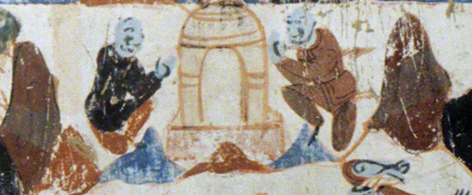
The story actually ends on the topmost right corner of this image, returning to the place where the two princes found their brother’s corpse. After reporting to the king, the family builds a stupa over Prince Mahasattva’s bones and hair to commemorate his selfless actions.
Detail of the brothers building a stupa over Prince Mahasattva’s remains. Third register. Mogao Cave 428. Northern Zhou, 557-581 CE. Dunhuang. Image courtesy of the Dunhuang Academy.
Many of the Mogao caves at Dunhuang have central pillars that take after the stupa form.
Scholars have theorized that worshippers could have circumambulated these central pillars inside the Mogao caves at Dunhuang as one would do around stupas in the open air.
The central pillar in Mogao Cave 428. Northern Zhou dynasty. 557-581 CE. Dunhuang. Image courtesy of the Dunhuang Academy.
In traditional China, painting was revered as “silent poetry,” while poetry was seen as “painting with sound.” Both art forms found expression through the medium of calligraphy, which was considered the “art of handwriting.” Scholars and artist-scholars incorporated calligraphic brushstrokes into their paintings, viewing their artworks as vehicles for self-expression. Consequently, painting was not only regarded as an art form of equal purity and lyricism to poetry and contemplative thought but also as a means to evoke sensory experiences, emotions, and a holistic engagement with the world.
For Western observers, it may be intriguing why Chinese artists incorporate writing in their paintings and what significance the characters hold. By examining some of H.H. Dorje Chang Buddha III’s paintings, we can gain insight into these questions and witness the embodiment of the concept known as the “Three Perfections.” This concept represents the harmonious fusion of fine painting, poetry, and calligraphy within a single artwork.
Song of the Waves in the Three Gorges by H.H. Dorje Chang Buddha III
This painting, titled “Song of the Waves in the Three Gorges,” beautifully captures the grandeur of splash-ink technique alongside the charm of water and ink colors. Its overall tone carries a weighty presence. The brushwork employed in this artwork evokes a powerful sense of momentum, lively charm, and a vividness akin to the scene of a long, flowing river just passing by. The inclusion of a few small sailboats adds elegance to the water scene as they gracefully navigate through it. The combination of the mighty river and awe-inspiring mountains, enveloped in mist and holding sacred spaces, has a purifying effect on one’s emotions. This painting possesses a quality that is reminiscent of both poetry and calligraphy.
Notably, H.H. Dorje Chang Buddha III has inscribed an elegant Chinese poem onto this painting, which can be translated as follows: “The song of waves echoes in the gorge. Hanging colors of rocky cliffs burst with charm. A few cloudy, misty mountains reveal shades of blue. The vast water’s melody sets the sails in motion.” This poem aptly captures the beautiful and misty landscape of the Three Gorges, where the water and sky harmoniously blend, and human emotions become intertwined with the scenery. This painting serves as an artistic paragon, showcasing the mastery of poetic, calligraphic, and painting skills.
Yi Shan Shui Yun Liang Qing Nong ( One Landscape Charm Presents Two Strong Emotions) By H.H. Dorje Chang Buddha III
This remarkable painting showcases a rare combination of splash-ink and splash-color techniques, displaying the artist’s bold and skillful brushwork. The resulting natural effect achieved through these techniques is truly indescribable. Within the bold and dynamic brushstrokes, one can discern countless intricate details and traces of charm emerging from the flowing watery ink.
The painting depicts a scene of mountains and water during the approaching dusk, conveying a profound message. The poem imparts the wisdom that we should strive to engage in virtuous deeds rather than harmful actions, treating all living beings with kindness and respect. By embodying such a way of life, one can transcend to another realm and grasp the truth of existence beyond the concepts of birth and death. This painting offers a profound contemplation on the purpose and significance of human existence.
The calligraphy in the two art works are executed in a cursive style, known for its swift and dynamic strokes. Cursive writing is often characterized by its rapidity and vitality, effectively conveying the artist’s profound emotions.
The Title “A Lotus Pond Has Carp” suggests profound Philosophical implications that transcend everyday life. In addition to its masterful artistry, the painting contains subtle messages of the Dao and its fruits. The lyrics on the left and right sides of this work correspond perfectly with the image of the fish, forming a whole that awakens and enlightens, richly rewarding its viewers.
Why is this painting so artistically enchanting that it stirs the hearts of those who see it? One reason is that the fish are depicted with uncanny realism. The swimming carp are infused with vitality. The painting’s details clearly reveal the damage done to the carp’s skin, accumulated over a lifetime in the water, through lines that fade in and out. Appearing as delicate as a fine gauze, the translucent fins, for example, possess a natural realism. Texture and spirit are captured with utter precision, providing the viewer with stirring aesthetic pleasure. The surface and bottom of the pond are depicted with a wonderfully hazy charm, while the lotus flowers, leaves, and pods are portrayed in bold freehand brushwork with distinct and unusual brushstrokes rapidly applied.
The painting is mainly composed of back ink and rich colors. Only a few brushstrokes were used to create each vibrantly red flower, which seem to emit a pure fragrance. The hanging lotus pods embellish the painting, conveying an elegant contrast of hues and instilling a sense of vitality. As the fish swim about, free of any inhibition, the sunlight faintly reflecting off the water ripples provides the illusion of movement that occurs in the natural world.
When examined more closely, the painting has an intricate style to ascertain, for it seems to transcend realistic fine brushwork and convey the feeling of freehand brushwork. It is not in the style of conventional paintings. Instead, freehand brushwork was applied to produce the effect of fine brushwork with close attention to detail.
Fine brushwork was applied that transcends realism. The real and the surreal blend, resulting in a work that excels the beauty of a natural lotus pond. It represents a combination of techniques from the “Menglong” style of painting and bold, large-scale freehand brushwork.
For the painting, H.H. Dorje Chang Buddha III composed these lyrics of a Dao song: “No Dao exists on the high mountain, yet hearts yearn to go there. A lotus pond has carp; men have inquired about them. Which path leads to the truth is worth pondering. It would be better to look tranquil to our original nature, like a lotus flower sitting over its leaves in tranquility.” These lyrics speak of mysteries unknown to the ordinary person – seeing fish, not as fish; seeing water, not as water; no Dao exists on the high mountain, so no value exists in searching for it; and the fish have neither life nor death.
To understand the origin of the painting, we must ask: where did the fish come from? What state of realization was relied upon and gave birth to this exquisite painting? What form of realization manifested this mysterious, hazy, and illusory painting? The magical illusion of the fish and water is nothing more than a superficial image. Spirit is within; A life force underlies spirit. Spirit is empty or nothingness. The original essence of all things is neither empty nor substantive. Everything illusory and impermanent quickly changes in time and space, but their original nature remains constant. Thus, the lyrics of the Dao song continue: “To find our original nature, do not seek the source, as the source is our original nature, tranquil and unmoving, like a lotus flower sitting over its leaves in tranquility. There is no such thing as arising, passing away, and change. From this surpassing wisdom, usages that arise from Buddha-nature will naturally manifest. These usages include calligraphy and painting. Only in such a way is a consummate work created.” Thus, one should understand the tremendous meaning of this song of Dao written in this painting. Profound mysteries are deeply hidden within it.
In case the viewer remains oblivious to right stanza, on the left side of the painting, the second stanza of the song continues with: “The carp rely on the Dao, and the Dao awakens the fish.” The Dao refers to the state of holy ones, a realm that transcends the realm of ordinary people. It does not refer to regular abilities. The artist created this carp painting based on such a holy state. “The Dao awakens the fish” means that this painting of carp in a lotus pond was accomplished based on the wisdom of the transcendent Dao. Only with such wisdom could this lifelike, graceful scene of carp swimming in water be painted, a setting that combines the real and the surreal, emptiness and substance in such a wondrously appealing way. This scene of carp complimented by the boldly and powerfully depicted lotus leaves results from the artist’s awakening to the holy Dao.
This painting of carp, then, is merely an expression of one who has attained the Dao and reached enlightenment. Thus, this work is not just an ordinary combination of brush strokes, color, ink, and water. Instead, it results from techniques derived from the beautiful application of holy wisdom. The profound mysteries contained in “A Lotus Pond Has Carp” cannot possibly be conveyed by the superficial meaning of the words in its title! Actually, this explanation is entirely unnecessary. All those with discerning eyes will understand once they see the lyrics of the Dao song and the calligraphic skills with which they were written on the painting.
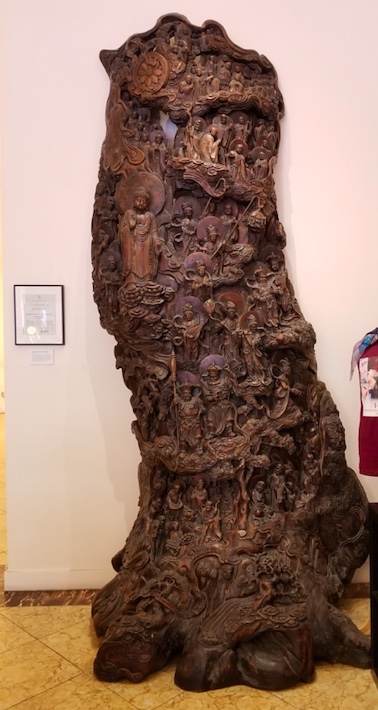
In a world where art manifests itself in countless forms, there are rare instances when we stumble upon something truly extraordinary—a concealed treasure that enthralls our senses and moves us on a deep level. Such a remarkable encounter occurred one fateful day as I explored the gift shop at The International Art Museum of America (IAMA), nestled in the heart of downtown San Francisco. Amidst the vast array of artistic wonders, my gaze became fixated on an exquisitely crafted wood carving—a masterpiece that exuded an ethereal essence of spirituality and profound significance.
This awe-inspiring sculpture, meticulously chiseled from a single tree, originated from China and was skillfully brought to life by gifted folk artists. It portrayed an enchanting realm of spiritual growth and profound accomplishments in Buddhism. Towering at an impressive height of approximately three and a half meters and spanning one meter in width, this artwork was a testament to the dedication and artistry of its creators. Every intricate detail, meticulously carved figures, and delicate embellishments, painted a vivid tableau illustrating the virtues of compassion, enlightenment, and the transformative journey towards Nirvana.
The intricately carved sculpture was a masterpiece that depicted the journey of practitioners from being ordinary to mastering the higher levels of Buddhahood. The figures in the relief were so vividly carved that it was easy to see their progression towards enlightenment and Nirvana. Every detail, from the facial expressions to the flowing cloth, the delicate flowers, and the instruments, was so meticulously presented that it was impossible not to be impressed.
The beauty of this piece lay not just in its stunning visual presentation but also in the message it conveyed. It illustrated the importance of practicing compassion in thoughts, words, and deeds to achieve spiritual growth. It reminded us that every act of kindness, every gesture of love, and every moment of selflessness is a step towards enlightenment and Nirvana.
The sculpture had a calming effect on me. It was a tangible reminder of the power of art to transcend language, culture, and time. It spoke to me in a language that was universal, one that transcended borders and connected people across the world.
As an art lover, I have seen many beautiful pieces over the years, but this wood carving sculpture stood out as a true masterpiece. It was a testament to the skill and craftsmanship of the folk artists who created it, and it served as a reminder of the timeless beauty of art.
Karma literally means action. It refers to the universal law of cause and effect whereby positive actions produce happiness and negative actions produce suffering. You must be willing to rid yourself of evil according to the principles of karmic retribution for doing evil and likewise be willing to do good for the same reasons. Only in this manner will you bring about true happiness and good fortune for yourself and others. All Buddhist disciples must understand cause and effect, but, as Dorje Pa Mu explains, merely understanding this principle is not enough. You must clearly believe in the principle and live accordingly. You must use this principle in your actual practice to solve your worldly problems. You end causes and effects through cultivation whereby you train your mind and correct your erroneous ways so that your actions of body, speech, and mind (also known as your three karmas) correspond with the teaching of your vajra master and the Buddhas. Remember that greed, anger (hatred), and ignorance are the three great obstacles of cultivation.
You must remember that the so-called good effects or bad effects of karma are not a judgment nor given as a reward or punishment by a supra mundane authority such as God. The good or bad effect produced by good or bad karma is purely and simply a natural phenomenon governed by natural laws that act automatically, with complete justice. It is just like the law of gravity and other similar rules. This Law of Karma, or cause and effect, is so powerful that it governs everything in the universe except enlightened beings or those who recognize their basic original nature. Upon enlightenment, the round of cause and effect loses its significance, just as samsara, or the round of birth and death, ceases with enlightenment. Since basic or original nature transcends all duality and is ultimate, there is no one to receive the effect, whether it is good or bad, and no one to whom any effect can apply. This unique explanation by the Buddha of the nullification of the Law of Karma is very important.
H.H. Dorje Chang Buddha III has said, “Thus, only through learning from the Buddha, cultivating the conduct of the Buddha, and ultimately becoming a Buddha can we thoroughly liberate ourselves from the karma (cause and effect) that binds us to the cycle of reincarnation. Cause and effect still exists when one becomes a Buddha. However, cause and effect can not affect a Buddha. For example, the Buddha saw mountains of swords and seas of fire in the hell realm. The mountains of swords and seas of fire continued to exist as extremely painful means by which living beings undergo karmic retribution. When the Buddha suddenly jumped into the mountains of swords and seas of fire in order to undergo suffering on behalf of other living beings, the mountains and seas immediately transformed into a lotus pond of nectar. They transformed into a wonderful state. With respect to a Buddha, all bad or evil karmic conditions turn into the manifestation of good karma. Not only is there no suffering, there is instead a manifestation of great happiness.”
However, until we become enlightened, we must remember that it is as Dharma King Tsongkhapa said, “the things I’ve done, the white or black and what these deeds will bring to me, follow always close behind, as certain as my shadow.”

















 Peace LiLy