Mount Xuedou and Maitreya Bodhisattva

Mount Xuedou and Maitreya Bodhisattva

Located at around 8 kilometers north-west of Xikou Town, Fenghua City of Zhejiang Province, Xuedou Mountain is 800 meters above sea level, featuring graceful mountain ridges, unique cliffs, tempting waterfalls, and deep streams. The mountain has a milky peak, while on the peak there is a dou (meaning hollow or hole). Water flows out of the dou, and it is as white as milk, thus getting the name of the Milk Spring. It is well-known for its serenity, magnificent landscape, and an abundance of greenery. Mount Xuedou Scenic Area was known as “a fairyland on the sea” early in the Han Dynasty (206 BC-220 AD. However it was not popular until the previous president of National Party Jiang, Jieshi promoted it heartly. Xikou is the hometown for this important historical figure Jiang, Jieshi. His family had Buddhism tradition. So when he was young he often went to Xuedou Temple with his mother. He loved its picturesque sceneries, and believed it was the most beautiful place in the country. Later on he built a mansion in Mount Xuedou, he and his family lived there once a while. He even had a plan to promote Mount Xuedou as second Mount Lu, but the plan did not come true, since he left mainland China to Taiwan after the civil war. Therefore, this place becomes more mysterious and interesting for tourists from China and abroad to explore.

The charm of Mount Xuedou lies not only in its picturesque sceneries, it also has held a high status in Chinese Buddhism since ancient times. Located in a scenic site, the Xuedou Temple has a history of over 1600 years and has cultivated numerous eminent monks. It is also the place where Monk Maitreya practiced his Buddhism, thus a large number of eminent monks and pilgrims have been attracted to Mount Xuedou.

Maitreya Bodhisattva is a very popular Buddhist figure in China. Maitreya is a transcendent bodhisattva,he will be the next Buddha in the Saha world. Maitreya means “loving kindness.” In Mahayana Buddhism, Maitreya is the embodiment of all-encompassing love. Maitreya, in Buddhist tradition, presently resides in Tushita heaven.

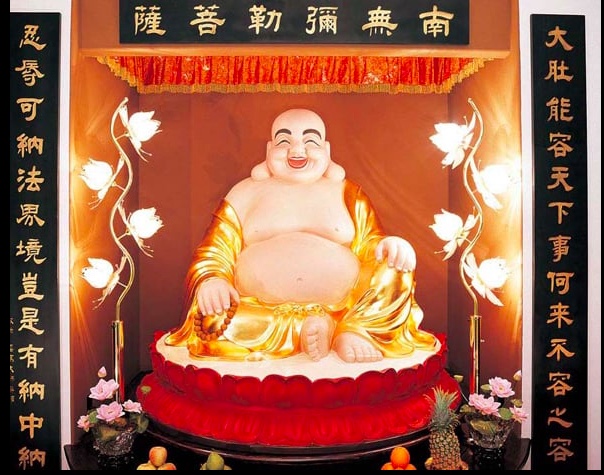
With big belly and jolly smell, he is a symbol of enduring humiliation, optimism and compassion. In Buddhism teaching, disciples should be like the Buddhas and Bodhisattvas. All should have a broad mind, open heart, and great tolerance. The first priority for one who learns Buddhism and cultivates himself is to be patient and forbearing under insult.

In the historical record, there is an eminent Monk named Qichi (契此), who was the incarnation of Maitreya Bodhisattva. This monk lived at the end of WuDai period (right after the Tang Dynasty), and is most well known for his rather fat belly. Since he always carried a cloth bag, people began to call him the cloth bag monk. Unlike the stereotypical image of the strict and severe ascetic, Qichi was a jovial, good-humored man, but no less intelligent and thoughtful. He was loved and respected by all for these qualities. Often, others would ask him, “what is the true meaning of Buddhism?”, and in response, he would drop his bag to the ground. The deepest meaning of Buddhism is to lay down your burdens. Qichi took residence in Xuedou Temple, where he would spread the Buddhist Dharma to all those who came to him. To this day, Xuedou Mountain is regarded as the Holy Land of Maitreya. In honor of the cloth bag monk, statues of the Maitreya Bodhisattva are always depicted carrying a cloth bag.

Xuedou Temple

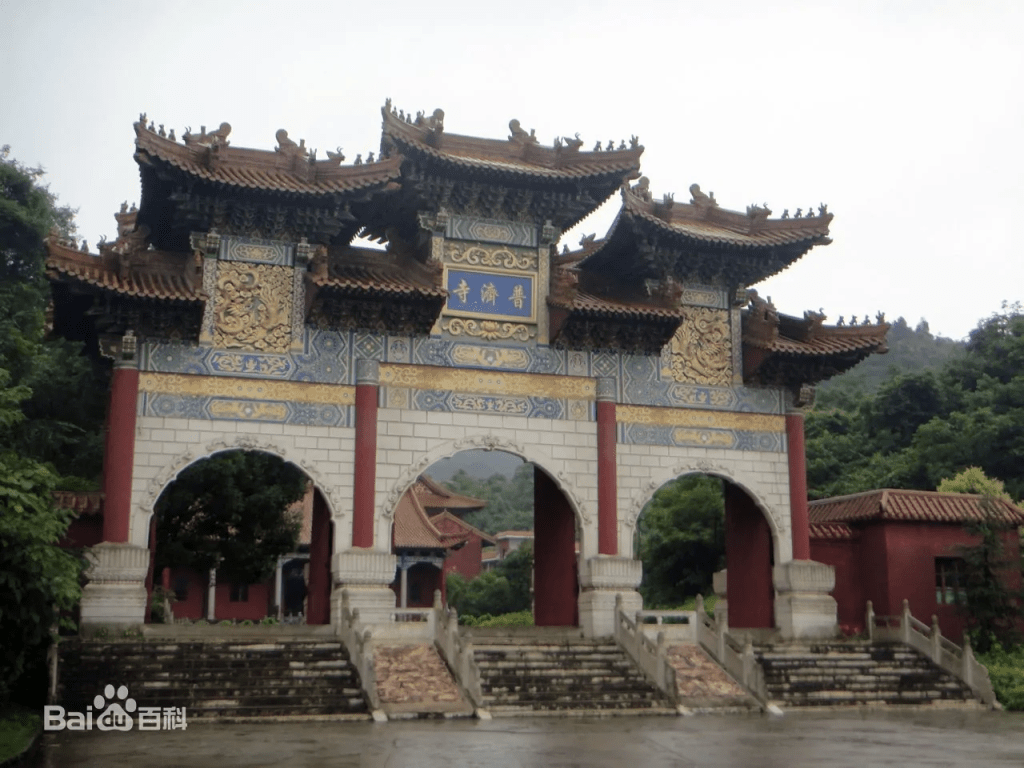
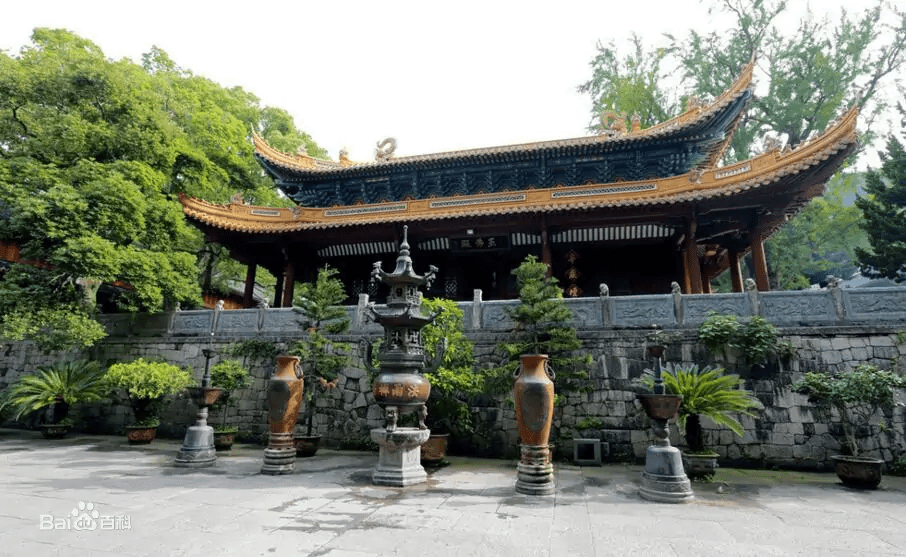
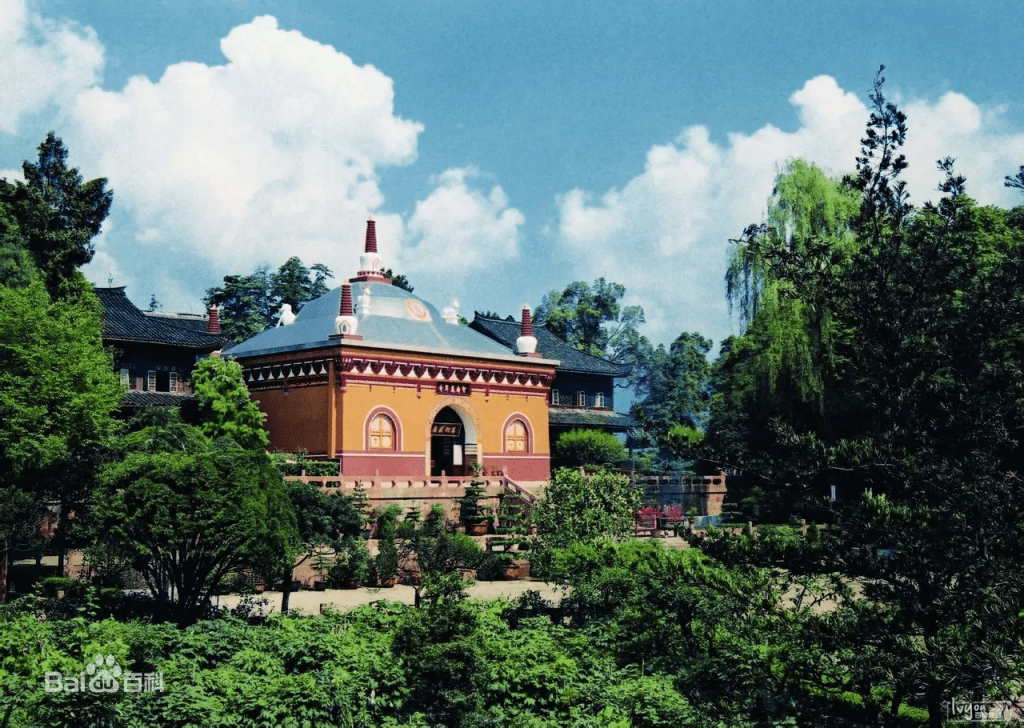
Xuedou Temple was originally founded in the Jin Dynasty. For thousands of years, it has been visited by many people, and has produced numerous eminent monks. It has a high status and is regarded by the Buddhist circle in China as one of the ten most famous Buddhist temples together with the other nine temples, such as Zhongtian, Zhutianning, Wanshou, the Yongzuo Temple of Hangzhou, and the Jiangshan Taiping Xingguo Temple of Nanjing.

During the Tang and Song dynasties, Xuedou Temple had received 41 imperial edicts from emperors of several generations. So far, the temple has stored 5,760 Confucian classics granted by emperors, jade seals, dragon robes, dragon pots and jade Buddhas.

In the temple, the constructions are magnificent and attractive. Outside the temple, ancient trees are towering up into the sky. Among them, two ginkgo trees from the Han Dynasty can be surrounded by about five people. With exuberant leaves, the ginkgoes rise above the clouds.

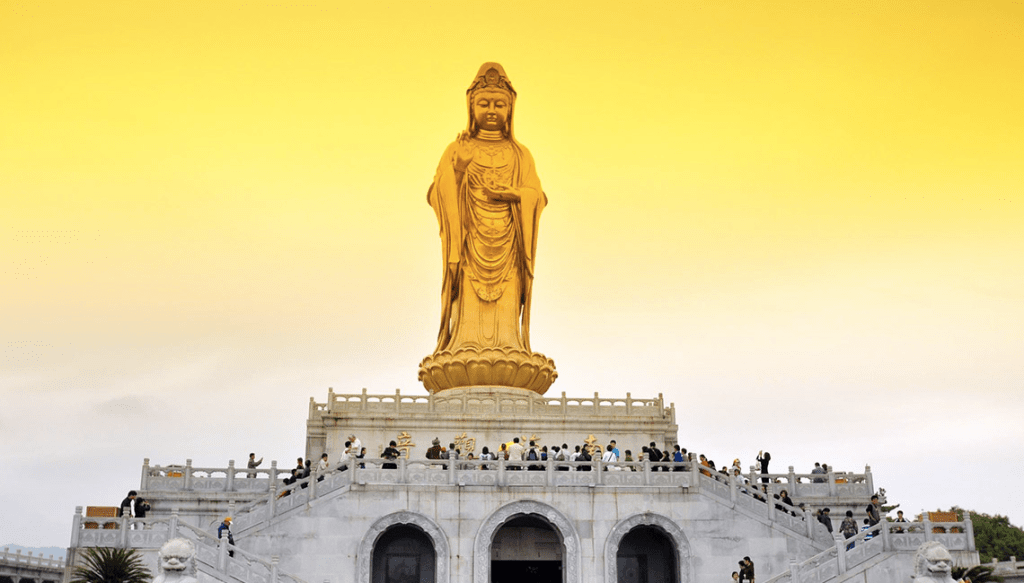
At the back peak of Xuedou Mount, the statue of Maitreya Buddha is the highest copper statue of its kind in the world. The Buddha body is 33 meters high, the lotus seat is 9 meters high, and the base is 14.74 meters high. It completed at 2008, with exquisite workmanship. Having this remarkable structure, Mount Xuedou was officially named as the fifth sacred Buddhist Site, dedicated to Maitreya Bodhisattva. Now, the temple covers a landscape area of over 20,000 sq meters and has perfectly combined natural landscapes and Buddhist culture. 

XueDou Temple Overview

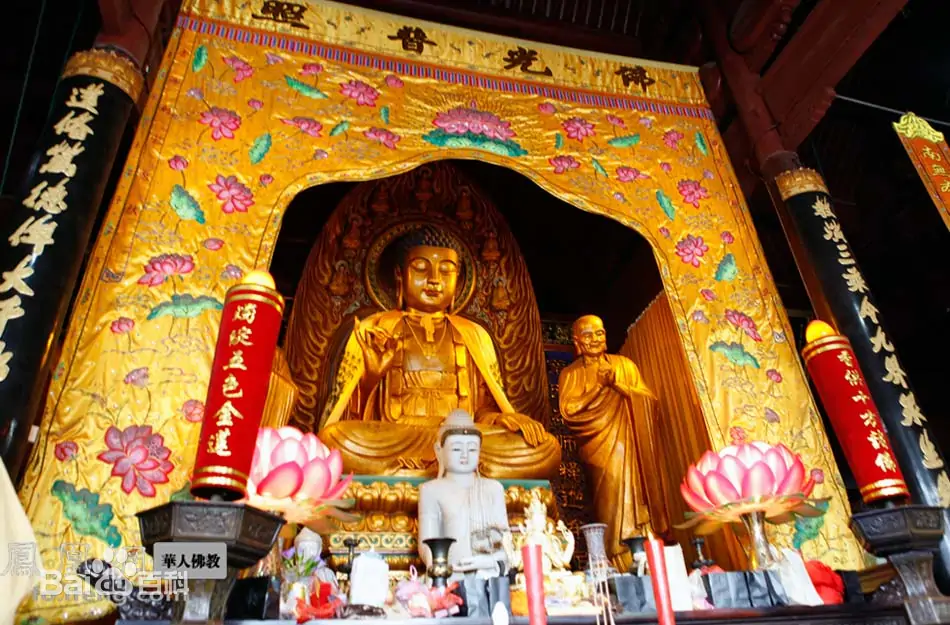
Since Mount Xuedou is dedicated for Maitreya Bodhisattva, there is a Grand Maitreya Hall in the Temple. It is really magnificent and dignified.
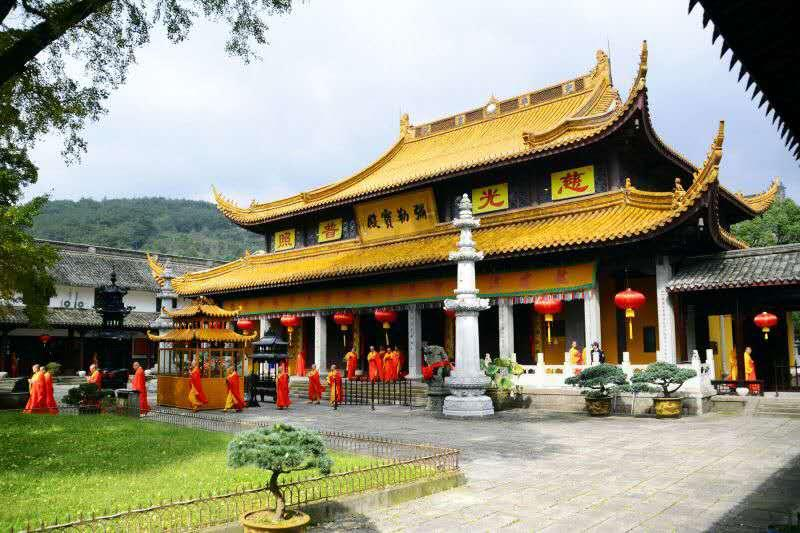
Grand Maitreya Hall
Marvelous Maitreya Statue

Qianzhang Rock Waterfall

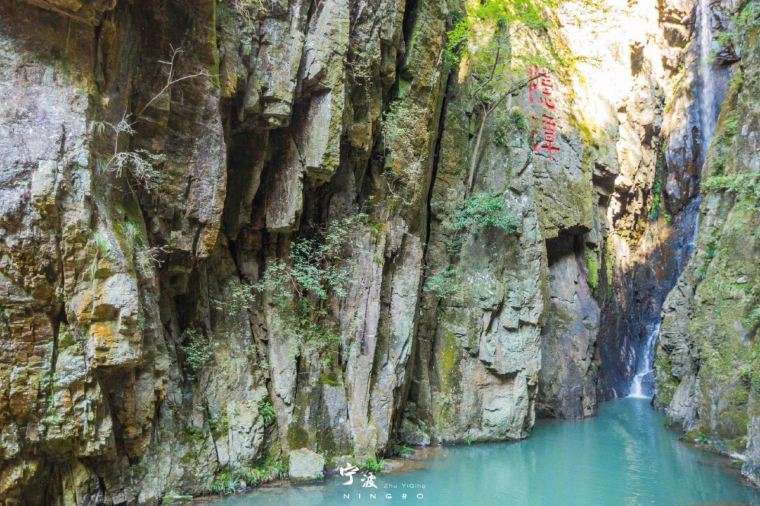
In front of Xuedou Temple, there is a waterfall called Xuedou Waterfall, also known as Qianzhang Rock Waterfall. The water head is in the valleys at the south and the north of Xuedou Temple. The water of the Milk Spring flows into Jinjing Pool (which is an ancient pool developed in the Southern Song Dynasty), crossing Guanshan Bridge and pouring out of the cliff mouth.

The waterfall pours down from Qianzhang Rock. From the top of the rock to the pool, it is as high as 186 meters. At the half-way point, there is a huge rock. In spring and autumn, the rain falls down in a deluge but it runs into the rock at the half-way point and splashes in all directions right away. It falls like pearls and jades, and also dances like snow. Under the sunlight, it forms a rainbow, which is quite splendid. Xuedou Waterfall was well known by the whole nation as early as in the Northern Song Dynasty.

Sanyin Pond Waterfall

Sanyin Pond Waterfall is situated at 5 li north-west of Xuedou Temple. The water flows from Dongao Village (on Xuedou Mountain, there is a village of alpine flowers. With a beautiful and clean environment, the village is an ocean of flowers and seedlings) to the cliff mouth, forming one waterfall; it continues running down the mountainside to the foot, forming three waterfalls. As a result, it is called Sanyin Pond.

With a length of more than 1,600 meters, the pond can be divided into Shangyin Pond, Zhongyin Pond and Xiayin Pond respectively from the highest to the lowest. Shangyin Pond is highlighted by its quietness and danger; Zhongyin Pond stands out for its delicacy and cleanness; Xiayin Pond is well known for its superb beauty. Despite the positions of the three ponds in remote mountains and deep valleys and the difficulty of visiting them, tourists still visit in great numbers.
Miaogao Platform

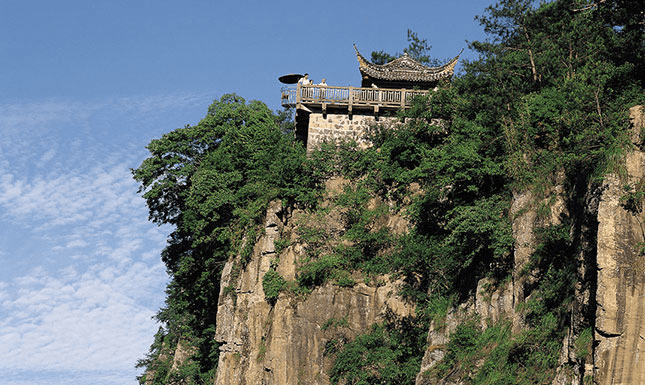
Miaogao Platform is also known as Miaogao Peak or Tianzhu Peak. It is the main scenic spot of the Xuedou landscapes. Although it is only 396 meters above sea level, it stands out against the mountain behind it. With the middle part bulging, three steep cliffs, and a gaping abyss down its side, the platform has a precipitous terrain.

In a narrow sense, Miaogao Platform refers to a platform of about 350 square meters. Standing at the front edge, you can look out on the natural sceneries of Tingxia Lake. On the periphery of Miaogao Platform, ancient trees and green bamboos are thriving so much that they keep the sunlight away. In addition, the clear breeze blows gently. It is an ideal summer resort.
Tingxia Lake

Located at the south of Xuedou, Tingxia Lake is 6 kilometers away from Xikou Town. It is a large artificial lake, with a surface area of 5.9 square kilometers, an equivalent of West Lake in Hangzhou. The water storage capacity is as much as 153 million cubic meters.

Tingxia Lake is a good place to enjoy the landscapes of lakes, mountains, steep peaks and deep valleys. Tingxia Lake is a huge reservoir famous for its position under Yushu Pavilion of Xuedou Mountain and its location at Tingxia Village.

Tingxia Lake has wonderful natural sceneries. On the basis of unique peaks, deep valleys, high mountains and water scenes, interesting and attractive landscapes of lakes and mountains come into being. With clean air and high quality water, the scenic spot is also rich in fish, fruit and forest resources. Tourists can sail on the lake, and can also go fishing, picnicking and camping.

Naturalists and photographers love to visit the Miaogao Platform, Qianzhang Rock, and Qianzhang Crag with its huge, scenic waterfall in the region spanning 85 square kilometers. Mount Xuedou is also a national forest park, a really great place worth of visiting.

Mount Xuedou and Maitreya Bodhisattva

Link: https://peacelilysite.com/2022/08/10/mount-xuedou-and-maitreya-bodhisattva/

 #Buddhism#ClothBagMonk #Buddhist #XuedouTemple#MountXuedou#MaitreyaBodhisattva#Compassion#TravelChina

Source: https://www.trip.com/travel-guide/attraction/ningbo/xuedou-mountain-90600/, https://www.chinahighlights.com/ningbo/attraction/xuedou-mountain.htm

Inspiring Art Creation and Promoting Community Culture Activities

Mission of The International Art Museum of American

Established in October 2011, The International Art Museum of America(IAMA) is a charming and vibrant gallery, full of both exotic and familiar paintings, portraits, and sculptures. Its diverse collection of artwork and education programs promotes art appreciation, culture exchange, and communication between artists and guests. With these qualities, the IAMA hopes to nurture an important spiritual goal: that all people may have a deeper understanding of each other.

Tengergold Gallery

Tendergold Gallery was first introduced by IAMA in early 2018.  The name pays homage to our ever-so-funky neighboring Tenderloin District. While it could undeniably be seen as dark and gritty, it also hosted some of San Francisco’s most exciting underground art scenes and nightlife. At Tendergold celebrated this by bringing art to the light of day from emerging artists, both internationally and from the Bay Area.  Once at this room, a young Syria refugee artist, who live in Greece refugee camp, displayed her paintings, and the income from auction of the drawing was donated to Syria refugee camp. Tendergold Gallery was closed in early 2022 and replaced by Sip Art.

Tengergold Gallery and Artist Interviews 1
Tengergold Gallery and Artist Interviews 2

Lightspace Gallery

Besides collecting timeless and world-class art treasures, the  International Art Museum of America is also mindful of contemporary art creations of all forms.  The museum created a special exhibit dedicated to the modern art of our era. The quarterly rotating exhibit called Lightspace was conceived thereafter beginning in September of 2018. We select outstanding artworks to be on exhibit in the Lightspace Gallery, from photography to mixed media, sculpting, and installation art.

Lightspace Gallery and Artist Interviews 1
Lightspace Gallery and Artist Interviews 2

Culture and Entertaining Events

For ten years, the IAMA has brought the artwork and traditions of many cultures to the residents of San Francisco. It has embraced a mission of bringing happiness and cultural understanding through its various activities and artistic programs. We hope that our work will help bring people all over the world to a greater understanding and harmony.

Mission of The International Art Museum of American

Link: https://peacelilysite.com/2022/08/04/inspiring-art-creation-and-promoting-community-culture-activities/

#MasterWanKoYee #DorjeChangBuddhaIII #HHDorjeChangBuddhaIII#DorjeChangBuddha#IAMA#InternationalArtMuseumofAmerica#SanFrancisco#Art#Artist#CultureExchange

Mount Putuo: Wonders and Thoughts

From trip.com

Mount Putuo: Wonders and Thoughts

By Xuming Bao August 9, 2021

It was late January, just a few weeks before Chinese New Year, when we headed to Zhoushan in Zhejiang Province. It was bitterly cold and traveling to Mount Putuo (普陀) for a two-day visit was not good timing. COVID-19 was—and still is—running rampant around the world. Any kind of travel required constant and painstaking vigilance, including full compliance with stringent prevention measures in China. Nevertheless, our destination  looked as beautiful as ever, a glimmering island in the great ocean, celebrated as the “Buddha-land in the sea.” (Haitian fogou 海天佛國)

Mount Putuo is very environmentally friendly. Except for public buses, no vehicles are allowed, so we had to leave our car at the wharf. Most residents simply cycle around for their daily errands, and even said bicycles are under a quota control. For visitors to move about, you can take a bus, cycle, or simply walk. Roads and pathways are well maintained, and there is a long road that connects all the temples on the island, big or small, affording a pleasant journey at one’s own pace.

It was warm and sunny with a gentle breeze by the time we reached the island in the early afternoon. As there were very few visitors, we could stroll around at our leisure, enjoying the sunlight’s embrace. “You are so lucky,” commented our trip’s docent. “It was so windy in the morning that the ferry service was about to be suspended. In a week, the entire mountain might be closed to prevent the chance of further infections, no matter how sporadic.” We were blessed with the good fortune of a joyful excursion.

Mount Putuo is classified by the Chinese government as an “AAAAA Grade Scenic Resort and Historic Site,” attracting about 10 million visitors each year under normal circumstances. Visitation, though down 40 per cent during the pandemic in 2020, has rebounded sharply; as of April, 2.8 million people had visited Mount Putuo, a fivefold increase. The effort to attract visitors is ongoing: the Putuo Mountain College of the Buddhist Academy of China was recently completed, and Guanyin Dharma Park opened last November.

Putuo is a Chinese transliteration of the Sanskrit Potalaka, which is mentioned in several Buddhist scriptures, including the Gandavyuha Sutra (added as the final sutra in the Avatamsaka Sutra). Potalaka is described as the holy residence of Avalokiteshvara, the bodhisattva of compassion. According to Guang Xing, Mount Putuo was identified as the mythical Potalaka mountain by Buddhist monks and Chinese literati (Guang 2011: 1-22). It has been the pilgrimage site of Avalokiteshvara for about a millennium, honored as one of the four sacred Buddhist mountains in Chinese Buddhism. We speak here of Guanyin, the feminine form of Avalokiteshvara popularized in Chinese Buddhism. We will return to Guanyin below. For now, we simply need to know that Mount Putuo’s status matches that of Mount Wutai (五台) for Manjushri, Mount Jiuhua (九華) for Kshitigarbha, and Mount Emei (峨眉) for Samantabhadra.

There seem to be three main demographics for visitors to Mount Putuo: sightseers, pilgrims, and students of Buddhism. The majority of sightseers are visitors who do not have much knowledge of Buddhism, nor much interest in its history, sutras, or temples. Nevertheless, everyone, regardless of background, recognizes this place as one expecting reverence and respect for the buddhas and bodhisattvas. When we worship and make our wishes before the famous 33-meter statue of Nanhai Guanyin, we are also introspecting, contemplating, and reflecting on the vicissitudes and travails of our lives.

The town nearby is neat and chic, full of activity and interesting souvenirs for tourists to commemorate their visit. Even in the winter, Mount Putuo is generously covered with greenery and vegetation, with a multitude of species including ancient camphor trees and the rare wild plants of Carpinus putoensis (普陀鵝耳櫟). They are one of the major treasures on Mount Putuo and monoecious. There are red and yellow variations coexisting, but they do not mature at the same time, so the pollination rate is extremely low. When the Sun is shining, the leaves of many trees turn golden in the backdrop of the Prussian blue sky, surrounded by the various temples. It is truly a picturesque sight.

Carpinus Putoensis Cheng. From baidu

The beautiful scenery, unique to Mount Putuo, is reminiscent of places I have visited in Japan. The connection between Mount Putuo and Japan can be traced back to the Tang dynasty (618–907), when a Japanese Zen and Tendai monk-pilgrim named Egaku (Chinese: 慧鍔; Hui’E) wanted to bring a statue of Guanyin from Mount Wutai to Japan. However, his voyage back via Mount Putuo was hampered by storms and waves despite several attempts. One day, Egaku had a dream in which he realized that the statue of Guanyin did not want to leave. He decided to enshrine it and built a simple hut near the Tidal Sound Cave. Immediately, his ship sailed through and he was able to return to Japan. This is the story of Guanyin “bu ken qu” or “unwilling to go,” and is the source of many folktales surrounding the establishment of temples and monasteries on Mount Putuo. Exchanges between Mount Putuo and Japan continued over many centuries.

Guanyin is the real protagonist linking Japan and China, with Guanyin known as Kannon or Kanzeon in Japan. Belief in this personification of compassion and benevolence has a long history in China. First introduced from India in the Western Han dynasty (202 BCE–9 CE), Avalokiteshvara was adapted and amalgamated into Chinese culture, most famously through the female figuration and her unique 32 transformations (Guang 2011: 1-22). Beginning in the Song dynasty (960–1279), the Chinese transformed the bodhisattva into the Goddess of Mercy, depicted in the feminine. (Minneapolis Institute of Art)

Belief in Guanyin has flourished in China ever since, going beyond even religious boundaries in everyday life (Guang 2011: 1-22). She is not confined to monastic life, as it is said in the Universal Gate chapter of the Lotus Sutra that any worldly being in danger will be delivered instantly on calling her name. Therefore, Guanyin has been worshipped and revered by all classes of people. As she is a compassionate divinity with countless virtues and merits, she is endowed with transcendental power. She excels in skilful means, allowing her to appear in whatever form needed by sentient beings. And that, in my opinion, is probably the reason behind the 32 forms in the Chinese tradition, including Guanyin Yangzhi (楊枝), or Willow Branch Guanyin. The Guanyin Yangzhi is only one example among many of her history-rich gender transitions.

Willow Branch Guanyin. From online source

We were able to visit a 2.5-meter-high, 2.2-meter-wide monument of Guanyin Yangzhi at a nunnery of the same name. The nunnery, situated at the foot of Putuo’s Western Xiangwang Peak, was built in 1608. The artistic style was pioneered by Yan Liben (閻立本), a famous figure painter in the Tang dynasty, while the stele’s engravings appeared during the Ming dynasty (1368–1644). Holding a tender willow branch in her right hand and a clear water vase in the left, Guanyin is luxuriously crowned with pearls and precious stones, dressed in sumptuously embroidered garments, and adorned with agate, amber, and pearls. She spreads dewdrops to all the world’s quarters to dispel suffering and pain.

Guanyin is replete with the marks of beauty, dignity, and calm. Except for her face, there are not many traditionally female features shown. Indeed, she appears tall and somehow mighty and masculine, standing on her bare feet. Her belly bulges out slightly, and she has large hands and feet. While beholding her, I could not help but think of the mural of Padmapani, another manifestation of Avalokiteshvara, at Ajanta Cave No.1, in India. Painted during the sixth century BCE, the bearer of the blue lotus is a male figure with a slender body. Both forms of Avalokiteshvara are crowned and bejewelled, have physically beautiful features, and appear composed and graceful.

Padmapani, Ajanta Cave 1. From alamy.com

There are many temples on Mount Putuo, but the two most well known are Puji Temple (普濟寺) or the “front temple” (又稱前寺), and Huiji Temple (慧濟寺) on the peak of the mountain. They receive the most pilgrims, but Fayu Temple (法雨寺) is my personal favorite; when there is no pedestrian crowding, it has a gentle and soothing atmosphere. It is surrounded by towering ancient trees, suspending the visitor in time between past and present. From a distance, one can see that the gate to the monastery is unique, unlike those of other temples on Mount Putuo, which are painted in yellow ochre. Here it is light red in color: a soft, ambient hue that emphasizes an atmosphere of paradisical peace and bliss.

Upon entering and reaching the main hall of Nine Dragons, where a statue of Guanyin is enshrined, one feels a strong sense of sublime and resplendent majesty. Yuantong Hall of the Fayu Temple is renowned for its resplendent appearance and ingenious interior structure, with a large ball hanging from the ceiling of its dome surrounded by nine vertical rafters. Each rafter is carved with a dragon that rears its head in a scramble for the ball. This intricate layout is called the Bracket with Nine Coiling Dragons and is ascribed to Emperor Kangxi (康熙) (1654–1722), who used the materials of the former palace of the Ming dynasty in Nanjing to reconstruct an earlier monastery, Zhenhai Monastery, on Mount Putuo. 

Fayu Temple. From the author

What strikes me most, however, is not Fayu Temple’s imperial heritage, but rather two great minds that made their mark here. Venerable Yinguang (印光) (1861–1940) was the 13th patriarch of the Pure Land tradition and the abbot of Fayu Temple for decades. Meanwhile, Ven. Hongyi (弘一) (1880–1942) wrote in traditional calligraphy Fayu Temple’s nameplate of “heavenly flowers and Dharma rain”—first devised by Emperor Kangxi. Li Shu Tong (李叔同) was Hongyi’s secular name. A wealthy and rakish young man, he was also an eclectic and learned scholar of high culture. He relinquished what he possessed and committed to living a monastic life. Fully devoted to promulgating Buddhism, he rose to become an eminent monk.

At some point, the two monastics met each other. It is said that Master Hongyi admired Master Yinguang and asked him to be his teacher. Humble and modest, Master Yinguang refused, but invited him to stay as long as he wanted. The two spent seven days together, studying, practicing, and meditating without a single word exchanged. They simply were, as minds think alike, without verbal obstructions, thoughts traveling and flowing effortlessly. How wonderful it is to exist together beyond words. But in the era of the Internet, we are bombarded with so many words and so much information that we lose our sense of their meaning, let alone their authenticity.

If we wish to be heard, we need to be sincere, candid, and heartfelt. “Guanyin” in Chinese means the Perceiver of Sounds, or “Guanshiyin,” the Perceiver of World’s Sounds. As chanted in the Universal Gate chapter of the Lotus Sutra: “Perceiver of the World’s Sounds, heavenly voice, the voice of the sea’s tide—magnificent, rich and harmonious surpassing all worldly sounds.” If we keep Guanyin in our hearts and call on her sincerely, she will always respond.

Mount Putuo: Wonders and Thoughts

Link:https://peacelilysite.com/2022/07/17/mount-putuo-wonders-and-thoughts/

Source: https://www.buddhistdoor.net/features/mount-putuo-wonders-and-thoughts/

#Avalokiteshvara#Buddhism#BuddhistPilgrimage#ChineseBuddhism#compassion#Fayu temple#Guanyin#GuanShiYin

Jesus was a Buddhist Monk BBC Documentary

Jesus was a Buddhist Monk BBC Documentary

Many years ago, I have read an article about Zen Buddhism Master XuYun’s conversation about Christianity and Buddhism with previous presidents of Nationalist Party Mr. Jiang Jie Shi (蔣介石). Master XuYun said Jesus Christ learned buddhism in Indian, he reached enlightenment, and then went back to found Christianity. Even though I knew Master XuYun was a truly holy and virtuous, I was quite doubtful about his opinion.

However when I watched the documentary file below, I was quite convinced. At any rate, the unity and cooperation of these two religions could do a great contribution to peace in the world.

This BBC 4 documentary examines the question “Did Jesus Die?”. It looks at a bunch of ideas around this question until minute 25, where this examination of ideas takes a very logical and grounded turn with surprising conclusions that demonstrates that the three wise men were Buddhist monks who found Jesus and came back for him around puberty. After being trained in a Buddhist Monastery he spread the Buddhist philosophy, survived the crucifixion, and escaped to Kashmir, Afghanistan where he died an old man at the age of 80.

Jesus was a Buddhist Monk BBC Documentary

Link: https://peacelilysite.com/2022/07/15/jesus-was-a-buddhist-monk-bbc-documentary/

#Buddhism#ZenMaster#XuYun#Christianity#JesusChrist#Crucifixion

Mount Putuo – Buddhist Land on The Sea

Mount Putuo – Buddhist Land on The Sea

Mount Putuo is one of the four sacred mountains in Chinese Buddhism, lies in the East China Sea and incorporates the beauty of both mountain and sea, and honored as the Buddhist Land on the Sea. Its area is approximately 12.5 square kilometres (4.8 sq mi) and there are numerous famous temples. Mount Putuo has been a pilgrimage site for over a thousand years. After the Tang dynasty, Mount Putuo became a center of Avalokitasvara (Guanyin) worship.

In 863, a Japanese monk called Hui E aimed to carry a statue of Avalokitasvara from Mount Wutai to his country by ship. However, when the ship was passing through the sea nearby Mount Putuo, it was prevented by the stormy waves and hundreds of iron lotus flowers suddenly appeared on the sea, blocking the way. Monk Hui E believed that Avalokitasvara didn’t want to leave China. So he knelt down on the bow of the boat and silently prayed to the Bodhisattva Avalokitasvara for instructions. After a while, the iron lotus on the sea disappeared, and the boat drifted to the shore of Mount Putuo, where he built a temple in the purple bamboo forest to enshrine the statue of theBodhisattva. From that time, Mount Putuo got the spirit and became the bodhimanḍa of Bodhisattva Guanyin.

Traditionally there were three main temples: The Puji Temple (founded 10th cent.), the Fayu Temple  (founded 1580 CE), and the Huiji Temple (founded 1793 CE).  Today, there are more than 30 major temples located at Mount Putuo. In addition to these monasteries, there is the Institute of Buddhism, one of the largest Buddhist academic institutes in China.

Puji Temple

Puji Temple is the main temple of Mount Putuo and all important Buddhist activities are held here. Covering an area of 37,019 square meters, it contains Grand Yuantong Palace, Hall of Heavenly Kings, Depository of Buddhist Sutras and 357 other buildings. Grand Yuantong Palace is the main hall which houses an 8-meter-high statue of Guanyin surrounded by 32 Bodhisattva with different costumes in a variety of poses on east and west walls. Haiyin Pond in Puji Temple was a free life pond full of spring water primitively and now a lotus pond. At the night of summer, the gorgeous lotus and bright moonlight compose an attractive scenery. 

Puji Temple
Haiyin Pond in Puji Temple

Fayu Temple

Fayu Temple was built along the uphill with grand building groups and extraordinary manners. It got such a name in that you could see amazing relives of nine dragons are fighting for pearl on the screen wall before the gate of Halls of Heavenly Kings. Among the 294 halls of Fayu Temple, Nine Dragons Guanyin Palace(also called Grand Yuantong Palace), said to be a Buddhist Temple transported from the imperial palace of Ming Dynasty, acts as the most magnificent one. The highlighted part of this palace must be the Nine Dragons Caisson Ceiling. With unique shapes and vivid images, it enjoys high artist value and is listed in Three Treasures of Mount Putuo.

FaYu Temple
Delicate Carvings in Nine Dragons Screen Wall

Huiji Temple (惠济禅寺)

Huiji Temple is perched in Foding Mountain, the highest peak of Mount Putuo. The architecture of the whole temple is unique. It is located on the mountain and is arranged horizontally. The hall is spacious and magnificent. Hidden in a luxury forest, Huiji Temple features in peaceful environment. Standing at the peak of Mount Putuo, you can have a distant view of the mountains, sea, reefs, beaches and buildings. In the whole temple, statues, carvings and pictures of Guanyin can be found everywhere.

Grand Huiji Temple
Status of Guanyin Bodhisattva

Statue of Standing Nanhai Guanyin

Standing in the south Shuangfeng Peak, Statue of Standing Nanhai Guanyin is the largest outdoor statue of Guanyin made from copper in Asia. With an 18-meter-high statue, 2-meter-high lotus and 13-meter-high foundation, the whole structure has two stories in its foundation. The first story displays elegant carvings, while the second story houses 500 statues of Guanyin in different poses. On the consecrating day at year 1997, a strange nature phenomenon happened. Before the consecrating ceremony, the sky was full of dark cloud and it seemed that it would rain soon. However, as the ceremony began, it became sunny as if two hands pushed aside the clouds. A beam of sunlight just casts on the Guanyin statue.

Statue of Nanhai Guanyin

Avalokitasvara, Guan Shi Yin in Chinese, means the Perceiver of World’s Sounds. The Lotus Sutra says: “Perceiver of the World’s Sounds, heavenly voice, the voice of the sea’s tide—magnificent, rich and harmonious surpassing all worldly sounds.” The bodhisattva always help all beings in danger and distress and is willing to bear the pain of all beings. There are many stories and folk tales about the bodhisattva’s infinite mercy and compassion.

If we hold the bodhisattva in our hearts and call on her sincerely, she will always respond. I had a personal experience. You can read my story here: Guan Shi Yin Bodhisattva saved my life

Fortunately for us, H.H. Dorje Chang Buddha III has brought the powerful Dharma to this world: the Avalokiteshvara Bodhisattva Great Compassion Empowerment Dharma (觀音大悲加持法). This Dharma does not require the practitioner to have any Dharma powers or holy realization. As long as you have the power of the lineage, that is sufficient. You can succeed the same day you take up the practice of it. The next day, you can convene people, empower them, and lead them into a supernormal state. Many Buddhist disciples have participated the dharma assembly and recorded their true extraordinary experience. Click here to read some example articles: 1. Dharma Assembly of Empowerment by Guan Shi Yin Bodhisattva’s Mind of Great Compassion ——Note Written Afterwards to Describe the Most Magnificent Scene at the Site,2. Guan Yin Bodhisattva of Great Compassion Empowerment Dharma Assembly- ——A Personal Experience Written Afterwards to Describe the Most Magnificent Scene at the Site.

May the greatly loving and compassionate Namo Guan Shi Yin Bodhisattva bless all beings!!!

Mount Putuo – Buddhist Land on The Sea

Link:https://peacelilysite.com/2022/07/13/mount-putuo-buddhist-land-on-the-sea/

#MountPutuo#BuddhaLandonTheSea#DorjeChangBuddhaIII#HHDorjeChangBuddhaIII#DorjeChangBuddha#BuddhaDharma#Avalokitasvara#Bodhisattva#GreatMercy#Compassion#Empowerment#Buddhism#Temple#PuTuoShan#GuanYin#GuanShiYin

Source: https://en.wikipedia.org/wiki/Mount_Putuo, https://www.chinadiscovery.com/zhejiang/putuoshan-mountain.html

After Generating Great Compassion in Mind, Master Asanga Was Able to Meet Maitreya Bodhisattva

After Generating Great Compassion in Mind, Master Asanga Was Able to Meet Maitreya Bodhisattva

Maitreya is a transcendent bodhisattva,he will be the next Buddha in the Saha world. Maitreya means “loving kindness.” In Mahayana Buddhism, Maitreya is the embodiment of all-encompassing love. Maitreya, in Buddhist tradition, presently resides in Tushita heaven.

Maitreya Bodhisattva Statue in Hua Zang Si Temple San Francisco

Master Asanga was born with uniquely deep talent and wisdom from his past lifetimes. When studying sutras and commentaries, he was able to understand the meaning with a quick reading. Later, he practiced meditative concentration and became free of desires. He repeatedly thought about the “meaning of emptiness” but was unable to deeply understand and explain it. He was quite unhappy for that. An Arhat named Pindola-Bharadvaja heard about his difficulty and came to him to teach “the Small-Vehicle (Hinayana) School’s view of emptiness.” Then, he practiced contemplation according to the teaching and achieved a deep understanding. However, Master Asanga was still not satisfied after learning the Small-Vehicle School’s view of emptiness because he still did not have perfect answers for many doubts and questions he had.

At that time, the teaching of Mahayana Buddhism (the Large Vehicle) was available from Maitreya Bodhisattva. However, to receive Maitreya Bodhisattva’s teaching in person, one must successfully enter into the state of concentration. Due to his urge to quest for the dharma, Master Asanga longed for the opportunity to meet Maitreya Bodhisattva in person to be taught with the dharma. Therefore, he chose a mountain cave in a sparsely populated area and began practicing cessation and contemplation diligently.

As time was flowing away continuously, six years elapsed. Master Asanga still was unable to see Maitreya Bodhisattva while practicing concentration in the cave. A thought came up in his mind, “If it is impossible to see Maitreya Bodhisattva, I should just give up!” Thus, he decided to take a break from cultivating and practicing in the cave. He put on his regular clothing and walked out of the cave. On his way of coming down from the mountain, he saw a white-haired elder lady, who held an iron stick and was laboriously grinding it on a flab of stone. The scene caught Master Asanga’s attention.

“Elder lady. May I ask what you are doing?” Master Asanga asked.

“Oh, I am grinding this iron stick into a thin needle.”

“You are grinding it into a thin needle?” Master Asanga was very much astonished and also greatly moved. He thought, “This elder lady was willing to grind it day after day with a seemingly silly movement. In contrast, as a cultivator, I could not adhere to practicing true Buddha-dharma to pursue wisdom.” The arising of this extremely precious thought caused Master Asanga to introspect himself and generate humility in mind. Then, he returned to the cave to devote himself into the difficult and hard cultivation and practice once again.

During the next three years, Master Asanga still did not make any achievement. Another thought rose in his mind, “Why should I waste time? It is simply impossible to see Maitreya Bodhisattva!” So he again broke his practice in retreat and went down the mountain. This time, he met a person, who was using a feather to scrub an enormously big rock. Master Asanga asked that person what he was doing. That person said, “This big rock blocks sunlight. I am grinding it to make it smaller, so that sunlight can shine into my room.” Upon hearing that, Asanga was alerted and began to introspect himself, “This person can be so unyielding in doing such a ridiculous thing. Comparing to him, I am so ashamed. I receded from my determination just because of a small setback!” With regret he again returned to his retreat chamber in the mountain.

Photo by Pixabay on Pexels.com

Thus, another three years passed. Master Asanga was still unable to see Maitreya Bodhisattva appearing. At last, he receded from his determination once more. With discouragement, he left the retreat chamber again. On the way of coming down from the mountain, he saw a dying old dog, whose body had already begun to rot. The wounds were totally covered by maggots that were diffusing an awful stench. Compassion rose in Master Asanga toward this dog. He cut off a piece of flesh from his own body to feed the dog and also intended to remove the many maggots from the dog’s wounds. At that time, Master Asanga thought, “These maggots have very tender and fragile bodies. If I use my coarse fingers to move them, they will definitely be harmed.” Therefore, he decided to use his tongue to carefully lick up the maggots to move them to an inhabitable place for them. However, those maggots really looked very terrible. Master Asanga had to kneel on the ground and close his eyes. He then lowered his body to lick the maggots with his tongue.

As he was lowering his body, Master Asanga actually felt that his tongue was touching the ground. He opened his eyes and saw that the dog was no longer there. The solemn and majestic Maitreya Bodhisattva was standing in front of him. After the moment of excitement, Master Asanga asked Maitreya Bodhisattva, “I wholeheartedly prayed and beseeched you, revered Bodhisattva, to manifest before me for the last twelve years. Why didn’t you?”

Maitreya Bodhisattva replied, “Starting from the first day when you entered the retreat and began to pray, I was with you and next to you at every moment. However, due to the obstruction by your karmic forces, you were never able to see me. Through your diligent cultivation and practice during these twelve years, most of the karmic hindrance has been purified. Additionally, you generated great compassion in the occasion that just passed. Now all your karmic hindrance has been removed. That is why you can see me now! If you do not believe what I said, you can carry me on your shoulder and walk around at the market to see if people can see me.”

Thus, Master Asanga carried Maitreya Bodhisattva on his shoulder and walked to the market. While walking, he yelled to people, “What do you see that is on my shoulder?” People all thought that he had mental problems. They laughed and said, “There is nothing!” Only one old lady said that he was carrying a dog with scabies. Thus, Master Asanga was totally convinced and free of any doubt. Uncommon respect and faith rose in him toward Maitreya Bodhisattva.

After meeting Maitreya Bodhisattva, Master Asanga politely sought teaching from the Bodhisattva. Maitreya Bodhisattva asked, “What do you want to learn?” Master Asanga said, “My wish is to propagate the Mahayana Dharma.” Maitreya Bodhisattva was delighted to hear that and brought him to the pure land within the Tusita Heaven. Maitreya Bodhisattva expounded to him the precious views of Mahayana Buddhism and the “Five Shastras (Commentaries) by Maitreya.” The teachings enlightened Master Asanga like pushing away clouds to see the Sun. Many doubts that he had had before were completely removed. Since then, he followed Maitreya Bodhisattva’s teaching to dedicate himself to study “the View of Emptiness of Mahayana Buddhism.” Maitreya Bodhisattva gave him a series of discourses and also explained the essence of the Mahayana sutras to him in detail. Master Asanga was enlightened from listening to the teachings and basically gained the understanding and proficiency in the sutras and shastras of Mahayana Buddhism. Later, Master Asanga also practiced the Dharma of Sunlight Samadhi. Through learning and practicing diligently, he eventually attained holy accomplishment. From then on, he was able to understand what he could not before and could forever remember all Buddhist scriptures he read. Later, he built a big lecture hall and dedicated himself to expound all Mahayana sutras to the great masses.

Master Asanga lived in the world for 150 years and made great contributions to the undertaking of widely propagating the teachings and dharmas of Mahayana Buddhism. He benefited countless living beings.

After Generating Great Compassion in Mind, Master Asanga Was Able to Meet Maitreya Bodhisattva

Link: https://peacelilysite.com/2022/07/08/after-generating-great-compassion-in-mind-master-asanga-was-able-to-meet-maitreya-bodhisattva/

#HHDorjeChangBuddhaIII #DorjeChangBuddhaIII #DorjeChangBuddha#Buddha #Dharma #Sharing #benefit #Buddhism #Koan #Buddhist #temple #dharma#MaitreyaBodhisattva#Compassion

Mount Emei – Bodhimanda of Bodhisattva Samantabhadra

Mount Emei – Bodhimanda of Bodhisattva Samantabhadra

Mount Emei is one of the “Four Famous Buddhist Mountains” in China. It has steep terrain and striking beautiful scenery. “Emei” is a term used to describe a woman’s beautiful eyebrows in an ancient book titled The Book of Songs. The main peak, Golden Summit of Wanfoding, is 3,099 meters above sea level, it is the crown of all other famous mountains in China.

Mount Emei (Emeishan) is an area of exceptional cultural significance as it is the place where Buddhism first became established on Chinese territory and from where it spread widely through the East. The first Buddhist temple built on the summit of Mount Emei was in the 1st century CE. It became the Guangxiang Temple, receiving its present royal name of Huazang in 1614. The addition of more than 30 other temples including the Wannian Temple founded in the 4th century containing the 7.85m high Puxian bronze Buddha of the 10th century, and garden temples including the Qingyin Pavilion complex of pavilions, towers and platforms dating from the early 6th century; the early 17th century Baoguo Temple and the Ligou Garden (Fuhu Temple) turned the mountain into one of Buddhism’s holiest sites.

Mount Emei Jinding Massive Statue of Bodhisattva Samantabhadra

On Mount Emei, the importance of the link between the tangible and intangible, the natural and the cultural, is uppermost. Mount Emei is a place of historical significance as one of the four holy lands of Chinese Buddhism. Buddhism was introduced into China in the 1st century CE via the south Silk Road from India to Mount Emei. Mount Emei is traditionally regarded as the bodhimaṇḍa, or place of enlightenment, of the iconic bodhisattva Samantabhadra (Puxian). In Buddhist sutra, it is recorded that Samantabhadra Bodhisattva rides a white elephant with six tusks. Therefore, the statues of Samantabhadra in the temples of Mount Emei mostly ride on white elephants. There is an Elephant Washing Pool in Mount Emei as well.

Samantabhadra Bodhisattva is associated with Buddhist practice and action. In the Āvataṃsaka-sūtra, the Buddha states that Samantabhadra Bodhisattva made ten great vows in his path to full Buddhahood:

  1. To pay homage and respect to all Buddhas.
  2. To praise the Thus Come One-Tathagata.[3]
  3. To make abundant offerings. (e.g. give generously)
  4. To repent misdeeds and evil karmas.
  5. To rejoice in others’ merits and virtues.
  6. To request the Buddhas to continue teaching.
  7. To request the Buddhas to remain in the world.
  8. To follow the teachings of the Buddhas at all times.
  9. To accommodate and benefit all living beings.
  10. To transfer all merits and virtues to benefit all beings.

The ten vows have become a common practice in East Asian Buddhism, particularly the tenth vow, with many Buddhists traditionally dedicating their merit and good works to all beings during Buddhist liturgies.

From ancient times to the present, there have been many eminent monks and great virtues in Mount Emei. The thirteenth patriarch of Emei Master Pu Guan, and abbot of JiuLaoDong XianFeng temple Master Guo Zhang, were all disciples of H.H. Dorje Chang Buddha III. They both received Great Dharma initiation from H.H. Dorje Chang Buddha III and reached liberation. At year 1998, Master Pu Guan passed away in the meditation posture having attained control over his life and death. Eight years after his passing, he still sits in a stupa in that meditation posture without having rotted at all. At year 2015, Master GuoZhang passed away at 108 years-old, at the Western Sichuan University Medical center. Doctor diagnosed the Master passed away. Unexpectedly, after a few hours, he was resurrected and opened his eyes, he then ordered his disciples to move him back to Jiewangting Temple to officially pass away. Eleven days after he passed away, local government officials visited Jiewangting Temple. They didn’t believe that the master was a profound practitioner. So he stabbed his body with needles, and blood spurted out.

Mount Emei is an area of striking scenic beauty. It is considered to be one of the most beautiful mountains in China.

Amazing Scenery of Sun rise over clouds at Golden Summit of Mount Emei

Mount Emei – Bodhimanda of Bodhisattva Samantabhadra

Link:https://peacelilysite.com/2022/07/07/mount-emei-bodhimanda-of-bodhisattva-samantabhadra/

#DorjeChangBuddhaIII #HHDorjeChangBuddhaIII  #MasterWanKoYee #Buddha#MountEmei#liberation#SamantabhadraBodhisattva#Meditation#EminentMonk#MasterGuoZhang#MasterPuGuan#GoldenSummit#TenGreatVows

Source: https://en.wikipedia.org/wiki/Mount_Emei, https://whc.unesco.org/en/list/779/

Aloneness to Oneness

Aloneness to Oneness – Life Changing Spiritual Documentary Film on Non-duality

If we could hear all frequencies of sound and see all spectrum of light, then we will have different view and deeper understanding of the world that we live in.

Only 5% of the stuff in our universe is made up of normal matter, but that is where most of us put 100% of our focus and attention. This creates an illusion of separateness where we believe we are alone and that when our material body dies, that’s the end. We even call this stuff “matter” because we believe it is all that matters. But, the other 95% of stuff in our universe is made up of energies and a mysterious dark matter, which actually govern our universe, our bodies, our experiences and our lives. This non-material universe can also be called the spiritual universe. As we tap into this spiritual dimension, we start to see how all things are connected, we see relationships, we feel energies, we sense intuition, and we discover the true nature of our mind. Todd Perelmuter takes us on a spiritual journey, from Aloneness to Oneness, where borders and barriers disappear, and open hearts and open minds take hold. It takes us to a place where anger, greed, hatred and fear cease to be, and only love, joy, peace and gratitude remain. Todd Perelmuter studied meditation and mindfulness from world-renowned teachers around the world for over 9 years. Upon his return to the States, he created EastWesticism, a nonprofit dedicated to helping everyone reach their highest potential and lead a peaceful, calm, and stress-free life.

Aloneness to Oneness – Life Changing Spiritual Documentary Film on Non-duality

It is a very beautiful narrated movie, delivered a profound life messages. However I can’t totally agree with some parts, such as the concept of oneness, because I haven’t had that experience yet, so don’t know what this “oneness” really feels like. To me this is still an abstract concept, and until I can experience it myself I cannot say I truly understand it. Base on my very shallow knowledge of Buddhism, the experience of oneness has many levels. basically there are four levels in Arahant , and 12 stages in Bodhisattva, the higher the stage the greater achievement. Buddha is the only one that has truly reached oneness with everything in the universe. Again, this is just my own understanding, I haven’t experienced any level of the holy being yet. But I hope this short movie will inspire you to find your own spiritual journey, and find the ultimate truth about life and universe.

May Buddha, God and all holy beings Bless us ALL!

Aloneness to Oneness – Life Changing Spiritual Documentary Film on Non-duality

Link: https://peacelilysite.com/2022/06/23/aloneness-to-oneness/

#DocumentaryFilm#SpiritualFilm#Meditation#Death#Oneness#Aloneness#ToddPerelmuter#Buddhism#Arahant#Bodhisattva

Source: https://www.youtube.com/watch?v=9M56t0UoW5M&t=841s

Ashoka, the Emperor Who confessed His crimes and Renounced War

Ashoka, the Emperor Who confessed His crimes and Renounced War

Ashoka is a king who truly deserves the title of Great. Unlike other “great men”, he earned his title not with blood and war, but rather through peace. He conquered what Alexander and Caesar never could: his desire to conquer.

Ashoka, also spelled Aśoka, (died 238? BCE, India), last major emperor of the Mauryan dynasty of India. His vigorous patronage of Buddhism during his reign (c. 265–238 BCE; also given as c. 273–232 BCE) furthered the expansion of that religion throughout India. Following his successful but bloody conquest of the Kalinga country on the east coast, Ashoka renounced armed conquest and adopted a policy that he called “conquest by dharma” (i.e., by principles of right life).

According to his own accounts, Ashoka conquered the Kalinga country (modern Orissa state) in the eighth year of his reign. The sufferings that the war inflicted on the defeated people moved him to such remorse that he renounced armed conquests. It was at this time that he came in touch with Buddhism and adopted it. Under its influence and prompted by his own dynamic temperament, he resolved to live according to, and preach, the dharma and to serve his subjects and all humanity.

Ashoka’s visit to the Ramagrama stupa Sanchi Stupa 1 Southern gateway. For interpretation see: Ashoka in Ancient India by Nayanjot Lahiri, Harvard University Press, 2015 p.295-296

Ashoka repeatedly declared that he understood dharma to be the energetic practice of the sociomoral virtues of honesty, truthfulness, compassion, mercifulness, benevolence, nonviolence, considerate behaviour toward all, “little sin and many good deeds,” nonextravagance, nonacquisitiveness, and noninjury to animals. He spoke of no particular mode of religious creed or worship, nor of any philosophical doctrines. He spoke of Buddhism only to his coreligionists and not to others.

Further more, apart from banning royal hunting, he also introduced veterinary clinics for animals, the Mauryan Empire under Ashoka has been described as “one of the very few instances in world history of a government treating its animals as citizens who are as deserving of its protection as the human residents”

A sample quotation that illustrates the spirit that guided Ashoka is: All men are my children. As for my own children I desire that they may be provided with all the welfare and happiness of this world and of the next, so do I desire for all men as well.

Ashoka was the rarest kind of person: one who would confess his crimes and renounce war. I hope that the world leaders of today can learn this message, and stop the bloodshed between countries.

Ashoka, the Emperor Who confessed His crimes and Renounced War

Link: https://peacelilysite.com/2022/06/17/ashoka-the-emperor-who-confessed-his-crimes-and-renounced-war/

Source: https://www.britannica.com/biography/Ashoka

#Buddhism#Buddha#IndiaEmperor#AshokaTheGreat

Clear-sighted the Great, King of the World (Impermanence)


Clear-sighted the Great, King of the World (Impermanence)

It is said that there are two ways to practice religion. One is to live apart from the ordinary everyday world as a monk, a nun or a holy one. Those who are sincere in this way have as their highest goal the direct experience of complete Truth – full Enlightenment.
The other way to practice religion is within the ordinary world. Those who are sincere in this way have as their highest goal the harmony of an undivided world, living peacefully under a perfectly wholesome ruler – a ‘King of the World’.
Once upon a time the Enlightenment Being was born and given the name ‘Clear-sighted’. As he grew up he developed ten rules of good government: absence of hidden ill will. absence of open hostility, harmlessness, self-control, patience, gentleness, charity, generosity, straightforwardness and goodness.

The people of the world began to notice the wholesomeness and fairness of Clear-sighted, who lived strictly according to these rules. Gradually those in his vicinity volunteered to live under his authority as king, rather than under the dishonest politicians of the time.
As his reputation spread, every king in the world came to Clear-sighted and said, “Come, oh lord. You are welcome. My kingdom is your kingdom. Advise me how to rule in your name.”
Then Clear-sighted said, “Do not destroy life. Do not take what is not given. Do not behave wrongly in sexual desires. Do not speak falsely. Do not take alcohol that clouds the mind. My commands to the world are only these five. As long as these five are obeyed, my sixth rule is freedom for all to follow local customs and religions.”
After all the people on earth had come to live under his peaceful rule, he became known as Clear-sighted the Great, King of the World. His royal city, the capital of the whole world, was called Kusavati. It was a beautiful and prosperous city with four magnificent gates – one golden, one silver, one jade and one crystal.

Outside the gates, Kusavati was surrounded by seven rows of palm trees – a row with golden trunks and silver leaves and fruits; a row with silver trunks and golden leaves and fruits; a row with cat’s-eye trunks and crystal leaves and fruits; a row with crystal trunks and cat’s-eye leaves and fruits; a row with agate trunks and coral leaves and fruits; a row with coral trunks and agate leaves and fruits; and finally a row with trunks and leaves and fruits of every kind of jewel found in the world!
When breezes blew through these marvelous palms the sweet sounds of gentle music were heard throughout the city. This music was so enticing and pleasant that some of the citizens were enchanted into stopping their work and dancing for joy!
Clear-sighted the Great, King of the World, had a couch encrusted with jewels from the wonderful palms. After a long, righteous and peaceful reign, he lay on the rich couch for the last time. He knew that his end was near.

Of all his 84,000 queens, the one who loved him most was called, ‘Most-pleasant’. Sensing the state of his mind she said, “You rule over all the cities of the world, including this beautiful Kusavati with its four magnificent gates and seven rows of marvelous palms. Think about this and be happy!”

The King of the World said, “No, my dear queen. don’t say that. Instead you should advise me to give up attachment to the cities of the world and all they contain.” Surprised. she asked, “Why do you say this, my lord?” “Because today I will die,” he said.

Then Queen Most-pleasant started to cry, wiping away the tears as they flowed. And all the other 84,000 queens also broke into tears. And the king’s ministers and his whole court, both men and women, could not keep from weeping and sobbing. All eyes overflowed with tears.

But King Clear-sighted the Great said, “Your tears are useless. Be at peace.” Hearing this the wailing subsided and his subjects became silent. Then he said to Queen Most-pleasant, “Oh my queen, do not cry, do not lament. Anything that comes into being, whether it be a kingdom including the whole world, or just a tiny sesame seed – it cannot last forever. Anyone who comes into being, whether it be the King of the World, or the poorest petty thief – all must decay and die. Whatever is built up, falls apart. Whatever becomes, decays. The only true happiness is in the moment when becoming and decaying are not.”

In this way the Enlightenment Being got them to think about what most people don’t want to think about – that all things come to an end. He advised them to be generous and wholesome. Then the King of the World, like everyone else, died. He was reborn as a god in a heaven world, where in time, like everyone else, he died.

The moral is: “All good things come to an end.”

Link: https://wisdomtea.org/2022/06/10/clear-sighted-the-great-king-of-the-world-impermanence/

#BuddhistStories#BuddhistTales#Impermanence#Kingoftheworld#King#Enlightenment