In the realms of the divine, where questions often outweigh answers, one man sought to understand the essence of Heaven and Hell. Little did he know that his journey would reveal a profound truth about human nature and the impact of our actions on others. As the man conversed with the Lord, he discovered that the stark difference between these two realms was not found in their physical setting, but rather in the attitudes and approach of the people present. This revelation serves as a powerful reminder that we possess the ability to shape the experiences of those around us, either by causing suffering or by bringing comfort and hope. In this blog post, we delve deeper into this thought-provoking tale and explore how we can create heaven or hell for one another in our own lives.
Parable of the Long Spoon
The man, driven by curiosity, approached the Lord and asked about the nature of Heaven and Hell. In response, the Lord led him to two seemingly identical rooms. In the first room, the man witnessed a distressing sight. A large round table occupied the center, with an enticing pot of stew resting upon it. The aroma of the stew tantalized the man’s senses, but his attention was soon drawn to the people surrounding the table. They appeared thin, sickly, and famished, holding spoons with long handles. Though they could dip their spoons into the pot and retrieve a mouthwatering spoonful, the length of the handles prevented them from nourishing themselves. The scene evoked immense suffering and misery within the man’s heart.
As the man recoiled from the harrowing sight, the Lord declared, “You have seen Hell.”
Curiosity still burning within him, the man followed the Lord into the second room. To his surprise, he discovered an identical scene to the previous room. The same round table with the savory pot of stew occupied the center, and the people around it were equipped with the same long-handled spoons. However, in stark contrast to Hell, the people here were well nourished, plump, and filled with joy. Laughter and lively conversation filled the room.
Baffled and perplexed, the holy man expressed his confusion to the Lord. The Lord responded with a simple yet profound explanation: “It is simple. They have learned to feed each other, while the greedy only think of themselves.”
The Power of Perspective: The tale’s moral lies not in the physical attributes of the two rooms, but in the way individuals treat one another. It highlights the transformative impact of selflessness, compassion, and cooperation in creating a heavenly environment. Similarly, the absence of these qualities leads to a hellish existence characterized by suffering and isolation.
Photo from weixin.com
In our everyday lives, we are constantly presented with opportunities to shape the experiences of those around us. Our actions, however small, carry the potential to bring either happiness or sorrow. By choosing to treat others with kindness, empathy, and generosity, we create a ripple effect that can transform even the most challenging situations into moments of solace and hope.
Imagine a world where every interaction is infused with compassion and understanding. It is a world where we go beyond our self-centered desires and actively seek to alleviate the suffering of others. By recognizing the interconnectedness of our lives, we can foster a sense of unity and build a harmonious society.
Creating heaven on Earth begins with cultivating empathy and embracing a mindset that values the well-being of others. It involves reaching out to those in need, offering a helping hand, and truly listening to one another’s struggles. Small acts of kindness, whether it’s a smile, a supportive word, or a selfless gesture, can make a significant difference in someone’s life.
Even if you keep yourself to a strict bedtime each night, there’s so much more to maintaining a good sleep schedule and achieving healthier sleep habits. Sleep patterns play a crucial role in how well-rested you may feel, especially over time — despite hitting a consistent amount of sleep every night (even within your recommended range), you can still find yourself feeling unprepared for busy schedules in the day ahead if you’re stuck in a late-night rut.
Sleep hygiene, or the collective steps to ensure you’re enjoying your best sleep on a regular basis, can look and feel very different for each individual based on one’s lifestyle. This usually depends on when you may need to be up and active or working, as well as when you eat meals; translating to a different sleep schedule and subsequent habits. In any case, your body is often relying on cues surrounding these daily routines in order to regulate what’s known as your internal circadian rhythm. Nestled in a part of the brain known as the hypothalamus, your circadian rhythm is largely governed by the environment you’re in or by other cues in your surroundings, like a gradual shift from light to dark.
But issues involving hormones, body temperatures and metabolic influences may also impact your circadian cycle, even after just one night’s worth of disruptions or significant changes.
There are a few ways you can work to reverse any disturbance to your sleep schedule and be extra considerate of your circadian rhythm to set yourself up for better sleep tonight. Try troubleshooting your sleep schedule by doing a reset; follow along as we highlight proven tricks and tips for getting back to a good night’s sleep.
How to reset your sleep schedule:
If you’re trying to improve your sleep hygiene but don’t know where to start, try working your way through this list of proven tactics before moving on to other resources available to you.
1. Build-in pockets of break times during your day — especially before bed.
Taking time to wind down in the hours leading up to sleep is indeed important. But often people who are experiencing disruptions to their sleep routine are in the midst of an overbearing schedule that extends throughout the entire day and into the evening. If you’re having trouble staying asleep at night, it may be due to a condition known as hyperarousal, explains Jade Wu, Ph.D., a clinical psychologist in the department of psychiatry and behavioral sciences at Duke University.
“It’s basically because your body and mind are too revved up,” she says. “The problem may be what you’re doing, or failing to do, during the day. You must make sure you have time to rest, instead of being on the go all day long.”
Being busy, either physically or through mental exhaustion, is an easy way to tire yourself out — but if you’re not building in periods of time to allow yourself to rest, this may lead to disrupted sleep functions later in the evening. This is especially true for people who are working right up until their bedtime; simply shutting off a computer or stopping chores and making a beeline for a dark bedroom doesn’t ensure immediate sleep.
It goes hand in hand with scheduling breaks throughout your day, but offsetting stress and cortisol in your body (the hormone that stress produces) is essential to set yourself up for a mindset that’s conducive to sleep. If you can tell that the day’s stress is following you into your bedroom at night, Wu advises focusing on a relaxing ritual in the hour before you lay down to signal to your brain that it’s time to shut down for the evening.
The activity can be something of your choice, and it can be as simple as zoning out over a favorite show or scrolling through a social media feed — as long as you’re putting boundaries in to ensure you’re not self-sabotaging your bedtime. Sleep specialists have long advocated for meditation or journaling during this time, or even something physical that can be practiced easily in your quarters, like yoga or stretching exercises. Whatever you choose to do, be sure to consistently practice it within the hour you plan to turn off your lights and put your head on the pillow; building this routine may help guide your circadian rhythm over time.
“Make sure to have some dedicated time to process your thoughts, too, or else they’ll be pent up and ready to disrupt you during the night,” Wu adds. “If you’re prone to overthinking or worry during the night, get out of your head and into your body with mindful breathing or another exercise beforehand.”
3. Monitor what you eat and drink at night.
Your metabolism has a direct impact on your body’s internal clock, says Rebecca Robbins, Ph.D., a sleep medicine instructor at Harvard Medical School and sleep expert to Oura. Some of the things you consume at night may be obvious culprits for keeping you awake: Caffeinated beverages and sugary sweets, which stimulate you and keep you up later than you may intend. Spicy or acidic foods may also trigger acid reflux or heartburn which may keep you up longer than you’d like.
Alcohol is a nervous system depressant and may seem like it helps you get to sleep, but research confirms that booze before bed may reduce the quality of your sleep by impairing your rapid eye movement (REM) sleep. Alongside a heavy meal late in the day, these kinds of dietary choices may impact you over time — and definitely impacts sleep quality if you have a temporary disruption in routine.
Stick to decaffeinated teas and other soothing beverages, and try reaching for a portion-controlled unprocessed snack if you’re hungry before bed; fresh fruit or even a dose of lean protein can help lull you to sleep. There is a wide range of foods that you can incorporate into your end-of-day routine which promotes better sleep if your snacking habits are impeding bedtime.
4. Invest in an air purifier and air conditioning as necessary.
Many people may already know that sleeping hot is one surefire way to damper the quality of your sleep and set yourself up for tossing and turning during the night. A National Institutes of Health (NIH) review suggested that temperatures higher than 75°F in your bedroom overnight (as well as below 54°F in cooler months) may prompt you to have trouble falling asleep or staying asleep during the night.
But temperature and a good air conditioner isn’t the only factor to consider when it comes to the air inside your bedroom. Poor ventilation and air quality may impact your lungs and overall sleep quality, especially if you have pets or share your bedroom with more than one person.
“If you have a small bedroom and share it with other humans or animals consistently, the air quality may not be ideal for good quality sleep,” Wu says, adding that humans’ oxygen saturation levels drop significantly as breathing becomes more shallow during certain stages of sleep. “Keep doors and windows open if possible to keep the air flowing.”
5. Limit your exposure to light in the hours before bed.
Whether it’s light emitted from an electronic device or if you’re someone who needs to sleep during the day to work at night, you need to curtail your exposure to light in order to stimulate your body into a good period of sleep.
For most, this means dimming or turning off lights in your home and in your bedroom; doing so may prompt your circadian rhythm to communicate to your brain to produce melatonin, a sleep hormone that makes you feel naturally tired and drowsy. This includes light produced by electronic screens, from television and computers to smartphones that you may wish to use while lying in bed.
On the flip side, you’ll harness natural light and other devices in your home to help you feel more awake when you need to be — a key regulatory function of the circadian rhythm. “When we spend all day indoors, we don’t get enough broad-spectrum light exposure, which makes it harder for our circadian clocks to function,” Wu explains. “At least half an hour of outdoor light during the day can improve sleep quality.”
6. Try sleeping a bit longer.
If you’re frequently fighting to drag yourself out of bed in the morning despite sticking to a strict bedtime, this could be your body’s way of signaling that you’re just not getting enough sleep. “If you are falling short of the recommended seven to nine hours of sleep for adults, you might consider trying to build in a bit more time into your routine by adjusting your bedtime slowly,” Robbins advises.
You may need to adjust your sleep habits on a seasonal basis, too, due to the limited amount of sunshine that most experience during the winter. This is especially true if you’re experiencing what’s known as Seasonal Affective Disorder (SAD), which is much more common and goes undiagnosed in many individuals with mild cases.
“Our brain is less able to understand when it should be tired and when it should be alert [during the winter],” she adds. “If this is an issue for you, try to get outside and into the light when the sun is up to help train your brain to understand appropriate sleep and wake times.”
7. Don’t categorize your sleep routine between weekdays and weekends.
Sticking to a strict schedule and good habits during the weekday and then slacking off on weekends may seem innate for some; after all, you don’t have to wake up when you’re not at work or in school. But doing this on a cycle can easily damage your quality of sleep and make it impossible to maintain a consistent sleep schedule, due to a phenomenon that sleep experts call “social jetlag.”
“When we sleep and rise at very different times on workdays versus days off, it’s like we’re traveling multiple time zones throughout the week and getting jetlagged,” Wu says. “This confuses our circadian clocks, making our sleep quality and daytime functioning worse.”
If you’re finding that you’re having a lot of trouble getting to sleep or are feeling particularly restless on Sunday, Monday or Tuesday, social jetlag is likely a root cause — and a key indicator you’ll need to maintain a recurrent wake-up time each morning to avoid the issue. Organizing your sleep schedule around a consistent wake-up time rather than a consistent bedtime will ensure your circadian rhythm helps you truly feel sleepy at the end of the day rather than tossing and turning in bed.
8. Avoid getting into bed when you don’t feel sleepy.
This is also true for someone who frequently wakes up in the middle of the night and can’t get back to sleep. Consistently using your bed to signal your brain that it’s time to sleep — rather than simply lounging, eating a meal, binging shows or doomscrolling — can become part of a routine that helps those who frequently are tossing and turning from becoming frustrated and being unable to sleep.
“If you toss and turn after getting back into bed, start over again — get out of your bed and only get back when you actually feel tired,” Robbins advises, adding that people can also use this tactic if they have to use the bathroom in the middle of the night.
Setting boundaries in your bedroom to truly delegate sleeping to your bed on its own can be very helpful if you can’t seem to find a solution for tossing and turning on end. Don’t try to adhere to a bedtime by begrudgingly laying in bed if you feel alert and awake; try other techniques listed in this guide to calm down, and feel out your circadian clock to really know when you’re ready to lay down and hit the pillow.
Taking a power nap seems like a good solution if you’ve recently experienced an interruption in your sleeping routine — whether it’s traveling into another time zone or simply because you’ve been sleeping poorly at home recently. But napping can inevitably cause you to feel more tired and groggy than you did before in most cases, as it only takes between 60 and 90 minutes for your body to slip into REM sleep, and waking up from that prematurely contributes to this sensation.
To avoid impacting your circadian rhythm, try avoiding naps altogether — if you can’t skip a nap for whatever reason, be sure to keep it to 30 minutes or less and make it as early in the day as possible. Doing so may leave your circadian clock better positioned for a regular bedtime later, as Mayo Clinic officials have noted.
10. Don’t quit your current sleep habits cold turkey.
This may sound counterintuitive, but you can’t expect results overnight — adopt all of these techniques and new objectives on a rolling basis, as abruptly changing your sleeping habits can easily lead to more disaster before any growth. One key aspect to think about is an adjusted bedtime; it’s very easy to dip into sleeping time than it is to make more of it, so be easy on yourself at first.
Both Robbins and Wu, alongside many other sleep experts, advise easing into a new, optimized bedtime by training yourself to get into bed earlier in 15-minute increments every three days. If you have a sleep routine already, including wind-down activities, bumping these up too can help impact your circadian rhythm naturally over time.
Temporary issues that may be impacting your sleep schedule:
A disruption in your sleep schedule and subsequent quality of rest can be expected due to a myriad of lifestyle choices, most of which you can immediately address by using some of the tactics we’ve highlighted in the sections above.
You should expect that your sleep schedule will be impacted due to issues like:
Pulling an all-nighter
Traveling through multiple time zones on long-haul trips
Jet lag on extended trips
Temporary evening work shifts
Light pollution at home
Temporary illness as well as stress and anxiety
While it’s normal for your sleep schedule to be temporarily disrupted or impaired due to these issues, there may be other root causes behind declining sleep quality that you’ll need help addressing. Since having an inconsistent sleep schedule often quickly leads to poor sleep, chronic health issues or lifestyle choices that are leading you to experience sleep disruption should be addressed with your healthcare provider. Without working to reverse these chronic disruptions, research suggests that poor sleep quality and an impacted circadian rhythm can lead to depression, other sleep disorders, seasonal affective disorder (known as SAD), as well as physical drawbacks like an increased risk of obesity and diabetes.
Sleep can easily be impacted by lifestyle choices that you may need help from a doctor in managing in the long run; namely, proper nutrition, sustained exercise and stress management, explains Ali Rodriguez, M.D., an Arizona-based OB-GYN and women’s health expert to health technology brand Oura. “A lot of people don’t realize that exercise, for example, helps our sleep; moving your body for at least 30 minutes five days a week contributes to better sleep,” Dr. Rodriguez says.
Mental health may also come into play and require a helping hand, Robbins adds. “Managing stress across the day is important and can help with sleep; research suggests those who practice meditation and mindfulness get better sleep and take a bit less time to fall asleep than those without these skills,” she says.
When it’s time to see a doctor: One key indicator is a chronic toss-and-turn that lasts for more than 30 minutes. If you’ve experienced this issue almost every night during the week and have done so for more than 3 months, it’s time to seek out medical input. This time frame remains true for most sleep issues, like chronically waking up in the middle of the night — or having trouble getting out of bed in the morning.
Dr. Rodriguez stresses checking in with your healthcare provider is also crucial when you can no longer get through essential tasks within your daily routine. Given that current Centers for Disease Control and Prevention figures peg more than 70 million Americans as being influenced by underlying sleep disorders, some of which may silently impact circadian rhythms, there may be an issue that requires medical attention before you’re able to truly enjoy a good night’s sleep.
In the “Buddha Imparts The Parables Sutra,” Sakyamuni Buddha explained a story to King Shengguang that conveyed the true meaning of life. The story goes like this: A thousand eons ago, there was a man wandering in the wilderness who was suddenly chased by a ferocious elephant. With no place to rely on, he ran in fear and came across an empty well with a large tree beside it. Desperate to escape, he followed the roots of the tree and hid in the well. However, the well was not a safe place either. There were two mice, one black and one white, constantly gnawing at the tree roots. And there were four poisonous snakes surrounding the well, ready to strike, and a poisonous dragon at the bottom of the well. The man was afraid of the snakes and the dragon, and also worried that the mice would eat away the tree roots. Just then, five drops of honey from a honeycomb on the tree fell into the man’s mouth, and he immediately forgot his fear and worries. But soon, bees from the honeycomb stung him due to the shaking of the tree, and a wildfire suddenly broke out and burned the tree.
The Buddha told King Shengguang that the wilderness represents the long night of ignorance, the man represents all sentient beings, the elephant represents impermanence, the well represents life and death, the tree root represents life, and the black and white mice represent night and day. The four poisonous snakes symbolize the four elements of earth, water, fire, and wind; the honey represents the five desires of wealth, sex, fame, food, and sleep; the bees represent evil thoughts; the wildfire represents aging and disease; and the poisonous dragon represents death. The Buddha emphasized that birth, old age, sickness, and death are inevitable and frightening. One should always be vigilant and not be consumed by the desires for wealth, sex, fame, food, and sleep. Upon hearing the Buddha’s teachings on the parables of life and death, King Shengguang was deeply moved.
This story serves as a reminder for us as well. Have we become absorbed in the sweetness of “honey” in our lives, forgetting that the “black and white mice” are constantly nibbling away at our time? Life is like a fleeting dream, and it is empty. It is crucial for us to awaken from this dream of fleeting existence.
I recently read a book called “Remember Who You Are: 15 Harvard Professors Tell Life Stories That Inspire the Heart and Mind.” This book features stories from faculty members of Harvard Business School who share lessons on how to balance personal and professional responsibilities as a leader. While the stories aren’t specifically about business, they offer valuable insights into life. One story that particularly resonated with me was “A Fall Before Rising,” as told by Jai Jaikumar.
Professor Jay Kumar shared his near-death experience, which occurred during a mountain climbing expedition in the Himalayas. Born in India, he had a passion for mountaineering and had set out to climb a summit with a friend when he was a college student. While attempting to reach the top, they lost track of time and missed their chance to return to camp before darkness fell.
On their way back, they were unable to see clearly and were separated by an avalanche, causing the professor to tumble 2.5 miles down the mountain, sustaining injuries all over his body and losing all his belongings. Fortunately, he did not hit any rocks and survived the fall.
He spent a grueling day and night walking until he finally stumbled upon a small house where a kind lady saved him. The lady carried him on the snow for three days and helped him seek medical treatment without expecting anything in return.
After his rescue, Jaikumar went back to college, but he never forgot the kindness of the rescue lady and her village. The professor was deeply moved by her selflessness and began to reflect on his own good fortune in life.
He realized that his survival and success were due to many good lucks in his childhood, family, education, and the kind lady saved him from mountain accident, etc… . He felt grateful for everything that had led him to where he was and recognized the role of chance in shaping his life. The loss of his friend on the mountain served as a poignant reminder of the fragility of life and the importance of appreciating what one has.
Years had passed since Professor Jaikumar’s last time visit to the village, where the lady had refused to accept any reward. When he returned, she still declined any form of compensation. However, Jaikumar felt compelled to give back to the village in some way, and recognized that education was the key to a better future for the children there. He came up with the idea of building a school, and after years of hard work and dedication, his vision became a reality.
In life, we come across many instances where we are given a second chance to make things right. And sometimes, these second chances inspire us to do something extraordinary, something that can make a positive impact on the world.
In his message to the students, he emphasized the importance of remembering that when good fortune comes our way, we should also be grateful for the accompanying responsibilities. According to him, success is not only the result of luck but also of taking responsibility, contributing to the well-being of others, and striving to achieve one’s highest potential.
During our family trip, one of the most stunningly beautiful places we visited was Horseshoe Bend. As we approached the overlook, I was immediately impressed by the diamond blue water and the strange-shaped cliffs that surrounded the bend in the Colorado River. We stepped near the edge of the cliffs, and it was stunning how large the canyon was. The river was far below the towering cliff-sides, and I felt almost dizzy being so small and so high above the canyon floor.
We walked around the overlook area, which was full of visitors admiring the landscape. Despite the large crowd, everyone seemed to be happy, enjoying the beauty of nature and forgetting about the unhappiness in their lives. It was as if they were all experiencing the healing power of nature.
People were busy taking photos and posing for pictures, trying to preserve their memories of this awe-inspiring landscape that was formed over millennia of the river carving through the rock. And it made me realize how important it is to protect and preserve our planet, our beautiful home Earth.
The river, although beautiful, was much below its usual water height, due to the ongoing drought and unsustainable water use in this area. As a society, we need to focus on preventing global climate change, cleaning up pollution, and taking care of our planet for future generations. Instead of spending resources on trying to inhabit other planets, which are currently devoid of life, we need to work together to save our own planet.
If we don’t take action, our future generations might not have the same opportunities to experience and appreciate the beauty of nature that we have today. Earth is our only place for food, shelter, and energy for at least the next thousand years. So let’s join hands and work together to protect and preserve our beautiful home planet, so that our future generations can enjoy the same wonders of nature that we do today.
Our visit to Horseshoe Bend was more than just a family vacation. It was a powerful reminder that we all have a responsibility to protect and preserve our planet. As a result, I have made a personal commitment to reduce my consumption of unnecessary goods, and to practice the principles of “reduce, reuse, and recycle.” Additionally, I pray for an end to man-made disasters, such as war, and for the regeneration of healing powers from everyone’s heart.
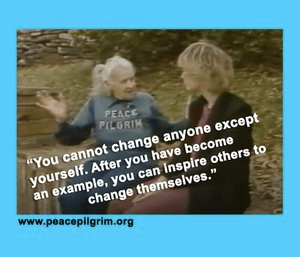
In reflecting on this experience, I was reminded of the words of Peace Pilgrim, who said, “Remember the power of thought, and think only about the best that could happen. Dwell only upon the good things you want to see happen. Remember, through thought you create your inner conditions and help to create the conditions around you. We are all helping to make a great decision.” These words inspire me to focus on positivity and to believe that my thoughts and actions can create positive change in the world.
About 20 years ago, I participated in a retreat that focused on organic farming, nutrition, and spirituality, at Santa Barbara CA. While much of what I learned during the retreat has since slipped from my memory, one aspect of the experience has remained with me: my encounter with the beautiful soul known as Peace Pilgrim.
I never had the opportunity to meet Peace Pilgrim in person, but I was deeply moved by her book, “Peace Pilgrim: Step toward Inner Peace,” which I read in Chinese. I couldn’t believe that such an amazing and spiritual person existed. Peace Pilgrim’s journey across America to spread the message of peace, with nothing but the clothes on her back, was truly inspiring. The book left a lasting impression on me, and it actually started my spiritual journey.
Peace Pilgrim, born Mildred Lisette Norman, was a spiritual teacher and peace activist who walked across America several times in the 1950s and 1960s to spread the message of peace. She traveled on foot, carrying only a few possessions and wearing a tunic with the words “Peace Pilgrim” written on it.
During her journey, Peace Pilgrim spoke to thousands of people about the importance of inner peace and the role it plays in creating a more peaceful world. She believed that true peace could only be achieved when individuals found inner peace within themselves, and that this inner peace would radiate outwards to create a more peaceful society.
Peace Pilgrim’s message resonated with many people, and her simple, yet powerful words inspired many to work towards peace in their own lives and in the world. She wrote several books, including “Peace Pilgrim: Her Life and Work in Her Own Words,” which chronicled her journey and the lessons she learned along the way.
In a time of great turmoil and uncertainty, the message of Peace Pilgrim is more relevant than ever. Her teachings remind us that true peace begins within, and that each of us has the power to make a difference in the world by finding inner peace and living a life of compassion and kindness. Her spirit and teachings continue to inspire and guide many people, and her message of peace will continue to resonate for years to come.
In this pandemic and tough time, her message of inner peace could be a guiding light for many people. World will have true peace until each one of us find our inner peace. Her teachings and stories are an inspiration for all of us to work on peace for the whole world. May her spirit and teachings continue to guide and inspire us all to work towards a more peaceful world.
Recently, my two college-aged sons have been expressing that they find life to be difficult. In an effort to provide them with guidance and support, I have been offering them spiritual advice and emotional support. While searching for resources to assist in this endeavor, I stumbled upon the profound and enlightening book, The Road Less Traveled, by Scott Peck. The insights and philosophy presented within the book have been incredibly inspiring and beneficial in helping me to support my sons in their journey.
The Road Less Traveled is a self-help book by American psychiatrist and author Scott Peck, first published in 1978. The book has had a significant impact, selling millions of copies and remaining on the New York Times bestseller list for more than ten years. One of the main themes of the book is the concept of the four disciplines: psychiatry, psychology, religion, and philosophy. Each discipline offers unique perspectives on how to navigate the challenges of life and achieve personal growth.
The book’s central message is that life is difficult, but that this difficulty can be transcended by understanding and accepting it. Peck argues that discipline is the basic tool we need to solve life’s problems, and that with enough discipline we can solve all problems. Additionally, the book explores themes of love, relationships, parenting, and self-discovery, as well as teaching about distinguishing dependency from love and how to become one’s true self.
Life is a series of problems. It is something that we all must face and deal with on a daily basis. Some of these problems may be small and easily solved, while others may be more complex and difficult to overcome. The question we must ask ourselves is: do we want to moan about these problems or do we want to solve them?
As adults, we have the power to choose how we react to life’s problems. We can choose to bemoan our difficulties and wallow in our troubles, or we can choose to take action and find solutions. The latter approach is far more productive and will ultimately lead to greater satisfaction and fulfillment in life.
In addition to making this choice for ourselves, it is also important to teach our children to solve problems in a similar manner. As parents, we have a responsibility to guide and teach our children, helping them to develop the skills and mindset needed to overcome the challenges that life will inevitably present to them.
One of the most important tools we have for solving life’s problems is discipline. Without discipline, we will not be able to effectively tackle the issues that we face. With only some discipline, we may be able to solve only some problems, but with total discipline, we can solve all problems. Discipline is the key to success in any endeavor. It allows us to focus our minds and efforts, to set goals and make plans, and to persist in the face of adversity.
It is important to note that problems do not go away on their own. They must be worked through and dealt with, otherwise they will remain forever, acting as a barrier to the growth and development of the spirit. It is essential that we learn to face and overcome problems, rather than avoiding or ignoring them.
One way to do this is by learning to Delay Gratification. By scheduling the pain and pleasure of life in a way that we deal with pain first and get it over with, it allows us to enhance the pleasure we gain from it. This is the only decent way to live. With discipline, we can solve most of the problems, and delay gratification is a process that can help us to get through the most difficult moments.
Peck also emphasizes the importance of Love and Community in personal growth. He argues that true love is not just an emotional state, but also an action, and that it requires a commitment to growth and self-discipline. He also stresses the importance of community, stating that “the love of community is the only true love.”
I have also found out in Buddhism, love has a deeper meaning that goes beyond romantic or familial feelings. It encompasses compassion and the belief in treating all beings as if they were our own relatives or parents. In What is Cultivation by H.H. Dorje Chang Buddha III, says: “Loving-kindness: At all times, through the actions of my three karmas, I am loving and kind toward all living beings, who have been my parents. I wish them a long life without illness, good fortune, good luck, and a happy life. ” This means that at all times, through all our actions, thoughts, and words, we should strive to be loving and kind towards all living beings, recognizing that they have been our parents in past lives. This belief is expressed through the wish for all beings to have a long life free from illness, good fortune, good luck, and happiness. This unconditional love can have a positive impact on individuals who are facing challenges and difficulties in their lives.
Everyone must face and deal with the challenges and difficulties in life. Moaning about them or solving them, it’s a choice we make, and the latter can lead to greater satisfaction and fulfillment in life. Teaching our children to solve problems in a similar manner and helping them to develop the discipline and tools needed, that could be in religions or philosophy or psychology, to succeed in life is an essential responsibility of parenthood.
In the National Geographic channel’s “The Power of Miracles” episode of “The Story of God with Morgan Freeman,” Freeman delves into the concept of miracles and the role they play in different cultures and religions around the world. Throughout the episode, Freeman explores the various stories and accounts of miracles that have been passed down through traditional cultures and religions. These stories often involve healing, protection, and other seemingly miraculous events.
One of the main focuses of the episode is the stories of miracle in Christianity. Freeman visits the site of a Catholic pilgrimage in Lourdes, France, where thousands of people travel each year to pray for healing. Freeman also visits the site of a Marian apparition in Medjugorje, Bosnia, where six children reported seeing the Virgin Mary in 1981. Freeman also meets with people who believe they were healed as a result of the apparition, which is still ongoing. Freeman also explores other religion’s records of miracles like the Jewish Kabbalah, and the Islamic Hadith.
While some people may be skeptical of these stories, Freeman makes it clear that they hold great significance for the people who believe in them. For many, these stories of miracles provide hope, inspiration, and a sense of connection to something greater than themselves. Freeman ultimately concludes that miracles are about the power of belief, and that the belief in something larger than ourselves can have a profound impact on our lives.
Watching this episode is a miracle for me. I explored so many beautiful places, cultures and religions. It’s a must watch for people with an interest in the intersection of faith and science, and in the power of belief to shape our lives.
New Year’s resolutions have long been a way to take stock of what’s truly important in our lives, allowing us to pause and reflect on the year behind us, as well as plan for the year ahead. If living through a global pandemic has taught us anything, it’s that we shouldn’t take health and wellness for granted. In 2023, improving your body, mind and soul is a great way to organize your long-term goals for the new year.
Focusing on your health and well-being doesn’t have to translate to starting a new diet or workout plan, though. You can set your sights on taking charge of your mental health, finally optimizing a better sleep routine or diving headfirst into reclaiming your space (wave goodbye to messy closets and disastrous bathrooms).
Your resolutions don’t have to be big, instead of workout everyday for two hours you could just set a goal like walking 15 minutes a day. Doing small things persistently, will bring big changes.
Keep your new resolutions by using a planner to help you stay on track, checking off daily fitness goals and tackling frequent decluttering tasks. This year, it’s time to put you first!
Here are some ideas to help you to kick off the year with a stronger, well-nourished body and an enriched mind.
Do some low intensity breath focusing exercise
Each week, try to do 15 to 30 minutes of slow and mind focusing exercise, such as Yoga or Tai chi. Tai chi is an ancient Chinese tradition that, today, is practiced as a graceful form of exercise. It involves a series of movements performed in a slow, focused manner and accompanied by deep breathing.
Yoga is also a mind and body practice. Yoga combines physical postures, breathing techniques, and meditation or relaxation. Yoga involves movement, meditation, and breathing techniques to promote mental and physical well-being. According to the National Institutes of Health, scientific evidence shows that yoga supports stress management, mental health, mindfulness, healthy eating, weight loss and quality sleep.
Do a short prayer
Each night, before you go to bed, do a short prayer. Praying can reduce anxiety and promote relaxation, gratitude, and thankfulness. In less than 3 minutes, you can express your gratitude to your body, your family, your friends, society, and your country. In this quiet time remind yourself to admire others, to accept others, to be attentive of others, and to forgive others. Wish for everyone to have a happy, healthy and auspicious life, wish for peace and harmony of the world, and wish that tomorrow will be better.
Build a better budget
If there’s one New Year’s resolution that will help you the most in the long run, it’s making a vow to save more money.
Before you head back to the office in January, outline a rough budget that works for you — and make a plan for how you’ll stick to it. Budgeting apps can help you do this as painlessly as possible. And supercharge your shopping habits by rethinking when and how you buy things for your home and family; often, there are savings you’re leaving on the table.
Photo from pexels.com
Practice mindfulness
Anxiety can nag at anyone during any season, in all parts of life — and it can be easy to let the idea of the future or past experiences inform your reality of the present. Practicing mindfulness means doing everything you can to be grateful for what you have in the moment, where you are in life, and who you are right now. Some leading psychological experts say committing to mindfulness can help you become a better person in less than a year’s time.
Read more books
January is the perfect time of year to snuggle up with a new book. Some of us like to unwind with a great fiction book that transports us to places we’ve never been, into lives that differ from our own. Others love the shiver that goes up your spine when you crack open a creepy ghost story that makes you think twice before turning off the light to go to bed. And who among us can resist a juicy romance novel that reminds us that chivalry isn’t dead? Of course, the best nonfiction books can also open our eyes to lived experiences far beyond our own perspective. Needless to say: books can change lives, whether they’re intended to be inspirational or just come to us at the moment we need them most.
Commit to a healthier sleep routine.
So many issues can be traced back to a poor night’s sleep. And yet, there is so much more that we can aim to improve beyond a reasonable bedtime. Creating a plan to improve your sleep hygiene — the habits you maintain to get good sleep every night — may look different for everyone, as it depends on when you need to be active and working throughout the day. Your brain actually relies on cues to regulate your internal circadian rhythm, and the choices you make throughout the day can interfere with these. Start taking charge of your sleep by mastering these 10 to-dos as the year progresses.
ANNA BLAZHUKGETTY IMAGES
Volunteer regularly.
Research shows that pitching in regularly can lead to less stress and lower blood pressure. Try to schedule an outreach mission of your own on a day of service; many recognize Martin Luther King Day as a prime opportunity, or even Veteran’s Day in November. So use this day to jumpstart a longer-term personal commitment — and consider working on this goal with loved ones all year round.
SOUTH_AGENCYGETTY IMAGES
Explore new hobbies.
Getty Images
Another sleepy Sunday? Today’s the day you try Ethiopian food, attend a ballet, or take a painting class — whatever feels fun. When researchers followed 7,500 people for 25 years, they found that those who complained of major boredom were roughly twice as likely to die from heart disease.
Start walking more
Even if you can’t keep track of a new fitness routine, keeping yourself moving on a simple walk around the neighborhood is a must. The U.S. Department of Health and Human Services maintains that adults should spend as much time moving each day as possible — and some physical activity (even just walking!) is better than none.
Do one thing at a time.
Multitasking doesn’t make you more efficient, but it does stress you out, says mindfulness expert Pedram Shojai, author of Focus: Bringing Time, Energy, and Money Into Flow. “If your focus is fragmented, you’ll likely find yourself getting anxious as new items come up when old ones are still incomplete,” he says.
Instead, he suggests, organize your activities into chunks of time, such as kid time and cooking time, and then “commit to being focused in those allotted minutes and see what happens.” It’ll help stop you from overthinking everything.
Getty Images
Give yourself more compliments.
Getty Images
Repeat after us: “Today is my day. I’m thankful for me.” Positive self-talk can help you focus on what’s good in your life, says psychologist Joy Harden Bradford, Ph.D.
Research shows that a little vitamin G (for gratitude) can make you feel happier and more satisfied and even improve your sleep. “If you repeat an affirmation related to gratitude in the morning, you’re likely to show and feel more of it throughout that day,” Bradford says. You’re so welcome!
Head outside without your phone
In a previous GH survey, 83% of people told us they lost track of how long they spent on their devices. But short of deleting all social apps, it can be hard to trade screen time for more productive pastimes like walking the dog and coffee with friends. Whether you’re Team iPhone or Team Android, download the latest software to access built-in tools that help you track your personal app usage. Set screen downtime is also very helpful to remind you need to stop.
Add more citrus to your grocery cart.
When you see all those gorgeous in-season grapefruits, oranges, clementines, and pomelos in the produce aisle, grab an armful.
Winter citrus can help keep skin looking healthy thanks to vitamin C, which aids in collagen production. In fact, an American Journal of Clinical Nutrition study found that people who ate foods high in C had fewer wrinkles and less age-related dry skin than those who didn’t. Try clementine sections sprinkled with pistachios or sweet grapefruit dipped in Greek yogurt for a snack.
I recently realized that I live most of my waking hours in a state of perpetual striving. There’s a nagging voice at the back of my mind constantly adding new items to my to-do list. My phone is littered with notes made at odd times of the day and night, reminding me to email this person, pitch that idea, edit my website, write this blog post, make a healthier meal plan, and complete a complicated DIY craft project with my kids.
The lists spill out over the pages of my notebooks and diary, onto sticky notes and scraps of paper in my purse. The to-do list is an ever-evolving beast that is never satisfied, and leaves me feeling impatient, frustrated, and restless. Can you relate?
Overstimulation sets us up for failure
We crave peace — to be fully present in the here and now; to soak it all up; to be grateful for all that we have. But our minds constantly skip ahead to the next task. We barely notice when we reach or surpass one goal because we’re so focused on what we haven’t achieved yet.
We live in an unnaturally fast-paced culture, with a 24/7 digital connection to the rest of the world. With all the noise that surrounds us, we feel pressure to cram as much into our schedules and brains as possible.
One of the many consequences of this overstimulation can be that we end up holding ourselves to impossible standards and get impatient with our limitations and seemingly “slow” progress. There are so many things we could do, and we’re more aware of all our options and potential than ever. It can be hard to remember how impossible it would be to actually do it all.
Patience can unlock productivity and open the door to growth
Research shows multitasking damages our productivity and can negatively impact the way our brains process information. We know that rest is essential for our well-being and creativity. The benefits of disconnecting from our tech and making an intentional choice to slow down our lives are more and more widely discussed.
I’ve found in my own life, however, that understanding the benefits and actually internalizing those beliefs are two different things. One of the trickiest aspects of choosing to unplug and slow down is to tune out that frantic, impatient voice telling us that we’re not achieving enough fast enough. So what’s the solution?
Patience is the antidote to this sense of restless striving — especially learning to have patience with ourselves. Here are a few ideas to help you cultivate this in your own life.
Tips for cultivating patience
1. Understand that your energy will ebb and flow
Despite what our post-Industrial Revolution capitalist society would like us to think, we’re not machines, and our bodies have more in common with the natural world and the seasons than our constantly switched-on devices. Research shows that our brains rarely work well for long uninterrupted stretches of time, and, as Inc. put it, “An 8-hour workday only makes sense if you’re screwing in widgets on an assembly line.”
You’re probably already aware of your favorite time of day, and have a sense of whether you work better in the morning, afternoon, or evening. This applies to the seasons, as well — your productivity and whether or not you’re feeling at your best, in general, can be hugely influenced by other factors like your hormonal cycle, your health, and whatever is going on in your life at that particular time.
Remembering you’re not a machine and that your mood, abilities, and needs will be constantly shifting and changing can help you become more patient with yourself.
2. Grow in self-awareness
In their online course, A Seasonal Year, Maddy Lawson and Eleanor Cheetham suggest mapping out the year to find where your energy is naturally highest and where it’s lowest. Think about what kind of work fills you up, and what kind of work leaves you feeling more drained. Consider which seasons find you scribbling down new ideas like there’s no tomorrow, and which ones make you feel like hunkering down and staying firmly in your comfort zone.
Once you’ve learned to recognize your own patterns, you’ll be better placed to think creatively about how you can work with your tendencies, rather than against them. We don’t always have a choice about how much work we have on our plates or how we spend our days, but we usually have at least a little more choice than we think we do. And growing in self-awareness is the first step toward becoming more patient with yourself.
On my own journey towards self-awareness, for example, I’ve learned that my energy tends to be the lowest in the winter. So now I can prepare myself to be less ambitious and more patient with myself during that particular season.
3. Stay curious about your roadblocks
Nir Eyal, the author of Indistractable, encourages us to watch out for the moments when we start to procrastinate and question why we’re putting something off. He points out that there’s always a deeper emotion underneath the instinct to procrastinate — whether that’s fear of failing, not knowing how to do something, weariness and feeling too burnt out to engage with it, or just plain boredom.
When you cultivate a habit of observing the things that trip you up — that hold you back from making the progress you’d like to make without judgment — you can have more empathy for yourself instead of beating yourself up or calling yourself lazy. Keep in mind, though, that this isn’t about making excuses or trying to get out of doing the necessary work. When you can say, “That’s interesting, I’m trying to put off doing this thing because I’m really tired right now,” it’s easier to be patient with yourself. This allows you to find potential solutions — like rearranging your schedule in order to tackle a task later on with renewed focus and energy — rather than just getting frustrated with yourself.
4. Notice, celebrate, and cultivate gratitude for the good
I’m guilty of not taking the time to reflect on — or celebrate — the good things in my life. I recently achieved a dream I’d been harboring for years, and after about five minutes of feeling excited and happy about it, I went back to worrying about the next thing. This experience helped me realize that patience is a habit — a mindset that we have to cultivate — and that it’s intimately linked with gratitude.
It can feel kind of corny or egotistical to stop and pat yourself on the back when something goes well or you handle something in a way that you’re proud of, but as I get older I’m realizing how important it is to celebrate the small victories. Regularly refocusing on the bigger picture can help you see how far you’ve come, have a deeper sense of gratitude for where you’re at, and make peace with the time it takes to get anywhere good.
Patience is a virtue
Ultimately, having patience with ourselves helps us to develop deeper patience for others, and it all starts with understanding ourselves better. These tips will help you to self-assess, put patience into practice, and reap the benefits of increased self-awareness and productivity throughout your life. It might seem counterintuitive, but when things speed up, we should slow down — and watch the wonderful results that patience provides.