Tongli Ancient Water Town: A Poetic Dream of the Oriental Venice

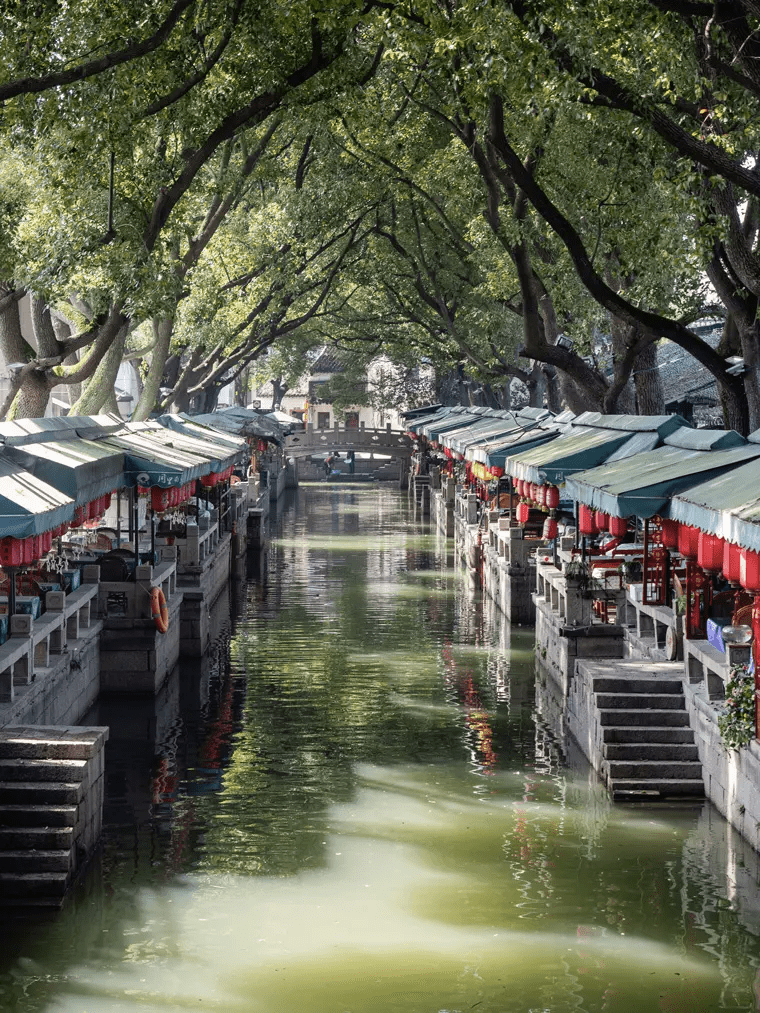
Photo from https://almostlanding.com/things-to-do-in-tongli-water-town-china/

Tongli (同里), also called Tongli Water Town, in the southwest of Suzhou, is one of the “Top Six Ancient Towns in Jiangnan (Regions South of Yangtze River)” in China with a long history of over 1,000 years. Enjoying the advantageous location of being surrounded by water and linked by old stone bridges, Tongli is the symbol of water town in southern China. Therefore, it is regarded as the “Oriental Venice” as well as a “Natural Photo Studio” by people from the whole world and is titled the “National AAAAA Tourist Attraction”. Moreover, since it still well keeps a series of ancient structures from the Song, Yuan, Ming and Qing dynasties, like the “Retreat & Reflection Garden (退思园)” which is a World Cultural Heritage Site praised by many poets, Tongli is a perfect place to savor the authentic flavor of old water town in China and the real leisure life of the charming Jiangnan (江南) region.

Tongli was established in the Song Dynasty over 10 centuries ago and was first named Fu Tu (富土, Fertile Land). But it changed to be called as Tong Li (铜里) so not to be too extravagant. And later people finally changed its name again into the present Tongli (同里). According to the history, Tongli is a key place in the ancient Wu (吴) region, and since it could communicate with the outside world only by boat, there were few wars or turbulence. And then, it became an ideal place for people to escape from the social upheaval and settle down.

Highlights in Tongli

Retreat & Reflection Garden

Tuisi Garden, also known as Retreat & Reflection Garden, earned its place on the prestigious list of UNESCO World Cultural Heritage Sites. This exquisite garden was meticulously crafted between 1885 and 1887 by Ren Lansheng, a former government official who was dismissed due to corruption. Ren chose to name this sanctuary “Tui Si Yuan” to symbolize his personal journey of introspection.

As you wander through Tuisi Garden, you’ll be transported to a bygone era, where historic wooden structures exude an ancient charm. However, what truly astonishes visitors is the enchanting water garden concealed within its confines. Here, pavilions, corridors, bridges, halls, houses, rockeries, pools, ancient trees, vibrant flowers, and charming fish coexist in perfect harmony, creating a secret oasis.

Whether you follow the stone-paved paths or stand atop pavilions nestled among the rockeries, you’ll be treated to breathtaking views of this natural and traditional garden. Such is its extraordinary beauty that a Tuisi Zhuang (Retreat & Reflection Villa) was recreated in a botanic garden in New York, USA, faithfully mirroring the essence of Tuisi Garden. This tribute stands as a testament to the global appreciation of Chinese garden artistry.

Secret Garden in Retreat & Reflection Garden
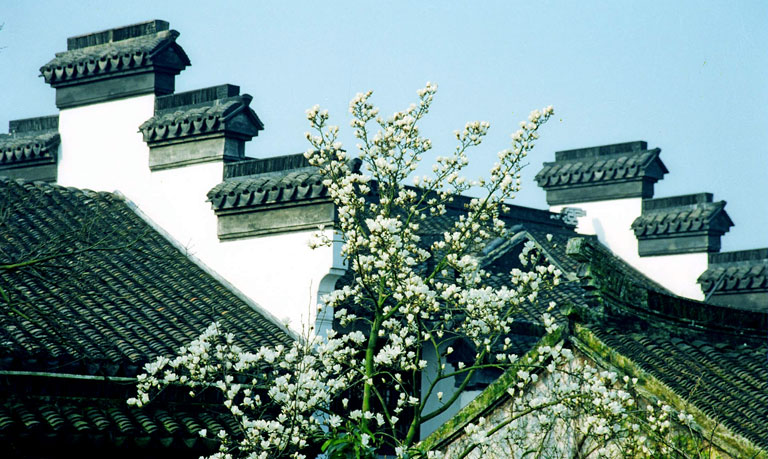
Tongli

Ancient Tuisi Garden in Spring

Gengle Hall

Gengle Hall (耕乐堂 or Happy Farming Hall), situated in the heart of Lujiadai (陆家埭), stands as a remarkable testament to ancient architecture within Tongli Water Town. Dating back to the Ming Dynasty, this building exemplifies the traditional residential-garden structure of its time, offering visitors a glimpse into the historical architecture of the region.

Within the residential section of Gengle Hall, one can admire an array of intricately carved root artworks, showcasing a variety of shapes including eagles, flowering trees, figures, lions, and more. As you explore this part of the hall, you’ll be immersed in a world of artistic craftsmanship.

Venturing into the water garden, you’ll be treated to crystal-clear pools teeming with vibrant red fish, picturesque stone bridges gracefully arching over the water, weathered yet charming old houses, and the backdrop of a serene blue sky. Every moment spent here promises a unique and captivating visual experience.
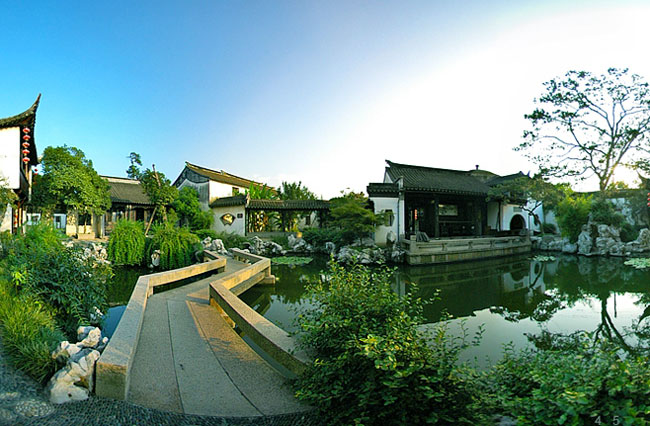
Tongli

Picturesque Scenery in the Garden of Gengle Hall

The Pearl Tower

The Pearl Tower (珍珠塔) in Tongli Water Town is not precisely a tower, but rather an opulent mansion. It is renowned for its association with the poignant love story known as the ‘Pearl Tower,’ which unfolds within the walls of this former official censor’s residence.

According to the tale, Fang Qing (方卿) and Chen Cuie (陈翠娥) shared a deep and passionate love, yet their union was fraught with the challenges posed by their disparate family backgrounds. Undaunted, Fang Qing worked tirelessly to attain the coveted title of ‘Number One Scholar’ and returned to his hometown with a sterling reputation. Finally, he and Cuie were able to overcome the obstacles and were wed.

When you visit the Pearl Tower, you’ll have the opportunity to marvel at the ancient architecture and the expansive water garden, allowing you to immerse yourself in the enchanting ambiance of this historic water town and experience the enduring romance of the famous love story.
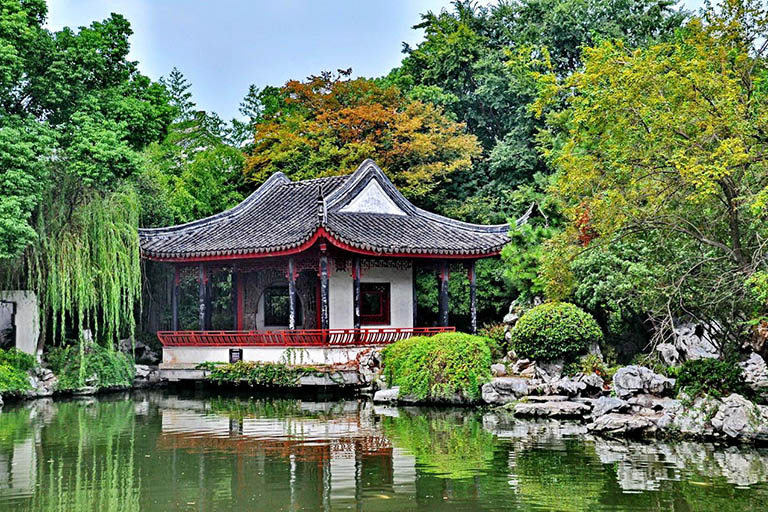
Tongli

The Mansion of Pearl Tower

The Three Bridges

The Three Bridges (三桥) in Tongli, namely Taiping Bridge (太平桥), Jili Bridge (吉利桥), and Changqing Bridge (长庆桥), stand out as must-see attractions within Tongli Water Town. Together, they form a configuration resembling the Chinese character “品,” making the Three Bridges a cherished treasure of Tongli. As you stroll along these bridges, you’ll witness people walking above and boats gracefully gliding beneath, creating a dynamic and picturesque scene.

Particularly during festivals, these bridges come alive with activity, exuding a sense of bustling joy. Local residents consider it highly auspicious and joyous to traverse the Three Bridges, believing that it brings good fortune and improved health. You can embrace this tradition by walking across the Jili Bridge, Taiping Bridge, and Changqing Bridge in a continuous loop without turning back, in pursuit of greater blessings and well-being.
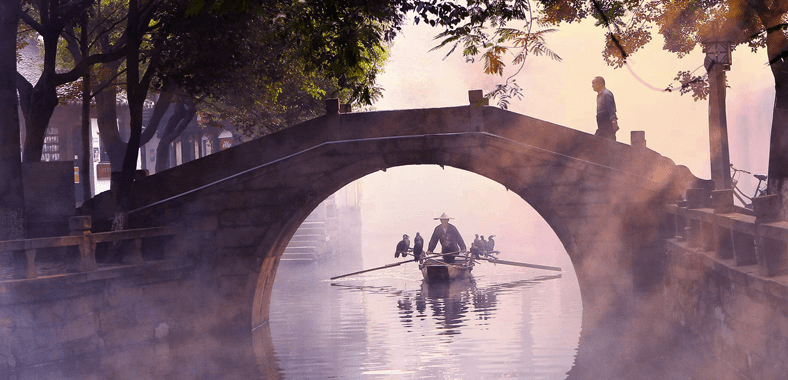
Besides, there are many other interesting places to visit in Tongli Water Town, like Jiayin Hall (嘉荫堂) with beautiful design and gauze-cap-like beam decorations, Chongben Hall (崇本堂) with exquisite sculptures, Mingqing Street (明清街) with various local food and shops, Luoxing Island (罗星洲) with fabulous natural scenery, etc. you can spend more time to discover deeper beauty of Tongli!

Amazing Activities in Tongli

You deserve to try the featured activities in Tongli to get the real fun and feel the authentic charm of this famous water town.

Rickshaw Tour

Let the local carter take you to appreciate Tongli Water Town with a distinct visual angle on the ancient rickshaw. Passing through the narrow lanes and admiring the centuries-old buildings, you can imagine yourself being the people living in Tongli in ancient times.

Boat Tour

Take a sculling boat at the daytime to feel the excitement of watching the ancient buildings and people passing by, the brand-new practice of going through the old Chinese bridges. You can have the scene of ancient Tongli people communicating the outside by boat in your mind. (25 min, about CNY 90 / boat; 1-6 people / boat)
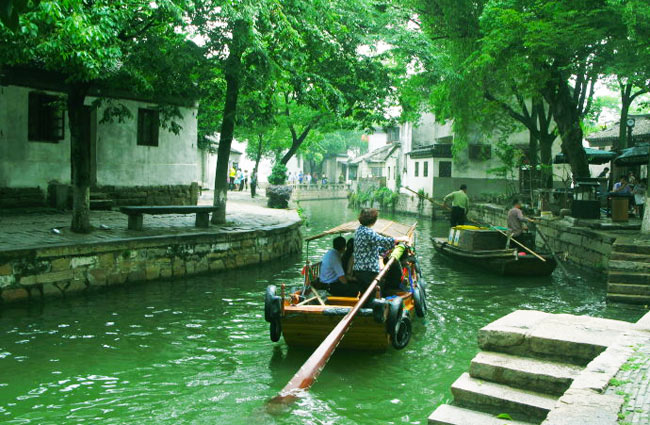
Tongli

Splendid Night View

The night view of Tongli Water Town is splendid. With strings of red lanterns lighting along the river, gorgeous colorful flashes shining in the trees, sparkling lights curving the fancy lines of bridges and paths, the water town will make you immerse into its beauty.
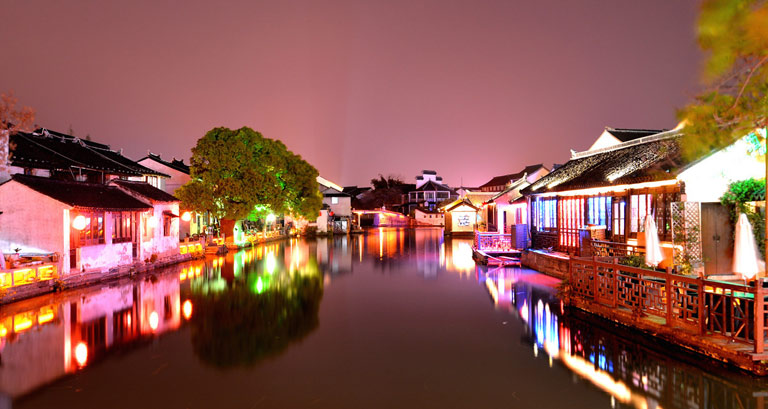
TongliSplendid Night View in Tongli Water Town

Best Seasons to Visit Tongli

Tongli is an ideal destination to visit year-round, showcasing diverse landscapes in each season:

  • Spring: Tongli is at its most charming and poetic during this season, boasting moderate temperatures and a touch of misty rain to enhance its allure.
  • Summer: The summertime in Tongli is vibrant, with numerous local folk activities that offer a fantastic opportunity to immerse yourself in the rich folk culture of this renowned Chinese water town. Additionally, you can savor the mesmerizing night views as you wander along its scenic rivers and bridges.
  • Autumn: Tongli dons a fresh and crisp aura during autumn. The faint fragrance of sweet-scented osmanthus fills the air, transforming Tongli Water Town into a captivating young lady beneath the clear azure skies.
  • Winter: In the winter months, Tongli is tranquil, attracting fewer tourists. Particularly after a snowfall, the town adorns itself in pure white beauty, complemented by the soft glow of red lanterns lining the riverbanks.”

Tongli Ancient Water Town: A Poetic Dream of the Oriental Venice

Link:https://peacelilysite.com/2023/09/12/tongli-ancient-water-town-a-poetic-dream-of-the-oriental-venice/

Source: https://www.chinadiscovery.com/jiangsu/suzhou/tongli.html, https://almostlanding.com/things-to-do-in-tongli-water-town-china/
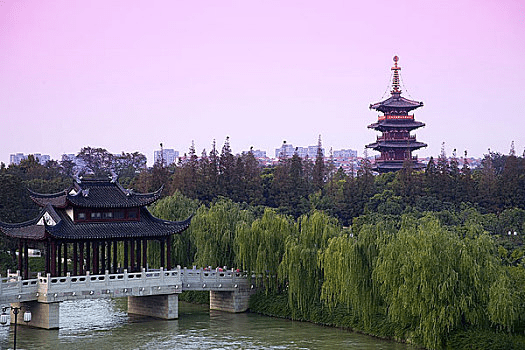
The cultural Heritage of Hanshan Temple

The cultural Heritage of Hanshan Temple

Hanshan Temple (寒山寺), which translates to Cold Mountain Temple, is situated in the Gusu District of Suzhou city. Originally named “Miaoli Puming Temple,” it dates back to the Liang Dynasty of the Southern Dynasties, specifically from A.D 502-519. Covering an area of approximately 13,000 square meters, the temple boasts a construction area exceeding 3,400 square meters.

During the Tang Dynasty’s Zhenguan period (A.D. 627-649), two prominent monks of the time, Hanshan and Xiqian, founded Hanshan Temple. Over its more than 1,300-year history, the temple has suffered five fires (some versions claim seven), with its most recent reconstruction occurring during the Guangxu period (A.D. 1875-1908) of the Qing Dynasty. Historically, Suzhou’s Hanshan Temple held a prestigious position among China’s top ten famous temples. Its fame extends beyond borders due to a poem composed by Zhang Ji, a Tang Dynasty poet, which is taught in Chinese primary schools. This poem is also included in the curriculum of Japanese schools, further elevating Hanshan Temple’s renown in Japan, attracting numerous Japanese visitors who come to pay their respects to the Buddha. The temple features numerous historic buildings and tablet inscriptions authored by calligraphers, making it a popular destination for those seeking peace and spiritual solace.

Hanshan Temple holds a distinguished place in China’s Buddhist history, chiefly because of the famous poem by Tang Dynasty poet Zhang Ji. This poem is part of the curriculum in primary schools in both China and Japan.

The Night Lodging at Maple Bridge
By Zhang Ji

月落乌啼霜满天
The moon sinks in the frosty sky and ravens caw far and near

江枫渔火对愁眠
Riverside maples and fishing lamps gloomily make me drowsy

姑苏城外寒山寺
From the Han-Shan temple siting at outside of the Gu-Su town

夜半钟声到客船
Come midnight bell rings as a passenger boat is arriving 

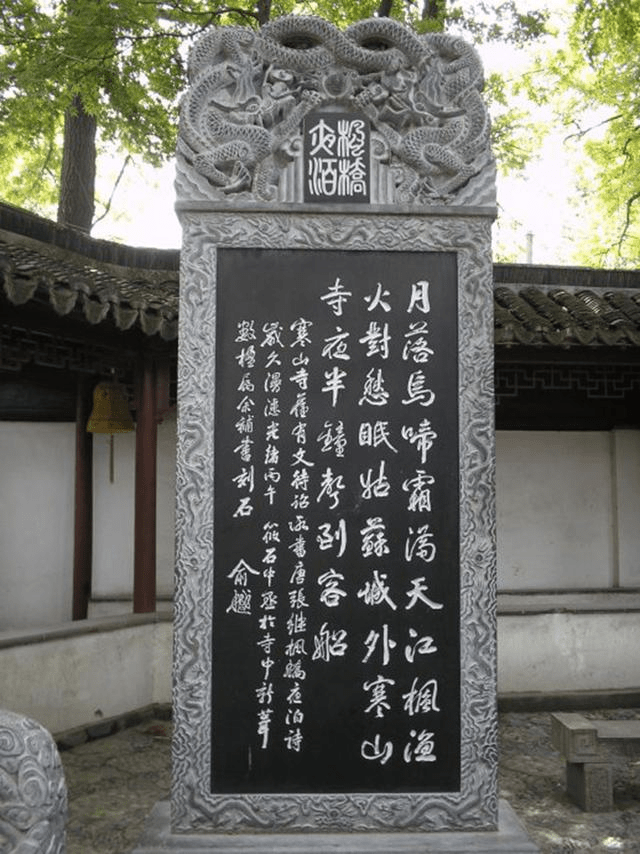
Apart from the legends of Hanshan and Shide, Hanshan Temple boasts a collection of treasures that have been cherished throughout its extensive history. Among these treasures, one of the most renowned is the poetic stele of ‘Night Mooring at Maple Bridge,’ crafted by the esteemed scholar and calligrapher Yu Yue during the late Qing Dynasty. It stands as an invaluable asset to Hanshan Temple.

It must be acknowledged that this piece of calligraphy represents the apex of ‘Night Mooring at Maple Bridge’ renditions throughout history. The lines of regular script flow seamlessly, displaying an inherent elegance and freshness, achieved with seemingly effortless brushwork. Engraved upon the stele, it emanates a subtle, age-old charm and an evocative poetic atmosphere. Each time I gaze upon this stele, it evokes a different emotional response within me. As I have delved into the art of calligraphy myself, I have even attempted to replicate ‘Night Mooring at Maple Bridge.’ While I deeply appreciate Yu Yue’s extraordinary skill and find it visually pleasing, there has always been a sensation of something missing, an ineffable aspect I couldn’t articulate. My pursuit has persisted, a continuous quest to discover calligraphic masterpieces that could genuinely satiate my aesthetic sensibilities, and this aspiration remains deeply rooted within me.

The other day, I had a sudden encounter with ‘Night Mooring at Maple Bridge,’ personally penned by H.H. Dorje Chang Buddha III, and it was as if I had stumbled upon a divine masterpiece! This artwork utilizes cursive script, showcasing the grandeur reminiscent of dragons and serpents, seasoned with masterful brushwork, conveying both a majestic ruggedness and a subtle elegance. What elevates its worth even further is its dynamic and ceaseless artistic allure, reaching monumental proportions. It can be aptly described as the highest sacred creation, far beyond the grasp of ordinary individuals. This represents the embodiment of the Five Vidyas, as expressed by the Buddhas and Bodhisattvas in the realm of Prajna, offering an extraordinary experience to those who behold it and serving as the ultimate exemplar for calligraphy enthusiasts like myself to aspire to emulate.

In this lifetime, I am profoundly fortunate to have encountered the authentic and unwavering Dharma of the Tathagata. The achievements of H.H. Dorje Chang Buddha III stand unparalleled on a global scale. When it comes to providing tangible evidence of wisdom and realization attained through proficiency in both exoteric and esoteric Buddhism, as well as mastery of the Five Vidyas, there is simply no one within the realm of Buddhism who can be mentioned in the same breath as His Holiness.

The Buddha’s criterion for measuring one’s level of accomplishment in the Buddha-dharma is rooted in the extent of proficiency in both exoteric and esoteric Buddhism, as well as the mastery of the Five Vidyas. However, throughout the history of Buddhism up to the present day, only H.H. Dorje Chang Buddha III Holiest Tathagata has truly and comprehensively demonstrated complete proficiency in exoteric and esoteric Buddhism, along with perfect mastery of the Five Vidyas. His Holiness unmistakably presents, for all to witness, a myriad of achievements that exemplify his complete proficiency in exoteric and esoteric Buddhism and his impeccable mastery of the Five Vidyas, as stipulated by the Buddha.

His Holiness, an ancient Buddha, holds the distinction of being the first being of holy virtue in history to genuinely manifest such lofty and all-encompassing realization. The undeniable proof of this is found in the numerous accomplishments single-handedly achieved by H.H. Dorje Chang Buddha III, as detailed within the thirty main categories listed in this book, “H.H. Dorje Chang Buddha III — A Treasury of True Buddha-Dharma.”

I earnestly pray that all sentient beings may embark upon the ‘vessel’ of liberation and achieve enlightenment.

The cultural Heritage of Hanshan Temple

Link:https://peacelilysite.com/2023/09/08/the-cultural-heritage-of-hanshan-temple/

#DorjeChangBuddhaIII #HHDorjeChangBuddhaIII  #HanShanTemple #ChineseCalligraphy #Buddhism #ExotericandEsotericBuddhism #AcientBuddha #TreasureBook #FiveVidyas

Source: https://blog.wenxuecity.com/myblog/77953/202108/16124.html, https://www.chinadiscovery.com/jiangsu/suzhou/hanshan-temple.html

Seven Wonders of the Buddhist World-BBC

This YouTube documentary by the BBC was done several years ago, but is worthy of another visit as it gives us a glimpse of the various forms of Buddhism and some of the great monuments and architectural expressions in the different cultures where it took root including our own. 

In this fascinating documentary, historian Bettany Hughes travels to the seven wonders of the Buddhist world and offers a unique insight into one of the most ancient belief systems still practised today. Buddhism began 2,500 years ago when one man had an amazing internal revelation underneath a peepul tree in India. Today it is practised by over 350 million people worldwide, with numbers continuing to grow year on year. In an attempt to gain a better understanding of the different beliefs and practices that form the core of the Buddhist philosophy and investigate how Buddhism started and where it travelled to, Hughes visits some of the most spectacular monuments built by Buddhists across the globe. Her journey begins at the Mahabodhi Temple in India, where Buddhism was born; here Hughes examines the foundations of the belief system – the three jewels. At Nepal’s Boudhanath Stupa, she looks deeper into the concept of dharma – the teaching of Buddha, and at the Temple of the Tooth in Sri Lanka, Bettany explores karma, the idea that our intentional acts will be mirrored in the future. At Wat Pho Temple in Thailand, Hughes explores samsara, the endless cycle of birth and death that Buddhists seek to end by achieving enlightenment, before travelling to Angkor Wat in Cambodia to learn more about the practice of meditation.

Seven Wonders of the Buddhist World-BBC

Link:https://peacelilysite.com/2023/06/30/seven-wonders-of-the-buddhist-world-bbc/

#SevenWonders #BuddhistWorld #BBCdocumentary #BuddhistHistory#SriLanka#India#China #Temple#History

Refrain from Harsh Words, Kind Speech Will Bring Wealth for Love

Photo by Sharath G. on Pexels.com

A Jataka Tale: The Ox Named Great Joy

The Buddha recounted this tale in response to a dispute between two monks, highlighting the destructive nature of harsh words. Gathering a large group in the monastery hall at Jetavana, he addressed them, saying:

“Monks and nuns, even animals suffer unhappiness due to harsh words. Allow me to share with you a story from ancient times, when bitter words caused a farmer to lose his fortune.”

Once, in a bygone era, the Future Buddha manifested as a bull and was gifted to a farmer. Overjoyed, the farmer named the young calf “Great Joy” and treated him like his own child. He provided the bull with the best rice and milk, fostering his growth. Great Joy flourished and became a mighty ox, black as the night sky and as radiant as the stars. Despite his immense strength, he remained gentle and obedient.

After years of tender care, Great Joy felt immense gratitude towards the farmer. He thought to himself, “The farmer has raised me with loving kindness and made great sacrifices for my well-being. He has even gone hungry at times to ensure I am well-fed. I must find a way to repay him for all his kindness!” The next morning, as the farmer brushed the bull, Great Joy spoke to him, saying, “Master, I have devised a plan to repay you for your many years of care.”

Pausing his brushing, the farmer gently placed his hand upon the bull’s large head and replied, “Great Joy, you already plow my fields, turn my well wheel, and carry heavy loads to and from the village. You work tirelessly, and there is no need for you to repay me. Do not trouble yourself with such matters.”

However, Great Joy was determined to execute his plan. “Master, please listen. I have a marvelous idea that will make you instantly wealthy. Journey to the town today and find a merchant who owns a vast herd of oxen. Make a bet with him for a thousand silver pieces, claiming that your bull is the mightiest in all of India. Wager that tomorrow morning, in the village square, your ox will draw a hundred carts overflowing with rocks, stones, and gravel!”

Skeptical, the farmer replied, “My dear friend, how could any ox in the world pull a hundred loaded carts? It has never been done before. The entire town will think I have gone mad.”

Unyielding, Great Joy persisted, “I possess the strength, and I will not let you down.”

“But what if you fail to pull such a heavy load? A thousand silver pieces comprise all I possess! If you lose, I will be left impoverished!”

Remaining steadfast, Great Joy reassured him, “I promise you, I will not let you down. I will not lose the wager, and you shall not lose your money.”

And so, the farmer followed the ox’s suggestion. He ventured to the village and positioned himself in the town square, where business transactions took place. Eventually, a wealthy merchant dressed in fine robes approached him. Seizing the opportunity, the farmer boldly proclaimed, “Did you know, gentlemen, that I am the owner of the strongest ox in the kingdom? I doubt there is a bull in all of India that can rival mine! In fact, my bull may be the largest and mightiest in the entire world!”

The crowd fell silent upon hearing his boast. All eyes turned towards the farmer. Finally, the wealthy merchant broke the silence and retorted, “It is widely known that I, sir, possess an entire herd of the world’s strongest oxen. What makes your single bull so exceptional?”

Photo by Ricky Esquivel on Pexels.com

Realizing he had found the ideal opponent, the farmer promptly replied, “I have a bull capable of effortlessly pulling a hundred fully loaded carts!”

Mockingly, the merchant responded, “And where might this extraordinary bull be found? In the land of fairies and dreams?”

“He resides at my home,” answered the farmer confidently.

“Well, if you hold him in such high regard, let us make it a wager,” challenged the merchant.

“Certainly,” agreed the farmer. “I will bet you a thousand silver pieces that my bull can move one hundred carts fully loaded with rocks, stones, and gravel. Prepare the carts and meet me here in the village square at sunrise tomorrow morning.” With a firm handshake, the deal was sealed, and both parties made their preparations.

The following morning, before daybreak, the farmer fed Great Joy sweet milk and hay, bathed him, and brushed his coat until it shone. Speaking gentle and soothing words, just as he did every day, the farmer adorned the ox’s neck with a garland of flowers.

Great Joy knew the moment had arrived to prove himself.

At dawn, the farmer led Great Joy to the village square. Excited onlookers, including men, women, and children, filled the streets, eager to witness the outcome of this seemingly impossible bet. The farmer was astounded by the sight that greeted him—an unprecedented number of carts, each loaded to the brim with rocks. If any doubts lingered in the farmer’s mind, they were quickly replaced by certainty that he had been foolish to believe a mere animal’s promise.

Photo by Karen Lau00e5rk Boshoff on Pexels.com

Nevertheless, Great Joy stood proudly at the head of the line of carts, awaiting his harnessing. Magnificent and towering, his shoulders surpassing any other ox, he captured the awe of the crowd. Two men struggled to secure the heavy yoke upon his broad back, and then they attached the carts in a long chain.

Anxious, the farmer anticipated his impending humiliation before the townsfolk. Clutching the leather goad tightly, he muttered to himself, “I cannot afford to lose this wager. The ox has made a promise, but I am his master. I must ensure that he pulls the carts without fail. Ailee! I have risked my life savings on the word of a mere beast!” With determination, the farmer raised his goad and struck Great Joy forcefully, shouting, “Now, you beast, pull the carts! Pull! Pull, you rascal!”

Great Joy was taken aback by this treatment. He thought, “I am not a rascal! I am not a beast! He has never spoken to me like this before or used a whip on me. I will not move an inch!” Ignoring the lashes of the whip and the harsh words from his friend, Great Joy planted his hooves firmly, like the roots of four Banyan trees, and remained immobile.

Instantly, the crowd erupted in laughter and mockery, witnessing the farmer’s stubborn ox refusing to obey. Once again, the farmer struck Great Joy with the goad and cursed him, but the ox gazed straight ahead, disregarding the goad, the farmer, and the jeering crowd. In no time, the crowd began pelting both the farmer and the ox with mud and dung. Overwhelmed with shame, the farmer hung his head low and reluctantly handed over his entire savings to the merchant.

Jingling the coins in his hands, the merchant chuckled and said, “Whenever you wish to make another wager, seek me out! What ox could possibly pull a hundred loaded carts?” he laughed.

Despondent and penniless, the farmer unharnessed Great Joy from the line of carts and led him back home. The villagers taunted them along the way, hurling insults, rotten fruit, and mud. The farmer tied the ox to a stake and retreated inside his home, overcome with grief. “I am a pauper! It took me twenty years to earn that silver!” he wailed and moaned.

Hearing the farmer’s pained sobs from outside, Great Joy approached the window and inquired what was wrong. “I have lost all my money because of you!” the farmer bitterly exclaimed. “You promised me you wouldn’t let me down!”

Great Joy replied, “Ah, but master, it was you who let me down! Throughout all the time I have lived under your care, have I ever harmed anyone? Have I ever been clumsy or broken a pot? No. I have carried children gently on my back, even allowing the smallest of them to lead me. I have always done exactly as you asked.”

“Yes, I suppose you are right,” sniffed the farmer.

“Well, then, go once more to the town and bet the merchant double the silver. We shall meet him again in the square tomorrow morning at sunrise. But remember, treat me kindly as you always have, and I will treat you as I always have!”

Hurriedly, the farmer returned to town, found the merchant, and presented him with a new offer. Laughing at the prospect of making even more money, the merchant agreed to another wager.

At dawn the next morning, the village square mirrored the scene from the previous day. One hundred carts stood in a long line, each loaded with rocks. Once again, the streets were filled with eager spectators. Great Joy, bathed and brushed with a fresh garland around his neck, walked proudly alongside the farmer to the front of the carts. However, people chatted and joked, not taking the two participants seriously.

The weighty wooden yoke was placed upon Great Joy’s back, and the ropes were securely fastened. The farmer stood beside his ox, gently stroking his powerful shoulders. After a while, he leaned over and spoke softly into the bull’s ear, “Now, my fine fellow, my friend, pull the carts forward!”

Upon hearing these words, Great Joy seemed to grow in size. His muscles tensed, and he leaned against the ropes with all his might, causing them to tighten, cart by cart, until reaching the hundredth. Great Joy strained and pulled, taking one step and then another, each accompanied by a surge of momentum. Step by step, with unwavering determination, Great Joy continued his effort until the final cart stood exactly where the first one had started.

Photo by Renjith Tomy Pkm on Pexels.com

It was a sight to behold! Cheers and applause filled the air as flowers and money rained down upon the bull and the farmer. Great Joy, glistening with sweat, stood nobly and proudly in his place.

The merchant shook his head in disbelief but paid the two thousand silver coins as agreed. Children reached out to stroke the mighty ox, marveling at his remarkable perseverance. There was much celebration. Before the morning came to an end, the farmer and his faithful companion, Great Joy, trotted down the dusty road back home, where they lived happily and prosperously ever after.

Thus, the Buddha finished his lesson with the monks and nuns, sayingagain that harsh words please no one. And he spoke this verse in conclusion:

Speak only kind words: never be unkind.

For he who speaks gently, the ox moves the whole earth,

And brings him wealth for love.

A Jataka Tale: The Ox Named Great Joy

Link:https://peacelilysite.com/2023/06/28/refrain-from-harsh-words-kind-speech-will-bring-wealth-for-love/

#Kindness # Buddha #BuddhistTales #JakataTales#GreatJoy #Ox

Source: Kindness A Treasury of Buddhist wisdom for Children and Parents By Sarah Conover Page 111-118

The First Sign of Civilization: Healing Broken Bones

In our quest to understand the origins of civilization, we often associate it with technological advancements, architectural marvels, or complex social structures. However, renowned anthropologist Margaret Mead presented a profound perspective on the matter. When asked about the first sign of civilization in a culture, Mead shared an unexpected answer that challenged conventional wisdom. She believed that the first evidence of civilization lies not in material objects but in the compassionate act of healing a broken femur.

In the animal kingdom, the inability to run, defend oneself, or access vital resources due to a broken leg can be a death sentence. Animals, being driven primarily by instinct, have limited capacity for compassion and assistance. Consequently, when a leg is fractured, survival becomes nearly impossible. Mead’s contrasting observation highlights the crucial distinction between human and animal behavior.

When a human being sustains a broken femur, the healing process takes time, care, and attention. It is during this period that the true essence of civilization emerges. The act of staying with the injured person, binding their wound, providing support, and ensuring their safety exemplifies the depth of human compassion and the development of a nurturing society. It is in these moments that the potential for humanity’s collective progress is realized.

Photo by Sarwer e Kainat Welfare on Pexels.com

Empathy lies at the core of our ability to serve others. It is our capacity to understand and share the feelings of another that allows us to extend a helping hand. Mead’s observation reminds us of the inherent empathy ingrained within our species. When we see someone in pain, our natural inclination is to offer assistance, whether through physical aid, emotional support, or simply being present. It is through the act of serving others that we tap into our highest human potential.

Acts of service have far-reaching consequences beyond the immediate impact on the individual being helped. When we extend kindness and support to others, we inspire a chain reaction of goodwill and compassion. Small acts of service can ignite a spark within others, motivating them to pay it forward. This ripple effect spreads throughout communities, strengthening social bonds and fostering a collective spirit of unity and care.

In Mead’s view, civilization begins with the act of helping someone through difficulty. It is through these acts of kindness, empathy, and service that we create a society marked by progress and interconnectedness. Civilization is not solely defined by technological advancements or material achievements but rather by the quality of human relationships and our commitment to supporting one another.

Margaret Mead’s perspective on the first sign of civilization challenges conventional notions and invites us to reflect on our values as a society. True civilization is not measured solely by material progress, but by our capacity to care for and uplift one another. By embracing our innate empathy and engaging in acts of service, we foster a civilization rooted in compassion, unity, and collective growth. Let us remember that we are at our best when we serve others, and through our actions, we can shape a more civilized and harmonious world.

The First Sign of Civilization: Healing Broken Bones

Link: https://peacelilysite.com/2023/06/22/the-first-sign-of-civilization-healing-broken-bones/

#Anthropologist #MargaretMead #Civilization#Healing #BrokenBones #Empathy #Help#Compassion

Nun’s body intact four years after death in A Missouri monastery

This May, Gower, a small rural town in Missouri, has unexpectedly gained recognition as a pilgrimage destination following an extraordinary occurrence related to the exhumation of a nun’s body. Sister Wilhelmina Lancaster, the founder of the Benedictine Sisters of Mary, Queen of the Apostles, was buried at the age of 95 in May 2019. Remarkably, when her body was exhumed four years later, it displayed no visible signs of decomposition, leading to a surge of visitors to the town, approximately 40 miles north of Kansas City.

The preservation of Sister Wilhelmina Lancaster’s body has captivated the attention of hundreds of people, who have deemed it a “miracle in Missouri.” Despite expectations that only bones would remain due to her burial in a simple, unembalmed wooden coffin, the exhumation revealed her fully intact body, along with her religious habit impeccably preserved. Initially, the discovery was intended to remain private, but the news spread rapidly after a private email was mistakenly shared with the public.

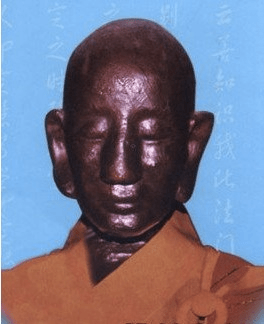
While as a Buddhist disciple, I find this occurrence surprising, it is not unprecedented in Chinese Buddhist history. Throughout the annals of Chinese Buddhism, there have been quite a few revered masters and patriarchs who have left behind fully intact relics of their bodies after passing away. Notably, Nanhua Temple in Shaoguan, Guangdong Province, houses three such relics: Master Huineng, the Sixth Patriarch of Zen; Master Hanshang; and Master Dantian. These examples from Buddhist history further highlight the profound reverence and awe associated with the preservation of such relics.

Master Huineng the Sixth Patriarch of Chan Buddhism

Huineng, widely recognized as the Sixth Patriarch or Sixth Ancestor of Chan (Zen) Buddhism, holds a significant place in the early history of Chinese Chan Buddhism. He is both a semi-legendary and a central figure in the development of this tradition. Huineng is renowned as the author of the influential Sixth Platform Sutra and is revered as the sixth patriarch of Chan Buddhism.

To this day, Huineng’s physical body remains preserved in the Nanhua Monastery in Shaoguan, Guangdong Province. Clad in a yellow robe and a red shawl, his corpse serves as a revered symbol within the monastery where he once taught. According to the Biography of the Great Master of Caoxi (Caoxi Dashi Zhuan, circa 781), Huineng’s body was removed from an urn on September 8, 714. After being desiccated for over a year, it was carefully covered with glue and lacquer before being enshrined in a stupa, where it has remained since.

This preservation of Huineng’s body and its continued veneration serve as a testament to his profound impact on the development of Zen Buddhism and his lasting influence on generations of practitioners. The presence of his preserved corpse stands as a tangible reminder of his teachings and spiritual legacy within the Nanhua Monastery.

Master HanShan (1546-1623)
Master Dantian (1535 – 1614)

Mount Jiuhua, located in China, has a significant historical and religious importance as a Buddhist Holy Land, boasting a rich heritage that spans over 1600 years. Its origins can be traced back to the year 401 AD during the Eastern Jin Dynasty, when the esteemed monk known as “Beidu” journeyed from ancient India to Mount Jiuhua with the intention of constructing temples and spreading the teachings of Buddhism.

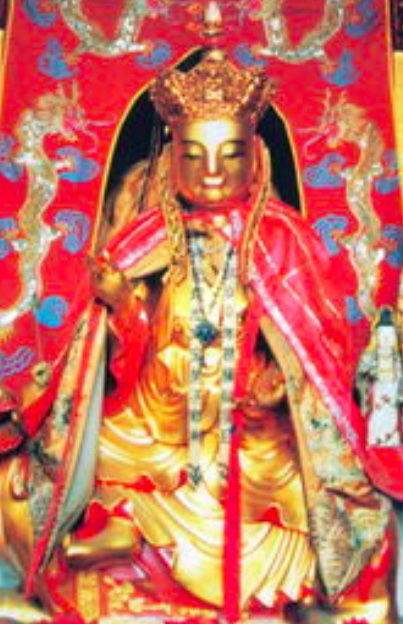
In 719 AD, when Kim Qiaoque, a prince hailing from Silla (present-day South Korea), arrived at Jiuhua Mountain. Kim Qiaoque dedicated himself to self-cultivation in this sacred place for an impressive span of 75 years. His life came to an end at the remarkable age of 99, and astonishingly, his physical body remained intact even after death. Due to the striking resemblance between Kim Qiaoque and Ksitigarbha Bodhisattva, the revered monks residing in Mount Jiuhua firmly believed that the spirit of Ksitigarbha Bodhisattva had reincarnated within him. Consequently, Mount Jiuhua evolved into a significant site for conducting rites and rituals dedicated to Ksitigarbha Bodhisattva.

Throughout history, Mount Jiuhua has served as a dwelling place for countless enlightened masters. Historical records reveal an astounding tally of sixteen masters who achieved the extraordinary feat of leaving behind relics of their physical bodies, fully intact. To safeguard these precious remains, most of the relics were delicately adorned with a layer of gold, serving as a symbol of veneration from the people. These sacred relics not only stand as a testament to the spiritual accomplishments of these masters but also continue to evoke deep reverence and inspiration among devotees to this very day.

Mount Jiuhua Incarnation Grand Hall Enshrines Flesh Body of Ksitigarbha covered by a layer of gold

Master Mingjing (1928 – 1992)

Renyi Nun 仁义师太(1911—1995)enshrined at Mount Jiuhua Tonghui Zen temple
慈航法师 Master CiHang (1893—1954)Now enshrined in Taiwan Metriya Temple

Just a few years ago, the esteemed holy monk Yinhai, a devoted disciple of H.H. Dorje Chang Buddha III, departed this earthly realm, leaving behind a profound and awe-inspiring spiritual legacy. On January 15, 2017, Elder Monk Yinhai completed his earthly journey through impeccable spiritual practices. What followed after his passing was an extraordinary phenomenon that surpassed anything witnessed in Buddhist history.

Even after his physical demise, the holy monk’s body underwent a truly extraordinary and divine metamorphosis. In a stunning departure from the natural order of things, his fingers and nails continued to grow, presenting an unprecedented occurrence in the annals of Buddhist history. This majestic and wondrous manifestation set a remarkable new record that reverberated throughout the Buddhist community. Commencing on the tenth day following his passing, an awe-inspiring process of complete transformation unfolded within his flesh and bones. In a mere twenty days, his body underwent a magnificent metamorphosis, assuming a form that transcended all comparisons, resembling a sacred dharma image.

The astounding and sacred phenomenon demonstrated by the revered monk Yinhai stands as a powerful testament to the profound Buddha Dharma transmitted by H.H. Dorje Chang Buddha III in the annals of Buddhist history.

Photo on the left was taken 11 hours after the Holy Monk entered nirvana, on the right was taken after 24 days

Across various religions, there have been instances of inexplicable miracles that defy the understanding and explanations provided by current scientific knowledge. These miracles, although beyond the grasp of science, undeniably exist. It is my sincere hope that individuals refrain from hastily dismissing them as mere superstition and avoid judging them solely based on their personal knowledge and beliefs.

The realm of spirituality and faith often transcends the limitations of scientific understanding. It encompasses dimensions and experiences that extend beyond empirical observations and logical reasoning. Just because something cannot be readily explained by scientific means does not diminish its significance or validity. Rather, it calls for a humble recognition of the vast mysteries that exist beyond the boundaries of human comprehension.

By approaching these miracles with an open mind and a willingness to explore the depths of the unknown, we can cultivate a greater appreciation for the diverse expressions of spirituality across different belief systems. It is through this mindset that we can foster respect and understanding, recognizing that our individual perspectives may not encompass the entirety of the world’s wonders.

Nun’s body intact four years after death in A Missouri monastery

Link:https://peacelilysite.com/2023/06/16/nuns-body-intact-four-years-after-death-in-a-missouri-monastery/

Source: https://nypost.com/2023/05/25/nuns-body-exhumed-years-after-death-shows-no-signs-of-decay/

#DorjeChangBuddhaIII #HHDorjeChangBuddhaIII#BuddhaDharma#HolyMonkYinhai#ChanBuddhism#MasterHuineng # #YinhaiShengzun#Holyfeat#SixthPatriarchofChanBuddhism #ZenBuddhism #MountJiuhua #KsitigarbhaBodhisattva #NanhuaTemple #Relics #MasterHanshan

A Jataka Tale Depicted by Art

The complete Prince Mahasattva jataka tale mural. Mogao Cave 428. Northern Zhou, 557-581 CE. Dunhuang. Image courtesy of the Dunhuang Academy

Prince Mahasattva

Jataka tales are fascinating narratives that shed light on the past lives of the Buddha. These captivating stories unveil the incarnations preceding Prince Siddhartha Gautama’s birth and illustrate the ways in which he accumulated virtuous karma through selfless acts of sacrifice.

Before his existence as Prince Siddhartha Gautama, the Buddha’s soul had already amassed immense virtue from numerous previous lifetimes, embodying various selfless beings.

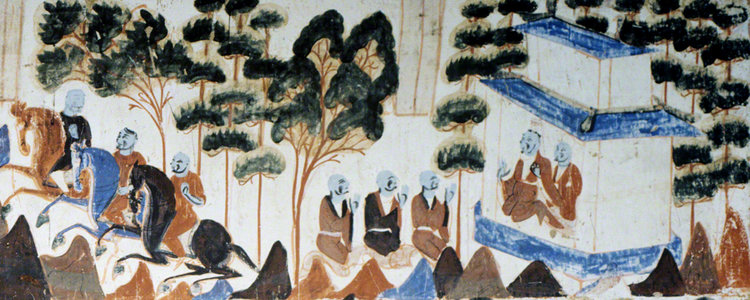
One remarkable representation of these Jataka tales can be found in a Dunhuang mural. Located on the eastern wall of Mogao Cave 428, this mural intricately portrays a renowned Jataka tale featuring Prince Mahasattva. The entire narrative is depicted across three registers, capturing the essence of the story within its captivating artwork.

Detail of the three princes paying their respects to the king and queen before they leave for the forest. First register, right section. Mogao Cave 428. Northern Zhou, 557-581 CE. Dunhuang. Image courtesy of the Dunhuang Academy.

The mural commences on the right-hand side of the first register, where a captivating scene unfolds. Three young men, their hands pressed together in a gesture of genuflection, kneel before a majestic blue pagoda. Inside the pagoda, two figures exuding regal aura can be identified as the king and queen, bidding a heartfelt farewell to their sons, the three young men.

As the story progresses, the mural transitions to subsequent scenes, unveiling the brothers’ journey into the forest for a hunting expedition. Within this vibrant forest setting, an array of deer and tigers roam, coexisting with the majestic presence of towering trees and majestic mountain ranges. The undulating mountains, adorned with a multitude of colors, gracefully assume a smaller scale compared to the trees, animals, and human figures, harmoniously framing each scene of the narrative.

Detail of the three princes hunting in the forest. First register, middle section. Mogao Cave 428. Northern Zhou, 557-581 CE. Dunhuang. Image courtesy of the Dunhuang Academy.

The story unfolds on the second register, commencing from the left-hand side. As the three brothers venture deeper into the forest, they eventually dismount from their horses, seeking respite at the foothills of towering mountains.

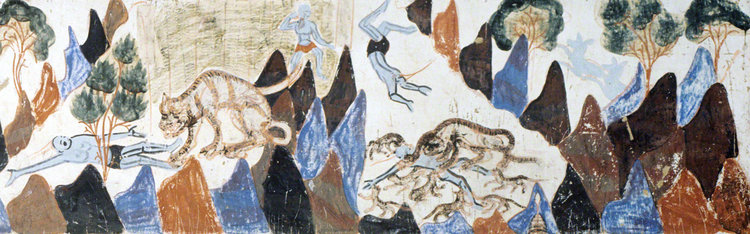
While taking a moment to rest, the brothers catch sight of a tigress accompanied by seven adorable cubs. The tigress is portrayed with her mouth agape, and her painted figure exudes a somber aura with limbs hanging low. Her gaze fixates upon the playful cubs frolicking around her, creating an illusion of impending maternal aggression, as if she were poised to devour her own offspring.

Detail of the starving tigress and her baby cubs. Second register, middle-left section. Mogao Cave 428. Northern Zhou, 557-581 CE. Dunhuang. Image courtesy of the Dunhuang Academy.

The brothers convene to discuss the matter of the tigress. Not wanting to watch a mother devour her own children, the brothers resolve to help her find food. However, there does not appear to be any food nearby.

Prince Mahasattva suddenly comes up with an idea. He keeps it to himself and tells his two brothers to leave the forest to find some food while he stays behind to watch over the tigers.

After his brothers leave, Prince Mahasattva strips off his clothes and lies down in front of the tigress, offering himself to the tigress. He decides to offer himself as food for the tigress so that she wouldn’t have to eat her own children. 

The tigress sniffs at his body but makes no move to harm him even though she is starving.

When we offer help to someone and they are unable to accept what is offered, it’s a chance for us to feel good about having attempted goodness without losing anything. We can think to ourselves, well, we tried to help. In the case of Prince Mahasattva, he understood that good intentions alone would not save a life. It would take determined and complete self-sacrifice to save the tigers.

Realizing that the tigers will not eat him alive, Prince Mahasattva climbs to the edge of a cliff, cuts open his neck and throws himself off the ledge. With his neck bleeding profusely, his body drops in front of the tigress and her cubs. At Prince Mahasattva’s second attempt to offer his body, the tigers devour him as nourishment.

Detail of the Prince Mahasattva’s sacrifices to the tigers. Second register, right section. Mogao Cave 428. Northern Zhou, 557-581 CE. Dunhuang. Image courtesy of the Dunhuang Academy.

Snaking across and down the three registers, the story continues on the third register by beginning on the right-hand side again. Prince Mahasattva’s brothers return and they understand what happened in their absence when they see the bones left behind by the tigress and her cubs.

The brothers’ bodies contort across the scene in shock, anguish, and grief in reaction to the death of their third sibling.

Detail of the grieving brothers and their return to the palace. Third register. Mogao Cave 428. Northern Zhou, 557-581 CE. Dunhuang. Image courtesy of the Dunhuang Academy.

The two brothers practically fly back to the palace on their horses to tell the king about what happened to Prince Mahasattva. 

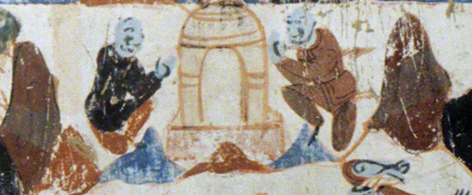
The story actually ends on the topmost right corner of this image, returning to the place where the two princes found their brother’s corpse. After reporting to the king, the family builds a stupa over Prince Mahasattva’s bones and hair to commemorate his selfless actions.

Detail of the brothers building a stupa over Prince Mahasattva’s remains. Third register. Mogao Cave 428. Northern Zhou, 557-581 CE. Dunhuang. Image courtesy of the Dunhuang Academy.

Many of the Mogao caves at Dunhuang have central pillars that take after the stupa form.

Scholars have theorized that worshippers could have circumambulated these central pillars inside the Mogao caves at Dunhuang as one would do around stupas in the open air.

The central pillar in Mogao Cave 428. Northern Zhou dynasty. 557-581 CE. Dunhuang. Image courtesy of the Dunhuang Academy.

Prince Mahasattva

Link:https://peacelilysite.com/2023/06/09/a-jataka-tale-depicted-by-art/

#PrinceMahasattva #Mural #Dunhuang#MogaoCave #BuddhistTeaching #BuddhistSutra #BuddhistTales #moralstories #Buddha #Jatakastories #BuddhistWisdom #BuddhistWisdomforChildrenandParents #Jatakatales

Source: http://dunhuangfoundation.us/blog

Why Kumarajiva Swallowed Needles

Great Master Kumarajiva

Once, I had the privilege of listening to a pre-recorded dharma discourse by the esteemed H.H.  Dorje Chang Buddha III. During this enlightening session, His Holiness shared a captivating story that left a profound impact on my mind. It was the tale of Kumarajiva, a legendary figure who demonstrated his profound inner realization by consuming needles. Intrigued by this extraordinary account, I felt compelled to delve further into the remarkable life of Kumarajiva.

Kumārajīva was a Buddhist monk, scholar, missionary and translator from the Kingdom of Kucha (present-day Aksu Prefecture, Xinjiang, China). Kumārajīva is seen as one of the greatest translators of Chinese Buddhism. According to Lu Cheng, Kumarajiva’s translations are “unparalleled either in terms of translation technique or degree of fidelity”.

Kumārajīva settled in Chang’an during the Sixteen Kingdoms era. He is mostly remembered for the prolific translation of Buddhist texts written in Sanskrit to Chinese he carried out during his later life.

At Chang’an, Kumārajīva was immediately introduced to the emperor Yao Xing, the court, and the Buddhist leaders. He was hailed as a great master from the Western regions, and immediately took up a very high position in Chinese Buddhist circles of the time, being given the title of National Teacher. Yao Xing looked upon him as his own teacher, and many young and old Chinese Buddhists flocked to him, learning both from his direct teachings and through his translation bureau activities.

Kumārajīva appeared to have a major influence on Emperor Yao Xing’s actions later on, as he avoided actions that may lead to many deaths, while trying to act gently toward his enemies. At his request, Kumārajīva translated many sutras into Chinese. Yao Xing also built many towers and temples. 

Yao Hsing was so impressed with Kumarajiva’s political acumen, intellectual talent and spiritual depth that he was impelled to try a eugenic experiment. He insisted that Kumarajiva move out of the monastic community into a private house staffed by female attendants. Yao Hsing believed that the offspring of Kumarajiva and carefully selected maidens would be as brilliant and talented as their father. Although Kumarajiva was repelled by the experiment, he refused to jeopardize the welfare of the translation centre by refusing to obey his emperor. He complied with Yao Hsing’s orders but was concerned about the effect his actions might have on the monastic community. He likened himself to a lotus growing out of the mud and enjoined the monks to attend to the lotus and ignore the mud.

However, it is widely understood that monks are expected to adhere strictly to the rules and precepts, diligently purifying their bodies and minds while maintaining purity in their six senses. Deviating from these principles, particularly by engaging closely with women and disregarding the precepts, can hinder the attainment of positive outcomes. Consequently, doubts began to arise among the Sangha regarding Kumarajiva’s integrity, leading to a decline in the commitment of some disciples to uphold the essential Buddhist rules.

When Kumarajiva became aware of the troubling trend spreading among the monks, he could not afford to be complacent. In response, he summoned all his disciples to gather before him, determined to address the issue head-on.

Before the perplexed audience, Kumarajiva unveiled a bowl filled with silver needles, their sharpness and gleaming appearance catching everyone’s attention. The monks were left wondering about the purpose behind Kumarajiva’s display.

In a solemn tone, Kumarajiva addressed his disciples, saying, “Not every monk is qualified to enter into worldly attachments and establish households. If you can swallow these silver needles as I do, then I will consider granting you permission to marry and have children. However, if you are unable to do so, you must never attempt to follow in my footsteps.”

Having spoken these words, Kumarajiva proceeded to place each silver needle into his mouth, consuming the entire bowl with a composed ease. The supernatural power exhibited by Kumarajiva left the assembled monks awe-struck, their eyes widened in astonishment. In the end, they were all convinced by Kumarajiva’s demonstration, believing him to be the true successor endorsed by the Buddha.

With this act, Kumarajiva showcased the potency of the correct Buddha Dharma. Consequently, no one dared to criticize him from that point forward. Instead, they committed themselves to diligent practice, upholding the precepts, engaging in self-cultivation, and abandoning any fantasies of pursuing worldly desires.

The community perceived Kumarajiva’s actions as an exemplification of self-sacrifice in the pursuit of the Bodhisattva Ideal, despite the disappointment he experienced due to the children of Yao Hsing’s experiment falling short of his grand expectations.

Why Kumarajiva Swallowed Needles

Link: https://peacelilysite.com/2023/05/11/why-kumarajiva-swallowed-needles/

#DorjeChangBuddhaIII#HHDorjeChangBuddhaIII #Kumarajiva #Buddhist #BuddhaDharma #SwallowNeedles #ChangAnChina #YaoxingEmperor #KuchaKingdom #InnerRealization #BuddhistPower #Monk

Source: https://en.wikipedia.org/wiki/Kum%C4%81raj%C4%ABva, https://www.tsemrinpoche.com/tsem-tulku-rinpoche/great-lamas-masters/kumarajiva-the-great-translator-from-kucha.htmlhttps://khyentsefoundation.org/the-life-and-legacy-of-kumarajiva/https://japanesemythology.wordpress.com/study-notes-the-influence-of-kumaraju-kumarajiva-upon-japan/

The inspiring story of Eddie Jaku – The happiest man on earth

I stumbled upon a video by Eddie Jaku, titled “The happiest man on earth” at TEDxSydney 2019, and it moved me deeply. Eddie shared his story of love, survival, and happiness. His holocaust survival story spanned 12 years, from Hitler’s rise to power in 1933 until liberation in 1945. Despite experiencing unimaginable horrors and facing death every day, Eddie is a truly happy person, and his story changed my concept of happiness.

Eddie Jaku was born Abraham Jakubowicz in Germany in 1920. His family considered themselves German, with Jewish heritage coming second. However, on the night of November 9, 1938, known as Kristallnacht, Eddie returned home from boarding school to find an empty house. Nazi soldiers burst in, beat him, and took him to Buchenwald. Eddie was released and escaped to Belgium with his father, but was soon captured and sent to a camp, and then to Auschwitz.

On his way to Auschwitz, Eddie managed to escape back to Belgium and lived in hiding with his parents and sister. However, in October 1943, the family was arrested and sent to Auschwitz, where Eddie’s parents were both murdered. Eddie was sent on a “death march” in 1945, but he managed to escape and hid in a forest, surviving on slugs and snails until he was finally rescued in June 1945.

Photo by Julia Sakelli on Pexels.com

After the war, Eddie Jaku moved to Australia and started a new life. He married his wife, Flore. However, Eddie’s past experiences continued to haunt him, and he struggled to find happiness in his new life.

It wasn’t until his first son, Michael was born that Eddie began to feel truly happy again. He was overcome with joy and gratitude for his son’s arrival, and it reminded him of the importance of love and family.

In his book, “The happiest man on earth,” Eddie writes, “With Michael’s birth, I began to feel happy again. I realized that I had a responsibility to be a loving and caring father to him, and that gave me purpose and meaning in life.”

Michael became a source of immense pride and joy for Eddie, and he dedicated himself to being the best father he could be. He taught Michael about the importance of resilience, compassion, and kindness, and instilled in him a deep appreciation for life and family.

Eddie’s love for his sons and his commitment to being a positive force in the world is a testament to his resilience and strength of character. His story is a powerful reminder that no matter what challenges we face, we can always find happiness and meaning in life through love and connection with others.

Another remarkable aspect of Eddie Jaku’s story is his attitude towards hate and forgiveness. Despite all the suffering and loss he endured during the Holocaust, Eddie refuses to hold on to hate or anger towards anyone.

In fact, Eddie has spoken publicly about his belief that hate is a disease that only causes more pain and suffering. He believes that hate can lead to violence, discrimination, and even genocide, as he experienced firsthand during the Holocaust. Eddie has made it his life’s mission to spread the message of love, compassion, and forgiveness. He believes that the only way to overcome hate is with love, and that the best way to combat discrimination and prejudice is through education and empathy.

Eddie Jaku’s story is truly inspiring. His message of love, happiness, and resilience is a testament to the power of the human spirit. Eddie’s story reminds us that no matter what challenges we face, we can always find happiness within ourselves. His warm and wise words become my daily prayer to my family, friends and all people on earth: May you always have lots of love to share, lots of good health to spare, and lots of good friends that care.

The inspiring story of Eddie Jaku – The happiest man on earth

Link:http://The inspiring story of Eddie Jaku – The happiest man on earth

#EddieJaku#Thehappiestmanonearth#Friendship#Compassion #Forgiveness#Auschwitz#Holocaust

The Life and Legacy of A Great Translator — Kumarajiva (III)

Photo by Jeremy Bishop on Pexels.com

Long and Tortuous Blooding Journey to China

Emperor Fu-Chien (337-385), also known as Fu-Jian, became increasingly interested in Buddhism. In 379, he conquered the city of Hsiang-yang and invited Tao-an to establish his renowned center for the translation of Buddhist scriptures and texts in the capital of Ch’ang-an, which Fu Chien fully supported. Tao-an, impressed by Kumarajiva’s spiritual, philosophical, and linguistic abilities, urged Fu Chien to invite him to Ch’ang-an. However, the warlord-emperor, in his aggressive manner, dispatched Lu Kuang with an army to conquer Kucha and capture Kumarajiva. Kucha fell to Lu Kuang, and Kumarajiva willingly accompanied the conquering general to Ch’ang-an in 383.

Then, a series of unexpected events occurred. Tao-an died in 385, and six months later, the Yao family attacked and conquered Ch’ang-an, killing Fu Chien. The new dynasty continued the policies of the previous rulers, such as preserving Tao-an’s translation center and promoting Buddhist studies, eagerly anticipating the arrival of Kumarajiva in the capital. Lu Kuang, upon hearing of the conquest of Ch’ang-an, halted his return and declared himself independent, establishing a state known as Later Liang with its center at Ku-tsang. Although Lu Kuang was not a Buddhist and did not care for spiritual matters, he recognized the political value of Kumarajiva.

Lu Kuang held Kumarajiva captive for sixteen years, subjecting him to numerous indignities while also using him as a military adviser. During this time, the rulers of Ch’ang-an pleaded for his release, but to no avail. Kumarajiva found this period of his life difficult and frustrating, as he was mocked for his beliefs and practices and could not pursue the work he felt destined to do. Despite this, he did not become passive or disheartened. Instead, he used this time to learn about China from the rugged soldiers who had traversed much of the country. He also quietly gathered texts to take with him to Ch’ang-an and thoroughly mastered the Chinese language.

Eventually, Yao Hsing, the second ruler of the new dynasty at Ch’ang-an, grew tired of fruitless negotiations with Lu Kuang and took a daring risk. In 401, his armies attacked and conquered Ku-tsang (in present-day Afghanistan). Kumarajiva was rescued unharmed, and in 402, he was welcomed into Ch’ang-an. He finally realized a dream he had conceived in his twenties, but it took until his fifties to come to fruition.

This image has an empty alt attribute; its file name is image-37.png
An artist’s impression of a translation session

Kumarajiva was warmly received by Yao Hsing, who bestowed upon him the title Teacher of the Nation. The fruitful phase of his life, which has profoundly influenced Chinese Buddhist tradition from the moment he entered Ch’ang-an to the present day, began with his arrival and lasted barely a decade. Within six days of taking up residence in his new home, he accepted the suggestion of a monk named Seng-jui, later one of his chief disciples, and began to translate a text on meditation, the Tso-ch’an san-mei ching. He found that the translation centre founded by Tao-an had been preserved and supported by Yao Hsing, and he marvelled at the quality of the work his predecessor had undertaken. He found himself surrounded by an enormous group of knowledgeable monks who were ready to continue the work of translation under his guidance. He rapidly reorganized the centre so that new translations could be made even while the accomplishments of the previous generation could be reviewed and revised. Within the next few years he translated almost fifty works in about three hundred volumes.

Like Tao-an, Kumarajiva thought that the ko-i or ‘matching the meaning’ method of translation, in which unfamiliar Sanskrit Buddhist concepts were replaced by well-known Chinese Taoist words, compromised Buddha’s teachings. A review of Tao-an’s work convinced him, however, that too strict an insistence on literal translation, sometimes requiring the creation of awkward neologisms, rendered beautiful texts obscure. His belief that a translation should accurately convey the tone and texture of a teaching inseparably from its content compelled him to adopt a new methodology for translation. He chose to emphasize the central theme of a text or treatise and to edit passages which would seem unnecessarily repetitive to Chinese readers. Once he had arranged the working force at his disposal to his satisfaction, he would read a text aloud, sentence by sentence, before a large congregation. Yao Hsing would often attend these sessions, and sometimes he held the original palm-leaf manuscript in his own hands while Kumarajiva explained it. After each sentence, Kumarajiva explained its meaning and offered an oral translation in Chinese. The congregation would comment on the results and suggest improvements. Meanwhile, a recorder would write down the approved translation, and later an editor would review the whole text for style and internal consistency. Finally, a calligrapher would correct the Chinese ideographs to be sure there were no ambiguities in transmission of the texts.

Kumarajiva’s influence was not limited to the so-called barbarous kingdoms of northern China. In 378 Hui-yuan, one of Tao-an’s chief disciples, had gone south and made his abode in a monastic community at Lu-shan, a mountain famous amongst Taoists, Confucians and Buddhists for its majesty and mystery. Within a few years, he became the informal leader of the Southern Chinese Buddhist community. Shortly after Kumarajiva’s arrival in Ch’ang-an in 402, Hui-yuan wrote to him and encouraged him to continue the work of Tao-an. A year later, hearing that Kumarajiva might return to Kucha, he wrote again, strongly urging him to remain in China. During the next few years the two monks exchanged letters on philosophical and monastic subjects, and eighteen of these exchanges survive. Hui-yuan enquired about many issues, but he was most interested in gaining a clear understanding of the dharmakaya, the highest vehicle of a Buddha. Kumarajiva distinguished between dharmakaya, the ultimate body of Buddha, and dharmadhatujakaya, the invisible body consciously evolved by a Bodhisattva to serve humanity in the world even after physical death. Thereby he showed how that which is ultimately real is reflected in subtle material form through one-pointed and universal consciousness. In these letters answering questions posed by a serious disciple of buddhadharma, one can glimpse something of Kumarajiva’s own profound insight and understanding. In general, he preferred to remain hidden behind the lustre of his translations and refrained from writing treatises setting out his own views.

Seng-jui is said to have rejoiced after attending a translation session with Kumarajiva, because for the first time he caught a glimmer of understanding of the enigmatic concept of shunyata. The collective work of Kumarajiva and his colleagues produced texts which were readable, comprehensible and inspiring. After a millennium and a half his translations are still read and studied, and they are often used as the basis for new translations into other languages, including English. Even though he translated a range of sutras and commentaries from a variety of Buddhist teachings, such as the Prajnaparamita literature, the Vimalakirti Sutra and the Surangama Sutra, his most famous and influential work was his powerful rendition of the Lotus Sutra, known in Sanskrit as the Saddharma Pundarika Sutra and in Chinese as Miao-fu lien-hua. In it one finds harmoniously combined Kumarajiva’s astounding linguistic facility and his profound grasp of the scope and depth of buddhadharma. Perhaps less obvious to the modern reader is the remarkable support Yao Hsing gave to this sort of project. Also, Kumarajiva never hesitated to point out the enormous support he received from knowledgeable and enthusiastic monks who worked together with an exemplary spirit of harmony and cooperation.

Golden copy of the “Universal Gateway”, Chapter 25 of the Lotus Sutra kept in Taiwan National Palace Museum. One of the many excellent works of Kumarajiva

Within just 11 years, Kumarajiva and his team translated 384 volumes, including sutras, commentaries, and other Buddhist texts. Since that time, his translations have been held in high regard by modern scholars due to the smooth flow of the work which conveys deeper meaning than just literal rendering. If it wasn’t for Kumarajiva, many of the great Mahayana texts may not have been preserved until today.

The major scriptures translated by Kumarajiva between 401-413 CE include:

  • Smaller Sukhavati-vguha (Amitabha Sutra) in 1 volume, 402 CE
  • Vajracchedika Prajnaparamita Sutra (Diamond Sutra) in 1 volume, 402-412 CE
  • Satyasiddhi Shastra, (Treatise on the Completion of Truth) in 20 volumes, 402-412 CE
  • Mahaprajnaparamita Upadesha (Treatise on the Great Perfection of Wisdom Sutra) in 100 volumes, 402-405 CE
  • Shatika-shastra (Treatise in One Hundred Verses) in 2 volumes, 404 CE
  • Sarvastivadin Vinaya (Ten-Category Vinaya) in 61 volumes, 404-409 CE
  • Panchavimshati Sahasrika Prajnaparamita Sutra (Perfection of Wisdom Sutra in Twenty-five Thousand Lines) in 27 volumes, 404 CE
  • Vimalakirti Nirdesha Sutra (Vimalakirti Sutra) in 3 volumes, 406 CE
  • Astasahasrika Prajnaparamita Sutra (Perfection of Wisdom Sutra) in 10 volumes, 408 CE
  • Madhyamaka-shastra (Treatise on the Middle Way) in 4 volumes, 409 CE
  • Dvadashamukha Shastra (Treatise on the Twelve Gates) in 1 volume, 409 CE
  • Maitreyavyakarana Sutra in 1 volume
  • Shurangama-samadhi Sutra in 2 volumes
  • Karunikaraja Prajnaparamita Sutra in 2 volumes
  • Brahmajala Sutra (Brahma Net Sutra) in 2 volumes
  • Saddharmapundarika Sutra (Lotus Sutra) in 8 volumes
  • Dasabhumikavibhasa in 17 volumes

Temple Dedicated for Kumarajiva in WuWei, China


Pagoda enshrining Kumarajiva‘s Tongue Relics

On his deathbed, Kumarajiva prophesied to his closest disciples that his cremation would serve as a criterion of his success as a translator. If he had made errors – a possibility he was always willing to acknowledge – his entire body would be consumed by the funeral flames. However, if he had not erred, then his tongue would remain untouched by the fire. His disciples testified that his tongue survived the cremation of his body unharmed. This precious tongue relic is now preserved at the Kumarajiva Temple, located in Wuwei, in northwest China’s Gansu Province. It is the only temple in the world named after Kumarajiva. Additionally, the Kumarajiva Pagoda, built in the 4th century, was an important structure on the Silk Road. The elegant 12-storey brick pagoda was destroyed during a great earthquake in 1927, but was later rebuilt.

The judgement of history concurs with Kumarajiva’s disciples: his work became the backbone of the grand organic edifice of Buddhist thought and teaching that arose in China, even as the buddhavachana began to wane in India. Kumarajiva gave his life to a sacred mission, the full significance of which his contemporaries could not fathom. However, they correctly sensed from the magnetic force of his presence that subsequent generations would benefit immensely from his selfless service.

Kumarajiva’s translations were instrumental in the development of Buddhism in China, as he was able to transmit the true meaning of Buddhism through his works, which contributed to the development of schools such as the Pure Land, Tian Tai, San Lun, and many others. His translated sutras were always considered central to their principal readings.

The Life and Legacy of A Great Translator — Kumarajiva (III)

Link:https://peacelilysite.com/2023/04/06/the-life-and-legacy-of-a-great-translator-kumarajiva-iii/

#Buddhism #Kucha#Kumarajiva #Buddhist# Kashgar#GreatTranslator #BuddhistSutra #Prajnaparamita #Mahayanasutra#WuWeiChina #KumarajivaTemple #KumarajivaPagoda

Source: https://www.tsemrinpoche.com/tsem-tulku-rinpoche/great-lamas-masters/kumarajiva-the-great-translator-from-kucha.html, https://khyentsefoundation.org/the-life-and-legacy-of-kumarajiva/, https://japanesemythology.wordpress.com/study-notes-the-influence-of-kumaraju-kumarajiva-upon-japan/