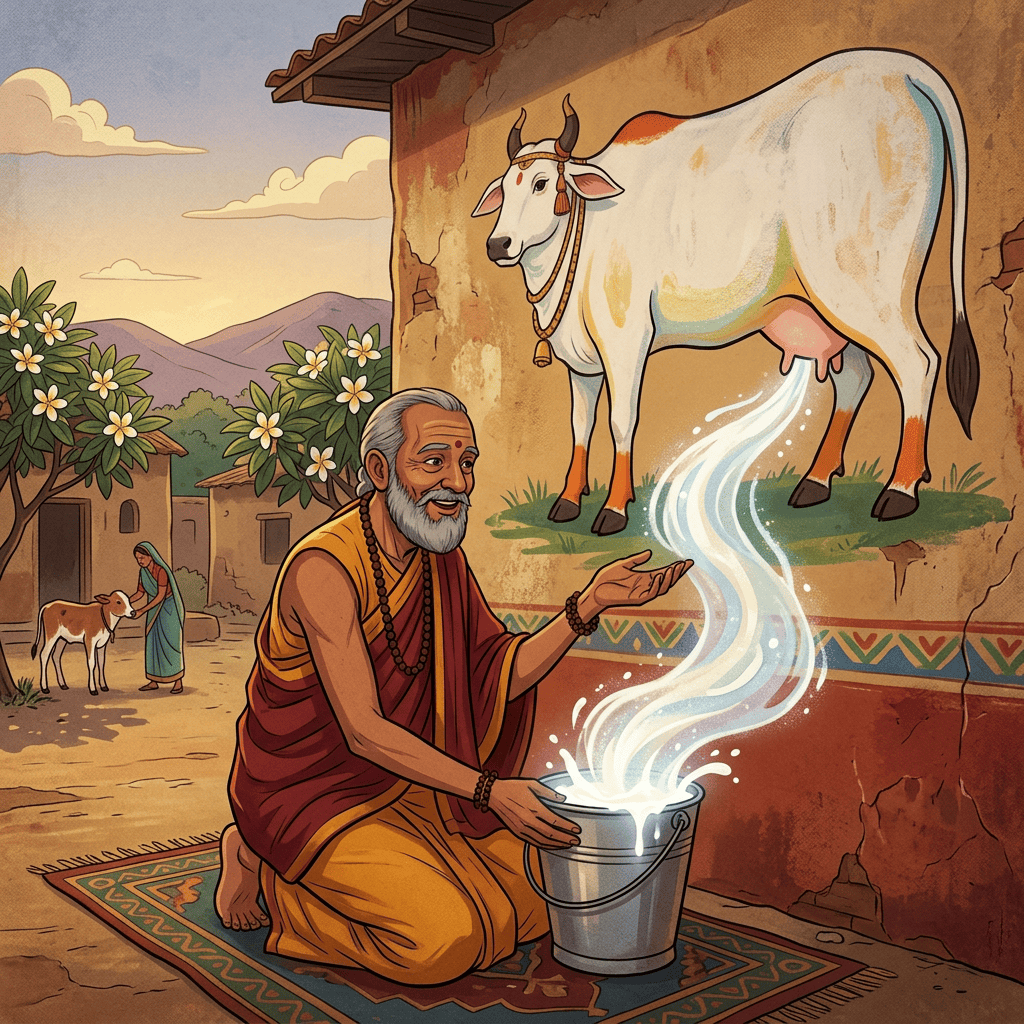
Bodhisattva Candrakīrti: Milking a Cow in a Painting
Recently, I came across a video about Bodhisattva Candrakīrti, one of the great Buddhist masters of ancient India.
The video told a remarkable story: according to Buddhist tradition, Candrakīrti was able to obtain milk from a cow that existed only in a painting.
When I first heard this, I was amazed.
How could a cow painted on a wall or in a picture possibly give milk?
Curious, I looked into the story and discovered that it is more than a fascinating Buddhist legend. Behind it stands a great master in the history of Buddhism and, more importantly, a profound teaching about emptiness.
Candrakīrti lived in India around the sixth or seventh century. He was one of the most important masters of the Madhyamaka, or Middle Way, school of Buddhist philosophy, and an important commentator on the teachings of Nagarjuna.
His best-known work, Madhyamakāvatāra (Introduction to the Middle Way), became an important text for the study of Madhyamaka philosophy.
Candrakīrti deeply explored a central Buddhist teaching:
All things arise in dependence upon causes and conditions. Nothing exists with an independent, permanent, unchanging essence.
This is one of the meanings of emptiness.
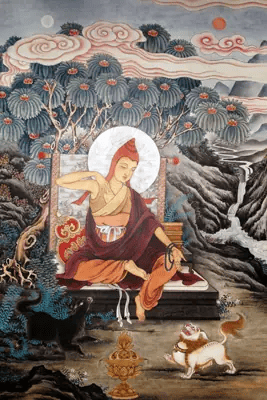
According to a story preserved in Buddhist tradition, Candrakīrti once lived and practiced at a monastery. Because some people did not understand his way of practicing, they misunderstood him.
Later, he was given responsibility for providing milk for the monastery. It is said that Candrakīrti released the cows into the forest, allowing them to roam freely.
Yet somehow, milk continued to appear at the monastery.
People were puzzled.
If the cows were far away in the forest, where was the milk coming from?
Some people secretly followed Candrakīrti.
According to the traditional story, they saw him approach a painting of a cow—and somehow draw milk from the painted cow.
It is an extraordinary story.
But perhaps the most important question is not whether the event sounds miraculous.
It is what the story invites us to think about.
We normally think:
A real cow can give milk.
A painted cow cannot.
That seems obvious.
Yet the story of the painted cow quietly asks us:
What exactly do we mean when we say something is “real”?
This question goes to the heart of Candrakīrti’s teachings on emptiness.
Emptiness does not mean that nothing exists.
Rather, it means that things do not exist independently, permanently, or entirely on their own. Everything depends upon causes, conditions, relationships, and the way we designate and understand it.
For example, someone is called a “teacher” because there are students. Someone is called a “parent” because there is a child. These identities arise through relationships and conditions.
When we look more deeply, we begin to see that many things we regard as fixed and permanent are actually dependent upon countless conditions.
What I find most meaningful about this story is that it encourages us not to be too quick to conclude:
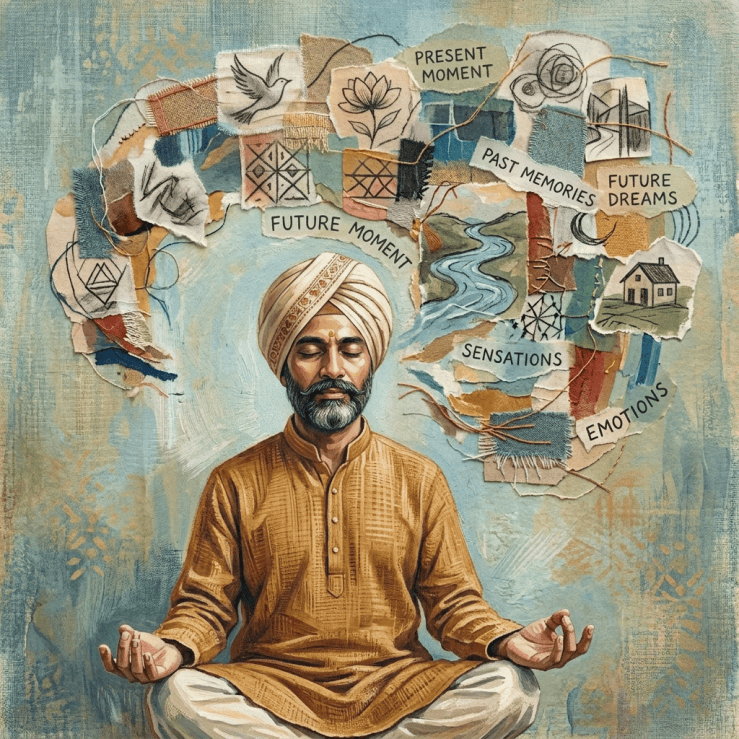
“Things must always be this way.”
“That is absolutely impossible.”
“I already know the answer.”
Our understanding of the world is often shaped by our past experiences, habits, assumptions, and fixed ideas.
Buddhist practice encourages us to hold our views more lightly—to have less attachment, more observation; less prejudice, more humility.
When we loosen our attachment to the belief that “I must be right,” we may begin to see possibilities and truths that we could not see before.
So when I think about the story of Candrakīrti and the painted cow, I no longer see it simply as a miraculous tale.
To me, it feels more like a doorway.
A doorway inviting us to question our ideas about reality, to recognize our own attachments, and to explore the deeper wisdom of dependent origination and emptiness.
Perhaps the story was never meant simply to leave us amazed.
Perhaps it is inviting us to look more deeply.
Just when we think we have completely understood the world, there may still be much more for us to discover.
And perhaps that is one of the most beautiful lessons we can receive from the wisdom of Bodhisattva Candrakīrti.

Link: https://peacelilysite.com/2026/09/09/bodhisattva-candrakirti-milking-a-cow-in-a-painting/
Source: https://www.fjdh.cn/wumin/2009/04/06452346128.html?utm_source=chatgpt.com, https://tricycle.org/magazine/truth-about-truth/?utm_source=chatgpt.com, https://baike.baidu.com/item/%E6%9C%88%E7%A7%B0/9958686

