Unraveling the Mystique: Celebrating the Dragon Year in Chinese New Year 2024

Photo by Chris F on Pexels.com

As we step into the Chinese New Year of 2024 (February 10th), ushering in the Year of the Dragon, we embark on a journey through the intricate tapestry of Chinese culture and folklore. Beyond the tangible creatures represented in the Chinese Zodiac, the dragon stands as a mystical symbol shrouded in enigma. Join us as we delve into the tales, traditions, and jubilations surrounding the Year of the Dragon, uncovering the profound significance of the Chinese Lunar New Year and its ancient lunar calendar.

The Chinese New Year, also known as the Spring Festival, is intricately linked with the Chinese Lunar Calendar, a timekeeping system rooted in the moon’s phases. Unlike the Gregorian calendar, the Chinese Lunar Calendar dates back over four millennia, its inception during the Xia Dynasty and refinement during the Shang Dynasty. It serves not only as a means to measure time but also reflects the Chinese people’s harmonious rapport with nature. Aligned with the agricultural cycle, the lunar calendar aids in agricultural endeavors, guiding farmers in sowing and reaping.
IVAN/GETTY IMAGES

More than a mere chronometer, the Chinese Lunar Calendar embodies a cultural legacy brimming with significance. Grounded in the principles of yin and yang, the five elements, and the Chinese zodiac, it offers a holistic understanding of existence. This venerable calendar not only demarcates the passage of time but also orchestrates cultural ceremonies, festivals, and customary observances.

In ancient China, the dragon reigned as a symbol synonymous with imperial authority. Emperors, considering themselves the “Sons of Heaven,” identified with the dragon, an emblem of celestial power. This perception permeated society, fostering a collective belief in the Chinese people’s lineage from dragons. Rooted in mythology, folklore, and cultural symbolism, dragons hold a special place in Chinese ethos, embodying myriad virtues and auspicious qualities.

Legends abound in Chinese mythology, recounting the exploits of the Four Dragon Kings, guardians of the seas in the cardinal directions. Revered for their prowess and rain-summoning abilities, these divine beings epitomize the grace and might associated with dragons. Similarly, the tale of Nezha and the Dragon Prince underscores the dragon’s dual role as a symbol of strength and wisdom, transcending conventional boundaries. 

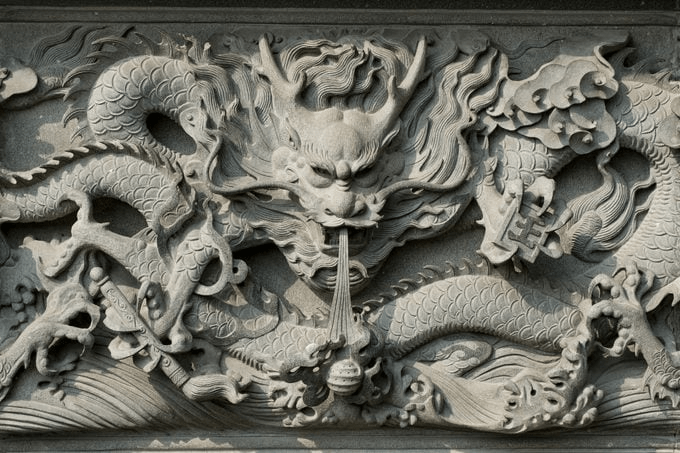
This mural depicting the Four Dragon Kings is preserved in Baiyun Temple, Beijing.

Ancient myths narrate the existence of the Nine Sons of the Dragon, each endowed with unique abilities shaping the natural world. From thunderous roars to water manipulation, these dragon progeny epitomize the elemental forces governing existence. The dragon’s omnipresence in imperial symbolism further underscores its significance, depicting the dragon as the epitome of majesty and sovereignty.

As the Chinese New Year approaches, customs and celebrations honoring the dragon come alive:

  1. Dragon Dances: The iconic dragon dance involves a team of performers manipulating a long, undulating dragon puppet through the streets. This dynamic display is believed to bring good luck and drive away evil spirits.
KEVIN FRAYER/GETTY IMAGES

  1. Dragon Boat Festival: While not directly related to the Chinese New Year, the Dragon Boat Festival is another celebration featuring dragon imagery. Races are held with elaborately decorated boats to commemorate the tragic death of the poet Qu Yuan.
  2. Dragon Lanterns: During the Lantern Festival, which marks the end of the Chinese New Year celebrations, dragon-shaped lanterns light up the night sky, creating a mesmerizing spectacle.

H.H. Dorje Chang Buddha III, a vocal artist, many years ago, has even composed a unique masterpiece, the energetic and festive song “Chinese Dragon,” showcasing the dragon’s cultural significance.

The dragon, shrouded in myths and revered in Chinese culture, takes center stage as we welcome the Year of the Dragon. These captivating stories and customs not only enrich our understanding of Chinese folklore but also highlight the dragon’s enduring role as a symbol of power, wisdom, and good fortune. As the dragon dances through the streets and the Lunar New Year festivities unfold, let us embrace the magic of this mythical creature and wish for a year filled with prosperity and auspicious beginnings. May the dragon bring its legendary blessings to all in the Year of the Dragon!

Link:https://peacelilysite.com/2024/02/09/unraveling-the-mystique-celebrating-the-dragon-year-in-chinese-new-year-2024/

#DorjeChangBuddhaIII#HHDorjeChangBuddhaIII#Vocal #Buddha #Dragon #ChineseNewYear #Zodiac#ChineseCulture

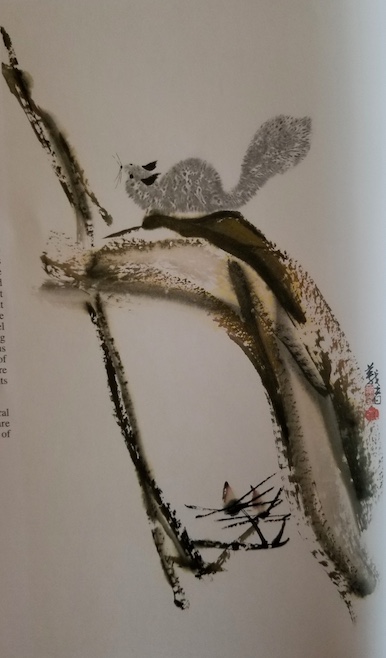
Simplicity, Innocent Charm, and Natural Appearance

Minimal Brush Strokes Create Charming Paintings

It is often said that the essence of a high-quality painting lies in its incorporation of the calligraphic brushstrokes, the commanding presence reminiscent of engraved stone seals, a tonal quality derived from the artist’s mastery of literature, a stylistic expression emanating from the artist’s virtue, and a captivating allure that springs from the artist’s state of realization—this, indeed, is the true spirit of the painting.

In the International Art Museum of America, several paintings, executed with only a minimal number of strokes, possess the robust appeal akin to stone seal engravings. These artworks convey the artistic conception of returning to original purity and simplicity. With a liberated hand and mind, the artist applies their most refined skills, devoid of any lingering attachments, creating with minimal yet natural brushstrokes.

Za Chai Shi Gu (Brushwork Resembling Smashed Jade)

There is a phrase used in commenting upon Chinese paintings and calligraphy that related to smashed jade. This painting exemplifies that charming style of smashed jade.

The pine tree, rendered with just a few simple strokes, emanates a pervasive sense of strength across the entire painting. The exquisite and lively portrayal of the little squirrel employs a truly remarkable and mysterious technique, combining simplicity, innocent charm, a natural appearance, and authenticity into a harmonious whole.

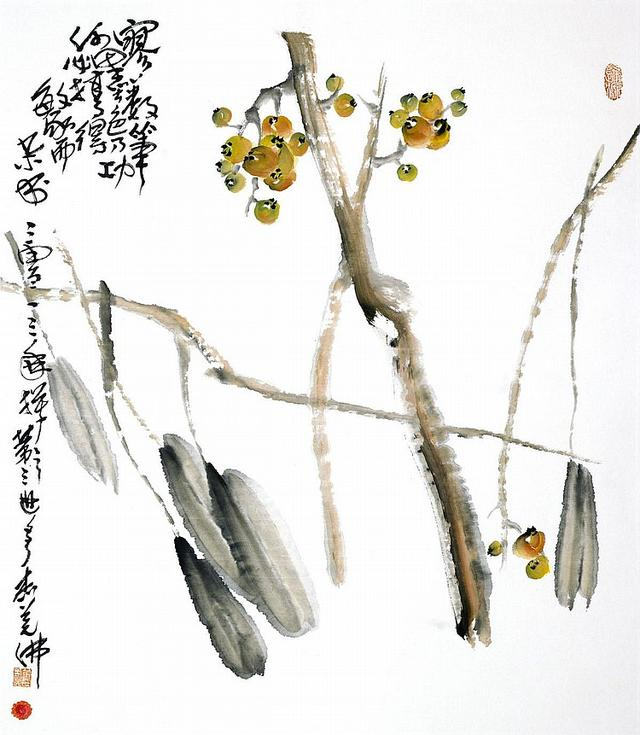
Loquat

H.H. Dorje Chang Buddha III painted ‘Loquat’ in 2013. This painting achieves the skill of cherishing ink like gold in its conception, with no wasted or faulty strokes. With just a few strokes, it is high and lofty, vibrant and lively, containing an elegant and comforting sense of ease, as if the brush strokes were divinely inspired.

At the autumn auction of the New York Zhenguan International Auction Company on September 12, 2015, this painting ‘Loquat’ was auctioned for a staggering 10.2 million U.S. dollars.

Yi Chen Bu Ran (Immaculate)

With only a small number of strokes, a comforting and natural appeal appears vividly on paper. The style is neither overly cautious nor affected. A scholarly tone and an air of stone seals are revealed in the brushwork. This is a work of art with an attractiveness that stems from mature skills. The title “Immaculate” means that this painting is free of any trace of the mundane.

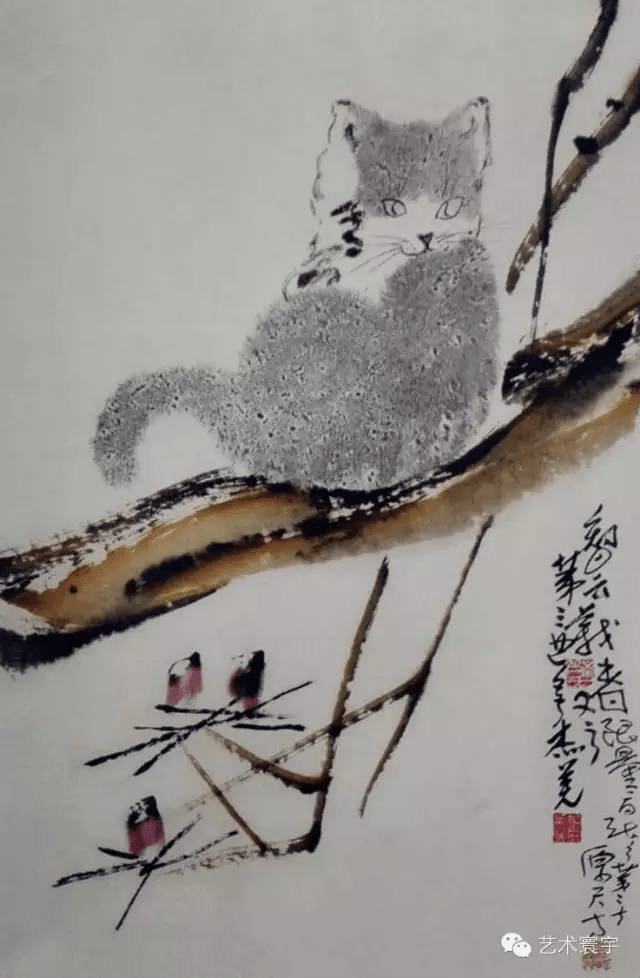
Cat of Unique Charm

In this painting, the cat is portrayed with a vibrant yet natural presence, achieved through the dynamic and captivating use of scattered ink. The entire artwork, painted with only a few brushstrokes, exudes the style of stone seals and an air of scholarly refinement. Both the form and spirit of the scene are skillfully captured. This work truly exemplifies masterful ink usage in a restrained manner.

One of the one hundred limited release copies of this small-scale, painting “Cat of Unique Charm” sold at auction for US$253,000, which is the highest per square foot selling price of any duplicate painting in the world. The prices of sold duplicate paintings by the most famous first-rate masters of art in the world cannot match the prices of sold duplicate paintings by H.H. Dorje Chang Buddha III.

Si Yu Sheng Hui (Resplendent Like Jade)

With just a few simple strokes, the entire painting is remarkably infused with a robust jade-like charm and an auspicious aura. Both the plantain tree and fruits exhibit a lack of mediocrity and were painted without the slightest mental attachment in the artist’s mind. They appear natural, elegant, and enchanting. This sentiment is succinctly captured in the accompanying short poem: “Unfurl the painting scroll, and the particularly fragrant scent of ink is released, permeating the viewer’s mind and intoxicating them to the core. Only a minimal number of strokes were applied. This exemplifies the regal art of using ink as sparingly as gold.”

H.H. Dorje Chang Buddha III, the artist behind these magnificent paintings, has crafted a pure and enchanting spiritual realm with his incredibly succinct brush and ink technique. Upon viewing, it evokes a sense of ethereality, akin to the moon reflected in water, and a freshness that pierces the heart, reminiscent of the sound produced when a piano key is pressed. This unique artistic essence, bridging the real and the virtual, transcends the ordinary, providing a natural and enlightening experience that often transports individuals into a realm of wonder.

Simplicity, Innocent Charm, and Natural Appearance

Link: https://peacelilysite.com/2023/11/10/simplicity-innocent-charm-and-natural-appearance/

#DorjeChangBuddhaIII #HHDorjeChangBuddhaIII##IAMA#InternationalArtMuseumofAmerica #Simplicity #InnocentCharm #Natural Appearance #StoneSeal

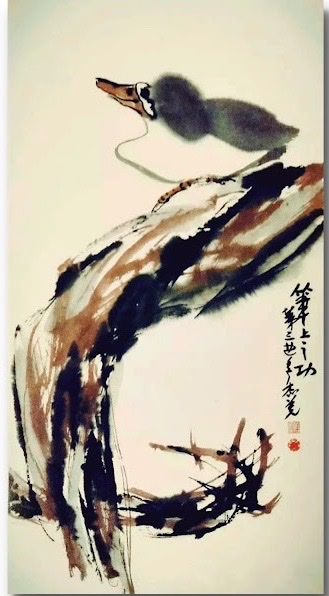
Bi Shang Zhi Gong – Skillful Brushwork

After learning about Eastern painting, American painter Graves said: “I realized that art and nature are landscapes of the soul, from which we can perceive the essence of human existence.” When you are fortunate enough to encounter these masterpieces, you will gain insight into the essence of Eastern art.

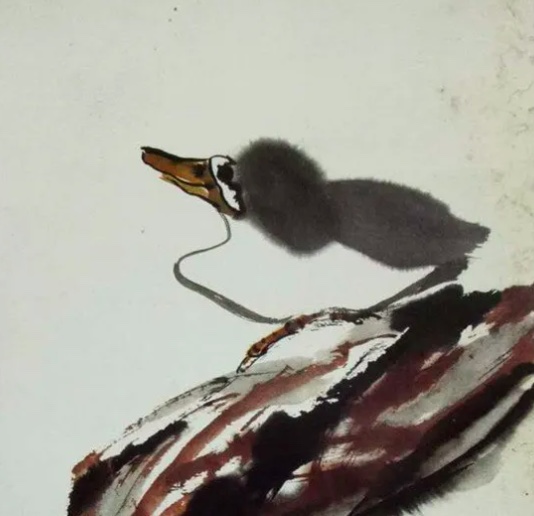
“Bi Shang Zhi Gong (Skillful Brushwork)” is a masterpiece of Chinese flower and bird painting that appears fresh and clear at first glance, profound in meaning after viewing, and unforgettable after further contemplation. The composition is extremely simple: in the center of the painting is a uniquely shaped bird with a flat, long beak and a spotlessly white belly. It sits comfortably and alone on the curved, thick trunk. Its eyes are ethereal and deep, as if completely focused; its posture demonstrates that wherever it is, is the focal point.

Upon careful observation, you will find that everything in the painting is in a state of colorful transformation. The bird’s head and back are painted with two blocks of ink that are close in shade, creating a melting effect, with the ink color seemingly still wet and spreading around.

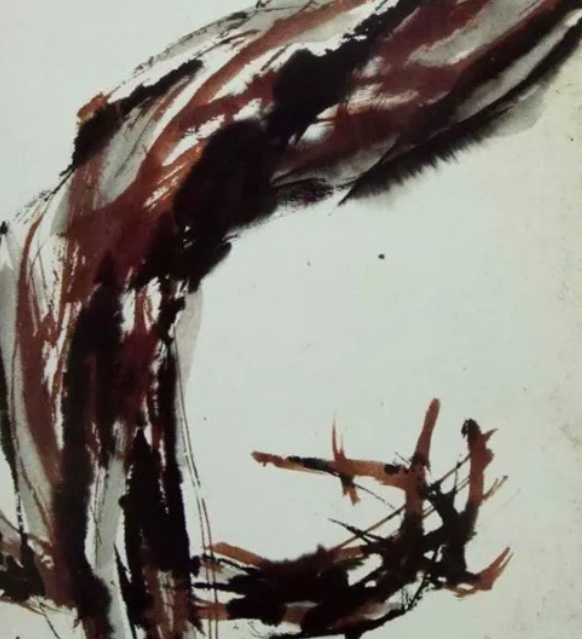
The trunk’s ink lines are clear and distinct, resembling a tree yet not quite a tree, as if constantly changing in the impermanence. At the bottom left of the tree, a branch twists and turns out, creating an S-shaped composition in the painting that is still in motion. The painting also uses color sparingly, with only a warm and friendly purple-brown color applied to the bird’s beak and the trunk.

This painting has a fascinating story behind it. It was created in 1982 during the filming of a movie in Sanhe, Sichuan. The painting captures an on-the-spot portrayal of a real-life scene. The artist used ink sparingly, treating it as if it were as precious as gold, while still showcasing his exceptional skills. At the time, the News Film Studio of China was producing a documentary exclusively about the artist, Master Yi Yungao (H.H. Dorje Chang Buddha III).

The cameramen and other observers witnessed a wild duck landing on a withered tree trunk. Master Yi Yungao quickly picked up his brush and swiftly completed the entire painting. By the time the wild duck took flight again, the painting had already been finished. Furthermore, the artistic mastery embodied in this artwork is extraordinary. It not only preserves the elegance, purity, and high-quality of traditional paintings but also introduces a new style—expressing the artistic conception of returning to original purity and simplicity. The artist, with an unfettered hand and mind, applies his most mature skills without the slightest attachment and with minimal, natural brushstrokes.

This masterpiece Chinese painting by H.H. Dorje Chang Buddha III is rich in literary atmosphere and varied in layers. It does not merely depict the external world, but rather it serves as a true manifestation of the inner spirit, transcending the natural material form to open up the world through the illumination of life’s spiritual light, reflecting the spiritual world. Appreciating the painting can reveal the pure world behind it, where everything, including the self, is forgotten, remaining untainted.

This painting is part of the permanent exhibition at The International Art Museum of America, located in the heart of San Francisco.

Bi Shang Zhi Gong – Skillful Brushwork

Link:https://peacelilysite.com/2023/10/26/bi-shang-zhi-gong-skillful-brushwork/

#DorjeChangBuddhaIII #HHDorjeChangBuddhaIII#DorjeChangBuddha#IAMA#InternationalArtMuseumofAmerica #ChinesePainting #MasterYiYunGao

Enemies and Foes can Stimulate Your Potential and Become Your Benefactors

Shallow men believe in luck. Strong men believe in cause and effect.” -Ralph Waldo Emerson

My grandmother was a woman of few words but very hardworking and resilient. I remember she once told me “Not to be afraid of being taken advantage of because suffering a loss is a blessing. What you are supposed to receive, Heaven will provide.” I didn’t understand my grandmother’s words at first, but as I grew older and gained life experience, I came to understand her wisdom.

I remember just after graduating from college, a TV company asked me to host a special program. The director of the program liked my writing and asked me to be a scriptwriter as well. However, when the program was finished and it was time to get paid, the director not only didn’t give me the scriptwriting fee but also deducted half of my hosting fee. He handed me a receipt and said, “You should be paid for $1600, but I can only give you $800 because the program is over budget.”

At that time, I didn’t say anything, signed it, and thought to myself, “Revenge is a dish best served cold.”

Later, the director asked me to help him a few more times, and I did.

The last time, he didn’t deduct any money and became very polite to me because by then I had been noticed by the news department of the TV station and suddenly became a TV reporter and news anchor.

We later often met at the company, and he always looked a bit embarrassed when he saw me.

I once thought about telling the boss about what he did to me before, but just as my grandma said, would I have what I have today without him? If I hadn’t held my breath at that time, would I have had the opportunity to continue hosting?

The opportunity was given by him; he was my benefactor. He already knew he was wrong, so why should I retaliate?

Later, I went to study in the United States.

One day, a classmate who had already found a job complained to me about his boss “exploiting” him, not only giving him a low salary but also deliberately delaying his green card application.

Photo by August de Richelieu on Pexels.com

At that time, I said to him: Such a bad boss is not worth working for. But you can’t work for free for so long, you have to learn something, then change jobs, so you have to learn secretly.

He listened to my words, and not only worked overtime every day but also stayed behind to memorize the writing of those business documents.

He even took notes on how to repair the copier, standing next to the workers, so that one day when he went out to start his own business, he could save some repair fees.

After half a year, I asked him if he was going to change jobs?

He smiled: No need! My boss now looks at me with new eyes, has been promoted, got a raise, and even asked me why my attitude changed 180 degrees and became so positive?

His dissatisfaction disappeared, he took revenge, but in a different way, and he also reflected on himself, realizing that he was not working hard at the time.

It was about five years ago when I came across an interesting incident.

A friend of mine suddenly took a keen interest in fortune-telling, studying everything from Bazi (Chinese astrology), naming studies, to astrology, all to prove that fortune-telling was a scam.

The reason was that a master had told his fortune, predicting that he would not live past 47. He swore to discredit the master’s reputation. Guess what happened? The more he learned, the more scared he became, because he realized that his own predictions for himself also indicated a short life.

Photo by Mikhail Nilov on Pexels.com

At that point, he changed. He started doing charity work, thinking, “Since I won’t live long, I might as well make the most of the time I have left and do something meaningful.”

He threw himself into it wholeheartedly. Everyone said he had changed, from an anxious and opportunistic petty person to a kind and gentle gentleman.

Unbeknownst to him, he passed 47, then 48, and is now 53, healthy and full of life, healthier than anyone else.

“You can go smash that master’s sign now!” I joked with him one day.

His eyes lit up, and he asked me, “Why?” Then he laughed, “If it wasn’t for his warning, given my previous personality, I would indeed have had a heart attack by the age of 47. He wasn’t wrong!”

My friends, do you like to show off and be ruthless? Are you always harboring grudges? Do you have the resentment of “a gentleman takes revenge; it is never too late”?

Please think about these stories.

You should know that enemies and adversaries can stimulate your potential and become your benefactors.

You should also know that many grudges, grievances, and dissatisfaction actually stem from your own issues.

You should further know that the best revenge in this world is to use that dissatisfaction to propel yourself towards success, and to treat your past enemies with the magnanimity that comes with that success and the success that follows.

Isn’t turning “a cycle of vengeance that never ends” into “a win-win situation where past grievances are forgotten with a smile” the greatest success in life?

Enemies and Foes can Stimulate Your Potential and Become Your Benefactors

Link: https://peacelilysite.com/2023/10/06/enemies-and-foes-can-stimulate-your-potential-and-become-your-benefactors/

Source: FaceBook 臉書 五味人生。回憶裡。尋找

Yanmenguan – A Famous Pass of Great Wall

Nestled in the depths of Yanmen Mountain in Shanxi, the ancient Yanmenguan Pass stands as a solitary testament to history, dating back some 2,000 years. This once invincible guardian of the frontier, which served as a formidable defense along the boundary, now seems like a wise old man, eager to share tales of its storied past.

Located 12 miles (19 kilometers) north of Daixian County, in Shanxi Province, Yanmenguan Pass is one of the three notable passes of the Inner Great Wall, alongside Ningwu Pass and Pianguan Pass.

The region’s history can be traced back to the Spring and Autumn Period (770 BC – 476 BC), when King Wuling of Zhao State first established Yanmen County here. During the reign of Emperor Qin Shi Huang (259 – 210 BC), orders were given to construct Yanmen Pass as a fortification against the northern tribes, sparking centuries of fierce battles for control.

In the Northern Song Dynasty (960 – 1127), the famous Yang family warriors, including female members, were stationed at the pass to defend against invasions from the Qidan troops of the northern prairies. Statues of some of these legendary figures can be seen lining the entrance path of the scenic area.

The structure of the pass includes a pass city, a barbican, and an enclosing wall. Nestled between two rolling hills, the pass city stands at a height of 30 feet (nine meters) and spans a perimeter of 1,100 miles (1,006 meters). Extending from the east and west wings of the pass city, the enclosing wall measures over three miles (five kilometers) in length and is punctuated with beacon towers. The barbican was constructed outside the northern gate of the pass city.

A Uniquely Designed Military Stronghold

The northern gate of the pass, Di Li Gate, boasts a barbican that forms a double defense line. Unlike most barbicans, the entrance door is situated on the east wall instead of the front, exposing potential invaders from two sides. Another distinctive feature is that Tian Xi’an Gate, which opens to the central plain, is not directly aligned with Di Li Gate. It is located at the northeast corner of the pass, while the area directly opposite Di Li Gate is a false lead, leading to a secluded mountain area with no walkable path, only dense trees, knee-high grass, and wild beasts.

Behind Di Li Gate lies a large reservoir with military potential. In case of a breach, defenders could break the dam to flood the invading forces. Additionally, a pagoda stands on the northern slope of the enclosing wall, occupying the highest point of the area at an altitude of 5,968 feet (1,819 meters). This strategic location served as an ideal command post, offering a commanding view of the entire area.

Yanmenguan was renowned for its strategic significance and legendary wars, having witnessed over 1,000 skirmishes and 140 significant battles throughout history. Since the era of the Zhao State during the Warring States period, every dynasty has recognized the importance of Yanmenguan’s defensive position. It has always been a border gateway marked by fierce conflict and integration between farming and nomadic peoples.

However, amidst the echoes of past battles, a story of peace and kindness emerges through the figure of Wang Zhaojun, one of the “Four Great Beauties” of ancient China. Two thousand years ago, she passed through Yanmenguan as an envoy of peace between China and the Xiongnu.

In 33 B.C., after over a century of conflict with the Xiongnu in the north, the Han Dynasty had grown stronger under Emperor Yuan, while the southern Xiongnu had weakened. The people longed for stability, and to establish friendly relations with the Han Dynasty, Chanyu Huhanye, the Monarch of the Xiongnu, visited Chang’an to meet Emperor Yuan.

Wang Zhaojun, born in 51 BC near the beautiful Xiangxi River at the foot of Jingchu Mountain, traveled to the bustling capital Chang’an in 38 BC after being chosen as a maid for the Imperial Palace. Customarily, the Emperor selected maids based on their portraits, and Wang, likened to a phoenix, was so pure that she didn’t need to bribe the artist Mao Yanshou, unlike the other maids. Mao, however, deliberately created an unflattering portrait of her, relegating her to the role of an ordinary maid with chores in the palace’s corners. Despite the cold treatment and challenging tasks, this adversity served to strengthen her mentally and physically, perhaps as a divine preparation for her destiny.

As a court lady in waiting, Wang Zhaojun was chosen for the marriage. When the matron of the harem presented her unflattering portrait to the Emperor, he merely glanced at it and approved. But upon seeing her in person, her beauty and grace astonished the Emperor, the monarch, and the ministers. Huhanye was overjoyed and vowed to maintain peace along the frontier.

Wang Zhaojun followed the Emperor’s orders, becoming a symbol of peace through her marriage to the Xiongnu. She was honored with the title “Ninghu Yanzhi,” meaning queen who could bring peace to the Xiongnu. Subsequently, she devoted her life to maintaining stability along the Han-Xiongnu border and promoting Han culture.

Two thousand years ago, the Huns led a nomadic life in the harsh northern deserts, lagging behind the more advanced Han Dynasty. As Wang Zhaojun traveled to Xiongnu, she observed the stark contrast between the desolation of the north and the prosperity of Chang’an.

After crossing Yanmenguan, her hometown of Jingchu and the Han palace in Chang’an seemed far away, leading to feelings of homesickness. Playing a sorrowful melody on her pipa (Chinese lute), she captured the attention of a flock of geese flying overhead. So captivated were they by the beautiful music and the sight of the graceful woman on horseback that they forgot to flap their wings and fell to the ground. This incident gave rise to the saying that Wang Zhaojun’s beauty was so captivating that it made geese fall to the ground. Wang Zhaojun’s role in fostering harmony through her marriage and contributing to a peaceful border region exemplifies the traditional Chinese cultural value of “harmony.”

After arriving in Xiongnu, Zhaojun faced a challenging living environment and vastly different customs. Nevertheless, she steadfastly adhered to her mission, set aside her homesickness, and courageously, persistently, and compassionately integrated into the Hun’s lifestyle. She transformed from an ordinary Han palace maid to a virtuous and kind Queen of the Xiongnu, assisting the monarch across two generations.

She urged the monarch to cease hostilities and introduced Han’s advanced cultural etiquette system to the Hun people. Moreover, she taught them to cultivate millet and hemp, rear domestic animals, weave cloth, and dig wells. Consequently, the beacons and wars along the frontier ceased, and a scene of “wind blowing through the grass and cattle and sheep grazing” emerged, allowing the people to live peaceful and prosperous lives.

Wang Zhaojun’s role in fostering harmony through her marriage and contributing to a peaceful border region exemplifies the traditional Chinese cultural value of “harmony.” The ethereal Wang Zhaojun lived up to the expectations of the Han Dynasty, resolved the conflict between the Han Dynasty and the Xiongnu, and propagated Han culture. Her accomplishments have become beacons of inspiration for future generations.

Instrumental in establishing peace and prosperity along the Han-Xiongnu border for half a century, she earned the love and respect of the people of her time and those of future generations. In her honor, the Huns constructed ‘The Tomb of Wang Zhaojun’ near the bank of the Big Black River. In the northern desert, she was revered as a Goddess sent by Heaven to assist the Xiongnu. It was said that there would be plentiful water and lush grass wherever she passed.


wang-zhaojun
(Image: Yaliga Ba via Dreamstime)

Today, as I reflect on this beautiful and strong woman, I can’t help but feel deeply moved. In the present world, we have extremely advanced technology, but it seems that people’s moral standards and the level of civilization have not been correspondingly enhanced. I earnestly hope that modern people can resolve national, racial, and regional contradictions and conflicts through peaceful means, and avoid resorting to war, violence, and terror, as these can only bring disaster and trauma to humanity and the planet.

Yanmenguan – A Famous Pass of Great Wall

Link: https://peacelilysite.com/2023/10/05/yanmenguan-a-famous-pass-of-great-wall/

Source: https://www.travelchinaguide.com/china_great_wall/scene/shanxi/yanmenguan.htm, https://artsandculture.google.com/story/yanmenguan-simatai-great-wall-tourist-area/SgUBezUMaQVMQQ?hl=en

Ms. Han Suyin held the Young painter in the Highest Esteem, and His Artworks Reached Record-breaking Prices at Auctions

Han Suyin was born in Xinyang, Henan Province, China, on September 12, 1916, to a Chinese father and a Belgian mother. She was raised in a multicultural and multilingual environment, which greatly influenced her future writings and perspectives.

Ms. Han Suyin gained international recognition as a prolific writer, primarily known for her semi-autobiographical novels. Her most famous work, “A Many-Splendored Thing,” published in 1952, became a bestseller and was adapted into a successful Hollywood film titled “Love Is a Many-Splendored Thing” in 1955. She authored numerous novels, essays, and articles that delved into themes of love, cultural identity, and East-West relations.

Ms. Han Suyin, an extraordinary figure in her own right, shared a remarkable connection with world leaders and spiritual luminaries from across the globe. Her life was intertwined with a little-known story of profound affinity with a great sage.

In February 1982, Ms. Han Suyin and her husband, Mr. Lu Wenxing, made a long-awaited journey to Sichuan, their ancestral homeland, to celebrate the Chinese New Year with their family. This marked her first return to Sichuan for the New Year since the establishment of the People’s Republic of China. As a professional writer, she was an unwavering observer of the human and cultural aspects of her homeland. She once articulated, “My life will forever traverse two opposing directions, leaving love to embrace love; leaving China to return to China.” This succinctly summarized her life’s journey. Her deep love for this ancient land fueled an unceasing quest for individuals with profound philosophical ideals, firmly convinced that within the mystical realm of China’s ancient civilization, cultural giants awaited discovery to awe the Western world.

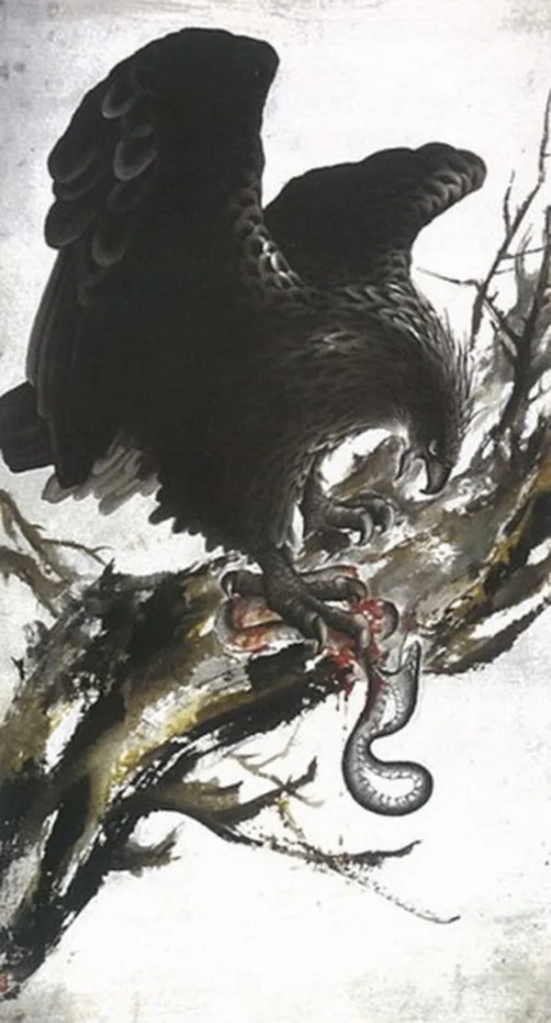
Fate and reason have their own ways. Soon, Ms. Han Suyin discerned her calling with remarkable acumen. While visiting an exhibition of Chinese paintings at Sichuan’s Wenshu Monastery, she was captivated by a yet-to-be-displayed masterpiece of a soaring eagle. The painting exuded vastness, antiquity, ethereality, and enduring profundity. Having toured renowned art museums worldwide and seen countless world-famous paintings, she found herself profoundly moved by this artwork, eagerly wishing to acquire it as a lifelong treasure. Regrettably, the exhibition had not yet officially opened, dashing her immediate hopes.

With the assistance of the local cultural department, Ms. Han Suyin eventually tracked down the artist behind the masterpiece. To her astonishment, the creator was an elegant young man, and an instant kinship developed between Ms. Han and this young prodigy. Their conversations touched upon a spectrum of subjects, from various styles within the Chinese art scene to global artistic movements and the evolution of humanistic ideals.

Upon parting ways, Ms. Han Suyin not only acquired the eagle painting for her collection but also handpicked two additional Chinese paintings, intending them as cherished gifts for her close friends. Thus, an international writer and an ancient sage forged a profound and enduring connection.

In 1993, eleven years later, Ms. Han Suyin reflected on this treasured memory, describing it as follows: “…I was the first fortunate individual to witness His artwork and immediately recognize His talent. His painting technique, marked by ever-shifting nuances and a compelling balance of strength and delicacy in each brushstroke, left an indelible impression on me. His vast knowledge and wide-ranging interests extended beyond art into the realm of traditional Chinese herbal medicine. His passion for medicine stemmed from his father’s status as a renowned traditional Chinese medicine practitioner. Moreover, he ventured into enhancing a particular palace-grade tea and brought it to market. In recent years, he has dedicated himself to creating a significant work, striving to establish a new life philosophy rooted in the authentic principles of Buddhism and the universe. Consequently, he produced internationally acclaimed paintings. His series of paintings featuring Buddhist monks garnered high praise in Japan and Singapore. His achievements were also acknowledged in North America, where he assumed a professorship at the Sino-American Cultural and Arts Research Institute and served as the president of the Chinese Painting Research Association at the Chinese Social Welfare and Education Center in Beijing. I genuinely believe he is an exceptional artist, and I am firmly convinced that his unwavering pursuit of knowledge will lead to even greater accomplishments…”

So, who is this extraordinary sage whom Ms. Han Suyin esteemed, and whom the world came to admire? None other than H.H.  Dorje Chang Buddha III.

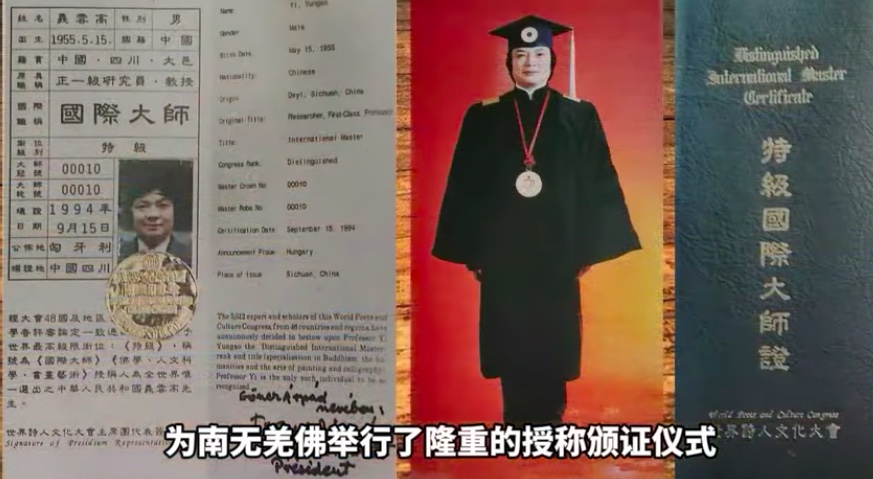
It must be acknowledged that Ms. Han Suyin’s discerning judgment was remarkably precise, as she firmly believed. H.H.  Dorje Chang Buddha III‘s achievements were indeed unparalleled. In 1994, at the World Poets Conference, 5,612 experts and scholars from 48 countries and regions acclaimed Mr. Yi Yungao (H.H.  Dorje Chang Buddha III ) as the world’s sole supreme international master, acknowledging his extraordinary contributions in Buddhism, the humanities, medicine, painting, and his lofty moral character. On September 28 of the same year, special envoys from the conference traveled to Sichuan to present him with the certificate of supreme international master, bearing the signature of the President of the International Olympic Committee, Samaranch.

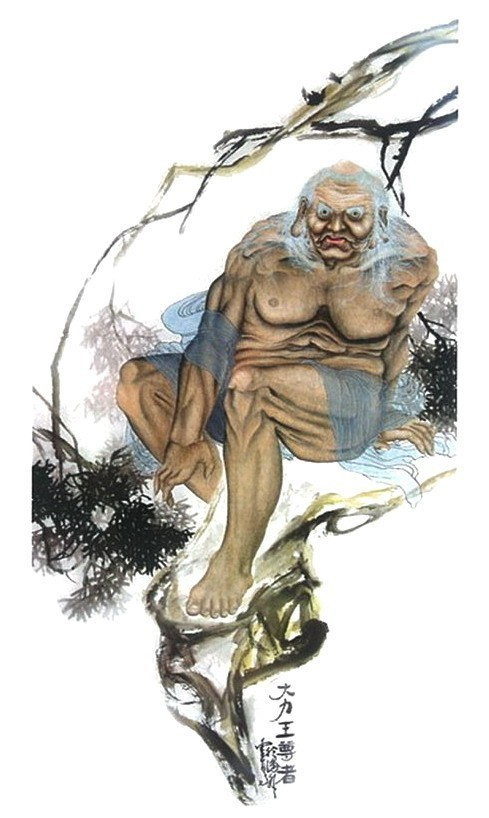
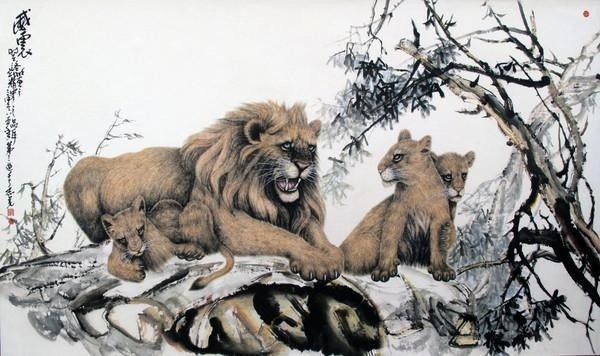
In the year 2000, H.H.  Dorje Chang Buddha III‘s artworks “Thunderous” and “Great Strength Vajra” achieved prices exceeding 2.12 million dollars and 2.2 million dollars, respectively, in the international market. Then, in March 2015, his artwork “Ink Lotus” set a record price at the New York Spring Auction, reaching an astonishing 1.65 million dollars per square foot.

Vulnerable Dali Wang
威震 WeiZheng (Thunderous)

Ink Lotus

You can appreciate all these three masterpieces at The International Art Museum of America (IAMA).

Another piece, “Loquat,” measuring six square feet, was successfully auctioned at an astounding price of 10.2 million dollars at the New York Zhenguan International Auction Company’s autumn auction, establishing an unprecedented record for Chinese paintings in the auction market. When calculated on a per square foot basis, it reached an astonishing 1.7 million dollars per square foot. The painting, “Loquat,” drew praise from experts at the auction company during the autumn preview, exceeding the criteria of a “masterpiece” set by ancient Chinese art critics. They described it as follows: “In the style of H.H.  Dorje Chang Buddha III , this painting exhibits an ever-changing technique, with strength and depth in every brushstroke, and an endless charm.”

World news media reports have hailed H.H.  Dorje Chang Buddha III as an “unprecedented master in the history of Chinese painting” and as the “pioneer who propelled Chinese painting art onto the global stage.” At this juncture, we, the younger generation, express our deep admiration and respect for Ms. Han Suyin’s extraordinary discernment.

Ms. Han Suyin held the Young painter in the Highest Esteem, and His Artworks Reached Record-breaking Prices at Auctions

Link: https://peacelilysite.com/2023/09/22/ms-han-suyin-held-the-young-painter-in-the-highest-esteem-and-his-artworks-reached-record-breaking-prices-at-auctions/

#MasterYiyungao #InternationalMaster #ChinesePaintings #MsHanSuyin #DorjeChangBuddhaIII  #HHDorjeChangBuddhaIII #DorjeChangBuddha#IAMA#InternationalArtMuseumofAmerica

Source: https://www.tpcdct.org/article/4869

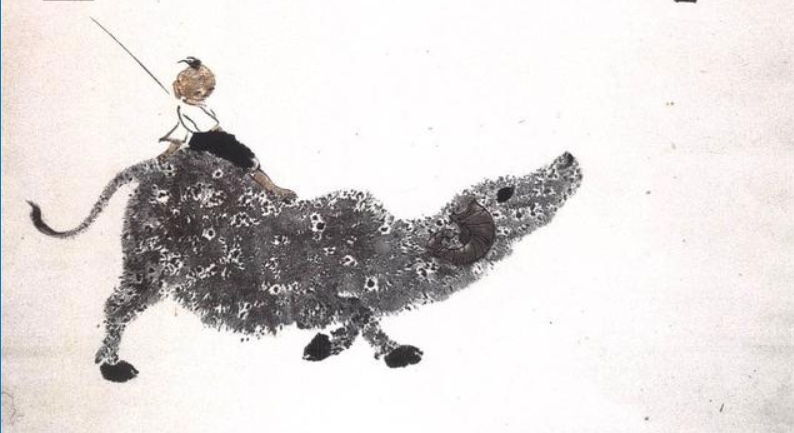
Niu Nian Tu (Year of the OX)

Artist: H.H. Dorje Chang Buddha III

At year February 2007, this Year of the Ox (by H.H. Dorje Chang Buddha III) painting was exhibited at an auction in the Hua Zang Si Temple in San Francisco. Even though I saw it online, when I saw this work in person that year, I was suddenly transported into a world of pure and poetic spirituality.

The ox strolled leisurely, Looking up to admire the scenery. On the ox’s back, a young herder, Humming a tune, Enjoying a unique sense of freedom. Though there was no verbal communication, There was mutual companionship, Dependence on each other.

Later, I saw this painting again at The International Art Museum of America in San Francisco. It was as if I were re-experiencing the long-lost joy of childhood innocence, and I couldn’t help but stop and admire this exquisite masterpiece.

The entire composition of the painting is concise: an ox, a flute, a young herder on the ox’s back, a few simple strokes representing tree branches, and a hint of green. The old ox was covered in glistening sweat, and no matter where or when, it remained calm, with steady steps and a high head, as if filled with determination and strength for the journey of life. The young herder reclined comfortably on the ox’s back, at ease and trusting that the old ox would take him where he wanted to go. Urban dwellers fortunate enough to witness such a rare and beautiful scene would find their tense hearts instantly relaxed.

In terms of technique, this Chinese painting exhibits remarkable simplicity, featuring an expansive and open composition coupled with unique and striking artistic techniques. The skillful use of white space within the artwork, thanks to clever design choices, not only avoids diminishing or dulling the image but also creates boundless room for the viewer’s imagination to roam. Additionally, the artist employed a scattered perspective technique to lend the painting a three-dimensional quality, skillfully using emptiness to convey form. The seamless integration of form and emptiness results in an exceptionally elegant layout.

This painting serves as a testament to the artist’s ability to convey the inherent charm of nature and capture the essence of a pure and childlike spirit, offering solace and enjoyment to its viewers. What is particularly astonishing is the meticulous application of ink at a minute level, portraying the oxen’s hairs in an array of intricate variations.

Although the painting does not depict the colors of early spring, mountains, valleys, or springs, they seem to be faintly visible on the canvas. It’s said that by calculating white as black and using emptiness as a form of depiction, the simplicity of the image leaves room for endless beauty and boundless imagination. This painting beautifully exemplifies the traditional Chinese cultural principle that ‘The Dao resides in simplicity.’ It evokes thoughts of the legendary tale of Laozi departing China on a green ox through the Hangu Gate in pursuit of Sakyamuni Buddha.

Having been in the hustle and bustle of the city for a long time, one longs for the tranquility of the countryside. But once in the quiet countryside, one can’t bear the loneliness and solitude. The restless heart can’t resist the temptation of the bustling world and constantly seeks outward under the pull of desire. When lost and falling into despair, one realizes that this is not the life one truly desires.

In reality, the ideal paradise is not far away; it resides in the inner tranquility and practicality of the present moment. Just like the young herder and the old ox in the painting, tranquility and boundless joy are always found in the present moment.

Niu Nian Tu (Year of the OX)

Link:https://peacelilysite.com/2023/09/15/niu-nian-tu-year-of-the-ox/

#DorjeChangBuddhaIII #HHDorjeChangBuddhaIII#DorjeChangBuddha#IAMA#InternationalArtMuseumofAmerica#HuaZangSi #SanFrancisco #YearofOX #ChinesePainting

Source: https://baijiahao.baidu.com/s?id=1760888707241544465

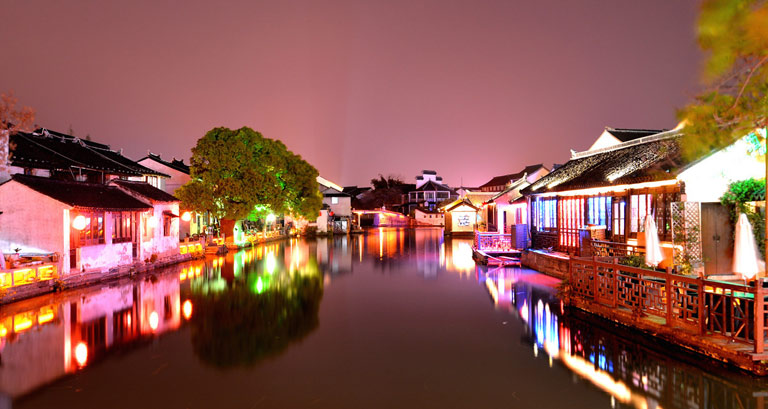
Tongli Ancient Water Town: A Poetic Dream of the Oriental Venice

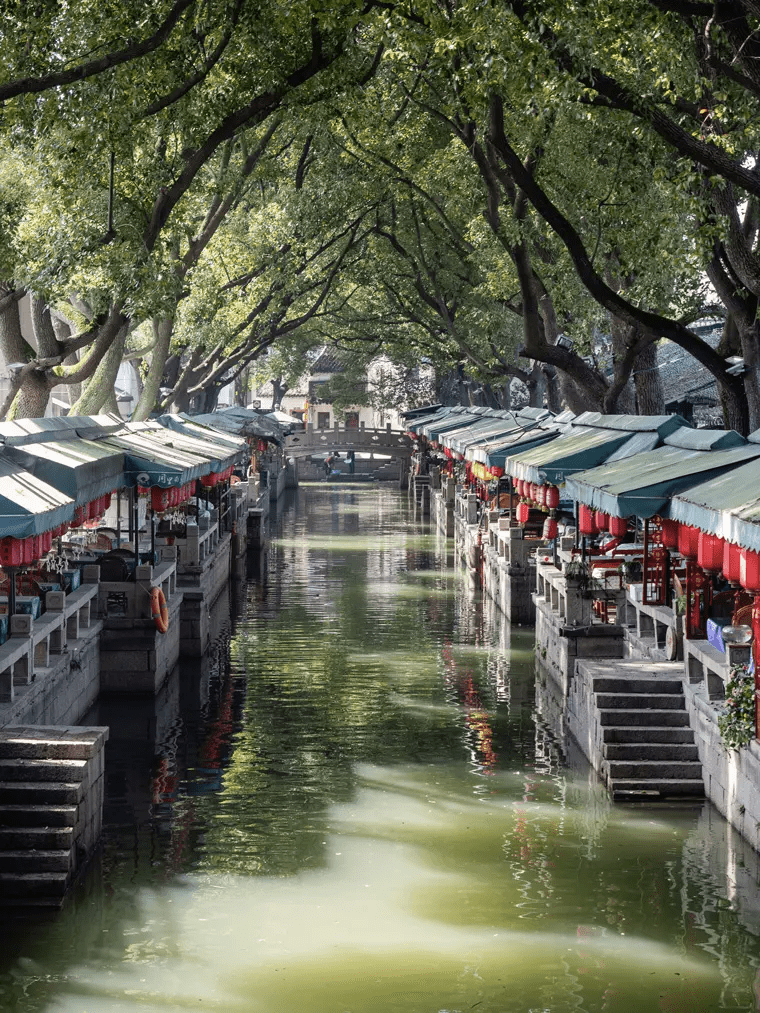
Photo from https://almostlanding.com/things-to-do-in-tongli-water-town-china/

Tongli (同里), also called Tongli Water Town, in the southwest of Suzhou, is one of the “Top Six Ancient Towns in Jiangnan (Regions South of Yangtze River)” in China with a long history of over 1,000 years. Enjoying the advantageous location of being surrounded by water and linked by old stone bridges, Tongli is the symbol of water town in southern China. Therefore, it is regarded as the “Oriental Venice” as well as a “Natural Photo Studio” by people from the whole world and is titled the “National AAAAA Tourist Attraction”. Moreover, since it still well keeps a series of ancient structures from the Song, Yuan, Ming and Qing dynasties, like the “Retreat & Reflection Garden (退思园)” which is a World Cultural Heritage Site praised by many poets, Tongli is a perfect place to savor the authentic flavor of old water town in China and the real leisure life of the charming Jiangnan (江南) region.

Tongli was established in the Song Dynasty over 10 centuries ago and was first named Fu Tu (富土, Fertile Land). But it changed to be called as Tong Li (铜里) so not to be too extravagant. And later people finally changed its name again into the present Tongli (同里). According to the history, Tongli is a key place in the ancient Wu (吴) region, and since it could communicate with the outside world only by boat, there were few wars or turbulence. And then, it became an ideal place for people to escape from the social upheaval and settle down.

Highlights in Tongli

Retreat & Reflection Garden

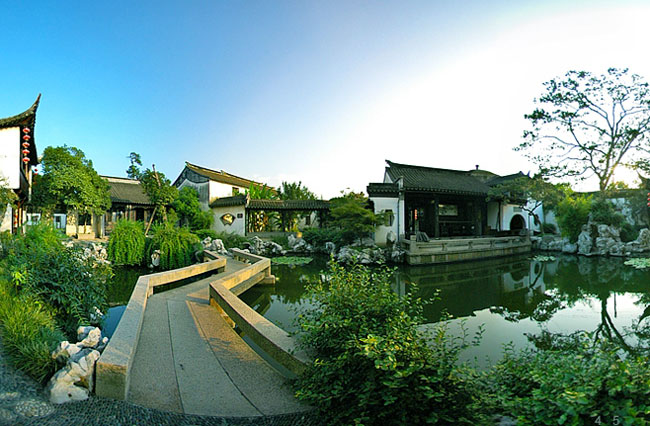
Tuisi Garden, also known as Retreat & Reflection Garden, earned its place on the prestigious list of UNESCO World Cultural Heritage Sites. This exquisite garden was meticulously crafted between 1885 and 1887 by Ren Lansheng, a former government official who was dismissed due to corruption. Ren chose to name this sanctuary “Tui Si Yuan” to symbolize his personal journey of introspection.

As you wander through Tuisi Garden, you’ll be transported to a bygone era, where historic wooden structures exude an ancient charm. However, what truly astonishes visitors is the enchanting water garden concealed within its confines. Here, pavilions, corridors, bridges, halls, houses, rockeries, pools, ancient trees, vibrant flowers, and charming fish coexist in perfect harmony, creating a secret oasis.

Whether you follow the stone-paved paths or stand atop pavilions nestled among the rockeries, you’ll be treated to breathtaking views of this natural and traditional garden. Such is its extraordinary beauty that a Tuisi Zhuang (Retreat & Reflection Villa) was recreated in a botanic garden in New York, USA, faithfully mirroring the essence of Tuisi Garden. This tribute stands as a testament to the global appreciation of Chinese garden artistry.

Secret Garden in Retreat & Reflection Garden

Tongli

Ancient Tuisi Garden in Spring

Gengle Hall

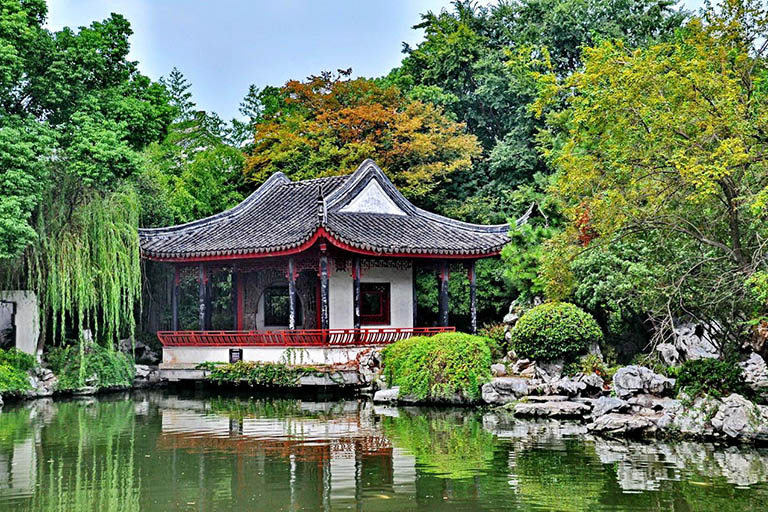
Gengle Hall (耕乐堂 or Happy Farming Hall), situated in the heart of Lujiadai (陆家埭), stands as a remarkable testament to ancient architecture within Tongli Water Town. Dating back to the Ming Dynasty, this building exemplifies the traditional residential-garden structure of its time, offering visitors a glimpse into the historical architecture of the region.

Within the residential section of Gengle Hall, one can admire an array of intricately carved root artworks, showcasing a variety of shapes including eagles, flowering trees, figures, lions, and more. As you explore this part of the hall, you’ll be immersed in a world of artistic craftsmanship.

Venturing into the water garden, you’ll be treated to crystal-clear pools teeming with vibrant red fish, picturesque stone bridges gracefully arching over the water, weathered yet charming old houses, and the backdrop of a serene blue sky. Every moment spent here promises a unique and captivating visual experience.

Tongli

Picturesque Scenery in the Garden of Gengle Hall

The Pearl Tower

The Pearl Tower (珍珠塔) in Tongli Water Town is not precisely a tower, but rather an opulent mansion. It is renowned for its association with the poignant love story known as the ‘Pearl Tower,’ which unfolds within the walls of this former official censor’s residence.

According to the tale, Fang Qing (方卿) and Chen Cuie (陈翠娥) shared a deep and passionate love, yet their union was fraught with the challenges posed by their disparate family backgrounds. Undaunted, Fang Qing worked tirelessly to attain the coveted title of ‘Number One Scholar’ and returned to his hometown with a sterling reputation. Finally, he and Cuie were able to overcome the obstacles and were wed.

When you visit the Pearl Tower, you’ll have the opportunity to marvel at the ancient architecture and the expansive water garden, allowing you to immerse yourself in the enchanting ambiance of this historic water town and experience the enduring romance of the famous love story.

Tongli

The Mansion of Pearl Tower

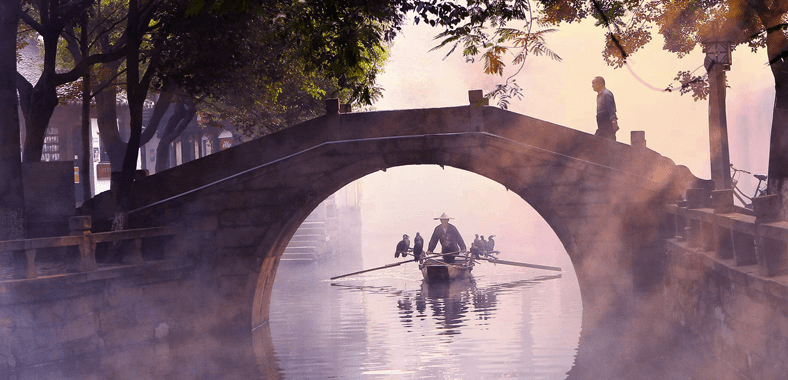
The Three Bridges

The Three Bridges (三桥) in Tongli, namely Taiping Bridge (太平桥), Jili Bridge (吉利桥), and Changqing Bridge (长庆桥), stand out as must-see attractions within Tongli Water Town. Together, they form a configuration resembling the Chinese character “品,” making the Three Bridges a cherished treasure of Tongli. As you stroll along these bridges, you’ll witness people walking above and boats gracefully gliding beneath, creating a dynamic and picturesque scene.

Particularly during festivals, these bridges come alive with activity, exuding a sense of bustling joy. Local residents consider it highly auspicious and joyous to traverse the Three Bridges, believing that it brings good fortune and improved health. You can embrace this tradition by walking across the Jili Bridge, Taiping Bridge, and Changqing Bridge in a continuous loop without turning back, in pursuit of greater blessings and well-being.

Besides, there are many other interesting places to visit in Tongli Water Town, like Jiayin Hall (嘉荫堂) with beautiful design and gauze-cap-like beam decorations, Chongben Hall (崇本堂) with exquisite sculptures, Mingqing Street (明清街) with various local food and shops, Luoxing Island (罗星洲) with fabulous natural scenery, etc. you can spend more time to discover deeper beauty of Tongli!

Amazing Activities in Tongli

You deserve to try the featured activities in Tongli to get the real fun and feel the authentic charm of this famous water town.

Rickshaw Tour

Let the local carter take you to appreciate Tongli Water Town with a distinct visual angle on the ancient rickshaw. Passing through the narrow lanes and admiring the centuries-old buildings, you can imagine yourself being the people living in Tongli in ancient times.

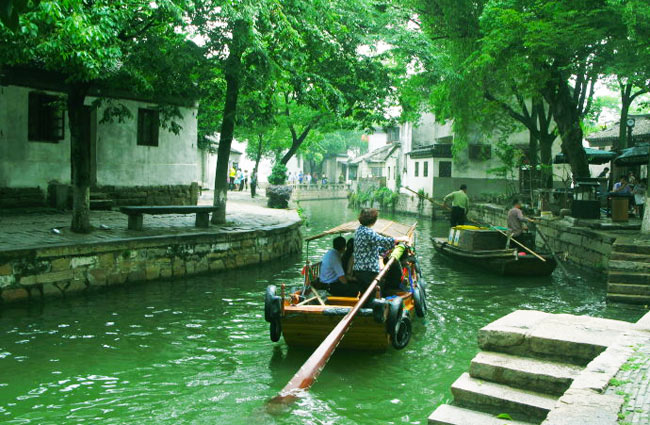
Boat Tour

Take a sculling boat at the daytime to feel the excitement of watching the ancient buildings and people passing by, the brand-new practice of going through the old Chinese bridges. You can have the scene of ancient Tongli people communicating the outside by boat in your mind. (25 min, about CNY 90 / boat; 1-6 people / boat)

Tongli

Splendid Night View

The night view of Tongli Water Town is splendid. With strings of red lanterns lighting along the river, gorgeous colorful flashes shining in the trees, sparkling lights curving the fancy lines of bridges and paths, the water town will make you immerse into its beauty.

TongliSplendid Night View in Tongli Water Town

Best Seasons to Visit Tongli

Tongli is an ideal destination to visit year-round, showcasing diverse landscapes in each season:

  • Spring: Tongli is at its most charming and poetic during this season, boasting moderate temperatures and a touch of misty rain to enhance its allure.
  • Summer: The summertime in Tongli is vibrant, with numerous local folk activities that offer a fantastic opportunity to immerse yourself in the rich folk culture of this renowned Chinese water town. Additionally, you can savor the mesmerizing night views as you wander along its scenic rivers and bridges.
  • Autumn: Tongli dons a fresh and crisp aura during autumn. The faint fragrance of sweet-scented osmanthus fills the air, transforming Tongli Water Town into a captivating young lady beneath the clear azure skies.
  • Winter: In the winter months, Tongli is tranquil, attracting fewer tourists. Particularly after a snowfall, the town adorns itself in pure white beauty, complemented by the soft glow of red lanterns lining the riverbanks.”

Tongli Ancient Water Town: A Poetic Dream of the Oriental Venice

Link:https://peacelilysite.com/2023/09/12/tongli-ancient-water-town-a-poetic-dream-of-the-oriental-venice/

Source: https://www.chinadiscovery.com/jiangsu/suzhou/tongli.html, https://almostlanding.com/things-to-do-in-tongli-water-town-china/

The cultural Heritage of Hanshan Temple

The cultural Heritage of Hanshan Temple

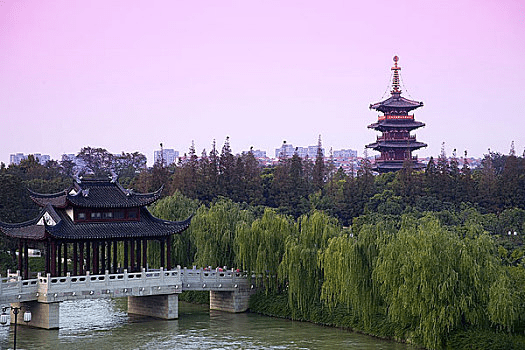
Hanshan Temple (寒山寺), which translates to Cold Mountain Temple, is situated in the Gusu District of Suzhou city. Originally named “Miaoli Puming Temple,” it dates back to the Liang Dynasty of the Southern Dynasties, specifically from A.D 502-519. Covering an area of approximately 13,000 square meters, the temple boasts a construction area exceeding 3,400 square meters.

During the Tang Dynasty’s Zhenguan period (A.D. 627-649), two prominent monks of the time, Hanshan and Xiqian, founded Hanshan Temple. Over its more than 1,300-year history, the temple has suffered five fires (some versions claim seven), with its most recent reconstruction occurring during the Guangxu period (A.D. 1875-1908) of the Qing Dynasty. Historically, Suzhou’s Hanshan Temple held a prestigious position among China’s top ten famous temples. Its fame extends beyond borders due to a poem composed by Zhang Ji, a Tang Dynasty poet, which is taught in Chinese primary schools. This poem is also included in the curriculum of Japanese schools, further elevating Hanshan Temple’s renown in Japan, attracting numerous Japanese visitors who come to pay their respects to the Buddha. The temple features numerous historic buildings and tablet inscriptions authored by calligraphers, making it a popular destination for those seeking peace and spiritual solace.

Hanshan Temple holds a distinguished place in China’s Buddhist history, chiefly because of the famous poem by Tang Dynasty poet Zhang Ji. This poem is part of the curriculum in primary schools in both China and Japan.

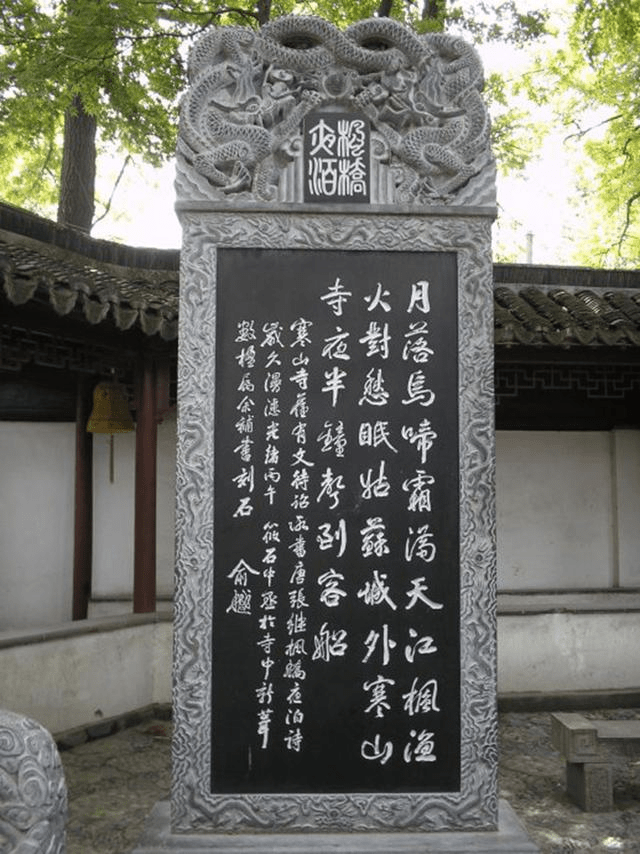
The Night Lodging at Maple Bridge
By Zhang Ji

月落乌啼霜满天
The moon sinks in the frosty sky and ravens caw far and near

江枫渔火对愁眠
Riverside maples and fishing lamps gloomily make me drowsy

姑苏城外寒山寺
From the Han-Shan temple siting at outside of the Gu-Su town

夜半钟声到客船
Come midnight bell rings as a passenger boat is arriving 

Apart from the legends of Hanshan and Shide, Hanshan Temple boasts a collection of treasures that have been cherished throughout its extensive history. Among these treasures, one of the most renowned is the poetic stele of ‘Night Mooring at Maple Bridge,’ crafted by the esteemed scholar and calligrapher Yu Yue during the late Qing Dynasty. It stands as an invaluable asset to Hanshan Temple.

It must be acknowledged that this piece of calligraphy represents the apex of ‘Night Mooring at Maple Bridge’ renditions throughout history. The lines of regular script flow seamlessly, displaying an inherent elegance and freshness, achieved with seemingly effortless brushwork. Engraved upon the stele, it emanates a subtle, age-old charm and an evocative poetic atmosphere. Each time I gaze upon this stele, it evokes a different emotional response within me. As I have delved into the art of calligraphy myself, I have even attempted to replicate ‘Night Mooring at Maple Bridge.’ While I deeply appreciate Yu Yue’s extraordinary skill and find it visually pleasing, there has always been a sensation of something missing, an ineffable aspect I couldn’t articulate. My pursuit has persisted, a continuous quest to discover calligraphic masterpieces that could genuinely satiate my aesthetic sensibilities, and this aspiration remains deeply rooted within me.

The other day, I had a sudden encounter with ‘Night Mooring at Maple Bridge,’ personally penned by H.H. Dorje Chang Buddha III, and it was as if I had stumbled upon a divine masterpiece! This artwork utilizes cursive script, showcasing the grandeur reminiscent of dragons and serpents, seasoned with masterful brushwork, conveying both a majestic ruggedness and a subtle elegance. What elevates its worth even further is its dynamic and ceaseless artistic allure, reaching monumental proportions. It can be aptly described as the highest sacred creation, far beyond the grasp of ordinary individuals. This represents the embodiment of the Five Vidyas, as expressed by the Buddhas and Bodhisattvas in the realm of Prajna, offering an extraordinary experience to those who behold it and serving as the ultimate exemplar for calligraphy enthusiasts like myself to aspire to emulate.

In this lifetime, I am profoundly fortunate to have encountered the authentic and unwavering Dharma of the Tathagata. The achievements of H.H. Dorje Chang Buddha III stand unparalleled on a global scale. When it comes to providing tangible evidence of wisdom and realization attained through proficiency in both exoteric and esoteric Buddhism, as well as mastery of the Five Vidyas, there is simply no one within the realm of Buddhism who can be mentioned in the same breath as His Holiness.

The Buddha’s criterion for measuring one’s level of accomplishment in the Buddha-dharma is rooted in the extent of proficiency in both exoteric and esoteric Buddhism, as well as the mastery of the Five Vidyas. However, throughout the history of Buddhism up to the present day, only H.H. Dorje Chang Buddha III Holiest Tathagata has truly and comprehensively demonstrated complete proficiency in exoteric and esoteric Buddhism, along with perfect mastery of the Five Vidyas. His Holiness unmistakably presents, for all to witness, a myriad of achievements that exemplify his complete proficiency in exoteric and esoteric Buddhism and his impeccable mastery of the Five Vidyas, as stipulated by the Buddha.

His Holiness, an ancient Buddha, holds the distinction of being the first being of holy virtue in history to genuinely manifest such lofty and all-encompassing realization. The undeniable proof of this is found in the numerous accomplishments single-handedly achieved by H.H. Dorje Chang Buddha III, as detailed within the thirty main categories listed in this book, “H.H. Dorje Chang Buddha III — A Treasury of True Buddha-Dharma.”

I earnestly pray that all sentient beings may embark upon the ‘vessel’ of liberation and achieve enlightenment.

The cultural Heritage of Hanshan Temple

Link:https://peacelilysite.com/2023/09/08/the-cultural-heritage-of-hanshan-temple/

#DorjeChangBuddhaIII #HHDorjeChangBuddhaIII  #HanShanTemple #ChineseCalligraphy #Buddhism #ExotericandEsotericBuddhism #AcientBuddha #TreasureBook #FiveVidyas

Source: https://blog.wenxuecity.com/myblog/77953/202108/16124.html, https://www.chinadiscovery.com/jiangsu/suzhou/hanshan-temple.html

Chinese Valentine’s Day

Qixi Festival when Niulang and Zhinu Meet Once a Year

Valentine’s Day, observed worldwide on February 14th, is a celebration dedicated to love, inspired by the legacy of Saint Valentine. This global festival serves as an emblem of affection and connection. Similarly, in China, a comparable event pays homage to an enamored couple.

Known as the Qixi Festival, also referred to as the Qiqiao Festival and colloquially named “Chinese Valentine’s Day” in Western culture, this festival possesses a captivating historical narrative. The Qixi Festival commemorates the age-old tale of Zhinu and Niulang. Zhinu, an ethereal weaver, and Niulang, a humble cowherd, compose this mesmerizing love story. According to legend, their love was thwarted by the Milky Way, allowing them a solitary annual reunion—on the night of Qixi.

The celestial pairing of Zhinu and Niulang is immortalized as radiant stars in the expanse of the galaxy. A passage connecting their realms materializes each year, expertly crafted by magpie birds in anticipation of their rendezvous.

The Qixi Festival, rooted in the Lunar Calendar, unfolds on the seventh day of the seventh month. Transitioning to the Gregorian calendar, this momentous occasion occupies the eighth month, specifically August. In the year 2023, the Qixi Festival is slated for celebration on Tuesday, August 22nd.

Buddhism offers a multifaceted lens through which to view human emotions and relationships. Rooted in the concept of the “Twelve Links of Dependent Origination,” Buddhism elucidates the cyclical nature of birth and death, attributing this cycle to ignorance and attachment. Humans, characterized as “sentient beings,” are intricately tied to these attachments. While Buddhism does not oppose love and marriage, it does caution against excessive attachment and an undue grasp on emotions, as they can impede the path to liberation.

Within Buddhism, emotions are not dismissed but embraced. Modern perceptions sometimes label Buddhism as detached and unfeeling. There’s a notion that embarking on a monastic journey necessitates forsaking family and worldly ties, an outlook perceived as callous. This misconception paints monastics as “heartless.”

Yet, the reality of Buddhism diverges from this stereotype. The monastic life, as envisioned by Buddhism, doesn’t mandate the abandonment of all emotions.

It’s essential to recognize the transient nature of the intense romantic love that often consumes us. Such love possesses a fleeting existence, its novelty waning with time. Buddhism offers intricate insights into this ephemeral sentiment, highlighting that all desires are impermanent and tinged with suffering, stemming from irrational attachments of sentient beings. An in-depth exploration of Buddhist teachings can foster a profound comprehension of these principles.

In the ebb and flow of relationships, cherish the connections when they emerge and gracefully embrace their absence when they dissipate. Buddhism advocates for mastering the art of detachment, discouraging the clutching onto emotions. This isn’t an endorsement of emotional callousness, but rather a perspective that perceives the unions and separations inherent in love and marriage as natural transitions dictated by circumstances. These transitions can be viewed as shared opportunities for growth, mutual enrichment, and learning—cornerstones of companionship on the journey to enlightenment.

Buddhism champions the elevation of emotions through the channels of compassion and wisdom. It fosters an environment where spouses treat each other with reverence and intimacy, colleagues extend assistance and forgiveness, and friends place a premium on their connections. This culminates in embodying “great compassion without attachment” and “great mercy as a shared essence.” In essence, personal love evolves into a universal compassion for all sentient beings—an embodiment of empathy that transcends the confines of the individual.

Chinese Valentine’s Day

Link:https://peacelilysite.com/2023/08/25/chinese-valentines-day/

#Valentine #ChineseCulture #QixiFestival#Buddhism #GreatCompassion
Source: https://economictimes.indiatimes.com/news/international/us/when-is-qixi-festival-2023-all-about-the-chinese-valentines-day-legend-of-lovers-zhinu-and-niulang/articleshow/102917179.cms?from=mdr