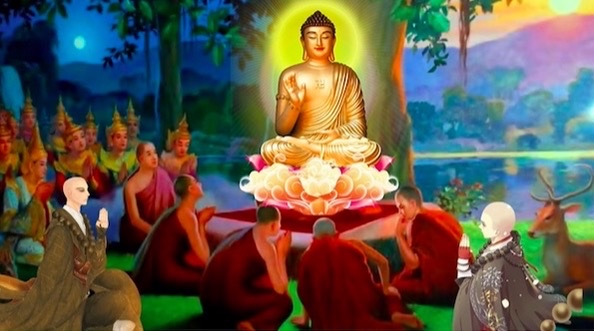
Expounding the Absolute Truth Through the Heart Sutra

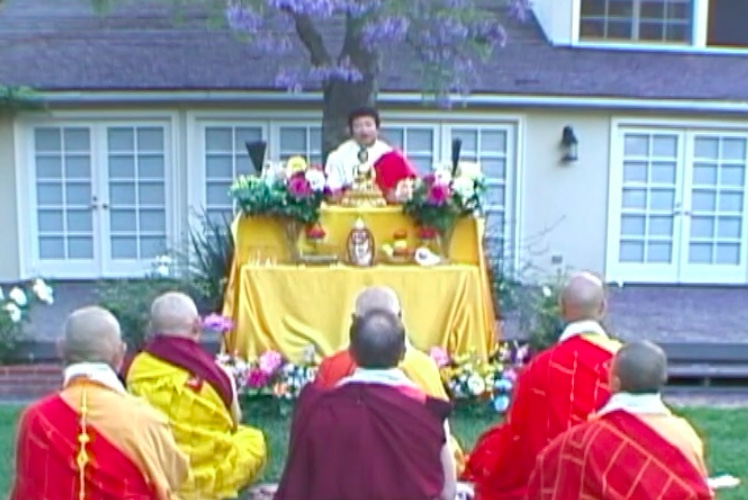
        This book by H.H. Dorje Chang Buddha III was released in Chinese in 2014 but is not yet available in English. It is based on a series of very famous discourses given in China in 1992, using the text, meaning, and principles of the Heart Sutra to transmit Dharma. It clearly explains the relationships between mind, Buddha, and living beings. It tells everyone what the absolute truth of Buddha-dharma and liberation is. Several years ago, His Holiness told a number of Western disciples that this is the only book you need to read to understand emptiness and become enlightened. This text is for acquiring prajna or transcendental wisdom, although it also teaches the importance of cultivating character.

        To stress how important this holy book is, we must remember that just before the Buddha left this world His Holiness told us that “. . . At all times, we must think about bringing auspiciousness, serenity, happiness, and peace to living beings and to the world, to the extent of giving our all and even our lives. I have already brought true Buddha Dharma to this world. Everyone who practices in accordance with The Supreme and Unsurpassable Mahamudra of Liberation and Expounding the Absolute Truth Through the Heart Sutra will surely attain liberation. That’s all. I wish all living beings happiness.”

Venerable Master Puguan’s Reflection After Listening to Expounding the Absolute Truth Through the Heart Sutra

Below is the heartfelt reflection of Venerable Master Puguan, the abbot of Kaihua Monastery on Mount Wuzhong—the first site of Southern Transmission Buddhism and the thirteenth-generation patriarch of Mount Emei—after listening to the Dharma discourses of Expounding the Absolute Truth Through the Heart Sutra spoken by H.H. Dorje Chang Buddha III.

Venerable Master Puguan said:

“No matter what words I use today, they cannot fully express the supreme joy and wonder in my heart.
My most magnificent and compassionate Buddha Master, the Great Dharma King Yangwo, once visited Mount Wuzhong in person. At that time, my junior Dharma brother, Dharma Master Guozhang, and I were on the third day of a Zen retreat with the four assemblies of disciples when suddenly the Dharma protector came and told me, ‘The greatest holy being has arrived! He is wearing white clothes. Quickly cancel the Chan session and lead everyone to greet Him with full ceremony!’

Dharma Master Guozhang also received the same message—that the highest Holy One had come. We immediately announced to all disciples that the Zen session was to be stopped, and we prepared the ceremonial welcome with drums and bells. Indeed, about ten minutes later, a group of dozens of people arrived at the foot of the mountain—it was my revered Master, the Great Dharma King Yangwo (H.H. Dorje Chang Buddha III).

When I supported my Master while walking toward the Bright Moon Pool, He gently took hold of my hand instead and said, ‘I am younger than you; you should not support me. It is I who should support you, the elder.’

At that moment, I felt deeply ashamed. How could a disciple ever deserve to be supported by his Master, the Great Dharma King?

Now, after listening to Expounding the Absolute Truth Through the Heart Sutra, I finally realize that what my Master said back then was the very expression of ultimate truth!
We practitioners must rely on our Master’s steadfast guidance, never letting go of His compassionate hand, until we are led to the pure Buddha-land of ultimate Nirvana. How could we ever imagine supporting our Master?

Having repeatedly listened to this Dharma discourse, I can only say that my Master has explained the very essence of all 600 volumes of the Prajnaparamita Sutras and the two essential provisions of precepts and practice. The Dharma He expounded is so profound that the deep will see its depth and the shallow will see its shallowness—it is wondrous beyond description, extraordinary within the ordinary. In truth, it is the supreme teaching of the ultimate truth since the beginning of time.

After listening to this unparalleled Dharma spoken by my Buddha Master, I was instantly and completely awakened—the bottom of the bucket had fallen out! Unfortunately, my age has deprived me of the condition to attain rainbow-body ascension, but I rejoice that I have realized the state of indestructible flesh body. After my parinirvana, this body can serve as evidence to the world that my Great Dharma King, my Buddha Master, is truly the Dharma King who unites all Buddhas of the ten directions.

When I think back on my earlier misunderstandings, I feel deeply ashamed. I once mistakenly believed that only Tibetan Esoteric Buddhism possessed the Great Dharma that enables enlightenment within one lifetime. Now that I have attained realization, I truly understand that the authentic Dharma of the Tathagata transcends all schools and sects.

In fact, the true Buddha Dharma is a wondrous treasure existing independently of any tradition. It is neither exclusive to nor absent from any particular school—because genuine Dharma is not governed by sects but by Buddhas and Bodhisattvas themselves. Wherever a Buddha or Bodhisattva manifests as a teacher, that school naturally possesses the Great Dharma.

When I recall my past cultivation at the Golden Summit of Mount Emei, I can only remain speechless in humility. Today, immersed in the bliss of Dharma joy, I can only pray:

May all Buddhas bless that the great karmic conditions of the Tathagata ripen soon.
May all sentient beings swiftly hear the teachings of my Buddha Master—the Mother of All Buddhas’ Dharmas, Expounding the Absolute Truth Through the Heart Sutra
so that their blessings and wisdom may swiftly and perfectly flourish,
attaining Bodhi and liberation in this very life,
and achieving freedom from life and death!

Namo Amitabha Buddha!
Namo Avalokiteshvara Bodhisattva!

Note: In 1998, Master Pu Guan passed away while in meditation, having attained mastery over his life and death. Remarkably, even eight years after his passing, his remains rest within a stupa, preserved in the meditation posture without any signs of decay.

The following is the English translation of Venerable Master Pu Guan’s Dharma discourse, rendered into English by Linda Chang. The original Chinese version is provided below.

普觀長老聽《藉心經說真諦》法音感言

下面是峨嵋山第十三代祖師、佛教南傳第一站霧中山開化寺方丈普觀老和尚聽 H.H. 第三世多杰羌佛說法《藉心經說真諦》法音後的感言,老和尚說:

我今天無論說出什麼樣的話,也代表不了我內心的喜悅殊勝,我最偉大的如佛恩師,仰諤大法王聖駕霧中山,當時我和我的師弟果章法師正在與四眾弟子打禪七的第三天,突然護法叫我說:「最偉大的巨聖德駕臨了,祂穿的是白衣服,趕快取消禪七,率領大眾大禮接駕吧!」這時果章師弟對我說,他接到護法的報告,有最大的聖德駕臨;我們當場宣布四眾弟子取消禪七,立刻擺駕擂鼓鳴鐘接駕,果然十分鐘後山下來了一隊幾十人,原來是我的恩師仰諤總持大法王駕到,當我攙扶恩師登上明月池的途中,師父反攙著我的手說:「我年輕,你不要攙扶我,應該我攙著你這位老人。」當時我深感慚愧,弟子怎能有資格讓大法王恩師攙扶呢?現在聽完《藉心經說真諦》以後,恩師說的才是一語道斷的真理哦!我們這些行人,就是要依靠恩師不鬆手地把我們攙扶著到究竟涅槃的佛土,我們哪裡有資格攙扶恩師啊!當我反覆聽到《藉心經說真諦》的開示說法般若心髓,我只能說講透了六百卷般若的心要和行修戒體二資糧,恩師的說法深者見深,淺者見淺,微妙至極,平中見奇,實在說來,是開天闢地第一義諦之無上說法。聽了恩師講說的法音無上大法以後,讓我頓然大徹大悟,桶底脫落,可惜我歲數太大,失掉化虹飛升的條件,但慶幸的是,我證到了肉身不壞的境界,今後圓寂後,可以為世人證明我大法王如佛恩師,才是十方諸佛的總匯法王。回想起當初錯誤的認識,深感羞慚,誤認為只有西藏密宗才有即身成佛的大法,現在我得到了,才真正瞭解如來的正法不是哪一宗有、哪一宗沒有,其實佛法是獨立在世外的妙寶,與密宗、顯宗沒有任何關係,任何一宗都有佛法,也沒有佛法,關鍵在於真正的佛法不是宗在掌管,而是佛菩薩在掌法,佛菩薩化身在哪一宗為師,哪一宗就有大法。想到當初我在峨嵋金頂的修持,只能無言以對,而今天處於法樂中的我,只能祈請諸佛加持,如來大事因緣早日成熟,眾生早日得聞恩師講說出諸佛之母法《藉心經說真諦》,福慧速猛圓滿,今生必證菩提聖道,生死自由!

南無阿彌陀佛!

南無觀世音菩薩!

Link:https://peacelilysite.com/2025/10/31/expounding-the-absolute-truth-through-the-heart-sutra/

Source: https://cabuddhists.org/en/expounding-the-absolute-truth-through-the-heart-sutra/buddhist-books/h-h-dorje-chang-buddha-iii-expounding-buddha-dharma/; https://www.wbahq.org/ch/dharma-discourses/sf-jxjszd/

Buddhism, Multidimensional Space, and the Science of Consciousness

Modern scientists suggest there may be multidimensional spacetime. The world we perceive in our daily lives consists of three dimensions of space—length, width, and height—plus one dimension of time, forming what we call four-dimensional spacetime.

For most people, it is nearly impossible to imagine what multidimensional space could be like. Even scientists struggle to describe how such realms might appear.

Yet once, while I was reading a Buddhist sutra, I felt as though I glimpsed something of this mysterious idea.

In the Vimalakirti Sutra, it is recorded that Manjushri Bodhisattva led 8,000 bodhisattvas, five hundred arhats, and countless heavenly beings to visit the ailing lay master Vimalakirti.

Vimalakirti lived in a small chamber. He invited everyone to enter. Miraculously, they all went inside, but the room did not grow any larger. No one felt crowded or obstructed, and everyone saw Vimalakirti sitting directly before them.

Manjushri and Vimalakirti engaged in profound dialogue about the Dharma. Later, Vimalakirti displayed astonishing spiritual powers, bringing seats, exquisite foods, and treasures from distant worlds into that same room.

It was absolutely astonishing—like witnessing the seamless merging of multiple dimensions.

Throughout Buddhist history, many great masters have demonstrated abilities that seem to transcend space and time.

For example, there is the story of Milarepa, Tibet’s most renowned yogi. When he was welcoming his disciple Rechungpa back from India—where Rechungpa had traveled to collect scriptures—an incredible event took place.

Rechungpa carried the scriptures on his back as he crossed the vast grasslands. When he saw Milarepa waiting for him, he was overjoyed. Eagerly, he described how he had met the great master Tilopa. With visible pride, he declared:

“In the past, Tilopa did not transmit this Dharma to Master Marpa, but now he has passed it on to me!”

His words brimmed with arrogance.

As they walked together, Milarepa noticed a broken yak horn on the ground and asked Rechungpa to pick it up. Rechungpa couldn’t see the point and made excuses not to touch it. Silently, Milarepa bent down, picked it up himself, and carried it along.

Suddenly, the sky darkened. Thunder boomed, lightning flashed, and hailstones the size of eggs pounded them mercilessly. Rechungpa was battered and bruised.

When the storm finally ended, he looked around—Milarepa had vanished. Alarmed, he began calling out.

Then, Milarepa’s calm voice rose from the little yak horn at his feet:

“Why are you so flustered? Come in here and take shelter.”

Rechungpa stared in disbelief. The opening of the horn was barely larger than a fist. How could he possibly fit inside?

He bent down to look, and to his amazement, he saw an endless green meadow within—stretching as far as the eye could see. Milarepa sat serenely in meditation.

But no matter what he tried, Rechungpa could not enter.

In that instant, all his pride dissolved. Humility and awe took its place.

Milarepa finally emerged and said with a gentle smile, “Did you see? My little yak horn turned out to be quite useful after all.”

Even in our time, extraordinary manifestations still occur.

H.H. Dorje Chang Buddha III has demonstrated countless inconceivable displays of supreme Buddha Dharma.

Ruzun Ruo Hui, the abbess of Hua Zang Si (in San Francisco) shared one remarkable example in Interviews with Buddhist Disciples (Episode 78).

Around 1995, about a dozen people were gathered together in a room, respectfully listening to the recorded Dharma discourse Expounding the Absolute Truth through the Heart Sutra.

Halfway through, the entire house vanished. All the walls and structures simply disappeared, and everyone found themselves sitting under the open sky.

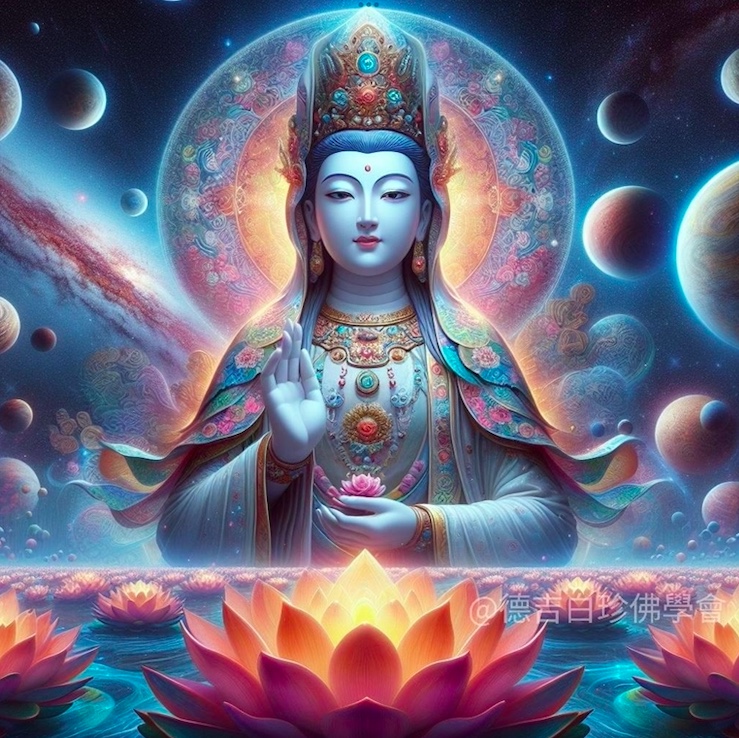
Above them, Avalokiteshvara Bodhisattva appeared, standing in the air, radiating boundless light while auspicious clouds billowed around.

For nearly an hour, Avalokiteshvara remained visible, bestowing blessings. No sounds of the street—no passing cars or footsteps—could be heard. The only sound was the voice of H.H. Dorje Chang Buddha III expounding the Dharma.

It was clear that everyone present had entered another dimension altogether.

Moments like these show us that the universe is far more profound than what our senses can grasp.

I believe Buddhism is deeply scientific—not superstition. Just because today’s scientists cannot yet explain these phenomena does not mean they are unscientific.

On the contrary, Buddhist wisdom offers an entirely different lens through which to explore reality. It can inspire modern science to uncover new methods and fresh insights to understand the universe’s deepest mysteries.

If we open our hearts and minds, perhaps Buddhist teachings will one day help humanity discover shortcuts to truths that today seem unimaginable.

Link:https://peacelilysite.com/2025/07/03/buddhism-multidimensional-space-and-the-science-of-consciousness/

Master Milarepa Manifested the True Meaning of Emptiness in Heart Sutra

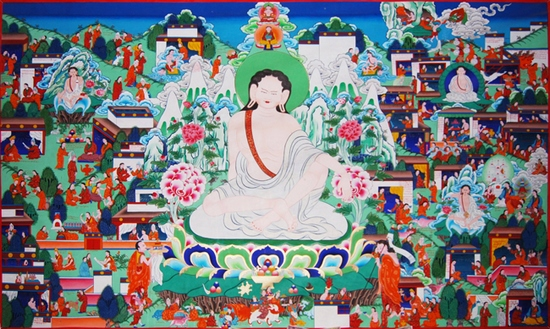
Milarepa was the most famous disciple of the Kagyu lineage patriarch, Great Master Marpa, in Tibetan Buddhism. Renowned for his ascetic practices, Milarepa was celebrated as a prominent yogi, master of tantra, ascetic monk, and poet.

Milarepa was born in 1052 in Gongtang, Tibet, with the secular name Milarepa Tönpa. His family was very wealthy. However, at the age of seven, his father passed away due to illness, and the family’s estate was seized by his uncle and aunt, plunging them into poverty. Milarepa, his mother, and his three-year-old sister were treated as slaves by his relatives, going from being wealthy to destitute beggars, subjected to the cold stares of former friends and relatives.

This turn of events filled his mother with resentment. When Milarepa grew older, she sent him to learn sorcery for revenge. After mastering his skills, at his uncle’s wedding feast, Milarepa used sorcery to cause the house to collapse, killing 35 people, including his enemies. Later, he also summoned hailstorms that destroyed the crops of his uncle and the entire village. However, instead of finding satisfaction in revenge, Milarepa felt deep remorse for his actions, experiencing sleepless nights filled with regret. Eventually, he vowed to seek liberation through studying Buddhist teachings.

Later on, guided by others, Milarepa sought out Marpa as his teacher. To test Milarepa’s resolve to repent and to help him cleanse his negative karma, Marpa intentionally subjected him to various forms of arduous labor as a form of “torture.”

Marpa Lotsawa repeatedly instructed Milarepa to build houses on different mountains, and all the building materials—stones and wood—had to be carried by Milarepa himself. Then, intentionally, when the houses were nearly completed, Marpa would order them to be demolished, and all the materials had to be carried back to their original places. Due to the prolonged carrying of stones, Milarepa’s back was rubbed raw, covered with scars that would heal and then be rubbed raw again.

The arduous labor caused Milarepa immense suffering, but due to his intense desire for teachings, he continued to obey his teacher’s orders with gritted teeth. During this time, whenever Milarepa sought teachings, he would often be scolded by his master, which left him feeling hopeless. Yet, it was in this seemingly painful torment that Milarepa’s karmic obstacles were gradually purified.

About six years later, Milarepa finally received teachings from his master and, following his instructions, began to meditate in a mountain cave. Having learned the technique of “Tummo Concentration” from his master, Milarepa could withstand the cold wearing only a single piece of cloth in winter. Hence, people called him “Milarepa,” meaning “the one from the Mila family who wears a cloth garment.” After nine years of austere meditation in a mountain cave, Milarepa finally attained enlightenment. He became a highly acclaimed practitioner of actual realization in the snowy plateau of Tibet.

At that time, there was a venerable master who had been lecturing on scriptures and teachings in a temple for many years. Upon hearing the revered name of Milarepa, this master was unimpressed and insisted on inviting Milarepa to come for a debate.

Milarepa said, “Let’s not debate yet. Do you understand what emptiness is?” The master immediately began eloquently explaining various theories of emptiness. At that moment, Milarepa pointed to a pillar in the temple and sighed, “All that you are saying is theoretical. Tell me, is this pillar empty or substantial?” The master replied, “The pillar is substantial; how could it be empty?” Milarepa responded, “You say it’s substantial, but I say it’s empty.” With that, he used his hand to gesture through the pillar as if the pillar didn’t exist at all. The master was astonished.

Milarepa then pointed to the empty space and asked the master, “Is this empty space substantial or empty?” The master quickly answered, “It’s empty.” However, Milarepa countered, “I say it’s substantial,” and proceeded to walk into the empty space to demonstrate. He confidently walked step by step as if on solid ground, moving around in the empty space effortlessly.

The master was at a loss for words, feeling deeply ashamed of his arrogance and ignorance.

This encounter helps us understand that theoretical discussions or worldly-wise understandings of emptiness are entirely different from the realized emptiness of the enlightened beings. There is a fundamental distinction. Whether one can demonstrate the realm of “form is emptiness, emptiness is form” signifies the difference between the sacred and the mundane. Milarepa, revered as a great saint who realized emptiness, established the profound wisdom of “form is emptiness, emptiness is form” based on actual realization of the unity of appearance and emptiness.

The Venerable Milarepa has long departed this world, and we are unable to personally receive his teachings. However, we are incredibly fortunate to have witnessed the emanation of the primordial Buddha – Dorje Chang Buddha III, who descended to this saha world, bringing forth the correct and unbiased true Dharma for all sentient beings.

H.H. Dorje Chang Buddha III expounded the Dharma with profound clarity and precision. “The Supreme and Unsurpassable Mahamudra of Liberation” and “The Absolute Truth Through the Heart Sutra” represent the first appearance of such excellent treasures of Buddhist scriptures, the supreme essence classics, in thousands of years of Buddhist history.

“The Absolute Truth Through the Heart Sutra” elucidates the teachings based on the phrases and principles of the Heart Sutra, as expounded by H.H. Dorje Chang Buddha III. It clarifies the relationship between mind, Buddha, and sentient beings, explaining the definitions of the impermanent and non-impermanent nature of life, the universe, and sentient beings, as well as the truth of form, dwelling, decay, and emptiness. What is a Buddha? What is the connection between sentient beings and Buddhas? What does liberation from birth and death entail?

The Buddha Dharma spoken by H.H. Dorje Chang Buddha III is presented in the most direct, accessible language, elucidating the profound truths of the Buddha Dharma for everyone to understand. During the inaugural empowerment ceremony for “The Absolute Truth Through the Heart Sutra,” Buddhas manifested in the empty sky and bestowed three-colored nectar, confirming that this teaching is the true Dharma spoken by the Tathagata. Those who sincerely practice “The Supreme and Unsurpassable Mahamudra of Liberation” and thoroughly understand “The Absolute Truth Through the Heart Sutra” can truly embark on the swift path to liberation and accomplishment.

Link:https://peacelilysite.com/2024/04/19/master-milarepa-manifested-the-true-meaning-of-emptiness-in-heart-sutra/

Source: https://www.jinbodhi.org/cn/67702

When Taoist Immortal Met Buddhist Master

Photo by Delia Dwi on Pexels.com

When Taoist Immortal Met Buddhist Master

Taoism is an ancient Chinese philosophy that emphasizes living in harmony with the natural world and embracing simplicity. Its teachings have had a significant impact on both Eastern and Western cultures, including the field of psychology. One prominent figure in psychology who was influenced by Taoism is Carl Jung, a Swiss psychiatrist and psychoanalyst who founded analytical psychology.

Jung’s complex concept of “the Self” is one of his most significant contributions to psychology. The Self represents the totality of an individual’s psyche, including both conscious and unconscious elements. According to Jung, the Self is the goal of the individuation process, a lifelong journey of self-discovery and personal growth.

In ancient China, there were eight prominent figures in Taoism, and Lu Dongbin was the most popular one. Besides being a renowned Taoist, he was also a skilled poet and scholar. Throughout history, many legendary stories and folk tales have been told about him.

One interesting story was recorded in a Buddhist book called JiaTai Pu Deng Lu (嘉泰普灯录), which has also been documented in several other books, including XinShi Heng Yan (醒世恒言). Although there are some variations, the main points of the story remain the same. H.H. Dorje Chang Buddha III also told this story in his dharma discourse: Expounding the Absolute Truth through the Heart Sutra.

Once, Lu Dongbin asked his master, “Master, why did you only save me for a thousand years?”

His master replied, “It’s difficult to teach all living beings. People’s habits are deeply ingrained, and they constantly change. Most living beings find it challenging to learn our Taoism.”

Lu Dongbin countered, “Master, I disagree. We are powerful beings. Are we afraid it will be difficult to liberate them? Let me go down and liberate people for you. I will free a thousand souls every year.”

His master warned, “You may go down to Earth, but be careful not to provoke the monks. Some cannot be trifled with.”

Lu Dongbin descended from the South Gate of Heaven on an auspicious cloud and saw the golden light of Huanglong Temple in Shanghai, China. Zen Master Huanglong was teaching the Heart Sutra and explaining Prajna principles. Lu Dongbin decided to listen in and transformed himself into a fly, sticking to the door.

However, Zen Master Huanglong was a powerful monk who knew Lu Dongbin was eavesdropping. He stopped teaching and instructed his attendant to remove the “person who stole our Dharma.”

Enraged, Lu Dongbin revealed his true form, brandishing his Qingfeng sword and accusing Zen Master Huanglong of insulting him. Lu Dongbin told Zen Master: “I am the great Taoist Immortal LU Dongbin.” Huanglong found it amusing and called Lu Dongbin a “ghoul guard” who would eventually die in vain.

Lu Dongbin drew his sword, but Zen Master Huanglong remained unperturbed, blocking the sword with his sleeve. Lu Dongbin knelt before the Zen master, feeling ashamed.

Huanglong proceeded to teach Lu Dongbin sudden enlightenment dharma, explaining that “speech is cut off, and mind is silenced.” As a god, Lu Dongbin was able to grasp the teaching quickly and had an epiphany.

After his enlightenment, Lu Dongbin wrote a gatha containing the line, “Since I met Huanglong, I realized that I mistakenly used my mind in the past.”

In Buddhist teachings, it is said that even the highest Taoist practitioner can reach heaven, but still remain in the realm of the birth and death cycle. However, if one can realize and abide in the original nature, then they can break through this cycle and achieve liberation. The original nature refers to the pure dharma body of all sentient beings within the three spheres of existence (triloka), which is united with the universe. It has no form, shape, physical body, or appearance. All living beings possess this original nature equally, which is the same as the dharma body of the Tathagata or dharmakaya. It neither comes nor goes, and is neither excessive nor lacking. It is immaculate, free from any notion of cleanliness or dirtiness.

When Taoist Immortal Met Buddhist Master

Link:https://peacelilysite.com/2023/02/24/when-taoist-immortal-met-buddhist-master/

#Buddhist #BuddhistMaster#HuanglongTemple #Taoist #Immorta #Ludongbin #Buddhism #DorjeChangBuddhaIII # HHDorjeChangBuddhaIII