Dragon Boat Festival and Duanwu Jie

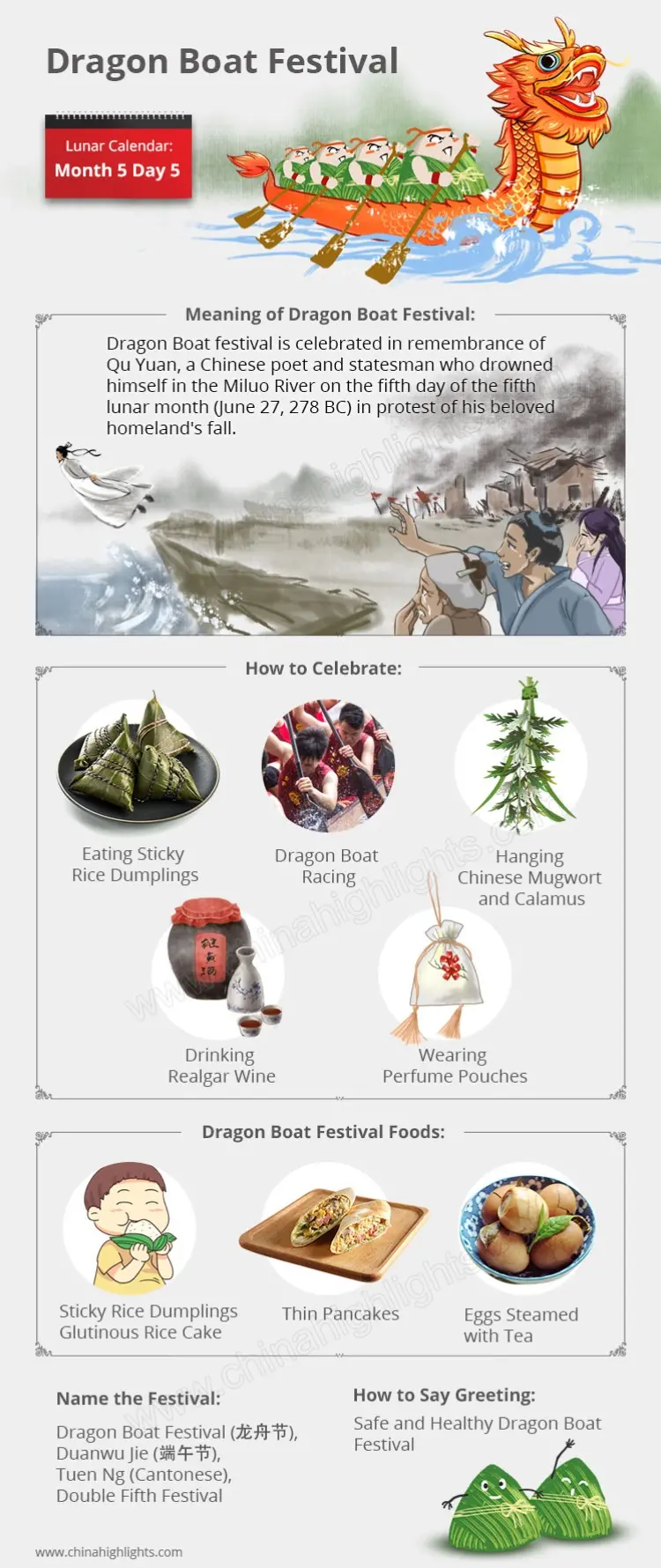
The Dragon Boat Festival, also known as Duanwu Jie, is one of the four major traditional Chinese festivals, alongside the Spring Festival, Tomb-Sweeping Day, and Mid-Autumn Festival. It is celebrated on the fifth day of the fifth month of the Chinese lunar calendar, which is why it is also called the “Double Fifth Festival” (Chongwu Jie, 重五节). On the Gregorian calendar, it usually falls in late May or early June.

In addition to Chinese mainland, many other Asian countries and regions also celebrate this festival. In Malaysia, Indonesia, Singapore, and Taiwan, China, it is known as Bak Chang Festival (‘Dumpling Festival’). Learn more facts about the Dragon Boat Festival

Why Is Dragon Boat Festival So Important?

Many believe that the Dragon Boat Festival is celebrated to commemorate the death of Qu Yuan, a renowned Chinese poet and minister known for his patriotism and profound contributions to classical poetry. He ultimately became a national hero.

However, historical evidence shows that the origins of the Dragon Boat Festival actually predate Qu Yuan’s death. The festival’s earliest roots are tied to the fifth lunar month, which the ancients considered the “month of poison.” As summer began, people were more prone to illness, and epidemics often spread. This made the month seem ominous, prompting ancient communities to adopt various practices to ward off disease and evil spirits.

Thus, the Dragon Boat Festival was originally observed as a traditional health and wellness festival. It was a time for people to carry out rituals and customs aimed at protecting themselves from illness and repelling harmful forces.

Dragon Boat Festival

Dragon Boat Festival Customs

The customs of the Dragon Boat Festival can generally be divided into two main categories. One centers on honoring dragons and historical heroes—most notably Qu Yuan—while the other focuses on warding off evil spirits and promoting health and well-being.

1. Honoring Heroes and Dragons

a. Eating Sticky Rice Dumplings

dragon boat festival celebration, eating sticky rice dumplings

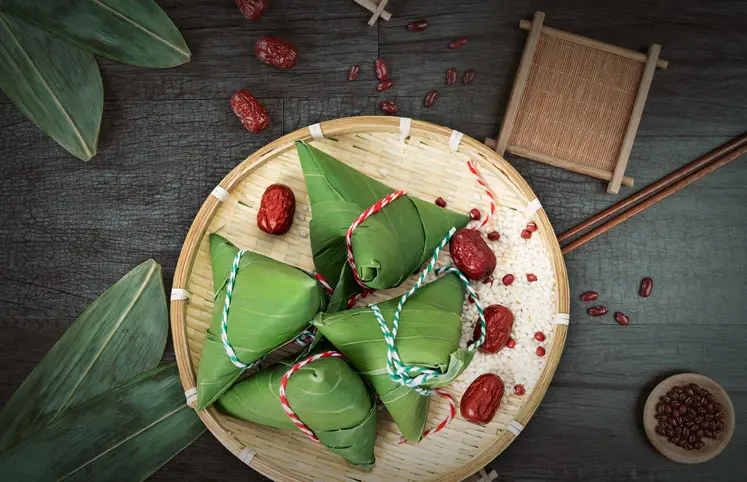
Zongzi (粽子, zòngzi) are the most iconic food of the Dragon Boat Festival. According to legend, after the patriotic poet Qu Yuan drowned himself in the river, local people threw lumps of rice into the water to prevent fish from eating his body. This evolved into the custom of making zongzi.

Traditionally, families would prepare and share homemade zongzi. Today, while some older generations still hand-make them, most people buy them from restaurants or bakeries.

Zongzi are made with glutinous rice and often filled with meats, beans, or other ingredients. They are wrapped in bamboo or reed leaves into triangular or rectangular shapes and tied with soaked stalks or colorful silk cords. Flavors and fillings vary widely across different regions of China.

b. Participating or Watching Dragon Boat Races

dragon boat festival celebration, dragon boat race

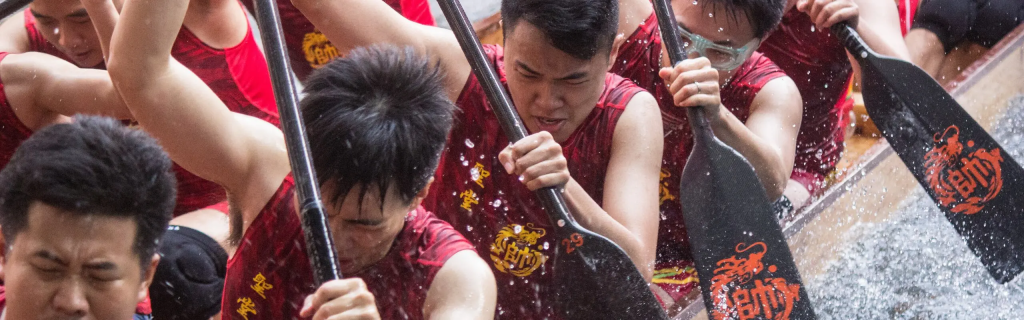
Dragon boat racing is the most exciting and prominent activity during the festival. The sport is said to have originated from people paddling out in boats to search for Qu Yuan’s body after his tragic death in 278 BCE.

Another theory suggests that the races originated more than 2,000 years ago as a ritual to worship the Dragon God or Water God.

The boats are traditionally carved and painted to resemble dragons. Depending on the region, each boat can carry 30 to 60 paddlers. Teams row in unison to the rhythm of pounding drums, creating a thrilling and energetic spectacle. Winning is believed to bring good luck and happiness for the year ahead.

Some of the most famous races take place in Hong Kong, Guangzhou, and Hangzhou.

2. Warding Off Evil and Promoting Health

a. Hanging Chinese Mugwort and Calamus

dragon boat festival celebration

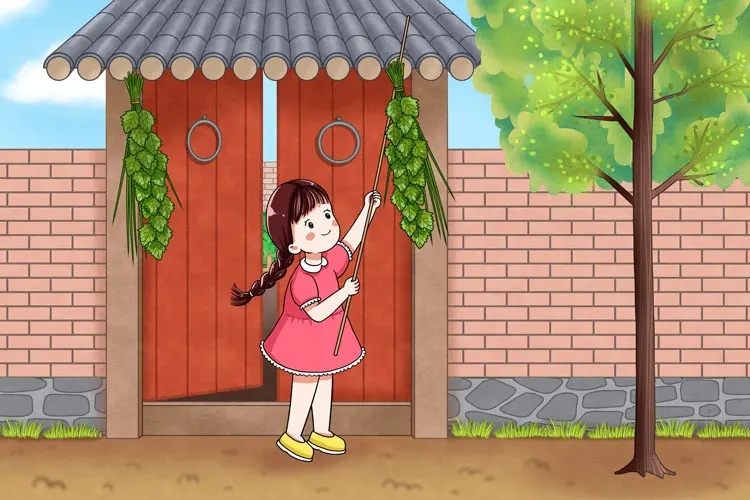
The festival coincides with the early summer season, a time when illnesses were historically more common. Mugwort and calamus are medicinal herbs used to prevent disease and repel pests. Their strong fragrances are believed to drive away flies, mosquitoes, and negative energies.

On the fifth day of the fifth lunar month, people clean their homes and hang these herbs on their doors to protect against illness and bring good luck.

b. Drinking Realgar Wine

dragon boat festival celebration,

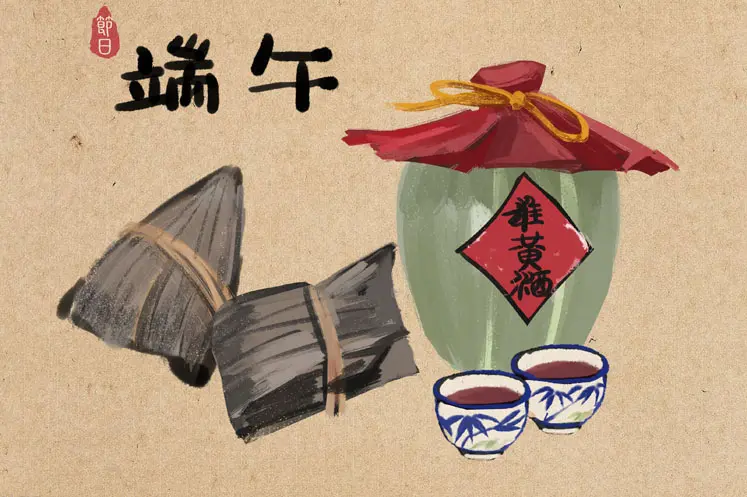
A traditional saying goes: “Drinking realgar wine drives away disease and evil spirits.” Realgar wine is made from fermented grains and realgar, a red mineral (arsenic sulfide) once believed to be an all-purpose antidote.

Historically, people drank realgar wine to kill insects, detoxify the body, and protect against spiritual harm.

c. Wearing Perfume Pouches

dragon boat festival celebration,

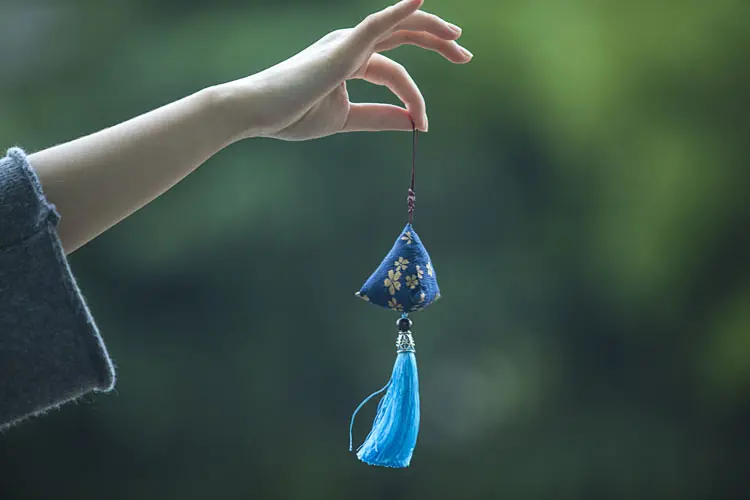
Before the festival, parents prepare small, colorful silk pouches filled with fragrant herbs or perfume for their children. These are either worn around the neck or pinned to clothing as ornaments.

Perfume pouches are believed to offer protection from evil spirits and disease, and are a cherished custom that blends health with artistry.

The Origins of the Dragon Boat Festival

There are many legends about the origin of the Dragon Boat Festival. The most popular ones are as follows:

Why Dragon Boat Festival Celebrated

The Death of Qu Yuan

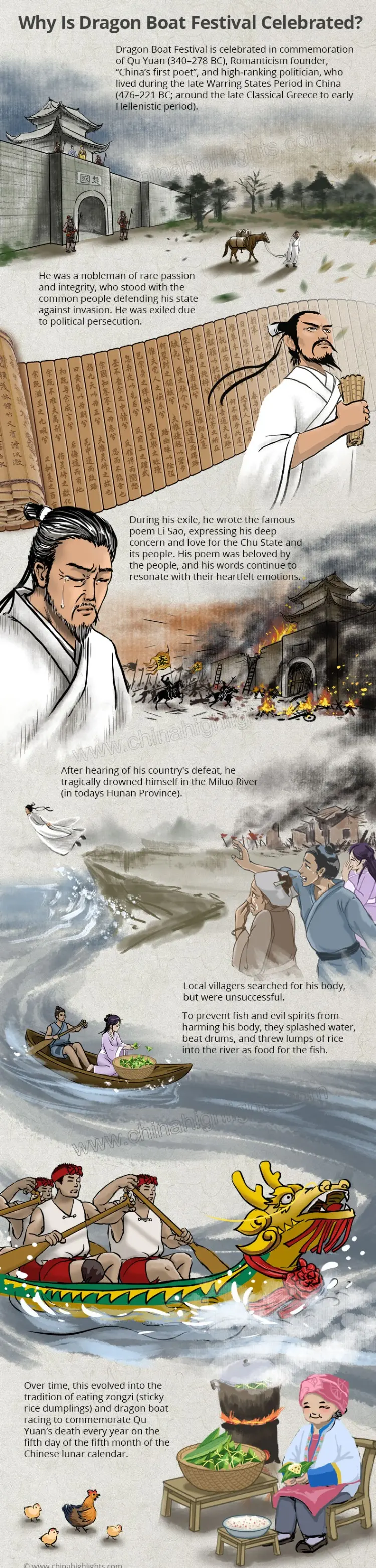
The most widely accepted origin of the Dragon Boat Festival is its commemoration of Qu Yuan (340–278 BCE), a patriotic poet and loyal official of the Chu State during the Warring States Period. When his beloved state fell to the Qin, Qu Yuan, devastated by the loss, drowned himself in the Miluo River on the fifth day of the fifth lunar month.

Local people, deeply moved by his patriotism, raced out in boats to rescue him or retrieve his body, but their efforts were in vain. To keep fish and evil spirits from disturbing his remains, they beat drums and threw rice dumplings into the river. These traditions evolved into the dragon boat races and the custom of eating zongzi that continue today.

The Unlucky Fifth Month

Another explanation for the origins of the Dragon Boat Festival relates to the traditional Chinese calendar and seasonal beliefs. Since ancient times, the fifth lunar month was considered an unlucky time and was even referred to as the “Month of Poison” (毒月). This was when the “Five Poisonous Creatures” (五毒 wǔ dú)—centipedes, scorpions, snakes, toads, and spiders—began to appear in greater numbers due to the warming weather. Disease, pestilence, and natural disasters were also more prevalent during this period.

The fifth day of the fifth month, or the “Double Fifth,” was seen as especially ominous. To protect themselves, people hung wormwood and calamus on their doorways and wore sachets of fragrant mugwort (xiāng bāo, 香包). The sword-like shape and pungent aroma of calamus were believed to repel both pests and evil spirits. For this reason, the Dragon Boat Festival is also sometimes referred to as the “Calamus Festival” (菖蒲节 Chāngpú Jié).

These rich and varied customs reflect the Dragon Boat Festival’s deep cultural significance, blending ancient health practices with heartfelt traditions of honor, protection, and community celebration.

Link:https://peacelilysite.com/2025/06/05/dragon-boat-festival-and-duanwu-jie/

Source: https://www.chinahighlights.com/festivals/dragon-boat-festival.htm

A Serene Masterpiece: The Water-Moon Guanyin at the Nelson-Atkins Museum

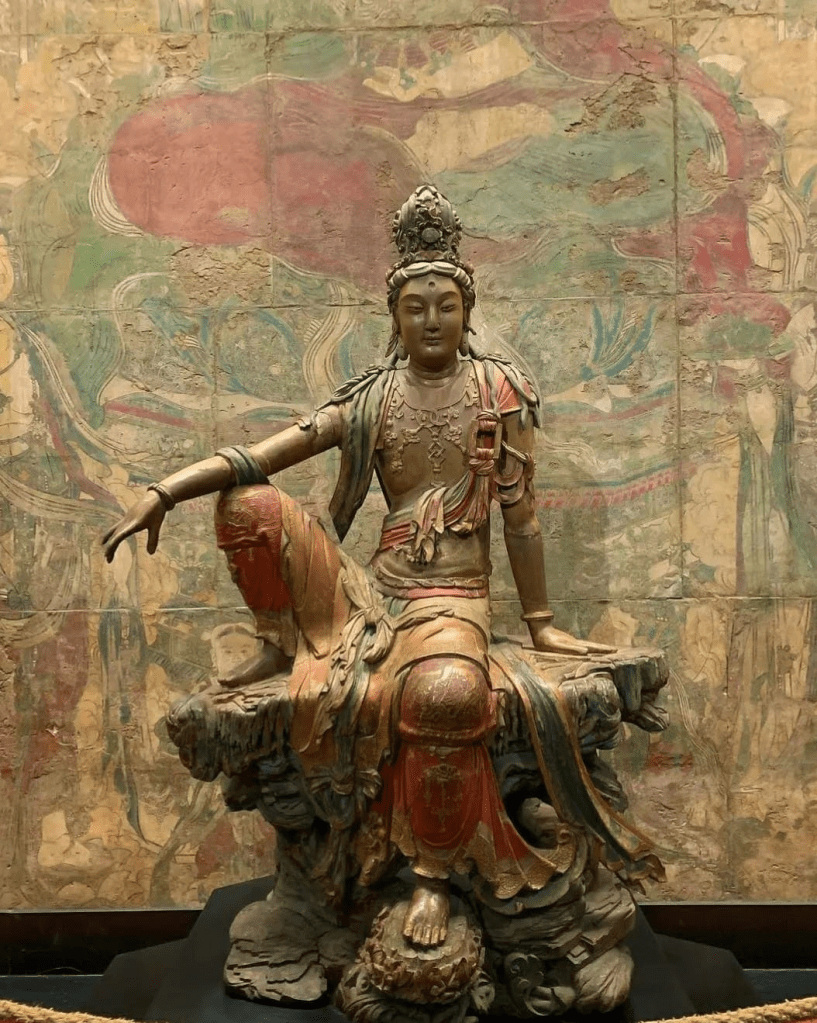
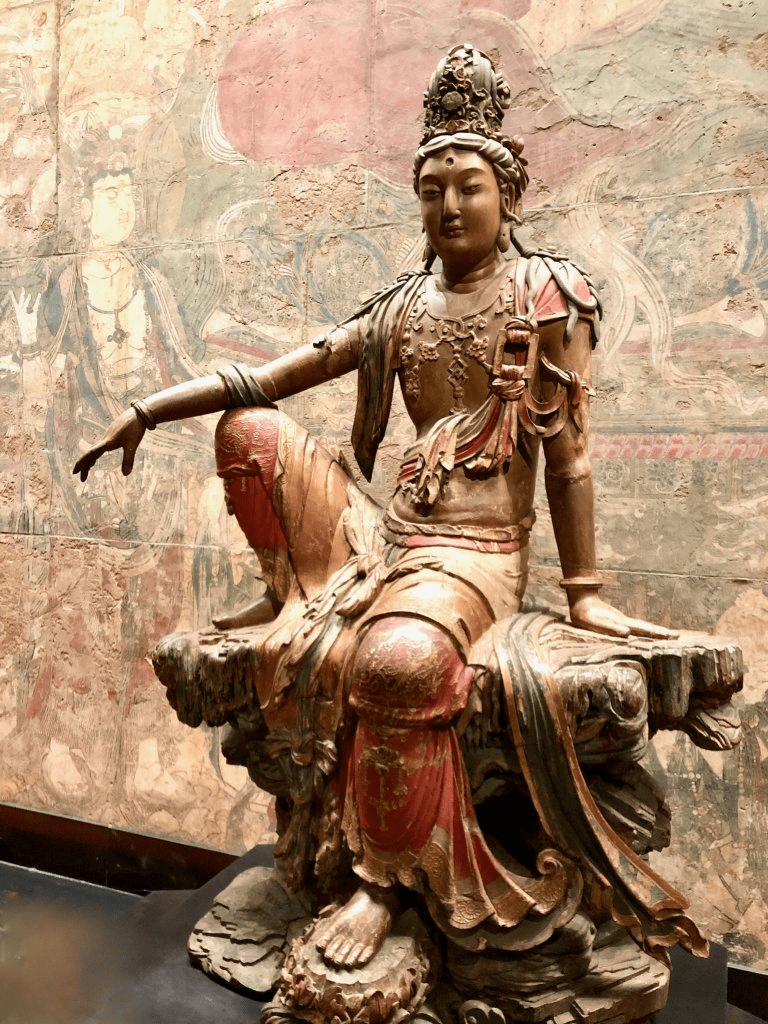
Tucked within the tranquil halls of the Nelson-Atkins Museum of Art stands a breathtaking wooden sculpture of Water-Moon Guanyin from the Liao Dynasty—a work hailed as “the most magnificent surviving sculpture in China” and “a triumph of religion and aesthetics.” It has also been honored by the media as “one of the thirty finest works held in American public institutions.”

Officially labeled by the museum as “Guanyin of the Southern Sea,” this statue rises to an impressive height of 2.4 meters. Aside from the right forearm, the entire figure—including its base—was masterfully carved from a single block of wood. Dating back to the 11th or 12th century (Liao or Jin Dynasty), the sculpture has been remarkably well-preserved over the centuries.

This Guanyin is an extraordinary example of religious artistry. Her face is gently sculpted with refined features—serene, graceful, and quietly majestic. Adorned with a jeweled crown, her eyes are softly closed, gazing downward in meditation and compassion. The statue’s pose reflects the elegance and wisdom traditionally associated with the feminine form, especially in the flowing hand gestures—while still retaining some subtle masculine traits in the upper body, a nod to Guanyin’s transcendent nature.

In classic iconography, Water-Moon Guanyin is often portrayed seated on a rock or lotus throne, gazing compassionately at the world. In this sculpture, she sits with one leg bent and the other gracefully draped downward. Her right arm rests lightly on her knee, fingers gently curved, as she gazes diagonally downward with a calm smile—evoking the image of the moon reflected in water. This visual metaphor powerfully symbolizes a core Buddhist teaching: the illusion of form and the essence of emptiness.

Every aspect of the statue—the proportions, the flowing posture, the tranquil expression—conveys a sense of effortless grace, inner freedom, and compassionate presence. It is a piece that invites quiet reflection, stirring something deep within the soul of the viewer.

The Legend Behind the Water-Moon Guanyin

The form of Water-Moon Guanyin, also known as “Auspicious Water Guanyin” or “Auspicious Water Bodhisattva,” is one of the most beloved among the thirty-three manifestations of Guanyin in Chinese Buddhist tradition. Interestingly, the name “Water-Moon” does not come from early Buddhist scriptures, but rather from Chinese folklore—born of the fusion between Buddhism and indigenous Chinese culture.

According to legend, Guanyin once appeared in Suzhou during a time of war, where she witnessed the brutal slaughter of civilians by the Jin army. Out of great compassion, she transformed into a beautiful woman, built a ritual platform, and began chanting sutras to deliver the souls of the dead. When her recitation was complete, someone among the crowd recognized her divine aura and asked to see her true form.

The Bodhisattva pointed to the riverbank. There, reflected in the still waters, was the image of a radiant full moon, within which her sacred figure appeared—graceful and ethereal. Among the witnesses was a talented artist named Qiu Zijing, who quickly sketched the vision. As his painting circulated, this image came to be known and venerated as the Water-Moon Guanyin.

A Space Worthy of the Divine

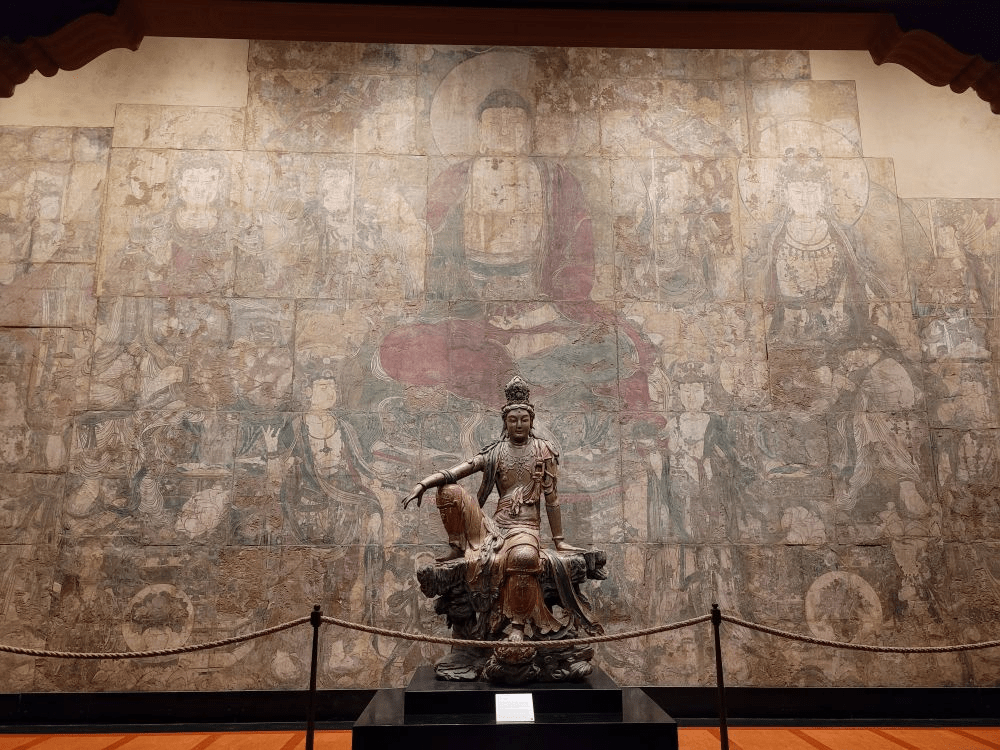
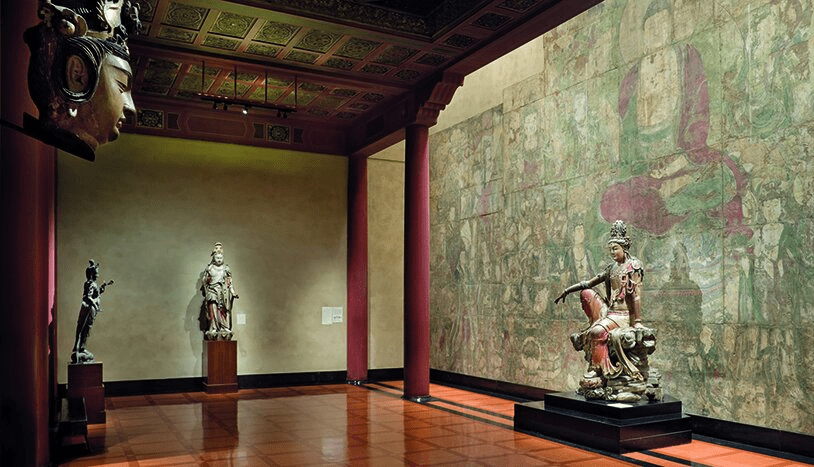
To properly honor this extraordinary statue, the Nelson-Atkins Museum created an expansive Chinese Temple Gallery. Behind Guanyin stands a Yuan Dynasty mural titled “Assembly of the Radiant Buddha,” originally from Guangsheng Temple in Shanxi Province. Above hangs a carved Ming Dynasty coffered ceiling adorned with dragons, while in front, finely carved lattice doors from a Qing Dynasty official’s residence in Beijing complete the immersive setting.

This harmonious environment allows visitors to experience the sculpture not just as a museum piece, but as a living expression of faith, beauty, and timeless spiritual insight.

https://www.orientations.com.hk/highlights/creating-spaces-for-asian-art-c-t-loo-and-the-nelson-atkins-museum-of-art

https://www.orientations.com.hk/highlights/creating-spaces-for-asian-art-c-t-loo-and-the-nelson-atkins-museum-of-art

The Water-Moon Guanyin at the Nelson-Atkins Museum is more than an ancient sculpture—it is a sacred embodiment of compassion, artistry, and transcultural storytelling. Whether viewed through the lens of religion, history, or aesthetics, it stands as a serene reminder of the enduring power of beauty to transcend time and touch the human spirit.

Link:https://peacelilysite.com/2025/05/21/a-serene-masterpiece-the-water-moon-guanyin-at-the-nelson-atkins-museum/

The “Banqi” Style: A Masterpiece of Artistic Innovation

Going to a Faraway School in the Mountains
《山間遠學》


Artist: H.H. Dorje Chang Buddha III
H.H.第三世多杰羌佛
Style: Banqi(版氣派)

This exquisite painting, rendered in the unique “Banqi” style, captures a touching scene of children from mountain villages on their way to school. Unlike city children, these young students must trek across rugged terrain—climbing mountains, crossing ravines—day after day to pursue their education. Their journey is filled with challenges, yet their unwavering determination and thirst for knowledge shine through. This artwork serves as a tribute to their resilience, reminding us all of the value of education and the perseverance required to achieve greatness.

A Revolutionary Artistic Technique

What makes this painting extraordinary is its unconventional brushwork, which blends the bold energy of ink-wash painting with the refined precision of engraving. Every stroke, whether light or dark, delicate or bold, exudes an artistic charm that is both fluid and structured. The layering of ink and color creates depth, while the intricate texture gives the illusion of an engraved plate print, despite being entirely painted by hand. The brushwork is dynamic—lines seem to break and reconnect, mimicking the traditional elegance of carved stone seals. This interplay between spontaneity and meticulous control infuses the painting with life, movement, and a profound sense of authenticity.

What Is the “Banqi” Style?

The “Banqi” style is a rare and fascinating artistic approach that combines the visual impact of printmaking with the expressive freedom of brush painting. While these works resemble engravings at first glance, they are, in fact, purely ink-wash paintings—imbued with an effortless yet profound beauty that is both natural and lively. Beneath their structured appearance lies a deep, inexhaustible charm, where each stroke carries an essence of tradition, innovation, and artistic mastery.

Through this masterpiece, we witness not only a compelling story of perseverance but also a groundbreaking artistic vision—one that harmonizes the precision of engraving with the fluid grace of brush painting. It is a celebration of both form and spirit, a true testament to the boundless possibilities of art.

This beautiful artwork is part of the permanent exhibition at the International Art Museum of America, located in downtown San Francisco.

Link:https://peacelilysite.com/2025/03/21/the-banqi-style-a-masterpiece-of-artistic-innovation/

Celebrating the Chinese Lunar Lantern Festival: A Journey Through Tradition and Light

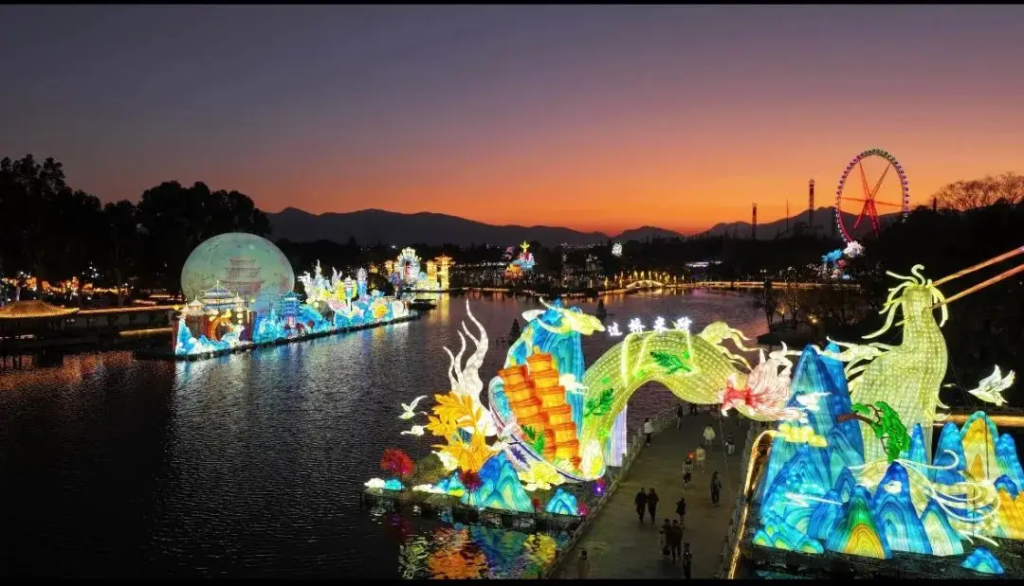
The Chinese Lunar Lantern Festival, also known as the Yuan Xiao Festival, is a vibrant celebration that marks the end of the Chinese New Year festivities. This enchanting festival, rich in history and culture, is an opportunity for families to come together, enjoy delicious food, and marvel at the stunning displays of lanterns that illuminate the night sky.

The Origin of the Lantern Festival

The Lantern Festival is a traditional Chinese holiday that dates back over 2,000 years to the Western Han Dynasty. The custom of enjoying lanterns began during the Ming Dynasty under Emperor Ming, who promoted Buddhism. It is said that on the 15th day of the first lunar month, monks would observe Buddhist relics and light lamps in reverence. In response, the emperor ordered that lamps be lit in the palace and temples on this night, encouraging both nobles and commoners to hang lanterns. Over time, this Buddhist ceremonial festival gradually evolved into a grand folk celebration. The festival has transitioned from the imperial court to the general public and expanded from the Central Plains to the entire country. As the tradition evolved, lanterns became a central feature of the celebrations, symbolizing hope, prosperity, and good fortune.

How the Chinese Celebrate the Festival

The Lantern Festival is celebrated with various customs and activities that bring communities together. Here are some of the most cherished traditions:

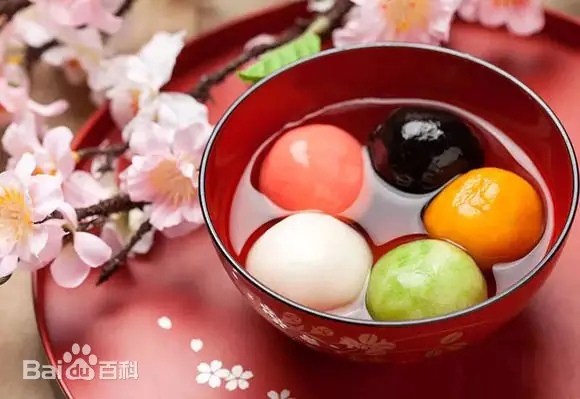
Eating Tangyuan: A key highlight of the festival is the consumption of tangyuan, sweet glutinous rice balls filled with various fillings such as sesame paste, red bean paste, or peanut butter. These round dumplings symbolize family unity and togetherness.

Fireworks: In many regions, fireworks are set off to celebrate the occasion, adding to the festive atmosphere and marking the end of the New Year celebrations.

Lion Dances and Dragon Dances: Traditional lion and dragon dances are performed to ward off evil spirits and bring good luck. The rhythmic drumming and vibrant costumes add to the festive spirit.

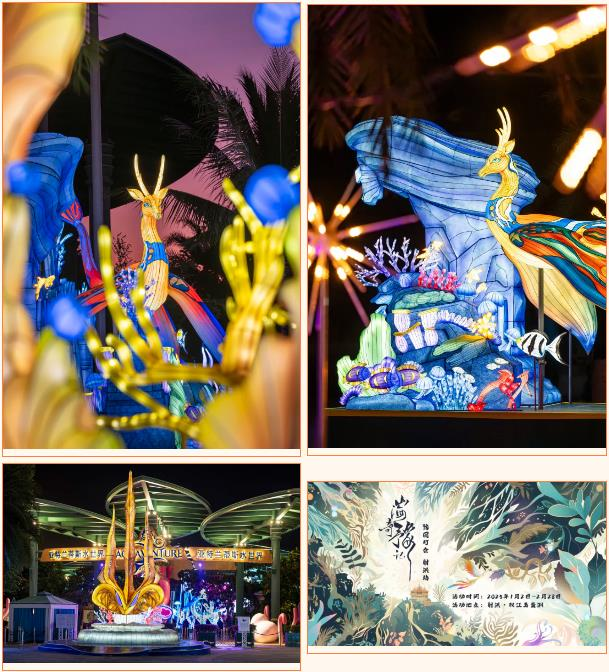
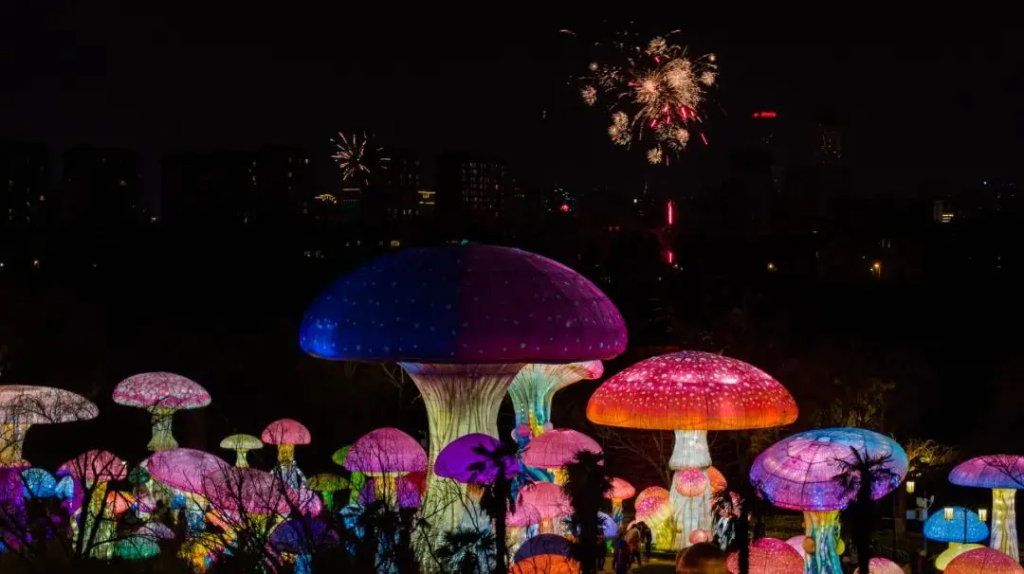
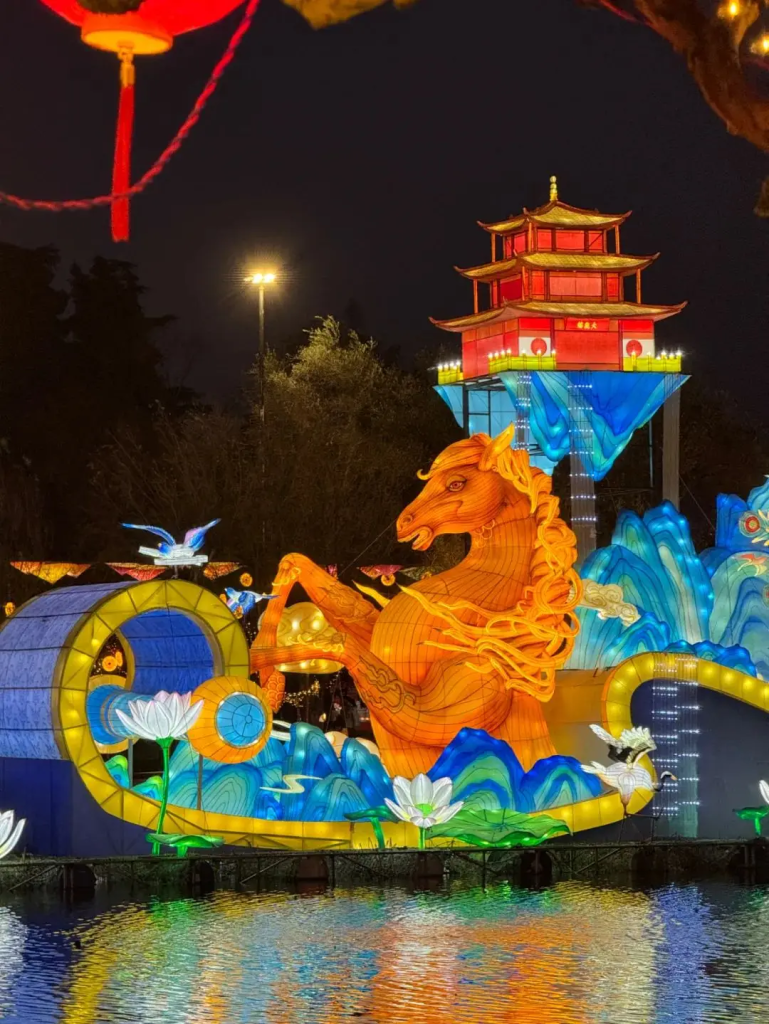
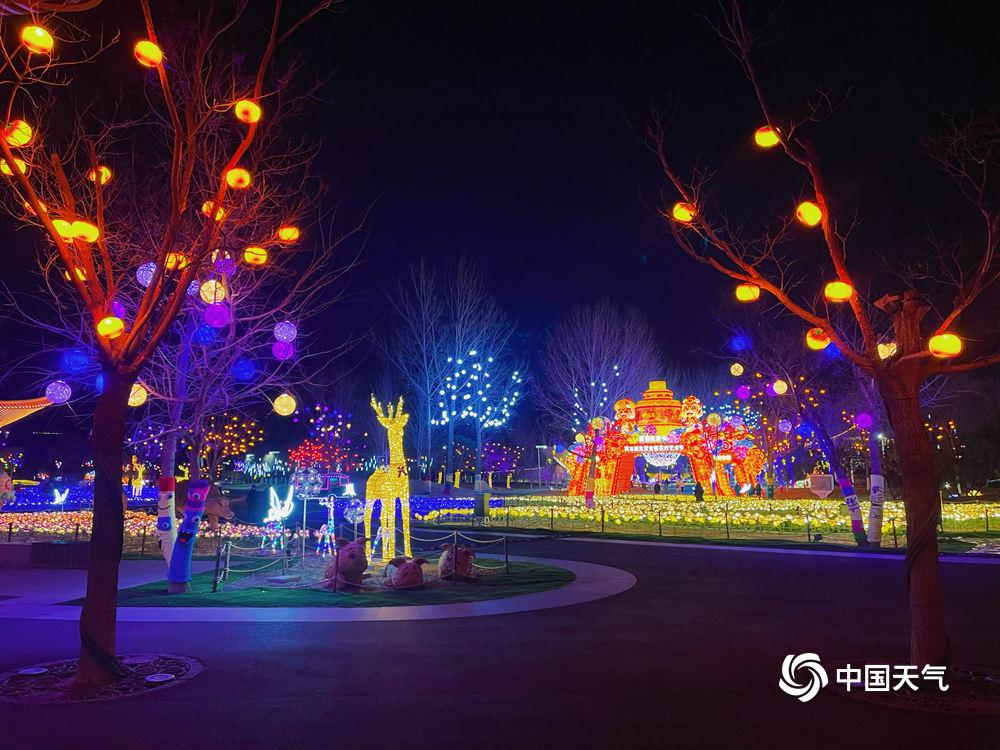
Lantern Displays: People of all ages create and display colorful lanterns, often in intricate shapes and designs. These lanterns can be found in parks, streets, and temples, creating a magical atmosphere.

Solving Lantern Riddles: A fun and engaging activity during the festival is solving riddles written on lanterns. Families and friends gather to test their wits and enjoy the playful competition.

The Most Beautiful Places to See Lanterns

If you’re looking to experience the beauty of the Lantern Festival, several locations across China are renowned for their stunning lantern displays:

  1. Beijing: The city’s parks, such as the Yuanmingyuan Park and the Temple of Earth Park, host impressive lantern displays, attracting thousands of visitors each year.
  2. Shanghai: The Yuyuan Garden in Shanghai is transformed into a lantern wonderland, featuring elaborate designs and a lively atmosphere, making it a must-visit during the festival.
  3. Hangzhou: Known for its picturesque West Lake, Hangzhou hosts beautiful lantern displays that reflect off the water, creating a breathtaking sight.
  4. Chaozhou: This city in Guangdong Province is famous for its traditional lantern-making techniques, and visitors can witness the craftsmanship and creativity of local artisans.
Beijing

Beijing

Beijing

HangZhou

Shanghai

Shanghai Yuyuan Lanter Festival
ChaoZhou

Chaozhou

Chaozhou

Chaozhou

Kunming Da Guan Lou

Kunming Da Guan Lou

The Chinese Lunar Lantern Festival is a captivating celebration that brings together tradition, culture, and community. As families gather to enjoy delicious food, admire beautiful lanterns, and participate in lively activities, the festival serves as a reminder of the importance of unity and hope. Whether you’re in China or celebrating from afar, the Lantern Festival is a time to reflect on the past year and look forward to the future, illuminated by the light of countless lanterns.

Link:https://peacelilysite.com/2025/02/13/celebrating-the-chinese-lunar-lantern-festival-a-journey-through-tradition-and-light/

The Enchanting Red Panda: A Masterpiece by H.H. Dorje Chang Buddha III

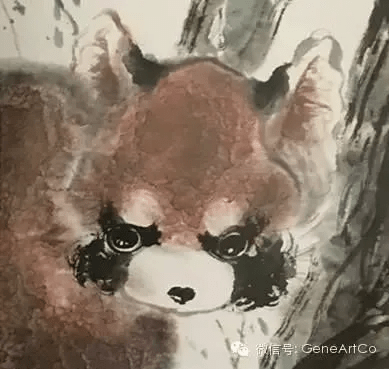
In this exquisite artwork, the slightly reddish small animal depicted is an extraordinarily rare and precious creature known as the red panda, also referred to as the small panda. H.H. Dorje Chang Buddha III, with His masterful artistic techniques, brings this delicate creature to life in a way that captivates the viewer’s heart.
The red panda, native to the eastern Himalayas and southwestern China, is known for its striking reddish-brown fur, bushy ringed tail, and expressive face. H.H. Dorje Chang Buddha III skillfully captures these natural features, emphasizing the panda’s endearing innocence and elegance. The slightly upturned tail, adorned with subtle yet distinct spots, adds a dynamic sense of movement and charm. This tail gracefully echoes the surrounding elements of nature, blending harmoniously with the drooping round leaves of the willow branches. The careful balance between the animal and its environment enhances the visual poetry of the piece.

A particularly remarkable aspect of this painting is the technique used to depict the panda’s face. H.H. Dorje Chang Buddha III employs a calligraphic brushstroke style, reminiscent of traditional Chinese ink painting, to portray the panda’s features with simplicity yet profound expressiveness. The crystal-clear, soulful eyes seem to glisten with life, while the velvety black fur is rendered with such fluidity and precision that it conveys both softness and texture.

Through masterful control of brush pressure, ink flow, and color layering, H.H. Dorje Chang Buddha III achieves a perfect balance of realism and artistic interpretation. Each stroke reveals deep insight into both the subject’s physical form and its spiritual essence, a hallmark of true artistic mastery.

The meticulous attention to detail and the profound artistic wisdom evident in this painting reflect H.H. Dorje Chang Buddha III’s extensive experience and unparalleled skill. This artwork is not merely a visual delight but a spiritual expression, reminding viewers of the beauty and fragility of life and the interconnectedness between all living beings and nature. It stands as a testament to the profound depth of both artistic technique and compassionate vision embodied in the works of H.H. Dorje Chang Buddha III.

This beautiful artwork is part of the permanent exhibition at the International Art Museum of America, located in downtown San Francisco.

Link:https://peacelilysite.com/2025/01/10/the-enchanting-red-panda-a-masterpiece-by-h-h-dorje-chang-buddha-iii/

Exploring the Timeless Charm of Pingyao Ancient City

Pingyao Ancient City – The Best-preserved Ancient City in China

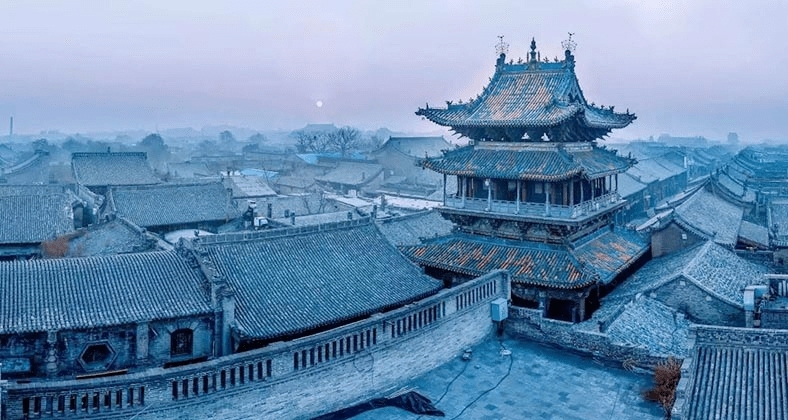
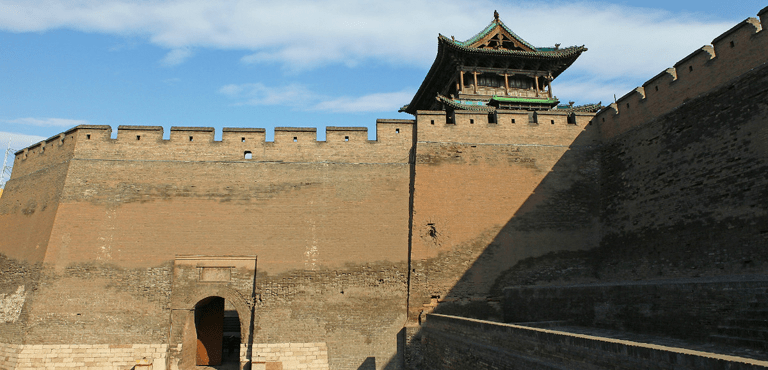
Pingyao Ancient City, with over 2,700 years of history, remains one of China’s best-preserved ancient cities. Its authentic layout features long, ancient city walls, elegant residences, courtyards, and a maze of streets and alleys that evoke the bustling county life of the Ming and Qing Dynasties. Designated a UNESCO World Cultural Heritage Site in 1997 alongside Shuanglin and Zhenguo Temples, Pingyao is one of the Four Most-Preserved Ancient Cities in China, making it a must-visit for those keen on history and culture.

A Journey Through Time

Pingyao was founded during the Western Zhou Dynasty in the 8th century BC, and it grew significantly during the Ming and Qing Dynasties. Unlike many ancient cities, it has survived wars and modernization, making it even older and more intact than famous counterparts like Lijiang Old Town, Huizhou Ancient City, and Langzhong Ancient City.

As the seat of county government since the Qin Dynasty (221 BC), Pingyao’s prominence only increased when its city walls were rebuilt and expanded in 1370. With over 400 ancient residential houses, government offices, shops, banks, and temples still standing, the city offers visitors a glimpse into traditional Chinese life, commerce, and religion.

Pingyao’s Unique Architecture

The architecture of Pingyao is one of its greatest treasures. Beyond its famous city walls and financial institutions, the city’s homes and structures reveal traditional design principles of the Ming and Qing Dynasties. Constructed using ancient techniques and materials, Pingyao’s buildings retain exquisite details in layout, decorations, and craftsmanship. When viewed from above, the city’s layout resembles a turtle, with the Southern Gate as its head, the Northern Gate as its tail, and the east and west gates representing its limbs.

Must-See Highlights in Pingyao

Ancient City Wall
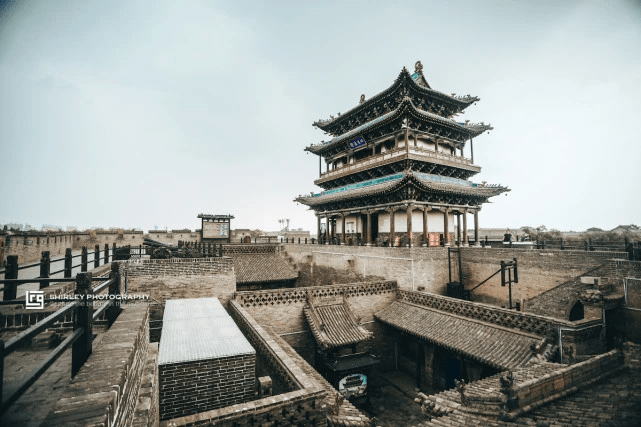
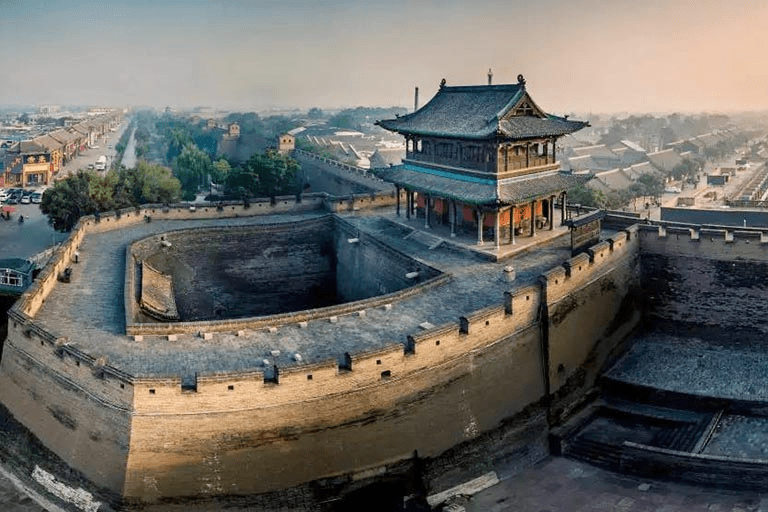
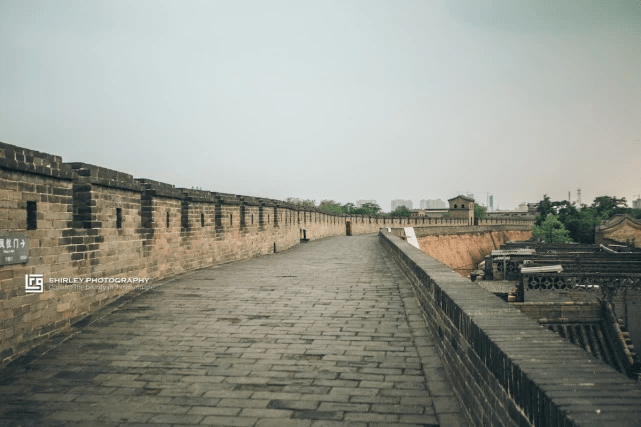
Built in 1370, Pingyao’s city walls stretch over 6,163 meters and are considered among the best-preserved in China. The walls stand 12 meters high, and at the top, you can explore 72 watchtowers, said to symbolize the 72 disciples of Confucius. Walking along the walls offers breathtaking views of the city below, the surrounding countryside, and the ancient military equipment once used to defend this historic town.

Rishengchang Former Bank
As China’s first modern bank, established in 1823, Rishengchang revolutionized financial operations in the Qing Dynasty. The museum here offers a fascinating look at China’s banking history, with exhibits on ancient financial tools, account books, and original working scenes.

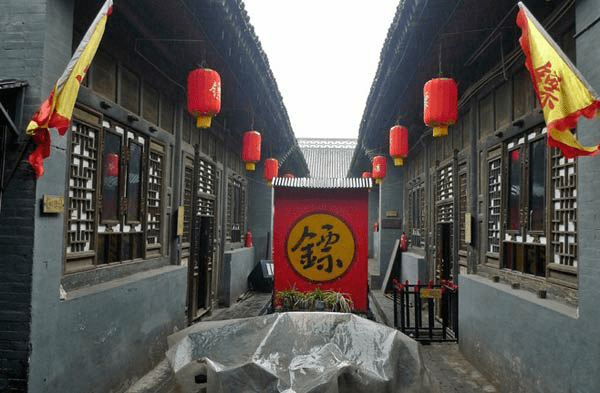
North China First Escort Agency
Known for its armed escorts protecting valuables, this agency thrived during the Qing Dynasty. Today, it’s a museum that tells the history of these brave escorts, showcasing the tools and techniques they used to safeguard goods during China’s bustling commercial era.

Pingyao Ancient Government Office
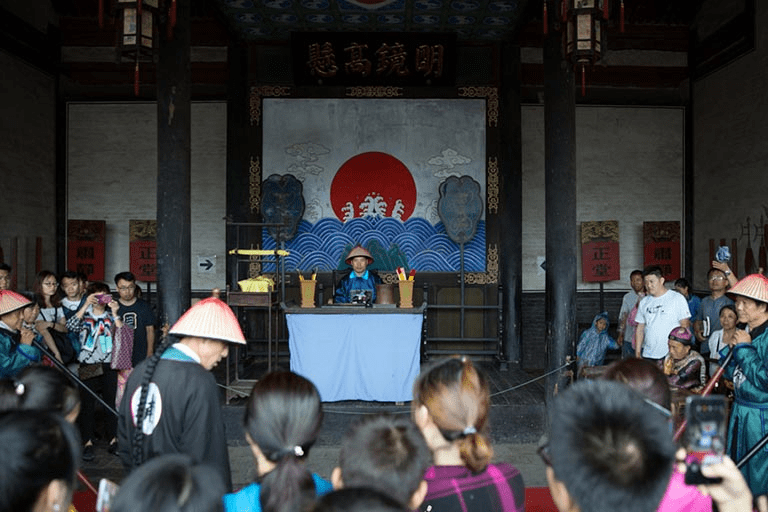
Dating back over 600 years, this grand office complex served as the seat of government in feudal China. Visitors can tour its judicial halls, ancient jails, and living quarters, and even watch performances of ancient court proceedings.

Temple of the City God
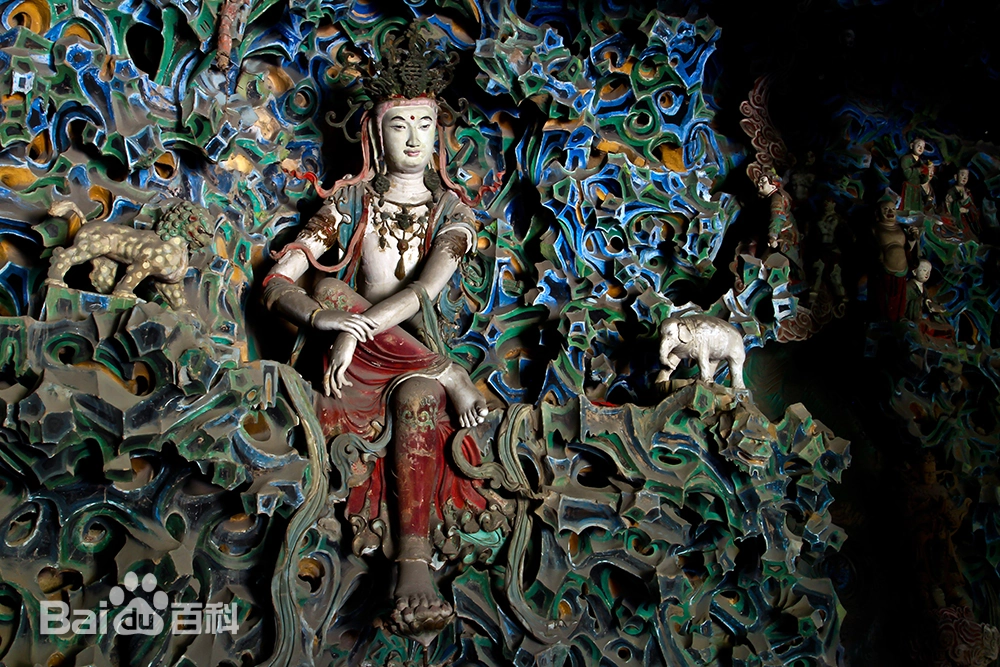
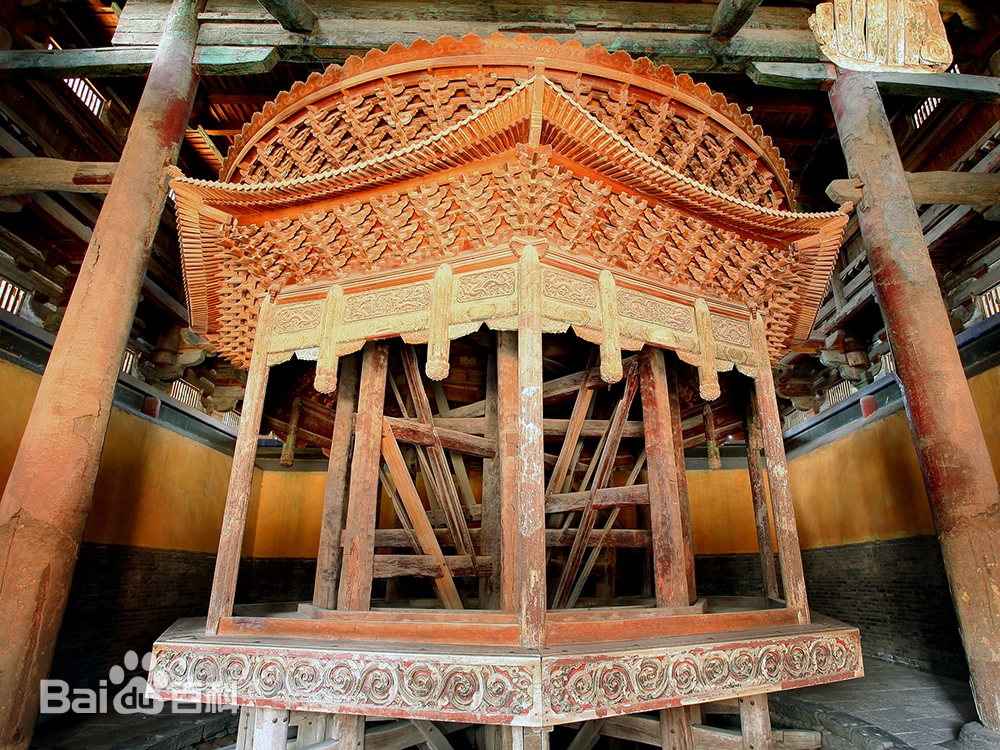
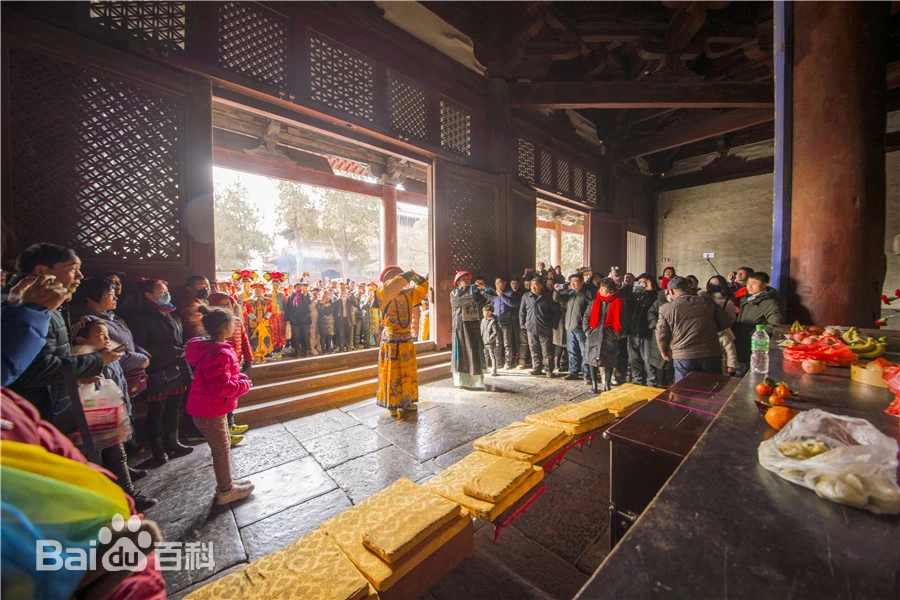
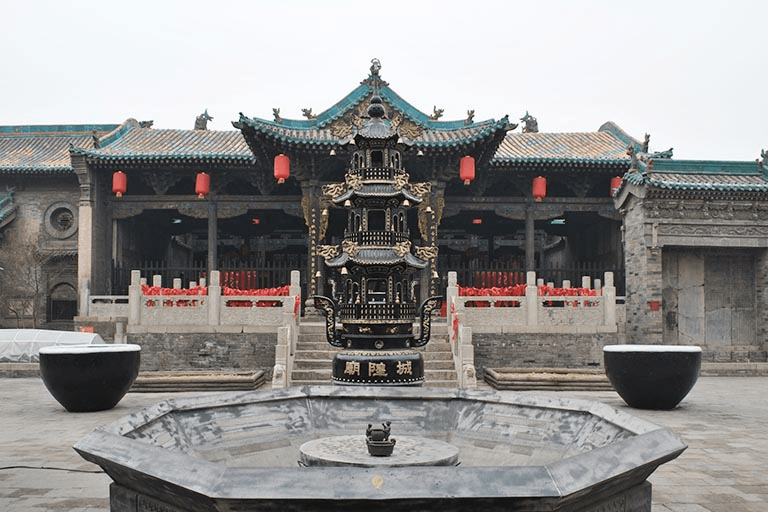
One of the most well-preserved City God temples in China, this Ming Dynasty complex is located in the eastern part of the city. With stunning wooden architecture, colored glazes, and vibrant frescoes, it’s a peaceful spot to take in the spiritual atmosphere while admiring the craftsmanship of centuries past.

Exploring Beyond the City

Pingyao Ancient City is part of a UNESCO-listed trio that includes the nearby Shuanglin and Zhenguo Temples, each rich with history and cultural significance.

  • Zhenguo Temple
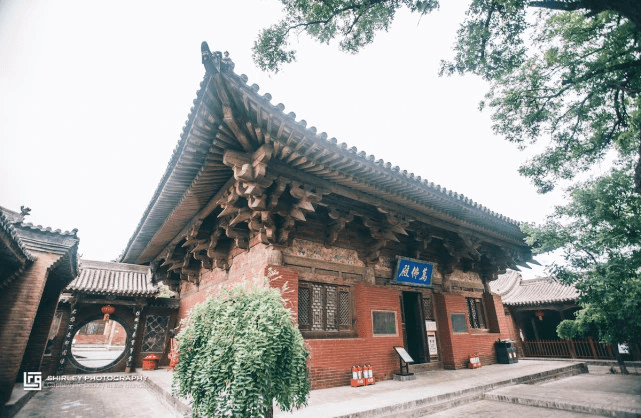
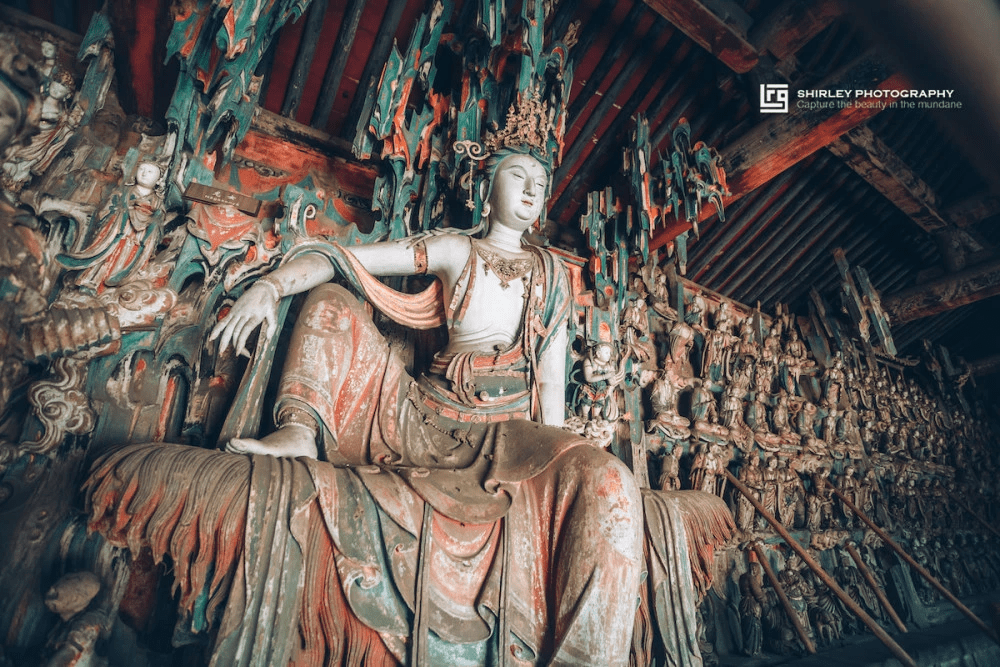
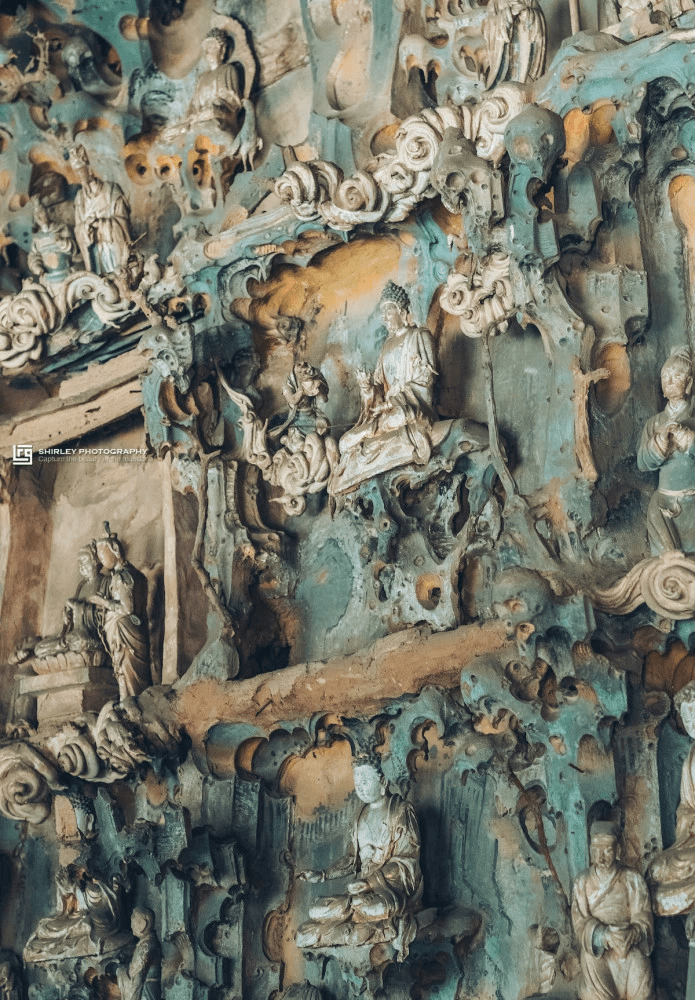
    Although less known, Zhenguo Temple is a hidden gem, offering an impressive array of ancient painted sculptures from the Five Dynasties period. The Ten Thousand Buddha Hall houses statues with a powerful presence, showcasing techniques that date back to the Tang Dynasty.

  • Shuanglin Temple
    Located just 6 kilometers from Pingyao, Shuanglin Temple is a masterpiece of Chinese painted sculpture, with over 2,000 Ming Dynasty statues that appear lifelike, capturing human emotions and worldly charm.

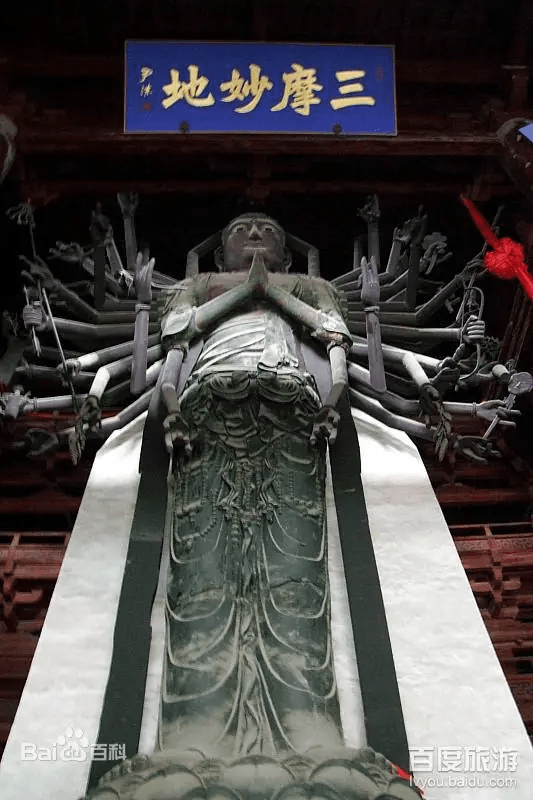
The Thousand-hand Avalokitesvara

A Culinary Adventure in Pingyao

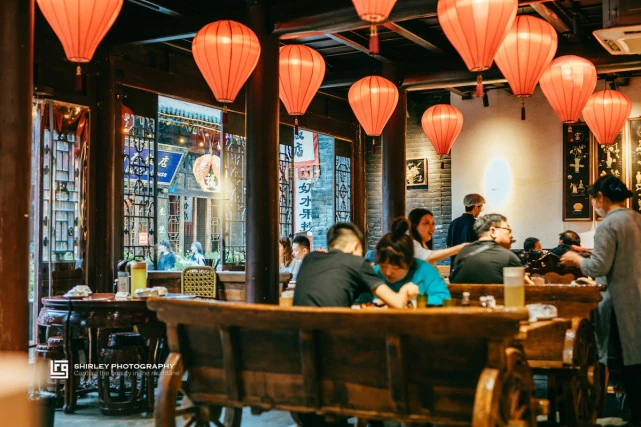
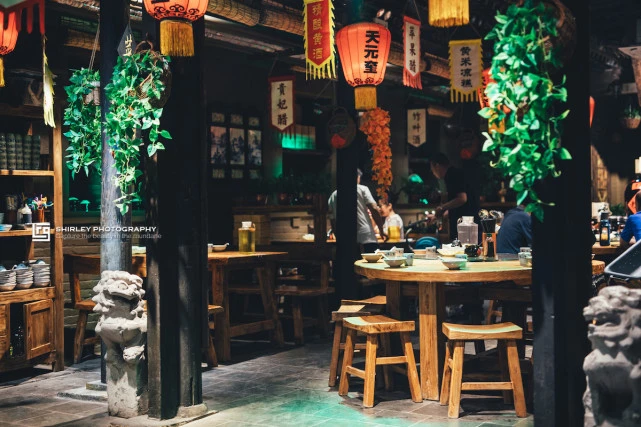
Pingyao boasts 108 types of local snacks and dishes, with noodles being the star. The city’s famous Pingyao Beef is a must-try, thinly sliced and bursting with flavor. Another local favorite is Pingyao Wantuo, a buckwheat dish with a chewy texture that’s perfect for summer, known for its cooling and detoxifying properties.

The environment is also a quaint restaurant

Tips for a Budget-Friendly Trip

Many tourist traps in Pingyao are located near the city’s outer entrances. Avoid being lured in by promotions outside and head straight into the ancient city for an authentic experience. Once inside, you can explore freely, with many areas open to the public.

  • Ancient City Pass: The ¥125 pass includes access to 22 attractions, such as the city walls, government offices, and temples. If you’re just looking to wander the streets and grab a bite, entry to the ancient city itself is free. The pass is valid for three days and can be purchased via the official “Pingyao Ancient City Scenic Area” mini-program. Discounts are available for students, military personnel, and seniors.

Where to Stay: Accommodations in Pingyao

Staying inside the ancient city is the best way to fully immerse yourself in Pingyao’s charm. Not only is it convenient for sightseeing, but it also allows you to enjoy the beautiful night views and avoid the peak tourist times. Homestays within the city are affordable, ranging from ¥100-200+ per night, with some offering traditional heated beds that add a touch of historical authenticity to your stay.

However, be sure to check the reviews and photos before booking, as the quality of accommodations can vary. Some rooms may be small or lack private bathrooms, so it’s essential to do a little research beforehand.

Pingyao Ancient City is vast, so if your time is limited, focus on exploring the main attractions around South Street and East Street. For those staying longer, take the time to wander the quieter alleys to experience local life and discover hidden gems beyond the tourist hotspots.


Pingyao Ancient City offers a unique window into China’s rich history and cultural heritage. With its well-preserved architecture, vibrant temples, and fascinating museums, it’s a destination that promises to transport you back in time, offering unforgettable experiences at every turn.

Link:https://peacelilysite.com/2024/09/20/exploring-the-timeless-charm-of-pingyao-ancient-city/

Source: https://www.chinadiscovery.com/shanxi/pingyao/pingyao-ancient-city.html, https://new.qq.com/rain/a/20210825A00UZJ00

Inheriting Traditional Painting Techniques and Pioneering Modern Artistic Styles

Chinese Landscape Paintings by H.H. Dorje Chang Buddha III

Painting is the artist’s pursuit of passion, and the artist’s spiritual realm and artistic insight determine the quality of the work. H.H. Dorje Chang Buddha III once said, “Every artist must tread the path of learning from the past while innovating for the future. Learning from the past embodies tradition, while innovation demands the fusion of Eastern and Western art, philosophy, aesthetics, and literature into a unified whole. This entails grasping the true essence, understanding the inner and outer spirit of the subject, navigating the transitions between the internal and external, the virtual and the real, and infusing rhythm into one’s creations. The result is a work that flows freely, exudes power, and embodies both familiarity and uniqueness. It conceals craftsmanship while remaining wild yet disciplined, possessing a distinct personality and charm. Upon reaching this stage, one can embark on the pursuit of egolessness and the true essence of emptiness and colorlessness. This journey leads to a profound, rich, elevated, and vibrant artistic realm that offers people the joy of beauty. With such mastery, Chinese painting can take a significant leap forward and ultimately stand as a world-class masterpiece.”

Let’s appreciate two masterpieces painted by H.H. Dorje Chang Buddha III and gain deep insights into innovation rooted in tradition.

Ancient Style Emergence

The landscape painting “Ancient Style Emergence” captivates viewers at first sight with its unique style and transcendent meaning. The simple and unadorned lines depict rugged cliffs, hills, forests, and cottages. Layers of ink washes render the rocks thick and the mountain mists hazy. The clustering mountains and overlapping peaks evoke the ancient charm of Yuan dynasty landscape paintings while also embodying a contemporary innocence. Beneath the moistened ink, clouds flicker and smoke swirls. The tree crowns, mountain shadows, and distant peaks are rendered in a nearly pale ink-like gray-green hue, creating a rich and deep landscape. The sunlit sides of the hills and rocks are lightly tinted with a bright ochre, resembling vermillion, which contrasts vividly with the large areas of gray-green, lending the painting a magnificent and ancient beauty.

The pristine and dust-free atmosphere depicted in the painting stands in stark contrast to the noisy scenes of the mundane world, perhaps serving as a reminder for viewers to awaken to the beauty of life.

The brushstrokes in the painting are highly calligraphic, lively, and modern, diverging significantly from traditional landscape depictions. It represents a landscape of the heart, created purely through brush and ink.

While lacking the specific forms of traditional paintings that one can wander and inhabit, it possesses a more authentic and dynamic charm of modern art, particularly evident in its abstract qualities, which resonate deeply with contemporary audiences.

This landscape painting is created by H.H. Dorje Chang Buddha III, characterized by its straightforward and lively brushwork, as well as its modern sensibility.

Setting Sail to the East

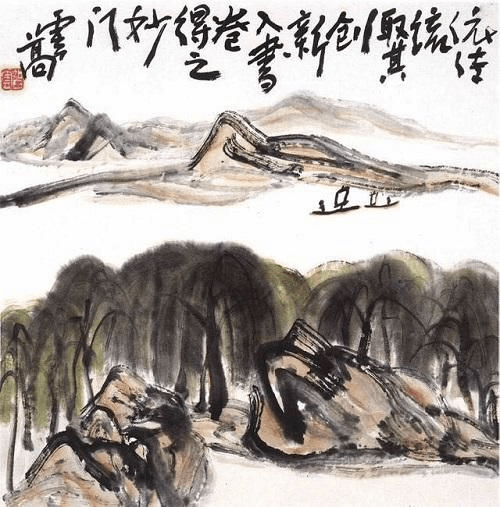
“Setting Sail to the East,” this painting employs thirsty brush and light ink, with free and bold strokes, abandoning the meticulousness of carving. Horizontal and vertical brushstrokes appear to be dragging mud and water, yet they possess the strength to carry a heavy weight. The brushwork is seasoned and heavy, yet balanced between reality and illusion.

In the foreground, there is a poetic dense willow forest, where two stubborn rocks seem to be “nodding” to each other, engaged in intimate conversation, perhaps narrating the endless past and future of the mundane world. In the middle ground, there are two simple small boats, leisurely passing through the river, seemingly minimalist yet imbuing the scene with a rich humanistic atmosphere. In the distance, distant mountains are depicted with dry brush and thirsty ink, subtly rendered with a watery light ochre, evoking the elegant beauty of classical Chinese paintings, reminiscent of the dry autumn wind and the moist spring rain, yet with a strong modern painting atmosphere.

This is a masterpiece of landscape painting with profound underlying themes and innovative imagery. Its lofty style, deep meaning, grand momentum, and charming spirit all stem from H.H. Dorje Chang Buddha III’s profound philosophical thoughts and masterful brushwork. The inscription on the painting reads: “Drawing on tradition for innovation, entering the wonderful realm of the written scroll.” The brushwork is arranged in a skillful and coherent manner, serving as the backbone of the painting and the soul of the entire composition.

The term “vivid charm” embodies the artistic realm of the calligrapher and painter. H.H. Dorje Chang Buddha III‘s landscape painting art transcends the ordinary and mundane, achieving a level of artistry that is beyond compare, with a spiritual realm that has become a benchmark in contemporary painting art.

Chinese Landscape Paintings by H.H. Dorje Chang Buddha III

Link:https://peacelilysite.com/2024/03/27/inheriting-traditional-painting-techniques-and-pioneering-modern-artistic-styles/

#DorjeChangBuddhaIII#HHDorjeChangBuddhaIII#Art #ChinesePaintings

Yellow Crane Tower: A Timeless Tale of Magic, Kindness, and Cultural Splendor in Wuhan

Bell courtyard in Yellow Crane Tower Park

Yellow Crane Tower

Perched majestically atop Snake Mountain, Yellow Crane Tower stands as a beacon of cultural significance in Wuhan, Hubei Province, rivaling the fame of Yueyang Tower in Hunan Province and Tengwang Pavilion in Jiangxi Province. With origins tracing back to the Three Kingdoms period in 223 A.D., this architectural marvel is more than just a sightseeing spot; it’s a testament to China’s rich history and enduring legacy.

Rising 51.4 meters into the sky, Yellow Crane Tower’s five floors house a treasure trove of murals, couplets, and cultural relics, each floor a testament to centuries of artistry and inspiration. The tower is not an isolated structure; it is surrounded by auxiliary buildings, including pagodas, memorial arches, and pavilions, which add to its grandeur and mystique.

Throughout history, Yellow Crane Tower has attracted luminaries from all walks of life, drawn by its ethereal beauty and historical resonance. Poets and writers, including the esteemed Cui Hao, have penned timeless works inspired by the tower’s allure. Cui Hao’s masterpiece, “Yellow Crane Tower,” resonates across generations, immortalizing the tower’s mystique in poetic verse.

Legend intertwines with reality in the tale of Yellow Crane Tower’s origins, where an act of kindness transforms a humble innkeeper’s life forever. The story unfolds in the ancient city of Wuhan, where a benevolent innkeeper named Old Xin encountered a shabbily dressed customer. Unperturbed by the visitor’s destitution, Mr. Xin welcomed him daily, offering him a glass of wine without expecting payment.

For six months, the mysterious customer continued to frequent the inn, accumulating a debt that Old Xin graciously overlooked. One day, the indebted visitor revealed his true identity as a magical being. He presented a drawing of a yellow crane, which came to life as he played a flute and sang. The enchanted crane danced along with the music, captivating the onlookers and turning the inn into a spectacle.

This magical partnership continued for ten years, bringing wealth and prosperity to Mr. Xin. When the mysterious customer returned one day, Old Xin, overwhelmed with gratitude, offered to support him in any way possible. However, the magical visitor had no material desires. Instead, he played a few tunes on his flute, and white clouds descended from the sky, carrying the drawing of the crane. With a graceful ascent, the customer mounted the crane and soared into the sky, leaving behind a tale imbued with traditional Chinese wisdom—kindness is a virtue that will always be repaid.

To express his gratitude and immortalize this magical encounter, Mr. Xin erected a tower on the spot and named it the “Yellow Crane Tower.”

Despite enduring centuries of upheaval and destruction, Yellow Crane Tower stands resolute, a symbol of resilience and cultural continuity. From its inception during the Three Kingdoms to its reconstruction in modern times, the tower has weathered the storms of history, emerging stronger with each passing era.

The tower’s architectural splendor is matched only by its cultural significance. Each floor tells a story, from legends of ancient cranes to the poetry of Tang Dynasty luminaries. Visitors are treated to panoramic views of the Yangtze River and Wuhan cityscape, offering a glimpse into China’s past and present.

It stands 51.4 meters (about 168 feet) high and has five floors

Around the main tower there are many other buildings, including the Sheng Xiang Pagoda and the temple gate. Each storey is decorated with traditional upturned eaves, but each one has a different style. The ground floor is a tall, wide hall. The midmost caisson ceiling stands over 10 meters high. On the front wall is a huge ceramic mural painting of a white cloud and a yellow crane. A pair of 7-meter-long inscribed tablets hang on the posts on both sides. The front wall of the second floor holds a marble inscription of Tang Dynasty poet Yan Baojin’s ‘Note on the Yellow Crane Tower’. On each side of it are mural paintings. One is ‘The Town that Sun Quan Built’. It describes the history of the Yellow Crane Tower and Wuchang town. The other is ‘Zhou Yu Made a Feast’, which tells the story of the Three Kingdoms celebrity’s visit to the tower.

With yellow upturned eaves, each floor seems to have been designed to resemble a yellow crane spreading its wings to fly.

As visitors explore Yellow Crane Tower, they encounter a journey through time and culture. Each floor is a testament to China’s literary and artistic heritage, inviting travelers to immerse themselves in centuries of tradition and innovation.

Outside the tower, bronze cranes stand sentinel, silent witnesses to the ebb and flow of history. Memorial gateways and pavilions beckon travelers to explore further, inviting them to partake in the tower’s timeless legacy.

Yellow Crane Tower is more than just a scenic spot; it’s a living testament to China’s cultural resilience and artistic ingenuity. As visitors stand atop its lofty heights, they are reminded of the enduring power of human creativity and the timeless allure of the written word.

In the heart of Wuhan, Yellow Crane Tower stands as a testament to the enduring spirit of China’s cultural heritage. Its towering presence serves as a beacon of inspiration for generations to come, inviting travelers from near and far to embark on a journey through time, tradition, and a touch of enchantment.

Charming night scene of the Yellow Crane Tower


Link:https://peacelilysite.com/2024/03/08/yellow-crane-tower-a-timeless-tale-of-magic-kindness-and-cultural-splendor-in-wuhan/

#TravelChina #YellowCraneTower

Source: https://www.chinadaily.com.cn/m/hubei/travel/2012-01/06/content_14103874.htm https://en.wikipedia.org/wiki/Yellow_Crane_Tower

Benjamin Franklin’s 13 Virtues: A Blueprint for Personal Development

A Path to Personal Excellence

George Washington may rightly be known as the “Father of his Country,” but for the two decades before the American Revolution, Benjamin Franklin held the title of the world’s most famous American.

Franklin, a celebrated scientist and inventor, earned recognition for his groundbreaking electrical experiments, winning the Royal Society’s Copley Medal—a prestigious 18th-century equivalent of the Nobel Prize. His notable inventions included the lightning conductor, the first map of the Gulf Stream, and a unique musical instrument, the glass armonica. Renowned composers like Gluck, Mozart, and Beethoven created concertos for this instrument. Franklin’s genius received international acclaim, with Immanuel Kant describing him as “The Prometheus of Modern Times,” and David Hume hailing him as America’s “first great man of letters.”

Benjamin Franklin, a polymath and one of the Founding Fathers of the United States, left an enduring legacy not only for his political contributions but also for his philosophy of personal development. In his autobiography, Franklin outlined 13 virtues that he believed were crucial for leading a virtuous and successful life. This blog post will explore each of these virtues and delve into how Franklin practiced them in his own life.

  1. Temperance: Franklin advised moderation in eating and drinking, emphasizing the importance of avoiding excess. By maintaining temperance, individuals could achieve a clear and focused mind. Franklin recognized that a balanced lifestyle laid the foundation for success in cultivating other virtues.
  2. Silence: The virtue of silence urged individuals to speak only when their words could benefit others or themselves, discouraging trifling conversation. Franklin realized the power of listening and the importance of thoughtful communication for personal and intellectual growth.
  3. Order: To bring order to one’s life, Franklin recommended organizing belongings and allocating time efficiently. By assigning specific places for possessions and dedicating time to each aspect of one’s business, an individual could enhance productivity and reduce chaos.
  4. Resolution: Resolution involved the commitment to fulfill one’s duties and promises without fail. Franklin understood that steadfast determination was crucial for personal and professional success, encouraging individuals to set goals and work relentlessly towards achieving them.
  5. Frugality: Franklin advocated for mindful spending, emphasizing that expenses should serve a purpose, either benefiting oneself or others. This virtue highlighted the importance of avoiding wastefulness and making financial decisions with a long-term perspective.
  6. Industry: Losing no time and being consistently engaged in useful activities formed the basis of the virtue of industry. Franklin valued hard work and believed that avoiding unnecessary actions was essential for personal progress and achievement.
  7. Sincerity: Sincerity required the avoidance of deceit and the cultivation of honest and just thoughts and speech. Franklin believed that sincerity contributed to building trust in personal and professional relationships.
  8. Justice: The virtue of justice focused on treating others fairly and fulfilling one’s duty to both prevent harm and provide benefits. Franklin emphasized the importance of not wronging others through actions or neglect.
  9. Moderation: Avoiding extremes in emotions and reactions, particularly in response to injuries, was crucial for maintaining composure and cultivating the virtue of moderation. Franklin recognized the value of forbearance in dealing with challenges.
  10. Cleanliness: Tolerating no uncleanliness in body, clothes, or habitation reflected Franklin’s belief in the importance of personal hygiene and a clean environment for overall well-being.
  11. Tranquility: Tranquility involved maintaining a calm and composed demeanor, especially in the face of trifles and common accidents. Franklin valued the ability to remain undisturbed and focused on long-term goals.
  12. Chastity: Chastity, as outlined by Franklin, suggested a responsible approach to intimate relationships, emphasizing health and the well-being of oneself and others.
  13. Humility: Imitating the virtues of Jesus and Socrates, humility was the capstone of Franklin’s 13 virtues. Humility involved recognizing one’s strengths and weaknesses, learning from others, and continually striving for self-improvement.

Franklin’s approach to acquiring these virtues was systematic. He advised focusing on one virtue at a time, mastering it before moving on to the next. By prioritizing temperance, Franklin believed that a clear and focused mind would make subsequent virtues easier to acquire. This deliberate and methodical approach allowed him to build a foundation for a virtuous life.

Benjamin Franklin’s 13 virtues remain a timeless guide to personal development and success. By understanding and incorporating these principles into our lives, we can strive towards a more virtuous and fulfilling existence, following in the footsteps of one of history’s most influential thinkers and statesmen.

Benjamin Franklin’s 13 Virtues: A Blueprint for Personal Development

Link:https://peacelilysite.com/2024/01/12/benjamin-franklins-13-virtues-a-blueprint-for-personal-development/

#BenjaminFranklin #Virtues #PersonalDevelopment #Thinkers #Statesmen#Temperance#Humility

Source: https://www.mountvernon.org/library/digitalhistory/digital-encyclopedia/article/benjamin-franklin/

Dazu Rock Carvings – The Last Monumental Works in the History of World Grotto Art

Detail of reclining Buddha, Parinirvana of Shakyamuni attended by bodhisattvas, Mt. Baoding, Southern Song Dynasty, Dazu, China, 102′ long (photo: Mulligan Stu, CC BY 2.0)

With a history spanning over 1,300 years, the Dazu Rock Carvings represents the pinnacle of grotto art worldwide from the ninth to the thirteenth century. The exquisite and varied cliff-side sculptures at Dazu caves provide outstanding proof of the harmonious fusion of Buddhism, Taoism, and Confucianism in civil. In 1999, the Dazu Rock Carvings was inscribed on the World Heritage List by UNESCO.

Enjoying a comparable reputation with the top four grottoes in China (Mogao Grottoes, Yungang Grottoes, Longmen Grottoes, and Maijishan Grottoes) and being rated as one of the eight grottoes in the world, the Dazu Rock Carvings (“大足石刻” in Chinese), also known as Dazu Caves or Dazu Grottoes, located 167km from the city center of Chongqing. It is the one and only UNESCO World Cultural Heritage Site in Chongqing municipality. The Dazu Rock Carvings consists of 75 cave temple sites, including more than 50,000 statues, being protected for their historical, artistic, and scientific values at different levels, representing the pinnacle of Chinese cave temple art between the 9th and 13th centuries. Among them, rock carvings of Baodingshan (宝顶山), Beishan (北山), Nanshan (南山), Shimenshan (石门山), and Shizhuanshan (石篆山) are exquisitely sculpted with the most distinctive style.

The Dazu Rock Carvings started in the early Tang Dynasty, went through the late Tang Dynasty and the Five Dynasties, and then experienced its golden time in the Northern and Southern Song Dynasty. At the time when cave art in northern China fell into decay, the Dazu Rock Carvings undoubtedly created another peak in the history of Chinese cave art, extending the history of Chinese cave art for more than 400 years. Since then, there have been no such large-scale rock carving events in China or even in the world. Therefore, the Dazu Rock Carvings are also known as the last monument and swan song in the history of the world’s grotto art.

UNESCO Stele of the Dazu Rock Carvings

Differing from famous royal grottoes in the north, the religious cliff inscriptions in Dazu show distinctive features of nationalization, secularization, and everyday life, reflecting the remarkable development and changes in folk religious beliefs. Thus, the Dazu caves have the irreplaceable historical, artistic, scientific, and connoisseurship values of grottoes of the previous generations. Another highlight that has to be mentioned is that the statues there provide outstanding evidence of the harmonious synthesis of Tantric Buddhism, Taoism, and Confucianism. Visitors can see separate stone carvings as well as the unity caves reflecting the three religions’ confluence and ruling together. Moreover, thanks to the southern hinterland location of the Dazu Rock Carvings, this cultural heritage stays far away from man-made sabotage, retaining the integrity of the statues, the original characteristics and values of the period when the carvings were created.

Rock carvings in Dazu are mainly located across five mountains, each containing distinct sets of grottoes, among which the cliff-side sculptures on Baodingshan and Beishan are best known and considered to be the model of the late Chinese grottoes statue art. The pictures of the Dazu rock carvings that we commonly find online were mostly taken at the Baodingshan Scenic Area, which is also the must-visit site for a Dazu Rock Carvings tour.
Baodingshan Rock Carvings (Baodingshan Scenic Area)

Fifteen kilometers northeast from Dazu center, Baodingshan Rock Carvings was constructed by the famous monk Zhao Zhifeng in the Song Dynasty for more than 70 years. As one of the most famous Tantric Buddhist shrines in China, there is an old saying that goes like “Go North, climb the Emei Mountain; Go South, reach the Baoding Mountain.” The centerpiece of the Baodingshan rock carvings is the U-shaped Grant Buddha Bay, also known as Dafowan (“大佛湾” in Chinese). Nearly ten thousand statues are carved along the east, north, and south cliffs, which are approximately 500 meters in length and 8-25 meters high. Like a picture scroll with endless photographs, the content of Baodingshan rock carvings is mainly Buddhist scripture stories, each niche related to the other but not identical.

Dazu Rock Carvings – Buddhist Wheel of Life

Avalokitesvara with Thousand Hands

The Buddha statues at Baodingshan are novel in conception, skillful in carving, and rich in secular characters. Religious treasures come one after another, including the representative work – Niche of Sakyamuni Entering Nirvana, one of the wonders of Buddhist art in the world – Avalokitesvara with Thousand Hands, striking image of Buddhist Wheel of Life, scientific designs of Three Saints of Huayan School of Buddhism and Cave of Full Enlightment showed craftsmans’ ingenuity.

In addition, niche content and their expression approach are striving to visualize reality. For instance, Niche of Parental Love Sutra contains ten groups of carvings, including scenes like begging for a son, carrying a child, and going into labor, etc., depicting parental love in bringing up children with plots linking to each other as a picture-book. These carvings are vivid and impressive. They were the outcome after Buddhism had been localized in China.

The ox herding story

Located at the eastern end of the Great Buddha Bend, the ox herding tableau, shows a herdsman taming a disobedient ox—a traditional metaphor for the path to self-enlightenment and a popular theme among Ch’an Buddhist monks and painters in the Song Dynasty. The tableau is made up of eleven vignettes arranged horizontally along a 27-meter cliff wall.

Ox herding story (scene 1–2), Niche 30, Dafowan, Mt. Baoding, Dazu. Southern Song Dynasty (photos: G41rn8, CC BY-SA 4.0)

The first three vignettes each depict a lively interaction between a herdsman and an ox in a landscape setting. The herdsman represents the Buddhist practitioner while the ox refers to the practitioner’s potential to become a Buddha. As the ox turns its body away, the stocky herdsman uses force, grass, and a stick to tame the ox. The verses accompanying the scenes further recount these struggles. 

Herdsmen embracing in the ox herding story (scene 5), Niche 30, Dafowan, Mt. Baoding, Dazu. Southern Song Dynasty (photos: G41rn8, CC BY-SA 4.0)

In the fourth and fifth vignettes, the ox is finally brought under control. The herdsman, featuring a wide, joyful smile, wraps his arms around his fellow herdsman while holding on to the ox with the rope in his hands.

In addition to the uncanny quality of grottoes’ masterpieces at Grant Buddha Bay (Dafowan), there are also many highlights you can’t miss while visiting Baodingshan Scenic Area:

  • Watch a 4K film with English subtitles to learn about the history and development of Dazu rock carvings, and enjoy an 8D view of spectacular grottos at the dome theater
  • Take a leisure stroll at Dazu Rock Carvings Museum (大足石刻博物馆) to gain insights into the whole thread of world cave temple art and the basic characteristics of Dazu Rock Carvings
  • Visit Shengshou Temple (圣寿寺) to admire the exquisite temple architecture, which was rebuilt at the Ming and Qing Dynasties.
Shengshou Temple & Dazu Rock Carvings Museum

Beishan Rock Carvings

1.5km north to Longgang Town of Dazu, with an altitude of 545.5m, Beishan is also called Longgang Mountain in the past. Beishan Rock Carvings is the initial of Dazu Rock Carvings. They were first created by Wei Junjing, prefect of Changzhou, in 892 A.D. of the late Tang Dynasty. Until 1162 A.D. of the Southern Song Dynasty, the existing scale of Beishan Rock Carvings was formed, and it centered around Fowan. The rock carvings are numbered and divided into two sections: No.1 ~ No.100 are in the south section, while No.101 ~ No. 290 are in the north section. There are over 5,000 statues on a 500m long cliff, with a height of 7 to 10 meters. The grottoes are very dense, just like a hive, and all of them are delicate and carved with high sculpture skills.

Avalokitesvara with a Rosary

The crowning jewels of Beishan rock carvings are the statues of Avalokitesvara. They are ornamental and artistic, with diverse looks and postures. The most emblematic ones are the Avalokitesvara with a RosaryAvalokitesvara Watching the Moon Reflection in the Water, and Thousand-armed and Thousand-eyed Avalokitesvara, etc.

Beishan rock carvings can be visited both during the day and at night. An additional visual experience is provided by the scenic spot’s usage of colored light to illuminate the stone statues. Besides, if you have enough time and stamina, don’t forget to follow the downhill trail to visit the Duobao Pagoda (多宝塔) to see the giant cliff statues of Beishan, the Two Buddhas of the North Pagoda.

Dazu Rock Carvings – The Last Monumental Works in the History of World Grotto Art

Link:https://peacelilysite.com/2024/01/04/dazu-rock-carvings-the-last-monumental-works-in-the-history-of-world-grotto-art/

#AvalokitesvarawithThousandHands #Shakymunibuddha #DazuRockCarvings #History #WorldGrottoArt #Buddhism #BuddhistArt #BuddhaStatue#Cave#TravelChina #ChineseCulture

Source:https://www.chinadiscovery.com/chongqing/dazu-rock-carvings.html, https://smarthistory.org/mt-baoding-dazu-rock-carvings/