One day Ananda, the Buddha’s assistant, approached a well to have a drink. A woman, a member of the untouchable caste, was drawing water and Ananda asked her for some. The woman was surprised that she had been asked to give anything to a monk as the caste laws stated that anything given by one who is considered unclean would also be unclean. However, Ananda persisted and eventually she gave in and gave him a drink.
The woman was so moved by this experience which had never happened before that she felt a strong affection for Ananda and made up her mind to serve him. Thus, she went to the Buddha and asked if she might be Ananda’s assistant.
The Buddha asked her why she wanted to do this. She told him. The Buddha replied that what she had fallen in love with was not Ananda but his kindness. Also, that this kindness was present in her own heart and that if she were to cultivate it within she would be able to serve both kings and queens.
This is a lovely story about the power of goodwill or ‘metta’ to affect the heart. The Buddha taught that the most important element of any act is the motivation behind it. All of us are capable of ‘doing the right thing’ but this is not really enough; the motivation behind the action determines the outcome. A common Buddhist practice is the practice of acquiring merit in order to ensure a good future re-birth. This is akin to the old Christian view of doing good so as to go to heaven after death. However, if I am doing good solely for the outcome to myself then the act is already flawed. What is more it shows itself to others in time. We all know the stereotype of the do-gooder who is so caught up in bringing about some future good that he ignores whether or not the other person requires help in this way. The problem with trying to do good for others when in fact I am looking for something for myself is that I fail to see what it is that others really do need right now. Both self-concern and regard for others are two very different way of seeing the same situation.
When the heart has for a moment forgotten ‘I’ and ‘my concerns’, and this does happen more often than realised, then it opens up and reflects the situation. What is more, not only does it see clearly, but, because it is a human heart, it responds with the warmth of humanity. This happens, not because it wants anything, but because it is its nature to do so. Humans have the capacity to put themselves in the other’s shoes and thus respond without intending something just for myself. This is also reflected in Jesus Christ’s admonition to ‘Love thy neighbour as thyself’. In other words, by forgetting myself I forget the separation from others too. Thus, a true ‘fellow feeling’ is born and this is the root of metta and of compassion .
Karma, in Sanskrit known as ‘karma,’ is the creator of deeds of body, speech, and mind, producing both good and evil without forgetting. It is also like the causes created by the three activities, which manifest as their results.
The force of karma leads to the consequences of suffering or happiness based on its nature, whether good or evil. Therefore, there is also the doctrine of karma and its consequences. Karma accumulated in the past is referred to as past karma; karma in the present is referred to as present karma.
The law of karma is a special instance of the law of cause and effect, according to which all our actions of body, speech and mind are causes and all our experiences are their effects. Certainly, perhaps some people might ask, “This ‘karma’ you speak of, I can neither see it nor touch it. Does it really exist?”
The law of karma explains why each individual has a unique mental disposition, a unique physical appearance and unique experiences. These are the various effects of the countless actions that each individual has performed in the past. We cannot find any two people who have created exactly the same history of actions throughout their past lives, and so we cannot find two people with identical states of mind, identical experiences or identical physical appearances. Each person has different individual karma. Some people enjoy good health while others are constantly ill. Some people are seen as very beautiful while others are seen as very ugly. Some people have a happy disposition that is easily pleased while others have a sour disposition and are rarely delighted by anything. Some people easily understand the meaning of spiritual teachings while others find them difficult and obscure.
Master Milarepa was renowned for his profound spiritual practice amidst the snowy plateaus of Tibet.
In his youth, Milarepa engaged in regrettable actions that resulted in negative karma. He resorted to sorcery, causing a house to collapse and resulting in the deaths of 35 people, including his adversaries. Additionally, he summoned hailstorms that devastated his uncle’s crops and the entire village.
There are accounts of Master Milarepa experiencing the consequences of his actions. In the later stages of spreading the Dharma for the benefit of all beings, a monk observed the reverence and admiration directed towards Venerable Milarepa by the crowd. Although outwardly respectful, the monk harbored intense jealousy and disdain, viewing the Venerable as understanding nothing and merely a hypocritical, arrogant, and conceited individual.
Once when the Venerable Milarepa fell seriously ill, this monk, pretending to be concerned, went to visit him and said:
“A great master like you who has attained enlightenment should not be so gravely ill, yet here you are sick! If there were a way to share this illness, to distribute some of it among your disciples. If there were a method to transfer it, for example, I could share some of it, but unfortunately, there seems to be no solution. What can be done?”
The Venerable smiled gently and replied, “I should not be ill by nature, but illness is beyond my control.”
The monk continued, “If only I knew the cause of your illness. I suppose no reason can be found? If it could be transferred, I would willingly take on some of it.”
The Venerable responded, “I could indeed share some of this illness with you, but you would not withstand it even for a moment. Therefore, it’s better not to transfer it.”
The monk thought to himself that perhaps the illness couldn’t be transferred, so he persisted more earnestly, saying, “Please, in any case, transfer the illness onto me!”
The Venerable then said, “Very well, but you will not bear it.”
Subsequently, the Venerable transferred the illness onto the door of the silent room, causing the door to creak and shake as if it were about to collapse. Despite this display, the monk remained skeptical, wondering if it was all an illusion, and he once again requested, “This is truly extraordinary! Please transfer it onto me.”
The Venerable agreed, warning him, “You will not endure it.”
He then withdrew the illness from the door and transferred it onto the monk. Instantly, the monk collapsed in pain, unable to move, breathe, or nearly fainting. Seeing this, the Venerable quickly withdrew the illness back, telling the monk, “I only transferred half of the illness to you.”
At that moment, the monk felt profound remorse and sincerely placed the Venerable’s feet on his forehead, tears streaming down in genuine emotion…
Thus, in the realm of karma, distinctions of wealth, poverty, status, or identity dissolve; there are only individuals confronting the unfiltered repercussions of their actions, whether virtuous or malevolent. Like an ever-present shadow, karma unfailingly trails behind, and when it matures, one experiences the consequences firsthand, feeling both its warmth and coldness.
Every action we perform leaves an imprint, or potentiality, on our very subtle mind, and each imprint eventually gives rise to its own effect. Our mind is like a field, and performing actions is like sowing seeds in that field. Virtuous actions sow seeds of future happiness and non-virtuous actions sow seeds of future suffering. These seeds remain dormant in our mind until the conditions for them to ripen occur, and then they produce their effect. In some cases, this can happen many lifetimes after the original action was performed.
The compassionate teachings of the contemporary Buddha, H.H. Dorje Chang Buddha III, instruct us to accumulate wholesome karma and avoid unwholesome karma; through practice, we can transform causes and effects. Only in this way can we allow our good karma to ripen first, keep evil deeds at bay, break free from the bondage of karmic forces, and truly escape the ocean of suffering. The supreme practice method taught by the Buddha, in “What is cultivation“, when followed diligently, brings boundless benefits.
Therefore, only through genuine repentance from the heart and earnest adherence to the teachings, can we eliminate karmic obstacles and allow the fruits of our wholesome actions to mature swiftly. Conversely, if we do not follow this path, we will only confirm the truth of the saying “We can’t take anything with us, only karma accompanies us,” and thus cycle endlessly in samsara.
At early year 2006, I found that my strength was leaving my body. I had tried various alternative medical treatments, but it seemed that I was loosing energy every day. When a friend gave me a thermometer, I started taking my temperature and found that my body temperature was constantly at around 95 degrees—way below normal. I just felt that my life force was leaving me and that one by one all my body functions were beginning to shut down. I had watched my elderly father die several years earlier and knew that was what happened in the death process, so I became convinced that I was about to die.
I am fortunate to be able to see the H.H. Dorje Chang Buddha III fairly often, but he is so busy, I did not want to bother him with my problems. I figured that if this was my time to go, I would go. If not I would stay. I am 65 years old and ready. His Holiness had told me that as soon as he was finished with a particular project, he would take care of my problems. Since I have seen His Holiness help many of his disciples and how they have miraculously become well or heal after receiving the Buddha Master’s blessing, I was not too concerned. I had also seen the Buddha Master help people who were not even Buddhists go to the Western Paradise. Whether I lived or died, it would be ok. Either way I had faith in my vajra master and knew he would take care of me.
One afternoon, I could not bear to stay with the Buddha Master any longer. I simply had to go home and rest. As I was paying my respects to leave, His Holiness looked at me and stopped what He was doing and asked what was wrong. I told him how I was very, very tired and wanted to get some rest.
The Buddha Master said, “No, wait. I will help you.” His Holiness was very busy right then and in the middle of doing some very important matters, but the Buddha Master stopped and went into the next room and when He came back, His Holiness said that He would practice a particular dharma for me. What I did not know until later, because it was not translated at the time (I do not understand Chinese), was that His Holiness told the other disciples who were there, that I was in a very dangerous state. In hindsight, I should have suspected as much, since the Buddha Master was so very busy and it was His Holiness who volunteered to help me. I did not even ask. His Holiness told those present that my chakras had almost completely shut down and, if He could not reactivate them by transferring his energy to me, I might as well go home and prepare to die. They should contact my relatives to prepare for my funeral. I know the disciples had suddenly gathered around us and looked very serious, but that often happened when the Buddha Master transmitted any dharma, so I was not alarmed. The first few times the Buddha Master tried to open my chakras, nothing happened. His Holiness practiced the dharma and recited many mantras. I felt nothing. He then told the other disciples (and they told me afterwards) that He could try one more time and if that did not work I was a goner. Some of the disciples thought at first that the Buddha Master was joking, but by now they realized how serious the matter was. All this time the Buddha Master was very jolly and since I knew no better, I was not frightened. Then His Holiness did another dharma and, while reciting a secret mantra, he was able to transfer his energy to me. It was like being hit by a lightening bolt. POW! I can’t say it was painful, but it was certainly overwhelming!
His Holiness showed us how He could turn this transfer of energy on and off. I would feel the energy, then I would not. The Buddha Master had complete control over this process. It was amazing. The Buddha Master was very happy. I knew from his reaction that His Holiness had healed me. His Holiness said my chakras were now functioning and open and “That was what I have been waiting for. This is the last step you needed to receive the Dharma. Now I can teach you.” Over the past few years the Buddha Master had given me many initiations and empowerments to remove my negative karma and prepare me for receiving the esoteric dharma.
Of course I was ecstatic. I went home and slept for a very long time. I woke up feeling that my entire body had been run over by a semi. Every cell in my body ached, but I could tell my energy or life force was back. This very understandable “cell fatigue” only lasted a few days. When I remembered to take my temperature again it was back to normal. I have had extraordinary energy ever since. I normally only sleep a few hours a night and feel great! My Buddha Master is truly magnificent. The healing powers of His Holiness are amazing. The Buddha Master has attained perfection in all of the Five Vidyas and the Buddha-dharma! I am very, very grateful for the kindness and compassion of my Buddha Master. Amitabha!
Have you ever stumbled upon a book that instantly captivates your attention, drawing you into its pages with an irresistible allure? That’s precisely what happened to me when I discovered the Chinese version of “The Boy Who Saw True.” From the moment I started reading, I was completely enthralled.
At the heart of this remarkable book is a young boy from England, born into privilege yet endowed with an extraordinary gift. Raised in a family where literature was cherished, he inherited his father’s passion for reading, immersing himself in books far beyond his tender years. Despite his mother’s attempts to steer him away from certain subjects, his determination to explore the literary world only grew stronger, infusing his writings with a delightful blend of wit and charm that is uniquely his own.
But what truly sets this young boy apart is his “third eye” – an innate ability to see truths hidden from ordinary sight. In his diary, he meticulously chronicles the myriad of peculiar phenomena he encounters in the spiritual realm. From envisioning himself as a monk in a secluded cave, imparting ancient Buddhist teachings to his disciples, to glimpsing his past life as a revered priest in ancient Egypt, seduced by the allure of worldly power – each revelation is as astonishing as it is profound, offering profound insights into the mysteries of human nature and the cosmic order.
Despite facing skepticism and misunderstanding from those around him, the boy’s unwavering insight into the spiritual realm remains unquestionable. His experiences, both mysterious and mesmerizing, serve as a beacon of inspiration, igniting a fervent curiosity in readers eager to unlock the secrets of the universe.
The author’s integrity shines through every page, as he never seeks to exploit his psychic abilities for personal gain. It’s this steadfast commitment to truth and authenticity that makes his diary a rare and precious gem, entrusted to the world by the esteemed editor, Mr. Cyril Scott, after the author’s passing.
What makes “The Boy Who Saw True” truly exceptional is its exploration of the spiritual realm through the innocent eyes of a child. Unlike other metaphysical books, it eschews complex theories in favor of a refreshingly simple and humorous narrative style, making it accessible to readers of all ages.
As I delved deeper into its pages, I couldn’t help but feel a profound sense of wonder and enlightenment. This book is more than just a literary masterpiece – it’s a journey of self-discovery and spiritual awakening that transcends the boundaries of time and space.
In conclusion, “The Boy Who Saw True” invites readers to embark on a transformative voyage into the unknown, where the boundaries between reality and imagination blur, and the truth reveals itself in the most unexpected of places. It’s a reminder that our lives are but a small part of a vast and wondrous universe, waiting to be explored and embraced with open hearts and minds.
In the tranquil setting of one afternoon, Sariputra and Maudhara, the first disciples of the Shakyamuni Buddha, introduce an ascetic named Tigaro to the profound teachings of enlightenment. Little did they know that this encounter would unveil a tapestry of insights and narratives, offering timeless wisdom that transcends doctrines and narrow beliefs.
Upon meeting the Buddha, Tigaro’s skepticism manifests through his query: “What exactly is your doctrine?” His disdain for theories is palpable as he voices his disbelief. However, the Buddha, with a serene countenance, responds with an unexpected question, challenging Tigaro’s perspective: “Then you don’t believe yourself? What about those who don’t believe in any theory? Do you believe in unbeliefism?” This exchange sets the stage for an enlightening discourse on the nature of truth and belief.
With a calm and understanding demeanor, the Buddha delves into his teachings, addressing the perils of rigid doctrines. He elucidates how attachment to perceived truths stifles freedom and engenders conflict. Through poignant storytelling, exemplified by the narrative of a young widower and his son, the Buddha illustrates the consequences of attachment and false perceptions.
In the heartrending tale, a young widower cherishes his 5-year-old son deeply. However, tragedy strikes when one day the father must depart on business, leaving his son alone. Bandits ravage the village on that very day, and upon his return, the widower discovers his home burned and his son presumed dead. Overwhelmed by grief, he cremates what he believes to be his son’s remains and carries the ashes with him daily, a poignant symbol of his attachment.
A month later, the son miraculously returns, only to find his father clinging to the ashes. Despite his son’s pleas and knocking on the door, the widower, consumed by his attachment to his perceived reality, remains oblivious. In a heartbreaking moment, the son departs once more, unable to break through his father’s delusion. The narrative poignantly illustrates the impermanence of existence and the tragedy of clinging to false perceptions.
The essence of Buddha’s teachings transcends philosophical abstraction. Rooted in direct experience and empirical truth, Buddhism offers a profound understanding of oneself and the world. The Buddha invites practitioners to explore the depths of their minds, guiding them toward liberation from suffering.
The Buddha employs a metaphorical finger pointing to the moon to elucidate the nature of his teachings. He emphasizes that his teachings serve as a guide, directing attention toward ultimate truth rather than being the truth itself. This analogy underscores the importance of experiencing reality directly, beyond the confines of doctrinal interpretations.
As Tigaro seeks guidance on overcoming painful feelings, the Buddha imparts practical wisdom. He elucidates the nature of feelings and their origins, offering a pathway to transcend suffering through awareness and understanding.
In the presence of disciples such as Sariputra and Maudhara, the Buddha’s teachings resonate as a beacon of wisdom and self-discovery. The narrative serves as an invitation to embark on a journey beyond doctrines and limiting beliefs, toward a profound understanding of reality. In embracing the impermanence of existence and cultivating awareness, individuals can unlock the profound truth that lies within—an eternal truth accessible to all who seek it with an open heart.
This complex world is neither exclusively rosy nor entirely thorny. The rose, soft, beautiful, and fragrant, grows on a stem filled with thorns. What is rosy remains so, and what is thorny persists. One should not interfere with the thorns due to the presence of the rose, nor disparage the rose because of the thorns.
To an optimist, the world appears absolutely rosy; to a pessimist, it seems entirely thorny. However, a realist views the world neither as entirely rosy nor wholly thorny. From a realistic perspective, the world is a blend of beautiful roses and prickly thorns.
An understanding person appreciates the rose’s beauty without becoming infatuated, acknowledging the thorns’ nature and taking precautions not to be wounded.
Similar to a pendulum swinging between right and left, four inevitable conditions prevail in life — gain and loss, fame and defame, praise and blame, happiness and pain.
Gain and Loss: Businesspeople experience both gain and loss. While it’s natural to be pleased with profits, one must exhibit moral courage and maintain a balanced mind in the face of losses. Anticipating losses and being prepared helps reduce disappointment.
Fame and Defame: Fame and defame are inevitable in life. Seeking undue praise or avoiding criticism can lead to unfulfillment. True greatness is indifferent to external approbation.
Praise and Blame: Wise individuals remain unaffected by praise or blame, recognizing that opinions vary. The Buddha’s teachings emphasize responding to false accusations with patience and understanding.
Happiness and Pain: Genuine happiness is not solely derived from material possessions, power, or external circumstances. Inner happiness is found in non-attachment and leading a blameless life.
Facing pain, whether from old age, disease, separation, or death, requires equanimity. The Buddha himself endured physical suffering but maintained a balanced mind. Death, inevitable for all, should be faced with perfect equanimity.
Amidst these dualities, a balanced mind is crucial. The Buddha’s teachings encourage cultivating equanimity in the face of worldly conditions.
Once, the Blessed One resided in Savatthi, at Jeta’s Grove in Anathapindika’s monastery. Addressing the assembly of monks, he spoke, “Monks!”
Respectfully, the monks replied, “Yes, Lord.”
The Blessed One shared guidance on cultivating a focused mind, highlighting five essential themes for monks to consider at the appropriate times.
Firstly, if unwholesome thoughts arise during meditation, connected to desire, aversion, or delusion, the monk should shift attention to a different theme associated with what is skillful. By doing so, the disturbing thoughts subside, allowing the monk to steady, settle, unify, and concentrate the mind.
If, despite this shift, unskillful thoughts persist, the monk should examine the drawbacks: recognizing them as unskillful, blameworthy, and causing stress. Through this scrutiny, the undesirable thoughts fade away, and the monk attains mental steadiness.
In the rare case that unwholesome thoughts persist, the monk should practice indifference, paying no mind to them. By disregarding these thoughts, the monk frees the mind from their influence and achieves concentration.
Should the unskillful thoughts persist even with indifference, the monk is advised to focus on relaxing thought-fabrication concerning those thoughts. This practice enables the abandonment of the troublesome thoughts and promotes mental stability.
In the event that unwholesome thoughts persist during the relaxation of thought-fabrication, the monk is encouraged to employ a more forceful approach. With teeth clenched and tongue pressed against the roof of the mouth, the monk should beat down, constrain, and crush the unskillful thoughts with awareness. This resolute effort results in the abandonment of disturbing thoughts and the attainment of mental concentration.
A monk who successfully applies these methods is recognized as having mastery over thought sequences. Such a monk can choose to think or not think as desired, having severed craving and liberated themselves from the fetters. Through a deep understanding of conceit, they have reached the cessation of suffering and stress.
Upon hearing these teachings, the monks were gratified, finding delight in the Blessed One’s words.
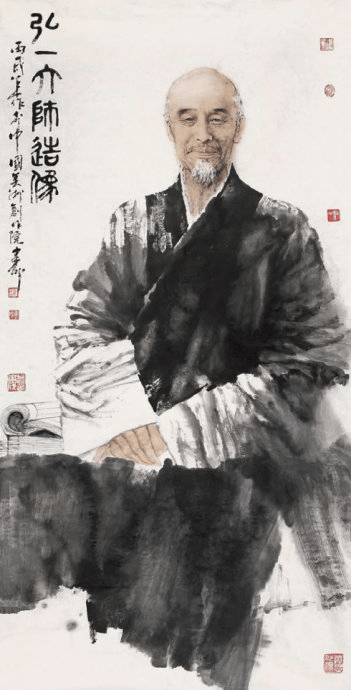
Master Hongyi (弘一大师, October 23, 1880 – October 13, 1942) was originally named Li Shutong (李叔同) and was born into a prosperous family in the bustling northern city of Tianjin on October 23, 1880. The family, originally hailing from Hongdong County, Shanxi, had relocated to Tianjin during the Ming Dynasty.
Li Shutong’s grandfather, a prosperous banker and salt merchant, and his father, Li Shizhen (李世珍), a scholar deeply immersed in Chan Buddhism and the teachings of Ming Neo-Confucian philosopher Wang Yangming (1472-1529), reflected the family’s intellectual and financial standing.
In contrast, Li Shutong’s mother had a modest upbringing as the daughter of a farmer in Pinghu, Zhejiang Province. She became Li Shizhen’s fourth wife in their multi-courtyard household, marrying him at the age of 20 when he was 68.
Tragically, Master Hongyi’s father passed away when he was just four years old. Subsequently, his mother faced challenges in maintaining her position within the complex dynamics of the household while residing under her eldest son’s roof. Fortunately, Li Shutong found support from two of his elder half-brothers during his early years, allowing him to access a quality education and a firm foundation in the Confucian classics.
The young Li Shutong mastered the art of calligraphy and after his ordination as Master Hongyi, he continued to engage in this artistic tradition. This calligraphy, produced during the period of his life when he was known as Master Hongyi, reads from right to left “Zijing Qixin” (自净其意). It means “to cleanse one’s mind” and is an extract from a famous verse
Influenced by his formative experiences, Li Shutong eloquently expressed a profound perspective on life through poetry at the tender age of 15, capturing the fleeting nature of wealth and honor: “Life is truly like the setting sun on the western hills; wealth and nobility are as transient as frost on the grass.” His personal life, marked by an unconventional marriage, served as a poignant reflection of the internal conflict between societal expectations and his genuine affections.
Li Shutong’s participation in the Hundred Days’ Reform and subsequent rumors prompted his relocation to Shanghai, where he thrived in the dynamic literary scene. Becoming a prominent figure in Shanghai’s cosmopolitan lifestyle, he joined the Chengnan Wenshe and co-founded the “Five Friends of Tianya.”
His impact extended beyond literature. Collaborating with the painter Ren Bonian, he established the Shanghai Calligraphy and Painting Association, marking a pivotal moment in Chinese art history. Li Shutong’s engagement in Liyuan activities showcased his versatility as a performer in plays such as “Bai Shuitan” and “Huang Tianba.”
Li Shutong’s literary repertoire included numerous poems and songs, among them the renowned poem “Farewell” (《送别》, Song Bie), which later inspired the widely sung “The Farewell Song” (《送别歌》, Song Bie Ge).
The Farewell Song
Outside the long pavilion, along the ancient route, fragrant green grass joins the sky, The evening wind caressing willow trees, the sound of the flute piercing the heart, sunset over mountains beyond mountains.
At the brink of the sky, at the corners of the earth, my familiar friends wander in loneliness and far from home, One more ladle of wine to conclude the little happiness that remains; don’t have any sad dreams tonight.
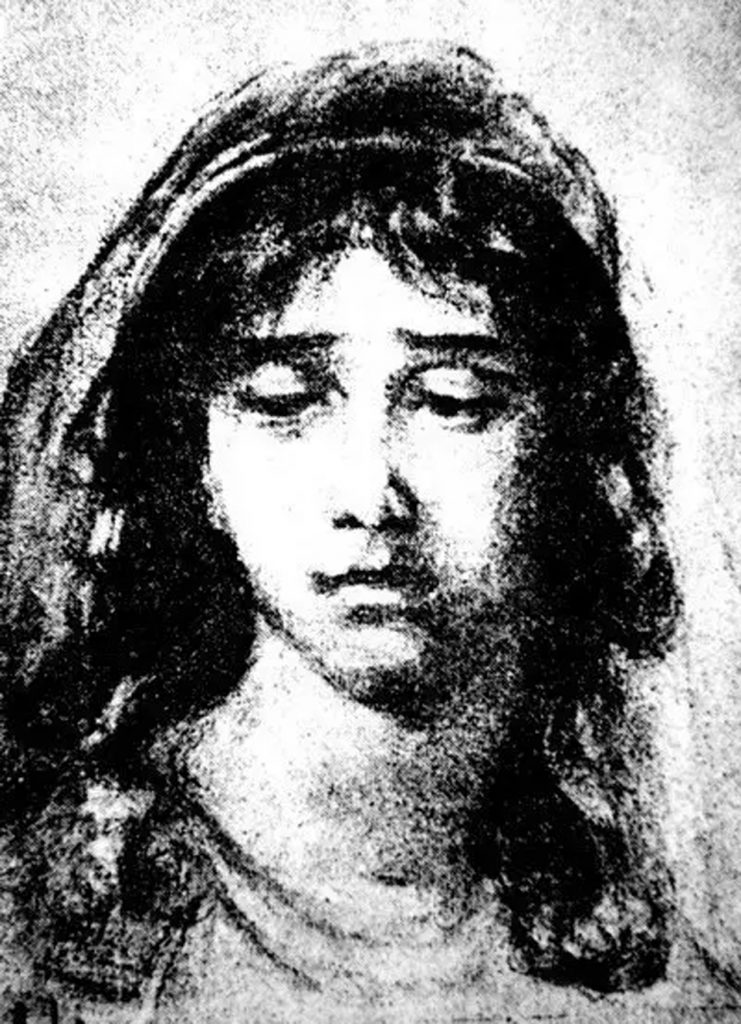
Li Shutong’s charcoal drawing titled ‘Maiden’
“A Half-naked Woman” by Li Shutong, collected by CAFA Art Museum, China
However, Li Shutong’s life underwent a profound transformation. Confronted with personal and financial challenges, he voluntarily entered a self-imposed exile in Japan. The success of the Xinhai Revolution in 1911 further complicated his circumstances, resulting in financial ruin. Undeterred by these setbacks, Li Shutong maintained composure and supported his family by teaching in Tianjin and Shanghai.
His teaching career, notably at Zhejiang First Teachers’ College, left an indelible mark. Li Shutong played a pivotal role in introducing Western painting to China, earning him the title of the forefather of Chinese oil painting. As the first Chinese art educator to incorporate nude models in his painting classes and introduce Western music to China, his influence was far-reaching. Some of his personally groomed students, including contemporary Chinese artist, educator, and musician Feng Zikai (丰子恺), and Singaporean artist Chen Wenxi (陳文希), went on to become accomplished artists in their own right. His impact on students, such as the renowned painters Pan Tianshou and Shen Benqian, underscored his lasting influence.
During this period, Li Shutong delved deeper into Buddhism. In 1916, he embarked on a 21-day fast at a temple in Hangzhou to experience aspects of the spiritual path. This experience prompted his decision to embrace the ordained life, leading to his monastic vows at Hupao Temple. His disciplined lifestyle, which included fasting therapy for deeper insights, marked a significant spiritual transformation.
Li Shutong’s transition from a worldly existence to a monk, detailed in a letter to his second wife, Yu, reflected his detachment from transient fame and wealth. His decision to leave behind a worldly life for monastic vows occurred only a month after joining the Order. He was known by the monastic names Yanyin (演音) and Hongyi (弘一) after undergoing full ordination rites at Lingyinsi, the largest monastery in Hangzhou.
His departure, though painful for those close to him, exemplified Master Hongyi’s profound understanding of Buddhism. In a conversation with his second wife, he elucidated the nature of love, defining it as compassion, aligned with Buddhist teachings that emphasize letting go of attachment and cultivating compassion.
Master Hongyi’s transformation from the proud and arrogant Li Shutong to a humble and receptive teacher was evident in his approach to teaching Dharma. Contrary to expectations of flawless mastery, Master Hongyi sought feedback from student monks and welcomed constructive criticism without defending himself.
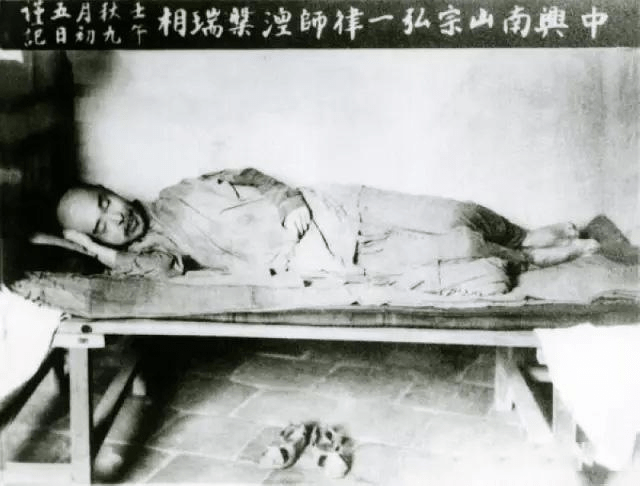
By early 1942, the toll of austerities and fasts began affecting Master Hongyi’s health, and by mid-May, his condition deteriorated rapidly.
The paranirvana of Master Hongyi
Three days before his passing at Busi Temple in Quanzhou, Fujian Province, on October 13, 1942, Master Hongyi inscribed his final calligraphic strokes, creating the work known as “Sorrow and Joy Comingle,” “Worldly Sorrows and Joy Are Intertwined,” or “Sorrow or Joy Are Inextricably Bound to Each Other” (《悲欣交集》, Beixin jiaoji).
Master Hongyi’s philosophical framework posited three distinct stages in human life: material, intellectual, and spiritual. The material phase pertains to mundane existence, the intellectual phase characterizes the life of ordinary intellectuals, while the spiritual phase encompasses the religious realm.
Material, intellectual, spiritual; beauty, profundity, deity. These concepts are intricately tied to the principles of abstinence, composure, and wisdom in Buddhism.
Abstinence, in this context, denotes the renunciation of materialistic pursuits. Composure signifies the practice of deep meditation—tranquil and remote—a path that ultimately leads to the attainment of wisdom. The imagery of Venerable Hongyi experiencing both sorrow and joy (欣) symbolizes the dynamic interplay between these various dimensions of life.
Li Shutong: From Prodigy to Monk – A Journey Beyond Wealth and Artistry