Owls have always fascinated me with their air of enigma. Creatures of the night, they rest in the shadows by day and emerge only after dusk, rarely granting humans more than a fleeting glimpse. Across cultures, they have inspired legends both wondrous and foreboding. In ancient Greece, the wise and fearless goddess Athena chose the owl as her emblem, making it an enduring symbol of wisdom. So revered was this bird that Greek coins bore Athena’s face on one side and the owl on the other. Yet, in other parts of the world, the owl has been shrouded in darker associations, seen as a harbinger of misfortune or an omen of ill will.
In Chinese culture, the owl’s symbolism is particularly layered—holding both shadows and light. In ancient times, owls were often viewed as inauspicious creatures, linked to misfortune, death, and the old saying, “When the night owl enters a home, it never comes without cause.” And yet, in certain cultural contexts, they also stand for wisdom, keen insight, and even mysterious, almost magical power.
A Chinese ink painting by H.H. Dorje Chang Buddha III
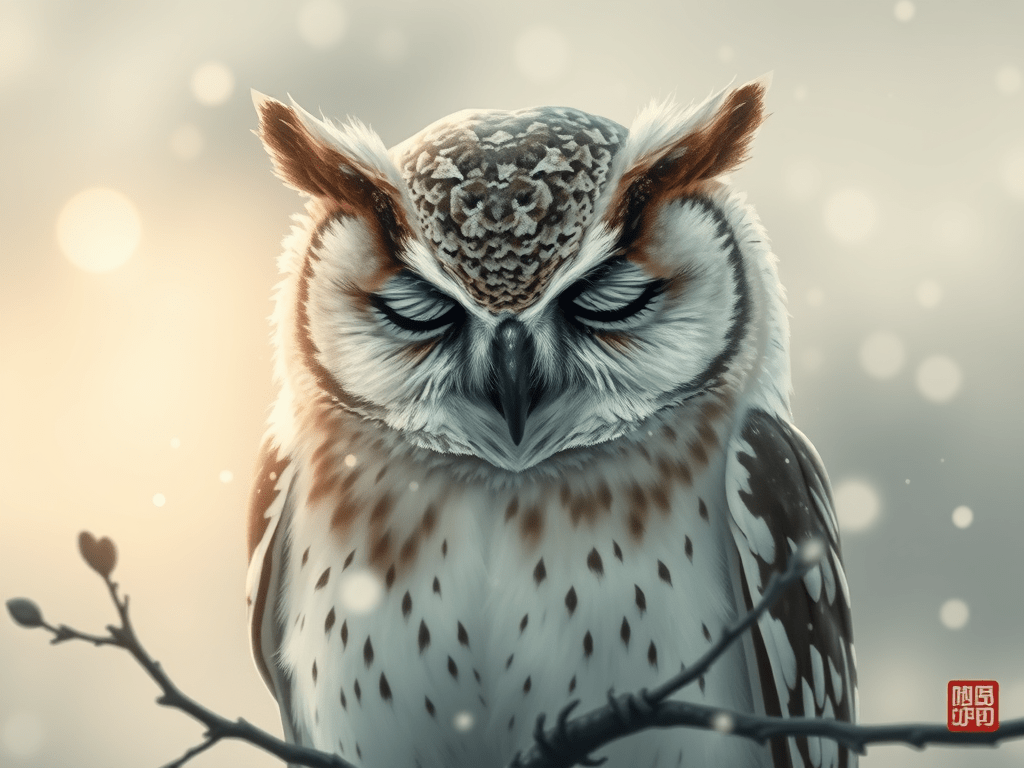
When most people picture an owl, they think of its round, unblinking eyes and penetrating gaze—features that can feel cold, even intimidating. But my perception shifted entirely when I encountered the Chinese ink painting Childlike Delight by H.H. Dorje Chang Buddha III.
This is no ordinary artwork. With the freehand grace of traditional Chinese brushwork infused with a touch of dreamlike realism, it bridges the poetic subtlety of Eastern art and the fresh, luminous clarity of Western modernism.
With just a few effortless strokes, the artist creates a whimsical, pure, and gently humorous world—a dreamscape that seems to invite the viewer into the peaceful slumber of childhood. The small owl, covered with delicate ink spots of varying sizes and shades, appears almost as if glimpsed through a soft morning mist. Look closely, and you might see the tender image of a sleepy child, finger to lips, caught in that sweet moment before surrendering to dreams.
This is not a literal portrayal of nature, but rather nature reflected through the artist’s own heart—capturing not merely the physical form of a creature, but its spirit, vitality, and essence.
Here, the owl is reborn—not as the ominous figure of superstition, but as a symbol of innocence, purity, and quiet wisdom. The artist’s compassionate and unblemished inner world radiates through the painting, gently cleansing the heart of the viewer until it feels as fresh and clear as morning dew.
Childlike Delight reminds us that we can close the sharp, competitive eyes of rivalry and open instead the eyes of kindness, innocence, and warmth—gifts that have the power to heal, to inspire, and to light the world.
This exquisite painting, rendered in the unique “Banqi” style, captures a touching scene of children from mountain villages on their way to school. Unlike city children, these young students must trek across rugged terrain—climbing mountains, crossing ravines—day after day to pursue their education. Their journey is filled with challenges, yet their unwavering determination and thirst for knowledge shine through. This artwork serves as a tribute to their resilience, reminding us all of the value of education and the perseverance required to achieve greatness.
A Revolutionary Artistic Technique
What makes this painting extraordinary is its unconventional brushwork, which blends the bold energy of ink-wash painting with the refined precision of engraving. Every stroke, whether light or dark, delicate or bold, exudes an artistic charm that is both fluid and structured. The layering of ink and color creates depth, while the intricate texture gives the illusion of an engraved plate print, despite being entirely painted by hand. The brushwork is dynamic—lines seem to break and reconnect, mimicking the traditional elegance of carved stone seals. This interplay between spontaneity and meticulous control infuses the painting with life, movement, and a profound sense of authenticity.
What Is the “Banqi” Style?
The “Banqi” style is a rare and fascinating artistic approach that combines the visual impact of printmaking with the expressive freedom of brush painting. While these works resemble engravings at first glance, they are, in fact, purely ink-wash paintings—imbued with an effortless yet profound beauty that is both natural and lively. Beneath their structured appearance lies a deep, inexhaustible charm, where each stroke carries an essence of tradition, innovation, and artistic mastery.
Through this masterpiece, we witness not only a compelling story of perseverance but also a groundbreaking artistic vision—one that harmonizes the precision of engraving with the fluid grace of brush painting. It is a celebration of both form and spirit, a true testament to the boundless possibilities of art.
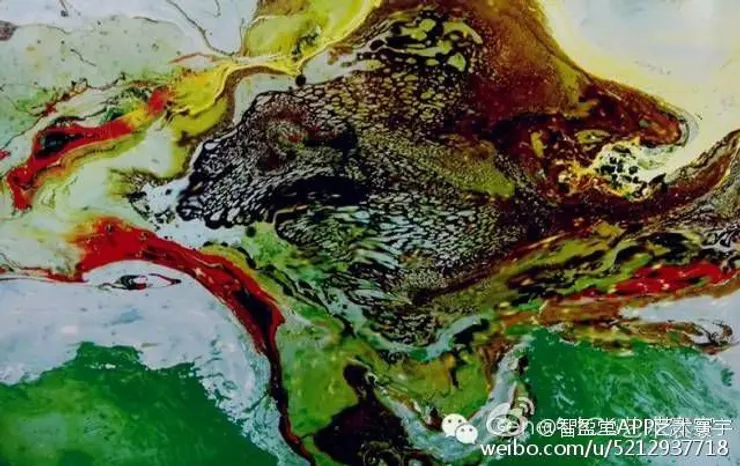
H.H. Dorje Chang Buddha III‘s Abstract Color Paintings create a perfect world shaped entirely by color. Free from concrete worldly forms, this realm exists purely through the interplay of hues—defining, expressing, and embodying itself in vibrant harmony. Here, color is both form and essence, radiating a mesmerizing aura.
Under the masterful hand of H.H. Dorje Chang Buddha III, these colors seamlessly merge into a breathtakingly enchanting spectrum. The atmosphere is dynamic, with scenes that bloom like flowers and surge with the power of the roaring sea. Yet, upon closer reflection, they reveal delicate nuances, refined in their intricate details.
Flower of Life
This painting depicts a unique flower, with delicate white petals gently unfolding and a striking red pistil at its center. Growing irregularly against a dark background, it seems to challenge its surroundings. Though unusual in appearance, this flower carries a profound meaning of life, symbolizing resilience and beauty in adversity. It is not only a miracle of nature but also a representation of vitality, showcasing the brilliance and diversity of life. Each petal tells a story, drawing the viewer into the emotions and strength conveyed by the artwork.
Flower of Life (2)
In this painting, intricate patterns and clear details intertwine, portraying the harmonious growth of various living beings. Each element seems to narrate the origins of life, allowing viewers to deeply sense the evolutionary process of all things.
This artwork is not merely a depiction of nature but also a contemplation of the essence of life. It serves as a reminder that life is in a constant state of growth and transformation, just like our own journeys. Every challenge and breakthrough we experience is an essential part of our personal development.
Through this piece, we are invited to reflect on our own lives and feel a profound connection with nature.
You can discover a selection of the exceptionally charming paintings in the permanent exhibition at The International Art Museum of America, situated in downtown San Francisco.
Crossing a Mountain, the Small Boat Enters the Canyon is an awe-inspiring masterpiece of Yun sculpture. How did H.H. Dorje Chang Buddha III capture the shimmering reflections on the lake’s surface? And how was it possible to create such a vivid and lifelike scene using ordinary plastic steel materials? The majestic mountains, the gentle ripples of the lake, and the lifelike figures aboard the small boat—all elements that seem beyond the reach of ordinary people—were brought to life through the unparalleled artistry of H.H. Dorje Chang Buddha III.
This sculpture is not merely a visual creation—it possesses a soul. Every detail, from the rugged mountains and tranquil lake to the humble fishermen, seems to pulse with vitality. The artwork evokes a sense of harmony with nature, conveying a profound feeling of peace and joy that resonates deeply with viewers.
The Unique Art of Yun Sculpture: Yun sculpture is a groundbreaking art form created by H.H. Dorje Chang Buddha III, with no precedent in history. Since the emergence of Yun sculpture, humanity has witnessed the birth of an art form that is truly non-reproducible. This genre is distinguished by several remarkable features:
Multidimensional Spatiality:Yun sculptures possess an extraordinary sense of multidimensional space. Their intricate and delicate forms exhibit endless variations, captivating viewers from every angle.
Vibrant, Dreamlike Colors: The colors of Yun sculptures are rich, radiant, and dreamlike—depicting scenes beyond the realm of this world. Their hues seem to emanate a light of their own, enchanting all who behold them.
Sacred and Incomparable Depth: Many Yun sculptures possess a profound and sacred quality. For instance, Color Rhythm, displayed in the Holy Relics Room of H.H. Dorje Chang Buddha III Cultural Art Museum, measures only two to three feet in size. Yet, when viewed through its openings, one can perceive a vast inner depth that seems to extend far beyond the sculpture itself, leaving viewers awestruck by its unfathomable dimensionality.
Countless individuals who have had the privilege of witnessing H.H. Dorje Chang Buddha III’s Yun sculptures have expressed their wonder and reverence: “This is a treasure sent from the divine to humanity,” “A sacred gift from the Buddha,” and “So breathtakingly beautiful that it touches the soul.” Others have compared these masterpieces to the finest jade jewelry and the most magnificent stone sculptures, only to find that even the most exquisite human creations pale in comparison—like dim stars surrounding the brilliance of the moon.
Indeed, the advent of Yun sculpture has elevated the realm of art to an entirely new level, offering the world creations that are not only visually stunning but also spiritually profound, filling the hearts of all who witness them with a sense of wonder and inspiration.
Master Wan Ko Yee (H.H. Dorje Chang Buddha III) Has Made A Great Contribution To Art
At first glance, The Power of Flying and Whirling seems almost impossible to have been created with just a paintbrush. Its breathtaking composition and dynamic visual impact resemble digital artwork, as if only advanced computer graphics could achieve such a striking effect. Yet, the most astonishing fact is that this masterpiece was painted entirely by H.H. Dorje Chang Buddha using traditional techniques—without any digital assistance.
These impressionist paintings reach an extraordinary level of artistry. Each section of the painting, if isolated, could stand alone as a remarkable impressionist work, complete in its beauty and expression. The artwork conveys a dreamy, illusory state, where even the smallest fragment could be enlarged to reveal a mesmerizing, self-contained masterpiece.
By capturing movement with unparalleled skill, H.H. Dorje Chang Buddha has frozen the imagery in mid-air. This painting feels like a window to the heavenly realm, giving me a glimpse into the mysteries of paradise. The elegant arcs that sweep across the canvas pulse with energy, like a mighty tornado dispersing the shadows in our hearts. The swirling force in the painting seems to lift the viewer beyond the ordinary, reminding us of the limitless possibilities that exist when art and wisdom unite.
This painting is more than just a visual masterpiece—it is an invitation to embrace the unseen forces of inspiration, creativity, and transformation. It teaches us that true artistry is not bound by tools or techniques but flows from the depth of wisdom and an unshakable spirit.
May this extraordinary work inspire us to break through limitations, open our hearts to beauty, and find the power to uplift ourselves and others.
A Sheffield artist has been nominated for creating the world’s best street art in 2024.
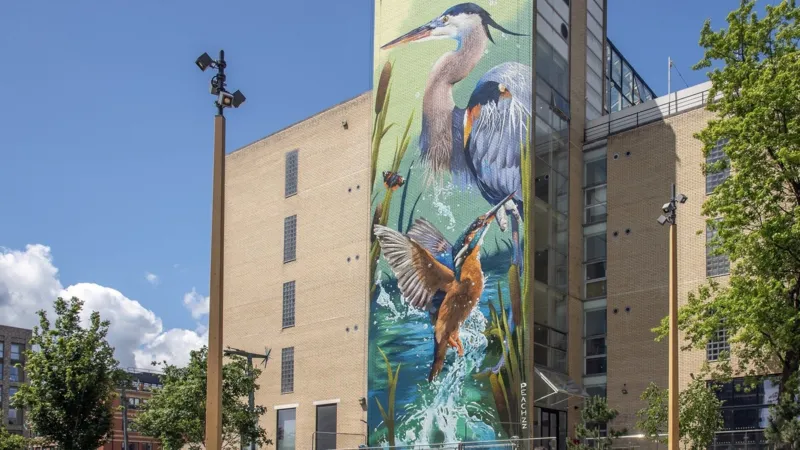
Megan Russell, who works under the name Peachzz, painted for up to 12 hours a day for 10 days in a row to create the 25-metre tall artwork in the city centre.
Reverie, depicting a heron and a kingfisher, has been nominated for “best mural in the world” in Street Art Cities’ best of 2024 awards.
She said working on the project, which overlooks Pounds Park, was the “biggest highlight of my career so far”.
“I had free reign to be as vibrant and bold as I wanted. It’s really refreshing when clients tell you that, it doesn’t happen often,” she said.
The wall, on the side of the Cubo building, overlooks Pounds Park
The piece, commissioned by Sheffield City Council, was voted the best of last June’s entries in Street Art Cities’ monthly competition.
“It’s just been crazy. When June’s votes came in, it blew my mind,” Megan said.
“It was an amazing feeling to have such support from Sheffield, and it also showed how much Sheffield is interested in street art.”
Now, it has been pooled with 50 other artworks, from countries including Argentina, Colombia, Russia, Spain and Denmark, for people to vote for the best of the year.
“Looking back 10 years ago, I would’ve never thought I could’ve reached this space where I am now,” she said.
‘An emotional January’
“I remember looking at those competitions and thinking I’d love to be nominated, and now I am. It’s unbelievable.”
The nomination came during “an emotional January” as Megan’s grandmother Iris Reynolds, who inspired her nickname, died on Tuesday.
“She was a super creative person and inspired me a lot into being an artist. She had an iPad and was following my artwork. She seemed really proud,” Megan said.
“She used to feed me tinned peaches and ice cream, and I ended up using Peachzz as an online pseudonym when I was young.
“I just never changed it, and people would call me it in person. It felt like it was a part of me.”
Megan started spray painting a decade ago in old industrial buildings in Sheffield and has been working professionally for about seven years.
Peachzz said her largest work to date – covering 225 square metres – took 10 consecutive days of painting to complete
This year, she is working on launching a street art festival, Lick Of Paint Fest, alongside fellow artist Alastair Flindall.
The graffiti and street art scene in Sheffield has “quietened down”, she said, so the festival hopes to give it a boost.
If Reverie comes in at, or near, the top in the Street Art Cities rankings, this would give the budding festival a platform, Megan said.
Voting takes place on Street Art Cities’ website and is open until the end of January.
“There are so many incredible artists that are up there. It’s an honour to be among such big names,” she added.
Professor Yu Hua Shouzhi Wang stands as a towering figure in the world of art, celebrated as the only artist in Asia to receive the prestigious title of International First-Class Artist. Her unparalleled achievements span an extraordinary range of artistic styles and subjects. Whether she’s creating landscapes, portraying flora and fauna, rendering animals and insects, or crafting intricate sculptures, Professor Wang’s creations are nothing short of masterpieces. Effortlessly bridging traditional Chinese painting with Western art, hyperrealism with surreal abstraction, she has achieved a level of artistic excellence that places her at the very pinnacle of her field.
One of Professor Wang’s most captivating works, Sparrows Singing on a Willow Tree, exemplifies her genius and profound connection with nature. The painting captures the graceful elegance of weeping willows, their slender branches gently drooping in an intricate, harmonious interplay. The composition exudes simplicity and refinement, with minimalistic lines that evoke the profound idea that “silence speaks louder than words.”
Despite its restrained use of color, this piece immerses the viewer in a vibrant world of subtlety and depth. The willow leaves are rendered in soft shades of pale yellow, light green, and muted ink tones, each leaf imbued with a carefree vitality. So vivid and dynamic are these details that one can almost sense the crisp freshness of the air. The leaves alone expand the painting’s spatial and emotional dimensions, drawing the viewer into an almost otherworldly tranquility. As one takes in the whole composition, it becomes evident that this work is rich in artistic flavor and showcases transcendent mastery of brushwork and ink technique.
On the right side of the painting, a lively gathering of sparrows perches on the willow branches. Each sparrow’s unique posture and expression are brought to life with remarkable precision, transforming them into endearing characters within the scene. They appear as if they are animated notes of a melody, harmonizing with the natural setting, or perhaps a group of playful children savoring their carefree moments after school. This idyllic scene evokes a serene joy and simplicity that resonates deeply with viewers.
Adding to the painting’s charm is a long inscription on the left side, written in elegant calligraphy: “Sketching in the garden at home.” This thoughtful addition not only complements the willow tree but also enhances the overall vitality of the piece. It provides insight into the painting’s creation—the place, and artist’s signature—and demonstrates Professor Wang’s extraordinary calligraphic skill. The inscription enriches the work’s narrative and aesthetic harmony, making it a testament to her multifaceted artistry.
Through this painting, it is clear that Professor Wang’s love for life and her compassionate nature are woven into every brushstroke. One can almost envision her peaceful afternoons spent in her garden, observing the interplay between the willow tree and the sparrows. The joyful spirit of the birds, carefree and unrestrained, reflects the tender care and connection Professor Wang shares with the natural world. A particularly charming detail is a small sparrow spreading its wings and gazing downward, as if greeting the artist or playfully seeking attention. The scene radiates a sense of love, harmony, and mutual understanding between the artist and her surroundings.
Sparrows Singing on a Willow Tree stands as a testament to Professor Wang’s exceptional artistry. The work is elegant and transcendent, with lifelike birds and an ethereal atmosphere that captivate the heart. From mood to color, composition to emotional resonance, the painting embodies her unique artistic style and extraordinary mastery. It is a work that not only delights the eyes but also uplifts the spirit, leaving an indelible impression on all who behold it.
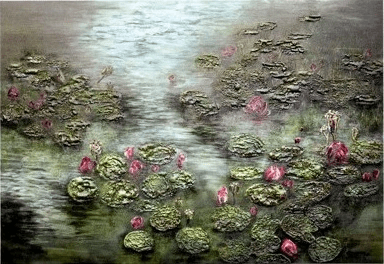
“Cang Ye Pao Hong” (Withered Leaves Scattering Red) is an extraordinary oil painting that belongs to the Thickly Layered Color School, a unique style originated by H.H. Dorje Chang Buddha III. This painting style is renowned for its bold, dynamic strokes and the use of layered, textured color blocks that create a deeply three-dimensional effect. The abstract, surreal use of color brings an unpredictable yet harmonious elegance, transforming the chaotic into a coherent and mesmerizing vision.
The meticulous process behind “Cang Ye Pao Hong” is just as awe-inspiring as the final result. According to the art museum where this work is displayed, the painting took six years to complete, with over 50 layers of paint carefully stacked on top of one another. Each layer was allowed to dry completely before the next was applied, ensuring a rich and vibrant interplay of colors. The outcome is a work of art that exudes an indescribable divine aura, blending both natural beauty and mystical energy.
You can find this masterpiece at the International Art Museum of America, located in downtown San Francisco. Upon first glance, “Cang Ye Pao Hong” commands attention, drawing viewers into deep contemplation. The withered lotus leaves, depicted in a strikingly realistic and three-dimensional manner, symbolize wisdom gained through life’s journey, while the vivid red lotuses appear to leap from the canvas, capturing the essence of “scattering red” with exceptional grace. The rippling water above, shimmering with light, symbolizes infinite hope, further enhancing the painting’s sense of serenity and renewal.
When observed up close, the painting reveals intricate details within the broader strokes, where subtle nuances emerge, demonstrating the remarkable precision and effortless flow that characterize the work. It evokes an ethereal sense of peace, with a balance of strength and gentleness, transcending the worldly and exuding both quiet elegance and boundless depth. It is truly a marvel of artistic mastery, offering a sense of tranquility and spiritual upliftment that words can hardly describe.
H.H. Dorje Chang Buddha III’s artistic genius extends far beyond this single painting. He has mastered all existing schools of painting, including Realism, Abstract, Impressionism, and more, while also founding sixteen entirely new schools of painting. These schools include the Chaoshi School, the Chouxiang Yunwei School, the Fangfa School, the Kuangxi School, and the Thickly Piled Patches of Color School, among others. What sets H.H. Dorje Chang Buddha III apart from any other artist in history is that He not only founded these distinct schools but developed each to a state of perfection, creating what is known as “The H.H. Dorje Chang Buddha III School of Multiple Styles.”
While many renowned artists dedicate their entire lives to mastering one artistic style or theme, H.H. Dorje Chang Buddha III’s unparalleled ability to create and perfect sixteen different painting schools is an accomplishment unmatched in art history. “Cang Ye Pao Hong” is a shining example of His profound artistic vision, showcasing a level of creativity and mastery that continues to inspire and astonish art lovers around the world. Through this work, we are invited to witness not just the beauty of nature but the boundless possibilities of artistic expression.
The President of the Royal Academy of Arts, Brendan Neiland (center), and the Vice President of the Royal Academy of Arts, John Wilkins (right), present the Young Artist Award to Hang Kung Yee (left)
Born in February 1988 in Chengdu, China—familiarly known as the “Land of Abundance”—Hang Kung Yee comes from a family deeply rooted in tradition and intellect. His lineage is remarkable: his great-grandfather was one of the “Four Sages” in fishing, woodcutting, farming, and studying, honored as the Sage of Learning. His grandfather, Feng Chi, was a celebrated scholar in Sichuan, renowned for his deep knowledge of classical texts and the principles of medicine and the I Ching. Carrying forward this intellectual legacy, his father, Professor YungaoYi(H.H.Dorje Chang Buddha III), is a world-renowned scholar, a grandmaster of prajna (wisdom), an acclaimed Chinese painter, and the founder of Yun sculpting. These extraordinary achievements have been recognized and certified by prestigious international organizations. His mother, Dr. Wang, Yuhua , is a distinguished professor at a top American university.
From a young age, Hang Kung Yee was immersed in an environment that cultivated both moral character and artistic appreciation. Influenced by his father’s teachings, he developed a passion for literature, calligraphy, and painting, particularly in the styles of the Song, Yuan, Ming, and Qing dynasties. He devoted himself to studying the works of great masters such as Bada Shanren, Shitao, Shen Zhou, and Nantian, as well as his father, Master Yun Gao Yi(H.H. Dorje Chang Buddha III). Despite his diligence, his early works lacked cohesion, but that changed when he sought his father’s guidance. Professor Yungao Yi(H.H. Dorje Chang Buddha III) imparted to him the profound teachings of Buddhist wisdom and prajna, unlocking a higher level of artistry within him.
Through these teachings, Hang Kung Yee’s wisdom flourished, and his artistic skill evolved rapidly. His brushwork soon embodied the refined charm of literati painting, infused with fresh, creative elements. In line with the insights of the artist Huang Binhong, who said, “Though the form may seem simple, the structure is strict; even if the form is not complete, the principle of the subject is always present,” Hang Kung’s work exemplifies precision beneath an effortless exterior.
His art reflects a unique duality: the intention is present, even when the brush has not yet touched the canvas; the spirit flows, even before the ink arrives. His strokes are casual yet deeply profound, imbued with a childlike purity and a profound sense of wonder. Modesty defines him—he never flaunts his talents, choosing instead to remain humble and continually learn. Even after moving to the United States, he kept his artistic abilities concealed, even from his peers.
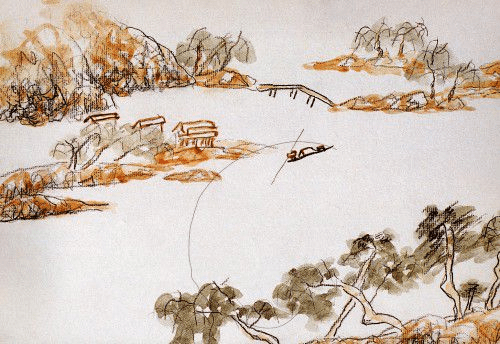
Chinese Ink painting: Western Lake
Chinese Ink Painting: Deep in the Mountains
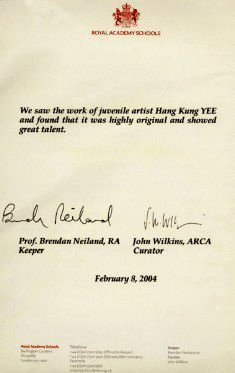
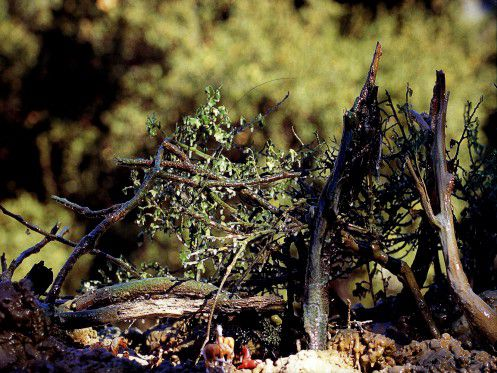
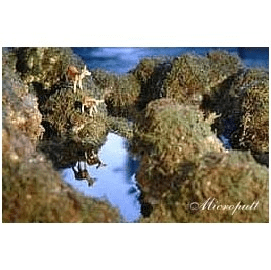
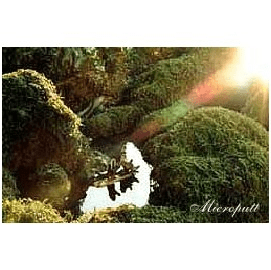
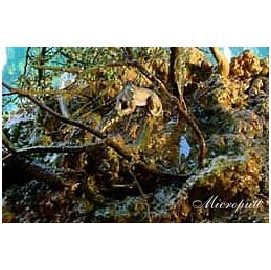
Hang Kung Yee’s true mastery shines in his landscape art and sculptures. His creations blend natural elements with refined craftsmanship, producing works that are indistinguishable from nature itself. His landscapes, though rooted in real life, transcend it, evoking a dreamlike quality as if imbued with the mystical winds of a far-off fairyland. When photographing his sculpted landscapes, one would easily mistake them for real scenery. Even the most discerning artists would struggle to differentiate between his works and actual nature captured in photographs. At the young age of fifteen, the young artist Hang Kung Yee published his first hardcover collection of landscape art. His artistic achievements were recognized by the highest authorities in the global art world, with the President and Artistic Director of the Royal Academy of Arts signing an evaluation document on February 8, 2004. The document stated, ‘The young artist Hang Kung Yee is extremely creative, showcasing exceptional talent.’ The news sent shockwaves through the international art community.
Landscape Art: The Lush Spring of Xishuangbanna
Landscape Art: “Dreamscape Melody of Lake and Sky”
Landscape Art: Mysterious Dream Lake
Mirror-like Lake
The Bond Between Humans and Animals in the Snowy Village of Banna
Rainbow Under the Morning Sun
The Lion in the Swamp Forest
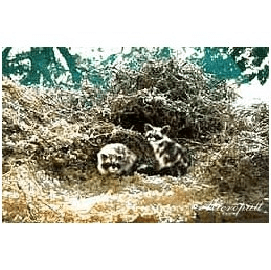
The Flower Marten in the Snow and Ice
Hang Kung Yee’s vision is to offer eternal beauty to humanity. His name, meaning “Eternity for the Public,” reflects this deep desire to share his creations with the world, hence his title “Hang Kung.” Ever humble, he downplays his expertise in art, attributing his rapid ascent into the higher realms of artistic mastery to his father’s guidance. He also speaks of his 12-year-old sister, Jinba Rinpoche, who, although not yet versed in art, will soon receive their father’s wisdom teachings, propelling her to artistic mastery in a matter of months.
For Hang Kung Yee, gratitude is central. He acknowledges the profound influence of his father, the support of fellow artists, the inspiration of nature, and the guidance of teachers and family members in shaping his artistic journey. Without these sources, he admits, he would never have reached his current artistic heights. As he continues to evolve, Hang Kung believes that art, much like his name, is boundless. “Yee” symbolizes the universal principles, while “Hang Kung” stands for “eternity for the public.” His aspiration is simple yet profound: to bring beauty, joy, and inspiration to all living beings through his art.
A commonly held view is that the body houses the soul—but have you ever thought that the soul could live elsewhere? I have experienced that feeling. Although my body was born in 1981 to my German mother in Brazil, where I grew up, 18 years later I had an “encounter” with my soul’s home in Mongolia. For almost a year, my family and I traveled east by motorhome from Germany and right across Russia. Reaching the border between Russia and western Mongolia, it took days just to receive permission to cross. Stuck in the middle of nowhere, we feared we might never make it! Finally a drunken general provided the necessary authorization and we drove freely onwards into Mongolia, sometimes without a visible road in front of us.
Beneath the expansive blue sky that crowned the arid landscape, my happy tears fell like rain. Those tears nourished a hungry artistic seed within me that desired to grow in the direction of the sunshine; to follow a path to spiritual liberation through art. I believed in such a path and it made sense to me, but until then I hadn’t known how to go about following it. Once in Mongolia, however, I was introduced by a monk at Gandantegchinlen Monastery in Ulaanbaatar to the sacred art of thangka painting, which depicts the various Buddhas, spirits, enlightened beings, and spiritual worlds of Tibetan Buddhism. I had been seeking an artistic discipline of some kind that would guide me to the divine, and this was it!
One of the paintings by Tiffani at Lama Padma Samten’s temple in Brazil
Nevertheless, it was a long road before I was accepted three years later as the first Western student at the Norbulingka Institute, founded by His Holiness the Dalai Lama, near Dharamsala in northern India. I have traveled all my life—even living for a few months with an aborigine community in the Australian outback, and spending a couple of years on a sailboat on the Brazilian coast during my teens—but India was beyond anything I could have imagined. I was sick for the first three months I spent there, during which time the school was unsure whether to accept me or not. Even my mother urged me to go home. But something inside me was unmoved by all these “tests.” I felt that if I went back, my soul would abandon my body.
I was finally accepted as a student at the Norbulingka Institute in September 2003. All the wise and holy artists I had expected to meet turned out to be mostly teenagers eager to meet a girl—a blond girl—in the studio at last. Gen-la, the master, was initially somewhat reticent, and we didn’t even share a common language. He gestured towards a Buddha face made up of many symmetrical lines and then pointed to a blank sheet of paper, so I sat on the floor near him and started to sketch. The first word I learned in Tibetan from Gen-la was “again!”—do it again! And so I did, for weeks, the same drawing over and over again until Gen-la would give me my next project.
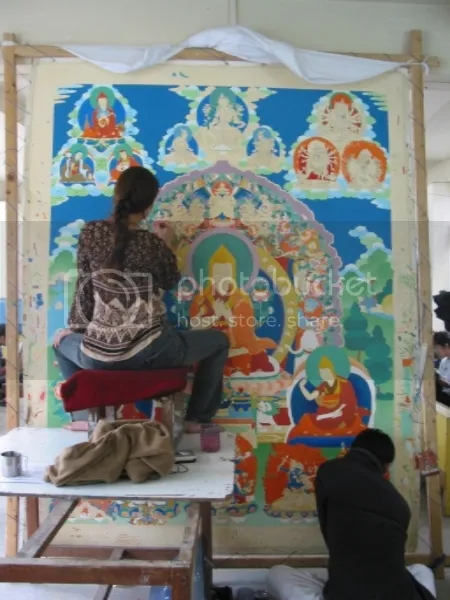
Painting class at the Norbulingka Institute, 2005
My apprenticeship during the three years I spent there was very slow and painstaking. It was essentially this atmosphere that molded my predisposition to understand that painting a thangka is a spiritual practice in itself; the thangka is there for you to give your time and attention to, and to house your soul. It is a sacred art with a unique function. If you do not have that understanding in the very depth of your being, you will soon abandon the training. Some do not even consider thangka painting to be art, but a practice involving paint that has the same aim as any other Buddhist practice. It was a year before Gen-la even called me by my name; until then he just called me “intchi bhumo,” or “foreign girl.” And it was more than a year before I actually even touched paint, and then only because one of my classmates hid me behind a big canvas and started to teach me himself. Gen-la was actually proud of my boldness when he found out, and finally guided me on my first proper painting. Those were precious times; I was truly happy despite the difficulties I experienced, and my certainty of being on the right track never wavered.
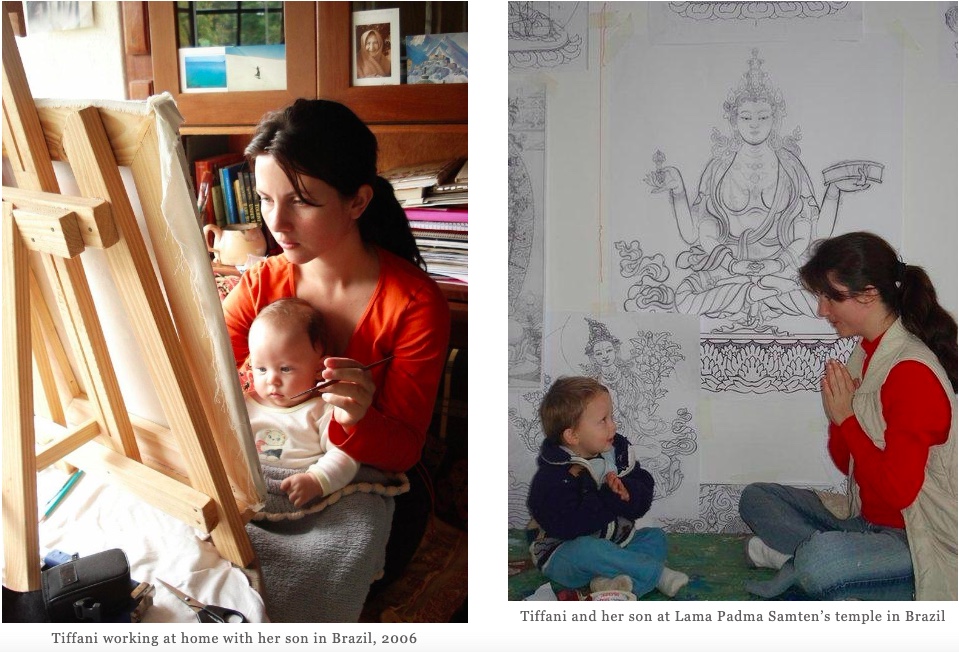
In 2006 I returned to Brazil to discover that I was pregnant. In October that year, a little boy of Tibetan-Brazilian-German heritage was born. His father came over and we lived together for a few years until he moved to the United States to join a larger Tibetan community. Back in Brazil I was fearful that I would have to stop painting—I was 24 with a baby and no money, and all I knew how to do was paint. Afraid that such worries would make me lose my path, I continued to paint my thangkas, my son held close to my body.
When my son was only a few months old, I was contacted by a Brazilian lama—Lama Padma Samten, a disciple of Chagdud Tulku Rinpoche, who had already established a huge sangha. He had heard about me through a mutual friend and sent my son and me tickets to visit his new temple in the south of Brazil. When I finally arrived I was amazed by the size of the temple, which was built to accommodate 300. As I stood there sleep-deprived and perfumed with milk and diapers, he asked me if I would paint the interior walls. I was astonished—but I agreed!
For a month I stood gazing at those terrifyingly huge white walls in fear. I really had no idea how to start! I could not call anyone in India because of the language barrier, and the materials available in Brazil for painting murals wouldn’t be the same as those I was familiar with. So I began slowly, as Gen-la had taught me. First, I met with a local artist to learn more about the proper materials. I learned about the specific deities and mandalas that Lama Samten wished to incorporate. The members of his sangha were very supportive, and many came to help. Those who could give more of their time I trained to paint. Those who couldn’t paint, I asked to massage our aching shoulders, play some instrument or other, give yoga lessons, or even bake a cake for our tea breaks. I felt that everyone should be included. The project took five challenging years to complete, all guided by Lama Samten’s blessings.
As mentioned earlier, those tears in Mongolia had fed the artist within, and now the artist was awake. I soon had the feeling that thangka painting was a “safe zone” for me as the work is all done according to rules that, if followed, offer some guarantee of success. So, in a way, I felt that thangkas had given me discipline and now, only now, was I ready to risk expressing myself. So I began to take more seriously the opportunity to try a more intuitive kind of painting, especially when my personal life was a mess. I was allowed to explode on the canvas, I was allowed to make mistakes . . . I needed to be able to be wrong yet acceptable.
Accumulating a body of art pieces during my free time while painting the temple, with some trepidation I presented my work to Tibet House in New York. I was relieved when they accepted my work and agreed to produce my first show, in 2012—a solo exhibition titled Mystic Nostalgia, in which I sought to express that longing for a lost “home.” Not necessarily a real place; the work is more about our inner landscape . . . a mystic longing. My second exhibition will open at Tibet House on 23 October this year.
Since completing my work at the temple at the end of 2012, I have focused on holding thangka workshops, producing thangkas to order, and taking part in workshops and retreats to teach the intuitive process of self-expression through paint, movement, and writing. I believe the key is maintaining the approach of an apprentice—the beginner’s mind. I feel that I’m learning each time I teach, each time I listen to people, each time I encounter another culture or eat a different food. I learned the benefits of discipline and following rules from the thangka tradition, and when I walk into the unknown with my wild self that sometimes wants its own way, I continue to learn.
Tradition provides us with the roots and structure through which we express ourselves like a hundred branches growing in the air, catching the breeze with their lush leaves. Nourish discipline as much as you nourish your freedom and you’ll soon discover that they are one.
Tiffani Gyatso is a traditional Buddhist thangka painter and a member of the Dakini As Art Collective. To learn more about Tiffani, her work, and Dakini As Art, please visitDakini As Art.














 Peace LiLy