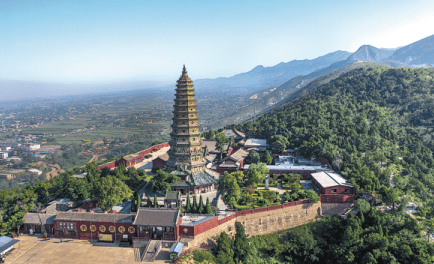
Xiaoxitian, originally known as Qianfo’an (The Hermitage of a Thousand Buddhas), was founded in the second year of the Chongzhen reign of the Ming Dynasty (1629). It stands atop Phoenix Mountain, about one kilometer west of Xixian County in Linfen, Shanxi Province.
Built entirely in harmony with the mountain, the temple unfolds in layers, as if it had grown naturally from the slope itself. Stone steps lead visitors upward, passing through courtyards divided by arched cave-like gateways. The upper, middle, and front courtyards are connected yet distinct, creating a spatial rhythm that is winding, intimate, and quietly profound. As one walks through the complex, footsteps instinctively slow, and time itself seems to soften.
The architecture of Xiaoxitian is restrained rather than ostentatious, yet its mastery reveals itself everywhere. Painted beams are elegant and dignified, and many of the halls are ingeniously built as two-story structures, creating a rich sense of vertical space within the limited mountain terrain. The bell and drum towers stand in stillness, inviting the imagination to wander back to an age when morning bells and evening drums echoed through the valley.
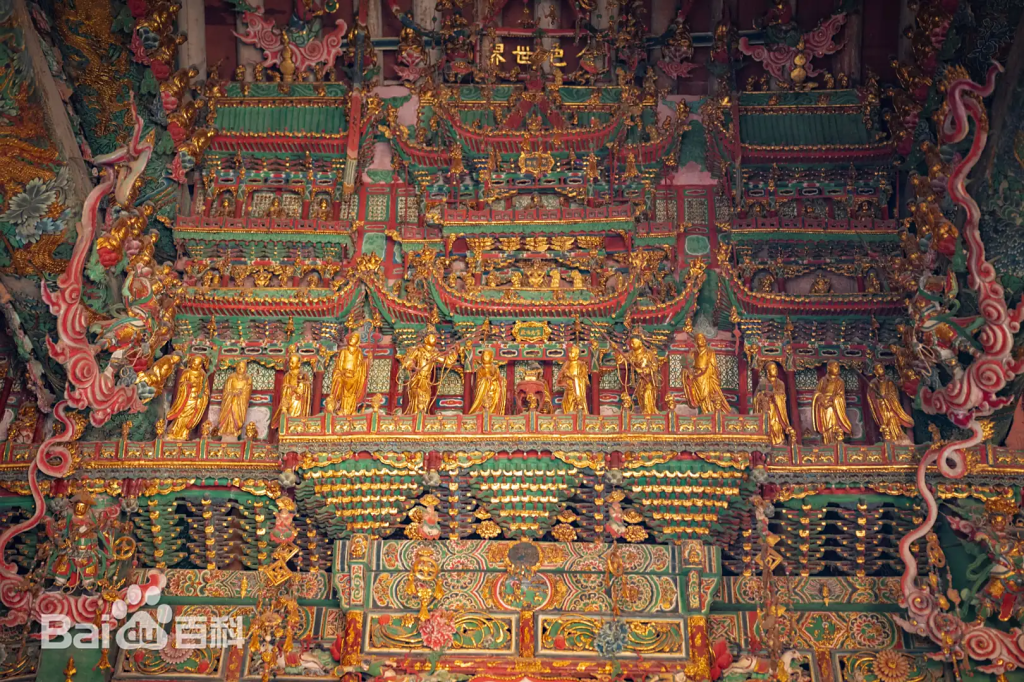
Stepping into the Mahavira Hall is a moment of sudden awe. Nearly the entire interior is filled with suspended polychrome sculptures—more than 1,900 figures, layered from floor to ceiling. From towering Buddhas over three meters high to figures no larger than a thumb, the sculptures are densely arranged yet never chaotic, solemn yet vibrantly alive. In that instant, one understands why Xiaoxitian is revered as the “Museum of Chinese Hanging Sculpture Art.”
Unlike many Buddhist temples that draw attention primarily to their principal Buddhas, the Mahavira Hall at Xiaoxitian is celebrated for the immersive world it creates as a whole. At its core stand the Medicine Buddha, Amitabha, Shakyamuni, Vairocana, and Maitreya, but surrounding them unfolds an entire celestial realm: the Ten Great Disciples, six young novices, the Ten Wisdom Kings, the Six Desire Heavens, and countless heavenly musicians dancing through the air.
Most unforgettable are the celestial musicians suspended within the tiered “sky pavilions” above the altars. Their figures are light and graceful, sleeves flowing as if caught in an eternal breeze, frozen in a moment of unending heavenly music. Some play the pipa, others hold flutes, while some seem to dance midair. One pipa-playing figure, leaning slightly forward with fingers poised on the strings, radiates such focus and elegance that one can almost hear the melody drifting across centuries.
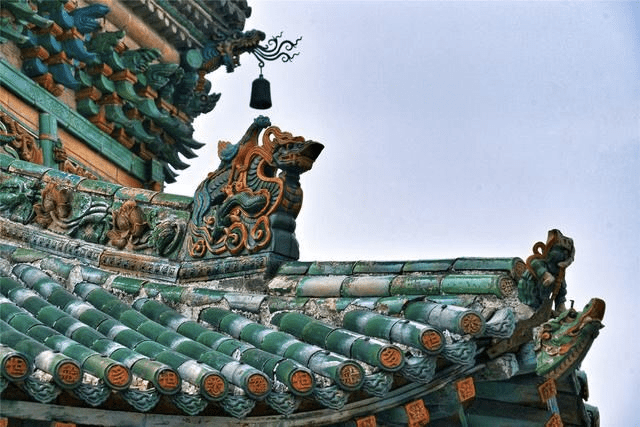
Looking up toward the roof, the tri-colored glazed chiwen ornaments—yellow, green, and blue—gleam softly in the light. Their refined brilliance reflects the unmistakable aesthetic of the Ming Dynasty. Here, architecture, sculpture, and color merge seamlessly, and one forgets that this is a mountain temple at all. It feels instead like stepping into a floating Buddha realm, suspended between earth and sky.
That these sculptures have survived nearly four hundred years in such vivid detail inspires deep reverence. They represent not only the pinnacle of craftsmanship, but also a profound devotion—to faith, to beauty, and to a harmonious vision of the cosmos.
Perhaps what truly moves the heart at Xiaoxitian is not only the astonishing number of its hanging sculptures or the rare Ming Yongle Northern Buddhist Canon once preserved here, but something more enduring: a spiritual presence that has remained vibrant across centuries. It quietly reminds us that beyond the noise of the modern world, there still exists a place of serenity and dignity—carefully upheld by time itself.
As a cradle of Chinese culture, Shanxi is renowned for its abundance of cultural and historical treasures. While some iconic historical relics and monuments like the Great Wall, which stretches across the province, the Yungang Grottoes in Datong, and the Sakyamuni Pagoda in Yingxian, are at the top of tourists’ itineraries, there are also lesser-known “hidden gems” in terms of historical significance that are well worth exploring.
One such hidden gem is the Guangsheng Buddhist Temple, located in the Zhaocheng township of Hongtong county. The Guangsheng Temple is actually a complex that encompasses the upper monastery, the lower monastery, and the Water God Temple, situated on the slopes and foothills of Huoshan Mountain in Zhaocheng.
Founded in the first year (147) of the Jianhe reign of the Eastern Han Dynasty (25-220), the temple originally bore the name Julushe Temple. It later acquired its present name during the Tang Dynasty (618-907). While it suffered damage during an earthquake in the 7th year (1303) of the Dade reign of the Yuan Dynasty (1271-1368), subsequent restoration efforts took place over the years, preserving much of the architectural style from the Yuan Dynasty. Nestled against the mountains and overlooking a river, the temple is surrounded by ancient trees and boasts the Huoquan Spring gushing beneath the rocks at the foot of Huoshan Mountain, creating a serene and picturesque environment. The temple can be divided into three main sections: the upper temple, the lower temple, and the Water God Temple.
The upper temple, perched atop Huoshan Mountain amidst lush pine trees, is graced with ancient towers and adorned with colored glaze components, radiating magnificence and splendor. The lower temple, situated at the base of Huoshan Mountain, harmoniously blends with the mountain’s natural contours, creating an intriguing landscape with varying elevations. Adjacent to the lower temple is the Water God Temple, with connected walls. Here, one can find the Statue of Ying, an emperor of the Ming Dynasty, and renowned frescoes depicting Yuan Dramas, both of which are celebrated locally and internationally.
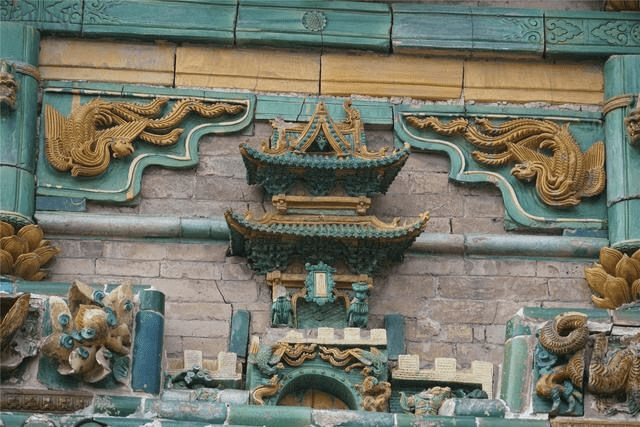
The upper temple complex comprises the temple gate, the Flying Rainbow Tower, the Amitabha Hall, the Great Hall, the Vairochana Hall, the Kwan-yin Hall, the Ksitigarbha Hall, as well as wing-rooms and corridors, among other features. The Temple Gate, situated at the entrance, is flanked by two guardian warriors. Just beyond the gate stands the impressive Flying Rainbow Tower, constructed from colored glaze bricks. Originally built during the Eastern Han Dynasty (25-220) and later restored in the Ming Dynasty (1368-1644), this thirteen-story tower soars to a height of 47.31 meters, featuring an octagonal plan. The tower is adorned with tri-colored glaze in yellow, green, and blue, creating a splendid and vibrant spectacle. Elaborate wooden square blocks and intricately carved designs of Buddha, Bodhisattvas, guardian warriors, flowers, birds, and animals adorn the eaves and pillars. Corridors encircle the first story, while the tower’s interior houses only the stairs leading to the tenth floor, showcasing remarkable architectural and artistic prowess.
Behind the tower lies the Amitabha Hall, a 5-bay wide, 4-bay long structure with a single-eaved gable and hip roof. Inside, the hall features three exquisite statues: Amitabha Buddha, Manjusri Bodhisattva, and Vajrapani Bodhisattva. These statues, masterpieces of the Ming Dynasty, are accompanied by frescoes adorning the eastern wall and screen wall. Additionally, the temple once housed 4,000 volumes of the Pingshui version of the Tripitaka during the Huangtong reign of the Jin Dynasty (1115-1234). These valuable volumes are now preserved in the Beijing Library and serve as a rare source for studying the history of Chinese printing.
The Great Hall, characterized by a 5-bay width, a single-eaved gable, and a hip roof, features three niches within for wooden statues of Sakyamuni, Manjusri, and Samantabhadra. These statues are meticulously crafted, possessing well-proportioned forms, a plump appearance, and an air of perfect serenity. In the Qing Dynasty, the hall was adorned with eighteen iron arhats along its two sides, along with statues of Kwan-yin and Amitabha Buddha on the rear niche wall.
The Vairochana Hall, spanning 5 bays in width with a hip roof, boasts an architectural style typical of the Yuan Dynasty, with two gables supported by substantial crawling beams. The altar within the hall features statues of three Buddhas and four Bodhisattvas, surrounded by wooden niches containing 35 iron statues. Notably, the back wall of the hall showcases frescoes depicting Sakyamuni and twelve Bodhisattvas of Perfect Enlightenment, regarded as exceptional examples of this art form.
The lower temple complex comprises the temple gate, front hall, back hall, the buttress hall, and other buildings, all constructed during the Yuan Dynasty. The temple gate stands impressively tall, measuring 3 bays in width and 3 bays in length, featuring a single-eaved gable and a hip roof. Canopies have been added to both the front and back eaves, lending it the appearance of a pavilion with double eaves. The front hall spans five bays in width and is supported by only two pillars that bear the weight of the entire structure. The back hall, dating back to the second year (1309) of the Zhida reign in the Yuan Dynasty, stretches 7 bays in width, featuring 9 purlins, 8 rafters, and a single-eaved overhanging gable roof. Within the hall, you’ll find the main statues of Amitabha Buddha, Sakyamuni Buddha, Bhaisajyaguru Buddha, Manjusri Bodhisattva, and Samantabhadra Bodhisattva, all crafted during the Yuan Dynasty. Sadly, the once-present frescoes on the walls were stolen and smuggled to other countries in 1928, and they are currently housed in the Naerson Museum in Texas, US. Notably, the fresco on the south wall documented the performances of Yuan Drama, serving as rare reference material for the study of Chinese dramas.
The lower temple complex photo from:Beijing Transportation University ancient architectureThe lower temple complex photo from: Beijing Transportation University ancient architecture
The Water God Temple comprises two courtyards: the front yard and the back yard, featuring key structures like the Temple Gate, the Door of Amenity, the Ming Ying King Hall, and wing-rooms of cave dwellings. The Ming Ying King Hall, measuring 5 bays in width and 5 bays in length, is enveloped by a cloister and crowned with a double-eaved gable hip roof. The interior beams follow a conventional style. Within the hall, you’ll find statues of Water God Ming Ying King and his eleven attendants. Their facial features, attire, and postures are all reflective of the Yuan style. The hall’s walls are adorned with frescoes depicting scenes of people praying for rain and other historical narratives, covering an area of 197 square meters. Notably, the eastern end of the south wall features vivid depictions of a comprehensive set of stage properties used by performers, including costumes, stage instruments, musical instruments, makeup, curtains, and the stage itself. The artwork is meticulously arranged, with a simple yet profound color palette, and the dramatis personae are depicted with great expressiveness. This fresco offers an authentic glimpse into the heyday of Yuan Drama and stands as a rare and outstanding example of Yuan fresco art in China.
Mount Putuo is one of the four sacred mountains in Chinese Buddhism, lies in the East China Sea and incorporates the beauty of both mountain and sea, and honored as the Buddhist Land on the Sea. Its area is approximately 12.5 square kilometres (4.8 sq mi) and there are numerous famous temples. Mount Putuo has been a pilgrimage site for over a thousand years. After the Tang dynasty, Mount Putuo became a center of Avalokitasvara (Guanyin) worship.
In 863, a Japanese monk called Hui E aimed to carry a statue of Avalokitasvara from Mount Wutai to his country by ship. However, when the ship was passing through the sea nearby Mount Putuo, it was prevented by the stormy waves and hundreds of iron lotus flowers suddenly appeared on the sea, blocking the way. Monk Hui E believed that Avalokitasvara didn’t want to leave China. So he knelt down on the bow of the boat and silently prayed to the Bodhisattva Avalokitasvara for instructions. After a while, the iron lotus on the sea disappeared, and the boat drifted to the shore of Mount Putuo, where he built a temple in the purple bamboo forest to enshrine the statue of theBodhisattva. From that time, Mount Putuo got the spirit and became the bodhimanḍa of Bodhisattva Guanyin.
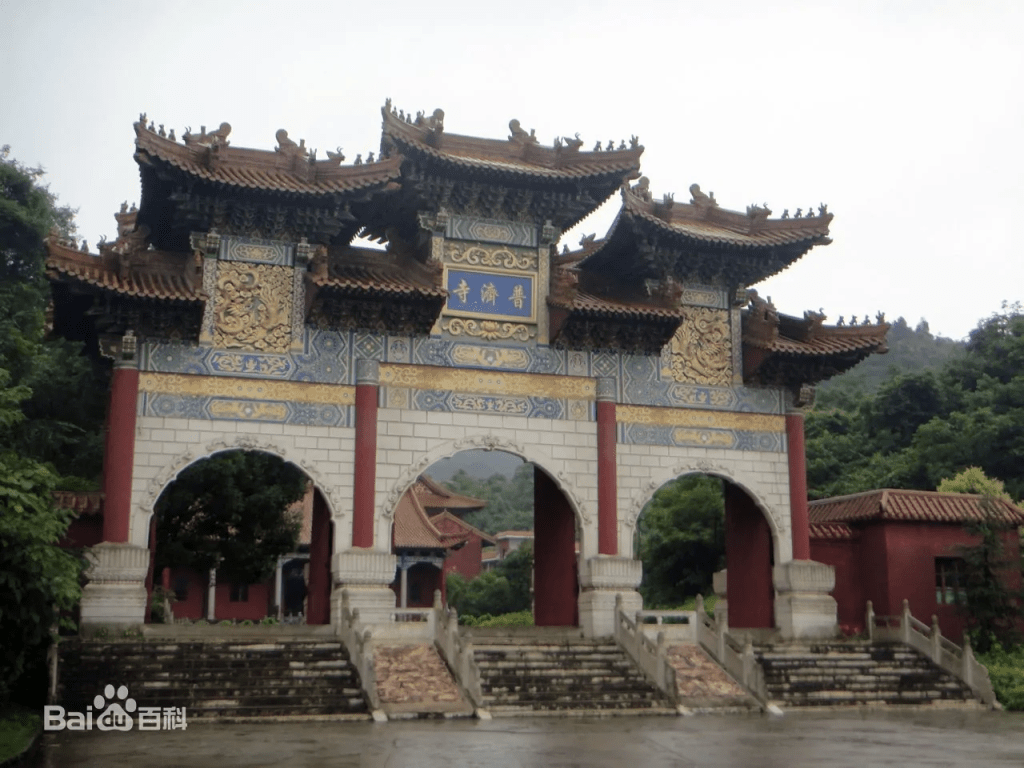
Traditionally there were three main temples: The Puji Temple (founded 10th cent.), the Fayu Temple (founded 1580 CE), and the Huiji Temple (founded 1793 CE). Today, there are more than 30 major temples located at Mount Putuo. In addition to these monasteries, there is the Institute of Buddhism, one of the largest Buddhist academic institutes in China.
Puji Temple
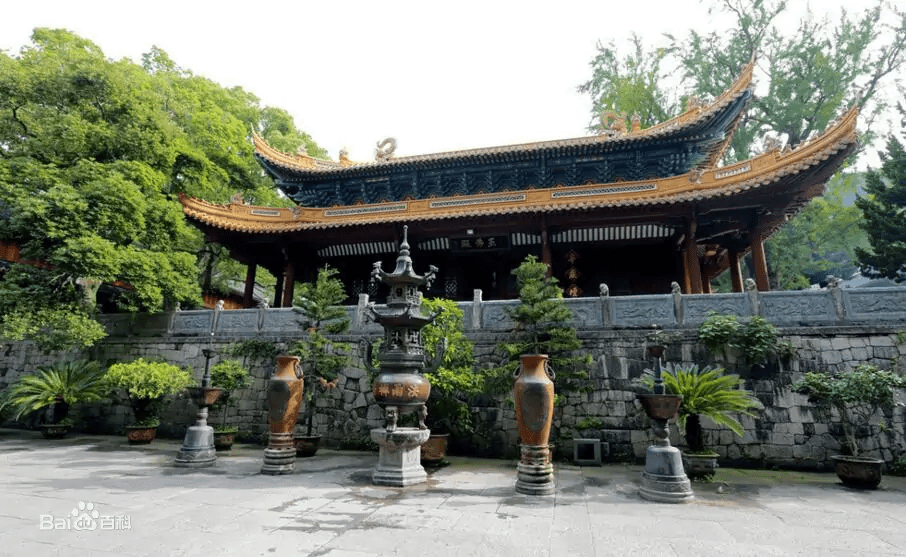
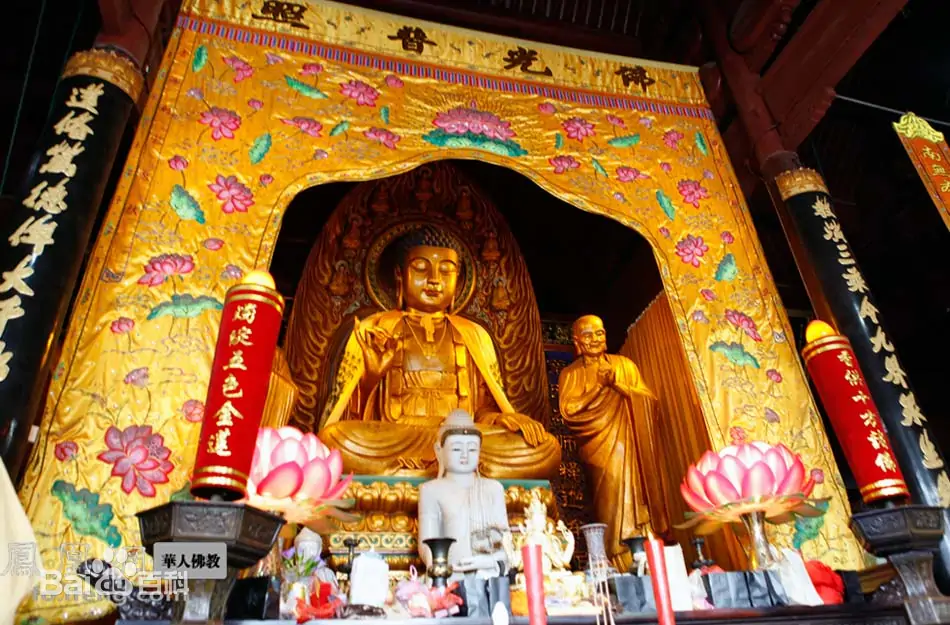
Puji Temple is the main temple of Mount Putuo and all important Buddhist activities are held here. Covering an area of 37,019 square meters, it contains Grand Yuantong Palace, Hall of Heavenly Kings, Depository of Buddhist Sutras and 357 other buildings. Grand Yuantong Palace is the main hall which houses an 8-meter-high statue of Guanyin surrounded by 32 Bodhisattva with different costumes in a variety of poses on east and west walls. Haiyin Pond in Puji Temple was a free life pond full of spring water primitively and now a lotus pond. At the night of summer, the gorgeous lotus and bright moonlight compose an attractive scenery.
Puji Temple
Haiyin Pond in Puji Temple
Fayu Temple
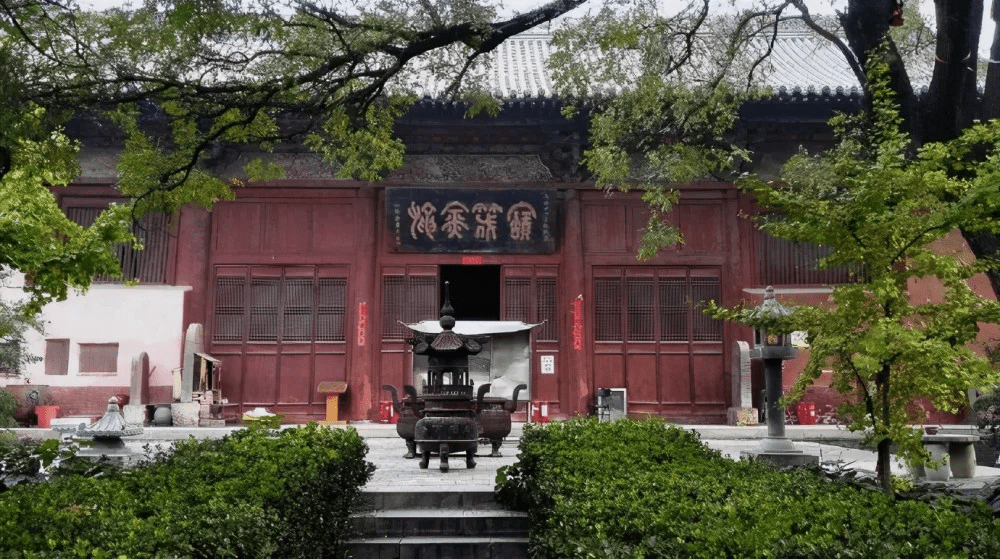
Fayu Temple was built along the uphill with grand building groups and extraordinary manners. It got such a name in that you could see amazing relives of nine dragons are fighting for pearl on the screen wall before the gate of Halls of Heavenly Kings. Among the 294 halls of Fayu Temple, Nine Dragons Guanyin Palace(also called Grand Yuantong Palace), said to be a Buddhist Temple transported from the imperial palace of Ming Dynasty, acts as the most magnificent one. The highlighted part of this palace must be the Nine Dragons Caisson Ceiling. With unique shapes and vivid images, it enjoys high artist value and is listed in Three Treasures of Mount Putuo.
FaYu Temple
Delicate Carvings in Nine Dragons Screen Wall
Huiji Temple (惠济禅寺)
Huiji Temple is perched in Foding Mountain, the highest peak of Mount Putuo. The architecture of the whole temple is unique. It is located on the mountain and is arranged horizontally. The hall is spacious and magnificent. Hidden in a luxury forest, Huiji Temple features in peaceful environment. Standing at the peak of Mount Putuo, you can have a distant view of the mountains, sea, reefs, beaches and buildings. In the whole temple, statues, carvings and pictures of Guanyin can be found everywhere.
Grand Huiji Temple
Status of Guanyin Bodhisattva
Statue of Standing Nanhai Guanyin
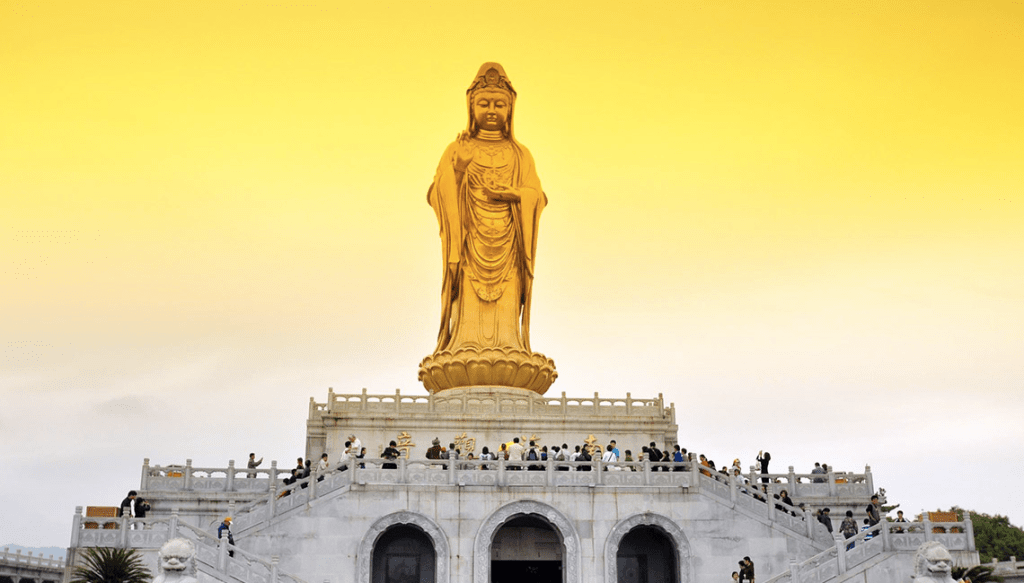
Standing in the south Shuangfeng Peak, Statue of Standing Nanhai Guanyin is the largest outdoor statue of Guanyin made from copper in Asia. With an 18-meter-high statue, 2-meter-high lotus and 13-meter-high foundation, the whole structure has two stories in its foundation. The first story displays elegant carvings, while the second story houses 500 statues of Guanyin in different poses. On the consecrating day at year 1997, a strange nature phenomenon happened. Before the consecrating ceremony, the sky was full of dark cloud and it seemed that it would rain soon. However, as the ceremony began, it became sunny as if two hands pushed aside the clouds. A beam of sunlight just casts on the Guanyin statue.
Statue of Nanhai Guanyin
Avalokitasvara, Guan Shi Yin in Chinese, means the Perceiver of World’s Sounds. The Lotus Sutra says: “Perceiver of the World’s Sounds, heavenly voice, the voice of the sea’s tide—magnificent, rich and harmonious surpassing all worldly sounds.” The bodhisattva always help all beings in danger and distress and is willing to bear the pain of all beings. There are many stories and folk tales about the bodhisattva’s infinite mercy and compassion.
If we hold the bodhisattva in our hearts and call on her sincerely, she will always respond. I had a personal experience. You can read my story here: Guan Shi Yin Bodhisattva saved my life。








 Peace LiLy