You probably have a vague sense that exercise is good for you—and you’ve probably heard that it’s “healthy for the heart.” But if you’re like most people, that’s not enough motivation to get you to break a sweat with any regularity. As I report in the TIME cover story, “The Exercise Cure,” only 20% of Americans get the recommended 150 minutes of strength and cardiovascular physical activity per week, more than half of all baby boomers report doing no exercise whatsoever, and 80.2 million Americans over age 6 are entirely inactive.
Photograph by Gjon Mili—The LIFE Picture Collection/Getty Images. Colorization by Sanna Dullaway for TIME
That’s bad news, but emerging evidence shows that there are plenty of compelling reasons to start moving at any age and even if you’re ill or pregnant. Indeed, scientists are learning that exercise is, actually, medicine. “There is no pill that comes close to what exercise can do,” says Claude Bouchard, director of the human genomics laboratory at Pennington Biomedical Research Center in Louisiana. “And if there was one, it would be extremely expensive.”
You can read the whole story for more, but here are some of the amazing things that happen to a body in motion.
1. Exercise is great for your brain.
It’s linked to less depression, better memory and quicker learning. Studies also suggest that exercise is, as of now, the best way to prevent or delay the onset of Alzheimer’s disease, a major fear for many Americans.
Scientists don’t know exactly why exercise changes the structure and function of the brain, but it’s an area of active research. So far, they’ve found that exercise improves blood flow to the brain, feeding the growth of new blood vessels and even new brain cells, thanks to the protein BDNF (brain-derived neurotrophic factor). BDNF triggers the growth of new neurons and helps repair and protect brain cells from degeneration. It may also help people focus, according to recent research.
2. You might get happier.
Countless studies show that many types of exercise, from walking to cycling, make people feel better and can even relieve symptoms of depression. Exercise triggers the release of chemicals in the brain—serotonin, norepinephrine, endorphins, dopamine—that dull pain, lighten mood and relieve stress. “For years we focused almost exclusively on the physical benefits of exercise and really have ignored the psychological and emotional benefits of being regularly active,” says Cedric Bryant, chief science officer of the American Council on Exercise.
3. It might make you age slower.
Exercise has been shown to lengthen lifespan by as much as five years. A small new study suggests that moderate-intensity exercise may slow down the aging of cells. As humans get older and their cells divide over and over again, their telomeres—the protective caps on the end of chromosomes—get shorter. To see how exercise affects telomeres, researchers took a muscle biopsy and blood samples from 10 healthy people before and after a 45-minute ride on a stationary bicycle. They found that exercise increased levels of a molecule that protects telomeres, ultimately slowing how quickly they shorten over time. Exercise, then, appears to slow aging at the cellular level.
4. It’ll make your skin look better.
Aerobic exercise revs up blood flow to the skin, delivering oxygen and nutrients that improve skin health and even help wounds heal faster. “That’s why when people have injuries, they should get moving as quickly as possible—not only to make sure the muscle doesn’t atrophy, but to make sure there’s good blood flow to the skin,” says Anthony Hackney, an exercise physiologist at the University of North Carolina at Chapel Hill. Train long enough, and you’ll add more blood vessels and tiny capillaries to the skin, too.
The skin also serves as a release point for heat. (See “Why Does My Face Turn Red When I Exercise?” for more on that.) When you exercise, your muscles generate a lot of heat, which you have to give up to the environment so your body temperature doesn’t get too high, Hackney says. The heat in the muscle transfers to the blood, which shuttles it to the skin; it can then escape into the atmosphere.
5. Amazing things can happen in just a few minutes.
Emerging research suggests that it doesn’t take much movement to get the benefits. “We’ve been interested in the question of, How low can you go?” says Martin Gibala, an exercise physiologist at McMaster University in Ontario. He wanted to test how effective a 10-minute workout could be, compared to the typical 50-minute bout. The micro-workout he devised consists of three exhausting 20-second intervals of all-out, hard-as-you-can exercise, followed by brief recoveries. In a three-month study, he pitted the short workout against the standard one to see which was better. To his amazement, the workouts resulted in identical improvements in heart function and blood-sugar control, even though one workout was five times longer than the other. “If you’re willing and able to push hard, you can get away with surprisingly little exercise,” Gibala says.
6. It can help you recover from a major illness.
Even very vigorous exercise—like the interval workouts Gibala is studying—can, in fact, be appropriate for people with different chronic conditions, from Type 2 diabetes to heart failure. That’s new thinking, because for decades, people with certain diseases were advised not to exercise. Now scientists know that far more people can and should exercise. A recent analysis of more than 300 clinical trials discovered that for people recovering from a stroke, exercise was even more effective at helping them rehabilitate.
Dr. Robert Sallis, a family physician at Kaiser Permanente Fontana Medical Center in California, has prescribed exercise to his patients since the early 1990s in hopes of doling out less medication. “It really worked amazingly, particularly in my very sickest patients,” he says. “If I could get them to do it on a regular basis—even just walking, anything that got their heart rate up a bit—I would see dramatic improvements in their chronic disease, not to mention all of these other things like depression, anxiety, mood and energy levels.”
7. Your fat cells will shrink.
The body uses both carbohydrates and fats as energy sources. But after consistent aerobic exercise training, the body gets better at burning fat, which requires a lot of oxygen to convert it into energy. “One of the benefits of exercise training is that our cardiovascular system gets stronger and better at delivering oxygen, so we are able to metabolize more fat as an energy source,” Hackney says. As a result, your fat cells—which produce the substances responsible for chronic low-grade inflammation—shrink, and so does inflammation.
Have you ever seen a man-made sculpture like real withered vines? In The International Art Museum of America located at San Francisco, there is just such a sculpture, called Ancient withered vines become a fossil fortress. The artist is H.H. Dorje Chang Buddha III. I was told the sculpture is made of the material like PVC, stone and oil paint. The astonishing fact is the artist needed to carve the sculpture in super fast speed; the material hardens into a mold in less than ten seconds after melting. I can’t image how this huge sculpture could be done in such short time. It has many layers from inside to outside. The sculpture is well lit, and I can see clearly the inside structures. I can only say the artist superior craftsmanship skill is beyond human imagination.
H.H. Dorje Chang Buddha III, Holiest Tathagata created high-quality withered vines through a form of carving called “Yun Sculpture.” All of those Yun Sculpture vines must have certain distinguishing attributes in four categories: visual quality, style, shape, and texture. Of these four categories, texture is the most important and indispensable.
Ancient-looking withered vine
The four distinguishing attributes in the area of visual quality are old, withered, dry, and beautiful. As for old, the vines must appear to be old vines from the ancient past. As for withered, the vines must look dehydrated, withered, and wrinkly. As for dry, the winding vines must seem desiccated. As for beautiful, they must have a graceful look to them. The four distinguishing attributes in the area of style are scholarly, otherworldly, highly elegant, and comforting. As for scholarly, the style of sculpting must be imbued with a feeling of literary or poetic genius. As for otherworldly, the vines must appear to transcend the handwork of human artisans such that they look not of this world. As for highly elegant, the vines must look highly refined, aesthetically pleasing, and far above the ordinary.
As for comforting, the vines must convey a feeling of auspiciousness, grace the place in which they are present, and give those who view them a feeling of harmony and well-being. The four distinguishing attributes in the area of shape are as follows: natural-looking, genuine-looking, weathered over time, and intertwining.
Regarding the first attribute, the vines must match the winding look of real vines. Regarding the second attribute, the vines must look exactly like real ancient vines. The viewer should have the impression that the carved vines are no different from real vines that grew in nature. Indeed, the viewer should conclude that the sculpted vines look even more ancient than their natural counterparts. Regarding the third attribute, the vines must convey a natural sense that they have been exposed to wind, frost, rain, dew, and sunshine over a very long time and have aged over that long time period. Regarding the fourth attribute, thick and thin vines must intertwine to look like one natural, connected body that has grown together month after month.
The four distinguishing and extremely subtle attributes in the area of texture are as follows: the vines must have the texture and appearance of having withered in different time periods; the skin of the vines must have the texture of real vines with tiny pores; the lines and wrinkles on the vines must follow the natural course of the vines; and the shades of colors of the vines must be just like those of real ancient vines. The meticulousness shown in the area of texture is the best way to tell whether or not a work of art is a genuine carving of withered vines created by H.H. Dorje Chang Buddha III through His Holiness’s Yun Sculpture form of art. These four attributes, which cannot be matched by any other artist, are essential in determining whether or not the withered vines are masterpieces sculpted by H.H. Dorje Chang Buddha III himself. These four attributes are most important and indispensable in distinguishing the works of H.H. Dorje Chang Buddha III from other works. The first attribute is that the vines must have the texture and appearance of having withered in different time periods. Since interwoven withered vines come into being and grow in different time periods, they dry, age, and shrivel to different degrees. Their texture and color also vary. Thus, His Holiness’s Yun Sculpture vines give the impression of being historical relics of different time periods. The second attribute is that the skin of the vines must have the texture of real vines with tiny pores. This means that when one touches the texture of the carved vines, their stems and skin will feel exactly like those of real vines. One can see that the carved vines have minute pores, such as old pores of various colors, pores that follow the course of the stem, inverted pores, miscellaneous pores, and concave and convex pores.
Furthermore, one can see that there are spots of color, shades of color, flows of color, differences in color, and harmony of color relating to the pores. Even under the scrutiny of a magnifying glass, the sculpted pores appear tiny and no different from those of real vines. Indeed, the vines are much more beautiful than real vines. The third attribute is that the lines and wrinkles on the vines must follow the natural growth of the vines. Having existed through a very long period of time, ancient vines will manifest wrinkles. The key factors in carving the highest quality wrinkles relate to the course or direction in which the wrinkles run, their size, their degree of thickness, their depth, their length, and their degree of visibility. They must not have the slightest appearance of disorder or randomness. Rather, the lines and wrinkles must totally follow the natural growth patterns of the vines. They must follow the track of the winding vines. As the vines change directions, the lines must follow the twists and turns. They must look natural and no different from real lines on ancient vines.
The fourth attribute is that the shades of colors of the vines must be just like those of real ancient vines. The color or hue of the carved vines must convey a feeling of antiquity and a wondrous quality of age. The sculpted vines must seem old, parched, and shriveled, but in a very fascinating and attractive way. They must not show any trace of having been sculpted by man. All of the freshness and brightness of living vines must be gone. They must appear as relics that are thousands of years old. There are two Chinese sentences that aptly summarize the artistic skills of H.H. Dorje Chang Buddha III in carving withered vines: “There is nothing more beautiful than faux jade, ganoderma lucidum frames, and cactus frames. There is no higher art than creating ancient withered vines that even go beyond the appearance of real vines.”
Only those works of art that possess all of the above–described distinguishing characteristics can be called genuine Yun Sculpture withered vines created by H.H. Dorje Chang Buddha III. When these frames of withered vines accompany other Yun Sculpture works of art, the result is “double supreme beauty.” This combination is also solid evidence to determine the authenticity of Yun sculptures created by H.H. Dorje Chang Buddha III. When His Holiness’s withered vines are part of Yun Sculpture art frames, such as “Ancient Jade”and “Emerald,” these art frames become even more phenomenal and take on the ancient air of precious and splendid cultural relics. Truly, such works are national treasures that have no equal in the entire world. They are wonderful masterpieces to hang on your wall. More importantly, we should understand that these sculptures of ancient-looking withered vines are actually a manifestation of His Holiness’s mastery of the inner-realization vidya. Persons of holy virtue who are able to leave their footprints on stones are unable to create such ancient-looking withered vines. The source of these works of art is the enlightenment of a Buddha that H.H. Dorje Chang Buddha III possesses. That is why they are precious withered vines that cannot be found anywhere else in the world.
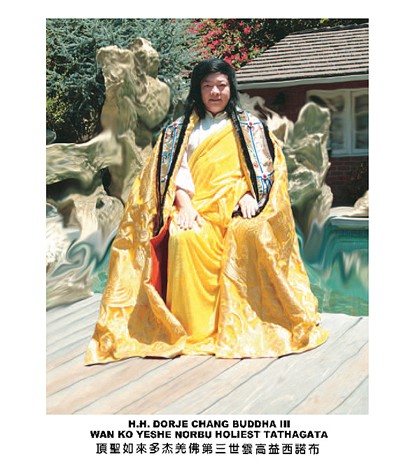
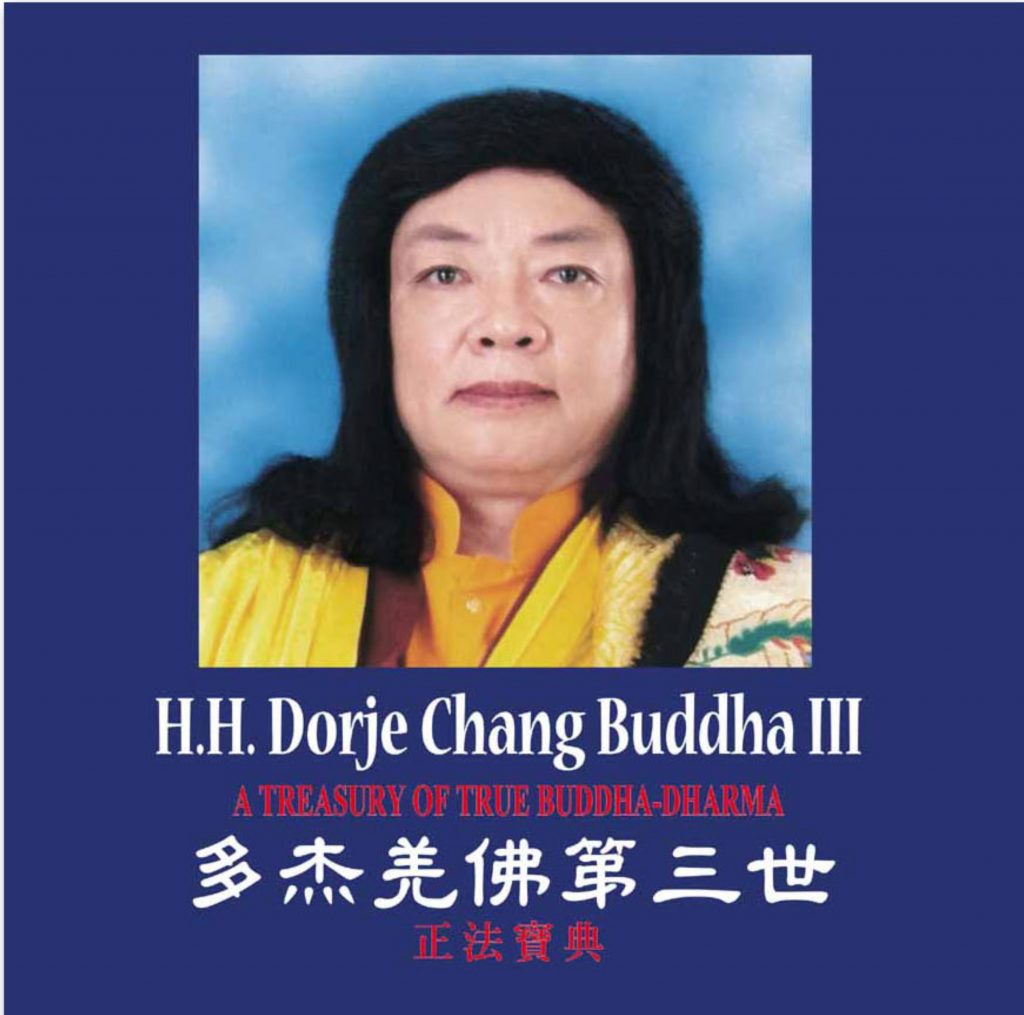
In 2008, the Great Dharma King Wan Ko Yeshe Norbu’s identity was finally published in the treasure book of “H.H. Dorje Chang Buddha III“. The Great Dharma king’s true identity is the third incarnation of the primordial and highest Buddha in the dharma realm, Dorje Chang Buddha.
On April 3, 2008, a solemn and dignified book-launching ceremony was held at the Library of Congress of the United States; on occasion of the first release of a fact-recording book entitled H.H. Dorje Chang Buddha III, jointly published by the World Buddhism Publishing LLC and the World Dharma Voice, Inc. At the same time, the book was formally accepted into the collection of the Library of Congress of the United States. From then on, people came to know that the widely respected Master Wan Ko Yee, the one who has been recognized and corroborated through official written documents issued by top leaders, regent dharma kings, and great rinpoches of major Buddhist sects throughout the world; actually, is the third incarnation of Dorje Chang Buddha, the primordial Buddha. Ever since, people address the Buddha by the name Dorje Chang Buddha III. This is similar to the precedent regarding the name of Sakyamuni Buddha—before Sakyamuni Buddha attained Buddhahood, His name was Prince Siddhartha Gotama. Once Prince Siddhartha Gotama attained Buddhahood, He was thereafter addressed as “Namo Sakyamuni Buddha.”
On June 21, 2008 in San Francisco the world’s first ceremony to welcome the treasure book “H.H. Dorje Chang Buddha III” was held at Hua Zang Si by the International Buddhism Sangha Association (IBSA). When the banner welcoming the treasure book “H.H. Dorje Chang Buddha III” was hung above Hua Zang Si, a giant Buddha light appeared in the sky above Hua Zang Si. It was gorgeously bright and auspicious. This was what is called a celebration taking place in both the human world and the heavens. And furthermore, the most precious gift from Buddhas and Bodhisattvas was presented, nectar from the heavens. At that time, from the clear and blue sky totally free of any cloud, thunder rolled continuously. The uninterrupted sounds of the torrent of thunder had never been heard before, as if fireworks were launched in the heavens. The densely descending nectar appeared from nowhere coming through the Magnolia tree branches, the tree was planted at the backyard of the temple. People could neither see where it came from nor how it eventually disappeared. Floating like goose feathers and flocs, the nectar was rolling and dancing in the space between the tree branches. In contrast, right outside the perimeter of Hua Zang Si temple, it was dry everywhere under the cover of a completely fine summer sky with the bright sun shining.
On December 12, 2012, in the Senate Resolution No. 614 of the United States Congress, the title “His Holiness” was officially used with the name Dorje Chang Buddha III; the Buddha was addressed as “H.H. Dorje Chang Buddha III.” Since then, the title H.H. Dorje Chang Buddha III was definitively affirmed.
The accomplishments of H.H. Dorje Chang Buddha III are the highest in the entire world. No one of holy virtue within Buddhism can be mentioned in the same breath with His Holiness when it comes to showing real evidence of wisdom and realization attained through proficiency in exoteric and esoteric Buddhism and mastery of the Five Vidyas. The standard that the Buddha set for measuring one’s level of accomplishment in the Buddha-dharma is the degree to which one is proficient in both exoteric and esoteric Buddhism and the degree to which one has mastered the Five Vidyas. However, in the history of Buddhism up to the present time, only H.H. Dorje Chang Buddha III Holiest Tathagata has truly and fully manifested complete proficiency in exoteric and esoteric Buddhism and perfect mastery of the Five Vidyas! H.H. Dorje Chang Buddha III actually exhibits for all to see item after item of accomplishments relating to complete proficiency in exoteric and esoteric Buddhism and perfect mastery of the Five Vidyas as laid down by the Buddha. His Holiness, an ancient Buddha, is the first being of holy virtue in history who has truly manifested such lofty and complete realization! Clear evidence of this are all of the single-handed accomplishments of H.H. Dorje Chang Buddha III mentioned in the thirty main categories listed in this book, H.H. Dorje Chang Buddha III —A Treasury of True Buddha-Dharma.
You wonder how a book like Zen Baggage could be written. First, who would have guessed that China’s legendary Zen temples would rise from the ashes of the Cultural Revolution and prosper in the new century? And second, what Western writer could pull off a history of Zen in China and then go on to paint a vivid picture of contemporary life in China’s most legendary Zen temples and monasteries?
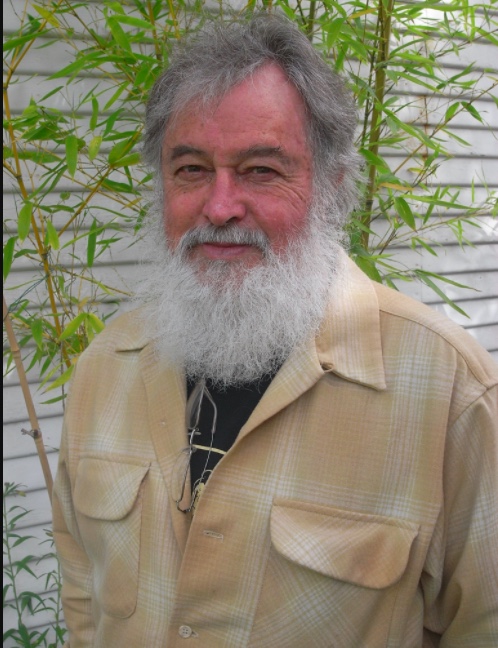
Bill Porter in Port Townsend (2010). Photograph by Julie Anand
The only writer I know who could do that justice is Bill Porter, also known as Red Pine, the éminence grise of translators and commentators on Zen and Taoist poetry and texts. In this latest, most personal, travel book, Porter is back on the fertile ground he covered so well in Road to Heaven: Encounters with Chinese Hermits.
Thanks to that book, we know that Taoist hermits continued to practice and live in their remote huts in the Chungnan Mountains throughout the era of China’s Red Guards. The book was a revelation to Westerners and it seems to have fascinated many Chinese as well: the Chinese translation is now in its sixth printing under the title Hidden Orchids of Deserted Valleys.
Porter makes it clear that the average Chinese doesn’t quite know what to make of the legendary Zen temples and monasteries that have become heavily visited pit stops on a sort of Zen Tourist Highway running from Beijing to Hong Kong. Most of the temples are thriving: attracting more monks, building academies, expanding zendos, and refurbishing, enlarging, and promoting themselves in close—maybe too close—cooperation with the Chinese authorities, all under the auspices of a program that seems more intent upon raking in tourists’ money than in preserving the cultural legacy of Zen. The current government’s new relationship with Zen temples seems to be motivated in part by a desire to be more respectful and tolerant than the Communist regimes of the past, and its view that Zen is a non-threatening, home-grown, institution that promotes responsibility and discipline.
Zen being Zen, the abbots of these ancient temples are only too happy to accept whatever benefits accrue from the government’s new view of things. They remember all too well the days when monks were rounded up and abused, and temples were gutted or shut. Now abbots can easily meet the government’s modest expectations while also scooping up hoards of badly needed yuan from the bus loads of Chinese tourists who flock to the temples’ trinket shops to buy T-shirts, tea sets and kitschy souvenirs. The money is wisely used to build sub-temples in remote locations where monks can practice without being put on public view.
Porter’s personality comes through vividly in Zen Baggage, and it contains sketches of his earlier life in Taiwan, his frequent travels to China, and, most revealingly, his on-the-road personae as he makes his six-week, 2,500-mile, temple-hopping pilgrimage, which was largely a catch-up journey to supplement his many previous visits. He is on intimate terms with many of the temple abbots and others that he meets on his trip. In contrast, in Road to Heaven, during his forays into the rugged Chungnan Mountains (home of the hermits), he was on new ground ferreting out the names of hermits and the mountains where they were living, and then he tracked them down. What was most surprising about his first encounters with these Taoist solitaries, both men and women, is how seldom they showed surprise at the appearance of this bearded foreigner–if, indeed, they perceived him as a foreigner. He seemed to have been expected.
Zen Baggage is soaked in wisdom so subtle it is almost invisible. I was three-quarters of the way into it, for example, when I realized I’d easily absorbed a chronology of the major Chinese Zen patriarchs along with the distinctive swerves and turns that collectively make up Zen’s birth, its crucial philosophical debates, its divisions, its flowering in the sixth century, its slow decline, and its diffusion in the world.
Porter’s personal Taoist/Zen style of travel gives his journey an interesting edge. Whether he’s interviewing the abbot of a legendary temple or eating sweet cakes at a truck stop, he lashes it all together in a bundle of concrete details that help illuminate the tales, metaphysics, koans, and esoterica of early Zen. He has read so deeply in Zen, Taoism and Buddhism that he could be the abbot of any of these legendary temples––to the benefit of the temples and monks––but it’s clear that most, if not all, of the abbots and monks he talked with would laugh at such a suggestion. Throughout Asia, Zen too often remains the “property” of individual countries, whereas in the West it’s readily perceived as open to all equally. In all his encounters, you get the feeling that in only a few cases was there a true meeting of minds. Many Chinese sized Porter up as just another Westerner who spoke good Chinese, and had no knowledge of his translation work or of his life (not that he cared), and most probably weren’t interested anyway. The prevailing orthodoxy seemed to be: “We’re the only ones who can translate the texts, who understand Zen––Westerners can’t get it.” But as history reminds us, Buddhism is international: the Chinese texts the abbots depend upon were carried back to China from India by Chinese pilgrims and translated from Sanskrit and other languages. In Porter’s many trips to China over the past two decades, we have an apposite addition to the history of Buddhism: a Western pilgrim who traveled to the East to get Chinese texts to translate into English.
On this latest trip, he bounced down China’s buzzing highways in buses to report to the world (or the English-speaking West), on what grew from those early Chinese translations into Zen. This recounting of how Zen was born and thrived in China (for a while), then died out, and is now being reborn closes China’s Buddhist/Zen circle, for the time being at least.
Along with his translations (11 so far), Porter’s two travel books are singular achievements that break new ground in our understanding of Zen and Taoism in contemporary China. My guess is that we can expect more travel books from him that will flesh out the on-the-ground story of Zen and Taoism, and that they will showcase his two greatest assets as a writer: his independence as a scholar and his practical knowledge of whatever he calls his personal blending of Taoism and Zen.
The travel books most closely resemble the work of his mentor John Blofeld (1913-1987), the British writer and translator of Buddhist texts, who gave Porter the encouragement that led to his first translation in 1983, Cold Mountain Poems. Like Blofeld, Porter uses his unique skills as a translator and his talents as a travel writer to bring to life Buddhism’s past and present.
The conferment of the Pope of Buddhism to His Holiness Dorje Chang Buddha III originated in January 2018 when the World Peace Prize Awarding Council and World Peace Prize Religious Leaders Title Awarding Council passed the resolution to confer to H.H. Dorje Chang Buddha III the title of Pope of Buddhism, the highest leader of Buddhism in this world. However, His Holiness the Buddha refused to accept the conferment.
For the sake of propagating Buddha Dharma and benefitting living beings, the World Buddhism Association Headquarters took the liberty to accept the conferment decree and the Pope of Buddhism Scepter. When the World Buddhism Association Headquarters respectfully presented the Pope of Buddhism Scepter and conferment decree to H.H. Dorje Chang Buddha III , His Holiness the Buddha III said: “I see that on top of this Scepter is the seated Shakyamuni Buddha, we should be respectful to Namo Shakyamuni Buddha.” His Holiness the Buddha then raised the Scepter above His head and made a symbolic closed palm gesture with one hand to express His respects. However, H.H. Dorje Chang Buddha III also expressed that He is just a humble cultivator and resolutely would not accept such a conferment. Hence, His Holiness the Buddha immediately returned the conferment decree and the Pope of Buddhism Scepter to the two Councils.
On September 23, 2020, the World Peace Prize Awarding Council and World Peace Prize Religious Leaders Title Awarding Council passed an ultimate joint resolution, determining that the return of the Pope of Buddhism Scepter and conferment decree by H.H. Dorje Chang Buddha III was not effectible. On September 24, the joint Chair of the World Peace Prize Awarding Council and World Peace Prize Religious Leaders Title Awarding Council Suzi Leggett made the ultimate announcement at the Holy Miracles Temple of the World Buddhism Association Headquarters: “Over the past several decades, the World Peace Prize Awarding Council has presented the World Peace Prize to presidents, spiritual leaders, and prime ministers of many nations, including President Ronald Reagan, Hon. Mahatma Gandhi, and H.E. Yitzhak Rabin. There has never been a precedence of an award being retracted or returned. All determinations made and implemented by our Councils are very solemn, serious, and absolutely cannot be changed. The return of the Pope of Buddhism Scepter and conferment decree by H.H. Dorje Chang Buddha III is deemed not effectible. The title, status, and authority of the Pope of Buddhism belong only to H.H. Dorje Chang Buddha III, and cannot be exercised by anyone else.” Chair Leggett once again requested that the World Buddhism Association Headquarters accept and present to H.H. Dorje Chang Buddha III the Pope of Buddhism Scepter and conferment decree that His Holiness the Buddha previously returned.
Representing the World Buddhism Association Headquarters, Venerable Mozhi Rinpoche accepted the conferment decree and Pope of Buddhism Scepter. He said during his speech, “The World Buddhism Association Headquarters considers that the decision made by the two Councils is remarkably proper and sagacious.
“Ever since Namo Shakyamuni Buddha entered parinirvāṇa, there has not been a supreme leader who has the authority to guide all Buddhists the same way that the Buddha did. However, the authoritative position of the Pope of Buddhism certainly is not a role that a leader of a single Buddhist sect would have the attributes to fulfill; rather, the Pope must be a leader who has authority over the entirety of Buddhism, namely, a Buddha.
“Namo H.H. Dorje Chang Buddha III holds the perfect teachings of Buddhism and meets the criteria used by all Buddhist sects to recognize a Buddha. His inherent nature is in accord with that of a Buddha. His unsurpassed, complete, and perfect enlightenment is in accord with that of a Buddha. Just based on the accomplishment of H.H. Dorje Chang Buddha III in Lifting the Pestle onto the Platform, surpassing His own base weight standard by 59 levels, no one else can possibly reach such a record.
“The state of virtue of H.H. Dorje Chang Buddha III is that of a Buddha. His Holiness the Buddha has perfect mastery of Exoteric and Esoteric Buddhism, perfect accomplishments in the Five Vidyas, and so forth, all of which accord with the unsurpassed, complete, and perfect enlightenment of a Buddha.
“In more than 2,000 years, there has not been a Buddhist Holy Guru in this world who possesses the same Buddha level qualities. Just by the facts that H.H. Dorje Chang Buddha III vowed and carries out the vow to benefit living beings purely on a voluntary basis and does not accept any offerings throughout His entire life, and that He possesses perfect wisdom and unimpeded accomplishments, no other Holy Guru can be of comparison. Only Namo H.H. Dorje Chang Buddha III can take on this immensely noble, holy, and heavy responsibility of the Pope of Buddhism, to properly guide Buddhists onto the correct path of learning Buddhism.
“Therefore, on behalf of Buddhists, the World Buddhism Association Headquarters thanks the World Peace Prize Awarding Council and the World Peace Prize Religious Leaders Title Awarding Council for having made the ultimate decision.”
H.H. Dorje Chang Buddha III is selfless and noble, and the first person in Buddhism to possess substantive holy realization power of a Buddha and perfectly flawless accomplishments at the pinnacle of the Five Vidyas. These are the qualities that no other eminent Buddhist monastic or virtuous person in this world has so perfectly attained. It is naturally a matter of course that H.H. Dorje Chang Buddha III is the veritable Pope of Buddhism.
BUDDHA SAID IN THE BUDDHIST SUTRAS THAT BUDDHAS AND BODHISATTVAS ARE TO BE FOUND WITH THEIR ACHIEVEMENTS IN THE FIVE VIDYAS.
Traditionally, the vidyas are divided into the five major vidyas and the five minor vidyas. The five major vidyas are the silpakarmasthanavidya (craftsmanship vidya), the cikitsvidya (healing vidya), the sabdavidya (sound vidya), the hetuvidya (causality or Buddhist logic vidya), and the adhyatmavidya (inner realization vidya). The five minor vidyas are rhetoric, ornate diction, prosody, dramaturgy, and astronomy. Actually, the Five Vidyas are not that narrow. Everything in the universe can be classified into five aspects of brightness and darkness. To develop everything that is good in the universe and that benefits living beings is classified as bright. That which confuses and is bad is classified as dark. This is the real meaning of the Five Vidyas (Five Bright) of which the Buddha spoke. -Venerable Akou Lamo Rinpoche
H.H. Dorje Chang Buddha III is a true ancient Buddha, His Holinesss accomplishments are limitless and countless. If categorized into worldly branches of learning, H.H. Dorje Chang Buddha III is a scientist, writer, philosopher, healer, artist, and great master of many other fields. Sculpture “A Rock Of Horizontal Charm” is the manifestation of H.H. Dorje Chang Buddha III‘s craftsmanship vidya.
The sculpture A Rock of Horizontal Charm is a masterpiece of Yun Sculpture, embodying the spirit of an art surpassing the beauty of nature, created by H.H. Dorje Chang Buddha III for humankind. Derived from an art form created by H.H. Dorje Chang Buddha III that possesses beauty beyond nature’s, it has attained a realm –never before seen in human history – of artistry transcending nature, originating an art form in this world that is irreplicable by any craftsman or high technology. This amazing beautiful sculpture is currently displayed in H.H. Dorje Chang Buddha III Cultural And Art Museum.
Granted, more than ten years ago, we had already heard someone call a particular sculpture a “peerless treasure.” To speak truthfully, however, we could not concur with such an appellation. “Peerless” is not a word to use lightly. Only that which is truly in a league of its own in the world can properly be called peerless. A “peerless treasure” must attain the pinnacle of unrivaled preciousness in order to be so named. From ancient times to the present, how many sculptures can truly be christened a peerless treasure? It can be said that not even one can be found. Even the He Shi Bi (the Jade Disc of He), recorded in history as a treasure of monumental value, does not fit the title of “peerless treasure,” since it is completely replicable— and if it can be replicated, it is not unique; if it is not unique, it is not peerless. In fact, any master sculptor’s magnum opus can be recreated and, on this basis alone, is unfit to be designated a “peerless treasure”!
Our most indelible encounter with the appellation of “peerless treasure” came in 2017, when we saw the sculpture A Rock of Horizontal Charm for the first time. We were immediately awestruck, and in the moment we were simply moved to praise it from the heart, unable to find the most appropriate laurel with which to crown it, and could only pronounce that the laurel of “peerless treasure” belongs to no other! Therefore, this museum has named the room in which A Rock of Horizontal Charm is exhibited, “Peerless Treasure.” Just how remarkable is this sculpture? We must acknowledge that its extraordinary charm and beauteous spirit exceeds the highest realm of human sculpture, and truly manifests
Endless changes of spirit and feelings unfold Mysterious motions envelop wonders untold Only in heaven is such a presence found No handiwork of artisan earthly bound
This divine sculpture is ranked the first, as the “emperor,” and will be shown to the public for the first time; while the second-ranked empress, Mystery of Lovely Colors, is exhibited in the Treasury of the International Art Museum of America; and the fourth-ranked little princess Yellow Yellow has been hailed by a viewer —during its exhibition at the Gold Room of a Congressional House office building on Capitol Hill— as “a gift from God to mankind.” These Wondrous Multicolored Sculptures are treasures of art irreplicable by any craftsman, expert, or high technology.
For the first time in the world, H.H. Dorje Chang Buddha III has created an irreplicable art, and one can only say that when the Yun Sculpture appears, the most gorgeous jewels of the world lose their luster, just as the stars all pale against the resplendent moon. Its beauty is truly soul-enrapturing.
I was born in Cuba and left with my parents when I was six years old. When I arrived in America, I didn’t even know how to say “yes”. We stayed at this little hotel in Miami and I remember one of the people working at the hotel was teaching me English. I started school and still didn’t speak much English, but knew I had to learn. It’s like when you’re thrown into a pool and forced to swim so that you don’t drown. Though I was young, what I do remember from our arrival is that people were overwhelmingly welcoming. I felt that people had empathy for us and they sympathized with our struggles. That is so much more powerful than some of the dismissive rhetoric that goes on now in the United States because it gives you as a refugee a sense of loyalty to the country and its people.
After staying in Miami, my family moved to New York where we became U.S. Citizens. My father got a job in Mexico, so that’s where we landed next. I attended Junior and Senior High School there and started my career in Mexico selling cereal out of a truck. I worked my way up over 30 years; it wasn’t easy, but it worked for me. One time, after I had managed Kellogg in Mexico for a while. I was talking to my boss and explained that I had been doing a good job and wanted to get transferred. He responded “Sure, where?” and I said I wanted to go to an Anglo Market. The Anglo Markets were the big, sophisticated cereal markets- UK, USA, Canada, Australia. He kept trying to ask me why I wanted to do that. Why wouldn’t I want to be head of Latin America? Eventually, I understood what he was asking: You really think that a Latino can lead Non-Latinos? This bothered me, but that was the general mindset at the time. If you’re Latin, you lead your Latin people but don’t try to cross markets.
Some other major obstacles I faced growing up were culture and language. A big cultural shock was what kids ate for lunch. I didn’t know what a peanut butter and jelly sandwich was but everybody else had one. Other kids found things we did at home strange, especially when they heard me speak the language with my parents. I’ve seen how these barriers affect the lives of other immigrants and refugees in America. Coming to a new county, you have to get used to a totally new world and over time, you do. The idea that refugees and immigrants don’t assimilate is crazy. It suggests that the people claiming such don’t have confidence in the country and the power of our society.
Later in life, I remember sitting around off-site and discussing work/life balance with colleagues. One guy said, if you want to leave work for a given reason, you’re able to but it’s your responsibility to tell your boss. Right then, it hit me. Even though I had been in the company for twenty years, maybe longer, I never asked my boss if I could take time to attend things like my son’s Little League games because the stereotype of Cubans was that all we wanted to do was play Baseball. So, I never gave myself the luxury of saying “Hey, my kid has a game, I’m leaving.” I probably don’t realize how often I have catered to the misconceptions of others in order to hide these stereotypes.
Starting early in my career, I was given the opportunity to manage the Mexico subsidiary of Kellogg Company and we turned it around. That was my first general management job and it gave my name a little more visibility throughout the company. I would say the biggest accomplishment was really changing the strategy and making the company’s business model viable again because it had the most impact on the people involved. They picked me, so I did what I had to do to achieve that goal. I think success is what gives you a sense of accomplishment. At one time in this country, success itself was measured by money. I don’t think that’s entirely true anymore, though it is one of the factors. The real measure of success is doing something that you love. What made me successful and gave me energy was probably, to be frank, the fear of failure. It’s easy to say that it was the excitement of success, but it was more-so the fear that Americans who didn’t believe this refugee could make it would be proven right. So, if other people in the office worked 12 hours, I worked. This is the drive that helped me become the youngest CEO in Kellogg’s 100-year history.
Refugees growing up must ALWAYS think long-term. The idea is that it’s rough today but 10 or 20 years from now, it’s going to be fine because that’s the future you’re actively working towards. It’s also important that you look at the short-term and figure out what you have to do to get there. So, there may be the struggle of 18-hour days but also the ever-present dream that this is all going to pay-off. In terms of empowering refugees as Americans, what I would tell people is to be kind. You have no idea how far kindness to a refugee goes. Good morning, welcome, how are you, good to see you… Especially in the workplace. Oftentimes, there may be someone who is an immigrant or refugee, documented or not, and when you walk in a room, nobody ever looks at them. It’s like they’re there but they’re not. Since 9/11, this narrative of compassion has gone downhill. Shaking someone’s hand, looking them in the eyes, and acknowledging that they’re there can make a world of difference. In work settings, give immigrants opportunities and responsibility but also provide a level of protection because it’s inevitable that not everyone is going to be so kind. I wish we could make everyone think “Oh my gosh, this country actually wants and welcomes me.” Looking back on the impact that kindness, respect, and the feeling that people welcomed me had on myself and my family, I know I want us to have that effect on all refugees.
Currently, I’m Co-Chair of Albright Stonebridge Group, a global business strategy firm. I also sit on boards, councils, committees, and the like. My goal is to make a contribution in the relations between the US and Cuba. I discovered this aspiration when I went back for the Embassy Opening in 2015. I hadn’t returned to Cuba since I first left at age six. Since then, I’ve been back almost 20 times and I can’t get enough. Home is where the heart is, and I know that’s my place of birth. Every time I get off the plane, I feel the sense that I was born there and belong; it just feels natural. It’s a bit of an abstract goal but something I continue to strive for daily.
Most of the Buddhist disciples know that: “Among the highest unconditioned Dharmas imparted by the Buddha, patience under humiliation and adversity is the foremost Dharma “. In the Six Paramitas1, Buddha request all disciples to endure insults, to overcome hate and anger.
So many ancient virtuous ones made use of slander, verbal abuse, and harm directed at them from other people, transforming such experiences into enlightenment and great compassion. In the end, they became holy ones. Zen Master Yongjia said, “If there were no slander and praise that create enemies and friends, how would you show the power of lovingkindness and patience that stems from no-birth?” Here are some stories, that could inspire us to practice humility.
(一)
Hanshan and Shide — Song of Endurance
Master Hanshan and Shide were legendary monks lived in China about one thousand years ago. People said that Hanshan and Shide were the incarnation of Manjushri and Puxian Bodhisattva.
Once Master Hanshan asked Master Shide:” What shall I do if someone mistreats me, slanders me, bullies me, insults me, ridicules me, disparages me, belittles me, offends me, or deceives me?”
Shide answered: You just tolerate him, let him be, avoid him, respect him, ignore him, be kind to him, and wait for a few years to see what becomes of him.
Japnese Zen Master Hakuin was greatly respected and had many disciples. At one time in his life, he lived in a village hermitage, close to a food shop run by a couple and their beautiful, young daughter. One day the parents discovered that their daughter was pregnant. Angry and distraught, they demanded to know the name of the father. At first, the girl would not confess but after much harassment, she named Hakuin. The furious parents confronted Hakuin, berating him in front of all of his students. He simply replied, “Is that so?”
When the baby was born, the family gave it to Hakuin. By this time, he had lost his reputation and his disciples. But Hakuin was not disturbed. He took delight in caring for the infant child; he was able to obtain milk and other essentials from the villagers. A year later, the young mother of the child was troubled by great remorse. She confessed the truth to her parents – the real father was not Hakuin but rather a young man who worked at the local fish market. The mortified parents went to Hakuin, apologizing, asking his forgiveness for the wrong they did him. They asked Hakuin to return the baby. Although he loved the child as his own, Hakuin was willing to give him up without complaint. All he said was: “Is that so?”
(三)
H. H. Dorje Chang Buddha III set the greatest example of Patiently endure humiliation and adversity for all the Buddhist disciples in the world. He never minds and never appeals or complains about any framing, persecution, or slandering against Him.
In the past decade, H.H. Dorje Chang Buddha III has suffered greatly for withstanding long-term persecution for his religious activities. A member country of the Interpol has once requested the Interpol to issue a warrant for His arrest. The request was subsequently withdrawn voluntarily by this member country after some years. Upon thorough investigation, in October of 2008, the 72nd session of the Commission for the Control of Interpol’s Files withdrew the arrest warrant and the entire case against H.H. Dorje Chang Buddha III. Interpol also issued a document stating in definite terms that the arrest warrant against H.H. Dorje Chang Buddha III has been cancelled and all of its member countries have been notified of the cancellation.
Although H.H. Dorje Chang Buddha III long ago received official notification of the withdrawal of the arrest warrant and the removal of the entire case, He has never shown such documents to prove His innocence.
H.H. Dorje Chang Buddha III, recieved 2010 World Peace Prize as Top Honor Prize recipient. When people of the “World Peace Prize Awarding Council” asked Him, after learning the facts, why He had not published INTERPOL’s conclusion from investigation to refute the rumors, H. H. Dorje Chang Buddha III said, “I will bear all negative karmas and sins of living beings, and I will give all my good karmas and merit to you. These are the things I will do. If I show stuff to exonerate me, then the people who slandered me would be tarnished. Who will bear their sins and negative karmas in that case?”
The video below is of buddhist disciple Hongxi Fazang’s sincere repent. He did so many defamations to H.H. Dorje Chang Buddha III, yet the greatly loving and greatly compassionate Buddha still accepted him as a disciple and teaches him as same as before.
Note1: Six Paramitas — 1 Be generous, overcome greed, 2 Keep precepts, overcome violations, 3 Endure insults, overcome hate and anger, 4 Be energetic, overcome laziness, 5 Be Concentrated, overcome disorder, 6 Develop prajna, overcome ignorance.
People who have read articles discussing His Holiness Dorje Chang Buddha III might assume he is a villain given the rumors that tend to spread on the Internet. Since the public security department of China’s Guangdong Province issued an arrest warrant for the case of “Yi Yungao’s Fraud” long ago, there has been much speculation as to what the truth actually is. That arrest warrant was reported to the International Criminal Police Organization (INTERPOL), which also issued its own arrest warrant based on China’s request. The fact is, “Yi Yungao” is H.H. Dorje Chang Buddha III‘s worldly name before being recognized as the Buddha. However, after more than 12 years since INTERPOL issued that arrest warrant, why can He still travel freely from country to country without being arrested? Shouldn’t this fact make people wonder whether He is a criminal or not? H.H. Dorje Chang Buddha III spends much of his time publicly in the United States. Not only does He never go into hiding, He also visits different countries to teach and receive people of all walks openly. He even went to the U. S. Capitol to accept the “World Peace Prize” in person. Many policemen were at the site on that day, yet no arrests were made. INTERPOL could have had Him apprehended without any effort. Then, why didn’t they? What is the truth behind this situation?
The so-called case of “Yi Yungao’s Fraud”, according to insiders, was actually a forged case jointly fabricated by Zhou Yongkang, the then Secretary of the CPC Sichuan Provincial Committee and Chen Shaoji , the then Secretary of the Politics and Law Committee and the Police Chief of Guangdong Province (who later served as the chairman of the Political Consultative Conference of Guangdong Province and was sentenced to death with reprieval for embezzlement and corruption in 2010) for framing H. H. Dorje Chang Buddha III.
This incident dates back to 1999, when Lau Pak Hun and Wong Hiu Shui were H. H. Dorje Chang Buddha III‘s students. Due to an occurrence of fraud at the Master Yi Yungao Museum in Hong Kong, H.H. DDorje Chang Buddha III told the museum’s members to form a team of inspection and reporting and to put up a report box. Wong Hiu Shui begged H. H. Dorje Chang Buddha III to withdraw the inspection and reporting but was rejected by His Holiness. Since Wong Hiu Shui was the person committing the fraud, she generated deep hatred. On the next day after the team of inspection and reporting was formed, she beclouded Lau Pak Hun and some other people by smearing H.H. Dorje Chang Buddha III as a villain doing all evils. That caused the Master’s Museum to be closed down three days later and the team of inspection and reporting to be dismissed automatically.
Wong Hiu Shui’s godfather, Mr. Niu, was from Sichuan and was the deputy minister of a ministry of the Central Government at that time. His son was a business partner of Wong Hiu Shui’s. Mr. Niu was directly acquainted with the then Communist Party Secretary of Sichuan Province, Zhou Yongkang, and the corrupt official in Guangdong, Chen Shaoji, through work relations. With hatred towards H. H. Dorje Chang Buddha III, Mr. Niu, together with Zhou Yongkang and Chen Shaoji, planned and fabricated the case of “Yi Yungao’s Fraud.” Zhou Yongkang and the then Mayor of Chengdu, Li Chuncheng, both signed the persecution document that forcefully ordered the closure of the Master Yi Yungao Museum, built by the Dayi County Government and approved by the Chengdu City Planning Committee, a property that belonged to the government. More then 100 paintings and calligraphy arts on exhibition in the museum, created and provided to the museum by H. H. Dorje Chang Buddha III, were then embezzled into private hands. Without any necessity nor providing any compensation, the government purposedly demolished the only real estate owned by H. H. Dorje Chang Buddha III in China — His residence located at No. 19, West Xinhua Road in Chengdu, Sichuan. To this day, that parcel of land, located at the center of the city’s business district, remains baron with nothing constructed on it.
On June 20, 2002, under the instruction of Chen Shaoji, the Shenzhen Police Bureau used a baseless cause of “defrauding through a contract” to issue a “Report Form To Place Criminal Case On File For Investigation And Prosecution” in order to establish a case on Yi Yungao. The report stated that Yi Yungao signed a contract with Liu Juan in April of 2000 to sell the already-sold Auspiciousness Building (Jixiang Property) in Shenzhen to Liu Juan and made 150 million CNYs from the fraud. The Shenzhen Police Bureau tortured Liu Juan to extort a deposition from her. Moreover, they planted a separate matter on Yi Yungao which involves Lau Pak Hun, a Hong Kong businessman, being defrauded by his Buddhist sister Wong Hiu Shui regarding a property. As a result, Liu Juan and Lau Pak Hun were the only two “victims” in the entire case as reported by the news media.
Hong Kong’s Independent Commission Against Corruption (ICAC) prosecuted Wong Hiu Shui and her brother in November 2002 for their crime of illegally mortgaging the Master Yi Yungao Museum in Hong Kong to a bank in order to obtain a loan, and the High Court in Hong Kong subsequently sentenced them to 11 years and 7.5 years in jail respectively. Knowing well that Won Hiu Shui was the real criminal, the Guangdong Police Department, under the control of Chen Shaoji, had to obey and execute their boss’ order and framed the crime on H.H. Dorje Chang Buddha III. At the end of 2002, the Police Department of Guangdong Province still issued an arrest warrant for Yi Yungao, but the statement therein was contradictory to the case report of the Shenzhen Police Bureau, saying that He “obtained a property with a huge value of about 60 million CNYs from the victims by fraud.”
So, was the Shenzhen Police Bureau telling the truth, or was the Police Department of Guangdong Province? Who were these unfounded “victims”that did not really exist? Isn’t it ridiculous?
After being promoted as the Secretary of the Politics and Law Committee under the CPC Central Committee in Beijing and later the position of a Member of the Standing Committee of the Political Bureau of the CPC Central Committee, Zhou Yongkang continued the persecution against H. H. Dorje Chang Buddha III. Although INTERPOL did issue an arrest warrant of Red Notice near the end of 2004 based on a request by China, questions were quickly raised about the case right at that time. Therefore, the case was restarted and a detailed investigation lasting more than three years was launched. Eventually INTERPOL firmly determined that this was a fabricated false case to frame H. H. Dorje Chang Buddha III. Meanwhile, the relevant government agencies in China also confirmed through verification that Yi Yungao did not commit any crime. They submitted a report to INTERPOL on June 11, 2008, requesting to rescind the arrest warrant. Think this: If the person is guilty, would China take an initiative to cancel the arrest warrant?
At the 72nd session of “the Commission for the Control of INTERPOL’s Files” held in October 2008, a conclusion of “Not Guilty” was reached and INTERPOL officially announced the cancelation of the arrest warrant for “Yi Yungao” as well as the entire case. Additionally, an official document was issued to inform all member nations not to detain “Yi Yungao.” INTERPOL also wrote a letter to H. H. Dorje Chang Buddha III on this matter, which described the entire process.
The fact is that H. H. Dorje Chang Buddha III has never said or done anything that violated the law or committed a crime, nor has there been any “guilty verdict” against Him from any court or law-enforcement agency. He legally arrived at the United States on August 1, 1999 with a teaching invitation and subsequently obtained legal permanent residency. He has never returned to China since. H. H. Dorje Chang Buddha III has never formed a company in China. Not only has He never signed a contract or done any business with Liu Juan, but He also, by no means, had any authority to sign the contract even if He wanted to, because the company that owned the Auspiciousness Building (i.e. Jixiang Property) was not H. H. Dorje Chang Buddha III‘s. H. H. Dorje Chang Buddha III never served any position at the company and was not even an employee. In fact, H. H. Dorje Chang Buddha III has never signed any contract with anyone!
The Police Bureau made a false accusation against H.H. Dorje Chang Buddha III with no substantial evidence. They do not have a contract to show to the public at all,. They only have a false “Report Form To Place Criminal Case On File For Investigation And Prosecution” to smear H. H. Dorje Chang Buddha III with. If they disagree , we ask them to post this contract on the Internet and let everyone see it.
As early as in 2003, Liu Juan already wrote a statement while in the United States and sent it to the Shenzhen Intermediate People’s Court with notarization to attest that she was tortured into an extorted false deposition. “I had to say whatever the Police personnel wanted me to say according to their purposes,” she stated. She also stated that H. H. Dorje Chang Buddha III absolutely had not defrauded her. The other “victim”, Lau Pak Hun, spoke publicly at a press conference held in Hong Kong on December 9, 2014, stating that H. H. Dorje Chang Buddha III never defrauded him for money and it was Wong Hiu Shui who deceived him and defrauded his property. On April 23, 2015, Lau Pak Hun stated again in a written testimony: “My Master H. H. Dorje Chang Buddha III never defrauded me! The person who defrauded me for more than 60 million Hong Kong dollars is my unworthy Buddhist sister Wong Hiu Shui. For that, the court in Hong Kong sentenced her to nine years imprisonment. She has received the punishment by law that she deserved. I always think that my Master H. H. Dorje Chang Buddha III is the greatest and the most selfless.”
Since the “victims” in the case as well as INTERPOL have successively testified and proven that this is a false case fabricated for framing H. H. Dorje Chang Buddha III, and since China has also requested INTERPOL to cancel the arrest warrant, why is the arrest warrant issued by the Police Department of Guangdong Province still online, and why has no decision been made to exonerate an innocent person? That is really the core of the entire matter!
According to information revealed, the unlawful police personnel in Guangdong and Shenzhen led by Chen Shaoji privately embezzled lots of money, properties, and valuables under the cloak of handling cases. Not only they robbed more than 700 paintings and calligraphy arts created by H. H. Dorje Chang Buddha III out of painstaking efforts through several decades (which are conservatively worth more than 40 billion CNYs if calculated by the current auction prices of H. H. Dorje Chang Buddha III’s art works), they robbed over 70 famous ancient paintings that Mr. Wu Wentou had bought for his collection, but also they plundered tens of kilograms of gold and jewelries as well as brand name watches and other valuables from the jewelry company owned jointly by Liu Juan and Wu Wentou. They are the avaricious “Big Tigers” who never refrain from eating humans!
Although the corrupt officials, including Zhou Yongkang and Chen Shaoji, in persecuting H.H. Dorje Chang Buddha III were later sentenced to jail terms one after another due to their corruption and degeneration being uncovered in other cases, the embezzling and corrupt members of the police involved in this case are still within the rank of the Police Department of Guangdong Province. To cover up their crimes of embezzlement, they resist the cancelation of the arrest warrant by all means. Worrying about their embezzling acts being exposed, they spread rumors everywhere to describe H. H. Dorje Chang Buddha III as a bad person in order to delude the great masses and to hide their own embezzlement and corruption.
Another and even more important fact is that the greatly loving and greatly compassionate H. H. Dorje Chang Buddha III never minds and never appeals or complains about any framing, persecution, or slandering against Him. When people of the “World Peace Prize Awarding Council” asked Him, after learning the facts, why He had not published INTERPOL’s conclusion from investigation to refute the rumors, H. H. Dorje Chang Buddha III said, “I will bear all negative karmas and sins of living beings, and I will give all my good karmas and merit to you. These are the things I will do. If I show stuff to exonerate me, then the people who slandered me would be tarnished. Who will bear their sins and negative karmas in that case?”
According to the news media, H. H. Dorje Chang Buddha III had already announced to the whole world since early years that He “would not accept offering from any people in this entire lifetime.” For all these decades, there have been innumerable instances where He declined offerings worth tens of millions or even more than 100 million from others. Moreover, at the “New York Spring Auction” in March 2015, a painting titled Ink Lotus that took less than two hours of H. H. Dorje Chang Buddha III‘s time to create was auctioned for 16.5 million U.S. dollars, the highest price realized at this spring auction, exceeding by far the prices of other paintings by famous ancient and modern Chinese artists sold there.
Could such a great person with huge wealth and accomplishments defraud people for money and property? This is certainly worth pondering. What is even more worthy of an investigation by the relevant government agencies in China is, who actually embezzled the properties valued more than 40 billion CNYs and all those gold and jewels weighing tens of kilograms?
Bill Porter assumes the pen name Red Pine for his translation work. He was born in Los Angeles in 1943, grew up in the Idaho Panhandle, served a tour of duty in the US Army, graduated from the University of California with a degree in anthropology, and attended graduate school at Columbia University. Uninspired by the prospect of an academic career, he dropped out of Columbia and moved to a Buddhist monastery in Taiwan. After four years with the monks and nuns, he struck out on his own and eventually found work at English-language radio stations in Taiwan and Hong Kong, where he interviewed local dignitaries and produced more than a thousand programs about his travels in China. His translations have been honored with a number of awards, including two NEA translation fellowships, a PEN Translation Prize, and the inaugural Asian Literature Award of the American Literary Translators Association. He was awarded a Guggenheim Fellowship to support work on a book based on a pilgrimage to the graves and homes of China’s greatest poets of the past, which was published under the title Finding Them Gone in January of 2016. More recently, Porter received the 2018 Thornton Wilder Prize for Translation bestowed by the American Academy of Arts and Letters. He lives in Port Townsend, Washington.
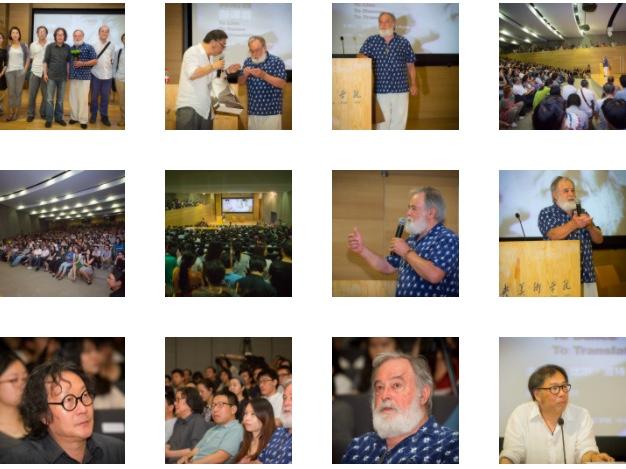
At 6:30 pm on June 12, 2014, the American writer, translator and Sinologist Bill Porter gave a lecture entitled “To Live, To Dance, To Translate” at the Auditorium of the CAFA (Central Academe of Fine Art) Art Museum. The lecture was jointly organized by the School of Humanities, CAFA, and CAFA Art Museum, the poet Xichuan presided over the lecture, and honoured guests included Xu Bing, Vice President of CAFA, Yu Fan, Jiang Jie, teachers of the Department of Sculpture, and poets Zhai Yongming, Ouyang Jianghe, etc., were also presentat the lecture.
Host Xichuan initially told the audience of his experience of his meeting with Bill Porter, whose pen name was Red Pine, his publications of the Chinese edition included “Road to Heaven”, “Zen Baggage”, “The Tour of Yellow River”, “Reading the Heart Sutra”, “Finding Tao in China”, “Silk Road”, etc.; his English translations include “Tao Te Ching”, “One Thousand Poems”, “Cold Mountain Poems”, “In Such Hard Times: The Poetry of Wei Ying-wu”, etc. Xichuan said Bill Poter’s translation was distinctive and creative which also made a contribution to English poetry itself, and he called Bill Porter immortal.
Bill Porter gave a lecture starting from his childhood experiences. He was born into a rich family, but he felt rich people had a deceptive smiling face, so they weren’t “real people”. Instead, he thought the “real people” were the servants of his family. At the age of 15, his parents divorced, and his father soon became bankrupt which made him relaxed and happy. It also made him clear that money was not the target he pursued in his life.
In 1972 Porter went to the Fo Kwang Shan Buddhist monastery in Taiwan, to concentrate on studying Zen. During this period of practice, Bill learned and translated Chinese, and he thought through translating, he would be able to learn another foreign language. In addition, this experience brought him freedom which was the biggest harvest for him, because he found that, although he could learn a lot of knowledge at Columbia University, it seemed like“delusions”, his thinking was controlled by the system. But the practice in the temple helped him depose the “delusion”, and obtain freedom.
In 1989, funded by Wang Wenyang, the son of a rich man in Taiwan, Bill was able to travel in China, and he started an historical record looking for hermits in the Zhongnan Mountains, combining the experience and the historical anecdotes, he wrote a book Road to Heaven. In 2012, at 69, Bill began the last trip – “finding them gone”. This time, along the Yellow River and the Yangtze River, he followed the footprints of 36 poets including Chen Zi-ang, Cao Zhi, Ruan Ji, Ouyang Xiu, Su Dongpo, Li Qingzhao, Bai Juyi and was able to have a dialogue with them across time and space.
In the lecture, Bill Porter wittily told the story of his learning Chinese and practicing in the mountains, engaging in translation for almost 40 years, his discovery that translating was the best way to understand a culture. For Bill, translation was a kind of “dance”, and moreover, the dance relied on Chinese culture. He took the translating process as the metaphor of the story Jiang Ziya Fishing, sometimes he spends a lot of time on the translation, waiting for inspiration through meditation, and with the help of others’ strength.
In the following Q & A, Bill Porter shared the harvest on the road of translation, the feeling of China, and the understanding of Zen. Bill said there wasn’t any correct or wrong translation, as there wasn’t any perfect “dance”, but one needed to see the inner heart, because translation was a performing art which allowed the pursuit of your own happiness. Bill was like a practicing person, he thought Zen had no thought, and the so-called“enlightenment” was also a kind of delusion.
After the end of the lecture, Xichuan gave some small gifts to Bill on behalf of CAFAM, and he himself gave a set of ancient coins of the Tang Dynasty to Bill Porter.
Text: Ye Yuanfeng, translated by Chen Peihua and edited by Sue/CAFA ART INFO













 Peace LiLy
