The Five People You Meet in Heaven, by Mitch Albom, an enchanting, beautifully crafted novel that explores a mystery only heaven can unfold. It is a tale of a life on earth. It’s a tale of life beyond it. It’s a fable about love, a warning about war, and a nod of the cap to the real people of this world, the ones who never get their name in lights.
This book is about the meaning of life. What do we humans live for? Eddie, the protagonist, thought his life was meaningless during his lifetime. After his death, he met five people in heaven. These five people, known and unknown, all played a pivotal role in Eddie’s life. They taught Eddie the meaning and value of life. At last Eddie was relieved. The originally heavy soul also became lighter. Each of us is running towards death. Death is not scary. The scary thing is that we do not know how to live.
Eddie is a grizzled war veteran who feels trapped in a meaningless life of fixing rides at a seaside amusement park. As the park has changed over the years — from the Loop-the-Loop to the Pipeline Plunge — so, too, has Eddie changed, from optimistic youth to embittered old age. His days are a dull routine of work, loneliness, and regret.
Then, on his 83rd birthday, Eddie dies in a tragic accident, trying to save a little girl from a falling cart. With his final breath, he feels two small hands in his — and then nothing. He awakens in the afterlife, where he learns that heaven is not a lush Garden of Eden, but a place where your earthly life is explained to you by five people who were in it. These people may have been loved ones or distant strangers. Yet each of them changed your path forever.
Eddie arrives in Heaven, where he meets “the Blue Man.” The Blue Man explains that Eddie is about to journey through Heaven’s five levels, meeting someone who has had a significant impact upon his life or someone on whom his life had a significant impact. Eddie asks why the Blue Man is his first person, and he informs Eddie that, when Eddie was very young, he caused the car accident that killed him. From this, Eddie learns his first lesson: there are no random events in life and all individuals and experiences are connected in some way.
Eddie meets his former captain from the army, who reminds Eddie of their time together as prisoners of war in a forced labor camp in the Philippines. Their group burned the camp during their escape and Eddie, while running away, remembers seeing a shadow move in one of the huts. The Captain confesses that he shot Eddie in the leg to prevent Eddie from chasing the shadow into the fire. This saved Eddie’s life despite leaving him with a lifelong severe limp. Eddie then learns how the Captain died: he stepped on a land mine that would have killed all the men had he not set it off.
Eddie finds himself outside a diner, where he sees his father through a window. A well-dressed woman named Ruby appears and introduces herself to him. Ruby explains that Ruby Pier was named after her by her husband Emile, who built it in tribute to her. Ruby shows Eddie the true cause of his father’s death, which is different from what he had always believed. She tells Eddie that he needs to forgive his father.
Eddie meets his late wife, Marguerite. They remember their wedding, and Marguerite teaches Eddie that love is never lost in death; it just moves on and takes a different form.
Eddie awakens to see children playing along with a riverbed. A young Filipina girl named Tala comes up to him. Tala reveals that she was the little girl from the hut that Eddie set on fire. Distraught, Eddie breaks down both cursing and asking God “why?” Tala hands him a stone and asks him to “wash” her like the other children in the river are doing to one another. Eddie is puzzled, but dips the stone in the water and starts to scrape off the injuries he had inflicted on her. Tala’s wounds begin to clear until she is freed of all the scars. Eddie asks Tala if she knows if he was able to save the little girl before his death. Tala tells him he did manage to push her out of the way. In this way, Tala explains, he also managed to atone every day for her unnecessary death.
In the end, it shows that Eddie’s Heaven is the Stardust Band Shell, where he met Marguerite.
One by one, Eddie’s five people illuminate the unseen connections of his earthly life. As the story builds to its stunning conclusion, Eddie desperately seeks redemption in the still-unknown last act of his life: Was it a heroic success or a devastating failure? The answer, which comes from the most unlikely of sources, is as inspirational as a glimpse of heaven itself.
Reading The Five People You Meet in Heaven helped me understand deeper about the law of cause and effect in Buddhism teaching. We live in the web of reincarnation of life and death woven by our own karma. Each one of us is connected by the threads in this vast web. Our thoughts, words, and actions all have a small or big impacts to others near and far. What we humans need now is more love, respect, kindness and compassion, and less conflict, fighting and argument.
In 2014, I was diagnosed with stage 2 spleen cancer and had the surgery performed at the University of Taiwan Hospital. In June the same year, I started chemotherapy. Sister Qinyi Zhou came to visit me in September that year and brought me a copy of the book The Buddha Speaks on Curing the Hemorrhoids Sutra. I chanted the sutra continuously for one month and I noticed the dark brown nails on my hands – the side effect of chemotherapy – had started to fade. It was unbelievable!
During that time, sister Zhou and Buddhist brother Sangdun Chuba Rinpoche frequently visited me and even helped me to begin to set up an altar and purchased all the necessary items to offer to the Buddhas. I also invited Buddhist brother Jijia Cuoren Rinpoche and many other Buddhist brothers and sisters to come to my house for the purification ceremony and beseeching blessings. I then set up my dharma-listening center. I requested recorded Dharma from International Buddhism Sangha Association in order to promote Buddha Dharma and benefit others. After that, miraculously my symptoms of peeling skins on my hands and feet and the mouth ulcer that was seriously affecting my eating gradually disappeared. What was even harder to believe was that the MRI done in November 2014 showed that the cancer had vanished. Cancer marker went from 67 to 46 in about a little more than 2 months – The terrifying spleen cancer just disappeared! I had never thought that chanting Buddhist Sutras and setting up a Dharma-listening center would have such powerful blessing on me!
Seeing my progress, sister Zhou encouraged me to take the examination to become a Master of Dharma-Listening Sessions so that I could promote the correct views and understanding of the Buddha dharma of H.H. Dorje Chang Buddha III to others. It would be the best way to benefit others and carry out the Bodhicitta. In so doing, I would receive even more blessings, she said. I did not disappoint her and successfully passed the exam in March 2015.
A few months after that, the doctor who was in charge of my chemotherapy, Dr. Yang, suddenly announced that my treatment should be stopped ahead of schedule ( normally it has to last for more than a year) This had never happened before! So, my confidence increased and I was even more diligent in listening to the Buddha Dharma and reading Buddhist books. I consistently rain or shine went to the group cultivation sessions held at Holy Dharma Compassion and Kindness Association. I cultivate myself and learn from the Buddha with a heart of repentance and gratitude. On September 21, 2016 my primary doctor, Professor Tian told me “no more doctor’s visits, just periodical rechecks in charged by Dr. Yang.” So I only need another doctor’s visit! What a great relief! I felt like a burden of rock has shifted off my shoulders.
During the past two years, if it was not because of the blessings of H.H. Dorje Chang Buddha III, if I did not study Buddhism and cultivate myself, if there was no help and encouragement from the Buddhist brothers and sisters , I would not have recovered from cancer and I would not have been able to travel around the world and gone to social functions! In contrast, my husband who had brain cancer and was very stubborn and did not want to believe in Buddhism died in May 2015.
I transform my grief to power and strongly believe in the law of cause and effect. I will continue to study Buddhism, listen to the recorded Dharma of H.H. Dorje Chang Buddha III, cultivate my words, thoughts, and behaviors, promote kindness and eradicate evil, and strive to correspond with the Buddha! Here, I would like to thank all the members of the medical team at Taiwan University who have treated me, all my relatives and family members, my Buddhist brothers and sisters for their kindness and care. They have made it possible for me to cultivate and learn from the Buddha! Amitabha!
Dorje Chang Buddha is Buddha Vajradhara (金剛總持, pronounced jin gang zong chi in Chinese, which literally means “Supreme Ruler of the Vajra Beings”) and is also called in Chinese 持金剛 (pronounced chi jin gang, which literally means “Ruler of the Vajra Beings”). Dorje Chang Buddha is not 金剛持 (pronounced jin gang chi in Chinese, which means “Practitioner of the Vajra” as explained below). In English, people often use the word vajradhara to refer to a 金剛持 (jin gang chi), or Practitioner of the Vajra. Actually a 金剛持 (vajradhara) is a master or guru. BuddhaVajradhara is a Buddha. Moreover, Buddha Vajradhara is the primordial sambhogakaya Buddha whose sambhogakaya manifested out of the dharmakaya of Adharma Buddha (Adi Buddha, or Samantabhadra Tathagata). All of the Buddha-dharma of Buddha Vajradhara originated from the tathata (true suchness) of Samantabhadra Tathagata. With respect to the dharmakaya of Samantabhadra Tathagata, there is no past and no future. Without form yet not empty, He neither comes nor goes. There are no Buddhas above Him to become. There are no living beings below Him to be saved. Such is His absolute truth. Thus, the dharma-body state of Samantabhadra Tathagata is without signs or characteristics, without speech, and without form. As such, there is no subject or being who could expound the dharma. Without such a subject or being, the multitudinous living beings could not be saved.
Because of such karmic conditions, the formless dharmakaya Buddha generated the first sambhogakaya Buddha with form. This sambhogakaya Buddha with form transformed into Vajrasattva and other nirmanakayas. In order to make a distinction between those three, the dharmakaya Buddha was named Adharma Buddha; the sambhogakaya Buddha was named Dorje Chang Buddha; the nirmanakaya was named Vajrasattva. Actually, all three are Samantabhadra Tathagata, all three are Adharma Buddha, and three are Dorje Chang Buddha. In truth, there are not two Buddhas. These distinctions are due to a dharmakaya, sambhogakaya, and nirmanakaya. Based on this dharma, Samantabhadra Tathagata did not directly incarnate. Even the ancient Buddha Dipankara and Vajrasattva were the nirmanakayas of Dorje Chang Buddha.
Dorje Chang Buddha is also called Buddha Vajradhara or Ruler of the Vajra Beings (持金剛 chi jin gang). In the entire universe, Dorje Chang Buddha is the first Buddha with form and is the highest Buddha. That is, the highest leader of Buddhism in the entire universe came into being in the form of Dorje Chang Buddha. It was Dorje Chang Buddha who began transmitting dharma and saving living beings in the dharmadhatu. As a result, Buddhism was born and the Buddha-dharma began spreading.
However, many sects and lineages list Samantabhadra Tathagata as the first Buddha who began all the lineages in the dharmadhatu. This way of thinking is actually correct as well. That is because although Samantabhadra Tathagata is a dharmakaya without form and has no way of speaking, the origin lies with this dharmakaya from which the sambhogakaya Dorje Chang Buddha manifested. This sambhogakaya Buddha was the first one to spread the Buddha-dharma in the dharmadhatu. That sambhogakaya Buddha also transformed into Vajrasattva and other nirmanakayas whospread the dharma in the triloka (three spheres). Because of the birth of Dorje Chang Buddha, living beings were thus able to become holy beings in accordance with His dharma teachings.
We often see in dharma books a blue image of Adharma Buddha. Actually, this image is a symbol. Such a symbolic form is necessary since the tathata emptiness of Adharma Buddha is invisible and cannot be depicted in a thangka. There is no way to draw the shape of emptiness. The dharmakaya has no features that can be pictorially depicted. In fact, the concept of dharmakaya is the absolute truth of the universe (dharmadhatu) that is not born and does not perish. The sambhogakaya Buddha (Buddha Vajradhara) manifested out of this concept of not being born and not perishing.
Dorje Chang Buddha is the ancient, primordial sambhogakaya Buddha. He has the unsurpassed virtuous appearance that all of the Buddhas in the ten directions have. He was the first in the dharmadhatu and triloka (three spheres) to express the dharma. Therefore, Buddha Vajradhara, or Dorje Chang Buddha, is actually the greatest leader of Buddhism in the entire dharmadhatu. He is the original ancestor of Buddhism.
However, many Buddhists misinterpret Dorje Chang Buddha, or Buddha Vajradhara, as being a 金剛持 (jin gang chi), or Practitioner of the Vajra (i.e. vajradhara). This is a mistake in a matter of principle that carries with it a karmic offence. Buddha Vajradhara has the meaning of one who is in charge of and has supervision over all of the vajra beings. Thus, He is the 持金剛 (chi jin gang) or Ruler of the Vajra Beings, the one who has dominion over the vajra beings. On the other hand, a 金剛持 (jin gang chi), or Practitioner of the Vajra (i.e. vajradhara), is one who learns the dharma and teaches others. Such a person enlightens himself and others. The term 金剛持 (jin gang chi), or Practitioner of the Vajra, connotes Vajra Master. There is a world of difference between a 金剛持 (jin gang chi) or Practitioner of the Vajra on the one hand and a 持金剛 (chi jin gang) or Ruler of the Vajra Beings on the other hand.
Buddha Vajradhara (also called Ruler of the Vajra Beings) has passed down dharma to all of the Buddhas and Bodhisattvas, who received such dharma. All of the Buddha-dharma of both exoteric and esoteric Buddhism was originally transmitted by this Ruler of the Vajra Beings. The 84,000 dharma methods that Sakyamuni Buddha taught were transmitted to Sakyamuni Buddha by the ancient Buddha Dipankara, who was a nirmanakaya of Dorje Chang Buddha. Tibetan esoteric Buddhism, which contains all of the dharma of the Nyingma, Sakya, Jonang, Kagyu, and Geluk sects, including the Kalachakra Vajra Dharma transmitted by Sakyamuni Buddha; Japanese esoteric Buddhism; and esoteric Buddhism taught by Sakyamuni Buddha contained in the Tripitaka all come from the lineage of which Dorje Chang Buddha is the original ancestor or from the lineage of His nirmanakaya, Vajrasattva. 金剛總持 Buddha Vajradhara or Ruler of the Vajra Beings is the supreme leader of Buddhism in the dharmadhatu. He is not a Vajra Master who is a 金剛持 (jin gang chi), or Practitioner of the Vajra (i.e. vajradhara).
When disciples find a qualified master, they should visualize their Vajra Master as being a Buddha. This is done out of respect for the dharma and respect for one’s lineage. However, no matter what type of master he may be, if his identity or status has not been recognized as a Buddha by rinpoches of great holiness in accordance with the dharma, then he is not a Buddha. Still, the disciple must visualize Him as a Buddha. Even the holy and venerable Vimalakirti, who as the second Buddha Vajradhara, was affirmed as a Tathagata (Buddha) through an announcement of Sakyamuni Buddha.
The incarnation of Dorje Chang Buddha is different from the nirmanakayas of any other Buddha. Such an incarnation is a primordial manifestation of the existence of Buddha-dharma. In each world of living beings, there can be at any one time only one incarnation of Dorje Chang Buddha, who manifests or expresses the existence of the true dharma. There will not be a second incarnation of Dorje Chang Buddha in the same age or era. Only after the first incarnation of Dorje Chang Buddha leaves the world can the second incarnation be born based on karmic conditions relating to the good fortune of living beings. For example, the holy and venerable Vimalakirti, who was the second Dorje Chang Buddha, took birth in this earthly realm in the past. The third Dorje Chang Buddha,H.H. Wan Ko Yeshe Norbu, took birth in this earthly realm more than two thousand years after Vimalakirti left it and only when karmic conditions relating to the good fortune of living beings had matured.
Nobody can get away with falsely claiming to be the incarnation of Dorje Chang Buddha. In order to protect the dignity of the Buddha-dharma in the dharmadhatu and prevent demons from falsely claiming to be Buddha Vajradhara or the Ruler of the Vajra Beings, Buddha Vajradhara must be born with His own dharma and realization so that He may manifest or express the dharma. No other Buddha is able to manifest realization equal to the realization of Dorje Chang Buddha. That is because in order to protect the true dharma, the Buddhas do not manifest realization powers at the sameholy level as the realization of Dorje Chang Buddha. Conversely, all demons lack the power to manifest such realization and therefore cannot manifest such realization.
When Sakyamuni Buddha lived in this world, Dorje Chang Buddha took birth as the holy and venerable Vimalakirti, who helped Sakyamuni Buddha teach the 500 monks and 8,000 Bodhisattvas. The holy and venerable Vimalakirti, who was the second incarnation of Dorje Chang Buddha, had the highest wisdom and the greatest ability to manifest supernatural powers as an expression of dharma. No other holy being could match Him.
H.H. Mahavairocana Tathagata formally pronounced that the third incarnation of Dorje Chang Buddha, H.H. Wan Ko Yeshe Norbu, must meet five conditions: He must successfully invoke the Buddhas to bestow nectar. He must be able to perform the Golden Vase Selection of Karmic Affinity and predict the results of that ceremony beforehand. He must be able to eliminate the karmic obstructions of disciples. He must be able to take mist, place it inside a hollowed out sculpted boulder, and have the mist stay there. He must be able to carve wondrous multicolored sculptures.
The formal pronouncement stated that no other holy being could repeat those five types of accomplishments. It also stated that if any other person of great holiness repeat those five types of accomplishments, then Mahavairocana Tathagata’s recognition that H.H. Wan Ko Yeshe Norbu is Dorje Chang Buddha is false, and the pronouncement has deceived the public in order to build up a false reputation.
The facts have proven that in this world there is no being of great holiness and virtue or even an expert who is able to match the accomplishments of H.H. Dorje Chang Buddha III Wan Ko Yeshe Norbu. Furthermore, great dharma kings on the level of a Buddha or Bodhisattvahave unanimously recognized the identity of H.H. Wan Ko Yeshe Norbu through recognition certificates. This thoroughly proves that no one can get away with falsely claiming the identity or status of Dorje Chang Buddha.
In order to prevent demons from wreaking havoc by falsely claiming to be the incarnation of Dorje Chang Buddha, the required number of many holy beings must recognize the incarnation of Dorje Chang Buddha. Furthermore, many additional holy beings must bear witness to the veracity of the recognition and respectfully offer congratulations. The many holy beings who recognize the incarnation of Dorje Chang Buddha must be Buddhas, Bodhisattvas, or great dharma kings. Those who bear witness to the veracity of the recognition and respectfully offer congratulations must beextremely holy and virtuous Bodhisattvas. All of those who recognize, bear witness, and respectfully offer congratulations must be famous leaders within Buddhism and great rinpoches. If the identity of the person was not recognized by those on such a holy level, if congratulations were not respectfully offered to him by those on such a holy level, and if he does not have legitimate recognition certificates, then his claims that he is a holy being are false.
People say, “So-and-so rinpoche is universally recognized as the incarnation of Buddha Vajradhara.” This way of speaking is based on heretical and erroneous understanding. It is not in accord with the rules of true Buddhism. Where is the realization of this rinpoche that an incarnation of Buddha Vajradhara would have? Does this rinpoche have complete proficiency in both exoteric and esoteric Buddhism? Does he have full mastery of the Five Vidyas? Which five dharma kings have recognized his identity as being Buddha Vajradhara and which ten dharma kings or rinpoches have certified that recognition? Can he show others a recognition certificate showing he is the third Buddha Vajradhara? Which several famous people of holy virtue respectfully offered congratulations to him for being recognized? No matter how high a certain monastic may be, if he does not have true realization and the required written recognitions andcongratulations stating he is the third incarnation of Buddha Vajradhara, then all claims by others that he is Buddha Vajradhara are flattery, exaggeration, and rumors.
Hence, one must understand that Buddha Vajradhara (金剛總持, jin gang zong chi) is 持金剛 (chi jin gang, which is a Buddha). On the other hand, a 金剛持 (jin gang chi) is a lama (master). Anyone who misinterprets a 金剛持(jin gang chi) as being a 持金剛 (chi jin gang) or Buddha Vajradhara is undoubtedly placing the status of a mere vajra master over that of Amitabha Buddha and other Buddhas. Such conduct is a terrible offense because according to the sutras and esoteric scriptures Buddha Vajradhara is Dorje Chang Buddha (持金剛 chi jin gang), the Master of the Five Buddhas and other Buddhas.
The World King of Monks, Venerable Elder Wu Ming, lived for 102 years. Thirty years ago he vowed to pass away sitting in a jar, and leaving relics for people to venerate.
Venerable Elder Wu Ming, a witness of the Buddha’s Nectar Assembly, has personally experienced when H.H. Dorje Chang Buddha III invoked the Buddhas to bestow nectar from the sky into a bowl. He passed away on July 19, 2011 on the day of Avalokitesvara’s Enlightenment.
Venerable Elder Wu Ming observed the precepts strictly and cultivated himself in a practical and thorough manner. His fundamental practice was the Kuan Yin Dharma, which he has penetrated deeply. He edified countless people.
He has been praised as “the incarnation of Kuan Yin Bodhisattva in Taiwan”, and is known as “the World King of Monks” in Buddhism.
At a Buddha Bestowing Nectar Empowerment Initiation conducted by H.H. Dorje Chang Buddha III, Elder Wu Ming manifested his two-face and two-arm nirmanakaya form. It revealed that he was a holy monk who was the incarnation of a bodhisattva.
Elder Wu Ming has been working non-stop for half a century to propagate the dharma to benefit living beings. He traveled and lectured around the world to propagate the Dharma and made a positive contribution to Buddhism.
Elder Wu Ming received a great Nectar Dharma Empowerment from H.H. Dorje Chang Buddha III for his lifelong practice. In the end he obtained great accomplishment! Living beings greatly admire him.
【Video】What happened to the World King of Monks who passed away sitting on a jar?
I was a factory worker in the past. In 1993, a co-worker had to go home to help plant his family’s wheat crop. His leave request was not approved by the shift leader. So, I went to cover him.
When looking at his work in the past, I thought I should be able to do it. In reality, it was not that simple. I was not skillful in operating the machine. The machine pulled my right hand in. When I dragged the arm out, I had no flesh in my hand and arm, only a long, bare bone left.
The doctor at the hospital took a look and told me that I must have amputation. The upper arm bone was fractured; however, he could reconnect it back.
When I slowly woke up from the surgery, I saw that my entire right arm…, my right arm was like, so short , only 5, 6 cm long.
Actually, the doctor had told me very clearly before the surgery that the amputation would only be limited to my hand. This is just not fair at all. I was furious. How could he be a doctor? What medical ethics did he have?
I cried my heart out at that time. I got very upset. I did not even want to go out of my room. I got a room from the company. I didn’t go out at all and felt that it would be embarrassed to go out and see people. Why do I get such bad luck?
I was depressed all day long and also could not get along with my wife. I would smash bowls or chopsticks whenever things didn’t go my way. That happened a lot. When I popped open a bottle of white wine, I would have a big, long gulp. In one morning, I could almost finish a bottle with only a few drops left. I buried myself in the alcohol at home. Once I am drunk, I lose my temper. I almost had a mental breakdown and lost confidence in my life.
It started out from doing a favor, to help out my co-worker. How did it make me to become a handicapped person? How could such a thing happen to me? Even the hospital mistreated me in that way. The whole society did not treat me fairly. I also didn’t see justice from the Heavenly God…….
One day, my daughter told me: “Father, I will take you to a Buddhist center. Go learn Buddhism. Buddhism will be good for you, and for our family. Chant “Namo H.H. Dorje Chang Buddha III!”
“What did you tell me to chant?” I said, “I have only heard about Amitabha Buddha. Why didn’t I know about H.H. Dorje Chang Buddha III?”
Starting from that day, I would head to the Buddhist center and then listened to the Dharma discourses every day. I listened to the discourse on the Law of Cause and Effect. I listened to many pre-recorded dharma discourses, such as The Dharma to Cut Off the Twenty Worldly Emotions, etc. I listened to The Dharma to Cut Off the Twenty Worldly Emotionsa few more times. I also listened more times to the discourse on the Law of Cause and Effect. Eventually I understood that everything is a result of the Law of Cause and Effect.
I gradually realized that the loss of my right arm was not without a cause. Whether in my past lifetimes or in this lifetime, I have harmed so many living beings. This bit of suffering is what I deserve. When I took the lives of other living beings in the past, I caused them sufferings.
Through the learning, I slowly understood the truth about the Law of Cause and Effect. The hatred in my mind also gradually vanished.
I then made a resolve.
Since I have learned and understood the truth of the Law of Cause and Effect, I will now repent to all the living beings I have killed or harmed. I will repent to them. With the utmost respect, in front of the Buddhas and Bodhisattvas, I will repent with my most pious heart.
I will do 100,000 prostrations for repentance. In less than four months, I completed 100,000 prostrations. H.H. Dorje Chang Buddha III told us, only cultivation can transform the Law of Cause and Effect.
The retribution I am receiving right now is caused by what I have done in many lifetimes and eons ago. From now on, I will follow and learn from H.H.Dorje Chang Buddha III and cultivate myself.
As long as I plant good causes. I will definitely get good fruition in the future. I am determined to follow and learn from the Buddha and cultivate myself until I attain accomplishment.
Fangsheng 放生 refers to releasing lives and Buddhists are encouraged to do that during the course of their practice. What is the truth behind this action?
When we release a life, we save a life. In return, it will lengthen our lifespan.
It is a meritorious deed and will accumulate merits.
It stresses the importance of compassion and kindness. We cannot bear to see them die or getting harmed. We want them out of life-threatening situations.
If one is sick and goes to release lives, it will bring benefits to one’s health.
All living beings are equal. Whenever they are in danger, we will rescue them.
Fangsheng promotes compassion, kindness, equality, and harmony.
It was April 2015. My stomach suddenly became harder and harder, and it swelled noticeably after eating. A colleague suffered from colorectal cancer and also had a hard stomach. I quickly went to the hospital for examination.
After the CT scan, the doctor said that the initial diagnosis was a liver tumor that was suspected to be cancerous, so emergency surgery was necessary. When I heard this result, I felt my heart racing. I thought that this was my karma and I should suffer it if I need to. If I didn’t die, I would be reprimanded.
At that time, I often went to the Sanger Mission Temple to listen to the dharma courses of H.H. Dorje Chang Buddha III. I understood some truths about karma. So I accepted it calmly without complaining to others, and actively cooperated with the doctor’s treatment. A highly skilled Indonesian doctor took the lead for my surgery. She is the second best doctor in Southern California. She said: “Your liver tumor has a layer of membrane wrapped with bad things. We just need to take out the cyst and we don’t need to cut the liver, so it won’t hurt the liver. After doing so many operations, this is the second strangest example I have ever seen. The doctor asked “Are you a Buddhist?”
Even more strange is that despite the anesthesia effects after the operation, I seem to have temporarily lost the pain. The doctor prescribed morphine to relieve the pain, but I didn’t use it because I didn’t feel any pain at all. After the operation, I spoke as usual, full of energy. On the fourth day after the operation, a sister came to visit me and said that the monks in Sanger Mission had not seen me for a while and knew about my situation. So they recited the Sutra in the morning and night, then they transferred their merits to me.
The power of Buddhism and the power of recitation of the Sutra are incredible. My operation went well and the wound healed quickly. A week later, I walked very fast, and I didn’t look like someone who had undergone surgery! After several months of observation, the doctor determined that my tumor was benign and he ruled out the possibility of cancer.
The Buddha and Bodhisattva have saved my life twice, and I am truly grateful.
The Explanation of the Buddha’s Title – “H.H. Dorje Chang Buddha III
On April 3, 2008, a solemn and dignified first-publishing ceremony of a fact-recording book entitled H.H. Dorje Chang Buddha III, which published jointly by the World Buddhism Publishing LLC and the World Dharma Voice, Inc., was held at the Library of the Congress of the United States. The book was also formally accepted into the collection of the Library of the Congress of the United States. Only since that time, did people in the world know that Master Wan Ko Yee, who had been broadly respected by the great masses and who had also been known as Great Dharma King Yangwo Yeshe Norbu, had been recognized by the world’s leaders, regent dharma kings, and great rinpoches of Buddhism through official documents as the third incarnation of Dorje Chang Buddha, who is the primordial Sambhogakaya Buddha of the universe. The Buddha’s name is H.H. Dorje Chang Buddha III. Since then, people began to address His Holiness the Buddha by “Namo[1] Dorje Chang Buddha III.” This is similar to the situation that Sakyamuni Buddha’s name was Prince Siddhartha Gotama before attaining Buddhahood. However, after Sakyamuni Buddha had attained Buddhahood, His title changed to “Namo Sakyamuni Buddha.” That is why we now address His Holiness the Buddha as “H.H. Dorje Chang Buddha III.” In particular, on December 12, 2012, the Senate Resolution No. 614 of the United States Congress officially used “His Holiness” in the name addressing Dorje Chang Buddha III (That is to say, “H.H. Dorje Chang Buddha III.”) Since then, the title and status of H.H. Dorje Chang Buddha III has been definitive by nature. And, as a matter of fact, “Dorje Chang Buddha III” is a name used legally in governmental and official legislative documents. Therefore, the previously used respected name and titles such as “Wan Ko Yee,” Great Master, and Great Dharma King no longer exist. However, the news below was published before the Buddha’s title of H.H. Dorje Chang Buddha III was publicly announced. At that time, people did not know about the true status of His Holiness the Buddha. Therefore, to respect the true history, we still kept the names used before the title of H.H. Dorje Chang Buddha III was legitimately determined in republishing this news. However, all must clearly know that the only legitimate name of His Holiness the Buddha is H.H. Dorje Chang Buddha III and all other names used before the legitimate determination no longer exist.
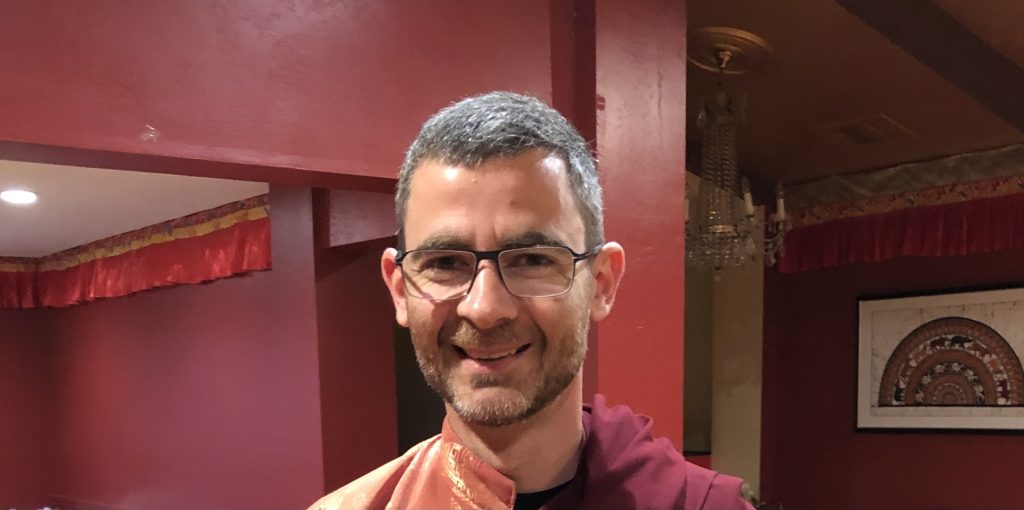
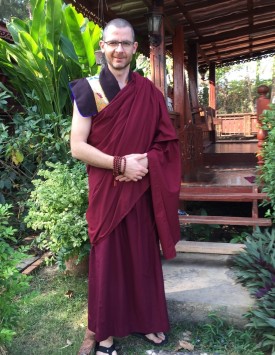
Gongjue Tuji Rinpoche, who founded and leads the Xuanfa Dharmazentrum (Dharma Center) in Cologne, Germany. He is truly a sincere, humble, and dedicated buddhist disciple and totally devoted to our Buddha Master H.H. Dorje Chang Buddha III and his yidam.
In mid-February, after H.H. Dorje Chang Buddha III entered parinirvana, Gongjue Tuji Rinpoche had been visited by the Buddha. H.H. Dorje Chang Buddha III, reassured that Gongjue would be able to receive the inner-tantric initiation, His Holiness had promised that Gongjue’s yidam would make the arrangements. During Gongjue’s practice, his yidam Green Tara appeared and confirmed all this as Gonjue explains in this short video.
CLICK for an article of Gongjue Tuji Rinpoche received a powerful lesson from attending the June 2018 Dharma Assembly celebrating the birthday of H.H. Dorje Chang Buddha III.
CLICK for an article from Gongjue Tuji Rinpoche on his relationship with Green Tara and how She had helped his wife through a dangerous bout of cancer at year 2013. You will see that this is not the first or only time his yidam appeared and spoke to him.
Gongjue Tuji Rinpoche, who founded and leads the Xuanfa Dharmazentrum (Dharma Center) in Cologne, Germany received a powerful lesson from attending the June 2018 Dharma Assembly celebrating the birthday of H.H. Dorje Chang Buddha III. Below is his account of what happened.
When I heard that a very special dharma assembly was going to take place and everyone was encouraged to attend, I was very excited. Actually, I had already planned my trip for this year and booked the appropriate airline tickets. I originally wanted to visit the Holy Vajrasana Temple for a few days later in the year and read the preliminary translations of the Supreme and Unsurpassable Mahamudra of Liberation and Imparting the Absolute Truth through the Heart Sutra. My personal situation usually only allows me to travel to the USA once a year. Which made it a bit difficult for me in this case as it is always a cost issue.
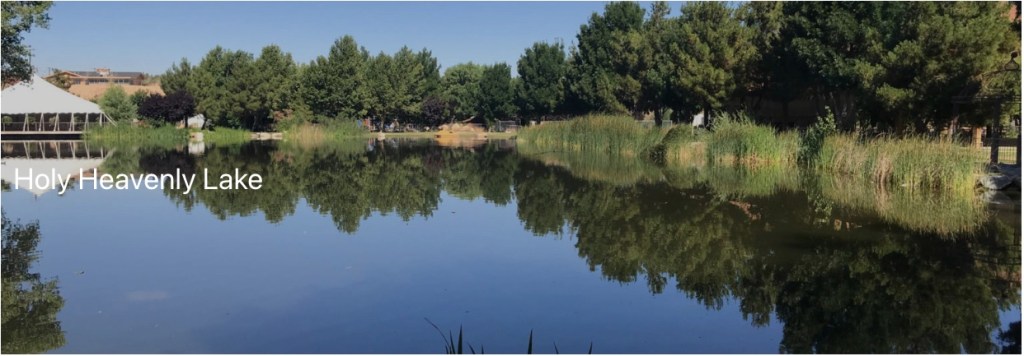
Also, the date fell pretty close in the time we were supposed to move into our new home. All in all, it seemed as if it would not be possible for me to participate in this dharma assembly. But since it was said that everyone should do everything possible to attend, I knew that it had to be something special that I shouldn’t miss. Perhaps we would all be given a very special Dharma? I didn’t want to miss it under any circumstances. I was very sad at the time when the Holy Monk Yin Hai passed away and I was not able to attend one of the dharma assemblies to pay my last respects. This is a brief account of what I experienced when I travelled to the dharma assembly for celebrating the birthday of H.H. Dorje Chang Buddha III at Heavenly Lake, California.
Gongjue Tuji Rinpoche
So this time I had to do everything I could to make sure I didn’t miss this important event. Since 2009 I have been travelling regularly to the USA to learn and receive the true Buddha Dharma. So far everything has always worked out happily and I have never experienced anything negative on these trips. So this time it surely should work, too, although the signs were not good.
So I decided to discuss it with my wife. She is not a Buddhist, but she supports me a lot in being able to practice Buddhism. She wasn’t thrilled when I told her about it. The move was almost upon us and there was still so much to do. Also, we had a lot of expenses at that time with the purchase of the house, so our parents had to support us financially. In the end she agreed to let me go. But she only did it because she didn’t want to be blamed for me missing this important event.
So I booked another flight to California at short notice and was very happy that I was allowed to leave. Unfortunately, it turned out that the flight I had booked before for my trip to the Holy Vajrasana Temple could not be cancelled and I was left with the cost. I still got an affordable accommodation, but due to my limited budget, it was not in an all too nice neighborhood. Arriving there, the first doubts arose whether the decision to fly and leave my wife and daughter behind in the chaos of our move was right.
The next day was the day. The dharma assembly was about to begin. His Holliness, the Buddha came and rose up to the dharma rostrum. Now I should be compensated for everything. Deep down I hoped to get a great Dharma, something which was priceless. And so it was! It was just something completely different than I had expected. His Holliness, the Buddha began to give us a Dharma discourse about self-cultivation. At that moment I began to understand how stupid I really was. It became clear to me that even when searching for the Dharma, you can’t go beyond the principles of self-cultivation, which are to not let others suffer by putting your own interests first. I began to understand how terrible my wife was feeling at that moment when I left her alone at home with all the work and spent a lot of money that we could have used differently right now. I felt very bad and wanted to go home quickly.
When the Buddha finally announced that each participant should receive a special vajra pill, I was at least a little calmer. In the new house I will finally have my own Buddha room with a large altar and I will place this pill there as a “trophy”. So I thought.
From then on I focused on my journey home. All I had to do was check in and get to my plane in time and then everything would be fine again. At the motel I tried to check in online for my flight. But unfortunately the flight was already overbooked and I was not assigned a seat. If I didn’t get this plane anymore and was forced to take the next one, I wouldn’t make it to our move in time. I knew that my wife would not forgive me for this and would get divorced from me. And as if that wasn’t enough, I had also lost my robe. This has never happened to me before and it was not a good sign.
I was devastated and in a state of despair I beseeched my Yidam to help me in this situation. During the practice of my Yidam Dharma I was told not to worry as I would return home in time for the move. But due to my misconduct I have to bear the karmic consequences immediately. In addition, my Yidam explained to me that it is not about how great and big my altar is in my new Buddha room. The highest offering I should make to all Buddhas and Bodhisattvas is correct cultivation. That’s the most important thing! I wouldn’t need to collect “trophies.”
I was deeply grateful and burst into tears. I found out afterwards, that I could book a Priority Seat by a further surcharge. In total, this was the most expensive flight I ever had. This was just karmic consequence. So I actually got home in time and from that point on focused even more on correct cultivation.
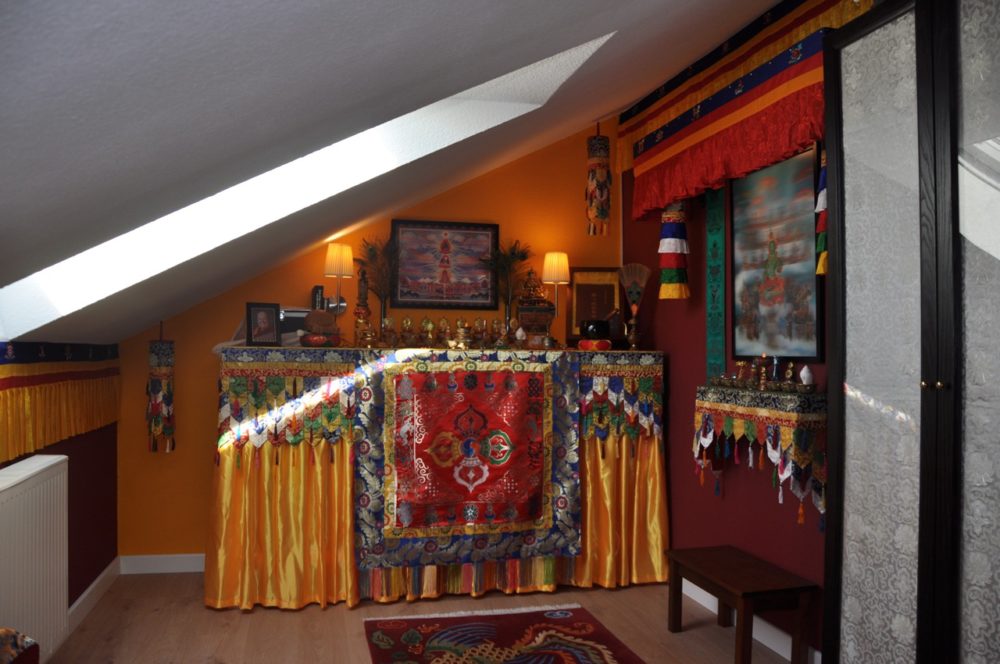
I had to promise my wife that I wouldn’t renovate and build the Buddha Room until I had finished everything else in the house. Meanwhile, the new Buddha Room is standing, and every time I enter it, I think back about the event and reflect on whether I have cultivated correctly so as not to enter the room without a real offering.





 Peace LiLy