The Sacred Dragon Stone: Manjushri Bodhisattva’s Compassion and the Five Dragon Princess

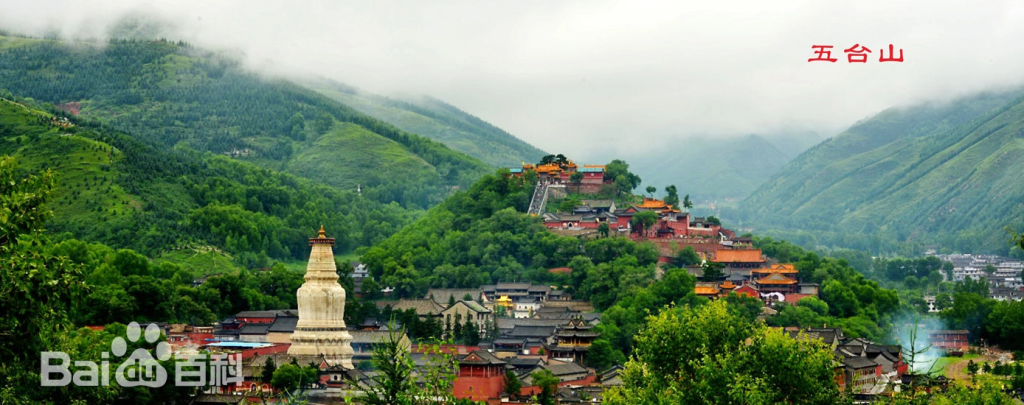
Mount Wutai, home to over 53 sacred monasteries, stands as one of the Four Sacred Mountains of Chinese Buddhism. Each of these mountains is regarded as the bodhimaṇḍa of one of the four great bodhisattvas, and Wutai is the sacred domain of Manjushri, the Bodhisattva of Wisdom. Revered since ancient times, Mount Wutai holds a profound spiritual significance, attracting countless pilgrims seeking enlightenment and divine blessings.

Mount Wutai was the first of the four great mountains to be identified and is often referred to as the “First Among the Four Great Mountains.” Due to its unique status, it is also known as “Golden Wutai.” The identification of this sacred site can be traced back to the Avataṃsaka Sūtra, which describes the abodes of many bodhisattvas. In this scripture, Manjushri is said to reside on a “clear cold mountain” in the northeast. This passage not only solidified Wutai’s spiritual identity but also inspired its alternative name, “Clear Cool Mountain.” With an annual average temperature of around -4°C and high-moisture air, the mountain’s name perfectly encapsulates its serene and pure atmosphere.

Legends tell of Manjushri’s frequent appearances on Mount Wutai, often taking the form of ordinary pilgrims, monks, or most notably, five-colored clouds. Among the many tales that surround this sacred land, the story of the Xielong Stone and the Dragon Temple remains one of the most awe-inspiring.

In ancient times, the climate of Mount Wutai was harsh—winters were bitterly cold, and powerful spring winds carried dust and sand, making the land inhospitable. At that time, the mountain was simply known as “Five Peaks Mountain.” Determined to transform Wutai into a haven for spiritual cultivation and to bring blessings to sentient beings, Manjushri sought the mystical Xielong Stone, a sacred gem held by the Dragon King of the Eastern Sea. This stone possessed miraculous powers that could regulate the climate, making the land fertile and serene.

Manjushri traveled to the Dragon Palace and humbly requested the Xielong Stone. However, the Dragon King hesitated, explaining, “This stone was left behind by the goddess Nüwa. It is a resting place for our dragon clan, and we cannot part with it.”

With infinite compassion, Manjushri responded, “I seek this stone to benefit all sentient beings. I hope you, great Dragon King, will fulfill this virtuous karmic connection.”

Although moved by Manjushri’s vow, the Dragon King was reluctant to relinquish the treasured stone. He assumed that even with his great dharma powers, Manjushri would be unable to move it, as it weighed tens of thousands of pounds. Feigning generosity, he said, “Great Bodhisattva, if you can take the stone, you may do so.”

To the Dragon King’s astonishment, Manjushri gently approached the stone, recited a divine mantra, and instantly shrank the massive rock to the size of a marble. With a flick of his sleeve, he stowed it away, bowed to the Dragon King, and effortlessly departed.

The Dragon King, realizing his mistake too late, could only watch in stunned regret.

When the five dragon princes returned to the palace and learned what had happened, they were enraged. Determined to reclaim the stone, they pursued Manjushri to Wutai Mountain. As they arrived, Manjushri sat in serene meditation, awaiting them.

Upon seeing him, the Fifth Dragon Prince demanded, “Are you truly the teacher of the Seven Buddhas, the Awakened Mother of the Three Periods, Manjushri Bodhisattva?”

Manjushri calmly replied, “Indeed, I am.”

Scoffing, the young dragon sneered, “It is said that past Buddhas were your disciples, yet you appear to be only fifteen or sixteen years old. How can this be?”

Manjushri then imparted a teaching:

“The Buddha taught that there are four things in the world that must never be underestimated:

  • A young prince—though small, he will one day rule the land and influence countless lives.
  • A young dragon—though young, he will one day command the winds and tides.
  • A small flame—though weak, it can grow into an all-consuming blaze.
  • A young monk—though inexperienced, he may attain supreme wisdom through practice.”

Hearing this, the young dragons began to reflect on the depth of Manjushri’s wisdom. However, the young dragons were still defiant. They demanded, “If you truly have great divine power, why not change the climate of Wutai Mountain directly? Why did you have to take the Xielong Stone?”

With patience, Manjushri explained, “Divine power can temporarily change conditions, but only through the Xielong Stone can Wutai Mountain remain perpetually cool and become a sanctuary for spiritual cultivation.”

Unconvinced, the young dragons retorted angrily, “So you admit that your power is limited! Return the stone at once, or we will show no mercy!”

Furious, the five dragons launched a fierce attack, unleashing their claws, storms, and lightning against Manjushri. Yet, no matter how they struck, they could not harm him in the slightest.

In their frustration, they began to tear at the mountains, hoping to shake the ground beneath Manjushri. Their immense strength clawed away the mountaintops, scattering rocks across the land, creating what is now known as the Dragon-Turned Stones (龙翻石).

Realizing the young dragons’ arrogance and aggression, Manjushri used his supreme power to subdue them. He sealed them beneath Mimo Rock (秘魔岩), merging two great peaks, leaving only a narrow crevice for them to reflect and temper their hearts. He then instructed the local mountain spirits and earth deities to ensure the dragons were provided with food and offerings, allowing them to cultivate patience and wisdom until their minds were at peace.

Later, the Dragon King of the Eastern Sea personally traveled to Wutai Mountain, pleading with Manjushri to release his sons.

With a compassionate smile, Manjushri assured him, “I have never harmed even an ant, let alone your five sons. They are here only to refine their minds. Once they achieve inner harmony, they will be freed naturally.”

To honor the young dragons and appease their spirits, Manjushri decreed that a Dragon King Temple be built in their name. There, they would receive offerings and incense from devoted followers, increasing their divine merits while they cultivated.

From then on, the Dragon King Temple on Wutai Mountain flourished, becoming a revered site for pilgrims seeking blessings for favorable weather and divine protection. Its existence symbolizes humanity’s reverence for the water deities and our hope for harmony between nature and sentient beings. Amidst the rising incense and prayers, worshippers not only feel the celestial blessings but also gain insight into wisdom and inner peace through spiritual practice.

Today’s Wutai Mountain is surrounded by lush green hills, beneath a sky of pure blue and auspicious clouds. In summer, the weather shifts between sunshine and rain, mist and fog. On clear days, the vast sky is brilliantly blue, filling the heart with joy and serenity; on rainy days, the misty veils create an atmosphere of elegance and tranquility, bringing deep peace to the soul. Strolling through the mountains, one feels naturally at ease and in harmony with the surroundings.

All of this, in truth, is a manifestation of the blessings and protection of Manjushri Bodhisattva. With His innate cool radiance, Manjushri employed the Dragon-Resting Gem to enlighten the beings of the dragon lineage. In doing so, He also established this sacred pure land of Wutai, where both ordinary and holy beings coexist. Here, He watches over this realm, awaiting the return of the countless wayfarers lost in the endless cycles of samsara.

Link:https://peacelilysite.com/2025/03/04/the-sacred-dragon-stone-manjushri-bodhisattvas-compassion-and-the-five-dragon-princess/

How to Discern Authentic Dharma Teachings

You can receive the Dharma from many sources—through discourses given by Dharma Kings, Rinpoches, Lamas, or great Dharma teachers, as well as by reading their writings. You can also study exoteric and esoteric texts along with classic commentaries by fully realized masters. However, how can you determine whether these are authentic teachings? How do you know if the master or teacher is truly enlightened? And even if they are, how can you be sure that the translations you receive are accurate if the original text was not in English?

This issue applies even to the holy sutras and tantras, which have been transmitted through various traditions, cultures, and translations. Remember, it took centuries and the combined efforts of kings, emperors, and accomplished holy beings to complete these translations in China, Japan, Tibet, and other Buddhist countries. These translations were tested for their correctness by greatly realized beings. The authenticity of teachings must be verified by their efficacy—do they lead to full enlightenment?

Recognizing Accomplished Masters

How can you tell if someone is truly accomplished? A genuine master exhibits complete mastery of the sutras and tantras and demonstrates proficiency in all five vidyas. It is crucial to develop wisdom to discern true Dharma Kings or Rinpoches from those who are not. A reliable way to do this is by listening to the discourses and reading the books of H.H. Dorje Chang Buddha III. His Holiness teaches the correct Buddha-Dharma and has demonstrated mastery of all five vidyas.

Master Mipam Gyatso (1846-1912) of the Nyingma sect warned:

“…. As the sutras and tantras prophesy, there are many who, having abandoned the profound meaning through dry analysis, distribute quasi-doctrine for material gain, leading those of low merit and small intelligence onto a perverse path at this time of the Dharma-Ending Age….”

H.H. Dorje Chang Buddha III has stated that true Dharma teachings enlighten people, increase their good fortune, eliminate disasters, and help them attain the Bodhi state. The Buddha further emphasized that the Dharma must align with the Tripitaka and the commentaries of those who have attained enlightenment. It does not matter whether the teacher is a layperson or a monastic—if the teachings do not conform to the Tripitaka, tantras, or bodhichitta and are not given with compassion, they will contain errors. The Dharma must guide us toward happiness, liberation, and freedom from the cycle of reincarnation; otherwise, it holds no real value.

The Rarity of Listening to True Dharma

The opportunity to listen to the true Dharma is a rare and precious karmic condition. H.H. Dorje Chang Buddha III has said that listening to the true Dharma for one day can yield more progress than ten years—or even decades—of self-practice and meditation. The ability to hear the Dharma is a reward for accumulated merit. Without sufficient merit, one may not even have the opportunity to encounter it.

If you do not understand the principles of Buddhism, your cultivation may be in vain, as you may practice based on a confused understanding of the teachings. Listening to the discourses of H.H. Dorje Chang Buddha III and reading authentic Buddhist books is essential for proper cultivation.

The Proper Way to Listen to the Dharma

How you listen to the Dharma is just as important as receiving it. The analogy of the three pots is often used to illustrate this point. A pot can have three faults:

  1. It can be upside down, meaning it cannot receive water (Dharma cannot enter if one does not pay attention).
  2. It can be dirty, meaning the water is contaminated (Dharma is misunderstood or received with impure motivation).
  3. It can be full of holes, meaning it cannot retain water (Dharma is heard but not remembered or applied).

Even if you have the fortune to hear the Dharma, it will not benefit you if you do not pay attention, misunderstand the teachings, or fail to retain and practice them.

In ancient India and Tibet, practitioners had an extraordinary capacity for memorization. While modern individuals may lack this ability, we have the advantage of electronic recordings and printed texts. We should repeatedly listen to and reread the teachings until we thoroughly understand their principles and integrate them into daily practice—this is true understanding.

Applying the Dharma in Daily Life

It is not enough to merely listen, read, or even memorize the Dharma. True practice requires applying it in daily life. The Buddha’s teachings were meant to be lived, not just studied intellectually. Our actions, speech, and thoughts must align with the Dharma.

Dorje Pa Mu’s book, Dharma That Every Buddhist Must Follow, is an excellent guide, as are the books and discourses of H.H. Dorje Chang Buddha III. However, to truly recognize authentic Buddha-Dharma in the world today, one must read H.H. Dorje Chang Buddha III.

Guidelines for Evaluating Dharma Teachings

The sutras teach that when attending a Dharma lecture or listening to a teacher, one should focus on the teachings rather than the teacher’s personal attributes. Avoid distractions such as whether the teacher:

  • Has or has not violated precepts
  • Comes from a poor or wealthy background
  • Has a pleasant or unpleasant physical appearance
  • Has good diction or a speech impediment
  • Has a melodious or harsh voice

Instead, follow the Buddha’s four guidelines from the Catuhpratisarana and Samdhinirmocana Sutras:

  1. Rely upon the teaching, not the teacher.
  2. Rely upon the meaning, not the text.
  3. Rely upon the definitive meaning, not the provisional meaning.
  4. Rely upon prajna (wisdom), not consciousness.

By becoming familiar with the Tripitaka and tantras, you will be able to evaluate the authenticity of any teaching. Then, through practice, you will discover whether they truly lead to enlightenment. True Dharma will bring real transformation, guiding you toward liberation and awakening.

Link:https://peacelilysite.com/2025/02/28/how-to-discern-authentic-dharma-teachings/

Source: https://holyvajrasana.org/dharma-and-ritual/receiving-dharma

Nezha: From Buddhist Origins to a Chinese Cultural Icon

Recently, the animated film Nezha 2 has become incredibly popular, reaching the top spot in global box office earnings for animated movies. While many believe Nezha is a character from Chinese mythology, his origins can actually be traced back to Buddhist scriptures.

Vaisravana

Nezha’s name first appeared in Vajrayana Buddhist texts, where he is associated with the role of a Dharma protector. He is described as the third son of Vaisravana, one of the Four Heavenly Kings. According to The Ritual of Vaisravana, “The Heavenly King’s third son, Prince Nezha, holds a pagoda and always follows the King.” His duty is to assist his father in safeguarding the Dharma, driving away evil forces, and protecting humanity. In The Mantra of the Dharma Protector Following the Northern Vaisravana Heavenly King, translated by the eminent Tang Dynasty monk Amoghavajra, Nezha is again referred to as Vaisravana’s third son. Other Buddhist texts from the Tang Dynasty, such as The Awakening of Faith in the Mahayana and The Lotus Sutra, also mention Nezha.

In Buddhism, Dharma protectors and yaksha deities often have fierce appearances, symbolizing their hatred of evil and fearless bravery. As a result, Nezha is typically depicted with a wrathful and intimidating image. As Buddhism spread to China, many Buddhist stories and figures gradually merged with local Chinese culture, giving rise to new belief systems. Over time, Nezha became integrated into Taoism and Chinese folk beliefs, forming a unique cultural phenomenon.

The story of Nezha is filled with many well-known and beloved episodes, such as his birth from a ball of flesh, cutting his flesh and bones to repay his parents, and being reborn from a lotus flower. Although this scene cannot be found in modern Buddhist scriptures, it became a popular topic among monks after the Song Dynasty. For example, Volume 1 of The Comprehensive Collection of Zen Verses on Ancient Cases mentions: “Prince Nezha offered his flesh to his mother and his bones to his father, then manifested his true form and used his divine power to preach to his parents.” This suggests that the story of Nezha sacrificing his flesh and bones likely originated from Buddhist texts. Although the exact cause and details are unclear, this story undoubtedly provided a prototype for later adaptations in folk literature.

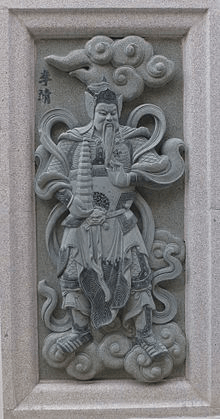
As Buddhism spread throughout China, the assimilation of foreign religions by local culture and the evolution of folk beliefs gradually transformed Nezha’s image, steering it away from its original Buddhist context and toward a more Chinese identity. After the Tang Dynasty, the worship of Vaisravana (known as Bishamonten in Japan) reached its peak in China, gaining widespread recognition from both the imperial court and the common people. He was honored in official rituals and revered by many folk believers. Simultaneously, Li Jing, a prominent Tang Dynasty military general, became a popular figure of worship as a god of war. Renowned for his military campaigns against the Turks and Tuyuhun in the northwest, Li Jing was deified as early as the Tang Dynasty, with dedicated temples built in his honor during the Song Dynasty.

Li Jing’s temple wall statue

The broader and deeper the spread of a belief, the greater the possibility of its transformation and integration with other cultural elements. Over time, through public imagination and interpretation, the belief in Vaisravana merged with the worship of Li Jing, forming a new deity known as “Pagoda-Wielding Heavenly King Li” (Tuota Li Tianwang) by the Song Dynasty at the latest. From then on, Vaisravana took on the surname Li and became more secularized and localized within Chinese culture. Since Li Jing became identified with Vaisravana, it was only natural within folk beliefs to regard Nezha as Li Jing’s son. This marked Nezha’s departure from the cultural context of foreign religions and his integration into the Chinese pantheon.

This transformation made Nezha a more relatable and accessible figure, understood through the lens of native cultural concepts. As a result, Nezha’s story gained broader appeal, providing ample room for reinterpretation and adaptation in later generations.

Nezha holds an important place in ancient Chinese mythology. Under the influence of Taoism, he was endowed with more mythological attributes, portrayed as a young hero with powerful magical abilities who frequently battles demons and protects the people. His story further developed in classic literary works such as Journey to the West and Investiture of the Gods, where Nezha became a symbol of justice and courage.

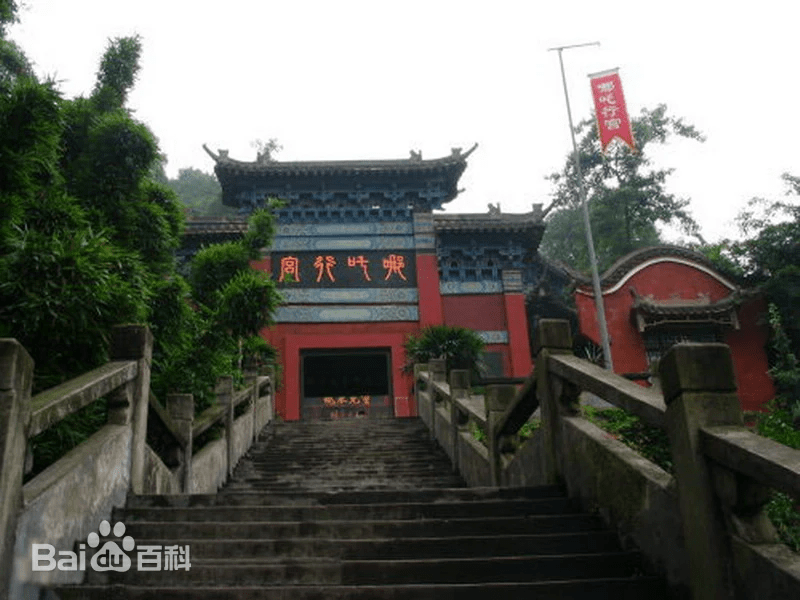
Nezha Temple in HeNan China

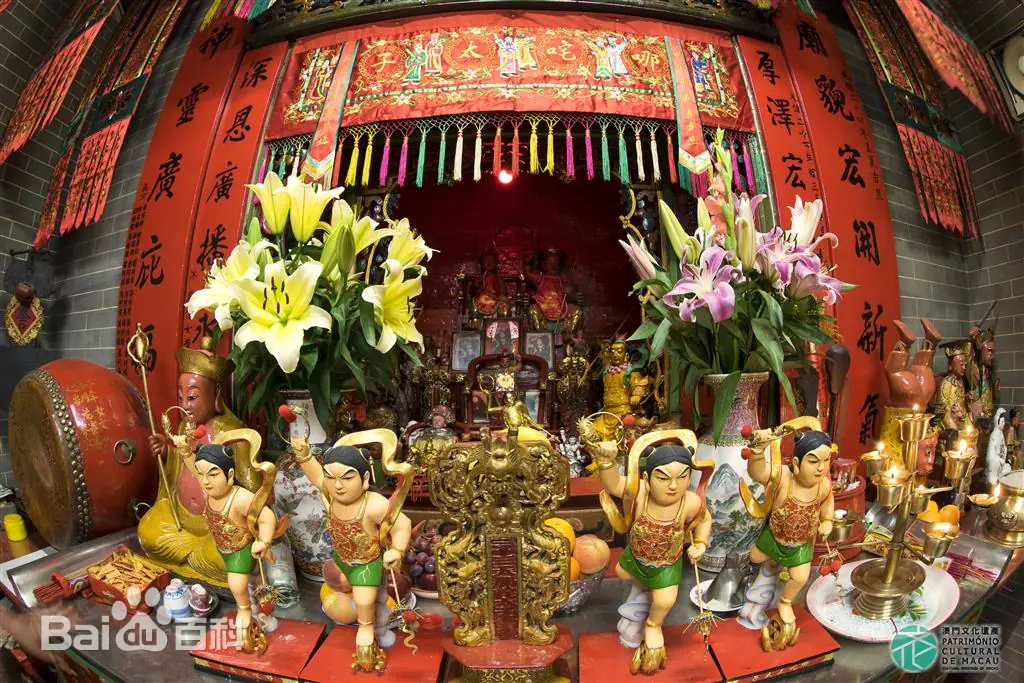
Folk worship activities for Nezha

Link:https://peacelilysite.com/2025/02/21/nezha-from-buddhist-origins-to-a-chinese-cultural-icon/

HQ Announcement 20210101: An Impostor Will Not Dare To Practice These Eighteen Dharmas

The Headquarters would like to use this announcement to express our gratitude to Namo Dorje Chang Buddha III for the dependent origination of the Dharma impartment for a Shakya descendant, who is the Chairperson of a Buddhist University. This Dharma discourse has jolted and woken the karmic-obstructed Buddhists. Such an earth-shattering Dharma discourse has also destroyed the heresy that “Deluded thought makes you an ordinary person, an enlightened thought makes you a Buddha.” We are incredibly grateful to Namo Dorje Chang Buddha III.

Namo Dorje Chang Buddha III has imparted that since Shakyamuni Buddha entered nirvana, and Mara the Demon King vowed to have his descendants infiltrate the Sangha, those mara-monastics have been wearing sangha attires posing as monks and nuns and become evil masters. They have transgressed and desecrated the authentic Buddha Dharma. Therefore, today’s Buddhism is in a deteriorating and decadent state. Evildoers are rampant in Buddhist communities. They blatantly disregard and contradict Shakyamuni Buddha’s Doctrines, Precepts, and Dharma. Some mara-descendants become evil Dharma masters, and some sit on the Dharma King’s rostrum. Whether monastics or laymen, they all falsely claim to be great Bodhisattva or even Buddha.

They show the inflated and pretentious outside of being eminent monastics, Dharma masters, Dharma kings, or great virtuous laypeople. However, they are just ordinary people with frail bodies who fool and confuse those clueless Buddhist followers. They lie through their teeth without blinking, and their bloviations are merely an army of pompous phrases. They flash their fictitious holiness certificates and show little to no achievement in Five Vidyas. Furthermore, while pretending to be Buddhas or Bodhisattvas, these scoundrels have violated the precepts, eroded the Dharma, and deceived the public. Worse yet, some Bhikkhus and Bhikkhunis exhibit obscene, scandalous, and offensive behaviors and shamelessly post those videos on the web.

These evil masters and evildoers have wreaked havoc in the Buddhist communities. They have fooled millions of people into believing they were holy sages. In fact, whether an individual is a Tathagata, Bodhisattva, or Arahat, the Buddhas have established the Eighteen Kinds of Great Dharma for Holiness Selection and Confirmation. By way of them, all frauds will show their true colors easily. Any evil master, whether they sit on the Dharma king’s rostrum, a patriarch of a Buddhist lineage, a repository of sutras and treatises, or who can talk nineteen to the dozen, once put under the Dharma for confirmation, righteous or evil will reveal itself immediately. It is why the impostors dare not try any of the Eighteen Dharmas, because ordinary people will not be able to conduct any of these Dharmas successfully and will expose their frauds under the sun.

Buddhist disciples, if the truth is what you are after, these four points are essential to remember:

  1. You must not listen to this person’s empty talk on Sutra or Shastra.
  2. You must not solely trust this person’s superficial status as a lineage patriarch.
  3. You must not exclusively believe in this person’s fame and notoriety, such as a lineage-holder of a Buddhist sect.
  4. Tests must validate this individual; the Holy Test is the standard measure.

Otherwise, those who follow the impostors will most likely be deceived and ruined for good.

Whether a heavenly king, earthly deity, Bodhisattva, venerable, or Arahat, if the individual can conduct any of the Eighteen Dharmas and demonstrate the manifestation state according to the Dharma, this person is 100% a reincarnated Bodhisattva or Buddha. On the contrary, if this individual cannot practice any of these Dharmas, this person is certifiably ordinary, an impostor, and may even be a wicked con artist or scoundrel!

These Eighteen Dharmas are 1. Buddha Bestowing Holy Amritas (佛降甘露);2. Sending a Petition to Bodhisattva (送菩薩一表);3. Holy Fire Homa (勝義火供);4. Uncovering Terma with Direct Verification (現量伏藏);5. Knowing in Advance and Foretelling (先知預言);6. Establishing Mandala Through a Boulder (隔石建壇);7. Bodhi Holy Water (菩提聖水);8. Lifting Pestle onto Platform With One Hand (拿杵上座);9. Bodhi Path Sin Decrease and Merit Increase Dharma (菩提道損減增益法);10. Vajra Array (金剛陣);11. Grand Eight Winds Array (八風大陣);12. Vajra Pillar Adjudication (金剛柱擇決);13. Hanging Bowl to Ask the Truth ( 懸缽問真.);14. Moving Vajra Pill like Dancing on Ice ( 冰姿顯聖);15. Vajra Faman Holy Adjudication (金剛法曼擇決);16. Hayagriva Or Horse-Head Wisdom King Water Altar Bead Hexagram (馬頭明王水壇珠卦);17. Dharma Gate Peacock Feathers Adjudication (法門宮羽);18. Double Adjudications (雙應擇決). These Eighteen Dharmas determine the holy from the mundane and the good from the evil. Each Dharma has its own Bodhisattva, Buddha, Vajra, and Dharmapala as yidam, and each presents a different manifestation of the realization state.

For examples,

  1. Buddha Bestowing Amrita: The congregation witnesses the Buddha, an Equal Enlightenment Bodhisattva, or a Marvelous Enlightenment Bodhisattva practicing the Dharma to beseech the Buddha to appear in the sky and bestow holy amritas into an empty bowl.
  2. Sending a Petition to Bodhisattva: The congregation witnesses the Tremendous Holy Guru practicing the Dharma, and a Bodhisattva retrieves the petition in front of the public.
  3. Holy Fire Homa: The congregation witnesses the Bodhisattva, a Tremendous Holy Guru, practicing the Dharma. The blue Vajra Maternal Buddha appears in the sky, prancing and dancing in front of the disciples, and then emits flame from between the eyebrows and ignites the charcoals in the cauldron instantly. The flame’s temperature can reach more than a thousand degrees Celsius.
  4. Uncovering Terma with Direct Verification: The congregation participates and witnesses in person. See details on the March 19, 2019 edition of “Wangzha Shangzun Manifests Vajra Power, and Yuzun Uncovers Terma With Direct Verification at The Holy Miracles Temple” on Las Vegas Chinese News Network.
  5. Knowing in Advance and Foretelling: The Tremendous Holy Guru personally predicts the number of amrita pills he will hold in his hand. He then reaches and grabs a bunch of amrita pills. The pills are counted before the congregation, and the result will be the same as his prediction.
  6. Establishing Mandala Through a Boulder: The congregation witnesses the Tremendous Holy Guru or Great Holy Guru using colored sands to create a Mandala on top of a boulder. With a flick of the finger, the Mandala design penetrates through the boulder to the bottom of the boulder and onto an empty Mandala plate. The Mandala is thus established.
  7. Bodhi Holy Water: The holy water manifested by the Tremendous Holy Guru or a Great Holy Guru. The water can penetrate any vessel. And, when poured on a rostrum, the water will maneuver according to the direction given by the Bodhisattva, Tathagata, a Tremendous or Great Holy Guru.
  8. Lifting Pestle onto Platform With One Hand: It determines whether the participant’s physical condition is holy or mundane. Anybody can try, and everyone is treated equally. Lifting the vajra Pestle with one hand to determine the holiness level will instantly reveal the sacred or mundane.
  9. Bodhi Path Sin Decrease and Merit Increase Dharma: See Namo Dorje Chang Buddha III imparted Dharma “This is the Invincible Vajra Dharma to Enable Buddhist Practitioners to Achieve Accomplishment.” If an individual with such advanced cultivation conducts this Dharma successfully before the congregation, then this individual must be a Bodhisattva or a Buddha, a Tremendous Holy Guru.
  10. Vajra Array: It is a mighty formation that tests a person’s level or stage in Buddhist practice. The World Buddhism Association Headquarters has video recordings of the Vajra Array in real applications.
  11. Grand Eight Winds Array: No candidate can step across a thin vajra rope when the array is established. The World Buddhism Association Headquarters has videos of the Grand Eight Winds Array in real applications.
  12. Vajra Pillar Adjudication: The congregation will witness a peacock feather hanging in the air. The Tremendous Holy Guru stands about 10 meters away from it and submits inquiries to the vajra pillar. The truth will be revealed in front of the congregation.
  13. Hanging Bowl to Ask the Truth: The congregation witnesses the supernatural come-without-a-shadow-and-leave-without-a-trace Vajra descending to the Mandala. The Vajra will knock on the bowl to confirm adjudication.
  14. Moving Vajra Pill like Dancing on Ice: It is a holy inner-tantric initiation. The sacred manifestation goes beyond the entry-level vibration of the Vajra Pill. The Vajra Pill must twirl like dancing on a snow-capped mountain. It is more like ice figure skating than swing dancing. It can transform to be bigger or smaller, taller or shorter. It can levitate and spin around the bowl without touching its wall or even shows the image of a wrathful Vajra.
  15. Vajra Faman Holy Adjudication: The congregation witnesses Vajra sand forming into crowns of various fruition and realization stages that befit the ones to be validated above the heads of their visages.
  16. Hayagriva (Horse-Head) Wisdom King Water Altar Bead Hexagram: The congregation does a lottery to choose a candidate. The adjudication is unequivocally accurate. The Bodhi beads are placed on the water altar. See details on World Buddhism Association Headquarters Announcement No. 20200103.
  17. Dharma Gate Peacock Feathers Adjudication: The congregation witnesses that the presiding master stands from afar, and the disciple stands in front of the sacred peacock feathers and submits an inquiry. The peacock feathers will respond definitively to the question the disciple raises accordingly.
  18. Double Adjudications: It is a test that entails both the Lesser Eight Winds Array (八風小陣) and the Holy Divination of Manjushri Bodhisattva. All the candidates take part in this test individually, with everyone witnessing the result, which shows accurate and consistent answers between the two adjudications without discrepancy.

Among the above Eighteen Dharmas, some only a Buddha, an Equal Enlightenment Bodhisattva or a Marvelous Enlightenment Bodhisattva can practice, and others only a great Mahasattva or above can. One must be at least at the level of an Arahat to be able to practice these Dharmas. The only exception is Puji Vajra’s (普及金剛) Lifting Pestle onto Platform With One Hand. Anyone can attempt to lift the Vajra Pestle to determine their holiness level.

Although each Dharma has its yidam, these Eighteen Dharmas can differentiate the real from the fake and the righteous from the evil. We call them Demon-Revealing Mirrors. They are not actual mirrors but categories of great Dharmas. In concrete applications, only Lifting Pestle onto Platform With One Hand takes as little as requiring the candidate to lift the pestle off the ground for 8 seconds. For the other seventeen Dharmas, the self-proclaimed holy individual is asked to choose one and practice it in front of the congregation. Whether this individual is a divine being or a fake can be seen on the spot.

Besides, only a Buddha, an Equal Enlightenment Bodhisattva or a Marvelous Enlightenment Bodhisattva are qualified to conduct the Dharma of Buddha Bestowing Amrita, all Bodhisattvas of lesser stages do not have the power to practice the Dharma. Many people have personally participated in and witnessed these Eighteen Dharmas, which were genuinely extraordinary, remarkable and praiseworthy.

On May 15, a great Mahasattva and the anagarikas of the World Buddhism Association Headquarters conducted the Bodhi Path Sin Decrease and Merit Increase Dharma for a pious practitioner who made outstanding contributions to Buddhist work. The entire congregation successfully practiced the Dharma together. Everyone experienced and witnessed this wonderful, world-astounding, and miraculous event. With only one strike on the bell, the sound reverberated throughout the site and resonated for a long time. All attendants stood about four to five feet from the platform, and all eyes focused on the jar in the middle. The total number of Bodhi pills has increased by three. The blessed disciple, from now on, can take the merit-increasing Bodhi pills every month and is guaranteed to achieve accomplishment. The Shengzun brought some of the merit-increasing Bodhi pills and made offerings to Namo Dorje Chang Buddha III to celebrate His Holiness, the Buddha’s holy birthday. Namo Dorje Chang Buddha III praised and proclaimed, “Although you have successfully practiced this holy Dharma, you should persistently turn away from all evildoings, commit to doing good, and selflessly serve and benefit others with your body, speech, and mind.” The Shengzun bowed and replied, “This disciple shall faithfully obey and will practice in accordance with the Dharma.”

Please note that during a validation test, the first eight Dharmas are the type that the candidate must practice in person. They are to verify if this individual has attained sufficient cultivation accomplishment to complete any of these eight Dharmas. The first eight Dharmas must be practiced by this candidate and witnessed by the congregation. No substitution is allowed. From the ninth to the eighteenth Dharmas, the candidate can practice the Dharma by themself to reveal their stage of holy manifestation. However, a great reincarnated Bodhisattva can also conduct the Dharma to adjudicate this individual’s true nature as sacred or mundane. It is the same process as verifying which fruition level, bhumi (ground), or Bodhisattva stage someone’s holiness stage is. The process can also be applied to confirm if any Sutra, Vinaya, Shastra, and Dharma contains distorted, erroneous, and deluded views. For example, some sutras have different versions of translations and interpretations. And various sutras may contradict each other. It is the aftermath caused by mara-descendants, who have infiltrated the Sangha and corrupted Shakyamuni Buddha’s Sutrapitaka. The Buddha knew the tricks of these evildoers to distort and falsify the Tripitaka. Therefore, the Buddha imparted these Eighteen Dharmas to differentiate the authentic from the spurious and the righteous from the evil. These Eighteen Dharmas are necessary to distinguish the moral from the evil. And we will not be able to resolve the self-contradictory statements between sutras without these eighteen Dharmas.

For example, on a Sutra, it writes: “The period since I became a buddha would exceed this by umpteen nayutas and asamkhyas of kalpas. Since then, I have been residing in the sahā world, teaching the Dharma and inspiring sentient beings. I have also been leading and benefiting sentient beings in umpteen nayutas and asamkhyas of other worlds. “On another Sutra, it indicates that Shakyamuni Buddha had been “a royal prince for ten lifetimes, and through many kalpas to become a Ksanti-vadi-rsi,” and after that, Buddha Dipamkara gave the prediction that the prince would achieve enlightenment at the Assembly on the Gridhakuta Peak (aka the Vulture’s Peak). Another Sutra depicts that when Prince Siddhartha Gautama practiced asceticism on the bank of the Nairanjananadi (Phalgu River), He was unsure if He would achieve enlightenment. The prince placed a bowl on the Nairanjananadi and made a wish: “If I can be the Enlightened One, this bowl will float upstream.” The bowl indeed floated upstream, which foretold His Buddhahood. In addition, Sutrapitaka lectures and proclaims that all Dharma (phenomena) arise in dependence upon causality.

Nevertheless, the Buddha also made many prophecies in the sutras, seemingly indicating a self-contradictory fatalism. In addition, many versions of the same Sutra or Mantra contain many different lengths of wording. All the confusion and destruction were caused by the mara-descendants who executed the orders from the Demon King. Therefore, practicing any of the Eighteen Dharmas will provide adjudication clearly and irrefutably to verify if an individual is holy or evil.

One of the Eighteen Dharmas provides the most convenient and immediate adjudication. It can validate any individual to be genuine or a sham in a few seconds unconditionally. This Dharma is Lifting a Pestle Onto Platform With One Hand Using Vajra Hook, whose yidam is Puji Vajra. Anyone who volunteers to participate will use one hand to lift the pestle. It will instantly confirm the participant’s physical condition irrefutably according to their corresponding realization power. Those who reach level twelve and above are the entry-level holy person. Those who fail to reach above level eleven don’t have a holy physical condition and are 100% ordinary. See details in “By Age and Weight, The Good-Health-Man Weight Standards for Lifting Vajra Pestle With One Hand.”

Please note that women are not required to partake in Lifting Pestle Onto Platform With One Hand. The other seventeen Dharmas will validate them instead. However, all men – pious believers, eminent monks, great Dharma masters, the Ehrampa Geshis, Lharampa Geshis, great lamas, great rinpoches, great Dharma kings, generational patriarchs, or even ordinary Buddhists, are treated equally in front of the Dharma of Lifting Pestle Onto Platform With One Hand. By lifting the same vajra pestle, whether the candidate has a holy physical composition or simply an ordinary body, and whether they are genuine or sham, will be revealed. This Dharma will confirm that an ordinary person is just ordinary and a holy being is holy. Pompous grandees without dharma power will be just that. In as little as a few seconds, the truth will reveal itself. There is no freeloading at all. Therefore, the impostors dare not lift the pestle.

However, suppose a male master, who has been validated by one of the Eighteen Dharmas, is a humble Buddhist cultivator, teaches according to the Dharma, is discreet and unpretentious, and practices true Dharma but has some health issues. In that case, the validation requirements of the Dharma of Lifting the Pestle Onto Platform With One Hand do not apply to him. Therefore, all Buddhist disciples should heed that as long as your Dharma master follows the teachings of Namo Shakyamuni Buddha and abides by the Dharma imparted by Namo Dorje Chang Buddha III, you should approve your master. Your learning relies on the audio recordings of the Dharma imparted by His Holiness the Buddha, which is the standard and guiding principle of correct meaning. Besides, only a Tremendous Holy Guru of the World Buddhism Association Headquarters with dharma power can transmit a holy Dharma to you. Your master’s role is to assist you in following the authentic Dharma and walking on the correct Bodhi path. Therefore, the master does not need to have advanced dharma power. If the master abides by the Buddha’s doctrine, the disciples should respect and follow them.

The Headquarters has received some complaint letters that state xxx pretended to be a Buddha; xxx deceived their disciples and self-proclaimed as a great Bodhisattva or a Marvelous Enlightenment Bodhisattva; xxx Dharma master has a scandalous relationship with xxx Bhikkuni and they went to karaoke, drank alcohol and ate meat, etc. These are unsurprising because Shakyamuni Buddha already predicted that evil demons would increase in the Dharma Degeneration Age and authentic Dharma would be increasingly diluted and corrupted. These reports have fulfilled the Buddha’s prophecies. Evil and demonic elements have rampantly mixed with pure Buddhism, obscured authentic Buddha Dharma, disregarded the precepts and ordinance, and contradicted and counterfeited the teachings of Buddha Shakyamuni. Worst of all, a charlatan even declares that he was recognized and authenticated by Namo Dorje Chang Buddha III as a reincarnated Bodhisattva and Tathagata. We implored a reply from Namo Dorje Chang Buddha III yesterday about this.

Namo Dorje Chang Buddha III replied, “I am very humbled. What capacity do I have to confirm others to be holy being? Ever since I was young, I have never confirmed anyone to be a Buddha or Bodhisattva for two reasons. First, I am a common cultivator. Therefore, I can’t practice the Eighteen Dharmas. Although I did lift the grand pestle, it hurt my back and legs. I am so humbled. What credentials have I to confirm others to be sacred or not? Second. I am not a Tremendous Holy Guru. I don’t have the authority to confirm anybody to be Buddha or Bodhisattva. I only advocate for others to practice cultivation diligently, avoid evildoings, and commit to doing good. If anyone is arrogant, unbridled, and self-proclaimed to be sacred and trump as a holy king, if they are so shamelessly audacious, why would they not dare to conduct any of the Eighteen Dharmas to prove to Buddhist disciples that they are holy and not mundane? If they cannot do it, they must be an impostor!!!

The Holy Gurus at the Headquarters agree that His Holiness the Buddha’s words and deeds left us with contrite hearts. His Holiness the Buddha is the unsurpassed, complete and perfect Enlightened One. However, His Holiness the Buddha has maintained such humility and is without a shred of arrogance. Here are some facts. Namo Dorje Chang Buddha III has exhibited for all to see His Holiness the Buddha’s perfect mastery of the Five Vidyas. His Holiness the Buddha publicly lifted the pestle to surpass His base standard by 59 levels, which far exceeds the level of the King of Great Vajra Strength. Throughout history, His Holiness the Buddha is the only one who never accepted any offerings but voluntarily served the masses to let them learn from Buddha and practice cultivation.

It is confirmed that Namo Dorje Chang Buddha III has never recognized anyone as a Buddha or Bodhisattva. Those so-called Dharma kings, Bodhisattva impostors, and fake great Dharma masters don’t even qualify to dust the shoes for Namo Dorje Chang Buddha III. Nevertheless, the Headquarters has established Puji Vajra’s Dharma of Lifting a Pestle Onto Platform With One Hand Using a Vajra Hook. From the lightest “Ruzi Chu” (Beginner Pestle), to “Famen Chu” (Dharma Gate Pestle), to “World Strongman Pestle,” and to “Buddha Pestle,” which is one level above Bodhisattva’s King-of-Great-Vajra-Strength level, all are openly placed at the Headquarters’ temple. All virtuous and pious people are welcome to try.

If your master calls himself a holy being, you must discreetly observe him to see if he is a counterfeit or if he dares to lift the pestle to prove his realization state. Perhaps you should invite the self-enthroned great Bodhisattva to raise the pestle at the Headquarters’ temple. If he excuses himself, you should see if he will go to a gym to raise the barbell with one hand. If he does, you can inform us of the heaviest weight he can lift. We will check and confirm back to you if he surpasses his base standard or fails to reach it and whether he is holy or mundane. The result will give definitive adjudication. If our Headquarters’ 90-year-old Kaichu Jiaozun, who weighed 180 lbs, could lift the pestle off the ground, how can the self-proclaimed Bodhisattva, who professes to teach others to become divine, not raise the pestle of the same weight? Perhaps he cannot even lift the “Dharma Gate Pestle” or the lightest “Beginner Pestle,” can he? It proves that not only he is not holy, but he has also not even entered the “Dharma Gate.” That is to say, if someone cannot even walk across the door, he then must be counterfeit and is just an ordinary person. For he who cannot even lift the “Beginner Pestle,” if he is not mundane, what is he? Could he be called holy? Could he not be feeble and has a holy physique?

Look, no matter how glorious this person’s status is, should he pompously self-proclaim to be a Bodhisattva, you must see if this individual dares to take the test of “Lifting Pestle Onto Platform With One Hand”!! Of course, this invitation is for those mundane masters who pretend to be holy.

We must unequivocally warn Buddhist disciples not to believe in those fairy tales, such as a divine being stepping on a boulder and leaving a footprint or handprint. Those are hoaxes. It is outrageous blasphemy to compare the Bodhisattva and Tathagata to stonemasons. Consider this: Is a Bodhisattva or Tathagata with complete mastery of the Five Vidyas just a stone mason who processes stones? Isn’t it ridiculous?

Furthermore, throughout history, there has never been a holy being who stepped on a boulder and left a footprint for all to see. The foot impression or handprint on boulders you see were fabricated by the fake or his disciples, who secretly chiseled out the imprints in advance, then pompously and fictitiously advertised it as a holy remark. Any skeptical Buddhist can try to duplicate it, and you will find the truth. The Headquarters can confidently assert that the so-called lineage-holder, rumored to have stepped on a boulder and left a footprint, would not be able to lift the vajra pestle that the 90-year-old Kaichu Jiaozun lifted off the ground with one hand and surpassed his base by 26 levels. It is because this individual is a fake, an ordinary person without any accomplishment that goes beyond the commoners, let alone to be compared to the holy elder, Kaichu Jiaozun.

We wish to remind all Buddhists that only the masters whose Dharma attire shows the ranking remarks certified by the Holy Gurus via Dharma authentication are recognized. Otherwise, for those famous figures or ordinary Buddhists, who have not been validated by one of the Eighteen Dharmas, if they self-proclaim to be holy, you should reserve a question mark on them. Otherwise, in this Dharma Degeneration Age, you have probably already been cheated. The matter of fact is that you have yet to follow a genuine holy guru to learn from Buddha and cultivate yourself. You have gone astray and blindly believed in an evil master or a con artist. That will ruin your life forever and lead you toward the Three Evil Realms of reincarnation!

World Buddhism Association Headquarters

May 15, 2021

(Translated to English from Chinese by Sheila Lauly. English translation reviewed and edited by Eric Huang)

Link ref: HQ Announcement 20210101: An Impostor Will Not Dare To Practice These Eighteen Dharmas

BRIEF INTRODUCTION TO THE SUPREME LEADEROF JONANG SECT H.H. DHARMA KING JIGME DORJE

Within Tibetan Buddhism, the Jonang sect has been known around the world for the true practice of its followers. There currently are two dharma kings who are in charge of the dharma teachings of the Jonang sect. One of them is the head of the Zangwa Monastery, H.H. Dharma King Jigme Dorje. The other is H.H. Dharma King Ngagwang Pedma Namgyal Palzangpo of the Longshijia Monastery. There is also a young future sect leader, Jianyang Lezhu Rinpoche, who is vice-head of the Zangwa Monastery.

When Shakyamuni Buddha lived in the world, H.H. Dharma King Jigme Dorje Rinpoche was already a great Bodhisattva in that lifetime. H.H. Dharma King Jigme Dorje was born in 1944 accompanied by various amazing auspicious signs that cannot be fully described. As a child, he never did anything to upset his parents, such as crying or acting in a common, childish way. He was very much different from other children. The masters of a monastery, as well as the monastics and laypersons in that monastery who handled monastery matters, all praised the child as being the incarnation of a wonderful Bodhisattva who had come back to this world voluntarily. Later, he went to the headquarters of the Jonang sect, the Zangwa Monastery in Rangtang, where he worshipped the Buddhas. His uncle, the Sai Rinpoche by the name of Awang Genga Phuntsok who lived at the Zangwa Monastery, saw that this child was the incarnation of a holy being. In accordance with the dharma, Awang Genga Phuntsok Rinpoche recognized that the child was the true reincarnation of a rinpoche who had been the head of the Zangwa Monastery. In accordance with the dharma rules, Lama Danba Daji from Xiayan, Lama Aguoba from Hongtu, and others practiced the dharma, entered holy supernatural states, and confirmed the accuracy of Awang Genga Phuntsok Rinpoche’s conclusion. They then made their formal pronouncements concerning the identity of H.H. Jigme Dorje. Moreover, the International Buddhism Sangha Association held an unprecedented Drawing Lots From a Golden Vase Ceremony to affirm the true reincarnated identity of H.H. Dharma King Jigme Dorje and others. There were ten possible identities recognized by various rinpoches. One lot was drawn from among 120 lots to affirm the true reincarnated identity of H.H. Dharma King Jigme Dorje. That drawing affirmed that H.H. Dharma King Jigme Dorje is the incarnation of Shambhala King Suchandra, which is the reincarnated identity that H.H. Dorje Chang Buddha III recognized before that lot was drawn.

After the formal enthronement ceremony for H.H. Jigme Dorje Rinpoche was performed at Saige Monastery in Aba County and the celebration of the enthronement ceremony was performed at Zhuoge Monastery, the rinpoche returned to Zangwa Monastery. The intelligence of the rinpoche is extraordinary. He was able to thoroughly learn and recite the scriptures, treatises, and rituals without having to exert himself. He later served as a disciple under his root master, Awang Gongqiu Daji, who was the Vajra Master of the Zangwa Dazang Monastery and the 44th Kalachakra Dharma King of the Jonang sect. Under H.H. Awang Gongqiu Daji, the rinpoche learned and practiced the five preliminary practices of the Jonang sect and the generation and completion stages of the Kalachakra Vajra the Six Yogas. He reached perfect merit in every dharma he practiced.

When the rinpoche was eight years old, he succeeded to the throne of the head of the Zangwa Monastery. However, at this time, his uncle, the Sai Rinpoche, and H.H. Dharma King Awang Gongqiu Daji predicted to H.H. Jigme Dorje Rinpoche that changes in the world situation would occur that would be disadvantageous to Buddhism. They told the rinpoche to go back to Aba County and that in the future, when the world situation stabilizes, he should return to the Zangwa Monastery and teach the dharma. Afterward, the Sai Rinpoche passed away and later H.H. Dharma King Awang Gongqiu Daji passed away as well. H.H. Jigme Dorje Rinpoche then went to Aba County, where he requested and received the complete precepts from Lama Tujihua of Sai. He later served as a disciple under another root master, Lama Kesang, who is the nirmanakaya of the Eleven-Faced Kuan Yin Bodhisattva. Under Lama Kesang, the rinpoche learned all of the initiation and lineage teachings. During this time period, he both herded goats and cultivated himself in caves, tree holes, and other places while traveling from mountain to mountain. He realized the state of viewing all phenomena as equal and the state where the mind is not affected by the situation one encounters. Thus, he became a free and unhindered person of great accomplishment in the dharma. He then lived in a cave, where he continued his practice of the dharma.

After the restraints on religion were slightly eased, the supreme leader of the Jonang sect, H.H. Dharma King Yundan Sangbu of the Zangwa Monastery in Rangtang, twice dispatched people to the cave at the Zilang Monastery in Aba County (that was the cave in which Maji Lazun practiced the Xiduan Dharma) where the rinpoche was staying. H.H. Dharma King Yundan Sangbu did so based upon the formal pronouncements of certain great masters of the past. When those dispatched arrived, they invited H.H. Jigme Dorje Rinpoche to go to the Zangwa Monastery and lead the teaching of the Buddha-dharma. There was a third visit when H.H. Dharma King Yundan Sangbu himself went to that cave at the Zilang Monastery, bringing with him a kharda (white silk scarf). When the two venerable ones met, they praised each other. H.H. Dharma King Yundan Sangbu repeatedly urged H.H. Jigme Dorje Rinpoche to follow the formal pronouncements of those great masters of the past by going to the Zangwa Dazang Monastery, by leading the teaching of the Buddha-dharma of the Jonang sect at that monastery, and by being the monastery’s retreat lineage Vajra Master. H.H. Jigme Dorje Rinpoche then gave his response to the formal pronouncements of those three masters of the past (H.H. Dharma King Gongqiu Daji, the Sai Rinpoche, and Lama Kesang) that he must go to the Zangwa Monastery in Rangtang. He respectfully said to H.H. Dharma King Yundan Sangbu, “Your merit and cultivation are like those of my father. You are my master. I will carry out your instructions well!”

After H.H. Jigme Dorje Rinpoche returned to the Zangwa Monastery at Rangtang, he helped H.H. Dharma King Yundan Sangbu restore the monastery and build Buddhist statues. The rinpoche performed initiations and dharma transmissions at regular intervals and guided those on retreat. He perpetuated the dharma teachings of the Jonang sect in this human world and propagated such teachings around the world.

In accordance with the rules handed down by the historical masters, H.H. Dharma King Yundan Sangbu personally handed over to H.H. Jigme Dorje Rinpoche in 1998 certain precious objects passed down through the generations by past masters, such as a vajra bell, a vajra, and the writing called “Guiding Text You Will Know Its Meaning When You See It.” He also formally conferred upon H.H. Jigme Dorje Rinpoche the positions of 47th dharma throne holder of the Jonang Kalachakra lineage and 11th Vajra Master of the Zangwa Dazang Monastery. After H.H. Dharma King Yundan Sangbu passed away, H.H. Dharma King Jigme Dorje became the supreme leader of the Jonang sect.

After H.H. Dharma King Jigme Dorje saw who His Holiness Dorje Chang Buddha III Wan Ko Yeshe Norbu is through the limitless omniscience displayed in A Treasury of True BuddhaDharma, he stated that His Holiness Wan Ko Yeshe Norbu has reached the highest state of Buddhahood in the few-thousand-year history of Buddhism, having truly attained complete.

CONGRATULATIONS
United International World Buddhism Association Headquarters:
On behalf of the Jonang sect, I hereby respectfully congratulate H.H. Dorje Chang Buddha III Wan Ko Yeshe Norbu for directly propagating in this world the teachings of Buddhism. Such teachings have benefited countless living beings in their practice of the dharma and have caused countless living beings to obtain deep blessings and wisdom. The book A Treasury of True Buddha-Dharma especially shows this Buddha’s complete proficiency in exoteric and esoteric Buddhism and perfect mastery of the Five Vidyas. Such superlative accomplishments are truly unprecedented in the past few thousand years, outshining the accomplishments of all others, both ancient and modern. His Holiness is a shining paragon among Buddhas. May this inexhaustibly mighty light and power of compassion continue so that His Holiness forever teaches the dharma and forever remains in the world. I place my palms together and respectfully praise His Holiness.

I respectfully prostrate to H.H. Dorje Chang Buddha III, Wan Ko Yeshe Norbu!
Supreme Dharma King of the Jonang Sect
Jigme Dorje
May 8, 2007

Link:https://peacelilysite.com/2025/01/10/brief-introduction-to-the-supreme-leaderof-jonang-sect-h-h-dharma-king-jigme-dorje/

Source: A Treasury of True Buddha Dharma


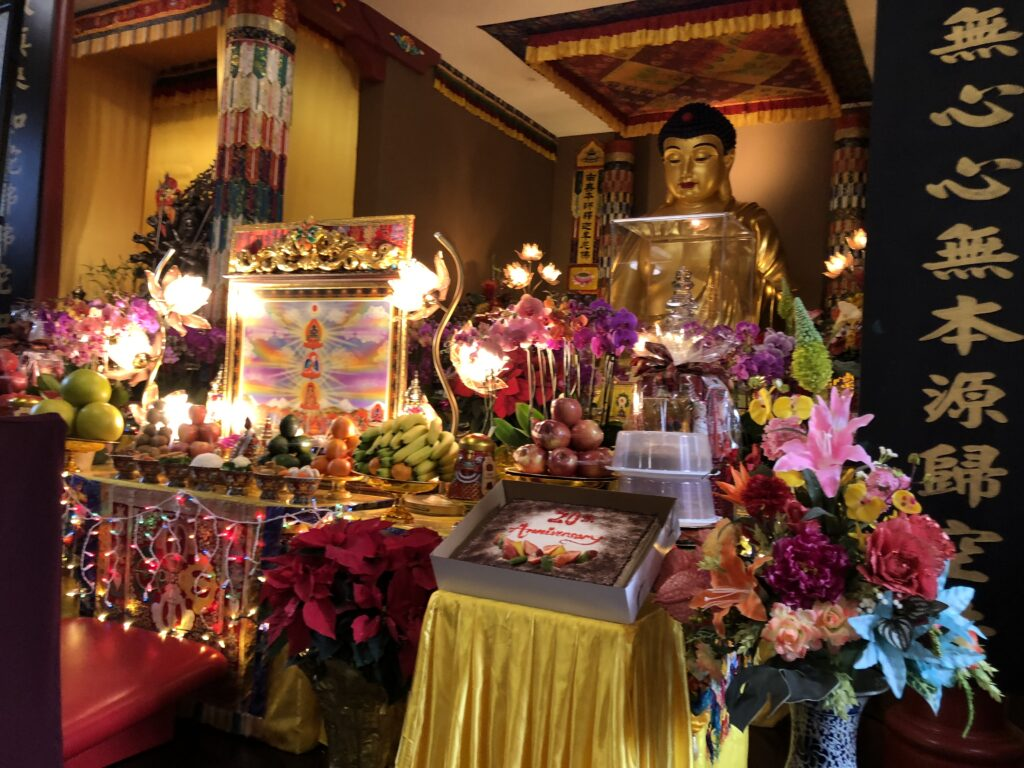
San Francisco Hua Zang Si Temple Celebrates 20th Anniversary with Charity Event: “Love Without Limits” Donation Drive


San Francisco Hua Zang Si Temple Celebrates 20th Anniversary with Charity Event: “Love Without Limits” Donation Drive Photo Courtesy: Joyce Lee (The Hua Zang Si Temple held a Dharma Assembly to celebrate the Holy Birthday of Amitabha Buddha)

The San Francisco Hua Zang Si Temple, inaugurated on December 26, 2004, upholds and promotes the genuine teachings of H.H. Dorje Chang Buddha III, the incarnation of the primordial Buddha, and the World-Honored Shakyamuni Buddha, extending boundless compassion and kindness to all beings. 

Guided by the teachings of H.H. Dorje Chang Buddha III, Hua Zang Si Temple has actively participated in various charitable activities for many years, including organizing New Year entertainment events in nursing homes, assisting with hospital relocations, providing food relief to disaster-affected areas, and holding garage sales, with all proceeds donated to vulnerable groups. The temple expressed their hope that this spirit of helping others will continue to flourish: “In acts of kindness, seeds of virtue grow, a family that sows goodness finds happiness in full flow.”

San Francisco Hua Zang Si Temple Celebrates 20th Anniversary with Charity Event: "Love Without Limits” Donation Drive
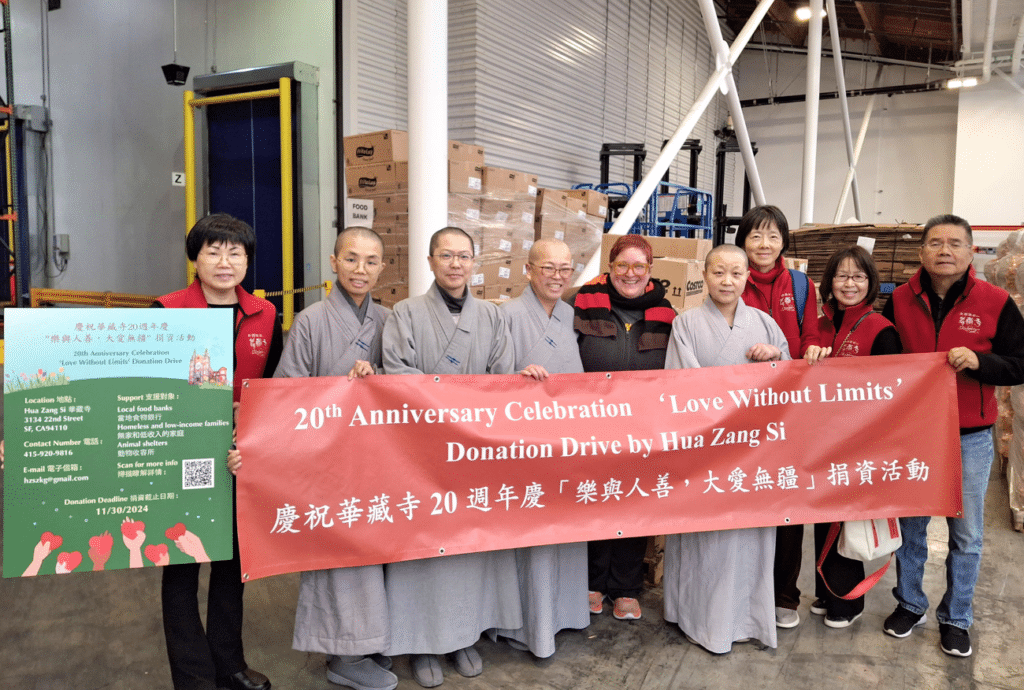
Photo Courtesy: Natty Kao (Nuns from Hua Zang Si Temple and volunteers from the Dharma-Protecting Fellowship of Hua Zang Si donated items to San Francisco Marin Food Bank.)

To commemorate its 20th anniversary, Hua Zang Si launched a month-long charity drive titled “Love Without Limits” in November, supporting animal rescue centers, homeless and low-income families, and local food banks. On the morning of December 15, a Dharma Assembly was held to celebrate the Holy Birthday of Amitabha Buddha, praying for world peace and the well-being of all people. The afternoon featured a 20th-anniversary performance and raffle, attended by nearly 300 people.

By December, Hua Zang Si had collected a total of 812 items, categorized into three main types: 241 animal supplies, including dog collars, walking harnesses, pet carriers, and disposable puppy pads; 211 baby and cookware items, including baby bottle drying racks, baby bodysuits, air fryers, and cookware sets; and a total of 2,265 pounds of food, including rice, pasta, and other food items. On December 11, nuns from Hua Zang Si Temple and volunteers from the Dharma-Protecting Fellowship of Hua Zang Si delivered these items to Muttville Senior Dog Rescue, the Homeless Prenatal Program (HPP), and the San Francisco Marin Food Bank.

San Francisco Hua Zang Si Temple Celebrates 20th Anniversary with Charity Event: "Love Without Limits” Donation Drive
Photo Courtesy: Joyce Lee 
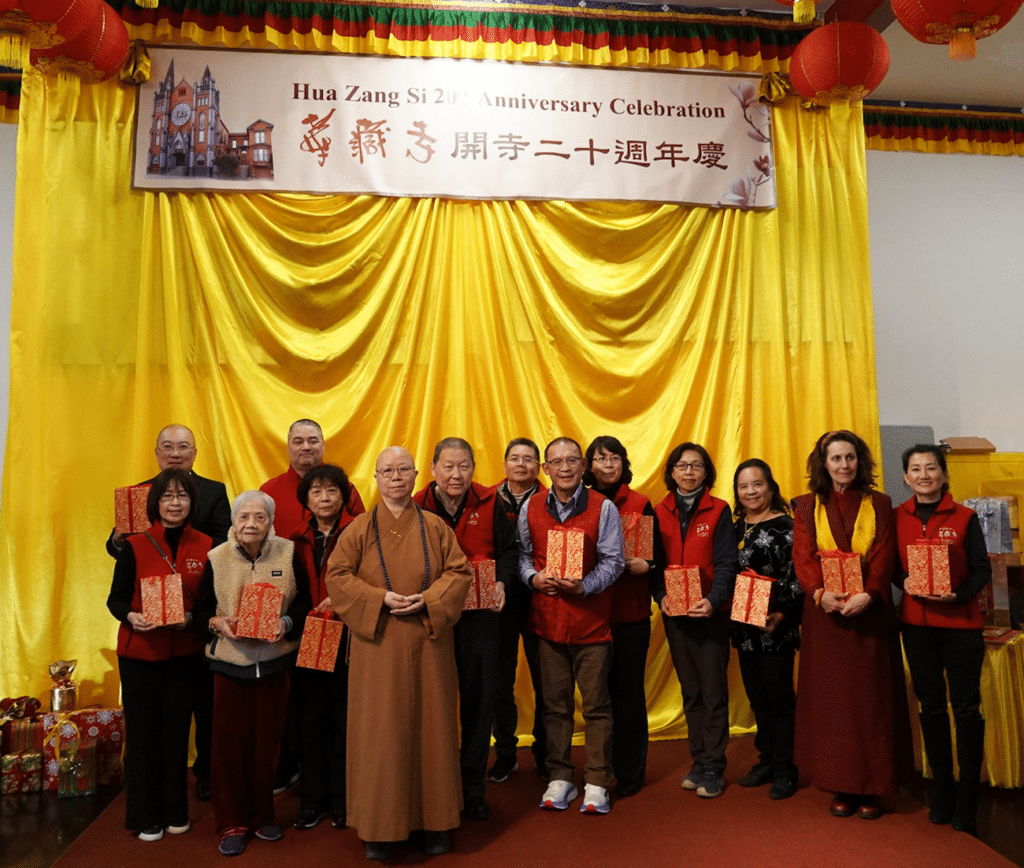
(The abbess of Hua Zang Si Temple awarded 20 years’ service awards to volunteers.)
Photo Courtesy: Joyce Lee (The abbess of Hua Zang Si Temple awarded 20 years’ service awards to volunteers.)

As the first cage-free rescue organization in the U.S. and California’s first nonprofit dedicated to rescuing senior dogs, Muttville has rescued nearly 13,000 senior dogs over the past 17 years, providing support for about 100 senior dogs each month. The generous donations from Hua Zang Si were gratefully received, greatly aiding in the care and rehoming efforts for these senior dogs.

The San Francisco Marin Food Bank, a nonprofit organization dedicated to addressing hunger in San Francisco and Marin counties, distributed over 60 million pounds of food this year, thanks in part to Hua Zang Si’s year-end support. In these regions, one in five people faces food insecurity, and the temple’s contributions have significantly bolstered the food bank’s efforts. The donated food from the temple will be utilized in various community programs, including after-school programs, Boy and Girl Scouts, ensuring that nutritious meals reach those in need.

San Francisco Hua Zang Si Temple Celebrates 20th Anniversary with Charity Event: "Love Without Limits” Donation Drive
Photo Courtesy: Joyce Lee
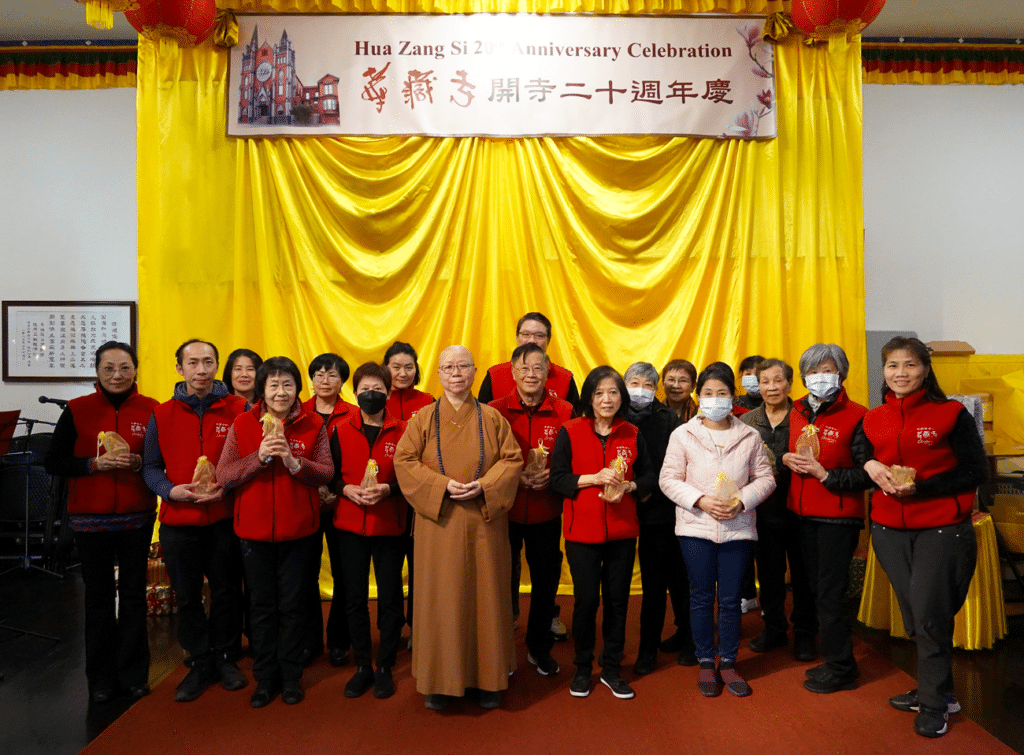
(The abbess of Hua Zang Si Temple awarded 10 years’ service awards to volunteers.)

The Homeless Prenatal Program (HPP), a renowned family support center in the U.S, serves over 4,000 vulnerable families each year, particularly aiding mothers seeking assistance during pregnancy and parenting. The temple’s donations have significantly enhanced HPP’s ability to support mothers and children facing life challenges.

On the afternoon of December 15, the 20th-anniversary celebration was held in the main shrine of Hua Zang Si, featuring live performances of several classic philosophical songs with lyrics written by H.H. Dorje Chang Buddha III, cello performances of various songs, a mesmerizing Tibetan dance, and an exciting raffle with numerous prizes. The event provided a visual and auditory feast for nearly 300 attendees. The celebration concluded with a heartfelt group sing-along of “Buddha Holding My Hand,” bringing the 20th-anniversary festivities to a perfect close.

Looking ahead, Hua Zang Si will continue to serve as a beacon of love and care within the community. They hope more people will join in these acts of kindness, creating a warm, loving, and harmonious society together.


The above article is from the World Reporter, December 23, 2024.

Link:https://peacelilysite.com/2025/01/08/san-francisco-hua-zang-si-temple-celebrates-20th-anniversary-with-charity-event-love-without-limits-donation-drive/

Hair Sariras of H.H. Dorje Chang Buddha III

In Buddhist scriptures, relics are broadly classified into two types. The first type, known as Dharma-body relics, refers to the teachings and scriptures spoken by the Buddha, representing his spiritual essence and wisdom. The second type, physical relics, comprises the solid remains left after the Buddha’s cremation. These physical relics are traditionally described as being of three kinds: white bone relics, red flesh relics, and black hair relics. They are noted for their luminous, pristine appearance, unbreakable nature, and incomparable beauty, far surpassing worldly jewels.

It is also believed that Bodhisattvas and Arhats may leave behind similar relics. According to Buddhist teachings, relics naturally crystallize in those who have achieved enlightenment and sincerely practiced devotion to the Buddha. They are considered extraordinary and unattainable by ordinary individuals.

H.H. Dorje Chang Buddha III is recognized as the true reincarnation of the Primordial Buddha. His Holiness has demonstrated extraordinary miracles, including the manifestation of hair sariras. Below are authentic accounts from Buddhist disciples detailing their experiences and discoveries of the hair sariras of H.H. Dorje Chang Buddha III.

Hair Sariras (1)

H.H. Dorje Chang Buddha III Wan Ko Yeshe Norbu Holiest Tathagata usually cuts His own hair. However, there have been several occasions when I respectfully accompanied His Holiness to a barber shop. Each time, out of reverence, I carefully swept away the floor and removed other people’s hair before the haircut began. After the Buddha Master’s haircut was finished, I would gather His hair from the floor, wrap it carefully in paper, and place it on my Buddhist altar upon returning home. Gradually, I began collecting and keeping some of the hair.

I still remember what happened on June 1, 2003. On that day, I took out several unopened paper packs and organized them, intending to wash the hair. Because the individual hairs were very fine, I had paid special attention and placed them on a screen. While soaking them in water, I saw three small round red beads among the hair. The entire cleaning process was handled by me, and I did not touch anything else during that time. I felt this to be very strange and wondered where those red beads came from. I intended to press them with my finger to see if they were hard or soft and even took a magnifying glass to carefully exam them. Suddenly, a thought occurred to me. Could they be sariras? I realized if I did this, it would be too disrespectful.
Hurriedly, I placed the three small beads in a small white box and took them to H.H. Dorje Chang Buddha III to inquire of their origin. I asked, “May I know what these things are?” The Buddha Master said, “Where did you get these? These are sariras!” Afterwards, the Buddha Master practiced dharma and chanted mantras to prove the authenticity of those sariras. I reported to the Buddha Master that they were wrapped in paper and appeared from the cut hair of His Holiness.

Later, the Buddha Master gave us a special discourse in which His Holiness stated, “This has happened because of conditions and the level of fortune of all sentient beings. It does not matter where they come from. Perhaps they originated from the empowerment of the Buddhas and Bodhisattvas. It actually does not matter what the disciples think concerning how or where they come from. If they can appear out of nothing, then they can disappear out of nothing. The important thing is the cultivation of each one of us and the need to live in accordance with the teachings and abide by the principles of Buddhism.”
That night, I carefully placed those three red sariras in a small tightly covered Tibetan box and cushioned them with white cotton. The next day, a fellow disciple requested to view them. I thought about placing the sariras in a crystal bottle that I had just bought. When I opened the small box and looked inside–how could it be that there were only two sariras left? I did not touch any other things anymore! I shredded and tore the cotton, but could only find two sariras. It was really upsetting! This proves and corresponds to what H.H. Dorje Chang Buddha III previously expounded: “If they can
appear out of nothing, then they can disappear out of nothing.”

This extraordinary occurrence reminded me of a fellow disciple’s personal testimony of witnessing sariras falling from the Buddha Master. This time, I experienced it firsthand, and it was truly a wonderful and auspicious sign.

Everything I have recounted above is true and authentic. If there are any falsehoods, may I suffer all evil retribution. If they are genuine facts, may living beings receive the dharma teachings of H.H. Dorje Chang Buddha III Wan Ko Yeshe Norbu Holiest Tathagata, be liberated from the cycle of life and death, and attain wisdom and good fortune.

Buddhist disciple,
Hsuan Hui

(This is a complete translation of the Chinese text that follows, originally written and signed by Hsuan Hui.)

Hair Sariras (2)

I established a Buddhist altar in my home in Thailand on January 16, 2005. On that day, a fellow disciple brought me a small glass bottle containing several individual strands of the hair sariras of my Buddha Master, Dorje Chang Buddha III Wan Ko Yeshe Norbu Holiest Tathagata. Each strand was approximately one centimeter long. Out of reverence, I placed a blue semi-precious stone inside the bottle and set it on my altar.

A few months later, I decided to replace the glass bottle with a Venetian crystal one. When I opened the glass bottle, I noticed something astonishing: the originally short hairs had grown longer. Although surprised, I did not dwell on it initially. However, the hairs continued to grow, and recently the change has become undeniable. Some strands have grown to five or six times their original length, now measuring five or six centimeters. Remarkably, some of the hairs, pinned down on both ends by the stone, have grown in their middle sections, forming loops. How truly extraordinary!

From a scientific perspective, hair cells die once cut, making it inexplicable how short, severed hairs could continue to grow. Let this miraculous phenomenon strengthen our faith and conviction. It is a genuine manifestation of the power of the Buddha-dharma!

Buddhist disciple,
Shu-Hui Chen

(This is a complete translation of the Chinese text that follows, originally written and signed by Shu-Hui Chen.)

Link:https://peacelilysite.com/2024/12/06/hair-sariras-of-h-h-dorje-chang-buddha-iii/

Source: https://www.tpcdct.org/sites/default/files/media/194.pdf

The Meaning and Merits of “Life Release”

Embracing Compassion: The Day of Releasing Lives and the Teachings of H.H. Dorje Chang Buddha III

The practice of life release originates from Mahayana Buddhist scriptures and has been widely practiced in mainland China, Tibet, and also spread to Japan, Korea, Vietnam, and neighboring regions. The act of life release is rooted in the compassionate principle of equality among all beings and the karmic understanding of the cycle of birth and death. As the saying goes, “If you take half a pound from others, you will have to repay eight ounces.” Abstaining from killing while also practicing life release brings even greater merit, and there are countless historical accounts of miraculous responses and blessings resulting from such acts.

In Volume 4 of the Miscellaneous Treasures Sutra, there is a story about a novice monk and his teacher. The teacher foresaw that the novice monk would pass away within seven days and advised him to return to his family home, asking him to come back after seven days, without explaining why.

On his way home, the novice monk came across a broken pond, where water was flooding an anthill.

The ants were frantically trying to escape, but their speed was no match for the rushing water. Seeing that countless ants were about to drown, the novice monk used his robe to carry soil and blocked the breach in the pond, saving all the ants.

After seven days, the novice monk returned to his teacher. The teacher, upon seeing him alive, was astonished and asked what had happened during those days. Mistakenly thinking he was being accused of wrongdoing, the novice monk fearfully replied that he had done nothing. The teacher, being an Arhat, used his divine vision and discovered that the novice monk had performed a small yet significant act of kindness by saving the ants from drowning.

This single compassionate act altered the novice monk’s karmic fate, extending his lifespan and allowing him to live a long life until his natural passing.

The Profound Teachings Behind Life Release

The practice of releasing lives is deeply rooted in Buddhist scriptures:

  • The Chapter on the Practices and Vows of Samantabhadra states:
    “Living beings cherish their lives above all, and Buddhas cherish living beings above all. To save the lives of living beings is to fulfill the heartfelt wishes of the Buddhas.”
  • The Brahma Net Sutra on the Bodhisattva Precepts states: “If a disciple of the Buddha practices life release out of compassion, they should regard all men as their fathers and all women as their mothers, for in every life, they are born through them. Therefore, all beings in the six realms are like one’s own parents. To kill and eat them is akin to killing one’s parents or oneself. When witnessing the slaughter of animals, one should strive to protect and relieve them from their suffering. Furthermore, one should teach and explain the Bodhisattva Precepts, guiding and saving all sentient beings.”
  • The Sutra on Distinguishing the Origin of Good and Evil reveals:
    “The Buddha said: In this world, if one possesses a compassionate heart and refrains from killing, they will gain five blessings: longevity, physical well-being, freedom from harm, rebirth in the heavens, and a long life when returning to the human world. Those who live to a hundred years today owe it to their abstention from killing in past lives.”

These teachings emphasize that compassion is both a passive and active virtue. While refraining from killing is essential, taking proactive steps to save lives embodies the true spirit of Buddhist teachings.

October 29 marks the Day of Releasing Lives, a profound observance dedicated to the protection and liberation of living beings. This day calls for the nurturing of compassion, the accumulation of virtue, and the cultivation of good karma. Initiated in 2009 by H.H. Dorje Chang Buddha III, this practice symbolizes an enduring commitment to compassion and liberation. Following a major Buddhist event, H.H. Dorje Chang Buddha III designated this day as a global occasion for the compassionate release of captive lives, inspiring a tradition now embraced worldwide.

The 2024 Life Release Event: A Global Act of Compassion

This year, the H.H. Dorje Chang Buddha III Culture and Art Museum, in collaboration with the World Buddhism Association Headquarters, hosted a commemorative Dharma Assembly in Marina Del Rey, California. The event brought together esteemed holy gurus, eminent monks, and devout Buddhists from around the world.

Photo Courtesy: Joyce Lee | Vice President of World Buddhism Association Headquarters, Jiaozun Zhengda, presided over the Dharma Assembly on the Buddha-Stipulated Day of Releasing Lives.

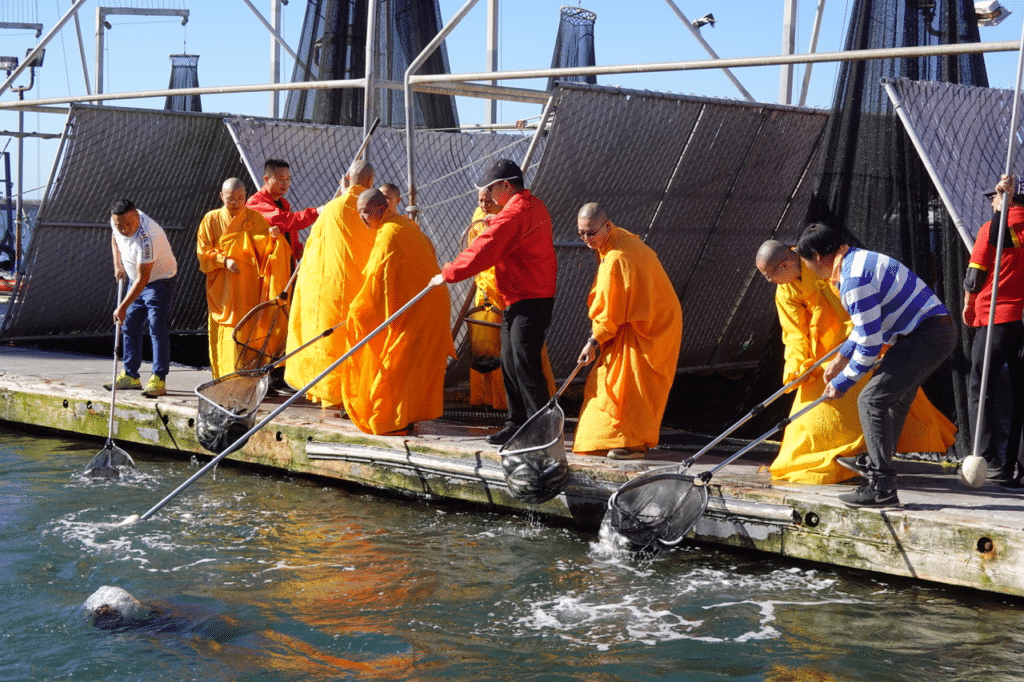
The gathering featured the release of thousands of fish back into the ocean, accompanied by the recitation of the Heart Sutra. Jiaozun Zhengda, Vice President of the World Buddhism Association Headquarters, led the prayers and delivered an inspiring address on the significance of the occasion. She emphasized the need for ongoing acts of compassion and the responsibility to protect living beings wherever and whenever they face suffering.

Jiaozun Zhengda explained that the practice of releasing lives arises naturally from the precept of refraining from killing. While refraining from harm is virtuous, actively saving lives elevates compassion to its highest form. This principle is at the heart of the teachings of Namo H.H. Dorje Chang Buddha III and Namo Shakyamuni Buddha.

Photo Courtesy: Joyce Lee | Hundreds of Buddhists from all over the world attended the Dharma Assembly of Releasing Lives.

Photo Courtesy: Joyce Lee | Participants released captive fish into the ocean

Participants shared profound reflections on the event. Watching the fish swim freely into the ocean became a moving symbol of resilience, freedom, and the boundless compassion of Buddhas and Bodhisattvas. For many, this practice reaffirmed their vows to live with kindness, respect all life, and emulate the selflessness of the Buddhas.

The Day of Releasing Lives is more than a symbolic gesture. It is a reminder that compassion knows no boundaries of time or space. Through the release of captive lives, Buddhists actively demonstrate their commitment to fostering a world of harmony and peace.

A Global Call for Compassion

As we observe the Day of Releasing Lives, let us remember that every act of compassion matters. By choosing to release lives, we contribute to a legacy of kindness that transforms our world. May this day inspire all of us to nurture compassion, protect life, and cultivate peace for the benefit of all beings.

For more information about the H.H. Dorje Chang Buddha III Culture and Art Museum and their compassionate initiatives, please visit https://www.wbahq.org/.

Link: https://peacelilysite.com/2024/11/07/the-meaning-and-merits-of-life-release/

Source: https://www.wbahq.org/reports-by-news-media/rm20241105/

#DorjeChangBuddhaIII #HHDorjeChangBuddhaIII  #Buddha Dipankara#FishRelease #Buddhism #HolyGurus#Rinpoches#Bodhisattva Avalokiteshvara#HolyMiraclesTemple#DvineTransformations #DharmaAssembly#ShakyamuniBuddha #H.H.DorjeChangBuddhaIIICultureandArtMuseum

The Compassionate Vows of the Medicine Buddha: A Path to Health, Harmony, and Happiness

Source: Luobenkun Art museum

On the 29th day of the ninth lunar month, Buddhist disciples worldwide honor the birthday of Bhaisajyaguru Buddha, known as the Medicine Buddha or the Great Medicine King. He is also referred to as the Buddha of Twelve Great Vows, embodying deep compassion and healing. Presiding over the Pure Land of Lapis Lazuli Light in the East, the Medicine Buddha has inspired countless practitioners with his transformative teachings and boundless compassion.

Buddhist communities celebrate this sacred day with ceremonies, reciting the Medicine Buddha Sutra, learning from his teachings, and making offerings. The Medicine Buddha Sutra recounts Shakyamuni Buddha’s dialogue with Manjusri Bodhisattva, where he reveals the profound virtues of the Medicine Buddha’s Pure Land and the twelve vows he made as a bodhisattva. These vows reflect his deep empathy for beings suffering from illness, poverty, and ignorance, and his wish to liberate them from these afflictions. This sutra is not only a sacred text but also a guide for overcoming life’s challenges, helping us gain inner peace, health, and happiness.

The sutra explains the Medicine Buddha’s teachings with a unique emphasis on relieving suffering in this life. By focusing on the here and now, the Buddha’s teachings encourage us to look at our lives with clarity, understand our challenges, and gain relief from worldly troubles. This practical orientation gives the Medicine Buddha Sutra a distinctive place in Buddhist practice, emphasizing the importance of compassionate action and wisdom in daily life.

The Twelve Great Vows of the Medicine Buddha

First:
I vow to assist those impoverished and tormented by constant struggles. Those who come across my name, sincerely honor it, and practice Dharma to build their merit will see their wishes come true.

Second:
I vow that my body shall shine as beams of brilliant light across this infinite, boundless world, freeing all beings from ignorance and worry through my teachings. May all beings attain a perfect state of character, integrity, and enlightenment, like the Buddha.

Third:
I vow that my body shall be like flawless crystal, radiating splendid light to all corners, enlightening beings with wisdom. Through the blessings of compassion, may all beings gain spiritual power and physical strength to achieve their aspirations on a virtuous path.

Fourth:
I vow to grant all beings the inexhaustible resources they need, freeing them from pain and guilt caused by material desires. While essentials such as clothing, food, shelter, and transport are needed, they should be wisely used. May they generously share these resources within the community to foster harmony.

Fifth:
I vow to lead those who have strayed back to the path of righteousness, guiding them toward enlightenment on the Buddha way.

Sixth:
I vow to enable all beings to uphold precepts of purity and morality. If they falter, they shall be guided to repent. Those who sincerely regret their wrongdoings and vow to change, with faith in the Buddha, shall be forgiven and regain purity.

Seventh:
I vow that all beings who are physically disabled or ill will be blessed with both physical and mental health. Those who faithfully honor the Buddha will receive these blessings.

Eighth:
I vow to alleviate the suffering of the poor and sick. May the ill be cured, the helpless supported, and the impoverished uplifted.

Ninth:
I vow to relieve the suffering of women seeking transformation. By hearing my name, paying homage, and praying, may their wishes be fulfilled, leading them ultimately to Buddhahood.

Tenth:
I vow to release all beings from harmful thoughts. I will guide them to righteousness and honor, so they may walk the Buddha way on a path of light.

Eleventh:
I vow to save those who have sincerely repented, including prisoners and victims of natural disasters. Those who are sincere will receive my blessings and be freed from suffering.

Twelfth:
I vow to relieve those facing starvation or committing crimes for survival. If they hear my name and hold it dear, I will lead them to the benefits of Dharma and favor them with the sustenance they need, helping them to lead peaceful, contented lives.

The Medicine Buddha’s great vows remind us of the healing power of compassion and inspire us to live with kindness and selflessness. Whether through reciting his name, chanting his mantras, or making offerings, we are encouraged to practice not only for our own relief but also for the welfare of all beings. By embodying the virtues outlined in the Medicine Buddha Sutra, we aim to carry forward the Buddha’s compassionate mission, helping ourselves and others find happiness, harmony, and well-being.

May we all find solace and empowerment through the compassionate vows of the Medicine Buddha and live our lives with health, joy, and a sense of unity with all beings.

Link:https://peacelilysite.com/2024/10/31/the-compassionate-vows-of-the-medicine-buddha-a-path-to-health-harmony-and-happiness/

Source: https://www.baromkagyu.org/medicine

Holy Miracles Temple: A Sanctuary of Compassion and Healing Amid Global Turmoil

Holy Miracles Temple, located at 1730 N. Raymond Ave., Pasadena, CA, serves as a sanctuary dedicated to teaching the true Dharma of the Tathagata, as transmitted by Namo H.H. Dorje Chang Buddha III and Shakyamuni Buddha, guiding disciples on their path to liberation and spiritual accomplishment. Grounded in the Buddha’s teachings and fueled by boundless compassion, the temple’s core mission is to selflessly serve humanity. Its hope is for people in America and across the globe to embrace Buddha Dharma, cultivating love for their country, fellow people, and the world. Through mutual support, peace, kindness, and auspiciousness, the temple envisions a strong nation with thriving citizens and a world brimming with joy and happiness.

In these challenging times, when suffering and catastrophe touch so many, Buddhism’s compassionate spirit calls us to extend blessings to all sentient beings. On October 13, 2024, the Holy Miracles Temple held a Blessing and Peace Dharma Assembly, a response to the unprecedented hardships the world faces today. Devoted Buddhist disciples gathered to honor the teachings of Namo Dorje Chang Buddha III, coming together to send prayers for healing and hope to those affected by natural disasters, conflicts, and upheavals. This assembly reaffirmed the Buddhist commitment to easing the suffering of all.

The event featured a solemn chanting of the Universal Gate Chapter of the Lotus Sutra, dedicated to Avalokitesvara Bodhisattva, the embodiment of compassion. The gathering was led by Abbess Ruzun Ruohui from Hua Zang Si Temple, who guided attendees through the prayers.

This year has been marked by profound global calamities. In the United States, Hurricane Helene ravaged Texas and Louisiana in August, displacing thousands and flooding communities. Just weeks later, Hurricane Milton unleashed further destruction in Florida and Georgia. Recovery efforts faced tremendous challenges as these back-to-back disasters left homes shattered and lives in turmoil.

In Asia, Typhoon Dindo devastated the Philippines, causing severe flooding and landslides across Luzon in September. Thousands of people were forced to evacuate as the typhoon submerged entire neighborhoods. Nepal, too, was struck by tragedy when a powerful earthquake hit in June, resulting in widespread destruction and loss of life in remote regions.

The war in Ukraine, continuing its escalation throughout 2024, inflicted further suffering on cities like Kyiv and Mariupol, leaving behind a deepening humanitarian crisis. Meanwhile, renewed violence in Syria once again brought bloodshed to war-torn cities such as Aleppo and Damascus, compounding the plight of its weary people.

Europe was not spared from disaster either, as record-breaking floods struck in July. Torrential rains overwhelmed parts of Germany and Belgium, causing rivers to overflow and submerging entire towns. Meanwhile, the United States’ western regions grappled with annual wildfires of increasing magnitude, destroying homes and forests alike.

During the Dharma Assembly at Holy Miracles Temple, attendees united in spirit and purpose. As the sacred verses of the Universal Gate Chapter resonated through the temple, the prayers reached out to those suffering from this year’s tragedies, seeking to bring healing and relief. Prayers were offered for the displaced, the injured, and those who had lost everything. In the face of conflict and war, the community gathered to extend peace, comfort, and hope to all those impacted.

This powerful assembly embodied the compassionate essence of Avalokitesvara Bodhisattva, radiating light and healing to all beings affected by suffering. It was a profound reminder that through shared compassion and collective action, we can create a world where all beings may find peace, healing, and joy.

Link:https://peacelilysite.com/2024/10/18/holy-miracles-temple-a-sanctuary-of-compassion-and-healing-amid-global-turmoil/

Source: https://cagazette.com/insights-from-the-blessing-and-peace-dharma-assembly-at-the-holy-miracles-temple/?fbclid=IwY2xjawGADEJleHRuA2FlbQIxMAABHSOFxdL9Y7OJSnH14qBxTQoBYe2QSzdXAI_yk56BTajnwGdAXcnXxCa7bQ_aem__GWuVw6xxEGleMzpPI9e5A