A Great Drum

The Wisdom of Generosity: A Tale of Compassion and Righteousness

Once, the Buddha was residing in the Jetavana Monastery in the kingdom of Śrāvastī, spreading his teachings. At that time, there was a prince of a celestial king named Pilu. One day, he flew down from the heavens to the Jetavana Monastery, prostrated himself at the Buddha’s feet, and, with hands folded in reverence, asked the Buddha: “In this world, people are constantly pursuing clothes, food, treasures, pleasures, official positions, and territories. Are there any treasures that pursue people in return?” The Buddha praised Prince Pilu: “You have asked a good question. Indeed, there are situations where territories, treasures, and pleasures pursue people.”

Prince Pilu asked again, “What does it mean for the causes and conditions that fulfill people’s wishes and bring complete satisfaction to always follow them?”

The Buddha replied, “All actions can be categorized into two types: doing good deeds, which brings blessings, and committing evil deeds, which results in calamities. Whether it is blessings or disasters, they always follow each person like a shadow.”

Prince Pilu said, “This is truly extraordinary! Just as the World-Honored One has taught, in my past life, I was once a king among humans. Because I was aware of the impermanence of life and had no attachment to material things, I wanted to practice generosity widely. One day, during a gathering of my ministers, I announced: ‘I want to make a great drum whose booming sound can spread for a hundred miles. Who can accomplish this task for me?’

However, the ministers all replied, ‘We are incapable of doing so!’ At that moment, a minister named Kuang Shang, who had always been loyal to the court and compassionate towards the people, stepped forward and said to the king, ‘I can accomplish this task, but it will require some funding.’

The king said, ‘Great! Whatever amount you need is not a problem.’ Thus, the treasury was opened, and a large sum of money was handed over to Kuang Shang.

Kuang Shang transported a carriage full of treasures to the gate of the royal palace and beat the drum to announce, “Today, our benevolent king, with great compassion, is distributing wealth to the world to relieve all those in poverty and distress, as well as to provide for the needs of practitioners. Anyone in need can come to the palace gate to receive these goods.”

The news quickly spread to neighboring countries. The poor, carrying their babies and bringing along the elderly and young, came in droves, filling all the roads leading to the city. People would often look up to the sky and exclaim, “Thank you, benevolent king! We, the poor people, finally have the chance to escape the days of hunger and cold!”

A year later, the king asked Kuang Shang, “Is the great drum completed?” The minister replied, “Your Majesty, it is done.” The king asked again, “Since it is finished, why haven’t I heard the drum sound?” Kuang Shang responded, “Please, Your Majesty, take a trip into the city tomorrow, and you will hear the sound of virtue resonating far and wide.”

The next day, the king’s procession entered the city, discovering it was crowded and bustling. The king exclaimed, “Why are there so many people in the city?” Kuang Shang answered, “Last year, Your Majesty ordered me to create a great drum, hoping its mighty sound would spread for miles, proclaiming Your Majesty’s benevolence. I thought that a drum made of dead wood and cowhide would not adequately convey the king’s virtue. After much deliberation, I decided to use the treasures Your Majesty entrusted to me to provide for the practitioners and relieve the poor and distressed. Since the announcement, people from neighboring countries have come, hoping for Your Majesty’s benevolence, like hungry children yearning for their compassionate mother.”

Upon hearing this, the king asked the nearby citizens, “Where have you come from?” The people respectfully bowed and replied, “We came from a hundred miles away.” Some said, “I came from two hundred miles away.” Others said, “I came from thousands of miles away.” Then, they all declared, “Wise and benevolent king! Your widespread generosity has brought joy to the people of the neighboring countries. Many have even moved their entire families here, seeking to live under your benevolent protection and hoping for a stable life henceforth.”

The king was very pleased and said, “Kuang Shang, you have done an excellent job! Previously, I was attached to fame, hoping that the great drum’s mighty sound would resonate far and wide. Now, I finally understand that the unrest in the country comes from the people’s unease. Just as a sick body needs medicine to be healed, I should provide remedies to address the people’s suffering. You, my minister, understood the hardships of the people and distributed food to help the poor and needy, allowing the people to live in peace and return their loyalty to me.” Thus, the king declared, “From now on, as long as it concerns the people’s needs, take care of it to the best of your ability without needing to consult me!”

After the king’s natural death, he was reborn in heaven as King Miao. After his life in heaven ended, he was reborn as a Cakravartin (Wheel-Turning) King on earth, always accompanied by seven treasures and surrounded by followers who protected him. Now, he has again been reborn in heaven as a prince of the heavenly king. All of this was because he strictly upheld pure precepts and compassionately aided all living beings, earning such blessings. If we follow the Buddha’s teachings and rectify our body, speech, and mind, we can all obtain such magnificent blessings.

The Buddha encouraged Prince Bilu, saying, “A person’s actions are like a shadow following the body, or an echo responding to a sound. For every cause, there is an effect, and retribution is certain!” Prince Bilu, after hearing the Buddha’s teaching, joyfully made obeisance and departed.

A Great Drum

Link:https://peacelilysite.com/2024/05/23/a-great-drum/

Source: https://www.ctworld.org.tw/sutra_stories/story801-1000/story862.htm,


Ananda and the Untouchable

A Buddhist Story of Loving Kindness

By Martin Goodson

One day Ananda, the Buddha’s assistant, approached a well to have a drink.  A woman, a member of the untouchable caste, was drawing water and Ananda asked her for some.  The woman was surprised that she had been asked to give anything to a monk as the caste laws stated that anything given by one who is considered unclean would also be unclean.  However, Ananda persisted and eventually she gave in and gave him a drink.

The woman was so moved by this experience which had never happened before that she felt a strong affection for Ananda and made up her mind to serve him.  Thus, she went to the Buddha and asked if she might be Ananda’s assistant. 

  The Buddha asked her why she wanted to do this.  She told him.  The Buddha replied that what she had fallen in love with was not Ananda but his kindness.  Also, that this kindness was present in her own heart and that if she were to cultivate it within  she would be able to serve both kings and queens.

This is a lovely story about the power of goodwill or ‘metta’ to affect the heart. The Buddha taught that the most important element of any act is the motivation behind it.  All of us are capable of ‘doing the right thing’ but this is not really enough; the motivation behind the action determines the outcome.  A common Buddhist practice is the practice of acquiring merit in order to ensure a good future re-birth.  This is akin to the old Christian view of doing good so as to go to heaven after death.  However, if I am doing good solely for the outcome to myself then the act is already flawed.  What is more it shows itself to others in time.  We all know the stereotype of the do-gooder who is so caught up in bringing about some future good that he ignores whether or not the other person requires help in this way.  The problem with trying to do good for others when in fact I am looking for something for myself is that I fail to see what it is that others really do need right now. Both self-concern and regard for others are two very different way of seeing the same situation.  

When the heart has for a moment forgotten ‘I’ and ‘my concerns’, and this does happen more often than realised, then it opens up and reflects the situation.  What is more, not only does it see clearly,  but, because it is a human heart, it responds with the warmth of humanity.  This happens, not because it wants anything, but because it is its nature to do so.  Humans have the capacity to put themselves in the other’s shoes and thus respond without intending something just for myself.  This is also reflected in Jesus Christ’s admonition to ‘Love thy neighbour as thyself’.  In other words, by forgetting myself I forget the separation from others too.  Thus, a true ‘fellow feeling’ is born and this is the root of metta and of compassion .

Link:https://peacelilysite.com/2024/04/26/ananda-and-the-untouchable/

Source: https://www.thezengateway.com/practice/ananda-and-the-untouchable

Karma cannot be Seen or Touched. Does It Really Exist?

What is karma?

Karma, in Sanskrit known as ‘karma,’ is the creator of deeds of body, speech, and mind, producing both good and evil without forgetting. It is also like the causes created by the three activities, which manifest as their results.

The force of karma leads to the consequences of suffering or happiness based on its nature, whether good or evil. Therefore, there is also the doctrine of karma and its consequences. Karma accumulated in the past is referred to as past karma; karma in the present is referred to as present karma.

The law of karma is a special instance of the law of cause and effect, according to which all our actions of body, speech and mind are causes and all our experiences are their effects. Certainly, perhaps some people might ask, “This ‘karma’ you speak of, I can neither see it nor touch it. Does it really exist?”

The law of karma explains why each individual has a unique mental disposition, a unique physical appearance and unique experiences. These are the various effects of the countless actions that each individual has performed in the past. We cannot find any two people who have created exactly the same history of actions throughout their past lives, and so we cannot find two people with identical states of mind, identical experiences or identical physical appearances. Each person has different individual karma. Some people enjoy good health while others are constantly ill. Some people are seen as very beautiful while others are seen as very ugly. Some people have a happy disposition that is easily pleased while others have a sour disposition and are rarely delighted by anything. Some people easily understand the meaning of spiritual teachings while others find them difficult and obscure.

Master Milarepa’s Story

Master Milarepa was renowned for his profound spiritual practice amidst the snowy plateaus of Tibet.

In his youth, Milarepa engaged in regrettable actions that resulted in negative karma. He resorted to sorcery, causing a house to collapse and resulting in the deaths of 35 people, including his adversaries. Additionally, he summoned hailstorms that devastated his uncle’s crops and the entire village.

There are accounts of Master Milarepa experiencing the consequences of his actions. In the later stages of spreading the Dharma for the benefit of all beings, a monk observed the reverence and admiration directed towards Venerable Milarepa by the crowd. Although outwardly respectful, the monk harbored intense jealousy and disdain, viewing the Venerable as understanding nothing and merely a hypocritical, arrogant, and conceited individual.

Once when the Venerable Milarepa fell seriously ill, this monk, pretending to be concerned, went to visit him and said:

“A great master like you who has attained enlightenment should not be so gravely ill, yet here you are sick! If there were a way to share this illness, to distribute some of it among your disciples. If there were a method to transfer it, for example, I could share some of it, but unfortunately, there seems to be no solution. What can be done?”

The Venerable smiled gently and replied, “I should not be ill by nature, but illness is beyond my control.”

The monk continued, “If only I knew the cause of your illness. I suppose no reason can be found? If it could be transferred, I would willingly take on some of it.”

The Venerable responded, “I could indeed share some of this illness with you, but you would not withstand it even for a moment. Therefore, it’s better not to transfer it.”

The monk thought to himself that perhaps the illness couldn’t be transferred, so he persisted more earnestly, saying, “Please, in any case, transfer the illness onto me!”

The Venerable then said, “Very well, but you will not bear it.”

Subsequently, the Venerable transferred the illness onto the door of the silent room, causing the door to creak and shake as if it were about to collapse. Despite this display, the monk remained skeptical, wondering if it was all an illusion, and he once again requested, “This is truly extraordinary! Please transfer it onto me.”

The Venerable agreed, warning him, “You will not endure it.”

He then withdrew the illness from the door and transferred it onto the monk. Instantly, the monk collapsed in pain, unable to move, breathe, or nearly fainting. Seeing this, the Venerable quickly withdrew the illness back, telling the monk, “I only transferred half of the illness to you.”

At that moment, the monk felt profound remorse and sincerely placed the Venerable’s feet on his forehead, tears streaming down in genuine emotion…

Thus, in the realm of karma, distinctions of wealth, poverty, status, or identity dissolve; there are only individuals confronting the unfiltered repercussions of their actions, whether virtuous or malevolent. Like an ever-present shadow, karma unfailingly trails behind, and when it matures, one experiences the consequences firsthand, feeling both its warmth and coldness.

Every action we perform leaves an imprint, or potentiality, on our very subtle mind, and each imprint eventually gives rise to its own effect. Our mind is like a field, and performing actions is like sowing seeds in that field. Virtuous actions sow seeds of future happiness and non-virtuous actions sow seeds of future suffering. These seeds remain dormant in our mind until the conditions for them to ripen occur, and then they produce their effect. In some cases, this can happen many lifetimes after the original action was performed.

The compassionate teachings of the contemporary Buddha, H.H. Dorje Chang Buddha III, instruct us to accumulate wholesome karma and avoid unwholesome karma; through practice, we can transform causes and effects. Only in this way can we allow our good karma to ripen first, keep evil deeds at bay, break free from the bondage of karmic forces, and truly escape the ocean of suffering. The supreme practice method taught by the Buddha, in “What is cultivation“, when followed diligently, brings boundless benefits.

Therefore, only through genuine repentance from the heart and earnest adherence to the teachings, can we eliminate karmic obstacles and allow the fruits of our wholesome actions to mature swiftly. Conversely, if we do not follow this path, we will only confirm the truth of the saying “We can’t take anything with us, only karma accompanies us,” and thus cycle endlessly in samsara.
Link:https://peacelilysite.com/2024/04/25/karma-cannot-be-seen-or-touched-does-it-really-exist/

#DorjeChangBuddhaIII #HHDorjeChangBuddhaIII#DorjeChangBuddha#MasterMilarepa #Buddhism #Karma #causeandeffect

Master Milarepa Manifested the True Meaning of Emptiness in Heart Sutra

Milarepa was the most famous disciple of the Kagyu lineage patriarch, Great Master Marpa, in Tibetan Buddhism. Renowned for his ascetic practices, Milarepa was celebrated as a prominent yogi, master of tantra, ascetic monk, and poet.

Milarepa was born in 1052 in Gongtang, Tibet, with the secular name Milarepa Tönpa. His family was very wealthy. However, at the age of seven, his father passed away due to illness, and the family’s estate was seized by his uncle and aunt, plunging them into poverty. Milarepa, his mother, and his three-year-old sister were treated as slaves by his relatives, going from being wealthy to destitute beggars, subjected to the cold stares of former friends and relatives.

This turn of events filled his mother with resentment. When Milarepa grew older, she sent him to learn sorcery for revenge. After mastering his skills, at his uncle’s wedding feast, Milarepa used sorcery to cause the house to collapse, killing 35 people, including his enemies. Later, he also summoned hailstorms that destroyed the crops of his uncle and the entire village. However, instead of finding satisfaction in revenge, Milarepa felt deep remorse for his actions, experiencing sleepless nights filled with regret. Eventually, he vowed to seek liberation through studying Buddhist teachings.

Later on, guided by others, Milarepa sought out Marpa as his teacher. To test Milarepa’s resolve to repent and to help him cleanse his negative karma, Marpa intentionally subjected him to various forms of arduous labor as a form of “torture.”

Marpa Lotsawa repeatedly instructed Milarepa to build houses on different mountains, and all the building materials—stones and wood—had to be carried by Milarepa himself. Then, intentionally, when the houses were nearly completed, Marpa would order them to be demolished, and all the materials had to be carried back to their original places. Due to the prolonged carrying of stones, Milarepa’s back was rubbed raw, covered with scars that would heal and then be rubbed raw again.

The arduous labor caused Milarepa immense suffering, but due to his intense desire for teachings, he continued to obey his teacher’s orders with gritted teeth. During this time, whenever Milarepa sought teachings, he would often be scolded by his master, which left him feeling hopeless. Yet, it was in this seemingly painful torment that Milarepa’s karmic obstacles were gradually purified.

About six years later, Milarepa finally received teachings from his master and, following his instructions, began to meditate in a mountain cave. Having learned the technique of “Tummo Concentration” from his master, Milarepa could withstand the cold wearing only a single piece of cloth in winter. Hence, people called him “Milarepa,” meaning “the one from the Mila family who wears a cloth garment.” After nine years of austere meditation in a mountain cave, Milarepa finally attained enlightenment. He became a highly acclaimed practitioner of actual realization in the snowy plateau of Tibet.

At that time, there was a venerable master who had been lecturing on scriptures and teachings in a temple for many years. Upon hearing the revered name of Milarepa, this master was unimpressed and insisted on inviting Milarepa to come for a debate.

Milarepa said, “Let’s not debate yet. Do you understand what emptiness is?” The master immediately began eloquently explaining various theories of emptiness. At that moment, Milarepa pointed to a pillar in the temple and sighed, “All that you are saying is theoretical. Tell me, is this pillar empty or substantial?” The master replied, “The pillar is substantial; how could it be empty?” Milarepa responded, “You say it’s substantial, but I say it’s empty.” With that, he used his hand to gesture through the pillar as if the pillar didn’t exist at all. The master was astonished.

Milarepa then pointed to the empty space and asked the master, “Is this empty space substantial or empty?” The master quickly answered, “It’s empty.” However, Milarepa countered, “I say it’s substantial,” and proceeded to walk into the empty space to demonstrate. He confidently walked step by step as if on solid ground, moving around in the empty space effortlessly.

The master was at a loss for words, feeling deeply ashamed of his arrogance and ignorance.

This encounter helps us understand that theoretical discussions or worldly-wise understandings of emptiness are entirely different from the realized emptiness of the enlightened beings. There is a fundamental distinction. Whether one can demonstrate the realm of “form is emptiness, emptiness is form” signifies the difference between the sacred and the mundane. Milarepa, revered as a great saint who realized emptiness, established the profound wisdom of “form is emptiness, emptiness is form” based on actual realization of the unity of appearance and emptiness.

The Venerable Milarepa has long departed this world, and we are unable to personally receive his teachings. However, we are incredibly fortunate to have witnessed the emanation of the primordial Buddha – Dorje Chang Buddha III, who descended to this saha world, bringing forth the correct and unbiased true Dharma for all sentient beings.

H.H. Dorje Chang Buddha III expounded the Dharma with profound clarity and precision. “The Supreme and Unsurpassable Mahamudra of Liberation” and “The Absolute Truth Through the Heart Sutra” represent the first appearance of such excellent treasures of Buddhist scriptures, the supreme essence classics, in thousands of years of Buddhist history.

“The Absolute Truth Through the Heart Sutra” elucidates the teachings based on the phrases and principles of the Heart Sutra, as expounded by H.H. Dorje Chang Buddha III. It clarifies the relationship between mind, Buddha, and sentient beings, explaining the definitions of the impermanent and non-impermanent nature of life, the universe, and sentient beings, as well as the truth of form, dwelling, decay, and emptiness. What is a Buddha? What is the connection between sentient beings and Buddhas? What does liberation from birth and death entail?

The Buddha Dharma spoken by H.H. Dorje Chang Buddha III is presented in the most direct, accessible language, elucidating the profound truths of the Buddha Dharma for everyone to understand. During the inaugural empowerment ceremony for “The Absolute Truth Through the Heart Sutra,” Buddhas manifested in the empty sky and bestowed three-colored nectar, confirming that this teaching is the true Dharma spoken by the Tathagata. Those who sincerely practice “The Supreme and Unsurpassable Mahamudra of Liberation” and thoroughly understand “The Absolute Truth Through the Heart Sutra” can truly embark on the swift path to liberation and accomplishment.

Link:https://peacelilysite.com/2024/04/19/master-milarepa-manifested-the-true-meaning-of-emptiness-in-heart-sutra/

Source: https://www.jinbodhi.org/cn/67702

80. FEAR MAKER AND LITTLE ARCHER [SELF-DECEPTION]

80. FEAR MAKER AND LITTLE ARCHER [SELF-DECEPTION]

Some say that the world comes into being, disappears, and comes into being … over and over, throughout time. In one of these previous worlds, countless years ago, Truth was unknown and the Five Training Steps were practiced by only a few. Even the Enlightenment Being — the Bodhisatta — did not know Truth, and had not yet discovered the Five Training Steps.

Once upon a time in that long ago world, there was a king named Brahmadatta. Like many other kings of that name, he ruled in the place known today as Benares.

The Bodhisatta was born in a rich high class family in a market town, also in northern India. He happened to be a dwarf, bent over and partly hunchbacked. When he became a young man he remained short and stooped. Many people found him unpleasant to look at.

He studied under a very outstanding teacher. He learned all there was to know at that time, about the two great branches of knowledge — religion and science. He also learned how to use a bow and arrow better than anyone else in India. For this reason his teacher called him ‘Little Archer’.

Like most new graduates he was quite clever. He thought, “Many people judge by appearance alone. If I go to a king and ask for a job, he’ll probably ask, ‘Having such a short body, what can you possibly do for me?’ Therefore it would be better if I can team up with a front man — someone who is handsome in appearance, tall and well-grown in body, and strong in personality. I will provide the brains, but remain out of sight behind his shadow. In this way we can earn a good living together.”

One day he was walking in the district where the weavers live and work. He happened to see a big, strong looking man. He greeted him and asked his name. The weaver said, “Because of my appearance, people call me Fear Maker.”

“With such an impressive name.” said Little Archer, “and being so big and strong looking, why do you have such a low paying job?” “Because life is hard,” he replied.

“I have an idea.” Said the dwarf “In all India there is no one as skilled with a bow and arrow as I am. But I don’t look the part! If I asked a king for work he would either laugh or get angry at me. He would not believe that a hunchbacked little dwarf could be the greatest archer in India!

‘But you look perfect. And your name helps too. Therefore, let us go together to the king. You will be the front man and do all the talking. The king will hire you immediately. Meanwhile I will remain as if hidden underneath your shadow. I will be the real archer and we will prosper and be happy. You just have to do whatever I tell you.”

Thinking he had nothing to lose, Fear Maker agreed, saying, “It’s a deal, my friend!”

The two partners went off to Benares to see the king. When they entered the throne room, they bowed respectfully to the king. He asked them, “Why have you come here?”

Fear Maker stood in front and did all the talking. He answered, “I am the great archer known as Fear Maker. There is no one in all India who understands the science of archery as well as I do. I wish to be in your service, your majesty.”

The king was quite impressed. He asked, “What shall I pay you?” “I will serve you for 500 pieces of money per week your majesty,” he replied.

Nodding, the king noticed the silent dwarf stooping behind him, almost out of sight. “Who is this little man?” he asked. “What does he do for you?” “He’s my little assistant,” said Fear Maker. ‘Very well,” said King Brahmadatta, “the job is yours.”

In this way Fear Maker was accepted into the king’s service, but it was Little Archer who did all the work.

Before long, news came to the palace that there was a ferocious tiger living in the jungle next to the king’s highway. He ambushed travellers, and then killed and ate them. Many began to avoid the king’s highway out of fear of the man-eater.

The king summoned Fear Maker and asked, “Can you capture this rampaging tiger, young man?” “Your majesty,” he answered, “I am known as your best archer. Why wouldn’t I be able to capture a tiger?” Hearing this, the king gave him an extra sum of money and sent him out to catch the tiger.

Fear Maker went home and told all this to his partner. “All right,” said Little Archer, “be on your way!” “Aren’t you coming too?” asked the surprised Fear Maker. “No, I won’t go,” he replied, “but I will give you a perfect plan. You must do exactly as I say.” “I will, my little friend. Please tell me,” said the big front man.

The clever little dwarf said to his friend, “Go to the district of the tiger, but don’t rush straight to his home by yourself. Instead, gather together a thousand local villagers and give them all bows and arrows. Take them directly to the tiger’s home. But then you must let them go on ahead while you hide in the underbrush.

‘The local villagers will be very afraid of the tiger. When they see him they will surround him and beat him. Being so terrified, they won’t stop beating him until he’s dead!

“Meanwhile you must cut a piece of vine with your teeth. Then come out of hiding and approach the dead tiger, holding the vine in your hand. When you see the tiger’s body, shout at the people, ‘Hey! Who has killed the tiger? I was going to capture him with this vine and lead him like a bull to the king. That’s why I’ve been searching in the jungle. Now tell me who has killed the tiger before I could get here with my vine.’

“The villagers will be easily frightened by this. They will say, ‘Lord Fear Maker, please don’t tell the king! Then they will give you a big bribe to be quiet. Thinking you have killed the dangerous tiger, King Brahmadatta will also reward you greatly.” This was the tricky plan of the clever Little Archer.

Fear Maker did exactly as he had been instructed. The man-eating tiger was killed, and fear was removed from that part of the king’s highway. Followed by a big crowd he returned to the king and said, “Your majesty, I have killed the tiger and made the jungle safe for people again.” The king was pleased and gave him a huge reward.

Before long there were similar complaints about a buffalo who threatened another royal road. Again the king sent Fear Maker. Following Little Archer’s strategy he did exactly as before. He took credit for killing the buffalo and was greatly rewarded again by the grateful king.

By this time Fear Maker had become a very rich and powerful nobleman. All the wealth and praise, which he didn’t really deserve, soon went to his head. He became intoxicated with his own conceit and began thinking he was a ‘big man’ in his own right. He even looked down on Little Archer and ignored his advice. He said to him, “You think this is all because of you. But I don’t need you. I can do all this without you!” He had come to believe the appearance created by Little Archer’s plan.

Then it happened that an enemy king attacked. He surrounded the city of Benares with his army. He sent a message to King Brahmadatta that he must either surrender his kingdom or wage war. The King of Benares ordered his greatest hero, Fear Maker, to go out and fight the enemy.

Fear Maker was dressed in full military armour. He mounted the mightiest armoured war elephant. Little Archer knew that the ungrateful conceited braggart, called Fear Maker was really scared to death underneath. So he too mounted the elephant and sat behind Fear Maker. The mighty elephant walked through the city gates towards the battlefield, followed by a big crowd.

When Fear Maker heard the huge noise made by the war drums, he began trembling with fear. To keep him from falling off the elephant and being killed, Little Archer tied a rope around him and held him with it.

When Fear Maker saw the field of battle he was overwhelmed by the terrible fear of death. So much so, that he couldn’t help but release his bowels and urinate at the same time — all over the back of the poor brave war elephant!

The Enlightenment Being said, “Before you bragged and spoke roughly like a big man. But now, the only big thing you do is make a filthy mess all over this elephant’s back! Your present actions prove your past appearance was false.”

Fear Maker had embarrassed himself. Little Archer had humbled him by speaking the truth. But he couldn’t help feeling sympathy for him. He said, “Don’t be afraid anymore, my friend. With me to protect you, your life is safe. Climb down from the elephant and go home and take a bath.”

Alone atop the great elephant, the Enlightenment Being thought, “Now is the time to show what is in the heart of this hunchbacked little dwarf!” Shouting mightily as he rode he charged into the field of battle. Without killing any men or animals, he crashed through the enemy’s defences. He broke into the king’s camp, captured him, and took him back as prisoner to the King of Benares.

King Brahmadatta was delighted with Little Archer’s great victory. He rewarded him with wealth and fame. He became known throughout all India as ‘Little Archer the Wise’. He sent his friend Fear Maker back to his home village and supported him with monthly payments.

Little Archer the Wise practiced generosity and other meritorious deeds. When he died he was reborn as he deserved.

The moral is: “Appearances can be deceiving.”

80. Fear Maker and Little Archer [Self-deception]

Link: https://hhdorjechangbuddhaiiiinfo.com/2024/04/16/80-fear-maker-and-little-archer-self-deception/

#Buddhisttalesforyoungandold #Buddhiststories #storiesforkids #moralstories #Buddha #Jatakastories #PansiyaPanasJataka

Iron Man of Bhutan

Great Bodhisattva H.E. Tangtong Gyalpo

H.E. Tangtong Gyalpo , the iron man of Bhutan, the Leonardo da Vinci of the Himalayas, the king of empty fields, artisan, engineer, composer, poet, soldier, merchant and more. He is a repertoire matched only by his own achievements. He is none other than H.E. Tangtong Gyalpo, the great wandering scholar and accomplished yogi saint- and all the above.

Perhaps the most enigmatic of Buddhist saints,H.E. Tangtong Gyalpo is the most renowned as the builders of iron bridges. In his many visits to Bhutan he built 8 iron bridges and 2 temples, the Dumtseg lhakhang in Paro and the Tachog Lhakhang . These are the top places to visit in Bhutan

Dumtsek Lhakhang at Paro

If any imminent personage has fired the imagination of later day chronicles, scholars and devotees, none can compare to that of H.E. Tangtong Gyalpo. From the scandalously rogue antics of Drukpa Kuenley, the divine madman, to the menacingly airborne Milarepa, the legacy of Thang Tong Gyalpo is solid iron, literally so.

Personality

H.E. Tangtong Gyalpo is most revered and remembered for the numerous iron bridges that he built, accomplishments that begat him the more popular title  Chazampa(iron bridges). For his eccentricity and unconventional behavior he was called Lungton Nyonpa, the madman of an empty village. What was generally accepted was that he was Drubthob, the realized and accomplished one. He was so, in every sense of the word.

Iron Bridge at Tacgogang Lhakhang Built by H.E. Tangtong Gyalpo

His Birth

A popular and interesting but apocryphal legend has it that H.E. Tangtong Gyalpo was born as an old man. His parents, fearing that they had given birth to a freak abandoned him in the fields. He was then brought up by the wild animals and hence his name Tangtong Gyalpo. It translates as King of the open fields.

The more accurate accounts are that he grew up a child prodigy who has mastered the scriptures and the arts at a young age. In this context the name has been interpreted as the one with incomparable excellence in meditation. He is also known for steadfast and immobile from the plains (thang) of concentration. The name is also explained as indicative of his vast and supreme views on the nature of emptiness. 

His Reincarnation

His life is one of progression. The avatars as manifold as the names and their interpretations. He is at once a militia conscript who rose rapidly through the ranks to become a commander. He has captured several forts by way of nonviolent strategy. In his youth, he was a very successful merchant who gave up his wealth and profits to a local ruler to save the lives of several unknown people from execution. 

It is hardly surprising from this incident that he was considered an active emanation of Chenrezig, the bodhisattva of compassion. Additionally, several of his sadhanas such as Avalokiteshvara sadhana ‘For The benefit of All Beings Pervading Space” was composed by him after he received the transmission of this practice directly from Chenrizig. Chenrizig Nyungnye was also said to be a practice that he did throughout his life.

His Youth

H.E. Tangtong Gyalpo lived for a time in Lhasa, at the court of  the Deb Desi and was under the patronage of the daughter of the Desi. 

The princess commissioned several major works of sculpture and paintings; most notable among them the exquisite gold sculpture of Milarepa. He also crafted several life-sized statues of Chenrezig, Tsepame and Drolma from conch shell, coral and turquoise that were destroyed in 1959.

chenrezig
Chenrezig

H.E. Tangtong Gyalpo’s creativity and ingenuity were not limited to art but even extended to developing numerous medicines and treatments including some longevity pills. Perhaps through strange coincidence, the Chakpori hilltop where H.E. Tangtong Gyalpo lived near Lhasa later became the site for the first formal Tibetan medicinal institute built in the 17th century.

His Inspiration

H.E. Tangtong Gyalpo’s engineering feats, particularly with regard to bridge building, were reportedly inspired after he was refused passage on a ferry because of his ferocious and unkempt outward appearance. He was thrown unceremoniously into the water only to emerge with an insatiable zest for building bridges and ferry points. 

Tachogang village , connected by iron bridge
Tachogang Village , Connected By iron Bridge

The new found vocation was intended to inter-link remote and inaccessible villages and propagate the Buddhist faith. His early attempts suffered many set backs, the primary one being the lack of funds. This did not deter or faze H.E. Tangtong Gyalpo and he is said to have come up with an innovative idea to compose and organize performances of the first ever Tibetan Opera, the Achi Lhamo to finance his passion. 

Acheivement

Both bridge building and the opera were great successes. H.E. Tangtong Gyalpo went on to build something like 58 iron bridges and an equal number of wooden bridges, and over hundred ferry crossings all over the Himalayas including 8 iron bridges in Bhutan. None of the bridges are known to be standing. However, parts and pieces of iron still stand the taste of time at the national museum in Paro and at Duksum near Trashiyangtse, in eastern Bhutan. 

National Museum in Paro

The Achi Lhamo opera, with the starting troupe of seven sisters who worked on the saint’s bridges, is still performed and enjoyed hugely to these days during the new year celebration and on festive occasions. 

Achi Lhamo Opera Still Prevalent in Bhutan
Achi Lhamo Opera Composed by H.E. Tangtong Gyalpo Still Prevalent in Bhutan

Places he visited

H.E. Tangtong Gyalpo traveled widely and is said to have visited SIkkim, Ladakh, Assam, Arunachal Pradesh and Bhutan in search of iron ore. He is a celebrated figure in this region and his exploits and compositions live on in the local folk songs and lore. He is also credited with composing many of the work songs sung in the villages of the region, including in Bhutan. Numerous stories and songs also extol his miracles and his enlightened activities and one song tells of him using the yeti as his porter. 

Living Temple of Thang Tong Gyalpo in Bhutan

H.E. Tangtong Gyalpo’s passage in Bhutan stands enshrined in the temples of Tachoggang and Dumtse in Paro that he built.

Dumtseg Lhakhang Paro

The biography of Lochen Gyurmey Dechen narrates that the blacksmith of Paro once manufactured seven thousand chain links for H.E. Tangtong Gyalpo. These he took to Tibet in 1400 carrier loads. During his frequent and long sojourns to bhutan he took a consort Drubthob Zangmo, the aunt of Great Terton Pema Lingpa from whom he had several sons whose descendants live on at the Tachogang monastery. 

The Depictions of H.E. Tangtong Gyalpo

Depictions of H.E. Tangtong Gyalpo are easily identifiable given his unusual appearances as in the manner of Maha siddhas. He has the signature iron chain link held in his right hand. The saint’s body complexion is dark reddish- brown, described in some cases as having the hue of “wet liver”.

Thangtong Gyalpo

He is said to belong to the descendent of the famed and legendary king Gesar. Seated on an antelope skin in the relaxed posture, he holds a  tsebum or vase of long life in his left hand which rests on his lap in the dhyani mudra. The saint’s tsebum links him to tsepame, the bodhisattva of infinite life. He had also discovered the sacred dharani  as a terma hidden by Guru Rinpoche. Special H.E. Tangtong Gyalpo drupchens of long life are still very popular..

His Countenance

H.E. Tangtong Gyalpo is depicted with his hair in a turban-like knot. He sports a long beard and long logs up to his shoulders which may be either black or white depending on whether he is depicted as an old man or in his prime. His image in Dumtse Lhakhang near the entrance is perhaps the youngest depiction. 

Thangtong Gyalpo

Clothed  in a white garment in this particular and unusual depiction, he maintains a goatee, short hair and holds his hand in the bhumisparsa mudra. The iron chain links are not held in the hands as usual but lie at the edge of the throne, barely discernible under the folds of his garments. In contrast, the huge main statue of the saint in the ZIlukha Drubthob nunnery above the Tashichho Dzong shows him at a ripped old age with long white flowing locks and beard. A pot belly and perhaps a gentler expression on his face. Numerous slate carvings of the saint holding his iron chain and vase are found in the Dzong and monasteries all around Bhutan. In many of these slate carvings the face is embellished with gold paint. 

H.E. Tangtong Gyalpo was also famous throughout Tibet for his great strength and engineering skills. He is a great Bodhisattva known and respected by one and all in Tibet. H.E. Tangtong Gyalpo was the supreme leader of four esoteric sects within India, Bhutan, Sikkim, Mongolia, and Eastern Tibet. He possessed teachings from many dharma lineages, the most remarkable of which were the lineage to extend one’s life and the lineage to bring in wealth and change one’s fortune. H.E. Tangtong Gyalpo was a great terton, or discoverer of hidden teachings called terma, who both revealed and concealed terma for future generations. His main practice was that of Chenrezig. A young incarnation of this great master is currently living in Bhutan.

In year 2005, H.H. Dorje Chang Buddha III accepted H.E. Tangtong Gyalpo as one of his disciples who is on the level of a great venerable one and performed an initiation for him, at HuaZangSi Temple in San Francisco.

He later learned that the book A Treasury of True Buddha-Dharma about the H.H. Dorje Chang Buddha III Wan Ko Yeshe Norbu Holiest Tathagata was about to be published. He thereupon organized many rinpoches to practice the Kuan Yin Dharma one billion times as an offering to His Holiness Dorje Chang Buddha III. He also sent his written congratulations stating that His Holiness is the master of Buddhas, the magnificence of His Holiness is supreme and that in this world no other holy being in history can compare with His Holiness.

Iron Man of Bhutan

Link:https://peacelilysite.com/2024/04/12/iron-man-of-bhutan/

#DorjeChangBuddhaIII#HHDorjeChangBuddhaIII#HuaZangSi #Buddha #Buddhism #buddhist #Temple#GuanYinBodhisattva#BuddhismTemple#SanFrancisco#TangtongGyalpo #Buthan #Tibet

Source: https://www.bhutaninbound.com/blog/2022/06/11/thang-tong-gyalpo-iron-man-of-bhutan/#:~:text=Thang%20Tong%20Gyalpo%20is%20most,title%20Chazampa(iron%20bridges).

The Transformative Encounter: King Ajatasattu and the Buddha’s Teachings

King Ajatasattu, in order to seize the throne, murdered his own father, King Bimbisara. Afterwards, he felt constant pain and fear in his mind and body, seeking help from various physicians and religious experts but to no avail. Finally, at the urging of a monk named Jivaka, he went to seek the Buddha.
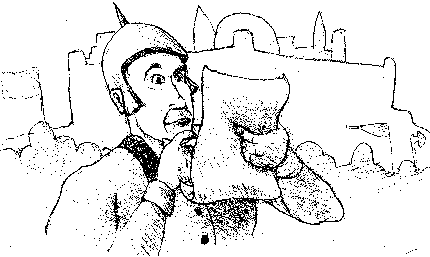
At that time, the Buddha was residing in a grove with a thousand monks. King Ajatasattu entered the assembly hall and saw a thousand monks sitting peacefully around the Buddha, not even the sound of rustling robes could be heard. King Ajatasattu had only briefly encountered the Buddha before, as he had never attended any of the Buddha’s teachings with his father. The Buddha invited them to sit down, and after bowing, the king said, “World-Honored One, I remember hearing you speak when I was young in the palace. Now I have a question for you: what practice can lead thousands of people to renounce worldly life and seek enlightenment?”
The Buddha asked if he had asked the same question to other teachers. King Ajatasattu said he had asked many different teachers, including Devadatta, but had never received a satisfactory answer. The Buddha said, “Your Majesty, tonight the Tathagata will explain to you the fruits of the true Dharma, some of which can be enjoyed in the present and some of which can be harvested in the future. You do not need to seek lofty answers; you just need to see clearly the mango you hold in your hand. Your Majesty, let me give you an analogy: a servant who obeys his master’s every command from morning till night. One day, he asks himself, ‘Why should I willingly be enslaved by my master?’ This servant decides to renounce his servitude and become a monk. He lives a life of celibacy, diligence, and mindfulness, eating only one meal a day, practicing walking and sitting meditation. His demeanor exudes peace and dignity in his actions and speech; he becomes a virtuous and respected monk. Although you know he was once a servant, when you see him now, would you say to him, ‘Come here, boy, I want you to serve me from morning till night, obeying all my orders’?”

King Ajatasattu said, “Certainly not, World-Honored One. I would never speak to him in such a manner. I would respectfully bow to him, offer him food, and ensure he receives the legal protections due to a monk.”

The Buddha said, “Your Majesty, this is the first fruit of the monk’s practice: he has liberated himself from prejudices of race, society, and class, and he has regained the dignity of being a human being.”

The Buddha continued, “Your Majesty, a person’s dignity is just the first fruit. A monk who observes the two hundred and fifty precepts can reside in a state of tranquility. Those who do not observe precepts are more prone to stray from the path; they may commit sins such as deception, intoxication, adultery, theft, or even murder. Such actions bring terrible punishments to their bodies and minds, and they may face severe penalties when caught. A monk who observes the precepts of non-killing, non-stealing, chastity, truthfulness, abstinence from intoxicants, and over two hundred other precepts finds it easier to live a psychologically freer life than ordinary people. This is another fruit that can be enjoyed in the present.

The Buddha continued, “Your Majesty, a monk possesses only three robes and an alms bowl. He never fears robbery nor needs to guard against thieves at night. He can sleep under a tree without worry. The freedom released from fear is the greatest joy. This is another fruit attained through practice. A monk’s life is very simple; although he eats only one meal a day, the food in his bowl comes from thousands of different households. He does not pursue fame or profit; he only uses what he truly needs, seeking nothing else. Dwelling in such unfettered freedom is a fruit that can be enjoyed at this moment.

King Ajatasattu said, “Truly remarkable, World-Honored One! Please continue.”

The Buddha said, “Your Majesty, if you understand how to cultivate mindfulness and contemplation of breathing, you can experience the joy of those who walk the path of practice. That is the bliss of meditation. A monk observes the six senses to overcome the five hindrances of desire, anger, delusion, sloth, and doubt. He attentively observes the breath to create joy nourishing body and mind, which helps him progress on the path to enlightenment. The pleasure derived from sensory experiences cannot compare with the joy obtained through meditation. The joy of meditation permeates body and mind, dispelling all anxieties, sorrows, and grief, allowing the practitioner to experience the true wonder of life. Your Majesty, this is one of the most important fruits of practice that can be enjoyed at this moment.”

The Buddha continued, “Your Majesty, because a monk consistently maintains mindfulness and adheres to the precepts, he can develop right concentration and insight into all phenomena. Through this insight, he sees the impermanent and selfless nature of all phenomena, thus no longer being bound by worldly affairs. He can then sever all entanglements of afflictions such as greed, anger, desire, sloth, doubt, attachment to views, speculative views, distorted views, and mistaking wrong views for right ones. After cutting off all these entanglements, the monk can attain liberation and freedom.”

“Your Majesty, liberation is true happiness and one of the greatest fruits of practice. Some of the monks sitting here tonight have already attained this fruit. Your Majesty, this is a fruit that can be realized in this very life.”

King Ajatasattu exclaimed, “Excellent, World-Honored One! I hope you can say more.”

The Buddha said, “Your Majesty, by illuminating the true nature of all phenomena, a monk knows that all phenomena are neither born nor extinguished, neither defiled nor pure, neither increasing nor decreasing, neither one nor many, neither coming nor going. With this understanding, a monk no longer discriminates; he regards all phenomena with equanimity, without hindrance. He rides the waves of birth and death to rescue sentient beings from the sea of suffering. He introduces sentient beings to the Great Way, allowing them to taste the joy of liberation. Your Majesty, helping others to break free from the maze of greed, anger, and delusion is the greatest joy. This joy extends from the present into the future as the supreme fruit of practice.

Your Majesty, in all his interactions, a monk never forgets the responsibility to guide others towards virtue and liberation. Monks do not engage in politics; they only contribute to the peace, morality, and happiness of society. The fruits of practice are not only for the benefit of monks; they are also the legacy that can be inherited by the people of the country.

The king stood up, sincerely clasping his hands together. He said, “Most Honored Teacher! World-Honored One! With your simple words, you have enlightened me, showing me the true value of the Dharma. World-Honored One, you have helped me rebuild what was shattered, revealed what was concealed. You have guided me back to the right path in my confusion, turning darkness into light. I beseech you, World-Honored One, to accept me as your disciple, just as you accepted my parents in the past.”

The king prostrated himself before the Buddha, who nodded in acceptance. He asked venerable Shariputra to teach king Ajatasattu the Three Refuges.

The meeting between the Buddha and King Ajatasattu was beneficial for all present, greatly alleviating the king’s mental torment. That night, he dreamt of his father smiling at him, healing all the wounds of the past. The king’s disposition completely changed, bringing infinite joy to his subjects. From then on, the king often visited the Buddha privately, no longer arriving on an elephant and without any guards. He climbed the meticulously carved stone steps up the mountain as his father had done in the past. In these conversations, King Ajatasattu confessed his innermost thoughts to the Buddha and repented for his past sins. The Buddha regarded him as his own son and advised the king to associate with virtuous people.

Link:https://peacelilysite.com/2024/03/28/the-transformative-encounter-king-ajatasattu-and-the-buddhas-teachings/

Brief Introduction to Great Bodhisattva H.E. Tangtong Gyalpo Bodhisattva

A Great Disciple of H.H. Dorje Chang Buddha III

H.E. Tangtong Gyalpo is a greatly accomplished person within Tibetan esoteric Buddhism who attained the rainbow body. He is a great Bodhisattva known and respected by one and all in Tibet.

He is also an extremely holy person who has made huge contributions to the Tibetan people. It was this great Bodhisattva who was the father of medicine, ferryboats, bridges, and operas in Tibet. He has brought to the living beings of Tibet limitless blessings. To this day, Tibetan temples and families continue to worship H.E. Tangtong Gyalpo Bodhisattva.


The first Tangtong Gyalpo left the household life to become a monk when he was very young. He studied the sutras and treatises and became good at debating the sutras. Although he possessed the Five Vidyas, he remained modest, simple, and down-to-earth. In order to provide a model of self-cultivation, H.E. Tangtong Gyalpo followed and learned under many people of great virtue.

He also engaged in solitary, quiet cultivation for a long period of time at the Eri Temple. Later, he received teachings directly from Dakini Niguma and became a person greatly accomplished in the dharma. People praised H.E. Tangtong Gyalpo with the following words: “In the vast realm of emptiness, there is a yogi who intensively studies emptiness and who is like the King of Fearlessness. His name is Tangtong Gyalpo.” He has also been respectfully called Zhibai Wangxiu Tangtong Gyalpo, which means the accomplished, free and unhindered Tangtong Gyalpo!

During a certain year in history, there was a serious drought and famine in Tibet. H.E. Tangtong Gyalpo conducted a Dharma Assembly in front of the Sakyamuni Buddha statue in the Jo-khan Temple in Lhasa. At that Dharma Assembly, he wrote “A Prayer to Eliminate Famine.” Many people then saw Kuan Yin Bodhisattva in the sky disseminating various grains. The famine ended not long after that.


There was another time when war and chaos occurred in the Muya district of Kham in Tibet, causing people to leave their homes and wander about. H.E. Tangtong Gyalpo made a vow and wrote “A Prayer to End War and Chaos.” People in that area very soon after that ended their mutual hatred and instead treated one another in a peaceful, friendly, and loving manner. There was another year when a pestilence broke out in a large area covering a religious site of the Sakya sect, causing countless deaths. The chanting of mantras and the offering of sacrifices could not end the pestilence. Thus, H.E. Tangtong Gyalpo again practiced dharma and wrote “A Prayer to End the Disaster of Illness.” As a
result, the pestilence disappeared forthwith. In previous times in Tibet, it was very difficult for people to cross rivers. The river waters mercilessly took away people’s lives as they attempted to cross the rivers. Thus, H.E. Tangtong Gyalpo made improvements to ferryboats and began building bridges. In that lifetime, he built fifty iron-chain bridges, sixty wooden bridges, and many temples. One of those temples was the Tangge Lakong (the Tangtong Gyalpo Temple), which was the first temple in the Derge region. With respect to medicine, H.E.Tangtong Gyalpo established the Medicine King Temple at Jiabori in Lhasa, invented a white pill that cured all kinds of internal medical diseases, and invented a red pill that cured epidemic diseases. Thus, he became the founder of Tibetan medicine. That white pill and red pill are used in Tibetan medicine even to this very day to relieve the sufferings of living beings.

This 600 year old bridge crosses the Paro Chhu (Paro River) and was traditionally restored in 2005 after being washed away during a 1969 flood. The bridge was originally built by the legendary Thangtong Gyalpo
Dungtse Lhakhang, a temple in form of a chörten near Paro in Bhutan was built by Thangtong Gyalpo. The roof construction is made of iron.


H.E. Tangtong Gyalpo Bodhisattva also wrote many Tibetan operas and established the Ache Lhamo opera troupe, the members of which acted out Tibetan historical stories through song and dance and pioneered Tibetan operas. The Achi Lhamo opera, with the starting troupe of seven sisters who worked on the saint’s bridges, is still performed and enjoyed hugely to these days during the new year celebration and on festive occasions. 

Achi Lhamo Opera Composed by Thang Tong Gyalpo Still Prevalent in Bhutan

H.E. Tangtong Gyalpo was the supreme leader of four esoteric sects within India, Bhutan, Sikkim, Mongolia, and Eastern Tibet. He possessed teachings from many dharma lineages, the most remarkable of which were the lineage to extend one’s life and the lineage to bring in wealth and change one’s fortune.
Everyone in Tibet, no matter what sect he or she belonged to, believed in and practiced such lineages and scriptures. Countless disciples of H.E. Tangtong Gyalpo became accomplished in the dharma under his teachings and attained great supernatural powers, wisdom and great compassion. More than one hundred disciples of his attained the rainbow body or the transformation rainbow body. All Tibetan people know that H.E. Tangtong Gyalpo is truly a great patriarch of Tibetan esoteric Buddhism and a great Bodhisattva. Later, each time H.E. Tangtong Gyalpo incarnated into this world. He was a great patriarch who spread the dharma, liberated living beings, and pervasively benefited people.

Thang Tong Gyalpo Present Reincarnation


H.E. the sixteenth Tangtong Gyalpo Bodhisattva (Thangtrul Rinpoche) took birth in Bhutan. His physical appearance resembles that of Guru Padmasambhava. Even when he sleeps, his eyes remain open. He saw H.H. Wan Ko Yeshe Norbu (Dorje Chang Buddha III) during a Dharma Assembly that took place in 2005 at Hua Zang Si in San Francisco, U.S.A. In a supernatural state of samadhi, he instantly saw that H.H. Dorje Chang Buddha, the highest ancient Buddha in the dharma realm, had already come to this world again. He at once formally acknowledged H.H. Dorje Chang Buddha III Wan Ko Yeshe Norbu as his master. H.H. Dorje Chang Buddha III asked him, “Did you follow and learn dharma under Guru Padmasambhava? Why have you come here?”H.E. Tangtong Gyalpo answered
that he had received teachings directly from Guru Padmasambhava and from H.H. Sakya Trizin who is the nirmanakaya of Manjushri Bodhisattva. He also said that he had come to request the highest dharma in order to save living beings. H.H. Dorje Chang Buddha III immediately snapped His fingers, and a dharma bowl manifested awesome power. H.H. Dorje Chang Buddha III then accepted H.E. Tangtong Gyalpo as one of his disciples who is on the level of a great venerable one and performed an initiation for him. H.E. Tangtong Gyalpo took that dharma bowl back to his home country.


He later learned that the book A Treasury of True Buddha-Dharma about the H.H. Dorje Chang Buddha III Wan Ko Yeshe Norbu Holiest Tathagata was about to be published. He thereupon organized many rinpoches to practice the Kuan Yin Dharma one billion times as an offering to His Holiness Dorje Chang Buddha III. He also sent his written congratulations stating that His Holiness is the master of Buddhas, the magnificence of His Holiness is supreme and that in this world no other holy being in history can compare with His Holiness.

H.H. Dorje Chang Buddha III accepted H.E. Tangtong Gyalpo as his disciple at Hua Zang Si temple San Francisco

#DorjeChangBuddhaIII#HHDorjeChangBuddhaIII#HuaZangSi #Buddha #Buddhism #buddhist #Temple#GuanYinBodhisattva#BuddhismTemple#SanFrancisco#TangtongGyalpo #Buthan #Tibet


Link:https://peacelilysite.com/2024/03/22/brief-introduction-to-great-bodhisattva-h-e-tangtong-gyalpo-bodhisattva/

Source: https://www.rigpawiki.org/index.php?title=Thangtong_Gyalpo, https://www.nwrafting.com/international/thangtong-gyalpo-tachog-lhakhang, https://www.bhutaninbound.com/blog/2022/06/11/thang-tong-gyalpo-iron-man-of-bhutan/

Dharma Master Tonghui —- Great Achievers

Dharma Master Tonghui —- Great Achievers-图片2

Dharma master Tonghui

Venerable Dharma Teacher Tonghui (1922-2013) served as the Abbot of Longju Temple, renowned for Jiangxi Mazu. A devoted disciple of H.H. Dorje Chang Buddha III, he immersed himself in the teachings and practices of dharma. Also known as Elder Monk Tonghui, he transcended the ordinary, attaining the revered status of a holy monk.

Venerable Master Tong Hui, born Tang Zhenbang on March 5, 1922, in Penglai town, Suining City, Sichuan Province, belonged to the Han ethnicity. Renowned for his intelligence from a young age, he adhered to a vegetarian diet and practiced abstinence, following his parents’ guidance. In 1931, he entered monkhood under Master Pu Jing at Jinwen Temple in Pengxi. Full ordination followed in 1940, under Venerable Master Miaoneng at Baoguang Temple, and further studies in Chengdu’s Jingci Temple under Master Nenghai in 1941. Residing at Longju Temple with Master Miaoneng in 1942, he served during the transmission of the Great Precepts by Master Nenghai. Master Nenghai was one of the most eminent monks in last century.

Post-liberation, Longju Temple faced dispersion, confiscation of properties, and occupation during the Cultural Revolution. As the warehouse keeper, Venerable Master Tong Hui personally bore the repercussions of stolen food, enduring imprisonment to spare innocent people. False accusations regarding the team’s beekeeping further led to additional years in prison. His unwavering compassion and selflessness epitomized the Buddhist spirit.

Reopened by the government on December 16, 1986, Longju Temple underwent extensive renovations under the venerable master’s guidance. The Arhat Hall, Main Hall, Scripture Hall, and Accommodation Building were constructed, while the main gate, Ksitigarbha Hall, Hall of Heavenly Kings, and Bell Tower were restored. The restoration of large Buddha and Bodhisattva statues, as well as Arhat statues, showcased the venerable master’s dedication. Numerous instances of his awe-inspiring virtue were evident, such as his ability to attract dharma-protecting deities and revive a withered ginkgo tree with Bodhi Holy Water.

Front Entrance of Longju Temple

Grand Hall in Longju Temple

Moreover, Venerable Master Tong Hui made significant contributions to Buddhism by bringing back Buddha and Bodhisattva statues made of Burmese jade from temples in Dayi County and Daying County.

A legendary story recounts Master Tonghui’s visit to Burma in 1992. Venerable Dharma Teacher Tonghui went to Burma to respectfully receive and take back with him a Jade Statue of the Buddha. The night before the Dharma teacher arrived, many people in Burma suddenly dreamed that he was a golden Arhat and would soon come to Burma. The next day when he arrived in Burma, hoards of people made offerings to him. In Hinayana Buddhism, Arhats are praised in the same way that Bodhisattvas who attained the marvelous fruit of enlightenment are praised. It is clear that Venerable Dharma Teacher Tonghui was an amazing and great sage.

Venerable Dharma Teacher Tonghui peacefully passed away on February 26, 2013, at the age of 92. His preserved body, following ancient Buddhist rituals, was respectfully opened three years later on June 12, 2016, revealing a full and jade-colored flesh body in the urn. This sacred event reaffirmed the authenticity and practicality of true Buddha Dharma.

The flesh body of Venerable Dharma Teacher Tonghui is now enshrined in Longju Temple for people to respectfully admire.

Dharma master Tonghui — Great Archivers

Link:https://peacelilysite.com/2024/02/16/dharma-master-tonghui-great-achievers/

#Buddhist #BuddhaDharma #LonjuSiTemple #MasterTonghui #DorjeChangBuddhaIII  #HHDorjeChangBuddhaIII

A Beautiful Love Story Carved in the Dunhuang Grotto China

Prince Sunwoo ventured into the sea in search of treasures

In the ancient Dunhuang Grottoes of China, a mesmerizing love story unfolds, delicately captured in murals that have withstood the test of time. Let us immerse ourselves in this enchanting tale of kindness, courage, and wisdom.

Once upon a time, in the Kingdom of Polo, a joyous occasion marked the birth of a prince named Sunwoo. Born to the noble king and queen after twelve years of fervent prayers, the young prince brought immense happiness to the royal family.

As Sunwoo grew, so did his wisdom and kindness. His presence was a beacon of light, radiating love and compassion. However, alongside him was a stepbrother, an evil friend, whose heart harbored jealousy and resentment towards the virtuous prince.

The tale takes an unexpected turn when Sunwoo, driven by a desire to alleviate the suffering of his people, embarks on a perilous journey to seek treasures from the sea. His selflessness touches the hearts of many, but it also ignites the envy of his malevolent stepbrother.

Prince Sunwoo accompanied by 500 volunteers to search for treasur

Guided by an elderly instructor and accompanied by 500 volunteers, Sunwoo reaches Haizhou Jumbo Island. As he ventures further, facing challenges and loss, he encounters the benevolent Dragon King, who grants him the priceless Ruyi pearl.

Prince Sunwoo and his team sailed across the ocean

Meanwhile, back in the Kingdom of Polo, Sunwoo’s absence is keenly felt. His parents, yearning for his return, send a white goose as a messenger. The devoted goose delivers a letter revealing the Prince’s dire circumstances.

As Sunwoo’s journey unfolds, his evil stepbrother, fearing Sunwoo’s increased popularity upon return, decides to sabotage him. The malicious act blinds Sunwoo, leaving him vulnerable and alone.

In his darkest hour, a compassionate cowherd boy comes to Sunwoo’s aid. Unaware of his royal identity, the boy rescues Sunwoo and becomes his loyal companion, leading him back to the kingdom.

The love story takes an unexpected twist when the blind Sunwoo, reduced to a beggar, meets a kind princess during his wanderings. The princess was very touched by Sunwoo’s music. Her genuine affection and determination to marry him, despite societal norms, lead to a grand wedding.

In a poignant moment, the princess, deeply in love, makes a solemn vow. She promises to restore Sunwoo’s sight if her love is true and vows to take away her own eyes if she ever betrays him. Miraculously, her unwavering love restores one of Sunwoo’s eyes.

The narrative weaves through twists and turns, revealing the complex interplay of good and evil, karma, and ultimate redemption. Sunwoo’s evil stepbrother, realizing the consequences of his actions, repents and reveals the hidden Ruyi pearl.

In a grand reunion, Sunwoo’s parents regain their sight, and the entire kingdom is bathed in prosperity. The murals in Dunhuang and Kaihua Temple immortalize this timeless love story, showcasing not only the artistic brilliance of ancient China but also the enduring power of kindness and virtue.

As we reflect on this captivating tale, may it inspire us to embrace compassion, navigate life’s challenges with wisdom, and believe in the transformative power of love and redemption. The Dunhuang Grottoes stand as a testament to the rich tapestry of human stories etched in history, inviting us to cherish the enduring lessons embedded in their ancient walls.

Link:https://peacelilysite.com/2024/02/08/a-beautiful-love-story-carved-in-the-dunhuang-grotto-china/

#DunhuangGrottes #Murals #AcientArts

Source: photos from http://m.news.cctv.com/2020/08/09/ARTIoQSmgcAEjtx5j0cLVoos200809.shtml, https://www.sohu.com/a/334453850_120259260#google_vignette