Journey to Tranquility: Exploring the Wonders of Usnisa Palace at Niushoushan

The Usnisa Palace, also known as Foding Palace, is situated in the Niushoushan Cultural Tourism Zone, Jiangning District, Nanjing City. This architectural marvel, characterized by its deep pit structure, serves as the long-term sanctuary for the Foding relic bone. Spanning 220 meters in length, 160 meters in width, and towering at an overall height of 89.3 meters, with a total building area of approximately 136,000 square meters, the palace is a testament to grandeur. The external space is subdivided into three components: the large dome, small dome, and Foding cliff. Internally, it comprises nine layers – three above ground and six underground – housing the Zen Grand View, Relic Hall, and Relic Treasury. Foding Palace not only serves as the primary repository for the Buddha’s crown relic bones and a place of worship for believers but also functions as a cultural exhibition space showcasing relic culture and global Buddhist culture through various artistic mediums.

Niushoushan stands as one of China’s renowned Buddhist mountains and is the birthplace of Niutou Zen Buddhism, a significant sect of Chinese Zen Buddhism. It houses the world’s only Buddha’s Parietal Relic – the skull of Shakyamuni. This complete skull, with a circumference of 35 cm and a diameter of 10 cm, is adorned with yellow-and-black hues and features clear hair holes distributed throughout.

The Buddha’s Parietal Relic was unearthed in the Ashoka Pagoda within the underground palace of Bao’en Temple in Qinhuai District, Nanjing. It stands as the sole surviving true parietal relic of the Buddha globally.

The external space is ingeniously divided into three sections: the large dome, small dome, and Buddha Grottoes. The large dome, shaped like a Buddha’s cassock and stretching 120 meters in length, covers the small dome palace, symbolizing the boundless blessings of the Buddha. The small dome, resembling the Buddha’s hair bun, is composed of thousands of small units, representing the offerings made by thousands of believers. The base of the small dome takes the form of a lotus throne, featuring 56 flying Bodhi gates symbolizing Buddha’s infinite wisdom and 56 cloud gate wishful pillars symbolizing good luck and fortune.

Usnisa Palace : Large Dome and Small Dome

Within Foding Palace, the design deviates from a singular dome to an atrium-style space connecting upper and lower levels directly. The central reclining statue of the Buddha in Nirvana is a captivating focal point, visible from various angles. Using the four sights of birth, old age, sickness, and death, the Buddha imparts guidance and enlightenment to sentient beings. In Buddhism, “Nirvana” signifies a state of eternal and serene tranquility without birth or death. As the Buddha speaks, heavenly beings scatter flowers. Tradition holds that in the Buddha’s pure land, day and night witness the auspicious occurrence of raining flowers. During the Buddha’s Nirvana, offerings such as incense, flowers, and precious banners are made.

Upon entering Foding Palace, visitors traverse a long corridor adorned with paintings depicting sacred scenes. Four small palaces within the passage illustrate wonders of the four natural elements: earth, fire, water, and wind. The journey provides an opportunity to contemplate the painted stories of the Buddha’s eightfold path to enlightenment, featuring extraordinary phenomena related to earth and fire, such as thousands of small Buddha niches and a thousand heart lamps.

To approach Foding Palace, one ascends using a water elevator, marking the third wonder – the purification of the three realms through water. Depicting these natural phenomena through a meditative design, the top floor of Foding Palace awaits, featuring a towering space and exquisite dome. The celestial ambiance, with stars seemingly within reach, fosters a sense of unity between heaven and earth. This intentional design aims to allow individuals to grasp Buddhist stories and appreciate nature’s wonders before encountering the Buddha’s relic. This preparatory “journey” facilitates entry into Foding Palace with a tranquil and peaceful mindset, reminiscent of a meditative experience.

The internal space encompasses nine floors – three above ground and six underground – housing the Zen Grand View, Relic Hall, and Relic Palace.

Relic Hall

The Relic Hall comprises the Thousands Buddhas Hall and the Ten Thousands Buddha Corridor. The Thousand Buddhas Hall, adorned in red, yellow, and dark gold, features a vault-shaped layout corresponding to the Hua Zang Buddhist World. The central focus is the 21.8-meter-high Relic Pagoda, imitating the Ashoka Pagoda where the Buddha’s Parietal Relic was found. The Ten Thousands Buddha Corridor spans the 3rd, 4th, and 5th underground floors, showcasing Chinese Buddhism culture, seven-sided lacquer paintings depicting Indian Buddhist teachings, and Buddha’s relic and relic culture, including videos, porcelain paintings, ancient pagodas, and historical relics.

Thousand Buddha Hall
Ten Thousands Buddha Corridor

Relic Palace

Also known as the Buddha’s Treasure Palace, the Relic Palace exudes a solemn and mysterious atmosphere with its dark color scheme. It serves as a sacred space for housing the Buddha’s Parietal Relic and a place for Buddhist worship and meditation. At its center is the 7-meter-high Relic Treasure Pagoda adorned with exquisite golden decoration. Inside the pagoda is a hexagonal and intricate lotus stupa, housing the sealed glass box containing the Buddha’s Parietal Relic. The pagoda is equipped with fireproof and explosion-proof features, along with a constant temperature and humidity system to ensure the optimal environment for the relic. Surrounding the relic pagoda are eight unparalleled marble mosaics depicting the life of the Buddha.

Corridor of the Relic Palace
Relic Palace

Zen Grand View

The Zen Grand View spans 112 meters from north to south and 62 meters from east to west, with a total height of 46.5 meters. Its oval shape encompasses an area exceeding 6000 square meters, with a core focus on Zen culture. Comprising Buddha’s Birth, Buddha’s Enlightenment, and the Lotus Theater in the middle, the Zen Grand View narrates the life story of the Buddha.

Lotus Buddha Theatre – Not-to-miss Visual Feast

The Lotus Buddha Theatre hosts a daily “Song of the Lotus Buddha” Zen Buddhism culture ceremony and stage multimedia show from 10:00 to 11:30 in the morning and from 13:30 to 15:00 in the afternoon. This 30-minute visual feast combines ceremonial performance with burning lamps, praying, offering flowers to the Buddha, large-scale dancing, and more. During the performance, the Sleeping Buddha descends slowly from the air, accompanied by a rising stage, actors, and 16-meter-high lotus petals. The Sleeping Buddha, a copper statue of Sakyamuni, with a length of 7.5 meters and a surface made of white marble, can rotate 360 degrees, expressing the Buddha’s peaceful moment of Nirvana.

Lotus Buddha Theatre

Journey to Tranquility: Exploring the Wonders of Usnisa Palace at Niushoushan

Link:https://peacelilysite.com/2024/01/19/journey-to-tranquility-exploring-the-wonders-of-usnisa-palace-at-niushoushan/

#UsnisaPalace #Buddha #Travel #Nanjing #TravelChina #Lotus #BuddhaRelic #ZenBuddhism

Source: https://www.chinadiscovery.com/jiangsu/nanjing/niushoushan.html, https://baike.baidu.com/item/%E4%BD%9B%E9%A1%B6%E5%AE%AB/18723834

The Debate of King Milinda – Nagasena Bhikkhu Sutra

The twelfth among the Eighteen Arhats is recognized as Nagasena in Sanskrit, meaning “Dragon Army.” Often referred to as “Bhikshu Nagasena,” he was a Buddhist theoretical philosopher who received full ordination at the age of twenty and eventually attained the state of Arhat. Bhikshu Nagasena journeyed to the ancient kingdom of Shakyadesha in northwestern India to engage with King Milinda. Responding to the king’s inquiries, Nagasena eloquently expounded on the impermanence of life, the law of karma, and various facets of Buddhist practice, employing metaphors to convey profound insights. This discourse is encapsulated in the “Nagasena Bhikshu Sutra,” representing a comprehensive exposition of fundamental Buddhist teachings.

Below are excerpts from conversations between Nagasena and King Milinda, where the king poses questions and Nagasena responds with profound wisdom and intelligence.

First Question

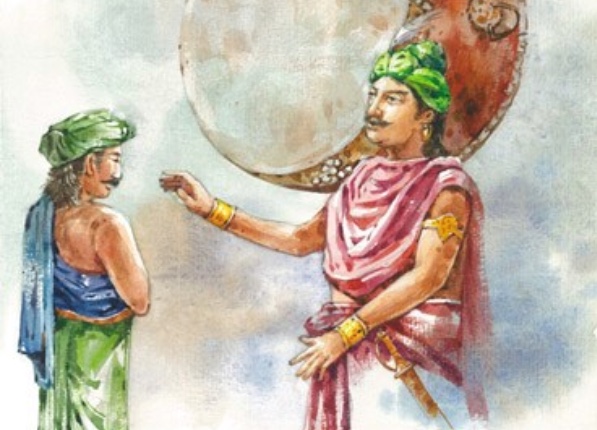
Once, King Milinda intentionally sought to challenge Bhikkhu Nagasena and questioned him, saying, “You did not live in the same era as the Buddha, and you never met Siddhartha Gautama. How can you be sure that the Buddha actually existed?”

Wise Bhikkhu Nagasena responded by asking, “Great King, how did you inherit your throne?”

“It was passed down to me by my father,” replied the king.

“And from whom did your father receive the throne?” Nagasena inquired.

“From his father, my grandfather.”

“And your grandfather’s throne, from whom did he receive it?”

“From his forefather, my great-grandfather!”

Nagasena continued, “If we trace this lineage generation by generation, do you believe that there was an original founder of your kingdom?”

King Milinda replied with certainty, “Certainly, I believe so!”

“Have you ever seen this founder?” Nagasena asked.

“No, I haven’t.”

“How can you believe in someone you haven’t seen?” Nagasena questioned further.

The king explained, “Our founding monarch established laws, systems, and regulations, all of which are recorded in history. Though I haven’t seen him, I believe in his existence because there are historical records.”

Smiling, Bhikshu Nagasena nodded and said, “In the same way, we believe that the Buddha indeed existed. In Buddhism, there is the Triple Gem of Buddha, Dharma, and Sangha, along with scriptures, Vinaya (monastic rules), and Abhidharma (philosophical teachings). The Buddha’s ethical guidelines and historical events are not fabrications; they are as real as your founding monarch in historical terms!”

Second Question:

Unable to find fault with Bhikkhu Nagasena in the first question, King Milinda, using his wit, posed another challenging query. He asked, “Buddhists often speak of the ultimate happiness being the realization of Nirvana, attaining a state beyond birth, death, and cessation. Bhikshu Nagasena, have you attained Nirvana?”

Bhikshu Nagasena humbly replied, “I’m ashamed to admit that I haven’t.”

King Milinda, feeling triumphant, questioned, “If you haven’t experienced it yourself, how do you know about the state of Nirvana?”

If this question were posed to you, how would you respond?

Rather than directly answering, Bhikshu Nagasena turned the question back to King Milinda, asking, “Great King, if I were to take a large knife and cut off your arm right now, would it be painful?”

King Milinda’s expression changed, and he said, “Certainly, it would be painful! How could having one’s arm cut off not be painful?”

Nagasena pressed on, “But your arm has never been cut off before, so how do you know it would be painful?”

The king replied, “I have seen others experience the pain of having their arms cut off, so I know it would be painful!”

Smiling, Bhikshu Nagasena respectfully remarked, “Great King, just as you can understand the pain of losing an arm by witnessing others, I, too, have seen the joy of those who have realized Nirvana. Hence, I am certain about the sublime nature of the Nirvana state!”

Third Question:

King Milinda, persisting in his skepticism, attempted a third inquiry, asking, “Monastics are supposed to embrace compassion. How do you forgive your enemies?”

Bhikshu Nagasena smiled and replied, “Great King, if you had a festering wound on your leg, would you chop off your entire leg?”

“No, I wouldn’t,” answered the king.

Nagasena continued, “So, what would you do?”

“I would carefully clean it, apply medication, and with time, the wound would heal,” explained the king.

Bhikshu Nagasena stated, “Exactly! Enemies and wrongdoers are like festering wounds. If not taken care of and treated, they will spread and worsen. Therefore, one must use the water of dharma to cleanse them, encouraging them to abandon wrongdoing and turn towards righteousness. This principle is similar to how you, Great King, nurture and care for the wound on your leg!”

Fourth Question:

King Milinda nodded in acknowledgment but remained unconvinced. After contemplating, he posed another question, “You often advise people to accumulate merits for the next life. Since you haven’t experienced death, how do you know there is life after death?”

Bhikshu Nagasena responded with a simile, “It’s similar to a mandarin orange. When the fruit ripens and falls to the ground, the flesh rots away. However, the seed remains buried in the soil. When the time is right, it sprouts, grows, and becomes a robust mandarin orange tree. The human body is just a temporary aggregation of the four elements. When the illusion shatters, the body dies. Yet, the karmic consciousness continues the cycle of birth and death. It is like the seed of the mandarin orange, persistently reincarnating in the six realms, not just once but countless times, with an endless cycle of rebirths.”

Fifth Question:

Despite King Milinda’s lingering dissatisfaction, he presented a fifth question, each one more challenging than the last. However, Bhikshu Nagasena, wise and composed, continued to respond with a smile.

King Milinda asked, “Do monastics love their own bodies?”

Bhikshu Nagasena replied, “The body is merely a temporary confluence of the four elements and five aggregates. Monastics do not have attachment to it.”

King Milinda, feeling confident, cleverly countered, “Oh! You claim not to love your body, but monastics still dress, eat, and sleep. Isn’t that a way of protecting the physical form? If you say you don’t love it, isn’t that a contradiction?”

Bhikshu Nagasena smiled and offered a different perspective, “Great King, if you had a boil on your body, would you love it?”

“A boil? Such a dirty and unpleasant thing! Who would like it?” exclaimed the king.

“If you dislike it, why bother cleaning it, applying medication, and taking constant care to prevent it from worsening? Checking on it every day to see if it’s improving. If you claim not to like the boil, isn’t that contradictory behavior?” Nagasena questioned.

King Milinda, somewhat defiantly, argued, “I do it for the health of my body!”

Bhikshu Nagasena chuckled and said, “Exactly! Monastics may not love this body, but for the purpose of cultivating the spiritual path, they still have to care for this illusory form.”

Sixth Question:

King Milinda, undeterred by previous responses, continued with his inquiries, asking, “Can Siddhartha Gautama, the Buddha, know the causes and effects of the past, present, and future?”

“Buddha possesses great supernatural powers, and indeed, he can know the past, present, and future!” answered Nagasena.

“If that’s the case, why doesn’t he teach all of you those supernatural powers? Then, disciples could instantly know the past, present, and future karmic obstacles, and everyone would attain enlightenment quickly. Why go through gradual training?” questioned the king.

The clever Nagasena, handling the question with ease, asked in return, “Great King, if you were a physician, wouldn’t you know about various medicinal herbs?”

“Of course! A physician needs to know the properties of different herbs and their healing abilities,” replied the king.

“Since a physician knows about numerous medicinal herbs, can he prescribe all of them to a single patient?” Nagasena asked.

King Milinda, dismissing the idea, responded, “Certainly not! Treating an illness requires targeted medications, gradual adjustments, and specific remedies tailored to the patient’s condition. Haphazard prescriptions won’t cure the patient; it needs careful consideration!”

Seizing the opportunity, Nagasena continued, “Likewise, the Buddha imparts the Dharma based on individual capacities, tailoring the teachings to each disciple’s unique qualities. Gradual instruction is necessary, adapting to the disciples’ diverse capacities, to guide them step by step on the path to enlightenment. Otherwise, trying to rush the process might lead to unintended consequences!”

The Debate of King Milinda – Nagasena Bhikkhu Sutra

Link:https://peacelilysite.com/2024/01/11/the-debate-of-king-milinda-nagasena-bhikkhu-sutra/

Source: https://hk.aboluowang.com/2020/0519/1453067.html

Dazu Rock Carvings – The Last Monumental Works in the History of World Grotto Art

Detail of reclining Buddha, Parinirvana of Shakyamuni attended by bodhisattvas, Mt. Baoding, Southern Song Dynasty, Dazu, China, 102′ long (photo: Mulligan Stu, CC BY 2.0)

With a history spanning over 1,300 years, the Dazu Rock Carvings represents the pinnacle of grotto art worldwide from the ninth to the thirteenth century. The exquisite and varied cliff-side sculptures at Dazu caves provide outstanding proof of the harmonious fusion of Buddhism, Taoism, and Confucianism in civil. In 1999, the Dazu Rock Carvings was inscribed on the World Heritage List by UNESCO.

Enjoying a comparable reputation with the top four grottoes in China (Mogao Grottoes, Yungang Grottoes, Longmen Grottoes, and Maijishan Grottoes) and being rated as one of the eight grottoes in the world, the Dazu Rock Carvings (“大足石刻” in Chinese), also known as Dazu Caves or Dazu Grottoes, located 167km from the city center of Chongqing. It is the one and only UNESCO World Cultural Heritage Site in Chongqing municipality. The Dazu Rock Carvings consists of 75 cave temple sites, including more than 50,000 statues, being protected for their historical, artistic, and scientific values at different levels, representing the pinnacle of Chinese cave temple art between the 9th and 13th centuries. Among them, rock carvings of Baodingshan (宝顶山), Beishan (北山), Nanshan (南山), Shimenshan (石门山), and Shizhuanshan (石篆山) are exquisitely sculpted with the most distinctive style.

The Dazu Rock Carvings started in the early Tang Dynasty, went through the late Tang Dynasty and the Five Dynasties, and then experienced its golden time in the Northern and Southern Song Dynasty. At the time when cave art in northern China fell into decay, the Dazu Rock Carvings undoubtedly created another peak in the history of Chinese cave art, extending the history of Chinese cave art for more than 400 years. Since then, there have been no such large-scale rock carving events in China or even in the world. Therefore, the Dazu Rock Carvings are also known as the last monument and swan song in the history of the world’s grotto art.

UNESCO Stele of the Dazu Rock Carvings

Differing from famous royal grottoes in the north, the religious cliff inscriptions in Dazu show distinctive features of nationalization, secularization, and everyday life, reflecting the remarkable development and changes in folk religious beliefs. Thus, the Dazu caves have the irreplaceable historical, artistic, scientific, and connoisseurship values of grottoes of the previous generations. Another highlight that has to be mentioned is that the statues there provide outstanding evidence of the harmonious synthesis of Tantric Buddhism, Taoism, and Confucianism. Visitors can see separate stone carvings as well as the unity caves reflecting the three religions’ confluence and ruling together. Moreover, thanks to the southern hinterland location of the Dazu Rock Carvings, this cultural heritage stays far away from man-made sabotage, retaining the integrity of the statues, the original characteristics and values of the period when the carvings were created.

Rock carvings in Dazu are mainly located across five mountains, each containing distinct sets of grottoes, among which the cliff-side sculptures on Baodingshan and Beishan are best known and considered to be the model of the late Chinese grottoes statue art. The pictures of the Dazu rock carvings that we commonly find online were mostly taken at the Baodingshan Scenic Area, which is also the must-visit site for a Dazu Rock Carvings tour.

Baodingshan Rock Carvings (Baodingshan Scenic Area)

Fifteen kilometers northeast from Dazu center, Baodingshan Rock Carvings was constructed by the famous monk Zhao Zhifeng in the Song Dynasty for more than 70 years. As one of the most famous Tantric Buddhist shrines in China, there is an old saying that goes like “Go North, climb the Emei Mountain; Go South, reach the Baoding Mountain.” The centerpiece of the Baodingshan rock carvings is the U-shaped Grant Buddha Bay, also known as Dafowan (“大佛湾” in Chinese). Nearly ten thousand statues are carved along the east, north, and south cliffs, which are approximately 500 meters in length and 8-25 meters high. Like a picture scroll with endless photographs, the content of Baodingshan rock carvings is mainly Buddhist scripture stories, each niche related to the other but not identical.

Dazu Rock Carvings – Buddhist Wheel of Life

Avalokitesvara with Thousand Hands

The Buddha statues at Baodingshan are novel in conception, skillful in carving, and rich in secular characters. Religious treasures come one after another, including the representative work – Niche of Sakyamuni Entering Nirvana, one of the wonders of Buddhist art in the world – Avalokitesvara with Thousand Hands, striking image of Buddhist Wheel of Life, scientific designs of Three Saints of Huayan School of Buddhism and Cave of Full Enlightment showed craftsmans’ ingenuity.

In addition, niche content and their expression approach are striving to visualize reality. For instance, Niche of Parental Love Sutra contains ten groups of carvings, including scenes like begging for a son, carrying a child, and going into labor, etc., depicting parental love in bringing up children with plots linking to each other as a picture-book. These carvings are vivid and impressive. They were the outcome after Buddhism had been localized in China.

The ox herding story

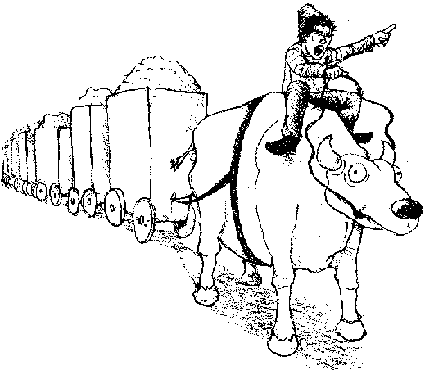
Located at the eastern end of the Great Buddha Bend, the ox herding tableau, shows a herdsman taming a disobedient ox—a traditional metaphor for the path to self-enlightenment and a popular theme among Ch’an Buddhist monks and painters in the Song Dynasty. The tableau is made up of eleven vignettes arranged horizontally along a 27-meter cliff wall.

Ox herding story (scene 1–2), Niche 30, Dafowan, Mt. Baoding, Dazu. Southern Song Dynasty (photos: G41rn8, CC BY-SA 4.0)

The first three vignettes each depict a lively interaction between a herdsman and an ox in a landscape setting. The herdsman represents the Buddhist practitioner while the ox refers to the practitioner’s potential to become a Buddha. As the ox turns its body away, the stocky herdsman uses force, grass, and a stick to tame the ox. The verses accompanying the scenes further recount these struggles. 

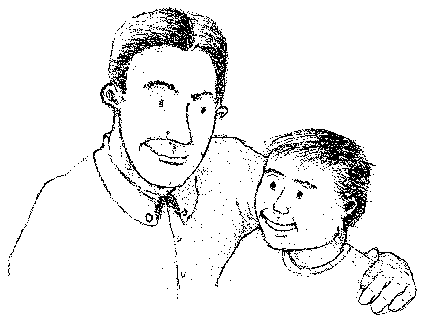
Herdsmen embracing in the ox herding story (scene 5), Niche 30, Dafowan, Mt. Baoding, Dazu. Southern Song Dynasty (photos: G41rn8, CC BY-SA 4.0)

In the fourth and fifth vignettes, the ox is finally brought under control. The herdsman, featuring a wide, joyful smile, wraps his arms around his fellow herdsman while holding on to the ox with the rope in his hands.

In addition to the uncanny quality of grottoes’ masterpieces at Grant Buddha Bay (Dafowan), there are also many highlights you can’t miss while visiting Baodingshan Scenic Area:

  • Watch a 4K film with English subtitles to learn about the history and development of Dazu rock carvings, and enjoy an 8D view of spectacular grottos at the dome theater
  • Take a leisure stroll at Dazu Rock Carvings Museum (大足石刻博物馆) to gain insights into the whole thread of world cave temple art and the basic characteristics of Dazu Rock Carvings
  • Visit Shengshou Temple (圣寿寺) to admire the exquisite temple architecture, which was rebuilt at the Ming and Qing Dynasties.
Shengshou Temple & Dazu Rock Carvings Museum

Beishan Rock Carvings

1.5km north to Longgang Town of Dazu, with an altitude of 545.5m, Beishan is also called Longgang Mountain in the past. Beishan Rock Carvings is the initial of Dazu Rock Carvings. They were first created by Wei Junjing, prefect of Changzhou, in 892 A.D. of the late Tang Dynasty. Until 1162 A.D. of the Southern Song Dynasty, the existing scale of Beishan Rock Carvings was formed, and it centered around Fowan. The rock carvings are numbered and divided into two sections: No.1 ~ No.100 are in the south section, while No.101 ~ No. 290 are in the north section. There are over 5,000 statues on a 500m long cliff, with a height of 7 to 10 meters. The grottoes are very dense, just like a hive, and all of them are delicate and carved with high sculpture skills.

Avalokitesvara with a Rosary

The crowning jewels of Beishan rock carvings are the statues of Avalokitesvara. They are ornamental and artistic, with diverse looks and postures. The most emblematic ones are the Avalokitesvara with a RosaryAvalokitesvara Watching the Moon Reflection in the Water, and Thousand-armed and Thousand-eyed Avalokitesvara, etc.

Beishan rock carvings can be visited both during the day and at night. An additional visual experience is provided by the scenic spot’s usage of colored light to illuminate the stone statues. Besides, if you have enough time and stamina, don’t forget to follow the downhill trail to visit the Duobao Pagoda (多宝塔) to see the giant cliff statues of Beishan, the Two Buddhas of the North Pagoda.

Dazu Rock Carvings – The Last Monumental Works in the History of World Grotto Art

Link:https://peacelilysite.com/2024/01/04/dazu-rock-carvings-the-last-monumental-works-in-the-history-of-world-grotto-art/

#AvalokitesvarawithThousandHands #Shakymunibuddha #DazuRockCarvings #History #WorldGrottoArt #Buddhism #BuddhistArt #BuddhaStatue#Cave#TravelChina #ChineseCulture

Source:https://www.chinadiscovery.com/chongqing/dazu-rock-carvings.html, https://smarthistory.org/mt-baoding-dazu-rock-carvings/

Unveiling Insights Through the Wild Fox Koan: Understanding the Law of Cause and Effect

In the annals of Chinese Buddhist teachings, a narrative known as the “Wild Fox Koan” imparts profound insights into the principles of karma and its undeniable consequences.

According to legend, during the Tang Dynasty in China, Master Bai Zhang Huai Hai, a venerable monk and the third-generation disciple of the Sixth Patriarch Master Huineng, played a pivotal role in this story. During his sermons, he consistently noticed an unfamiliar old man attentively listening to his teachings on Buddhism. The mysterious visitor would only depart after the session concluded. One day, after another sermon, the old man lingered, prompting the puzzled monk to inquire, “Who is standing there without leaving? Who are you?”

Huaihai, curious, asked, “Do you have something on your mind?” The old man got straight to the point, confessing, “I am not a human; I am a wild fox on this mountain. Five hundred years ago, I was a monk and once gave a Dharma talk here. One day, a junior monk asked me if enlightened beings fall under the law of cause and effect. I replied, ‘They do not fall under cause and effect.’ Unfortunately, I gave the wrong answer and fell into the realm of a fox. Today, I want to ask a question in front of you, venerable teacher. Would you be willing to enlighten me?” Huaihai replied, “Please go ahead.” The old man asked, “Do enlightened beings fall under the law of cause and effect?” Huaihai responded, “They do not ignore cause and effect.” The old man paused for a moment, then prostrated himself, saying, “Teacher, I have attained enlightenment. I have now transcended the realm of the fox. I am beneath the big stone on the back mountain. I hope that you, as a monk, will bury me according to the proper rites.” After saying this, he disappeared without a trace.

Accompanied by monks, Master Huaihai went to the back mountain and found, under a large stone, a dead black fox. Master Huaihai instructed them to light torches and cremate the fox. They then chanted sutras together, performing rites to help the fox monk attain liberation.

The Fox Zen Master, due to a single mispronounced word, uttered a great falsehood, resulting in five hundred lifetimes as a wild fox. The principle of cause and effect is unfailing, as it does not discriminate between the ordinary and the saintly. Advanced practitioners maintain a profound reverence for the law of karma. Hence, there is the notion that bodhisattvas fear the cause, while ordinary beings fear the effect. A bodhisattva contemplates the emptiness and tranquility of all phenomena, harboring no attachment or grasping. Due to their wisdom, they do not give rise to undesirable consequences such as ignorance or darkness.

If one were to claim that a bodhisattva “transcends cause and effect,” it would imply an annihilationist view. It is only by “not obscuring cause and effect” that a bodhisattva, within the profound samadhi of deep prajna paramita, can attain the ultimate wisdom.

“To keep things secret, refrain from doing them unless by oneself.” This is a commonly heard phrase advising people to do good, implying that whatever one does, there will always be someone who knows. Moreover, secrets are bound to be exposed sooner or later. Therefore, it is essential to reflect on one’s actions regularly, ensuring they align with goodness. Never assume that no one is watching, as actions that go against the laws of cause and effect will eventually come to light.

Two other frequently heard sayings are: “Within three feet, there are gods” and “Every step leaves a mark.” These cautionary words remind individuals that every action leaves an imprint, and nothing done will vanish into oblivion over time. In the realm of cause and effect, if one sows seeds of negativity, they must ultimately bear the consequences, adhering to the principle of “unobscured cause and effect.”

During the Three Kingdoms period, the king of Su, Liu Bei, offered sagacious advice to his son, Liu Shan, before his passing, saying, “Do not commit small evils, and do not refrain from doing small acts of goodness.” This counsel underscores the importance of consistently engaging in virtuous deeds, regardless of their scale, while avoiding any participation in wrongdoing. The admonition implies that accumulating small wrongs over time can lead to significant consequences.

Conversely, it’s not uncommon to encounter individuals who, despite their kindness and numerous good deeds, face repeated disasters and misfortunes. Understanding why such outcomes occur can be challenging, leading to a lack of comprehension about the concept of doing good. Some may even develop biases, assuming that avoiding wrongdoing in this life is sufficient and that there’s no need to help others since there’s no apparent reward for good deeds. This perspective represents a clear form of biased and distorted understanding, lacking insight into the law of cause and effect and focusing on one aspect without considering the other.

Applying the concept of the threefold law of cause and effect, we realize that positive causes we sow may not yield immediate results. Karmic consequences from past lives need to be accounted for and repaid. We cannot solely judge our current situation based on what we see in this lifetime. Holding the belief that “I haven’t done anything wrong, so why is life more difficult for me than for others?” is a narrow perspective. Observing others who seemingly haven’t done much good yet are living well, we might not realize that they sowed positive causes in past lives—an aspect our ordinary eyes cannot perceive, akin to the monk descending to a fox in many lifetimes.

If the notion of avoiding wrongdoing but not engaging in virtuous deeds takes root, the future may only bring unbearable misery. Reflect on whether we’ve never taken a life. Insects, ants, cockroaches, spiders—all are living beings, and consciously or unconsciously, we’ve all caused harm to one at some point. Furthermore, injuring a life means we will have to repay in kind in future lives. Without cultivating positive causes in this life, how can we expect to have a good future?

Therefore, it is crucial to firmly believe in the universal truth of “cause and effect.” You reap what you sow—good actions bring good results, and harmful actions bring harm. It’s not a matter of if, but when the time comes!

Unveiling Insights Through the Wild Fox Koan: Understanding the Law of Cause and Effect

Link:https://peacelilysite.com/2023/12/14/unveiling-insights-through-the-wild-fox-koan-understanding-the-law-of-cause-and-effect/

#Buddhism #BuddistTeaching #ZenBuddhism #ZenKoan #LawofCauseandEffect#MasterBaiZhang HuaiHai #FoxKoan #WildFox #Liberation #Enligthen

Source: https://www.sohu.com/a/493514605_121124434,

THE WISDOM OF QUEEN TENDERHEARTED[LUST]

66, 251 THE WISDOM OF QUEEN TENDERHEARTED[LUST]

Once upon a time, the Enlightenment Being was born into a rich high-class family in Kasi, in northern India. He grew to young manhood and completed his education. Then he gave up ordinary desires and left the everyday world. He became a holy man and went to live by himself in the Himalayan forests. He meditated for a long time, developed high mental powers, and was filled with inner happiness.

Having run out of salt, one day he came down to the city of Benares. He spent the night in the royal garden. In the morning he washed himself, tied his tangled hair knot on top of his head, and dressed in a black antelope skin. He folded up the robe made of red bark, which he usually wore. Then he went to the city to collect almsfood.

When he arrived at the palace gate, King Brahmadatta was walking back and forth on his terrace. When he saw the humble looking holy man, he thought. There is such a thing as perfect calm, this man must have found it!” He had his servants bring him into the palace.

The holy man was seated on a luxurious couch and was fed the very best foods. He thanked the king. The king said, “You are welcome to live in my royal garden permanently. I will provide the ‘Four Necessities’ — food, clothing, shelter and medicine. In so doing I may gain merit leading to rebirth in a heaven world.”

The holy man accepted this kind offer. He spent the next sixteen years living in the royal garden of Benares. During that time he taught all in the king’s family, and received the Four Necessities from the king.

One day King Brahmadatta decided he must go to a frontier area and put down a revolt. Before leaving he ordered his queen to care for the needs of the holy man. Her name was Queen Tenderhearted.

She prepared food every day for the holy man. Then one day he was late in arriving for his meal. While waiting, Queen Tenderhearted refreshed herself in a perfumed bath, dressed in fine clothes and jewellery, and lay down on the couch.

Meanwhile the Enlightenment Being had been meditating in a particularly joyful mental state. When he realised what time it was, he used the power of his mental purity to fly through the air to the palace.

When Queen Tenderhearted heard the rustling sound made by his bark robe, she rose up suddenly from her couch. In so doing, her blouse accidentally slipped down for a moment — and the holy man glimpsed her from the window as he entered. He was surprised by the unusual sight of the queen’s great beauty.

Desire, which had been subdued but not erased, rose within him. It was just like a cobra rises, spreading his hood, from the basket in which it is kept. His desire lost its purity. He was wounded, like a crow with a broken wing.

The holy man could not eat his food. He took it back to his temple dwelling in the royal garden, and put it under his bed. His mind was enslaved by the sight of the beauty of Queen Tenderhearted. His heart was burning with desire. He remained on his bed, without eating or drinking, for the next seven days.

Finally the king arrived home again. He circled the city and then went directly to see the holy man in the garden temple. Seeing him lying in bed, he thought he was sick. He cleaned out the temple and sat down next to him. He began massaging his feet, and asked, “Reverend sir, what happened to you? Are you sick?”

The holy man replied, “Oh great king, my sickness is that I am caught in the chains of desire.” “What is it you desire?” asked the king. “Queen Tenderhearted, my lord.” “Your reverence,” said the king, “I will give Tenderhearted to you. Come with me.”

When they arrived at the palace, King Brahmadatta had his queen dressed in her finest clothing and jewellery. Then he secretly told her to help the unfortunate holy man regain his purity. She replied. “I know what to do, my lord, I will save him.” Then the king gave her away and she left the palace with the holy man.

After they passed through the main gate she said, “We must have a house to live in. Go back and ask the king for one.” He returned and asked the king for a house. The king gave them a tiny run-down hut that people used as an outhouse.

The holy man took the queen to their new home, but she refused to go inside. He asked her why. She said, “Because it’s filthy! Go back to the king and get a shovel and basket.” He obeyed and when he returned she ordered him to do all the cleaning. He even had to plaster the walls and floor with fresh cow dung!

Then she commanded him to go to the palace and get her a bed. Then a chair. Then a lamp, bed linen, a cooking pot, a water pot. She ordered him to get all these things one at a time, and he obeyed dutifully. She sent him to get water for her bath and many other things. He set out the water for her bath and then made up the bed. Finally they sat down next to each other on the bed. Suddenly she grabbed him by the whiskers, shook him back and forth, pulled him towards her and said, “Don’t you remember that you are a holy man and a priest?”

Only then was he shocked out of his mad infatuation and made to realise who he was. Having regained his self-awareness, he thought, “Oh what a pitiful state I have fallen into. I have been blinded by my desire into becoming a slave. Beginning with only the sight of a woman, this mad craving could lead me into a hell world. My body was burning, as if I’d been shot in the heart with an arrow of desire. But there was no bleeding wound! Not seeing her body as it really was, my own foolishness caused all my suffering!”

Then he spoke out loudly, “On this very day I will return the wise Queen Tenderhearted to the noble King Brahmadatta. Then I will fly back to my forest home!”

After taking her back, he said to the king, “I don’t want your queen anymore. Before I had her, she was my one desire. After I got her, one desire led to another endlessly, leading only to hell.”

The wise Queen Tenderhearted, by using her intelligence and knowledge of life, had given a great gift to the holy man. Rather than taking advantage of his weakness, she had restored his purity.

In perfect calm the Enlightenment Being rose into the air, preached to the king, and then magically flew to the Himalayan forests. He never again returned to the ordinary world. After meditating for years in peace and joy, he died and was reborn in a high heaven world.

The moral is: Desire enslaves, wisdom liberates.

INTERPRETER’S INTRODUCTION – BUDDHIST TALES FOR YOUNG AND OLD, VOLUME 1, STORIES 1-50

Link: https://hhdorjechangbuddhaiiiinfo.com/2023/11/28/66-251-the-wisdom-of-queen-tenderheartedlust/

#Buddhisttalesforyoungandold #Buddhiststories #storiesforkids #moralstories #Buddha #Jatakastories #PansiyaPanasJataka

The transformative story of Angulimala

A Tale of Compassion and Transformation

The Angulimala Sutta, a captivating narrative from Buddhist scriptures, recounts the remarkable transformation of a blood-thirsty murderer into a compassionate monk under the profound influence of the Buddha. Angulimala, notorious for his brutal killings and a garland of severed fingers, terrorized the realm of King Pasenadi. The tale unfolds during a time when the Buddha, with unwavering compassion, confronted the darkness that shrouded Angulimala’s soul.

Angulimala’s notoriety as a ruthless killer, leaving villages and towns in a state of fear, paints a grim picture of his violent nature. His garland of fingers serves as a gruesome testament to the lives he had taken, making him a symbol of terror and malevolence.

Undeterred by Angulimala’s fearsome reputation, the Buddha ventured into the region where the murderer roamed freely. Despite warnings from locals about the dangers posed by Angulimala, the Buddha calmly continued his journey, determined to confront the source of darkness.

As the Buddha walked towards Angulimala’s lair, the air thick with tension, he encountered the menacing killer. Rather than responding with fear, the Buddha skillfully engaged Angulimala in a dialogue that would alter the course of his life. The Buddha’s words, laden with wisdom and compassion, began to unravel the tightly woven fabric of Angulimala’s violent identity.

In a pivotal moment, as Angulimala sought to chase down the Buddha with murderous intent, the Buddha employed a feat of psychic power. Despite running at full speed, Angulimala found himself unable to catch up with the Buddha walking at a normal pace. This display of supernatural ability left Angulimala astonished and created a space for the transformative dialogue that followed.

Angulimala urgently called out, “Stop, contemplative! Stop!” The Buddha calmly replied, “I have stopped, Angulimala. You stop.”

Perplexed, Angulimala asked, “While walking, contemplative, you say, ‘I have stopped.’ But when I have stopped, you say I haven’t. I ask you the meaning of this: How have you stopped? How haven’t I?”

The Buddha responded, “I have stopped, Angulimala, once and for all, having cast off violence toward all living beings. You, though, are unrestrained toward beings. That’s how I’ve stopped and you haven’t.”

Baffled by the Buddha’s profound words, Angulimala sought clarity on the apparent contradiction. The Buddha’s response not only clarified the cessation of violence within his own heart but also illuminated the unrestrained nature of Angulimala’s actions. This insightful exchange marked the beginning of a transformative journey within Angulimala, planting the seeds of change in his consciousness.

With a heart now inclined towards virtue, Angulimala, in an impromptu moment, requested ordination from the Buddha. The Buddha, recognizing the sincerity of Angulimala’s transformation, granted his request, welcoming him into the community of monks adorned with saffron robes and shaven heads.

Even as Angulimala embraced the monastic life, local villagers, fearing his past atrocities, sought protection from King Pasenadi. The king, in response, assembled an army and approached the monastery. Despite the villagers’ pleas to “stamp him out,” the Buddha’s wisdom paved the way for an unexpected resolution.

When questioned by the Buddha about how he would treat Angulimala if he had truly renounced violence, King Pasenadi underwent a profound transformation. The Buddha’s teachings on discernment and compassion prompted the king to reconsider his stance. Witnessing Angulimala’s monkhood, the king shifted from disbelief to acceptance, vowing to support him on his path to redemption.

The Angulimala Sutta not only narrates the personal transformation of a notorious murderer but also highlights the transformative power of compassion and wisdom. The Buddha’s fearlessness, compassion, and skillful means shattered the shackles of violence that bound Angulimala. Moreover, the sutta portrays the ripple effect of transformation, as even King Pasenadi undergoes a change of heart. This timeless tale serves as an enduring testament to the potential for redemption, forgiveness, and the profound impact of the Buddha’s teachings on even the most deeply entrenched patterns of suffering.

The transformative story of Angulimala

Link:https://peacelilysite.com/2023/11/15/the-transformative-story-of-angulimala/

#AngulimalaSutta #ShakymuniBuddha #Transformation #Compassion #Wisdom #Monk

Source: https://blogs.icrc.org/religion-humanitarianprinciples/a-humanitarian-re-reading-of-the-angulimala-sutta/#:~:text=Moved%20by%20the%20Buddha’s%20words,saffron%20robes%20and%20shaven%20heads.

The earliest introduction of Buddhism to China and the first Buddhist-Taoist Debate and Contest

Eminent Monks She Moteng and Zhu Falan

In 64 AD, Emperor Ming of the Eastern Han Dynasty sent Cai Yin and others on a mission to the Western Regions to retrieve Buddhist scriptures. The following year, in 65 AD, Cai Yin, Qin Jing, and others met the esteemed Indian monks She Moteng and Zhu Falan in Greater Yuezhi (present-day Afghanistan), where they were introduced to Buddhist scriptures and statues for the first time. In 67 AD, the Han envoy team returned to Luoyang with the high monks She Moteng, Zhu Falan, and the Buddhist scriptures and statues carried by a white horse. The two high monks were welcomed with a grand reception by Emperor Ming, who also commissioned the construction of China’s first temple, the White Horse Temple in Luoyang, especially for them.

White Horse Temple

On the first day of the first month in the fourteenth year of Yongping, Taoists from the Five Sacred Mountains submitted a petition requesting a competition with the Brahmin monks to determine the superiority of China’s native Taoism versus the foreign Buddhism. Emperor Ming granted the Taoists’ request. In 71 AD, a historic Buddhist-Taoist debate and contest unfolded in Chinese Buddhist history.

As the competition began, the Taoists said, “Let’s start with debating. You monks pride yourselves on eloquently explaining the Dharma, don’t you? So, let’s have a debate! If you can make one point, we will make two; if you raise one, we will counter with three. Go ahead and present your profound arguments!”

She Moteng slowly lifted one foot and raised it towards the sky, smiling, and said, “Amitabha, I have raised one, now it’s your turn to raise three!”

The Taoists looked at each other, stumped, and couldn’t think of a way to counter for a long time. They then changed the subject: “Let’s compare theories. You Buddhists call yourselves ‘Inner Learning,’ while you call us ‘Heterodox.’ But throughout history, when discussing inner and outer, inner has always been smaller than outer. So, your Inner Learning is small, and cannot compare to our great Heterodox!”

She Moteng brought his palms together in a gesture of respect and slowly explained: “The emperor resides in the inner palace, while the common people live in the outer city; although the inner palace is small, the emperor is great. The heart is inside the body, while the hands and feet are outside, the activity of the heart is boundless, while the movements of the hands and feet are limited. This is another example of how the inner is superior to the outer. Think carefully, the Inner Learning of Buddhism is much greater than the Heterodox!”

The Taoists, unable to win the debate, finally said, “Let’s compare magical powers!” How to compare? By placing the scriptures spoken by the Buddha and the scriptures spoken by the Taoist tradition together and burning them with fire. If one’s scriptures burn, then they are false; if one’s scriptures don’t burn, then they are true.

So, in the south of White Horse Temple, two high platforms were set up, one in the east and one in the west. The east platform held the Buddhist scriptures, images, and relics, while the west platform held the Taoist scriptures.

At that time, five hundred Taoist priests gathered the Taoist scriptures and magical texts together and prayed to the Supreme Lord Laozi, saying: “Oh, Taoist Virtuous Sage! Please show great divine power, and make our Taoist scriptures not burn, and let the Buddhist scriptures burn.”

Many of the Taoist priests at that time had supernatural powers – some could ride clouds and fog, some could fly in the sky and hide underground, and some could become invisible. Invisible means that you could see him right in front of you, and then suddenly he’s gone! There were Taoist priests with such abilities. They could use evasion techniques – Qimen Dunjia, to escape, and with Taoist spells and incantations, they had great supernatural powers.

But what happened when the fire was lit? The Buddhist scriptures did not burn; they emitted light! The Buddha’s relics also emitted a five-colored light, and the scriptures emitted light up into the sky, as if the sun was shining upon the world.

What about the Taoist scriptures? They caught fire as soon as they were burned and were completely destroyed by the fire. Those who could ride clouds and fog could no longer ride clouds or exhibit supernatural powers; those who could fly in the sky could no longer fly; those who could hide underground could no longer hide; those who could become invisible could no longer become invisible. Their spells and incantations also lost their effectiveness and had no power.

Photo by Mo Eid on Pexels.com

She Moteng and Zhu Falan, the two venerable monks, were responsible for overseeing this scripture contest, which was of great significance for the rise or fall of Buddhism. To strengthen the faith of the masses, She Moteng and Zhu Falan displayed eighteen divine transformations, levitating in the sky and reciting the following verses:

“The fox is not of the lion’s kind, a lamp is not as bright as the sun and moon; a pond cannot hold the vast sea, a hill cannot match the towering mountain. The Dharma cloud descends upon the world, the Dharma rain nourishes all beings. Supernatural powers are rare, manifesting everywhere to transform sentient beings.”

“The fox is not of the lion’s kind” means that, although the fox spirit is cunning and can change shape, it is far inferior to the lion. The fox and the lion cannot be compared; they are not of the same kind. This is saying that the breadth of Taoism is like the smallness of the fox, different from Buddhism, which has the grandeur of a lion.

“The lamp is not as bright as the sun and moon” refers to how the light of a lamp or a candle, which were small in the past, is far less bright than the light of the sun and moon. This means that the scriptures and teachings of Taoism are like the light of a lamp, while the Buddhist scriptures and teachings are like the light of the sun and moon, incomparable.

“A pond cannot hold the vast sea” means that a small pond has a limited capacity and can only hold a small amount of water, while the vast sea can accommodate many rivers. The pond and the sea cannot be spoken of in the same breath. This is a metaphor comparing the theories of Taoism to a small pond, while the teachings of Buddhism are like the vast and boundless sea.

“A hill cannot match the towering mountain” means that a small hill cannot compare to the grand and towering Mount Song, one of the Five Sacred Mountains of China. If the practice of Taoism is like a small hill, then the profound teachings of Buddhism are like the towering cliffs and deep ravines of ancient trees.

“The Dharma cloud descends upon the world, the Dharma rain nourishes all beings” means that when Buddhism spread to China, it was like a cloud of Dharma, like sweet dew, pervading the world and nourishing all beings.

“Supernatural powers are a rare thing” means that I have now shown supernatural powers, which is a rare and precious thing in the world.

“Everywhere transforming sentient beings” means that in reality, I did not want to show supernatural powers, and I did not want to compete with you. This is a last resort, for the purpose of guiding you and leading you to a brighter path, I am doing this as a convenient means.

After this contest, Buddhism took deep roots in China, not only producing a succession of talented individuals but also establishing a glorious foundation. White Horse Temple became the first and foremost temple in Chinese Buddhist history, and temples began to be built one after another. Ever since then the marvelous fruits and wondrous flowers of Chinese Buddhism have continued to flourish from generation to generation.

The earliest introduction of Buddhism to China and the first Buddhist-Taoist debate and Contest

Link:https://peacelilysite.com/2023/10/17/the-earliest-introduction-of-buddhism-to-china-and-the-first-buddhist-taoist-debate-and-contest/

Note: The information comes from the internet and may not be entirely accurate. It is for reference only.

Source: https://www.163.com/dy/article/F7BR86210523CRB2.html

Rainbow Body

The True Story of Khenchen Tsewang Rigdzin
(Khenpo Chaiwan Runzheng)

Article provided by Jinghan

There have been great practitioners who attained the accomplishment of the Rainbow-Light Body (the ability of moving one’s body anywhere at will without being blocked or stopped by any material or force) in our current era. This is a true story. A Khenpo who cultivated at the Zhuqing Temple, in order to liberate himself at the time of Cultural Revolution in China and in order to inspire the later generations to believe in the Buddha-dharma, manifested his entering of nirvana in the form of demonstrating his Rainbow-Light Body.

There really have been great practitioners with the accomplishment of Rainbow-Light Body! Khenpo Chichengluozhu once investigated and reported such an event.

Under Shining Daylight and in Front of Many People’s Eyes, a Person Vanished with His Body into Nowhere

  • Investigation on a person’s mysterious disappearance 44 years ago

Time can erase people’s memory on many things in the past. As each day slipped by us, we may suddenly realize that the past would never come back. Only some very special events will pass the filtering of time to remain at the bottom of our hearts and coalesce into unforgettable scenes in our memory.

I am certain that, to many people who live in Tongde County, Huangnan Region, Qinghai Province, Khenchen Tsewang Rigdzin (Khenpo Chaiwan Runzheng) is such a treasured memory in their minds. This great accomplished practitioner of the Nyingma Sect who suddenly flew away and disappeared into the sky in September, 1958, in front of the soldiers who escorted him, has evolved from a topic of after-dinner chat among local people into a legendary character in people’s minds. He was eventually elevated into the status of a spiritual leader and source of confidence. During the time of over 40 years that the story has been spread by word of mouth, a question exists. Is this an image created by people’s illusion for resting their fragile hearts, or is this a living drama of freedom from birth and death performed by a truly accomplished practitioner with the achievement of flying and vanishing away? Many people, including myself, had thought about, analyzed, and even doubted this matter. However, we all based our thinking on a simple and self-evident truth: we cannot rule out the possible existence of something we did not see. Insisting on seeing-with-my-own-eyes and hearing-with-my-own-ears may still lead to hearing “true stories” from other people. In analyzing a complex event, respecting the facts is the best way in finding the underlying truth. Only time can provide the most fair and eventual testing and judgment. With such a motive, I stepped onto the legendary land of Huangnan in Qinghai Province. My sole purpose was to depict a true picture of and provide the true story about Khenchen Tsewang Rigdzin (Khenpo Chaiwan Runzheng), for benefiting the people, especially the future generations.

1. Brief Introduction on the Life of Khenchen Tsewang Rigdzin (Khenpo Chaiwan Runzheng)

Before I describe the process and findings from my investigation, let me first give an introduction on the life of this Master of the Nyingma Sect to the readers. I’d like to stress the following: the information and materials I collected were all from reliable sources.

Khenchen Tsewang Rigdzin (Khenpo Chaiwan Runzheng) was born in 1883, in Maiwa Village of Hongyuan County, Sichuan Province. At the age of 10, he entered the Zhaxiquenang (meaning auspicious dharma bell) Temple to study the dharma. When he was 15, he had a formal ceremony to receive the precepts and became a monk. Then, he immediately went to the Zhuqing Temple, one of the six major temples of the Nyingma Sect to study the Tripitaka and took refuge with a number of great accomplished masters. At the age of 25, he received the perfect and complete precepts of Bhiksu to become a monk. Since then, he strictly abided by the precepts and carefully avoided violations as if protecting his own eyes. Eventually, his clothing, waist belt, meditation mattress and other things used daily all had a clear and pure scent coming out of them. During this long period of cultivation and questing for the dharma, he received many initiations within the lineage of the Nyingma Sect, and demonstrated many times that he had above-normal character, including being conversant in the Sutra and Tantra teachings and superlative wisdom. When he was 30, he was accepted by Maipeng Rinpoche to learn the profound dharma. When the Master taught him the dharma with the linage from Manjushri Bodhisattva, he was instantly enlightened by the essence of the Bright and Great Perfection. From then on, he easily commanded many Sutras and the classic books of Esoteric Buddhism (tantras).

Khenchen Tsewang Rigdzin (Khenpo Chaiwan Runzheng) then went to the mountains to cultivate ascetic practices. His ascetic practices can truly be regarded as representative and a role model among all ascetic practitioners. First, because of the living conditions at the time, the external environment for practicing asceticism was extremely challenging and tough. On the other hand, Khenchen Tsewang Rigdzin’s (Khenpo Chaiwan Runzheng’s) will and determination through his persistence and devotion under the cruel conditions were very moving and inspiring to other people. Every meal, he just ate a little roasted barley flour along with a bowl of water. Such a daily intake of thin flour soups had made a small bag of roasted barley flour last for a whole year. He lived such a life without sufficient food throughout the long period of ascetic practices. At one time, when roasted barley flour and cooking oil was used up, he had to cook the cow-skin container bag for cooking oil as food to sustain his life. The lack of food was not the only major hindrance for Khenchen Tsewang Rigdzin (Khenpo Chaiwan Runzheng). With no oil for light at night, he could only study books by moonlight. While climbing the hill following the movement of moonlight, he would eventually reach the summit peak. There was such scenery at the place he was cultivating: when the sunlight began to shine on the summit peak, his shadow would be there to see off the last ray of moonlight. During the nights without moonlight, he would use the almost lightless light from the ashes of the cooking bonfire to read the Sutras.

To Tsewang Rigdzin (Chaiwan Runzheng), his sleeping at night had almost been completely substituted by meditation. He had no additional clothing to what he wore during the day for keeping warm at night. Through such ascetic practices, one night in his dreams, he met the founding master of Tibetan Esoteric Buddhism, Guru Padmasambhava, who was wearing an amber necklace. Since then, his wisdom was so stimulated that he was able to memorize and recite Sutras that are as long as 24,000 words.

While cultivating inside the snow mountain near the Zhuqing Temple, Khenchen Tsewang Rigdzin (Khenpo Chaiwan Runzheng) ate only one meal a day. Sometimes, he might be without food for three days in a row. To make himself more alert and to keep from falling asleep during meditation, he sat on the snow-covered ground with bare-feet, wearing only one short skirt! Due to the long-time exposure to ice and snow, his feet suffered permanent damage and since then he could only walk with the aid of two walking sticks.

That is how this genuine practitioner cultivated himself under all types of hardships and stress. He applied all aspects of his three karmas of body, voice, and mind to quest for and to experience the essence of the dharma. At the same time, his life demonstrated, to people in this world, the possibility and pathway in attaining enlightenment in one’s current life. Even the side effects he suffered in the form of bodily handicaps (he needed to be carried in order to move) was just an indication of not being attached to worldly affairs from an accomplished practitioner with the achievement of the Rainbow-Light Body. Huadan, the care-taker of Khenchen Tsewang Rigdzin (Khenpo Chaiwan Runzheng), had in-depth knowledge on this. Once, Huadan was tying the waist belt for his master. Unexpectedly, the whole belt completely penetrated the waist of the Master and came back to his hand. Huadan was totally surprised. He did the tying one more time and made a tight knot. However, when he started to use a little force to tighten the belt, the whole belt again completely penetrated the Master’s body. Only then Huadan realized the real reason for what happened.

With the achievement of the Rainbow-Light Body, there was no shadow from the body of  Khenchen Tsewang Rigdzin (Khenpo Chaiwan Runzheng) under light during evenings and at night. Another indication of the Rainbow-Light Body achievement is that the body cannot be blocked or stopped by any worldly material or force. Another care-taker of Khenchen Tsewang Rigdzin (Khenpo Chaiwan Runzheng), Arluo, had personally witnessed the penetrating capability of the Master’s body.

One day, Arluo was leaving home to run an errand. As usual, he left the Master resting in the bedroom and locked the door when leaving the house. When he was returning home from the errand, he was totally shocked to see the Master sitting outside the house. Normally, the Master would be carried to get out of the house for sunlight. How could he get out this time, with the door being locked? Arluo verified that the door was still locked and without any damage. Then he checked the window, which was also closed from the inside. Besides, the size of the window would not even allow a person to get through. The only possible answer was that Khenchen Tsewang Rigdzin’s (Khenpo Chaiwan Runzheng’s) body had become a Rainbow-Light Body or Vajra-immortal body.

Khenchen Tsewang Rigdzin (Khenpo Chaiwan Runzheng) had pushed away all worldly attachment to concentrate on cultivating the path toward the supreme Buddha-dharma. However, due to certain causes and affinity, in 1951, at the elderly age of 68, he was respectfully invited to be in change of the Shangdan Temple in Tongde County, Huangnan Region of Qinghai Province. At that time, Khenchen Tsewang Rigdzin (Master Chaiwan Runzheng) was quietly cultivating in the Yellow-Dragon Holly Mountain in Jiuzhaigou area of Sichuan Province. The invitation came from Jinmei-deqing-duojie, the reincarnated third-generation Zhongwuo Rinpoche, who was the founding master of the Digan Temple in Tongde County. At that time, the construction of the Shangdan Temple was not completed yet. With the help of Jinmei-deqing-duojie Rinpoche, Master Tsewang Rigdzin (Chaiwan Runzheng) oversaw the completion and opening of Shangdan Temple at the end of 1951. Since then, I have been the abbot of the Shangdan Temple. Before 1958, Shangdan Temple had been the home base of Khenchen Tsewang Rigdzin (Khenpo Chaiwan Runzheng) for propagating the dharma and benefiting living beings.

Another event that occurred during this period can be regarded as a footnote to the later mysterious disappearance of Khenchen Tsewang Rigdzin (Khenpo Chaiwan Runzheng). After he had settled in Shangdan Temple, his hometown Hongyuan kept sending people to ask him to come back. Khenchen Tsewang Rigdzin (Khenpo Chaiwan Runzheng) declined all their invitations. Once, after going to the toilet, he called his disciples over and said, “These (people from Hongyuan) insisted on getting me back there, but I will not go. Through the years, my practice of the Phowa Dharma has reached a very high level. I am able to reincarnate myself. The temple here is still relatively new, you all must manage everything well. If they force me to go back, I will reincarnate myself on the way back.”

This story tells us that Khenchen Tsewang Rigdzin (Khenpo Chaiwan Runzheng) was able to control his life or death using the Phowa Dharma. There were more examples that provided explanations to what he did later on. Here is another.

Three people, Dawa, Wangqin and Nanda, who currently still live in Tongde County, remember to this day an event that occurred shortly before Khenchen Tsewang Rigdzin’s (Khenpo Chaiwan Runzheng’s) flying away. At the time, they and the Khenpo were to be sent to prison. Before starting their prison terms, the four and some other detainees were temporally held in a military camp. Dawa was 21 years old and Wangqin and Nanda were about the same age. The three all witnessed a scene of the Khenpo’s practicing the Phowa Dharma in front of people.

When the Khenpo chanted the first sound of “Ho”, they all saw that his hair pointed upward and his ears were growing and expanding, until reaching the forehead. At that time, an officer quickly came and pointed his pistol toward the Khenpo’s head. The Khenpo was not at all affected by this. He spitted another “Ho.” The three then saw that all his hairs were pointing up and the ears had grown to the top of his head. The officer then yelled to the Khenpo for a while, as if telling him not to make the sound of “Ho” again. The Khenpo calmly accepted the officer’s instruction and stopped the Phowa Dharma. He said OK to the officer.

44 years after that, the elderly Dawa was still very moved when talking about that event: “I was very close to the Master at the time. There were only two people between him and me. I clearly saw the entire process from beginning to the end. Now I understand. If the Master wished to leave, he could have done that right away but he chose to stay for the time being.”

2. Flying Away into the Sky

Let’s end here the brief introduction about Khenchen Tsewang Rigdzin’s (Khenpo Chaiwan Runzheng’s) life before his flying-away. What is described below is one popular version of the event that was commonly known to the elder local people in Tongde County. This version was known to most people and believed by most people. Our investigation, witness interviewing, analysis and verification were conducted around this version.

According to local people, one day in September of 1958, a mass assembly was to be held near the Digan Temple in Tongde County to criticize and interrogate Khenchen Tsewang Rigdzin (Khenpo Chaiwan Runzheng). At that time, he was already in jail in the County Prison. Several small hills must be crossed from the prison to the site of the mass assembly. Several soldiers were escorting the Khenpo after taking him from the prison. Because of his handicap, the Khenpo was allowed to ride on the back of a red yak. When the group of five or six people were approaching their destination, an extremely strong and violent whirlwind (cyclone) suddenly took place. The wind was so strong that none of the soldiers could open their eyes. Their location at the time was close to the top of a hill, with a distance of several kilometers from the Digan Temple. After the wind had gone away, the soldiers started to look around. However, Khenchen Tsewang Rigdzin (Khenpo Chaiwan Runzheng) was no longer on the yak. Before starting the trip, to prevent an accident, the soldiers had tied the Khenpo tightly on the back of the yak with rope. All their efforts were proven to be in vain, because the Khenpo had flown into the sky, accompanied by several auspicious colored clouds. This event was witnessed by many people at the scene.

3. My Investigation

If you come to Tongde County and mention the name of Khenchen Tsewang Rigdzin (Khenpo Chaiwan Runzheng) to people, almost anyone will tell the above story to you in similar details. Even though the story is so commonly known, I still decided to do my investigation from the start. My first goal was to clarify the doubt many people may have. On the other hand, I wanted to have the facts recorded truthfully. I wished to find out: did people put their feelings into the story so the truth got covered by kind lies? Also, between legend and fact, to what degree and scope can the truth be re-manifested?

The people I interviewed in my investigation included some who were escorting the Khenpo at the time; those who were near the location when the Khenpo was flying away, including some eye witnesses; and a number of people who listened to the entire story from eye witnesses. When putting their words into text, I wrote down exactly what they said almost without editing a word. My goal was to let the readers draw their own conclusions naturally, without being influenced by the subjective and, possibly, already fixed thinking in my mind. I believe that this style of truthfully presenting the original narration would be convincing to the readers.

My first interview was with the elderly Zhimei, who is 77 years old now. He was a local shepherd in Tongde County. He told me:

“On the day when Master Tsewang Rigdzin (Chaiwan Runzheng) was taken from the prison to the site of the mass meeting, I was watching cattle on one of the hills he must pass. I saw several soldiers passing by with the Master. They tied the Master onto the back of a red yak. When they went over the top of the hill, I was with the cattle half way on the hill. Then, I suddenly saw the Master, in monk’s clothing, started to ascend from the other side of the hill. At the beginning, he was flying up slowly. Eventually he disappeared into the clouds. Many people said that there was a strong swirling wind and auspicious colorful clouds appeared in the sky but I did not see those scenes. This may be because I was half way up this side of the hill, while the Master had already gone to the other side. All I saw was that the Master flew into the sky. I saw that with my own eyes. I was still young then with good eye sight. It would be impossible that what I saw was some illusion. Years later, the charges to those jailed in 1958 were dropped. The Master’s hometown Hongyuan also sent people to request the Master’s remains from Tongde County. I knew that they would not get them because the Master flew away into the sky. I saw that with my own eyes. I told this to my family members but I dare not to tell the people from Hongyuan.  After all these years, now as an elderly person of almost 80 years old, I am telling this story again from my memory. Do you think I would fabricate it to deceive you? I absolutely do not have any false statement in it. I do not have any reason to lie on this. In general, there are two possible motives for one to lie. One is trying to reap benefits from doing so. The other is being forced to lie and under pressure. My situation has nothing to do with either of these. That’s why I can guarantee you that I did not make any false statement in what I said.”

The elderly Zhimei was an eye witness of the event. The next person I met, Chongpeier, provided detailed collaborating materials in many aspects. Also, he was the most talkative person among those I interviewed.

Chongpeier is over 60 now. He is a local resident and currently stays at home after retiring from his job. He was a middle-level cadre of Tongde County. He described to me, in great detail, what he learned on this event:

“I remember that it was a day in October of 1988. I was the director of the Bureau of Industry and Commerce Management of Tongde County then. On that day, when it was near the end of workday, a Han (mandarin) person came to see me and invited me to have dinner with him. At the dinner table, he told me his purpose of looking for me. His name was Li Desheng and he was from the Shangchun Village of Huangzhong County in Qihai Province. He came to Tongde County to buy about 500 head of cattle and lambs from local people. He wanted to ask me a favor of collecting less taxes and fees from him. He told me that he knew many senior officials in Tongde County very well, but not me. I asked him where he had worked before. He said that he has been a soldier in the security force of Tongde County and had risen to the position of a squad leader. While we were enjoying wine and dining, he told me a miraculous experience of his that was beyond imagination:

‘I saw a person who flew away in front of my own eyes. At that time, I and several soldiers of my squad were escorting that Lama from the prison to the mass meeting site near the Digan Temple. We tied him tightly onto the back of a yak and surrounded him as we were on our way. While we were climbing the hill and close to the top, he started to chant something that we could not understand. At the top of the hill, we ordered him to stop making the sound. Then we saw that the other side of the hill was flat land. Suddenly, many pieces of colored clouds flew over. The Lama got carried away by the clouds!

Source: https://holyvajrasana.org/articles/rainbow-body

The Story of the Nine-Colored Deer

The Most Perfect Continuous Mural in the Dunhuang Mogao Caves

“The Story of the Nine-Colored Deer King” is the main theme of the murals in Cave 257 of the Mogao Caves. It unfolds in a long horizontal scroll, narrating many stories from the past life of the founder of Buddhism, Siddhartha Gautama.

Legend has it that long ago, on the banks of the Ganges River in India, there lived a beautiful and kind nine-colored deer king (the previous incarnation of Siddhartha Gautama)…

One day, as the nine-colored deer king was leisurely strolling by the river, he suddenly heard a pitiful cry from the water. Without hesitation, the brave nine-colored deer leaped into the river, risking its own safety, and rescued the drowning person. The saved individual, overwhelmed with gratitude for a second chance at life, repeatedly bowed in thanks to the nine-colored deer.

The nine-colored deer king said, “No need for thanks; just go on your way. My only request is that you do not reveal my whereabouts to anyone.” The drowning person solemnly swore, “Kind benefactor, rest assured. If I ever betray this promise, may my body be covered in sores and my mouth emit a foul odor.” With that, the person departed.

Before long, the queen of that country dreamt of a deer—one with nine colors and silver-like antlers. She told the king about her dream and requested that he order the capture of such a deer. She had a strong desire to use its colorful hide for clothing and its antlers for earrings. Consequently, the king issued a proclamation and offered a substantial reward.

Upon seeing the proclamation, the person who had been saved reported to the king, leading soldiers to the mountain to hunt down the nine-colored deer.

When the nine-colored deer was surrounded by the king’s troops… it spotted the person it had rescued from drowning, tears of sorrow welled up in its eyes…

The nine-colored deer leaped in front of the king and recounted the story of how it had saved the person from drowning and how that person had broken his promise. The king and the soldiers were deeply moved by the deer’s account. The king ordered the soldiers to clear a path, allowing the nine-colored deer to regain its freedom. He also issued a decree: “From now on, people are not allowed to shoot deer.”

As for the person who had broken his promise, in an instant, sores covered his body, and a foul odor emanated from his mouth. From that moment on, he was despised and reviled by the people.

The story of the nine-colored deer is vividly portrayed in Cave 257 of the Dunhuang Grottoes, which is what we now see as “The Story of the Nine-Colored Deer King.” While the mural is not particularly large in size, it holds significant importance in Chinese art history.

This artwork takes the form of a horizontal scroll with the story unfolding from both ends and converging in the middle. It consists of multiple scenes depicting various stages of the story, such as its origin, development, climax, and conclusion, all seamlessly connected to create a cohesive narrative.

“The Story of the Nine-Colored Deer King” is composed of nine panels, illustrating five key plot points: the person drowning, the nine-colored deer rescuing the drowning person, the drowning person expressing gratitude to the deer, the queen’s desire to capture the deer, the informant revealing the deer’s whereabouts to the king, and the confrontation between the king and the deer.

The story progresses from both ends of the mural towards the center, placing the pivotal conversation between the king and the deer in the middle. This unique composition style captures the essence of continuous horizontal scroll art from the Wei and Jin dynasties, showcasing the distinctive historical aesthetics of the era.

In the artwork, the depiction of mountains, rocks, and rivers occupies a significant portion. The rendering of the landscape primarily serves to fill the space and delineate the composition, providing a brief description of the specific environment, thereby enhancing the visual impact of the artwork and its storytelling function.

“The Story of the Nine-Colored Deer King” places the climax of the story—the moment when the nine-colored deer recounts the events—at the center of the composition. At the same time, both nine-colored deer on the left and right sides turn their bodies toward the center, serving as visual guides.

This is precisely the turning point in the storyline of the nine-colored deer, where the drowning person’s affliction receives its retribution. It places the Buddhist concept of rewarding goodness and punishing evil at the visual forefront, narrating the sequence of events step by step to gradually reveal the story’s progression to the viewer.

The entire process is rhythmic, marked by the ebb and flow of the narrative, skillfully aligning the chronological order with the spatial arrangement, showcasing the artist’s unique conceptualization of the composition.

In terms of color usage, “The Story of the Nine-Colored Deer King” appears to be very vibrant, but in reality, it uses a limited color palette, consisting of only six colors. The earthy red color dominates the entire painting, which is a prominent color characteristic of the Wei, Jin, Northern and Southern Dynasties period.

Complementing this are touches of stone blue and stone green, along with the harmonious blending of black, white, and gray. This blending softens the strong contrast between earthy red and stone green and blue, achieving a harmonious contrast of warm and cool tones. At the same time, it also accentuates the brightness of contrasting colors.

The introduction of Buddhism had a significant impact on the development of portraiture in China, introducing a set of strict conventions for Buddhist iconography. During the Northern Wei dynasty, the Dunhuang murals began to emphasize body proportions and adopted more attention to three-dimensionality after incorporating color shading techniques.

In “The Story of the Nine-Colored Deer King,” most of the figures on the canvas have slender bodies, with their clothing belts fluttering in the wind. Their gestures and movements exude a graceful dance-like elegance, evoking the style of figures that “float like wandering dragons and are delicate as startled swans.”

In the murals of the Northern Wei period in Dunhuang, Jataka stories are an important theme. Jataka stories refer to the countless events and experiences in the past lives of Siddhartha Gautama, who would later become the founder of Buddhism. In history, there are numerous Jataka stories related to Siddhartha Gautama.

Within Buddhist art themes, there are many Jataka story paintings, and “The Story of the Nine-Colored Deer King” is just one of them. Story paintings are used to promote the Buddhist concept of karmic retribution and to praise the spirit of self-sacrifice displayed by the Nine-Colored Deer King.

In reality, all Jataka paintings ultimately convey one message: that by performing good deeds, selflessly giving, and enduring hardships, one can achieve positive outcomes, whereas engaging in wrongful actions will lead to self-destruction.

The Story of the Nine-Colored Deer King

Link:https://peacelilysite.com/2023/10/02/the-story-of-the-nine-colored-deer/

#SiddharthaGautama #SakymuniBuddha #JatakaStories #BuddhistStories #MoralStory #Mural #Dunhuang #MogaoCaves #Grottoes #Buddhism #ChineseCulture #Art #karmicRetribution #Paintings

Source: https://www.toutiao.com/article/7025418785972847140/?ug_source=seo_juhe, https://zhuanlan.zhihu.com/p/346828893

Lessons from Orchids: Finding Serenity Amidst Life’s Challenges

Photo by Tayla Walsh on Pexels.com

In the tranquil solitude of a monastery, an old monk devoted his time to cultivating a pot of delicate orchids. Each day, he lavished care upon these tender blooms, diligently tending to their needs by watering and weeding them with unwavering dedication.

As a result of the old monk’s meticulous attention, the orchids flourished under his care, displaying an elegant and breathtaking beauty that mirrored his own inner peace.

One day, the old monk found himself with a commitment that required him to leave the monastery to meet with friends. In his absence, he entrusted the nurturing of the cherished orchids to a young monk. He handed over the responsibility, emphasizing the importance of their care.

With a sense of honor and respect for the elder monk’s teachings, the young monk embraced his duty wholeheartedly. He approached the task just as the old monk had, showing genuine care and tenderness towards the orchids. Under his watchful eye, the orchids continued to thrive and bloom.

However, fate took an unexpected turn. On a day when the young monk had diligently watered the orchids and positioned them on a windowsill to soak in the sunlight, a sudden and fierce rainstorm struck. Powerful winds knocked the orchids from their perch, causing them to shatter upon impact.

Upon his return, the young monk was met with the heartbreaking sight of the shattered remnants of the once-beautiful orchids. He was overwhelmed with sorrow, dreading the old monk’s reaction and fearing his reprimand for failing in his entrusted duty.

Several days later, the old monk returned to the monastery. The young monk gathered the courage to confess the unfortunate incident, ready to face whatever consequence may arise from his actions.

Surprisingly, the old monk responded with silence. This unexpected reaction left the young monk puzzled and uncertain. After a moment, the old monk’s serene countenance broke into a calm smile, and he uttered words that carried profound wisdom, “I don’t cultivate orchids to get angry.”

In that simple and sincere statement, the old monk revealed a profound truth about his serene attitude towards life. The cultivation of the orchids was not about breeding frustration or anger; rather, it represented a deeper pursuit—the nurturing of one’s character and inner qualities. The orchids, though precious, were symbolic of the journey to refine one’s life and embrace noble virtues.

Life, much like a bustling marketplace, presents us with an array of experiences, people, and emotions. Some individuals exhibit unwavering positivity and joy, while others grapple with restlessness and anxiety. Our perspectives differ, our thought processes vary, and as a consequence, our approaches to problem-solving diverge greatly.

So, how can we navigate the sea of life’s challenges and find solace amidst the chaos? The answer lies in the simple yet profound art of detachment. By relinquishing our attachments and embracing life’s imperfections, we can begin to comprehend the transient nature of all things. Just as clouds swiftly drift across the sky, life’s moments are fleeting and subject to the universal cycle of existence.

The key lies in cultivating a mindset of detachment and releasing the grip of selfish desires. In doing so, we can expand our hearts, broaden our perspectives, and uncover a sense of tranquility that transcends the storms of life. Through this journey of self-discovery, we can learn from the wisdom of the orchids and the serenity of the old monk—finding beauty not just in the blooms, but in the growth of our own souls.

Lessons from Orchids: Finding Serenity Amidst Life’s Challenges

Link:https://peacelilysite.com/2023/08/29/lessons-from-orchids-finding-serenity-amidst-lifes-challenges/

#Orchids #Serenity #Monk #BuddhistWisdom #BuddhistTeaching