Nowadays, some heretical individuals on the internet are spreading slander. They are fabricating lies such as claiming to be a living Buddha in order to exploit followers. Many people may begin to wonder: Is H.H. Dorje Chang Buddha III truly a Buddha?
The Purpose of a Buddha’s Appearance in the World
In reality, when a Buddha comes into this world, it is to let sentient beings hear the true dharma. The purpose is to liberate from samsara and attain great accomplishment — not to prove that they are a Buddha! If you believe in Him, He is a Buddha; if you do not believe in Him, He is still a Buddha. This is just like the ignorant people who sought evidence that Namo ShakyamuniBuddha was a Buddha — they spent their whole lives doubting. Meanwhile, Namo Shakyamuni Buddha’s disciples focused on listening to the teachings. They were practicing according to them. Each attained great supernatural powers and liberation. Those burdened with doubts, even until death, were still questioning, “Was He truly a Buddha?”
Since coming into this world, H.H. Dorje Chang Buddha III has manifested unparalleled Buddha wisdom. Even though H.H. Dorje Chang Buddha III knew that He was indeed Dorje Chang Buddha III, He always described Himself as a humble and ashamed person. He never once declared that He was a Buddha. This is evident from the many dharma discourses and audio teachings He has given and spread worldwide over the years. Only after He was formally recognized by the “Three Masters and Ten Witnesses” with written certifications and congratulatory endorsements did H.H. Dorje Chang Buddha III acknowledge this identity.
H.H. Dorje Chang Buddha III’s Teachings Are No Different from Shakyamuni Buddha’s Dharma
The teachings of Namo Shakyamuni Buddha and the teachings of H.H. Dorje Chang Buddha III are no different. They are in complete interpenetration without obstruction. Just as Namo Shakyamuni Buddha’s disciples in ancient times attained supernatural powers and great accomplishment, the holy achievements of disciples under H.H. Dorje Chang Buddha III are likewise numerous and undeniable.
Holy Accomplishments of Disciples Under H.H. Dorje Chang Buddha III
This is also why leaders of many sects have sought profound dharmas from H.H. Dorje Chang Buddha III, thereby attaining great accomplishment. To name a few well-known accomplished figures:
Elder Puguan of Kaihua Temple at Misty Mountain, the first station of Southern Transmission Buddhism in China, and 13th-generation Patriarch of Golden Summit, Mount Emei — his holy body remained incorrupt.
Elder Zhang Wangtingguo — attained accomplishment of freedom in life and death at age 109; eleven days after parinirvana, fresh blood still flowed from his body like that of a living person.
Elder Yinhai — after passing away, his holy body transformed into a vajra body as hard as stone, an unprecedented holy manifestation in Buddhist history.
Great Master Desi Rinpoche of the Sherpa lineage — attained rainbow body accomplishment.
Dharma Master Tonghui — accomplished the state of Golden Arhat, his holy body remaining incorrupt, now enshrined in gold.
Dharma Master Yongding — possessed vast supernatural powers, traversing freely through the Three Realms.
Elder Wuming — worldly spiritual leader of exoteric Buddhism — holy body remained incorrupt.
Elder Yizhao of Hong Kong’s Zhulin Chan Temple, Dharma heir of the Venerable Master Hsu Yun — also attained great accomplishment.
Additionally, Lobsang Zhenzhu, who mastered the Tripitaka and was champion of the entire Buddhist debate system, achieving the highest Lharampa Geshe degree, also studied dharma under H.H. Dorje Chang Buddha III.
In conclusion, no amount of slander or doubt can obscure the truth. The dharma teachings of H.H. Dorje Chang Buddha III, together with the undeniable holy accomplishments of His disciples, stand as living testimony to the authenticity of the Buddha-dharma. Just as Namo Shakyamuni Buddha was not confined to any sect but was the Buddha of all Buddhism, so too is H.H. Dorje Chang Buddha III universally recognized by Dharma Kings, Regent Dharma Kings, and eminent Rinpoches from every major sect. His Holiness has never sought to prove His own Buddhahood. Instead, He has selflessly devoted His life to guiding sentient beings toward liberation and accomplishment. For those with faith, the truth is luminous and undeniable: H.H. Dorje Chang Buddha III is indeed a true Buddha, manifesting in this world to bring sentient beings onto the path of liberation and enlightenment.
Recently, a Western friend asked me why I believe that H.H. Dorje Chang Buddha III is the true Buddha. He told me that when he searched online, he found many negative comments, and even saw that some Rinpoches claimed they did not recognize the Buddha at all. Sadly, certain people with evil intentions have slandered H.H. Dorje Chang Buddha III, falsely accusing Him of conferring the title upon Himself, thereby misleading Buddhist practitioners and causing great harm.
I feel deeply saddened that so much true and authentic information about the Buddha has been buried under falsehoods and misunderstandings. To help clarify, I would like to share selected passages from the publicly available book H.H.Dorje Chang Buddha III (A Treasury of True Buddha-Dharma). In it, many Bodhisattvas, Dharma Kings, Rinpoches, Dharma Teachers, as well as renowned monasteries, issued official certificates and congratulatory letters confirming the identity of H.H. Dorje Chang Buddha III.
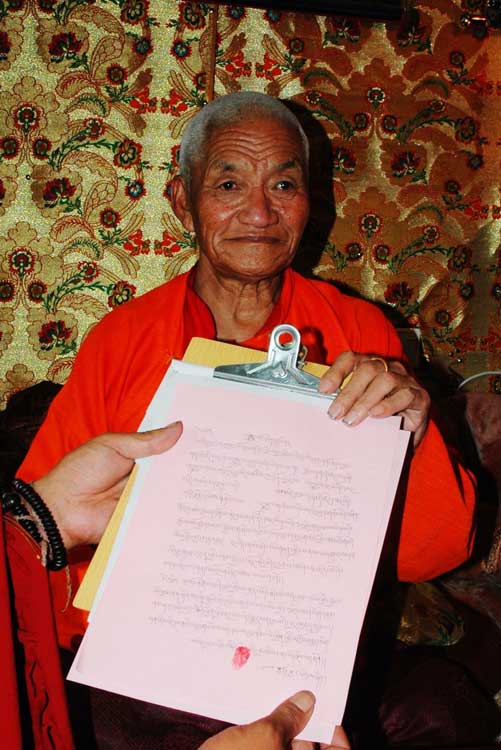
The above photo of sixty such dharma kings, rinpoches, and temples, many of whom are shown below. Photos of some of these dharma kings and rinpoches actually signing or stamping their letters are also included. Although this is only a small portion of those who have recognized H.H. Dorje Chang Buddha, the following list does represent the highest present-day dharma kings and regent dharma kings from various temples or famous rinpoches in current times. It is they who recognized or corroborated, or sent congratulations to H.H. Dorje Chang Buddha III.
For more information and more detailed biographies on many of these great holy beings as well as their letters of certification and congratulation see A Treasury of True Buddha-Dharma.That book also explains how many of these holy beings had their identities.
H.H. Dodrupchen Rinpoche (1927- ), a famous great dharma king of the Nyingma sect who is the sole holder of the complete Longchen Nying-thik, said the following in his letter congratulating the publication of A Treasury of True Buddha-Dharma: “I found the book wonderful and amazing and totally inspiring. . . [It is a] truly miraculous and extraordinary expression of truth expressed and unexpressed beyond words in Buddha Dharma.”
An incarnation of Guru Padmasambhava, H. H. Dodrupchen Rinpoche IV, Thupten Thrinle Palzang, is the holiest great dharma king within the Nyingma lineage. His Holiness is the greatest living Dzogchen or Great Perfection master and the main lineage holder of the Longchen Nyingthik lineage, the highest dharma in Tibet for perfecting the rainbow body. The first Dodrupchen, Jigme Thrinle Oser (1745-1821), was the greatest disciple of Jigme Lingpa (1730-1798). The Third Dodrupchen Jikmé Tenpé Nyima (1865-1926), was both a great scholar and a remarkable yogi.
The Dharma King’s main seat is at Chorten Gonpa Monastery, which His Holiness founded in the outskirts of Gangtok, Sikkim. His Holiness is also the spiritual director of the very small isolated Sera Gonpa (Nubri Monastery) in Kylmo Lung (Peaceful Valley), Nepal. It is unique in that the 50 monks and 50 nuns that study there have identical programs. H. H. Dodrupchen Rinpoche IV is represented in the USA by the Mahasiddha Nyingmapa Center, Kunzang Choling Temple, in Hawley, MA.
H.H. Dharma King Penor Rinpoche
H.H. Dharma King Penor (1932-2009), a supreme dharma king of the Nyingma sect, wrote the following in a letter to rinpoches: “H.H. Dorje Chang Buddha III Yangwo Wan Ko Yeshe Norbu. . . has been recognized by numerous greatly virtuous and eminent monastics. . . A Treasury of True Buddha-Dharma. . .will provide the karmic conditions for living beings to . . . attain the ultimate state of Buddhahood.”
An incarnation of Vajrapani Bodhisattva, the eleventh lineage holder of the Nyingma Palyul tradition, Kyabje Drubwang Pema Norbu Rinpoche, was born in December 1932 in the Kham region of eastern Tibet and left this world in March 2009. After H. H. Dilgo Khyentse departed in 1991, H. H. Penor Rinpoche became the Supreme Head of the Nyingma Sect. In 2001 he resigned from that position to devote more time to his extensive global network of monasteries and dharma centers, recommending that H. H. Mindrolling Trichen Rinpoche assume that position. His Holiness Karma Kuchen Rinpoche IV, is the current head of the Palyul subsect.
His Holiness’s Main seat was at Palyul Monastery in Tibet, one of the six main Nyingma monasteries. His Main seat outside of Tibet was at Namdroling (Thegchog Namdrol Shedrub Dargyeling) Monastery, Bylakuppe in Karnataka State, South India, close to the sacred Drekar Pungwa Stupa where Buddha first taught the Kalachakra Tantra. In 1978 the Ngagyur Nyingma Institute for Higher Buddhist Studies was added along with a nunnery and college for women. His Holiness had a number of branch temples in the US and a retreat center in McDonough, New York. During the 2008 Dharma Propagation Tour, Zhaxi Zhuoma Rinpoche and other tour members were able to have an audience with His Holiness and hear His Holiness Penor Rinpoche praise H.H. Dorje Chang Buddha III. The rinpoche said that it was good that such a holy being would incarnate in these dharma-ending days.
H.H. Jamyang Lungdok Gylatsen Rinpoche
H.H. Dharma King Omniscience Jamyang Lungdok Gyaltsen (Lama Achuk 1927-2011),who is the incarnation of Venerable Longsal Nyingpo, stated in his recognition certificate, “. . . H.H. Master Wan Ko Yee . . . is the incarnation of Vimalakirti. . . is Dorje Chang Buddha III. . . .”
H. H. Jamyang Lungdok Gyaltsen or Lama Achuk (Also referred to as Khenpo Achuck Brioche or Achiu Kamabu or Lama A-chos) is an incarnation of the great terton Rigdzin Longsal Nyingpo (1625-1682) of Kathok Monastery. He was the head of the Nyingma Sect in China and the foremost person of great holiness and virtue in all Tibet.
He was born in 1927 in Eastern Tibet and spent 43 years in retreat with his master, Tulku Arik Rinpoche. On July 23, 2011 he entered into paranirvana. His Holiness lived at Yarchen
Vajra body of Lama Achuk
Uddiyana Meditation Monastery, an encampment (gar) of thousands of monks, nuns, and lay practitioners, that he established in an isolated valley near Ganzi (Kandze) in Baiyu (White Jade) County, in Sichuan Province, China. This was the largest concentration of rinpoches and lamas in the entire world. The cremation ceremony of Lama Achuk commenced on August 29, 2011. The body of Lama Achuk shrunk from a height of almost six feet (1.8 meters) to about 1 inch tall, a sign of very high realization. From time of Lama Achuk’s paranirvana to the cremation, many auspicious signs appeared, five colored rainbows were often sighted in the sky and five colored pure lights often appeared in the area surrounding Lama Achuk’s body. More than 100,000 sangha members and lay devotees attended the puja and paid respect to the sacred body of Lama Achuk.
One of his disciples, Khenpo A-chos, achieved the rainbow body earlier in 1998. Father Tiso, a Catholic priest who went to Tibet to investigate the rainbow body phenomena at the suggestion of the Benedictine monk David Steindl-Rast, found evidence that H. H. Lama Achuk himself had already achieved the rainbow body as well.
H.H. Dharma King Jigme Dorje
On behalf of the Jonang sect, H.H. Dharma King
H.H. Dharma King Jigme Dorje stamps his seal onto his congratulatory letter to H.H. Dorje Chang Buddha III that he had already signed.
Jigme Dorje (1944- ), who is the Supreme Dharma King of the Jonang sect, respectfully congratulated H.H. Dorje Chang Buddha III Wan Ko Yeshe Norbu with the following words: “Such superlative accomplishments are truly unprecedented in the past few thousand years, outshining the accomplishments of all
Kalachakra Mandala created by Jonang monks at Jamdha Monastery, Golok Region, Amdo, Tibet
others, both ancient and modern. His Holiness is a shining paragon among Buddhas.”
The supreme dharma king of the Jonang sect, H. H. Jigme Dorje is an incarnation of the Shambhala King, Suchandra, who was the first to receive the Kalachakra tantra from Shakyamuni Buddha. His Holiness continues to hold the highest teachings of the Kalachakra dharma. H. H. Jigme Dorge was born in 1944 and is head of the Zangwa (Tsangwa) Dazang Monastery in Eastern Tibet.
H.H. Dharma King Mindrolling Trichen
The chief secretary for H.H. Dharma King Mindrolling Trichen (1031-2008) of the Nyingma sect, Ven. D. G. Khochhen Rinpoche, sent a congratulatory letter on behalf of Dharma King Mindrollling Trichin and the Mindrolling Sangha in which he wrote, “. . . H.H. Wan Ko Yeshe Norbu Dorje Chang brings good fortune and wisdom to all living beings.”
Trichen Jurme Kunzang Wangyal, Mindrolling (Mindling) Trichen Rinpoche XI (1931-2008), was the supreme head of the Nyingma sect. Although the original seat of Mindrolling, one of the six major Nyingma monasteries founded in 1876 by Rigzin Terdak Lingpa on the south side of the Tsangpo River, is near Lhasa, Tibet, a new Mindrolling Monastery has been established at Dehra Dun, in Uttranchal State, India. The Nagyur Nyingma College, Mindrolling’s Institute of Advanced Buddhist Studies. (Five Vidyas University) is also located there. His Holiness’s daughter, H.E. Khandro Rinpoche has a retreat center in the USA and continues the Jetsunma lineage of female masters there and at Samten Tse, her nunnery in India.
H.H. Dharma King Trulshik
The famous H.H. Dharma King Trulshik Rinpoche (1924-2011), who is a master of H.H. the Dalai Lama and the root master of several Tibetan Buddhist dharma kings and lineage holders, wrote the following words respectfully congratulating Buddha Vajradhara Yangwo Wan Ko Yeshe Norbu: . . . “A Treasury of True Buddha- Dharma. . .will become the cause whereby each sentient being who has descended into the abyss of the six realms of reincarnation leaves suffering and attains happiness.”
H. H. Nyingma Dharma King Zhadeu Trulshik (Trulshig) Chenpo Ngawang Chokyi Lodro Rinpoche (1924-2011), who resided in the Everest region of Nepal, was an incarnation of Maitreya Bodhisattva and a lineage holder from the first Dodrupchen, Jigme Thrinle Oser. His Holiness was considered the closest and most accomplished disciple of H. H. Dilgo Khyentse Rinpoche and like Khyentse Rinpoche a leading proponent of the Rime or non-sectarian movement in Tibet. He was entrusted with the responsibility of finding and recognizing the incarnation of Khyentse Rinpoche after he passed on in 1991 as well as Tulku Urgyen Rinpoche after he left this world in 1996. Dharma King Trulshik founded a remote monastery and retreat center in Nepal at Tubten Choling. He was the fifth Supreme Leader of the Nyingma Sect until his death in 2011.
H.H. Taklung Tsetrul Rinpoche
The highest dharma king of the Northern Treasure lineage of the Nyingma sect, H.H. Dharma King Taklung Tsetrul (1926-2015), wrote the following words of congratulations: “His Holiness Dorje Chang Buddha III Wan Ko Yeshe Norbu possesses the true dharma of the Buddhas . . .
H. H. Taklung Kyabgon Tsetrul Thupaten Gyaltsen Rinpoche is the Dharma King of the Drak Dorje (Vajra or Indestructible Rock) Monastery, one of the six main Nyingma Monasteries, founded in 1610 by Rigdzin Ngakgi (Aji) Wangpo (1580-1639). This monastery specialized in the changter or jangter tradition of Rigdzin Godem (1337-1408). Rigdzin Godem was the master of the “northern terma (treasures)” tradition of the Nyingma school. Rigdzin Godem literally means “the vidyadhara with the vulture feather.” He received this name because three vulture feathers grew from his head when he was twelve years old, and five more when he was twenty-four. A reincarnation of Dorje Dudjom of Nanam, one of the nine close Tibetan disciples of Guru Padmasambhava, he is also counted among the five king-like tertons and one of the three nirmanakayas of Guru Padmasambhava. In 2011 he became the Supreme Leader of the Nyingma Sect.
H.H. Dharma King Jigdal Dagchen Sakya
H.H. Dharma King Jigdal Dagchen Sakya (1929- ), the second highest leader of the Sakya order, offered the following congratulations: “Many masters praise H.H. Dorje Chang Buddha III Wan Ko Yeshe Norbu and his book about his Dharma activities. The book’s name is A Treasury of True Buddha-Dharma.”
H. H. Jigdal Dagchen Sakya Rinpoche is the head of the Phuntshok Phodrang branch of the Khon dynasty, the main lineage of the Sakya tradition. The leadership of the Sakya sect has rotated between the Phuntshok Phodrang branch and the Dolma Phodrang branch, currently headed by H. H. Sakya Trizin. H. H. Jigdal Dagchen Sakya founded and serves as the main teacher of Sakya Monastery of Tibetan Buddhism in Seattle, WA. He has given teachings and empowerments in other parts of the United States and Canada as well as various European and Asian countries.
H.H. Dharma King Sakya Trizin
H.H. Great Vehicle Dharma King Sakya Trizin (1945- ), who is the supreme leader of the Sakya order and the nirmanakaya of Manjushri Bodhisattva, wrote the following recognition concerning the descent into this world of H.H. Dorje Chang Buddha III: “. . . H.H. Yangwo Wan Ko Yeshe Norbu . . . is . . .Buddha Vajradhara Dorje Chang Buddha III.”
A true nirmanakaya of Manjushri Bodhisattva, The 41st Patriarch of the Khon lineage of the Sakya tradition was born September 7, 1945 in Tsedong near Shigatse, Tibet. While maintaining temples and dharma centers all over the world, His Holiness lives in Rajpur in Northern India with his wife and two sons.
The main seat of H. H. Sakya Trizin, the Sakya Centre at Tsechen Tenpai Gatsal Monastery, and the Sakya College are located north of New Delhi in Rajpur, Dehradun, India. Another major Sakya monastery exists at Sa Magon in Puruwalla, Himachal Pradesh, a state in northwest India, along with the Sakya Institute for Higher Buddhist Studies.
The seat of H. H. Sakya Trizin in the United States is located at Tsechen Kunchab Ling, the Temple of All-Encompassing Great Compassion, in Walden, New York. His older sister, H.E. Sakya Jetsun Chimey Luding (1938-), lives in North America.
H.E. Chogye Trichen Rinpoche
H.E. Dharma King Chogye Trichen, Ngawang Khyenrab Thupten Lekshe Gyatso (1920-2007), who was Dharma King of the Tsharpa branch of Sakya sect and the root master of H.H. the Dalai Lama, offered the following respectful congratulations: “H.H. Buddha Vajradhara (Dorje Chang) Yangwo Wan Ko Yeshe Norbu: A Treasury of True Buddha-Dharma. . . is the guidepost leading to true Buddha- dharma and the gateway of the dharma leading to benefiting and providing happiness to sentient beings.” H.E. Dharma King Chogye Trichen and Ven. Shabdrung Rinpoche are seen here reading the manuscript copy of A Treasury of True Buddha-Dharma, which has now been published as H.H. Dorje Chang Buddha III.
H. E. Chogye Trichen RInpoche, Ngawang Khyenrab Thupten Lekshe Gyatso, was the dharma king and head of the Tsharpa (Tsar) sub-sect of the Sakya Sect and thought to be an incarnation of Mahasiddha Virupa. He was enthroned as the 26th patriarch of Phenpo Nalendra Monastery in North Lhasa, Central Tibet, that was founded in 1425 by the great Sakya master Rongton Sheja Kunrig (1367-1459). The “Whispered-Lineage of Tshar” founded by Tsharchen Losel Gyatso (1502-1566) considered this to be the seat of their lineage. H. E. Chogye Trichen rebuilt the Nalendra Monastery in Nepal, which became the seat of the Tsharpa sub-sect. His Eminence established the Tashi Rabten Ling Monastery in Lumbini, the birthplace of Lord Buddha, as well as the Jamchen Lhakhang Monastery and retreat center in Boudha, Katmandu where he resided until his death in 2007. He also established centers in Hong Kong, Taiwan, Australia, and New Zealand. His Eminence taught in the West and started dharma centers in America as well.
H.E. Sharmapa
The Red Jewel Crown Dharma King H.E. Shamarpa Rinpoche (1952-2014) is the nirmanakaya of Kuan Yin Bodhisattva and is the chief of the four regents of the Kagyu sect. He offered his respectful congratulations with the following words: “H.H. Yangwo Wan Ko Yeshe Norbu . . . the third incarnation of Vajradhara . . . all his accomplishments . . . will benefit sentient beings. . .”
H. E. Mipham Chokyi Lodro of the Kagyu Sect, an incarnation of Avalokiteshvara, is the present Shamarpa and the second nirmanakaya of the Karmapa. The second Karmapa, Karma Pakshi (1204 – 1283), predicted that “future Karmapas shall manifest in two nirmanakaya forms.” The Karmapa would continue to incarnate at different times as two beings and one would recognize and teach the other. One would be known as the Black Jewel Crown Karmapa and the other as the Ruby-red Jewel Crown Shamarpa. The Shamarpa, in the absence of the Karmapa, is the lead regent with responsibility over both administrative and Buddha-dharma matters. His Eminence was born in 1952 in Derge, Tibet. The main seat of the Karma Kagyu lineage has been at Tsurphu Monastery in central Tibet where it was established in 1159 by the First Karmapa, Dusum Khyenpa (1110-1193). After leaving Tibet, the 16th Karmapa established the main seat of the Karmapa outside of Tibet at Rumtek Monastery.
His Holiness, the 14th Shamar Rinpoche or Shamarpa has established many dharma centers in the West.
H.E. Goshir Gyaltsab Rinpoche
H.E. Goshir Gyaltsab Rinpoche (1954- )is the incarnation of Patriarch Gampopa. He is the only regent for the Karmapa Great Jewel Dharma King who has the title of “National Master.” He respectfully praised the incomparable Master, H.H. Yangwo Wan Ko, as Vimalakirti and stated: “. . . .I sincerely wish that . . . the multitudinous living beings who have the karmic affinity to read A Treasury of True Buddha-Dharma. . . will attain the supreme fruits of perfect enlightenment, omniscience, and Buddhahood!”
The Vajra Regent and caretaker for the Karmapas, H. E. Goshir, is the current incarnation of the founder of the Kagyu Sect, Master Gampopa (1079-1153). He lives in Sikkim where he oversees Rumtek, the main monastery of the Karma Kagyu as well as his own monastery Ralang, also in Sikkim. He was born in Nyimo, near Lhasa, in 1954. In 1959, the 16th Gwalya Karmapa, Rangung Rigpe Dorje, carried the dharma king on his back as he left Tibet. The Orange Jewel Crown Dharma King along with The Ruby-red Jewel Crown Dharma King Shamarpa, Situpa Rinpoche, and Jamgon Kongtrul Rinpoche are considered the four princes or regents for the Black Crown Karmapa. There are currently two incarnations considered to be the 17th Black Crown Karmapa, Urgyen Trinley Dorje (1985– ), who is recognized by H. E. Goshir Gyaltsab Rinpoche and H. E. Tai Situ Rinpoche, and Trinley Thaye Dorje (1983– ), who is recognized by H. E. Shamarpa Rinpoche. The North American seat of the Karma Kagyu, Karma Triyana Dharmachakra, is located in Woodstock, NY.
Tangtong Gyalpo Bodhisattva
The name Tangtong Gyalpo Bodhisattva has gone down in Buddhist history. In the past, this Bodhisattva was the leader of the four main sects of esoteric Buddhism in India, Bhutan, Sikkim, Mongolia, and eastern Tibet. The people of Tibet call this Bodhisattva the father of medicine, the father of bridges, the father of Tibetan opera, and the father of ferryboats. During a dharma assembly held at Hua Zang Si in San Francisco of the United States in which Buddha-dharma realization was manifested, H.E. the sixteenth Tangtong Gyalpo Bodhisattva saw the realization and virtue of H.H. Dorje Chang Buddha III Wan Ko Yeshe Norbu. He was astounded and immediately prostrated before His Holiness, formally acknowledging His Holiness as his Master. In his congratulatory letter to His Holiness, he stated the following: “. . . H.H. Wan Ko Yeshe Norbu is . . . the Master of the Five Buddhas, and has for the first time in the history of Buddhism in the human realm truly manifested complete proficiency in exoteric and esoteric Buddhism and perfect mastery of the Five Vidyas. This is a goal of Buddhism that all other Buddhists have not been able to achieve. This goal has finally been achieved by H.H. Wan Ko Yeshe Norbu.”
H.E. the sixteenth Tangtong Gyalpo Bodhisattva (Thangtrul Rinpoche) took birth in Bhutan. His physical appearance resembles that of Guru Padmasambhava. Even when he sleeps, his eyes remain open. He saw H.H. Wan Ko Yeshe Norbu during a Dharma Assembly that took place in 2005 at Hua Zang Si in San Francisco, U.S.A. In a supernatural state of samadhi, he instantly saw that H.H. Dorje Chang Buddha, the highest ancient Buddha in the dharma realm, had already come to this world again. He at once formally acknowledged H.H. Dorje Chang Buddha III Wan Ko Yeshe Norbu as his master. H.H. Dorje Chang Buddha III asked him, “Did you follow and learn dharma under Guru Padmasambhava? Why have you come here?” H.E. Tangtong Gyalpo answered that he had received teachings directly from Guru Padmasambhava and from H.H. Sakya Trizin. He also said that he had come to request the highest dharma in order to save living beings. H.H. Dorje Chang Buddha III immediately snapped His fingers, and a dharma bowl manifested awesome power. H.H. Dorje Chang Buddha III then accepted H.E. Tangtong Gyalpo as one of his disciples who is on the level of a great venerable one and performed an initiation for him. H.E. Tangtong Gyalpo took that dharma bowl back to his home country.
He later learned that the book A Treasury of True Buddha-Dharma about the H.H. Dorje Chang Buddha III Wan Ko Yeshe Norbu Holiest Tathagata was about to be published. He thereupon organized many rinpoches to practice the Kuan Yin Dharma one billion times as an offering to His Holiness Dorje Chang Buddha III.
H.E. Xiazhu Quiyang Rinpoche
H.E. Xiazhu Qiuyang Rinpoche, who is the incarnation of Venerable Naropa, respectfully congratulated the highest and holiest Wish Fulfilling Jewel Dharma King Wan Ko as follows: “. . .the book A Treasury of True Buddha-Dharma. . . is the highest authentic dharma that is of benefit to living beings.”
H.E. Dharma King Xiazhu Qiuyang has just stamped his fingerprint onto the congratulatory letter he wrote to H.H. Dorje Chang Buddha III.
H. E. Xiazhu Qiuyang Rinpoche of the Geluk Sect is a current incarnation of the great Mahasiddha Naropa (1016-1100), the venerable leader of 100,000 dakinis. Naropa, a former abbot at the famous Nalanda University in north-east India, was Master Marpa’s guru and the disciple of Tilopa. Master Tilopa received the dharma directly from Dorje Chang Buddha as did Naropa’s sister, Lady Niguma. H. E. Xiazhu Qiuyang was born in 1945, and has become greatly accomplished in Dakini Dharma, having received guidance and empowerment from Vajrayogini herself.
H.E. Renzeng Nima Rinpoche
H.E. Dharma King Renzeng Nima is holding the congratulatory letter he wrote to H.H. Dorje Chang Buddha III.
H.E. Mighty Lion Dharma King Renzeng Nima previously vowed to stay in a mountain valley engaged in solitary meditation for the rest of his life. He possesses supernatural powers, inspires awe throughout Tibet, and is the reincarnation of King Gesar. He wrote the following words of recognition: “. . . H.H. Master Wan Ko Yee . . . is the true incarnation of Dorje Chang Buddha.”
H.E. Dharma King Renzeng Nima of the Nyingma Sect is a great terton and the current nirmanakaya of King Tuiba Gawa Gesar, the hero of Tibet’s great epic saga.
H.E. Ngagwang Pedma Namgyal Palzangpo
His Eminence Ngagwang Pedma Namgyal Palzangpo stamps his seal onto his congratulatory letter to H.H. Dorje Chang Buddha III that he had already signed.
H.E. Dharma King Ngagwang Pedma Namgyal Palzangpo, who is a dharma king of the Jonang sect, respectfully congratulated H.H. Dorje Chang Buddha III Wan Ko Yeshe Norbu with the following words: “The body and lifespan of the Buddha Vajradhara of the dharma realm never comes to an end. His Holiness manifests Mahayana states and has the most wondrous powers of great compassion.”
The Jonang Dharma King, H. E. Ngagwang Pedma Namgyal Palzangpo (Penam Rinpoche), was born in 1925 near Amnhymachen, the holy Mountain of the protector Machen Pomra, in Amdo, Tibet. He has been recognized as an incarnation of Duqin Langwa, an incarnation of a close disciple of Guru Padmasambhava, Gelong Namuke Niangbo. His Eminence taught the Kalachakra Dharma in the United States and established Dorje Ling Dharma Centers in New York City and Atlanta, Georgia.
H.E. Mindrolling Khenchen Rinpoche
H.E. Mindrolling Khenchen Rinpoche of the Mindrolling Monastery wrote the following congratulations: “His Holiness Buddha Vajradhara III Yangwo Wan Ko Yeshe Norbu[’s] . . . A Treasury of True Buddha-Dharma. . . will restore dharma that had faded and will cause the growth of dharma that has not yet faded.”
The ninth Mindrolling Khenchen Rinpoche, Venerable Jigmey Namgyal, was born in 1970. His lineage began with the great translation master Lochen Dharmashri (1654-1717), the younger brother of Rigzin Terdak Lingpa, the founder of the original Mindrolling Monastery, located south of Lhasa in the Drachi Valley of central Tibet.
Since 1992, His Holiness has been the president of Nagyur Nyingma College, Mindrolling’s Institute of Advanced Buddhist Studies. (Five Vidyas University) at Dehra Dun, in Uttranchal State, India. The college was founded in conjunction with the new Mindrolling Monastery also located at that location.
H.E. Khandro Rinpoche
H.E. Jetsun Khandro Rinpoche of the Mindrolling lineage within the Nyingma sect is the incarnation of Yeshe Tsogyal. She sent a congratulatory letter expressing her deep gratitude toward H.H. Wan Ko Yeshe Norbu Dorje Chang Buddha for the book A Treasury of True Buddha-Dharma.
As an incarnation of Yeshe Tsogyal, the advanced disciple of Guru Padmasambhava, Her Eminence is part of the Jetsunma lineage of female masters at Mindrolling Monastery, which was founded in 1676 by Rigzin Terdak Lingpa. Her father, H. H. Trichen Jurme Kunzang Wangyal, the XI Mindrolling Trichen Rinpoche, was the head of the Nyingma sect.
Khandro Rinpoche has a North American retreat center in the Northern Shenandoah Valley adjoining the Blue Ridge Mountains in Virginia as well as Samten Tse, a nunnery in India.
H.E. Dzogchen Ganor Rinpoche
The famous H.E. Dzogchen Ganor Rinpoche offered the following congratulations: “. . . A Treasury of True Buddha-Dharma is the wish-fulfilling true dharma that the Buddha expounded.”
H. E. Ganor Rinpoche (1942- ) is the 14th reincarnation of Terton Ratag Pelsang (Karma Lekshe Drayang). He was born near the town of Palpung in the Derge District in eastern Tibet. Because of his level of realization and practices, he was able to perform many supernatural feats like leaving his footprint in rocks and tying swords into knots as if they were rope. He was also able to communicate with non-humans like nagas and devas. He was a great terton who revealed many hidden treasures.
H.E. Urgyen Xirao
H.E. Urgyen Xirao Woxiu, who is a great terton revered by all four types of monastic and lay Buddhists in the land of the Han- Chinese and the land of the Tibetans, wrote in his recognition certificate the following: “. . . Buddha Vajradhara assisted Sakyamuni Buddha in teaching the five hundred monks and other holy ones. . . . H.H. Master Wan Ko Yee, Yangwo Wan Ko Yeshe Norbu, is the incarnation of Buddha Vajradhara.”
Ven. Ugyen Xirao Woxiu of the Nyingma Sect is an incarnation of Ugyen Pema Lingpa (1450-1521), the fourth and most controversial of the Five Terton Kings. Guru Padmasambhava prophesied that Pema Lingpa would recover 108 sacred texts as termas, but due to inauspicious circumstances he only recovered 32. He was known for his spectacular and daring methods in recovering these texts. Once he dived into a lake in Bhutan holding a lighted butter lamp. He told onlookers that the lamp would go out if he were a false spirit. After he disappeared in the dark pool and all thought that he had drowned, he returned to the surface with his butter lamp still brightly burning and with a new terma. He is considered the greatest spiritual master of Bhutan and the immediate incarnation of Master Longchenpa (1308-1364).
H.E. Dorje Rinzin Rinpoche
H.E. Dorje Rinzin Rinpoche, master of the seventh Dzogchen Dharma King in China, stamps his fingerprint onto the congratulatory letter he wrote to H.H. Dorje Chang Buddha III.
H.E. Dorje Rinzin Rinpoche is the incarnation of Rigzin Terdak Lingpa Unchanging Vajra, who was the founder the Mindrolling monastery. H.E. Dorje Rinzin Rinpoche, a holy being of great enlightenment, is now the master of many great rinpoches. He said the following in his congratulatory letter: “. . . the accomplishments contained in A Treasury of True Buddha-Dharma. . . are those of Dorje Chang Buddha Wan Ko Yeshe Norbu, the Master of the Five Buddhas.”An incarnation of Rigzin Terdak Lingpa Unchanging Vajra Being (1646-1714) who was the great terton and founder of the Mindrolling monastery and lineage, H. E. Dharma King Dorje Rinzin Rinpoche of the Nyingma Sect was a model for eminent monastics to follow and emulate.
H.E. Dharma King Rabjam
H.E. Shechen Rabjam Rinpoche, the dharma king of the Shechen monasteries of the Nyingma sect, offered the following words of congratulations: “. . . H.H. Dorje Chang Buddha III Yangwo Wan Ko Yeshe Norbu, the Wish-Fulfilling Jewel Holy One, has taken action that spreads and makes grander the true Buddha- dharma. How wonderful!”H. E. Shechen Rabjam Rinpoche VII (1966- ) is the grandson of H. H. Dilgo Khyentse Rinpoche. The second Rabjam Rinpoche founded Shechen Monastery, one of the six main Nyingma Monasteries in Tibet, in 1695 in Kham. H. E. Shechen Rinpoche VII is the abbot and dharma king of Shechen Tennyi Dargyeling Monastery in Nepal, one of the largest and most beautiful monasteries outside of Tibet. It is located near the Great Stupa of Boudhanath, a suburb of Kathmandu and is noted for its ceremonies and sacred dances.
H.E. Renqing Rongbo Barongbo Rinpoche
H.E. Renqing Rongbo Barongbo Rinpoche, an eastern Tibetan Dharma King of the Nyingma sect, respectfully praised H.H. Wan Ko Yeshe Norbu with the following words: “The Master is the magnificent sambhogakaya Buddha who has descended into the human world again. . . . His Holiness’s accomplishments are unprecedented in this world and reflect the pinnacle of wisdom. May H.H. Dorje Chang Buddha boundlessly save living beings. . .”
H.E. Dharma King Renqing Rongbo Barongbo Rinpoche (1969- ) of the Nyingma Sect is a current incarnation of Venerable Ananda.
H.E. Green Jewel Crown Karmapa Dharma King Jiezhong
The Green Jewel Crown Karmapa, H.E. Great Jewel Dharma King Jiezhong, prostrated to H.H. Yangwo Wan Ko Yeshe Norbu, the Buddha Vajradhara, and wrote the following words: “A Treasury of True Buddha-Dharma about the Buddha Vajradhara is a concrete expression of the highest Buddha-dharma wisdom and abilities.”
The sixth Karmapa Green Jewel Crown Dharma King was born in 1967 in Tibet amidst wonderful auspicious signs. The 16th Karmapa, H. H. Great Jewel Dharma King Rangjiong Rigpe Dorje in India, recognized him as a previous incarnation of the Green Jewel Crown Dharma King Jiezhong Rinpoche.
H.E. Jigme Losel Wangpo
H.E. Jigme Losel Wangpo, the seventh Dzogchen Dharma King who resides in India, wrote the following words of congratulations: “. . . A Treasury of True Buddha-Dharma brings benefit to all sentient beings. . . .”
There are two incarnations recognized as the seventh Dzogchen Rinpoche of the Nyingma Sect: H. E. Jigme Losel Wangpo, born in 1964 in Gangtok, Sikkim, and H. E. Tenzin Longdock Nyima, born in Qinghai Province in the Bare Region of lower Amdo in 1974.
The original Dzogchen Monastery in Tibet, one of the six main Nyingma monasteries, was established in 1684 by Pema Rigdzin. More than 60,000 people have attained the rainbow body and become Buddhas in that lifetime while practicing at that monastery. H. E. Dharma King Tenzin Longdock Nyima Dzogchen Rinpoche VII is the current throne holder of Dzogchen Monastery in Tibet.
The official seat of H. E. Dharma King Jigme Losel Wangpo Dzogchen Rinpoche VII is at the new Dzogchen Monastery in Dhondenling, South India.
H.E. Tenzing Longdock Nyima
H.E. Tenzin Longdock (Lungdok) Nyima, the seventh Dzogchen Dharma King who resides in China, respectfully congratulated the ancient Buddha who saves all sentient beings in the three spheres, H.H. Yangwo Wan Ko Yeshe Norbu, as follows: “. . . A Treasury of True Buddha-Dharma. . . is like the. . . Wish-Fulfilling Jewel in that it outshines all ancient or modern, Chinese or non-Chinese books. . . . The book also opens up and develops the spiritual wisdom of people.”
Ven. Junmai Baima Dorje Rinpoche
Ven. Junmai Baima Dorje Rinpoche of the Shechen Temple is a nirmanakaya of Vajravarahi. He wrote a letter expressing his respect for the Three Bodies and Four Wisdoms of H.H. Yangwo Wan Ko Yeshe Norbu, the Dharma King of the Three Spheres. In that letter, he stated, “H.H. Great Dharma King is the first holy being who used true realization to display fully in the dharma realm the teachings of the Buddha! H.H. Great Dharma King is the true Buddha Vajradhara, the teacher of both humans and celestial beings!”
Ven. Junmai Baima Dorje Rinpoche VI of the Shechen Monastery in Tibet is a nirmanakaya of Vajravarahi. The first Junmai Baima Dorje was a famous terton and the second achieved the rainbow body. As a small child, the rinpoche could transform a thick knife into a knot. That knife is currently at Hua Zang Si in San Francisco as one of the many holy objects that they hold for public display and veneration.
Ven. Angwang Khyentse Rinpoche
Venerable Angwang Khyentse Rinpoche was the closest disciple of H.H. Dzongsar Khyentse Chokyi Lodro. He is the head of the Gensa Temple of the Sakya sect and has been in retreat for a long period of time. He possesses supernatural powers and is praised throughout the snowy plateaus of Tibet for his cultivation. In his congratulatory letter, he stated, “Greatest leader of Buddhism, H.H. Wan Ko Yeshe Norbu: . . . .Only the wisdom of the ancient Buddha, Dorje Chang Buddha, could produce such a textbook [as A Treasury of True Buddha-Dharma] . . . !”
Ven. Angwang Khyentse (Qinzhe) Rinpoche is the Head of the Sakya Gensa Temple in Tibet. He has been in retreat for many years. He is a successor to the dharma lineage of the second Jamyang Khyentse, Dzongsar Chokyi Lodro, the former abbot of the Dzongsar Monastery in Tibet and later the guru of the royal family of Sikkim. Dzongsar Khyentse was one of the incarnations of Jamyang Khyentse Wangpo (1820-1892), the great nonsectarian(rime) master and terton of the nineteenth century.
Ven. Yundeng Jiangcuo Rinpoche
The eighty-year-old Ven. Yundeng Jiangcuo Rinpoche, who is the incarnation of Patriarch Milarepa, respectfully offered the following congratulations on the publication of A Treasury of True Buddha-Dharma about Buddha Vajradhara: “This book manifests great Buddha-dharma based wisdom and contains accomplishments that no other person in history has achieved. Only H.H. Wan Ko Yeshe Norbu has attained such accomplishments.”
Ven. Abbot Kalsang Gyaltsen
Ven. Kalsang Gyaltsen, who represents H.H. the Dalai Lama and is fully authorized to exercise control over the Geluk sect in Nepal, stated in his congratulatory letter the following: “I am sure the works of Venerable Vajradhara Master Wan Ko will inspire all the sentient beings to a better understanding of both the theoretical and practical aspects of the Buddhist philosophy.”
Ven. Zangxia Rinpoche
The famous Zangxia Rinpoche prostrated to the ancient Buddha and greatest leader of Buddhism, H.H. Dorje Chang Buddha III, and stated, “. . . led us to find Dorje Chang Buddha, our supreme ancient Buddha, and thereby enabled all living beings to have the ultimate refuge in this Dharma-Ending Age!”
Ven. Bamba Tuben Geleg Gyatso Rinpoche
The famous Respected Bamda Tubten Geleg Gyatso Rinpoche stated: “. . . [I] beseech the magnificent and holy Dorje Chang Buddha III to bless all sentient beings in the six realms of reincarnation so that they may realize enlightenment soon, hear of and read A Treasury of True Buddha-Dharma, . . . and attain the perfect, supreme, and complete enlightenment of a Buddha.”
Ven. Baima Rongzhu Rinpoche
Ven. Baima Rongzhu Rinpoche is widely respected in India and is revered by the people who live along the banks of the Jinsha River. Having prostrated to H.H. Wan Ko Yeshe Norbu, he wrote, “Having read A Treasury of True Buddha-Dharma, I learned that the ancient Buddha, Dorje Chang Buddha, has descended to the human world again. This is truly our greatest blessing!”
Respected Eba Rinpoche
Respected Eba Rinpoche Danba Wangxu, the fifth dharma king of his temple, used the following words to express on behalf of other rinpoches deep gratitude to the most venerable H.H. Wan Ko Yeshe Norbu: “The supreme Dorje Chang Buddha has brought to us A Treasury of True Buddha-Dharma!”
Respected Khenpo Chucheng Qupei
Respected Khenpo Chucheng Qupei, whose status as khenpo was conferred upon him by H.H. Dharma King Sakya Trizin, respectfully praised H.H. Dorje Chang Buddha III Wan Ko Yeshe Norbu, as follows: “His Holiness is the supreme holder of the 84,000 Buddha-dharmas, the one who is in charge of all dharma methods of Buddhism. His Holiness was the first sambhogakaya Buddha in the dharmadhatu.”
Respected Wangzhi Tudeng Jigmei Rinpoche
Respected Wangzhi Tudeng Jigmei Rinpoche, the famous abbot of the Tsangtsang Temple, expressed his gratitude to the most venerable ancient Buddha, H.H. Dorje Chang Buddha III Wan Ko Yeshe Norbu, as follows: “The most honorable ancient Buddha has perfectly and flawlessly brought to this world the Buddha-dharma of Tibet’s four main sects as well as the exoteric Buddha-dharma.”
Respected Bishop Seicho Asahi
Respected Bishop Seicho Asahi is the supreme leader of the headquarters of the Koyasan Shingon-shu North American Mission. He praised H.H. Dharma King Wan Ko Yeshe Norbu, the Buddha Vajradhara, with the following words: “. . . Your Holiness’s great accomplishments on Buddhism . . . have never been seen before in the world. Your Holiness is truly the primordial Buddha who incarnated to this world to save living beings and to transmit the authentic Buddha-dharma of Tathagata.”
Bishop Seicho Asahi is the supreme leader of the of the Koyasan Shingon-shu North American Mission which has its headquarters in Los Angeles, CA. He was born in Hiroshima, Japan and came to California as a Buddhist minister in 1981. He has been active in community work, the Buddhist Peace Fellowship, interfaith activity, and developing a prison sangha at maximum security Folsom Prison near Sacramento, where he served as Buddhist chaplain prior to becoming Bishop.
The main headquarters of this sect of Esoteric Buddhism, Kongobu-ji (Vajra Peak Temple), is located at Koyasan (Mount Koya) in Wakayama perfecture, Japan. It has been designated as a World Heritage site by UNESCO. The temple was constructed in 1593 and rebuilt in 1863.
Gele Sanbu Rinpoche
Gele Sanbu Rinpoche prostrated to the supreme H.H. Yangwo Wan Ko Yeshe Norbu and stated, “H.H. Great Dharma King thoroughly understands the true causes and effects concerning all things in the universe. His Holiness is the first great holy being in the history of Buddhism to truly manifest in the human realm complete proficiency in exoteric and esoteric Buddhism and perfect mastery of the Five Vidyas!”
Luozhu Jiangcuo Rinpoche
Luozhu Jiangcuo Rinpoche prostrated to H.H. Wan Ko Yeshe Norbu and wrote, “I was fortunate to have respectfully read A Treasury of True Buddha-Dharma about the greatest leader of Buddhism, H.H. Yangwo Wan Ko Yeshe Norbu. . . . we see that a true Buddha has again descended into this world!”
Lama Renzhen Rinpoche
Lama Renzhen Rinpoche of the Five Vidyas Buddhist Institute prostrated to H.H. Wan Ko Yeshe Norbu and praised the accomplishments of the Vajra Dharma King of Great Holiness with the following words: “We have respectfully read A Treasury of True Buddha-Dharma about H.H. Buddha Vajradhara Great Dharma King and were truly astounded! . . . H.H. Great Dharma King represents the Buddha-dharma!”
During recent years, we at the World Buddhism Association Headquarters have been continuously receiving inquiries regarding upright masters and evil masters, asking for replies in this regard. However, WBAH has given replies to such questions many times publicly through announcements. Furthermore, H.H. Dorje Chang Buddha III also clearly explained many times the distinctions between what is upright and what is evil and between what is true and what is false. Yet, many of you still act blindly and without a direction in the matter of recognizing and distinguishing whether a master is upright or evil and are unable to decide on whether to continue following your current master or to find and choose another excellent master. Simply speaking, if you do not make recognition according to the announcements and are satisfied with devolving, even all Buddhas in the ten directions are unable to save you!
Now, WBAH provides you with three demon-detecting mirrors, which can enable you to easily see the original forms of such evil persons, regardless of whether they are masters or disciples.
The First Demon-Detecting Mirror: An absolute criterion is to see whether a master makes a big effort to facilitate the disciples to study and broadly propagate the announcements, such as the “Important Replies from Holy Virtuous Ones and Eminent Monastics” from WBAH (the 35 questions with the answers), or not. Any master who does not take measure to enable the disciples to study the announcement well and, rather, only makes propaganda about his/her own articles, writings, books, or other types of undertaking that not only do not refer to the specifics of the announcements but also violate the stipulations in the announcements is definitely an evil master!!!
The Second Demon-Detecting Mirror: Regardless of what status or title the person you follow as your master has, as long as this master’s level obtained from the holy test is not a level within the ranks of holy virtuous persons and yet this master poses as a holy person or instructs the disciples to falsely brag or praise him/her as a holy person, this master is not a holy person. Since such a master imposes rules on the disciples to prevent them from doubting the master and to force them to correspond their three karmas to the master, this is absolutely an ordinary person and is a charlatan!!!
The Third Demon-Detecting Mirror: This is about how to recognize and distinguish holy persons. Holy persons of ancient times have long been known through historical records. Regarding holy persons of the current time, only those who attained the Gold Button levels from taking the written test and the holy exam are holy ones!!! On the other hand, those who did not attain a Gold Button level after taking the examination are not holy ones!!! Anyone who scored a high level of blue buttons can only be an eminent monastic or a great virtuous one.
All those who oppose or persecute holy persons will be included in a name list of malicious persons and will not be conferred an inner-tantric initiation in this entire lifetime!!! If you have already done things that harm holy persons under the instruction of an evil master, then the only way you have is to repent immediately and publicly expose the malicious and demonic evil person who instructed you to create the sin. Then your record will be deleted from the list of malicious persons and you can immediately return to your original status of a cultivator.
These three demon-detecting mirrors can correctly and accurately show the true faces of all evil, malicious, and demonic persons and swindlers!
The conferment of the Pope of Buddhism to His Holiness Dorje Chang Buddha III originated in January 2018 when the World Peace Prize Awarding Council and World Peace Prize Religious Leaders Title Awarding Council passed the resolution to confer to H.H. Dorje Chang Buddha III the title of Pope of Buddhism, the highest leader of Buddhism in this world. However, His Holiness the Buddha refused to accept the conferment.
The Pope of Buddhism H.H. Dorje Chang Buddha III
For the sake of propagating Buddha Dharma and benefitting living beings, the World Buddhism Association Headquarters took the liberty to accept the conferment decree and the Pope of Buddhism Scepter. When the World Buddhism Association Headquarters respectfully presented the Pope of Buddhism Scepter and conferment decree to H.H. Dorje Chang Buddha III, His Holiness the Buddha III said: “I see that on top of this Scepter is the seated Shakyamuni Buddha, we should be respectful to Namo Shakyamuni Buddha.” His Holiness the Buddha then raised the Scepter above His head and made a symbolic closed palm gesture with one hand to express His respects. However, H.H. Dorje Chang Buddha III also expressed that He is just a humble cultivator and resolutely would not accept such a conferment. Hence, His Holiness the Buddha immediately returned the conferment decree and the Pope of Buddhism Scepter to the two Councils.
On September 23, 2020, the World Peace Prize Awarding Council and World Peace Prize Religious Leaders Title Awarding Council passed an ultimate joint resolution, determining that the return of the Pope of Buddhism Scepter and conferment decree by H.H. Dorje Chang Buddha III was not effectible. On September 24, the joint Chair of the World Peace Prize Awarding Council and World Peace Prize Religious Leaders Title Awarding Council Suzi Leggett made the ultimate announcement at the Holy Miracles Temple of the World Buddhism Association Headquarters: “Over the past several decades, the World Peace Prize Awarding Council has presented the World Peace Prize to presidents, spiritual leaders, and prime ministers of many nations, including President Ronald Reagan, Hon. Mahatma Gandhi, and H.E. Yitzhak Rabin. There has never been a precedence of an award being retracted or returned. All determinations made and implemented by our Councils are very solemn, serious, and absolutely cannot be changed. The return of the Pope of Buddhism Scepter and conferment decree by H.H. Dorje Chang Buddha III is deemed not effectible. The title, status, and authority of the Pope of Buddhism belong only to H.H. Dorje Chang Buddha III, and cannot be exercised by anyone else.” Chair Leggett once again requested that the World Buddhism Association Headquarters accept and present to H.H. Dorje Chang Buddha III the Pope of Buddhism Scepter and conferment decree that His Holiness the Buddha previously returned.
Representing the World Buddhism Association Headquarters, Venerable Mozhi Rinpoche accepted the conferment decree and Pope of Buddhism Scepter. He said during his speech, “The World Buddhism Association Headquarters considers that the decision made by the two Councils is remarkably proper and sagacious.
“Ever since Namo Shakyamuni Buddha entered parinirvāṇa, there has not been a supreme leader who has the authority to guide all Buddhists the same way that the Buddha did. However, the authoritative position of the Pope of Buddhism certainly is not a role that a leader of a single Buddhist sect would have the attributes to fulfill; rather, the Pope must be a leader who has authority over the entirety of Buddhism, namely, a Buddha.
“Namo H.H. Dorje Chang Buddha III holds the perfect teachings of Buddhism and meets the criteria used by all Buddhist sects to recognize a Buddha. His inherent nature is in accord with that of a Buddha. His unsurpassed, complete, and perfect enlightenment is in accord with that of a Buddha. Just based on the accomplishment of H.H. Dorje Chang Buddha III in Lifting the Pestle onto the Platform, surpassing His own base weight standard by 59 levels, no one else can possibly reach such a record.
“The state of virtue of H.H. Dorje Chang Buddha III is that of a Buddha. His Holiness the Buddha has perfect mastery of Exoteric and Esoteric Buddhism, perfect accomplishments in the Five Vidyas, and so forth, all of which accord with the unsurpassed, complete, and perfect enlightenment of a Buddha.
“In more than 2,000 years, there has not been a Buddhist Holy Guru in this world who possesses the same Buddha level qualities. Just by the facts that H.H. Dorje Chang Buddha III vowed and carries out the vow to benefit living beings purely on a voluntary basis and does not accept any offerings throughout His entire life, and that He possesses perfect wisdom and unimpeded accomplishments, no other Holy Guru can be of comparison. Only Namo H.H. Dorje Chang Buddha III can take on this immensely noble, holy, and heavy responsibility of the Pope of Buddhism, to properly guide Buddhists onto the correct path of learning Buddhism.
“Therefore, on behalf of Buddhists, the World Buddhism Association Headquarters thanks the World Peace Prize Awarding Council and the World Peace Prize Religious Leaders Title Awarding Council for having made the ultimate decision.”
H.H. Dorje Chang Buddha III is selfless and noble, and the first person in Buddhism to possess substantive holy realization power of a Buddha and perfectly flawless accomplishments at the pinnacle of the Five Vidyas. These are the qualities that no other eminent Buddhist monastic or virtuous person in this world has so perfectly attained. It is naturally a matter of course that H.H. Dorje Chang Buddha III is the veritable Pope of Buddhism.
To honor the Holy Birthday of H.H. Dorje Chang Buddha III, revered as the Pope of Buddhism, several prominent Buddhist organizations including the World Buddhism Association Headquarters, Holy Miracles Temple, Hua Zang Si, Benevolence Temple, and the Sanger Mission, jointly organized a Grand Dharma Assembly in Glendale, California. The two-day event took place on June 30th and July 1st, 2023, at the Glendale Civic Auditorium and attracted over a thousand Buddhists from around the world.
June 30th marked the unveiling of the first three volumes of the “Namo Dorje Chang Buddha III Complete Sutra Collection”. The Dharma Assembly opened with a procession led by a group of nuns, chanting the Buddha’s name “Namo Dorje Chang Buddha III”. The “Namo Dorje Chang Buddha III Complete Sutra Collection” was gracefully displayed on a sacred sedan chair, carried by Holy Gurus Venerable Tsemang and Ruzun Bodi Wentu. In a display of reverence, all attendees of the Assembly humbly prostrated themselves, paying their respects to the Collection.
In the Dharma Assembly, Venerable Tsemang addressed the congregation, emphasizing the significance of the “Namo Dorje Chang Buddha III Complete Sutra Collection”: “We have undertaken the significant task of editing and publishing the first part of the ‘Namo Dorje Chang Buddha III Complete Sutra Collection.’ This endeavor not only expresses our profound gratitude and unwavering yearning for H.H. Dorje Chang Buddha III but, more importantly, will enable countless sentient beings to attain accomplishment and liberation through studying the Collection. We firmly believe that the ‘Namo Dorje Chang Buddha III Complete Sutra Collection’ will serve as the ultimate guide for all Buddhist disciples seeking accomplishment and liberation.
“The Collection encompasses the essence of the Tripitaka and the esoteric Buddhist scriptures. It covers Buddhist precepts, views, cultivation, and Dharma practices. It covers the whole spectrum of Buddhism regardless of whether it is Hinayana, Mahayana, or Vajrayana. Through the Collection, H.H. Dorje Chang Buddha III reveals the most direct and expedient path for sentient beings, Arhats, and Bodhisattvas to advance themselves. If we diligently study and practice the teachings on even a single volume of the Collection, while focusing on any one dharma-gate, we can be assured of attaining liberation.”
During this Age of Dharma Degeneration, H.H. Dorje Chang Buddha III descended to the earthly realm, exhibiting perfect mastery of Exoteric and Esoteric Buddhism, along with unparalleled expertise in the Five Vidyas. The Five Vidyas are what Buddhas and Bodhisattvas do to help living beings. Over the past 2,000 years, Buddhist teachings have encountered distortions and alterations due to mistranslation and misinterpretation of Buddha-dharma by Buddhist patriarchs, eminent monastics, and Buddhist scholars. Recognizing the distortions and errors that had infiltrated Buddhist teachings, H.H. Dorje Chang Buddha III corrected the mistakes present in the Buddhist teachings, restoring the authenticity, power, and purity of Buddha’s wisdom and views.
H.H. Dorje Chang Buddha III has bequeathed over two thousand audio recordings of imparted Dharmas and published invaluable Buddhist books, including “A Monk Expounds the Absolute Truth to a Layperson,” “Commentary on the Prajnaparamita Heart Sutra,” “The Essence of Buddha Dharma,” “Correcting the Treatises of Patriarch Bodhidharma,” “What Is Cultivation?,” “The Supreme and Unsurpassable Mahamudra of Liberation,” and “Learning From Buddha.” H.H. Dorje Chang Buddha III imparted the subtleties of Dharmas in colloquial language so that people living in the 21st century could easily comprehend. They serve as supreme treasures and indispensable resources for Buddhist disciples seeking to escape the sufferings of this world and attain enlightenment.
In response to the needs of Buddhist disciples, the Office of H.H. Dorje Chang Buddha III is working to transcribe audio recordings of Dharmas imparted by H.H. Dorje Chang Buddha III into extensive written texts, and the “Namo Dorje Chang Buddha III Complete Sutra Collection” is being meticulously compiled. The first three volumes of the Collection, consisting of “Dharma Imparted During the Trip to the East,” “Dharma Imparted During a Trip in Response to the Needs of Disciples,” and “Imparting the Absolute Truth through the Heart Sutra,” were released to commemorate this Holy Birthday of H.H. Dorje Chang Buddha III. The remaining volumes will be released and published in the future.
The Dharma Assembly continued July 1st, 2023, with participants representing Buddhist disciples all over the world presenting 108 offerings to Buddhas and Bodhisattvas. Under the solemn direction of Jiaozun Zhengda, the congregation recited the Buddhist Sutra “Sutra on Understanding and Realizing Definitive Truth”. The attendees offered heartfelt reverence to the Buddhas, engaged in prostrations, and prayed to the Buddhas and Bodhisattvas for blessings upon all sentient beings. The gathering collectively expressed their aspirations for the eradication of all global pandemics, the endurance of international peace and friendship, and the cessation of calamities, while invoking prosperity, good health, and longevity for all.
Venerable Pannavati Karuna, the Abbot of Heartwood Refuge monastery in North Carolina, led dozens of her students to attend the Dharma Assembly. In an interview, she said: “I was introduced to Buddha Master (H.H. Dorje Chang Buddha III) 18 years ago through Zhaxi Zhouma Rinpoche. I thought I had too many duties and responsibilities to follow His teachings. But I kept reading and pondering them through the years. I began to notice in my everyday life the truth and ability to live differently in the world. I had more integrity, clarity, joy for the first time and an understanding that enlightenment was possible if one follows the true teachings of Shakyamuni Buddha. Buddha Master imparted Dharmas and explained those teachings in a down to earth, understandable way without compromise. He even spoke African American slang. Sometimes translators had a difficult time translating it into English because they may not fully understand the slang. But I heard it and I understood what He meant. That is the marvelousness of a true Buddha in this world. He can speak the language in a way that you hear it, understand it, penetrate it, and realize it. He guided me towards the correct aspiration. The goal is not Buddhist studies, and realization cannot be explained by mere words, but it can be experienced. The true purpose of the Buddha Dharma is to awaken us to our Buddha-nature. His teachings point the way.”
Gongjue Tuji Rinpoche from Germany also shared his joyfulness after attending the Dharma Assembly. He said: “I am very happy to be here today on this very auspicious occasion. Because for us Westerners, it is very hard to get the teachings and Dharma from Buddha Master since most of us do not speak Chinese. I am very happy about this event today that we are finally getting the opportunity to get the Buddha Dharma in English language, and we will have direct access to it.”
The Dharma Assembly held in Glendale fostered unity and devotion among Buddhist practitioners from diverse backgrounds. With the release of the first volumes of “Namo Dorje Chang Buddha III Complete Sutra Collection”, the event left an indelible mark on the spiritual aspirations of attendees, inspiring them to pursue enlightenment and emulate the compassion and wisdom demonstrated by H.H. Dorje Chang Buddha III.
Photo Courtesy: Shawn Liu (A two-day Dharma Assembly at the Glendale Civic Auditorium drew over a thousand Buddhists globally to honor the Holy Birthday of H.H. Dorje Chang Buddha III.)
Glendale, CA — May 30-31, 2025 — In a profound expression of global devotion, more than a thousand Venerables, Dharma Masters, Rinpoches, and lay practitioners gathered at the Glendale Civic Auditorium in Los Angeles County to honor the Holy Birthday of H.H. Dorje Chang Buddha III, the Pope of Buddhism.
In the solemn Dharma Assembly, the spiritual sounds of bells, drums, and other Dharma instruments created an atmosphere of reverence throughout the venue. With participants from diverse cultural backgrounds and nationalities, the assembly highlighted unity through spiritual harmony. The rituals—including scripture recitation, invocations, and ceremonial offerings—provided a transformative spiritual experience for all attendees.
A momentous highlight of the event was the presentation of five newly published volumes of the Namo Dorje Chang Buddha III Complete Sutra Collection, symbolizing the growth of the True Buddha Dharma. The congregation celebrated the invaluable teachings expounded by H.H. Dorje Chang Buddha III, whose profound wisdom continues to inspire disciples in their pursuit of liberation.
Speaking at the Dharma Assembly, Venerable Tsemang, Director of the Office of H.H. Dorje Chang Buddha III, emphasized that the ultimate goal of every Buddhist disciple is enlightenment and liberation. He noted that H.H. Dorje Chang Buddha III has expounded the authentic Buddha Dharma to guide sentient beings across the ocean of suffering, urging practitioners to uphold steadfast devotion, diligent study, ethical precepts, sincere practice, and deep introspection.
The event welcomed spiritual leaders, scholars, dignitaries, practitioners, and many non-religious individuals from around the globe, united by a shared respect for the compassionate wisdom of H.H. Dorje Chang Buddha III.
Photo Courtesy: Shawn Liu (Venerable Mozhi and Venerable Tsemang guided the congregation in the Dharma Assembly.)
Venerable Chadima, founder of the Nagananda International Institute for Buddhist Studies in Sri Lanka, offered heartfelt homage and shared his experiences of receiving teachings from H.H. Dorje Chang Buddha III.
Zhaxi Zhuoma Rinpoche, president of the Xuanfa Institute and abbot of the Holy Vajrasana Temple and Retreat Center, spoke about her journey of looking for an experience of Buddhism that was similar to the Buddhism in ancient times when Shakyamuni Buddha was here. After many years of searching, she described finding the same kind of experience when she met H.H. Dorje Chang Buddha III.
Ven. Bhikkhuni Dr. Pannavati, abbot of Heartwood Refuge Monastery in North Carolina, shared her joy in getting together with brothers and sisters in the Dharma who study under H.H. Dorje Chang Buddha III. She expressed that it felt as though they were one big family, despite coming from all corners of the world.
During the Dharma Assembly, participants respectfully chanted the Sutra on Understanding and Realizing Definitive Truth and made meal offerings to the Buddhas. Through religious rituals—Sutra recitation, invocation chanting, mantra practice, and devotion—attendees collectively prayed for the flourishing of the True Dharma, the swift liberation of all sentient beings, and the realization of lasting peace, prosperity, and happiness throughout the world.
To honor the occasion, the H.H. Dorje Chang Buddha III Cultural and Art Museum in Covina, CA, presented an exclusive Dharma recording expounded by H.H. Dorje Chang Buddha III, which had previously not been available to the public, alongside a life-release event dedicated to benefiting living beings.
Buddhist communities in Canada, Germany, Malaysia, China, Sri Lanka, Peru, Japan, Thailand and other countries and regions across the globe also commemorated this day with Dharma Assemblies, life-release ceremonies, charitable events, and educational aid initiatives. These activities illustrate the expansive reach of H.H. Dorje Chang Buddha III’s compassionate influence and the shared aspiration among all beings for enlightenment and liberation.
Photo Courtesy: Shawn Liu (Venerable Chandima, Venerable Pannavati, Buddhist professors and scholars from Sri Lanka, and others attended the Dharma Assembly to honor the Holy Birthday of H.H. Dorje Chang Buddha III.)
This worldwide commemoration not only showcases the deep unity of devotees in upholding the True Buddha Dharma but also reinforces the enduring spiritual inspiration of H.H. Dorje Chang Buddha III—a guiding light of compassion, wisdom, and boundless blessings for our world.
A few years ago, I visited a well-known Chan (Zen) practice center and began what I thought would be a meaningful journey into Chan meditation as a lay Buddhist disciple. Alongside the physically demanding daily farm work, I occasionally joined meditation sessions—but instead of clarity or insight, they often left me feeling drowsy and disoriented. I also listened to recordings of teachings by an elderly monk, but they felt dry and uninspiring. At the time, I thought this was all Chan practice had to offer. Disappointment quietly took root in my heart.
As I spent more time at the center, I began to notice that some of the Buddhist nuns displayed strange and unsettling behavior. I was told that their mental disturbances had arisen during meditation and, without proper guidance or support, their conditions had never improved. The idea that meditation—supposedly a path to peace—could lead to such outcomes deeply frightened me. I couldn’t help but worry: Would I end up like them? My own practice was already filled with drowsiness and confusion. Each time I sat for meditation, their presence weighed heavily on me. What had gone wrong? Why did their practice lead to such distress?
One memory remains especially vivid. During a seven-day retreat, the presiding master criticized the decision to take the temple’s elderly abbot to the hospital when he fell critically ill. The master insisted that the abbot should have remained in the temple, reciting Amitabha Buddha’s name to seek rebirth in the Western Pure Land. He questioned why anyone would try to prolong life at the time of death, suggesting that doing so only prolonged suffering. Many attendees agreed, believing the abbot’s passing was natural and that emergency medical care was unnecessary. I was shocked. Something felt inherently wrong with that view. I wasn’t a monastic, just a lay practitioner, yet I couldn’t help but ask: When someone is in a coma, completely unconscious, can they still recite “Amitabha” with sincere intent? Can they truly attain rebirth in the Pure Land just by wishing so? Logically, this didn’t make sense to me.
Later, I heard of a monk who made a solemn vow to realize his true nature through three years of Chan meditation—and if he failed, he would return to lay life. Sadly, three years passed, and the result was heartbreaking. He had gained no realization.
After this string of disheartening events, I lost my passion for Buddhist practice. I felt lost, as if I’d reached a spiritual dead end. I even began questioning the purpose of monastic life: If there’s no true goal or path to liberation, what’s the point? Reluctantly, I considered giving up and returning to a mundane life.
But just when I stood at this crossroads, I encountered the Dharma discourses of H.H. Dorje Chang Buddha III. It was like a brilliant light breaking through the darkness—suddenly, all the disappointment, fear, and confusion that had weighed on me vanished. At that moment, I made a resolute decision to let go of my doubts and wholeheartedly follow the path illuminated by the Buddha’s true teachings. Eventually, my wish was fulfilled.
What I shared here are just my personal experiences—perhaps not yet the true path of Chan—but they reflect challenges that many practitioners face in their spiritual pursuit. Fortunately, I came across the book Concentration and Visualization—The Essence of the Right Path by Pamu, and the profound teachings of The Supreme Dharma of Chan imparted online by H.H. Dorje Chang Buddha III. For the first time, I received complete and correct teachings and truly understood what Chan meditation is meant to be.
Furthermore, through reading H.H. Dorje Chang Buddha III’sExpounding the Absolute Truth through the Heart Sutra (specifically page 216), I finally understood why those nuns had lost their way. Their mental disturbances stemmed from becoming attached to illusions produced by the manas consciousness, mistakenly believing those illusions were real. They had failed to comprehend the profound truth that all forms are illusory and false. Caught in delusion, they strayed into a demonic path.
The retreat master’s complaints about the abbot’s emergency care were also misguided. As stated in the article “Lay Buddhist Zhao Yusheng’s Transmission of the Dharma is Genuine, Not False”, if someone truly possesses the realization and power of H.H. Dorje Chang Buddha III—to the extent that the yidam Amitabha Buddha manifests and receives the deceased into the Pure Land—then yes, there would be no need for emergency treatment. But how many people have such realization? Did that master?
And what about the monk who gave up after three years? He didn’t know that there exists a supreme and ultimate Buddha Dharma—one so profound that it can open the crown chakra in just two hours. When opened, the space is vast and expansive like an eggshell, and consciousness can freely enter and exit the body, even engage in practice outside the body. With such realization, seeing one’s true nature is not a distant goal but a near certainty.
Looking back, I feel deep compassion for those nuns. They longed for true Dharma and liberation, but without authentic teachings or proper guidance, and weighed down by attachments and karmic hindrances, they couldn’t achieve realization. Tragedies like this still happen today. It’s heartbreaking.
The most authentic and supreme Buddha Dharma is that which comes from H.H. Dorje Chang Buddha III, yet many sentient beings remain unaware of it. Even those with karmic affinity who encounter the teachings may still fail to receive them due to karmic obstacles or worldly pressures—missing their rare chance to escape the endless cycle of birth and death.
All I can do is sigh deeply and reflect: The true Dharma of the Buddha is so rare, so precious—harder to encounter than one might in millions of kalpas. I am incredibly fortunate to have this karmic opportunity to respectfully listen to and study the Dharma discourses of H.H. Dorje Chang Buddha III.
In the last post, I mentioned the treasured book H.H. Dorje Chang Buddha III: A Treasury of True Buddha-Dharma. It is a comprehensive and extensive read, which can feel overwhelming to some. I was recently asked if there is an easier-to-read book that also provides insight into the Buddha’s life and teachings.
In fact, on page 139 of A Treasury of True Buddha-Dharma, under Category 2: The Virtue of H.H. Dorje Chang Buddha III and Holy Occurrences, you’ll find inspiring stories and testimonies from disciples. Many readers may find these accounts both engaging and easy to read, making them a great starting point for those yearning to learn more.
I sure can introduce another book that offers a glimpse into the Buddha’s daily life—Revealing the Truth. The paper copies of the book are available at Buddhist temples or can be purchased online at Amazon. It chronicles the personal experiences of a nun over 12 years (2001–2013) at the Buddha’s home base. As the cover describes, it explores moments of disappointment, sadness, pain, and ultimately, awakening.
A Buddhist Nun Tells the Extraordinary Story of Her Practice in America
Upon graduating law school, Shi Zheng Hui decided she could better penetrate and accomplish her life by entering a monastery in Taiwan as a Buddhist nun. In 2001, she was given a rare opportunity to study in America at the Temple and home base of H.H. Dorje Chang Buddha III where she received Buddhist training of the highest order. Her book, Revealing the Truth tells the story of her extraordinary experiences there, including being witness to miraculous manifestations during Holy Assemblies and on other occasions. Her story exemplifies the sometimes painful and sometimes exultant life of a deeply committed Buddhist cultivating herself through effort and self-reflection to emulate the actions, speech and thoughts of a Bodhisattva (a selfless being who lives to help others eliminate suffering and become enlightened.) After years of cultivation and refinement, Zheng Hui proves her worthiness to receive a very great Dharma practice and is transmitted the Xian Liang Great Perfection Dharma through which she actually accomplishes the rainbow body state.
H.H. Dorje Chang Buddha III, by virtue of His unprecedented accomplishments, has been recognized to be the incarnation of the Ancient Buddha by scores of high-level masters from Tibet and elsewhere. On September 10, 2008, the US House of Representatives confirmed these recognitions in H. Res. 1423. Prior to this recognition in 2008, His Holiness was known as the Great Dharma King Yangwo Wan Ko Yeshe Norbu and also as Master Wan Ko Yee.
H.H. Dorje Chang Buddha III is also famous in Asian Art circles for His paintings and sculptures. A recent painting, Ink Lotus, was sold by the Gianguan Auction House on March 11, 2015 for over 16 million dollars. One of the His Holiness’s widely viewed sculptures contains a mysterious mist that miraculously occupies a cavernous carving in a sculpted boulder. This otherworldly sculpture has been exhibited at the US Capitol’s Rayburn building in October 2003 and in Los Angeles and San Francisco, California.
Revealing the Truth is now in English translation from the original Mandarin language edition published in Taiwan in 2013.
(Above) Genuine precious nectar bestowed by Amitabha Buddha during a Holy Buddha-dharma Assembly in California. From Revealing The Truth by Shi Zheng Hui
(Above) San Francisco June 21, 2008. The packed crowd under this holy tree at Hua Zang Si was happily reaching for the fragrant nectar descending from empty space. From Revealing The Truth by Shi Zheng Hui.
With its unexpected twists and turns and the author’s delightful sense of humor, this book presents personal stories that you will not find elsewhere. I am truly grateful for its existence, as it allows us to gain a more intimate understanding of a revered public figure such as the Buddha.
Pick up a copy and embark on a journey of spiritual discovery alongside Dharma Master Zheng Hui.
The Headquarters would like to use this announcement to express our gratitude to Namo Dorje Chang Buddha III for the dependent origination of the Dharma impartment for a Shakya descendant, who is the Chairperson of a Buddhist University. This Dharma discourse has jolted and woken the karmic-obstructed Buddhists. Such an earth-shattering Dharma discourse has also destroyed the heresy that “Deluded thought makes you an ordinary person, an enlightened thought makes you a Buddha.” We are incredibly grateful to Namo Dorje Chang Buddha III.
Namo Dorje Chang Buddha III has imparted that since Shakyamuni Buddha entered nirvana, and Mara the Demon King vowed to have his descendants infiltrate the Sangha, those mara-monastics have been wearing sangha attires posing as monks and nuns and become evil masters. They have transgressed and desecrated the authentic Buddha Dharma. Therefore, today’s Buddhism is in a deteriorating and decadent state. Evildoers are rampant in Buddhist communities. They blatantly disregard and contradict Shakyamuni Buddha’s Doctrines, Precepts, and Dharma. Some mara-descendants become evil Dharma masters, and some sit on the Dharma King’s rostrum. Whether monastics or laymen, they all falsely claim to be great Bodhisattva or even Buddha.
They show the inflated and pretentious outside of being eminent monastics, Dharma masters, Dharma kings, or great virtuous laypeople. However, they are just ordinary people with frail bodies who fool and confuse those clueless Buddhist followers. They lie through their teeth without blinking, and their bloviations are merely an army of pompous phrases. They flash their fictitious holiness certificates and show little to no achievement in Five Vidyas. Furthermore, while pretending to be Buddhas or Bodhisattvas, these scoundrels have violated the precepts, eroded the Dharma, and deceived the public. Worse yet, some Bhikkhus and Bhikkhunis exhibit obscene, scandalous, and offensive behaviors and shamelessly post those videos on the web.
These evil masters and evildoers have wreaked havoc in the Buddhist communities. They have fooled millions of people into believing they were holy sages. In fact, whether an individual is a Tathagata, Bodhisattva, or Arahat, the Buddhas have established the Eighteen Kinds of Great Dharma for Holiness Selection and Confirmation. By way of them, all frauds will show their true colors easily. Any evil master, whether they sit on the Dharma king’s rostrum, a patriarch of a Buddhist lineage, a repository of sutras and treatises, or who can talk nineteen to the dozen, once put under the Dharma for confirmation, righteous or evil will reveal itself immediately. It is why the impostors dare not try any of the Eighteen Dharmas, because ordinary people will not be able to conduct any of these Dharmas successfully and will expose their frauds under the sun.
Buddhist disciples, if the truth is what you are after, these four points are essential to remember:
You must not listen to this person’s empty talk on Sutra or Shastra.
You must not solely trust this person’s superficial status as a lineage patriarch.
You must not exclusively believe in this person’s fame and notoriety, such as a lineage-holder of a Buddhist sect.
Tests must validate this individual; the Holy Test is the standard measure.
Otherwise, those who follow the impostors will most likely be deceived and ruined for good.
Whether a heavenly king, earthly deity, Bodhisattva, venerable, or Arahat, if the individual can conduct any of the Eighteen Dharmas and demonstrate the manifestation state according to the Dharma, this person is 100% a reincarnated Bodhisattva or Buddha. On the contrary, if this individual cannot practice any of these Dharmas, this person is certifiably ordinary, an impostor, and may even be a wicked con artist or scoundrel!
These Eighteen Dharmas are 1. Buddha Bestowing Holy Amritas (佛降甘露);2. Sending a Petition to Bodhisattva (送菩薩一表);3. Holy Fire Homa (勝義火供);4. Uncovering Terma with Direct Verification (現量伏藏);5. Knowing in Advance and Foretelling (先知預言);6. Establishing Mandala Through a Boulder (隔石建壇);7. Bodhi Holy Water (菩提聖水);8. Lifting Pestle onto Platform With One Hand (拿杵上座);9. Bodhi Path Sin Decrease and Merit Increase Dharma (菩提道損減增益法);10. Vajra Array (金剛陣);11. Grand Eight Winds Array (八風大陣);12. Vajra Pillar Adjudication (金剛柱擇決);13. Hanging Bowl to Ask the Truth ( 懸缽問真.);14. Moving Vajra Pill like Dancing on Ice ( 冰姿顯聖);15. Vajra Faman Holy Adjudication (金剛法曼擇決);16. Hayagriva Or Horse-Head Wisdom King Water Altar Bead Hexagram (馬頭明王水壇珠卦);17. Dharma Gate Peacock Feathers Adjudication (法門宮羽);18. Double Adjudications (雙應擇決). These Eighteen Dharmas determine the holy from the mundane and the good from the evil. Each Dharma has its own Bodhisattva, Buddha, Vajra, and Dharmapala as yidam, and each presents a different manifestation of the realization state.
For examples,
Buddha Bestowing Amrita: The congregation witnesses the Buddha, an Equal Enlightenment Bodhisattva, or a Marvelous Enlightenment Bodhisattva practicing the Dharma to beseech the Buddha to appear in the sky and bestow holy amritas into an empty bowl.
Sending a Petition to Bodhisattva: The congregation witnesses the Tremendous Holy Guru practicing the Dharma, and a Bodhisattva retrieves the petition in front of the public.
Holy Fire Homa: The congregation witnesses the Bodhisattva, a Tremendous Holy Guru, practicing the Dharma. The blue Vajra Maternal Buddha appears in the sky, prancing and dancing in front of the disciples, and then emits flame from between the eyebrows and ignites the charcoals in the cauldron instantly. The flame’s temperature can reach more than a thousand degrees Celsius.
Uncovering Terma with Direct Verification: The congregation participates and witnesses in person. See details on the March 19, 2019 edition of “Wangzha Shangzun Manifests Vajra Power, and Yuzun Uncovers Terma With Direct Verification at The Holy Miracles Temple” on Las Vegas Chinese News Network.
Knowing in Advance and Foretelling: The Tremendous Holy Guru personally predicts the number of amrita pills he will hold in his hand. He then reaches and grabs a bunch of amrita pills. The pills are counted before the congregation, and the result will be the same as his prediction.
Establishing Mandala Through a Boulder: The congregation witnesses the Tremendous Holy Guru or Great Holy Guru using colored sands to create a Mandala on top of a boulder. With a flick of the finger, the Mandala design penetrates through the boulder to the bottom of the boulder and onto an empty Mandala plate. The Mandala is thus established.
Bodhi Holy Water: The holy water manifested by the Tremendous Holy Guru or a Great Holy Guru. The water can penetrate any vessel. And, when poured on a rostrum, the water will maneuver according to the direction given by the Bodhisattva, Tathagata, a Tremendous or Great Holy Guru.
Lifting Pestle onto Platform With One Hand: It determines whether the participant’s physical condition is holy or mundane. Anybody can try, and everyone is treated equally. Lifting the vajra Pestle with one hand to determine the holiness level will instantly reveal the sacred or mundane.
Bodhi Path Sin Decrease and Merit Increase Dharma: See Namo Dorje Chang Buddha III imparted Dharma “This is the Invincible Vajra Dharma to Enable Buddhist Practitioners to Achieve Accomplishment.” If an individual with such advanced cultivation conducts this Dharma successfully before the congregation, then this individual must be a Bodhisattva or a Buddha, a Tremendous Holy Guru.
Vajra Array: It is a mighty formation that tests a person’s level or stage in Buddhist practice. The World Buddhism Association Headquarters has video recordings of the Vajra Array in real applications.
Grand Eight Winds Array: No candidate can step across a thin vajra rope when the array is established. The World Buddhism Association Headquarters has videos of the Grand Eight Winds Array in real applications.
Vajra Pillar Adjudication: The congregation will witness a peacock feather hanging in the air. The Tremendous Holy Guru stands about 10 meters away from it and submits inquiries to the vajra pillar. The truth will be revealed in front of the congregation.
Hanging Bowl to Ask the Truth: The congregation witnesses the supernatural come-without-a-shadow-and-leave-without-a-trace Vajra descending to the Mandala. The Vajra will knock on the bowl to confirm adjudication.
Moving Vajra Pill like Dancing on Ice: It is a holy inner-tantric initiation. The sacred manifestation goes beyond the entry-level vibration of the Vajra Pill. The Vajra Pill must twirl like dancing on a snow-capped mountain. It is more like ice figure skating than swing dancing. It can transform to be bigger or smaller, taller or shorter. It can levitate and spin around the bowl without touching its wall or even shows the image of a wrathful Vajra.
Vajra Faman Holy Adjudication: The congregation witnesses Vajra sand forming into crowns of various fruition and realization stages that befit the ones to be validated above the heads of their visages.
Hayagriva (Horse-Head) Wisdom King Water Altar Bead Hexagram: The congregation does a lottery to choose a candidate. The adjudication is unequivocally accurate. The Bodhi beads are placed on the water altar. See details on World Buddhism Association Headquarters Announcement No. 20200103.
Dharma Gate Peacock Feathers Adjudication: The congregation witnesses that the presiding master stands from afar, and the disciple stands in front of the sacred peacock feathers and submits an inquiry. The peacock feathers will respond definitively to the question the disciple raises accordingly.
Double Adjudications: It is a test that entails both the Lesser Eight Winds Array (八風小陣) and the Holy Divination of Manjushri Bodhisattva. All the candidates take part in this test individually, with everyone witnessing the result, which shows accurate and consistent answers between the two adjudications without discrepancy.
Among the above Eighteen Dharmas, some only a Buddha, an Equal Enlightenment Bodhisattva or a Marvelous Enlightenment Bodhisattva can practice, and others only a great Mahasattva or above can. One must be at least at the level of an Arahat to be able to practice these Dharmas. The only exception is Puji Vajra’s (普及金剛) Lifting Pestle onto Platform With One Hand. Anyone can attempt to lift the Vajra Pestle to determine their holiness level.
Although each Dharma has its yidam, these Eighteen Dharmas can differentiate the real from the fake and the righteous from the evil. We call them Demon-Revealing Mirrors. They are not actual mirrors but categories of great Dharmas. In concrete applications, only Lifting Pestle onto Platform With One Hand takes as little as requiring the candidate to lift the pestle off the ground for 8 seconds. For the other seventeen Dharmas, the self-proclaimed holy individual is asked to choose one and practice it in front of the congregation. Whether this individual is a divine being or a fake can be seen on the spot.
Besides, only a Buddha, an Equal Enlightenment Bodhisattva or a Marvelous Enlightenment Bodhisattva are qualified to conduct the Dharma of Buddha Bestowing Amrita, all Bodhisattvas of lesser stages do not have the power to practice the Dharma. Many people have personally participated in and witnessed these Eighteen Dharmas, which were genuinely extraordinary, remarkable and praiseworthy.
On May 15, a great Mahasattva and the anagarikas of the World Buddhism Association Headquarters conducted the Bodhi Path Sin Decrease and Merit Increase Dharma for a pious practitioner who made outstanding contributions to Buddhist work. The entire congregation successfully practiced the Dharma together. Everyone experienced and witnessed this wonderful, world-astounding, and miraculous event. With only one strike on the bell, the sound reverberated throughout the site and resonated for a long time. All attendants stood about four to five feet from the platform, and all eyes focused on the jar in the middle. The total number of Bodhi pills has increased by three. The blessed disciple, from now on, can take the merit-increasing Bodhi pills every month and is guaranteed to achieve accomplishment. The Shengzun brought some of the merit-increasing Bodhi pills and made offerings to Namo Dorje Chang Buddha III to celebrate His Holiness, the Buddha’s holy birthday. Namo Dorje Chang Buddha III praised and proclaimed, “Although you have successfully practiced this holy Dharma, you should persistently turn away from all evildoings, commit to doing good, and selflessly serve and benefit others with your body, speech, and mind.” The Shengzun bowed and replied, “This disciple shall faithfully obey and will practice in accordance with the Dharma.”
Please note that during a validation test, the first eight Dharmas are the type that the candidate must practice in person. They are to verify if this individual has attained sufficient cultivation accomplishment to complete any of these eight Dharmas. The first eight Dharmas must be practiced by this candidate and witnessed by the congregation. No substitution is allowed. From the ninth to the eighteenth Dharmas, the candidate can practice the Dharma by themself to reveal their stage of holy manifestation. However, a great reincarnated Bodhisattva can also conduct the Dharma to adjudicate this individual’s true nature as sacred or mundane. It is the same process as verifying which fruition level, bhumi (ground), or Bodhisattva stage someone’s holiness stage is. The process can also be applied to confirm if any Sutra, Vinaya, Shastra, and Dharma contains distorted, erroneous, and deluded views. For example, some sutras have different versions of translations and interpretations. And various sutras may contradict each other. It is the aftermath caused by mara-descendants, who have infiltrated the Sangha and corrupted Shakyamuni Buddha’s Sutrapitaka. The Buddha knew the tricks of these evildoers to distort and falsify the Tripitaka. Therefore, the Buddha imparted these Eighteen Dharmas to differentiate the authentic from the spurious and the righteous from the evil. These Eighteen Dharmas are necessary to distinguish the moral from the evil. And we will not be able to resolve the self-contradictory statements between sutras without these eighteen Dharmas.
For example, on a Sutra, it writes: “The period since I became a buddha would exceed this by umpteen nayutas and asamkhyas of kalpas. Since then, I have been residing in the sahā world, teaching the Dharma and inspiring sentient beings. I have also been leading and benefiting sentient beings in umpteen nayutas and asamkhyas of other worlds. “On another Sutra, it indicates that Shakyamuni Buddha had been “a royal prince for ten lifetimes, and through many kalpas to become a Ksanti-vadi-rsi,” and after that, Buddha Dipamkara gave the prediction that the prince would achieve enlightenment at the Assembly on the Gridhakuta Peak (aka the Vulture’s Peak). Another Sutra depicts that when Prince Siddhartha Gautama practiced asceticism on the bank of the Nairanjananadi (Phalgu River), He was unsure if He would achieve enlightenment. The prince placed a bowl on the Nairanjananadi and made a wish: “If I can be the Enlightened One, this bowl will float upstream.” The bowl indeed floated upstream, which foretold His Buddhahood. In addition, Sutrapitaka lectures and proclaims that all Dharma (phenomena) arise in dependence upon causality.
Nevertheless, the Buddha also made many prophecies in the sutras, seemingly indicating a self-contradictory fatalism. In addition, many versions of the same Sutra or Mantra contain many different lengths of wording. All the confusion and destruction were caused by the mara-descendants who executed the orders from the Demon King. Therefore, practicing any of the Eighteen Dharmas will provide adjudication clearly and irrefutably to verify if an individual is holy or evil.
One of the Eighteen Dharmas provides the most convenient and immediate adjudication. It can validate any individual to be genuine or a sham in a few seconds unconditionally. This Dharma is Lifting a Pestle Onto Platform With One Hand Using Vajra Hook, whose yidam is Puji Vajra. Anyone who volunteers to participate will use one hand to lift the pestle. It will instantly confirm the participant’s physical condition irrefutably according to their corresponding realization power. Those who reach level twelve and above are the entry-level holy person. Those who fail to reach above level eleven don’t have a holy physical condition and are 100% ordinary. See details in “By Age and Weight, The Good-Health-Man Weight Standards for Lifting Vajra Pestle With One Hand.”
Please note that women are not required to partake in Lifting Pestle Onto Platform With One Hand. The other seventeen Dharmas will validate them instead. However, all men – pious believers, eminent monks, great Dharma masters, the Ehrampa Geshis, Lharampa Geshis, great lamas, great rinpoches, great Dharma kings, generational patriarchs, or even ordinary Buddhists, are treated equally in front of the Dharma of Lifting Pestle Onto Platform With One Hand. By lifting the same vajra pestle, whether the candidate has a holy physical composition or simply an ordinary body, and whether they are genuine or sham, will be revealed. This Dharma will confirm that an ordinary person is just ordinary and a holy being is holy. Pompous grandees without dharma power will be just that. In as little as a few seconds, the truth will reveal itself. There is no freeloading at all. Therefore, the impostors dare not lift the pestle.
However, suppose a male master, who has been validated by one of the Eighteen Dharmas, is a humble Buddhist cultivator, teaches according to the Dharma, is discreet and unpretentious, and practices true Dharma but has some health issues. In that case, the validation requirements of the Dharma of Lifting the Pestle Onto Platform With One Hand do not apply to him. Therefore, all Buddhist disciples should heed that as long as your Dharma master follows the teachings of Namo Shakyamuni Buddha and abides by the Dharma imparted by Namo Dorje Chang Buddha III, you should approve your master. Your learning relies on the audio recordings of the Dharma imparted by His Holiness the Buddha, which is the standard and guiding principle of correct meaning. Besides, only a Tremendous Holy Guru of the World Buddhism Association Headquarters with dharma power can transmit a holy Dharma to you. Your master’s role is to assist you in following the authentic Dharma and walking on the correct Bodhi path. Therefore, the master does not need to have advanced dharma power. If the master abides by the Buddha’s doctrine, the disciples should respect and follow them.
The Headquarters has received some complaint letters that state xxx pretended to be a Buddha; xxx deceived their disciples and self-proclaimed as a great Bodhisattva or a Marvelous Enlightenment Bodhisattva; xxx Dharma master has a scandalous relationship with xxx Bhikkuni and they went to karaoke, drank alcohol and ate meat, etc. These are unsurprising because Shakyamuni Buddha already predicted that evil demons would increase in the Dharma Degeneration Age and authentic Dharma would be increasingly diluted and corrupted. These reports have fulfilled the Buddha’s prophecies. Evil and demonic elements have rampantly mixed with pure Buddhism, obscured authentic Buddha Dharma, disregarded the precepts and ordinance, and contradicted and counterfeited the teachings of Buddha Shakyamuni. Worst of all, a charlatan even declares that he was recognized and authenticated by Namo Dorje Chang Buddha III as a reincarnated Bodhisattva and Tathagata. We implored a reply from Namo Dorje Chang Buddha III yesterday about this.
Namo Dorje Chang Buddha III replied, “I am very humbled. What capacity do I have to confirm others to be holy being? Ever since I was young, I have never confirmed anyone to be a Buddha or Bodhisattva for two reasons. First, I am a common cultivator. Therefore, I can’t practice the Eighteen Dharmas. Although I did lift the grand pestle, it hurt my back and legs. I am so humbled. What credentials have I to confirm others to be sacred or not? Second. I am not a Tremendous Holy Guru. I don’t have the authority to confirm anybody to be Buddha or Bodhisattva. I only advocate for others to practice cultivation diligently, avoid evildoings, and commit to doing good. If anyone is arrogant, unbridled, and self-proclaimed to be sacred and trump as a holy king, if they are so shamelessly audacious, why would they not dare to conduct any of the Eighteen Dharmas to prove to Buddhist disciples that they are holy and not mundane? If they cannot do it, they must be an impostor!!!”
The Holy Gurus at the Headquarters agree that His Holiness the Buddha’s words and deeds left us with contrite hearts. His Holiness the Buddha is the unsurpassed, complete and perfect Enlightened One. However, His Holiness the Buddha has maintained such humility and is without a shred of arrogance. Here are some facts. Namo Dorje Chang Buddha III has exhibited for all to see His Holiness the Buddha’s perfect mastery of the Five Vidyas. His Holiness the Buddha publicly lifted the pestle to surpass His base standard by 59 levels, which far exceeds the level of the King of Great Vajra Strength. Throughout history, His Holiness the Buddha is the only one who never accepted any offerings but voluntarily served the masses to let them learn from Buddha and practice cultivation.
It is confirmed that Namo Dorje Chang Buddha III has never recognized anyone as a Buddha or Bodhisattva. Those so-called Dharma kings, Bodhisattva impostors, and fake great Dharma masters don’t even qualify to dust the shoes for Namo Dorje Chang Buddha III. Nevertheless, the Headquarters has established Puji Vajra’s Dharma of Lifting a Pestle Onto Platform With One Hand Using a Vajra Hook. From the lightest “Ruzi Chu” (Beginner Pestle), to “Famen Chu” (Dharma Gate Pestle), to “World Strongman Pestle,” and to “Buddha Pestle,” which is one level above Bodhisattva’s King-of-Great-Vajra-Strength level, all are openly placed at the Headquarters’ temple. All virtuous and pious people are welcome to try.
If your master calls himself a holy being, you must discreetly observe him to see if he is a counterfeit or if he dares to lift the pestle to prove his realization state. Perhaps you should invite the self-enthroned great Bodhisattva to raise the pestle at the Headquarters’ temple. If he excuses himself, you should see if he will go to a gym to raise the barbell with one hand. If he does, you can inform us of the heaviest weight he can lift. We will check and confirm back to you if he surpasses his base standard or fails to reach it and whether he is holy or mundane. The result will give definitive adjudication. If our Headquarters’ 90-year-old Kaichu Jiaozun, who weighed 180 lbs, could lift the pestle off the ground, how can the self-proclaimed Bodhisattva, who professes to teach others to become divine, not raise the pestle of the same weight? Perhaps he cannot even lift the “Dharma Gate Pestle” or the lightest “Beginner Pestle,” can he? It proves that not only he is not holy, but he has also not even entered the “Dharma Gate.” That is to say, if someone cannot even walk across the door, he then must be counterfeit and is just an ordinary person. For he who cannot even lift the “Beginner Pestle,” if he is not mundane, what is he? Could he be called holy? Could he not be feeble and has a holy physique?
Look, no matter how glorious this person’s status is, should he pompously self-proclaim to be a Bodhisattva, you must see if this individual dares to take the test of “Lifting Pestle Onto Platform With One Hand”!! Of course, this invitation is for those mundane masters who pretend to be holy.
We must unequivocally warn Buddhist disciples not to believe in those fairy tales, such as a divine being stepping on a boulder and leaving a footprint or handprint. Those are hoaxes. It is outrageous blasphemy to compare the Bodhisattva and Tathagata to stonemasons. Consider this: Is a Bodhisattva or Tathagata with complete mastery of the Five Vidyas just a stone mason who processes stones? Isn’t it ridiculous?
Furthermore, throughout history, there has never been a holy being who stepped on a boulder and left a footprint for all to see. The foot impression or handprint on boulders you see were fabricated by the fake or his disciples, who secretly chiseled out the imprints in advance, then pompously and fictitiously advertised it as a holy remark. Any skeptical Buddhist can try to duplicate it, and you will find the truth. The Headquarters can confidently assert that the so-called lineage-holder, rumored to have stepped on a boulder and left a footprint, would not be able to lift the vajra pestle that the 90-year-old Kaichu Jiaozun lifted off the ground with one hand and surpassed his base by 26 levels. It is because this individual is a fake, an ordinary person without any accomplishment that goes beyond the commoners, let alone to be compared to the holy elder, Kaichu Jiaozun.
We wish to remind all Buddhists that only the masters whose Dharma attire shows the ranking remarks certified by the Holy Gurus via Dharma authentication are recognized. Otherwise, for those famous figures or ordinary Buddhists, who have not been validated by one of the Eighteen Dharmas, if they self-proclaim to be holy, you should reserve a question mark on them. Otherwise, in this Dharma Degeneration Age, you have probably already been cheated. The matter of fact is that you have yet to follow a genuine holy guru to learn from Buddha and cultivate yourself. You have gone astray and blindly believed in an evil master or a con artist. That will ruin your life forever and lead you toward the Three Evil Realms of reincarnation!
World Buddhism Association Headquarters
May 15, 2021
(Translated to English from Chinese by Sheila Lauly. English translation reviewed and edited by Eric Huang)
H.E. Tangtong Gyalpo , the iron man of Bhutan, the Leonardo da Vinci of the Himalayas, the king of empty fields, artisan, engineer, composer, poet, soldier, merchant and more. He is a repertoire matched only by his own achievements. He is none other than H.E. Tangtong Gyalpo, the great wandering scholar and accomplished yogi saint- and all the above.
Perhaps the most enigmatic of Buddhist saints,H.E. Tangtong Gyalpo is the most renowned as the builders of iron bridges. In his many visits to Bhutan he built 8 iron bridges and 2 temples, the Dumtseg lhakhang in Paro and the Tachog Lhakhang . These are the top places to visit in Bhutan
Dumtsek Lhakhang at Paro
If any imminent personage has fired the imagination of later day chronicles, scholars and devotees, none can compare to that of H.E. Tangtong Gyalpo. From the scandalously rogue antics of Drukpa Kuenley, the divine madman, to the menacingly airborne Milarepa, the legacy of Thang Tong Gyalpo is solid iron, literally so.
Personality
H.E. Tangtong Gyalpo is most revered and remembered for the numerous iron bridges that he built, accomplishments that begat him the more popular title Chazampa(iron bridges). For his eccentricity and unconventional behavior he was called Lungton Nyonpa, the madman of an empty village. What was generally accepted was that he was Drubthob, the realized and accomplished one. He was so, in every sense of the word.
Iron Bridge at Tacgogang Lhakhang Built by H.E. Tangtong Gyalpo
His Birth
A popular and interesting but apocryphal legend has it that H.E. Tangtong Gyalpo was born as an old man. His parents, fearing that they had given birth to a freak abandoned him in the fields. He was then brought up by the wild animals and hence his name Tangtong Gyalpo. It translates as King of the open fields.
The more accurate accounts are that he grew up a child prodigy who has mastered the scriptures and the arts at a young age. In this context the name has been interpreted as the one with incomparable excellence in meditation. He is also known for steadfast and immobile from the plains (thang) of concentration. The name is also explained as indicative of his vast and supreme views on the nature of emptiness.
His Reincarnation
His life is one of progression. The avatars as manifold as the names and their interpretations. He is at once a militia conscript who rose rapidly through the ranks to become a commander. He has captured several forts by way of nonviolent strategy. In his youth, he was a very successful merchant who gave up his wealth and profits to a local ruler to save the lives of several unknown people from execution.
It is hardly surprising from this incident that he was considered an active emanation of Chenrezig, the bodhisattva of compassion. Additionally, several of his sadhanas such as Avalokiteshvara sadhana ‘For The benefit of All Beings Pervading Space” was composed by him after he received the transmission of this practice directly from Chenrizig. Chenrizig Nyungnye was also said to be a practice that he did throughout his life.
His Youth
H.E. Tangtong Gyalpo lived for a time in Lhasa, at the court of the Deb Desi and was under the patronage of the daughter of the Desi.
The princess commissioned several major works of sculpture and paintings; most notable among them the exquisite gold sculpture of Milarepa. He also crafted several life-sized statues of Chenrezig, Tsepame and Drolma from conch shell, coral and turquoise that were destroyed in 1959.
Chenrezig
H.E. Tangtong Gyalpo’s creativity and ingenuity were not limited to art but even extended to developing numerous medicines and treatments including some longevity pills. Perhaps through strange coincidence, the Chakpori hilltop where H.E. Tangtong Gyalpo lived near Lhasa later became the site for the first formal Tibetan medicinal institute built in the 17th century.
His Inspiration
H.E. Tangtong Gyalpo’s engineering feats, particularly with regard to bridge building, were reportedly inspired after he was refused passage on a ferry because of his ferocious and unkempt outward appearance. He was thrown unceremoniously into the water only to emerge with an insatiable zest for building bridges and ferry points.
Tachogang Village , Connected By iron Bridge
The new found vocation was intended to inter-link remote and inaccessible villages and propagate the Buddhist faith. His early attempts suffered many set backs, the primary one being the lack of funds. This did not deter or faze H.E. Tangtong Gyalpo and he is said to have come up with an innovative idea to compose and organize performances of the first ever Tibetan Opera, the Achi Lhamo to finance his passion.
Acheivement
Both bridge building and the opera were great successes. H.E. Tangtong Gyalpo went on to build something like 58 iron bridges and an equal number of wooden bridges, and over hundred ferry crossings all over the Himalayas including 8 iron bridges in Bhutan. None of the bridges are known to be standing. However, parts and pieces of iron still stand the taste of time at the national museum in Paro and at Duksum near Trashiyangtse, in eastern Bhutan.
National Museum in Paro
The Achi Lhamo opera, with the starting troupe of seven sisters who worked on the saint’s bridges, is still performed and enjoyed hugely to these days during the new year celebration and on festive occasions.
Achi Lhamo Opera Composed by H.E. Tangtong Gyalpo Still Prevalent in Bhutan
Places he visited
H.E. Tangtong Gyalpo traveled widely and is said to have visited SIkkim, Ladakh, Assam, Arunachal Pradesh and Bhutan in search of iron ore. He is a celebrated figure in this region and his exploits and compositions live on in the local folk songs and lore. He is also credited with composing many of the work songs sung in the villages of the region, including in Bhutan. Numerous stories and songs also extol his miracles and his enlightened activities and one song tells of him using the yeti as his porter.
Living Temple of Thang Tong Gyalpo in Bhutan
H.E. Tangtong Gyalpo’s passage in Bhutan stands enshrined in the temples of Tachoggang and Dumtse in Paro that he built.
The biography of Lochen Gyurmey Dechen narrates that the blacksmith of Paro once manufactured seven thousand chain links for H.E. Tangtong Gyalpo. These he took to Tibet in 1400 carrier loads. During his frequent and long sojourns to bhutan he took a consort Drubthob Zangmo, the aunt of Great Terton Pema Lingpa from whom he had several sons whose descendants live on at the Tachogang monastery.
The Depictions of H.E. Tangtong Gyalpo
Depictions of H.E. Tangtong Gyalpo are easily identifiable given his unusual appearances as in the manner of Maha siddhas. He has the signature iron chain link held in his right hand. The saint’s body complexion is dark reddish- brown, described in some cases as having the hue of “wet liver”.
He is said to belong to the descendent of the famed and legendary king Gesar. Seated on an antelope skin in the relaxed posture, he holds a tsebum or vase of long life in his left hand which rests on his lap in the dhyani mudra. The saint’s tsebum links him to tsepame, the bodhisattva of infinite life. He had also discovered the sacred dharani as a terma hidden by Guru Rinpoche. Special H.E. Tangtong Gyalpo drupchens of long life are still very popular..
His Countenance
H.E. Tangtong Gyalpo is depicted with his hair in a turban-like knot. He sports a long beard and long logs up to his shoulders which may be either black or white depending on whether he is depicted as an old man or in his prime. His image in Dumtse Lhakhang near the entrance is perhaps the youngest depiction.
Clothed in a white garment in this particular and unusual depiction, he maintains a goatee, short hair and holds his hand in the bhumisparsa mudra. The iron chain links are not held in the hands as usual but lie at the edge of the throne, barely discernible under the folds of his garments. In contrast, the huge main statue of the saint in the ZIlukha Drubthob nunnery above the Tashichho Dzong shows him at a ripped old age with long white flowing locks and beard. A pot belly and perhaps a gentler expression on his face. Numerous slate carvings of the saint holding his iron chain and vase are found in the Dzong and monasteries all around Bhutan. In many of these slate carvings the face is embellished with gold paint.
H.E. Tangtong Gyalpo was also famous throughout Tibet for his great strength and engineering skills. He is a great Bodhisattva known and respected by one and all in Tibet. H.E. Tangtong Gyalpo was the supreme leader of four esoteric sects within India, Bhutan, Sikkim, Mongolia, and Eastern Tibet. He possessed teachings from many dharma lineages, the most remarkable of which were the lineage to extend one’s life and the lineage to bring in wealth and change one’s fortune. H.E. Tangtong Gyalpo was a great terton, or discoverer of hidden teachings called terma, who both revealed and concealed terma for future generations. His main practice was that of Chenrezig. A young incarnation of this great master is currently living in Bhutan.
In year 2005, H.H. Dorje Chang Buddha III accepted H.E. Tangtong Gyalpo as one of his disciples who is on the level of a great venerable one and performed an initiation for him, at HuaZangSi Temple in San Francisco.
He later learned that the book A Treasury of True Buddha-Dharma about the H.H. Dorje Chang Buddha III Wan Ko Yeshe Norbu Holiest Tathagata was about to be published. He thereupon organized many rinpoches to practice the Kuan Yin Dharma one billion times as an offering to His Holiness Dorje Chang Buddha III. He also sent his written congratulations stating that His Holiness is the master of Buddhas, the magnificence of His Holiness is supreme and that in this world no other holy being in history can compare with His Holiness.


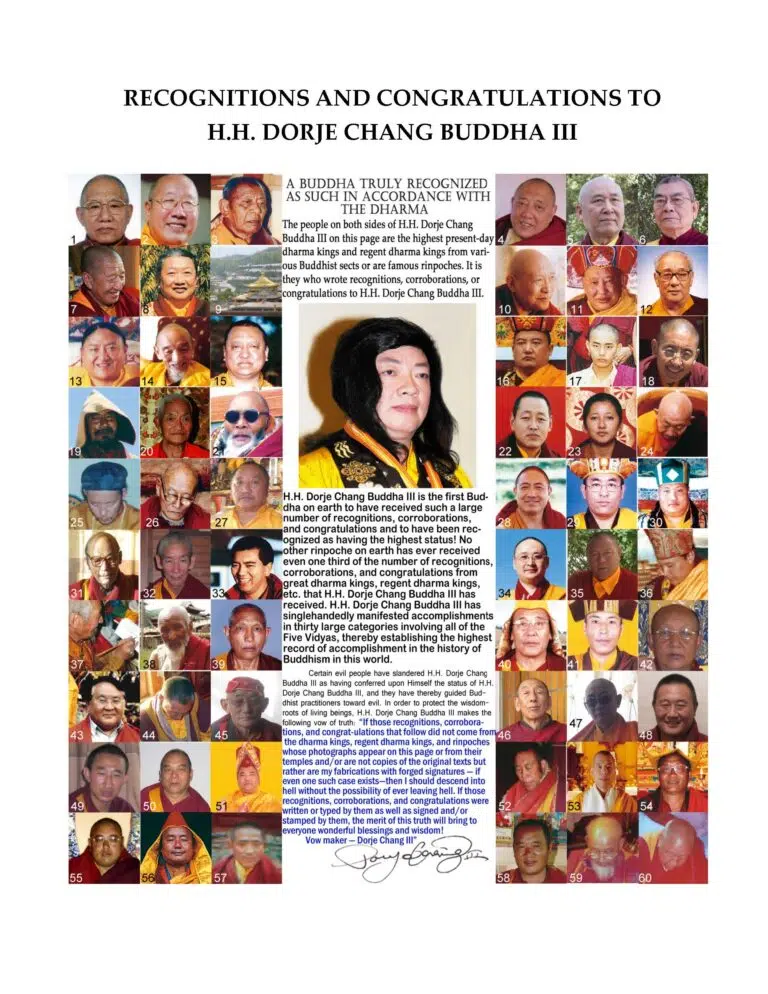
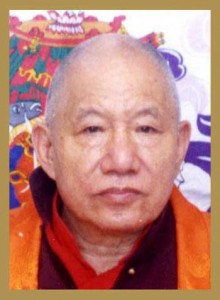
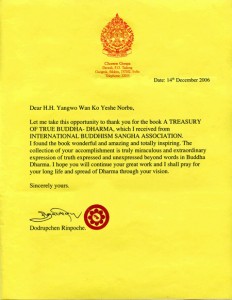


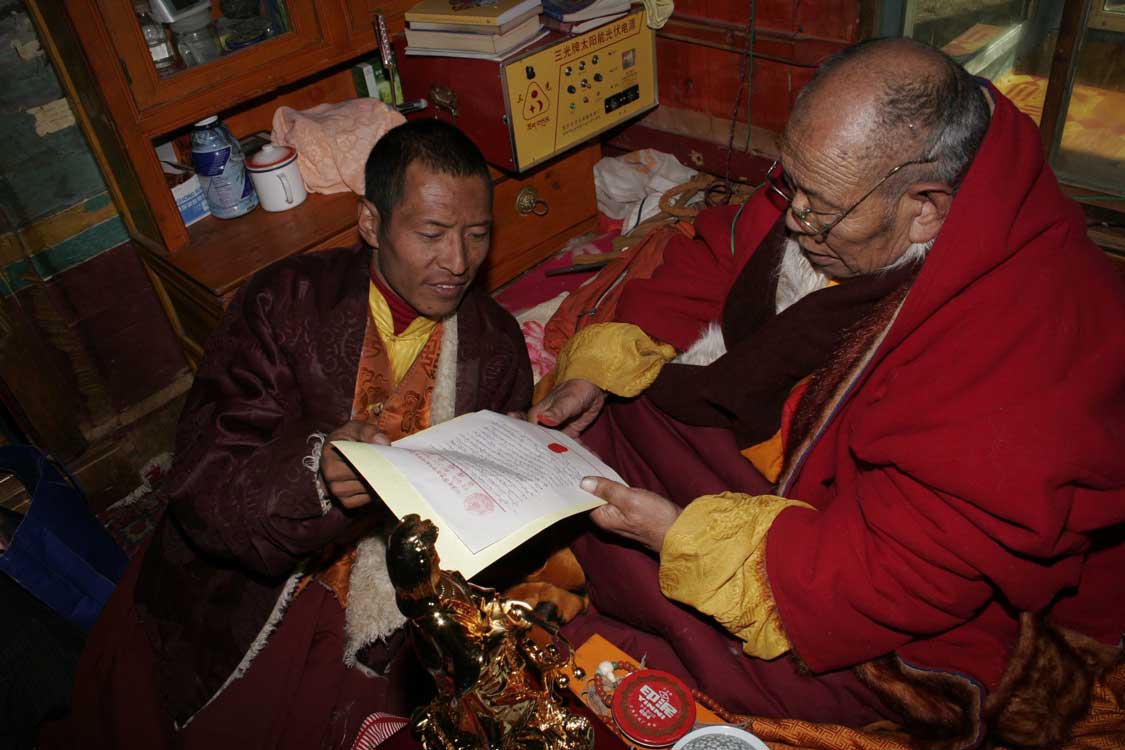


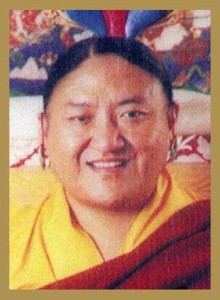
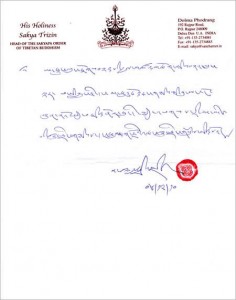



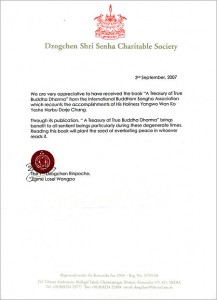

 Respected Khenpo Chucheng Qupei, whose status as khenpo was conferred upon him by H.H. Dharma King Sakya Trizin, respectfully praised H.H. Dorje Chang Buddha III Wan Ko Yeshe Norbu, as follows: “His Holiness is the supreme holder of the 84,000 Buddha-dharmas, the one who is in charge of all dharma methods of Buddhism. His Holiness was the first sambhogakaya Buddha in the dharmadhatu.”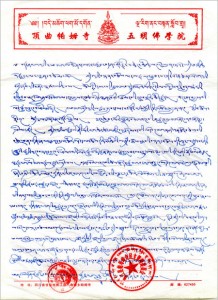

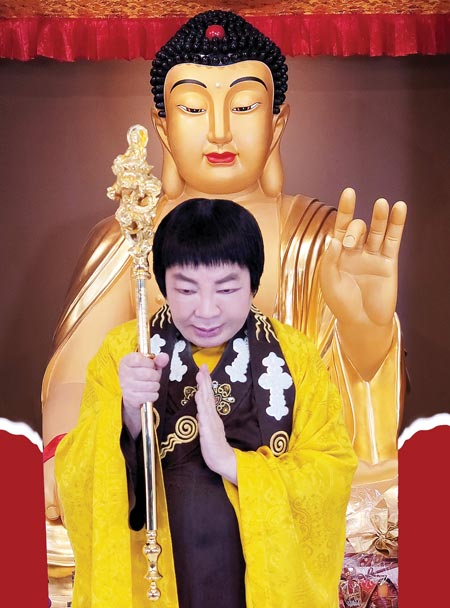


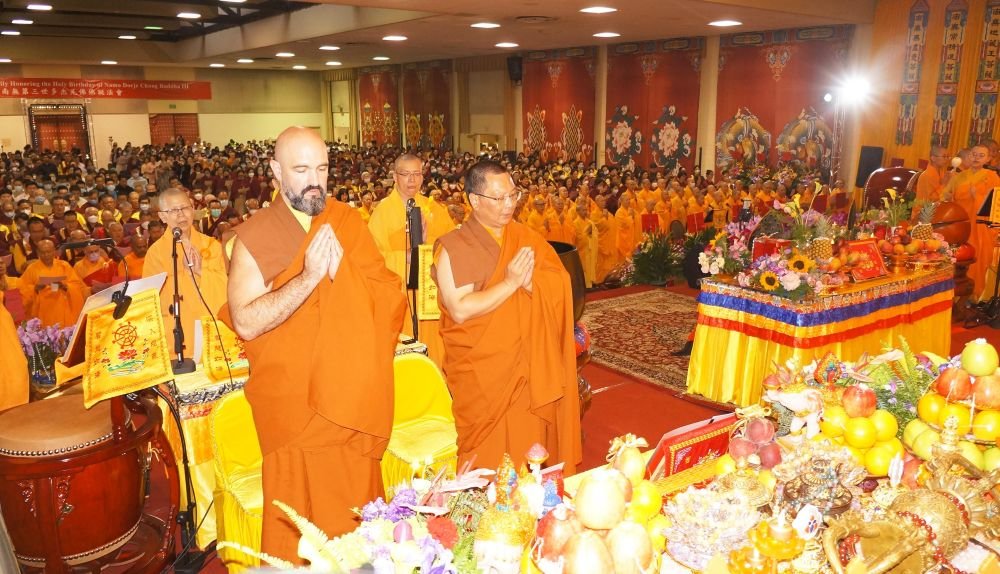



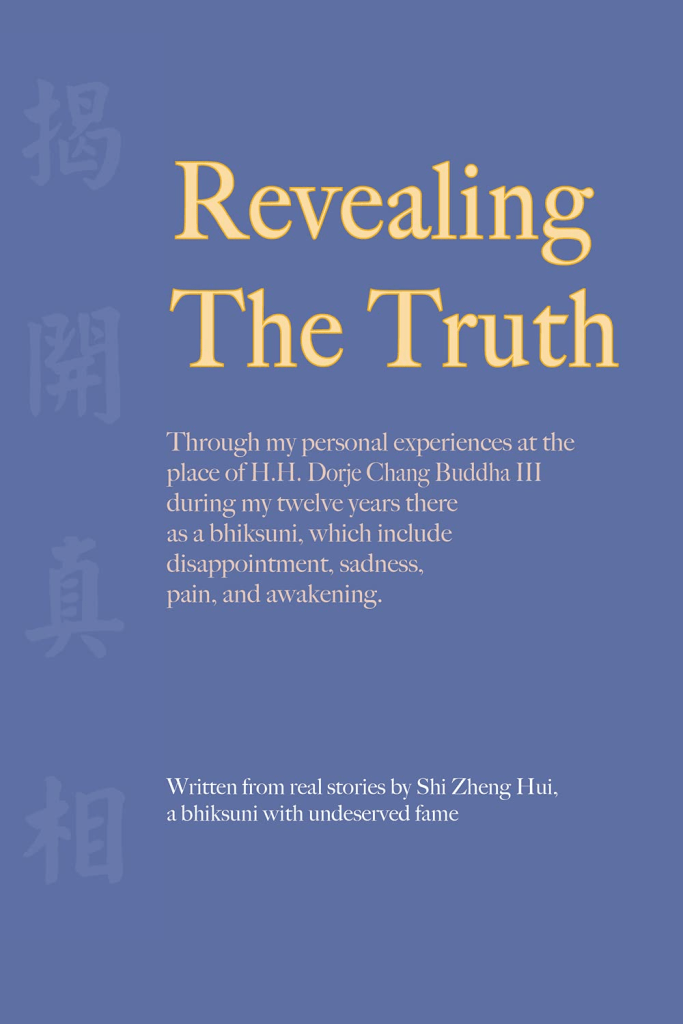
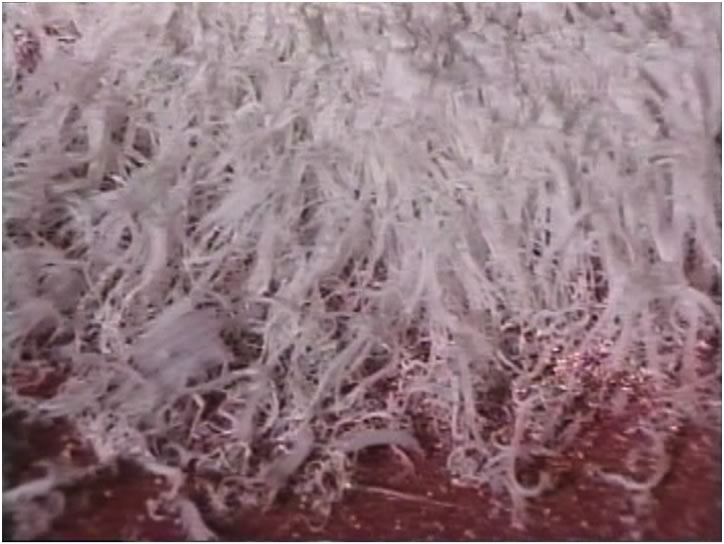
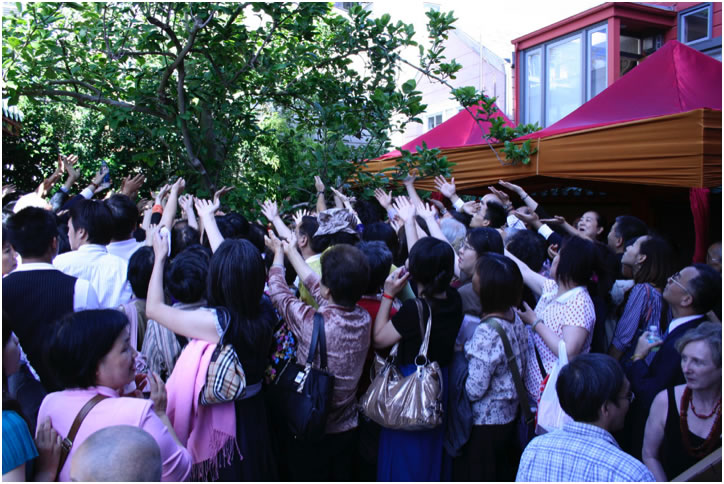




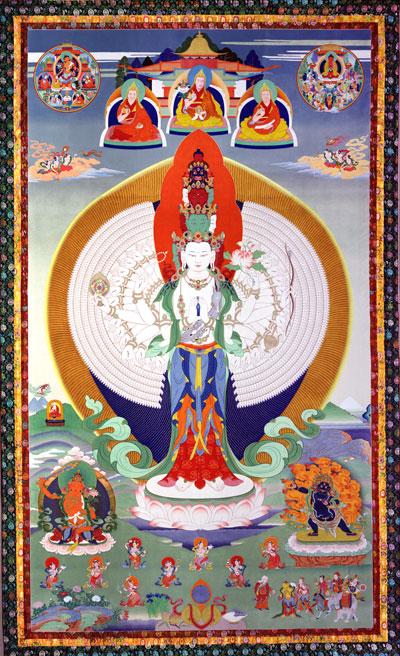
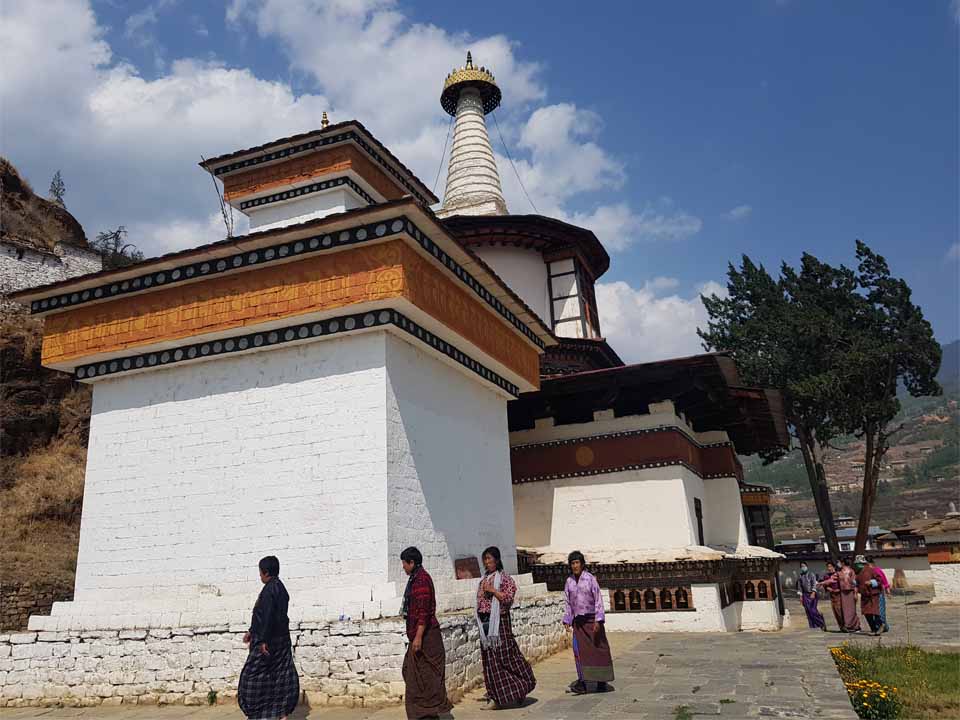

 Peace LiLy