A fifteen-year-old girl who had three hours, a law book, and the unwavering conviction that her sister’s life was not for sale

From : Gistreel Lifestyle. Liberia Online

She was eight years old when her father gambled her away in a card game.
Her older sister had three hours to win her back before the debt collector came.

Deadwood, Dakota Territory. 1877.
A place where law came slow, danger came fast, and survival belonged to the ruthless.

Thomas Garrett had lost everything—his mining stake, his wages, his self-respect—and now, in a drunken haze at the Gem Saloon, he’d lost something far worse:

his daughter.

The man who won her was Bullock—
not the sheriff, but a labor trafficker who “supplied” children to mining camps.
Kids as young as six spent twelve-hour days sorting ore until their lungs failed or their fingers gave out.
Most didn’t live past fourteen.

Thomas signed the paper without hesitation.
Bullock would collect little Emma at noon.

When fifteen-year-old Sarah came home from the laundry and learned what her father had done, she didn’t cry.
Didn’t scream.
Didn’t fall apart.

She simply asked, “When?”

“Tomorrow. Noon.”

Three hours until dawn.
Three hours to save her sister.

And Sarah had something her father never had:

clarity.

She knew Bullock.

Everyone did.
A cruel man who hid behind paperwork and respectability.

He’d made her father sign a contract—
which meant it could be challenged.

And Deadwood had something else:

A new federal judge who’d publicly declared that parents could not use their children to pay debts.

Sarah didn’t sleep.
She didn’t blink.

At dawn she was already standing in the courthouse, breathless, determined.

The clerk tried to dismiss her—
fifteen-year-old girls didn’t talk law.

But Sarah did.

Because before drink ruined him, her father had been a clerk…
and she’d read every law book he left lying around.

She laid out the case with the precision of a trained lawyer:

The contract violated territorial labor laws.

It constituted debt bondage of a minor.

Thomas Garrett was legally incapacitated due to intoxication.

The clerk stared. Then nodded.

He woke the judge.

Judge Isaac Parker—who would one day be known as the “Hanging Judge”—read the contract, listened to Sarah, and did something extraordinary:

He issued an emergency injunction, blocking the transfer and summoning both Bullock and Thomas Garrett to court that afternoon.

When Bullock arrived at the Garrett cabin at noon, two men at his back, he found Sarah waiting on the porch.

Not shaking.

Not pleading.

Holding a federal court order in her hand.

Bullock turned red with fury but wasn’t stupid enough to defy a judge.

At the hearing, Judge Parker didn’t hesitate.

He voided the contract.
Declared it an illegal attempt to traffic a minor.
Warned Bullock that any further attempt to collect “payment” would end with him in chains.

Then he turned to Thomas Garrett.

A father who gambled his children away forfeits the right to be a father.

Parker stripped him of parental rights and—
in a move that shocked the entire Dakota Territory—
appointed fifteen-year-old Sarah as her sister’s legal guardian.

But victory didn’t fill their stomachs.

Sarah now had an eight-year-old to raise,
no money,
no home,
and only her laundry work to survive.

What she did next became legend.

She went to five different businesswomen in Deadwood—
laundry owners, seamstresses, boarding house keepers—
and proposed a deal:

“I’ll work for reduced wages.
You house and feed my sister and me.
I’ll take the hardest jobs and the longest hours.”

Four said no.

The fifth—
a widow named Martha Bullock (no relation to the trafficker)—
said yes.

For the next three years, Sarah worked sixteen-hour days.
Emma went to school—
Sarah insisted on it.

She saved every coin.

By 1880, she’d saved enough to lease a small building and open her own laundry.

By 1882, she owned it.

She employed six women.
Paid fair wages.
Offered housing to those in need.

Emma, thirteen, kept the books.

When Emma turned eighteen, Sarah paid—
entirely from her business profits—
for her to attend normal school and become a teacher.

Emma later became a school principal
and one of the fiercest advocates for child labor reform in the state.

Sarah never married.

“I raised one child already,” she’d say with a half-smile.
“Did a better job than most with half the resources.”

She ran her business until 1910, providing work for over a hundred women across three decades.

Emma retired as the first female superintendent in her county.

When Sarah died in 1923, her obituary mentioned her “successful business career.”

Emma told the real story:

A fifteen-year-old girl who had three hours, a law book, and the unwavering conviction that her sister’s life was not for sale.

Judge Parker later said:

“Justice isn’t only about punishing the guilty.
Sometimes it’s about recognizing competence where no one else looks for it.”

The line between tragedy and triumph is thin.
Sometimes it’s nothing more than a teenage girl
who refuses to accept that her sister can be traded like poker chips—

and who’s smart enough to find the one legal lever that can stop it.

Sarah Garrett didn’t have money.
Didn’t have weapons.
Didn’t have allies.

She had time running out.
A mind trained by desperation.
And love hard enough to fight the world.

And that was enough.

Source: https://www.facebook.com/photo.php?fbid=866624929388914&set=a.764395932945148&type=3&mibextid=wwXIfr

The Desert-Conquering Queen: Yin Yuzhen’s 36-Year Battle Against the Sands

In 1985, a drunken promise set a young woman on a path that would change not only her life, but the fate of an entire desert.

At just 19 years old, Yin Yuzhen was forced to marry Bai Wanxiang, a man living deep in China’s Mu Us Desert.

On her wedding night, while Bai lay down early to rest, Yin Yuzhen sat awake until dawn, her eyes red from weeping. When she looked out from her tiny dugout home, she saw nothing but endless waves of yellow sand stretching to the horizon. She felt as if her life had ended before it began.

Her new home was a four-square-meter pit carved into a sand dune. To enter, she had to stoop under a doorway so low it nearly grazed her back. Inside, there was nothing but a bed of dry twigs and straw.

Her husband was four years older and came from a family who had battled the desert for generations. Years earlier, Yin’s father had been saved by Bai’s father when a sandstorm left him lost in the dunes. Grateful, the men became sworn brothers, and in a haze of alcohol, her father vowed to give his daughter to the Bai family. Though he regretted it once sober, he felt bound to keep his word.

Life was brutal. There was no electricity or running water. Summers scorched and winters froze. They survived on millet, wild plants, and the occasional scavenged animal carcass. For forty days after her wedding, Yin Yuzhen saw no one but her husband—until, at last, a wandering herder passed by.

The isolation was unbearable. In her loneliness, she would cover footprints in the sand with a basin, pretending someone was still there.

Seven times she tried to flee, and seven times she became lost in the swirling sand. Once, she walked for two days and nights, only to find herself back where she started. That was when she realized the desert was not going to let her go.

At her lowest point, she contemplated ending her life. But in that moment, she remembered her mother’s tearful face the day she left home—and she stepped back from the edge. If she couldn’t escape, she decided, she would have to find a way to survive.

Hope arrived in the form of two poplar saplings she brought home from a visit to her parents. Miraculously, one took root. That little sprig of green whispered a possibility: maybe the desert wasn’t completely invincible.

In 1986, Yin Yuzhen made a bold choice. She sold their only “three-legged sheep”—a wounded animal that was still precious—and used the money to buy 600 young trees.

That spring, she and Bai planted each sapling in the sand around their cellar.

The challenges were immediate. Every day, they walked kilometers to fetch water. Under the searing sun, most of the saplings withered. By summer’s end, fewer than 100 remained. But for Yin Yuzhen, that was enough to keep going.

From then on, reclaiming the desert became her life’s purpose. Bai took work wherever he could to buy more trees, while she stayed behind to plant, water, and protect them.

Every morning she rose at 4 a.m. and worked until late into the night.

Through years of trial and error, she devised a three-layer planting method: shrubs to anchor the sand, trees to form a windbreak, and fruit trees to sustain their livelihood. This innovation transformed survival rates.

But the desert kept testing her resolve.

In 1989, a monstrous sandstorm struck while they were returning with new saplings. The wind tore the trees from their cart and buried them. Yin Yuzhen clung to their ox’s tail, stumbling forward in the blinding grit. When they finally reached home, she didn’t rest—she planted every surviving sapling that same night.

Setbacks never stopped coming.

They flattened kilometers of sand to make water channels, only to watch them swallowed again and again.

She went into premature labor from exhaustion. He developed pneumonia. But neither ever quit.

For the first ten years, the progress was almost invisible. The trees grew painfully slowly, and the dunes kept advancing. Still, she believed that if she didn’t give up, someday the desert would yield.

In the fifteenth year, signs of hope appeared. The dunes near their home began to stabilize. The wind softened. Small animals returned.

After twenty years, their desolate hollow had transformed into an oasis that drew neighbors to settle nearby.

Today, after thirty-six years of relentless labor, Yin Yuzhen and Bai Wanxiang have reclaimed more than 70,000 acres of desert.

They have planted over 20 million trees—forming a vast green barrier against the sands.

Their perseverance has inspired 84 families to join in the mission, proving that even the harshest landscapes can be transformed.

Yin Yuzhen’s story has captured global attention. She has won over 100 honors, including “National Model Worker” and “Green China Person of the Year.” She was the first Chinese woman nominated for the Nobel Peace Prize, and the United Nations has praised her work as a model of ecological restoration.

What began as a forced marriage became the catalyst for a transformation no one imagined possible.

The young bride who wept in despair became a legend—China’s Desert-Conquering Queen.

Standing in her thriving “green kingdom,” she often reflects on her journey from hopelessness to triumph.

“At first, I only wanted to survive,” she says. “Later, it became my life’s mission.”

Today, the cellar where she once had to crawl inside has been replaced by a bright brick house surrounded by orchards and forests. That place—once a symbol of despair—has become a destination where people come to learn, to marvel, and to be inspired.

Yin Yuzhen’s life is a powerful reminder that in the most unforgiving environments, the strongest life force can grow.

One woman’s 36-year battle against the desert ended in a victory of green.

Link:https://peacelilysite.com/2025/07/08/the-desert-conquering-queen-yin-yuzhens-36-year-battle-against-the-sands/

Source: https://www.facebook.com/permalink.php?story_fbid=pfbid02UztZikitftmaF5mxFQ5hoJtqtvEFZSQjnfhEWWR12h9vKd4zhVZN2mMUcGoAVAcdl&id=100063478189650

Photos from: https://www.chinastory.cn/PCzwdbk/chinastory/wap/detail/20190617/1006000000039761560767204146970666_1.html

77. THE SIXTEEN DREAMS [CHAPTER 1. PANIC]

77. THE SIXTEEN DREAMS [CHAPTER 1. PANIC]

Once upon a time there was a king called Brahmadatta who was ruling in Benares, in northern India. One night he had sixteen frightening nightmare dreams. He awoke in the morning in a cold sweat, with his heart thumping loudly in his chest. The sixteen dreams had scared him to death. He was sure they meant that something terrible was about to happen. In a panic, he called for his official priests, to ask their advice.

When the priests arrived at the royal bed chamber, they asked the king if he had slept well. He told them that it had been the worst night of his life, that he had been scared to death by sixteen dreams, and that he was desperate to find out their meanings.

At this the priests’ eyes lit up. They asked him, “What were these dreams, your majesty?” King Brahmadatta told them all sixteen dreams. The priests pounded their foreheads and exclaimed, “Oh what horrors! It couldn’t be worse, your majesty. Such dreams as these can mean only one thing — danger!”

The king asked them, ‘What danger, oh priests? You must tell me the meaning at once!” They replied, It is certain, your majesty, these dreams show that one of three disasters will take place — terrible harm to the kingdom, to your life, or to the royal wealth.”

The king had feared as much. He wrung his hands as the sweat kept pouring from his body. He was shaking all over with terror and panic. He asked, “Tell me, oh worthy royal priests, is there any way to avoid this disaster?” “Indeed, it is very dangerous,” they said. “If you do nothing, the end is certain. But we can prevent it. If we couldn’t, then all our training and learning would be useless. Trust us, lord.”

The panic-stricken king cried out, “Just tell me what to do, priests. I’ll do anything! What can you do to save me, my kingdom and my wealth?” “We must offer the greatest animal sacrifice that has ever been seen,” they said. “We must kill, as sacrificial offerings, four of every type of animal that lives!”

Although he was usually a gentle, kind and merciful ruler. King Brahmadatta was so frightened that he couldn’t think straight at all. Paralyzed with fear, he put all his hope and faith in his priests. He gave them permission to prepare the gigantic slaughter.

The priests said, “Have no fear, your majesty, we will take care of everything. We will prevent the coming doom!” They knew they would be paid well to perform the sacrifice. And the meat from the killed animals would be theirs as well. Their secret thoughts were, “This is a great way for us to get piles of money, and the best food and drink too!”

The priests got to work organizing the biggest sacrifice Benares had ever seen. Just outside of town they dug a huge pit. Into it they put the most perfect ones they could find of all the animals — land animals, birds and fish. From each kind they selected four to be killed in the ceremony. It became known as the ‘Four-from-all’ sacrifice.

Meanwhile, the king’s senior teaching priest had a promising young pupil. He was gentle and compassionate, and very well-educated. He wondered about all that was happening. So he asked the teacher priest, “Oh master, you have taught me well the wise teachings of old. Can you show me anywhere it says the killing of one will save the life of another?”

The priest answered, “What kind of question is that? Open your eyes and be realistic, my boy. Don’t you see that this great sacrifice, the Four-from-all, will make us rich? You must be trying to help the king hold onto his riches! “

The idealistic and sincere pupil said, “You have not answered my question, master. If this sacrifice is to be your work, it shall be mine no longer!” With these words he departed and went to the royal pleasure garden to consider what he would do.

It just so happened that the Enlightenment Being had been born into a rich high class family. For many generations the men in that family had been priests, just like the ones who were now preparing the Four-from-all sacrifice. But when the Bodhisatta grew up he abandoned the life of a rich priest. Instead he went to the Himalayas and lived as a humble forest monk. He concentrated his mind in meditation and entered high mental states. He gained the sweetest inner happiness, and even miraculous supernatural powers.

This forest monk loved all the animals. When he heard about what was happening in Benares he was filled with tenderness and compassion. He decided, “I must teach the ignorant people and release them from the chains of superstition. I will go to the city at once!” Then he used his supernatural power to fly through the air to Benares. In an instant he was seated on a rock in the king’s pleasure garden. His gentle nature made him glow like a golden sunrise.

The idealistic young student approached and recognized him as a great holy man. He bowed respectfully and sat on the ground. The forest monk asked him, “Young man, do you have a good and just king reigning here in Benares?”

“Yes”, said the student, “our king is kind and good. But he is being misled by the royal priests. He had sixteen dreams which left him completely panic-stricken. The priests took advantage of this when he told them his dreams. They have convinced him to have a huge sacrifice and kill many animals. Oh holy one, please tell the king the true meanings of his dreams. Free the many helpless beings from fear and death.”

The holy man said, “If he comes and asks me, I will tell him.” “I will bring him, sir,” said the young man. “Kindly wait here a short while until I return.”

The student went to the king and told him there was a marvelous holy man seated on a rock in the royal pleasure garden. He told him he had said he could interpret the king’s dreams. Hearing this, the king went with him to the garden. A crowd followed behind.

77. The sixteen dreams [Chapter 1. Panic]

Link: https://hhdorjechangbuddhaiiiinfo.com/2024/02/27/77-the-sixteen-dreams-chapter-1-panic/

#Buddhisttalesforyoungandold #Buddhiststories #storiesforkids #moralstories #Buddha #Jatakastories #PansiyaPanasJataka

62. THE PRIEST WHO GAMBLED WITH A LIFE [MISGUIDED MORALITY]

62. THE PRIEST WHO GAMBLED WITH A LIFE [MISGUIDED MORALITY]

Once upon a time, there was a king who loved to gamble with his royal priest. When he threw the dice, he always recited this lucky charm:

“If tempted any woman will, for sure, give up her faithfulness and act impure.”

Amazing as it may seem, by using this charm the king always won! Before long, the royal priest lost almost every penny he owned.

He thought, “I have lost almost all my wealth to the king. It must be because of his lucky charm. I need to find a way to break the spell and win back my money. I must find a pure woman who has never had anything to do with a man. Then I will lock her up in my mansion and force her to remain faithful to me!”

This seemed like a good plan to him. But then he started having doubts. He thought, “It would be nearly impossible to keep a woman pure after she had already become accustomed to men. Therefore I must find the purest woman possible – one who has never even seen a man!”

Just then he happened to see a poor woman passing by. She was pregnant. The royal priest was an expert in reading the meaning of marks on the body. So he could tell that the unborn baby was a girl. And the thought occurred to him, “Aha! Only an unborn baby girl has never seen a man!”

The royal priest was willing to do anything to beat the king at dice. So he paid the poor woman to stay in his house and have her baby there. When the wonderful little girl was born, the priest bought her from her mother. Then he made sure she was raised only by women. She never saw a man — except of course the royal priest himself. When she grew up, he still kept her completely under his control. It was just as if he owned the poor girl!

The cruel priest did all this only because of his gambling habit. While the girl was growing up, he had avoided playing dice with the king. Now that she was of age, and still his prisoner, he challenged the king to a game of dice once again.

The king agreed. After they had made their bets, the king shook the dice and repeated his favourite lucky charm:

“If tempted any woman will, for sure, give up her faithfulness and act impure.”

But just before he threw down the dice, the priest added:

“Except my woman — faithful evermore!”

Lo and behold, the king’s charm didn’t work. He lost that bet, and from then on the priest won every throw of the dice.

The king was puzzled by this turn of events. After considering, he thought, “This priest must have a pure woman locked up at home, one who is forced to be faithful to him alone. That’s why my lucky charm doesn’t work anymore.”

He investigated and discovered what the cruel priest had done. So he sent for a well-known playboy character. He asked him if he could cause the lady’s downfall. He replied, “No problem, my lord!” The king paid him handsomely and told him to do the job quickly.

The man bought a supply of the finest perfumes and cosmetics. He set up a shop just outside the royal priest’s mansion. This mansion was seven stories high, with seven entrance gates — one on each floor. Women guarded each gate, and no man except the priest was allowed to enter.

Only only one servant waited on the priest’s lady. She carried everything in and out, including perfumes and cosmetics. The priest gave her money for her purchases.

The playboy saw the servant going in and out of the priest’s mansion. Soon he realised she was the one who could get him inside. So he devised a plan and hired some cronies to help him.

The next morning, when the serving lady went out to do her shopping, the playboy dramatically fell to the ground before her. Grabbing her knees he tearfully cried, “Oh my dear mother, it’s so wonderful to see you again after such a long time!”

Then his cronies chimed in, “Yes, this must be she! She looks the same – her hands and feet and face and type of dress. Yes, this must be she!” They all kept saying how amazing it was that her looks had changed so little in all that time.

The poor woman must have had a long lost son, for soon she was convinced this must be he. She hugged the king’s clever playboy, and both sobbed tears of joy over their miraculous reunion.

In between bouts of sobbing, the man was able to ask her, “Oh dear mother, where are you living now?” “I live next door,” she said, “in the royal priest’s mansion. Night and day I serve his young woman. Her beauty is without equal, like the mermaids sailors love to praise.”

He asked, “Where are you going now, mother?” “I’m going shopping for her perfumes and cosmetics, my son.” “There’s no need, mother,” he said, “from now on I will give you the best perfumes and cosmetics free of charge!” So he gave them to her, along with a bouquet of lovely flowers.

When the priest’s lady saw all these, much better quality than usual, she asked why the priest was so happy with her. “No,” said the serving woman, “these are not from the priest. I got them at my son’s shop.” From then on she got perfumes and cosmetics from the playboy’s shop, and kept the priest’s money.

After a while the playboy began the next part of his plan. He pretended to be sick and stayed in bed.

When the servant came to the shop she asked, “Where is my son?” She was told he was too sick to work, and was taken to see him. She began massaging his back and asked, “What happened to you, my son?” He replied, “Even if I were about to die, I couldn’t tell you, my mother.”

She continued, “If you can’t tell me, whom can you tell?” Then, according to his plan, he broke down and admitted to her, “I was fine until you told me about your beautiful mistress — ‘like the mermaids sailors love to praise’. Because of your description, I have fallen in love with her. I must have her. I can’t live without her. I’m so depressed, without her I’ll surely die!”

Then the woman said, “Don’t worry, my son, leave it up to me.” She took even more perfumes and cosmetics to the priest’s lady. She said to her, “My lady, after my son heard from me about your beauty, he fell madly in love with you! I don’t know what to do next!”

Since the priest was the only man she had ever seen, the lady was curious. And of course she resented being locked up by force. So she said, “If you sneak him into my room, it’s all right with me!”

The woman guards at the seven gates searched everything the servant took in and out. So she had to have a plan. She swept up all the dust and dirt she could find in the whole mansion. Then she began taking some of it out each day in a large covered flower basket. Whenever she was searched, she made sure some of the dust and dirt got on the guard women’s faces. This made them sneeze and cough. Pretty soon they stopped searching her when she went in and out.

Finally one day she hid the playboy in her covered flower basket. He was trim and fit, not heavy at all. She was able to sneak him past all seven guarded gates, and into the priest’s lady’s private chamber. The two lovers stayed together for several days and nights. So the playboy was able to destroy her perfect faithfulness, which had been forced on her by the cold-hearted priest.

Eventually she told him it was time to go. He said, “I will go. But first, since the old priest has been so mean to you, let me give him one good blow to the head!” She agreed and hid him in a closet. This too was part of his secret plan.

When the priest arrived, his lady said, “My lord and master, I’m so happy today! I’d like to dance while you play the guitar.”

The priest said, “Of course, my beauty.” “But I’m too shy to dance in front of you,” she added, “so please wear this blindfold while I dance.” Again he agreed to her request and she put a blindfold over his eyes.

The priest played a pretty tune on his complicated Indian guitar, while his lady danced. After a bit she said, “As part of my dance, won’t you let me give you a tap on the head?” “As you wish, my dear,” he said.

Then she motioned to the playboy, who came out of the closet, snuck up from behind, and hit the old priest on the head! His eyes nearly popped out, and a bump began rising from the blow. He cried out and the lady put her hand in his. He said, “Such a soft hand sure can deliver a wallop, my dear!”

The playboy returned to the closet. The lady removed the priest’s blindfold and put some ointment on his bump. When he had left, the serving woman hid the playboy in her flower basket and smuggled him out of the mansion. He went immediately to the king and told him the whole story, in a very boastful way of course.

The next day the royal priest went to the palace as usual. The king said, “Shall we gamble on the throw of the dice?” The priest, expecting to win once more, agreed. Just as before, the king recited his lucky charm:

“If tempted any woman will, for sure, give up her faithfulness and act impure.”

As usual the priest added:

“Except my woman — faithful evermore!”

But lo and behold the dice fell in the king’s favour and he took the priest’s money.

The king said, “Oh priest, your woman is no exception! True faithfulness cannot be forced! Your plan was to snatch a newborn baby girl, lock her up behind seven gates guarded by seven guards, and force her to be good. But you have failed. Any prisoner’s greatest wish is freedom!

“She blindfolded you and then her playboy lover gave you that bump on your old bald head – which proves your gates and guards were useless!

The priest returned home and accused his lady. But in the meantime, she had come up with a plan of her own. She said, “No, my lord, I have been completely faithful to you. No man has ever touched me except you! And I will prove it in a trial by fire. I will walk on fire without being burned to prove I speak the truth.”

She ordered the old servant woman to fetch her son, the playboy. She was to tell him to take the lady by the hand and prevent her from stepping in the flames. This the woman did.

On the day of the trial by fire, the priest’s lady said to the crowd of onlookers, “I have never been touched by any man except this priest, my master. By this truth, may the fire have no power over me.”

Then, just as she was about to step into the fire, the playboy leaped from the crowd and grabbed her hand. He shouted, “Stop! Stop! How can this priest be so cruel as to force this tender young lady into a raging fire!”

She shook her hand free and said to the priest, “My lord, since this man has touched my hand, the trial by fire is useless. But you can see my good intention!”

The priest realised he had been tricked. He beat her as he drove her away forever. At last she was free of him and mistress of her own fate.

The moral is: You can’t force someone to be good.

The Priest Who Gambled With a Life [Misguided Morality]

INTERPRETER’S INTRODUCTION – BUDDHIST TALES FOR YOUNG AND OLD, VOLUME 1, STORIES 1-50

Link: https://hhdorjechangbuddhaiiiinfo.com/2023/11/07/the-priest-who-gambled-with-a-life-misguided-morality/

#Buddhisttalesforyoungandold #Buddhiststories #storiesforkids #moralstories #Buddha #Jatakastories #PansiyaPanasJataka

Masterpieces of Eagle Paintings

Photo by Frank Cone on Pexels.com

Four Chinese Ink Paintings of Eagle in IAMA

Eagles, with their symbols of speed, power, sharp vision, and justice, are a common and captivating subject in paintings. H.H. Dorje Chang Buddha III, a renowned artist and spiritual leader, has masterfully captured the essence of this majestic creature in his Chinese ink paintings. These paintings are currently on display at the International Art Museum of America, where visitors can marvel at the unique style and charm of each of the four pieces.

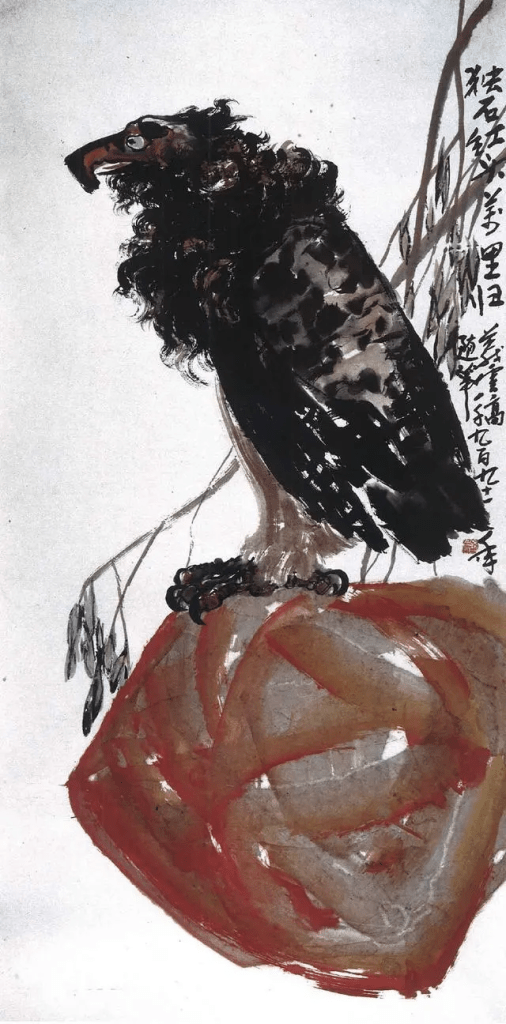
Du Shi Hong Tou Wan Li Gui (Red-Headed Eagle on a Lone Rock After Having Returned From Thousands of Miles Away)

The painting depicts an eagle returning from a journey of thousands of miles. It is completely black, with bright and mottled feathers. Its sharp eyes shine with intelligence, reflecting a silent abstraction of the vast ocean. Even after the long journey, its feathers are a bit disheveled, and its sharp claws are tightly grasping a red stone, supporting its slightly weary body. The stone appears to be floating in the sky rather than resting on the ground. The red stone, painted with powerful strokes, adds dynamism and strength to the painting. The eagle’s gaze is fixed on the distance, looking at its homeland. The gaze seems filled with eagerness, love, pride, and a touch of sadness and melancholy. The painting has a unique abstract style; it is not a realistic depiction of an eagle, but it gives the viewer a very real impression.

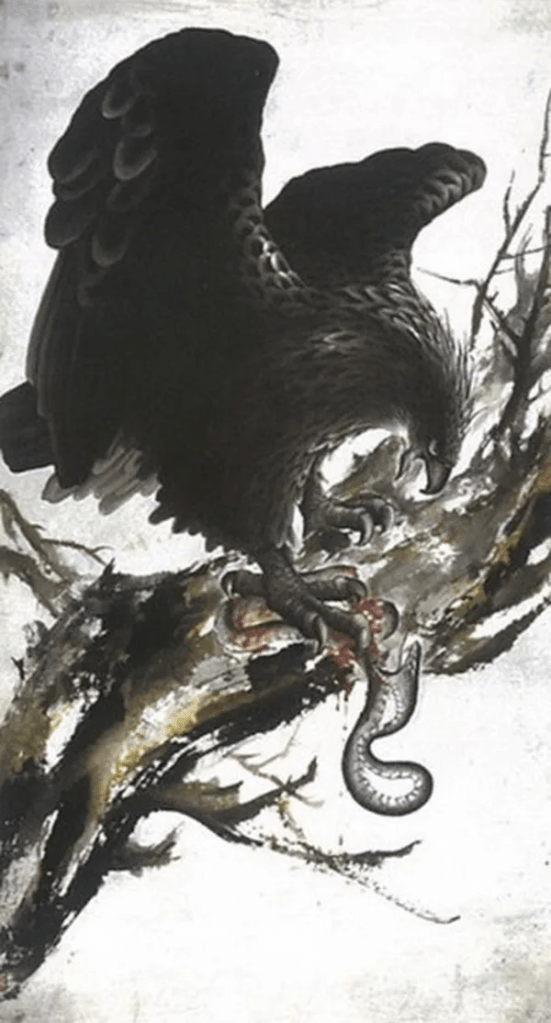
Ying She Dou (Fighting between Eagle and Snake)

The Chinese painting “Ying She Dou” depicts a real scene that is powerful and striking in its presentation. The composition is full and atmospheric, with a minimal but vivid color palette. The eagle is rendered with fine, meticulous brushwork, giving it a towering presence with wings like mountains painted in thick ink. The pure scorched royal black of the eagle is full of mysterious power. The accompanying withered tree trunk is painted with bold, vigorous strokes in a freehand style, exuding the charm of a casual style along with the scholarly air and graceful ancient look typical of engraved stone seals. The artist’s extraordinary skills are evident in this image, which is anything but mediocre. The atmosphere of the painting is terrifying, tense, and bloody, eliciting shudders and thrills from the viewer.

Gu Tu (Native Land)

This painting exudes a warm, soft, and tranquil atmosphere. Two mighty eagles are depicted circling and perching on their own rock, a location they have occupied for an extended period of time, leaving layers upon layers of visible bird droppings on the rock. The eagles’ poses and eyes convey their deep love and compassion for their homeland. Unlike other eagle paintings, this work showcases the eagles’ softer, more loving side. The rock, which appears like a cultural relic, is rendered in different shades of color, ranging from light to dark, and resembles a semi-transparent amber, adding warmth and softness to the painting. This piece of art conveys a grand vision and is free from any signs of rashness on the part of the artist.

This painting is one of my favorites. Standing in front of it, I can genuinely sense the calm, love, and inner strength emanating from the artist. It is my sincere hope that everyone may experience love, protection, and lead a life of peace and harmony.

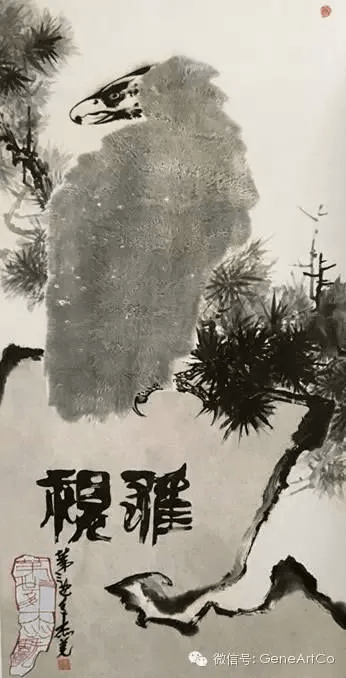
Xiong Shi (Powerful Gaze)

The painting titled “Powerful Gaze” captures the essence of magnanimity, courage, and extraordinary sentiment, finding wonder in the ordinary.

This delightful painting style is lively yet natural, producing a dynamic and fascinating effect from scattered ink.

While the structure of the painting is simple, the artist’s inner strength subtly emanates throughout. With just a few brushstrokes, the painting achieves a lofty and grand atmosphere, bringing the spirit to life with vibrancy and energy. The eagle’s eyes are particularly expressive and sharp, as if they could leap out of the painting, ready to destroy all evil and correct all wrongs. The eagle’s feathers are rendered in large blocks of abstract gray, providing room for the viewer’s imagination and adding a cold, pure, and divine tone to the painting. The stone beneath the eagle’s feet is outlined with the extremely energetic brushwork of calligraphy, and the Chinese calligraphy title “雄视” (Powerful Gaze) further enhances the dynamic energy of the entire painting. The painting conveys the message that the eagle is steadfastly carrying out its mission, no matter the circumstances.

These four paintings collectively showcase the artist’s true mastery of a diverse range of painting skills. The artist can effortlessly create artworks in different styles, demonstrating a comprehensive understanding of the craft. Beyond providing a visual feast for the eyes, the artist’s works also have the power to touch the hearts and souls of viewers, leaving a lasting impact.

Masterpieces of Eagle Paintings

Link:https://peacelilysite.com/2023/11/03/masterpieces-of-eagle-paintings/

#DorjeChangBuddhaIII #HHDorjeChangBuddhaIII#DorjeChangBuddha#IAMA#InternationalArtMuseumofAmerica#ChineseInkPainting#Art#Artist#YingSheDou #Eagle

Agganna Sutta (On Knowledge of Beginnings)

A Western Disciple’s Miraculous Experience


H.H. Dorje Chang Buddha III Ordained Me

Speaking of H.H. Dorje Chang Buddha III personally ordaining me, it is undoubtedly the most joyous event in my life. Sometimes, even in my nighttime dreams, laughter spontaneously escapes me. This occurrence represents the auspicious connection that has guided me from the worldly existence to embracing monkhood. The privilege of receiving ordination directly from the authentic chief Vajra-holder, undergoing head-shaving, and embarking on the path of a monk is not to be underestimated – it’s a journey that can’t be taken lightly.

Several years ago, I was granted the fortunate opportunity to become a disciple of H.H. Dorje Chang Buddha III. Initially, I perceived him as an approachable Dharma king. It wasn’t until this year (2007) that I serendipitously unveiled the truth. As circumstances matured, my aspiration to embrace monastic life grew stronger and stronger. Consequently, in collaboration with another senior practitioner, Hongxi Fazang, who shared the same intention, we formally petitioned the Dharma king for ordination. Astonishingly, His Holiness accepted our request and committed to ordain us.

On the day of the ordination, a multitude of monks and masters were present. At six o’clock in the early morning, H.H. Dorje Chang Buddha III was immersed in a Dharma practice, assigning us our Dharma names. In that precise moment, two peacocks descended gracefully from the sky, performing an elegant dance to pay homage to His Holiness. Their graceful dance persisted for over thirty minutes, culminating in a gentle conclusion. The peacocks even ventured onto the car His Holiness was preparing to use that day, continuing their homage through dance. Amidst this spectacle, a guardian dog’s resounding bark spurred a sudden realization that this remarkable scene should be captured on film. Regrettably, by the time a camera was procured, the two peacocks had already ascended to the rooftop.

Photo by Rajukhan Pathan on Pexels.com

During the head-shaving process by the Buddha Master, a newly acquired, exceptionally sharp, and powerful electric razor was employed. The initial cut proceeded smoothly, but upon attempting the second cut, the hair refused to yield. No matter the effort expended with the electric razor, not a single strand of hair succumbed. In this juncture, the Buddha Master chanted the Vajra mantra, and with a rustling sound, the hair began to fall.

Upon the completion of the ordination, we approached the two venerable monks in attendance, requesting their blessings upon our Vajra pills. As one of these venerable holy monks extended his hand above my head to bestow his blessings, I experienced a sudden flood of realizations. This sensation defies verbal description – truly an inexplicable and miraculous encounter!

Naturally, what we perceive as miraculous are ordinary occurrences within the realm of H.H. Dorje Chang Buddha III. Such experiences are constantly present in his presence. When H.H. Dorje Chang Buddha III imparted ordination and empowerment upon individuals like Zhaxi Zhuoma Rinpoche, Bodhi Wentu Rinpoche, and others, corresponding miraculous phenomena also materialized.

Puti Duxi at July 4th 2007

H.H. Dorje Chang Buddha III Ordained Me

Link:https://peacelilysite.com/2023/08/13/a-western-disciples-miraculous-experience/

#DorjeChangBuddhaIII #HHDorjeChangBuddhaIII  #Buddhism #Buddhist #PutiDuxi #Ordination

Source: Translate from https://mp.weixin.qq.com/s/xpDekicfKW49KbbgZ0-fIg

Amazing Bridges in China

The oldest Stone Bridge

By English Wikipedia user Zhao 1974 – Imported from English Wikipedia, Photo taken by Zhao 1974, Public Domain, https://commons.wikimedia.org/w/index.php?curid=1813644

Photo from Internet

The Anji Bridge (安济桥) is the world’s oldest open-spandrel segmental arch bridge of stone construction. Credited to the design of a craftsman named Li Chun, the bridge was constructed in the years 595–605 during the Sui dynasty (581–618). Located in the southern part of HebeiProvince, it is the oldest standing bridge in China.

The Anji bridge is about 64 metres (210 ft) long with a central span of 37.37 metres (122.6 ft). It stands 7.3 metres (24 ft) tall and has a width of 9 metres (30 ft). The central arch is made of 28 thin, curved limestone slabs which are joined with iron butterfly joints. This allows the arch to adjust to shifts in its supports and prevents the bridge from collapsing even when a segment of the arch breaks. The bridge has two small side arches on either side of the main arch. These side arches serve two important functions: first, they reduce the total weight of the bridge by about 15.3% or approximately 700 tons, which is vital because of the low rise-to-span ratio and the large forces on the abutments it creates. Second, when the bridge is submerged during a flood, they allow water to pass through, thereby reducing the forces on the structure of the bridge.

During the next 1,400 years, the bridge survived at least eight wars, ten major floods and numerous earthquakes, the most recent being the 7.2-magnitude Xingtai earthquake in 1966. Yet, the support structure remains intact and the bridge is still in use. Only the ornamental railings have been replaced every few hundred years.

The Highest Bridge in the World

The Duge Bridge, also called the Beipanjiang Bridge, is a four-lane cable-stayed bridge on the border between the provinces of Guizhou and Yunnan in China. As of 2021, the bridge is the highest in the world, with the road deck sitting over 565 metres (1,854 ft) above the Beipan River.

The Beipanjiang bridge in southern China has opened to traffic following three years of construction.

The longest Crossing Sea Bridge

The 55km crossing consists of three cable-stayed bridges and link roads in the three cities, reducing the travelling time between Hong Kong and Macau/Zhuhai from an hour’s ferry ride to a 40-minute car journey. This is a key initiative of the Chinese government’s plan to drive the economic and social integration of the Greater Bay Area which encompasses 11 cities in Southern China including Hong Kong and Macau. Opened to traffic at early 2018.

Crossing an Ocean: The Hong Kong-Zhuhai-Macau Bridge

Amazing Bridges in China

Link:https://wordpress.com/post/peacelilysite.com/6429

#China #Bridges #OldestBridge #LongestBridge #HighestBridge #AnjiBridge#Hebei #Hongkong #Macau #ChineseCulture #Yunnan #Guizhou #ZhaozhouBridge

Source: https://gz.cri.cn/n/20230216/b6d28ebf-5a77-46e8-7231-afcde4a8b554.html, https://finance.sina.com.cn/roll/2019-05-08/doc-ihvhiqax7322797.shtml, https://www.google.com/search?q=World%27s+highest+bridge+opens+to+traffic+in+China&oq=World%27s+highest+bridge+opens+to+traffic+in+China&aqs=chrome..69i57j69i61.1269j0j4&sourceid=chrome&ie=UTF-8, https://en.wikipedia.org/wiki/Anji_Bridge

50. The Prince Who Had a Plan [The Power of Superstition]

Western Lotus's avatar頂禮 H.H. 第三世多杰羌佛- 眾善奉行

50. The Prince Who Had a Plan [The Power of Superstition]

Buddhist Tales for Young and Old, volume 1, Prince Goodspeaker, Stories 1-50

nce upon a time, King Brahmadatta was ruling in Benares, in northern India. The Enlightenment Being was born as his son the prince. Being quite intelligent, he completed his entire education by the age of sixteen. So, at this early age, his father made him second in command.

In those days, most people in Benares worshipped gods. They were very superstitious. They thought gods caused things to happen to them, rather than being results of their own actions. So they would pray to these gods and ask special favours. They would ask for a lucky marriage, or the birth of a child or riches or fame.

They would promise the gods that, if their prayers were answered, they would pay them by making offerings to them. In addition…

View original post 793 more words

Purification

steve1658's avatarWisdom Tea

Purification

Even though we are cultivating ourselves, it is hard to overcome many, many lifetimes of evil behavior accumulated over eons of time, both as humans and as non-humans. However, we can stop negative actions from ripening by purifying them.His Holiness Dorje Chang Buddha IIIsaid it is like building a wall of good karma to protect us from the bad. Our bad karma cannot be eliminated–only by becoming enlightened can we escape the laws of cause and effect. The sutras say that “there can be no fault so serious that it cannot be purified by the four powers or four opponent forces.” EvenMilarepaand Angulimala, who were both mass-murderers, were able to purify their negative karma and become enlightened in a single lifetime, but they both were able to do this by following enlightened masters and using these powers. Thesefour opponent powersthat are essential for successful purification are:

1)…

View original post 231 more words