No One to Blame: Understanding the Root of Anger

When Anger Has Nowhere to Stay

In our daily lives, anger often appears without invitation. A single word, a small inconvenience, or an unmet expectation can stir something deep within us. Before we realize it, the mind is no longer calm, and the heart feels as though it is burning.

There was once a woman who had a very bad temper. She often got angry over small things. Afterward, she would regret it. She knew her anger hurt others, and she truly wanted to change. But when anger came, she felt she could not control it.

One day, a friend told her, “There is a wise monk nearby. Maybe he can help you.”
So she decided to go.

When she met the monk, she told him everything—how easily she lost her temper, how much pain it caused, and how helpless she felt. She hoped he would give her some advice.
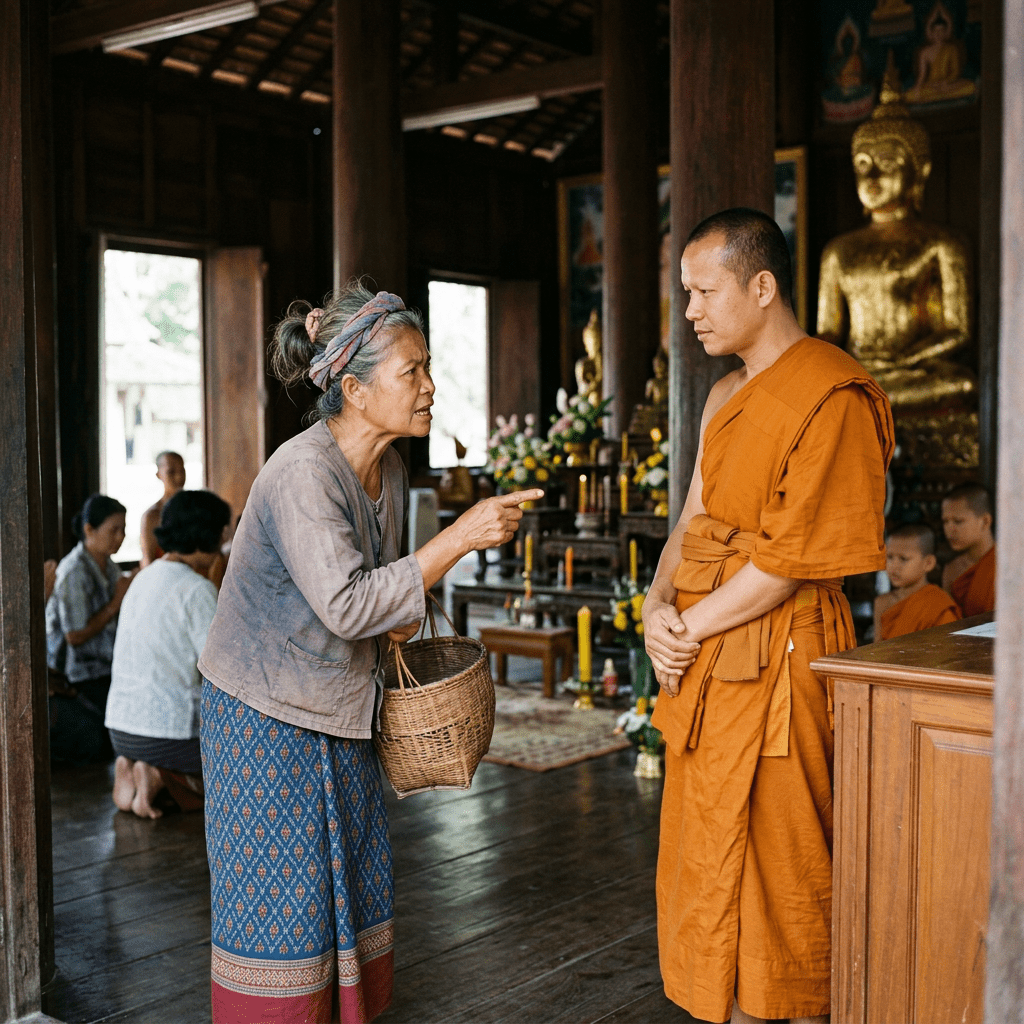
Elder woman talking to a Buddhist monk inside a temple with statues and worshippers in the background

The monk listened quietly. When she finished, he said nothing. He simply led her to a small room, stepped outside, and closed the door.

Soon she realized—the door was locked.

At first, she was confused. Then she became angry.

“I came here for help, and he locks me in?” she thought.

The room was dark and cold. The more she thought about it, the angrier she became. She started shouting, knocking on the door, and scolding the monk loudly.

But there was no answer.

No matter how much she shouted, the monk did not respond.

After a long time, she became tired. Her voice grew quiet.

Then the monk asked from outside, “Are you still angry?”

She said, “I’m angry at myself! Why did I come here?”

The monk replied, “If you cannot forgive yourself, how will you forgive others?” Then he left.

The room became quiet again.

After some time, the monk returned and asked, “Are you still angry?”

She said, “No, I’m not angry anymore.”

“Why?” he asked.

She said, “What’s the use of being angry? I’m still stuck in this dark, cold room.”

Her anger had weakened, but it was still there.

Later, when the monk asked again, she said, “I’m not angry anymore, because you are not worth my anger.”

The monk said, “The root of your anger is still there. You have not let it go.”

His words stayed in her mind.

After a long silence, she asked, “Can you tell me—what is anger?”

This time, the monk came to the door. He did not speak. He simply poured the tea in his cup onto the ground.

The woman watched quietly.

Suddenly, she understood.

“If I do not get angry, where does anger come from?” she thought.
“If my mind is clear, what is there to be angry about?”

At that moment, she saw the truth: anger does not come from others. It comes from our own mind.

From the teaching of Gautama Buddha, we learn that anger arises when the mind is not open—when we hold on too tightly to our own thoughts, feelings, and expectations.

If we do not hold onto anger, it cannot stay.

In our daily life, anger often feels very real. We think others cause it. But if we look carefully, we see that it begins inside us.

When anger comes, we can pause and ask:
Why am I reacting this way?
What am I holding onto?
Can I let it go?

If we become more patient, more tolerant, and more willing to step back, anger will slowly lose its power.

Letting go of anger does not make us weak. It frees us.

When we put down the fire in our heart, we will see that things are not as bad as we thought. Other people are not as terrible as we imagined.

In the end, the lesson is simple:

If we do not create anger, it has nowhere to stay.

Link:https://peacelilysite.com/2026/04/21/no-one-to-blame-understanding-the-root-of-anger/

Mastering Emotions: The Path to Inner Peace

In ancient Tibet, there was a man named Aediba. Whenever he found himself angry or in the midst of an argument, he had a peculiar habit. He would immediately run home and circle his house and land three times before sitting down by the fields to catch his breath. As the years passed, Aediba worked tirelessly, and his house and land expanded significantly. But regardless of how large his property grew, he continued his practice—whenever he got upset, he would run three laps around it.

By the time Aediba had grown old, his property stretched far and wide. One day, after yet another argument, he grabbed his walking stick and, with great effort, completed his customary three laps. When he finally sat down to rest, the sun had already set. Concerned, his grandson approached him and said, “Grandpa, you’re too old to keep doing this. No one around here owns more land than you. You don’t need to run around your property anymore when you’re angry. Can you tell me why you’ve done this your whole life?”

Aediba smiled and replied, “When I was young, every time I got angry, I would run around my house and land. As I ran, I’d think to myself, ‘My house is so small, my land is so little—what right do I have to be angry or argue with anyone?’ That thought always calmed me down, and I would pour all my energy into working harder. Now, even though my house is large and my land vast, I walk around it and think, ‘I have so much—why should I waste my time quarreling with others?’ And once again, my anger fades.”

Just as every rose has its thorns, every person has traits that may frustrate us. The key to happiness is not trying to remove these “thorns,” but learning how to live with them, avoiding getting hurt.

This simple yet profound story teaches us a vital lesson about managing emotions. With family, there’s no need to argue to prove who’s right or wrong. Winning or losing a debate doesn’t matter—home is not a battlefield. We need to make sure our own thorns don’t harm those we love.

When interacting with others, especially those who may not see the world as we do, it’s wise to avoid unnecessary arguments. Not engaging in debates over who’s right shows maturity and emotional intelligence. In fact, most arguments are futile. The real strength lies in holding back, demonstrating grace, and knowing when to step away. Spiritual teachings from ancient times remind us, “When you open your mouth, your energy scatters; when your mind stirs, your internal strength cools.” Engaging in constant disputes not only wastes time but drains our energy.

On Mount Emei, there lived an old monk named Yongtong, who was over 100 years old. Someone once asked him, “Master, what is the secret to happiness?” Yongtong calmly replied, “Never argue.” The person asking wasn’t satisfied with this simple answer and said, “Master, I don’t quite agree with your idea that this is the secret.” Yongtong smiled and said, “Yes, you’re absolutely right…”

Life is full of challenges and difficulties, and none of us can avoid them. However, if we let every problem cause frustration or every small setback lead to anger, life will be full of turmoil. Truly strong individuals know how to control their emotions, step back, and manage problems calmly. Mastering our emotions isn’t about avoiding conflict entirely, but about learning to navigate it with wisdom and grace—leading to a life of peace and fulfillment.

Link:https://peacelilysite.com/2024/10/11/mastering-emotions-the-path-to-inner-peace/