Discover Longxing Temple: A Timeless Treasure of Chinese Buddhism

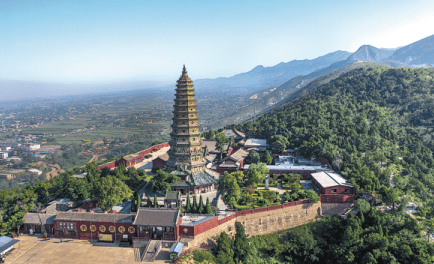
Longxing Temple, also known as the Great Buddha Temple, is one of China’s oldest, largest, and best-preserved Buddhist temples. This extraordinary complex is not only a sacred site but also a magnificent testament to the architectural genius and spiritual devotion of ancient China.

Located at No. 109 Zhongshan East Road in Zhengding County, Shijiazhuang, Hebei Province, Longxing Temple sprawls across an impressive 82,500 square meters.

Originally established in 586 CE during the Sui Dynasty under the name Longcang Temple, it was later renamed Longxing Temple during the Tang Dynasty. In 971 CE, Emperor Taizu of the Northern Song Dynasty issued an edict to cast an enormous bronze Thousand-Armed Avalokiteshvara Bodhisattva and build the splendid Hall of Great Compassion to house it.

This marked the beginning of large-scale expansion, culminating in a grand Song Dynasty architectural complex centered on the hall. Through the Jin, Yuan, and Ming Dynasties, the temple saw continued renovation and growth. In the Qing Dynasty, both Kangxi and Qianlong Emperors decreed extensive rebuilding, shaping the temple’s current layout:

  • The eastern section served as monks’ quarters
  • The central axis hosted Buddhist ceremonies
  • The western area functioned as the imperial palace quarters

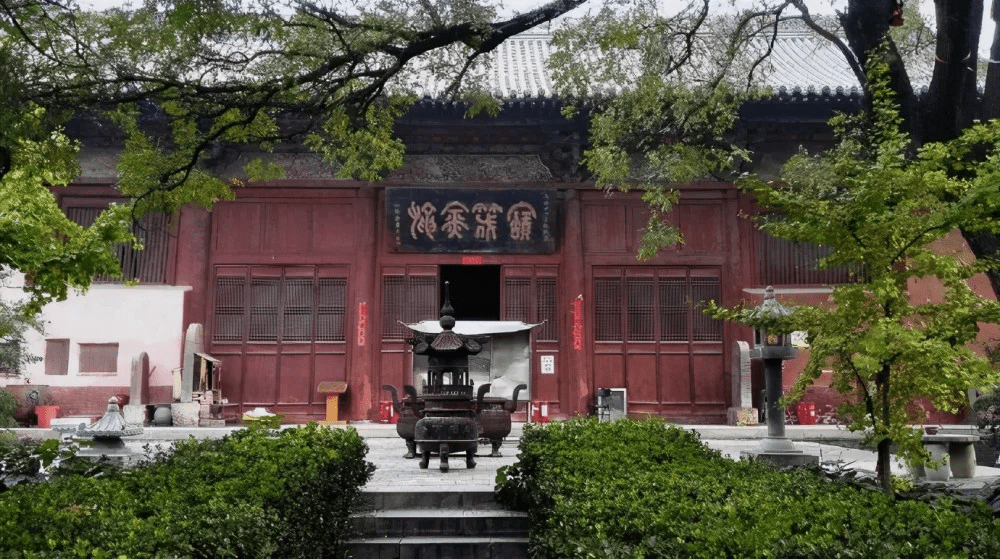
In 1710, Emperor Kangxi personally inscribed the name “Longxing Temple,” an honor that reflects its enduring importance.

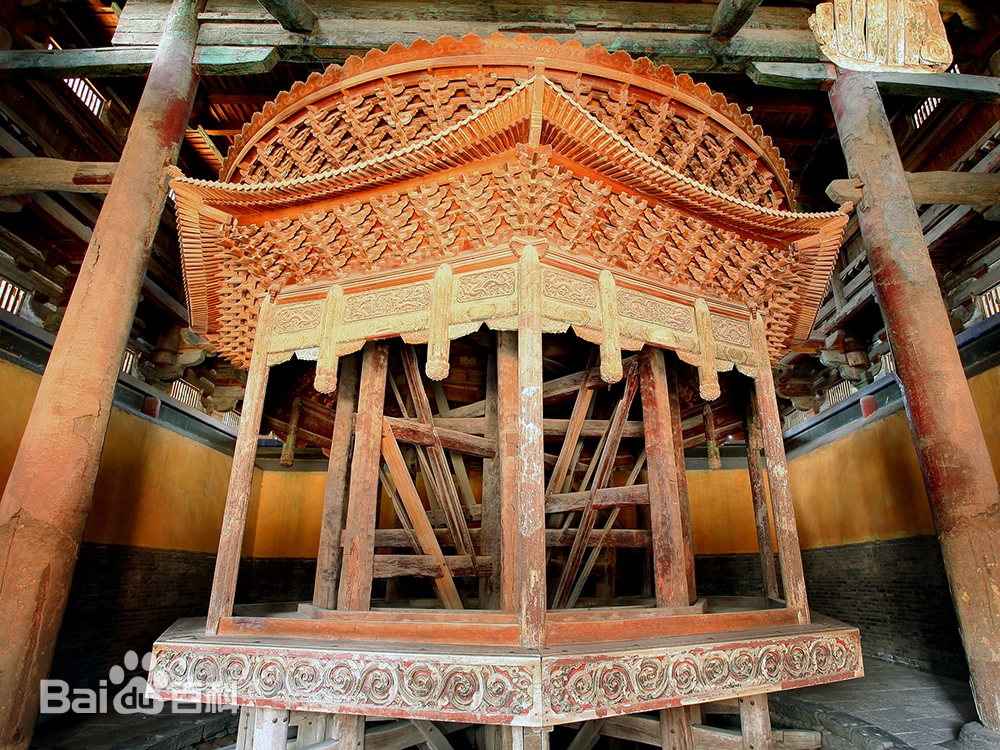
Today, visitors can trace a north–south axis that passes through a series of majestic structures: the Hall of Heavenly Kings, Mani Hall, the Ordination Altar, the Revolving Sutra Library, and more than a dozen other halls and pavilions. The complex is celebrated as a textbook example of ancient Chinese Buddhist temple design.

Recognized among China’s ten most famous temples, Longxing Temple was declared a Major National Historical and Cultural Site in 1961 and later designated a National AAAA Tourist Attraction.


Highlights Not to Miss

Hall of Heavenly Kings

First built in the Northern Song Dynasty, this is the oldest surviving structure of its kind within the temple. Even after a major renovation in 1780, its main timber frame remains original.

Above the entrance, plaques bearing the calligraphy of the Kangxi Emperor read:

“Imperially Established Longxing Temple”
“Hall of Heavenly Kings”

Inside stands the famous Big-Bellied Maitreya Buddha, a Jin Dynasty wood carving over 800 years old. Thoroughly localized in Chinese style, this smiling figure derives from the legendary monk Qici, known for his benevolence and laughter.

On either side stand the Four Great Heavenly Kings, each symbolizing auspicious natural forces:

  • Wind (Southern King, with a sword)
  • Harmony (Eastern King, with a lute)
  • Rain (Northern King, with a precious umbrella)
  • Compliance (Western King, with a coiled snake)

Together, they express the blessing of abundant harvests and national peace.


Mani Hall

Built in 1052, Mani Hall has an unusual cross-shaped floor plan created by four gabled annexes extending from its square central chamber.

Inside, five golden clay Buddha statues preside over the altar, with Shakyamuni Buddha at the center.

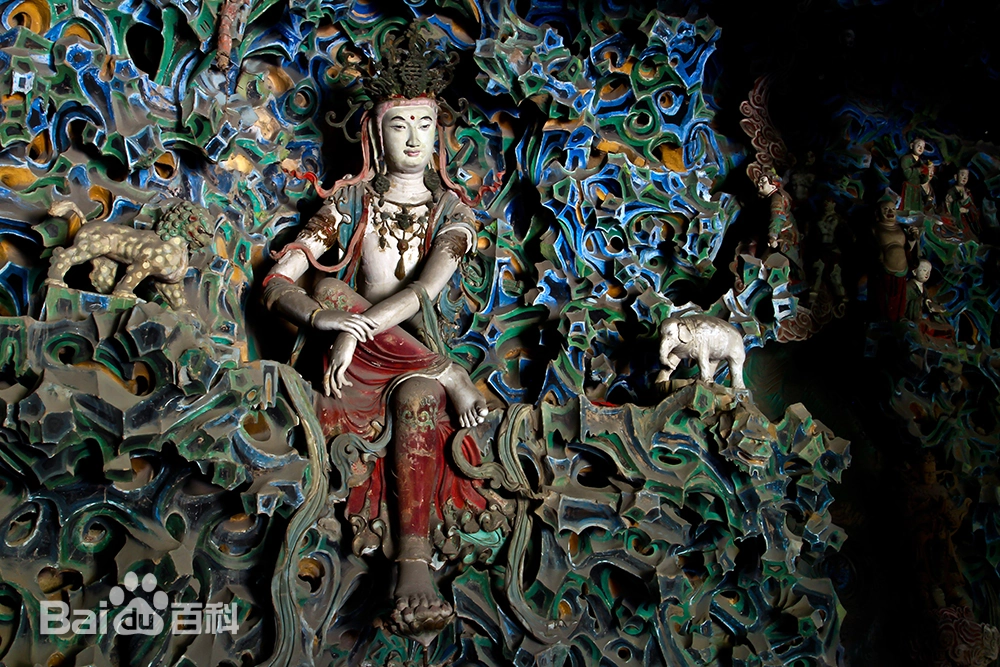
The hall’s north wall showcases a breathtaking polychrome relief nearly 16 meters long, depicting swirling clouds, celestial beings, and Avalokiteshvara stepping onto a lotus—symbolizing the entrance to the Western Pure Land.

At the heart of this scene sits the Backward-Facing Avalokiteshvara, so named because she faces north instead of south. Far from a supernatural image, this Avalokiteshvara appears as a serene, youthful woman with an expression so vivid and gentle it moves all who gaze upon her.

Visitors often remark:

“How beautiful—how extraordinary! She sits so naturally, one leg casually crossed, her eyes meeting yours wherever you stand. Her smile is as enigmatic as the Mona Lisa—truly ‘The Most Beautiful Avalokiteshvara.’”


Ordination Altar

Reserved for the most important temples, the Ordination Altar was where monks received their vows.

Inside the altar stands a unique double-sided bronze Buddha statue. Facing south is Amitabha Buddha, and facing north is Medicine Buddha. The two figures share a single body, seated back to back in lotus posture.

The statues are depicted in full lotus position, wearing five-leaf crowns, with round, gentle faces. Their necks are adorned with necklaces and their arms with bangles, while flowing sashes drape gracefully from their shoulders. Amitabha’s hands form the meditation mudra, while Medicine Buddha’s hands display the gesture of compassion.

Their expressions are serene and tranquil, exuding a quiet dignity and solemn beauty in their elegant simplicity.

Longteng Garden

To the northeast lies Longteng Garden, a Ming and Qing–style garden combining cultural heritage and tranquil scenery.
Here you’ll find:

  • Northern Dynasties stone statues
  • A Jin Dynasty scripture pillar
  • A Yuan Dynasty mural tomb
  • The Ming Dynasty Longquan Well Pavilion
  • The “Three Generations of Vice Ministers” stone archway

Meandering through its pavilions, terraces, and lush paths feels like stepping into a living scroll of history.

Cultural Traditions

Imperial Buddhist Ceremony Performance

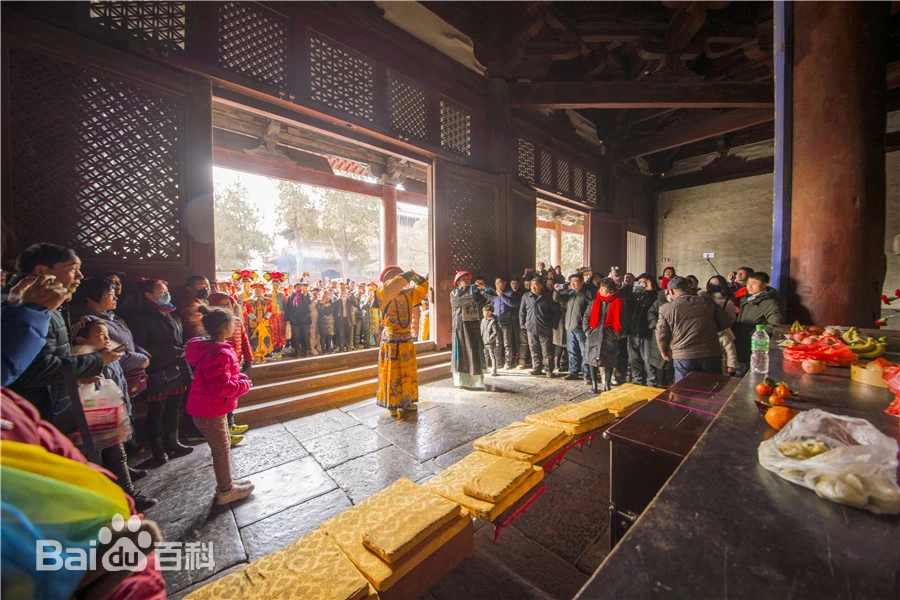
Zhengding’s Longxing Temple is an imperial temple that was visited and funded for repairs by emperors over many dynasties. According to The Chronicles of Longxing Temple, in the 49th year of Emperor Kangxi’s reign (1710 CE), the emperor ordered funds to be allocated from the national treasury to restore Longxing Temple. After the renovations were completed, Emperor Kangxi personally came to pay homage and bestowed 19 inscribed plaques, including one reading “Longxing Temple Constructed by Imperial Decree,” all handwritten by himself.

At the end of 2011, drawing on historical records, the Cultural Heritage Office re-created the Grand Imperial Buddhist Ceremony, reenacting the scene of Emperor Kangxi’s arrival at Longxing Temple, the local officials welcoming the imperial entourage, and the emperor bestowing plaques, offering incense, and performing rituals to honor the Buddha.

Thousand-Armed Avalokiteshvara Performance

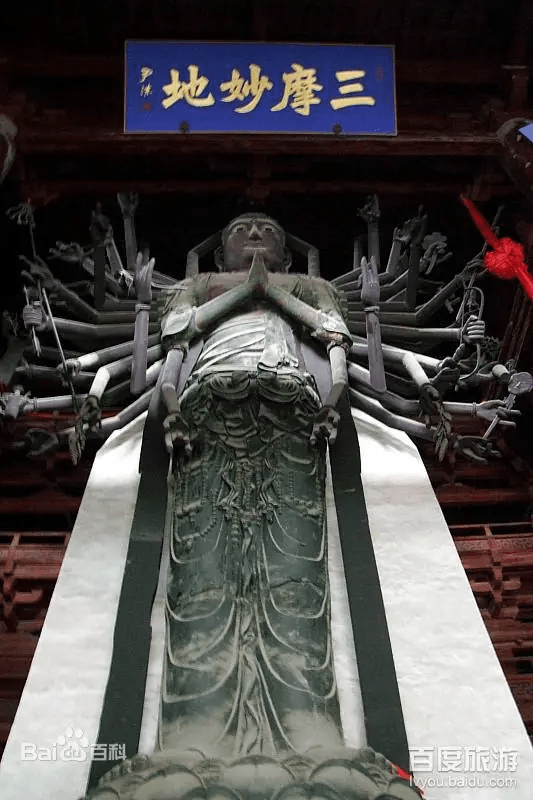
Inside the Great Compassion Pavilion of Zhengding’s Longxing Temple stands a bronze statue of the Thousand-Armed, Thousand-Eyed Avalokiteshvara, measuring 21.3 meters in height. Cast in the 4th year of the Kaibao era of the Northern Song Dynasty (971 CE), this towering bronze figure is remarkable both for its immense size and its exquisite craftsmanship.

It is the tallest and oldest ancient bronze Buddha statue of its kind in the world. It is not only a symbol of Longxing Temple but also an emblem of the ancient city of Zhengding.

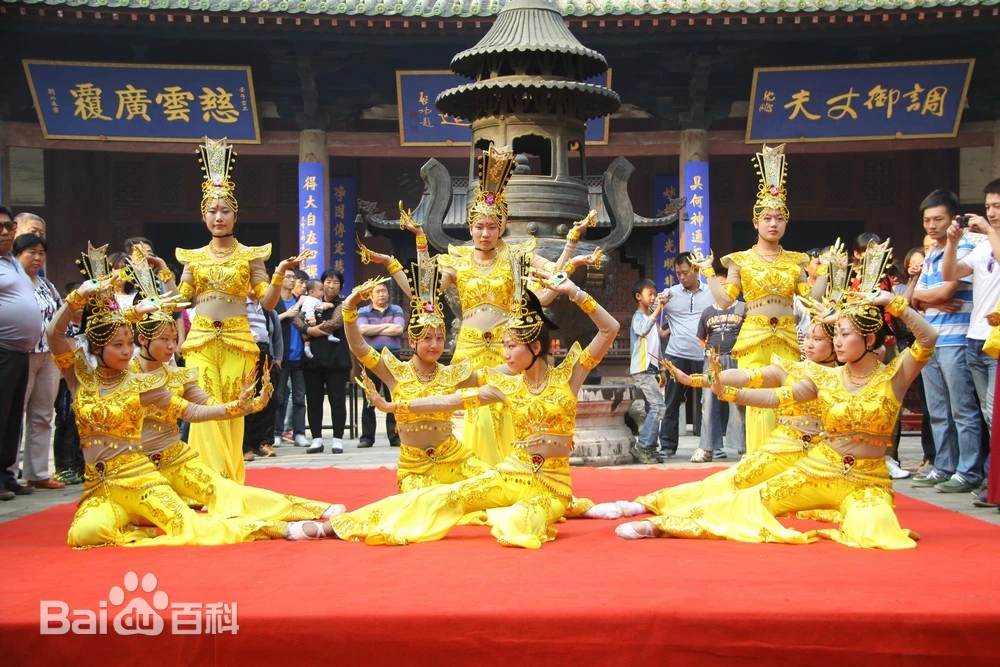
The Thousand-Armed Avalokiteshvara Performance features graceful melodies and captivating dance that vividly convey the divine presence and compassion of the bodhisattva.


Longxing Temple is more than a historical monument—it is a living symbol of Chinese Buddhist art, architecture, and spirituality. Whether you come for quiet reflection, cultural discovery, or simply to stand before centuries of devotion, this magnificent temple will leave a lasting impression on your heart.

Link:https://peacelilysite.com/2025/07/04/discover-longxing-temple-a-timeless-treasure-of-chinese-buddhism/

In Search of a Great Master to Learn from – H.H. Dorje Chang Buddha III


In Search of a Great Master to Learn from – H.H. Dorje Chang Buddha III

California is home to numerous Buddhist temples, each offering a distinct school of teaching to inspire and guide practitioners. Among them, Hua Zang Si, a unique Buddhist temple in San Francisco, particularly captured my attention as I live in the San Francisco Bay Area.

Hua Zang Si is dedicated to the authentic teachings of Sakyamuni Buddha and H.H. Dorje Chang Buddha III and provides pre-recorded oral teaching expounded by H.H. Dorje Chang Buddha III for visitors to listen to. However, other than Sakyamuni Buddha—historically known as Prince Siddhartha—who is this Buddha, H. H. Dorje Chang Buddha III?

Dorje Chang Buddha is, in fact, a primordial Buddha and the embodiment of the absolute truth of the universe, which itself has no form. As stated on page 17 of H.H. Dorje Chang Buddha III: A Treasury of True Buddha-Dharma:

“In the entire universe, Dorje Chang Buddha is the first Buddha with form and is the highest Buddha. That is, the highest leader of Buddhism in the entire universe came into being in the form of Dorje Chang Buddha. It was Dorje Chang Buddha who began transmitting dharma and saving living beings in the dharmadhatu. As a result, Buddhism was born and the Buddha-dharma began spreading.”

This extensive text of book provides a detailed account of H.H. Dorje Chang Buddha III, documenting the profound realization and supreme achievements of the true Buddha-dharma as demonstrated by the highest Buddha in the world.

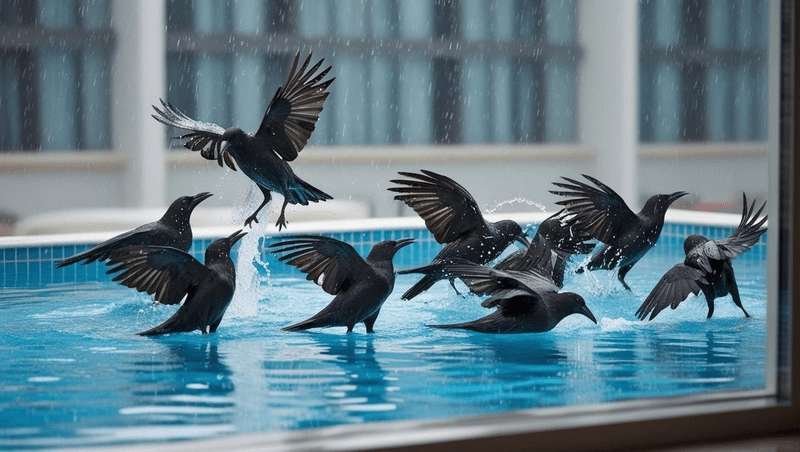
Numerous awe-inspiring accounts of H.H. Dorje Chang Buddha III, a revered Buddhist master—indeed, the highest Buddhist master—can be found in various publications and online sources. A documented example is the Buddha’s ability to predict the arrival of a flock of birds and accurately describe their actions upon arrival—an extraordinary and precise demonstration of insight.

This remarkable event, known as The Holy Feat, occurred in Mexico in 2014 and was witnessed firsthand by numerous Buddhist disciples, all of whom provided sworn testimonies under their own names, attesting to the authenticity of what they observed.

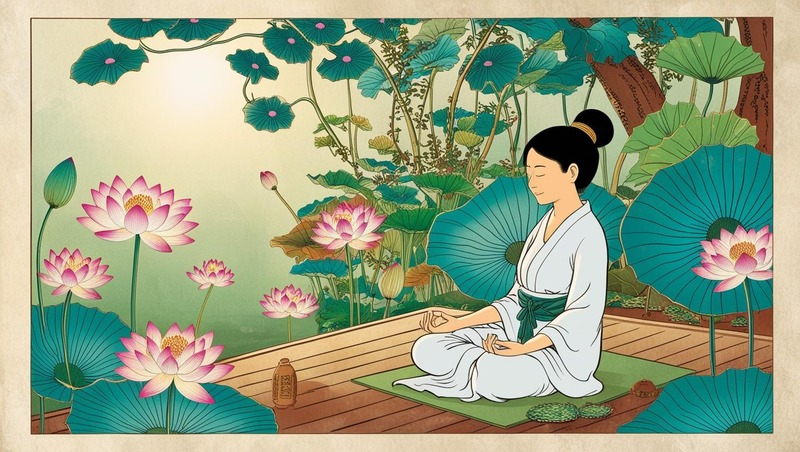
Attending a single temple, such as Hua Zang Si in San Francisco, which propagates complete Buddhism of all Buddhas will enable you to learn diverse practices, such as Zen meditation, the chanting of Buddhas’ and Bodhisattvas’ names, and Tibetan Dharma practices—these latter being transmitted only in accordance with an individual’s specific karmic affinity with the yidam and their karmic conditions at the time. Additionally, sutra chanting – a focus on Mahayana Buddhism and other Buddhist practices are available, ensuring a holistic approach to your spiritual cultivation.

How can I learn Buddhism directly from the Buddha? The monastics at Hua Zang Si recommend attending the temple or visiting Dharma-Listening Session centers worldwide to respectfully listen to the prerecorded Dharma teachings.

The temple offers additional religious services, including chanting and blessing services, group study meetings, support groups, Fish Release (field trips to release and save lives), and Buddhist storytime. The temple also hosts larger Dharma assemblies as part of its annual schedule. The Buddhist practice can be a lot of fun!

As a Buddhist disciple following the teachings of H.H. Dorje Chang Buddha III, I have found solace in the voice and wisdom of the Buddha. Through these teachings, I have learned to seek answers, clarity, wisdom, and strength to navigate both the joys and challenges of life.

I hope you, too, will find confidence in searching for a true, holy, and virtuous Buddhist master—one whom you can rely on not only in this lifetime but all the way until you attain enlightenment and become a Buddha yourself. This attainment is guaranteed by all Buddhas as long as we diligently cultivate ourselves with sincerity and perseverance.

In Search of a Great Master to Learn from – H.H. Dorje Chang Buddha III

Link: https://hhdorjechangbuddhaiiiinfo.com/2025/04/01/in-search-of-a-great-buddhist-master-to-learn-from-h-h-dorje-chang-buddha-iii/

#DorjeChangBuddha #H.H.DorjeChangBuddhaIII #PrinceSiddharta #DharmaofDorjeChangBuddhaIII #HolyFeat #FishRelease #TheTreasureBook #HuaZangSi

Vibrant Ceremony Marks Grand Opening of new Buddhist Temple

Benevolence Temple Opened at Las Vegas

Disciples of Buddhism and honorary guests were treated to a vibrant grand opening for a new house of worship in central Las Vegas.

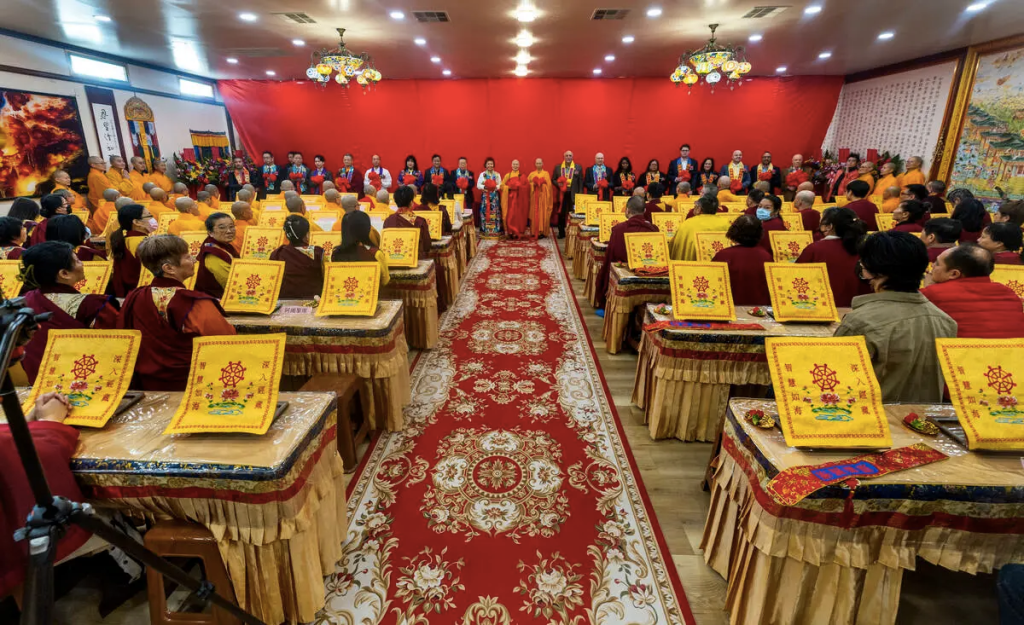
On the morning of January 18, 2024, the Benevolence Temple came alive with the vibrant festivities that commenced with a traditional Dragon Dance. Performers skillfully gyrated to the rhythmic beats of booming and clanking drums, creating an electrifying atmosphere. As they made their entrance into the packed temple, cloth-covered deities loomed overhead, surrounded by bountiful fresh fruit and food offerings.

The temple “will extend equal care to all sentient beings regardless of race, gender, or religion,” according to the organization. “The term ‘benevolence’ signifies language, actions, and thoughts that are kind, caring, and beneficial to others.”

Elected officials — or their representatives — entered and lined up in front of the main shrine, each holding a red ribbon shaped like a flower. They each were handed scissors to cut strands in a lavish ribbon-cutting ceremony.

The curtain shielding the shrine was pulled to reveal a large golden statue at the center of what appeared to be a tranquil garden.

“Great day for the state of Nevada,” Nevada Lt. Gov. Stavros Anthony said in his opening remarks. “I want to congratulate you on this significant milestone for your temple and your efforts to unify local residents and people from different religions and races.”

The temple — led by Holy Guru Jiaozun Zhengda, vice president of the World Buddhism Headquarters — will preach the teachings of Namo Dorje Chang Buddha III and Namo Shakyamuni Buddha, according to the organization.

“Naming a Buddhist temple with these words expresses the original intention of Holy Guru Jiaozun Zhengda to propagate the cause of Buddhism through selflessness and compassionate virtuous deeds, with the vow to enable sentient beings to learn the Buddhist Dharma and attain liberation through a compassionate Bodhi mind,” the organization wrote.

The Las Vegas Benevolence Temple was founded in 2019 but operated at a temporary site before it found its new home, 700 E. St. Louis Ave., which was vacant four months ago.

The Buddha statues were declared sacred in a Thursday ceremony. Now, the temple will offer meditation guidance, teach Dharma discourses and the chants of Mahayana Buddhism, according to the organization.

The disciples will participate in charity, the organization wrote. “The objective is to contribute in a practical way to the local community while spreading the doctrines of Buddhism to the public.”

The Metropolitan Police Department and City Council members Victoria Seaman and Olivia Diaz sent representatives.

“The community will benefit from the sanctuary that your temple provides,” Anthony said to applause.

Link: https://peacelilysite.com/2024/01/26/vibrant-ceremony-marks-grand-opening-of-new-buddhist-temple/

Source: https://www.reviewjournal.com/life/religion/vibrant-ceremony-marks-grand-opening-of-new-buddhist-temple-photos-2984063/?fbclid=IwAR1V2j4SbxQIeB2f6GEJQBsz7CyxPFU05AfDDqZ7deLRO9pNRimkI9dTtd4

XuanKongSi – The most Dangerous Monastery

Hanging Temple, China [huanqiu.com]

Some ancient structures were purposely and skillfully constructed at the riskiest of locations or sometimes just had their appearance altered to reflect a sense of danger and awe. These ancient buildings are so remarkable that even modern scientists are amazed and astounded by them.

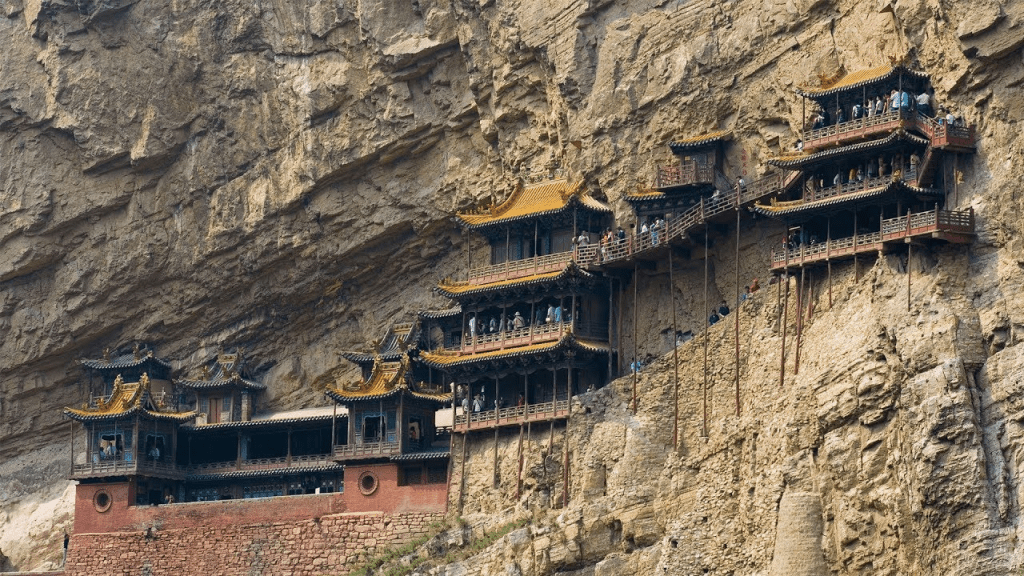
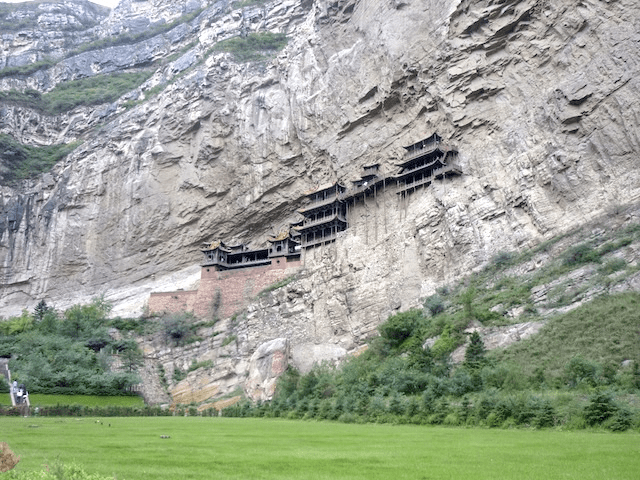
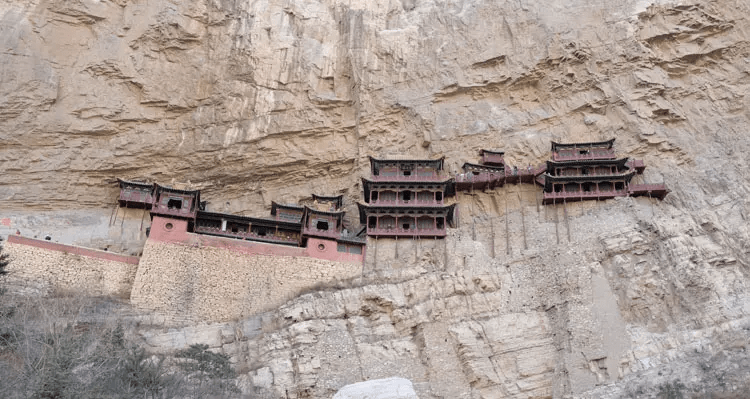
There are 10 most dangerous structures in the world, XuanKongSi Temple in China is one of them. Temples and monasteries were usually built on the ground, and if there was no money or it was necessary to hide from someone, then under the ground in caves. It seems impossible to think of anything else, but the temple tells us otherwise. It turns out that in one of the northern provinces of China, there is a so-called Hanging Temple which seems to be attached to the Rock at a height of 75 meters. It was built almost 1500 years ago in 491 during the northern Wei Dynasty. The Chinese call this Temple complex XuanKongSi.

The temple is located in Shanxi Province, 65 kilometers southeast of the city of Datang, it looks as if the entire Temple is held up on a steep Cliff by the power of Prayer. Perhaps prayers help because the temple is unique; it is the only Temple of three religions in China. It combines Buddhist, Taoist, and Confucian altars. It has everything that other temples have: the main gate, the bells, and drum Towers, the main and side Halls. The largest structure of the monastery is called sangana, and it stands on a stone ledge. There are also 40 halls in Pavilions, but they are smaller than the sangana. They are built on pallets that lie on beams hammered into the Rocks. The rock is used as the back wall of the rooms, and niches are made in it for statues. The larger the niches, the more statues they contain, and the larger they are.

Upon first glance, the temple’s buildings seem to have been partially swallowed by an expanding mountain rather than built onto and into it. Some of the pathways that connect the separate buildings are hewn into the mountain. Others feature the same design as the buildings themselves – parked atop seemingly impossibly-thin wooden poles.

It is composed of three main sections:

North Pavilion

This pavilion is three storeys tall, 4 metres (13 feet) wide and 7 metres (23 feet) in length. Wufo Hall, which is located on the lowest floor is dedicated to the Five Dhyani Buddhas. Above it is Guanyin Hall and on the top storey is Sanjiao Hall. Sanjiao Hall, or the Hall of the Three Religions is widely regarded as the most important room in the Hanging Temple, at least in terms of symbology. It contains large statues of Buddha Shakyamuni, Lao-Tze and Confucius standing together.

SanJiao Hall

Given that the Hanging Temple is the only surviving example of the concept of the Three Teachings Harmonious as One, the Hall of Three Religions is perhaps the most important of these chambers. The idea of Three Teachings Harmonious as One, which emphasises the complementary nature and unifying ideas of Buddhism, Taoism and Confucianism, flourished during the Ming and Qing Dynasties.

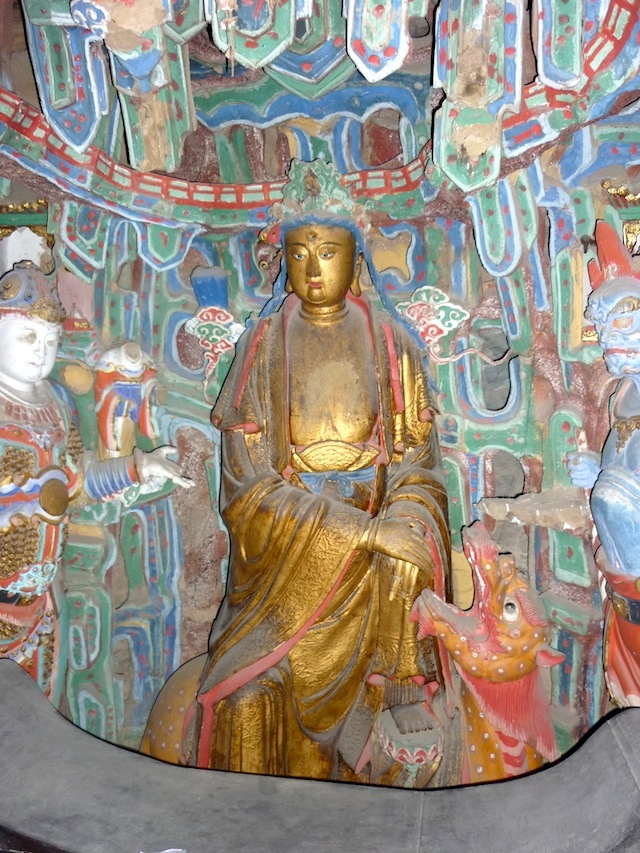
Accordingly, the hall features sculptures of deities of all three religions. Three large statues take centre stage here: Buddha Shakyamuni in the middle, flanked by Lao-Tze on his left and Confucius on his right.

GuanYin Hall

South Pavilion

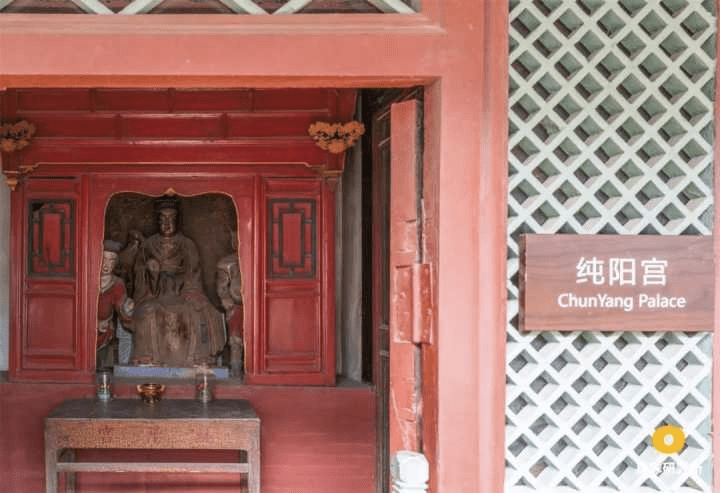
Slightly larger than the North Pavilion, it is also three storeys tall and 4 metres wide but longer at 8 meters (26 feet). The North Pavilion contains Sanguan Hall. It is the biggest hall of the Hanging Temple and is home to a 2-metre tall clay sculpture, the largest in the complex. On the middle storey is Chunyang Palace, which is dedicated to Lü Dongbin, one of the Eight Immortals of Taoism. He is the most popular Taoist character in Chinese culture. Leiyin Hall, which is dedicated to Buddhist deities is on the top storey.

The Long Bridge

The top storeys of the two pavilions are linked by a 10-metre (30 feet) bridge (a stairway has been cut into the mountainside to link the lowest storeys). A small balcony for worshipping sits above the bridge.

XuanKongSi007

However, as impressive as the Hanging Temple appears from the outside, the bulk of the builders’ efforts went into the portion of the complex that is ensconced within the rock. 40 halls and pavilions lie inside, covering an area of 125 m2.

The biggest and most prominent halls are the Hall of Three Religions, Guanyin (Avalokiteshvara) Hall, Hall of Shakyamuni, Qielan Hall (Hall of Sangharama), Sanguan Hall (Hall of the Three Officials) and Chunyang Hall.

Spread throughout the other halls are 78 sculptures made from stone, terracotta, copper and iron. They are remarkable for their vivid and detailed depiction of facial features and clothing.

Construction

Despite its precarious location and the logistical challenges construction must have presented, no design feature that is seen in other temples of the period has been spared. The two main buildings sport traditional multiple-roof designs, eaves and balconies with images of auspicious creatures like dragons common to Chinese holy structures.

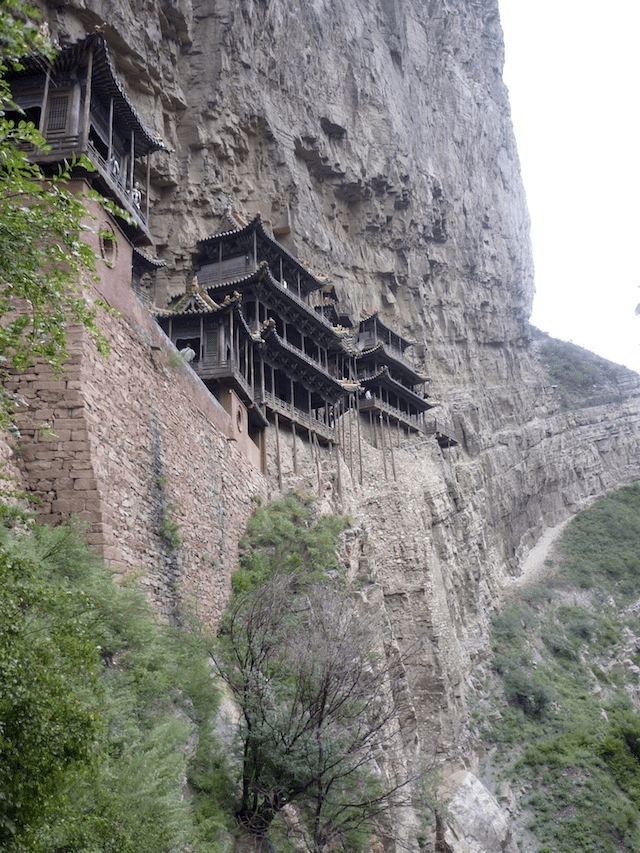
Today, the part of the temple that extends beyond the face of the cliff is supported by poles made of oak. These poles have been inserted into holes chiselled out of the rock. From a distance, the brown oaken poles meld into the background, making the temple appear to float in the air.

Amazingly, the real support framework for the temple complex is hidden within the mountain and the structure itself. If these external vertical poles were removed, the hanging temple would continue to hang!

While it’s impossible to overlook the fact that the architecture disrupts the natural rock wall formation, a closer examination reveals something quite astounding. The way the roof, walls, and other structures seamlessly integrate with the rock pattern suggests that significant care and effort were put into minimizing any unnecessary destruction.

A unique mechanical theory guided the construction of the framework. Crossbeams were partially inserted into the rock as the foundation, while the rock in the back provided support. The Hanging Monastery seems to defy gravity, appearing to float in midair.

At certain points, a roof will abruptly end at an outcrop, only to resume on the other side, leaving the stone intact. This not only benefits the structural integrity of the building but also signifies a harmony with nature, a state to which all Buddhists aspire.

Construction experts from countries including Britain, Germany, and Italy have visited the monastery. In their opinion, the Hanging Monastery, which melds mechanics, aesthetics, and Buddhism, is a rarity. The monastery and everything it represents is a significant cultural achievement of the Chinese people.

Source: https://www.tsemrinpoche.com/tsem-tulku-rinpoche/art-architecture/the-hanging-temple.html, https://7wonders.org/asia/china/datong/hanging-temple/

Guangsheng Temple with Ancient Chinese Buddhist Buildings,Murals & Statues

As a cradle of Chinese culture, Shanxi is renowned for its abundance of cultural and historical treasures. While some iconic historical relics and monuments like the Great Wall, which stretches across the province, the Yungang Grottoes in Datong, and the Sakyamuni Pagoda in Yingxian, are at the top of tourists’ itineraries, there are also lesser-known “hidden gems” in terms of historical significance that are well worth exploring.

One such hidden gem is the Guangsheng Buddhist Temple, located in the Zhaocheng township of Hongtong county. The Guangsheng Temple is actually a complex that encompasses the upper monastery, the lower monastery, and the Water God Temple, situated on the slopes and foothills of Huoshan Mountain in Zhaocheng.

Founded in the first year (147) of the Jianhe reign of the Eastern Han Dynasty (25-220), the temple originally bore the name Julushe Temple. It later acquired its present name during the Tang Dynasty (618-907). While it suffered damage during an earthquake in the 7th year (1303) of the Dade reign of the Yuan Dynasty (1271-1368), subsequent restoration efforts took place over the years, preserving much of the architectural style from the Yuan Dynasty. Nestled against the mountains and overlooking a river, the temple is surrounded by ancient trees and boasts the Huoquan Spring gushing beneath the rocks at the foot of Huoshan Mountain, creating a serene and picturesque environment. The temple can be divided into three main sections: the upper temple, the lower temple, and the Water God Temple.

The upper temple, perched atop Huoshan Mountain amidst lush pine trees, is graced with ancient towers and adorned with colored glaze components, radiating magnificence and splendor. The lower temple, situated at the base of Huoshan Mountain, harmoniously blends with the mountain’s natural contours, creating an intriguing landscape with varying elevations. Adjacent to the lower temple is the Water God Temple, with connected walls. Here, one can find the Statue of Ying, an emperor of the Ming Dynasty, and renowned frescoes depicting Yuan Dramas, both of which are celebrated locally and internationally.

The upper temple complex comprises the temple gate, the Flying Rainbow Tower, the Amitabha Hall, the Great Hall, the Vairochana Hall, the Kwan-yin Hall, the Ksitigarbha Hall, as well as wing-rooms and corridors, among other features. The Temple Gate, situated at the entrance, is flanked by two guardian warriors. Just beyond the gate stands the impressive Flying Rainbow Tower, constructed from colored glaze bricks. Originally built during the Eastern Han Dynasty (25-220) and later restored in the Ming Dynasty (1368-1644), this thirteen-story tower soars to a height of 47.31 meters, featuring an octagonal plan. The tower is adorned with tri-colored glaze in yellow, green, and blue, creating a splendid and vibrant spectacle. Elaborate wooden square blocks and intricately carved designs of Buddha, Bodhisattvas, guardian warriors, flowers, birds, and animals adorn the eaves and pillars. Corridors encircle the first story, while the tower’s interior houses only the stairs leading to the tenth floor, showcasing remarkable architectural and artistic prowess.

Behind the tower lies the Amitabha Hall, a 5-bay wide, 4-bay long structure with a single-eaved gable and hip roof. Inside, the hall features three exquisite statues: Amitabha Buddha, Manjusri Bodhisattva, and Vajrapani Bodhisattva. These statues, masterpieces of the Ming Dynasty, are accompanied by frescoes adorning the eastern wall and screen wall. Additionally, the temple once housed 4,000 volumes of the Pingshui version of the Tripitaka during the Huangtong reign of the Jin Dynasty (1115-1234). These valuable volumes are now preserved in the Beijing Library and serve as a rare source for studying the history of Chinese printing.

The Great Hall, characterized by a 5-bay width, a single-eaved gable, and a hip roof, features three niches within for wooden statues of Sakyamuni, Manjusri, and Samantabhadra. These statues are meticulously crafted, possessing well-proportioned forms, a plump appearance, and an air of perfect serenity. In the Qing Dynasty, the hall was adorned with eighteen iron arhats along its two sides, along with statues of Kwan-yin and Amitabha Buddha on the rear niche wall.

The Vairochana Hall, spanning 5 bays in width with a hip roof, boasts an architectural style typical of the Yuan Dynasty, with two gables supported by substantial crawling beams. The altar within the hall features statues of three Buddhas and four Bodhisattvas, surrounded by wooden niches containing 35 iron statues. Notably, the back wall of the hall showcases frescoes depicting Sakyamuni and twelve Bodhisattvas of Perfect Enlightenment, regarded as exceptional examples of this art form.

The lower temple complex comprises the temple gate, front hall, back hall, the buttress hall, and other buildings, all constructed during the Yuan Dynasty. The temple gate stands impressively tall, measuring 3 bays in width and 3 bays in length, featuring a single-eaved gable and a hip roof. Canopies have been added to both the front and back eaves, lending it the appearance of a pavilion with double eaves. The front hall spans five bays in width and is supported by only two pillars that bear the weight of the entire structure. The back hall, dating back to the second year (1309) of the Zhida reign in the Yuan Dynasty, stretches 7 bays in width, featuring 9 purlins, 8 rafters, and a single-eaved overhanging gable roof. Within the hall, you’ll find the main statues of Amitabha Buddha, Sakyamuni Buddha, Bhaisajyaguru Buddha, Manjusri Bodhisattva, and Samantabhadra Bodhisattva, all crafted during the Yuan Dynasty. Sadly, the once-present frescoes on the walls were stolen and smuggled to other countries in 1928, and they are currently housed in the Naerson Museum in Texas, US. Notably, the fresco on the south wall documented the performances of Yuan Drama, serving as rare reference material for the study of Chinese dramas.

The lower temple complex photo from:Beijing Transportation University ancient architecture

The lower temple complex photo from: Beijing Transportation University ancient architecture

The Water God Temple comprises two courtyards: the front yard and the back yard, featuring key structures like the Temple Gate, the Door of Amenity, the Ming Ying King Hall, and wing-rooms of cave dwellings. The Ming Ying King Hall, measuring 5 bays in width and 5 bays in length, is enveloped by a cloister and crowned with a double-eaved gable hip roof. The interior beams follow a conventional style. Within the hall, you’ll find statues of Water God Ming Ying King and his eleven attendants. Their facial features, attire, and postures are all reflective of the Yuan style. The hall’s walls are adorned with frescoes depicting scenes of people praying for rain and other historical narratives, covering an area of 197 square meters. Notably, the eastern end of the south wall features vivid depictions of a comprehensive set of stage properties used by performers, including costumes, stage instruments, musical instruments, makeup, curtains, and the stage itself. The artwork is meticulously arranged, with a simple yet profound color palette, and the dramatis personae are depicted with great expressiveness. This fresco offers an authentic glimpse into the heyday of Yuan Drama and stands as a rare and outstanding example of Yuan fresco art in China.

Guangsheng Temple with Ancient Chinese Buddhist Buildings,Murals & Statues

Link: https://peacelilysite.com/2023/09/20/guangsheng-temple-with-ancient-chinese-buddhist-buildings%ef%bc%8cmurals-statues/

Source: http://shanxi.chinadaily.com.cn/2022-05/06/c_748899.htm, http://en.chinaculture.org/library/2008-02/15/content_34504.htm

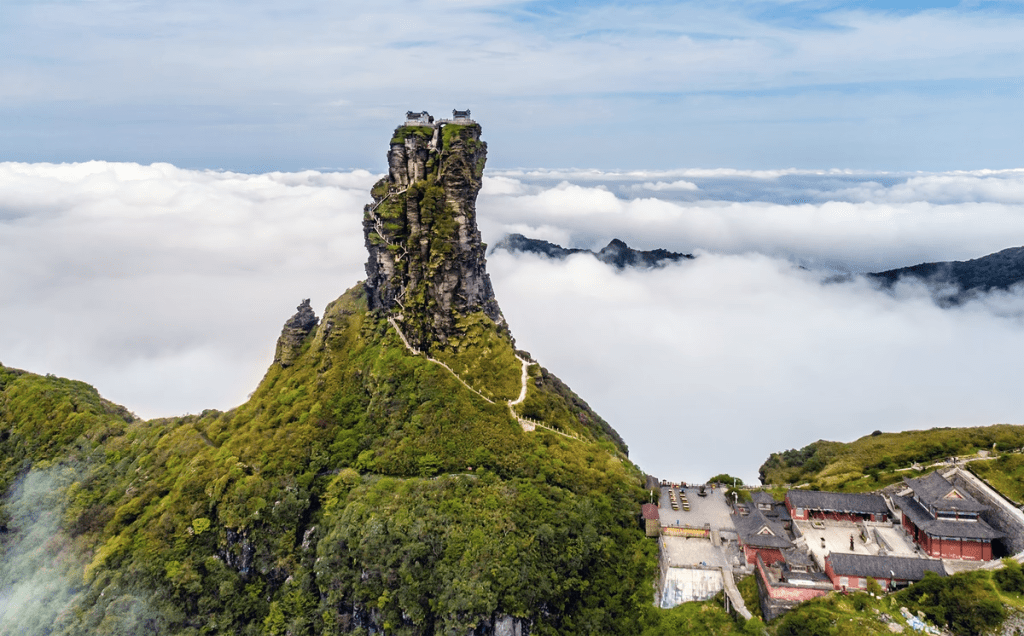
Fanjing Mount

A view of the New Golden Summit, looking west. Costfoto / Barcroft Media via Getty

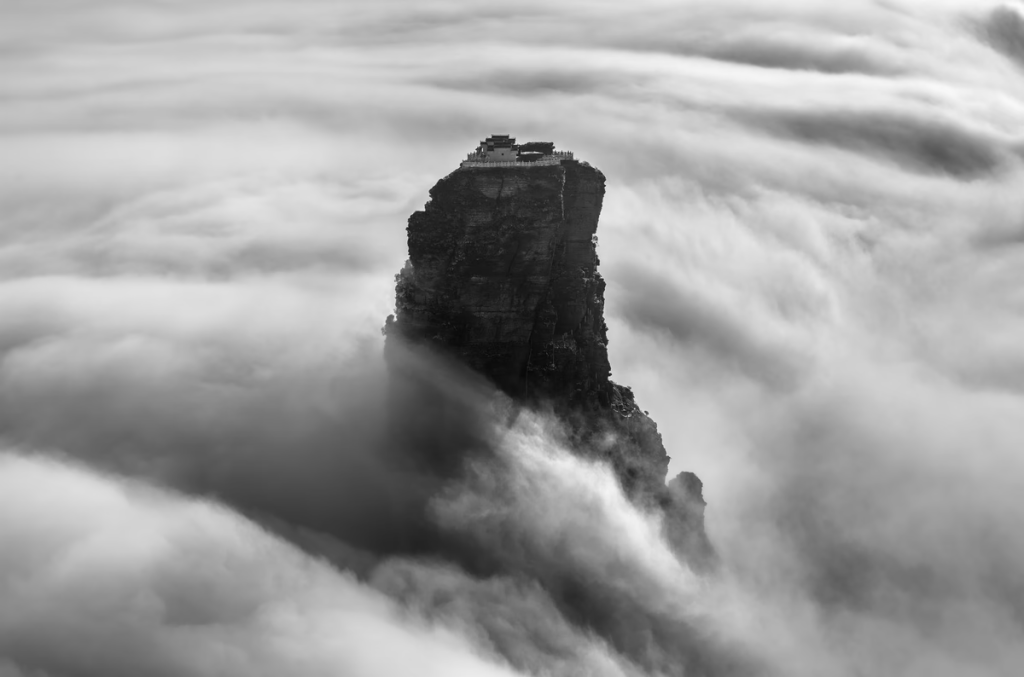
Clouds roll past the New Golden Summit on Mount Fanjing.  Clkraus / Shutterstock

Fanjingshan, also known as Mount Fanjing, is situated in the eastern part of Guizhou Province, China, within Tongren City. It is positioned approximately 248 kilometers away from Guiyang and 220 kilometers from Zhangjiajie. Mount Fanjing proudly claims the title of being the highest peak within the Wuling Mountains, with an impressive elevation of 2572 meters. The mountain stands adorned with primitive vegetation, its landscape characterized by majestic peaks, a continuous succession of towering summits, babbling streams interwoven with cascading waterfalls.

Moreover, Fanjingshan holds great spiritual significance as a revered Buddhist site. It’s widely believed among Buddhists that Fanjingshan is a place where spiritual enlightenment akin to that of Maitreya Buddha can be attained.

The appellation “Fanjing” finds its origins in “Fantian Jingtu,” a Buddhist term that translates to “Brahma’s Pure Land.” This hallowed mountain has been acclaimed as China’s Fifth Buddhist Mountain, a distinction following the likes of Mount Wutai in Shanxi Province, Mount Putuo in Zhejiang Province, Mount Emei in Sichuan Province, and Mount Jiuhua in Anhui Province. With a history spanning over 2000 years, embellished by extraordinary rock formations and abundant biodiversity, Mount Fanjing unveils itself as a serene, distinct haven. A sojourn to this tranquil expanse offers a revitalizing and spiritual respite from the bustling clamor of urban life.

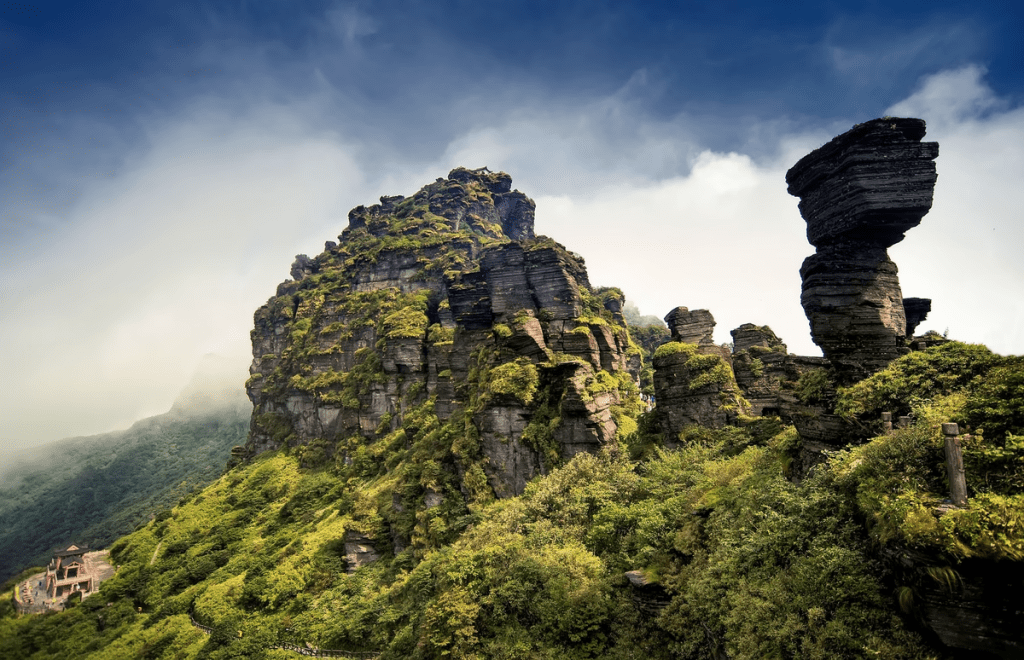
Unique geological landforms, including the “Mushroom Stone” at right. Sanyanwuji / Shutterstock

In geological terms, Mount Fanjing assumes the form of a “fold belt,” an arrangement akin to stacked layers of rock resembling an assemblage of intricate shapes, an occurrence seldom witnessed elsewhere. The Mushroom Stone serves as a prime exemplar, where layers of rock have taken on the semblance of a towering mushroom.

Throughout antiquity, Fanjing Mountain stood as a venerable hub of Buddhist culture within the Wuling Mountain range. Historical records attest to the proliferation of numerous Buddhist temples along its slopes, catering to pilgrims from around the world. Yet, during the 16th century in the Ming Dynasty, a substantial number of these temples met destruction, effectively suppressing Fanjing Mountain’s renown. The subsequent Qing Dynasty saw a revival of fortunes, with governmental initiatives aimed at temple reconstruction and expansion along the mountain’s pathway to the “Red Clouds Golden Summit.” Notable temples such as Cheng’en Temple and Baoguo Temple were erected. By 1896, the fifth phase of Fanjingshan Temple reconstruction reached its culmination, bestowing upon Fanjing Mountain an esteemed status in the global Buddhist sphere and solidifying its position as China’s “No. 5 Great Buddhist Mountain.”

Mount Fanjing boasts three soaring summits that pierce the heavens – the Red Clouds Golden Summit (2336 meters), the Old Golden Summit (2493 meters), and the Phoenix Golden Summit (2572 meters). From these majestic pinnacles, visitors are treated to breathtaking panoramic vistas of Mount Fanjing’s expansive landscape. Crowning the preeminent “Red Clouds Golden Peak” stands the remarkable Fanjingshan Temple, perched at a daring elevation of 2,336 meters above sea level. Nestled atop the columnar peak, this temple’s elusive location beckons travelers to witness its ethereal presence firsthand and capture mesmerizing, novel photographs.

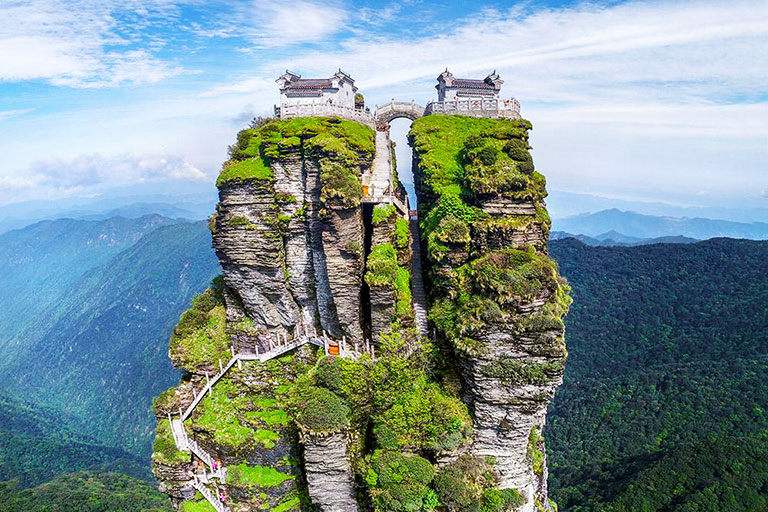
Fanjingshan Temple, encompassing the revered Temple of the Buddha (释迦殿) and the Maitreya Temple (弥勒殿), graces the summit of the “Red Clouds Golden Summit” (also known as the New Golden Summit) on Fanjing Mountain. The former is dedicated to the worship of Sakyamuni, symbolizing the present, while the latter venerates Maitreya, representing the future. These two temples trace their origins back to the Yongle period of the Ming Dynasty, over five centuries ago. Presently, they have been meticulously reconstructed to echo their original splendor, their structures fortified with iron tiles to withstand the mountain’s formidable winds. Each temple is embodied by a single hall, constructed from meticulously arranged stone pieces measuring 5.4 meters in width and 5.55 meters in depth. A bridge gracefully connects the two temples, spanning the depths of the Gold Sword Gorge.

For pilgrims journeying to Fanjingshan, the ascent involves ascending thousands of steps to initially reach the Temple of the Buddha on the southern facet. Subsequently, crossing the bridge leads to the Maitreya Temple on the northern side of the “Red Clouds Golden Summit.” This sequence mirrors the Buddhist concept of transition from the present (Sakyamuni) to the future (Maitreya). As the “Red Clouds Golden Summit” often finds itself enshrouded by mist and enveloped in sea of clouds, standing upon the terrace outside Fanjingshan Temple offers a surreal experience of gazing upon the world from above, capturing an otherworldly perspective amidst the natural elements.

Much like the iconic Avatar Hallelujah Mountain in Zhangjiajie National Forest Park, Fanjingshan stands as a towering pinnacle, slender and vertically oriented, evoking the image of a pencil standing upright on a desk. Scaling its summit requires ascending over 8,000 steps or opting for a cable car ride up from the road below. Most visitors opt for a full day to thoroughly explore this remarkable sacred mountain. Its attractions span a diverse range, encompassing the Red Cloud Golden Peak, Old Golden Summit, Ten-Thousand Sleeping Buddha, Mushroom Stone, Jiulong Pond, Fenghuang Mountain, Numerous Rolls of Books, and more.

Situated in the mountainous expanse of Guizhou Province, Fanjingshan falls within the ambit of a subtropical humid monsoon climate, distinctly marked by four seasons. Throughout the year, the average annual temperature oscillates between 13.1°C and 14.7°C. July witnesses the hottest days, with an average temperature hovering around 24°C, while January holds the chilliest nights, registering an average temperature of approximately 4.6°C. On the whole, Fanjingshan enjoys a temperate climate, graced by ample sunlight and rainfall. Summers remain moderate, and winters remain mild, with neither excessive heat nor biting cold. Rainfall predominantly occurs from May to October, while the frost-free period spans a generous 270 to 278 days annually.

The prime window to explore Mount Fanjing extends from March to November. For those seeking to capture stunning photographs, the early morning hours are particularly enchanting. The aftermath of rain unveils captivating spectacles, such as the Sea of Clouds, Zen Fog, Buddha Light, and breathtaking sunrises, which contribute to the mountain’s mystique and allure.

Fanjing Mount

Link: https://peacelilysite.com/2023/08/22/fanjing-mount/

#FanjingMount# MountFanjing #Zhangjiajie #Buddha #BuddhistTemple #MaitreyaBuddha #FanTieJingTu #China #Travel #TravelChina #GuiZhou

Source: https://www.chinadiscovery.com/guizhou/fanjingshan.html, https://www.theatlantic.com/photo/2019/04/a-photo-visit-to-mount-fanjing/586879/, https://www.chinadiscovery.com/guizhou/fanjingshan/fanjingshan-temple.html

The Hanging Temple in China

By Charlie fong – Own work, CC BY-SA 4.0, https://commons.wikimedia.org/w/index.php?curid=82753942

The Hanging Temple in China

China have about a dozen of hanging temples. They are truly relics in Chinese architecture history. The most famous hanging Temple, is Hengshan Hanging Temple, Hanging Monastery or Xuankong Temple, is a unique and ancient structure located in Hunyuan County, Datong City, Shanxi Province, China. This temple is built into a cliff that stands 75 meters or 246 feet above the ground, near Mount Heng. The closest city, Datong, is located 64 kilometers or 40 miles to the northwest.

The Hanging Temple is one of the main tourist attractions and historical sites in the Datong area, along with the Yungang Grottoes. It is considered unique because it is the only existing temple that combines three Chinese traditional philosophies or religions: Buddhism, Taoism, and Confucianism. The structure is held in place with oak crossbeams that are fitted into holes chiseled into the cliffs, and the main supportive structure is hidden inside the bedrock.

The temple was built more than 1,500 years ago by a monk named Liaoran in 491 AD. Over the years, many repairs and extensions have been made to the temple, leading to its present-day scale. The temple comprises of 40 halls and pavilions that are all built on cliffs that are over 30 meters or 98 feet from the ground. The distance from north to south is longer than from east to west, and it becomes higher and higher as one moves from the south gate to the north along the mountain.

The temple’s layout includes the Qielan Hall (Hall of Sangharama), Sanguan Hall (Hall of Three Officials), Chunyang Hall, Hall of Sakyamuni, Hall of Three Religions, and Guanyin Hall. The Hall of Three Religions mainly enshrines Buddhist deities, as well as both Taoism and Confucianism. The statues of Sakyamuni (middle), Lao-Tze (left) and Confucius (right) are enshrined in the hall, reflecting the prevailing idea of “Three Teaching Harmonious as One” in the Ming and Qing dynasties (1368–1911).

By Zhangzhugang – Own work, CC BY-SA 3.0, https://commons.wikimedia.org/w/index.php?curid=32138611

The Hanging Temple is a unique and ancient structure that combines three Chinese traditional philosophies or religions, and is one of the main tourist attractions and historical sites in the Datong area. Its location on a sheer precipice and its history make it a must-see destination for anyone visiting China.

You can visit the Hanging Temple all year around, but considering the Datong weather, normally from April to October is the best period. Datong has a temperate continental climate with distinct seasons, low rainfall, a short summer, and a long freezing winter (November–March).

There are big temperature differences between morning and night, day to day, and mountain and valley, so please bring a warm jacket with you even if you travel in the summer time.

In order to protect the temple, the number of visitors is limited to 80 in the temple at a time. Therefore, it is recommended to visit the Hanging Temple early in the morning to avoid long waits especially in the high travel seasons (summer and holidays).

The Hanging Temple in China

link: https://peacelilysite.com/2023/01/27/the-hanging-temple-in-china/

#HangingTemple#Buddhism#Datongcity#TravelChina # Architecture #ChineseCulture#Travel #Temple

Source: https://www.chinahighlights.com/datong/attraction/hanging-monastery.htm, https://en.wikipedia.org/wiki/Hanging_Temple

Angkor Wat


Angkor Wat

HISTORY.COM EDITORS * UPDATED:AUG 21, 2018*ORIGINAL:FEB 28, 2018

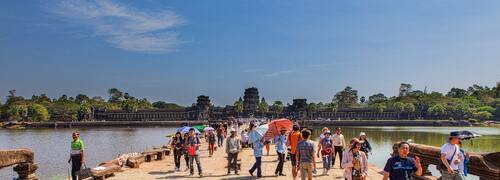
Angkor Wat is an enormous Buddhist temple complex located in northern Cambodia. It was originally built in the first half of the 12th century as a Hindu temple. Spread across more than 400 acres, Angkor Wat is said to be the largest religious monument in the world. Its name, which translates to “temple city” in the Khmer language of the region, references the fact it was built by Emperor Suryavarman II, who ruled the region from 1113 to 1150, as the state temple and political center of his empire.

Originally dedicated to the Hindu god Vishnu, Angkor Wat became a Buddhist temple by the end of the 12th century.

Although it is no longer an active temple, it serves as an important tourist attraction in Cambodia, despite the fact it sustained significant damage during the autocratic rule of the Khmer Rouge regime in the 1970s and in earlier regional conflicts.

Where Is Angkor Wat?

Angkor Wat is located roughly five miles north of the modern Cambodian city of Siem Reap, which has a population of more than 200,000 people.

However, when it was built, it served as the capital of the Khmer empire, which ruled the region at the time. The word “Angkor” means “capital city” in the Khmer language, while the word “Wat” means “temple.”

Initially, Angkor Wat was designed as a Hindu temple, as that was the religion of the region’s ruler at the time, Suryavarman II. However, by the end of the 12th century, it was considered a Buddhist site.

Unfortunately, by then, Angkor Wat had been sacked by a rival tribe to the Khmer, who in turn, at the direction of the new emperor, Jayavarman VII, moved their capital to Angkor Thom and their state temple to Bayon, both of which are a few miles to the north of the historic site.

As Angkor Wat’s significance within the Buddhist religion of the region increased, so too did the legend surrounding the site. Many Buddhists believe the temple’s construction was ordered by the god Indra, and that the work was accomplished in one night.

However, scholars now know it took several decades to build Angkor Wat, from the design phase to completion.

Angkor Wat’s Design

Although Angkor Wat was no longer a site of political, cultural or commercial significance by the 13th century, it remained an important monument for the Buddhist religion into the 1800s.

Indeed, unlike many historical sites, Angkor Wat was never truly abandoned. Rather, it fell gradually into disuse and disrepair.

Nonetheless, it remained an architectural marvel unlike anything else. It was “rediscovered” in 1840s by the French explorer Henri Mouhot, who wrote that the site was “grander than anything left to us by Greece or Rome.”

The compliment can likely be attributed to the temple’s design, which is supposed to represent Mount Meru, the home of the gods, according to tenets of both the Hindu and Buddhist faiths. Its five towers are intended to recreate the five peaks of Mount Meru, while the walls and moat below honor the surrounding mountain ranges and the sea.

By the time of the site’s construction, the Khmer had developed and refined their own architectural style, which relied on sandstone. As a result, Angkor Wat was constructed with blocks of sandstone.

A 15-foot high wall, surrounded by a wide moat, protected the city, the temple and residents from invasion, and much of that fortification is still standing. A sandstone causeway served as the main access point for the temple.

Inside these walls, Angkor Wat stretches across more than 200 acres. It’s believed that this area included the city, the temple structure and the emperor’s palace, which was just north of the temple.

However, in keeping with tradition at the time, only the city’s outer walls and the temple were made of sandstone, with the rest of the structures built from wood and other, less durable materials. Hence, only portions of the temple and city wall remain.

Even so, the temple is still a majestic structure: At its highest point—the tower above the main shrine—it reaches nearly 70 feet into the air.

The temple walls are decorated with thousands of bas-reliefs representing important deities and figures in the Hindu and Buddhist religions as well as key events in its narrative tradition. There is also a bas-relief depicting Emperor Suryavarman II entering the city, perhaps for the first time following its construction.

Angkor Wat Today

Unfortunately, although Angkor Wat remained in use until fairly recently—into the 1800s—the site has sustained significant damage, from forest overgrowth to earthquakes to war.

The French, who ruled what is now known as Cambodia for much of the 20th century, established a commission to restore the site for tourism purposes in the early 1900s. This group also oversaw ongoing archeological projects there.

While restoration work was accomplished in bits and pieces under French rule, major efforts didn’t begin in earnest until the 1960s. By then, Cambodia was a country transitioning from colonial rule to a limited form of constitutional monarchy.

When Cambodia fell into a brutal civil war in the 1970s, Angkor Wat, somewhat miraculously, sustained relatively minimal damage. The autocratic and barbarous Khmer Rouge regime did battle troops from neighboring Vietnam in the area near the ancient city, and there are bullet holes marking its outer walls as a result.

Since then, with the Cambodian government undergoing numerous changes, the international community, including representatives of India, Germany and France, among others, have contributed to the ongoing restoration efforts.

The site remains an important source of national pride for Cambodians.

In 1992, it was named United Educational Scientific, and Cultural Organization (UNESCO) World Heritage site. Although visitors to Angkor Wat numbered in just the few thousands at the time, the landmark now welcomes some 500,000 visitors each year—many of whom arrive early in the morning to capture images of the sunrise over what still is a very magical, spiritual place.

Link: https://wisdomtea.org/2022/01/26/angkor-wat/

https://www.history.com/topics/landmarks/angkor-wat