BRIEF INTRODUCTION TO H.H. DHARMA KING TRULSHIK

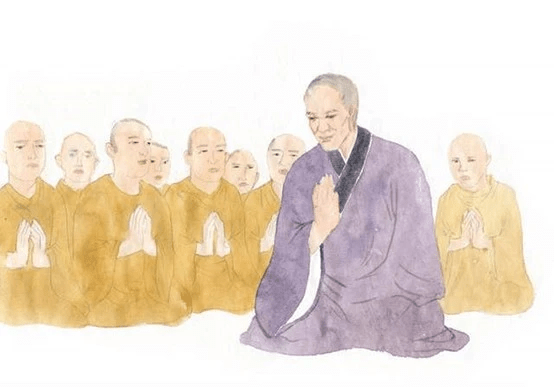
H.H. Dharma King Kyabje Trulshik Chokyi Lodro is one of the most accomplished masters of the Nyingma sect in the present age. He is also one of the few remaining great masters of Tibetan Buddhism who has real and extensive knowledge, real training, and true cultivation. He is a lineage holder of many important dharma lineages. He is a great dharma king who does not distinguish among the various sects of Buddhism. H.H. Dharma King Trulshik and the most magnificent modern dharma kings of Buddhism, such as the H.H. Dudjom Dharma King and H.H. Dharma King Dilgo Khyentse, have been masters and disciples of one another. H.H. Dharma King Trulshik also taught the dharma of many lineages to the 16th Karmapa. He is a personal master of H.H. the Dalai Lama as well as a master of the most recent reincarnation of the H.H. Dudjom Dharma King, H.H. Dharma King Dilgo Khyentse, and H.E. Dharma King Tulku Ugyen.

Many Rinpoches had different views concerning which great Bodhisattva H.H. Dharma King Trulshik was the incarnation of. Thus, the International Buddhism Sangha Association held an unprecedented Drawing Lots From a Golden Vase Ceremony to affirm the true reincarnated identity of H.H. Dharma King Trulshik and others. There were ten possible identities recognized by various rinpoches. One lot was drawn from among 120 lots to affirm the true reincarnated identity of H.H. Dharma King Trulshik. That drawing affirmed that H.H. Dharma King Trulshik is the nirmanakaya of Maitreya Bodhisattva, which is the reincarnated identity that H.H. Dorje Chang Buddha III recognized before that lot was drawn.

In history, H.H. Dharma King Trulshik incarnated as Thonmi Sambhota, who created the Tibetan written language. Later, he incarnated as the great translation master Bairotsana, who was one of the twenty-five major disciples of Guru Padmasambhava. H.H. Dharma King Trulshik will be the next Buddha of this Good Eon (Bhadra-kalpa) of one thousand Buddhas. At that time, all of his disciples who heard him expound the Buddha-dharma will attain accomplishment in the dharma.

The dharma king was born on September 10, 1924, the year of the wooden rat, which was the exact birthday of Guru Padmasambhava. He was born in Wengre Cave, which is a holy place of cultivation in southern Tibet. Many auspicious phenomena appeared at the time of his birth. The father of the dharma king, Dianjin Queda, was a practitioner of yoga. His mother, Jiangyang Wangmu, was a descendent of Zhangba Jialei, who was the first Drukpa Dharma King and founder of the magnificent Drukpa lineage.

The dharma king was extraordinary ever since childhood, especially with respect to his deep self-cultivation. When he was four years old, his master, Zhachu Rinpoche (who was a disciple H.H. Dharma King Trulshik personally taught in his previous life as Trulshik Dongak Lingpa), invited him to the Zhalongpu Monastery in the Latuo Xueka District. At that time and place, memories of his prior life spontaneously welled up in the mind of the dharma king. He recounted in detail past events of that prior lifetime. Zhachu Rinpoche had personally witnessed those past events of his former master. Zhachu Rinpoche wept as he orally corroborated each of those events without exception. Zhachu Rinpoche was truly astonished by this and firmly believed that this boy must be the incarnation of Trulshik Dongak Lingpa. After the rinpoche practiced the Selection of Karmic Affinity Dharma, he affirmed that the boy was undoubtedly the incarnation of Trulshik Dongak Lingpa.
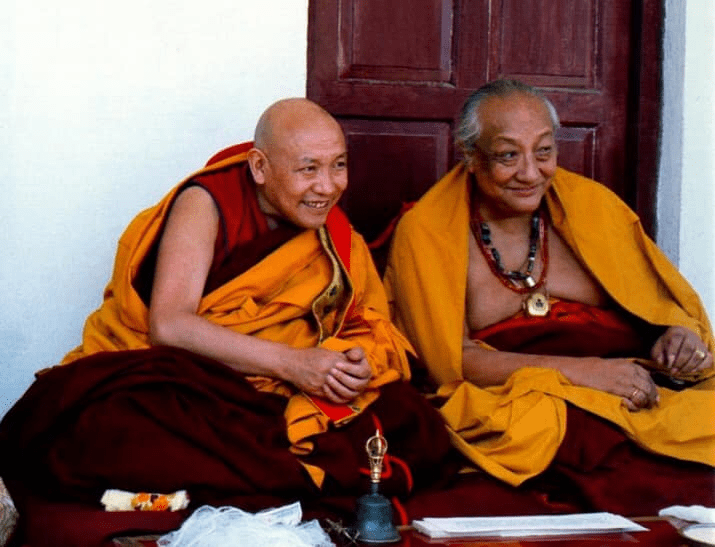
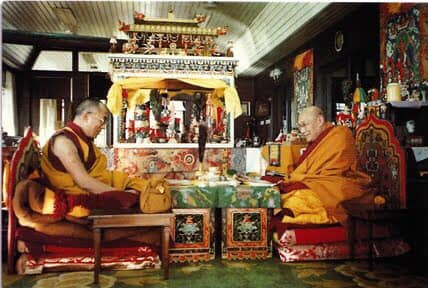
Dharma King Dilgo Khyentse Rinpoche (right) and his main Dharma heir, the Fifth Dharma King Trulshik Rinpoche (left)
The Gelug sect’s Dalai Lama invited the Nyingma sect’s Dharma King Trulshik to transmit the supreme Dharma

At the Mindrolling Monastery, the dharma king engaged in extensive learning. He received all of the monk precepts from his precept masters Cuikenqiong Rinpoche and Mindrolling Kenqian Khyentse Norbu according to the “Formal Pronouncement on Precepts” lineage passed down from Laqian Qianba Lasa. Present-day dharma kings unanimously agree that H.H. Dharma King Trulshik is one of the most important lineage-holders of this lineage. H.H. Dharma King Trulshik holds three types of precepts that are on different levels: the Pratimoksa precepts, the Bodhisattva precepts, and the precepts for tantric masters. The dharma king is one who truly wears a golden precept robe. Not only does he abide by the precepts for monks, he also completely abides by all of the Hinayana, Mahayana, and Vajrayana precepts. That is why he deserves to be called a “holder of the Vajra Three Secrets Vows.” H.H. Dharma King Trulshik is the main transmitter of the monastic vows within the Nyingma lineage.

The dharma king has received teachings on the sutras and tantras, as well as other teachings. He has visited famous masters in many places to learn Buddha-dharma, including over thirty famous masters who belong to ancient and modern sects of esoteric Buddhism. The dharma king has studied all of the dharma teachings of these important lineages and has put them into practice. He still learns assiduously even after he completed a strict three-year retreat. Accepting the request of Zhachu Rinpoche, the dharma king became the khenpo of the Zhalong Dongga Qielin Monastery, where he is responsible for upholding, protecting, and spreading the dharma.

Throughout his whole life, the dharma king has wholeheartedly cultivated himself in retreat. Every day he abstains from speaking until 10:00 in the morning. Each year the dharma king goes into retreat in his own temple for as much as nine months. All of the great Tibetan rinpoches acknowledge that as a master of masters, the dharma king has the greatest abilities and power to clearly point out the way leading to realization of one’s original nature. That is why extremely virtuous masters send their capable disciples to the dharma king in order to seek teachings and empowerment.

H.H. Dharma King Trulshik has vast and profound learning. His practice is solid and flawless. He is unassuming and amiable. No one in today’s world can match his profound experience, training, and realization. Many practitioners of the various sects regard him as a venerable Dharma King Master with limitless wisdom and vast supernatural powers. H.H. Dharma King Trulshik has recognized the identities of the person who is the incarnation of H.H. Dharma King Dilgo Khyentse, the person who is the incarnation of H.E. Dharma King Tulku Ugyen, and persons who are incarnations of other important rinpoches. He has also transmitted dharma to and performed initiations for such people. The dharma king is a magnificent practitioner of the Great Perfection Dharma and a magnificent accomplished one in our current age. He is a model master of this century with disciples spread all over the world.

After H.H. Dharma King Trulshik saw who His Holiness Dorje Chang Buddha III Wan Ko Yeshe Norbu is through the limitless omniscience displayed in A Treasury of True BuddhaDharma, he stated that His Holiness Wan Ko Yeshe Norbu has reached the highest state of Buddhahood in the few-thousand-year history of Buddhism, having truly attained complete. Dharma King Trulshik wrote a respectful congratulation letter.

RESPECTFUL CONGRATULATIONS
His Holiness Buddha Vajradhara (Dorje Chang Buddha) Yangwo Wan Ko Yeshe Norbu:
I recently learned that the book about you, A Treasury of True BuddhaDharma, was published a long time ago. The content of that book includes
the traditional Tibetan five major vidyas and five minor vidyas. In terms of modern branches of learning, the book involves more than thirty different branches of learning. Thus, I entered samadhi and visualized the Three Jewels the Buddha, the dharma, and the sangha. I pervasively spread bodhicitta and
wished that all living beings would realize the supreme, absolute truth and
Buddhahood. May the propagation of A Treasury of True Buddha-Dharma be
the karmic condition whereby living beings in the three spheres leave the sufferings of reincarnation and obtain the fruit of wonderful happiness. It will become the cause whereby each sentient being who has descended into the abyss of the six realms of reincarnation leaves suffering and attains happiness.
I hereby specially convey my respectful congratulations!


Buddhist monk Ngawang Chokyi Lodro,
having the undeserved name of Khenpo
Zhalong Trulshik Shatrul
Written on the auspicious day of June 28, 2007

Link:https://peacelilysite.com/2025/01/16/brief-introduction-toh-h-dharma-king-trulshik/

Source: H.H. Dorje Chang Buddha III A TREASURY OF TRUE BUDDHA – DHARMA

Mindful Speech: How Verbal Karma Shapes Our Lives and Spiritual Growth

Understanding Verbal Karma through Chinese Traditional Culture and Buddhism

Language is one of the most powerful tools in human communication. It has the capacity to warm hearts, yet it can also deeply wound others. The ancient Chinese saying, “Illness enters through the mouth; misfortune comes out of the mouth,” serves as a profound reminder of the critical importance of our words. Another popular saying states, “A kind word can warm one for three winters, but a harsh word wounds deeply and is hard to forget.” Those who speak thoughtfully build strong relationships, while careless words often lead to unintended enmity or trouble. Indeed, many of life’s great misfortunes arise from verbal mistakes.

The Chinese ancients emphasized the principle of “cautious speech and careful actions,” which is not only a foundational aspect of personal conduct but also key to cultivating one’s character. In modern times, misunderstandings and conflicts often stem from believing rumors and passing on unverified information. This carelessness turns small issues into major problems, causing unnecessary harm. The impact of careless words can extend beyond personal relationships, disrupting families, friendships, and even society, sometimes escalating into widespread societal issues.

Buddhism’s Teachings on Verbal Karma: The Four Types of Harmful Speech

Buddhism profoundly explains the karmic consequences of speech. Among the “three karmas” — body, speech, and mind — verbal karma is especially critical. The Buddha taught that the consequences of verbal karma can be even more destructive than a raging fire because hurtful speech inflicts suffering on others. Buddhism identifies four types of harmful verbal karma:

  • Harsh Speech: Using cruel or aggressive words that directly harm someone’s spirit.
  • Slander: Spreading rumors or sowing discord, leading to broken relationships and disputes.
  • False Speech: Speaking untruthfully or deceiving others.
  • Frivolous Speech: Words that may seem pleasant but mislead or confuse others, distracting them from right mindfulness.

These forms of verbal karma not only harm relationships but also sow seeds of negative karma, inevitably leading to future suffering.

Chinese Buddhist texts record a story from the Song Dynasty: One day, Zen Master Guang XiaoAn observed two monks engaged in a discussion about the Dharma, during which they were surrounded and protected by heavenly beings. However, as soon as their conversation shifted to worldly topics, the deities departed, and evil spirits appeared, mocking the monks with vulgar language. This story serves as a reminder that even monks, when they deviate from righteous speech, will attract negative consequences.

In today’s world, the effects of verbal karma are even more pervasive. Carelessly spreading rumors, posting unverified information online, or making inflammatory remarks can cause lasting damage. Every harsh word is like a sharp blade, hurting not only others but also oneself.

Here is another powerful example that highlights the benefits of controlling one’s speech. At Mount Jiuhua, a sacred Buddhist site renowned for venerating Ksitigarbha Bodhisattva, there once lived a venerable nun. She was widely respected for her virtuous life and profound wisdom, embodying the transformative power of positive speech.

Even at the remarkable age of 136, she remained in good health, continuously reciting the mantra “Amitabha Buddha.” This practice not only reflected her spiritual merit but also her mastery of speech, and self-discipline.

The venerable nun understood the profound impact of verbal karma and strictly adhered to the principle of “cautious speech.” She refrained from gossip and focused her speech on chanting the Buddha’s name. In conversations about spiritual matters, she offered concise and clear guidance, leading people toward the right path. When topics were unrelated to spiritual practice, she chose silence. This self-discipline brought her immense merit, making her a role model for others. She often said, “For women, whether lay or ordained, if one can guard against verbal karma, one is halfway to becoming a Buddha.” Her words highlighted the critical role verbal karma plays in the spiritual path.

The venerable nun’s teachings emphasized the severe consequences of verbal karma. She made it clear that verbal karma is one of the greatest obstacles in spiritual practice and explained its multiple harmful effects:

  • Verbal Karma Obstructs Spiritual Progress: Every instance of harsh speech, slander, or frivolous talk not only harms others but also pollutes one’s mind, hindering spiritual purification.
  • Verbal Karma Leads to Lower Rebirths: Harsh speech is like a wildfire, burning away one’s merit and leading to severe karmic consequences.
  • Verbal Karma Disrupts Harmony: In families, communities, or society, harmful speech creates discord, making it difficult to maintain a peaceful environment for practice.
  • Verbal Karma Weakens Faith: Harsh and false words can cause others to lose faith in their spiritual path, even destroying their potential for future practice.

Her virtuous life and disciplined speech accumulated immeasurable merit. It is said that many patients with difficult illnesses were cured after receiving her blessings, a testament to the power of pure verbal karma.

Guarding Verbal Karma in Modern Life

In today’s world, controlling speech is more essential than ever. Here are some practical steps to guard against verbal karma:

  • Speak Cautiously: Think before you speak. Avoid spreading unverified information and refrain from gossiping or discussing others carelessly.
  • Control Emotions: When emotions are high, it’s easy to say things that cause harm. Cultivate a calm and peaceful mind to avoid saying hurtful things in the heat of the moment.
  • Cultivate Positive Speech: Use kind and uplifting words to resolve conflicts, build trust, and foster harmony in your relationships.

By understanding Buddhism’s teachings on verbal karma, we can become aware of the power of language and use it to bring peace and happiness to ourselves and others. Guarding speech is not only a sign of respect for others but also an essential aspect of personal spiritual practice.

Through mindful and compassionate speech, we can spread kindness, promote harmony, and enhance both the quality of our lives and the happiness of those around us. Let us strive together to use the wisdom of language to create more peace and happiness in our lives and in the lives of others.

Link:https://peacelilysite.com/2024/10/24/mindful-speech-how-verbal-karma-shapes-our-lives-and-spiritual-growth/

100. A Mother’s Wise Advice [Non-violence]


100. A Mother’s Wise Advice [Non-violence]

Once upon a time, the son of Brahmadatta was ruling righteously in Benares, in northern India. It came to pass that the King of Kosala made war, killed the King of Benares, and made the queen become his own wife.

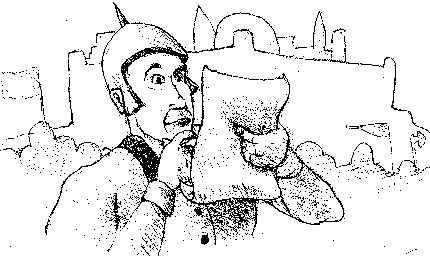
Meanwhile, the queen’s son escaped by sneaking away through the sewers. In the countryside he eventually raised a large army and surrounded the city. He sent a message to the king, the murderer of his father and the husband of his mother. He told him to surrender the kingdom or fight a battle.

The prince’s mother, the Queen of Benares, heard of this threat from her son. She was a gentle and kind woman who wanted to prevent violence and suffering and killing. So she sent a message to her son — “There is no need for the risks of battle. It would be wiser to close every entrance to the city. Eventually the lack of food, water and firewood will wear down the citizens. Then they will give the city to you without any fighting.”

The prince decided to follow his mother’s wise advice. His army blockaded the city for seven days and nights. Then the citizens captured their unlawful king, cut off his head, and delivered it to the prince. He entered the city triumphantly and became the new King of Benares.

The moral is: Kind advice is wise advice.

100. A Mother’s Wise Advice [Non-violence]

Link: https://hhdorjechangbuddhaiiiinfo.com/2024/10/22/100-a-mothers-wise-advice-non-violence/

#Buddhisttalesforyoungandold #Buddhiststories #storiesforkids #moralstories #Buddha #Jatakastories #PansiyaPanasJataka

98. A Man Named Wise [Cheating]

Once upon a time, the Enlightenment Being was born in a merchant’s family in Benares, in northern India. He was given the name Wise. When he grew up, he began doing business with a man whose name just happened to be Verywise.

It came to pass that Wise and Verywise took a caravan of 500 bullock carts into the countryside. After selling all their goods they returned to Benares with their handsome profits.

When it came time to split their gains between them, Verywise said, “I should get twice as much profit as you.” “How come?” asked Wise. “Because you are Wise and I am Verywise. It is obvious that Wise should get only half as much as Verywise.”

Then Wise asked, “Didn’t we both invest equal amounts in this caravan trip? Why do you deserve twice as much profit as I?” Verywise replied, “Because of my quality of being Verywise.” In this way their quarrel went on with no end in sight.

Then Verywise thought, “I have a plan to win this argument.” So he went to his father and asked him to hide inside a huge hollow tree. He said, “When my partner and I come by and ask how to share our profits, then you should say, ‘Verywise deserves a double share.”‘

Verywise returned to Wise and said, ‘My friend, neither of us wants this quarrel. Let’s go to the old sacred tree and ask the tree spirit to settle it.”

When they went to the tree Verywise said solemnly, “My lord tree spirit, we have a problem. Kindly solve it for us.” Then his father, hidden inside the hollow tree, disguised his voice and asked, “What is your question?” The man’s cheating son said, “My lord tree spirit, this man is Wise and I am Verywise. We have done business together. Tell us how to share the profits.” Again disguising his voice, his father responded, “Wise deserves a single share and Verywise deserves a double share.”

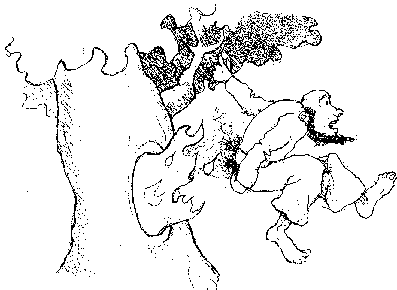
Hearing this solution, Wise decided to find out if it really was a tree spirit speaking from inside the tree. So he threw some hay into it and set it on fire. Immediately Verywise’s father grabbed onto a branch, jumped out of the flames and fell on the ground. He said in his own voice, “Although his name is Verywise, my son is just a clever cheater. I’m lucky that the one named Wise really is so, and I’ve escaped only half toasted!”

Then Wise and Verywise shared their profits equally. Eventually they both died and were reborn as they deserved.

The moral is: A cheater may be clever but not wise.

98. A Man Named Wise [Cheating]

Link: https://hhdorjechangbuddhaiiiinfo.com/2024/10/08/98-a-man-named-wise-cheating/

#Buddhisttalesforyoungandold #Buddhiststories #storiesforkids #moralstories #Buddha #Jatakastories #PansiyaPanasJataka

The Seven Treasures of True Wealth

In this world, which sentient being does not desire great wealth? Which of us does not seek blessings and fortune? But what truly defines wealth? Most people measure it by the amount of money they have, the assets they own—be it real estate, cars, or stocks. These tangible things may seem like wealth, but they are easy to lose.

Money and jewels cannot provide lasting security—they can be stolen by thieves.
Reputation and status cannot guarantee stability—enemies can destroy them.
Family and friends are not unshakable—they can change as people’s hearts do.
Illness, aging, and death remind us that the body itself is fragile and impermanent.
Fate and fortune cannot be relied upon—karma follows us, shaping our circumstances.

So, what is the true wealth that we can hold onto in this fleeting lifetime?

Over 2,500 years ago, Shakyamuni Buddha illuminated the path to real wealth—wealth that transcends the material and leads to lasting peace and wisdom. He shared the Seven Treasures of Life, invaluable treasures that guide us to inner fulfillment and enlightenment. These treasures cannot be stored in vaults or spent like gold and jewels. They are the true treasures that nurture the soul.

The Seven Treasures:

  1. The Treasure of Faith
    This is the deep trust a disciple places in the Buddha’s awakening. It is unwavering confidence in the truth of the Buddha’s enlightenment and teachings. Faith is the compass that keeps a person on the path of liberation, a guiding light through life’s trials.
  2. The Treasure of Integrity
    Integrity means living in alignment with one’s highest principles. It manifests as abstaining from harmful actions—whether through speech, thought, or deed. A person with integrity refrains from violence, stealing, falsehood, and indulgence in intoxicants. Integrity is the treasure of a life well-lived with honesty, respect, and compassion for all beings.
  3. The Treasure of Self-Respect
    This treasure is found in the heart of those who uphold their dignity and honor. Self-respect means feeling shame at the thought of misconduct and avoiding actions that degrade one’s character. A person who treasures self-respect lives with a deep sense of morality and avoids causing suffering.
  4. The Treasure of Responsibility
    This treasure reflects an understanding of the consequences of one’s actions. It is a profound sense of accountability for one’s choices, knowing that every action—whether good or bad—impacts oneself and others. Responsibility is driven by a genuine concern for well-being, not out of fear, but from love and care.
  5. The Treasure of Learning
    Learning is the treasure of an eager and inquisitive mind. It is the pursuit of wisdom through listening, reflecting, and studying the teachings. A disciple who treasures learning delves into the Dharma, growing in understanding, and cultivating insight that transforms their perception of life.
  6. The Treasure of Generosity
    This treasure resides in an open and giving heart. It is the joy of sharing wealth, time, and kindness without clinging to material things. A generous person delights in helping others and is always ready to support those in need. Generosity brings happiness both to the giver and the receiver, and it enriches the soul beyond measure.
  7. The Treasure of Wisdom
    Wisdom is the crown jewel of all treasures. It is the deep understanding of life’s impermanence and the realization that clinging to fleeting things leads only to suffering. With wisdom, one sees the world as it truly is, cultivating peace, detachment, and the ability to make decisions that lead to lasting happiness.

True Wealth Beyond Material Possessions

Shakyamuni Buddha shared these seven treasures with his disciples, emphasizing that true wealth is not measured by material abundance but by these inner riches. Whether man or woman, young or old, those who possess these treasures are truly wealthy. Their lives are meaningful, filled with purpose, and unshaken by the ups and downs of worldly fortunes.

So, what can we learn from these timeless teachings?

Cultivate faith and integrity,
Grow in generosity and wisdom,
Walk the path with responsibility and learning,
Always remembering the teachings of the Buddhas,
for they are the guideposts to inner peace, fulfillment, and the truest wealth.

Link:https://peacelilysite.com/2024/09/26/the-seven-treasures-of-true-wealth/

Source: https://wisdomtea.org/2024/09/13/treasure/

The Old Boat and the Journey Within: Lessons from the Buddha on Cultivation and Liberation

During the Buddha’s lifetime, there was a time when he was teaching on the far side of a river. Eager to hear his wisdom, many monks wished to cross the river, but there was only one boat available. The boatman warned them, “My boat is very old, and with so many of you on board, it could be dangerous!” Yet, in their eagerness to reach the Buddha, the monks ignored the boatman’s caution and all climbed aboard. Reluctantly, the boatman set sail.

As they reached the middle of the river, the monks noticed water seeping into the bottom of the boat, and panic began to spread. The boatman calmly said, “I told you this boat is old, but you didn’t listen. Now, if you can’t stay calm, the boat will sink even faster.”

Upon hearing this, the monks stilled themselves and did not dare move. Thankfully, the boatman’s experience guided them safely to the other shore.

When the monks arrived and recounted the incident to the Buddha, he offered this teaching: “When you were in the boat, you feared for your safety. But in daily life, you fail to realize that danger is ever-present. Many people worry about the uncertainty of the future, yet neglect the most important thing — being mindful of the present moment. Focus on this life, this moment. Pay attention to your thoughts and purify your mind of the five poisons: greed, anger, ignorance, pride, and doubt.”

The Buddha continued, “Our bodies are like that old, leaky boat. We must reduce its burden, and the heaviest load is the weight of greed, anger, ignorance, pride, and doubt. Just like in the boat, if we don’t repair our minds and lighten our burdens, we risk sinking. Only by addressing these burdens can we safely reach the other shore.”

“Do not be preoccupied with the thought of being reborn in the Western Pure Land in your next life. Instead, focus on your present condition. Are you free from afflictions in this very moment? Do you act with an open heart? Can you humble yourself in the eyes of others? These are the true questions we must face in life.”

The contemporary Buddha H.H. Dorje Chang Buddha III  has also imparted timeless wisdom on cultivation. His Holiness teaches that true cultivation stems from the depths of your heart, from your bodhicitta — the awakened mind of compassion. Be genuinely friendly and loving to your spouse, your brothers, and your sisters. Foster harmony with your friends, act cooperatively with others, and extend care and help to all sentient beings. Apply the Four Limitless States of Mind — loving-kindness, compassion, joy, and equanimity — and cultivate bodhicitta in every action. Constantly reflect on yourself: How do you treat others with your words? With your thoughts? With your actions?

The conduct of Buddhas and great Bodhisattvas is marked by complete disregard for personal gain. When interests conflict, they give way to others, willingly taking fewer benefits or even none. You must remind yourself, “When others harm or slander me, I will not be disturbed. Even to those who harm me, I will wish them well, sincerely hoping for their happiness. Furthermore, I will take practical steps to help them, even offering financial aid — without letting them know that I am doing so.”

By living in accordance with these teachings, we become holy ones at the causal stage. Without a doubt, such cultivation leads to the perfection of wisdom and virtue. Achieving liberation and accomplishment becomes as simple as turning over one’s hand!

Link:https://peacelilysite.com/2024/09/19/the-old-boat-and-the-journey-within-lessons-from-the-buddha-on-cultivation-and-liberation/

#HHDorjeChangBuddhaIII #DorjeChangBuddhaIII #DorjeChangBuddha #ShakymuniBuddha

#WhatisCultivation #Compassion #Kindness #Liberation

95. CLEAR-SIGHTED THE GREAT, KING OF THE WORLD [IMPERMANENCE]

95. CLEAR-SIGHTED THE GREAT, KING OF THE WORLD [IMPERMANENCE]

It is said that there are two ways to practice religion. One is to live apart from the ordinary everyday world as a monk, a nun or a holy one. Those who are sincere in this way have as their highest goal the direct experience of complete Truth — full Enlightenment.

The other way to practice religion is within the ordinary world. Those who are sincere in this way have as their highest goal the harmony of an undivided world, living peacefully under a perfectly wholesome ruler — a ‘King of the World’.

Once upon a time the Enlightenment Being was born and given the name ‘Clear-sighted’. As he grew up he developed ten rules of good government: absence of hidden ill will, absence of open hostility, harmlessness, self-control, patience, gentleness, charity, generosity, straightforwardness and goodness.

The people of the world began to notice the wholesomeness and fairness of Clear-sighted, who lived strictly according to these rules. Gradually those in his vicinity volunteered to live under his authority as king, rather than under the dishonest politicians of the time.

As his reputation spread, every king in the world came to Clear-sighted and said, “Come, oh lord, you are welcome, my kingdom is your kingdom, advise me how to rule in your name.”

Then Clear-sighted said, “Do not destroy life. Do not take what is not given. Do not behave wrongly in sexual desires. Do not speak falsely. Do not take alcohol that clouds the mind. My commands to the world are only these five. As long as these five are obeyed, my sixth rule is freedom for all to follow local customs and religions.”

After all the people on earth had come to live under his peaceful rule, he became known as Clear-sighted the Great, King of the World. His royal city, the capital of the whole world, was called Kusavati. It was a beautiful and prosperous city with four magnificent gates — one golden, one silver, one jade and one crystal.

Outside the gates, Kusavati was surrounded by seven rows of palm trees — a row with golden trunks and silver leaves and fruits; a row with silver trunks and golden leaves and fruits; a row with cat’s-eye trunks and crystal leaves and fruits; a row with crystal trunks and cat’s-eye leaves and fruits; a row with agate trunks and coral leaves and fruits; a row with coral trunks and agate leaves and fruits; and finally a row with trunks and leaves and fruits of every kind of jewel found in the world!

When breezes blew through these marvelous palms the sweet sounds of gentle music were heard throughout the city. This music was so enticing and pleasant that some of the citizens were enchanted into stopping their work and dancing for joy!

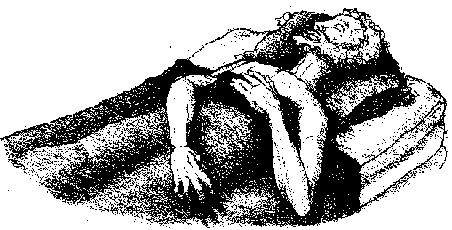
Clear-sighted the Great, King of the World, had a couch encrusted with jewels from the wonderful palms. After a long, righteous and peaceful reign, he lay on the rich couch for the last time. He knew that his end was near.

Of all his 84,000 queens, the one who loved him most was called, ‘Most-pleasant’. Sensing the state of his mind she said, “You rule over all the cities of the world, including this beautiful Kusavati with its four magnificent gates and seven rows of marvelous palms. Think about this and be happy!”

The King of the World said, “No, my dear queen don’t say that. Instead you should advise me to give up attachment to the cities of the world and all they contain.” Surprised she asked, “Why do you say this, my lord?” “Because today I will die,” he said.

Then Queen Most-pleasant started to cry, wiping away the tears as they flowed. And all the other 84,000 queens also broke into tears. And the king’s ministers and his whole court, both men and women, could not keep from weeping and sobbing. All eyes overflowed with tears.

But King Clear-sighted the Great said, “Your tears are useless. Be at peace.” Hearing this the wailing subsided and his subjects became silent. Then he said to Queen Most-pleasant, “Oh my queen, do not cry, do not lament. Anything that comes into being, whether it be a kingdom including the whole world, or just a tiny sesame seed — it cannot last forever. Anyone who comes into being, whether it be the King of the World, or the poorest petty thief — all must decay and die. Whatever is built up, falls apart. Whatever becomes, decays. The only true happiness is in the moment when becoming and decaying are not.”

In this way the Enlightenment Being got them to think about what most people don’t want to think about — that all things come to an end. He advised them to be generous and wholesome. Then the King of the World, like everyone else, died. He was reborn as a god in a heaven world, where in time, like everyone else, he died.

The moral is: “All good things come to an end.”

95. Clear-sighted the Great, King of the World [Impermanence]

Link: https://hhdorjechangbuddhaiiiinfo.com/2024/09/10/95-clear-sighted-the-great-king-of-the-world-impermanence/

#Buddhisttalesforyoungandold #Buddhiststories #storiesforkids #moralstories #Buddha #Jatakastories #PansiyaPanasJataka

A True Friend

Once, in a quiet monastery nestled in the hills, the Buddha sat before his disciples. The evening sun painted the sky in hues of gold and crimson, and the air was filled with a profound stillness, broken only by the occasional rustling of leaves in the gentle breeze. The monks, eager for wisdom, sat in reverence as the Buddha began to speak.

“Monks,” the Buddha said, “in this world, there are many who come and go in our lives. Some pass by like the wind, leaving no trace, while others remain, their presence felt deeply in our hearts. Among those who remain, there is a rare kind of person, a true friend, who is like a shelter from life’s storms, a beacon of light in the darkest of times. Such a friend is endowed with seven precious qualities, and these qualities are worth cultivating, for a friend like this is rare indeed.”

The monks listened attentively as the Buddha continued, “Which seven qualities are these? First, a true friend gives what is hard to give. He does not withhold generosity, even when it is difficult. Whether it be his time, his effort, or his possessions, he offers them freely, without hesitation. This kind of giving is rare, for many are willing to give when it is convenient, but few give when it costs them something.”

The Buddha paused, letting his words sink in, then added, “Second, he does what is hard to do. A true friend will go beyond his comfort zone for the sake of his companion. He will stand by you when others shy away, face challenges with you, and make sacrifices when needed, not for his own gain, but for the sake of friendship.”

The monks reflected on this as the Buddha continued, “Third, he endures what is hard to endure. Life is not always easy. There are times of joy, but also times of suffering and hardship. A true friend remains steadfast during the difficult times. He does not flee when the winds of adversity blow; instead, he endures alongside you, bearing the weight of the struggle as if it were his own.”

Then, the Buddha smiled softly and said, “Fourth, he reveals his secrets to you. Trust is the foundation of true friendship. A true friend does not hide behind a mask or shield himself with falsehoods. He shares his heart with you, revealing his vulnerabilities, knowing that in doing so, the bond of trust between you will grow ever stronger.”

“Fifth,” the Buddha continued, “he keeps your secrets. Just as he trusts you with his, so too does he honor your trust. He safeguards what you confide in him, never betraying your confidence, never allowing the winds of gossip to carry away what you have entrusted to him.”

The Buddha’s voice softened as he spoke of the sixth quality. “When misfortunes strike, he doesn’t abandon you. Life is unpredictable, and at times, suffering may come upon you like a sudden storm. A true friend does not turn his back on you in these moments. He stands beside you, offering support, comfort, and strength. He is like a tree with deep roots, unshaken by the winds of fate.”

Finally, the Buddha said, “The seventh quality is this: When you’re down and out, he doesn’t look down on you. In times of failure or disgrace, when the world seems to turn its back on you, a true friend remains by your side, never judging, never scorning. He sees you not for your misfortune, but for who you truly are. His respect for you does not waver, even when you are at your lowest.”

The monks, inspired by these words, bowed their heads in gratitude as the Buddha’s voice grew gentle. “Such a friend, endowed with these seven qualities, is a rare and precious gift. He gives what is beautiful yet hard to give, does what is hard to do, and endures the bitter words that life may bring. His heart is open to you, and he protects your heart in turn. In the darkest of times, he will not leave you, and even when you falter, his love for you does not falter.”

The Buddha paused for a moment, letting the weight of his words fill the air before continuing, “To cultivate such a friendship is a blessing for both parties. A friend like this is not just a companion but a guide, a mirror that reflects your virtues and helps you grow. Such a bond nurtures the spirit and brings peace to the heart. Therefore, monks, seek to be such a friend. Cultivate these seven qualities within yourself, and you will draw others of similar virtue to your side.”

The monks looked at one another with renewed purpose, understanding now that friendship was not a simple matter of convenience or shared interests but a profound practice of giving, endurance, and trust. The Buddha’s words had opened their hearts to the deeper meaning of companionship, and they resolved to embody the qualities of a true friend in their own lives.

And so, as the evening deepened and the stars began to appear in the sky, the monks rose, filled with a sense of peace. They knew that in cultivating these seven qualities, they would not only find true friends but would become true friends themselves—vessels of compassion and wisdom in a world often marked by fleeting connections.

The Buddha smiled as he watched them depart, knowing that the seeds of his teaching had taken root in their hearts, and that in time, they would bear the fruits of deep and enduring friendships, blessed with the seven qualities of a true friend.

Link: https://wisdomtea.org/2024/09/05/a-friend/

Illuminate Others, Illuminate Yourself

On a pitch-black night, a wandering ascetic on a journey to seek the Buddha arrived in a remote village. The dark streets were bustling with villagers coming and going.

The ascetic walked into a narrow alley and noticed a faint yellow light shining from deep within the quiet alleyway. A villager remarked, “The blind man is coming.”

“Blind man?” The ascetic was puzzled. He asked another villager beside him, “Is the person carrying the lamp really blind?”

The answer was affirmative. The ascetic couldn’t understand.

A blind man, who has no concept of day and night, who cannot see mountains or rivers, or the vibrant world of peach blossoms and green willows—he doesn’t even know what light looks like. Isn’t it ridiculous for him to carry a lamp?

The lamp gradually drew closer, and the faint yellow light moved slowly from the depths of the alley to the ascetic’s feet.

Still perplexed, the ascetic asked, “May I ask, are you truly blind?”

The blind man carrying the lamp replied, “Yes, I have lived in darkness ever since I entered this world.”

The ascetic asked, “Since you can’t see anything, why are you carrying a lamp?”

The blind man said, “Is it night now? I heard that in the dark, without the light of a lamp, no one can see anything, just like me. So I lit a lamp.”

The ascetic, beginning to understand, said, “Oh, so you are carrying the lamp to light the way for others?”

But the blind man replied, “No, it’s for myself.”

“For yourself?” The ascetic was stunned.

The blind man slowly explained, “Have you ever been bumped into by other travelers because of the darkness?”

The ascetic said, “Yes, just a moment ago, I wasn’t paying attention and was bumped by two people.”

The blind man then said thoughtfully, “But I haven’t been. Though I am blind and cannot see anything, by carrying this lamp, I not only light the way for others but also allow them to see me. This way, they won’t bump into me because they can’t see.”

Hearing this, the ascetic suddenly realized.

He looked up and sighed, “I’ve been traveling far and wide to find the Buddha, but little did I know that the Buddha was right beside me all along.”

It turns out that Buddha nature is like a lamp. As long as I light it, even if I cannot see the Buddha, the Buddha will be able to see me.

The story is simple, yet it seems to ignite a light within the darkest corners of our hearts.

The Merchant’s Compassion: A Tale of Kindness and Divine Protection

In the past, there was a merchant from Anhui Province named Wang Zhiren. He was over forty years old and, though successful in business with some savings, his only regret was that he had no son.

One day, while out on a business trip, he was walking alone by the riverside when he suddenly saw a young woman, dressed as a village wife, holding a baby and jumping into the river. He was shocked and wanted to jump in to rescue them, but he lamented that he couldn’t swim and was unable to save them. In that critical moment, he looked up and saw several fishing boats in the distance on the river. He raised his hand and shouted for help, but when his first few calls went unanswered, he ran and shouted that he would offer twenty taels of gold to anyone who saved them.

Only then did the fishermen rush over, and they finally pulled the young woman and the baby out of the water. Wang Zhiren handed over the twenty taels of gold to the fishermen and then asked the young woman why she had jumped into the river with the baby. The woman tearfully explained, “My husband works as a laborer elsewhere, and we kept a pig at home, planning to sell it to pay the rent. Yesterday, a pig trader came by, and I sold the pig, but after he left, I discovered that the money I received was all counterfeit. My husband has a very violent temper. If he finds out, he’ll certainly beat me severely. We are so poor that we can barely survive, so I decided to drown myself and my baby in the river.”

Hearing this, Wang Zhiren was filled with compassion. He asked how much the pig had been worth and gave her twice that amount in real silver. The young woman, encountering such a kind and compassionate person, was overwhelmed with indescribable joy and gratitude. She expressed her heartfelt thanks and blessings to Wang Zhiren and, to ensure she could repay his kindness in the future, she carefully asked for his name, birthplace, and residence. She then returned home with her baby, feeling consoled.

When she arrived home, her husband had already returned. The young woman recounted in detail how she had received counterfeit money for the pig, her fear of being beaten, her attempted suicide with the baby, and how a kind man had saved them and given her real silver.

Her husband was deeply moved upon hearing about Wang Zhiren’s compassion and decided to accompany his wife to Wang’s lodging to express their gratitude.

When Wang Zhiren, still in bed, heard them knocking at the door, he got up and went outside. As he stepped out, there was a sudden loud crash from inside the room, startling all three of them. They turned to see that the wall of the room had collapsed due to damage from several days of heavy rain, and the bricks, tiles, and beams had fallen, crushing the bed where Wang had been sleeping.

Wang Zhiren exclaimed, “Oh my! That was so dangerous! If you two hadn’t knocked on my door and called me out, I would have been crushed to death by the falling wall and bricks!”

The couple replied in unison, “This is the will of Heaven. A kind-hearted person like you, Mr. Wang, should not suffer such a calamity.”

Later, Wang Zhiren’s wife gave birth to several sons, and Wang Zhiren lived to the ripe old age of ninety-six, passing away peacefully without illness.


Link:https://peacelilysite.com/2024/08/30/illuminate-others-illuminate-yourself/

Source: https://www.fsm.gov.mo/cht/healthcare/ContextDetail.aspx?Context=91, http://www.muni-buddha.com.tw/buddhism/book/yahoo/0364.htm#a01

Gratitude

Gratitude

“Monks, I will teach you about the nature of a person without integrity and a person with integrity. Listen carefully and pay close attention.”

“Yes, Lord,” the monks replied in unison.

The Blessed One began, “What defines a person without integrity? Such a person is ungrateful and unthankful. This ingratitude and lack of thankfulness are characteristics of rude individuals and belong entirely to those without integrity. These individuals fail to recognize and appreciate the good done to them by others. They are driven by selfish desires and a sense of entitlement, neglecting the virtue of gratitude, which is the foundation of a harmonious and compassionate society.

“In contrast, a person with integrity is grateful and thankful. This gratitude and thankfulness are traits of civilized individuals and belong entirely to those with integrity. They recognize the value of the kindness and support they receive from others and make it a point to express their appreciation. Such individuals foster positive relationships and contribute to a community where mutual respect and support flourish.

Photo by Emma Bauso on Pexels.com

“Monks, there are two people who are difficult to repay. Who are they? Your mother and father. Even if you were to carry your mother on one shoulder and your father on the other for 100 years, attending to their needs by anointing, massaging, bathing, and rubbing their limbs, even if they were to defecate and urinate right there on your shoulders, you still would not have repaid them. If you were to establish them in absolute sovereignty over this great earth, filled with the seven treasures, you still would not have repaid them.


“Why is that? Because parents do much for their children. They care for them, nourish them, and introduce them to this world. From the moment of birth, parents make countless sacrifices, enduring sleepless nights and countless worries to ensure their child’s well-being. They provide food, shelter, education, and unconditional love, guiding their children through the complexities of life. These acts of love and devotion create a debt that is immeasurable.

“However, monks, the greatest way to repay one’s parents is not through material means or physical care alone. True repayment comes from leading them towards the path of virtue and wisdom. If someone inspires his unbelieving mother and father to have faith, guides his unvirtuous parents towards virtue, encourages his stingy parents to be generous, and leads his foolish parents to wisdom, then, to that extent, he has repaid his mother and father.

“Consider the transformative power of such actions. When you rouse your unbelieving parents to embrace faith, you open their hearts to a greater understanding of life’s purpose. By encouraging them to practice virtue, you help them cultivate qualities that bring inner peace and happiness. Inspiring them to be generous allows them to experience the joy of giving, and guiding them towards wisdom leads them to a deeper comprehension of the world and their place in it.

“Monks, remember that integrity and gratitude are the cornerstones of a meaningful life. By embodying these virtues and helping others, especially your parents, to do the same, you contribute to a legacy of compassion and understanding that extends beyond your lifetime. This is the true measure of repayment and the highest expression of filial piety.”

The monks, deeply moved by the Blessed One’s words, reflected on the profound teachings and resolved to cultivate integrity and gratitude in their own lives, vowing to honor and repay their parents in the most meaningful way.

Link:https://peacelilysite.com/2024/08/02/gratitude/

Source: https://wisdomtea.org/2024/07/27/gratitude/