In China, there’s a saying that goes, “Disaster comes from the mouth, and illness enters from the mouth.” This saying serves as a reminder for people to exercise caution with their words. In Chinese traditional culture, there’s an even stronger emphasis on encouraging individuals to avoid engaging in arguments as much as possible. Confucius’s Analects even contain the proverb “Silence is golden.” The traditional Taoist concept in China emphasizes achieving ultimate emptiness and upholding tranquility and dedication. In Buddhism, there’s also the story of Vimalakirti’s profound silence. While I used to think that these ideas were exclusive to Chinese culture, I later discovered that a similar perspective exists in Western culture as well.
In his timeless masterpiece “The 48 Laws of Power,” Robert Greene delves into the art of navigating complex human interactions to achieve personal and professional success. Amid the book’s numerous valuable insights, the power of silence stands out as a potent tool that often goes unnoticed. Embracing silence can be challenging in our fast-paced, noisy world, but it offers unique advantages that can significantly impact our lives. Let’s explore five key benefits of practicing silence as outlined in “The 48 Laws of Power.”
Cultivating Mystery and Intrigue:
In the realm of power and influence, excessive verbosity can lay bare your intentions and vulnerabilities. In contrast, silence exudes an aura of mystery and intrigue. By listening more and speaking less, people become curious about your thoughts and motivations. Practicing strategic silence creates an impression of wisdom and depth that captures others’ attention, rendering them more receptive to your words when you choose to speak.
Exerting Control Over Emotional Responses:
Our emotions frequently lead us astray, prompting impulsive and regrettable actions. Through silence, you gain mastery over your emotional reactions. By pausing and observing your feelings without immediate response, you grant yourself the space to process and rationalize, resulting in more thoughtful and measured reactions. This controlled demeanor projects strength and stability, fostering an air of authority and respect.
Revealing Concealed Motives:
In a world rife with deception and manipulation, silence can be a potent ally in exposing others’ true intentions. Your silence creates a void that others may attempt to fill with their words. In this process, people often unveil their motives, vulnerabilities, and secrets, affording you invaluable insight into their genuine character. The ability to discern hidden agendas bestows a significant advantage in any situation.
Promoting Attentive Listening and Learning:
In the era of ceaseless chatter and information overload, the art of listening has faded. Embracing silence allows you to become a more attentive and empathetic listener. Active listening enables you to gather vital information, identify valuable opportunities, and comprehend the needs of those around you. This heightened understanding empowers you to tailor your actions and words to suit diverse situations, enhancing relationships and augmenting your influence.
Mastery of Strategic Timing:
Silence is a formidable instrument for mastering the art of timing, particularly when dealing with sensitive or contentious matters. Selecting the appropriate moment to speak or act can profoundly impact the outcome of a situation. Silence grants you the ability to observe the rhythm of events, enabling well-calculated decisions that can profoundly affect your success.
By nurturing enigma, exercising emotional restraint, exposing hidden motives, fostering attentive listening, and mastering the art of timing, you can harness the power of silence to your advantage. Integrating these principles into your daily life will unveil newfound strength, resilience, and influence, propelling you toward success in both personal and professional pursuits. Remember, sometimes, less truly is more, and silence can speak volumes in a world saturated with noise.
Tucked away in the idyllic town of San Marino, California, lies a captivating destination that continues to enthrall visitors from all corners of the globe—the Huntington Library, Art Museum, and Botanical Gardens. Boasting breathtaking landscapes, vast collections, and a harmonious fusion of nature, culture, art, history, and science, the Huntington Library is a place of awe-inspiring wonder that leaves an indelible mark on the hearts of those who venture within its gates. This July 4th holiday, we had the pleasure of revisiting this remarkable institution, once again succumbing to its irresistible allure.
Stepping foot into the Huntington Library is like entering a world where nature and culture intertwine harmoniously. The lush botanical gardens stretch across 120 acres, offering a mesmerizing collection of plants, flowers, and trees from all corners of the globe. As you stroll along the meandering paths, you’ll encounter a kaleidoscope of colors and fragrances, inviting you to immerse yourself in the serenity of nature. The carefully manicured landscapes provide the perfect backdrop for contemplation, relaxation, and exploration.
Chinese Garden
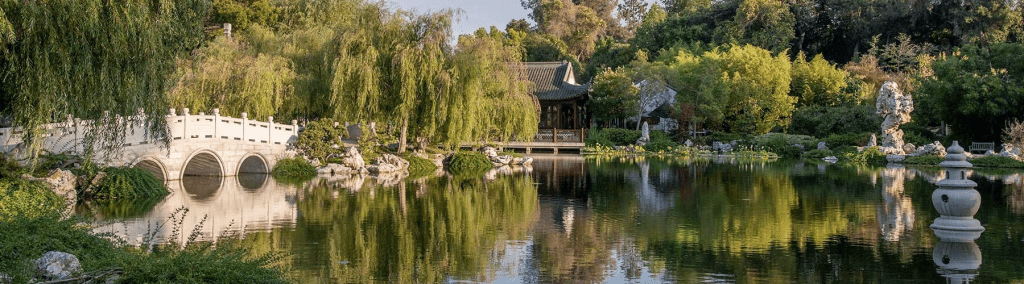
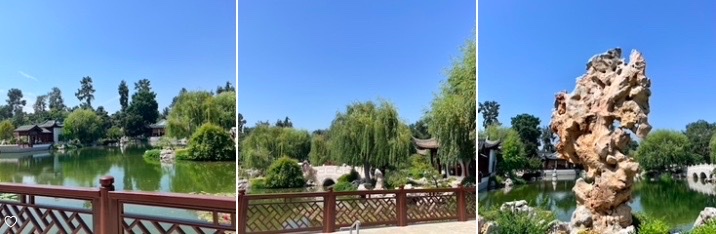
Among the many wonders that grace the Huntington Library, the Chinese Garden stands out as a true gem. This tranquil oasis, known as the Garden of Flowing Fragrance (Liu Fang Yuan), transports visitors to the essence of traditional Chinese landscaping. With its tranquil ponds, graceful pavilions, and meandering pathways, the Chinese Garden evokes a sense of peace and serenity. Every element, from the meticulously arranged rocks to the delicate architecture, conveys the rich insights of Chinese culture, inviting visitors to appreciate its profound beauty.
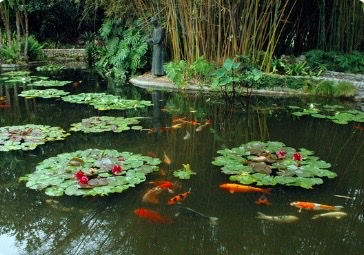
Nestled within the captivating grounds of the Huntington Library, Art Museum, and Botanical Gardens, the Lily Ponds stand as a timeless testament to the beauty and tranquility of nature. Established in 1904 as the first garden on Henry E. Huntington’s property, the Lily Ponds have become a beloved destination for visitors seeking solace and respite. Surrounded by bamboo groves and the majestic conifer tree collection, this serene haven features five picturesque ponds and an open grass meadow. With the presence of lotus blossoms, graceful koi fish, and elegant papyrus, the Lily Ponds offer a truly enchanting location for relaxation and the staging of unique events.
Beyond its mesmerizing gardens, the Huntington Library boasts an extensive collection of art, rare books, manuscripts, and historical artifacts. Art enthusiasts will find themselves immersed in masterpieces that span centuries, from the Renaissance to contemporary works. History buffs can delve into rare documents that shed light on pivotal moments in human civilization. Moreover, the Huntington Library offers an incredible array of scientific resources, including an impressive collection of botanical specimens, which serve as invaluable tools for researchers and scholars.
Peter Verstille’s diary and memorandum book, pages 19 and 20. Verstille was dismayed by the political corruption and misdirection he perceived in London. Throughout his diary, he worried what “the Deplorable Degeneracy of our present Times” would mean for the fate of the British Empire and America. | The Huntington Library, Art Museum, and Botanical Gardens.
The Huntington Library’s existence as a public treasure is owed to the foresight and generosity of Henry E. Huntington and his second wife, Arabella. The couple amassed an extraordinary collection of books, art, and manuscripts throughout their lifetimes. Instead of keeping these treasures confined to private quarters, they made the decision to establish the Huntington Library, ensuring that future generations would have the opportunity to experience the world’s wonders firsthand. Their philanthropic vision has created a lasting legacy that continues to enrich the lives of countless individuals today.
Visiting the Huntington Library is an experience that lingers in the hearts and minds of all who venture within its gates. The seamless integration of nature, culture, art, history, and science makes it a truly remarkable place. Whether you find solace in the tranquil Chinese Garden, lose yourself in the captivating art collections, or immerse yourself in the wealth of knowledge held within its walls, the Huntington Library offers a journey of discovery and inspiration. The selfless act of the Huntington couple in preserving this treasure for the public to enjoy is a testament to the power of sharing and the immense value of fostering a deeper understanding of our world. So, if you ever find yourself in California, make sure to visit the Huntington Library, where beauty, culture, and knowledge come together in perfect harmony.
Chinese calligraphy has transcended its role as a mere communication tool and has become an art form highly esteemed even in an era dominated by ballpoint pens and computers. No longer limited to intellectuals and officials, calligraphy is now practiced by professional artisans and enthusiastic amateurs. Calligraphers employ brushes to beautifully ink five distinct styles of script: ‘seal’, ‘official’, ‘cursive’, ‘running’, and ‘regular’. While calligraphy can be found on various surfaces, even adorning the rocky walls of cliffs, it is most commonly seen on letters, scrolls, literary works, and fan coverings.
Throughout history, the Chinese have believed that no art form or field of study can truly reflect a person’s moral character and knowledge as effectively as calligraphy. The accomplishments or creations in other arts or fields often overshadow one’s shortcomings in knowledge and character. However, calligraphy stands apart from this convention. It functions as a three-dimensional mirror, projecting the depth of knowledge, moral character, and mental strength with each brushstroke. There is no hiding or concealing these qualities. When examining an individual’s ordinary handwriting of Chinese characters, one can often discern their level of education. This is even more evident when examining their calligraphy.
In the annals of history, there is no account of an unknowledgeable person making significant contributions to calligraphy. Profound and extensive knowledge does not necessarily guarantee expertise in calligraphy. However, great calligraphers possess both knowledge and skillful brushwork. Without exception, the renowned calligraphers of past generations were literary masters who possessed deep knowledge. Notable examples include Xizhi Wang, Su Huai, Shaoji He, Huaiguan Zhang, Fei Yue, and in more recent times, Youren Yu. Each of them was an erudite literary figure and exemplar of virtue.
Knowledge serves as the pillar and cornerstone of calligraphy, while moral character is reflected in the style and allure of the art form. Thus, calligraphy demands a combination of knowledge and moral character.
When one appreciate the calligraphy of H.H. Dorje Chang Buddha III, one can understand that why chinese believe that calligraphy combines one’s knowledge, moral character and mental strength .The calligraphy of H.H. Dorje Chang Buddha III Wan Ko Yeshe Norbu Holiest Tathagata is not bound by worldly conventions and is devoid of unnecessary flamboyance. It is highly refined and based upon ingenious artistic conception. His Holiness’s strokes are sometimes written in a swift curling style. However, in an instant, His Holiness can express the innocent and natural charm of a child. There is wonder in even common strokes. His calligraphy is naturally graceful, exhibiting depth and brilliance. The calligraphy of His Holiness contains an invisible force that makes the characters seem much grander than they appear on a superficial level. His strokes look harmoniously smooth and unbroken. The Chinese characters may appear strong and vigorous, like a soaring dragon or mighty tiger. They may appear clear and gently elegant, like slowly floating clouds, cranes flying among pine trees, or dancing swans. They may appear simple and unadorned, like the free heart of a child. They are gracefully understated and completely devoid of any mundane quality. The calligraphy of H.H. Dorje Chang Buddha IlI is natural in quality and resonates with the true nature of the universe. A deep power underlies His Holiness’s strokes.
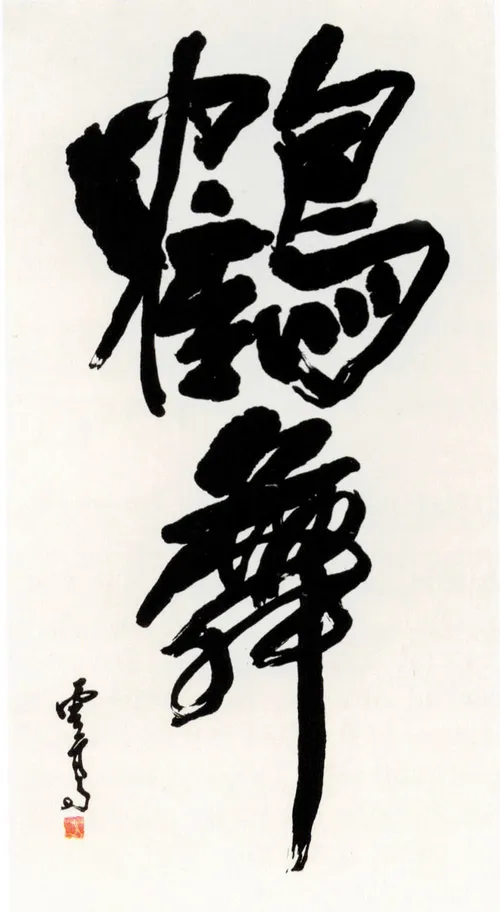
Crane Dance by H.H. Dorje Chang Buddha III at 1990
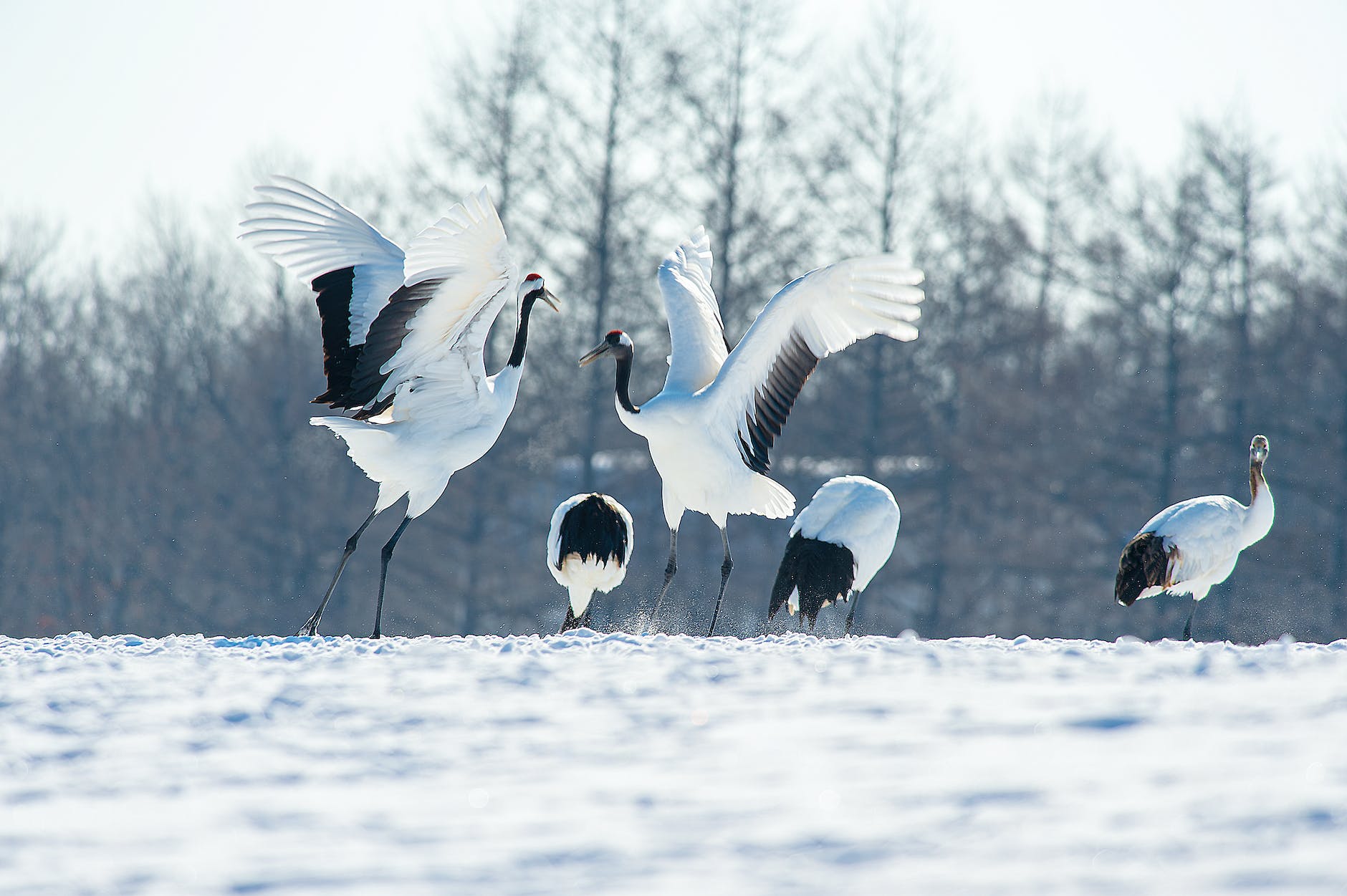
Red-crowned cranes tend not to build ness for themselves since they often stay in various places. When quiet, they frequently engage in meditational observation. When in motion, they frequently dance. Their nature is noble, pure, elegant and simple. They develop their virtue, are not attached to a specific abode, and take care of themselves so as to enjoy their natural lifespan. That is why since ancient times they have been praised for their longevity.
The ability of H.H. Dorje Chang Buddha III to reach such great heights in calligraphy is completely due to His Holiness’s vast knowledge and profound talents. Of course, His Holiness is extremely adept at learning from the styles of others since this is a simple matter for a Buddha. For example, even in the initial stage of learning calligraphy, H.H. Dorje Chang Buddha III had solid skills in the traditional cursive style of writing and also had extensive learning.
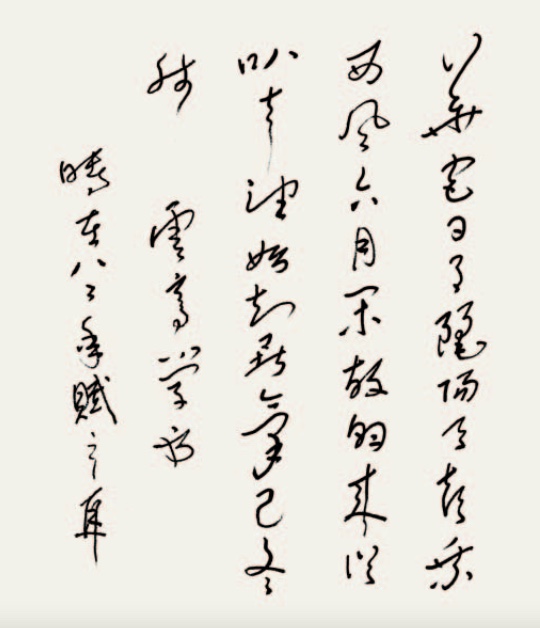
Calligraphy : A Qi jue poem (Thin Gold Cursive Style of Calligraphy)
Above is a qi jue poem written by H.H. Dorje Chang Buddha IIIat 1982. A qi jue poem is a four-line poem with seven characters to a line and a strict tonal pattern and rhyme scheme. The phonetic reading of the poem is as follows: “hua gong ri yue li yang tian, xi cheng xi feng liu yue xian, gu peng lai cong ba sheng wang, shi zhi shu qi yi dong can.” One can see that this work has surpassed all traces of the mundane and has transcended all earthly impurities. Its style is lofty and pure. When that poem was written, H.H. Dorje Chang Buddha III was living in the seclusion of an ancient temple. His Holiness used his extraordinary realization to express his thoughts and feelings. The first line expresses that although His Holiness lived alone and secluded in the room of a temple, He governed the universe and bestowed blessings upon living beings. The next line, “xi cheng xi feng liu yue xian,” conveys the scene that during the idle month of June H.H. Dorje Chang Buddha III bathed in the Buddha-state of coolness while under the scorching sun. His Holiness was free of all worldly cares and attachments, and his body merged with the universe. When friends came, His Holiness heard the horns of their cars, but He had already transcended the world, residing in quietude and non-action. H.H. Dorje Chang Buddha III kept no notion of the date, and His Holiness’s mind did not abide in anything whatsoever. The people of the world were ignorantly attached to the changing seasons and came in their cars and horses to inform H.H. Dorje Chang Buddha III that summer had long passed and the winter was about to end. The ancient Buddha acknowledged this and smiled.
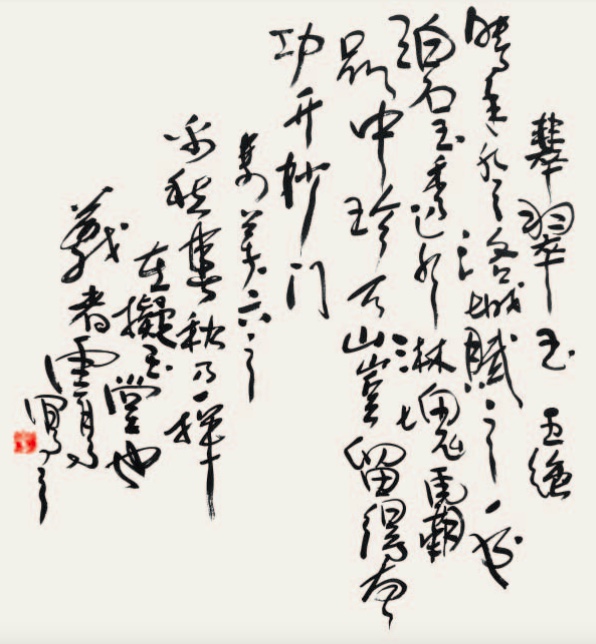
In recent years, there are works of H.H. Dorje Chang Buddha III that have been written in the cursive mode of calligraphy, showing a flowing and unobstructed style, and expressing even more than before the charm of this writing technique. For example, the work Fei Cui Jade expresses the spirit of an immortal or Buddha, thoroughly transcending the three worlds of reincarnation, standing proudly above the five elements of the universe. It is truly calligraphy beyond the category of calligraphy, expressing a feeling that incorporates the whole universe.
Fei Cui Jade: Created with an unfettered hand and unattached mind, it has the appearance of a celestial writing accomplished with a childlike mind and steady strokes of the brush.
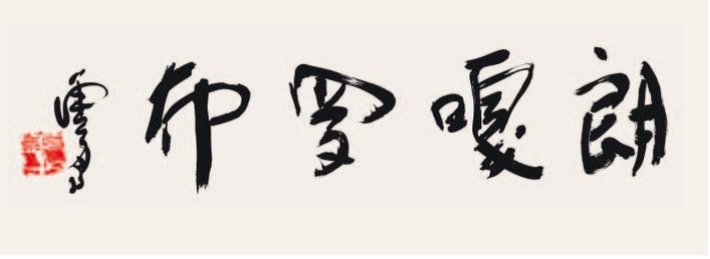
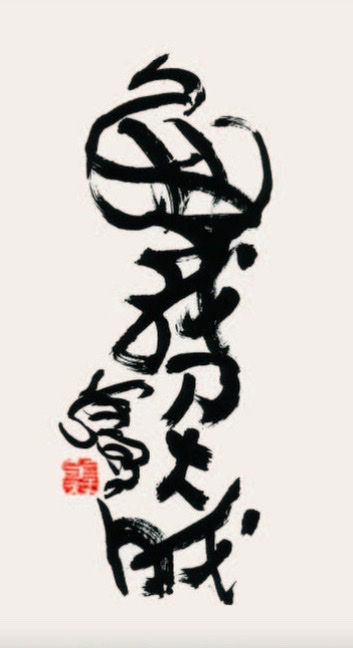
His Holiness’s calligraphy of the Chinese characters lang ga luo bu (Treasure of Heaven) excels the writing of calligraphers throughout history. It transcends all traces of worldliness. It expresses deep strength, like that which can break jade. The style of another calligraphic work called wu wo nai da cheng (No-Self Is Great Accomplishment), conveys the firmness and simplicity of steel and the vigor of a sharp knife. However, these same characters also contain delicate beauty. That calligraphic style truly surpasses styles of the past and present.
Lang ga luo bu (Treasure of Heaven)
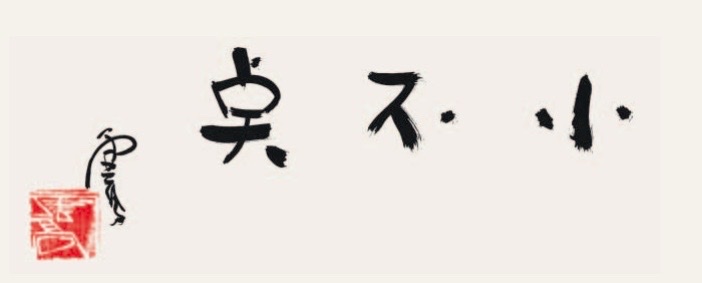
Another calligraphic style of H.H. Dorje Chang Buddha III is revealed in the writing of the Chinese characters xiao bu dian (Tiny). Such calligraphy shows the childlike innocence of a very old man, and its arrangement expresses the utmost ease and lack of rigid constraints. It is high-class calligraphy that does not even seem to be calligraphy. It is so elegant and refined that it completely transcends the mundane.
Tiny (Xiao bu dian)
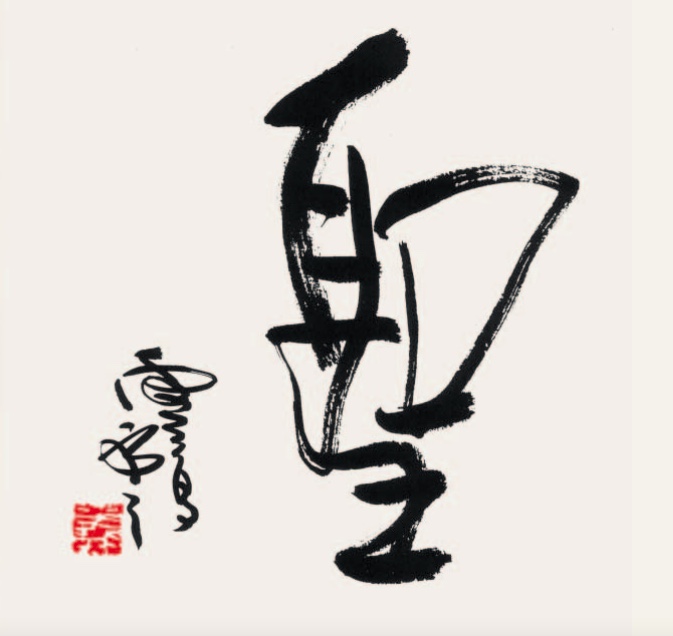
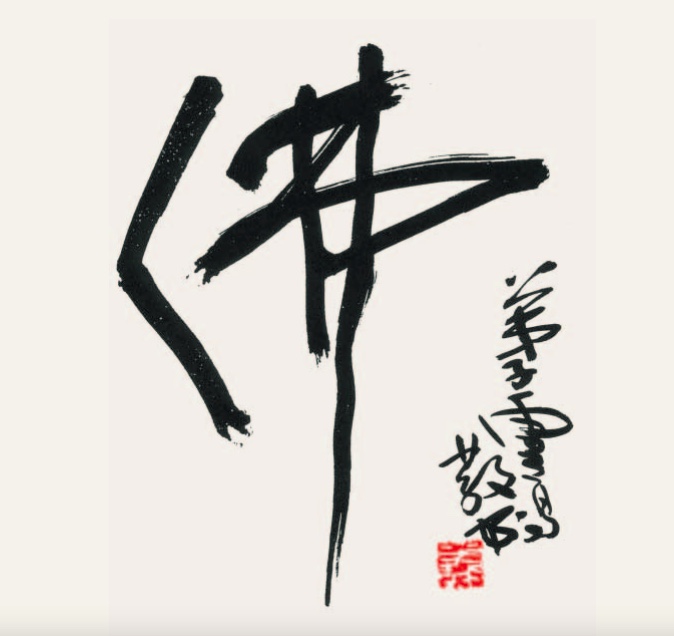
Beholding the character sheng (holy) written by His Holiness, one can see that it simultaneously embodies both the softness of ribbons and the inner-firmness of steel. Its inner beauty flows to the surface. Another example is the character fo, which means Buddha. The writing of that character demonstrates that His Holiness has truly attained the summit of calligraphic skills that the ancients extolled in the old saying, “the old pine branch cannot be weighed down by heavy snow; the might of a brush will lift a thousand-pound bronze cauldron.”
The Chinese character “sheng,” which means “holy.”
The Chinese character “fo,” which means “Buddha.”
In fact, the calligraphy of H.H. Dorje Chang Buddha III has a deep foundation and an internal richness. It embodies the manifold sensations that one could possibly experience in one lifetime. The essence of all things in the universe converges at the tip of His Holiness’s brush. With such a transcendent state of realization, the myriad things of the universe are in the palm of this Buddha. The calligraphy of H.H. Dorje Chang Buddha III is like a treasury. It can be vigorous, smooth, or naturally beautiful. His Holiness incorporates the best techniques of all of the schools of calligraphy. No words can really describe this! His Holiness’s calligraphic skills have reached the highest degree of proficiency and naturalness that only a Buddha could reach!
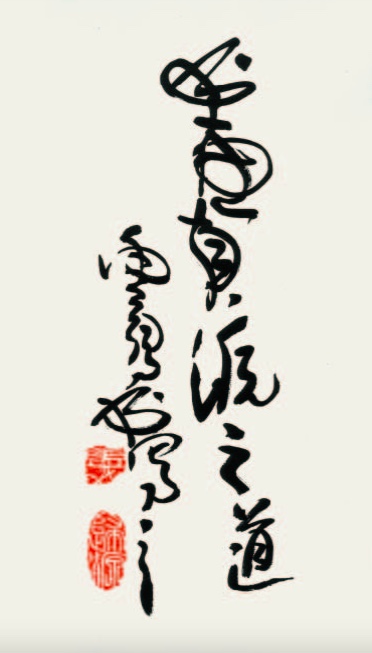
The Way to the True Source of Calligraphy and Painting
No-Self Is Great Accomplishment
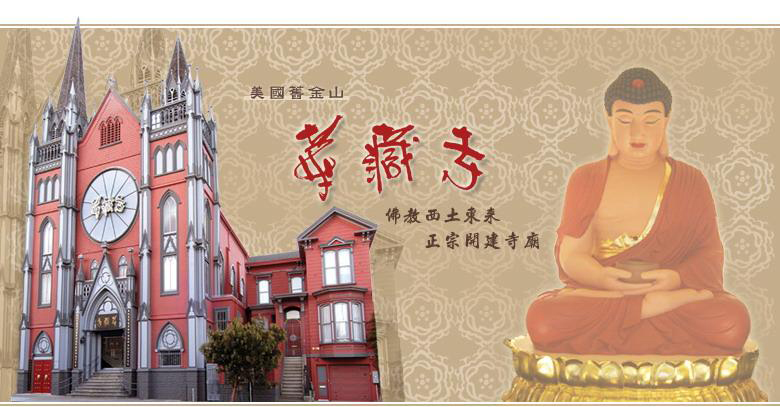
Hua Zang Si (Inscription of a Buddhist temple in San Francisco)
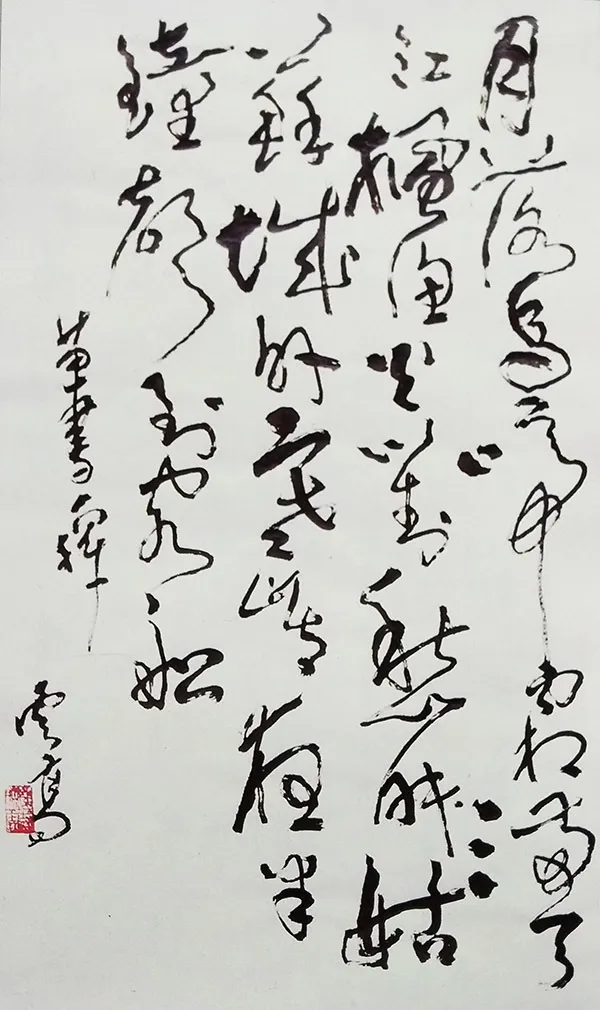
Chinese ancient poem Han Shan Si Temple in rapid cursive style by H.H. Dorje Chang Buddha III
In the annals of ancient wisdom, tales of great insight and philosophical musings have been passed down through generations. One such tale is that of Sai Weng, a man living on the northern frontier whose experiences teach us a valuable lesson about the unpredictability of life. This story illuminates the idea that blessings and curses often come disguised, and it reminds us of the importance of embracing life’s ups and downs with equanimity and resilience.
A long time ago, there lived a man named Sai Weng on the northern frontier of China. One day, his beloved white stallion ran off into the territory of the northern people, leaving Sai Weng without his cherished companion. His son was heartbroken. Naturally, his neighbors sympathized with him, considering it a great misfortune. Surprisingly, Sai Weng remained unperturbed and uttered these words: “Perhaps this will soon turn out to be a blessing.”
After a few months, the horse returned to Sai Weng, accompanied by another magnificent horse from the north. The neighbors were amazed by his good fortune and congratulated him on his newfound wealth. Yet, Sai Weng, ever wise, cautioned them by saying, “Oh, of course I am pleased…. but who knows if this is lucky or unlucky?.”
And so it did, for Sai Weng’s son, who grew fond of horse riding, had a terrible accident and broke his leg while riding the new horse. Once again, the neighbors expressed their sympathies, believing it to be an unfortunate turn of events. However, Sai Weng responded with his characteristic insight, saying, “I cannot know if these injuries will turn out to be something good or something bad.”
In due time, war broke out along the border with the northern people. The able-bodied men from Sai Weng’s village were called to arms to defend their homeland. Tragically, most of them perished in the battle. But Sai Weng and his son were spared, as the son’s injury prevented him from joining the fight. It was then that the true meaning of Sai Weng’s words became apparent – what seemed like a curse had, in fact, saved their lives.
Sai Weng’s story offers us profound insights into the nature of life and the ever-changing circumstances we encounter. It teaches us that appearances can be deceiving and that our judgments based on surface-level observations may not reflect the true nature of a situation. It urges us to refrain from hasty conclusions and remain open to the possibilities that lie ahead.
The concept of predestination is introduced in this tale, highlighting the idea that some things in life are beyond our control and are determined by fate. While we cannot alter the hand we are dealt, we can choose how we respond to it. Sai Weng’s calm acceptance and his ability to find hidden good opportunities in apparent setbacks demonstrate the importance of adapting to circumstances with grace and wisdom.
When fortune smiles upon us, it is essential to remain humble and vigilant, aware that circumstances can change unexpectedly. Gratitude for our blessings should be accompanied by a sense of preparedness for potential challenges. Similarly, when faced with adversity, we must remember that it is temporary and maintain hope and optimism for the future.
Sai Weng’s tale serves as a timeless reminder of the unpredictable nature of life and the need for a balanced perspective. It teaches us not to be overly complacent during favorable times and not to be disheartened by setbacks and obstacles. By embracing the ebb and flow of life, we can cultivate resilience, wisdom, and gratitude. As we navigate our own journeys, let us remember the lessons of Sai Weng and approach life with equanimity. By seeing beyond the surface and embracing both the blessings and the challenges.
In traditional China, painting was revered as “silent poetry,” while poetry was seen as “painting with sound.” Both art forms found expression through the medium of calligraphy, which was considered the “art of handwriting.” Scholars and artist-scholars incorporated calligraphic brushstrokes into their paintings, viewing their artworks as vehicles for self-expression. Consequently, painting was not only regarded as an art form of equal purity and lyricism to poetry and contemplative thought but also as a means to evoke sensory experiences, emotions, and a holistic engagement with the world.
For Western observers, it may be intriguing why Chinese artists incorporate writing in their paintings and what significance the characters hold. By examining some of H.H. Dorje Chang Buddha III’s paintings, we can gain insight into these questions and witness the embodiment of the concept known as the “Three Perfections.” This concept represents the harmonious fusion of fine painting, poetry, and calligraphy within a single artwork.
Song of the Waves in the Three Gorges by H.H. Dorje Chang Buddha III
This painting, titled “Song of the Waves in the Three Gorges,” beautifully captures the grandeur of splash-ink technique alongside the charm of water and ink colors. Its overall tone carries a weighty presence. The brushwork employed in this artwork evokes a powerful sense of momentum, lively charm, and a vividness akin to the scene of a long, flowing river just passing by. The inclusion of a few small sailboats adds elegance to the water scene as they gracefully navigate through it. The combination of the mighty river and awe-inspiring mountains, enveloped in mist and holding sacred spaces, has a purifying effect on one’s emotions. This painting possesses a quality that is reminiscent of both poetry and calligraphy.
Notably, H.H. Dorje Chang Buddha III has inscribed an elegant Chinese poem onto this painting, which can be translated as follows: “The song of waves echoes in the gorge. Hanging colors of rocky cliffs burst with charm. A few cloudy, misty mountains reveal shades of blue. The vast water’s melody sets the sails in motion.” This poem aptly captures the beautiful and misty landscape of the Three Gorges, where the water and sky harmoniously blend, and human emotions become intertwined with the scenery. This painting serves as an artistic paragon, showcasing the mastery of poetic, calligraphic, and painting skills.
Yi Shan Shui Yun Liang Qing Nong ( One Landscape Charm Presents Two Strong Emotions) By H.H. Dorje Chang Buddha III
This remarkable painting showcases a rare combination of splash-ink and splash-color techniques, displaying the artist’s bold and skillful brushwork. The resulting natural effect achieved through these techniques is truly indescribable. Within the bold and dynamic brushstrokes, one can discern countless intricate details and traces of charm emerging from the flowing watery ink.
The painting depicts a scene of mountains and water during the approaching dusk, conveying a profound message. The poem imparts the wisdom that we should strive to engage in virtuous deeds rather than harmful actions, treating all living beings with kindness and respect. By embodying such a way of life, one can transcend to another realm and grasp the truth of existence beyond the concepts of birth and death. This painting offers a profound contemplation on the purpose and significance of human existence.
The calligraphy in the two art works are executed in a cursive style, known for its swift and dynamic strokes. Cursive writing is often characterized by its rapidity and vitality, effectively conveying the artist’s profound emotions.
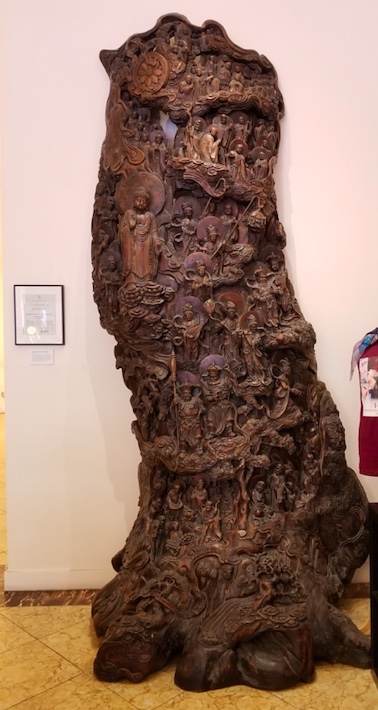
In a world where art manifests itself in countless forms, there are rare instances when we stumble upon something truly extraordinary—a concealed treasure that enthralls our senses and moves us on a deep level. Such a remarkable encounter occurred one fateful day as I explored the gift shop at The International Art Museum of America (IAMA), nestled in the heart of downtown San Francisco. Amidst the vast array of artistic wonders, my gaze became fixated on an exquisitely crafted wood carving—a masterpiece that exuded an ethereal essence of spirituality and profound significance.
This awe-inspiring sculpture, meticulously chiseled from a single tree, originated from China and was skillfully brought to life by gifted folk artists. It portrayed an enchanting realm of spiritual growth and profound accomplishments in Buddhism. Towering at an impressive height of approximately three and a half meters and spanning one meter in width, this artwork was a testament to the dedication and artistry of its creators. Every intricate detail, meticulously carved figures, and delicate embellishments, painted a vivid tableau illustrating the virtues of compassion, enlightenment, and the transformative journey towards Nirvana.
The intricately carved sculpture was a masterpiece that depicted the journey of practitioners from being ordinary to mastering the higher levels of Buddhahood. The figures in the relief were so vividly carved that it was easy to see their progression towards enlightenment and Nirvana. Every detail, from the facial expressions to the flowing cloth, the delicate flowers, and the instruments, was so meticulously presented that it was impossible not to be impressed.
The beauty of this piece lay not just in its stunning visual presentation but also in the message it conveyed. It illustrated the importance of practicing compassion in thoughts, words, and deeds to achieve spiritual growth. It reminded us that every act of kindness, every gesture of love, and every moment of selflessness is a step towards enlightenment and Nirvana.
The sculpture had a calming effect on me. It was a tangible reminder of the power of art to transcend language, culture, and time. It spoke to me in a language that was universal, one that transcended borders and connected people across the world.
As an art lover, I have seen many beautiful pieces over the years, but this wood carving sculpture stood out as a true masterpiece. It was a testament to the skill and craftsmanship of the folk artists who created it, and it served as a reminder of the timeless beauty of art.
The Yungang Buddhist grottoes, a massive complex comprising 252 caves and niches with 51,000 statues carved into an area of 18,000 square meters, are a remarkable achievement of Buddhist cave art in China. Constructed from the mid-5th to early-6th century AD, the grottoes were influenced by Buddhist cave art from South and Central Asia but also incorporated distinct Chinese elements and local spirit. They played a crucial role among early Oriental Buddhist grottoes and had a far-reaching impact on Buddhist cave art in China and East Asia.
The five caves of Tanyao and their imperial patronage
The construction of Yungang began with five cave-temples, known today as caves 16 to 20, at the west end of the cliff. These caves were imperial commissions of the Northern Wei dynasty in around 460 C.E. The Northern Wei rulers, who belonged to the Tuoba clan from northern China, had recently unified northern China after centuries of political turmoil and established Buddhism as the state religion. The dynasty’s capital, Pingcheng, became a significant center for Buddhist religious and artistic expression.
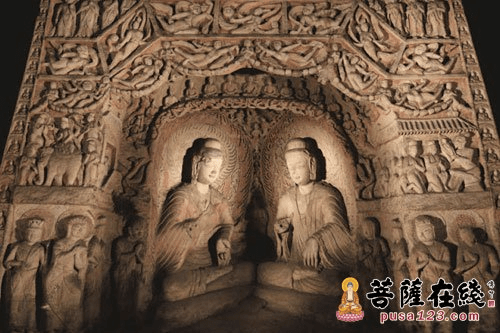
The five caves of Tanyao, created by Tan Yao, are classical masterpieces of the first peak of Chinese art, displaying a strict unity of layout and design. These caves each contain a colossal Buddha as the central icon, with Cave 20 housing a gigantic seated Buddha in a meditation posture and a standing attendant Buddha on one side. Another attendant Buddha likely existed on the other side, but it has been lost along with the cave’s exterior wall. The imperial patronage of these caves reflects the Northern Wei dynasty’s fusion of state power and religious devotion.
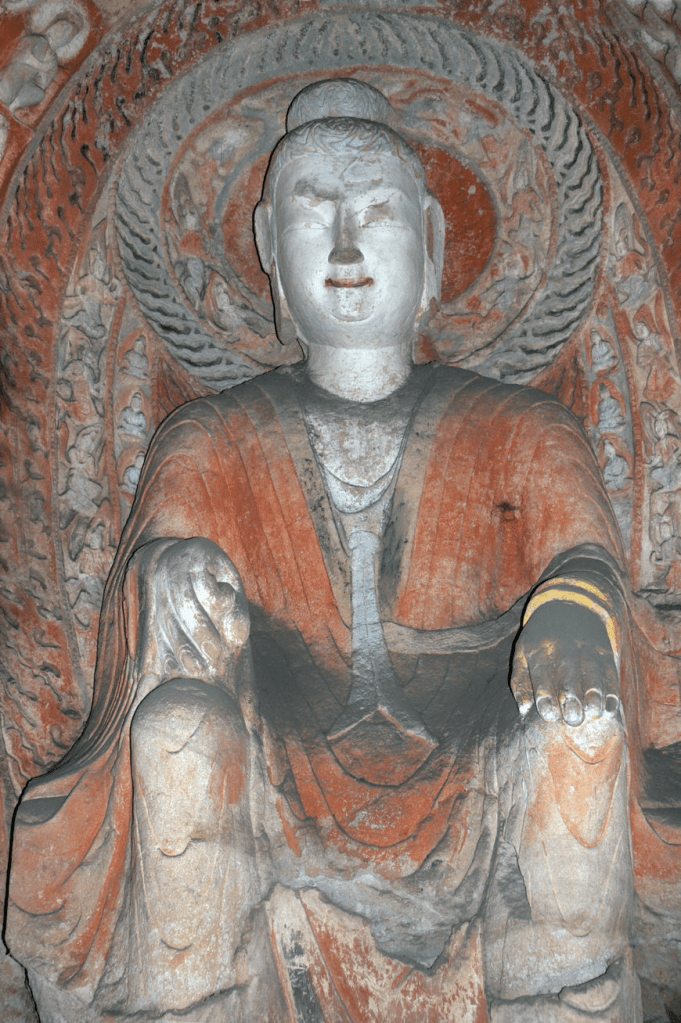
Buddha, Cave 20 at Yungang, Datong, China (photo: xiquinhosilva, CC BY 2.0)
The main Buddha measures roughly 13 meters in height. He has plump cheeks, a thick neck, elongated eyes, a sharply cut nose, slightly smiling lips, and broad shoulders, all of which produce a solemn appearance.
The well-preserved halo behind the main Buddha is composed of an outer band of flame patterns and two inner bands decorated with seven seated Buddhas of miniature size. The robe features zigzag patterns on the edge. The right shoulder of the main Buddha is left exposed, whereas the standing attendant Buddha on the east wall wears a robe that covers both shoulders with a high neckline.
Historical records recount that Tanyao, a renowned monk cleric with official ranks, advised Emperor Wencheng to undertake construction of five cave-temples (Caves 16–20) to commemorate the five founding emperors of the Northern Wei dynasty. Claiming that the emperor of Northern Wei was the living Buddha, this project declared the emperor’s political and spiritual legitimacy, and strengthened the rule of the imperial family.
Buddha (left) and attendant Buddha (right), Cave 20 at Yungang (photo: xiquinhosilva, CC BY 2.0)
The statues housed in the caves and niches are in good condition and all of the caves and statues have not suffered major damage from vandalism and/or natural disasters. Restoration and repair had been made on deficient parts of some statues in the past. All the necessary attributes demonstrating the Outstanding Universal Value of Yungang Grottoes are contained within the boundary of the property area. The buffer zone provides a necessary safe area for the conservation of the Grottoes, the setting and the historic environment. These measures have enabled the Yungang Grottoes to serve as one of the greatest ancient stone carving art treasure houses in the world.
The location, caves and statues of the Yungang Grottoes have retained their historic appearance. The eaves of wooden pavilions of the caves and the related historical remains have kept the distinctive character of the times when they were constructed. The daily maintenance and conservation intervention have been conducted following the conservation principle of minimal intervention in design, materials, methodology, techniques and craftsmanship.
The cross-legged Bodhisattva Maitreya, on the east wall of the antechamber of Cave 9, phase II, Yungang Grottoes, Datong, China (photo: G41rn8, CC BY-SA 4.0)
The paired caves and the major development at Yungang
Beginning roughly a decade after the initial commission, the imperial projects at Yungang advanced to a second phase that lasted from c. 470s until 494 C.E. In contrast to the monumental Buddha found in Cave 20, the interior of the second-phase cave-temples are decorated with reliefs that depict Buddhas, bodhisattvas, and other divine figures in various scales and configurations.
One of the most distinctive features developed in the second phase of construction are paired caves—two adjacent caves featuring a similar architectural plan and pictorial program. The paired cave-temple layout is understood to symbolically represent the reign of two coincident rulers: Emperor Xiaowen (471–499 C.E.) and Empress Dowager Wenming (442–490 C.E.). The use of paired cave-temples became another means to demonstrate the dynasty’s imperial power.
The paired Caves 5 and 6 are among the most lavishly decorated cave-temples at Yungang. Cave 6 has an antechamber and a square main chamber supported by a central pillar (see the full cave 6 in 3D). A square clerestory (window) is opened right above the passageway to the main chamber to let in light (although it is hard to see in photos or the 3D image).
In the main chamber of Cave 6, the east, south, and west walls are divided vertically into three main registers that include complex pictorial programs (the north wall features a large niche housing a trinity of Buddhas that are later repairs). We find seated Buddha figures and scenes from the Buddha’s life throughout the chamber. Depictions of the historical Buddha, who was believed to live in the Ganges River basin during the 6th century B.C.E., derived largely from Buddhist texts. The Buddha’s biography details the course of his life from birth to enlightenment, and eventually to nirvana, the final extinction. The life of the Buddha was among the most popular themes for artistic representation throughout the Buddhist world.
The First Sermon of the Buddha at Deer Park, Cave 6, Yungang, Datong, China
One scene from the Buddha’s life (at the southern end of the east wall) shows the First Sermon of the Buddha at Deer Park, identifiable by the depiction of a pair of deer on the Buddha’s throne. We see a canopied standing Buddha flanked by two standing bodhisattvas and a myriad of worshippers in the background. Just below the standing Buddha niche, a seated Buddha with his right hand raised (the fearless gesture) can be seen in a trapezoidal-shaped niche flanked by two five-story pagodas (just visible at the edges of the scene in the photograph). Worshippers either kneel in front of the throne or stand facing the Buddha on his two sides.
Rock-cut cave-temples
Rock-cut cave-temples first appeared in western India in the 1st century B.C.E. There are two basic types: apsidal-shaped (semicircular) chaitya (sanctuary, temple, or prayer hall in Indian religions) and vihāra caves where monks resided—both of which we find at places like the caves of Ajanta, India. Both types were transmitted eastwards to Central Asia up to the 5th century with modifications of the structures. At Yungang, the sanctuary type was further adapted into a square shape that houses a central pillar in the middle, as we find in Cave 6. At the same time, a number of architectural features find their precedents in Goguryeo tombs from present-day northeastern China and North Korea.
But what facilitated these different traditions coming together at Yungang?
Transmissions and transformations of artistic styles
Yungang was a hub where multiple artistic traditions of South Asia, Central Asia, and pre-Buddhist China synthesized into something new. This was made possible by the Silk Road, a network of ancient trade routes linking East Asia with the rest of Eurasia. Goods and ideas have been exchanged along the Silk Road since at least the second century B.C.E. Central to the economic, cultural, and religious interactions between different parts of Eurasia, the Silk Road tied the Northern Wei territory to the sacred heartland of Buddhism in South Asia, and to Central Asian kingdoms that promoted Buddhist teachings.
A primary factor facilitating the encounter of these varied traditions was the gathering of human resources and materials from different regions. In the 430s and 440s, the Northern Wei court issued decrees that relocated artisans and monks from its conquered lands to the capital city of Pingcheng. The concentration of people and craftsmanship in the capital led to the artistic flourishing of well-executed Buddhist monasteries, cave-temples, sculptures, and murals. Eminent monks who were active in Pingcheng had also engaged with religious activities in other urban centers such as Chang’an and Wuwei, and maintained close ties with Central Asian Buddhist communities.
Just as the form of the rock-cut cave-temples was adapted from earlier traditions in South Asia, statues and reliefs at Yungang exhibit strong stylistic and iconographic affinities with earlier Buddhist art traditions from northwestern India and Central Asia. For instance, the main colossal Buddha images in Caves 16 to 20 feature a round face, with a gentle, calm expression that creates an impression of sanctity, and a robe style that clings tightly to the body yet is rendered with schematic patterns. All of these features echo the aesthetics found in previous traditions, especially the Buddhist sculptures in Gandhara, a Buddhist center located in present-day northwest India and Pakistan.
Yungang art exerted influence, in turn, on Central Asian cave-temples starting in the later 6th century, such as Dunhuang, indicating that a dynamic exchange took place among the major cultural centers along the Silk Road.
An iconic form of the Buddha, 2nd–3rd century C.E., Kushan period, Gandhara, schist, 19.76 x 16.49 x 4.56 inches (The British Museum)
Sinicization reforms under the reign of Emperor Xiaowen
One of the new developments shown at Yungang that would have a long-lasting effect on Chinese Buddhist art was Sinicization, a process of adapting non-Chinese traditions into Han Chinese culture. In Cave 1, between the canopy of the central pillar and the ceiling we find intertwined dragons surrounding mountains that represent Mount Meru (the sacred mountain considered to be the center of the universe in Buddhist cosmology). The design shows strong influence of the pre-Buddhist Chinese tradition in two aspects. First, the dragons are depicted with typical Chinese conventions—a snake-like curving body with four legs. Mount Meru was not related to dragons in pre-Chinese Buddhist art traditions. The incorporation of dragons in the design reveals an integration of the motif’s symbolic reference to a spiritual life force in traditional Chinese beliefs.
Central pillar in Cave 1, c. 480s, Northern Wei, Yungang (photo: Zhangzhugang, CC BY-SA 3.0)
In Cave 6, we also see Sinicized traits in a new style of the Buddha’s monastic robe, which features loose drapery that falls around the body and clothes the Buddha entirely instead of the earlier style that clings closely to a partly exposed body. The new style finds parallel in the contemporary dress of court officials.
Overall, these new styles and motifs were a response to the political reform of Sinicization promoted by Emperor Xiaowen and Dowager Wenming during their reign in the Taihe era (477–499 C.E.). The reform aimed at legitimizing the Northern Wei regime, built by non-Chinese nomadic groups, as an imperial Chinese dynasty, and promoting a greater sense of conformity throughout the empire.
Buddha with Sinicized traits, Cave 6, Yungang, China (photo: Gisling, CC BY-SA 3.0)
The legacy of Yungang
Despite the move of the capital to Luoyang in 494 C.E., constructions at Yungang continued for another three decades. Cave-temples of this phase are much smaller in size than at the earlier western end of the complex. Over half a millennium later in the 13th century when Yungang was the capital of the Liao Dynasty, Yungang witnessed another era of glory, with restorations of the caves and installation of wooden structures attached to their façades. Yet it was only a temporary phenomenon. The site later stayed silent for centuries until its early 20th-century rediscovery along with other major cave-temples by foreigners on expeditions.
Modern scholarship about the history and the art of Yungang Cave-temples has continued to provide new information about the site. The most recent archaeological excavations at Yungang unearthed the remains of a monastery dated to the Northern Wei dynasty above the western section of the cliff. The well-preserved foundations of courtyards, the central stupa (a sepulchral monument that refers to the Buddha), residential cells for monks, and objects continue to enrich our understanding of the site as a significant religious center from the 5th century.
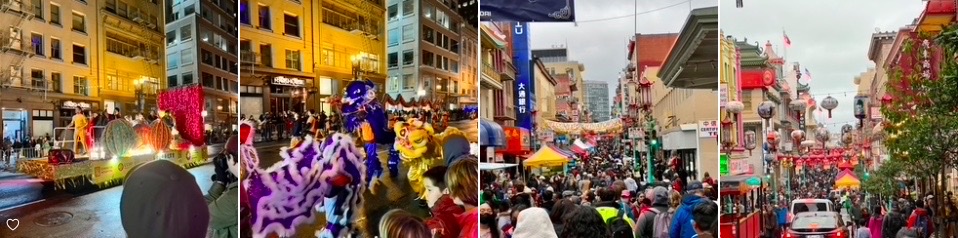
On Saturday, February 4th, the streets of San Francisco’s Chinatown were filled with the sounds and sights of the Chinese New Year parade. Thousands of people gathered to celebrate and enjoy the festivities.
The entire Chinatown was decorated in traditional Chinese style, adding to the already lively atmosphere. Street markets sold traditional Chinese goods and food, and the sounds of live music filled the air.
The parade, which started at 5 PM, was a highlight of the celebration. Floats, marching bands, and performers made their way through the crowded streets, bringing the excitement and energy to a whole new level. However, rain, showers and winds also joined the parade. That brought little bit uncomfortable to the crowds.
One of the highlights of the parade was the traditional lion and dragon dances, performed by skilled dancers dressed in colorful costumes. These dances are believed to bring good luck and prosperity for the new year, and the crowds were enthralled by the displays.
In addition to local performers, marching bands from Southern California and Oregon also made the journey to San Francisco to participate in the parade. The diversity of performers added to the already rich cultural atmosphere, and showcased the strong connection between the different Chinese communities across the United States. Despite the rain and showers, the spirit of the event was not dampened, and it was a beautiful tribute to the start of a new year.
As a proud Chinese, I was thrilled to participate in the Chinese New Year parade in San Francisco’s Chinatown. Living in the United States is a privilege, as this great nation has an open heart that accepts and embraces diverse cultures. I hope to see the US play a leading role in promoting peace and harmony globally.
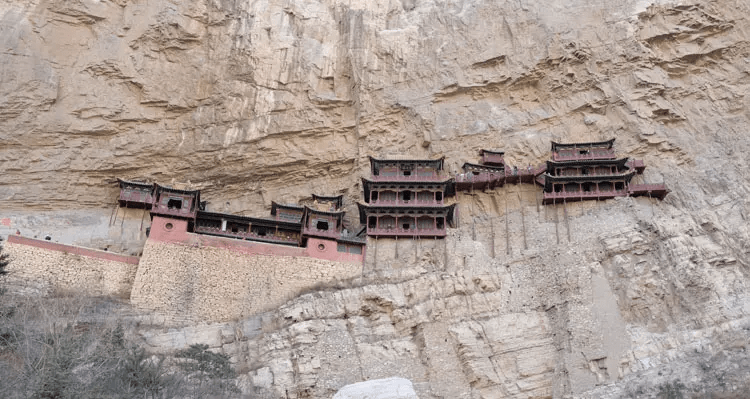
China have about a dozen of hanging temples. They are truly relics in Chinese architecture history. The most famous hanging Temple, is Hengshan Hanging Temple, Hanging Monastery or Xuankong Temple, is a unique and ancient structure located in Hunyuan County, Datong City, Shanxi Province, China. This temple is built into a cliff that stands 75 meters or 246 feet above the ground, near Mount Heng. The closest city, Datong, is located 64 kilometers or 40 miles to the northwest.
The Hanging Temple is one of the main tourist attractions and historical sites in the Datong area, along with the Yungang Grottoes. It is considered unique because it is the only existing temple that combines three Chinese traditional philosophies or religions: Buddhism, Taoism, and Confucianism. The structure is held in place with oak crossbeams that are fitted into holes chiseled into the cliffs, and the main supportive structure is hidden inside the bedrock.
The temple was built more than 1,500 years ago by a monk named Liaoran in 491 AD. Over the years, many repairs and extensions have been made to the temple, leading to its present-day scale. The temple comprises of 40 halls and pavilions that are all built on cliffs that are over 30 meters or 98 feet from the ground. The distance from north to south is longer than from east to west, and it becomes higher and higher as one moves from the south gate to the north along the mountain.
The temple’s layout includes the Qielan Hall (Hall of Sangharama), Sanguan Hall (Hall of Three Officials), Chunyang Hall, Hall of Sakyamuni, Hall of Three Religions, and Guanyin Hall. The Hall of Three Religions mainly enshrines Buddhist deities, as well as both Taoism and Confucianism. The statues of Sakyamuni (middle), Lao-Tze (left) and Confucius (right) are enshrined in the hall, reflecting the prevailing idea of “Three Teaching Harmonious as One” in the Ming and Qing dynasties (1368–1911).
The Hanging Temple is a unique and ancient structure that combines three Chinese traditional philosophies or religions, and is one of the main tourist attractions and historical sites in the Datong area. Its location on a sheer precipice and its history make it a must-see destination for anyone visiting China.
You can visit the Hanging Temple all year around, but considering the Datong weather, normally from April to October is the best period. Datong has a temperate continental climate with distinct seasons, low rainfall, a short summer, and a long freezing winter (November–March).
There are big temperature differences between morning and night, day to day, and mountain and valley, so please bring a warm jacket with you even if you travel in the summer time.
In order to protect the temple, the number of visitors is limited to 80 in the temple at a time. Therefore, it is recommended to visit the Hanging Temple early in the morning to avoid long waits especially in the high travel seasons (summer and holidays).
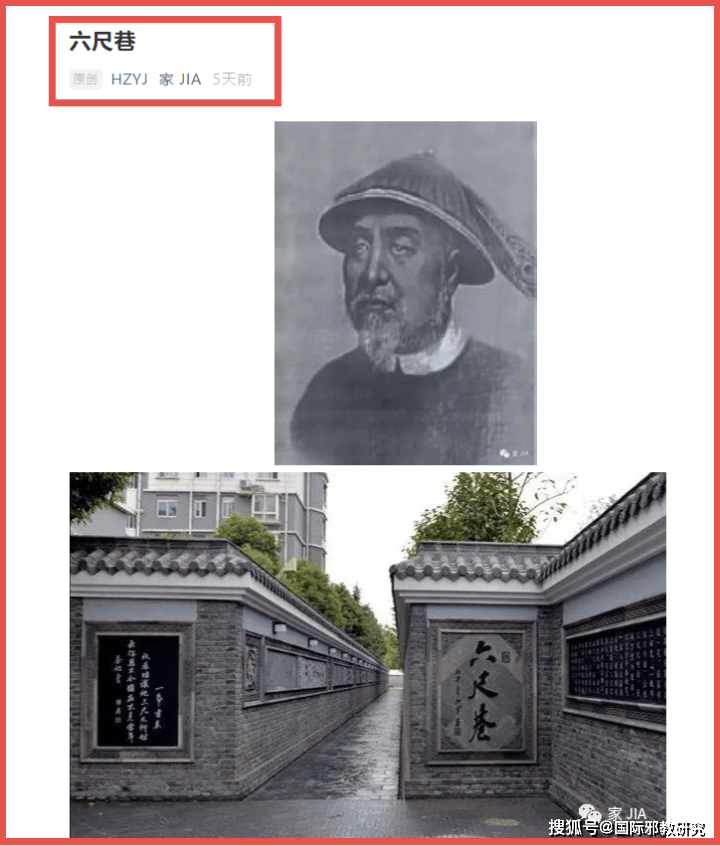
“Liu Chi Alley” (六尺巷 in chinese) is located between Xihou Street and Wumu Garden in Tongcheng District, Tongcheng city, Anhui Province. The allusion of “Six-foot Alley” has become a historical story stems from the land dispute between Zhang’s family and his neighbors.
In the Qing Dynasty, there was a famous family in Tongcheng, Anhui Province. Father and son were the prime ministers of the two generations and had great power. Their names were Zhang Ying and Zhang Tingyu. During the reign of Emperor Kangxi in the Qing Dynasty, Zhang Ying was a Bachelor of Arts at Wenhua Palace and a minister of rites. At that time, the Zhang family’s old house in Tongcheng was adjacent the house of the Wu family. There was only about 3 feet of space between the land owned by each family.
The Wu family wanted to expand their property to occupy this space. The Zhang family vehemently disagreed. The two sides brought the case to the county courthouse of Yamen. County officials knew that both families involved in the dispute were well-known families with prominent officials. They dared not easily break the dispute. During this period, the Zhang family wrote a letter to Zhang Ying, now a senior official in Beijing, asking Zhang Ying to come out and interfere in this matter. After receiving the letter, Zhang Ying thought that he should humble the neighbors, and wrote a poem to his home in reply:
Thousands of miles of a mail is only for a wall.
Why not give up him three feet?
The Great Wall still stands today.
But where is the Empire Qishihuang now?
The Zhang family read it and eventually realized they understood its meaning. They took the initiative to give up three feet of space for the Wu family’s property. The Wu family, deeply touched by this gesture, decided to concede three feet of their own adjacent land, thus forming a six-foot lane between the properties. The two courtesy concessions and the Zhang family’s non-oppressive approach were passed on to be good folk stories.
From this story, we learn to be modest and tolerant in life. Mutual humility can avoid many contradictions and reduce disputes between people. Mutual understanding and tolerance can help people get along harmoniously, and can greatly improve people’s happiness index. As the saying goes, “A bit of forbearance will calm the wind and silence the wave. Take a step back and have the vastness of sea and sky.”
The virtues of tolerance and equality have been passed down since ancient times. In the process of building a harmonious society for people who are open-minded and respectful, this tradition of humility needs to be carried forward even more. The allusions to a “Six-Foot Lane” have gone far beyond its original meaning and has become a testimony to the virtues of harmony and humility of the Chinese nation.




















 Peace LiLy


