Louise Hay: From Pain to Healing, From Healing to Helping the World

There are some people whose presence feels like sunlight—warm, gentle, and full of hope. Louise Hay was one of them. An internationally renowned spiritual teacher, best-selling author, and pioneer of the self-help movement, she inspired millions of people around the world to believe in their own healing power. Her landmark book You Can Heal Your Life has sold over 50 million copies in 35 countries, translated into 29 languages, and for many, it sits by the bedside as a trusted guide through life’s storms.

To the world, Louise Hay seemed perfect—healthy, elegant, wise, always radiating grace. Her teachings lifted countless people out of despair, helped them restore their health, and gave them courage to live again. Media across the globe lovingly called her “the closest person to a saint.”

But what made Louise extraordinary was not that her life was flawless—it was that she transformed the deepest wounds into the greatest gifts. Behind her radiant presence was a childhood filled with suffering, abuse, and neglect. It was from that very pain that she forged the wisdom that changed the lives of millions.

1. Falling Amid Misfortune

When Louise was just 18 months old, her parents divorced, abruptly ending her once-happy family life.

At that time, women had little social standing. After the divorce, her mother could only work as a maid to survive, while Louise was sent to live in foster care.

At age five, her mother remarried in the hope of giving Louise a complete home. But this marked the beginning of her nightmare.

Louise was raped by a neighbor, abused and assaulted by her stepfather, and subjected to violence and sexual exploitation. These experiences left her with deep wounds and a lack of self-worth. In her teenage years, as long as a man showed her the slightest kindness, she would give herself to him. By the age of sixteen, she had already given birth to a daughter.

Her childhood was filled with tragedy, and her youth with self-destruction. Those early wounds shaped her into someone who did not know how to love herself.

Yet later in life, Louise chose not to remain trapped in resentment or regret. She said, “No little boy is born a predator, and no little girl is born a victim. These are learned behaviors shaped by childhood experiences.”

2. Awakening and Transformation

In her forties, Louise was diagnosed with cancer. That moment became her wake-up call. She realized how little she had cared for her own body, and she resolved to change.

Instead of following the conventional treatment suggested by her doctors, she turned to what she called “holistic healing.” Within six months, her cancer had disappeared.

Holistic healing, as Louise practiced it, meant changing destructive thought patterns and adopting healthier eating habits. She stopped mourning her unhappy past and stopped blaming her parents. Instead, she came to understand their own painful childhoods.

During her recovery, she ate mostly sprouts and simple natural foods, avoiding processed products entirely. She also trained her mind daily—using positive affirmations, choosing not to let negative emotions dominate her, and seeing every situation through a more uplifting perspective.

Her life changed completely. She documented her experiences and insights in books, which went on to inspire millions and transform countless lives.

3. You Can Choose Your Own Destiny

There are many in this world who have been hurt or are still suffering. Their stories move us deeply.

But as an old Chinese saying goes, “Those who seem pitiable often have traits that make them vulnerable.” In truth, much of life’s suffering continues because, consciously or unconsciously, we allow it. And the root often lies in our formative years.

Take, for example, teenage pregnancies. While news headlines may highlight shocking cases, the majority stem not from coercion but from lack of self-respect or proper knowledge. Similarly, many women trapped in abusive relationships remain because they lack self-worth and the courage to leave.

We cannot rewrite our childhoods, but we can shape our adult lives. As Louise Hay wrote in You Can Heal Your Life: Mindfulness Edition:

“Every negative message you received as a child can be transformed into a positive affirmation.”

If you had an unhappy past, stop feeding yourself negative words. Begin telling yourself: I am worthy of love. I am needed. I have many strengths. I can live the life I choose.

And if doubt still lingers, look at Louise Hay’s journey. Few have endured the kind of suffering she did—yet she lived a life admired and envied by many. If she could, why not you?

In the infinity of life where I am, all is perfect, whole, and complete.

Life Is Really Very Simple. What We Give Out, We Get Back.  What we think about ourselves becomes the truth for us. I believe that everyone, myself included, is responsible for everything in our lives, the best and the worst. Every thought we think is creating our future. Each one of us creates our experiences by our thoughts and our feelings. The thoughts we think and the words we speak create our experiences.”

Her books may be called “chicken soup for the soul,” but isn’t that exactly what we need sometimes? A warm voice reminding us that we are enough, that healing is possible, and that life can be beautiful again.

You Can Heal Your Life walks us through every stage of existence—childhood pain, love’s struggles, career challenges, health worries, aging, and even the fear of death. Louise’s message is simple but powerful: change your beliefs, and you will change your life.

This “chicken soup” has comforted millions, given them strength, and helped them step into new beginnings.


💖 A Gentle Reminder

If you feel lost, unworthy, or stuck in a cycle of pain—Louise’s story is a light in the darkness. Her life teaches us that healing begins not from the outside, but from within.

No obstacle is too great. No past is too broken. Deep within each of us lies an infinite potential waiting to bloom. When we dare to change our thoughts and love ourselves, life unfolds in colors we never imagined.

Believe it: just like Louise Hay, you too can heal your life—and create a future filled with peace, love, and joy.

Here is the link for the E-book.

Link:https://peacelilysite.com/2025/09/03/louise-hay-from-pain-to-healing-from-healing-to-helping-the-world/

Thirty Million Words: How a Parent’s Voice Shapes a Child’s Future

“Imagine a child’s brain as a garden. Every word you speak is like a drop of water nurturing growth.”

One cold winter morning in 1995 at a Chicago hospital, Dr. Dana Suskind, a cochlear implant surgeon, held the small hand of a boy who had just undergone surgery. Technically, the boy could now hear. Yet weeks passed, and he still didn’t speak a word. Dr. Suskind wondered—what was missing? She discovered that while technology could restore hearing, it could not replace something even more vital: the daily language environment a child grows up in. Without rich and loving conversation, the boy’s world remained silent in a deeper sense.

This experience led Dr. Suskind to research the profound role parents play in shaping their children’s language and cognitive development. She founded the Thirty Million Words (TMW) initiative, inspired by a groundbreaking 1995 study by child development researchers Betty Hart and Todd Risley. Hart and Risley discovered a striking reality: by the age of three, children from higher-income families had heard about thirty million more words than children from lower-income families.

From birth to age three, a child’s brain forms 1 million neural connections every second. Every conversation is brain-building—especially when it’s warm, eye-to-eye, and responsive.

Quantity matters—more words create more neural connections.

Quality matters more—it’s not just talking to a child, but engaging with them in responsive conversations.

Children who heard more words also experienced more encouraging interactions, richer vocabulary, and emotionally supportive tones from their parents. Meanwhile, children who heard fewer words were often exposed to more negative or directive language (“Stop that!” “Don’t do this!”) and fewer warm, conversational exchanges. By the time these children entered school, the gap had already set the stage for differences in learning, confidence, and future opportunities.

Dr. Suskind’s TMW initiative encourages parents to intentionally fill their children’s early years with abundant, meaningful, and loving conversation. She emphasizes the Three T’s:

  1. Tune In – Notice what your child is focused on and talk about it.
  2. Talk More – Use a rich variety of words to describe, explain, and explore the world together.
  3. Take Turns – Engage in back-and-forth conversation, even before your child can speak words.

For example:

  • Instead of saying, “Don’t touch that!” try: “That’s sharp, sweetie. Let’s find something safer to play with.”
  • Instead of a quick “Good job,” you might say: “I love how you stacked those blocks so high! You worked so carefully.”
  • During a walk, point to things you see—“Look at that big red leaf!”—and let your child respond, even with just a gesture or sound.

But there’s another crucial element—how you speak. A gentle tone, warm facial expressions, and genuine interest create an emotional space where a child feels safe and valued. Neuroscience shows that when a child feels emotionally secure, their brain is more receptive to learning and language development.

Dr. Suskind’s work reminds us that parents are a child’s first and most influential teachers—not because of expensive toys or formal lessons, but because of the warmth, curiosity, and attention they share through conversation.

You don’t need a degree or a script. Your voice, attention, and curiosity are enough. Whether in the supermarket, on a walk, or during bedtime, every exchange plants seeds for your child’s future thinking, confidence, and empathy.

The goal isn’t to force constant chatter but to weave language naturally into your shared life—reading together before bed, singing songs in the car, talking about the day while cooking dinner. Over time, these small, daily moments accumulate into millions of words, building both vocabulary and a deep sense of connection.

The Thirty Million Words message is clear: Every word you speak to your child is a gift that shapes their mind and heart.

Because one day, those little ears won’t just remember the words you spoke—they’ll carry the mindset, resilience, and love you planted with them.

Link: https://peacelilysite.com/2025/08/14/thirty-million-words-how-a-parents-voice-shapes-a-childs-future/

Tasha Tudor: A Life of Simplicity and Beauty

At 92 years old, Tasha Tudor lived a life that seemed lifted from the pages of a fairy tale. A beloved American picture book author and illustrator, her world was filled with charm, creativity, and a profound connection to nature. Her quiet, pastoral lifestyle captured the imagination of many, and a documentary about her life gained widespread acclaim in both the United States and Japan—earning her the title of one of the most admired women of her time.

Tasha was born into a prominent family, surrounded by great minds and cultural icons—her home once welcomed the likes of Albert Einstein and Mark Twain. Growing up in such an environment may have nurtured her early independence and vivid imagination. While others her age dreamed of parties and popularity, Tasha longed for a simpler dream: to own a cow and live close to nature.

At just 15, she left formal schooling to follow her passion for art and farming. This bold decision marked the beginning of a remarkable artistic journey. Over her lifetime, Tasha created more than 80 beautifully illustrated children’s books, winning the prestigious Caldecott Medal and receiving the Queen’s Lifetime Achievement Award. Her delicate, nostalgic illustrations shaped the childhoods of generations.

At 23, she married and raised four children. But when her unconventional lifestyle became too difficult for her husband to accept, they separated. Tasha pressed on, supporting herself through her art and craftsmanship.

When she was 57, and her children had grown, Tasha embraced the life she had always dreamed of. She moved to the hills of Vermont and built a cottage modeled after an 18th-century farmhouse. There, she lived without electricity, running water, or modern conveniences—choosing instead to return to the rhythms of a bygone era.

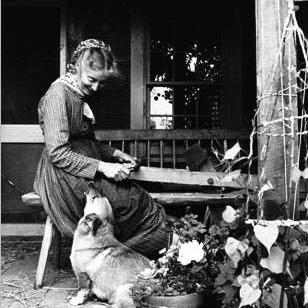
Tasha Tudor shaving splints from a log on her Vermont farm in 1977 By unknown Immediate sourcehttps://www.nytimes.com/2008/06/20/books/20tudor.html

Her days were filled with meaningful simplicity: raising chickens and sheep, growing vegetables, preparing meals by hand. She wove and sewed her own clothes—elegant dresses and colorful scarves—always taking pride in her appearance, even in solitude.

Tasha found deep joy in the natural world. She built a lush, secret garden where flowers bloomed in every season, and she tended it with love. Whether watering plants or walking through her fields, she embraced each moment with a grateful heart.

Though she lived alone, she was never lonely. Her cats and dogs kept her company, and her grandchildren visited often. Her home radiated warmth, creativity, and quiet joy.

“Letting go is a kind of strength,” she once said.

In an age obsessed with material gain, Tasha Tudor’s life reminds us that true richness lies in simplicity. She let go of the noise and temptations of modern life, choosing instead a path of peace, beauty, and authenticity.

Tasha Tudor didn’t just illustrate magical worlds—she lived in one. And through her life and work, she continues to inspire us to slow down, appreciate the everyday, and create beauty from the inside out.

Link: https://peacelilysite.com/2025/07/25/tasha-tudor-a-life-of-simplicity-and-beauty/

The Mirror of the Heart: A Lesson from a Single Father

A single father had just lost his job. All day, he wandered the streets, clinging to the hope that he might find work. But as the sun set, he returned home empty-handed.

Defeated and exhausted, he stepped into a small tavern, spent his very last coin, and finally stumbled back to his modest home.

That evening, he discovered that his son’s grades had slipped. He didn’t say a word. Instead, he shot the boy a harsh glare before collapsing into bed without another thought.

The next morning, out of habit, he opened his diary and wrote:

March 7, Tuesday.
This is the worst day ever. Lost my job, out of money, no work to be found, and my son is a disappointment. A day of utter discouragement.

After his son left for school, he happened to notice the boy’s diary lying open on the table. Curious, he began to read:

March 6, Monday.
Today, on my way to school, I helped a blind man cross the street. I was so happy. My grades weren’t good this time. I told Dad, and he didn’t scold me. He looked at me with such deep affection. I felt so encouraged. I’m determined to study hard so I won’t let him down.

Affection? the father thought, bewildered. I was glaring at him in frustration. How could he have seen that as love?

He turned another page:

March 5, Sunday.
The old grandpa next door is playing the violin better and better. He’s so old but still practices so diligently. I really want to learn from him.

His heart sank as he flipped to his own entry from that same day:

March 5, Sunday.
That annoying old man next door is playing that wretched violin again. On my only day off, he won’t even let me sleep in peace. So hateful—I wish I could smash that stupid instrument.

In that moment, the father felt the weight of shame press him down onto the bed. He was in his fifties, yet his spirit had been broken by hardship—his mindset darker and more defeated than that of his young child.

He realized, with painful clarity, that he had been looking at life through a lens clouded by bitterness. And that lens had distorted everything.

Deeply remorseful, he resolved to learn from his son—to face every trial with acceptance and gratitude instead of resentment. He knew he could no longer wear the mask of anger while searching for work. No matter how difficult life became, he would choose a sunnier disposition.

And when your mindset changes, everything changes.

The very next day, he found a suitable job. He began to meet life’s challenges with a heart full of gratitude.

Life is like a mirror: when you smile at it, it smiles back. When you cry, it weeps with you.

The human heart is also a mirror, reflecting the world within us. It reveals whether we carry kindness or bitterness, whether we live in light or in darkness.

With a single thought, we can create heaven or hell. Everything depends on whether we imprison or liberate our own hearts.

In the end, we are the creators of our own destiny.

Link: https://peacelilysite.com/2025/06/27/the-mirror-of-the-heart-a-lesson-from-a-single-father/

Father’s Day Joy: Poems to Celebrate Dad

Dads are just the best, aren’t they? They work hard, put up with so much, make us smile, and make everything okay. Father’s Day is a wonderful occasion to show the Dads in our lives how much we appreciate them. Here are some awesome Dad poems to celebrate every dad.

Fathers Mean the World
Fathers are the ones who work so hard,
Building bridges and fixing up the yard,
Driving trucks and feeding their families,
Their hard work is the backbone of society.

They have toiled in the sun and rain,
Working hard to help ease the family’s pain,
Their dedication and hard work, never in vain,
For their love and care, there is no refrain.

They have built homes and schools and more,
Their contributions we cannot ignore,
From fixing everything that’s broken,
To teaching us lessons that remain unspoken.

Fathers are the unsung heroes of our time,
Their sacrifices and hard work are a true sign,
Of their unwavering dedication and love,
That lifts us up and makes us soar above.

We need fathers in this world today more than ever,
To guide us through life’s twists and turns, we must endeavor,
To honor their hard work and sacrifice,
And cherish their love and care, forever in our lives.
~ Dev Sommerville

My Dad is My Rock
My dad has always been my rock,
Supporting me as I chased my dreams around the clock,
Encouraging me to go on the craziest adventures,
And taking me seriously, no matter the venture.
He gave me advice and encouragement,
Even when I was feeling lost and disheartened,
His words of wisdom, always on point,
Helped me navigate life’s twists and turns with every joint.

With his unwavering support, I gained strength,
To pursue my passions, no matter the length,
For all the times he’s been there, day by day,
My dad’s love and support, I’ll always repay.
So on this Father’s Day, I want to say,
Thank you, Dad, for all the support along the way,
Your love and care have helped me soar,
And for that, I’ll cherish you forevermore.
~ Winnie Smith-Garland

Photo by Josh Willink on Pexels.com

Dads Show Us the Way
Dads are the guiding lights that lead the way,
Raising kids to be strong, brave, and never stray,
Teaching us to try hard, and put ourselves to the test,
To see the funny side of things, and do our best.

Dads inspire us to be optimistic and kind,
To find our mission in life, and always keep in mind,
That success comes to those who never give up,
Who work hard and never hold a grudge.

With patience and love, dads show us the way,
To live in the here and now, and seize each day,
To face life’s challenges with grace and ease,
And to never ever give up on our dreams.

Dads teach us values that shape our lives,
To be kind to others, and treat them with respect and thrive,
Their love and guidance, we’ll cherish forevermore,
For dads play a crucial role in the world, that we can’t ignore.
~ Harrison Beslow

Photo by Lgh_9 on Pexels.com

My Dad, My Teacher
From the very start, my dad’s been there,
Teaching me to ride my bike without a care.
When my toys broke, he fixed them with a grin,
And when I needed help, he always pitched in.

Through every scrape and tear, he wiped away my fears,
Making everything okay, and drying up my tears.
He’s been my rock, my guide, my hero, all in one,
And I’m grateful for everything he’s done.

He’s taught me to be kind, and to spread my wings,
And he’s always been there to help with anything.
With his patience and love, he’s helped me through it all,
And I’m grateful for his support, big and small.

I’m lucky to have such an awesome dad,
And I’m grateful for all the fun we’ve had.
He’s the best friend I could ever wish for,
And I’ll always love him more and more.
~ Reese Carlington

My loving dad is always there,
To show me love and give me care,
With hugs and kisses, he makes my day,
I love my daddy more than words can say.
~ Louie Clyborne

Link:https://peacelilysite.com/2024/06/14/fathers-day-joy-poems-to-celebrate-dad/

Source: https://www.homemade-gifts-made-easy.com/fathers-day-poems.html

The Swan’s Gift

The Swan’s Gift

By Brenda Seabrooke

Anton was a farmer who lived with his wife Rubina and their seven children at the edge of the forest. He worked hard and they were happy for many years. Then one spring, the rains didn’t fall and Anton’s wheat died in the fields. As winter came on, their food supply grew smaller and smaller. Soon, Anton’s shoulders were stooped with worry. Rubina’s plump apple cheeks withered. The children no longer sang or laughed or danced, for they were all too hungry.

Every day Anton went out to hunt for food but returned without firing a shot. And every day, Rubina added water to the onion soup until there was nothing in the pot but water. When Anton saw his family crying with hunger, he wanted to cry too.

But instead, he took his gun and went out again into the cold, cold night. He had to find something for them to eat: a bird or a rabbit. But the black branches were empty of birds and no rabbits crouched in the frozen shrub. The only tracks Anton saw were his own.

He came to a small hill and knew it was the last one he would be able to climb before his strength was gone. His feet were numb and his breath rasped in the freezing air. At the top of the rise, he stopped to rest, scanning the snow for tracks. In despair, Anton turned to go. Just then, he saw below him a lake that was not yet frozen over. Its edge was lacy with ice and at its center floated a swan of such dazzling beauty that Anton could not look away. Its stark white feathers gleamed against the dark water and as Anton watched, the swan seemed to grow larger until its image filled his eyes.

Suddenly, juices flowed into Anton’s mouth. He could taste succulent roast swan and see his children’s faces glowing as his family sat at the table eating again. He raised his gun and sighted down the long barrel. Anton put his finger on the trigger. The swan seemed to be looking at him, listening for the shot that would kill it. He lowered the gun. The swan was the most beautiful creature Anton had ever seen. As he watched, the swan fanned its magnificent wings.

Anton closed his eyes and thought of his family. Again, he raised his gun. Hours seemed to pass. The feathers on the swan’s breast moved gently with each beat of its heart, and Anton could feel his own heart beating. He lifted his heavy wet feet, walked a few steps, and then dropped to his knees. “I can’t do it,” he said.

“Why not?” asked a voice as soft as snow or feathers ruffling in a gentle wind.

“I cannot kill beauty. If I kill this swan, my family will have food for one or two meals. And then what? We will be hungry again and it will have been for nothing.”

Anton was too tired to be surprised that he was speaking to the swan or the wind or the night. He was too tired to walk back home. He bowed his head with sadness for his family.

With a cry, the swan lifted its wings, rose from the lake, and circled Anton, water dropping from its wing feathers.As the water hit the snow, it froze into crystals that sparkled in the moonlight. Anton reached out and touched one. It was hard, harder than ice, and did not melt in the warmth of his hand.

“A diamond!” Anton said. Quickly, he scooped up the diamonds that lay in a glittering circle around him. He filled his pockets with them and set off through the snow to a nearby village.

Anton was no longer tired. He no longer felt the cold. He woke up the innkeeper, calling, “I need food.”

“Your crops failed,” said the innkeeper. “Everyone knows you have no money.”

“I have a diamond,” said Anton.

“Where would the likes of you get a diamond?” the man scoffed.

“Let me in and I will explain.”

The innkeeper fed Anton cold venison and sweet dumplings while Anton told his story, and the innkeeper’s wife packed a sledge for him with roast chickens and cheeses and onions and turnips. Then they sent Anton on his way so that they could begin looking for the magic swan themselves.

Rubina met him at the door. “Did you find any food? Mischa has fainted.”

“No. But look what I have brought.” Anton showed her the sledge.

“But how did you get it?” she asked.

For answer, he spilled the diamonds onto the table.

“Oh,” cried Rubina, “you have turned to robbery!”

“No,” said Anton. And he told her all about the swan, and how it had circled him with the diamonds falling from its wings.

Anton and Rubina woke the children even though it was the middle of the night, and they all sat at the table eating slowly, enjoying the flavor of the food and wonderful feeling in their stomachs. Rubina’s black eyes sparkled as she filled her children’s bowls. Anton felt his strength returning. Several of the children hummed as they were put to bed.

Anton and Rubina and their children were never hungry again, for they used their diamonds wisely and well. News of the magic swan spread throughout the land and many people searched for it. But the swan was never found.

Sometimes when Anton was alone in the forest, the image of the swan rose before him. He saw again the gleam of its feathers, the coral glow of its beak, and the magnificent reach of its wings as it glided silently across the sky.

Link:https://peacelilysite.com/2024/05/20/the-swans-gift/

Source: https://files.schudio.com/st-marys-ce-primary-school/files/documents/year_2_reading_1(1).pdf