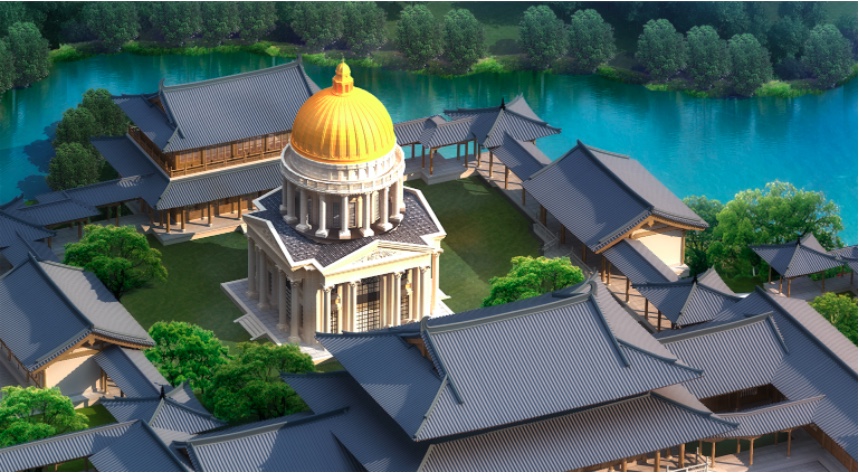
When Buddhists from all around the world want to gather together to share their knowledge, inspiration, and experience, there is no one place they can call home. Many Buddhist leaders have shared the vision of creating a permanent home centered in a major temple housing statues of the ancient Buddhas, surrounded by smaller temples built by the various different sects and organizations as the capital of Buddhism. Furthermore, it would be open and accessible to the general public, an inviting and beautifully designed space in which to experience the rich diversity of Buddhist culture and practice all in one place.
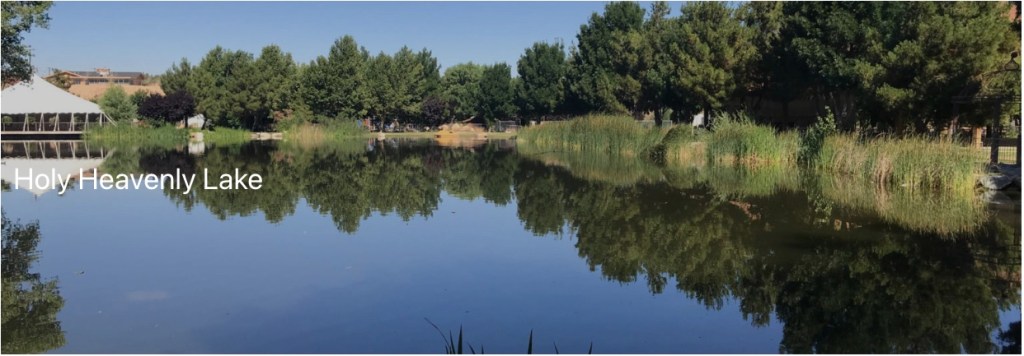
This concept was very well supported by H.H. Dorje Chang Buddha III. So, a search for a proper site began in early 2010. After visiting and considering several different locations and potential sites, the present project site at the Holy Heavenly Lake was most favored by the search team. A key factor in the decision for this project site was the presence of the lake, which made possible the vision of a spiritual oasis, in the form of a harmonious water garden that both physically and symbolically connects the various sects to the central temple. Holy Heavenly Lake is a holy site. Below the Holy Heavenly Lake, there is an underground river going from the south to the north, which is as wide as the Yangtze River. And there is a crystal lake with crystal gems lying 450 feet below the ground.
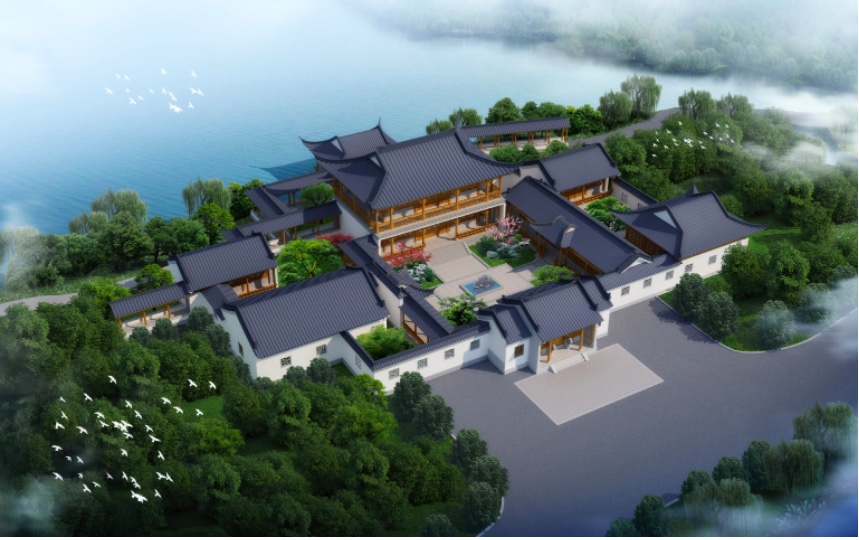
In 2015, the site and the initial conceptual site plan were presented to His Holiness, who expressed support for both. It was further decided that a Residence for His Holiness would be constructed next to the Main Temple. All major sects of Buddhism – including Zen, Pure-land, Nyingma, Kagyu, Sakya and Gelug— expressed their commitment to establish their temples or Dharma Centers in the compound. This will be the first time in history that all of the major sects are gathered at one location.
on February 14, 2019. The City of Hesperia where the Holy Heavenly Lake is located held a public hearing to discuss the matter of building the Buddhist City at the Holy Heavenly Lake and subdividing the land for various Buddhist sects to build temples in the city. The result was that the city agreed to let the project move forward. The meeting was held on the first day, and the nagas and dharmapalas showed their praises through a tremendously holy manifestation on the next day. Huge amount of clear water suddenly flow rapidly on 15th with waves lifted by its billows over the riverbed above the underground river, although the riverbed has been dried for many years. It runs northward like an endless tide from a river of hundreds of miles in length.
We believe that the Buddhist Town at the Holy Heavenly Lake will fulfill the myriad wishes and bring about prosperity in every undertaking!
Below are the videos showing the beautiful landscapes and inspiring events that have happened at this holy site:
Joy of Awakening
The Inner Light
Dharma Assembly for Medicine Buddha’s Holy Birthday
In September 5th, 2015 a great Dharma Assembly — Jin Gang Fa Man Ze Jue was successfully conducted by Wang Zha Shang Zun at a Temple in Los Angeles. This was an amazing and very high level ceremony to determine who was and who was not an authentic incarnation of a Buddha. Wang Zhan Shang Zun is a most impressive and powerful elder man who is worthy of our respect. I have met many dharma kings of different sects, but no one is like Wang Zha Shang Zun. His power and virtue surpass all of them.
After the ceremony, I had the extreme good fortune to meet an attendant of his who speaks English and requested to prostrate to the Shang Zun, which to my surprise, was granted. It is very difficult to meet him. The Assistant told me that, to date, probably less than 100 persons in the U.S. have had the good fortune to meet him privately. The attendant took me to the place where this great mahasattva was staying. I was very excited to be able to see him again. Wang Zha Shang Zun mostly speaks Tibetan, but I am told he can also speak Mandarin Chinese. His voice was as I had remembered from the ceremony. Seeing him up close, I realize that he is probably over six feet tall and in excellent health. I had guessed that he must be at least sixty as I knew he had spent 45 years in seclusion in Tibet, but from his appearance guessed he could be even younger. His attendant told me that Shang Zun had already turned 93. He is very spirited and looked like and had the energy and bearing of a much younger man. As for his appearance, he has a most remarkable full beard, large kind eyes, bushy eyebrows, a rectangular face, and is bald. I was reminded of images of Bodhidharma, the “barbarian” with such a beard and eyebrows who went to China from India, only Wang Zha Shang Zun is considerably more handsome than the great patriarch of Zen is usually portrayed to be. However, what is most impressive is his incredible modesty and humility. This is what it is like to be in the presence of a great holy being!
I had wanted to meet him to express my gratitude for the empowerment I received at the Jin Gang Fa Man Ze Jue Dharma Assembly, but also just to show my respect because I knew that only someone of very high attainment could have performed that dharma. When I offered him prostrations, he would always tell me to prostrate instead to H.H. Dorje Chang Buddha III. His attendant told me that this holder of three gold buttons at a Shang Zun level always carried an image of the Buddha Master with him and did this. When he went back to his living space, the first thing he would do was to put H.H. Dorje Chang Buddha III’s image and Shakyamuni Buddha’s image in a high place and make offerings to them. I again prostrated, but it was just as before. Wang Zha said, “The Buddha Master is here. You should prostrate to the Buddha Master. How can I accept your prostrations?” The other dharma kings I have met always accepted and even arrogantly awaited my prostrations while silently seating on their throne. Wang Zha Shang Zun is certainly the top chief great dharma king among all dharma kings, but he is still so humble. I was very touched. Again I realized how very, very fortunate I am.
Wang Zha Shang Zun is very easy to communicate with and very amiable. Every sentence he says with a smile. He also provided me with hot tea having his assistant serve me using traditional China teacups. I accepted the teacup and put it aside on the table. Wang Zha then told me that “the quality of this tea is not very good. It comes from Tibet and is called Old Eagle Tea”. However, the fragrance of the tea, was so wonderful that it betrayed his humble portrayal. I requested from Wang Zha Shang Zun how to practice the Green Tara Mirror Altar Dharma (Jing Tan Fa). The Shang Zun said, “First you have to have a good mirror. Then you get the dharma transmitted through holy inner tantric initiation. The most important thing is that you should practice according to the Buddha Master’s teachings, and let all people know that they should do good and cease evil. It is then very easy to succeed with this dharma. But you should decide by yourself if you want to practice this dharma. The Buddha Master proposed that we should cultivate ourselves and opposed the miraculous. I am not telling you to practice this Green Tara Altar Dharma.”
The time flew by so quickly. My mouth was dry and I realized I needed to drink the tea, but when I lifted the cup, the cup is so heavy it is as if it were glued to the table. I couldn’t move it even when I exerted a lot of force. I was so surprised. I put that cup on the table. How can I now not lift it? This time Wang Zha Shang Zun saw what was happening and told me, “It is no use to use force. Force cannot lift it. You have to use your mind to lift it. When your mind is not attached to anything, everything will follow your mind.” Then Wang Zha Shang Zun asked me to lift it again. Very strange. It was as if it was weightless. I easily lifted it and also when I opened the cover of the cup, there is a moving image like a video in the cover. I clearly saw a picture of one of my fellow brothers from the past and a moment when I was in Japan. It was very clear, but it quickly started to disappear. I was really surprised. I used my eyes to follow the cover. After a while it completely disappeared. Then Shang Zun said. “Any object can be used as a mirror.” So I suddenly understood why my mind and my cultivation are so important and cannot be replaced by anything else.
I pray that each of you take advantage of this most fortunate fact that the H.H. Dorje Chang Buddha is living in this world now and practice the Dharma that you learn. I also pray that you all quickly become accomplished.
Namo H.H. Dorje Chang Buddha III! Namo Shakyamuni Buddha!
A very ashamed and fortunate disciple, Zhaxi Zhuoma prostrates and offers special thanks to Wang Zha Shang Zun for teaching her this important lesson.
Hua Zang Si at San Francisco, has many Holy Treasures and holy manifestations. Several years ago, I was very fortunate to have a chance to see an unimaginable Buddha Dharma relic — Dharma Tent. According to mundane logical thinking, it is impossible for such a mysterious thing to have occurred in this world. However it truly did occur in tis world in front of a number of people! I would like to say that I do not know how to explain this. Ordinary language, high-tech principles, or the most advanced scientific theories cannot explain such a thing. This mysterious thing simply cannot be explained. It is truly wonderful, magnificent, and unbelievable!
The monastic introduced to me, the holy feat occurred in January of 2005. After the grand opening of the Hua Zang Si temple, Rinpoches and Dharma Teachers exhibited their ultimate artistic wisdom relating to carving vines. They made a dharma tent. They then went to H.H. Dorje Chang Buddha III and asked him to consecrate their tent.
Kuru Rinpoche said, “This Padmasambhava dharma tent is an indestructible treasure that removes the negative karma of living beings.”
H.H. Dorje Chang Buddha III smiled and said, “Everything that comes into being through causes and conditions illusorily exists. All sentient beings must die. All non-sentient things must perish. All of these things are impermanent.”
A Dharma Teacher then said, “This dharma tent looks very wonderful. It is not impermanent in the least.”
H.H. Dorje Chang Buddha III replied, “In every moment, it is arising, growing old, and dying. In every moment, it is in a state of impermanence. Your ordinary eyes cannot see such a process. If in a few hundred years from now you take another look at it, you will see that those entangled vines on the top of the tent are dried up. Actually, with respect to time and space, there is no past or future. Today, the causes and conditions are ripe. Watch!”
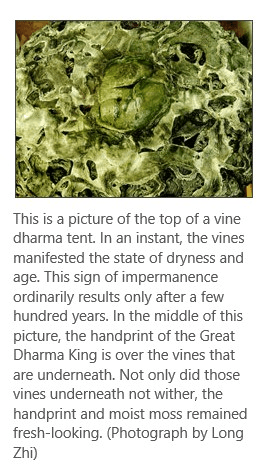
H.H. Dorje Chang Buddha III then pressed his hand upon the top of the dharma tent in the middle of the entangled vines. Halfway turning his hand, he then hit the vines once. A crackling sound could then be heard. A few minutes later, people looked at the vines and saw that their color had changed. They had withered and were dried up. In just a moment of time, they became a thousand-year-old cultural relic. They were thoroughly dried up, withered, and ruined. When the Great Dharma King lifted his hand, everyone saw that the Great Dharma King’s hand left an impression upon the vines when it pressed them down. Everyone also saw that the vines that were under the Great Dharma King’s hand did not wither, their color and luster did not change, they did not have any wrinkles, and they did not show any signs of dryness or aging. With respect to that part of the vines, no sign of the process of impermanence could be seen. Everyone was shocked!
At that time, H.H. Dorje Chang Buddha III gave the following explication: “All such phenomena do not truly exist. They are illusory phenomena. The Buddha expounded the dharma for forty-nine years, which was also a manifestation of illusory existence. There actually was not dharma that he had spoken of. If you obtain the Mahamudra of Liberation and realize the true, original nature of all phenomena (i.e. the original essence of all being, the true thusness or reality-nature), then it is exactly like this hand imprint analogy–there will be no impermanence nor birth and death. The Buddha expounded all of the dharmas. Sages attained the state of realization, and such dharmas were thereby real. Ordinary beings were confused, and such dharmas were thereby false. But who can turn the false into the real? Who possesses the dharma that leads to realization? Thus, only the correct dharma of the Buddha turns illusion into reality. All of you should listen, ponder, and deeply understand the Great Master’s discourse entitled “The Essence of Seeing One’s Original Nature.” Receiving such an initiation is truly an indestructible treasure. Today you have seen signs of impermanence relating to the dharma tent. Such signs are only an analogy. Such a manifestation is illusory and was done for fun only. Do not take it as being the absolute or ultimate truth. It is just art that one can dismiss with a laugh.”
This lecture by H.H. Dorje Chang Buddha III has profound meaning and is worthy of pondering. Although this feat is illusory in nature, who else can manifest such an impermanent illusion? If one cannot manifest illusory phenomena, nor can one turn illusion into reality, then how can one give expression to one’s realization? How can such a person possibly claim that he possesses the Buddha-dharma?
The dharma tent with vines on top is a wonderful treasure and evidence of a holy feat. Monastics have already respectfully received it in San Francisco, where it is worshipped as an object of veneration at the Hua Zang Si temple.
Rinpoches, Great Dharma Teachers, and laypersons observe the holy signs of permanence and impermanence that appeared on the top of the Padmasambhava dharma tent. (Photograph by Ru-Jun Zheng)
Hua Zang Si is my favorite sacred spiritual worship place in the bay area. In there I find peace, relaxation, and harmony, and a home for my soul. I have gone there many times, to chant the sutra, join the meditation sessions, and participate in Dharma assemblies.
Hua Zang Si, an impressive-looking temple located in the center of the Mission District in San Francisco. The building was formerly the St. John’s Evangelical Lutheran Church, built in 1903, and has been repurposed as a Chinese temple. To me it is really a friendly symbol that different religions can coexist in harmony.
The large outside facade of the temple is painted red color, made the building a very outstanding and eye-catching landmark in the neighborhood. Red is a good color in Chinese culture that symbolizes auspiciousness and warding off evil spirits。
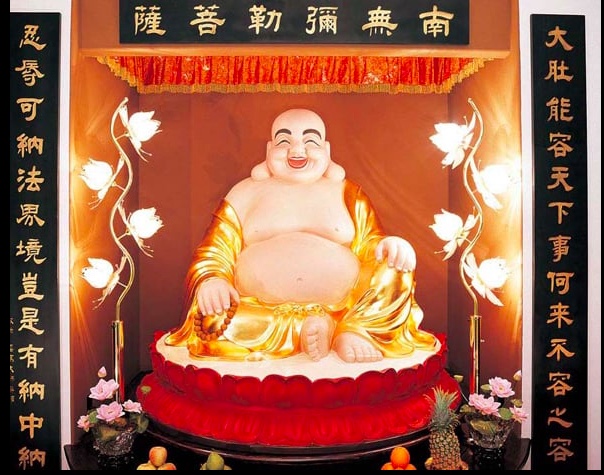
Once entering the temple, I feel like I am in another world. The marvelous statue at the entrance of the temple is an oversize representation of a jolly, laughing Buddha: Maitreya Bodhisattva (the next Buddha in this Saha world). It is such a warm welcoming sign. The big belly not only means jolly, it also means tolerating those intolerable things in the world. So when you look at the statue, you will start to feel that learning Buddhism is happy and kind.
The right line of the couplet is “da du neng rong tian xia shi he lai bu rong zhi rong.” As self-cultivators, we should be like the Buddhas and Bodhisattvas. We should have a broad mind, open heart, and great tolerance. The left line of the couplet is “ren ru ke na fa jie jing qi shi you na zhong na.” The first priority for one who learns Buddhism and cultivates himself is to be patient and forbearing under insult. The thought of patience or tolerance does not arise from his mind. Everything in all of the dharma realms can change from ordinary to holy.
Walking inside, the first floor is Shakyamuni Buddha Hall. The golden statue of Shakyamuni Buddha is a very dignified-looking Buddhist statue. On the left side is the one thousand-armed and one thousand-eyed Guanyin Bodhisattva, an awe-inspiring statue. On the right side is Skanda Bodhisattva, a standing majestic full-body armored statue. With a sword in hand, Skanda Bodhisattva is a Buddha Dharma protector, and it is believed he can subjugate demons and evil spirits.
Shakyamuni Buddha
One thousand-armed and one thousand-eyed Guanyin Bodhisattva
Skanda Bodhisattva
The second floor is Amitabha Buddha Hall. The twenty-one-foot-high statue of Amitabha Buddha (designed by H.H. Dorje Chang Buddha III) has been generally recognized as the most majestic Buddhist statue in the world. It is an extremely solemn sight. The color painted on the face is so lifelike, one feels like seeing the real Amitabha Buddha from western paradise. The Buddha’s eyes seem alive as well, looking down at all beings full of compassion and love. Every time when I look at the Buddha, I feel so moved and touched, tears fill my eyes. I can’t help but to kneel down and pray wholeheartedly: Please Buddha save me from the birth-death cycle, please take me to the western pure land. I feel my whole body melted into the compassionate gaze of the Buddha.
In the center of Amitabha Buddha hall, there is a large circular mandala on which a Yun sculpture (carved by H.H. Dorje Chang Buddha III) depicting Mt. Sumeru is placed. In that Yun sculpture are shariras (sacred relics) of the Shakyamuni Buddha for worshipping.
Directly facing the Amitabha Buddha is a tall Dharma altar, there is a huge blue Dorje Chang Buddha image. Dorje Chang Buddha is also called Buddha Vajradhara or Ruler of the Vajra Beings. In the entire universe, Dorje Chang Buddha is the first Buddha with form and is the highest Buddha. That is, the highest leader of Buddhism in the entire universe came into being in the form of Dorje Chang Buddha. It was Dorje Chang Buddha who began transmitting dharma and saving living beings in the dharmadhatu. As a result, Buddhism was born and the Buddha-dharma began spreading.
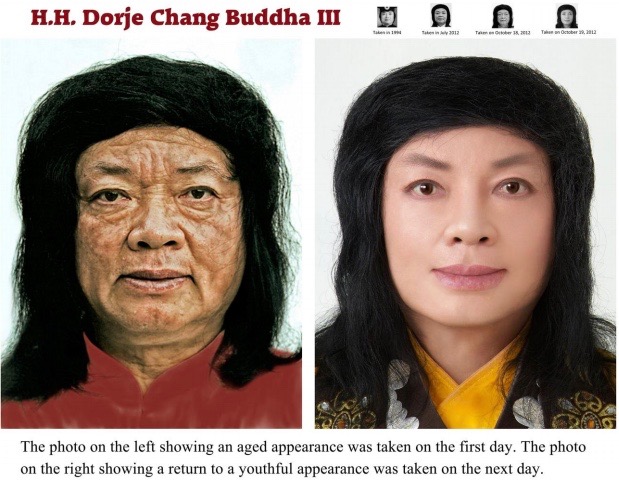
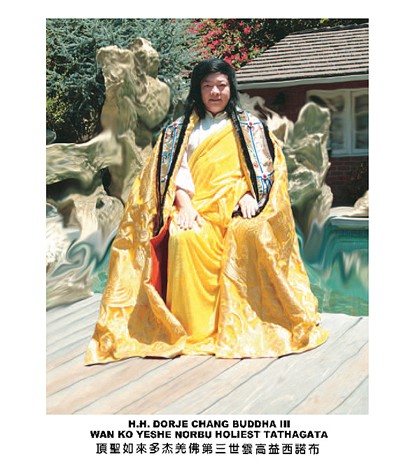
In front of the image of Dorje Chang Buddha are photos of H.H. Dorje Chang Buddha III. Dorje Chang Buddha has come to this world twice. The first time was in the form of the holy and venerable Vimalakirti, who was Dorje Chang Buddha II. The second time was in the form of H.H. Wan Ko Yeshe Norbu, who is Dorje Chang Buddha III.
These photos were true records of the holy miracle Buddha Dharma. On October 18, 2012, H.H. Dorje Chang Buddha III within ten minutes, reversed his appearance back to a youthful look. This incredible Buddha Dharma ever practiced successfully by Guru Rinpoche long time ago in Tibet.
Hua Zang Si has many Holy Treasures , make sure you check them out at the corner of this hall as well.
The third floor contains a library of Buddhist scriptures.
The backyard — a city oasis in the shadow of surrounding Victorians — is home to a magnolia tree, which the faithful say rained nectar for three days, along with a miraculous lotus tub used in the bathing of the Buddha and heavenly beings.
Further back, there is Dharma protector pavilion, a statue of the Dharma Protecting Deity Guan Yu was installed inside.
Guan Yu took refuge in Master Zhiyi at Yuquan Hill. He then manifested great supernatural power and constructed the Yuquan Temple overnight on a barren lot, where he resolved to become a protector of Buddhism. That is why, upon the plea of many Buddhist practitioners, he was recommended to be the Dharma Protecting Deity of Hua Zang Si.
Hua Zang Si is different from other temples that propagate only one sect within Buddhism. It teaches all of the various sects within Buddhism. If you want to know and learn Buddhism, Hua Zang Si is the best place to start with.
Among Caucasian female Rinpoches, Respected Zhaxi Zhuoma Rinpoche is one of outstanding cultivation. She has realized the power to telekinetically awaken a vajra pill. In order to seek the highest dharma, in her early years she learned under Japanese, Korean, and American Buddhist masters. Still, she did not obtain the true Buddha-dharma. She went through all kinds of hardships in her search for the supreme Buddha-dharma master. Finally, she was accepted by H.H. Dorje Chang Buddha III as a disciple, deeply penetrated the Buddha-dharma, and fulfilled her wish. The rinpoche is very conversant in English material on the various dharma lineages and their history. The rinpoche has had a wide range of experiences throughout her life, such as personally seeing Buddha Vajradhara Wan Ko Yeshe Norbu Holiest Tathagata amid the clouds, hearing a vajra pill speak the dharma, seeing a vajra pill transform into rainbow light and fly away, and having a photograph of her deceased uncle shake on the palm of her hand when the consciousness of that deceased uncle was raised to a higher realm of existence.
Currently she is president of the Xuanfa Institute located in Sanger, California, a nonprofit established to propagate the true Buddha-dharma of Shakyamuni Buddha and is the abbot of the Holy Vajrasana Temple and Retreat Center that is being established there. She is in the process of establishing the Xuanfa Five Vidyas University, a distant learning program to provide free or low-cost Buddhist studies to those understanding English. She has many disciples throughout America and in Europe and Asia.
She has not only found answers to her earlier questions, but being a rinpoche, she knows that she needs to benefit all living beings, friends and foes alike, with the dharma she has learned and received. Her job is to benefit living beings and propagate the true dharma, which she has devoted her life to doing.
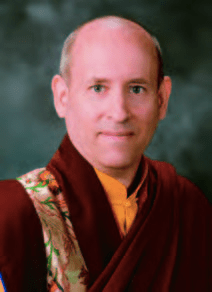
Venerable Bodi Wentu Rinpoche is a Caucasian westerner and the first person to hold the position of translation teacher at Hua Zang Si. Rinpoche has read many sutra teachings. He strictly abides by the principles of cause and effect and strictly observes the precepts. He is a straightforward and honest person who devotes himself to cultivation and study and who does not shirk hard work. The Rinpoche’s main work involves translating material on the dharma. He has translated sutras and recorded discourses of H.H. Dorje Chang Buddha III . He also has translated the books of the Great Vajravarahi (Ah Wang Nuo Bu Pa Mu). He has deep merit from helping westerners learn the dharma. He ever told us stories about his personal experience and examples that reflects the greatest inner realization vidya of H.H. Dorje Chang Buddha III .
Venerable Bodi Wentu Rinpoche
At the end of 1995, Bodi Wentu Rinpoche became a disciple of H.H. Dorje Chang Buddha III in Sichuan, China. After he returned to the United States from Sichuan, he began to translate the ten Dharma recorded discourses taught by H.H. Dorje Chang Buddha III from Chinese to English. Another Buddhist brother assisted him in this translation.
One day in 1998, when H.H. Dorje Chang Buddha III was visiting the United States, Bodi Wentu Rinpoche went to visit H.H. Dorje Chang Buddha III with an other Buddhist Losang Gyatso Rinpoche. The purpose was to present the translation of those discourses to the Buddha for review. The translations were placed in sealed envelopes. Right after they prostrated to the Buddha, the Buddha said, “You have earned great merit and made a great contribution to living beings. Although the translation you brought today contains some minor mistakes, it will still be of great benefit to westerners.” They were very surprised. Even before they reported the situation, the Buddha had already known what they were going to report. This moved Bodi Wentu Rinpoche very much because it was incredible.
The second case occurred in 1999, in Missouri, where the Buddha received an honorary doctorate from the American Association of Colleges and Universities as an expression of their respect for the Buddha. After the presentation ceremony, all the people had dinner together. The president of a religious college asked if they could ask questions. The Buddha replied, “Ask whatever questions you would like to ask. All of my answers will satisfy you.”
During the question period, the Buddha answered all the questions easily, which evoked great admiration. The president of a religious college asked the most difficult question, but the Buddha answered with total ease. The Buddha’s perfect answer made the president blush with embarrassment. “I have lived in darkness all these years, and the master’s answer today really opened my eyes.” The chairman of the alliance of 83 colleges and universities slapped himself with excitement and regret. All around him the presidents and professors from the colleges and universities looked at him dumbfounded and didn’t know what to do.
Bodi Wentu Rinpoche has steadfastly followed the Buddha to practice true dharma. Rinpoche has now realized the status of a sage at the Golden Button Grade II, which is amazing!
Have you ever seen a man-made sculpture like real withered vines? In The International Art Museum of America located at San Francisco, there is just such a sculpture, called Ancient withered vines become a fossil fortress. The artist is H.H. Dorje Chang Buddha III. I was told the sculpture is made of the material like PVC, stone and oil paint. The astonishing fact is the artist needed to carve the sculpture in super fast speed; the material hardens into a mold in less than ten seconds after melting. I can’t image how this huge sculpture could be done in such short time. It has many layers from inside to outside. The sculpture is well lit, and I can see clearly the inside structures. I can only say the artist superior craftsmanship skill is beyond human imagination.
H.H. Dorje Chang Buddha III, Holiest Tathagata created high-quality withered vines through a form of carving called “Yun Sculpture.” All of those Yun Sculpture vines must have certain distinguishing attributes in four categories: visual quality, style, shape, and texture. Of these four categories, texture is the most important and indispensable.
Ancient-looking withered vine
The four distinguishing attributes in the area of visual quality are old, withered, dry, and beautiful. As for old, the vines must appear to be old vines from the ancient past. As for withered, the vines must look dehydrated, withered, and wrinkly. As for dry, the winding vines must seem desiccated. As for beautiful, they must have a graceful look to them. The four distinguishing attributes in the area of style are scholarly, otherworldly, highly elegant, and comforting. As for scholarly, the style of sculpting must be imbued with a feeling of literary or poetic genius. As for otherworldly, the vines must appear to transcend the handwork of human artisans such that they look not of this world. As for highly elegant, the vines must look highly refined, aesthetically pleasing, and far above the ordinary.
As for comforting, the vines must convey a feeling of auspiciousness, grace the place in which they are present, and give those who view them a feeling of harmony and well-being. The four distinguishing attributes in the area of shape are as follows: natural-looking, genuine-looking, weathered over time, and intertwining.
Regarding the first attribute, the vines must match the winding look of real vines. Regarding the second attribute, the vines must look exactly like real ancient vines. The viewer should have the impression that the carved vines are no different from real vines that grew in nature. Indeed, the viewer should conclude that the sculpted vines look even more ancient than their natural counterparts. Regarding the third attribute, the vines must convey a natural sense that they have been exposed to wind, frost, rain, dew, and sunshine over a very long time and have aged over that long time period. Regarding the fourth attribute, thick and thin vines must intertwine to look like one natural, connected body that has grown together month after month.
The four distinguishing and extremely subtle attributes in the area of texture are as follows: the vines must have the texture and appearance of having withered in different time periods; the skin of the vines must have the texture of real vines with tiny pores; the lines and wrinkles on the vines must follow the natural course of the vines; and the shades of colors of the vines must be just like those of real ancient vines. The meticulousness shown in the area of texture is the best way to tell whether or not a work of art is a genuine carving of withered vines created by H.H. Dorje Chang Buddha III through His Holiness’s Yun Sculpture form of art. These four attributes, which cannot be matched by any other artist, are essential in determining whether or not the withered vines are masterpieces sculpted by H.H. Dorje Chang Buddha III himself. These four attributes are most important and indispensable in distinguishing the works of H.H. Dorje Chang Buddha III from other works. The first attribute is that the vines must have the texture and appearance of having withered in different time periods. Since interwoven withered vines come into being and grow in different time periods, they dry, age, and shrivel to different degrees. Their texture and color also vary. Thus, His Holiness’s Yun Sculpture vines give the impression of being historical relics of different time periods. The second attribute is that the skin of the vines must have the texture of real vines with tiny pores. This means that when one touches the texture of the carved vines, their stems and skin will feel exactly like those of real vines. One can see that the carved vines have minute pores, such as old pores of various colors, pores that follow the course of the stem, inverted pores, miscellaneous pores, and concave and convex pores.
Furthermore, one can see that there are spots of color, shades of color, flows of color, differences in color, and harmony of color relating to the pores. Even under the scrutiny of a magnifying glass, the sculpted pores appear tiny and no different from those of real vines. Indeed, the vines are much more beautiful than real vines. The third attribute is that the lines and wrinkles on the vines must follow the natural growth of the vines. Having existed through a very long period of time, ancient vines will manifest wrinkles. The key factors in carving the highest quality wrinkles relate to the course or direction in which the wrinkles run, their size, their degree of thickness, their depth, their length, and their degree of visibility. They must not have the slightest appearance of disorder or randomness. Rather, the lines and wrinkles must totally follow the natural growth patterns of the vines. They must follow the track of the winding vines. As the vines change directions, the lines must follow the twists and turns. They must look natural and no different from real lines on ancient vines.
The fourth attribute is that the shades of colors of the vines must be just like those of real ancient vines. The color or hue of the carved vines must convey a feeling of antiquity and a wondrous quality of age. The sculpted vines must seem old, parched, and shriveled, but in a very fascinating and attractive way. They must not show any trace of having been sculpted by man. All of the freshness and brightness of living vines must be gone. They must appear as relics that are thousands of years old. There are two Chinese sentences that aptly summarize the artistic skills of H.H. Dorje Chang Buddha III in carving withered vines: “There is nothing more beautiful than faux jade, ganoderma lucidum frames, and cactus frames. There is no higher art than creating ancient withered vines that even go beyond the appearance of real vines.”
Only those works of art that possess all of the above–described distinguishing characteristics can be called genuine Yun Sculpture withered vines created by H.H. Dorje Chang Buddha III. When these frames of withered vines accompany other Yun Sculpture works of art, the result is “double supreme beauty.” This combination is also solid evidence to determine the authenticity of Yun sculptures created by H.H. Dorje Chang Buddha III. When His Holiness’s withered vines are part of Yun Sculpture art frames, such as “Ancient Jade”and “Emerald,” these art frames become even more phenomenal and take on the ancient air of precious and splendid cultural relics. Truly, such works are national treasures that have no equal in the entire world. They are wonderful masterpieces to hang on your wall. More importantly, we should understand that these sculptures of ancient-looking withered vines are actually a manifestation of His Holiness’s mastery of the inner-realization vidya. Persons of holy virtue who are able to leave their footprints on stones are unable to create such ancient-looking withered vines. The source of these works of art is the enlightenment of a Buddha that H.H. Dorje Chang Buddha III possesses. That is why they are precious withered vines that cannot be found anywhere else in the world.
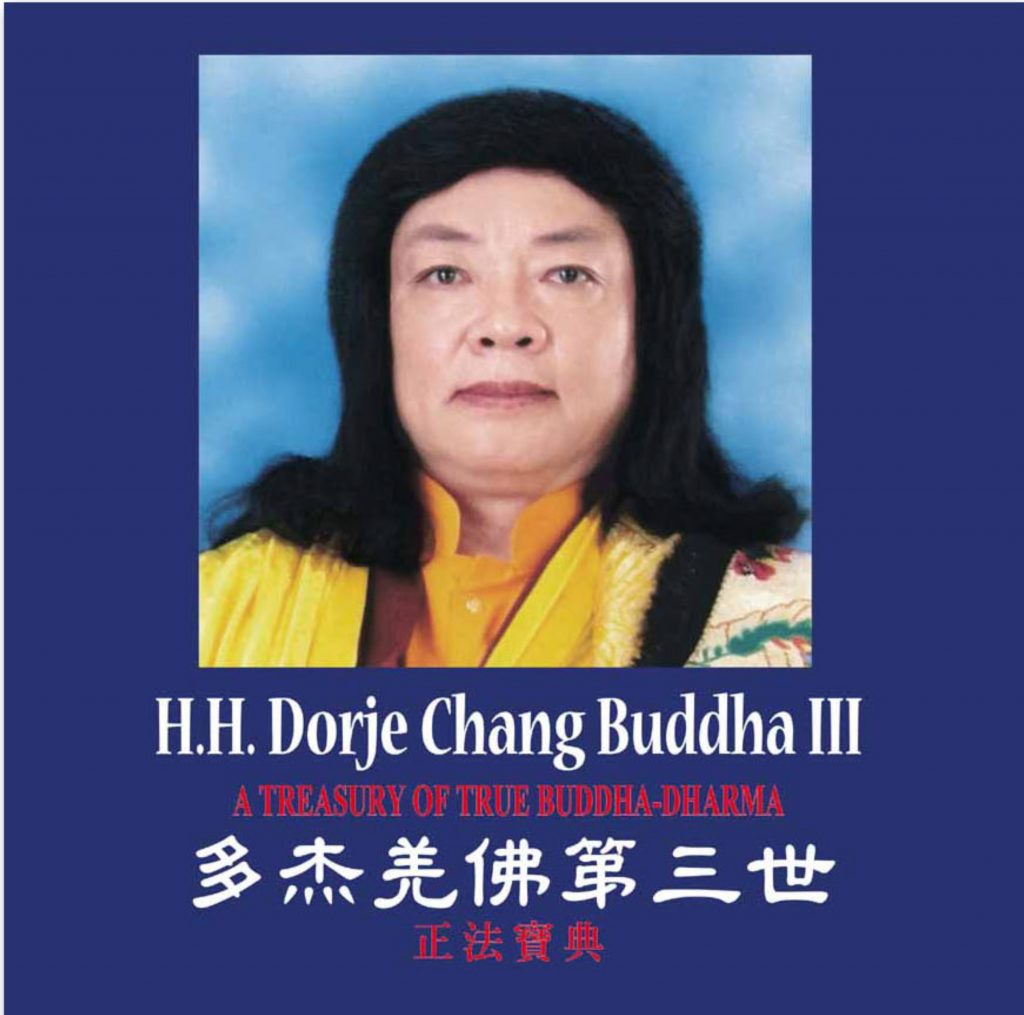
In 2008, the Great Dharma King Wan Ko Yeshe Norbu’s identity was finally published in the treasure book of “H.H. Dorje Chang Buddha III“. The Great Dharma king’s true identity is the third incarnation of the primordial and highest Buddha in the dharma realm, Dorje Chang Buddha.
On April 3, 2008, a solemn and dignified book-launching ceremony was held at the Library of Congress of the United States; on occasion of the first release of a fact-recording book entitled H.H. Dorje Chang Buddha III, jointly published by the World Buddhism Publishing LLC and the World Dharma Voice, Inc. At the same time, the book was formally accepted into the collection of the Library of Congress of the United States. From then on, people came to know that the widely respected Master Wan Ko Yee, the one who has been recognized and corroborated through official written documents issued by top leaders, regent dharma kings, and great rinpoches of major Buddhist sects throughout the world; actually, is the third incarnation of Dorje Chang Buddha, the primordial Buddha. Ever since, people address the Buddha by the name Dorje Chang Buddha III. This is similar to the precedent regarding the name of Sakyamuni Buddha—before Sakyamuni Buddha attained Buddhahood, His name was Prince Siddhartha Gotama. Once Prince Siddhartha Gotama attained Buddhahood, He was thereafter addressed as “Namo Sakyamuni Buddha.”
On June 21, 2008 in San Francisco the world’s first ceremony to welcome the treasure book “H.H. Dorje Chang Buddha III” was held at Hua Zang Si by the International Buddhism Sangha Association (IBSA). When the banner welcoming the treasure book “H.H. Dorje Chang Buddha III” was hung above Hua Zang Si, a giant Buddha light appeared in the sky above Hua Zang Si. It was gorgeously bright and auspicious. This was what is called a celebration taking place in both the human world and the heavens. And furthermore, the most precious gift from Buddhas and Bodhisattvas was presented, nectar from the heavens. At that time, from the clear and blue sky totally free of any cloud, thunder rolled continuously. The uninterrupted sounds of the torrent of thunder had never been heard before, as if fireworks were launched in the heavens. The densely descending nectar appeared from nowhere coming through the Magnolia tree branches, the tree was planted at the backyard of the temple. People could neither see where it came from nor how it eventually disappeared. Floating like goose feathers and flocs, the nectar was rolling and dancing in the space between the tree branches. In contrast, right outside the perimeter of Hua Zang Si temple, it was dry everywhere under the cover of a completely fine summer sky with the bright sun shining.
On December 12, 2012, in the Senate Resolution No. 614 of the United States Congress, the title “His Holiness” was officially used with the name Dorje Chang Buddha III; the Buddha was addressed as “H.H. Dorje Chang Buddha III.” Since then, the title H.H. Dorje Chang Buddha III was definitively affirmed.
The accomplishments of H.H. Dorje Chang Buddha III are the highest in the entire world. No one of holy virtue within Buddhism can be mentioned in the same breath with His Holiness when it comes to showing real evidence of wisdom and realization attained through proficiency in exoteric and esoteric Buddhism and mastery of the Five Vidyas. The standard that the Buddha set for measuring one’s level of accomplishment in the Buddha-dharma is the degree to which one is proficient in both exoteric and esoteric Buddhism and the degree to which one has mastered the Five Vidyas. However, in the history of Buddhism up to the present time, only H.H. Dorje Chang Buddha III Holiest Tathagata has truly and fully manifested complete proficiency in exoteric and esoteric Buddhism and perfect mastery of the Five Vidyas! H.H. Dorje Chang Buddha III actually exhibits for all to see item after item of accomplishments relating to complete proficiency in exoteric and esoteric Buddhism and perfect mastery of the Five Vidyas as laid down by the Buddha. His Holiness, an ancient Buddha, is the first being of holy virtue in history who has truly manifested such lofty and complete realization! Clear evidence of this are all of the single-handed accomplishments of H.H. Dorje Chang Buddha III mentioned in the thirty main categories listed in this book, H.H. Dorje Chang Buddha III —A Treasury of True Buddha-Dharma.
The conferment of the Pope of Buddhism to His Holiness Dorje Chang Buddha III originated in January 2018 when the World Peace Prize Awarding Council and World Peace Prize Religious Leaders Title Awarding Council passed the resolution to confer to H.H. Dorje Chang Buddha III the title of Pope of Buddhism, the highest leader of Buddhism in this world. However, His Holiness the Buddha refused to accept the conferment.
For the sake of propagating Buddha Dharma and benefitting living beings, the World Buddhism Association Headquarters took the liberty to accept the conferment decree and the Pope of Buddhism Scepter. When the World Buddhism Association Headquarters respectfully presented the Pope of Buddhism Scepter and conferment decree to H.H. Dorje Chang Buddha III , His Holiness the Buddha III said: “I see that on top of this Scepter is the seated Shakyamuni Buddha, we should be respectful to Namo Shakyamuni Buddha.” His Holiness the Buddha then raised the Scepter above His head and made a symbolic closed palm gesture with one hand to express His respects. However, H.H. Dorje Chang Buddha III also expressed that He is just a humble cultivator and resolutely would not accept such a conferment. Hence, His Holiness the Buddha immediately returned the conferment decree and the Pope of Buddhism Scepter to the two Councils.
On September 23, 2020, the World Peace Prize Awarding Council and World Peace Prize Religious Leaders Title Awarding Council passed an ultimate joint resolution, determining that the return of the Pope of Buddhism Scepter and conferment decree by H.H. Dorje Chang Buddha III was not effectible. On September 24, the joint Chair of the World Peace Prize Awarding Council and World Peace Prize Religious Leaders Title Awarding Council Suzi Leggett made the ultimate announcement at the Holy Miracles Temple of the World Buddhism Association Headquarters: “Over the past several decades, the World Peace Prize Awarding Council has presented the World Peace Prize to presidents, spiritual leaders, and prime ministers of many nations, including President Ronald Reagan, Hon. Mahatma Gandhi, and H.E. Yitzhak Rabin. There has never been a precedence of an award being retracted or returned. All determinations made and implemented by our Councils are very solemn, serious, and absolutely cannot be changed. The return of the Pope of Buddhism Scepter and conferment decree by H.H. Dorje Chang Buddha III is deemed not effectible. The title, status, and authority of the Pope of Buddhism belong only to H.H. Dorje Chang Buddha III, and cannot be exercised by anyone else.” Chair Leggett once again requested that the World Buddhism Association Headquarters accept and present to H.H. Dorje Chang Buddha III the Pope of Buddhism Scepter and conferment decree that His Holiness the Buddha previously returned.
Representing the World Buddhism Association Headquarters, Venerable Mozhi Rinpoche accepted the conferment decree and Pope of Buddhism Scepter. He said during his speech, “The World Buddhism Association Headquarters considers that the decision made by the two Councils is remarkably proper and sagacious.
“Ever since Namo Shakyamuni Buddha entered parinirvāṇa, there has not been a supreme leader who has the authority to guide all Buddhists the same way that the Buddha did. However, the authoritative position of the Pope of Buddhism certainly is not a role that a leader of a single Buddhist sect would have the attributes to fulfill; rather, the Pope must be a leader who has authority over the entirety of Buddhism, namely, a Buddha.
“Namo H.H. Dorje Chang Buddha III holds the perfect teachings of Buddhism and meets the criteria used by all Buddhist sects to recognize a Buddha. His inherent nature is in accord with that of a Buddha. His unsurpassed, complete, and perfect enlightenment is in accord with that of a Buddha. Just based on the accomplishment of H.H. Dorje Chang Buddha III in Lifting the Pestle onto the Platform, surpassing His own base weight standard by 59 levels, no one else can possibly reach such a record.
“The state of virtue of H.H. Dorje Chang Buddha III is that of a Buddha. His Holiness the Buddha has perfect mastery of Exoteric and Esoteric Buddhism, perfect accomplishments in the Five Vidyas, and so forth, all of which accord with the unsurpassed, complete, and perfect enlightenment of a Buddha.
“In more than 2,000 years, there has not been a Buddhist Holy Guru in this world who possesses the same Buddha level qualities. Just by the facts that H.H. Dorje Chang Buddha III vowed and carries out the vow to benefit living beings purely on a voluntary basis and does not accept any offerings throughout His entire life, and that He possesses perfect wisdom and unimpeded accomplishments, no other Holy Guru can be of comparison. Only Namo H.H. Dorje Chang Buddha III can take on this immensely noble, holy, and heavy responsibility of the Pope of Buddhism, to properly guide Buddhists onto the correct path of learning Buddhism.
“Therefore, on behalf of Buddhists, the World Buddhism Association Headquarters thanks the World Peace Prize Awarding Council and the World Peace Prize Religious Leaders Title Awarding Council for having made the ultimate decision.”
H.H. Dorje Chang Buddha III is selfless and noble, and the first person in Buddhism to possess substantive holy realization power of a Buddha and perfectly flawless accomplishments at the pinnacle of the Five Vidyas. These are the qualities that no other eminent Buddhist monastic or virtuous person in this world has so perfectly attained. It is naturally a matter of course that H.H. Dorje Chang Buddha III is the veritable Pope of Buddhism.
Most of the Buddhist disciples know that: “Among the highest unconditioned Dharmas imparted by the Buddha, patience under humiliation and adversity is the foremost Dharma “. In the Six Paramitas1, Buddha request all disciples to endure insults, to overcome hate and anger.
So many ancient virtuous ones made use of slander, verbal abuse, and harm directed at them from other people, transforming such experiences into enlightenment and great compassion. In the end, they became holy ones. Zen Master Yongjia said, “If there were no slander and praise that create enemies and friends, how would you show the power of lovingkindness and patience that stems from no-birth?” Here are some stories, that could inspire us to practice humility.
(一)
Hanshan and Shide — Song of Endurance
Master Hanshan and Shide were legendary monks lived in China about one thousand years ago. People said that Hanshan and Shide were the incarnation of Manjushri and Puxian Bodhisattva.
Once Master Hanshan asked Master Shide:” What shall I do if someone mistreats me, slanders me, bullies me, insults me, ridicules me, disparages me, belittles me, offends me, or deceives me?”
Shide answered: You just tolerate him, let him be, avoid him, respect him, ignore him, be kind to him, and wait for a few years to see what becomes of him.
Japnese Zen Master Hakuin was greatly respected and had many disciples. At one time in his life, he lived in a village hermitage, close to a food shop run by a couple and their beautiful, young daughter. One day the parents discovered that their daughter was pregnant. Angry and distraught, they demanded to know the name of the father. At first, the girl would not confess but after much harassment, she named Hakuin. The furious parents confronted Hakuin, berating him in front of all of his students. He simply replied, “Is that so?”
When the baby was born, the family gave it to Hakuin. By this time, he had lost his reputation and his disciples. But Hakuin was not disturbed. He took delight in caring for the infant child; he was able to obtain milk and other essentials from the villagers. A year later, the young mother of the child was troubled by great remorse. She confessed the truth to her parents – the real father was not Hakuin but rather a young man who worked at the local fish market. The mortified parents went to Hakuin, apologizing, asking his forgiveness for the wrong they did him. They asked Hakuin to return the baby. Although he loved the child as his own, Hakuin was willing to give him up without complaint. All he said was: “Is that so?”
(三)
H. H. Dorje Chang Buddha III set the greatest example of Patiently endure humiliation and adversity for all the Buddhist disciples in the world. He never minds and never appeals or complains about any framing, persecution, or slandering against Him.
In the past decade, H.H. Dorje Chang Buddha III has suffered greatly for withstanding long-term persecution for his religious activities. A member country of the Interpol has once requested the Interpol to issue a warrant for His arrest. The request was subsequently withdrawn voluntarily by this member country after some years. Upon thorough investigation, in October of 2008, the 72nd session of the Commission for the Control of Interpol’s Files withdrew the arrest warrant and the entire case against H.H. Dorje Chang Buddha III. Interpol also issued a document stating in definite terms that the arrest warrant against H.H. Dorje Chang Buddha III has been cancelled and all of its member countries have been notified of the cancellation.
Although H.H. Dorje Chang Buddha III long ago received official notification of the withdrawal of the arrest warrant and the removal of the entire case, He has never shown such documents to prove His innocence.
H.H. Dorje Chang Buddha III, recieved 2010 World Peace Prize as Top Honor Prize recipient. When people of the “World Peace Prize Awarding Council” asked Him, after learning the facts, why He had not published INTERPOL’s conclusion from investigation to refute the rumors, H. H. Dorje Chang Buddha III said, “I will bear all negative karmas and sins of living beings, and I will give all my good karmas and merit to you. These are the things I will do. If I show stuff to exonerate me, then the people who slandered me would be tarnished. Who will bear their sins and negative karmas in that case?”
The video below is of buddhist disciple Hongxi Fazang’s sincere repent. He did so many defamations to H.H. Dorje Chang Buddha III, yet the greatly loving and greatly compassionate Buddha still accepted him as a disciple and teaches him as same as before.
Note1: Six Paramitas — 1 Be generous, overcome greed, 2 Keep precepts, overcome violations, 3 Endure insults, overcome hate and anger, 4 Be energetic, overcome laziness, 5 Be Concentrated, overcome disorder, 6 Develop prajna, overcome ignorance.















 Peace LiLy