A True Friend

Once, in a quiet monastery nestled in the hills, the Buddha sat before his disciples. The evening sun painted the sky in hues of gold and crimson, and the air was filled with a profound stillness, broken only by the occasional rustling of leaves in the gentle breeze. The monks, eager for wisdom, sat in reverence as the Buddha began to speak.

“Monks,” the Buddha said, “in this world, there are many who come and go in our lives. Some pass by like the wind, leaving no trace, while others remain, their presence felt deeply in our hearts. Among those who remain, there is a rare kind of person, a true friend, who is like a shelter from life’s storms, a beacon of light in the darkest of times. Such a friend is endowed with seven precious qualities, and these qualities are worth cultivating, for a friend like this is rare indeed.”

The monks listened attentively as the Buddha continued, “Which seven qualities are these? First, a true friend gives what is hard to give. He does not withhold generosity, even when it is difficult. Whether it be his time, his effort, or his possessions, he offers them freely, without hesitation. This kind of giving is rare, for many are willing to give when it is convenient, but few give when it costs them something.”

The Buddha paused, letting his words sink in, then added, “Second, he does what is hard to do. A true friend will go beyond his comfort zone for the sake of his companion. He will stand by you when others shy away, face challenges with you, and make sacrifices when needed, not for his own gain, but for the sake of friendship.”

The monks reflected on this as the Buddha continued, “Third, he endures what is hard to endure. Life is not always easy. There are times of joy, but also times of suffering and hardship. A true friend remains steadfast during the difficult times. He does not flee when the winds of adversity blow; instead, he endures alongside you, bearing the weight of the struggle as if it were his own.”

Then, the Buddha smiled softly and said, “Fourth, he reveals his secrets to you. Trust is the foundation of true friendship. A true friend does not hide behind a mask or shield himself with falsehoods. He shares his heart with you, revealing his vulnerabilities, knowing that in doing so, the bond of trust between you will grow ever stronger.”

“Fifth,” the Buddha continued, “he keeps your secrets. Just as he trusts you with his, so too does he honor your trust. He safeguards what you confide in him, never betraying your confidence, never allowing the winds of gossip to carry away what you have entrusted to him.”

The Buddha’s voice softened as he spoke of the sixth quality. “When misfortunes strike, he doesn’t abandon you. Life is unpredictable, and at times, suffering may come upon you like a sudden storm. A true friend does not turn his back on you in these moments. He stands beside you, offering support, comfort, and strength. He is like a tree with deep roots, unshaken by the winds of fate.”

Finally, the Buddha said, “The seventh quality is this: When you’re down and out, he doesn’t look down on you. In times of failure or disgrace, when the world seems to turn its back on you, a true friend remains by your side, never judging, never scorning. He sees you not for your misfortune, but for who you truly are. His respect for you does not waver, even when you are at your lowest.”

The monks, inspired by these words, bowed their heads in gratitude as the Buddha’s voice grew gentle. “Such a friend, endowed with these seven qualities, is a rare and precious gift. He gives what is beautiful yet hard to give, does what is hard to do, and endures the bitter words that life may bring. His heart is open to you, and he protects your heart in turn. In the darkest of times, he will not leave you, and even when you falter, his love for you does not falter.”

The Buddha paused for a moment, letting the weight of his words fill the air before continuing, “To cultivate such a friendship is a blessing for both parties. A friend like this is not just a companion but a guide, a mirror that reflects your virtues and helps you grow. Such a bond nurtures the spirit and brings peace to the heart. Therefore, monks, seek to be such a friend. Cultivate these seven qualities within yourself, and you will draw others of similar virtue to your side.”

The monks looked at one another with renewed purpose, understanding now that friendship was not a simple matter of convenience or shared interests but a profound practice of giving, endurance, and trust. The Buddha’s words had opened their hearts to the deeper meaning of companionship, and they resolved to embody the qualities of a true friend in their own lives.

And so, as the evening deepened and the stars began to appear in the sky, the monks rose, filled with a sense of peace. They knew that in cultivating these seven qualities, they would not only find true friends but would become true friends themselves—vessels of compassion and wisdom in a world often marked by fleeting connections.

The Buddha smiled as he watched them depart, knowing that the seeds of his teaching had taken root in their hearts, and that in time, they would bear the fruits of deep and enduring friendships, blessed with the seven qualities of a true friend.

Link: https://wisdomtea.org/2024/09/05/a-friend/

Illuminate Others, Illuminate Yourself

On a pitch-black night, a wandering ascetic on a journey to seek the Buddha arrived in a remote village. The dark streets were bustling with villagers coming and going.

The ascetic walked into a narrow alley and noticed a faint yellow light shining from deep within the quiet alleyway. A villager remarked, “The blind man is coming.”

“Blind man?” The ascetic was puzzled. He asked another villager beside him, “Is the person carrying the lamp really blind?”

The answer was affirmative. The ascetic couldn’t understand.

A blind man, who has no concept of day and night, who cannot see mountains or rivers, or the vibrant world of peach blossoms and green willows—he doesn’t even know what light looks like. Isn’t it ridiculous for him to carry a lamp?

The lamp gradually drew closer, and the faint yellow light moved slowly from the depths of the alley to the ascetic’s feet.

Still perplexed, the ascetic asked, “May I ask, are you truly blind?”

The blind man carrying the lamp replied, “Yes, I have lived in darkness ever since I entered this world.”

The ascetic asked, “Since you can’t see anything, why are you carrying a lamp?”

The blind man said, “Is it night now? I heard that in the dark, without the light of a lamp, no one can see anything, just like me. So I lit a lamp.”

The ascetic, beginning to understand, said, “Oh, so you are carrying the lamp to light the way for others?”

But the blind man replied, “No, it’s for myself.”

“For yourself?” The ascetic was stunned.

The blind man slowly explained, “Have you ever been bumped into by other travelers because of the darkness?”

The ascetic said, “Yes, just a moment ago, I wasn’t paying attention and was bumped by two people.”

The blind man then said thoughtfully, “But I haven’t been. Though I am blind and cannot see anything, by carrying this lamp, I not only light the way for others but also allow them to see me. This way, they won’t bump into me because they can’t see.”

Hearing this, the ascetic suddenly realized.

He looked up and sighed, “I’ve been traveling far and wide to find the Buddha, but little did I know that the Buddha was right beside me all along.”

It turns out that Buddha nature is like a lamp. As long as I light it, even if I cannot see the Buddha, the Buddha will be able to see me.

The story is simple, yet it seems to ignite a light within the darkest corners of our hearts.

The Merchant’s Compassion: A Tale of Kindness and Divine Protection

In the past, there was a merchant from Anhui Province named Wang Zhiren. He was over forty years old and, though successful in business with some savings, his only regret was that he had no son.

One day, while out on a business trip, he was walking alone by the riverside when he suddenly saw a young woman, dressed as a village wife, holding a baby and jumping into the river. He was shocked and wanted to jump in to rescue them, but he lamented that he couldn’t swim and was unable to save them. In that critical moment, he looked up and saw several fishing boats in the distance on the river. He raised his hand and shouted for help, but when his first few calls went unanswered, he ran and shouted that he would offer twenty taels of gold to anyone who saved them.

Only then did the fishermen rush over, and they finally pulled the young woman and the baby out of the water. Wang Zhiren handed over the twenty taels of gold to the fishermen and then asked the young woman why she had jumped into the river with the baby. The woman tearfully explained, “My husband works as a laborer elsewhere, and we kept a pig at home, planning to sell it to pay the rent. Yesterday, a pig trader came by, and I sold the pig, but after he left, I discovered that the money I received was all counterfeit. My husband has a very violent temper. If he finds out, he’ll certainly beat me severely. We are so poor that we can barely survive, so I decided to drown myself and my baby in the river.”

Hearing this, Wang Zhiren was filled with compassion. He asked how much the pig had been worth and gave her twice that amount in real silver. The young woman, encountering such a kind and compassionate person, was overwhelmed with indescribable joy and gratitude. She expressed her heartfelt thanks and blessings to Wang Zhiren and, to ensure she could repay his kindness in the future, she carefully asked for his name, birthplace, and residence. She then returned home with her baby, feeling consoled.

When she arrived home, her husband had already returned. The young woman recounted in detail how she had received counterfeit money for the pig, her fear of being beaten, her attempted suicide with the baby, and how a kind man had saved them and given her real silver.

Her husband was deeply moved upon hearing about Wang Zhiren’s compassion and decided to accompany his wife to Wang’s lodging to express their gratitude.

When Wang Zhiren, still in bed, heard them knocking at the door, he got up and went outside. As he stepped out, there was a sudden loud crash from inside the room, startling all three of them. They turned to see that the wall of the room had collapsed due to damage from several days of heavy rain, and the bricks, tiles, and beams had fallen, crushing the bed where Wang had been sleeping.

Wang Zhiren exclaimed, “Oh my! That was so dangerous! If you two hadn’t knocked on my door and called me out, I would have been crushed to death by the falling wall and bricks!”

The couple replied in unison, “This is the will of Heaven. A kind-hearted person like you, Mr. Wang, should not suffer such a calamity.”

Later, Wang Zhiren’s wife gave birth to several sons, and Wang Zhiren lived to the ripe old age of ninety-six, passing away peacefully without illness.


Link:https://peacelilysite.com/2024/08/30/illuminate-others-illuminate-yourself/

Source: https://www.fsm.gov.mo/cht/healthcare/ContextDetail.aspx?Context=91, http://www.muni-buddha.com.tw/buddhism/book/yahoo/0364.htm#a01

The Light of Kindness: A Tale of Compassion and Redemption

When I was young, I often accompanied my grandfather to church for prayers.

One day, while my grandfather was bowing reverently in prayer, a few coins fell out of his coat pocket and landed on the floor with a faint clink. My grandfather, deeply engrossed in his prayers, didn’t notice the coins slipping out. However, a stranger nearby saw what had happened. Taking advantage of everyone’s closed eyes during prayer, he quickly picked up the coins and slipped them into his own pocket before retreating to a corner of the church.

I witnessed the entire incident but remained silent. After my grandfather finished his prayers, I quietly whispered to him what had just occurred. Upon hearing my account, his gentle smile turned calm and compassionate. He leaned down and softly said in my ear, “Dear child, please don’t tell anyone about this, and don’t tell me who took the coins—I don’t want to know. But I do hope you’ll remember who it was.”

I, still a child, protested, “Grandfather, your money was taken, and it happened in a church! That person is a thief! How can he still pray in the church?”

Photo by Blue Ox Studio on Pexels.com

At that moment, my grandfather interrupted me, his expression growing serious. He said to me solemnly, “Child, try to see things from a different perspective. If someone does such a thing in a church, it must mean they are in a very difficult situation. Their heart may be suffering even more. We must not be quick to judge such a person. In the eyes of God, we are all children who make mistakes, but that doesn’t prevent us from becoming His children in the future. We must not allow a few coins to define God’s judgment of a person.”

In the days that followed, my grandfather instructed me to discreetly deliver packages of daily necessities to that person every month, without letting them know who the sender was. Over time, that person moved away from the small town.

Many years later, my grandfather passed away, and I grew up. The church that had been a part of my wonderful childhood became overgrown and dilapidated due to lack of funds for maintenance. Then one day, a businessman donated a large sum of money to expand and restore the church. The century-old church was revitalized, becoming even more majestic and sacred.

The people of the town were deeply grateful to the person who had made such a generous contribution. It wasn’t until the day of the church’s reopening that the donor revealed himself. I recognized him immediately—it was the man who had taken my grandfather’s coins, the very person we had helped all those years ago.

I stared in astonishment as he stood on the podium and told the congregation a story about those coins.

“At the most desperate time of my life, right here in this small town, a messenger of God offered me great help and spiritual comfort, helping me overcome my difficulties and despair. I am deeply grateful to that old man and the child whose kindness saved my life. Though that child recognized me at the time, they chose to keep my secret until today. It was the hardest time of my life. They not only helped me selflessly but also protected my dignity. I can never forget this kind town, nor can I forget this church. I want to leave the most beautiful church for everyone in this town.”

To honor his contribution, the townspeople inscribed his name in the most prominent place in the church. However, the name that was ultimately inscribed was that of my grandfather.

As it is written in James 4:17: “If anyone, then, knows the good they ought to do and doesn’t do it, it is sin for them.”

This story teaches us that kindness is a quality, a virtue, and a strength. It is like a light—you never know who will find their way out of darkness through your light. Please hold on to the kindness in your heart, for you never know who might find their way out of despair through your kindness. May each of us live like a light, radiating all of our goodness.

Link:

Gratitude

Gratitude

“Monks, I will teach you about the nature of a person without integrity and a person with integrity. Listen carefully and pay close attention.”

“Yes, Lord,” the monks replied in unison.

The Blessed One began, “What defines a person without integrity? Such a person is ungrateful and unthankful. This ingratitude and lack of thankfulness are characteristics of rude individuals and belong entirely to those without integrity. These individuals fail to recognize and appreciate the good done to them by others. They are driven by selfish desires and a sense of entitlement, neglecting the virtue of gratitude, which is the foundation of a harmonious and compassionate society.

“In contrast, a person with integrity is grateful and thankful. This gratitude and thankfulness are traits of civilized individuals and belong entirely to those with integrity. They recognize the value of the kindness and support they receive from others and make it a point to express their appreciation. Such individuals foster positive relationships and contribute to a community where mutual respect and support flourish.

Photo by Emma Bauso on Pexels.com

“Monks, there are two people who are difficult to repay. Who are they? Your mother and father. Even if you were to carry your mother on one shoulder and your father on the other for 100 years, attending to their needs by anointing, massaging, bathing, and rubbing their limbs, even if they were to defecate and urinate right there on your shoulders, you still would not have repaid them. If you were to establish them in absolute sovereignty over this great earth, filled with the seven treasures, you still would not have repaid them.


“Why is that? Because parents do much for their children. They care for them, nourish them, and introduce them to this world. From the moment of birth, parents make countless sacrifices, enduring sleepless nights and countless worries to ensure their child’s well-being. They provide food, shelter, education, and unconditional love, guiding their children through the complexities of life. These acts of love and devotion create a debt that is immeasurable.

“However, monks, the greatest way to repay one’s parents is not through material means or physical care alone. True repayment comes from leading them towards the path of virtue and wisdom. If someone inspires his unbelieving mother and father to have faith, guides his unvirtuous parents towards virtue, encourages his stingy parents to be generous, and leads his foolish parents to wisdom, then, to that extent, he has repaid his mother and father.

“Consider the transformative power of such actions. When you rouse your unbelieving parents to embrace faith, you open their hearts to a greater understanding of life’s purpose. By encouraging them to practice virtue, you help them cultivate qualities that bring inner peace and happiness. Inspiring them to be generous allows them to experience the joy of giving, and guiding them towards wisdom leads them to a deeper comprehension of the world and their place in it.

“Monks, remember that integrity and gratitude are the cornerstones of a meaningful life. By embodying these virtues and helping others, especially your parents, to do the same, you contribute to a legacy of compassion and understanding that extends beyond your lifetime. This is the true measure of repayment and the highest expression of filial piety.”

The monks, deeply moved by the Blessed One’s words, reflected on the profound teachings and resolved to cultivate integrity and gratitude in their own lives, vowing to honor and repay their parents in the most meaningful way.

Link:https://peacelilysite.com/2024/08/02/gratitude/

Source: https://wisdomtea.org/2024/07/27/gratitude/

89. THE PHONEY HOLY MAN [HYPOCRISY]

89. THE PHONEY HOLY MAN [HYPOCRISY]

Once upon a time there was a man who looked and acted just like a holy man. He wore nothing but rags, had long matted hair, and relied on a little village to support him. But he was sneaky and tricky. He only pretended to give up attachment to the everyday world. He was a phoney holy man.

A wealthy man living in the village wanted to earn merit by doing good deeds. So he had a simple little temple built in the nearby forest for the holy man to live in. He also fed him the finest foods from his own home.

He thought this holy man with matted hair was sincere and good, one who would not do anything unwholesome. Since he was afraid of bandits, he took his family fortune of 100 gold coins to the little temple. He buried it under the ground and said to the holy man, “Venerable one, please look after this my family fortune.”

The holy man replied, “There’s no need to worry about such things with people like me. We holy ones have given up attachment to the ordinary world. We have no greed or desire to obtain the possessions of others.”

“Very well, venerable one,” said the man. He left thinking himself very wise indeed, to trust such a good holy man.

However, the wicked holy man thought, “Aha! This treasure of 100 gold coins is enough for me to live on for the rest of my life! I will never have to work or beg again!” So a few days later he dug up the gold and secretly buried it near the roadside.

The next day he went to the wealthy villager’s home for lunch as usual. After eating his fill he said, “Most honourable gentleman, I have lived here supported by you for a long time. But holy ones who have given up the world are not supposed to become too attached to one village or supporter. It would make a holy man like me impure! Therefore, kindly permit me to humbly go on my way.”

The man pleaded with him again and again not to go, but it was useless. “Go then, venerable sir,” he agreed at last. He went with him as far as the boundary of the village and left him there.

After going on a short way himself, the phoney holy man thought, “I must make absolutely sure that stupid villager does not suspect me. He trusts me so much that he will believe anything. So I will deceive him with a clever trick!” He stuck a blade of dry grass in his matted hair and went back.

When he saw him returning, the wealthy villager asked, “Venerable one, why have you come back?” He replied, “Dear friend, this blade of grass from the thatched roof of your house has stuck in my hair. It is most unwholesome and impure for a holy one such as myself to ‘take what is not given’.”

The amazed villager said, “Think nothing of it, your reverence. Please put it down and continue on your way. Venerable ones such as you do not even take a blade of grass that belongs to another. How marvellous! How exalted you are, the purest of the holy. How lucky I was to be able to support you!” More trusting than ever, he bowed respectfully and sent him on his way again.

It just so happened that the Enlightenment Being was living the life of a trader at that time. He was in the midst of a trading trip when he stopped overnight at the village. He had overheard the entire conversation between the villager and the ‘purest of the holy’. He thought, “That sounds ridiculous! This man must have stolen something far more valuable than the blade of dry grass he has made such a big show of returning to its rightful owner.”

The trader asked the wealthy villager, “Friend, did you perhaps give anything to this holy looking man for safekeeping?” “Yes friend,” he replied, “I trusted him to guard my family fortune of 100 gold coins.” “I advise you to go see if they are where you left them,” said the trader.

Suddenly worried, he ran to the forest temple, dug up the ground, and found his treasure gone. He ran back to the trader and said, “It has been stolen!” “Friend,” he replied, “No one but that so-called holy man could have taken it. Let’s catch him and get your treasure back.”

They both chased after him as fast as they could. When they caught up with him they made him tell where he had hidden the money. They went to the hiding place by the roadside and dug up the buried treasure.

Looking at the gleaming gold the Bodhisatta said, “You hypocritical holy man. You spoke well those beautiful words, admired by all, that one is not to ‘take what is not given’. You hesitated to leave with even a blade of grass that didn’t belong to you. But it was so easy for you to steal a hundred gold coins!” After ridiculing the way he had acted in this way, he advised him to change his ways for his own good.

The moral is: Be careful of a holy man who puts on a big show.

89. The Phoney Holy Man [Hypocrisy]

Link: https://hhdorjechangbuddhaiiiinfo.com/2024/07/30/89-the-phoney-holy-man-hypocrisy/

#Buddhisttalesforyoungandold #Buddhiststories #storiesforkids #moralstories #Buddha #Jatakastories #PansiyaPanasJataka

88,28. THE BULL CALLED DELIGHTFUL [ALL DESERVE RESPECT]


88,28. THE BULL CALLED DELIGHTFUL [ALL DESERVE RESPECT]

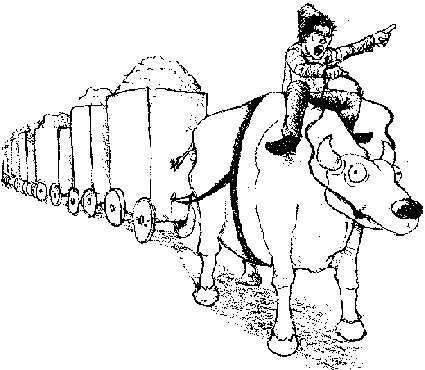
Once upon a time, in the country of Gandhara in northern India, there was a city called Takkasila. In that city the Enlightenment Being was born as a certain calf. Since he was well bred for strength, he was bought by a high class rich man. He became very fond of the gentle animal, and called him ‘Delightful’. He took good care of him and fed him only the best.

When Delightful grew up into a big fine strong bull, he thought, “I was brought up by this generous man. He gave me such good food and constant care, even though sometimes there were difficulties. Now I am a big grown up bull and there is no other bull who can pull as heavy a load as I can. Therefore, I would like to use my strength to give something in return to my master.”

So he said to the man, “Sir, please find some wealthy merchant who is proud of having many strong bulls. Challenge him by saying that your bull can pull one hundred heavily loaded bullock carts.”

Following his advice, the high class rich man went to such a merchant and struck up a conversation. After a while, he brought up the idea of who had the strongest bull in the city.

The merchant said, “Many have bulls, but no one has any as strong as mine.” The rich man said, “Sir, I have a bull who can pull one-hundred heavily loaded bullock carts.” “No, friend, how can there be such a bull? That is unbelievable!” said the merchant. The other replied, “I do have such a bull, and I am willing to make a bet.”

The merchant said, “I will bet a thousand gold coins that your bull cannot pull a hundred loaded bullock carts.” So the bet was made and they agreed on a date and time for the challenge.

The merchant attached together one-hundred big bullock carts. He filled them with sand and gravel to make them very heavy.

The high class rich man fed the finest rice to the bull called Delightful. He bathed him and decorated him and hung a beautiful garland of flowers around his neck.

Then he harnessed him to the first cart and climbed up onto it. Being so high class, he could not resist the urge to make himself seem very important. So he cracked a whip in the air, and yelled at the faithful bull, “Pull, you dumb animal! I command you to pull, you big dummy!”

The bull called Delightful thought, “This challenge was my idea! I. have never done anything bad to my master, and yet he insults me with such hard and harsh words!” So he remained in his place and refused to pull the carts.

The merchant laughed and demanded his winnings from the bet. The high class rich man had to pay him the one-thousand gold coins. He returned home and sat down, saddened by his lost bet, and embarrassed by the blow to his pride.

The bull called Delightful grazed peacefully on his way home. When he arrived, he saw his master sadly lying on his side. He asked. “Sir, why are you lying there like that? Are you sleeping? You look sad.” The man said, “I lost a thousand gold coins because of you. With such a loss, how could I sleep?”

The bull replied, “Sir, you called me ‘dummy’. You even cracked a whip in the air over my head. In all my life, did I ever break anything, step on anything, make a mess in the wrong place, or behave like a ‘dummy’ in any way?” He answered, “No, my pet.”

The bull called Delightful said, “Then sir, why did you call me ‘dumb animal’, and insult me even in the presence of others? The fault is yours. I have done nothing wrong. But since I feel sorry for you, go again to the merchant and make the same bet for two-thousand gold coins. And remember to use only the respectful words I deserve so well.”

Then the high class rich man went back to the merchant and made the bet for two-thousand gold coins. The merchant thought it would be easy money. Again he set up the one-hundred heavily loaded bullock carts. Again the rich man fed and bathed the bull, and hung a garland of flowers around his neck.

When all was ready, the rich man touched Delightful’s forehead with a lotus blossom, having given up the whip. Thinking of him as fondly as if he were his own child, he said. “My son, please do me the honor of pulling these one-hundred bullock carts.”

Lo and behold, the wonderful bull pulled with all his might and dragged the heavy carts, until the last one stood in the place of the first.

The merchant, with his mouth hanging open in disbelief, had to pay the two-thousand gold coins. The onlookers were so impressed that they honored the bull called Delightful with gifts. But even more important to the high class rich man than his winnings, was his valuable lesson in humility and respect.

The moral is: Harsh words bring no reward. Respectful words bring honor to all.

88,28. The Bull Called Delightful [All Deserve Respect]

Link: https://hhdorjechangbuddhaiiiinfo.com/2024/07/30/8828-the-bull-called-delightful-all-deserve-respect/

#Buddhisttalesforyoungandold #Buddhiststories #storiesforkids #moralstories #Buddha #Jatakastories #PansiyaPanasJataka

84. A QUESTION FROM A SEVEN-YEAR-OLD [SIX WORTHY WAYS]

84. A QUESTION FROM A SEVEN-YEAR-OLD [SIX WORTHY WAYS]

Once upon a time there was a rich man living in Bane’s, in northern India. He had a son who was intelligent, curious and eager to learn. Even though he was only seven years old, he was determined to find out what is really valuable.

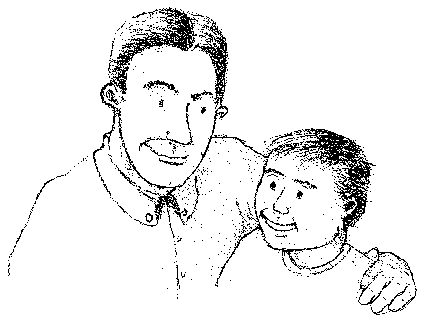
One day the little boy asked his father, “What are the ways to gain the most valuable things in life?”

His father said, “Only worthy ways lead to worthwhile goals. These are the six worthy ways:

  • Keep yourself healthy and fit;
  • Be wholesome in every way;
  • Listen to those with more experience;
  • Learn from those with more knowledge;
  • Live according to Truth;
  • Act with sincerity, not just energy.”

The boy paid close attention to his father’s words. He tried hard to practice these ways from then on. As he grew up and became wise, he realized that the six worthy ways, and the most valuable things in life, could not be separated.

The moral is: “A serious question deserves a serious answer.”

84. A Question From a Seven-year-old [Six Worthy Ways]

Link: https://hhdorjechangbuddhaiiiinfo.com/2024/06/11/84-a-question-from-a-seven-year-old-six-worthy-ways/

#Buddhisttalesforyoungandold #Buddhiststories #storiesforkids #moralstories #Buddha #Jatakastories #PansiyaPanasJataka

The Monkey Trap: A Lesson in Letting Go

African indigenous hunters have a unique method for catching monkeys.

First, they find a hole just big enough for a monkey’s hand. They place food that monkeys like inside the hole. When a monkey passes by and sees the food, it reaches in to grab it. With its hand full of food, the monkey’s hand gets stuck in the hole. Most monkeys won’t let go of the food and instead try to pull it out from different angles.

When the hunters arrive, the monkey is still struggling and trapped, making it easy for the hunters to catch it.

Many people’s anxiety and suffering stem from holding on to too many things and being unwilling to let go, which prevents them from truly obtaining what they need.

In reality, letting go appropriately allows us to broaden our horizons, take time to adjust ourselves, and better engage in our current work.

The Young Man and the Zen Master: A Lesson in Detachment

Once upon a time, a young man visited a Zen temple to seek guidance from an old Zen master. On his way, he witnessed an interesting sight and decided to test the master. Upon arriving at the temple, he and the master chatted over tea. Suddenly, the young man asked, “What does ‘going round and round’ mean?”

“It’s because the rope hasn’t been cut,” the Zen master replied casually.

The young man was stunned and amazed. He said, “Master, I am surprised that you knew! Today, on my way here, I saw a cow tied to a tree. The cow wanted to go far to graze, but because the rope was through its nose, it kept going round and round, twisting itself without being able to break free. It was quite amusing. I thought that since you hadn’t seen it, you wouldn’t be able to answer. But you answered correctly right away.”

The Zen master laughed and said, “You asked about an event, and I answered with a principle. You asked about a cow tied by a rope and unable to break free; I answered about the mind being entangled by worldly matters and unable to find liberation. One principle can explain many situations.

“A kite, no matter how high it flies, cannot soar into the vast sky because it is tethered by a string. Similarly, what often binds us in life, preventing us from being free? A single win or loss can exhaust us; a gain or loss can cause us great anguish; an exam can keep us tossing and turning; a relationship can tie us in knots.

“For power and money, we run around in circles; for fame and desire, we are constantly entangled. Fame is a rope, desire is a rope, profit is a rope; the attachments and temptations of the world are all ropes. So the Zen master said, ‘All beings are like that cow, bound by many ropes of worries and sufferings, unable to achieve liberation throughout life and death.'”

The Wisdom of Living in the Present

A young monk once asked an old monk, “Master, what did you do when you were young?”

The master replied, “I chopped wood, fetched water, and cooked.”

The young monk asked, “And what do you do now that you’ve attained enlightenment?”

The master said, “I still fetch water, chop wood, and cook.”

The young monk, puzzled, asked, “What’s the difference? It seems like you haven’t made any progress in your entire life.”

The old monk explained, “You’re wrong. There is progress. When I was young, I would think about fetching water while chopping wood, and think about cooking while fetching water. Now that I am enlightened, when I chop wood, I chop wood; when I fetch water, I fetch water; and when I cook, I cook.”

Reflecting on myself, I often feel that I need to do something else while eating to avoid “wasting time.” So, I like to chat with others, watch TV, or think about other things while eating. No wonder I sometimes feel like “I don’t even know what I just ate.”

Enjoying the time spent eating and treating each bite with attention, I savor the sweetness of the rice, the freshness of the vegetables, and the richness of the soup. The world on my taste buds is indeed wonderful, bringing much joy to everyday life.

While walking, I now instinctively let my phone rest and focus on walking, feeling my feet propel my body, enjoying the natural comfort of the breeze, smelling the flowers, hearing the birds, and seeing the colorful flowers, green leaves, and various passersby. The scenery is infinitely beautiful, something I rarely appreciated before. Missing out and becoming numb was inevitable.

This series of practices has gradually cultivated the quality of “focus” in me. I increasingly embrace the concept of “living in the moment.” Of course, I know this is just the beginning; focus is a lifelong practice.

Link: https://peacelilysite.com/2024/05/30/the-monkey-trap-a-lesson-in-letting-go/

Source: https://gospelexpress.id/2023/01/20/%E6%9D%BE%E6%89%8B%E6%94%BE%E4%B8%8B/, http://his.newdu.com/m/view.php?aid=358718https://www.sohu.com/a/240312612_761892

Enlightened Discourse: Exploring Love, Compassion, and Impermanence

One time, Shakyamuni Buddha and King Prasenajit engaged in a profound and comprehensive discussion about love and compassion.

“Master Gautama,” King Prasenajit began, “some people say you taught them not to love. They argue that the more you advocate for love, the more pain and sorrow there is. Though I can discern a grain of truth in this, I’ve always harbored a bit of unease about that perspective. Life without love feels devoid of meaning. Please enlighten me on this matter.”

The Buddha regarded the King with kindness and responded, “Your Majesty, that’s an insightful question, one from which many can benefit. Love, indeed, manifests in various forms, each requiring careful examination. While love is indispensable in life, it must not be rooted in lust, obsession, or prejudice. There is another form of love urgently needed in life. This entails love and compassion, or great kindness and great compassion. What people commonly perceive as love is often confined to mutual affection among family members and citizens. However, such love, tethered to notions of ‘me’ and ‘mine,’ fosters attachment and separation.”

“People primarily yearn to love those within their immediate circle—parents, spouses, children, grandchildren, relatives, and fellow citizens,” he elaborated. “However, love imbued with partiality breeds bias, leading to indifference or discrimination toward those outside one’s circle. Attachment and separation, therefore, perpetuate suffering for oneself and others.”

“The love that humanity truly craves is one rooted in love and compassion,” the Buddha emphasized. “Great kindness and compassion extend universally to all beings, transcending distinctions of ‘mine’ and ‘not mine.’ Devoid of attachment, they bring about happiness and alleviate suffering.”

“In great kindness and compassion, there lies no trace of differentiation,” he concluded. “They serve as the path to liberation from distress.”

The King bowed his head in thought. “I have a family and a country to take care of,” he said. “If I don’t love my family and my country, how can I take care of them? Please clarify this for me.”

The Buddha reassured him, saying, “Of course, you should love your family and your people, but your love can extend beyond them. Your present limited love can be transformed into an all-embracing love, and the young people of this country will become your sons and daughters. This is the true meaning of compassion.”

The King asked again, “This is something that can actually be done, especially where you live. It’s much easier. What about young people in other countries?”

The Buddha replied, “Though they are not in your country, that doesn’t stop you from thinking about the youth of other countries, just as you treat your own children. You love your people; that’s no reason why you can’t love other people.”

The King said, “But when they’re not under my jurisdiction, how can I show my love for them?”

The Buddha looked at the King and spoke, “The prosperity and security of a nation should not be gained at the expense of the weakness and turmoil of other countries. Your Majesty, lasting peace relies on the cooperation of all nations moving towards the common good. Kaushambi Salo will remain safe if you strive for it. You do not wish for your young men to perish on the battlefield; therefore, you must aid in stabilizing other nations. For genuine peace, foreign and economic policies must be guided by compassion. While you prioritize the well-being of your own people, you must also extend love and care to neighboring kingdoms such as Magadha, Gashi, Vitiha, Shakya, and Khalil.”

The King exclaimed with enthusiasm, “Wonderful! This is profound! Your words deeply resonate with me. Surely, you possess true enlightenment! I promise to ponder your teachings diligently and understand their wisdom thoroughly. However, I have a simple question for you. General love, as you mentioned, often involves separation, desire, and attachment, leading to sorrow and misery. But how can one love without desire or attachment? How can I, for example, love my children without succumbing to worry and pain?”

“In the path of enlightenment, love cannot exist without understanding,” the Buddha continued. “Love is born out of understanding. You cannot truly love someone unless you know them. Couples who are unfamiliar with each other will struggle to foster love. Similarly, parents and children who lack understanding of each other will find it challenging to cultivate love. If you desire the happiness of the one you love, you must make an effort to comprehend their concerns and aspirations. True love stems from this understanding. Conversely, if you merely seek to impose your own desires onto them, disregarding their needs, it is not genuine love but rather a desire for control and self-gratification. When everyone experiences peace, happiness, and joy, you will also come to understand these states. This is the essence of love on the path of awareness.”

The King, profoundly touched, conveyed his gratitude, stating, “I am truly grateful for the profound wisdom you have shared with me. However, I still find myself grappling with a lingering question. You assert that love rooted in attachment leads to pain and turmoil, while compassionate love brings peace and happiness. Although I perceive compassionate love as altruistic and selfless, I still harbor concerns that it may entail suffering.”

“Compassion is indeed the fruit of understanding,” the Buddha replied. “To tread the path of awareness is to bear witness to the reality of life—a reality characterized by impermanence. In everything, there exists no eternal or individual self. One day, all of this will be behind us.”

“When one comprehends the impermanence of existence, their perspective becomes tranquil and harmonious,” he continued. “The presence of impermanence does not disturb their mind and body; hence, the poignant feeling induced by compassion is unparalleled in its bitterness. Yet, the anguish of compassion serves to fortify one’s resolve.”

Moved deeply by the teachings, the King of Persia realized that no spiritual teacher or Brahmin priest had ever succeeded in opening his heart to such profound understanding. He considered the presence of the Buddha as a divine blessing bestowed upon the country. Filled with reverence, he expressed his wish to become a disciple of the Buddha.

Link:https://peacelilysite.com/2024/05/02/enlightened-discourse-exploring-love-compassion-and-impermanence/

Source: Old Path White Clouds A life story of the Buddha by Thich Nhat Hanh

80. FEAR MAKER AND LITTLE ARCHER [SELF-DECEPTION]

80. FEAR MAKER AND LITTLE ARCHER [SELF-DECEPTION]

Some say that the world comes into being, disappears, and comes into being … over and over, throughout time. In one of these previous worlds, countless years ago, Truth was unknown and the Five Training Steps were practiced by only a few. Even the Enlightenment Being — the Bodhisatta — did not know Truth, and had not yet discovered the Five Training Steps.

Once upon a time in that long ago world, there was a king named Brahmadatta. Like many other kings of that name, he ruled in the place known today as Benares.

The Bodhisatta was born in a rich high class family in a market town, also in northern India. He happened to be a dwarf, bent over and partly hunchbacked. When he became a young man he remained short and stooped. Many people found him unpleasant to look at.

He studied under a very outstanding teacher. He learned all there was to know at that time, about the two great branches of knowledge — religion and science. He also learned how to use a bow and arrow better than anyone else in India. For this reason his teacher called him ‘Little Archer’.

Like most new graduates he was quite clever. He thought, “Many people judge by appearance alone. If I go to a king and ask for a job, he’ll probably ask, ‘Having such a short body, what can you possibly do for me?’ Therefore it would be better if I can team up with a front man — someone who is handsome in appearance, tall and well-grown in body, and strong in personality. I will provide the brains, but remain out of sight behind his shadow. In this way we can earn a good living together.”

One day he was walking in the district where the weavers live and work. He happened to see a big, strong looking man. He greeted him and asked his name. The weaver said, “Because of my appearance, people call me Fear Maker.”

“With such an impressive name.” said Little Archer, “and being so big and strong looking, why do you have such a low paying job?” “Because life is hard,” he replied.

“I have an idea.” Said the dwarf “In all India there is no one as skilled with a bow and arrow as I am. But I don’t look the part! If I asked a king for work he would either laugh or get angry at me. He would not believe that a hunchbacked little dwarf could be the greatest archer in India!

‘But you look perfect. And your name helps too. Therefore, let us go together to the king. You will be the front man and do all the talking. The king will hire you immediately. Meanwhile I will remain as if hidden underneath your shadow. I will be the real archer and we will prosper and be happy. You just have to do whatever I tell you.”

Thinking he had nothing to lose, Fear Maker agreed, saying, “It’s a deal, my friend!”

The two partners went off to Benares to see the king. When they entered the throne room, they bowed respectfully to the king. He asked them, “Why have you come here?”

Fear Maker stood in front and did all the talking. He answered, “I am the great archer known as Fear Maker. There is no one in all India who understands the science of archery as well as I do. I wish to be in your service, your majesty.”

The king was quite impressed. He asked, “What shall I pay you?” “I will serve you for 500 pieces of money per week your majesty,” he replied.

Nodding, the king noticed the silent dwarf stooping behind him, almost out of sight. “Who is this little man?” he asked. “What does he do for you?” “He’s my little assistant,” said Fear Maker. ‘Very well,” said King Brahmadatta, “the job is yours.”

In this way Fear Maker was accepted into the king’s service, but it was Little Archer who did all the work.

Before long, news came to the palace that there was a ferocious tiger living in the jungle next to the king’s highway. He ambushed travellers, and then killed and ate them. Many began to avoid the king’s highway out of fear of the man-eater.

The king summoned Fear Maker and asked, “Can you capture this rampaging tiger, young man?” “Your majesty,” he answered, “I am known as your best archer. Why wouldn’t I be able to capture a tiger?” Hearing this, the king gave him an extra sum of money and sent him out to catch the tiger.

Fear Maker went home and told all this to his partner. “All right,” said Little Archer, “be on your way!” “Aren’t you coming too?” asked the surprised Fear Maker. “No, I won’t go,” he replied, “but I will give you a perfect plan. You must do exactly as I say.” “I will, my little friend. Please tell me,” said the big front man.

The clever little dwarf said to his friend, “Go to the district of the tiger, but don’t rush straight to his home by yourself. Instead, gather together a thousand local villagers and give them all bows and arrows. Take them directly to the tiger’s home. But then you must let them go on ahead while you hide in the underbrush.

‘The local villagers will be very afraid of the tiger. When they see him they will surround him and beat him. Being so terrified, they won’t stop beating him until he’s dead!

“Meanwhile you must cut a piece of vine with your teeth. Then come out of hiding and approach the dead tiger, holding the vine in your hand. When you see the tiger’s body, shout at the people, ‘Hey! Who has killed the tiger? I was going to capture him with this vine and lead him like a bull to the king. That’s why I’ve been searching in the jungle. Now tell me who has killed the tiger before I could get here with my vine.’

“The villagers will be easily frightened by this. They will say, ‘Lord Fear Maker, please don’t tell the king! Then they will give you a big bribe to be quiet. Thinking you have killed the dangerous tiger, King Brahmadatta will also reward you greatly.” This was the tricky plan of the clever Little Archer.

Fear Maker did exactly as he had been instructed. The man-eating tiger was killed, and fear was removed from that part of the king’s highway. Followed by a big crowd he returned to the king and said, “Your majesty, I have killed the tiger and made the jungle safe for people again.” The king was pleased and gave him a huge reward.

Before long there were similar complaints about a buffalo who threatened another royal road. Again the king sent Fear Maker. Following Little Archer’s strategy he did exactly as before. He took credit for killing the buffalo and was greatly rewarded again by the grateful king.

By this time Fear Maker had become a very rich and powerful nobleman. All the wealth and praise, which he didn’t really deserve, soon went to his head. He became intoxicated with his own conceit and began thinking he was a ‘big man’ in his own right. He even looked down on Little Archer and ignored his advice. He said to him, “You think this is all because of you. But I don’t need you. I can do all this without you!” He had come to believe the appearance created by Little Archer’s plan.

Then it happened that an enemy king attacked. He surrounded the city of Benares with his army. He sent a message to King Brahmadatta that he must either surrender his kingdom or wage war. The King of Benares ordered his greatest hero, Fear Maker, to go out and fight the enemy.

Fear Maker was dressed in full military armour. He mounted the mightiest armoured war elephant. Little Archer knew that the ungrateful conceited braggart, called Fear Maker was really scared to death underneath. So he too mounted the elephant and sat behind Fear Maker. The mighty elephant walked through the city gates towards the battlefield, followed by a big crowd.

When Fear Maker heard the huge noise made by the war drums, he began trembling with fear. To keep him from falling off the elephant and being killed, Little Archer tied a rope around him and held him with it.

When Fear Maker saw the field of battle he was overwhelmed by the terrible fear of death. So much so, that he couldn’t help but release his bowels and urinate at the same time — all over the back of the poor brave war elephant!

The Enlightenment Being said, “Before you bragged and spoke roughly like a big man. But now, the only big thing you do is make a filthy mess all over this elephant’s back! Your present actions prove your past appearance was false.”

Fear Maker had embarrassed himself. Little Archer had humbled him by speaking the truth. But he couldn’t help feeling sympathy for him. He said, “Don’t be afraid anymore, my friend. With me to protect you, your life is safe. Climb down from the elephant and go home and take a bath.”

Alone atop the great elephant, the Enlightenment Being thought, “Now is the time to show what is in the heart of this hunchbacked little dwarf!” Shouting mightily as he rode he charged into the field of battle. Without killing any men or animals, he crashed through the enemy’s defences. He broke into the king’s camp, captured him, and took him back as prisoner to the King of Benares.

King Brahmadatta was delighted with Little Archer’s great victory. He rewarded him with wealth and fame. He became known throughout all India as ‘Little Archer the Wise’. He sent his friend Fear Maker back to his home village and supported him with monthly payments.

Little Archer the Wise practiced generosity and other meritorious deeds. When he died he was reborn as he deserved.

The moral is: “Appearances can be deceiving.”

80. Fear Maker and Little Archer [Self-deception]

Link: https://hhdorjechangbuddhaiiiinfo.com/2024/04/16/80-fear-maker-and-little-archer-self-deception/

#Buddhisttalesforyoungandold #Buddhiststories #storiesforkids #moralstories #Buddha #Jatakastories #PansiyaPanasJataka