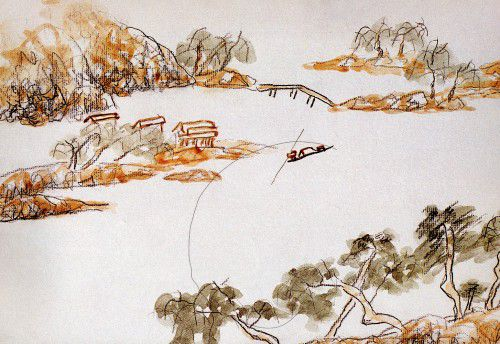
The Wisdom of the Empty Boat: Ancient Chinese Insight for Inner Peace

Chinese Painting by Henggong Yi

In the Mountain Tree chapter of the ancient Taoist classic Zhuangzi, there’s a simple yet profound story:

A man was crossing a river in a small boat when he noticed another boat drifting straight toward him. He shouted several times to warn the oncoming boat, but received no reply. Furious, he began cursing the other “reckless” person. But when the boats collided, he realized the other vessel was completely empty. In that moment, his anger vanished into thin air.

This story reveals a timeless truth: Often, what triggers our anger isn’t real harm but our judgment about the intention behind an event—our belief that someone shouldn’t have acted a certain way, or that people like that shouldn’t exist.

Imagine the same situation, but this time with a person steering the other boat. Most of us would react with outrage: “What’s wrong with you? Watch where you’re going!” A conflict would likely erupt. But when we know the boat is empty, we simply steer around it and move on.

This is beautifully explained in psychology by the ABC model:

  • A stands for the Activating event
  • B is our Belief about the event
  • C is the Consequence—our emotional response

It’s not the event itself that causes our reaction, but how we interpret it. Change your mindset, and your entire emotional response changes with it.

“The weak blame, the strong adjust, the wise let go.”
How you choose to interpret the world shapes the emotional and spiritual life you live.

Zhuangzi’s parable invites us to practice a mental shift: what if we saw others as “empty boats”? When a coworker unintentionally bumps into you, instead of assuming hostility, think, “Maybe they were just distracted.” When a friend speaks harshly, perhaps they’re struggling with something you don’t know. Instead of reacting with pain or revenge, consider that it may not have been personal.

Seeing others as “empty boats” helps us release resentment, practice compassion, and expand our emotional resilience. It allows us to heal ourselves faster, without getting trapped in cycles of blame and victimhood.

German philosopher Arthur Schopenhauer once said:

“To be angry at someone’s behavior is as foolish as being angry at a rock blocking your path.”
True wisdom lies in seeing through the illusion of control, and responding with tolerance rather than judgment.

When life doesn’t go our way, it’s easy to fall into the trap of self-pity: “Why is this happening to me?” But such thoughts only darken our mood and invite more misery.

The real shift happens when we stop blaming others and start examining our own mindset. By applying the “Empty Boat” perspective, we reduce conflict, soothe emotional storms, and gain a wider, calmer view of life. This isn’t just emotional regulation—it’s a deeper level of personal growth.

Zhuangzi also wrote:

“If a person can empty themselves and move through the world with humility, who can harm them?”

When we’re too attached to ego—too quick to feel offended, too focused on saving face—we inevitably clash with others. But if we release pride, prejudice, and the need to control, we become unshakable. No one can truly hurt us when we no longer take things personally.

Our mindset is the foundation of how we face adversity. Approach life with a peaceful, open heart, and life will respond in kind. Let go of the need for constant validation. Don’t let others’ words disturb your inner calm.

The journey of life is like sailing through mist—we never know what lies ahead. Complaining or getting angry doesn’t change reality; it only slows us down. But when we practice acceptance and face life with serenity, we go farther, and with greater ease.

Imagine all the unpleasant people or events in your life as “empty boats.” Let go of resentment and emotional baggage. You’ll find that forgiveness is not weakness, but a deep, penetrating wisdom. No longer a slave to your emotions, you become the true master of your mind.

May you carry an empty and serene heart, navigating life’s storms with grace, and holding on to peace amid the noise of the world.

Link: https://peacelilysite.com/2025/05/16/the-wisdom-of-the-empty-boat-ancient-chinese-insight-for-inner-peace/

Psychoenergetic Science: A Second Coperican-Scale Revolution

Dr. Tiller, a professor emeritus of materials science and engineering at Stanford University, tells us that “the term Psychoenergetics[1] was coined by the Russians in the Soviet era or 1950-1970. This was done to provide a strongly materialistic flavor to the fields of parapsychology and spiritual-related phenomena in order to make research in these areas palatable to the communist party’s worldview.” Dr. Tiller started his work to find a rigorous framework for scientifically understanding this class of phenomena during this period and until the present time.

He expanded on Einstein’s revolutionary work in this area even expanding Einstein’s famous E=mcto incorporate the evolutionary concept of consciousness. He even devised formulae, based upon careful experimental research, that link “subtle energies” to those of mainstream science and which expand the present-day formation of quantum mechanics. He noted that there “…was a class of truly weird phenomena that had been visible for more than a century and was somehow related to various processes associated with the application of human consciousness in our world. On the other hand, there still exists today, a very long-held, underlying assumption of conventional science that ‘No human qualities of consciousness, intention, emotion, mind or spirit can significantly influence a well-designed target experiment in physical reality.’ Something is very wrong here!”

He noted that “…the first Copernican revolution of thought lifted humanity from an earth-centric, theocratic-inspired, model of our solar system, which was largely qualitative in terms of details, to a local solar system which was sun-centered.” This, in turn, with the contribution of Galileo, Newton, and others, expanded our world-view and provided the framework for the great technological advancements of our modern era. He also provided his intuitive hypothesis on the link of our physical reality within the context of our higher [or spiritual] dimensional nature”…that this new, second Copernican-type revolution will, in terms of scale, be at least as significant for the progress of humankind as the first one!”

Not all scientists are there yet, or even close, but this beginning is hopeful. Much of what he writes is vastly beyond my capacity to absorb and, frankly, my interest. However, I believe that it is very relevant to our practice and is consistent with the teachings of the Buddha, albeit in a different language and perspective and with a different goal although Dr. Tiller holds that the underlying principle of all is “love.” You may ask how I can talk of dragons and yidams and all sorts of strange things and still be interested in science? I know a very bright young man, who was brought up as a religion-scorning communist, who thought that monks were parasites of the people and begrudged the donations his pious mother gave them. After several business failures, he took some time off to reflect on what had gone wrong in his life and started reading books by some on his favorite scientists and mathematicians. At the end of one such work, a scientist whom he admired greatly, said something after explaining an evolved scientific finding, “Of course, the Buddha told us all of this over 2,500 years ago.” He then decided to reconsider the works of the Buddha and is now a great master as well as a successful scientist. I too believe that science will eventually catch up with the Buddha or at least come closer to explaining what is now unkown and mysterious and the world will be better for it. I also believe that like unlocking the power of the atom through the work of Einstein et al came with great risks and potential for disaster, likewise our research into consciousness and our higher natures must be based in the evolution of our character. Correct Cultivation is essential on so many levels.

[1]   Psychoenergetic Science relates to the relationship between human consciousness and subtle energy.

Embracing Life’s Truths: Carl Jung’s Wisdom for Modern Challenges

In a world of endless distractions and relentless challenges, Carl Jung’s reflections on life’s most essential lessons remain profoundly relevant. In his later years, Jung observed that accepting all aspects of life is not just important—it is the cornerstone of a meaningful existence. His insights offer a timeless guide for navigating the complexities of modern society.

Jung poignantly recalled how people often try to escape the realities that life presents, whether in the form of suffering, challenges, or existential questions. This avoidance, he argued, only deepens pain and confusion. By evading suffering and placing blame on external circumstances or personal shortcomings, individuals reject the price of truly living. Such resistance, rather than shielding us from discomfort, births an even greater torment: the isolation and repression of the human spirit.

In today’s fast-paced world, where instant gratification and superficial solutions abound, Jung’s warning is especially pertinent. Modern society often encourages us to numb our struggles—whether through technology, consumerism, or escapism—but this path leads not to fulfillment, but to emptiness.

The Value of Acceptance

Jung’s philosophy centers on the idea that life’s true value lies in accepting one’s destiny, no matter how daunting it may seem. He acknowledged the inevitability of suffering but believed that such pain should stem from our authentic choices and realities, not from a refusal to face life’s responsibilities. Staying true to oneself and living authentically, Jung suggested, is the most profound response to life. As he put it:

“I have always remained true to myself, doing everything I could to the best of my knowledge and ability. As for whether I was right or wrong, I cannot say.”

This philosophy calls on us to embrace the fullness of life, including its struggles, as a path to authenticity and wholeness.

One of Jung’s most profound insights is the intergenerational impact of avoiding one’s destiny. He reflected on the heavy psychological burdens he inherited from his parents, describing them as unfulfilled responsibilities that weighed on his life like a snail’s shell—inescapable and ever-present. Jung warned that when we refuse to confront our challenges, we inadvertently pass these unresolved burdens to the next generation.

In the modern era, this serves as a powerful reminder of the importance of addressing our inner conflicts. By facing our struggles head-on, we not only free ourselves but also spare our children from carrying the weight of our unfinished business.

Jung believed that avoiding life’s essence severs us from our inner selves. While it may seem that evading certain troubles brings temporary relief, such avoidance also cuts us off from the vitality and richness of life itself. Ultimately, the deepest regrets arise not from the joys we never experienced, but from the moments we failed to embrace.

This insight is especially relevant in an age where disconnection has become commonplace. Whether through the overuse of technology or the prioritization of material success over personal growth, many people find themselves estranged from their true selves. Jung’s call to embrace life fully offers a powerful antidote to this modern malaise.

A Path to Wholeness

Jung’s enduring wisdom reminds us that the worth of a human being lies in taking responsibility for their own debts. This is not merely a duty but a journey toward completeness. As he said:

“The worth of a human being lies in taking responsibility for their debts—not just as a duty but as a path to wholeness.”

This profound philosophy encourages us to accept life, embrace our true selves, and confront our challenges with courage and authenticity. In doing so, we reconnect with our inner selves and pave the way for a more meaningful existence.

Jung’s reflections offer a timeless guide for navigating the complexities of modern life. By rejecting avoidance, accepting life’s realities, and living authentically, we can overcome the spiritual isolation that plagues our era. His philosophy is a call to action for anyone seeking to live a life of depth, connection, and purpose.

As we face the uncertainties of today’s world, let us carry forward Jung’s legacy and strive to embrace all aspects of life. In doing so, we honor his profound insights and open the door to a richer, more fulfilling human experience.

Link:https://peacelilysite.com/2025/01/19/embracing-lifes-truths-carl-jungs-wisdom-for-modern-challenges/

Discovering Meaning in Adversity: Lessons from Viktor Frankl’s ‘Man’s Search for Meaning’

In his profound book “Man’s Search for Meaning,” psychologist Viktor Frankl imparts crucial lessons on finding meaning in our lives. The book is divided into two parts: the first half comprises the author’s semi-autobiographical narrative of life in a concentration camp, retaining insights and thoughts from the perspective of a refugee. Frankl, with the keen observational eye of a psychologist, categorizes the camp’s inhabitants into two main groups. Those who survived were invariably those who found meaning in life and clung to a shred of hope to keep moving forward, although many of them did not persevere until the end. Those who deemed life meaningless, lost the will to live, and had no hope, inevitably perished.

The second half delves into the fundamental concepts of logotherapy from a psychological perspective. Observations from the refugee camp are documented and internalized into the author’s own “logotherapy,” aiding patients—or ordinary people like us—in finding meaning in life and living their unique existence. The author advocates against determinism, emphasizing the importance of individual choice over environmental determinism.

Frankl, a Jewish psychiatrist imprisoned in the Auschwitz concentration camp, experienced a tumultuous journey of emotions. Before Christmas in 1944, rumors spread in Auschwitz that the war would end and everyone would be released, yet after Christmas passed without the anticipated victory, hopelessness descended, resulting in the death of 80% of the camp’s inhabitants—not from hunger and cold, but from the loss of hope. Frankl survived because two things mattered to him: his family, especially his love for his wife, which provided him with immense motivation during times of suffering, and his manuscript, his work on the psychological “logotherapy” he aimed to complete. These two things were bigger than himself, sustaining him through the ordeal.

This book stands out among numerous works because it encompasses both the author’s personal harrowing experiences and the detached observations of a scientist. From the outset, the author states his reluctance to write a mere chronicle of the concentration camp but rather aims to answer one question: “What psychological journey does an ordinary prisoner go through each day in the camp?” His observations focus on the silent, anonymous inmates’ reactions to their environment, including his own.

What fascinates me most is the author’s earnest yet transcendent perspective. Grounded in his own inner being, he strives for honesty without self-pity or complaint, maintaining a clinical detachment that rises above the harsh realities of the time. This writing style and attitude reveal both his resilient spirit and remarkable clarity of mind, as well as his profound understanding of his inhuman conditions, rendering emotional catharsis unnecessary.

At times, he detaches himself from his immediate surroundings, engaging in imaginary dialogues with his beloved wife, allowing love to fill his heart. The ability to detach oneself from reality using imagination is a unique human skill that aids survival in extreme adversity.

His theory posits that the search for meaning in life is the fundamental driving force of human existence. This meaning is unique and individual, requiring realization and practice by each person; only through this realization can one’s will to meaning be fulfilled. The aim of “logotherapy” is to aid individuals in uncovering the meaning in their lives. This meaning varies for each person and changes at different life stages, necessitating personal exploration. Once discovered, it provides hope for easing the neuroses arising from a lack of meaning in life. Meaning in life is concrete and tangible. For instance, a mother may find meaning in living for her children. I wholeheartedly concur with the author’s view that the meaning of life is not fixed. The sustenance it provides varies at different ages and stages of life. For instance, there was an elderly man who had been depressed for two years after losing his wife, seeking assistance from Frankl. When asked what his wife would do if he had passed away before her, the man responded that she would not be able to bear such pain. Frankl then remarked, “So, she left first. You can bear the pain for her to rest in peace. Isn’t that good?” The man felt relieved upon hearing this. He found the meaning of his life at that time.

According to author, there are three paths to finding meaning in life: 1. Creativity and work; 2. Recognizing values (such as love); 3. Suffering. Frankl firmly believes that everyone can find meaning in life, whether through creativity and work, experiencing something or loving someone, or, in extreme circumstances, when all joy is stripped away, unavoidable suffering itself becomes the meaning of life. From his experiences in the concentration camp, he realized the third path.

In extreme adverse conditions, when a person is reduced to nothing but their body and mind, they still retain the freedom to choose their attitude towards their environment. They can either actively and arduously utilize every condition to survive or succumb to the desire to die, yielding to fate. The choice of attitude is the only and complete dignity and meaning. And humans can choose to say “yes” to life.

Therefore, Frankl is a pessimistic optimist. He acknowledges that life itself is inherently meaningless, yet he is willing to inspire humanity to find meaning for themselves. His mission in existential psychiatry is to help patients find their own meaning in life through various methods. In contrast to psychoanalysis, which views humans as passive products of their environment, Frankl places human subjective will in a more significant position.

I cannot disagree with Frankl’s viewpoint. From my own half-century of life experience, I also believe that the attitude we adopt towards our environment, whether favorable or adverse, ultimately determines the trajectory of our lives. This is what I mean by “character determines destiny.” There are times of despair, hopelessness, and pessimism, of course, and there is no need to feel ashamed. We should learn to pull ourselves out of negative emotions and sincerely believe that “tomorrow will be better.” And indeed, tomorrow often turns out fine.

Nine powerful quotes from the book Man’s Search for Meaning

  1. Choose hope. We cannot always change our circumstances but we always have a choice about our attitude in any given situation. As Viktor Frankl writes, “When we are no longer able to change a situation, we are challenged to change ourselves.”*
  2. Know your why. Ask yourself: What am I living for? Every single day, we should ask ourselves why we are getting up and why we are here at all “Those who have a ‘why’ can bear with almost any ‘how’.”
  3. Learn how to cry. Tears are not a sign of weakness; they emanate from a soul that is not afraid to break: “But there was no need to be ashamed of tears, for tears bore witness that a man had the greatest courage, the courage to suffer.”
  4. Don’t just be part of the herd. The world is upside down; sometimes doing what everyone else is doing is what is insane. “An abnormal reaction to an abnormal situation is normal.”
  5. Live meaningfully. We create meaning by answering the questions life asks from us. “Ultimately, man should not ask what the meaning of his life is, but rather must recognize that it is he who is asked. In a word, each man is questioned by life and he can only answer to life by answering for his own life. It did not really matter what we expected of life, but rather what life expected of us.”
  6. Fill your day doing acts of kindness. There is purpose in kindness; there is meaning in the hundreds of small acts of giving that we have the opportunity to grasp each day. “We who lived in concentration camps can remember the men who walked through the huts comforting others, giving away their last piece of bread. They offer sufficient proof that everything can be taken from man but one thing: the last of the human freedoms-to choose one’s own way.”
  7. Move beyond yourself. We find true meaning when we transcend our own needs and limits. “The more one forgets himself – by giving himself to a cause to serve or another person to love – the more human he is and the more he actualizes himself.”
  8. Feel the pain of others. Suffering hurts no matter how irrelevant or ordinary it may seem to others. Be attuned to others’ grief even if doesn’t seem like a tragedy in the overall scheme of life. “Thus suffering completely fills the human soul and conscious mind, no matter whether the suffering is great or little. Therefore, the ‘size’ of human suffering is absolutely relative.”
  9. We can change even when life is hard. We can create meaningful lives full of depth and love and purpose. “Man does not simply exist but always decides what his existence will be, what he will become the next moment. By the same token, every human being has the freedom to change at any instant.”

Link:https://peacelilysite.com/2024/05/10/discovering-meaning-in-adversity-lessons-from-viktor-frankls-mans-search-for-meaning/

Source: https://aish.com/viktor-frankl-on-mans-search-for-meaning/?utm_source=googlegrants&utm_medium=cpc&utm_campaign=19561819333&utm_term=&gad_source=1&gclid=Cj0KCQjwxeyxBhC7ARIsAC7dS39s79sG7BUeoDswcsOBoRwlH6T6GmrNQQI4sy3uRqgCvyLnNNoEQooaAo9EEALw_wcB, https://book.douban.com/subject/5330333/reviews

Facing the Truth: Life is Difficult

Facing the Truth: Life is Difficult

Recently, my two college-aged sons have been expressing that they find life to be difficult. In an effort to provide them with guidance and support, I have been offering them spiritual advice and emotional support. While searching for resources to assist in this endeavor, I stumbled upon the profound and enlightening book, The Road Less Traveled, by Scott Peck. The insights and philosophy presented within the book have been incredibly inspiring and beneficial in helping me to support my sons in their journey.

The Road Less Traveled is a self-help book by American psychiatrist and author Scott Peck, first published in 1978. The book has had a significant impact, selling millions of copies and remaining on the New York Times bestseller list for more than ten years. One of the main themes of the book is the concept of the four disciplines: psychiatry, psychology, religion, and philosophy. Each discipline offers unique perspectives on how to navigate the challenges of life and achieve personal growth.

The book’s central message is that life is difficult, but that this difficulty can be transcended by understanding and accepting it. Peck argues that discipline is the basic tool we need to solve life’s problems, and that with enough discipline we can solve all problems. Additionally, the book explores themes of love, relationships, parenting, and self-discovery, as well as teaching about distinguishing dependency from love and how to become one’s true self.

Life is a series of problems. It is something that we all must face and deal with on a daily basis. Some of these problems may be small and easily solved, while others may be more complex and difficult to overcome. The question we must ask ourselves is: do we want to moan about these problems or do we want to solve them?

As adults, we have the power to choose how we react to life’s problems. We can choose to bemoan our difficulties and wallow in our troubles, or we can choose to take action and find solutions. The latter approach is far more productive and will ultimately lead to greater satisfaction and fulfillment in life.

In addition to making this choice for ourselves, it is also important to teach our children to solve problems in a similar manner. As parents, we have a responsibility to guide and teach our children, helping them to develop the skills and mindset needed to overcome the challenges that life will inevitably present to them.

One of the most important tools we have for solving life’s problems is discipline. Without discipline, we will not be able to effectively tackle the issues that we face. With only some discipline, we may be able to solve only some problems, but with total discipline, we can solve all problems. Discipline is the key to success in any endeavor. It allows us to focus our minds and efforts, to set goals and make plans, and to persist in the face of adversity.

It is important to note that problems do not go away on their own. They must be worked through and dealt with, otherwise they will remain forever, acting as a barrier to the growth and development of the spirit. It is essential that we learn to face and overcome problems, rather than avoiding or ignoring them.

One way to do this is by learning to Delay Gratification. By scheduling the pain and pleasure of life in a way that we deal with pain first and get it over with, it allows us to enhance the pleasure we gain from it. This is the only decent way to live. With discipline, we can solve most of the problems, and delay gratification is a process that can help us to get through the most difficult moments.

Peck also emphasizes the importance of Love and Community in personal growth. He argues that true love is not just an emotional state, but also an action, and that it requires a commitment to growth and self-discipline. He also stresses the importance of community, stating that “the love of community is the only true love.”

I have also found out in Buddhism, love has a deeper meaning that goes beyond romantic or familial feelings. It encompasses compassion and the belief in treating all beings as if they were our own relatives or parents. In What is Cultivation by H.H. Dorje Chang Buddha III, says: “Loving-kindness: At all times, through the actions of my three karmas, I am loving and kind toward all living beings, who have been my parents. I wish them a long life without illness, good fortune, good luck, and a happy life. ” This means that at all times, through all our actions, thoughts, and words, we should strive to be loving and kind towards all living beings, recognizing that they have been our parents in past lives. This belief is expressed through the wish for all beings to have a long life free from illness, good fortune, good luck, and happiness. This unconditional love can have a positive impact on individuals who are facing challenges and difficulties in their lives.

Everyone must face and deal with the challenges and difficulties in life. Moaning about them or solving them, it’s a choice we make, and the latter can lead to greater satisfaction and fulfillment in life. Teaching our children to solve problems in a similar manner and helping them to develop the discipline and tools needed, that could be in religions or philosophy or psychology, to succeed in life is an essential responsibility of parenthood.

Facing the Truth: Life is Difficult

Link: http://What is Cultivation by H.H.Dorje Chang Buddha III

#TheRoadLessTraveled#ScottPeck#Discipline#Love#Compassion#Philosophy#DelayGratification#Religions#Phsycology#Truth#Discipline#WhatisCultivation #H.H.DorjeChangBuddhaIII