88,28. THE BULL CALLED DELIGHTFUL [ALL DESERVE RESPECT]


88,28. THE BULL CALLED DELIGHTFUL [ALL DESERVE RESPECT]

Once upon a time, in the country of Gandhara in northern India, there was a city called Takkasila. In that city the Enlightenment Being was born as a certain calf. Since he was well bred for strength, he was bought by a high class rich man. He became very fond of the gentle animal, and called him ‘Delightful’. He took good care of him and fed him only the best.

When Delightful grew up into a big fine strong bull, he thought, “I was brought up by this generous man. He gave me such good food and constant care, even though sometimes there were difficulties. Now I am a big grown up bull and there is no other bull who can pull as heavy a load as I can. Therefore, I would like to use my strength to give something in return to my master.”

So he said to the man, “Sir, please find some wealthy merchant who is proud of having many strong bulls. Challenge him by saying that your bull can pull one hundred heavily loaded bullock carts.”

Following his advice, the high class rich man went to such a merchant and struck up a conversation. After a while, he brought up the idea of who had the strongest bull in the city.

The merchant said, “Many have bulls, but no one has any as strong as mine.” The rich man said, “Sir, I have a bull who can pull one-hundred heavily loaded bullock carts.” “No, friend, how can there be such a bull? That is unbelievable!” said the merchant. The other replied, “I do have such a bull, and I am willing to make a bet.”

The merchant said, “I will bet a thousand gold coins that your bull cannot pull a hundred loaded bullock carts.” So the bet was made and they agreed on a date and time for the challenge.

The merchant attached together one-hundred big bullock carts. He filled them with sand and gravel to make them very heavy.

The high class rich man fed the finest rice to the bull called Delightful. He bathed him and decorated him and hung a beautiful garland of flowers around his neck.

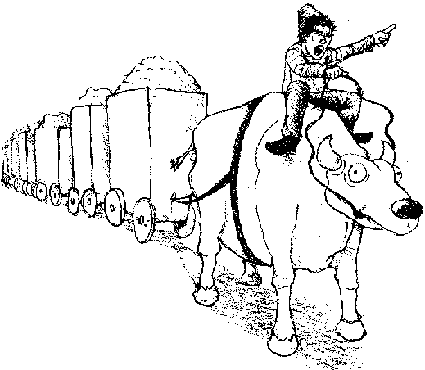
Then he harnessed him to the first cart and climbed up onto it. Being so high class, he could not resist the urge to make himself seem very important. So he cracked a whip in the air, and yelled at the faithful bull, “Pull, you dumb animal! I command you to pull, you big dummy!”

The bull called Delightful thought, “This challenge was my idea! I. have never done anything bad to my master, and yet he insults me with such hard and harsh words!” So he remained in his place and refused to pull the carts.

The merchant laughed and demanded his winnings from the bet. The high class rich man had to pay him the one-thousand gold coins. He returned home and sat down, saddened by his lost bet, and embarrassed by the blow to his pride.

The bull called Delightful grazed peacefully on his way home. When he arrived, he saw his master sadly lying on his side. He asked. “Sir, why are you lying there like that? Are you sleeping? You look sad.” The man said, “I lost a thousand gold coins because of you. With such a loss, how could I sleep?”

The bull replied, “Sir, you called me ‘dummy’. You even cracked a whip in the air over my head. In all my life, did I ever break anything, step on anything, make a mess in the wrong place, or behave like a ‘dummy’ in any way?” He answered, “No, my pet.”

The bull called Delightful said, “Then sir, why did you call me ‘dumb animal’, and insult me even in the presence of others? The fault is yours. I have done nothing wrong. But since I feel sorry for you, go again to the merchant and make the same bet for two-thousand gold coins. And remember to use only the respectful words I deserve so well.”

Then the high class rich man went back to the merchant and made the bet for two-thousand gold coins. The merchant thought it would be easy money. Again he set up the one-hundred heavily loaded bullock carts. Again the rich man fed and bathed the bull, and hung a garland of flowers around his neck.

When all was ready, the rich man touched Delightful’s forehead with a lotus blossom, having given up the whip. Thinking of him as fondly as if he were his own child, he said. “My son, please do me the honor of pulling these one-hundred bullock carts.”

Lo and behold, the wonderful bull pulled with all his might and dragged the heavy carts, until the last one stood in the place of the first.

The merchant, with his mouth hanging open in disbelief, had to pay the two-thousand gold coins. The onlookers were so impressed that they honored the bull called Delightful with gifts. But even more important to the high class rich man than his winnings, was his valuable lesson in humility and respect.

The moral is: Harsh words bring no reward. Respectful words bring honor to all.

88,28. The Bull Called Delightful [All Deserve Respect]

Link: https://hhdorjechangbuddhaiiiinfo.com/2024/07/30/8828-the-bull-called-delightful-all-deserve-respect/

#Buddhisttalesforyoungandold #Buddhiststories #storiesforkids #moralstories #Buddha #Jatakastories #PansiyaPanasJataka

The Swan’s Gift

The Swan’s Gift

By Brenda Seabrooke

Anton was a farmer who lived with his wife Rubina and their seven children at the edge of the forest. He worked hard and they were happy for many years. Then one spring, the rains didn’t fall and Anton’s wheat died in the fields. As winter came on, their food supply grew smaller and smaller. Soon, Anton’s shoulders were stooped with worry. Rubina’s plump apple cheeks withered. The children no longer sang or laughed or danced, for they were all too hungry.

Every day Anton went out to hunt for food but returned without firing a shot. And every day, Rubina added water to the onion soup until there was nothing in the pot but water. When Anton saw his family crying with hunger, he wanted to cry too.

But instead, he took his gun and went out again into the cold, cold night. He had to find something for them to eat: a bird or a rabbit. But the black branches were empty of birds and no rabbits crouched in the frozen shrub. The only tracks Anton saw were his own.

He came to a small hill and knew it was the last one he would be able to climb before his strength was gone. His feet were numb and his breath rasped in the freezing air. At the top of the rise, he stopped to rest, scanning the snow for tracks. In despair, Anton turned to go. Just then, he saw below him a lake that was not yet frozen over. Its edge was lacy with ice and at its center floated a swan of such dazzling beauty that Anton could not look away. Its stark white feathers gleamed against the dark water and as Anton watched, the swan seemed to grow larger until its image filled his eyes.

Suddenly, juices flowed into Anton’s mouth. He could taste succulent roast swan and see his children’s faces glowing as his family sat at the table eating again. He raised his gun and sighted down the long barrel. Anton put his finger on the trigger. The swan seemed to be looking at him, listening for the shot that would kill it. He lowered the gun. The swan was the most beautiful creature Anton had ever seen. As he watched, the swan fanned its magnificent wings.

Anton closed his eyes and thought of his family. Again, he raised his gun. Hours seemed to pass. The feathers on the swan’s breast moved gently with each beat of its heart, and Anton could feel his own heart beating. He lifted his heavy wet feet, walked a few steps, and then dropped to his knees. “I can’t do it,” he said.

“Why not?” asked a voice as soft as snow or feathers ruffling in a gentle wind.

“I cannot kill beauty. If I kill this swan, my family will have food for one or two meals. And then what? We will be hungry again and it will have been for nothing.”

Anton was too tired to be surprised that he was speaking to the swan or the wind or the night. He was too tired to walk back home. He bowed his head with sadness for his family.

With a cry, the swan lifted its wings, rose from the lake, and circled Anton, water dropping from its wing feathers.As the water hit the snow, it froze into crystals that sparkled in the moonlight. Anton reached out and touched one. It was hard, harder than ice, and did not melt in the warmth of his hand.

“A diamond!” Anton said. Quickly, he scooped up the diamonds that lay in a glittering circle around him. He filled his pockets with them and set off through the snow to a nearby village.

Anton was no longer tired. He no longer felt the cold. He woke up the innkeeper, calling, “I need food.”

“Your crops failed,” said the innkeeper. “Everyone knows you have no money.”

“I have a diamond,” said Anton.

“Where would the likes of you get a diamond?” the man scoffed.

“Let me in and I will explain.”

The innkeeper fed Anton cold venison and sweet dumplings while Anton told his story, and the innkeeper’s wife packed a sledge for him with roast chickens and cheeses and onions and turnips. Then they sent Anton on his way so that they could begin looking for the magic swan themselves.

Rubina met him at the door. “Did you find any food? Mischa has fainted.”

“No. But look what I have brought.” Anton showed her the sledge.

“But how did you get it?” she asked.

For answer, he spilled the diamonds onto the table.

“Oh,” cried Rubina, “you have turned to robbery!”

“No,” said Anton. And he told her all about the swan, and how it had circled him with the diamonds falling from its wings.

Anton and Rubina woke the children even though it was the middle of the night, and they all sat at the table eating slowly, enjoying the flavor of the food and wonderful feeling in their stomachs. Rubina’s black eyes sparkled as she filled her children’s bowls. Anton felt his strength returning. Several of the children hummed as they were put to bed.

Anton and Rubina and their children were never hungry again, for they used their diamonds wisely and well. News of the magic swan spread throughout the land and many people searched for it. But the swan was never found.

Sometimes when Anton was alone in the forest, the image of the swan rose before him. He saw again the gleam of its feathers, the coral glow of its beak, and the magnificent reach of its wings as it glided silently across the sky.

Link:https://peacelilysite.com/2024/05/20/the-swans-gift/

Source: https://files.schudio.com/st-marys-ce-primary-school/files/documents/year_2_reading_1(1).pdf

80. FEAR MAKER AND LITTLE ARCHER [SELF-DECEPTION]

80. FEAR MAKER AND LITTLE ARCHER [SELF-DECEPTION]

Some say that the world comes into being, disappears, and comes into being … over and over, throughout time. In one of these previous worlds, countless years ago, Truth was unknown and the Five Training Steps were practiced by only a few. Even the Enlightenment Being — the Bodhisatta — did not know Truth, and had not yet discovered the Five Training Steps.

Once upon a time in that long ago world, there was a king named Brahmadatta. Like many other kings of that name, he ruled in the place known today as Benares.

The Bodhisatta was born in a rich high class family in a market town, also in northern India. He happened to be a dwarf, bent over and partly hunchbacked. When he became a young man he remained short and stooped. Many people found him unpleasant to look at.

He studied under a very outstanding teacher. He learned all there was to know at that time, about the two great branches of knowledge — religion and science. He also learned how to use a bow and arrow better than anyone else in India. For this reason his teacher called him ‘Little Archer’.

Like most new graduates he was quite clever. He thought, “Many people judge by appearance alone. If I go to a king and ask for a job, he’ll probably ask, ‘Having such a short body, what can you possibly do for me?’ Therefore it would be better if I can team up with a front man — someone who is handsome in appearance, tall and well-grown in body, and strong in personality. I will provide the brains, but remain out of sight behind his shadow. In this way we can earn a good living together.”

One day he was walking in the district where the weavers live and work. He happened to see a big, strong looking man. He greeted him and asked his name. The weaver said, “Because of my appearance, people call me Fear Maker.”

“With such an impressive name.” said Little Archer, “and being so big and strong looking, why do you have such a low paying job?” “Because life is hard,” he replied.

“I have an idea.” Said the dwarf “In all India there is no one as skilled with a bow and arrow as I am. But I don’t look the part! If I asked a king for work he would either laugh or get angry at me. He would not believe that a hunchbacked little dwarf could be the greatest archer in India!

‘But you look perfect. And your name helps too. Therefore, let us go together to the king. You will be the front man and do all the talking. The king will hire you immediately. Meanwhile I will remain as if hidden underneath your shadow. I will be the real archer and we will prosper and be happy. You just have to do whatever I tell you.”

Thinking he had nothing to lose, Fear Maker agreed, saying, “It’s a deal, my friend!”

The two partners went off to Benares to see the king. When they entered the throne room, they bowed respectfully to the king. He asked them, “Why have you come here?”

Fear Maker stood in front and did all the talking. He answered, “I am the great archer known as Fear Maker. There is no one in all India who understands the science of archery as well as I do. I wish to be in your service, your majesty.”

The king was quite impressed. He asked, “What shall I pay you?” “I will serve you for 500 pieces of money per week your majesty,” he replied.

Nodding, the king noticed the silent dwarf stooping behind him, almost out of sight. “Who is this little man?” he asked. “What does he do for you?” “He’s my little assistant,” said Fear Maker. ‘Very well,” said King Brahmadatta, “the job is yours.”

In this way Fear Maker was accepted into the king’s service, but it was Little Archer who did all the work.

Before long, news came to the palace that there was a ferocious tiger living in the jungle next to the king’s highway. He ambushed travellers, and then killed and ate them. Many began to avoid the king’s highway out of fear of the man-eater.

The king summoned Fear Maker and asked, “Can you capture this rampaging tiger, young man?” “Your majesty,” he answered, “I am known as your best archer. Why wouldn’t I be able to capture a tiger?” Hearing this, the king gave him an extra sum of money and sent him out to catch the tiger.

Fear Maker went home and told all this to his partner. “All right,” said Little Archer, “be on your way!” “Aren’t you coming too?” asked the surprised Fear Maker. “No, I won’t go,” he replied, “but I will give you a perfect plan. You must do exactly as I say.” “I will, my little friend. Please tell me,” said the big front man.

The clever little dwarf said to his friend, “Go to the district of the tiger, but don’t rush straight to his home by yourself. Instead, gather together a thousand local villagers and give them all bows and arrows. Take them directly to the tiger’s home. But then you must let them go on ahead while you hide in the underbrush.

‘The local villagers will be very afraid of the tiger. When they see him they will surround him and beat him. Being so terrified, they won’t stop beating him until he’s dead!

“Meanwhile you must cut a piece of vine with your teeth. Then come out of hiding and approach the dead tiger, holding the vine in your hand. When you see the tiger’s body, shout at the people, ‘Hey! Who has killed the tiger? I was going to capture him with this vine and lead him like a bull to the king. That’s why I’ve been searching in the jungle. Now tell me who has killed the tiger before I could get here with my vine.’

“The villagers will be easily frightened by this. They will say, ‘Lord Fear Maker, please don’t tell the king! Then they will give you a big bribe to be quiet. Thinking you have killed the dangerous tiger, King Brahmadatta will also reward you greatly.” This was the tricky plan of the clever Little Archer.

Fear Maker did exactly as he had been instructed. The man-eating tiger was killed, and fear was removed from that part of the king’s highway. Followed by a big crowd he returned to the king and said, “Your majesty, I have killed the tiger and made the jungle safe for people again.” The king was pleased and gave him a huge reward.

Before long there were similar complaints about a buffalo who threatened another royal road. Again the king sent Fear Maker. Following Little Archer’s strategy he did exactly as before. He took credit for killing the buffalo and was greatly rewarded again by the grateful king.

By this time Fear Maker had become a very rich and powerful nobleman. All the wealth and praise, which he didn’t really deserve, soon went to his head. He became intoxicated with his own conceit and began thinking he was a ‘big man’ in his own right. He even looked down on Little Archer and ignored his advice. He said to him, “You think this is all because of you. But I don’t need you. I can do all this without you!” He had come to believe the appearance created by Little Archer’s plan.

Then it happened that an enemy king attacked. He surrounded the city of Benares with his army. He sent a message to King Brahmadatta that he must either surrender his kingdom or wage war. The King of Benares ordered his greatest hero, Fear Maker, to go out and fight the enemy.

Fear Maker was dressed in full military armour. He mounted the mightiest armoured war elephant. Little Archer knew that the ungrateful conceited braggart, called Fear Maker was really scared to death underneath. So he too mounted the elephant and sat behind Fear Maker. The mighty elephant walked through the city gates towards the battlefield, followed by a big crowd.

When Fear Maker heard the huge noise made by the war drums, he began trembling with fear. To keep him from falling off the elephant and being killed, Little Archer tied a rope around him and held him with it.

When Fear Maker saw the field of battle he was overwhelmed by the terrible fear of death. So much so, that he couldn’t help but release his bowels and urinate at the same time — all over the back of the poor brave war elephant!

The Enlightenment Being said, “Before you bragged and spoke roughly like a big man. But now, the only big thing you do is make a filthy mess all over this elephant’s back! Your present actions prove your past appearance was false.”

Fear Maker had embarrassed himself. Little Archer had humbled him by speaking the truth. But he couldn’t help feeling sympathy for him. He said, “Don’t be afraid anymore, my friend. With me to protect you, your life is safe. Climb down from the elephant and go home and take a bath.”

Alone atop the great elephant, the Enlightenment Being thought, “Now is the time to show what is in the heart of this hunchbacked little dwarf!” Shouting mightily as he rode he charged into the field of battle. Without killing any men or animals, he crashed through the enemy’s defences. He broke into the king’s camp, captured him, and took him back as prisoner to the King of Benares.

King Brahmadatta was delighted with Little Archer’s great victory. He rewarded him with wealth and fame. He became known throughout all India as ‘Little Archer the Wise’. He sent his friend Fear Maker back to his home village and supported him with monthly payments.

Little Archer the Wise practiced generosity and other meritorious deeds. When he died he was reborn as he deserved.

The moral is: “Appearances can be deceiving.”

80. Fear Maker and Little Archer [Self-deception]

Link: https://hhdorjechangbuddhaiiiinfo.com/2024/04/16/80-fear-maker-and-little-archer-self-deception/

#Buddhisttalesforyoungandold #Buddhiststories #storiesforkids #moralstories #Buddha #Jatakastories #PansiyaPanasJataka

A Beautiful Love Story Carved in the Dunhuang Grotto China

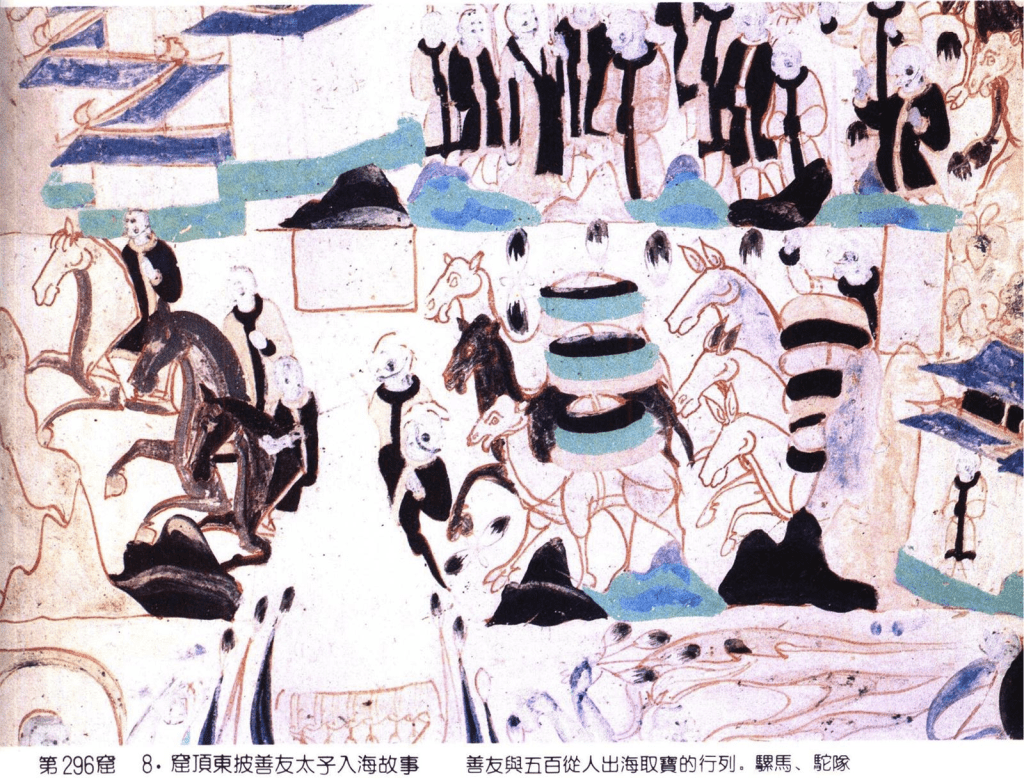
Prince Sunwoo ventured into the sea in search of treasures

In the ancient Dunhuang Grottoes of China, a mesmerizing love story unfolds, delicately captured in murals that have withstood the test of time. Let us immerse ourselves in this enchanting tale of kindness, courage, and wisdom.

Once upon a time, in the Kingdom of Polo, a joyous occasion marked the birth of a prince named Sunwoo. Born to the noble king and queen after twelve years of fervent prayers, the young prince brought immense happiness to the royal family.

As Sunwoo grew, so did his wisdom and kindness. His presence was a beacon of light, radiating love and compassion. However, alongside him was a stepbrother, an evil friend, whose heart harbored jealousy and resentment towards the virtuous prince.

The tale takes an unexpected turn when Sunwoo, driven by a desire to alleviate the suffering of his people, embarks on a perilous journey to seek treasures from the sea. His selflessness touches the hearts of many, but it also ignites the envy of his malevolent stepbrother.

Prince Sunwoo accompanied by 500 volunteers to search for treasur

Guided by an elderly instructor and accompanied by 500 volunteers, Sunwoo reaches Haizhou Jumbo Island. As he ventures further, facing challenges and loss, he encounters the benevolent Dragon King, who grants him the priceless Ruyi pearl.

Prince Sunwoo and his team sailed across the ocean

Meanwhile, back in the Kingdom of Polo, Sunwoo’s absence is keenly felt. His parents, yearning for his return, send a white goose as a messenger. The devoted goose delivers a letter revealing the Prince’s dire circumstances.

As Sunwoo’s journey unfolds, his evil stepbrother, fearing Sunwoo’s increased popularity upon return, decides to sabotage him. The malicious act blinds Sunwoo, leaving him vulnerable and alone.

In his darkest hour, a compassionate cowherd boy comes to Sunwoo’s aid. Unaware of his royal identity, the boy rescues Sunwoo and becomes his loyal companion, leading him back to the kingdom.

The love story takes an unexpected twist when the blind Sunwoo, reduced to a beggar, meets a kind princess during his wanderings. The princess was very touched by Sunwoo’s music. Her genuine affection and determination to marry him, despite societal norms, lead to a grand wedding.

In a poignant moment, the princess, deeply in love, makes a solemn vow. She promises to restore Sunwoo’s sight if her love is true and vows to take away her own eyes if she ever betrays him. Miraculously, her unwavering love restores one of Sunwoo’s eyes.

The narrative weaves through twists and turns, revealing the complex interplay of good and evil, karma, and ultimate redemption. Sunwoo’s evil stepbrother, realizing the consequences of his actions, repents and reveals the hidden Ruyi pearl.

In a grand reunion, Sunwoo’s parents regain their sight, and the entire kingdom is bathed in prosperity. The murals in Dunhuang and Kaihua Temple immortalize this timeless love story, showcasing not only the artistic brilliance of ancient China but also the enduring power of kindness and virtue.

As we reflect on this captivating tale, may it inspire us to embrace compassion, navigate life’s challenges with wisdom, and believe in the transformative power of love and redemption. The Dunhuang Grottoes stand as a testament to the rich tapestry of human stories etched in history, inviting us to cherish the enduring lessons embedded in their ancient walls.

Link:https://peacelilysite.com/2024/02/08/a-beautiful-love-story-carved-in-the-dunhuang-grotto-china/

#DunhuangGrottes #Murals #AcientArts

Source: photos from http://m.news.cctv.com/2020/08/09/ARTIoQSmgcAEjtx5j0cLVoos200809.shtml, https://www.sohu.com/a/334453850_120259260#google_vignette

Remembering Charlie Munger: A Beacon of Wisdom in the Investment World

Charlie Munger, the Philosopher of the Investment World

The investment realm bids farewell to its philosopher, the golden partner of Warren Buffett, Charlie Munger, who passed away on November 28th this year, at the age of 99. Munger’s life was a testament to generosity, kindness, rationality, humility, and a low-key demeanor. Renowned for his honesty, integrity, lack of complaints, and absence of hindsight bias, Munger earned global admiration and respect. His impactful literary work, “Poor Charlie’s Almanack,” reflects his profound humanity.

Among Munger’s profound teachings, five sentences stand out, resonating deeply with individuals and serving as timeless nuggets of wisdom. Deserving Success, Value Investing Strategy, Success and Surroundings, Magic of Compound Interest, Probabilities Over Luck.

“The best way to obtain something is to make oneself deserving of it” reflects classic wisdom upon contemplation. Unlike typical words of wisdom that merely offer principles without practical methods, Munger’s comprehensive approach in “Poor Charlie’s Almanack” reveals a value investing strategy intertwined with life philosophy.

Charlie Munger’s love for books was profound. Often referred to as a “bookshelf with two legs,” Munger’s voracious reading habit extended beyond the realms of finance. He explored diverse genres, not just for knowledge acquisition but to open his mind to different angles and views. His extensive reading shaped him into a profound thinker, and his eclectic taste in literature reflected in his unique perspectives. Munger’s commitment to continuous learning and intellectual curiosity made him an embodiment of wisdom.

Photo by Pixabay on Pexels.com

Munger’s belief in value investments extended beyond finance to personal development. He advocated assessing the value of a business before evaluating its stock, discarding speculative opportunities, and overlooking short-term factors. The enduring factor for a stock’s reliability, according to Munger, is whether it truly deserves its current price. This principle, he argued, holds true for personal growth, embodied in the saying, “The essential reason for a person’s success is that those around him wish for his success.”

Throughout his illustrious investment career, Munger adhered to the traditional values of the American West — diligence, focus, sincerity, thrift, and future investment. These principles earned him the trust of many collaborators. Notably, Munger’s initial million came from a real estate investment while he was still a lawyer. Recognizing the potential for real estate development in a property left by a client’s ancestors, Munger, through the client’s trust, achieved tremendous success.

Munger’s philosophy that making oneself valuable attracts potential collaborators is the most reliable investment method. This philosophy aligns with renowned stock guru Warren Buffett’s simple yet effective secret to wealth: save, invest, continue saving, and continue investing. Munger’s teachings delve into the power of compound interest, demonstrated in a thought experiment within “Poor Charlie’s Almanack.”

The experiment presents two choices — receiving $1000 daily for 30 days or receiving an escalating amount starting with 1 cent, doubling each day for 30 days. The seemingly attractive first choice limits the total to $30,000, while the second, with the magic of compound interest, accumulates to an astonishing $5.37 million. Munger highlights the patience required for compound interest to exhibit its true power, a principle applicable to personal growth.

Economist Xiang Shuai’s intriguing experiment reinforces Munger’s teachings. Progressing a little every day, even by 1%, leads to significant advancement after a year, while regressing daily results in minimal talent advantage. Munger’s emphasis on the importance of daily learning and reading resonates with the ancient wisdom: “Accumulate small steps, and you will cover a thousand miles.” He advocates believing in probability over luck, emphasizing that probability theory aligns closely with the world’s functioning.

Munger’s views on setting goals underscore the importance of realistic expectations and avoiding fanaticism. He advises setting goals slightly beyond one’s capabilities, then striving wholeheartedly to achieve them. The rational and joyful life attitude Munger promotes hinges on believing in the magic of compound interest.

Despite initial misconceptions, “Poor Charlie’s Almanack” is hailed as a seriously underestimated gem, transcending the appearance of a self-help book. Patiently reading through Munger’s insights reveals a figure resembling a traditional Chinese sage, offering universal wisdom for living a fulfilled and prosperous life. His desire for everyone to master universal wisdom echoes in the statement, “I only pass my sword to those who can wield it.” Munger’s legacy serves as a guiding light, illuminating our paths to a brighter and more brilliant existence.

Remembering Charlie Munger: A Beacon of Wisdom in the Investment World

Link: https://peacelilysite.com/2023/12/07/remembering-charlie-munger-a-beacon-of-wisdom-in-the-investment-world/

#CharlieMunger #InvestmentWisdom #LegacyOfLearning #PoorCharlieAlmanack #Wisdom

Six Powerful Habits That Will Change Your Life Forever

Once upon a time, a young man was very much troubled by his bad habits. His life was completely disturbed due to his bad habits. He did not value his time at all. He would just waste the whole day on useless things. He was also very lazy and drowsy. Whenever his family members asked him to do some work, he would try to avoid that work by making excuses. And for some reason, if he had to do that work, he would do it in haste without any interest. Whenever his parents tried to teach him something, he would argue with them without admitting his mistake. He would always postpone important tasks and decisions for tomorrow and try to avoid all kinds of responsibilities. Slowly and slowly, when all his friends started outdoing him, he began to realize that his bad habits are now causing him to lag. He tried many times to improve his bad habits, but every time he failed in it. Then one day, one of his friends told him that a monk is staying in a hut outside the village for a few days. He suggested him to meet the monk for his problem. Although the young man did not believe, he still reached the monk to meet him the next day.

When he reached there, the monk was meditating with his eyes closed. The young man went in front of him and bowed to him. The monk opened his eyes and with a smile on his face, he asked the young man to sit. The young man told his problem to the monk and told him how he wanted to change his habits but he failed every time. The monk listened to the young man patiently. Then he thought for a moment and said, “My friend, you want to change your habits in a few days, but you must know that just as it takes a long time to form habits, similarly, it will take a long time to change those habits. For this, you have to give time and change your bad habits with good habits. For example, if you want to leave the habit of lying, then you will have to adopt the habit of telling the truth first.” Then the monk became serious and said, “Son, today I will tell you about six such habits which will not only change your old habits but can also change your life.”

The first habit to adopt is reading books. Books contain answers to the questions that arise in your mind. Many people before you have had the same questions and have written down their answers in books. By reading books, you can gain knowledge and learn from the experiences of others.

It’s a way to discover your shortcomings and develop new and positive thoughts that will help you progress in life. Successful people often have the habit of reading books, so start reading today to bring about a miraculous change in your life.

The second habit recommended is writing. While reading books is a great way to gain knowledge, it’s easy to forget what you’ve learned. Writing down valuable information helps you retain and implement what you’ve learned. It also allows you to connect with your inner self, focus your mind, solidify your thoughts, and generate new ideas. Writing down your goals and keeping them visible can inspire you to work towards them.

The third habit is meditation, described as a solution for mental problems. Often, our troubles stem from dwelling on the past or worrying about the future. Meditation brings you to the present moment, reducing the flow of thoughts, calming your mind, and preventing overthinking. Regular meditation enhances your focus, reduces stress, and keeps your mind healthy.

Expressing gratitude for what you have is the fourth recommended habit. By focusing on what you have instead of what you lack, you can fill your life with happiness. Even during difficult times, taking a moment to appreciate what is going well can keep you content. Expressing gratitude reminds you of the abundance in your life and fosters a positive outlook.

The fifth habit is waking up early. This habit is common among successful individuals. Rising early makes you feel refreshed, happier, and more energetic. Mornings offer a peaceful environment with fewer distractions, enabling better concentration on work, studies, or activities such as yoga, meditation, exercise, or a morning walk. Waking up early reduces stress, anger, and fosters an optimistic and positive attitude.

The sixth habit is self-discipline. It involves creating a daily routine that promotes punctuality and hard work. Discipline contributes to present happiness and a promising future. It forms habits that shape your identity. Examples of disciplines include waking up early, consistent meditation, reading good books, consuming healthy food, avoiding junk food, exercising regularly, and practicing breathing exercises.

By adopting these six habits, your life can experience miraculous changes. Just as the young man who listened to the monk’s advice, make a promise to yourself to incorporate these habits into your life. If you want to bring positive change and progress towards your goals, start adopting these habits today. You will witness improvement and transformation in your life.

Six Powerful Habits That Will Change Your Life Forever

Link:https://peacelilysite.com/2023/07/14/six-powerful-habits-that-will-change-your-life-forever/

#Self-discipline #ReadingBooks#Meditation #Gratful #Writing #Monk #Buddhism #Gratitude

Source: https://www.youtube.com/watch?v=EUmL0zSV4Fw