This YouTube documentary by the BBC was done several years ago, but is worthy of another visit as it gives us a glimpse of the various forms of Buddhism and some of the great monuments and architectural expressions in the different cultures where it took root including our own.
In this fascinating documentary, historian Bettany Hughes travels to the seven wonders of the Buddhist world and offers a unique insight into one of the most ancient belief systems still practised today. Buddhism began 2,500 years ago when one man had an amazing internal revelation underneath a peepul tree in India. Today it is practised by over 350 million people worldwide, with numbers continuing to grow year on year. In an attempt to gain a better understanding of the different beliefs and practices that form the core of the Buddhist philosophy and investigate how Buddhism started and where it travelled to, Hughes visits some of the most spectacular monuments built by Buddhists across the globe. Her journey begins at the Mahabodhi Temple in India, where Buddhism was born; here Hughes examines the foundations of the belief system – the three jewels. At Nepal’s Boudhanath Stupa, she looks deeper into the concept of dharma – the teaching of Buddha, and at the Temple of the Tooth in Sri Lanka, Bettany explores karma, the idea that our intentional acts will be mirrored in the future. At Wat Pho Temple in Thailand, Hughes explores samsara, the endless cycle of birth and death that Buddhists seek to end by achieving enlightenment, before travelling to Angkor Wat in Cambodia to learn more about the practice of meditation.
Do Buddhists advocate supernatural powers? Actually, this is not a matter of advocating or not advocating. Rather, supernatural powers are that which everyone who is accomplished in the dharma possesses. Such powers are the manifestation of realization achieved through cultivation. They are phenomena that exist in the course of cultivation but are not the goal of cultivation, which is liberation from the cycle of birth and death. They are by-products that arise during one’s practice. These by-products called supernatural phenomena naturally exist in all liberating paths within the Buddha-dharma. Becoming attached to these by-products and regarding them as the goal is heretical supernatural powers. Applying these by-products in a free and unattached way and regarding them as illusory is treating supernatural powers based on the correct Buddha-dharma view.
Sakyamuni Buddha manifested supernatural powers and also was against supernatural powers. Each of those two tacks reflects different underlying karmic conditions. To those with higher vehicle (Mahayana) faculties, the Buddha spoke of supernatural powers as enjoyment resulting from incredible realization and the free and unattached application of samadhi. Examples of this are in the Lotus Sutra, the Samyuktagama Sutra, and other sutras. To those practitioners with low faculties, the Buddha spoke of not being attached to supernatural powers in order to reach the goal of realizing emptiness. An example of this is in the Shurangama Sutra.
Anyone with low faculties who wants to become a Buddha must go through the stage of cultivation corresponding to those with high faculties. In one’s course of cultivation, this is analogous to going from one city to another city. If one does not travel along the pathway between the two cities, one will not reach that other city. When one is walking toward that other city, one will certainly see and encounter all of the phenomena that are on the way. This is like the supernatural phenomena that arise in the course of one’s cultivation when wisdom is being opened. If one does not experience such phenomena that arise during the cultivation process, then one will not reach the other shore of liberation. Because one has not traversed the path of the Buddha-dharma leading to liberation, one cannot encounter phenomena that occur while traversing that path. That is why such a person has not experienced the stage in the process whereby wisdom is opened and supernatural powers are realized. Thus, all Buddhist who become accomplished in the dharma must go through the stage of supernatural powers.
Is it true that the authentic Buddha-dharma does not speak of supernatural powers? If that were the case, then why did the great leader of Buddhism, Sakyamuni Buddha, manifest supernatural powers everywhere? Why did he even manifest great supernatural powers right before entering nirvana? What crazed and demonic person would dare say that Sakyamuni Buddha did not practice the true Buddha-dharma? Just think. If someone with great accomplishment in the dharma did not have any supernatural realization powers, what would be the difference between that person and an ordinary person who had not learned Buddhism?
Based on the Sutra, it is stated that one who attains liberation and becomes a Saint must possess six great supernormal powers or superknowledges (abhijna). These powers are as follows:
Rddhi-saksatkriya: This power grants the ability to be anywhere or do anything at will, including extraordinary feats such as flying through the air and performing miraculous acts.
Divyasrotra: This power enables the individual to hear sounds from any location, even those that are normally inaudible, such as the subtle sounds of ants walking or distant noises emanating from other realms. It is also referred to as clairaudience or “the divine ear.”
Paracittajnana: With this power, one gains the ability to understand the thoughts and read the minds of other beings.
Purvanivasanu-smrtijnana: This power allows the recollection of previous existences or past lives, both one’s own and those of others.
Divyacakus: This power provides an instantaneous view of anything, regardless of its physical presence. It encompasses the ability to see events and occurrences in faraway places or even in other realms of existence. This power is also known as clairvoyance or “the divine eye.”
The sixth supernormal power, known as asavakkhaya, is unique to Buddhism and complements the other five powers. While individuals from non-Buddhist traditions can achieve the first five powers, their significance is not as profound as those attained by a Buddha due to the absence of complete enlightenment and wisdom. For instance, a Hindu practitioner remains bound by the world of Brahma, whereas a Buddhist practitioner is not limited in such a way. A Buddha’s powers are boundless. The sixth power refers to the understanding that one’s defilements have been extinguished and that liberation from the cycle of reincarnation has been attained. It represents the state of enlightenment. This is sometimes referred to as anasrava, which denotes the cessation of outflows or asravas. These powers are also known as the six superknowledges (abhijna) or supernatural cognitions.
The Dharma Protectors guard the use of these powers very closely. They will block the chakras of those unworthy to obtain these powers. Likewise they will untie the knots in the chakras of those cultivators who are worthy of such powers, causing the supernormal dharma powers of the buddhas and bodhisattvas to suddenly turn into light and enter the chakras. At that time, the mandala in each practitioner’s body will respond and will accept the powers. When your three karmas of body, speech, and mind unite into one body and correspond with the teachings, supernormal dharma powers will come into being. When your state of realization and state of virtue have reached the level where it is appropriate to obtain supernormal dharma powers, then as soon as you practice according to the dharma, supernormal dharma powers will appear. You cannot attain supernormal powers without proper moral discipline, concentration and wisdom. You must first be able to master the Dharma.
H.H. Dorje Chang Buddha III Wan Ko Yeshe Norbu Holiest Tathagata, is the highest ancient Buddha with complete proficiency in both exoteric and esoteric Buddhism and perfect mastery of the Five Vidyas. A portion of His Holiness’s realization powers is openly shown in this book A Treasury of True Buddha-Dharma for all to clearly see.
However, the clear and definite views expressed by His Holiness have enabled us to understand the principles and direction of cultivation. H.H. Dorje Chang Buddha III said the following:
“Not only did the Buddha speak a great deal about supernatural powers in the sutras, he also manifested supernatural powers. Such words and facts were directed at those who reached the higher vehicle (Mahayana) sambhogakaya state or nirmanakaya state. The Buddha also stated in the sutras that one must not become attached to supernatural powers. Such teachings were directed at those who were at the beginning stage of realizing their original nature and dharmakaya in order to protect them. If practitioners who are at the beginning stage of realizing the true nature or true-suchness of all phenomena become attached to supernatural powers, they will fall into that which is conditioned. They will then be practicing heresy. Thus, you should understand that supernatural powers are a reflection of the unhindered, unobstructed nature of Buddhas and great Bodhisattvas. Such powers are not that which beginning stage practitioners can possess and enjoy.”
May Buddha and Bodhisattva bestow their blessings upon all, guiding them towards liberation and enabling them to reside in the realm of ultimate bliss.
The Buddha recounted this tale in response to a dispute between two monks, highlighting the destructive nature of harsh words. Gathering a large group in the monastery hall at Jetavana, he addressed them, saying:
“Monks and nuns, even animals suffer unhappiness due to harsh words. Allow me to share with you a story from ancient times, when bitter words caused a farmer to lose his fortune.”
Once, in a bygone era, the Future Buddha manifested as a bull and was gifted to a farmer. Overjoyed, the farmer named the young calf “Great Joy” and treated him like his own child. He provided the bull with the best rice and milk, fostering his growth. Great Joy flourished and became a mighty ox, black as the night sky and as radiant as the stars. Despite his immense strength, he remained gentle and obedient.
After years of tender care, Great Joy felt immense gratitude towards the farmer. He thought to himself, “The farmer has raised me with loving kindness and made great sacrifices for my well-being. He has even gone hungry at times to ensure I am well-fed. I must find a way to repay him for all his kindness!” The next morning, as the farmer brushed the bull, Great Joy spoke to him, saying, “Master, I have devised a plan to repay you for your many years of care.”
Pausing his brushing, the farmer gently placed his hand upon the bull’s large head and replied, “Great Joy, you already plow my fields, turn my well wheel, and carry heavy loads to and from the village. You work tirelessly, and there is no need for you to repay me. Do not trouble yourself with such matters.”
However, Great Joy was determined to execute his plan. “Master, please listen. I have a marvelous idea that will make you instantly wealthy. Journey to the town today and find a merchant who owns a vast herd of oxen. Make a bet with him for a thousand silver pieces, claiming that your bull is the mightiest in all of India. Wager that tomorrow morning, in the village square, your ox will draw a hundred carts overflowing with rocks, stones, and gravel!”
Skeptical, the farmer replied, “My dear friend, how could any ox in the world pull a hundred loaded carts? It has never been done before. The entire town will think I have gone mad.”
Unyielding, Great Joy persisted, “I possess the strength, and I will not let you down.”
“But what if you fail to pull such a heavy load? A thousand silver pieces comprise all I possess! If you lose, I will be left impoverished!”
Remaining steadfast, Great Joy reassured him, “I promise you, I will not let you down. I will not lose the wager, and you shall not lose your money.”
And so, the farmer followed the ox’s suggestion. He ventured to the village and positioned himself in the town square, where business transactions took place. Eventually, a wealthy merchant dressed in fine robes approached him. Seizing the opportunity, the farmer boldly proclaimed, “Did you know, gentlemen, that I am the owner of the strongest ox in the kingdom? I doubt there is a bull in all of India that can rival mine! In fact, my bull may be the largest and mightiest in the entire world!”
The crowd fell silent upon hearing his boast. All eyes turned towards the farmer. Finally, the wealthy merchant broke the silence and retorted, “It is widely known that I, sir, possess an entire herd of the world’s strongest oxen. What makes your single bull so exceptional?”
Realizing he had found the ideal opponent, the farmer promptly replied, “I have a bull capable of effortlessly pulling a hundred fully loaded carts!”
Mockingly, the merchant responded, “And where might this extraordinary bull be found? In the land of fairies and dreams?”
“He resides at my home,” answered the farmer confidently.
“Well, if you hold him in such high regard, let us make it a wager,” challenged the merchant.
“Certainly,” agreed the farmer. “I will bet you a thousand silver pieces that my bull can move one hundred carts fully loaded with rocks, stones, and gravel. Prepare the carts and meet me here in the village square at sunrise tomorrow morning.” With a firm handshake, the deal was sealed, and both parties made their preparations.
The following morning, before daybreak, the farmer fed Great Joy sweet milk and hay, bathed him, and brushed his coat until it shone. Speaking gentle and soothing words, just as he did every day, the farmer adorned the ox’s neck with a garland of flowers.
Great Joy knew the moment had arrived to prove himself.
At dawn, the farmer led Great Joy to the village square. Excited onlookers, including men, women, and children, filled the streets, eager to witness the outcome of this seemingly impossible bet. The farmer was astounded by the sight that greeted him—an unprecedented number of carts, each loaded to the brim with rocks. If any doubts lingered in the farmer’s mind, they were quickly replaced by certainty that he had been foolish to believe a mere animal’s promise.
Nevertheless, Great Joy stood proudly at the head of the line of carts, awaiting his harnessing. Magnificent and towering, his shoulders surpassing any other ox, he captured the awe of the crowd. Two men struggled to secure the heavy yoke upon his broad back, and then they attached the carts in a long chain.
Anxious, the farmer anticipated his impending humiliation before the townsfolk. Clutching the leather goad tightly, he muttered to himself, “I cannot afford to lose this wager. The ox has made a promise, but I am his master. I must ensure that he pulls the carts without fail. Ailee! I have risked my life savings on the word of a mere beast!” With determination, the farmer raised his goad and struck Great Joy forcefully, shouting, “Now, you beast, pull the carts! Pull! Pull, you rascal!”
Great Joy was taken aback by this treatment. He thought, “I am not a rascal! I am not a beast! He has never spoken to me like this before or used a whip on me. I will not move an inch!” Ignoring the lashes of the whip and the harsh words from his friend, Great Joy planted his hooves firmly, like the roots of four Banyan trees, and remained immobile.
Instantly, the crowd erupted in laughter and mockery, witnessing the farmer’s stubborn ox refusing to obey. Once again, the farmer struck Great Joy with the goad and cursed him, but the ox gazed straight ahead, disregarding the goad, the farmer, and the jeering crowd. In no time, the crowd began pelting both the farmer and the ox with mud and dung. Overwhelmed with shame, the farmer hung his head low and reluctantly handed over his entire savings to the merchant.
Jingling the coins in his hands, the merchant chuckled and said, “Whenever you wish to make another wager, seek me out! What ox could possibly pull a hundred loaded carts?” he laughed.
Despondent and penniless, the farmer unharnessed Great Joy from the line of carts and led him back home. The villagers taunted them along the way, hurling insults, rotten fruit, and mud. The farmer tied the ox to a stake and retreated inside his home, overcome with grief. “I am a pauper! It took me twenty years to earn that silver!” he wailed and moaned.
Hearing the farmer’s pained sobs from outside, Great Joy approached the window and inquired what was wrong. “I have lost all my money because of you!” the farmer bitterly exclaimed. “You promised me you wouldn’t let me down!”
Great Joy replied, “Ah, but master, it was you who let me down! Throughout all the time I have lived under your care, have I ever harmed anyone? Have I ever been clumsy or broken a pot? No. I have carried children gently on my back, even allowing the smallest of them to lead me. I have always done exactly as you asked.”
“Yes, I suppose you are right,” sniffed the farmer.
“Well, then, go once more to the town and bet the merchant double the silver. We shall meet him again in the square tomorrow morning at sunrise. But remember, treat me kindly as you always have, and I will treat you as I always have!”
Hurriedly, the farmer returned to town, found the merchant, and presented him with a new offer. Laughing at the prospect of making even more money, the merchant agreed to another wager.
At dawn the next morning, the village square mirrored the scene from the previous day. One hundred carts stood in a long line, each loaded with rocks. Once again, the streets were filled with eager spectators. Great Joy, bathed and brushed with a fresh garland around his neck, walked proudly alongside the farmer to the front of the carts. However, people chatted and joked, not taking the two participants seriously.
The weighty wooden yoke was placed upon Great Joy’s back, and the ropes were securely fastened. The farmer stood beside his ox, gently stroking his powerful shoulders. After a while, he leaned over and spoke softly into the bull’s ear, “Now, my fine fellow, my friend, pull the carts forward!”
Upon hearing these words, Great Joy seemed to grow in size. His muscles tensed, and he leaned against the ropes with all his might, causing them to tighten, cart by cart, until reaching the hundredth. Great Joy strained and pulled, taking one step and then another, each accompanied by a surge of momentum. Step by step, with unwavering determination, Great Joy continued his effort until the final cart stood exactly where the first one had started.
It was a sight to behold! Cheers and applause filled the air as flowers and money rained down upon the bull and the farmer. Great Joy, glistening with sweat, stood nobly and proudly in his place.
The merchant shook his head in disbelief but paid the two thousand silver coins as agreed. Children reached out to stroke the mighty ox, marveling at his remarkable perseverance. There was much celebration. Before the morning came to an end, the farmer and his faithful companion, Great Joy, trotted down the dusty road back home, where they lived happily and prosperously ever after.
Thus, the Buddha finished his lesson with the monks and nuns, sayingagain that harsh words please no one. And he spoke this verse in conclusion:
Speak only kind words: never be unkind.
For he who speaks gently, the ox moves the whole earth,
Hostility toward spiritual traditions may be hampering empirical inquiry. Science and religion seem to be getting ever more tribal in their mutual recriminations, at least among hard-line advocates. While fundamentalist faiths cast science as a misguided or even malicious source of information, polemicizing scientists argue that religion isn’t just wrong or meaningless but also dangerous.
I am no apologist for religion. As a psychologist, I believe that the scientific method provides the best tools with which to unlock the secrets of human nature. But after decades spent trying to understand how our minds work, I’ve begun to worry that the divide between religious and scientific communities might not only be stoking needless hostility; it might also be slowing the process of scientific discovery itself.
Religious traditions offer a rich store of ideas about what human beings are like and how they can satisfy their deepest moral and social needs. For thousands of years, people have turned to spiritual leaders and religious communities for guidance about how to conduct themselves, how to coexist with other people, how to live meaningful and fulfilled lives — and how to accomplish this in the face of the many obstacles to doing so. The biologist Richard Dawkins, a vocal critic of religion, has said that in listening to and debating theologians, he has “never heard them say anything of the smallest use.” Yet it is hubristic to assume that religious thinkers who have grappled for centuries with the workings of the human mind have never discovered anything of interest to scientists studying human behavior.
Just as ancient doesn’t always mean wise, it doesn’t always mean foolish. The only way to determine which is the case is to put an idea — a hypothesis — to an empirical test. In my own work, I have repeatedly done so. I have found that religious ideas about human behavior and how to influence it, though never worthy of blind embrace, are sometimes vindicated by scientific examination.
Consider the challenge of getting people to act in virtuous ways. Every religion has its tools for doing this. Meditation, for example, is a Buddhist technique created to reduce suffering and enhance ethical behavior. Research from my own and others’ labs confirms that it does just that, even when meditation is taught and performed in a completely secular context, leading research participants to exhibit greater compassion in the face of suffering and to forgo vengeance in the face of insult.
Another religious tool is ritual, often characterized by the rigid following of repetitive actions or by engagement with others in synchronous movement or song. Here, too, an emerging body of research shows that ritualistic actions, even when stripped from a religious context, produce effects on the mind ranging from increased self-control to greater feelings of affiliation and empathy.
Ritual can also play a part in strengthening beliefs. Research on cognitive dissonance has shown that publicly stating beliefs that we don’t initially endorse leads to a psychological tension that is often remedied by altering our beliefs and behaviors to match our public pronouncements. Thus the religious practice of repeatedly stating beliefs as part of prayers — as in the Catholic Mass — may enhance devotion to a creed.
What findings like these suggest is that religions offer techniques — or “spiritual technologies,” in the words of Krista Tippett, the host of the radio show “On Being” — that help people endure difficulties, change their views or move them toward action. These techniques seem to work by nudging our behavior subconsciously. Ms. Tippett stresses that the specific religious traditions from which such techniques are borrowed should be understood and honored on their own terms. But when I spoke with her recently, she also agreed that the techniques might work even when separated from their religious trappings, as meditation and elements of ritual have been shown to do.
If this view is right, religion can offer tools to bolster secular interventions of many types, such as combating addiction, increasing exercise, saving money and encouraging people to help those in need. This possibility dovetails with a parallel body of research showing that by cultivating traditional religious virtues such as gratitude and kindness, people can also improve their ability to reach personal goals like financial and educational success.
When I broached this body of research with the cognitive scientist and religious skeptic Steven Pinker, he emphasized that it was by no means a vindication of religion as a whole. He made a point to differentiate between what he called religious practices and cultural practices, with religious ones being those more likely to have doubtful supernatural rationales (like using prayer to contact a deity for favors) and cultural ones having more practical justifications (like using ritual to foster connection and self-control).
While I can see Professor Pinker’s point — and I agree with him that religion as a whole must be judged by its full set of positive and negative effects — the dividing line between cultural and religious can be blurry. The Jewish practice of Shabbat, for instance, stems from a divine command for a day of rest and includes ritualistic actions and prayers. But it’s also a cultural practice in which people take time out from the daily grind to focus on family, friends and other things that matter more than work.
My purpose here isn’t to argue that religion is inherently good or bad. As with most social institutions, its value depends on the intentions of those using it. But even in cases where religion has been used to foment intergroup conflict, to justify invidious social hierarchies or to encourage the maintenance of false beliefs, studying how it manages to leverage the mechanisms of the mind to accomplish those nefarious goals can offer insights about ourselves — insights that could be used to understand and then combat such abuses in the future, whether perpetrated by religious or secular powers.
Science and religion do not need each other to function, but that doesn’t imply that they can’t benefit from each other. Rabbi Geoffrey Mitelman, the founding director of Sinai and Synapses, an organization that seeks to bridge the scientific and religious worlds, told me recently that science can help clergy better aid those they counsel by showing which types of social and behavioral practices are empirically most likely to foster their emotional, moral and spiritual goals.
A yearning for a science-religion synergy is growing in some circles. Ms. Tippett cites as an example the Formation Project, an initiative designed by a group of millennials who are looking to cultivate their inner lives and form a community by combining ideas from psychology and neuroscience with practices from ancient spiritual traditions.
In doing this, she points out, these young people are not blindly accepting any doctrine. They are asking questions and choosing what works based on evidence. In short, they are doing exactly what I think the communities of scientists and clergy need to do in a more rigorous way and on a much larger scale.
Will it work? That’s an empirical question. But if we choose not to investigate it, we’ll never know. And I suspect we’ll be the poorer for it.
In our quest to understand the origins of civilization, we often associate it with technological advancements, architectural marvels, or complex social structures. However, renowned anthropologist Margaret Mead presented a profound perspective on the matter. When asked about the first sign of civilization in a culture, Mead shared an unexpected answer that challenged conventional wisdom. She believed that the first evidence of civilization lies not in material objects but in the compassionate act of healing a broken femur.
In the animal kingdom, the inability to run, defend oneself, or access vital resources due to a broken leg can be a death sentence. Animals, being driven primarily by instinct, have limited capacity for compassion and assistance. Consequently, when a leg is fractured, survival becomes nearly impossible. Mead’s contrasting observation highlights the crucial distinction between human and animal behavior.
When a human being sustains a broken femur, the healing process takes time, care, and attention. It is during this period that the true essence of civilization emerges. The act of staying with the injured person, binding their wound, providing support, and ensuring their safety exemplifies the depth of human compassion and the development of a nurturing society. It is in these moments that the potential for humanity’s collective progress is realized.
Empathy lies at the core of our ability to serve others. It is our capacity to understand and share the feelings of another that allows us to extend a helping hand. Mead’s observation reminds us of the inherent empathy ingrained within our species. When we see someone in pain, our natural inclination is to offer assistance, whether through physical aid, emotional support, or simply being present. It is through the act of serving others that we tap into our highest human potential.
Acts of service have far-reaching consequences beyond the immediate impact on the individual being helped. When we extend kindness and support to others, we inspire a chain reaction of goodwill and compassion. Small acts of service can ignite a spark within others, motivating them to pay it forward. This ripple effect spreads throughout communities, strengthening social bonds and fostering a collective spirit of unity and care.
In Mead’s view, civilization begins with the act of helping someone through difficulty. It is through these acts of kindness, empathy, and service that we create a society marked by progress and interconnectedness. Civilization is not solely defined by technological advancements or material achievements but rather by the quality of human relationships and our commitment to supporting one another.
Margaret Mead’s perspective on the first sign of civilization challenges conventional notions and invites us to reflect on our values as a society. True civilization is not measured solely by material progress, but by our capacity to care for and uplift one another. By embracing our innate empathy and engaging in acts of service, we foster a civilization rooted in compassion, unity, and collective growth. Let us remember that we are at our best when we serve others, and through our actions, we can shape a more civilized and harmonious world.
Once, a man sought refuge in Gautam Buddha’s ashram after spending two days alone. Finally, he mustered the courage to approach Buddha and said, “Oh Buddha, I have questions lingering in my mind. I believe you hold the answers I seek.” Buddha replied, “Please, share your questions with me.” The man sighed deeply and expressed his dissatisfaction with life, saying, “I am constantly plagued by sadness and find no happiness whatsoever. I yearn to understand why this happens to me.”
Gautam Buddha, in his calm demeanor, responded, “First, tell me about the root cause of your sorrow. What are the exact factors contributing to your grief and anxiety?” The man pondered Buddha’s words for a moment and retorted, “Why do you ask me such a question? Aren’t you supposed to provide me with answers?”
With a serene smile, Buddha gently replied, “Your sorrow is yours to bear, and it is essential for you to identify the causes of your own suffering.” The man, astounded, exclaimed, “Oh Buddha, you possess prophetic abilities, capable of reading minds. You should already know everything.”
Buddha’s smile widened as he humbly replied, “It is a misconception on your part. You believe someone else can liberate you from your grief, but that is not the case. Only you have the power to resolve your own problems. I am just like you, the only difference being that I am free from confusion. The day your inner confusion dissipates, there will be no need for you to seek out a Buddha for answers. Have you ever observed flowers closely?”
Intrigued, the man responded, “Who has time to observe flowers?” Buddha continued, “A flower blooms like a bird at dawn, flourishes throughout the day, and withers by evening. If the flower had known it would wilt in the evening, it might have hesitated to blossom. Similarly, if you constantly dwell on sorrow, you will never experience true happiness. There are countless things in life that can bring you joy. You can smile and relish every moment. To find happiness, you must follow this path. I can show you the way, guide you on the path, but it is you who must walk it. Only then will you discover true happiness in life.”
Upon hearing this, the man fell silent for a while. After thoughtful contemplation, he said, “Buddha, one thing eludes my understanding. Is it possible to solve all the problems in my life simultaneously?” Buddha began to speak slowly, “Imagine someone approaches you and informs you that you will die in the next ten minutes. At that moment, no other problem would occupy your thoughts, for you would solely contemplate the absolute truth of life—death. You would realize the futility of dwelling on problems. We often fail to recognize life’s transience, becoming attached to our desires and perceiving our existence as eternal. Happiness and sorrow are not permanent; they arise from our actions and thoughts.”
The man listened attentively to Buddha’s words and inquired further, “So, should I constantly think about my mortality? Will that resolve my problems?” Buddha gently responded, “No, never think that way. Merely acknowledge the uncertainty of your existence and choose to live happily for as long as you are here. Ponder deeply; there are still many things that can bring you joy and contentment. Cultivate a focused mind, free from confusion. The sorrows and sufferings of life stem from desires. Control your mind. If you can make it as pure and innocent as that of a child, you will attain eternal happiness.”
The man eagerly asked Buddha, “Oh Buddha, how can I control my mind?” Buddha responded, “To gain control, we must understand the distinction between happiness and sorrow. One must recognize what brings happiness and what causes sorrow. The mind should neither be overly elated in extreme happiness nor deeply saddened in extreme sorrow. It is crucial to remain steady in the middle ground. If you closely analyze your sorrows and their underlying causes in real life, you will ultimately realize that the root of all sorrows lies within ourselves. And since the mind governs our actions, by controlling the mind, we can overcome sorrow.”
Buddha then suggested, “If you can accomplish one more task, you will witness the permanent vanishing of sorrow from your life.” The man, filled with enthusiasm, asked, “Tell me, Buddha, what must I do?” Buddha explained, “For the next two days, refrain from conversing with anyone. Find a solitary place in the ashram, take pen and paper, and contemplate your sorrows and their causes. On another piece of paper, write down the happiness that still exists in your life and its reasons. Take your time, think deeply.”
The man respectfully bowed to Buddha and retreated to a secluded corner of the ashram. After two days, he returned to Buddha with numerous sheets of paper. Buddha smiled and said, “Let me hear the summary of your sorrows first.” The man began reading, “Number one, all my siblings are wealthy, but I am burdened with debt and poverty. I fear taking action, always comparing myself to others. Number two, my neighbors have accumulated significant savings, unlike me. The reasons are that I have worked less, earned less, and squandered my money in bad company. I have not saved a single penny. Number three, my wife has been ill for a long time, and I am to blame for her suffering. Neglecting her, I have failed to seek medical help, leaving everything to chance. In truth, a wicked desire lingers in my mind: if my wife dies from her illness, I will remarry a faithful woman. Number four, I constantly daydream of illusory happiness, worrying and grieving when these dreams are unfulfilled due to a lack of money. Every day, I resort to alcohol to drown my sorrows, fully aware that I cannot afford it, yet I make excuses for my drinking. These are my four sorrows, and at the core of all of them lie my actions and thoughts.”
This time, Gautam Buddha smiled and said, “Now, tell me about your list of happiness.” The man’s face beamed with joy as he exclaimed, “I am truly happy, experiencing immense joy within me for the first time in my life during these past two days. The list of reasons for my happiness is so extensive that it would take hours to read. But let me share a few highlights.” Buddha smiled and responded, “Not just for you, but for all of us, the scenario is the same. We simply waste precious time fixating on the causes of sorrow. In reality, life is a treasure trove of happiness, peace, and joy. Well, you don’t need to read the entire list; just share a few.”
The man began with great delight, “First and foremost, I am grateful for being alive in this world, blessed with good health and strength. I have parents, a loving wife, and children, just like the fortunate ones in the world. My wealth extends far beyond material possessions; it encompasses the love and care from my parents, the affection of my beautiful wife, the tenderness of my children, and the joy of being a father. I am capable of working, physically fit and healthy. I have the opportunity to enhance my income through various endeavors, enabling me to fulfill the needs of my entire family. I am happy because I can create a harmonious family without comparing myself to neighbors or siblings. With the compassion instilled in me by your grace, I can leave behind my vices and embrace eternal peace.
The man continued: “The greatest joy and fortune lie in finding a place at the feet of Lord Gautam Buddha through your grace. As long as I am temporarily on this Earth, I will seek the truth of life, understand myself with a composed mind, and strive to bring eternal bliss to myself and others.”
Buddha remarked, “Now, go back to your family, for today you are reborn. Live a life of eternal peace with a steadfast mind. Whenever confusion arises, remind yourself that life is fleeting, and you are not meant to be enslaved by sorrow. Analyze and identify the causes of your sorrows, eliminating them immediately. Only then will you discover everlasting happiness and boundless joy.”
Chinese calligraphy has transcended its role as a mere communication tool and has become an art form highly esteemed even in an era dominated by ballpoint pens and computers. No longer limited to intellectuals and officials, calligraphy is now practiced by professional artisans and enthusiastic amateurs. Calligraphers employ brushes to beautifully ink five distinct styles of script: ‘seal’, ‘official’, ‘cursive’, ‘running’, and ‘regular’. While calligraphy can be found on various surfaces, even adorning the rocky walls of cliffs, it is most commonly seen on letters, scrolls, literary works, and fan coverings.
Throughout history, the Chinese have believed that no art form or field of study can truly reflect a person’s moral character and knowledge as effectively as calligraphy. The accomplishments or creations in other arts or fields often overshadow one’s shortcomings in knowledge and character. However, calligraphy stands apart from this convention. It functions as a three-dimensional mirror, projecting the depth of knowledge, moral character, and mental strength with each brushstroke. There is no hiding or concealing these qualities. When examining an individual’s ordinary handwriting of Chinese characters, one can often discern their level of education. This is even more evident when examining their calligraphy.
In the annals of history, there is no account of an unknowledgeable person making significant contributions to calligraphy. Profound and extensive knowledge does not necessarily guarantee expertise in calligraphy. However, great calligraphers possess both knowledge and skillful brushwork. Without exception, the renowned calligraphers of past generations were literary masters who possessed deep knowledge. Notable examples include Xizhi Wang, Su Huai, Shaoji He, Huaiguan Zhang, Fei Yue, and in more recent times, Youren Yu. Each of them was an erudite literary figure and exemplar of virtue.
Knowledge serves as the pillar and cornerstone of calligraphy, while moral character is reflected in the style and allure of the art form. Thus, calligraphy demands a combination of knowledge and moral character.
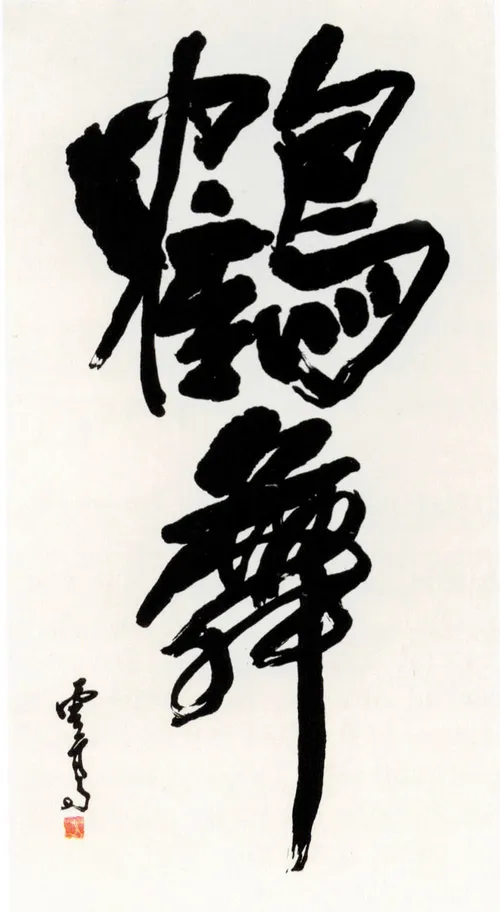
When one appreciate the calligraphy of H.H. Dorje Chang Buddha III, one can understand that why chinese believe that calligraphy combines one’s knowledge, moral character and mental strength .The calligraphy of H.H. Dorje Chang Buddha III Wan Ko Yeshe Norbu Holiest Tathagata is not bound by worldly conventions and is devoid of unnecessary flamboyance. It is highly refined and based upon ingenious artistic conception. His Holiness’s strokes are sometimes written in a swift curling style. However, in an instant, His Holiness can express the innocent and natural charm of a child. There is wonder in even common strokes. His calligraphy is naturally graceful, exhibiting depth and brilliance. The calligraphy of His Holiness contains an invisible force that makes the characters seem much grander than they appear on a superficial level. His strokes look harmoniously smooth and unbroken. The Chinese characters may appear strong and vigorous, like a soaring dragon or mighty tiger. They may appear clear and gently elegant, like slowly floating clouds, cranes flying among pine trees, or dancing swans. They may appear simple and unadorned, like the free heart of a child. They are gracefully understated and completely devoid of any mundane quality. The calligraphy of H.H. Dorje Chang Buddha IlI is natural in quality and resonates with the true nature of the universe. A deep power underlies His Holiness’s strokes.
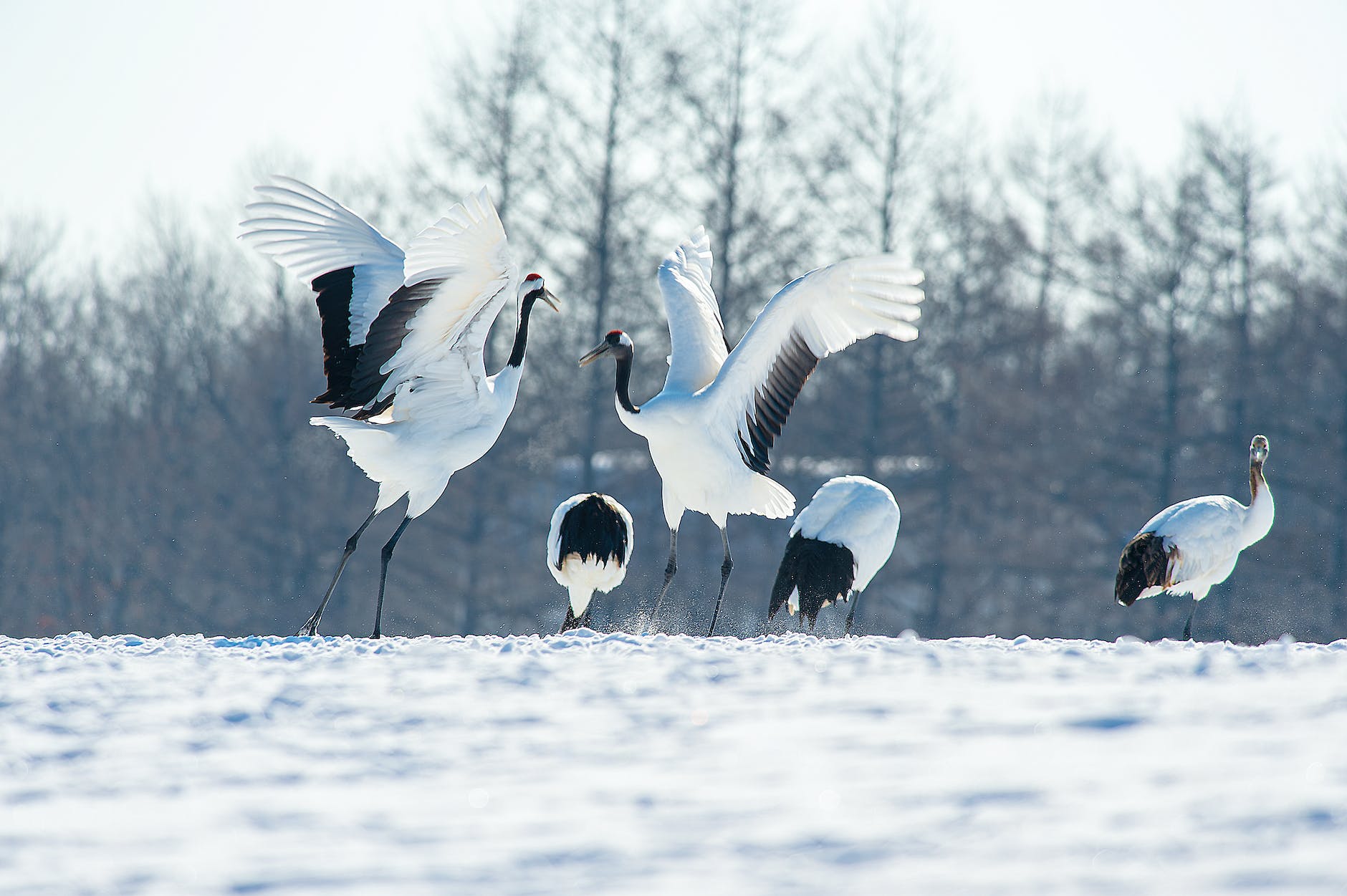
Crane Dance by H.H. Dorje Chang Buddha III at 1990
Red-crowned cranes tend not to build ness for themselves since they often stay in various places. When quiet, they frequently engage in meditational observation. When in motion, they frequently dance. Their nature is noble, pure, elegant and simple. They develop their virtue, are not attached to a specific abode, and take care of themselves so as to enjoy their natural lifespan. That is why since ancient times they have been praised for their longevity.
The ability of H.H. Dorje Chang Buddha III to reach such great heights in calligraphy is completely due to His Holiness’s vast knowledge and profound talents. Of course, His Holiness is extremely adept at learning from the styles of others since this is a simple matter for a Buddha. For example, even in the initial stage of learning calligraphy, H.H. Dorje Chang Buddha III had solid skills in the traditional cursive style of writing and also had extensive learning.
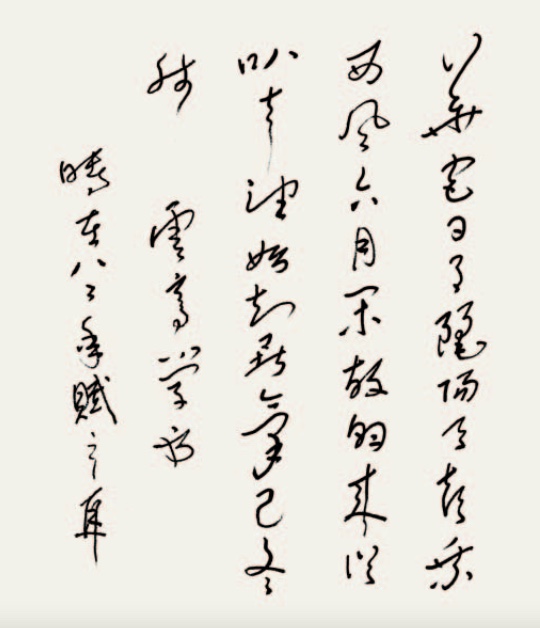
Calligraphy : A Qi jue poem (Thin Gold Cursive Style of Calligraphy)
Above is a qi jue poem written by H.H. Dorje Chang Buddha IIIat 1982. A qi jue poem is a four-line poem with seven characters to a line and a strict tonal pattern and rhyme scheme. The phonetic reading of the poem is as follows: “hua gong ri yue li yang tian, xi cheng xi feng liu yue xian, gu peng lai cong ba sheng wang, shi zhi shu qi yi dong can.” One can see that this work has surpassed all traces of the mundane and has transcended all earthly impurities. Its style is lofty and pure. When that poem was written, H.H. Dorje Chang Buddha III was living in the seclusion of an ancient temple. His Holiness used his extraordinary realization to express his thoughts and feelings. The first line expresses that although His Holiness lived alone and secluded in the room of a temple, He governed the universe and bestowed blessings upon living beings. The next line, “xi cheng xi feng liu yue xian,” conveys the scene that during the idle month of June H.H. Dorje Chang Buddha III bathed in the Buddha-state of coolness while under the scorching sun. His Holiness was free of all worldly cares and attachments, and his body merged with the universe. When friends came, His Holiness heard the horns of their cars, but He had already transcended the world, residing in quietude and non-action. H.H. Dorje Chang Buddha III kept no notion of the date, and His Holiness’s mind did not abide in anything whatsoever. The people of the world were ignorantly attached to the changing seasons and came in their cars and horses to inform H.H. Dorje Chang Buddha III that summer had long passed and the winter was about to end. The ancient Buddha acknowledged this and smiled.
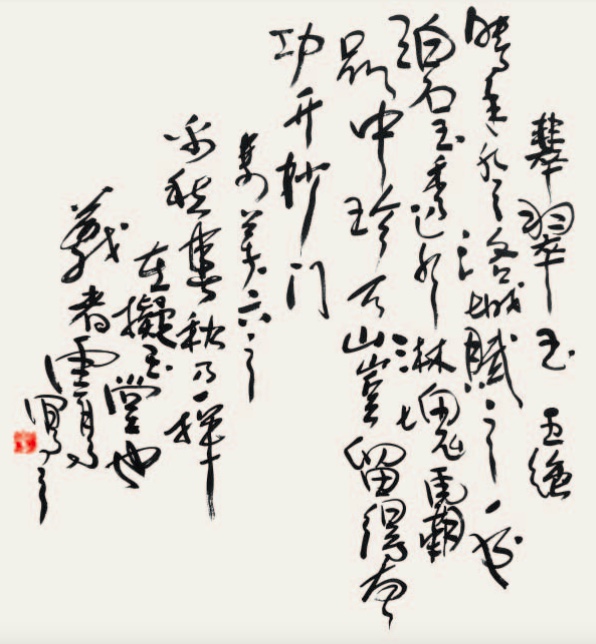
In recent years, there are works of H.H. Dorje Chang Buddha III that have been written in the cursive mode of calligraphy, showing a flowing and unobstructed style, and expressing even more than before the charm of this writing technique. For example, the work Fei Cui Jade expresses the spirit of an immortal or Buddha, thoroughly transcending the three worlds of reincarnation, standing proudly above the five elements of the universe. It is truly calligraphy beyond the category of calligraphy, expressing a feeling that incorporates the whole universe.
Fei Cui Jade: Created with an unfettered hand and unattached mind, it has the appearance of a celestial writing accomplished with a childlike mind and steady strokes of the brush.
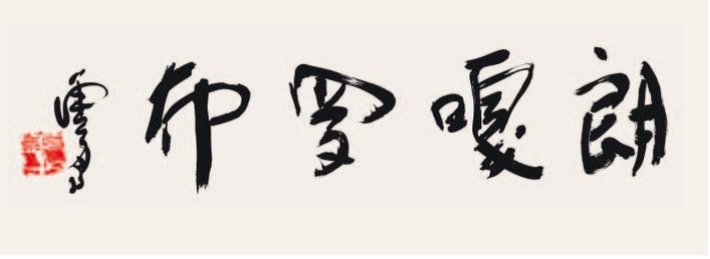
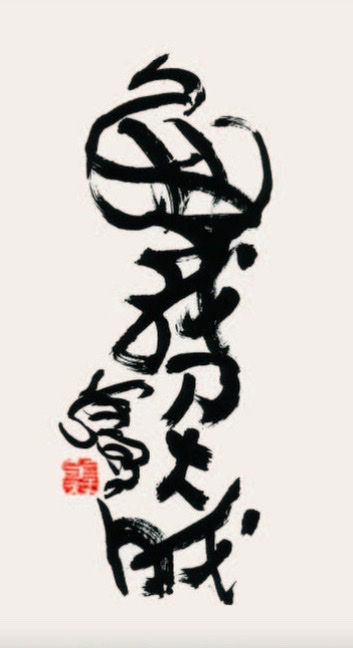
His Holiness’s calligraphy of the Chinese characters lang ga luo bu (Treasure of Heaven) excels the writing of calligraphers throughout history. It transcends all traces of worldliness. It expresses deep strength, like that which can break jade. The style of another calligraphic work called wu wo nai da cheng (No-Self Is Great Accomplishment), conveys the firmness and simplicity of steel and the vigor of a sharp knife. However, these same characters also contain delicate beauty. That calligraphic style truly surpasses styles of the past and present.
Lang ga luo bu (Treasure of Heaven)
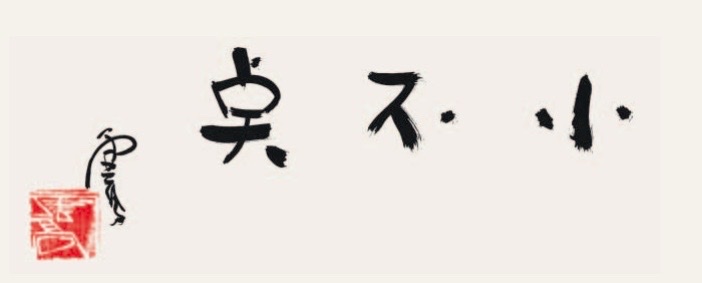
Another calligraphic style of H.H. Dorje Chang Buddha III is revealed in the writing of the Chinese characters xiao bu dian (Tiny). Such calligraphy shows the childlike innocence of a very old man, and its arrangement expresses the utmost ease and lack of rigid constraints. It is high-class calligraphy that does not even seem to be calligraphy. It is so elegant and refined that it completely transcends the mundane.
Tiny (Xiao bu dian)
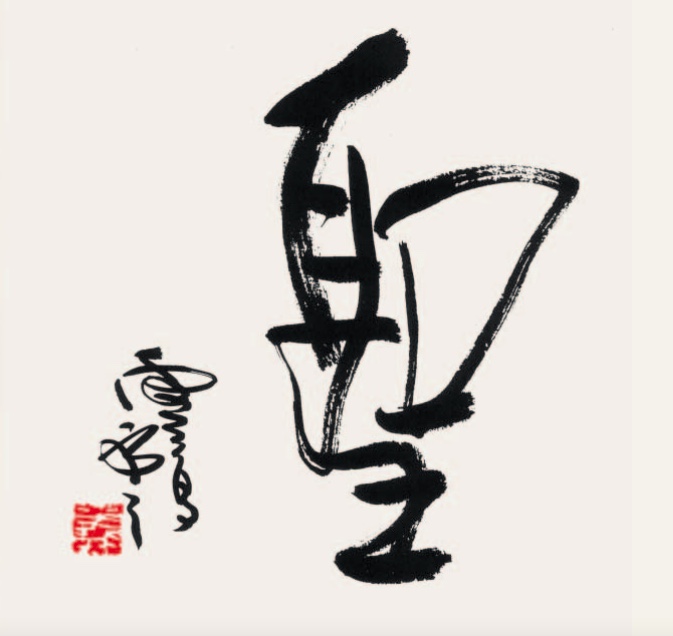
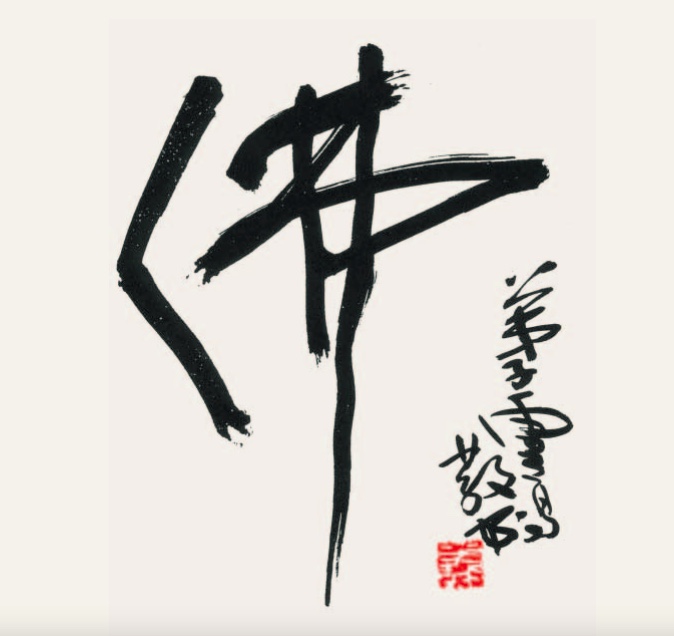
Beholding the character sheng (holy) written by His Holiness, one can see that it simultaneously embodies both the softness of ribbons and the inner-firmness of steel. Its inner beauty flows to the surface. Another example is the character fo, which means Buddha. The writing of that character demonstrates that His Holiness has truly attained the summit of calligraphic skills that the ancients extolled in the old saying, “the old pine branch cannot be weighed down by heavy snow; the might of a brush will lift a thousand-pound bronze cauldron.”
The Chinese character “sheng,” which means “holy.”
The Chinese character “fo,” which means “Buddha.”
In fact, the calligraphy of H.H. Dorje Chang Buddha III has a deep foundation and an internal richness. It embodies the manifold sensations that one could possibly experience in one lifetime. The essence of all things in the universe converges at the tip of His Holiness’s brush. With such a transcendent state of realization, the myriad things of the universe are in the palm of this Buddha. The calligraphy of H.H. Dorje Chang Buddha III is like a treasury. It can be vigorous, smooth, or naturally beautiful. His Holiness incorporates the best techniques of all of the schools of calligraphy. No words can really describe this! His Holiness’s calligraphic skills have reached the highest degree of proficiency and naturalness that only a Buddha could reach!
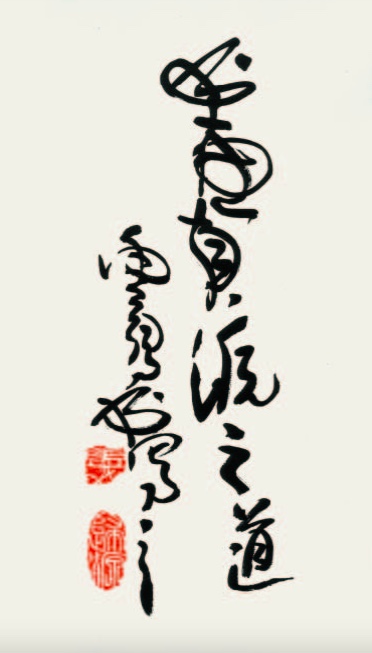
The Way to the True Source of Calligraphy and Painting
No-Self Is Great Accomplishment
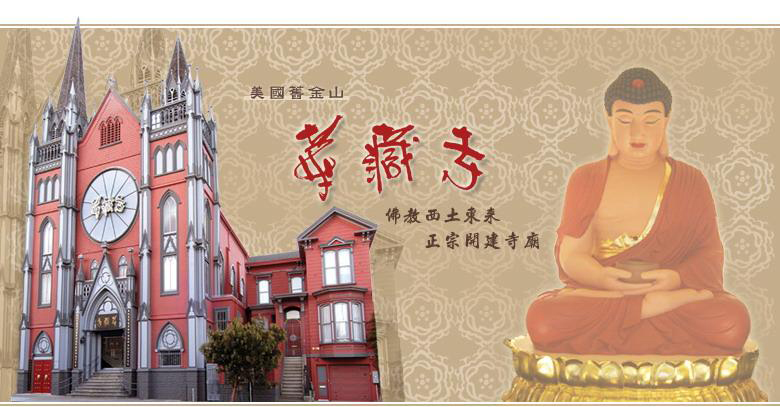
Hua Zang Si (Inscription of a Buddhist temple in San Francisco)
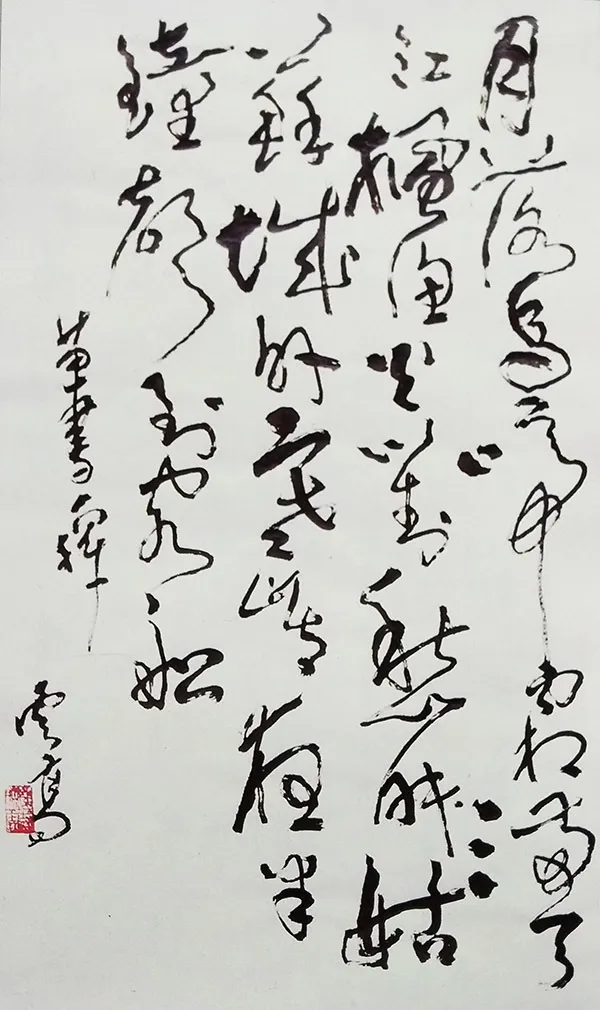
Chinese ancient poem Han Shan Si Temple in rapid cursive style by H.H. Dorje Chang Buddha III
This May, Gower, a small rural town in Missouri, has unexpectedly gained recognition as a pilgrimage destination following an extraordinary occurrence related to the exhumation of a nun’s body. Sister Wilhelmina Lancaster, the founder of the Benedictine Sisters of Mary, Queen of the Apostles, was buried at the age of 95 in May 2019. Remarkably, when her body was exhumed four years later, it displayed no visible signs of decomposition, leading to a surge of visitors to the town, approximately 40 miles north of Kansas City.
The preservation of Sister Wilhelmina Lancaster’s body has captivated the attention of hundreds of people, who have deemed it a “miracle in Missouri.” Despite expectations that only bones would remain due to her burial in a simple, unembalmed wooden coffin, the exhumation revealed her fully intact body, along with her religious habit impeccably preserved. Initially, the discovery was intended to remain private, but the news spread rapidly after a private email was mistakenly shared with the public.
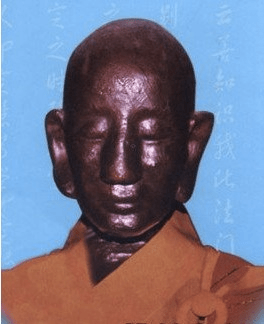
While as a Buddhist disciple, I find this occurrence surprising, it is not unprecedented in Chinese Buddhist history. Throughout the annals of Chinese Buddhism, there have been quite a few revered masters and patriarchs who have left behind fully intact relics of their bodies after passing away. Notably, Nanhua Temple in Shaoguan, Guangdong Province, houses three such relics: Master Huineng, the Sixth Patriarch of Zen; Master Hanshang; and Master Dantian. These examples from Buddhist history further highlight the profound reverence and awe associated with the preservation of such relics.
Master Huineng the Sixth Patriarch of Chan Buddhism
Huineng, widely recognized as the Sixth Patriarch or Sixth Ancestor of Chan (Zen) Buddhism, holds a significant place in the early history of Chinese Chan Buddhism. He is both a semi-legendary and a central figure in the development of this tradition. Huineng is renowned as the author of the influential Sixth Platform Sutra and is revered as the sixth patriarch of Chan Buddhism.
To this day, Huineng’s physical body remains preserved in the Nanhua Monastery in Shaoguan, Guangdong Province. Clad in a yellow robe and a red shawl, his corpse serves as a revered symbol within the monastery where he once taught. According to the Biography of the Great Master of Caoxi (Caoxi Dashi Zhuan, circa 781), Huineng’s body was removed from an urn on September 8, 714. After being desiccated for over a year, it was carefully covered with glue and lacquer before being enshrined in a stupa, where it has remained since.
This preservation of Huineng’s body and its continued veneration serve as a testament to his profound impact on the development of Zen Buddhism and his lasting influence on generations of practitioners. The presence of his preserved corpse stands as a tangible reminder of his teachings and spiritual legacy within the Nanhua Monastery.
Master HanShan (1546-1623)
Master Dantian (1535 – 1614)
Mount Jiuhua, located in China, has a significant historical and religious importance as a Buddhist Holy Land, boasting a rich heritage that spans over 1600 years. Its origins can be traced back to the year 401 AD during the Eastern Jin Dynasty, when the esteemed monk known as “Beidu” journeyed from ancient India to Mount Jiuhua with the intention of constructing temples and spreading the teachings of Buddhism.
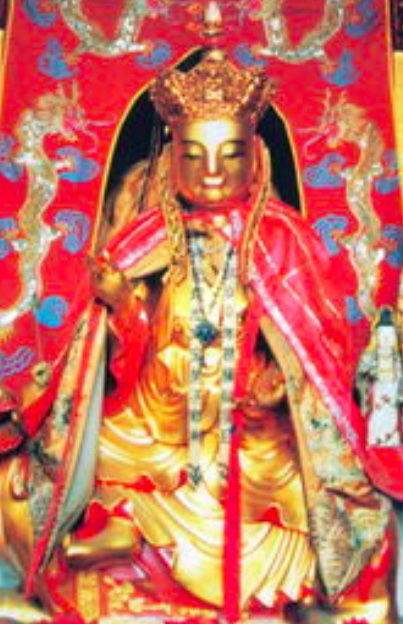
In 719 AD, when Kim Qiaoque, a prince hailing from Silla (present-day South Korea), arrived at Jiuhua Mountain. Kim Qiaoque dedicated himself to self-cultivation in this sacred place for an impressive span of 75 years. His life came to an end at the remarkable age of 99, and astonishingly, his physical body remained intact even after death. Due to the striking resemblance between Kim Qiaoque and Ksitigarbha Bodhisattva, the revered monks residing in Mount Jiuhua firmly believed that the spirit of Ksitigarbha Bodhisattva had reincarnated within him. Consequently, Mount Jiuhua evolved into a significant site for conducting rites and rituals dedicated to Ksitigarbha Bodhisattva.
Throughout history, Mount Jiuhua has served as a dwelling place for countless enlightened masters. Historical records reveal an astounding tally of sixteen masters who achieved the extraordinary feat of leaving behind relics of their physical bodies, fully intact. To safeguard these precious remains, most of the relics were delicately adorned with a layer of gold, serving as a symbol of veneration from the people. These sacred relics not only stand as a testament to the spiritual accomplishments of these masters but also continue to evoke deep reverence and inspiration among devotees to this very day.
Mount Jiuhua Incarnation Grand Hall Enshrines Flesh Body of Ksitigarbha covered by a layer of gold
Master Mingjing (1928 – 1992)
Renyi Nun 仁义师太(1911—1995)enshrined at Mount Jiuhua Tonghui Zen temple
慈航法师 Master CiHang (1893—1954)Now enshrined in Taiwan Metriya Temple
Just a few years ago, the esteemed holy monk Yinhai, a devoted disciple of H.H. Dorje Chang Buddha III, departed this earthly realm, leaving behind a profound and awe-inspiring spiritual legacy. On January 15, 2017, Elder Monk Yinhai completed his earthly journey through impeccable spiritual practices. What followed after his passing was an extraordinary phenomenon that surpassed anything witnessed in Buddhist history.
Even after his physical demise, the holy monk’s body underwent a truly extraordinary and divine metamorphosis. In a stunning departure from the natural order of things, his fingers and nails continued to grow, presenting an unprecedented occurrence in the annals of Buddhist history. This majestic and wondrous manifestation set a remarkable new record that reverberated throughout the Buddhist community. Commencing on the tenth day following his passing, an awe-inspiring process of complete transformation unfolded within his flesh and bones. In a mere twenty days, his body underwent a magnificent metamorphosis, assuming a form that transcended all comparisons, resembling a sacred dharma image.
The astounding and sacred phenomenon demonstrated by the revered monk Yinhai stands as a powerful testament to the profound Buddha Dharma transmitted by H.H. Dorje Chang Buddha III in the annals of Buddhist history.
Photo on the left was taken 11 hours after the Holy Monk entered nirvana, on the right was taken after 24 days
Across various religions, there have been instances of inexplicable miracles that defy the understanding and explanations provided by current scientific knowledge. These miracles, although beyond the grasp of science, undeniably exist. It is my sincere hope that individuals refrain from hastily dismissing them as mere superstition and avoid judging them solely based on their personal knowledge and beliefs.
The realm of spirituality and faith often transcends the limitations of scientific understanding. It encompasses dimensions and experiences that extend beyond empirical observations and logical reasoning. Just because something cannot be readily explained by scientific means does not diminish its significance or validity. Rather, it calls for a humble recognition of the vast mysteries that exist beyond the boundaries of human comprehension.
By approaching these miracles with an open mind and a willingness to explore the depths of the unknown, we can cultivate a greater appreciation for the diverse expressions of spirituality across different belief systems. It is through this mindset that we can foster respect and understanding, recognizing that our individual perspectives may not encompass the entirety of the world’s wonders.
In the annals of ancient wisdom, tales of great insight and philosophical musings have been passed down through generations. One such tale is that of Sai Weng, a man living on the northern frontier whose experiences teach us a valuable lesson about the unpredictability of life. This story illuminates the idea that blessings and curses often come disguised, and it reminds us of the importance of embracing life’s ups and downs with equanimity and resilience.
A long time ago, there lived a man named Sai Weng on the northern frontier of China. One day, his beloved white stallion ran off into the territory of the northern people, leaving Sai Weng without his cherished companion. His son was heartbroken. Naturally, his neighbors sympathized with him, considering it a great misfortune. Surprisingly, Sai Weng remained unperturbed and uttered these words: “Perhaps this will soon turn out to be a blessing.”
After a few months, the horse returned to Sai Weng, accompanied by another magnificent horse from the north. The neighbors were amazed by his good fortune and congratulated him on his newfound wealth. Yet, Sai Weng, ever wise, cautioned them by saying, “Oh, of course I am pleased…. but who knows if this is lucky or unlucky?.”
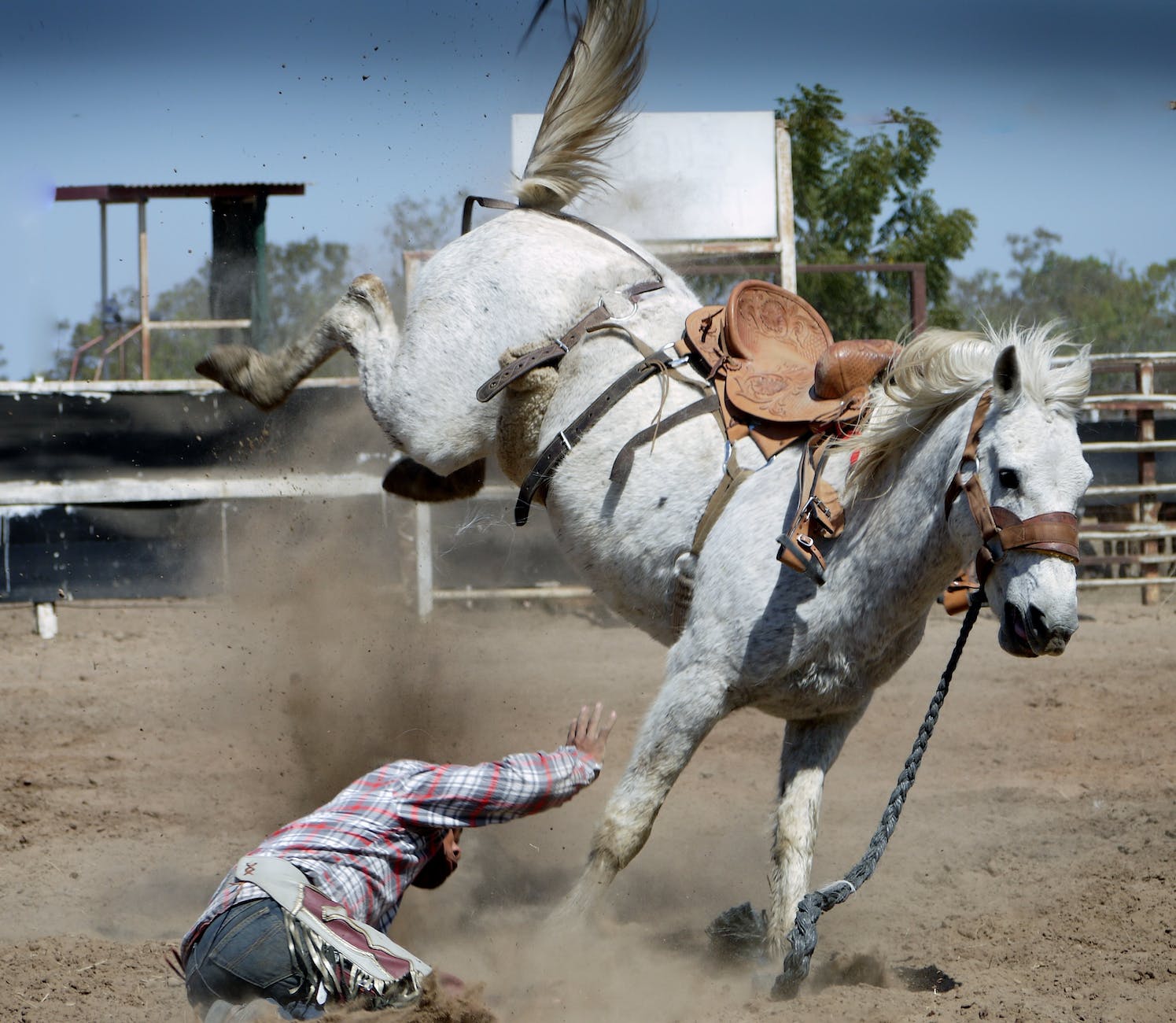
And so it did, for Sai Weng’s son, who grew fond of horse riding, had a terrible accident and broke his leg while riding the new horse. Once again, the neighbors expressed their sympathies, believing it to be an unfortunate turn of events. However, Sai Weng responded with his characteristic insight, saying, “I cannot know if these injuries will turn out to be something good or something bad.”
In due time, war broke out along the border with the northern people. The able-bodied men from Sai Weng’s village were called to arms to defend their homeland. Tragically, most of them perished in the battle. But Sai Weng and his son were spared, as the son’s injury prevented him from joining the fight. It was then that the true meaning of Sai Weng’s words became apparent – what seemed like a curse had, in fact, saved their lives.
Sai Weng’s story offers us profound insights into the nature of life and the ever-changing circumstances we encounter. It teaches us that appearances can be deceiving and that our judgments based on surface-level observations may not reflect the true nature of a situation. It urges us to refrain from hasty conclusions and remain open to the possibilities that lie ahead.
The concept of predestination is introduced in this tale, highlighting the idea that some things in life are beyond our control and are determined by fate. While we cannot alter the hand we are dealt, we can choose how we respond to it. Sai Weng’s calm acceptance and his ability to find hidden good opportunities in apparent setbacks demonstrate the importance of adapting to circumstances with grace and wisdom.
When fortune smiles upon us, it is essential to remain humble and vigilant, aware that circumstances can change unexpectedly. Gratitude for our blessings should be accompanied by a sense of preparedness for potential challenges. Similarly, when faced with adversity, we must remember that it is temporary and maintain hope and optimism for the future.
Sai Weng’s tale serves as a timeless reminder of the unpredictable nature of life and the need for a balanced perspective. It teaches us not to be overly complacent during favorable times and not to be disheartened by setbacks and obstacles. By embracing the ebb and flow of life, we can cultivate resilience, wisdom, and gratitude. As we navigate our own journeys, let us remember the lessons of Sai Weng and approach life with equanimity. By seeing beyond the surface and embracing both the blessings and the challenges.
Jataka tales are fascinating narratives that shed light on the past lives of the Buddha. These captivating stories unveil the incarnations preceding Prince Siddhartha Gautama’s birth and illustrate the ways in which he accumulated virtuous karma through selfless acts of sacrifice.
Before his existence as Prince Siddhartha Gautama, the Buddha’s soul had already amassed immense virtue from numerous previous lifetimes, embodying various selfless beings.
One remarkable representation of these Jataka tales can be found in a Dunhuang mural. Located on the eastern wall of Mogao Cave 428, this mural intricately portrays a renowned Jataka tale featuring Prince Mahasattva. The entire narrative is depicted across three registers, capturing the essence of the story within its captivating artwork.
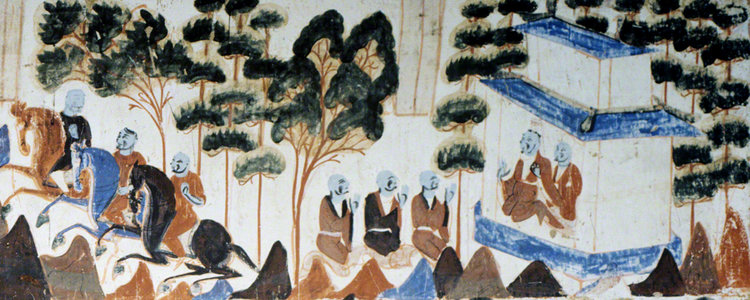
Detail of the three princes paying their respects to the king and queen before they leave for the forest. First register, right section. Mogao Cave 428. Northern Zhou, 557-581 CE. Dunhuang. Image courtesy of the Dunhuang Academy.
The mural commences on the right-hand side of the first register, where a captivating scene unfolds. Three young men, their hands pressed together in a gesture of genuflection, kneel before a majestic blue pagoda. Inside the pagoda, two figures exuding regal aura can be identified as the king and queen, bidding a heartfelt farewell to their sons, the three young men.
As the story progresses, the mural transitions to subsequent scenes, unveiling the brothers’ journey into the forest for a hunting expedition. Within this vibrant forest setting, an array of deer and tigers roam, coexisting with the majestic presence of towering trees and majestic mountain ranges. The undulating mountains, adorned with a multitude of colors, gracefully assume a smaller scale compared to the trees, animals, and human figures, harmoniously framing each scene of the narrative.
Detail of the three princes hunting in the forest. First register, middle section. Mogao Cave 428. Northern Zhou, 557-581 CE. Dunhuang. Image courtesy of the Dunhuang Academy.
The story unfolds on the second register, commencing from the left-hand side. As the three brothers venture deeper into the forest, they eventually dismount from their horses, seeking respite at the foothills of towering mountains.
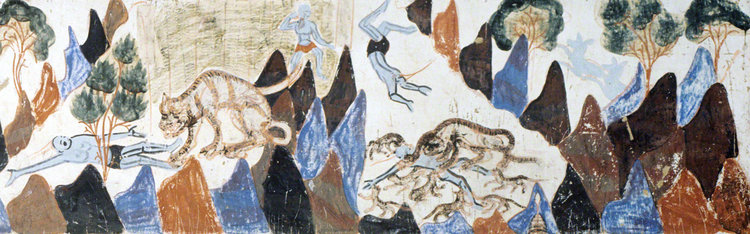
While taking a moment to rest, the brothers catch sight of a tigress accompanied by seven adorable cubs. The tigress is portrayed with her mouth agape, and her painted figure exudes a somber aura with limbs hanging low. Her gaze fixates upon the playful cubs frolicking around her, creating an illusion of impending maternal aggression, as if she were poised to devour her own offspring.
Detail of the starving tigress and her baby cubs. Second register, middle-left section. Mogao Cave 428. Northern Zhou, 557-581 CE. Dunhuang. Image courtesy of the Dunhuang Academy.
The brothers convene to discuss the matter of the tigress. Not wanting to watch a mother devour her own children, the brothers resolve to help her find food. However, there does not appear to be any food nearby.
Prince Mahasattva suddenly comes up with an idea. He keeps it to himself and tells his two brothers to leave the forest to find some food while he stays behind to watch over the tigers.
After his brothers leave, Prince Mahasattva strips off his clothes and lies down in front of the tigress, offering himself to the tigress. He decides to offer himself as food for the tigress so that she wouldn’t have to eat her own children.
The tigress sniffs at his body but makes no move to harm him even though she is starving.
When we offer help to someone and they are unable to accept what is offered, it’s a chance for us to feel good about having attempted goodness without losing anything. We can think to ourselves, well, we tried to help. In the case of Prince Mahasattva, he understood that good intentions alone would not save a life. It would take determined and complete self-sacrifice to save the tigers.
Realizing that the tigers will not eat him alive, Prince Mahasattva climbs to the edge of a cliff, cuts open his neck and throws himself off the ledge. With his neck bleeding profusely, his body drops in front of the tigress and her cubs. At Prince Mahasattva’s second attempt to offer his body, the tigers devour him as nourishment.
Detail of the Prince Mahasattva’s sacrifices to the tigers. Second register, right section. Mogao Cave 428. Northern Zhou, 557-581 CE. Dunhuang. Image courtesy of the Dunhuang Academy.
Snaking across and down the three registers, the story continues on the third register by beginning on the right-hand side again. Prince Mahasattva’s brothers return and they understand what happened in their absence when they see the bones left behind by the tigress and her cubs.
The brothers’ bodies contort across the scene in shock, anguish, and grief in reaction to the death of their third sibling.
Detail of the grieving brothers and their return to the palace. Third register. Mogao Cave 428. Northern Zhou, 557-581 CE. Dunhuang. Image courtesy of the Dunhuang Academy.
The two brothers practically fly back to the palace on their horses to tell the king about what happened to Prince Mahasattva.
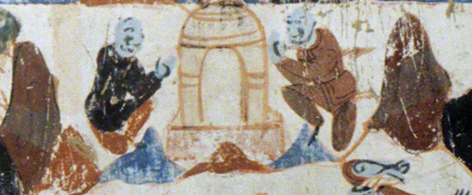
The story actually ends on the topmost right corner of this image, returning to the place where the two princes found their brother’s corpse. After reporting to the king, the family builds a stupa over Prince Mahasattva’s bones and hair to commemorate his selfless actions.
Detail of the brothers building a stupa over Prince Mahasattva’s remains. Third register. Mogao Cave 428. Northern Zhou, 557-581 CE. Dunhuang. Image courtesy of the Dunhuang Academy.
Many of the Mogao caves at Dunhuang have central pillars that take after the stupa form.
Scholars have theorized that worshippers could have circumambulated these central pillars inside the Mogao caves at Dunhuang as one would do around stupas in the open air.
The central pillar in Mogao Cave 428. Northern Zhou dynasty. 557-581 CE. Dunhuang. Image courtesy of the Dunhuang Academy.





















 Peace LiLy