“Monks, I will teach you about the nature of a person without integrity and a person with integrity. Listen carefully and pay close attention.”
“Yes, Lord,” the monks replied in unison.
The Blessed One began, “What defines a person without integrity? Such a person is ungrateful and unthankful. This ingratitude and lack of thankfulness are characteristics of rude individuals and belong entirely to those without integrity. These individuals fail to recognize and appreciate the good done to them by others. They are driven by selfish desires and a sense of entitlement, neglecting the virtue of gratitude, which is the foundation of a harmonious and compassionate society.
“In contrast, a person with integrity is grateful and thankful. This gratitude and thankfulness are traits of civilized individuals and belong entirely to those with integrity. They recognize the value of the kindness and support they receive from others and make it a point to express their appreciation. Such individuals foster positive relationships and contribute to a community where mutual respect and support flourish.
“Monks, there are two people who are difficult to repay. Who are they? Your mother and father. Even if you were to carry your mother on one shoulder and your father on the other for 100 years, attending to their needs by anointing, massaging, bathing, and rubbing their limbs, even if they were to defecate and urinate right there on your shoulders, you still would not have repaid them. If you were to establish them in absolute sovereignty over this great earth, filled with the seven treasures, you still would not have repaid them.
“Why is that? Because parents do much for their children. They care for them, nourish them, and introduce them to this world. From the moment of birth, parents make countless sacrifices, enduring sleepless nights and countless worries to ensure their child’s well-being. They provide food, shelter, education, and unconditional love, guiding their children through the complexities of life. These acts of love and devotion create a debt that is immeasurable.
“However, monks, the greatest way to repay one’s parents is not through material means or physical care alone. True repayment comes from leading them towards the path of virtue and wisdom. If someone inspires his unbelieving mother and father to have faith, guides his unvirtuous parents towards virtue, encourages his stingy parents to be generous, and leads his foolish parents to wisdom, then, to that extent, he has repaid his mother and father.
“Consider the transformative power of such actions. When you rouse your unbelieving parents to embrace faith, you open their hearts to a greater understanding of life’s purpose. By encouraging them to practice virtue, you help them cultivate qualities that bring inner peace and happiness. Inspiring them to be generous allows them to experience the joy of giving, and guiding them towards wisdom leads them to a deeper comprehension of the world and their place in it.
“Monks, remember that integrity and gratitude are the cornerstones of a meaningful life. By embodying these virtues and helping others, especially your parents, to do the same, you contribute to a legacy of compassion and understanding that extends beyond your lifetime. This is the true measure of repayment and the highest expression of filial piety.”
The monks, deeply moved by the Blessed One’s words, reflected on the profound teachings and resolved to cultivate integrity and gratitude in their own lives, vowing to honor and repay their parents in the most meaningful way.
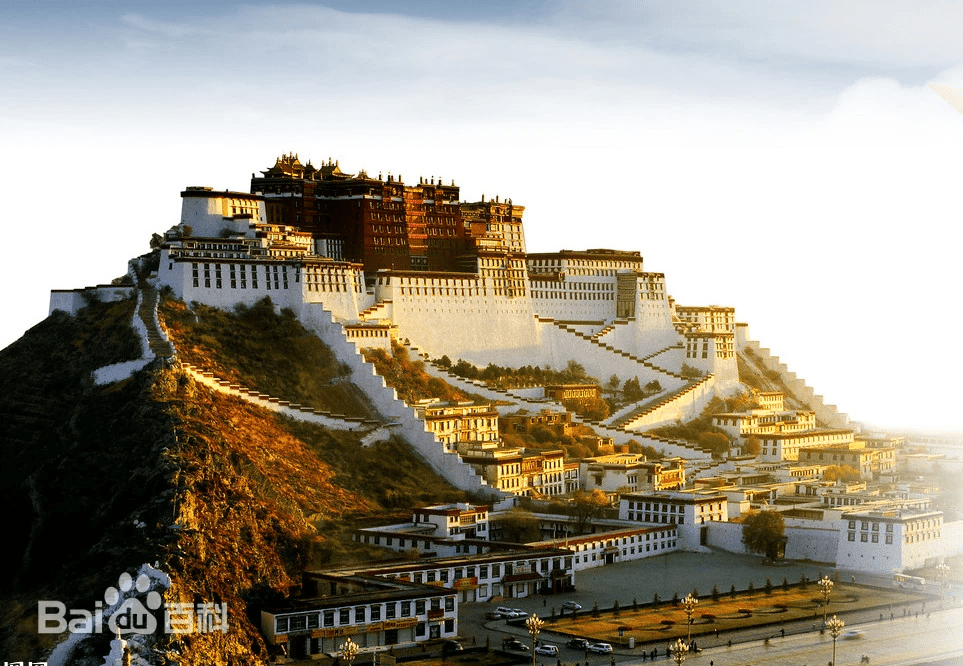
Located in the Tibet Autonomous Region of China, the Potala Palace is known as the “Jewel of the Roof of the World.” It stands as a symbol of China, Lhasa, and the Qinghai-Tibet Plateau. This palace, the highest and most majestic in the world, houses an incredibly rich collection of cultural relics and artifacts, preserving the unique heritage of the Snowy Plateau. The palace is renowned for its architectural layout, civil engineering, metal smelting, painting, and carving, showcasing the extraordinary skills of Tibetan artisans and the architectural achievements of the Tibetan people, as well as contributions from Han, Mongolian, and Manchu craftsmen. In December 1994, the Potala Palace was inscribed on the World Heritage List.
The magnificent Potala Palace stands at an altitude of 3,700 meters, covering a total area of 360,000 square meters, with a total building area of 130,000 square meters. The main building is 117 meters high, appearing to have 13 floors from the outside, while actually containing 9 levels internally. The complex includes palaces, stupas, Buddhist halls, scripture halls, monks’ quarters, and courtyards.
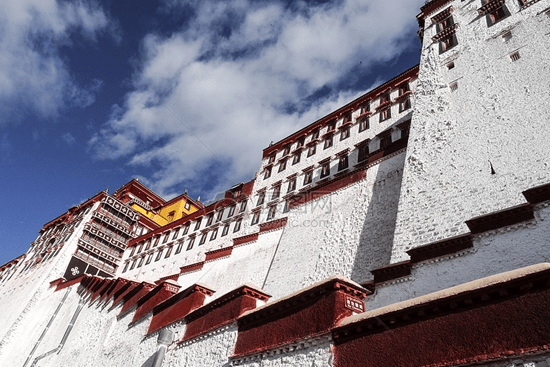
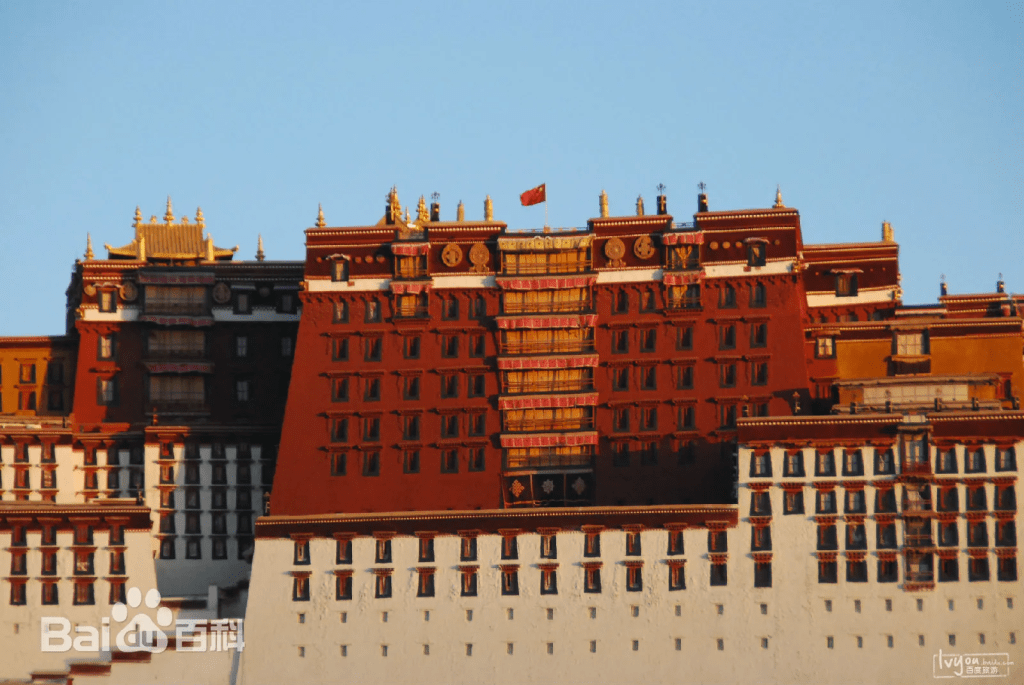
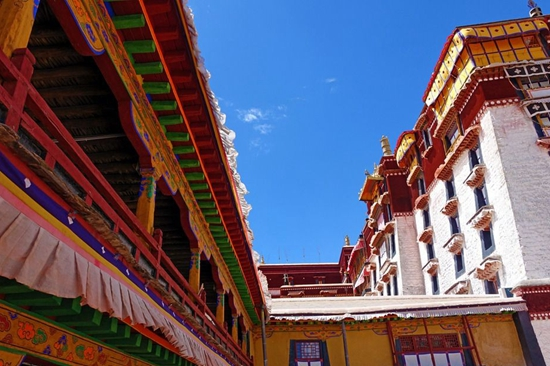
The Potala Palace’s main structure is divided into the White Palace and the Red Palace. Built into the mountainside, the complex features overlapping buildings, imposing halls, and a grand, sturdy granite structure. The white balustrades made of smooth bema grass, the resplendent golden roofs, and the large gilded bottles, stupas, and red banners create a striking decorative effect. The vivid contrast of red, white, and yellow, along with the intricate interlocking architecture, highlights the enchanting characteristics of ancient Tibetan buildings.
Historical records indicate that the Potala Palace was first constructed in the 7th century during the reign of Songtsen Gampo of the Tubo Kingdom, making it 1,300 years old. In the early 7th century, after moving the capital to Lhasa, Songtsen Gampo built three nine-story buildings with a total of one thousand rooms on Red Hill to welcome Princess Wencheng of the Tang Dynasty. The palace was named Potala Palace. The three walls surrounding Red Hill and a silver and copper bridge connecting the palaces of Songtsen Gampo and Princess Wencheng were part of the original structure. Outside the east gate of the Potala Palace was Songtsen Gampo’s horse-racing track.
When Princess Wencheng traveled to Tibet, she brought with her a large collection of books and documents, greatly promoting the development of Tibetan culture. It is said that there were more than 300 types of books on astronomy and calendrical calculations alone. The Tibetan calendar, still in use today, was created by absorbing and learning from the Han calendar, combined with the characteristics of Tibetan-inhabited areas and the experiences of the Tibetan people’s production labor. Classic works representing the excellent traditional culture of China, such as “Liezi,” “Shangshu,” “Strategies of the Warring States,” and “The Book of Questions Between Confucius and Xiang Tuo,” were also introduced to Tibet.
Ingenious Design and Construction
The design and construction of the Potala Palace take into account the patterns of sunlight in the plateau region. The foundation walls are broad and sturdy, featuring a network of tunnels and ventilation openings beneath them. Inside, the palace employs pillars, brackets, wooden struts, beams, and rafters to form its framework. The floors and roofs are made from a hard soil called “Arga.” Skylights are installed in the ceilings of each main hall and bedroom to facilitate lighting and air circulation. The pillars and beams inside the palace are adorned with various carvings, and the colorful murals on the walls cover an area of more than 2,500 square meters.
The Red Palace’s Enchanting Halls
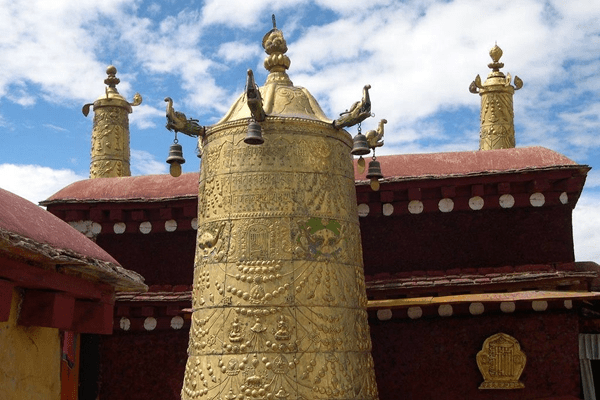
The Red Palace, situated in the central position of the Potala Palace, is distinguished by its red outer walls and mandala layout. The Hall of the Dharma King (Qujiejiebu) and the Hall of the Sage (Pabalakang) within the Red Palace are said to be structures remaining from the Tubo period. The Hall of the Dharma King is located in the middle of the Potala Palace, directly above the peak of Marpori Mountain. It is believed that this hall was once the meditation retreat of Songtsen Gampo and now houses statues of Songtsen Gampo, Princess Chizun, Princess Wencheng, and other ministers. The Hall of the Sage enshrines Songtsen Gampo’s principal deity, a naturally formed sandalwood statue of Avalokiteshvara. The rooftop platform of the Red Palace is adorned with the golden roofs of various stupa halls, all single-eaved hip-and-gable structures supported by wooden brackets and covered with gilded copper tiles.
Songtsen Gampo and Princess Wencheng (Image source: Potala Palace official website)
White Palace
A Masterpiece of Tibetan Architecture
The Potala Palace is a masterpiece of ancient Chinese architecture and an outstanding representative of Tibetan architecture. Its architectural artistry is the most remarkable example among the thousands of Tibetan Buddhist temples and palaces, unmatched anywhere in the world. At the pinnacle of the palace stand three gilded pagodas, one large and two small, shining brightly and dazzling the eyes. The parapet around the rooftop is constructed from a deep purple-red shrub, decorated with various gold ornaments. The roof is adorned with large gilded finials and red prayer flags, reflecting a strong Tibetan style.
A Fusion of Artistic Traditions
The sculptural art within the Potala Palace combines techniques from Han, Indian, and Nepalese Buddhist art. The palace houses a vast collection of treasures, including heavy-colored clay sculptures, wood carvings, stone carvings, and a significant number of metal statues made from gold, silver, copper, and iron. These works of art range in size from over ten meters tall to just a few centimeters.
Thangka Paintings and Cultural Treasures
“Thangka,” a Tibetan transliteration, refers to scroll paintings mounted on colorful silk brocade, depicting religious figures, historical events, and doctrines, as well as subjects like Tibetan astronomy, calendrical calculations, and traditional medicine. The Potala Palace preserves nearly ten thousand thangkas, some of which are several tens of meters long.
The palace also houses numerous religious and artistically significant artifacts, including Tibetan carpets, prayer cushions, prayer flags, canopies, and embroidered satin hangings.
Thangka of a stupa inscribed with the calligraphy of Emperor Qianlong. (Image source: Potala Palace official website)
Gilded bronze openwork incense burner with handle from the Potala Palace. (Image source: Potala Palace official website)
A National Treasure and World Heritage Site
The Potala Palace preserves a vast number of statues, murals, scriptures, and other cultural relics, making it a treasure trove of national art and culture. It is listed as a national cultural relic protection unit and a UNESCO World Heritage Site, reflecting its immense cultural and historical significance.
Explore the Potala Palace and immerse yourself in the rich tapestry of Tibetan history, art, and culture. Its breathtaking architecture and priceless artifacts offer a unique glimpse into the soul of Tibet, making it a must-visit destination for anyone seeking to understand the heritage of the Roof of the World.
Avalokiteshvara Bodhisattva, from beginningless eons, has been tirelessly saving countless sentient beings with his immense compassionate power. Despite his boundless efforts, he felt a sense of inadequacy. Thus, from the power of samadhi born of great compassion, he formed an immense compassionate force. This force, combined with the great compassionate power of Buddhas from the ten directions, resulted in a drop of green tear flowing from his eye, transforming into the infinitely majestic green female Bodhisattva, known as Green Tara. Due to this origin, Tara’s power to save is boundless and infinite.
Green Tara is revered as the Great Compassionate One and the Holy Savior Mother Buddha. The practice of the Green Tara ritual has a rich history that originated in India and later spread to China, Tibet, Japan, and beyond. The sacred roots of this practice trace back to Green Tara herself, who was initially the ancient Buddha Pravartaka and an incarnation of Avalokiteshvara Bodhisattva.
Chanting the Green Tara mantra even once, with focused contemplation of Tara’s sacred image, brings immense merit. Such merit is equivalent to chanting the names of seventy-two billion Buddhas and Bodhisattvas as numerous as the sands of the Ganges. Both the exoteric and esoteric traditions have extensive practices based on this ritual, and many practitioners have achieved great success and benefit from it.
Over time, the original texts and mandalas related to this profound practice have suffered from omissions and distortions in their transmission. For the past two hundred years, these deviations have increasingly moved away from the authentic regulations. In recent decades, the practice has nearly completely lost its true essence. Furthermore, the representations of Green Tara have deteriorated in form, lacking the dignity of the authentic appearance. This includes discrepancies in hand mudras, attire, and overall sacred depiction, resulting in a significant loss for the Buddhist community.
The Green Tara Perfect Practice Ritual and Thangka by H.H. Dorje Chang Buddha III
In response to these issues, H.H. Dorje Chang Buddha III transmitted the “Green Tara Perfect Practice Ritual” and personally supervised the creation of the Green Tara mandala thangka.
This three-dimensional thangka is not only lightweight and portable, making it easy to carry, but also presents the mandala clearly and vividly, ensuring that it remains etched in memory. Additionally, it possesses several extraordinary merits:
Authenticity and Compliance: The Green Tara mandala presented in the thangka fully complies with the regulations of the “Green Tara Perfect Practice Ritual.” This ensures that the practice remains true to its original form.
Historical and Miraculous Significance: Tara had already attained Buddhahood countless eons ago, her divine power is illustrious, and her sacred deeds are well-documented. Today, in the “Tara Hall” in Nethang, Tibet, the sacred statue of Tara once spoke to Atisha, instructing him, further propagating her holy name and Dharma power across China and Tibet. During the creation of this three-dimensional thangka, many miraculous occurrences were witnessed. For example, the sacred image of Tara, originally looking straight ahead, appeared differently in subsequent photographs taken from the same angle: one showed her looking up at the sky, while the other depicted her looking down at sentient beings. This clearly demonstrates Avalokiteshvara Bodhisattva’s extraordinary vow power: above, he shares the same compassionate force with all Buddhas and Bodhisattvas; below, he joins in compassionate aspiration with all sentient beings in the six realms. Additionally, when viewed from different angles, the main deity of Green Tara always faces the observer, and the seed syllables in the sky behind her follow her movement, appearing above her head. Furthermore, the colorful clouds, initially close to the sun and moon, seem to remain stationary while the sun and moon move vividly between the clouds from different perspectives.
Majestic and Unmatched Representation: The sacred image of Green Tara in the thangka is exceptionally majestic and perfect, unrivaled in both China and Tibet throughout history. The twenty Taras, each with different postures, exhibit supreme Dharma power, arranged behind the main deity, appearing and disappearing miraculously. Notably, standing in different positions reveals the Great Brahma Deva, the primary protector, initially as one, then suddenly as two, and then back to one again, a phenomenon unprecedented in history! Meanwhile, the Four Great Heavenly Kings and the Eight Dragon Kings remain unchanged. Additionally, Indra, the Four Great Heavenly Kings, and the retinue of the Eight Dragon Kings, wielding their divine weapons and instruments, surround and protect Tara with unmatched divine transformation. Visualizing this thangka makes the practice highly effective and rapidly fruitful.
Validation and Praise
Upon the completion of the “Green Tara Perfect Mandala Thangka,” Buddha Master specifically instructed disciples to bring all existing Green Tara statues of various materials from around the world to the Vajra Dharma Circle for public verification. They were to determine which one is the most orthodox and perfect thangka. The Vajra marbles immediately entered the mandala thangka, confirming that the Buddhas and Dharma protectors of the ten directions unanimously endorsed it.
Many of the seven classes of Buddhist disciples, upon practicing with this three-dimensional thangka, experienced unprecedented and unique realms. High monks, living Buddhas, and even Dharma Kings from around the world have all respectfully praised and recommended this rare and precious sacred image. In truth, among all the existing Green Tara images, none can compare to the perfection and majesty of this mandala thangka. Its blessing power is extraordinarily miraculous; a single glance imprints it deeply in the mind, leaving a lasting impression.
The Green Tara Perfect Practice Ritual and its accompanying thangka, as transmitted and supervised by H.H. Dorje Chang Buddha III, represent a revival of the authentic practice of Green Tara. This thangka not only restores the true essence of the practice but also enhances the spiritual experience for practitioners worldwide, offering unparalleled blessings and merits.









 Peace LiLy