The High-Leg Treasure Horse is a thoroughbred horse with great stamina. When this treasure horse perspires, it appears to be bleeding due to the color of its perspiration. According to ancient legend, it is the most precious among all species of horses. It has the reputation of being able to travel over three hundred miles a day. Long mane hairs and a mighty, strong-willed, handsome appearance are its prominent characteristics. The High-Leg Treasure Horses in this painting have longer legs than horses commonly seen in paintings. The hairs of their manes are also long and strong. An extremely rare brushwork technique that combines haziness with clarity was applied to paint the hairs of the horses. The gossamer-thin hairs are strong but pliable. One can clearly see the natural effect of sunlight on the horses’ manes. Moreover, contrasting variations of dark and light are seen in every hair. The hairs of the horses are depicted with a realistic effect that nonetheless transcend their natural look.
An artistic technique was used to thoroughly capture on paper the charm and atmosphere of the grassland, lake, sky, and land. The “haziness technique” was applied to express a state of realization in which there is no distinction between emptiness and form. The ancient cypress tree was drawn in one shade of green without the need to add decorative touches in several different shades of green. Both the spirit and form of the tree were captured through the artist’s brush. In addition, elegant charm is revealed by a small number dots of red leaves in the background that compliment the scene. The most difficult part of this work of art was painting the roots, trunk, and leaves in a spontaneous, casual manner using the center brush-up technique yet maintaining a scholarly tone. Such mastery of painting cannot be easily attained and requires solid skills in calligraphy, literature, and painting as well as a noble moral character. From the brushwork style and details of this painting, we can sense the profound inner-cultivation of a renowned scholar. The abilities of a literary giant with abundant talent are visible everywhere. The scholarly tone and brushwork style are skinful and vigorous, totally free of any trace of the mundane, and reflect the highest level of painting and calligraphy. Anyone who lifts a brush in an attempt to paint such painting will appreciate the fact that this scholarly style cannot be accomplished by anyone other than a literary giant who is a great master of art. This painting coherently unites realism and small-scale freehand brushwork as well as the use of haze and clarity.
This painting is in the permanent exhibition of The International Art Museum of America. H.H. Dore Chang Buddha III, an artist of great talent, has created sixteen distinctive painting styles. The composition we are discussing here belongs to the “Menglong” style. This style combines realism and non-realism to capture the essence of the portrayed subject, resulting in a seemingly realistic but actually non-representational depiction. The brush strokes and color application in these paintings create a whimsical and dreamlike appearance, where the real and surreal merge into a lovely and hazy composition.
The nectar formed a Dharma cloud along with more than 200 sariras of various colors at the time that On the Buddha’s Birthday in 2001, H.H. Dorje Chang Buddha III held Dharma assembly
By henghsing Gyatso Rinpoche
Although I am an ordinary RINPOCHE without any deep realization, nevertheless, I am very fortunate to have visited many Rinpoches. I have sought instruction from Great Dharma King Yangwo Yisinubu and from famous Rinpoches, such as Panchen Lama, Dalai Lama, Karmapa, Bo Mi Qiang Ba Luo Zhu, Dorje Losang, Dilgo Khyentse, Jiang Gong Kang Qin, Jiang Gong Kang Ce, Ga Wang, Zong Nan Jia Chu, Chuang Gu, Xia Ma, Hsi Jao, Bei Lu Qin Zhe, Tai Xi Du, Heng Sheng, Jia Cha, and Kalu. Especially with respect to nectar, I have a detailed understanding.
In general, nectar can be divided into five types: Most Precious Nectar, Great Precious Nectar, Long Life Nectar, Vajra Nectar, and Bodhi Nectar. These different types of nectar can also be divided into two different types: nectar that comes from sacred Dharma practice and nectar that comes from exoteric Dharma practice. There are several different types of nectar within the category of nectar that comes from sacred Dharma practice, depending upon the different manifestations of Dharma by each Buddha. Nectar resulting from exoteric practices is most prevalent in contemporary Vajrayana Buddhism. Basically, any Rinpoche can practice the Dharma to produce such nectar. Medicine or food is mostly used. Added to and mixed together with the medicine or food is sharira or a Dharma object that has been empowered. This is then made into powder to make pills. This powder is then empowered through practice of the Dharma and the recitation of mantras to become various types of nectar. Nectar that comes from exoteric Dharma practice is mostly used for empowerment, curing illnesses, and other reasons.
Nectar that comes from sacred Dharma practice is totally different from nectar that comes from exoteric, ordinary Dharma practice. The degree of empowerment from nectar that comes from sacred Dharma practice as compared with nectar that comes from exoteric Dharma practice is as different as ten thousand miles and one footstep. No words could adequately praise the nectar that comes from sacred Dharma practice. Ordinary Rinpoches and ordinary Dharma Kings who have been conferred such titles by the world cannot successfully practice the sacred Dharma to invoke nectar. Only those who are true Buddhas, or incarnations or transformations of Great Bodhisattvas, can successfully practice such Dharma. In the sacred Dharma practice to invoke nectar, the Dharma King conducting the practice will assemble over 100 Rinpoches to form a mandala. Gold, silver, and other precious items will be burnt as offerings. The Great Dharma King will then practice the holy Inner-Tantric Dharma to invoke the Buddhas and Bodhisattvas to bestow nectar from the realm of the Buddhas. The Buddhas will assemble in the sky or will enter the mandala area. This holy scene will be seen by all of the more than 100 Rinpoches in attendance.
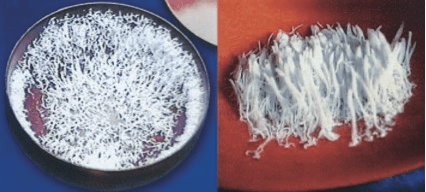
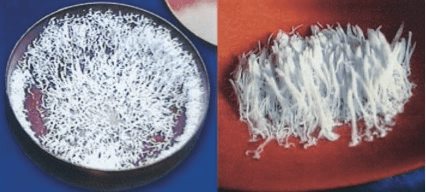
White Bodhi Nectar
At this time, the Buddha who corresponds to the particular nectar that is being invoked will descend. The appearance of that particular Buddha and its bestowing of nectar can be seen. There will be the emission of light and the manifestation of supernormal states when the nectar descends into the bowl. This Dharma bowl must first be thoroughly washed and must be empty. There is absolutely nothing in this world which has the mysterious and changeable shape of the nectar that descends into the bowl. It is exactly as what is described in the book Know the True Doctrines. According to people of great virtue, only this type of sacred nectar is true nectar. According to Tibetan tantra, nectar is the holy material used for initiations. No matter what type of initiation is performed, nectar must be used. Especially for the supreme yoga initiations, true nectar is an absolutely indispensable material for the initiation Dharma water. True nectar represents the causative factor that raises one from the ordinary world to the realm of the Buddhas. If true nectar is not used as the basis for an initiation, such as when man-made nectar created from medicine is used to empower, then such initiation is not an Inner-Tantric Sacred Dharma Initiation. Therefore, according to tantra, nectar is fundamental for liberation. Determining whether a Dharma King is the incarnation of a Buddha or Great Bodhisattva mostly depends upon whether he or she has the depth of realization to successfully practice the nectar Dharma. Can he or she commune with the Buddhas and successfully invoke them to bestow nectar? Any explanation other than this, no matter how many times said, is merely empty talk. This includes explanations such as, “I am the heir to a certain spiritual legacy… Since childhood, I have been officially recognized as a Holy One and have been so for many lives…. I am a Dharma King recognized by a certain Great Rinpoche…I am the head of a certain great temple.” This only proves that they are Rinpoches according to worldly regulations and teachings. Of course, they can save living beings. However, such explanations definitely do not prove that they are able to represent the sacred essence of the supreme tantra. Nevertheless, one cannot dismiss such people. They are persons of great virtue. It is simply a matter of different levels of attainment.
When visiting Rinpoches, I would speak of this matter of the Buddhas bestowing true nectar. Some Rinpoches who do not have the ability to successfully invoke true nectar become quite unhappy when this subject is raised. I think that this is not a big problem. If you think that you are a Great and Holy Dharma King or a Great Rinpoche, then conduct a Nectar Dharma Assembly in order to prove that you are someone whom living beings can fall back upon. Let everybody see that you have the Buddha Dharma within you and that the Buddha Dharma is true. This is saving living beings! Otherwise, use empowered medicine as nectar and save living beings while cultivating yourself with a heart of humility!
I would like to raise the following question for everybody’s consideration. Are the Dharma Kings who successfully invoke the Buddhas to bestow nectar in front of everybody able to represent the Buddhas and Bodhisattvas or are the Dharma Kings who only speak empty words able to represent the Buddhas and Bodhisattvas? This question is worthy of deep consideration! I and many people of great virtue believe that those who can commune with the Buddhas and Bodhisattvas are definitely Great Dharma Kings. Those who can only reach ordinary states are ordinary Rinpoches!
If monastics do not abide by the Buddha Dharma precepts and tenets, there will be mistakes in their practice, and their practice will become superficial. Such practice will not produce any true accomplishment. Sakyamuni Buddha spoke of those monks who do not abide by the precepts of Buddhism. He said that even if they do not covet the affection and love of others, they still covet personal gain and the offerings of disciples. This means that those monastics who do not abide by the precepts will covet worldly gain and will thus not have minds set upon cultivation. Naturally, it will not be possible for them to become accomplished. Most contemporary practitioners who have gone forth from the household life do not abide by the precepts. These range from certain Dharma Teachers and Rinpoches all the way down to the myriad monastics. Before monastics went forth from the household life, they were attached to worldly feelings of affection and love. They therefore had thoughts of worldly affection and desire. They were no different from the ordinary person. After they cut off their hair and went forth from the household life, if they did not renounce worldly desires, the defilements that obstruct enlightenment naturally would not vanish. They would not be able to cut off the defilements. At this time, even though they are not allowed to give rise to feelings of desire, it is difficult for them to stop coveting their own gain and the offerings of disciples. Thus, the longing they have at this time is longing for their own gain and the offerings of disciples. Therefore, their attachment to the five aggregates is still strong. As monastics, they are not able to abide by the Dharma and precepts. Their practice becomes false, and in the end they are not able to accomplish anything. Many monks do not abide by Buddhism. They covet their own personal gain and the offerings of disciples. They pretend to be pure. They quietly sit in meditation, yet their thoughts run wild. They long for the objects of the five desires and are deluded by sounds, smells, and tastes. They have hearts covered with ignorance and are bound by craving. Such phenomena are described in writings on the Dharma and are manifested in the practice of a portion of those practitioners who have gone forth.
Many monastics have the appearance of being pure. While practicing, they show refined and exquisite expressions. They lower their heads and are serious in speech. They often say “Amitabha!” They are frequently seen meditating in a remote, quiet place. They very much appear to be true cultivators, but in fact they are not.
Although these monastics give the impression of being very pure and scrupulous in their practice, they still have not understood the principle that all Dharmas and all things are empty. Why have they not understood this? Because their six bases are not yet pure. Their attachment to things of the world is not yet broken. Thus, they still crave forms, sounds, smells, tastes, touches, and thoughts. They still think that the five aggregates of form, feelings, perceptions, mental formations, and consciousness are not empty. They cannot cut off their infatuation with things of the world and thus engage in distorted, dreamlike thinking. They still allow themselves to be tossed about by the illusory things of the world. They cannot see clearly that such things, in essence, are empty. Thus, they are constantly obstructed from attaining enlightenment due to the defilements. Both day and night, they cannot avoid such confusion. Hence, this type of monastic, although appearing to be at peace, in truth has not yet become aware. Although they meditate, their thoughts run wild and are manipulated by the outside environment. Their thoughts are confused due to both inner and outer devils. They are unable to give rise to right mindfulness. Their thoughts are affected by the external environment. Their negative karma, born of ignorance, covers their original bright nature. They are obstructed and disturbed by the defilements. Although their bodies are in one place, who knows where their minds have roamed! Other people meditate and enter into a state of concentration. Their thoughts, however, are scattered, and they think of other things. They sit in the meditative posture, but they allow their good and bad thoughts – the two types of obstructions in attaining concentration – to pour into their minds in waves. They cannot attain peace.
There are a number of those who have gone forth from the household life, including some Dharma Teachers, who covet personal gain and the offerings of disciples and who devise ways to obtain money. In the end, they ruin their reputation and destroy their moral integrity. Those who ruin the reputation of Buddhist disciples are numerous. One often hears about such things.
Since monastics of this type have not yet cut off their defilements and are not permitted to fulfill their desire for love and affection, they then turn to seeking improper gain. It is just as Sakyamuni Buddha said. They will definitely turn to coveting personal gain and the offerings of disciples. Many monastics, under the pretense of furthering Buddhist affairs, cheat good Buddhist followers out of their money and property. Every now and then, some of them secretly embezzle such money or property. Some of them openly incite others to do bad. Some even brazenly steal money and property that would have been used in the furtherance of Buddhism.
There are also those who use the Buddha Dharma in other ways in order to cheat people. For example, there are many people who stand in front of certain Buddhist temples in Tibet. Holding an alms bowl, they force others to contribute money to them. Additionally, some people prostrate themselves a few times on the ground before another person, get up, and then thrust their alms bowl before this person, forcing him to contribute something.
There are many who covertly accumulate wealth. It can be said that they are experts in making money. In the end, they ruin the reputation of true monastics, who are the majority of monastics. They cause people of the world to think that all Dharma Teachers and monks cheat people out of their money, that all of those who have gone forth, whether true or false monastics, are birds of the same feather who hoodwink devout men and women out of their money. These monastics do not abide by the precepts of the Buddha Dharma. They not only destroy themselves since they ultimately cannot become accomplished and will descend into the hell realm, they also destroy the Buddha Dharma. When their lowly, foul conduct is revealed to the world, it not only causes a great uproar in Buddhist circles, it also causes some practitioners to be unable to practice in peace. These practitioners fall into a state of improper desires. It further causes people of the world to be unable to distinguish between who is true and who is false, who is sincere and who is fake. It causes people to think of leaving the Buddha Dharma. It stirs up prejudice towards even those who are upright monastics. It causes those who have roots of kindness to stay away from the Buddha Dharma. It thus cuts off people’s interest to learn Buddhism and realize liberation. If this continues, it will be a huge disaster for the Buddha Dharma and a great misfortune for living beings. If these practitioners who have gone forth do not immediately cease such behavior and repent, they will harm themselves by descending into the hell realm. This might not matter to them. However, causing countless sentient beings to stay painfully trapped in the burning house of the six realms of samsara for eons and cons without attaining liberation is an offense that is extremely worrisome. The consequences of such an offense are too dreadful to contemplate! I have thus vowed not to accept any offerings. This demonstrates that one can cultivate oneself, propagate the Dharma, and benefit living beings without accepting offerings. It is easy for living beings to give rise to prejudicial thoughts that will cut off their interest to learn Buddhism and realize liberation. This is caused by some monastics who neglect the Dharma and violate the precepts. It can be said that these people cannot possibly become accomplished. Even if they meditate and recite sutras every day just like others, their cultivation will always be superficial. It will not produce any results.
There is the following old story. A monk went to a certain village on his alms round. He constantly reminded himself that he must carefully abide by the precepts and must not violate the Buddha Dharma or proper etiquette. When he arrived before the door of a certain house, the woman of the house invited him inside in order to test whether he strictly abides by the precepts. She said that she greatly respects those who cultivate themselves and that she wanted to offer him the best roasted barley flour and cheese. Who would have known that as soon as he stepped into the house, this woman immediately jumped up and locked the door shut! She then said, “There are three things – if you do any one of them, I will give you the key and let you go. Otherwise, do not even think of leaving here.” This monk, having no other choice, could only ask, “Tell me, what three things?” The woman cunningly smiled and replied, “First, I have here a jar of wine. Drink it all. Second, on the table there is high quality mutton. Eat it. Third, if you and I engage in sexual relations, I will let you go. Of these three, you must do one. You choose!” After the monk heard this, he was greatly surprised, since all three things involved violating the precepts. He was at his wits’ end and did not know what to do. He thought of grabbing the key away from her, opening the door, and escaping. However, she was a woman, and such conduct was not befitting of practitioners who have gone forth from the household life. On the other hand, he feared that if he did not leave, people would certainly become suspicious. He reasoned that of those three things, sexual misconduct and eating meat were both serious violations of the precepts, whereas drinking wine was the lightest violation of the precepts. After thinking it over again and again, he decided to drink the wine. After he drank the entire jar of wine, he was completely drunk. He could not tell the difference between north, south, east, and west. Thus, he ate all of the mutton and engaged in sexual misconduct with that woman. He committed all three violations of the precepts. One can imagine the consequences of such conduct! This story has been passed down and disseminated widely within Buddhist circles. Its meaning is self-evident. It tells all practitioners, especially monastics, of the seriousness of violating the precepts. Not one of the precepts may be violated. Even if it appears to be an insignificant precept, one must be very scrupulous and absolutely must not violate it. If one violates one precept, then there will inevitably be a second violation. After one violates a relatively minor precept, there is the possibility of violating a major precept. If monastics cannot scrupulously abide by the precepts, then they may violate all of the precepts. In the end, they can only blame themselves and will reap what they have sown. Thus, the practice of monastics who do not abide by the precepts will certainly be superficial. For them, becoming accomplished will be like the reflection of flowers on water or the appearance of the moon on a mirror – something that, in the end, they will not obtain.
There is the following saying in Buddhism: “At the door of hell are many monastics.” Its meaning is what I just described. Those practitioners who have gone forth must be vigilant. They must be careful in upholding the precepts! Violating the precepts is committing an offense. Committing offenses will not lead one to the land of the Buddhas. Rather, it will lead one to the three evil realms to spend time in endless suffering!
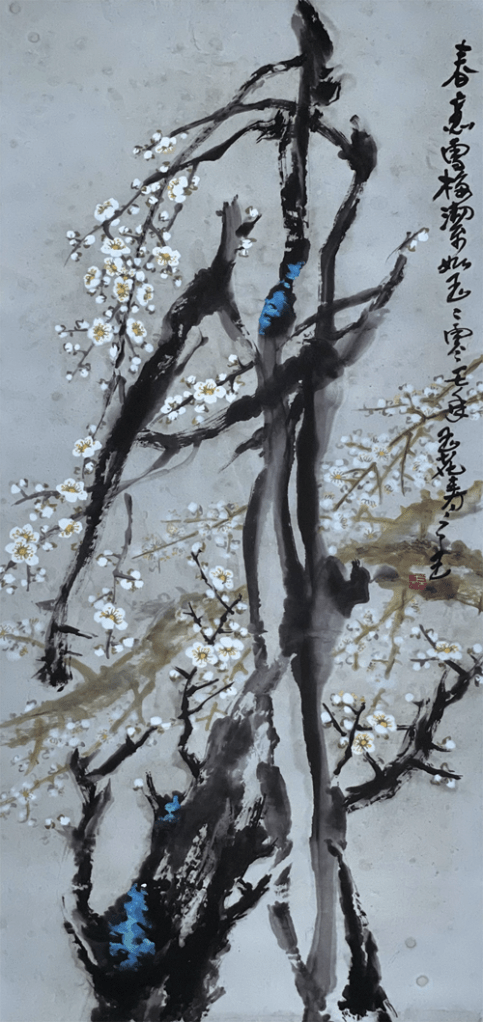
Springtime Snow-White Plum Blossoms as Pure as Jade
At the International Art Museum of America in downtown San Francisco, there is a special exhibition room, dedicated to Professor Yuhua Shouzhi Wang. This installation was established in 2018, containing a variety of water and ink paintings as wells as sketches. Professor Wang’s acclaimed works have been displayed all over the world, including an exhibition at Congress in 2008, where they called her work a ‘treasure of the world’. In 2019, Professor Wang’s art was exhibited at Shanghai Exhibition Center in China and the Louvre Museum in Paris. An art critic Aude de Kerros praised this event in Paris, saying ‘I have curated and critiqued so many art exhibitions, yet I have never seen an exhibition like this where all the guests are so touched and amazed by the art.’ Following the Paris exhibition, Professor Peter Drake, the Provost of the New York Academy of Art, presented a certificate to Professor Wang, recognizing her extraordinary contributions to representational and abstract art. In December 2020, the Chairman of Centre for Peace in United Nations Educational, Scientific and Cultural Organization (UNESCO), Guy Djoken awarded an “International First-Class Artist” title to Professor Wang for her accomplishment. Professor Wang is the only Asian artist who has ever received such a title. On December 29th 2020, Chairman Guy Djoken came to the museum to personally present the title certificate to Professor Wang.
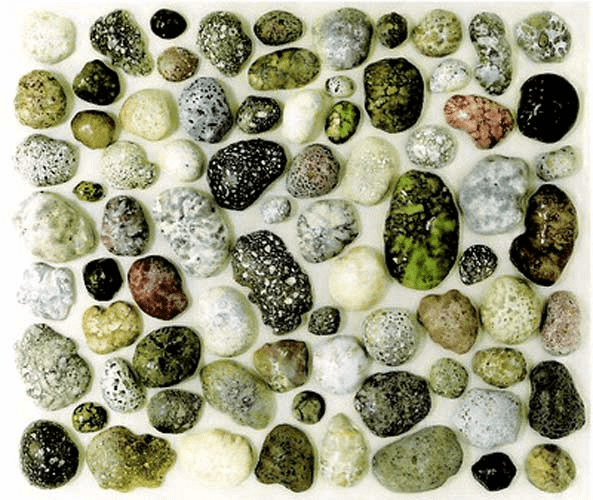
Hand crafted cobblestone
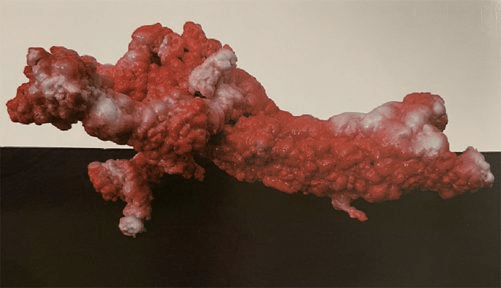
Hand Crafted Coral Sea Palace Monarch
Many people are aware that Professor Yuhua Shouzhi Wang is a world-renowned artist. However, the true identity of Professor Yuhua Shouzhi Wang is revealed as Fomu, Holy Mother the Great Mahasattva. She embodies great wisdom and compassion, noble morality, kindness, altruism, and selflessness in a perfect manner. She always considers other people’s well-being and is humble and very approachable. The compassion and kindness of Fomu, Holy Mother the Great Mahasattva, are pure and flawless. For example, in 2015, someone sneaked into the International Art Museum of America in San Francisco and tried to steal an artwork that had been acclaimed by the World Federation of UNESCO (WFUCA). This person was arrested by the police on site and subsequently detained. Since the artwork that he tried to steal was one of Fomu’s masterpieces, the court repeatedly requested Fomu to provide a valuation of the artwork, so that they could use her valuation to determinethe term for sentencing. When Fomu, Holy Mother the Great Mahasattva, knew about this person’s distress, She provided a statement saying that the artwork was rather ordinary and had no value. The court had no way of sentencing the person to any term and had to release him.
Another time, Fomu, Holy Mother the Great Mahasattva, saved a butterfly that had fallen into the water. Worried about the butterfly’s safety, Fomu brought it home and kept it for a few days to make sure the butterfly is well-recovered before letting it fly away. Fomu relentlessly led disciples to conduct life-releases. She went every week to woodlands to feed ducks and birds and never missed a week. She paid for it with Her own money and never accepted offerings from Buddhist disciples. Fomu, Holy Mother the Great Mahasattva, is well known for Her diligence and thriftiness. For many decades, the noble Fomu, Holy Mother the Great Mahasattva, always cooked Her own meals and washed Her own clothes. She never entrusted others to do Her chores. She would save the food that She could not finish eating and finish it the next day or two. She was never wasteful. Usually, Fomu, Holy Mother the Great Mahasattva, would even save the water that She did not finish drinking, the water used for washing vegetables or hands, or wastewater from the filter and use it for irrigating flowers or flushing toilet. Through Her deeds, the Great Fomu, Holy Mother the Great Mahasattva, was teaching us how to start with the small things, cherish our good fortune, and actualize our cultivation practices.It is impossible to recount all the numerous exemplary deeds of Fomu.
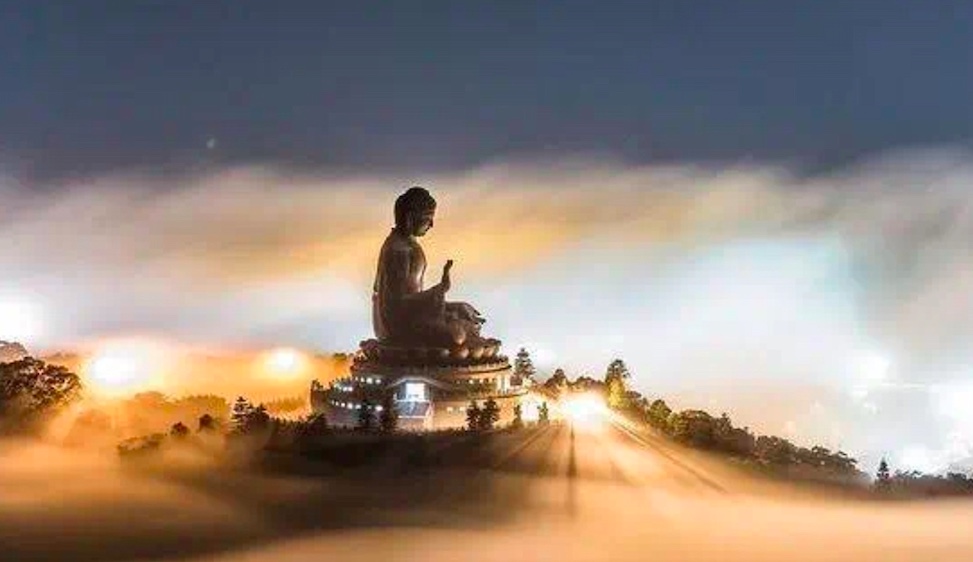
Photo from internet weixin.com
Wherever Fomu, Holy Mother the Great Mahasattva, went, dragon Dharma protectors were present, and holy miracles manifested. When Fomu performed initiation and transmitted Dharma, holy states were manifested. For example, at the Antelope Valley, Fomu’s hat turned into a black garuda. In New Jersey, the hair of Fomu, Holy Mother the Great Mahasattva, suddenly went up and wrapped around a tall building in Manhattan on the opposite shore. In San Francisco, a twin Buddha light suddenly appeared, centered around where Fomu stood. All cultivators are touched by the compassion and morality of Fomu, Holy Mother the Great Mahasattva.
In the “Buddha Imparts The Parables Sutra,” Sakyamuni Buddha explained a story to King Shengguang that conveyed the true meaning of life. The story goes like this: A thousand eons ago, there was a man wandering in the wilderness who was suddenly chased by a ferocious elephant. With no place to rely on, he ran in fear and came across an empty well with a large tree beside it. Desperate to escape, he followed the roots of the tree and hid in the well. However, the well was not a safe place either. There were two mice, one black and one white, constantly gnawing at the tree roots. And there were four poisonous snakes surrounding the well, ready to strike, and a poisonous dragon at the bottom of the well. The man was afraid of the snakes and the dragon, and also worried that the mice would eat away the tree roots. Just then, five drops of honey from a honeycomb on the tree fell into the man’s mouth, and he immediately forgot his fear and worries. But soon, bees from the honeycomb stung him due to the shaking of the tree, and a wildfire suddenly broke out and burned the tree.
The Buddha told King Shengguang that the wilderness represents the long night of ignorance, the man represents all sentient beings, the elephant represents impermanence, the well represents life and death, the tree root represents life, and the black and white mice represent night and day. The four poisonous snakes symbolize the four elements of earth, water, fire, and wind; the honey represents the five desires of wealth, sex, fame, food, and sleep; the bees represent evil thoughts; the wildfire represents aging and disease; and the poisonous dragon represents death. The Buddha emphasized that birth, old age, sickness, and death are inevitable and frightening. One should always be vigilant and not be consumed by the desires for wealth, sex, fame, food, and sleep. Upon hearing the Buddha’s teachings on the parables of life and death, King Shengguang was deeply moved.
This story serves as a reminder for us as well. Have we become absorbed in the sweetness of “honey” in our lives, forgetting that the “black and white mice” are constantly nibbling away at our time? Life is like a fleeting dream, and it is empty. It is crucial for us to awaken from this dream of fleeting existence.
On April 3, 2008, a solemn and dignified first-publishing ceremony of a fact-recording book entitled H.H. Dorje Chang Buddha III, which published jointly by the World Buddhism Publishing LLC and the World Dharma Voice, Inc., was held at the Library of the Congress of the United States. The book was also formally accepted into the collection of the Library of the Congress of the United States. Only since that time, did people in the world know that Master Wan Ko Yee, who had been broadly respected by the great masses and who had also been known as Great Dharma King Yangwo Yeshe Norbu, had been recognized by the world’s leaders, regent dharma kings, and great rinpoches of Buddhism through official documents as the third incarnation of Dorje Chang Buddha, who is the primordial Sambhogakaya Buddha of the universe. The Buddha’s name is H.H. Dorje Chang Buddha III Since then, people began to address His Holiness the Buddha by “Namo[1]Dorje Chang Buddha III.” This is similar to the situation that Sakyamuni Buddha’s name was Prince Siddhartha Gotama before attaining Buddhahood. However, after Sakyamuni Buddha had attained Buddhahood, His title changed to “Namo Sakyamuni Buddha.” That is why we now address His Holiness the Buddha as “H.H. Dorje Chang Buddha III”
In particular, on December 12, 2012, the Senate Resolution No. 614 of the United States Congress officially used “His Holiness” in the name addressing Dorje Chang Buddha III (That is to say, “H.H. Dorje Chang Buddha III”) Since then, the title and status of H.H. Dorje Chang Buddha III has been definitive by nature. And, as a matter of fact, “Dorje Chang Buddha III” is a name used legally in governmental and official legislative documents. Therefore, the previously used respected name and titles such as “Wan Ko Yee,” Great Master, and Great Dharma King no longer exist.
Several decades ago, Elder Dharma King Dorje Losang approached the Great Dharma King seeking clarification on certain Buddhist questions that troubled living beings. Provided below are the English translations of these questions.
The elder Dharma king asked: Living beings have certain questions, which I would like to ask on their behalf. Great Dharma King and respected Master who is supreme, would you instruct us? The Great Dharma King answers: If you have any questions, then raise them.
Q: What types of practitioners of Buddhism have the ability to successfully invoke nectar? A: Those Holy Ones and Great Dharma Kings who have reached the level of a Buddha or Mahasattva. Q: According to what the Great Dharma King just said, do all Dharma Kings within Vajrayana Buddhism have the ability to successfully invoke the Buddhas to bestow nectar? A: Not all of them are able. Q: Why are not all of them able? A: It is not necessarily true that all Dharma Kings are able to successfully invoke nectar. Q: What is the reason for this? A: Since there are those who are Dharma Kings in name but who have not attained the realization of a Dharma King, they are, therefore, not true Dharma Kings. Naturally, they are unable to commune with the Buddhas. How, then, could nectar be bestowed? Q: Can the present Dalai Lama successfully invoke the Buddhas to bestow nectar? A: I have not heard it said that he has such ability. Q: What is nectar? A: Holy food that corresponds with the miraculous powers and great wisdom of the Buddhas and Bodhisattvas. Q: What is the function of nectar? A: To plant the holy seeds of Vajra in order to realize enlightenment. It can eliminate all karma one produced in this world. Ending the cycle of birth and death becomes as easy as turning one’s hand. Q: How big is the difference in power between true nectar and the five types of nectar in this earthly world? A: As big as the difference between the great ocean and a drop of water, between 10,000 miles and a small step. There is no comparison. Q: What is the reason for this? A: Those five types of nectar are called nectar. In fact, they are ordinary things of this world that are empowered by mantras. True nectar bestowed by the Buddhas is something sacred that has come from the realm of the Holy Ones and Buddhas. There is a world of difference. It is the difference between the ordinary and the sacred. How could they be mentioned in the same breath? Q: Have there been any ordinary Rinpoches who have successfully practiced the nectar Dharma? A: Throughout Buddhist history until the present, there has not been one. Q: You are the Great Dharma King and Holy Master in our world. Could you invoke some nectar to empower everybody? A. When certain causes and conditions of living beings mature, nectar will fall naturally. If the Buddhist practitioner does not possess enough merit, there will be no nectar. I am an ordinary practitioner of Buddhism. I do not have the ability to successfully invoke nectar. Q: Then why did I personally see you successfully invoke the Buddhas to bestow nectar? A: That was due to the fullness of merit of those who were able to partake of the nectar. I alone do not have the depth of realization to successfully invoke the Buddhas to bestow nectar. Q: In this world, how many Rinpoches are able to successfully practice the Dharma of invoking the Buddhas to bestow true nectar? A: All of those who have attained the realization of a true Dharma King can successfully practice it. Furthermore, they must practice it. O: Is it unacceptable not to practice it? A: It is unacceptable. Q: Why is that? A: With respect to the highest Dharma within Vajrayana Buddhism, the initiation of Ati Yoga, Great Perfection of the Vajra division, nectar is an indispensable holy element for cleansing one’s negative karma and is the resource for planting the seeds of Vajra. If the truc nectar Dharma is not practiced, then it is an ordinary initiation.
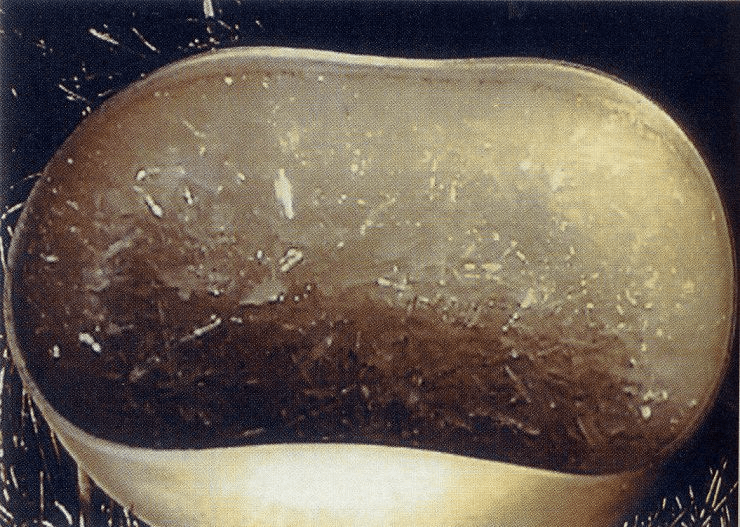
Crystal Bodhi Nectar
Q: The level of realization of Amang Nopu Pamu is extremely high. She is also able to successfully invoke nectar. Is she a Dharma King?
A: In order to successfully invoke the Buddhas to bestow true nectar, one must recite the holy mantras of a Dharma King, must put one’s hands in the mudra of a Dharma King, and must ascend to the throne of a Dharma King. Q: I would like to ask if the Great Dharma King’s Buddha Dharma is any different from her Buddha Dharma? A: The Buddha Dharma is the same. It is all passed down from the ancient Buddhas. Q: Does the Great Dharma King study the Buddha Dharma with Pamu? A: I have not seen her yet in this lifetime. Until now, I have not yet spoken to her. The Buddha Dharma is not the study of Buddhism. It does not contain the element of study. Only ordinary people of the world study it. Q: Generally speaking, what is the Buddha Dharma? A: It is cultivating yourself to live in accord with the law of cause and effect or karma. It is that simple. It is the same with nectar. Q: What is the reason for that? A: No reason. For example, you, Dorje Losang, have attained the position of an Elder Dharma King. However, your realization deepened and your beard grew only after you received empowerment from Pamu. This is cause and effect. Q: Can the Eight Great Rinpoches of Tibetan Tantric Buddhism successfully invoke the Buddhas to bestow nectar? A: Even the Four Great Dharma Princes do not have such power. Q: Why does each and every Rinpoche in today’s world have nectar pills? A: This is correct, but such pills are ordinary things of this world, such as medicine or other things, that are empowered by adding shar-ira and chanting mantras. After such empowerment, they are called nectar or the five great pills. Q: Thus, can 100 out of 10,000 Rinpoches successfully invoke nectar? A: It would not be a disappointing result if there were only 1 out of 10,000 Rinpoches who can successfully invoke nectar. O: If there are so few, how can they save living beings? A: All 84,000 Dharma methods can be used to save living beings. As long as any method is the Buddha Dharma, it can be used to save living beings. O: Which Dharma is the best and easiest method for attaining liberation? A: It is best to learn the Dharma spoken by Sakyamuni Buddha and the Dharma of true Great Dharma Kings. In today’s world, the Buddha Dharma that can liberate living beings most easily can be found in Buddhist books which are composed of commentary and instruction by Amang Nopu Pamu! O: Is there any usefulness in being initiated without real nectar? A: There is usefulness in being initiated by ordinary Rinpoches. As long as it is the correct Buddha Dharma, accomplishment can be achieved.
Q: If accomplishment can be achieved through both real nectar and ordinary nectar, then why distinguish between real nectar bestowed by the Buddhas and nectar made from ordinary objects that have been empowered? A: The difference lies in whether the accomplishment is great or small and the time it takes for such accomplishment. If one cultivates oneself according to the Dharma after having been initiated with real nectar, then one day of such cultivation would be better than 10 years, or even 20 or 30 years, of cultivation after having been initiated with ordinary nectar of this world. After having been initiated with real nectar, one can achieve in this lifetime the Three Bodies. Q: Why are the initiations performed by many Rinpoches not called nectar initiations? A: Nectar is the basic ingredient used in any initiation. This basic ingredient of nectar is then mixed with other things according to different tantra. Therefore, there are different names for various initiations. Q: Are those who were able to receive an ordinary initiation also able to receive a true nectar initiation or a true nectar empowerment? A: If one devotedly practices the Buddha Dharma and lives in accordance with Buddhism, then this will be clearly known by the Buddhas and Bodhisattvas. When one has accumulated enough merit, a Great Dharma King will initiate such person with nectar bestowed by the Buddhas! I already told you. Everything is cause and effect.
The Yungang Buddhist grottoes, a massive complex comprising 252 caves and niches with 51,000 statues carved into an area of 18,000 square meters, are a remarkable achievement of Buddhist cave art in China. Constructed from the mid-5th to early-6th century AD, the grottoes were influenced by Buddhist cave art from South and Central Asia but also incorporated distinct Chinese elements and local spirit. They played a crucial role among early Oriental Buddhist grottoes and had a far-reaching impact on Buddhist cave art in China and East Asia.
The five caves of Tanyao and their imperial patronage
The construction of Yungang began with five cave-temples, known today as caves 16 to 20, at the west end of the cliff. These caves were imperial commissions of the Northern Wei dynasty in around 460 C.E. The Northern Wei rulers, who belonged to the Tuoba clan from northern China, had recently unified northern China after centuries of political turmoil and established Buddhism as the state religion. The dynasty’s capital, Pingcheng, became a significant center for Buddhist religious and artistic expression.
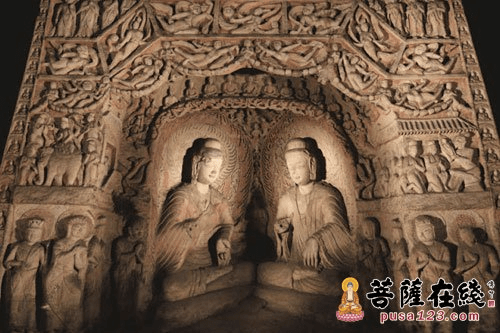
The five caves of Tanyao, created by Tan Yao, are classical masterpieces of the first peak of Chinese art, displaying a strict unity of layout and design. These caves each contain a colossal Buddha as the central icon, with Cave 20 housing a gigantic seated Buddha in a meditation posture and a standing attendant Buddha on one side. Another attendant Buddha likely existed on the other side, but it has been lost along with the cave’s exterior wall. The imperial patronage of these caves reflects the Northern Wei dynasty’s fusion of state power and religious devotion.
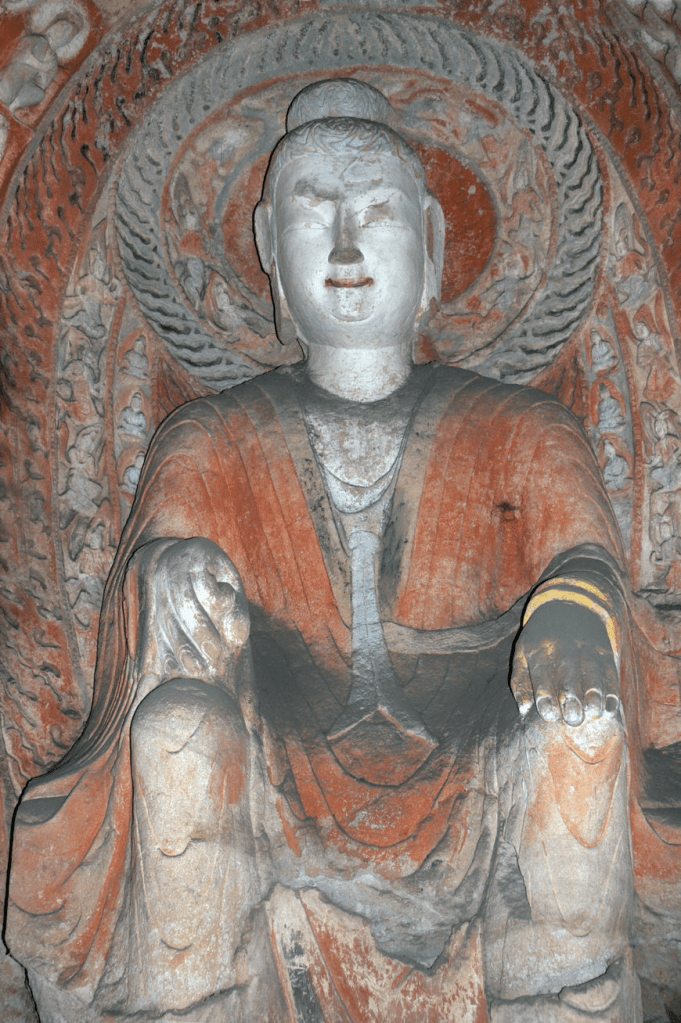
Buddha, Cave 20 at Yungang, Datong, China (photo: xiquinhosilva, CC BY 2.0)
The main Buddha measures roughly 13 meters in height. He has plump cheeks, a thick neck, elongated eyes, a sharply cut nose, slightly smiling lips, and broad shoulders, all of which produce a solemn appearance.
The well-preserved halo behind the main Buddha is composed of an outer band of flame patterns and two inner bands decorated with seven seated Buddhas of miniature size. The robe features zigzag patterns on the edge. The right shoulder of the main Buddha is left exposed, whereas the standing attendant Buddha on the east wall wears a robe that covers both shoulders with a high neckline.
Historical records recount that Tanyao, a renowned monk cleric with official ranks, advised Emperor Wencheng to undertake construction of five cave-temples (Caves 16–20) to commemorate the five founding emperors of the Northern Wei dynasty. Claiming that the emperor of Northern Wei was the living Buddha, this project declared the emperor’s political and spiritual legitimacy, and strengthened the rule of the imperial family.
Buddha (left) and attendant Buddha (right), Cave 20 at Yungang (photo: xiquinhosilva, CC BY 2.0)
The statues housed in the caves and niches are in good condition and all of the caves and statues have not suffered major damage from vandalism and/or natural disasters. Restoration and repair had been made on deficient parts of some statues in the past. All the necessary attributes demonstrating the Outstanding Universal Value of Yungang Grottoes are contained within the boundary of the property area. The buffer zone provides a necessary safe area for the conservation of the Grottoes, the setting and the historic environment. These measures have enabled the Yungang Grottoes to serve as one of the greatest ancient stone carving art treasure houses in the world.
The location, caves and statues of the Yungang Grottoes have retained their historic appearance. The eaves of wooden pavilions of the caves and the related historical remains have kept the distinctive character of the times when they were constructed. The daily maintenance and conservation intervention have been conducted following the conservation principle of minimal intervention in design, materials, methodology, techniques and craftsmanship.
The cross-legged Bodhisattva Maitreya, on the east wall of the antechamber of Cave 9, phase II, Yungang Grottoes, Datong, China (photo: G41rn8, CC BY-SA 4.0)
The paired caves and the major development at Yungang
Beginning roughly a decade after the initial commission, the imperial projects at Yungang advanced to a second phase that lasted from c. 470s until 494 C.E. In contrast to the monumental Buddha found in Cave 20, the interior of the second-phase cave-temples are decorated with reliefs that depict Buddhas, bodhisattvas, and other divine figures in various scales and configurations.
One of the most distinctive features developed in the second phase of construction are paired caves—two adjacent caves featuring a similar architectural plan and pictorial program. The paired cave-temple layout is understood to symbolically represent the reign of two coincident rulers: Emperor Xiaowen (471–499 C.E.) and Empress Dowager Wenming (442–490 C.E.). The use of paired cave-temples became another means to demonstrate the dynasty’s imperial power.
The paired Caves 5 and 6 are among the most lavishly decorated cave-temples at Yungang. Cave 6 has an antechamber and a square main chamber supported by a central pillar (see the full cave 6 in 3D). A square clerestory (window) is opened right above the passageway to the main chamber to let in light (although it is hard to see in photos or the 3D image).
In the main chamber of Cave 6, the east, south, and west walls are divided vertically into three main registers that include complex pictorial programs (the north wall features a large niche housing a trinity of Buddhas that are later repairs). We find seated Buddha figures and scenes from the Buddha’s life throughout the chamber. Depictions of the historical Buddha, who was believed to live in the Ganges River basin during the 6th century B.C.E., derived largely from Buddhist texts. The Buddha’s biography details the course of his life from birth to enlightenment, and eventually to nirvana, the final extinction. The life of the Buddha was among the most popular themes for artistic representation throughout the Buddhist world.
The First Sermon of the Buddha at Deer Park, Cave 6, Yungang, Datong, China
One scene from the Buddha’s life (at the southern end of the east wall) shows the First Sermon of the Buddha at Deer Park, identifiable by the depiction of a pair of deer on the Buddha’s throne. We see a canopied standing Buddha flanked by two standing bodhisattvas and a myriad of worshippers in the background. Just below the standing Buddha niche, a seated Buddha with his right hand raised (the fearless gesture) can be seen in a trapezoidal-shaped niche flanked by two five-story pagodas (just visible at the edges of the scene in the photograph). Worshippers either kneel in front of the throne or stand facing the Buddha on his two sides.
Rock-cut cave-temples
Rock-cut cave-temples first appeared in western India in the 1st century B.C.E. There are two basic types: apsidal-shaped (semicircular) chaitya (sanctuary, temple, or prayer hall in Indian religions) and vihāra caves where monks resided—both of which we find at places like the caves of Ajanta, India. Both types were transmitted eastwards to Central Asia up to the 5th century with modifications of the structures. At Yungang, the sanctuary type was further adapted into a square shape that houses a central pillar in the middle, as we find in Cave 6. At the same time, a number of architectural features find their precedents in Goguryeo tombs from present-day northeastern China and North Korea.
But what facilitated these different traditions coming together at Yungang?
Transmissions and transformations of artistic styles
Yungang was a hub where multiple artistic traditions of South Asia, Central Asia, and pre-Buddhist China synthesized into something new. This was made possible by the Silk Road, a network of ancient trade routes linking East Asia with the rest of Eurasia. Goods and ideas have been exchanged along the Silk Road since at least the second century B.C.E. Central to the economic, cultural, and religious interactions between different parts of Eurasia, the Silk Road tied the Northern Wei territory to the sacred heartland of Buddhism in South Asia, and to Central Asian kingdoms that promoted Buddhist teachings.
A primary factor facilitating the encounter of these varied traditions was the gathering of human resources and materials from different regions. In the 430s and 440s, the Northern Wei court issued decrees that relocated artisans and monks from its conquered lands to the capital city of Pingcheng. The concentration of people and craftsmanship in the capital led to the artistic flourishing of well-executed Buddhist monasteries, cave-temples, sculptures, and murals. Eminent monks who were active in Pingcheng had also engaged with religious activities in other urban centers such as Chang’an and Wuwei, and maintained close ties with Central Asian Buddhist communities.
Just as the form of the rock-cut cave-temples was adapted from earlier traditions in South Asia, statues and reliefs at Yungang exhibit strong stylistic and iconographic affinities with earlier Buddhist art traditions from northwestern India and Central Asia. For instance, the main colossal Buddha images in Caves 16 to 20 feature a round face, with a gentle, calm expression that creates an impression of sanctity, and a robe style that clings tightly to the body yet is rendered with schematic patterns. All of these features echo the aesthetics found in previous traditions, especially the Buddhist sculptures in Gandhara, a Buddhist center located in present-day northwest India and Pakistan.
Yungang art exerted influence, in turn, on Central Asian cave-temples starting in the later 6th century, such as Dunhuang, indicating that a dynamic exchange took place among the major cultural centers along the Silk Road.
An iconic form of the Buddha, 2nd–3rd century C.E., Kushan period, Gandhara, schist, 19.76 x 16.49 x 4.56 inches (The British Museum)
Sinicization reforms under the reign of Emperor Xiaowen
One of the new developments shown at Yungang that would have a long-lasting effect on Chinese Buddhist art was Sinicization, a process of adapting non-Chinese traditions into Han Chinese culture. In Cave 1, between the canopy of the central pillar and the ceiling we find intertwined dragons surrounding mountains that represent Mount Meru (the sacred mountain considered to be the center of the universe in Buddhist cosmology). The design shows strong influence of the pre-Buddhist Chinese tradition in two aspects. First, the dragons are depicted with typical Chinese conventions—a snake-like curving body with four legs. Mount Meru was not related to dragons in pre-Chinese Buddhist art traditions. The incorporation of dragons in the design reveals an integration of the motif’s symbolic reference to a spiritual life force in traditional Chinese beliefs.
Central pillar in Cave 1, c. 480s, Northern Wei, Yungang (photo: Zhangzhugang, CC BY-SA 3.0)
In Cave 6, we also see Sinicized traits in a new style of the Buddha’s monastic robe, which features loose drapery that falls around the body and clothes the Buddha entirely instead of the earlier style that clings closely to a partly exposed body. The new style finds parallel in the contemporary dress of court officials.
Overall, these new styles and motifs were a response to the political reform of Sinicization promoted by Emperor Xiaowen and Dowager Wenming during their reign in the Taihe era (477–499 C.E.). The reform aimed at legitimizing the Northern Wei regime, built by non-Chinese nomadic groups, as an imperial Chinese dynasty, and promoting a greater sense of conformity throughout the empire.
Buddha with Sinicized traits, Cave 6, Yungang, China (photo: Gisling, CC BY-SA 3.0)
The legacy of Yungang
Despite the move of the capital to Luoyang in 494 C.E., constructions at Yungang continued for another three decades. Cave-temples of this phase are much smaller in size than at the earlier western end of the complex. Over half a millennium later in the 13th century when Yungang was the capital of the Liao Dynasty, Yungang witnessed another era of glory, with restorations of the caves and installation of wooden structures attached to their façades. Yet it was only a temporary phenomenon. The site later stayed silent for centuries until its early 20th-century rediscovery along with other major cave-temples by foreigners on expeditions.
Modern scholarship about the history and the art of Yungang Cave-temples has continued to provide new information about the site. The most recent archaeological excavations at Yungang unearthed the remains of a monastery dated to the Northern Wei dynasty above the western section of the cliff. The well-preserved foundations of courtyards, the central stupa (a sepulchral monument that refers to the Buddha), residential cells for monks, and objects continue to enrich our understanding of the site as a significant religious center from the 5th century.
When his mother joined the monastery, it was said that Kumarajiva had already memorised many texts and sutras. Kumarajiva proceeded to learn the Dharma further and followed his mother into monastic life at the age of seven. When he was nine years old, mother and son undertook the arduous journey to India, eventually reaching the Kashmiri kingdom known to the Chinese as Chi-pin, which was probably his father’s native home. Bandhudatta, a renowned Buddhist teacher and cousin of the king, instructed Kumarajiva in the agamas (the nikayas of the Theravadin tradition). During the next two years Kumarajiva mastered these texts and was honoured by the king. Once he defeated several non-Buddhist teachers in a debate held before the ruler, and from this moment his reputation preceded him wherever he travelled. In addition to learning the scriptures and treatises of the Sarvastivadin school, Kumarajiva seized the opportunity afforded by his presence in India to study medicine, astronomy and astrology, exegetical and hermeneutical methods of exposition, logic and the applied sciences.
By the time Kumarajiva was twelve, he and his mother set out on the journey back to Kucha. The pace was leisurely, for every kingdom and principality along the way fêted and honoured him, and several urged him to take up residence as a teacher and adviser. As he was making his way through the mountains of the Yueh-chih region, he met an arhat who volunteered a prediction to his mother:
You must watch over and protect this novice. If by the time he reaches the age of thirty-five he has not abandoned the rules of religious discipline, he will become a great propagator of buddhadharma, enlightening countless people, and he will be the equal of Upagupta.
Upagupta was the fourth Indian patriarch after Buddha, famous for having converted the emperor Ashoka to the Buddhist way. Though Kumarajiva was forced by circumstances to break one vow late in life, he met the conditions of the prophecy and fulfilled the prediction.
Passing through Yueh-chih, Kumarajiva and his mother came to Kashgar, a Buddhist kingdom known for its excellent teachers and libraries. He settled there for a year and completed his studies of the Abhidharma and the texts revered by the Sarvastivadins. During this time he concentrated intently on Vedic literature and studied the most important systems of chanting the Vedas. Whilst he learnt a great deal about Hindu philosophical schools, he focussed upon the power of sound to affect the receptivity of consciousness to transcendental truths. The knowledge he gained later influenced his stirring translations of sutras and texts into Chinese. He also expanded his considerable grounding in Sanskrit and Pali and learnt more of the languages of Central Asia. On the advice of a monk, the king of Kashgar invited Kumarajiva to take the seat of honour and expound a sutra to a prestigious assembly which included the king himself. Kumarajiva did so, and as a result the monks of Kashgar were indirectly impelled to reform their previously lax monastic disciplines. At the same time, the king of Kucha heard of the high esteem in which Kumarajiva was held in Kashgar and sent a delegation to cement friendly relations between the two kingdoms.
While living in Kashgar, Kumarajiva met Sutyasoma, a prince of Yarkend (So-ch’e), perhaps as a result of his public discourse. Sutyasoma had renounced his royal inheritance and gone to Kashgar for spiritual instruction, and he was a revered teacher when he took Kumarajiva under his guidance. As a follower of Sarvastivadin doctrines, Kumarajiva held that the dharmas or ultimate constituents of existence are eternally real, whereas empirical phenomena which arise out of the momentary confluence of dharmas under karma are unreal. Sutyasoma adhered to the Mahayana view that all dharmas are themselves unreal; ontologically, dharmas are like empty space and assume distinct existence only in their momentary, ever-changing combinations. Although Kumarajiva initially found such teachings difficult to comprehend, Sutyasoma’s more universal application of Buddha’s doctrine of impermanence soon won him over to the Mahayana standpoint. Kumarajiva felt a tremendous sense of release and emancipation, declaring that he had been like a person who did not know what gold is and had previously taken brass for something wonderful.
Kumarajiva took up an intensive study of the sutras with the same enthusiasm he had brought to all his earlier training. He learnt the doctrines of the Madhyamika schools, memorized treatises by Nagarjuna and Aryadeva and rapidly assimilated Mahayana teachings. Just how fundamental a turning point Kumarajiva’s encounter with Sutyasoma was for his life is illustrated by his insistence that Bandhudatta, his first teacher in India, come to Kashgar. There Kumarajiva and Bandhudatta engaged in friendly but intensive debate, and eventually Bandhudatta was won over. During this time Sutyasoma foresaw something of the magnificent work Kumarajiva would undertake in China. Years after he left Kashgar, Kumarajiva recounted to his disciples in China what Sutyasoma once told him:
The sun of Buddha has gone into hiding behind the western mountains, but its lingering rays shine over the Northeast. These texts are destined for the lands of the Northeast. You must make sure that they are transmitted to them.
After spending a memorable year in Kashgar, Kumarajiva and his mother set out for Kucha. They stopped for a time in the kingdom of Wen-su and then moved on to their home. By the time Kumarajiva reached Kucha, his reputation had gone ahead of him as far as northern China. Monks from all over Central and East Asia gathered in Kucha to learn from him, even though he was only twenty years old and still officially a novice or shramanera. Within the year he was made a full monk in the Sangha and spent much of his time teaching others. For almost a decade he prepared himself for the mission to China which had been prophesied and which he felt was the central focus of his life work.’ This period lacked the peacefulness and prosperity that had marked his earlier years, for he witnessed the steady decline of the Kuchan state and heard reports of the incessant internal struggles which plagued northern China. Nonetheless, he worked quietly in the conviction that he was destined to go to the East one way or another.
Around this time, Jiva said to her son, “You should propagate the profound teachings of the Vaipulyasutras (the most important of the Mahayana sutras) in China. Its dissemination in the eastern countries will depend only on you. Does it matter that there will be no personal advantage for you (in this)?” To which he famously replied, “The teachings of the great master are there to serve (others) and to forget oneself (in the process). If one is able to spread the great conversion and awaken the blind masses, then, even if one’s body were burning in a red hot oven, one may suffer but feel no regret.” His mother, seeing the decline in Kucha’s fortunes and believing that she had done all she could for her son, exhorted him to follow unwaveringly the Bodhisattva Path and left to return to India. They never met again.
Kumarajiva stayed in Kucha and studied extensively the Pancavimsatika-Prajnaparamita and other Mahayana sutras and shastras. When he was first exposed to the Prajnaparamita texts, legend has it that Mara came to distract him by covering the pages so that they appeared blank. Ever more resolute when he discovered it was the devil’s work, Kumarajiva recited the sutras with vigour. Mara then spoke to him, declaring him already wise and questioned his need to read the sutras. Kumarajiva responded by telling him he was “a small devil” and to leave immediately. Reflecting the celebrated words of Buddha Shakyamuni, he declared, “My heart is (firm) like the earth; it is immutable.”
SUPERNORMAL DHARMA POWERS ARE skills that will inevitably appear during the course of a Buddhist’s cultivation and his striving for enlightenment. These powers are also a type of realization that the cultivator must naturally possess. This is especially true with respect to practitioners of Vajrayana Bud-dhism. When the Vajra Acarya Master manifests the Dharma at the Buddhist altar area, these skills will provide empowerment that is an indispensable part of the Buddhist altar area state. Those who are Rinpoches, Dharma Teachers, and Great Virtuous Ones desire and require such skills. Even ordinary cultivators who have just begun to follow Buddhism want to possess a few supernormal Dharma powers! Because of such ignorant thinking, these practitioners will not only cultivate themselves for their entire lives without attaining any supernormal powers, they will also never have the opportunity to even meet up with a teacher of great virtue who does possess supernormal Dharma powers! What is the reason for this result?
Can it be said that desiring supernormal Dharma powers is blameworthy and produces hindrances? Desiring supernormal powers can be a proper desire for the Dharma. The desire for supernormal powers can be divided into two types: blameworthy and non-blameworthy. It is blameworthy if one desires supernormal Dharma powers primarily for one’s own use. This would include desiring to appear impressive and awe-inspiring by showing off one’s Dharma powers. It would also include using one’s miraculous powers to subdue people, reap fame and Bain, cheat people out of money, hoodwink people into sexual misconduct, further one’s worldly selfish and evil intentions, and do all kinds of bad things.
These people do not know that the Dharma Protectors in space are inspecting and can see their evil minds. The Dharma Protectors will then immediately exercise their samadhi obstructive powers. These Dharma Protectors will seal up the chakras in the bodies of these ill-intentioned people. Their chakras will be confined to this earthly realm. As a result, for their entire lives, these people will only be able to manifest the state of an ordinary person. It will be impossible for them to obtain supernormal powers. This is because if these evil people were ever to obtain supernormal Dharma powers, they would immediately become sorcerers. That would be horrible. Wouldn’t the three spheres of the universe thereby fall into great chaos?
The Buddhas and Bodhisattvas in the various Dharma realms look back into beginningless time and look forward into the eternal future. They know all living beings in the three spheres of existence like the palms of their own hands. They specifically designate certain conditions under which they will bestow supernormal Dharma powers. Additionally, they dispatch Dharma Protectors, who keep watch on all practitioners, to manage the miraculous powers of living beings. Even if a Great Virtuous One is momentarily deceived by a person with such evil intent and consequently transmits the Buddha Dharma to him, as long as this person’s evil intentions still remain, it will be impossible for him to obtain supernormal Dharma powers no matter how diligently he may practice. This is because the Dharma Protectors inspecting from above do not dare to violate the precepts! They see that evil person’s preposterous ideas and immediately cease his miraculous Dharma powers. They block his chakras to prevent his chakras from developing. This is the responsibility of these Dharma Protectors.
There is a second type of person. Their desire to obtain supernormal Dharma powers is not blameworthy. The main reason why this type of person desires miraculous powers is to enlighten themselves and others. The practice of this type of person is based upon the four limitless states of mind. They constantly carry out the six paramitas. They have taken the great bodhicitta vows. They cultivate themselves in order to liberate all living beings. They want to obtain miraculous Dharma powers in order to liberate living beings from the suffering connected with samsara. They desire to obtain supernormal powers in order to benefit all living beings. They themselves clearly believe in the law of cause and effect. They even often fear that obtaining supernormal powers will bring about karmic hindrances and will cause them to go against the law of cause and effect. Thus, they are frightened of miraculous powers and maintain a heart of humility. They are Great Bodhisattvas, yet they always consider themselves to be ordinary living beings.
The practice of this type of person is entirely in accordance with Buddhism. Since their practice is in accordance with what I am now lecturing on – Dharma That Every Buddhist Must Follow – the Dharma Protectors inspecting from above will provide them with the most wonderful assistance. These deities will untie the knots in the energy channels of these practitioners and will cause the supernormal Dharma powers of the Buddhas and Bodhisattvas to suddenly turn into light and enter their chakras. At that time, the mandala in each practitioner’s body will respond well and will accept these powers. As a result, miraculous powers will naturally appear and Dharma powers will open up! Now then, how does one obtain supernormal Dharma powers after all? Those who are smart might already know the answer. However, perhaps those ignorant people who fantasize about learning miraculous Dharma powers do not yet understand. Hence, I, Pamu, will now clearly tell all of you! How should we obtain supernormal Dharma powers?
There are methods to obtain miraculous Dharma powers. There are mantras, mudras, and visualization techniques. When one’s three karmas unite into one body and correspond with the teachings, supernormal Dharma powers will come into being. One can then exhibit power and light. The uniting of one’s three karmas into one body and their correspondence with the teachings will be manifested in the state of realization and state of virtue one has attained through practice of the Buddha Dharma. When one’s state of realization and state of virtue have reached the level where it is appropriate to obtain supernormal Dharma powers, then as soon as one practices according to the Dharma, supernormal Dharma powers will appear. If one’s state of realization and state of virtue have not yet reached the level where it is appropriate to obtain supernormal Dharma powers, then even if one recites mantras until one’s lips crack, and even if one practices mudras until one’s Wrists fall off, one will still not obtain the slightest Dharma power. The ordinary practitioner of exoteric Buddhism knows that without moral discipline, one cannot develop concentration. Without concentration, One cannot attain wisdom. One also cannot attain supernormal powers. Without concentration, one cannot master the Dharma.
I am telling this to all of you here today in the hope that you will pass these instructions on to all of those people who fantasize about having limitless Dharma powers and great supernormal powers. If one does not learn the Tripitaka well and does not live according to Buddhism, or if one does not deeply study and truly practice the teachings contained in the books I have written, such as The Prajna of Ultimate Reality, Entering the Door of the Dharma, Dharma That Every Buddhist Must Follow, Brief Commentary on the Precepts and Discipline Treatise, etc., then one will not be able to obtain supernormal Dharma powers! This is because the great door leading to supernormal Dharma powers is opened by living according to the teachings of Buddhism and by possessing a high state of realization and a high state of virtue. There are no other means by which one can obtain supernormal Dharma powers!
Supernormal Dharma powers are arranged by the Buddhas and are managed by the Dharma Protectors who patrol and inspect in the sky. Since the beginning of Buddhist history, not one Dharma Protector has bestowed supernormal Dharma powers upon any cultivator who does not live in accordance with the teachings of Buddhism and who does not have a high state of realization and a high state of virtue. Since the beginning of Buddhist history, not one Dharma Protector has opened up the energy channel knots of any cultivator who does not live in accordance with the teachings of Buddhism and who does not have a high state of realization and a high state of virtue.
Kumarajiva’s statue in front of the Kizil Caves in Baicheng County, Xinjiang, China
The Buddhist scriptures from China are an invaluable repository of knowledge that was made possible by the benevolence of Buddhist masters who risked their lives to travel to China and spread the Dharma. Despite facing significant hardships along their journeys, they remained steadfast in their mission to share the Buddha’s precious teachings with a foreign culture. Thanks to their efforts in translating the teachings into Chinese and conveying their true meanings, people have been able to benefit from these teachings for over 25 centuries and continue to do so by achieving higher spiritual attainments.
The translation of the Buddha’s teachings took place between the 2nd and 13th centuries, with a significant number of translations carried out during the Tang Dynasty (7th – 10th centuries). In total, approximately 6,000-7,000 versions of various sutras were transmitted to China, and almost 200 renowned translators, including Kumarajiva, one of the most distinguished translators of the 4th and 5th centuries, were involved in the process.
A genius boy born in a buddhist kingdom Kucha
By User:Schreiber – Created with Inkscape (using Image:Bm taklamakan.jpg). Data based on: Marylin M. Rhie, Early Buddhist Art of China and Central Asia (Handbook of Oriental Studies / Handbuch der Orientalistik – Part 4: China, 12, Vol. 1) (Handbook of Oriental Studies/Handbuch Der Orientalistik). Brill Academic Publishers, ISBN 90-04-11201-4, CC BY-SA 3.0, https://commons.wikimedia.org/w/index.php?curid=2722471
Kucha played a crucial role in the spread of Buddhism during ancient times. In the last quarter of the 4th century CE, Kucha became a dominant force, overshadowing the Southern Silk Road, which ran along the southern edge of the Tarim Basin. According to the Jinshu(晋书), Kucha was a heavily fortified city with a magnificent royal palace, numerous Buddhist stupas, and temples. Book 97 of Jinshu states, “There are fortified cities everywhere, their ramparts are three-fold, inside there are thousands of Buddhist stupas and temples (…) The royal palace is magnificent, glowing like a heavenly abode.”
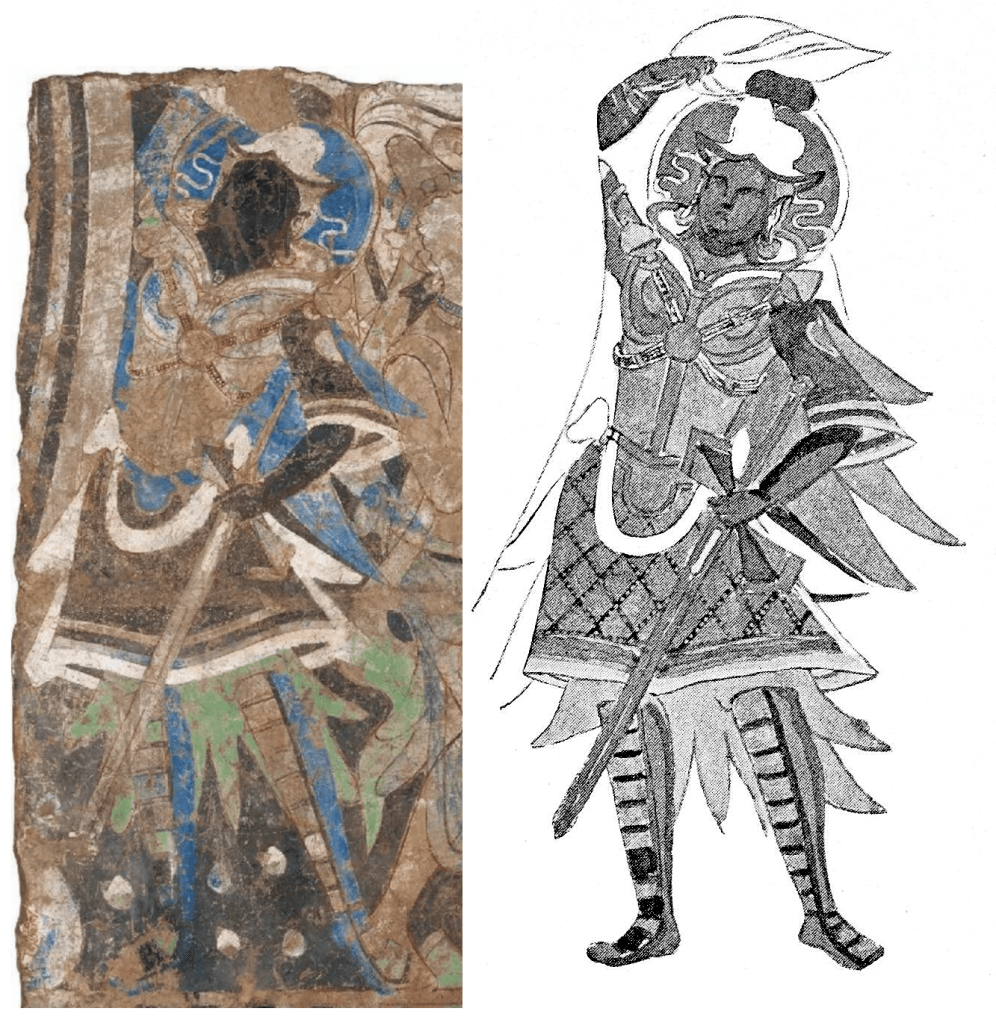
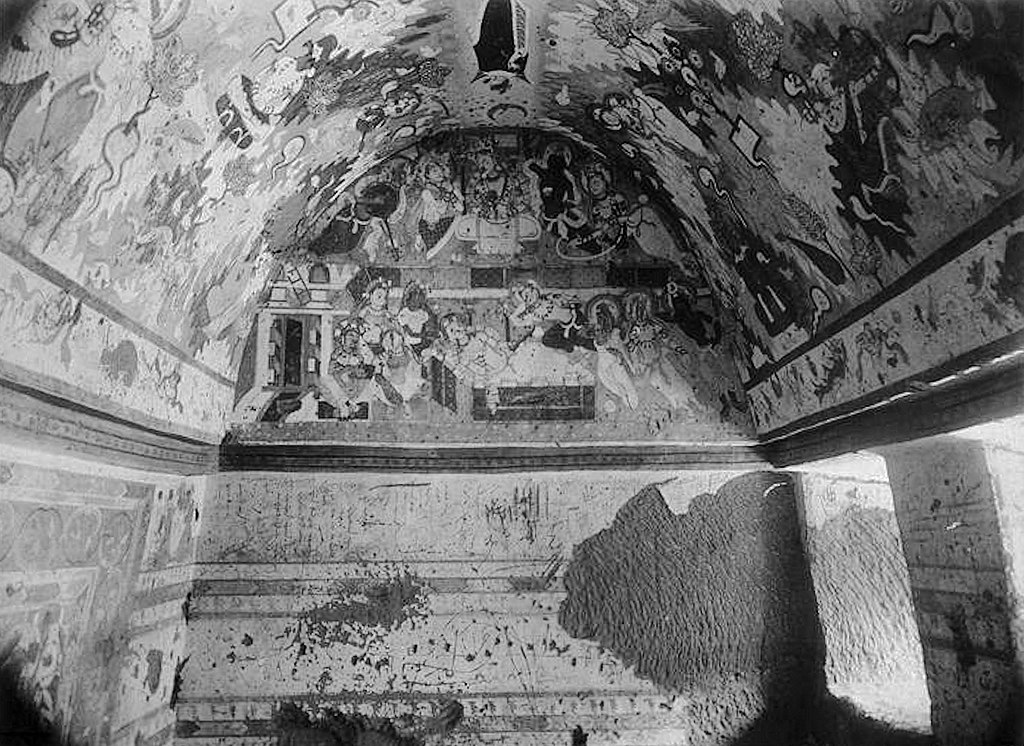
The culture and civilization of Kucha during this period can be glimpsed from the discoveries in the famous Kizil caves. In 1906, the German expedition team of Albert Von Le Coq and Albert Grunwedel explored the Kizil Caves, with different objectives. Grunwedel copied the murals, while Von Le Coq took them with him and placed most of the fragments in the Museum of Asian Art in Dahlem, Berlin. Other explorers also took the murals and placed them in various museums in Russia, Japan, Korea, and the United States.
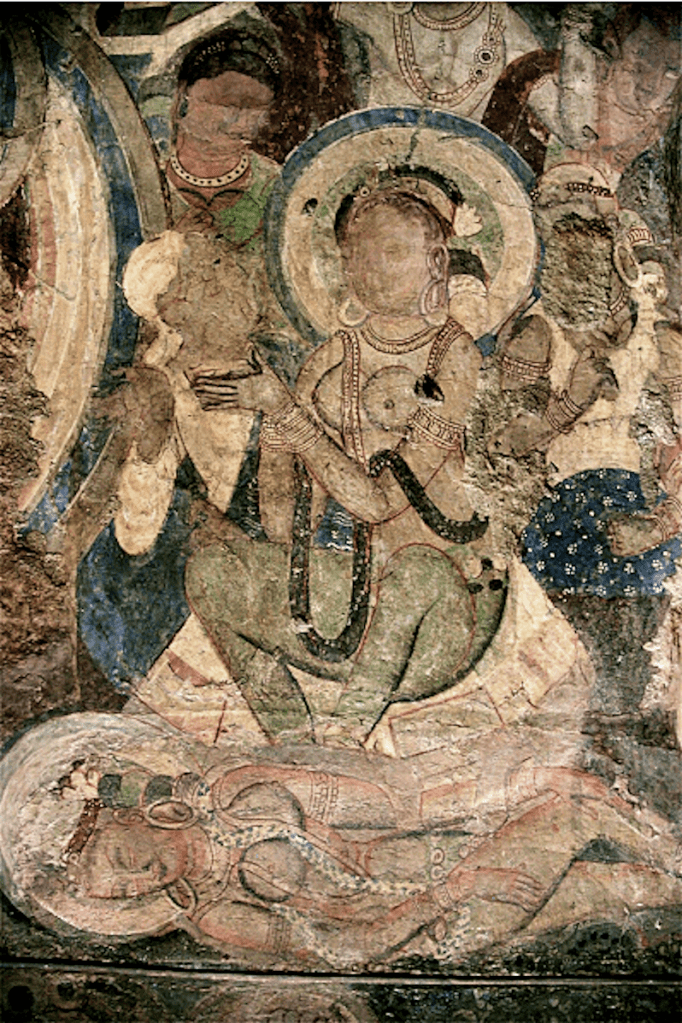
The murals in the Kizil Thousand-Buddhist Caves are considered “The most beautiful murals in Central Asia,” and can be found in 81 caves with a total area of over 10,000 square meters (11,960 yards). The diamond grid pattern is the most impressive feature of the caves, with each grid depicting a story about Buddha’s reincarnation through a single picture. Besides themes related to Buddha, Bodhisattva, Arhat, Flying Apsaras, and Buddhist fables, the murals also showcase various depictions of daily life, farming, hunting, pastures, riding, mountains and rivers in the West Region, animals, birds, and ancient architectures. The styles are not limited to local arts, indicating influences from diverse cultures.
Cave 4 Vajrapani, removed original and in-situ drawing by Grunwedel
Attendant, Cave 84 Painting: 6th century painter, Kizil Photography: Undetermined
Blue pigment used on mural. Greco-Buddhist Wind God Boreas or Vayu, central part of the ceiling of Cave 38
Ancient Uyghur Civilization (1)-Cave art by ancient Uyghurs
Kumarajiva was born around C.E. 344 in kingdom Kucha. Kumarajiva’s father, Kumarayana, was descended from an honourable line of prime ministers of a kingdom in Kashmir. Though Kumarayana was expected to become prime minister after his father, he renounced his hereditary claim and became a Buddhist monk. Eventually, he set out along the silk route which threaded its way across the mighty Pamirs and into the Takla Makan Desert and Central Asia. Following the northern route, he came in time to the devoutly Buddhist kingdom of Kucha on the northern rim of the great Tarim River basin. The Kuchan king either knew of Kumarayana by reputation or showed a shrewd perception of human nature, for he welcomed the traveller warmly and at once made him a trusted adviser. Soon he was elevated to kuo-shih, Teacher of the Nation, a privileged position which entailed political and cultural duties as well as religious functions. …
The great translator’s mother, Jiva (Jivaka), was the younger sister of the king of Kuchi. She was well known for her intelligence, wit, memory, and devotion to the dharma. It was said that she had only to glance at a written passage to comprehend it, and only to hear something once to repeat it from memory. These qualities attracted numerous suitors. Jiva had a red mole (or spots) on her body, an indication that she would give birth to a wise son.
She had politely rejected a number of eligible suitors from neighbouring kingdoms, but when she saw Kumarayana she expressed the desire to become his wife. The king was delighted and insisted that Kumarayana accept the proposal. Even though he was a monk, he bowed to the wishes of this generous and devout monarch.
When Kumarajiva was in utero, Jiva became considerably sharper and more perceptive than before. For example, although her language was what is now known as Tokharian B, while pregnant with Kumarajiva she was able to understand Sanskrit without ever having studied it; after Kumarajiva was born, this ability disappeared. Such an “omen” suggests that the child Kumarajiva was predisposed to master Sanskrit and thus the original Buddhist scriptures.
When their son was born, Kumarayana and Jivaka each gave a part of their names to him and called him Kumarajiva. With two devout parents, Kumarajiva was exposed to Buddhist texts and practice from the day he was born. At the age of seven, he trained with a learned master and memorized a thousand verses every day until he could recite all the teachings of the scholastic treatises of the Abhidharma.
As if an occult design of invisible Nature had become manifest, hardly had the remarkable child turned six before Jivaka received permission from her husband to become a Buddhist nun. By that time Kumarajiva had already learnt the vast literature of the Abhidharma by heart, understood it and entered the Sangha. Kumarajiva’s mother clearly recognized the penetrating intelligence of her son and was determined to give him the best available philosophical and spiritual training.























 Peace LiLy


