At February 14, 2019. The City of Hesperia where the Holy Heavenly Lake is located held a public hearing to discuss the matter of building the Buddhist City at the Holy Heavenly Lake and subdividing the land for various Buddhist sects to build temples in the city. The result was that the city agreed to let the project move forward.
At the very next day February 15th, when the bright sun was shining in the sky, it was suddenly reported that at the riverbed above the underground river at the Holy Heavenly Lake, huge waves were seen flowing very fast from south to north. The magnitude of the water flow was inconceivably large. The river’s width was similar to that of the Yangtze River (the longest and largest river in China). The color of the river was transparently blue, resembling that of the Danube River. Seeing the rushing billows with the rapid torrents, many people were very astounded and did not know how to react. They were speculating but did not know what kind of situation might occur after all.
Huge rushing waves in the riverThe water surface that is as wide as the Yangtze River, taken from the shore of the Holy Heavenly Lake
H.H. Dorje Chang Buddha III said at that time, “You do not know the situation but you don’t have to worry. This is a greatly auspicious precursor. There will not be any harm or damage done in the Holy Heavenly Lake where buildings and temples are to be constructed, or to the nearby places where people inhabit. Now the only thing to be done is to inform the World Buddhism Association Headquarters since they will build the temple there. They should send people to record the holy feat.”
We asked about why this is called a holy feat. H.H. Dorje Chang Buddha III said, “You were already told last year that the Holy Heavenly Lake is a holy site. Below the Holy Heavenly Lake, there is an underground river going from the south to the north, which is as wide as the Yangtze River. At that time, there were evil and demonic persons who slandered us to say that what we said was a rumor. For that, some people brought up scientific evidence to tell them that one of the world’s only two big underground rivers going from the south to the north is truly under the Holy Heavenly Lake. They were also told that there is a crystal lake with crystal gems lying 450 feet below the ground. But how could people with karmic hindrances believe my words? They are obstructed by dark karma and do not even believe science. You can think for yourself and then answer me: Why does clear water suddenly flow rapidly today with waves lifted by its billows over the riverbed above the underground river, although the riverbed has been dried for many years? What is the reason? It runs northward like an endless tide from a river of hundreds of miles in length. What holy, pure karmic condition can cause it after all?”
At this time, a Shangzun replied to His Holiness the Buddha, “Is this a river that holds the water flowing from the heavenly river into the big underground river at the entrance on the ground surface? This is truly a joyful celebration and an act of praise by the nagas and heavenly dharmapalas. The cause of it is an event that happened on February 14, 2019. The City of Hesperia where the Holy Heavenly Lake is located held a public hearing to discuss the matter of building the Buddhist City at the Holy Heavenly Lake and subdividing the land for various Buddhist sects to build temples in the city. The result was that the city agreed to let the project move forward. The nagas and heavenly dharmapalas are very pleased and give their praises!”
Following His Holiness the Buddha’s Dharma decree, we went to the shores of the Holy Heavenly Lake. All we heard was the rushing, pounding waves. It was really like what His Holiness the Buddha said. We saw the large river, just like the Yangtze River, appearing above ground in Holy Heavenly Lake. The river was flowing northward, with a huge volume of water in surging billows and waves at a very rapid speed, taking away the remnants and dead leaves from the lakeside. There was no harm done to the trees and buildings at all, nor was there any damage to the houses across the river. The video also captured a rainbow.
The meeting was held on the first day, and the nagas and dharmapalas showed their praises through this tremendously holy manifestation on the next day. We believe that the Buddhist City at the Holy Heavenly Lake will fulfill the myriad wishes and bring about prosperity in every undertaking!
A Tremendously Holy Feat Manifested At the Holy Heavenly Lake Where the Buddhist City Will Be Established on February 15th 2019
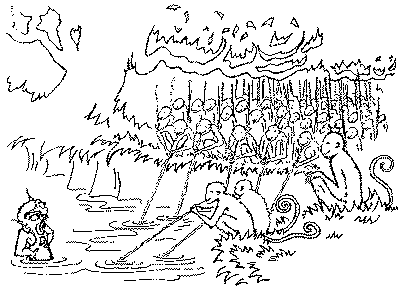
Once upon a time, far away in a deep forest, there was a nation of 80,000 monkeys. They had a king who was unusually large, as big as a fawn. He was not only big in body, he was also ‘large in mind’. After all, he was the Bodhisatta — the Enlightenment Being.
One day, he advised his monkey nation by saying, “My subjects, there are poisonous fruits in this deep forest, and ponds possessed by demons. So if you see any unusual fruit or unknown pond, do not eat or drink until you ask me first.” Paying close attention to their wise king, all the monkeys agreed to follow his advice.
Later on, they came to an unknown pond. Even though they were all tired out and thirsty from searching for food, no one would drink without first asking the monkey king. So they sat in the trees and on the ground around the pond.
When he arrived, the monkey king asked them, “Did anyone drink the water?” They replied, “No, your majesty, we followed your instructions.” He said, “Well done.”
Then he walked along the bank, around the pond. He examined the footprints of the animals that had gone into the water, and saw that none came out again! So he realized this pond must be possessed by a water demon. He said to the 80,000 monkeys, “This pond is possessed by a water demon. Do not anybody go into it.”
After a little while, the water demon saw that none of the monkeys went into the water to drink. So he rose out of the middle of the pond, taking the shape of a frightening monster. He had a big blue belly, a white face with bulging green eyes, and red claws and feet. He said, “Why are you just sitting around? Come into the pond and drink at once!”
The monkey king said to the horrible monster, “Are you the water demon who owns this pond?” “Yes, I am,” said he. “Do you eat whoever goes into the water?” asked the king. “Yes, I do,” he answered, “including even birds. I eat them all. And when you are forced by your thirst to come into the pond and drink, I will enjoy eating you, the biggest monkey, most of all!” He grinned, and saliva dripped down his hairy chin.
But the monkey king with the well-trained mind remained calm. He said, “I will not let you eat me or a single one of my followers. And yet, we will drink all the water we want!” The water demon grunted, “Impossible! How will you do that?” The monkey king replied, “Each one of the 80,000 of us will drink using bamboo shoots as straws. And you will not be able to touch us!”
Of course, anyone who has seen bamboo knows there is a difficulty. Bamboo grows in sections, one after another, with a knot between each one. Any one section is too small, so the demon could grab the monkey, pull him under and gobble him up. But the knots make it impossible to sip through more than one section.
The monkey king was very special, and that is why so many followed him. In the past, he had practiced goodness and trained his mind with such effort and attention, that he had developed very fine qualities of mind. This is why he was said to be ‘large in mind’, not because he simply had a ‘big brain’.
The Enlightenment Being was able to keep these fine qualities in his mind, and produce a very unlikely event – a miracle. First, he took a young bamboo shoot, blew through it to make the knots disappear, and used it to sip water from the pond. Then, amazing as it may sound, he waved his hand and all the bamboo growing around that one pond lost their knots. They became a new kind of bamboo.
Then, all his 80,000 followers picked bamboo shoots and easily drank their fill from the pond. The water demon could not believe his green eyes. Grumbling to himself, he slid back under the surface, leaving only gurgling bubbles behind.
In the Tang Dynasty, there was a peculiar Zen master. He didn’t even have a Dharma name, and his practice was very special. He did not live in a temple. He settled himself in an awning like a bird nest on the top of a pine tree. People called him “the Zen Master of the Birdsnest”. Many visitors hiked to the remote forest to seek the monk’s wise advices.
Bai Juyi, was a very famous Chinese poet, also a high level officer at that time. One time, Bai Juyi traveled long distance to visit the Zen Master. He asked Zen Master Birdsnest, “Can you tell me what is the most important thing the Buddha ever said?”
The Zen master replied, “Don’t do any bad things, and do all the good things.”
Bai Juyi thought this answer is far too simple, he sneered, “Even a three-year-old can say this.”
Zen Master Birdsnest said: “Although a three-year-old child can say it, but an eighty-year-old man still finds it very difficult to do it.”
Master Qinluan was a famous Japanese Zen master. At the age of nine, he made up his mind to become a monk and asked Zen Master Cizhen to shave his ordination for him. Zen Master Cizhen asked him, “Why do you want to become a monk when you are so young?” Qinluan said: “Although I am only nine years old, my parents have both died. I don’t understand why people must die. Why must I be separated from my parents? Therefore, I must become a monk and explore these truths.”
Zen Master Cizhen said: “Very well. I’m willing to accept you as a disciple. However, it’s too late today, so I’ll shave you tomorrow morning.” Qin Luan said, “Master! Although you said that you will shave me early tomorrow morning, I am still young and ignorant. I can’t guarantee whether my determination to become a monk will last until tomorrow. Besides, Master, you are so old, you can’t guarantee that you will even wake up tomorrow morning!” After listening this words, Zen Master Cizhen was surprisingly happy, and said joyfully, “Yes! What you said is absolutely right. Now I will shave for you!”
Three Moves by Mencius’s Mother
Mencius, was a famous scholar well-known for his erudition. He was one of the greatest representatives of Confucianism in ancient China.
He had a great mother, who really focused on education. Once his family lived near a graveyard when he was a child. Therefore, he often played near the grave and imitated people’s crying or digging the tombs. When his mother saw this, she said: “It’s not a good place for a child to live in.”
His mother moved the family to a house near a market. Soon Mencius began to amused himself by imitating peddler’s hawking and bargaining. His mother found this place still not good for a child to live in. She decided to move away again.
At last they settled down near a school. Mencius quickly began copying the students’ reading and writing. He also took pleasure by imitating the sacrificial rites on ceremony and formalities of courtesy. He became more polite and hardworking. Then his mother said: this is a good place for a child !.
Green Tara (Jetsun Drolma) statue from the Gyantse Kumbum Pagoda, Pelkor Chode Monastery, Gyantse, Tibet
H.E. Tangtong Gyalpo Bodhisattva (1361-1485)
It is through the understanding and practice of the Buddha-dharma that one becomes a holy person–a living jewel. Sainthood in Buddhism has a somewhat different meaning than that held in Christianity although both refer to people who live an exceptionally holy life, are very compassionate, and can demonstrate certain “miracles.” In Buddhism it also means one who has become enlightened—been liberated from the cycle of reincarnation and all its related suffering. The Christian saint aspires to be born in the Christian heaven, but this is not the goal of a Buddhist. A Buddhist saint is one who has escaped samsara or existence all together and gone beyond what is possible in the heavenly realms. A Buddhist saint would live in the Dharma realms or wherever he choses to be to help living beings. A saint in Buddhism is one who, like the Buddha, has become enlightened and realized his or her original nature, possessing the skills and wisdom of a Buddha. They have gained control over life and death and are thus liberated from the cycle of reincarnation. This is true happiness!
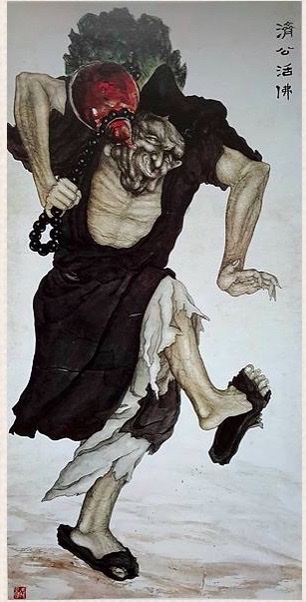
In Buddhism saints may not lead what is normally thought of as a “conventional” life. There are many examples of Buddhist saints who exhibited most unorthodox (“deliberate“) behavior. Examples of these kinds of happy, crazy saints are Han-shan and Shih-te, eccentric Ch’an (Zen) hermit-monks from Tang Dynasty, as well as Monk Ji-gong and Birdnest Roshi, but there are many others including the crazy yogis of Tibet like Padmasambhava, Virupa, Manjusrimitra, Tsang Nyon Heruka, and Tangtong Gyalpo. Saints can manifest in innumerable forms and may appear as humans or animals or live in other dimensions.
Japanese hanging scroll by Hashimoto Gaho of Han-shan and Shih-te (Kanzan and Fittoku), eccentric Ch’an (Zen) hermit-monks from Tang Dynasty, whose poetry is popular in the west.
It is important to know that one cannot fully understand what takes place on higher levels of the path. For example, those on the first Bodhisattva stage do not know about what takes place on the second Bodhisattva stage and so on up the path. Those on the second Bodhisattva stage see those on the first Bodhisattva stage as having impurities. Even those on the tenth Bodhisattva stage see those on the ninth Bodhisattva stage as having certain impurities. It is natural that the impurities and obscurations of those on the lower levels would be greater than those at the higher levels. Nevertheless, those who are kind and benefit others can guide and transform living beings no matter where they are on the path. However, ordinary beings and those at the lower levels of the path cannot possibly understand the behavior of true holy beings.
The key features of the various paths to becoming a holy being are summarized in the chart “The Way to Become a Holy Being or Saint.” It is useful to think of these paths as stages on the way to becoming a Buddha. It is interesting to note that the other world religions are also included as initial stages on the way to buddhahood in as much as they teach compassion, loving kindness, some aspects of morality, and discourage evil. Some also teach various forms of training the mind in meditation. Bodhisattvas do not only incarnate as Buddhists to help living being. The three pure precepts of Buddhism—cease evil, do good, and help others—can be practiced in many forms.
You must remember that ALL sentient beings are evolving toward the perfection of being a Buddha, whether they know it or not, and whether at the moment they may be very confused and behaving in foolish or even evil ways. This includes the minions of Mara and the demons of hell as well as the devas or gods in heaven.
One of the deities most frequently seen on altars in China’s temples is Quan Yin (also spelled Kwan Yin, Kuanyin; in pinyin, Guanyin). In Sanskrit, her name is Padma-pâni, or “Born of the Lotus.” Quan Yin, alone among Buddhist gods, is loved rather than feared and is the model of Chinese beauty. Regarded by the Chinese as the goddess of mercy, she was originally male until the early part of the 12th century and has evolved since that time from her prototype, Avalokiteshvara, “the merciful lord of utter enlightment,” an Indian bodhisattva who chose to remain on earth to bring relief to the suffering rather than enjoy for himself the ecstasies of Nirvana. One of the several stories surrounding Quan Yin is that she was a Buddhist who through great love and sacrifice during life, had earned the right to enter Nirvana after death. However, like Avlokiteshvara, while standing before the gates of Paradise she heard a cry of anguish from the earth below. Turning back to earth, she renounced her reward of bliss eternal but in its place found immortality in the hearts of the suffering. In China she has many names and is also known as “great mercy, great pity; salvation from misery, salvation from woe; self-existent; thousand arms and thousand eyes,” etc. In addition she is often referred to as the Goddess of the Southern Sea — or Indian Archipelago — and has been compared to the Virgin Mary. She is one of the San Ta Shih, or the Three Great Beings, renowned for their power over the animal kingdom or the forces of nature. These three Bodhisattvas or P’u Sa as they are know in China, are namely Manjusri (Skt.) or Wên Shu, Samantabhadra or P’u Hsien, and Avalokitesvara or Quan Yin.
Quan Yin is a shortened form of a name that means One Who Sees and Hears the Cry from the Human World. Her Chinese title signifies, “She who always observes or pays attention to sounds,” i.e., she who hears prayers. Sometimes possessing eleven heads, she is surnamed Sung-Tzu-Niang-Niang, “lady who brings children.” She is goddess of fecundity as well as of mercy. Worshiped especially by women, this goddess comforts the troubled, the sick, the lost, the senile and the unfortunate. Her popularity has grown such through the centuries that she is now also regarded as the protector of seafarers, farmers and travelers. She cares for souls in the underworld, and is invoked during post-burial rituals to free the soul of the deceased from the torments of purgatory. There are temples all over China dedicated to this goddess, and she is worshiped by women in South China more than in the North, on the 19th day of the 2nd, 6th and 9th moons. (For example, it is a prevalent birth custom in Foochow that when a family has a daughter married since the 15th day of the previous year, who has not yet given birth to a male infant, a present of several articles is sent to her by her relatives on a lucky day between the 5th and 14th of the first month. The articles sent are as follows: a paper lantern bearing a picture of the Goddess of Mercy, Quan Yin, with a child in her arms, and the inscription, “May Quan Yin present you with a son”; oysters in an earthenware vessel; rice-cakes; oranges; and garlic.) Worshipers ask for sons, wealth, and protection.
She can bring children (generally sons, but if the mother asks for a daughter she will be beautiful), protect in sorrow, guide seamen and fishermen (thus we see her “crossing the waves” in many poses), and render harmless the spears of an enemy in battle. Her principal temple on the island of Putuoshan, in the Chusan Archipelago off the Zhejiang coast near Ningbo, is a major pilgrimage site sacred to the Buddhists, the worship of Quan Yin being its most prominent feature on account of the fact that the Goddess is said to have resided there for nine years, reigning as the Queen of the Southern Seas. The full name of the island is P’u t’o lo ka, from Mount Pataloka, whence the Goddess, in her transformation as Avalokiteshvara, looks down upon mankind. Miao Feng Shan (Mount of the Wondrous Peak) attracts large numbers of pilgrims, who use rattles and fireworks to emphasize their prayers and attract her attention. In 847, the first temple of Quan Yin was built on this island. By 1702, P’u Tuo had four hundred temples and three thousand monks, and was the destination of countless pilgrims. (By 1949, however, P’u Tuo was home to only 140 monasteries and temples.)
No other figure in the Chinese pantheon appears in a greater variety of images, of which there are said to be thousands of different incarnations or manifestations. Quan Yin is usually depicted as a barefoot, gracious woman dressed in beautiful, white flowing robes, with a white hood gracefully draped over the top of the head and carrying a small upturned vase of holy dew. (However, in the Lamaistic form, common in bronze from eighteenth-century China and Tibet, she is often entirely naked.) She stands tall and slender, a figure of infinite grace, her gently composed features conveying the sublime selflessness and compassion that have made her the favorite of all deities. She may be seated on an elephant, standing on a fish, nursing a baby, holding a basket, having six arms or a thousand, and one head or eight, one atop the next, and four, eighteen, or forty hands, which which she strives to alleviate the sufferings of the unhappy. She is frequently depicted as riding a mythological animal known as the Hou, which somewhat resembles a Buddhist lion, and symbolizes the divine supremacy exercised by Quan Yin over the forces of nature. Her bare feet are the consistent quality. On public altars, Quan Yin is frequently flanked by two acolytes, to her right a barefoot, shirtless youth with his hands clasped in prayer known as Shan-ts’ai (Golden Youth), and on her left a maid demurely holding her hands together inside her sleeves known as Lung-nü (Jade Maiden). Her principal feast occurs yearly on the nineteenth day of the second lunar month. However, she is fortunate in having three birthdays, the nineteenth of the second, sixth and ninth months. There are many metamorphoses of this goddess. She is the model of Chinese beauty, and to say a lady or a little girl is a Kwan Yin is the highest compliment that can be paid to grace and loveliness.
According to one ancient legend her name was Miao Shan, and she was the daughter of an Indian Prince. Youthful and serene, she chose to follow a path of self-sacrifice and virtue, and became a pious follower of Buddha, herself attaining the right to buddhahood but remaining on earth to help mankind. In order to convert her blind father, she visited him transfigured as a stranger, and informed him that were he to swallow an eyeball of one of his children, his sight would be restored. His children would not consent to the necessary sacrifice, whereupon the future goddess created an eye which her parent swallowed and he regained his sight. She then persuaded her father to join the Buddhist priesthood by pointing out the folly and vanity of a world in which children would not even sacrifice an eye for the sake of a parent.
Another Miao Shan legend was that the son of the dragon king had taken the form of a carp and was caught by a fisherman and displayed for sale in the market place. Miao Shan sent her servant to buy the fish and released it.
As related in yet another legend Quan Yin was said to be the daughter of a sovereign of the Chou dynasty, who strenuously opposed her wish to be a nun, and was so irritated by her refusal to marry that he put her to humiliating tasks in the convent. This means of coercion failed, and her father then ordered her to be executed for disobedience to his wishes. But the executioner, a man of tender heart and some forethought, brought it about that the sword which was to descend upon her should break into a thousand pieces. Her father thereupon ordered her to be stifled. As the story goes, she forthwith went to Hell, but on her arrival the flames were quenched and flowers burst into bloom. Yama, the presiding officer, looked on in dismay at what seemed to be the summary abolition of his post, and in order to keep his position he sent her back to life again. Carried in the fragrant heart of a lotus flower she went to the island of Putuo, near Ningbo. One day her father fell ill and according to a Chinese custom, she cut the flesh from her arms that it might be made into medicine. A cure was effected, and in his gratitude her father ordered her statue to be made “with completely-formed arms and eyes.” Owing to a misunderstanding of the orders the sculptor carved the statue with many heads and many arms, and so it remains to this day.
The image of this divinity is generally placed on a special altar at the back of the great Shakyamuni Buddha behind a screen, and facing the north door, in the second half of the Buddhist monastery. Quan Yin is also worshiped by the Taoists, and they imitate the Buddhists in their descriptions of this deity, speaking in the same manner of her various metamorphoses, her disposition to save the lost, her purity, wisdom, and marvel-working power.
From early Ch’ing times to the present, many thousands of statues of Quan Yin have been carved in jade. The Maternal Goddess, the Protectress of Children, the Observer of All Sounds, Quan Yin is a favorite figure in domestic shrines. As well, her image is carved on small jades which Chinese women offer faithfully at the temples dedicated to her. She also is the single most important figure crafted in blanc de Chine ware, with approximately nine out of every ten figures from Dehua representing that divinity in one or other of her manifestations. (The Quan Yins often were described to European purchasers as “white Santa Marias,” so as to make them more desirable to a Christian market.)
United International World Buddhism Association Headquarters
Announcement No. 20160102: The definitive sense of the level from the test and the robe that indicate one’s Dharma capability and accomplishment
To protect Buddhist disciples from falling prey to deceit and lies, it is decreed that the master, whom Buddhist disciples prostrate themselves to, must take the test to determine their status. The test tells whether they are holy or ordinary and what level of accomplishment they have attained. The test result is given per the Dharma rather than the person; It is based on the definitive meaning, not the provisional meaning. No matter how high the status a Buddhist holy person is, it only counts if they have taken the test. If they dare not take the test, it proves that there are severe problems with that master, whom you must not trust even if their fame is higher than the sky.
Unless being determined by the exam, no matter what a venerable, dharma king or a certified reincarnated rinpoche one professes to be is not trustable. Additionally, a person can gain or recede according to whether their cultivation is good or bad before reaching the stage of a non-retrograde Bodhisattva. Consequently, they don’t have the definitive status of accomplishment, even if they may have the nirvana path-fruit (泥丸道果), had their crown opened deep and wide via the Vajra Change-body Zen (金剛換體禪), can show the Tummo Samadhi (拙火三昧) power, can have their consciousness exit the body, or can practice a Dharma to invite a Bodhisattva to manifest holiness and empower the disciples.
The Vajra Faman Selection Dharma (金剛法曼擇決), the Knowing in Advance and Foretelling Dharma (先知預言), or the Selection From One Hundred Dharma Bright Gates in Total Darkness Dharma (百法明門黑關擇決) must be performed to verify a master’s status and realization capability with 100% certainty. Otherwise, that master must have passed the test through the Vajra Array or the Eight-wind Array to get the corresponding level and the robe.
Unless that master can prove themselves by showing the even higher Dharma ability to Establish Mandala Through A Stone Slab (隔石建壇), or by being able to perform the Holy Inner-tantric Initiation, where the disciple holds a Vajra Ball that is as big as a pea in their hand and the master stands five meters away from the disciple. The master practices the Dharma to make the Vajra Ball in the hands of the disciple go through a holy transformation or dance. Any other miraculously manifested phenomenon is not a component of divine accomplishment. But to concretely tell the master’s level of capability, their level from the test and the robe must be checked for confirmation. Only then can their level of ability be known. The following are the details to ascertain the real status of a master definitively:
First, the people taking this year’s test to examine their actual Buddhist status must go through the one-hundred-problem written test on Sutra, Vinaya, and Sustra. Then they must be verified through Famen Gongyu (法門宮羽) to get the certificate of eligibility for the test before they can be qualified to take the holy test. If they can get the certificate of eligibility for the test, but their score from the written test is too low, they cannot take the holy test either.
There are two ways to take the holy test. The first is to write all your strong suits in one document and take one test on all of them. The second is to separately write your items and take a test on each one of them independently. Especially for Blue Button Level 3, which is a fundamental and critical level before advancing up to the Gold Button level, there can be three different types of indication. If one gets Blue Button Level 3 in one test, one can only get three blue buttons. If one retakes the test and gets Blue Button Level 3 again, then one will add a small black button in addition to the three blue buttons that one has already had. If one takes the test for the third time and gets Blue Button Level 3 again, then one adds yet another small black button. In that case, there will be three blue buttons and two little black buttons, totaling five buttons. The master is called Blue Button Level 3, having the status of the Runde.
If you still have more independent strong items that you would like to take the test on, in such a case, you cannot take the Blue Button test anymore. Instead, you will receive the advanced test for the Gold Button. You will then write all the items you have been tested on for the Blue Button Level 3 in one combined document and take the test for Gold Button Level 1 directly. If you fail to pass the Gold Button test, your previous Blue Button level will still be kept. If you pass the Gold Button test, then you will add one gold button to your robe, which maintains the original three blue buttons and two small black buttons, amounting to a total of six buttons. You will become a Holy and Virtuous One of Gold Button Level One.
If you see a master having only three blue buttons, it says that the master has only passed the test for Blue Button Level 3 once. If you see three blue buttons and an additional small black button, it says that the master has passed the test for Blue Button Level 3 twice on two separate items. If you see three blue buttons and two small black buttons, then it says that master has passed the test for Blue Button Level 3 three independent times, each on a different item. It is tough to obtain Blue Button Level 1 from the test. You may only be able to find one such person in two to three thousand Buddhist cultivators. Blue Button Level 2 is naturally higher than Blue Button Level 1, and all who have Blue Button Level 3 have the Runde status, which is extremely rare. It is hard to find one such person among one thousand masters or rinpoches. The Gold Button levels are the rarest among the rarest.
But all the masters taking the test must especially clearly understand that the headquarters has detailed records of everyone who comes to take the test for people to check. The Holy Test Inquiry Team will tell your test results factually to whoever is inquiring but will not expose your score from the written test on the Sutra, Vinaya, and Sustra. We will reply with how many times you have taken the test, and in each time which item you receive the test as well as what level you obtained, whether or not you were engulfed in the Samsara Black Region (輪迴黑界), whether you were unable to enter the Safe and Auspicious Region (平安吉界) that was right in front of you and fell to the ground or as soon as you had entered the Safe and Auspicious Region, you were pushed out of it by the eight winds, and whether you fell to the ground unconsciously and your flesh was hauled out by the four great guardians, but you recovered to safety by the master presiding over the mandala who practiced Dharma to save you.
Except for the robe a master wears, the United International World Buddhism Association Headquarters also issue a Certificate of Level that corresponds to the attire to the master who has achieved the level. If you find that the level and the certificate don’t match, then the robe the master wears is an act of falsehood and lying.
Additionally, we solemnly inform you that this holy and virtuous team will guarantee, with holy and virtuous righteousness, to everyone who calls or emails to inquire with us. We will keep the secret for you and will not reveal which master you are inquiring about or have inquired about.
This public announcement is now published.
United International World Buddhism Association Headquarters
On January 15 2017, Elder Monk Yinhai, has left us after perfect practices. A top-level great holy monk has forever gone in the world. Under the condition of having no sign of sickness, the Elder Monk went into a perfect passing in a sudden. According to U.S. laws, a doctor must file a death certificate with the government. The doctor, however, could not find any sickness as the cause of death, so he just wrote the heart stopped according to what happened.
Wangzha Shangzun had already predicted in public when the holy examinations ended on December 30th, 2016: “There is a holy monk who ever shone light from His nine burn-marks and broke the darkness of the room. He is the number one high monk in this world today, whom I respect the most. He will leave us in the middle of January next year. After his passing, a holy feat that has never happened in Buddhist history shall happen. That will be a great joyful matter and is worthy of joyful celebration.”
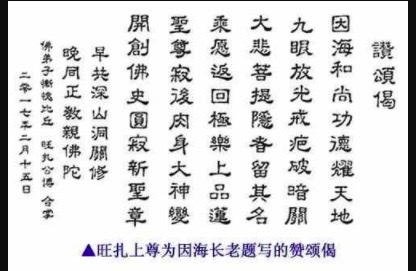
Wangzha Shangzun wrote a praise verse especially:
Monk Yinhai has merits that shine brightly in the universe His nine burn-marks emitted light that broke darkness in the room A greatly compassionate Bodhi incluse who now is known to the world, On His own will, He returned to the Upper Lotus of Ultimate Bliss After Shengzun’s passing, His flesh transformed with holy miracle Creating a new sacred chapter on passing in Buddhist history Earlier we went to reclusive practice in the deep mountain cave together Lately, we were both close to the Buddha to receive true teachings
—the humbled Buddhist disciple, Wangzha Gongbo, holding palms together. February 15, 2017
Chinese praise verse written by WangZha ShangZun
Besides composing and writing the praise verse, Shangzun also talked about the Elder Monk’s holy feats, explained that the Elder Monk’s greatly compassionate Bodhi merits shone in the universe and spread the dharmic connection to true Buddha Dharma for the human Saha world. He let Shakyamuni Buddha’s teachings show their positive energy and bright light once again; He exposed the dirty phenomena where evil masters and charlatans were wreaking havoc when Buddha Dharma gradually became chaotic two thousand years after Shakyamuni Buddha’s time under the daylight. He allowed Buddhists to find the path to return to the true and correct teachings by the Buddha.
After the holy monk’s perfect passing, even His fingers and nails continued to grow, showing a tremendous divine transformation in the flesh, which has never happened in Buddhist history. The holy feat manifest that is so majestic and wonderful created a new record in Buddhist history where, on the tenth day after the passing, the flesh and the bones started undergoing a complete change. In twenty days, the body transformed to another dharma image that is majestic beyond compare. The awe-inspiring holy feat the Elder Monk Yinhai left the human world indeed verified the prediction made by Wangzha Shangzun.
After the Holy Monk entered nirvana, Buddhist disciples of the seven types guarded the Holy Monk’s flesh body at all times day and night. Each shift had between 8 to 16 persons chanting the holy name of Kuan Yin Bodhisattva, without pausing for even one minute. Additionally, three high dharma assemblies were held every day at the site. From the tenth day, people began to see that the Elder Dharma Master’s flesh body was changing miraculously day by day and also emitted unique scent and light. Dharma Master Jue Hui, Dharma Master Long Hui, Dharma Master Xiangge Qiongwa, Dharma Master Ruo Hui, Dharma Master Miao Kong, Long Zhou Rinpoche, and others touched and pressed the Elder Monk’s flesh body by hand. They found that it was substantial and hard as a stone. They were all stunned and spoke with full praises. For that, Wangzha Shangzun was furious and scolded them, “This is total misbehavior. How could one touch and press the revered flesh body of the venerable holy one with one’s hand?” The dharma masters could only say that touching was permitted by H.H. Dorje Chang Buddha III. The Shang Zun did not know how to react and could only say, “You should read the article about what Lama Achuk told Ah Qiong Khempo. Then you will know why the flesh body cannot be touched. Fortunately, the holy venerable one’s stage and state of realization are truly very high. That is why there have not been many effects. Otherwise, this sole holy manifestation occurring for the first time in the history of Buddhism would no longer exist. You should never act so carelessly again.”
Photo on the left was taken 11 hours after the Holy Monk entered nirvana, on the right was taken after 24 days
The professional staff at the Universal Chung Wah Funeral Home also kept praising and said that it was amazing. Twenty days after the perfect passing, not only there are no more wrinkles, but also the bones and flesh have become quite full, and it looked like a completely different person. The fingers and nails have also grown longer. We have never seen it nor heard it, working here at the funeral home for twenty or thirty years. The great master practiced Buddhism too well!”
Yinhai Shengzun, with such vast merits, had never touched fame, wealth, or power. He stayed reclusive in deep mountains. The Elder Monk wrote a verse to Wangzha Shangzun which says:
From ancient times, the holy ones often endured being alone. Only those the recluse left their names. Abstain from all that is evil, engage in all that is good Sans evil or fraud, have a tremendous compassionate mind. I am not one belonging to a sect. Doing good deeds to attain merit is my dharma gate. If you want the pure Buddha Dharma to reach the apex Then follow me to take refuge in the Buddha’s School
(Buddha’s School is the religion that belongs to all Buddhas in the ten directions and is the true Buddhism of Shakyamuni Buddha. It is not the Buddha Dharma which sectarian people of later generations altered and added with their personal views. Buddha’s School directly belongs to Buddha and has no such things as lineages or sectarian systems.)
The Elder Monk also told the Shangzun that the best and the highest Buddha Dharma for cultivation is the Supreme and Unsurpassable Mahamudra of Liberation. When first meeting the Elder Monk, Wangzha Shangzun already observed in contemplation that His Holiness the Buddha had descended to the world. He asked the Elder Monk to help introduce him to the Buddha. The Elder Monk kindly declined the Shangzun’s request, citing that His Holiness the Buddha was still young at that time and had not started the karmic cause of spreading Buddha Dharma. It was not until ten years ago when the Shangzun finally followed Elder Dharma Master Yinhai to become a disciple of His Holiness the Buddha to learn Buddha Dharma and entered the School of Buddha, i.e., the authentic Buddha’s teaching which is not the sectarian Buddhism of any patriarch. It is the personal transmission and education that belongs directly to His Holiness the Buddha.
Shangzun said that He practiced Buddha Dharma in a reclusive cave deep in the mountains together with the Elder Monk Yinhai in the early years and learned a lot of things from Him. The Elder Monk had holy realization powers and the state of conducting Himself with great compassion and great wisdom, which cannot possibly be exhaustively told. Among the things that He learned from the Elder Monk was the formation of the Vajra Array. The Vajra of the Vajra Array does not belong to any one particular esoteric or exoteric school but directly pertains to the Buddha’s Buddhism. Take, for example, the Eight Great Vajras mentioned in the Diamond Sutra, or the Ucchusma Vajra of the Tang Esoteric Sect, or the Kalachakra Vajra and the Yamantaka Vajra of the Tibetan Esoteric Buddhism. They are all contained in the meaning of the Dharma. Which sect or school would they belong to? It is not the Buddhism of any particular lineage. It is directly the authentic Buddhism. Therefore, it is the School of the Buddha that it belongs to, not any patriarchal sectarian lineage.
The Elder Monk’s holy power is extreme. Wangzha Shangzun once saw by accident the nine burn-marks on the head of the Elder Monk emitting light rays, which brightened the dark retreat chamber as daylight. It allowed living beings of the non-human realms to raise to higher realms. That happened many years ago. Of late, He and the Elder Monk both got close to H.H. Dorje Chang Buddha III. They received Buddhist highest State-Practice Initiation and the supreme Great Initiation of Buddha Bestowing Amrit.
Shangzun said: “The Elder Monk is an exceedingly accomplished one from the combined practice of Mahamudra of Liberation and Great Compassionate Magnificent Ocean Red Avalokitesvara. He is a tremendously holy being who came to this world on His own will from the World of Ultimate Bliss. He has now returned to the Upper-Level Lotus Platform in the Pure Land. I am humbled by the level and the stage the Elder Monk has realized. The tremendous meritorious achievement He manifested with His flesh after His perfect passing has never happened in history. You can compare the pictures taken just eleven hours after His perfect passing and the ones taken about His miraculous transformation later. You can see right away that the miraculous transformation reaches such a magnificent and majestic degree, which has never happened in the entire history of the whole world. We can only say that it is terrific and dignified; it is an unparalleled holy feat; the source of true Buddha Dharma is there, and as such, all living beings are fortunate! This is the exact source of the true Dharma of the Tathagata. The holy feat of the miraculous transformation which the Elder Monk Yinhai manifests after His perfect passing lets people understand that the true Buddha Dharma, the great Dharma that allows people to attain liberation and accomplishment, is where H.H. Dorje Chang Buddha III is!
It has been several weeks since the announcement of the news that Namo Dorje Chang Buddha III and Fomu, Holy Mother the Great Mahasattva, have borne dark karmas for living beings and entered parinirvana. Since then I have gradually calmed down from the shock, sadness, sorrow, confusion and loss.
H.H. Dorje Chang Buddha III and Fomu, Holy Mother the Great Mahasattva, set selfless, dedicated, and unsurpassed examples for us. The Buddha’s last words to Venerable Tsemeng Jiaozun so touched my heart: “….. When I said I would bear dark karma for living beings, those were not empty words. To bear dark karma is not to enter dhyāna, but rather, truly and continuously practice shifting the mind-consciousness to suffer on behalf of living beings. What Fomu and I said is what we do. At all times, we must think about bringing auspiciousness, serenity, happiness, and peace to living beings and to the world, to the extent of giving our all and even our lives. ….. I wish all living beings happiness.”
It has been more than ten years since I first heard the pre-recorded Buddha’s Dharma discourse. I have heard many discs, and I have also read the Dharma books written by H.H. Dorje Chang Buddha III, including “The Supreme and Unsurpassable Mahamudra of Liberation”, “Expounding the Absolute Truth through the Heart Sutra”, “Liaoyi Jing” and so on. But have I really put the Buddha’s teachings into practice? I seldom thought about to take on other person’s dark karma and sufferings. Even when my mother followed the evil master, escaped from the Buddha, and defamed H.H. Dorje Chang Buddha III, I did not think of taking on my mother’s guilt. How selfish I am compared to the Buddha.
In all the Dharma imparted by H.H. Dorje Chang Buddha III, the Buddha always emphasizes putting bodhicitta into practice: When there is a conflict of interest between myself and others, I will rid myself of hatred, antipathy, greed, and arrogant, disparaging mentality. I must not emphasize benefiting myself. I should treat myself and others equally. When other living beings and I are suffering, I want others to extricate themselves from suffering before I do. When other living beings and I are happy, I want others to be happier than I am. I dedicate to all living beings all of the merit and accomplishments from my cultivation in the hope that they will leave suffering and attain liberation.
I felt ashamed that I rarely put all these teachings in my daily practice. Most of the time I put myself at the first priority. I want to have good health, good fortune, and good luck — after I have all these I may share some with others.
When I recite The Supreme and Unsurpassable Mahamudra of Liberation, I realize I just did ritualistic chanting, making empty vows, engaging in visualization. I have always considered myself as a true Buddhist, now I realize that I deceived myself. In fact, I was a fake cultivator, I have not truly put Buddha’s principles into practice. I still have so many dark karmas: selfish thoughts, a mind of hatred, greed, jealousy, presumptuousness, arrogance, shamelessness, a mind that considers myself always in the right, a mind that deceives others. In this life time I have done so many wrongs. Here I sincerely repent of my sins, and vow to not commit to these sins again.
I am already in my fifties — how much longer can I live. I have no time to waste. Buddha has entered parinirvana. Impermanence may come to me at any time. I must follow the Buddha’s teachings truly and diligently. Every day I will introspect myself, asking myself how I should treat others when it comes to my words, how I should treat others when it comes to my mentality, and how I should treat others when it comes to my conduct. I must earnestly practice “the three daily introspections” — conducting three introspections in the course of a day. In the morning, introspect about how during the day I should act to become a purely good and compassionate person, a person who benefits the public. At midday, think back: “From morning until midday, did I have that kind of mindset and conduct?” At night, again think back: “From midday until night, did I have that kind of mindset and conduct? Are the things I did today truly reflective of the conduct, speech, and mindset of a Bodhisattva at the causal stage?”
Great compassionate Buddha and Fomu, Holy Mother the Great Mahasattva! Thank you greatly for using your life to sound the alarm of impermanence for me. And thank you greatly for using your life to bring Buddhist disciples the extraordinary cause and condition to study the Tathagata Dharma. I vow to use my own real actions to wash away my sins, and benefit all beings with compassion and pure goodness in order to repay Buddha’s grace!
Great compassionate Buddha and Fomu, Holy Mother the Great Mahasattva! I, a disciple, still want to hold on to a glimmer of hope and beg you all to return to the Saha world and give us foolish beings another chance!
A Treasury of Buddhist Wisdom for Children and Parents
Collected and Adapted by Sarah Conover
When the Buddha and his followers lived at Jetavana, a certain monk in the group was always upset – so much so that he could barely concentrate. When the Buddha asked him about it, the monk replied that he desired many things he couldn’t have; thus, he never felt content. “Oh, monk,” said the Buddha kindly, “these passions have been discarded even by monkeys. It is all the more important for one who lives the holy life to leave these feelings behind. “ And the Buddha recounted this old-world tale about the monkey king.
Once, in olden times, the Buddha came into the world as a monkey. He lived among the treetops of a remote jungle with a large family of monkeys. One day, a woodcutter came to this same jungle to fetch a good supply of logs for his family hearth. But when the woodcutter felled a large tree, he accidentally trapped the young monkey underneath as the tree dropped to the forest floor. When the woodcutter saw his surprise, he decided to bring the monkey home as a present to his king.
The bright monkey quickly tamed and was soon the favorite royal pet. The king let him run everywhere about the palace. So the monkey spent his days visiting the royal courts and kitchens, the guards’ quarters, and all the other enterprises within. The monkey easily learned to imitate the manners of the royal retinue, the ministers, the guards, and even the cook who chased him from her kitchen. It was impossible not to laugh at the monkey’s antics.
After a few years, the king requested that the woodcutter return to the palace. Then the king asked, “As a favor to this monkey who has pleased us so, would you bring him back to the jungle where he was captured? It would be kindest if we let him live out his years with fellow monkeys.” So the woodcutter did as the king bid: he brought the monkey back to the very same spot in the very same jungle and released him.
At once, as soon as the woodcutter had left, a hundred monkeys surrounded the palace monkey, all asking questions at once. “Where have you been living this long time? Where did that man take you? Did you go on a great adventure? Why did he let you go free?” On and on the monkeys clamored, full of curiosity.
When they quieted down, the palace monkey recounted his tale. He told them all about the king’s splendid palace and how he had entertained the king. He told them of the sumptuous feasts, the elegant dances, the noble ministers of the royal court, the king’s fearsome army, and the dark dungeons.
“But then, how did you escape?” They wanted to know.
“I was such a good pet, and I amused them all so, that they felt badly keeping me from my home. The king decided to set me free again, so here I am!”
Now the monkeys were really excited. “Oh, tell us all about the palace life!” They jumped and shouted. “Tell us about the ways of people! Tell us about the grand deeds of a king!” they insisted.
“No, you wouldn’t want to know,” cautioned the palace monkey. “You really won’t like it.”
But the monkeys would not let up until he agreed to show them what life was like for a king. So the palace money picked a monkey in the troop and said, “O.K. then, you be the king. Get up on this high rock and make it your throne. We will set to work and bring you the best fruit in the kingdom!”
So the monkey king sat upon his rock throne, surveying his kingdom and looking quite content. Soon a huge pile of delicious fruit surrounded him. After a time the king monkey began to feel distressed. “ But I could never eat all this fruit, even in a whole year! And how there’s nothing left for all of you to eat,” laments the monkey king.
“Of course you can’t eat it all,”said the palace monkey. But that dose’t matter to a king. The point is that you eat whatever you want, but you must not give any of it away. You must always keep a large pile so that others know you are very rich and very powerful!” So the monkeys, wishing to be like men, brought even more fruit and stacked it even higher around their king.
“What else do we do?” asked the monkeys when there was no more fruit to be had.
“You must all come before the king and praise him in every way you can imagine.”
The monkeys liked this idea, so they tried it.
“Well, no wonder his is king!” pronounced one. “His coat glistens like water.”
“His fur is as thick as deep grass!” boasted another.
“I’ve never seen such a strong and capable animal!” exclaimed a third monkey.
“No one is as wise and dignified as our king!” And so they gathered around their king and enjoyed themselves in flattering him.
“Enough of that,” said the little palace monkey. “Now it’s time to come behind the throne and say terrible things about the king.”
The monkeys didn’t like this idea at all and at first refused to do it. But the palace monkey preserved saying, “You have to try this if you want to learn the ways of people! See what it’s like.”
So the monkeys gathered behind the rock and whispered insults about the king.
“Have you noticed how old and confused the king seems lately?” asked a monkey.
“His eyes seem dull and he constantly forgets what he has said!” chuckled another.
“I think his fur is getting extremely thin; I think he might even be going bald in some very funny spots” tittered a third.
“I’ve noticed that the king eats more like a pig than a monkey!” said a fourth and they all howled.
At last the insulted monkey king could stand it no longer. He jumped off his throne and ran after them through the trees. But the monkeys each escaped in a hundred different directions from the frustrated king. When the monkey king as last returned to his throne, his eyes widened in astonishment. All the fruit had vanished!
“Where is the fruit?” cried the king. “All my fruit is stolen!” he bellowed.
“Yes, it’s a shame, but these things happen even to kings!” said the palace monkey. “Now your guards must go find the thieves. That’s what a king would do. And when the guards capture the thieves, they must be sentenced to death at once.”
“What?” cried the monkey king. “You want me to kill them? Oh, how could such a terrible thing come to pass?” he wailed. And he covered his ears with his hands and wept.
“No more! No more!” cried all the monkeys. “We don’t want to know anything else about the ways of people and kings!”
The palace monkey, the Former Buddha, then recited for them a little poem he had made up about life in the palace:
“This gold is mine, this gold is mine!’
so they cry both day and night:
These foolish folk who live in splendor
never think about the holy way”
“And,” said the Buddha, concluding his lesson, “the monkeys ran away from the rock throne and back up to the tree tops where they all lived happily ever after.”
A Treasury of Buddhist Wisdom for Children and Parents
Collected and Adapted by Sarah Conover
Once, some monks who could not stop quarreling came to the Buddha to ask his advice. “Brothers” the Buddha calmly replied, “ I have told you many times that fight and quarrels solve no problems – yet you continue. Remember, even some kings with great and powerful armies have learned gentleness. So much the more that you, living the holy life without possessions, should be like light in the world, known far and wide for kindness. Listen now to this story of a noble prince, who became a true hero in the world”.
Once upon a time, two kingdoms lay side by side. One kingdom belonged to the King of Kasi: a powerful ruler who possessed a great army and treasures nursing with gold. But in the nearby kings of Kosala lived a much poorer king. He led a meager army, possessed little gold, and held sway over a modest territory. And just as you might guess, the powerful King of Kasi eyed the small kingdom of Kosala and decided he should conquer it.
When the King of Kosala heard that a large garrison was headed his way, he knew he didn’t stand a chance. To avoid any bloodshed, he counseled with his ministers and decided to immediately surrender his army. As the attacking warriors approached, the King of Kosala slipped away to the city’s edge – he and the queen disguised as humble potters.
After time concealed among the common folk, the queen gave birth to a beautiful baby boy. He was secretly named and crowned, Prince Dighavu. They so loved their new son, that the king and queens only concern became his safety. The king feared that somehow – at some time in the future – the royal family would be recognized. He felt it was only a matter of time; a spy would see through their disguises and kill them all. So with heartfelt loss, the King and Queen of Kosala sent their young prince away to be raised in the countryside.
Alas, a dozend years later, events occurred exactly as the king had feared. The present barber of the king of Kasi had once been the barber to the poorer king. And one day, in the hubbub of the busy marketplace, the barber recognized the disguised king. He easily saw through the king’s charade. The barber fell back into the crowd and secretly pursued the king to discover where he now lived. Then the barber reported right away to the King of Kasi, knowing that he would be richly rewarded for the information. “I have news that right within the walls of this city live both the King and Queen of Kosala! I, who know the king’s face better than any, saw it with my own eyes – they live in a potter’s shed and are disguised as beggars!”
When the King of Kasi heard this report, he feared that if the old king and queen were yet alive, they had a hundred reasons to seek his own death and the return of their kingdom. Disguised or not, he anticipate they would find an opportunity to kill him. So he commanded his guards, “Go now to the potters’ sheds near the outskirts of town. Arrest the old king and queen! When you find them, it will be their last hour! Bind their arms, shave their heads, bring them outside the gates of the city and destroy them!” And thus the guards were dispatched to the capture the couple.
But very early this same day, the young Prince Dighavu awoke full of longing to be with his parents. Now old enough to travel from village alone, he reasoned, “It’s been months since I’ve seen my parents. I would so much like to visit them today! I will make them a present of ripened fruit and delicious cheese from the country.” And so the prince cheerfully gathered a few gifts, packed some clothing and money, and set out of the city.
By this time, however, the guards had found the royal couple – just exactly where the barber had betrayed them to be. They bound their arms tightly with thick rope and dragged them roughly through the streets. But the king and queen walked with dignity, even as they reached the city gates where they knew they would soon die.
And so it came to pass that just as Prince Dighavu was entering the city, he witnessed his parents being led to their deaths. In desperation, he made his way to the front of the surrounding crowd. Just sat the moment he spied his parents, they too, saw him amidst the mob. When the prince neared within earshot, his father shouted, “Dear Dighavu, do not look long! Do not look short! For hatred is not stopped by more hatted! No, dear one, hatred ends only by love!”
The soldiers thought the old know had lost his mind. “Who is this Dighavu? What gibberish you speak!”
But the king cautioned Dighavu twice more in the same way, finishing, “He that is intelligent will understand my meaning!” There were the king’s last words. As swords fell upon his parents’ heads, the anguished prince said a silent farewell so as not to reveal his own identity.
Prince Dighavu went to the nearby forest and fell to the ground. In agony he wept and wept until he could weep no more. Under the empty night sky, he considered the terrible murder of his parents and devised a plan to recover his family’s honor.
First, he returned to the city, and purchased some liquor for the soldiers standing guard over his parents. When the guards cucumber to the alcohol and fell asleep, the prince performed a funeral by the city gates. But at that same, exact moment, from the atop the splendid place tower, the King of Kasi happened to see the prince paying his respects to the murdered king and queen. “Alas!” Said the king in great alarm. “What misfortune will happen now? I will still have no safety or peace of mind while someone who cares for them wishes to reverse their deaths!”
And so it came to pass that the very next day Prince Dighavu embarked on such a plan. He went to the king’s elephant stable and asked that the elephant trainer teach him his art. The trainer agreed to take on the eager apprentice. As part of the prince’s secret plan, he rose each day at dawn to play the lute and sing to the entire palace compound. His lovely songs were haunting and captivating. Just as the prince has hoped, the King of Kasi, standing on his palace balcony, heard the enchanting voice and asked his attendants from whence it came. “Your Majesty,” they replied, “it is the elephant trainer’s new apprentice”.
“Bring him to me,” commanded the king. “I must meet the one who possesses such a gift.”
All was proceeding exactly in accord with Prince Dighavu’s Plan. He came before the king, strummed the lute even more beautifully, and sang his most soothing melodies. The king was utterly charmed. “Young man”, said the king, “such a voice comes only from one with the finest sensibilities and depth of feeling. I would like you to have the honor of being my manservant.” So Prince Dighavu – still unknown for his identity – became the king’s personal attendant. He rose before the king, preparing the king’s affairs; he retired at night long after the king’s affairs; and he obeyed the king’s every command in between. And in due time, the king appointed Prince Dighavu as Councilor and Confidant – just as the prince had hoped.
But Prince Dighavu’s secret and grand scheme was far from complete. A year or so later, the prince had the chance he had worked and waited for. It so happened that one balmy, spring day, the king wished to go for a chariot ride. To Prince Dighavu he requested,”Harness the chariot, my best man; I wish to go hunting in the forest and I want you alone to drive me.”
“Yes, your majesty, right away!” Obeyed the prince. A magnificent chariot of gold and lapis was harnessed to two steeds. The prince firmly held the reins and hurried the chariot towards the city’s perimeter. As the city’s gates opened wide for the royal chariot, Prince Dighavu saw the king’s army go in the direction of the eastern forest; the prince steered the chariot towards the west. “I believe the hunting will be better in these quieter woods sir,” he assured the king.
“Very well, my man. Let us try it out,” replied the king.
The day was cloudless, and after an hour of travel, the heat oppressive. The sultry, midday sun made the king grow drowsy. “My man, unharness the chariot,” he mumbled. “ I am tired and I wish to lie down in the shade of some trees.”
“Yes, your majesty,” complied the prince. The prince watered and hobbled the horses, then rested beside the king under a large Banyan tree. The king placed his trusting head in the prince’s lap and fell immediately to sleep.
With the king’s safety resting utterly in the hands of Prince Dighavu, the prince’s plan was nearly complete. As the prince looked upon the sleeping king, he thought to himself, “The king of Kasi has done me as much harm as any man could. He has murdered my mother and father! He has robbed our kingdom of its treasury and territory! He has destroyed the honor of the Kingdom of Kosala! Now is the time for me to avenge my hatred!”
Ever so quietly, the prince unsheathed his sword. But as he raised his sword over the king, ready to inflict his punishment, his father’s last words seemed to shout within him: Dighavu, hatred is not stopped by more hatred! No, dear one, hatred ends only by love! Prince Dighavu could not disobey his father’s dying words. He could not kill this unsuspecting king. The prince slowly sheathed his sword. But then the same thought of revenge – the thought that had been his mission since the day of his parents’ deaths – rose in him more strongly! He had waited years for this moment! Again, he unsheathed his sword. But alas, he stopped himself once more; he could not act against his father’s last wish; he could not end his hatred with another murder.
Suddenly, the king awoke and sat bolt upright – pale and terrified! The prince’s internal struggle abruptly ended. “Your Majesty!” Said the prince, “what ever had occurred? Why did you wake so alarmed?”
The king gasped, “Right now, in my dream, the son of the King of Kosala – the heir and prince – wanted to kill me by sword. He was going to sever my head! I thought I was about to die!”
Then Prince Dighavu, gently touching the neck of the king with his left hand and drawing his sword with the other, told him the truth. “I, your majesty, am that prince! I am Prince Dighavu, son of the King of Kosala! You have robbed my people of food, territory, and treasure. You have even killed my own mother and father! This would indeed be the time to show my hatred and exact my revenge!”
At that admission, the king fell upon his knees at the feet of the prince and begged for forgiveness. “ Grant me my life, dear Dighavu ! Grant me my life!” Wept the king.
In his heart, Prince Dighavu now realized what his father had meant for him to learn. He told the king of his father’s forgiving words – his last words – and how they stopped the prince from ending the king’s life. The prince proclaimed that he would no longer carry this terrible hatred. “Although I have the power to grant you your life at this moment,” said the prince to the king, “you also have the power to grant me my life: for you can assure my safety in your kingdom!”
“This is very true,” agreed the king. “Grant me my life now and I’ll forever grant you yours. We will no longer be enemies, but vow to live in peace.” At that, the prince and king swore an oath never to harm one another and to protect each other’s well being.
Peaceful now, with a warm feeling of forgiveness, the two men harnessed the horses remounted the chariot, and leisurely made their way back to the palace. When the king returned to his court, he gathered all his ministers and councilors together. “Tell me sirs,” asked the king, “if it happened that you laid eyes upon Prince Dighavu, son of the King of Kosala, what would you do?”
A minister immediately spoke up, “ Your majesty, we would kill him on the spot!”
“Yes!” Shouted another. “We would chop off his head and cut him to pieces!” Many voices rose in a cacophony of agreement.
But the king said, “Hush! Sirs, in front of you is Prince Dighavu, son of the King of Kosala.” A great, astonished silence filled the hall. The king continued, “ You may not harm him. He has granted me my life and I have granted him his.” The king turned to the prince; “I would like you to tell them, young prince, the marvelous meaning of your father’s last words.”
All eyes in the court turned to the prince. He looked at his audience with courage and forgiveness. “When my father said to me in his hour of death, ‘Look not long dear Dighavu’ what he meant was, ‘Do not hold on to hatred, do not nurture it.’ When, Your Majesty, my father spoke, ‘Look not short,’ what he meant was, ‘Do not lose friends easily – be the most loyal of friends.’ When my father said, ‘Hatred is not stopped by more hatred!’ What he wanted me to learn was this: the king has had my mother and father killed. Were I to kill Your Majesty, your people wold want to kill me, and my people would want to kill those who had harmed me. Hatred would not end by further hatred. On and on it would go, with many lives lost and many hearts broken. But now,” continued the prince, turning towards the king, “ Your Majesty had given me my life ad safety, and I have done the same for you. So by love and forgiveness we have stopped this terrible cycle of hatred.”
The king blessed the prince, “Oh, councilors! Is it not remarkable how deeply the prince understands his father’s brief words!” And thus the king returned to Prince Dighavu the army, territory, and treasure that rightfully belonged to the Kingdom of Kosala. The prince and the king’s own daughter were soon married, and they all lived in peace, two kingdoms side by side, happily ever after.
“And so I say to you,” declared the Buddha to the monks, “enough of fighting! This is my advice, good brothers.” And the Buddha returned to the solace of his meditation.
The moral is : For never in this world Do hatreds cease through hatred; Through love alone do they end. This is the ancient and eternal law.
















 Peace LiLy