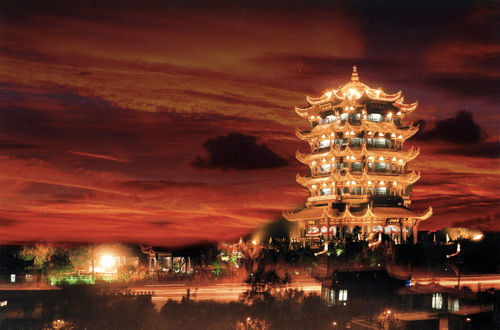
Perched majestically atop Snake Mountain, Yellow Crane Tower stands as a beacon of cultural significance in Wuhan, Hubei Province, rivaling the fame of Yueyang Tower in Hunan Province and Tengwang Pavilion in Jiangxi Province. With origins tracing back to the Three Kingdoms period in 223 A.D., this architectural marvel is more than just a sightseeing spot; it’s a testament to China’s rich history and enduring legacy.
Rising 51.4 meters into the sky, Yellow Crane Tower’s five floors house a treasure trove of murals, couplets, and cultural relics, each floor a testament to centuries of artistry and inspiration. The tower is not an isolated structure; it is surrounded by auxiliary buildings, including pagodas, memorial arches, and pavilions, which add to its grandeur and mystique.
Throughout history, Yellow Crane Tower has attracted luminaries from all walks of life, drawn by its ethereal beauty and historical resonance. Poets and writers, including the esteemed Cui Hao, have penned timeless works inspired by the tower’s allure. Cui Hao’s masterpiece, “Yellow Crane Tower,” resonates across generations, immortalizing the tower’s mystique in poetic verse.
Legend intertwines with reality in the tale of Yellow Crane Tower’s origins, where an act of kindness transforms a humble innkeeper’s life forever. The story unfolds in the ancient city of Wuhan, where a benevolent innkeeper named Old Xin encountered a shabbily dressed customer. Unperturbed by the visitor’s destitution, Mr. Xin welcomed him daily, offering him a glass of wine without expecting payment.
For six months, the mysterious customer continued to frequent the inn, accumulating a debt that Old Xin graciously overlooked. One day, the indebted visitor revealed his true identity as a magical being. He presented a drawing of a yellow crane, which came to life as he played a flute and sang. The enchanted crane danced along with the music, captivating the onlookers and turning the inn into a spectacle.
This magical partnership continued for ten years, bringing wealth and prosperity to Mr. Xin. When the mysterious customer returned one day, Old Xin, overwhelmed with gratitude, offered to support him in any way possible. However, the magical visitor had no material desires. Instead, he played a few tunes on his flute, and white clouds descended from the sky, carrying the drawing of the crane. With a graceful ascent, the customer mounted the crane and soared into the sky, leaving behind a tale imbued with traditional Chinese wisdom—kindness is a virtue that will always be repaid.
To express his gratitude and immortalize this magical encounter, Mr. Xin erected a tower on the spot and named it the “Yellow Crane Tower.”
Despite enduring centuries of upheaval and destruction, Yellow Crane Tower stands resolute, a symbol of resilience and cultural continuity. From its inception during the Three Kingdoms to its reconstruction in modern times, the tower has weathered the storms of history, emerging stronger with each passing era.
The tower’s architectural splendor is matched only by its cultural significance. Each floor tells a story, from legends of ancient cranes to the poetry of Tang Dynasty luminaries. Visitors are treated to panoramic views of the Yangtze River and Wuhan cityscape, offering a glimpse into China’s past and present.
It stands 51.4 meters (about 168 feet) high and has five floors
Around the main tower there are many other buildings, including the Sheng Xiang Pagoda and the temple gate. Each storey is decorated with traditional upturned eaves, but each one has a different style. The ground floor is a tall, wide hall. The midmost caisson ceiling stands over 10 meters high. On the front wall is a huge ceramic mural painting of a white cloud and a yellow crane. A pair of 7-meter-long inscribed tablets hang on the posts on both sides. The front wall of the second floor holds a marble inscription of Tang Dynasty poet Yan Baojin’s ‘Note on the Yellow Crane Tower’. On each side of it are mural paintings. One is ‘The Town that Sun Quan Built’. It describes the history of the Yellow Crane Tower and Wuchang town. The other is ‘Zhou Yu Made a Feast’, which tells the story of the Three Kingdoms celebrity’s visit to the tower.
With yellow upturned eaves, each floor seems to have been designed to resemble a yellow crane spreading its wings to fly.
As visitors explore Yellow Crane Tower, they encounter a journey through time and culture. Each floor is a testament to China’s literary and artistic heritage, inviting travelers to immerse themselves in centuries of tradition and innovation.
Outside the tower, bronze cranes stand sentinel, silent witnesses to the ebb and flow of history. Memorial gateways and pavilions beckon travelers to explore further, inviting them to partake in the tower’s timeless legacy.
Yellow Crane Tower is more than just a scenic spot; it’s a living testament to China’s cultural resilience and artistic ingenuity. As visitors stand atop its lofty heights, they are reminded of the enduring power of human creativity and the timeless allure of the written word.
In the heart of Wuhan, Yellow Crane Tower stands as a testament to the enduring spirit of China’s cultural heritage. Its towering presence serves as a beacon of inspiration for generations to come, inviting travelers from near and far to embark on a journey through time, tradition, and a touch of enchantment.
Among all Buddhas in the Dharma realm, Dorje Chang Buddha is the Primordial Buddha, the first Buddha with form, and the only Supreme Lord of Buddhism throughout the entire universe. Dorje Chang Buddha propagated Dharma throughout the universe, hence, all other Buddhas and Great Mahasattvas learned Dorje Chang Buddha’s Dharma and cultivation to attain holy state and liberation, and eventually became Buddhas and Great Bodhisattvas. Dorje Chang Buddha is the primordial ancestor of all Buddhas and Bodhisattvas. Samantabhadra, the Dharmakaya from which Dorje Chang Buddha perfectly manifested, is the Tathagata that has no form at all. The words and deeds of Dorje Chang Buddha are the compass and guiding principles of cultivation for all ordinary and holy beings in the universe.
To help Shakyamuni Buddha, Namo Dorje Chang Buddha II —Venerable Virmalakirti—applied His supreme wisdom and limitless supernormal power to edify Hinayana Arhats who then advanced themselves and eventually became Mahayana Bodhisattvas who helped living beings attain liberation. And, innumerable living beings attained liberationby learning the teachings of Venerable Virmalakirti.
After coming to the sahā world with the Buddha level enlightenment of the Primordial Sambhogakaya Buddha, His Holiness Dorje Chang Buddha III established countless number one records in the world, every one of which was for the sake of benefiting living beings. At a very young age, He saved others without any regard to His own life and was honored with the title “Young Hero.” As He grew older, His Holiness Dorje Chang Buddha III applied His inherent Healing Vidya to heal the sick, purely on a voluntary basis. More than 500 patients used to seek His help every day. His Holiness Dorje Chang Buddha III never accepted one penny from them. Plaques and pennants with words of gratitude sent by the recovered piled up in the Buddha’s house.
As His Holiness Dorje Chang Buddha III continued to benefit living beings on a larger scale, the Central Newsreels and Documentary Studio of China produced a documentary, “One Who Is Dedicated to Advance Himself,” about His life and work. The film was shown nationwide.
In 1987, the highly respected young His Holiness Dorje Chang Buddha III was named Chairman of the Chinese Painting Research Association of the National Commission of China for UNESCO. Honorary chairpersons of the Association included Liao Jingdan 廖井丹, Li Wenqing 李文清, Lü Ji 呂驥, Yuan Xiaoyuan 袁曉園, Wu Zhangshu 吳丈蜀, Qian Juntao 錢君匋, Xie Zhiliu 謝稚柳, and others. Advisors to the Association included Luo Zhanglong 羅章龍, Zhang Kejia 臧克家, and so forth.
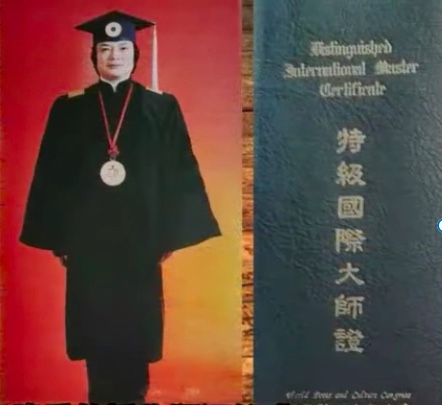
In 1992, His Holiness Dorje Chang Buddha III was accorded the “Art Maestro of the East” title. In 1994, during the fourth conference of the World Poets and Culture Congress held in Hungary, 5,612 experts and scholars unanimously voted to confer the “Preeminent Distinguished International Master” title, which was a Head of State level honor, to His Holiness Dorje Chang Buddha III.
The conferment certificate was signed by Juan Antonio Samaranch, the then President of the International Olympic Committee. In the same year, the Museum of Master Yi Yungao officially opened in Dayi 大邑, the hometown of His Holiness Dorje Chang Buddha III in Sichuan. That was the first memorial museum in China, or even in the world, being built by a government for a living person.
In 1995, when His Holiness Dorje Chang Buddha III went from Mainland China to visit Taiwan for the first time, Taiwanese people spontaneously gave His Holiness Dorje Chang Buddha III an overwhelmingly ceremonious welcome. More than 20,000 people went to the airport to greet and pay respect to His Holiness Dorje Chang Buddha III. A motorcade of more than 1,700 cars followed the lead of police motorcycles to escort His Holiness Dorje Chang Buddha III from the airport to the hotel. That became the largest welcoming event in human history. Within the short three weeks that His Holiness Dorje Chang Buddha III stayed in Taiwan, General Chiang Wei-kuo 蔣緯國, former Secretary-General of the Taiwan National Security Council, and many other high level government officials formally requested to become disciples of His Holiness Dorje Chang Buddha III. They expressed that they wanted to truly emulate the noble morality, humanistic ethics, thoughts, and deeds of His Holiness Dorje Chang Buddha III.
After His Holiness Dorje Chang Buddha III moved to the United States, His noble morality and unparalleled achievements won the love and admiration of the American people from all walks of life. In 2002, His Holiness Dorje Chang Buddha III was presented with the “Presidential Gold Medal” by the Commissioner to the President’s Advisory Commission on Asian Americans, on behalf of President Bush.
In 2003, the Organization of American States, composing of 34 countries including the United States, Canada, and Mexico,organized the Master Wan Ko Yee Yun Sculpture Exhibition in Washington D.C. at the Capitol of the United States.
The Master Wan Ko Yee Yun Sculpture Exhibition was also held at the Congressional Office Building. That was the first time the U.S. Congress held an art exhibition in their Congressional Office Building. Visitors expressed their praises in the guest book, exclaiming that the exhibition was “unprecedented,” and that the artworks were “treasures brought to the human realm by God.”
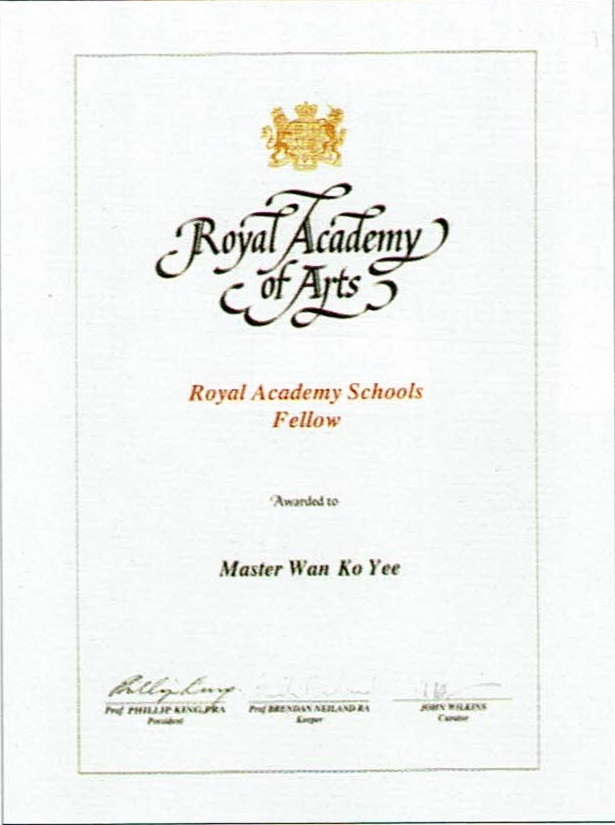
In 2004, His Holiness Dorje Chang Buddha III was named “Fellow” of the Royal Academy of Arts in the U.K.. Professor Phillip King, President of the Royal Academicians of the Royal Academy of Arts, presented the certificate to His Holiness Dorje Chang Buddha III at the British Embassy in Washington D.C., capital of the United States. The Cultural Attaché of the British Embassy personally attended the ceremony. Professor Phillip King stated that His Holiness Dorje Chang Buddha III was the first artist ever accorded this title in their renowned academy’s more than 200-year history.
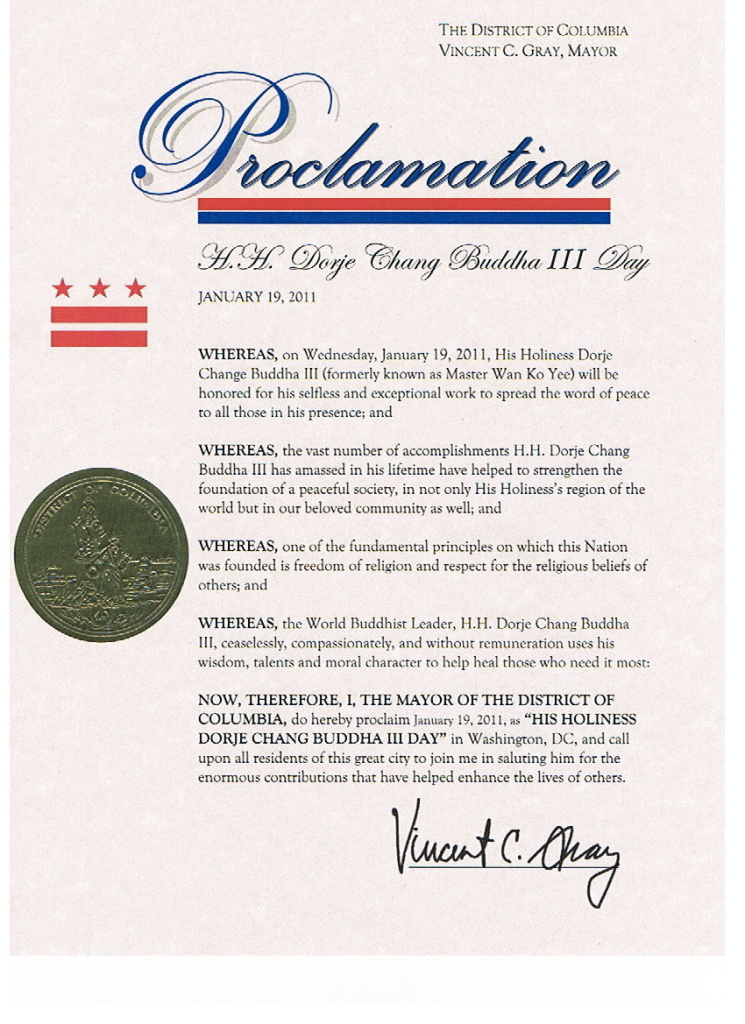
The mayor of the U.S. capital Washington D.C.pronounced January 19, 2011 as “His Holiness Dorje Chang Buddha III Day” and called on people to salute to His Holiness Dorje Chang Buddha III.
His Holiness Dorje Chang Buddha III was also accorded the “King Legacy Award for International Service & Leadership” by An International Salute to The Life and Legacy of Dr. Martin Luther King, Jr.. Dozens of great honors have also been presented to His Holiness Dorje Chang Buddha III by U.S. senators, members of the House of Representatives, governors, and governments of all levels.
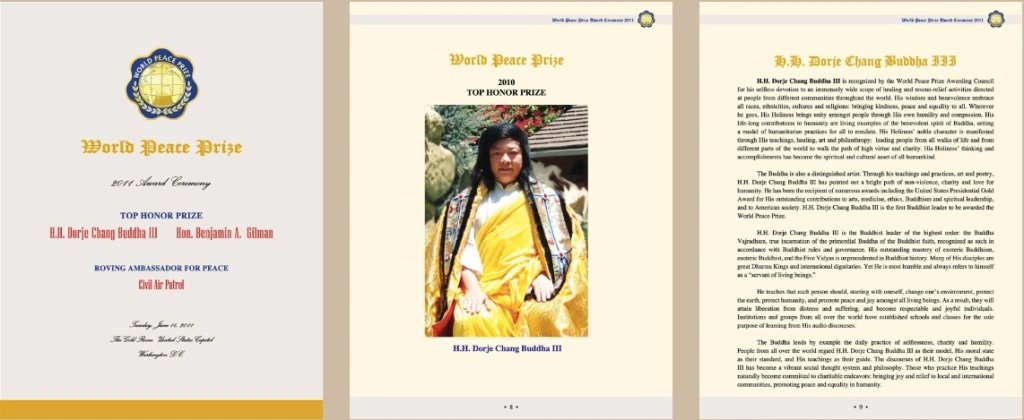
More remarkably exceptional, Namo Dorje Chang Buddha III was awarded the 2010 World Peace Prize Top Honor Prize, presented to Him at the United States Congress on June 14, 2011 at the U.S. Capitol. On occasions of the holy birthday of His Holiness Dorje Chang Buddha III, the U.S. Congress has held ceremonies to raise the national flag to celebrate, and President Trump and President Biden have sent personal congratulations.
In 2018, the World Peace Prize Awarding Council and the World Peace Prize Religious Leader Title Awarding Council resolved that His Holiness Dorje Chang Buddha III was the Pope of Buddhism of this world and decided to present the Pope of Buddhism Scepter to Him. Namo Dorje Chang Buddha III, however, did not accept the Scepter, but returned it instead. In September 2020, the World Peace Prize Awarding Council and the World Peace Prize Religious Leader Title Awarding Council made a joint resolution that solemnly stated, “The title, status, and authority of the Pope of Buddhism belong only to His Holiness Dorje Chang Buddha III and cannot be exercised by anyone else. This is a permanent and unalterable determination!” The two Councils also entrusted the World Buddhism Association Headquarters to present the Pope of Buddhism Scepter on their behalf to His Holiness Dorje Chang Buddha III.
Upon coming to this world, His Holiness Dorje Chang Buddha III immediately started teaching and saving living beings. He has always called Himself a “nameless cultivator.” His Holiness Dorje Chang Buddha III voluntarily served living beings and did not accept any offerings. One incident clearly shows how Namo Dorje Chang Buddha III taught and saved living beings selflessly. At the Heart Sutra Mandala on Xinhua West Road, Chengdu, Dharma Master Guozhang 果章法師 once recounted to some people that when he received initiation from His Holiness Dorje Chang Buddha III on Paoma Mountain 跑馬山, His Holiness the Buddha was only two and a half years old! After the identity of Namo Dorje Chang Buddha III being the true incarnation of the Primordial Buddha was formally recognized by Dharma kings, regent Dharma kings, and great rinpoches of major Buddhist sects in written congratulations and corroboration letters, His Holiness Dorje Chang Buddha III continued, as always, to teach and save living beings solely on a voluntary basis, and whole-heartedly devoted Himself to serving living beings. Whenever people made offerings to His Holiness Dorje Chang Buddha III, whether they were big or small offerings, in amounts as little as one dollar or as large as a few million US dollars, in the form of 37 acres of land in the city of San Francisco, or even a planeload or a shipload of gold, Namo Dorje Chang Buddha III categorically refused to accept. His Holiness Dorje Chang Buddha III was whole-heartedly dedicated to serving living beings voluntarily.
In the many years that His Holiness Dorje Chang Buddha III was propagating Dharma to save living beings, He imparted more than 2,000 Dharma Discourses in response to living beings’ levels and karmic conditions. Not only did His Holiness Dorje Chang Buddha III reveal the truth about humanity and the universe, He also elucidated the truths relevant to various stages of practices, from elementary to profound accomplishment levels.
Those Dharma Discourses were audio-recorded, and some of which such as What Is Cultivation 什麽叫修行, Sutra on Understanding and Realizing Definitive Truth 了義經, Imparting the Absolute Truth Through the Heart Sutra 藉心經說真諦, and Learning from Buddha 學佛, have been published into books.
In restoring Buddhist texts to their original meaning, His Holiness Dorje Chang Buddha III pointed out that the morning and evening chants used in Buddhist temples nowadays had been tampered with by the descendants of Mara, and those texts are filled with evil views and fallacies. Namo Dorje Chang Buddha III has corrected many errors made by patriarchs and translators in their interpretations of Dharma principles, and directly revealed the chaotic phenomena in Buddhism during this Dharma Ending Era. His Holiness Dorje Chang Buddha III pointed out the path that everyone who wants to attain liberation must take: That is to build our foundation on practicing cultivation. After cultivating ourselves well, we can then learn Dharma, and naturally attain liberation and accomplishment. The correct truths and Dharmas imparted by His Holiness Dorje Chang Buddha III enable listeners to develop their wisdom and good fortune, to help each other, care about each other, and be compassionate to all living beings.
In different countries, Namo Dorje Chang Buddha III has performed great Dharmas including Holy Amrita Bestowed by Buddhas 佛降甘露, Xianliang Great Perfection 現量大圓滿, Holy Fire Offering 勝義火供, Vajra Faman Determination by Holy Selection 金剛法曼擇決, Hayagrīva Raja Water Mandala Bead Divination 馬頭明王水壇珠卦, Determination by Holy Selection on the Regression or Progression on the Bodhi Path 菩提道損減增益法, Guaranteed Delivery to Buddha Land Dharma 保送法, Vajra Array 金剛陣, and Eight Wind Array 八風陣, all of which manifested authentic holy states, enabling living beings to see with their own eyes that Buddha Dharmas are scientific, have veritable power, and absolutely are not just empty talk or theory. More importantly, Namo Dorje Chang Buddha III has brought The Supreme and Unsurpassable Mahamudra of Liberation to living beings in the sahā world, showing humanity the shortcut to attaining liberation. The Supreme and Unsurpassable Mahamudra of Liberation is the highest Dharma that Dorje Chang Buddha transmitted to Amitabha Buddha as well as Buddhas and Great Bodhisattvas in the ten directions during their cultivation stage.
In The Supreme and Unsurpassable Mahamudra of Liberation, His Holiness Dorje Chang Buddha III has made the biggest and highest vow in the entire Dharma realm, “I bear all the sinful karma for living beings, I give living beings all the good karma and merit that I have planted.” Namo Dorje Chang Buddha III has actualized the greatest and holiest vow, sacrificed His life to save the lives of numerous living beings, and returned to the Sambhogakaya Buddha Land!
The unprecedented records established by Namo Dorje Chang Buddha III in this world:
Namo Dorje Chang Buddha III was, historically, the first Buddha to have received the largest, unprecedented number of status-recognition and congratulatory letters by top level great Dharma kings and rinpoches.
Namo Dorje Chang Buddha III was recognized with the highest status in history: an Ancient Buddha.
Namo Dorje Chang Buddha III is the first Ancient Buddha who manifested perfect mastery in Exoteric and Esoteric Buddhism, and perfection of the Five Vidyas. No one else has been able to accomplish the same in the past few thousand years.
Namo Dorje Chang Buddha III manifested Buddha-level wisdom in the creation of Yun Sculpture, which nobody has been able to replicate. Historically, this is the first art form that cannot be replicated.
Namo Dorje Chang Buddha III is the first Ancient Buddha throughout history who only benefited others but did not accept any offerings.
Namo Dorje Chang Buddha III is, historically, the first Ancient Buddha who manifested the most holy miracles.
Namo Dorje Chang Buddha III is, historically, the only Buddha who could offer the kind of Buddha Dharma that enables disciples to attain liberation within two hours: Xianliang Great Perfection, the quickest path to successfully enter the Buddha Land.
Namo Dorje Chang Buddha III had the largest number of disciples who attained accomplishments; for example: Dharma King Daxila of the Tsalpa Kagyu Sect attained the rainbow body; respected layperson Wang Lingze 王靈澤 and Dharma King Gar Tongstan attained freedom from death and rebirth and passed away in a sitting meditative pose; Dharma Master Puguan 普觀法師 and Elder Monk Wuming 悟明長老 attained incorruptible flesh bodies; the Elder Monk Yizhao 意昭老和尚 vowed to return to the sahā world to save living beings; and many others.
Namo Dorje Chang Buddha III has transmitted Dharma to disciples and invoked Avalokiteshvara Bodhisattva to come at a specific time to take the disciple to the Buddha Land; even non-Buddhists saw with their own eyes when the disciple Zhao Yusheng 趙玉勝 was taken away by Avalokiteshvara Bodhisattva. Some disciples, such as Hou Yushan 侯欲善 and Lin Liu Hui-Hsiu 林劉惠秀, were able to visit the World of Ultimate Bliss, then return to the human world before ascending at a specific time to the Buddha Land. The above listed are just a few examples of the numerous Buddhist disciples who followed Namo Dorje Chang Buddha III and attained liberation.
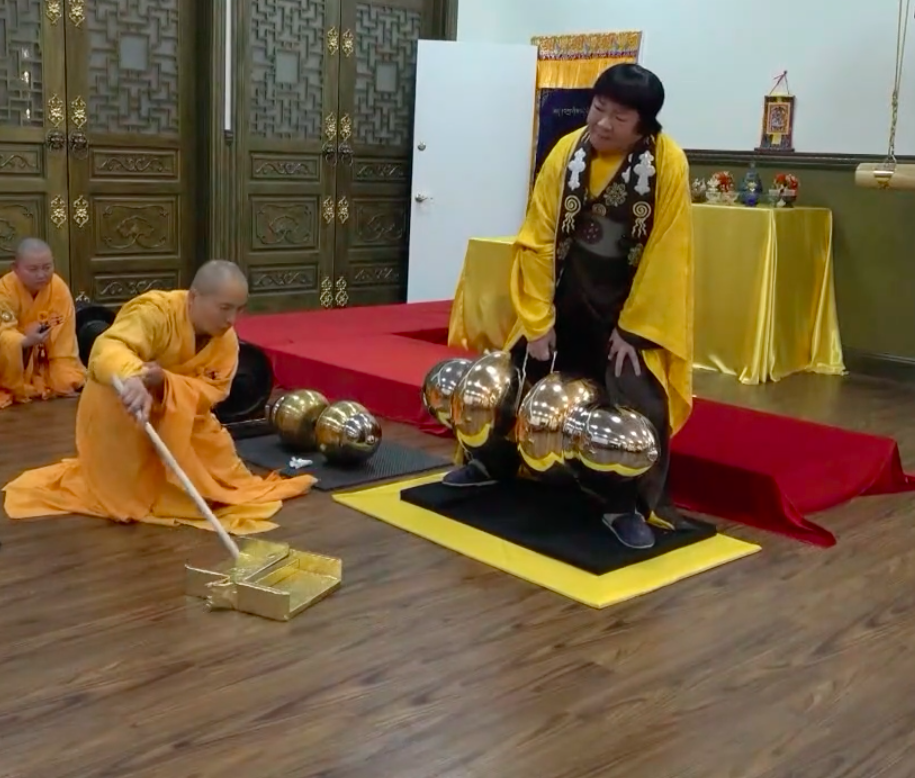
Namo Dorje Chang Buddha III possessed Buddha-level physical constitution and physical strength that are unmatched in the world. Just about a little more than a month ago, on December 23, 2021, at the Holy Miracles Temple, His Holiness Dorje Chang Buddha III lifted the Supreme Holy Vajra Pestle that weighs 437.2 pounds, by using just four fingers to hook on to the Pestle, lifted it up, and held it for more than 13 seconds, surpassing His own base weight standard by 72 levels. Taizun Poshan Waxiang 破山瓦象太尊 asserted: “In this world, from the ancient past up to now, and even before Maitreya Bodhisattva attain Buddhahood, no ordinary or holy being will be able to lift the Buddha Pestle that Namo Dorje Chang Buddha III lifted, surpassing His own base weigh standard by 72 levels!”
The morality of Namo Dorje Chang Buddha III is so noble, His accomplishments so great, and the holy miracles He performed so numerous that it is impossible for us to list them all. What was listed above was just a drop in the ocean. If we were to tell you about all the magnificent feats of His Holiness Dorje Chang Buddha III, it would take more than ten days and ten nights. The magnificent greatness of Namo Dorje Chang Buddha III is not limited to His well-respected humanistic ethics, His noble personality and morality, His erudition, His distinguished accomplishments, His selfless compassion toward humanity and all living beings, and His passion in teaching and actualizing the practice of Buddha Dharma.Through altruistic endeavors, His Holiness Dorje Chang Buddha III truthfully, sincerely, and persistently actualized the principle of compassion, and He diligently worked toward the development of world peace. Many people are moved and motivated by His Holiness Dorje Chang Buddha III. Many people in this world aspire to Namo Dorje Chang Buddha III as their model, referencing His state of morality as their standard, and using His teachings as guidance to elevate their own morality and to benefit living beings. In doing so, not only have they fulfilled happiness in their lives, but many of them have ascended to the Buddha Land, attained freedom from death and rebirth, or attained even higher states of realization and accomplishments.
More importantly, Namo Dorje Chang Buddha III pointed out a bright path for humanity to stay far away from violence, a path that leads to benevolence and loving kindness, successful endeavors, happy families, peace in humanity, and prosperity in societies. Throughout different countries and regions in the world, more and more people of different ethnicities and cultures are actively learning and following the teachings of Namo Dorje Chang Buddha III to cultivate themselves and benefit living beings. Consequently, they have greatly elevated the level of morality in society, advanced human civilization, motivating more and more people in this world to become good, kind, and ethical people, and enabling the world to become an auspicious and green planet. These are the tremendous and inexhaustible contributions that Namo Dorje Chang Buddha III has brought to all human and other sentient beings in this world, so they may increase their happiness.
Venerable Dharma Teacher Tonghui (1922-2013) served as the Abbot of Longju Temple, renowned for Jiangxi Mazu. A devoted disciple of H.H. Dorje Chang Buddha III, he immersed himself in the teachings and practices of dharma. Also known as Elder Monk Tonghui, he transcended the ordinary, attaining the revered status of a holy monk.
Venerable Master Tong Hui, born Tang Zhenbang on March 5, 1922, in Penglai town, Suining City, Sichuan Province, belonged to the Han ethnicity. Renowned for his intelligence from a young age, he adhered to a vegetarian diet and practiced abstinence, following his parents’ guidance. In 1931, he entered monkhood under Master Pu Jing at Jinwen Temple in Pengxi. Full ordination followed in 1940, under Venerable Master Miaoneng at Baoguang Temple, and further studies in Chengdu’s Jingci Temple under Master Nenghai in 1941. Residing at Longju Temple with Master Miaoneng in 1942, he served during the transmission of the Great Precepts by Master Nenghai. Master Nenghai was one of the most eminent monks in last century.
Post-liberation, Longju Temple faced dispersion, confiscation of properties, and occupation during the Cultural Revolution. As the warehouse keeper, Venerable Master Tong Hui personally bore the repercussions of stolen food, enduring imprisonment to spare innocent people. False accusations regarding the team’s beekeeping further led to additional years in prison. His unwavering compassion and selflessness epitomized the Buddhist spirit.
Reopened by the government on December 16, 1986, Longju Temple underwent extensive renovations under the venerable master’s guidance. The Arhat Hall, Main Hall, Scripture Hall, and Accommodation Building were constructed, while the main gate, Ksitigarbha Hall, Hall of Heavenly Kings, and Bell Tower were restored. The restoration of large Buddha and Bodhisattva statues, as well as Arhat statues, showcased the venerable master’s dedication. Numerous instances of his awe-inspiring virtue were evident, such as his ability to attract dharma-protecting deities and revive a withered ginkgo tree with Bodhi Holy Water.
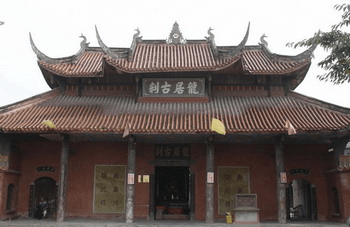
Front Entrance of Longju Temple
Grand Hall in Longju Temple
Moreover, Venerable Master Tong Hui made significant contributions to Buddhism by bringing back Buddha and Bodhisattva statues made of Burmese jade from temples in Dayi County and Daying County.
A legendary story recounts Master Tonghui’s visit to Burma in 1992. Venerable Dharma Teacher Tonghui went to Burma to respectfully receive and take back with him a Jade Statue of the Buddha. The night before the Dharma teacher arrived, many people in Burma suddenly dreamed that he was a golden Arhat and would soon come to Burma. The next day when he arrived in Burma, hoards of people made offerings to him. In Hinayana Buddhism, Arhats are praised in the same way that Bodhisattvas who attained the marvelous fruit of enlightenment are praised. It is clear that Venerable Dharma Teacher Tonghui was an amazing and great sage.
Venerable Dharma Teacher Tonghui peacefully passed away on February 26, 2013, at the age of 92. His preserved body, following ancient Buddhist rituals, was respectfully opened three years later on June 12, 2016, revealing a full and jade-colored flesh body in the urn. This sacred event reaffirmed the authenticity and practicality of true Buddha Dharma.
The flesh body of Venerable Dharma Teacher Tonghui is now enshrined in Longju Temple for people to respectfully admire.
Nestled in the southeastern part of the Tibet Autonomous Region lies Mêdog, a town whose name translates to “hidden lotus” in Tibetan. Situated in the Nyingchi area, Mêdog finds its home in the lower reaches of the Yarlung Tsangpo River, nestled at the southern foothills of the eastern Himalayas. This picturesque town boasts breathtaking landscapes, abundant rainfall, and pristine ecology, making it a true hidden gem waiting to be explored.
Mêdog’s allure lies not only in its natural beauty but also in its remote location, which has preserved its untouched landscapes from excessive development and damage. With a relatively sparse population, Mêdog offers visitors a rare opportunity to experience unspoiled natural beauty and unravel the mysteries of nature.
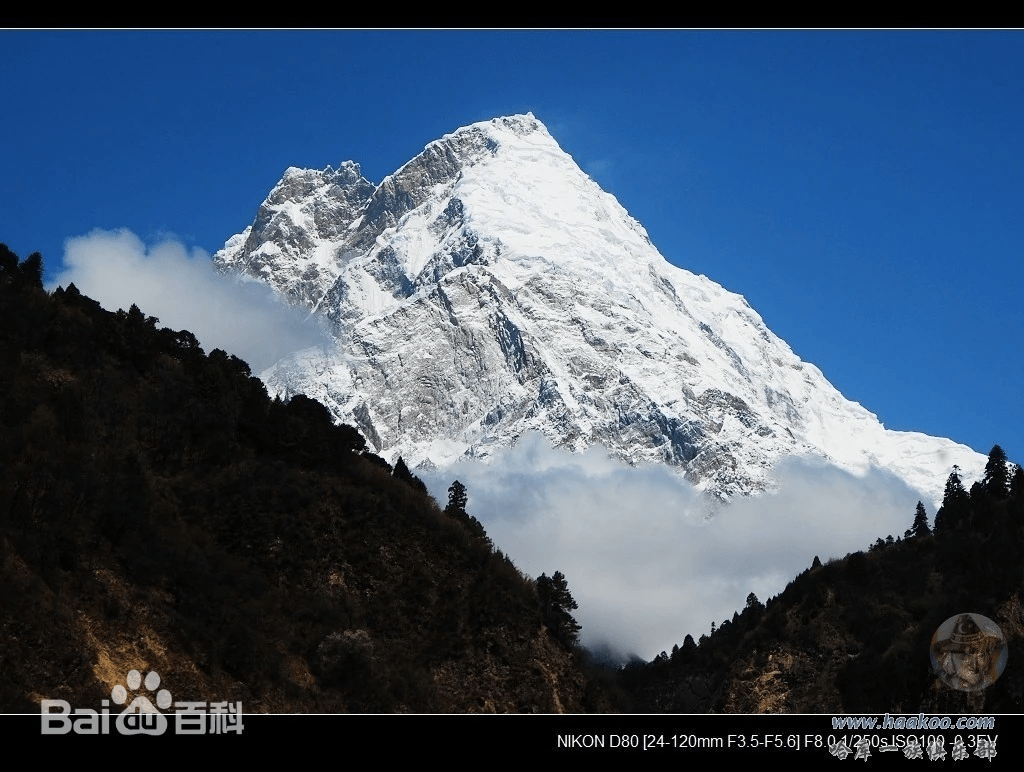
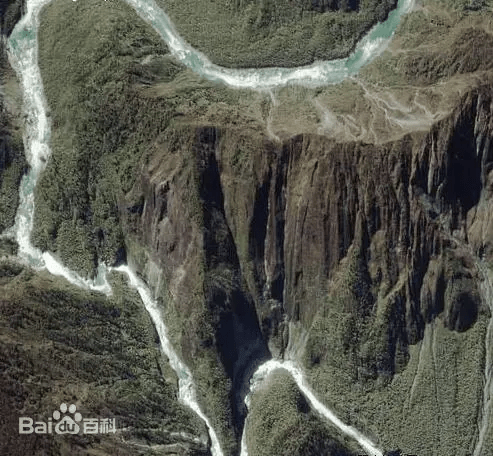
One of the most striking features of Mêdog is the majestic Yarlung Tsangpo River, which winds its way around the towering Namcha Barwa Peak, standing at an impressive 7,782 meters. As the river meanders through the territory of Mêdog, it carves a deep gorge akin to a sharp sword, creating a mesmerizing sight that resembles the Milky Way cascading towards the sea.
Big Bend
The Yarlung Tsangpo Grand Canyon stretches from Dado Kar village in Milin County at an elevation of 2880 meters in the north to Baxika village in Motuo County at an elevation of 115 meters in the south. The canyon spans a length of 504.6 kilometers, with an average depth of 2268 meters and a maximum depth reaching 6009 meters. With an average elevation of over 3000 meters, it holds the distinction of being the world’s largest canyon.
The entire canyon region is characterized by a harsh environment, where glaciers, cliffs, steep slopes, mudslides, and the turbulent Yarlung Tsangpo River converge. Many areas remain untouched by human activity, making it one of the few remaining “last frontiers” on Earth and a relatively unexplored geological blank spot.
Some of the primary waterfalls within the canyon have drop heights ranging from 30 to 50 meters. The canyon features nine vertical natural zones, ranging from high mountain snow zones to low river valley tropical rainforests. This diversity creates a habitat for a variety of biological resources, including two-thirds of known higher plant species on the Qinghai-Tibet Plateau, half of known mammal species, four-fifths of known insect species, and three-fifths of known large fungi species in China.
The convergence of warm and humid oceanic air currents with the snowy plateau gives rise to a unique climatic phenomenon in Mêdog. With annual rainfall reaching around 2000 millimeters and an average temperature of 16°C, Mêdog boasts rare South Asian climatic characteristics at its latitude. Despite its Tibetan location, Mêdog is home to the northernmost tropical rainforest in China, thriving with lush vegetation and vibrant landscapes reminiscent of Jiangnan’s greenery.
Exploring Mêdog offers visitors a chance to witness the breathtaking scenery of the Yarlung Tsangpo Grand Canyon, hailed as one of China’s ten most beautiful canyons by “National Geographic.” Here, travelers can marvel at the grandeur of nature while appreciating the unique rattan bridges that adorn the landscape, crafted without a single nail or pier.
As one traverses the mountains of Mêdog, they are greeted with mist-shrouded landscapes that change hues with the seasons, each unveiling its unique beauty. From the dense foliage to the meandering streams, Mêdog presents a captivating panorama that unfolds like a charming scroll, inviting visitors to immerse themselves in its vibrant colors and tranquil ambiance.
In the age of dinosaurs, a plant often referred to as a “living fossil” – the tree fern, also known as the “cycad,” is a nationally protected plant at the second level. It is the only woody fern species.
Wild Banana
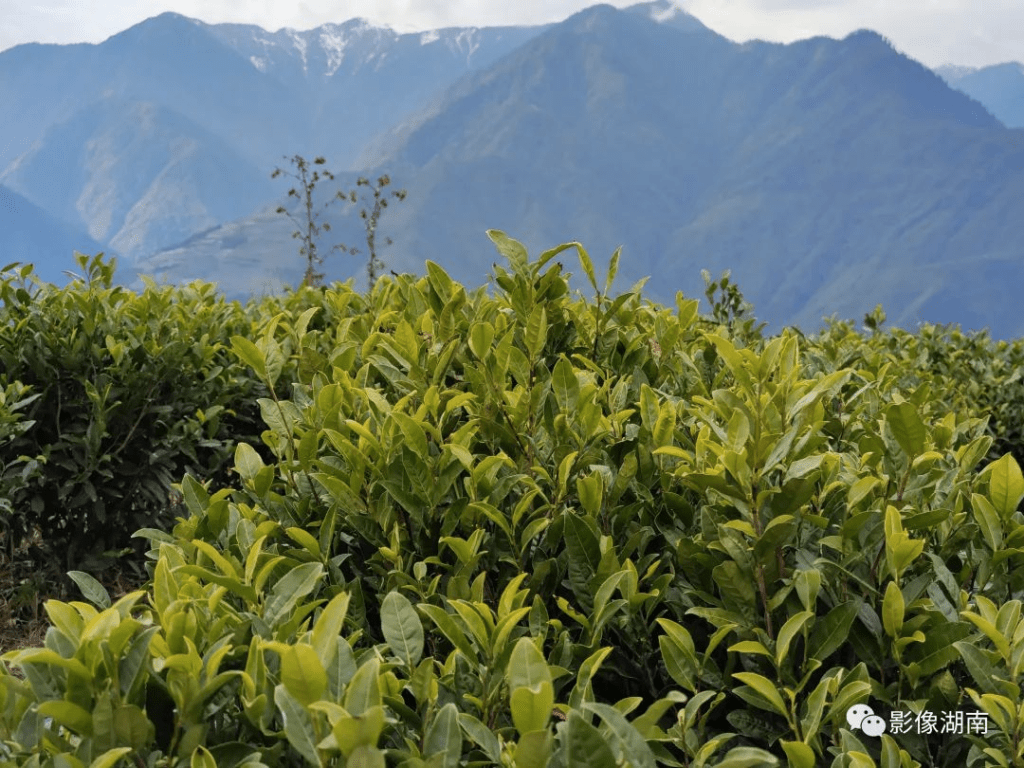
Tea Tree Farm
For those seeking respite from the hustle and bustle of city life, Mêdog offers a sanctuary of serenity and natural beauty. Whether it’s witnessing the grandeur of the Yarlung Tsangpo River or wandering through the lush rainforests, Mêdog promises an unforgettable journey filled with awe-inspiring moments and cherished memories.
In Mêdog, every step reveals a new wonder, every corner a hidden treasure. As visitors embark on this journey of exploration, they are reminded to approach nature with humility and appreciation, embracing its beauty with a calm heart and open mind. In Mêdog, the beauty of life reveals itself in every mist-covered peak and verdant valley, leaving an indelible mark on the soul of all who venture there.
Discovering the Hidden Gem of Tibet: Mêdog – Where Nature Unveils Its Mysteries
As we step into the Chinese New Year of 2024 (February 10th), ushering in the Year of the Dragon, we embark on a journey through the intricate tapestry of Chinese culture and folklore. Beyond the tangible creatures represented in the Chinese Zodiac, the dragon stands as a mystical symbol shrouded in enigma. Join us as we delve into the tales, traditions, and jubilations surrounding the Year of the Dragon, uncovering the profound significance of the Chinese Lunar New Year and its ancient lunar calendar.
The Chinese New Year, also known as the Spring Festival, is intricately linked with the Chinese Lunar Calendar, a timekeeping system rooted in the moon’s phases. Unlike the Gregorian calendar, the Chinese Lunar Calendar dates back over four millennia, its inception during the Xia Dynasty and refinement during the Shang Dynasty. It serves not only as a means to measure time but also reflects the Chinese people’s harmonious rapport with nature. Aligned with the agricultural cycle, the lunar calendar aids in agricultural endeavors, guiding farmers in sowing and reaping.
IVAN/GETTY IMAGES
More than a mere chronometer, the Chinese Lunar Calendar embodies a cultural legacy brimming with significance. Grounded in the principles of yin and yang, the five elements, and the Chinese zodiac, it offers a holistic understanding of existence. This venerable calendar not only demarcates the passage of time but also orchestrates cultural ceremonies, festivals, and customary observances.
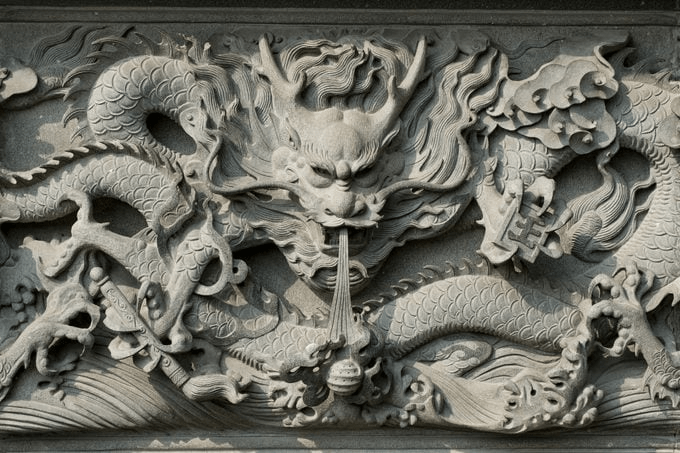
In ancient China, the dragon reigned as a symbol synonymous with imperial authority. Emperors, considering themselves the “Sons of Heaven,” identified with the dragon, an emblem of celestial power. This perception permeated society, fostering a collective belief in the Chinese people’s lineage from dragons. Rooted in mythology, folklore, and cultural symbolism, dragons hold a special place in Chinese ethos, embodying myriad virtues and auspicious qualities.
Legends abound in Chinese mythology, recounting the exploits of the Four Dragon Kings, guardians of the seas in the cardinal directions. Revered for their prowess and rain-summoning abilities, these divine beings epitomize the grace and might associated with dragons. Similarly, the tale of Nezha and the Dragon Prince underscores the dragon’s dual role as a symbol of strength and wisdom, transcending conventional boundaries.
This mural depicting the Four Dragon Kings is preserved in Baiyun Temple, Beijing.
Ancient myths narrate the existence of the Nine Sons of the Dragon, each endowed with unique abilities shaping the natural world. From thunderous roars to water manipulation, these dragon progeny epitomize the elemental forces governing existence. The dragon’s omnipresence in imperial symbolism further underscores its significance, depicting the dragon as the epitome of majesty and sovereignty.
As the Chinese New Year approaches, customs and celebrations honoring the dragon come alive:
Dragon Dances: The iconic dragon dance involves a team of performers manipulating a long, undulating dragon puppet through the streets. This dynamic display is believed to bring good luck and drive away evil spirits.
KEVIN FRAYER/GETTY IMAGES
Dragon Boat Festival: While not directly related to the Chinese New Year, the Dragon Boat Festival is another celebration featuring dragon imagery. Races are held with elaborately decorated boats to commemorate the tragic death of the poet Qu Yuan.
Dragon Lanterns: During the Lantern Festival, which marks the end of the Chinese New Year celebrations, dragon-shaped lanterns light up the night sky, creating a mesmerizing spectacle.
H.H. Dorje Chang Buddha III, a vocal artist, many years ago, has even composed a unique masterpiece, the energetic and festive song “Chinese Dragon,” showcasing the dragon’s cultural significance.
The dragon, shrouded in myths and revered in Chinese culture, takes center stage as we welcome the Year of the Dragon. These captivating stories and customs not only enrich our understanding of Chinese folklore but also highlight the dragon’s enduring role as a symbol of power, wisdom, and good fortune. As the dragon dances through the streets and the Lunar New Year festivities unfold, let us embrace the magic of this mythical creature and wish for a year filled with prosperity and auspicious beginnings. May the dragon bring its legendary blessings to all in the Year of the Dragon!
(This is the text of an article published in the Asian Journal on Oct. 6, 2004.)
Elder laywoman Quan-Fang Lu who was a disciple of Great Dharma King Yangwo Yisinubu1, was from Chengdu, Sichuan. She and her husband, layman Guang-Ming Wang, had been Buddhists since the 1950’s. When they took refuge in Buddhism, they received an initiation and Dharma transmission from the Great Dharma King. In the 1950’s, they were working in Tibet. Because of their underlying karmic conditions, they received the guidance of an outstanding Rinpoche of Tibetan esoteric Buddhism. That Rinpoche told them that Great Dharma King Yangwo Yisinubu possessed the best and highest Buddha Dharma. After going through many hardships, they brought their son to the Great Dharma King. The Great Dharma King was not even seven years old at the time. The three of them formally acknowledged the Great Dharma King as their Master. Laywoman Quan-Fang Lu and her husband Guang-Ming Wang then resolutely decided to have their son stay by the side of the Great Dharma King in order to receive his training and Dharma teachings.
They have been very pious and respectful toward the Great Dharma King, and they have diligently practiced the Dharma that the Great Dharma King transmitted to them. Over the past years, certain people have spread rumors and made false accusations against the Great Dharma King. Laywoman Quan-Fang Lu and her husband Guang-Ming Wang were filled with righteous indignation at this. They vigorously berated the contemptible conduct of those rascals who spread rumors, fabricated lies, and deceived people.
Based upon layman Guang-Ming Wang’s own pious heart and upon the Great Dharma King’s realization, which is like that of a Buddha, in November of 2003, layman Guang-Ming Wang passed on to the Western Paradise of Ultimate Bliss. At his cremation, layman Guang-Ming Wang left behind 11 sarira firm relics.
In the middle of August, 2004, laywoman Quan-Fang Lu told her son Min Wang that she would soon pass away. Min Wang telephoned the Great Dharma King a few times, beseeching the Great Dharma King to cause his loving mother to stay alive longer. When Min Wang’s mother found out about these calls, she admonished her son, “Those who learn Buddhism and cultivate themselves must understand that the law of cause and effect never fails. My karmic connection with this world is about to end. My karmic connection with the Dharma is now complete. The Dharma King Master will help me go to the Western Paradise of Ultimate Bliss.”
As expected, at around noon on September 9th, the crown of elder laywoman Lu’s head suddenly opened. The crown of her head became as soft as cotton. At that time, a colorful auspicious light filled the room. Amitabha Buddha came to escort her away. Beautifully set off by a huge white Buddha light, the pure gold bowl of Amitabha Buddha slowly descended. The red lotus flowers in the bowl were bright-colored. Two photographs were hurriedly taken of this extremely rare and holy sight. Heavenly music could be heard. Imitating the Buddha, elder laywoman Lu assumed the “auspicious recumbent posture.” Amid the Buddha light, she passed on to the Western Paradise of Ultimate Bliss. The next day, her body was placed in the Buddha worshipping hall of Bao Guang Temple in Xindu, which is one of the four great Chan (Zen) temples in China. Right after her body was placed there, an image of the Great Dharma King suddenly emitted bright light. A colorful Buddha light went round and round the Great Dharma King’s image. A fragrant scent wafted through the air.
Photo showed lotus light on the top of laywoman Lu’s house
News of such phenomena began to spread. More and more people came to chant mantras and sutras for the benefit of laywoman Lu, respectfully see her off to the next realm, and observe the ceremony. Day and night, the chanting of Amitabha Buddha’s name did not stop. On the evening of September 10th, eminent Tibetan Rinpoches and Lamas who were all disciples of the Great Dharma King arrived at the temple after having traveled a great distance. They came to perform Buddhist rites. On the evening of September 11th, the machine used to chant the name of Amitabha Buddha suddenly emitted the shocking sound of the Great Dharma King chanting the name of Amitabha Buddha. The Great Dharma King was in the United States. The monastics and laypersons in attendance were all extremely moved.
At around noon on September 12th, a holy sight appeared for the first time in history! A painting of Amitabha Buddha hangs in the Buddha worshipping hall of the temple. In front of Amitabha Buddha’s chest, a heavenly window to the Western Paradise of Ultimate Bliss suddenly opened. This heavenly window directly displayed the sights of the Western Paradise of Ultimate Bliss! People were seething with excitement. They were so pleasantly surprised they could hardly control themselves. Through that heavenly window to a Buddha land that appeared in front of the painting of Amitabha Buddha, all of those who had the requisite karmic affinity saw Amitabha Buddha. They even saw the protuberance on top of Amitabha Buddha’s head. They saw Kuan YinBodhisattva wearing white clothes and holding willow tree branches. They alssaw Mahasthamaprapta Bodhisattva. In that heavenly window, elder laywoman Lu was reciting the name of Amitabha Buddha. Her lips were constantly moving, her eyes blinked, and her head swayed. She looked the same as when she recited Amitabha Buddha’s name when she was alive.
The image of Great Dharma King Yangwo Yisinubu appeared in that heavenly window. He was wearing a red Dharma robe and a Dharma crown. When he appeared, people excitedly shouted words such as, “Master, I see you!” “Great Dharma King Master, by following you we do not fear even death!” “Great Dharma King, my whole family wants to take refuge in you! We want to learn the true Buddha Dharma from you!” People were awestruck by these holy scenes. They could not control their emotions. The sounds of people marveling, shouting, and kowtowing could be heard.
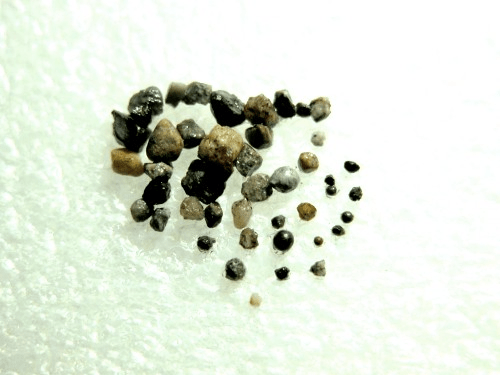
During the cremation of laywoman Lu, holy sights continually appeared. Lotus flowers emerged. Images of the Dharma King, the Three Holy Ones of the Western Paradise (Amitabha Buddha, Kuan Yin Bodhisattva, and Mahasthamaprapta Bodhisattva), and Maitreya Bodhisattva all appeared. Vajra Dharma protecting deities and dragon-spirit Dharma protecting deities stood in a circle on both sides of her. Fire phoenix flew to and fro inside the cremation furnace. Beautiful scenes of pagodas and towers from the Western Paradise of Ultimate Bliss repeatedly appeared. People before the cremation furnace were filled with Dharma joy and began prostrating. They were so moved they began to cry. The sound of joyous laughter filled the temple.After the cremation was completed, people collected 49 sarira firm relics from the bone ashes of laywoman Quan-Fang Lu.
49 solid relics from the ashes of the remains of Layman Lu Quanfang after his cremation
1.Here and below the words Great Dharma King Yangwo Yisinubu, Great Dharma King, or Dharma King Master refers to H.H. Dorje Chang Buddha III Wan Ko Yeshe Norbu Holiest Tathagata.
On April 18, 2014, a contest of skills of Buddha-dharma was held at Sanger Temple in the greater Los Angeles area of the United States of America. Rinpoches, dharma masters, and acaryas from the USA, mainland China, Taiwan, Hong Kong, Australia, New Zealand, and other countries were present. Among them, there were great dharma kings, venerable ones, and great dharma masters who possess uncommon abilities of realization. The master of the contesting stage was Jianggong Kangqing Rinpoche (Gong Kang), who is over 70 years old and is one of the four prominent dharma princes. He demonstrated an imposing grandeur and blustered arrogantly. The Contest was presided by Dharma King Gar Tongstan, who is a great holy virtuous one at the level of two Sun-Moon wheels.
The karmic condition of this dharma assembly was induced by a dharma master from Taiwan, whose name is Long Jing. This dharma master brought a highly capable rinpoche whose name is Baizhe Lamu and who had the title of Smiling-Face Fighter in her previous lifetime. They came to America with three laypersons Wang Sixia, Meiling, and Lianying as a group. They proposed to have a contest of dharma with dharma masters at the International Buddhism Sangha Association (IBSA). Dharma masters at IBSA thought they just wanted to have a debate on the Tripitaka and therefore accepted their proposal without hesitation. However, in addition to debating the sutras, they insisted on having a contest of dharma in the end. Baizhe Lamu stated that the purpose of the contest was to publicize the dharma and benefit living beings. Dharma Master Long Jing said that after winning the contest and returning to Taiwan they would look for a great dharma king and other great dharma masters and great laypersons to contest the dharma, because Baizhe Lamu would like to meet with them and learn each other’s realization of cultivation to see who is superior after all. When they were paying respect to H.H. Dorje Chang Buddha III in person, Baizhe Lamu’s speech and conduct showed her gaffes of arrogance and ignorance.
Coincidentally at that time, Jianggong Kangqing Rinpoche from China was in the United States. This rinpoche was fond of dharma contest even when in China. Through contesting with many famous dharma kings and venerable ones, he never met anyone who was a good match to him. After coming to America, he looked everywhere for superior persons for contesting. He declared that there was not even one dharma king or venerable one in China who could be a good match for him, and that dharma kings, dharma masters, and great laypersons in Taiwan could not withstand a single blow of his. Therefore, he came to America to find superior persons for contesting. Because of this, his Buddha Master H.H. Dorje Chang Buddha III seriously scolded him, “Your cultivation is only skin deep and very laughable. You must clearly understand that learning Buddhism requires cultivating patience, severing attachment to the self, and applying the bodhicitta of great compassion to benefit living beings. You should read and understand Expounding the Absolute Truth through the Heart Sutra to know the true dharma and the absolute truth. Showing one’s strength and pursuing winning runs counter to the undertaking of learning Buddhism and cultivation. Manifesting miraculous abilities to prove one’s power of cultivation is nothing other than playing with untrue illusions. Doing so can only produce one more actor or magician.”
At that time, Gong Kang nodded with obedience, “Yes! Yes!” Afterwards, he still did all he could to look for opponents to make appointments of contesting. He even said, “Many people who are learning from the sutras not only could not understand the sutras but also had hollow and wrong comprehension. That is why they do not have true Buddha–dharma and dare not contest with the dharma. Without comparing each other’s’ dharma through contesting, how can living beings be reminded not to be deceived by false holy ones and false Buddha-dharma?” Because he had won every fight so far, he was naturally indulged in self-pride and arrogance.
At the time, he met with the team of Baizhe Lamu Rinpoche, Dharma Master Longjing, and others. After a debate of sutras, the battle of contesting the dharma finally began on April 18!
Baizhe Lamu Rinpoche didn’t dare to engage in a one-on-one fight with Gong Kang. All five of the team joined force to participate in the match using the dharma of Kuan Yin. They climbed onto the stage and launched an imposing momentum. With focused concentration, they applied mudras and mantras. Their roars were swinging within the Hall of Three Holy Beings, demonstrating an all-out effort striving for winning. Gong Kang heightened his vigilance and responded cautiously. He practiced the dharma of Four-Armed Kuan Yin to fight back. A fierce battle was fought between the two sides with mental power, spirit, and crisscrossed movement. Additionally, with the karmadana shouting loudly to announce the battling field situation, the atmosphere was bustling and tense. Attacking mudras applied silently in unison created a scene of fighting as if sharp and flickering weapons were intercrossing. It was really an unprecedented great battle of dharma contest. Jianggong Kangqing Rinpoche truly deserved the status of one of the four prominent dharma princes. He fought bravely by himself against five in a very hard battle. In the end, Gong Kang applied the Besieging-God Battle Position to have all his five opponents tightly confined, unable to move, and thereby defeated.
In the second match, the two parties switched sides and roles. The losing party in the previous match was to confine and tie up the winning party. All five joined forces in the fighting. With an imposing manner and a sweating effort, they moved forward together with an extremely mighty power to practice the dharma to try to besiege and seize Gong Kang. Spectators at the scene were all holding their breath tightly. At this time of heavy contesting, Gong Kang chanted the Six-Character Great Bright Mantra to practice the dharma of Horsehead Vajra Armor (Horsehead Vajra is a manifestation of Kuan Yin Bodhisattva) as counter-attack. Then the five opponents were unable to defend themselves and were thrown off the stage by Gong Kang. The karmadana declared victory for Jianggong Kangqing Rinpoche, and the surrounding audience gave a loud applause.
Jianggong Kangqing Rinpoche in the contest
Gong Kang was very arrogant and put up an air of pride. He suddenly made a hand gesture to invite Great Dharma Master Zhengda who was present to contest with Buddha-dharma for learning from each other. Dharma Master Zhengda was unable to decline and had to step on the stage. In their earlier years, Jianggong Kangqing and Shi Zhengda were dharma brother and sister. They both are disciples of H.H. Dorje Chang Buddha III. However, Gong Kang was not happy to see this fellow sister taking the highest position of chief abbot at IBSA and being revered as a superior one. Therefore, he thought it was a good time to teach her a lesson on that day. That was why he invited her to contest the dharma in front of others. This arrogant act of Gong Kang scared the venerable ones and dharma masters who were present. Their hearts were trembling due to fear and they were afraid of being called by Gong Kang for contesting. It could be seen that, except Dharma King Gar Tongstan and Venerable Long Zhi Denma Tsemang, people in high ranks all lowered their heads and dared not to face Gong Kang’s eyesight.
Master Zhengda in the contest
Right after Jianggong Kangqing Rinpoche and Dharma Master Zhengda walked onto the stage, Gong Kang sneered with an air of pride and gave an arrogant statement, “You will not keep me still.” Zhengda replied, “I will besiege you and will not let you move.” The two fellow brother and sister started a verbal exchange before contesting the dharma. Later, they sat down facing each other along the north-south direction and both practiced the dharma of Kuan Yin to contest. The two entered deep concentration and manifested their dharma powers. Spectators were greatly impressed. For a long time, they fought to a match of draw without showing who could overpower the other. However, eventually the outcome could only be one defeating the other. Upon seeing Gong Kang’s extraordinary power, Dharma Master Zhengda used Kuan Yin’s dharma of Pure-Water Bottle in combination with the God-Besieging Rope. At that time, Gong Kang was tied up and captured. He was powerless and unable to move his limbs. Therefore, Dharma Master Zhengda won the first match.
They switched side to start the second match. Suffering this defeat had a great impact to Gong Kang’s record. He could never have imagined that Dharma Master Zhengda had truly became one with superior realization and was so great. Now he had to use his highest secretive method of Besieging-God Battle Position. That was truly powerful and had Dharma Master Zhengda bounded up. She was trembling all over her body and her body was as cold as ice. At this time, Dharma Master Zhengda unexpectedly used the dharma of Kuan Yin’s Pure-Water Bottle Willow-Branch Breaking Siege. Her voice of chanting the Six-Character Great Bright mantra sounded like rotating pearls and she was quickly revived. Gong Kang’s God-Besieging formation became seriously disorganized and he lost his power of concentration. Dharma Master Zhengda then made a punch to knock him off the stage. Because Gong Kong had spoken arrogantly before in public, this defeat made him very embarrassed. The Karmadana then announced, “Dharma Master Zhengda won and becomes the champion of the dharma contest.”
However, Gong Kang strongly disagreed. He said that the referee had judged erroneously, and asked for having another match of “Viewing the Realm and Exiting the Samsara” with Dharma Master Zhengda. Dharma Master Zhengda did not want to have another dharma contest with him, but Gong Kong insisted. Therefore, this big battle was fought on April 20. The battleground was a grassy lawn, with a very big piece of cubic cordierite. This is a mani stone used by a great holy virtuous one to practice the dharma. After the referee Dharma Master Long Hui sprinkled the pure soil that was empowered by an extremely great holy virtuous one onto the mani stone, the two fighters sat away from the huge stone by about three meters. Jianggong Kangqing Rinpoche started first to practice the dharma of Four-Armed Kuan Yin. He practiced 15 rounds of the mantra and the mudra, but was unable to push the mani stone into movement across the separation of empty space.
Next it was Dharma Master Zhengda’s turn in the contest. She also practiced the dharma of Four-Armed Kuan Yin. With three rounds of the mantra and the mudra, the mani stone was pushed to move across the separation of empty space. Then, after Dharma Master Zhengda, Jianggong Kangqing Rinpoche, and Dharma Master Long Hui prostrated to the mani stone to pay homage, the mani stone suddenly flew to the sky and disappeared in the sea of clouds. They were all stunned so as to be speechless. It was not known which extremely great holy virtuous one did this. Everyone could only utter exclamation and praise of surprise! The realization power of doing this is hundreds or thousands of times greater than the power of a female great rinpoche from Tibet who let a big mani stone circling around her in the empty space in 2002. The weight of this mani stone that flew to and disappeared in the sky was not exactly known. It was estimated to be about two tons heavy. Actually, weight is not the issue. Even making a pillow fly to the sky would be a world-shocking miracle.
Now, the referee announced that the dharma contest of “Viewing the Realm and Exiting the Samsara” was to begin. After the two had a conversation, Gong Kang still insisted on having the contest. Then they sat facing each other with a far distance in between to begin the dharma contest. According to the rules of the contest, Gong Kang was to besiege Dharma Master Zhengda. On the other hand, Dharma Master Zhengda had to exit samsara to win. Each of them practiced the dharma of the Tathagata to engage quickly in the battle. After only two encounters, Dharma Master Zhengda used Green Tara’s dharma of Breaking Siege by Bodhicitta of Great Compassion to break open Gong Kang’s iron peripheral surrounding of the Besieging-God Battle Position. In a moment, she started from the mandala of samsara and went through the outer court of the Tusita Heaven. After looking and verifying a few times, she quickly found the right direction and directly approached the siddhi of Bodhisattva. After arriving there, she stayed firmly unperturbed. Referee Long Hui who is IBSA’s chairperson was full of praises for her. The host of this dharma contest Great Dharma King Gar Tongstan announced, “Jianggong Kangqing Rinpoche was defeated. Dharma Master Zhengda exited samsara and won the victory. She is the champion of this contest.” The meaning of this one-to-one dharma contest is even more profound than the previous one. For details, readers can watch the live video recording of the contest.
Since ancient times, debating sutras has existed in Buddhism as a preliminary form of dharma contest. This belongs to the theoretical aspect of Buddhism. After practitioners’ cultivation and conduct reached the state of manifesting true utilization and realization, dharma contest is used as the main method of distinguishing whether one belongs to hollow theory only and appraising one’s realization for the purpose of benefiting living beings.
The earliest dharma contest in Buddhism was between two disciples of Sakyamuni Buddha, Shariputra who took the first-place in wisdom and Mahamaudgalyayana who was regarded as the best in supernatural power. Shariputra won the contest. Other examples of dharma contest in history include:
Baltsa Takdelwa (who later became a disciple of Dusongchienba) looked for Dusongchienba (the first-generation Great Jewel Dharma King of the Kyagu Sect) to have a dharma contest, but was defeated by a disciple of Dusongchienba.
Karma Pakshi (the second-generation Great Jewel Dharma King of the Kyagu Sect) lost to Chojal Pakpa in a dharma contest at the Mongolian Palace.
A dharma contest between Zhaguo Longjue Songmou Rinpoche (from Songzhanling Temple in Shangri-La) and Naizhang Qujiong of Lasa.
A dharma contest between the 13th Dalai Lama and the abbot of Kumbum Monastery Agya Rinpoche recorded in history that can be found on the internet.
During the last several hundred years, however, it became rare to see dharma contests between eminent monks. This is because true Buddha-dharmas are becoming extinct. Some rinpoches, dharma masters, and great laypersons who only have hollow theories to write books and give discourses dare not even mention the term “dharma contest.” They are afraid that their disciples would know the thing of dharma contest that can prove one’s true power of cultivation. They fear that their disciples would see the fact that their master can only talk about hollow and erroneous theories and therefore does not have Buddha-dharma. That is why the recorded stories of eminent monks contesting their dharma in the past have almost been completely wiped out within a short period of time. Today, Jianggong Kangqing Rinpoche, Baizhe Lamu Rinpoche, Dharma Master Long Jing, and others are fond of contesting with Buddha-dharma. Their deeds are opposed by H.H. Dorje Chang Buddha III. However, looking from a different angle, what they did does have boundless merit. Otherwise, the stories of holy virtuous ones contesting the dharma in the history of Buddhism would have completely disappeared without a trace. Then Buddhism would only be left with theories. Consequently false rinpoches and false dharma masters who have no understanding in the sutras could freely create and teach erroneous theories without having to prove with real Buddha-dharma. Therefore, we should thank the people who contest with Buddha-dharma on the stage. They proved the real existence of true Buddha-dharma and wrote the fact “Buddhism is not just talking about hollow theories” into the history of Buddha-dharma.
In the heart of Ming Dynasty China, a man named Yuan Liaofan emerged, leaving an indelible mark on history. Born in the picturesque Wujiang County, Jiangsu Province, China, Yuan Liaofan’s original name was Yuan Huang. With the courtesy name Kunyi and the alternative name Xuehai, he later adopted the name Liaofan, symbolizing a profound shift in his life’s trajectory. During his life, he underwent a precise fortune-telling by an adept in divination, which turned out to be accurate. However, Yuan Liaofan later transformed his own destiny.
Yuan Liaofan’s transformative journey began when he sought guidance from a revered monk, a master in the art of divination. The monk, through precise fortune-telling, revealed a predetermined path for Yuan Liaofan. Undeterred by this revelation, the monk imparted invaluable wisdom on how to change his fate.
The monk emphasized the importance of performing virtuous deeds and accumulating positive karma. He outlined a path that involved actively engaging in a thousand good deeds, actions that would not only benefit others but also bring about profound changes in Yuan Liaofan’s own destiny.
Embracing the monk’s teachings, Yuan Liaofan dedicated himself to a life of kindness, compassion, and generosity. He embarked on a mission to perform a thousand good deeds, each act carefully documented in a personal ledger. His deeds ranged from helping the needy and supporting the less fortunate to acts of kindness that reverberated through his community.
As Yuan Liaofan diligently pursued this virtuous path, the effects on his life were nothing short of remarkable. Contrary to the fortune-teller’s prediction that he would not have a son, Yuan Liaofan became a father, experiencing the joys of parenthood. His household, once devoid of the laughter of children, now echoed with the sounds of familial bliss.
Additionally, the diviner had foretold that Yuan Liaofan’s life would be limited to fifty-three years. However, Yuan Liaofan defied this prediction, living a full and fulfilling life until the age of seventy-four. The positive energy generated by his virtuous deeds not only defied fate but also led to a prolonged and healthy existence.
The transformative effects were not confined to his personal life alone. Yuan Liaofan’s career path witnessed an upward trajectory. Through his dedication, hard work, and the positive energy he exuded, he achieved professional success, earning promotions and garnering respect within his professional sphere.
“The Four Lessons of Liaofan,” penned by Yuan Liaofan himself, stands as a testament to his transformative experiences. It serves as a guiding light for all who aspire to harness the potential within themselves to cultivate positive change.
As we navigate the complexities of our modern existence, let Yuan Liaofan’s story inspire us to embark on a journey of goodwill. Embrace the opportunity to contribute to the well-being of others, and in doing so, witness the transformative effects it can bring to your own life.
May Yuan Liaofan’s tale be a beacon of encouragement for us all, urging us to embrace the inherent ability within ourselves to shape our destinies. After all, the power to create a life of abundance and health lies not in the stars, but within the choices we make each day.
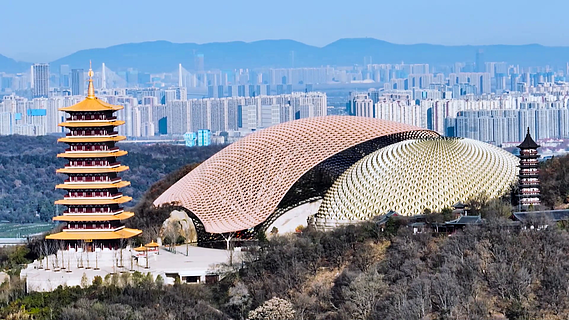
The Usnisa Palace, also known as Foding Palace, is situated in the Niushoushan Cultural Tourism Zone, Jiangning District, Nanjing City. This architectural marvel, characterized by its deep pit structure, serves as the long-term sanctuary for the Foding relic bone. Spanning 220 meters in length, 160 meters in width, and towering at an overall height of 89.3 meters, with a total building area of approximately 136,000 square meters, the palace is a testament to grandeur. The external space is subdivided into three components: the large dome, small dome, and Foding cliff. Internally, it comprises nine layers – three above ground and six underground – housing the Zen Grand View, Relic Hall, and Relic Treasury. Foding Palace not only serves as the primary repository for the Buddha’s crown relic bones and a place of worship for believers but also functions as a cultural exhibition space showcasing relic culture and global Buddhist culture through various artistic mediums.
Niushoushan stands as one of China’s renowned Buddhist mountains and is the birthplace of Niutou Zen Buddhism, a significant sect of Chinese Zen Buddhism. It houses the world’s only Buddha’s Parietal Relic – the skull of Shakyamuni. This complete skull, with a circumference of 35 cm and a diameter of 10 cm, is adorned with yellow-and-black hues and features clear hair holes distributed throughout.
The Buddha’s Parietal Relic was unearthed in the Ashoka Pagoda within the underground palace of Bao’en Temple in Qinhuai District, Nanjing. It stands as the sole surviving true parietal relic of the Buddha globally.
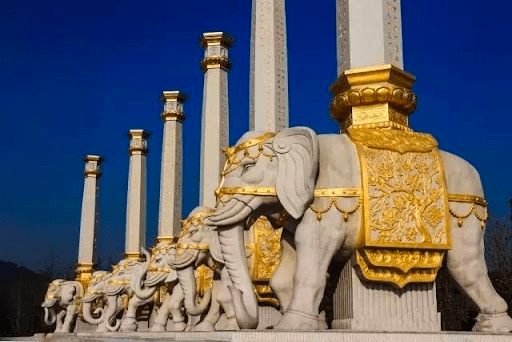
The external space is ingeniously divided into three sections: the large dome, small dome, and Buddha Grottoes. The large dome, shaped like a Buddha’s cassock and stretching 120 meters in length, covers the small dome palace, symbolizing the boundless blessings of the Buddha. The small dome, resembling the Buddha’s hair bun, is composed of thousands of small units, representing the offerings made by thousands of believers. The base of the small dome takes the form of a lotus throne, featuring 56 flying Bodhi gates symbolizing Buddha’s infinite wisdom and 56 cloud gate wishful pillars symbolizing good luck and fortune.
Usnisa Palace : Large Dome and Small Dome
Within Foding Palace, the design deviates from a singular dome to an atrium-style space connecting upper and lower levels directly. The central reclining statue of the Buddha in Nirvana is a captivating focal point, visible from various angles. Using the four sights of birth, old age, sickness, and death, the Buddha imparts guidance and enlightenment to sentient beings. In Buddhism, “Nirvana” signifies a state of eternal and serene tranquility without birth or death. As the Buddha speaks, heavenly beings scatter flowers. Tradition holds that in the Buddha’s pure land, day and night witness the auspicious occurrence of raining flowers. During the Buddha’s Nirvana, offerings such as incense, flowers, and precious banners are made.
Upon entering Foding Palace, visitors traverse a long corridor adorned with paintings depicting sacred scenes. Four small palaces within the passage illustrate wonders of the four natural elements: earth, fire, water, and wind. The journey provides an opportunity to contemplate the painted stories of the Buddha’s eightfold path to enlightenment, featuring extraordinary phenomena related to earth and fire, such as thousands of small Buddha niches and a thousand heart lamps.
To approach Foding Palace, one ascends using a water elevator, marking the third wonder – the purification of the three realms through water. Depicting these natural phenomena through a meditative design, the top floor of Foding Palace awaits, featuring a towering space and exquisite dome. The celestial ambiance, with stars seemingly within reach, fosters a sense of unity between heaven and earth. This intentional design aims to allow individuals to grasp Buddhist stories and appreciate nature’s wonders before encountering the Buddha’s relic. This preparatory “journey” facilitates entry into Foding Palace with a tranquil and peaceful mindset, reminiscent of a meditative experience.
The internal space encompasses nine floors – three above ground and six underground – housing the Zen Grand View, Relic Hall, and Relic Palace.
Relic Hall
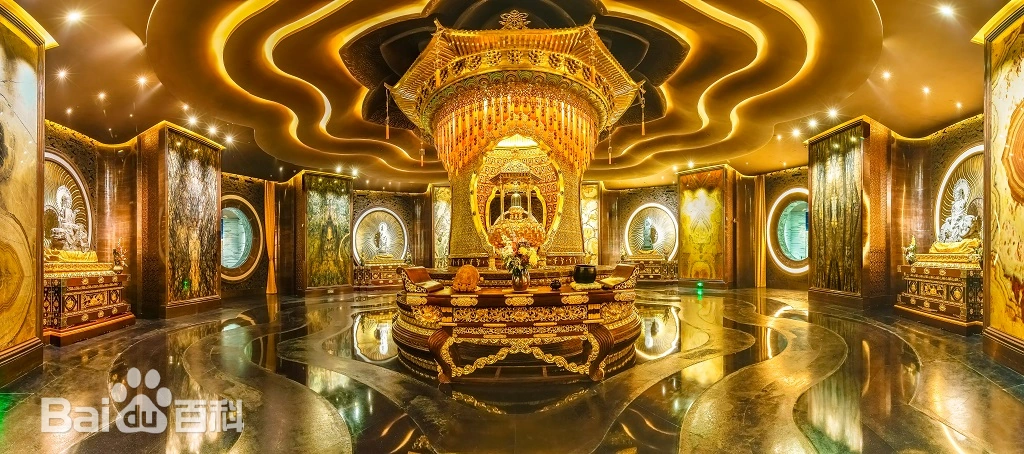
The Relic Hall comprises the Thousands Buddhas Hall and the Ten Thousands Buddha Corridor. The Thousand Buddhas Hall, adorned in red, yellow, and dark gold, features a vault-shaped layout corresponding to the Hua Zang Buddhist World. The central focus is the 21.8-meter-high Relic Pagoda, imitating the Ashoka Pagoda where the Buddha’s Parietal Relic was found. The Ten Thousands Buddha Corridor spans the 3rd, 4th, and 5th underground floors, showcasing Chinese Buddhism culture, seven-sided lacquer paintings depicting Indian Buddhist teachings, and Buddha’s relic and relic culture, including videos, porcelain paintings, ancient pagodas, and historical relics.
Thousand Buddha Hall
Ten Thousands Buddha Corridor
Relic Palace
Also known as the Buddha’s Treasure Palace, the Relic Palace exudes a solemn and mysterious atmosphere with its dark color scheme. It serves as a sacred space for housing the Buddha’s Parietal Relic and a place for Buddhist worship and meditation. At its center is the 7-meter-high Relic Treasure Pagoda adorned with exquisite golden decoration. Inside the pagoda is a hexagonal and intricate lotus stupa, housing the sealed glass box containing the Buddha’s Parietal Relic. The pagoda is equipped with fireproof and explosion-proof features, along with a constant temperature and humidity system to ensure the optimal environment for the relic. Surrounding the relic pagoda are eight unparalleled marble mosaics depicting the life of the Buddha.
Corridor of the Relic Palace
Relic Palace
Zen Grand View
The Zen Grand View spans 112 meters from north to south and 62 meters from east to west, with a total height of 46.5 meters. Its oval shape encompasses an area exceeding 6000 square meters, with a core focus on Zen culture. Comprising Buddha’s Birth, Buddha’s Enlightenment, and the Lotus Theater in the middle, the Zen Grand View narrates the life story of the Buddha.
Lotus Buddha Theatre – Not-to-miss Visual Feast
The Lotus Buddha Theatre hosts a daily “Song of the Lotus Buddha” Zen Buddhism culture ceremony and stage multimedia show from 10:00 to 11:30 in the morning and from 13:30 to 15:00 in the afternoon. This 30-minute visual feast combines ceremonial performance with burning lamps, praying, offering flowers to the Buddha, large-scale dancing, and more. During the performance, the Sleeping Buddha descends slowly from the air, accompanied by a rising stage, actors, and 16-meter-high lotus petals. The Sleeping Buddha, a copper statue of Sakyamuni, with a length of 7.5 meters and a surface made of white marble, can rotate 360 degrees, expressing the Buddha’s peaceful moment of Nirvana.
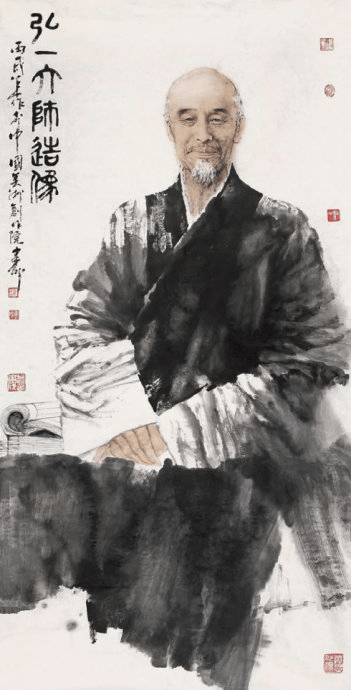
Master Hongyi (弘一大师, October 23, 1880 – October 13, 1942) was originally named Li Shutong (李叔同) and was born into a prosperous family in the bustling northern city of Tianjin on October 23, 1880. The family, originally hailing from Hongdong County, Shanxi, had relocated to Tianjin during the Ming Dynasty.
Li Shutong’s grandfather, a prosperous banker and salt merchant, and his father, Li Shizhen (李世珍), a scholar deeply immersed in Chan Buddhism and the teachings of Ming Neo-Confucian philosopher Wang Yangming (1472-1529), reflected the family’s intellectual and financial standing.
In contrast, Li Shutong’s mother had a modest upbringing as the daughter of a farmer in Pinghu, Zhejiang Province. She became Li Shizhen’s fourth wife in their multi-courtyard household, marrying him at the age of 20 when he was 68.
Tragically, Master Hongyi’s father passed away when he was just four years old. Subsequently, his mother faced challenges in maintaining her position within the complex dynamics of the household while residing under her eldest son’s roof. Fortunately, Li Shutong found support from two of his elder half-brothers during his early years, allowing him to access a quality education and a firm foundation in the Confucian classics.
The young Li Shutong mastered the art of calligraphy and after his ordination as Master Hongyi, he continued to engage in this artistic tradition. This calligraphy, produced during the period of his life when he was known as Master Hongyi, reads from right to left “Zijing Qixin” (自净其意). It means “to cleanse one’s mind” and is an extract from a famous verse
Influenced by his formative experiences, Li Shutong eloquently expressed a profound perspective on life through poetry at the tender age of 15, capturing the fleeting nature of wealth and honor: “Life is truly like the setting sun on the western hills; wealth and nobility are as transient as frost on the grass.” His personal life, marked by an unconventional marriage, served as a poignant reflection of the internal conflict between societal expectations and his genuine affections.
Li Shutong’s participation in the Hundred Days’ Reform and subsequent rumors prompted his relocation to Shanghai, where he thrived in the dynamic literary scene. Becoming a prominent figure in Shanghai’s cosmopolitan lifestyle, he joined the Chengnan Wenshe and co-founded the “Five Friends of Tianya.”
His impact extended beyond literature. Collaborating with the painter Ren Bonian, he established the Shanghai Calligraphy and Painting Association, marking a pivotal moment in Chinese art history. Li Shutong’s engagement in Liyuan activities showcased his versatility as a performer in plays such as “Bai Shuitan” and “Huang Tianba.”
Li Shutong’s literary repertoire included numerous poems and songs, among them the renowned poem “Farewell” (《送别》, Song Bie), which later inspired the widely sung “The Farewell Song” (《送别歌》, Song Bie Ge).
The Farewell Song
Outside the long pavilion, along the ancient route, fragrant green grass joins the sky, The evening wind caressing willow trees, the sound of the flute piercing the heart, sunset over mountains beyond mountains.
At the brink of the sky, at the corners of the earth, my familiar friends wander in loneliness and far from home, One more ladle of wine to conclude the little happiness that remains; don’t have any sad dreams tonight.
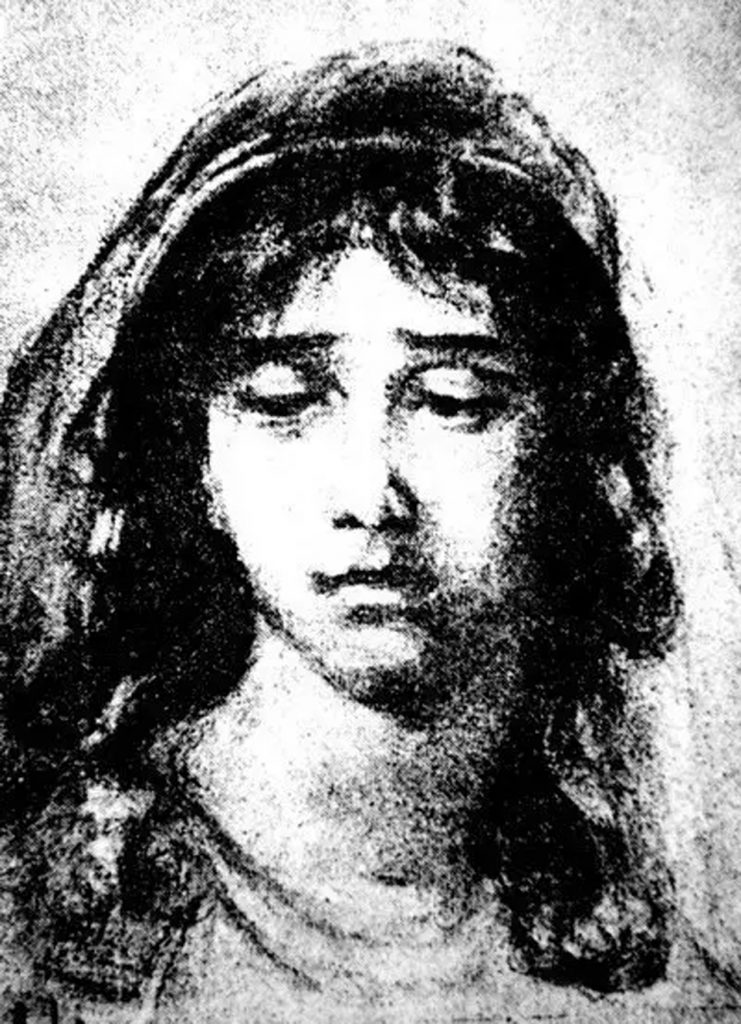
Li Shutong’s charcoal drawing titled ‘Maiden’
“A Half-naked Woman” by Li Shutong, collected by CAFA Art Museum, China
However, Li Shutong’s life underwent a profound transformation. Confronted with personal and financial challenges, he voluntarily entered a self-imposed exile in Japan. The success of the Xinhai Revolution in 1911 further complicated his circumstances, resulting in financial ruin. Undeterred by these setbacks, Li Shutong maintained composure and supported his family by teaching in Tianjin and Shanghai.
His teaching career, notably at Zhejiang First Teachers’ College, left an indelible mark. Li Shutong played a pivotal role in introducing Western painting to China, earning him the title of the forefather of Chinese oil painting. As the first Chinese art educator to incorporate nude models in his painting classes and introduce Western music to China, his influence was far-reaching. Some of his personally groomed students, including contemporary Chinese artist, educator, and musician Feng Zikai (丰子恺), and Singaporean artist Chen Wenxi (陳文希), went on to become accomplished artists in their own right. His impact on students, such as the renowned painters Pan Tianshou and Shen Benqian, underscored his lasting influence.
During this period, Li Shutong delved deeper into Buddhism. In 1916, he embarked on a 21-day fast at a temple in Hangzhou to experience aspects of the spiritual path. This experience prompted his decision to embrace the ordained life, leading to his monastic vows at Hupao Temple. His disciplined lifestyle, which included fasting therapy for deeper insights, marked a significant spiritual transformation.
Li Shutong’s transition from a worldly existence to a monk, detailed in a letter to his second wife, Yu, reflected his detachment from transient fame and wealth. His decision to leave behind a worldly life for monastic vows occurred only a month after joining the Order. He was known by the monastic names Yanyin (演音) and Hongyi (弘一) after undergoing full ordination rites at Lingyinsi, the largest monastery in Hangzhou.
His departure, though painful for those close to him, exemplified Master Hongyi’s profound understanding of Buddhism. In a conversation with his second wife, he elucidated the nature of love, defining it as compassion, aligned with Buddhist teachings that emphasize letting go of attachment and cultivating compassion.
Master Hongyi’s transformation from the proud and arrogant Li Shutong to a humble and receptive teacher was evident in his approach to teaching Dharma. Contrary to expectations of flawless mastery, Master Hongyi sought feedback from student monks and welcomed constructive criticism without defending himself.
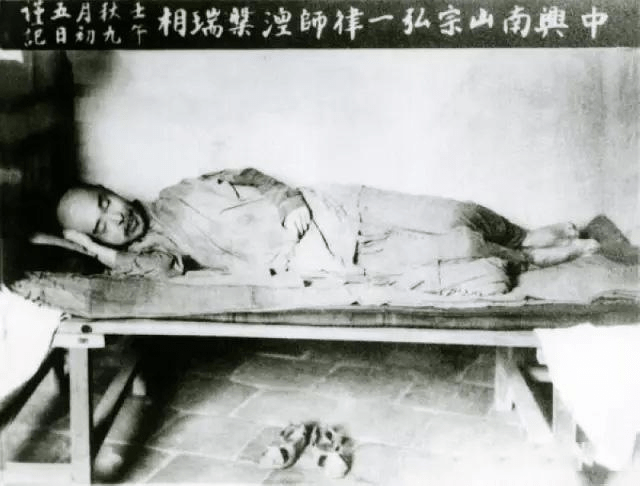
By early 1942, the toll of austerities and fasts began affecting Master Hongyi’s health, and by mid-May, his condition deteriorated rapidly.
The paranirvana of Master Hongyi
Three days before his passing at Busi Temple in Quanzhou, Fujian Province, on October 13, 1942, Master Hongyi inscribed his final calligraphic strokes, creating the work known as “Sorrow and Joy Comingle,” “Worldly Sorrows and Joy Are Intertwined,” or “Sorrow or Joy Are Inextricably Bound to Each Other” (《悲欣交集》, Beixin jiaoji).
Master Hongyi’s philosophical framework posited three distinct stages in human life: material, intellectual, and spiritual. The material phase pertains to mundane existence, the intellectual phase characterizes the life of ordinary intellectuals, while the spiritual phase encompasses the religious realm.
Material, intellectual, spiritual; beauty, profundity, deity. These concepts are intricately tied to the principles of abstinence, composure, and wisdom in Buddhism.
Abstinence, in this context, denotes the renunciation of materialistic pursuits. Composure signifies the practice of deep meditation—tranquil and remote—a path that ultimately leads to the attainment of wisdom. The imagery of Venerable Hongyi experiencing both sorrow and joy (欣) symbolizes the dynamic interplay between these various dimensions of life.
Li Shutong: From Prodigy to Monk – A Journey Beyond Wealth and Artistry



























 Peace LiLy