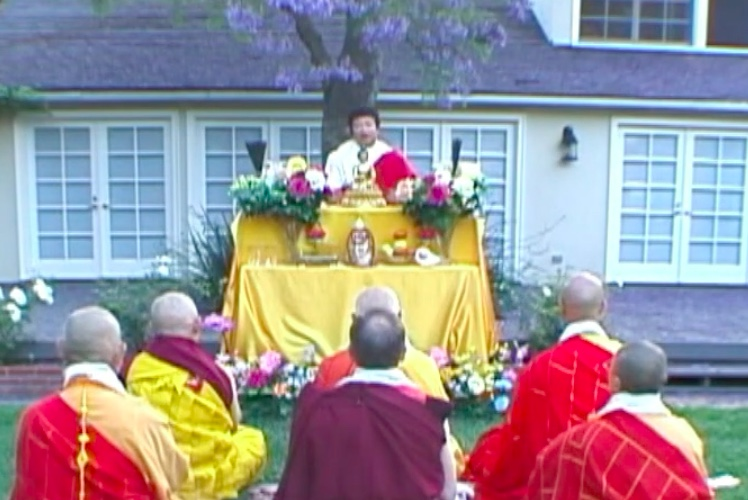
The Benevolence Temple Celebrates the Renunciation of the Shakyamuni Buddha and the Anniversary of the Temple

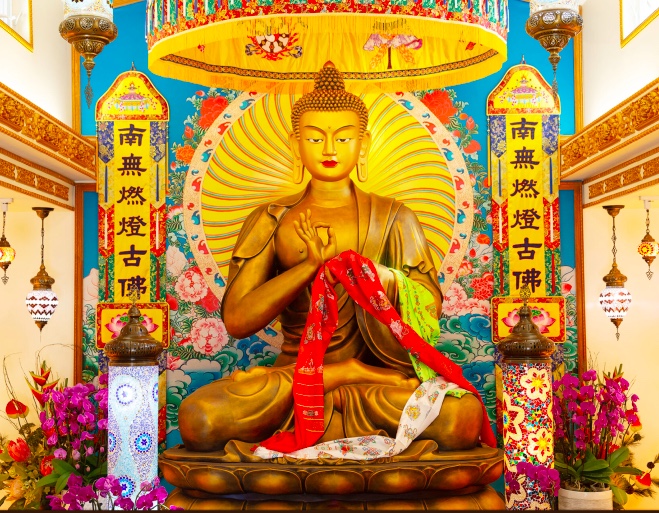
Photo Courtesy: Benevolence Temple (The Benevolence Temple held a Dharma assembly to commemorate the Enlightenment Day of Shakyamuni Buddha. Jiaozun Zhengda, Vice President of the World Buddhism Association Headquarters presided over the Dharma assembly.)

The Benevolence Temple, located in Las Vegas, hosted a series of Dharma assemblies and retreats from January 2 to January 11 to commemorate the Enlightenment Day of Shakyamuni Buddha and the anniversary of the Temple. Jiaozun Zhengda, Vice President of the World Buddhism Association Headquarters, led the congregation in a group study of the teachings of H.H. Dorje Chang Buddha III, revered as the Pope of Buddhism. Hundreds of participants from around the world attended this significant event.

This ten-day celebration features a variety of Dharma assemblies and spiritual practices, including a group study of the teachings of H.H. Dorje Chang Buddha III, one-day Zen sessions, the Grand Diamond Gem Repentance Ceremony, and life release rituals. Each day’s program begins at 8:30 a.m. and concludes at 9:00 p.m., providing participants with an immersive experience of the Temple’s tranquility and a temporary escape from worldly concerns. Lay practitioners also participate in the Temple’s daily routines, such as morning and evening chanting and dining ceremonies, offering them a glimpse into the essence of temple life.

The special one-day Zen session took place on January 4, 2025. Prior to the session, all participants were required to study Announcement No. 40 of the Office of H.H. Dorje Chang Buddha III, which details the “Great Dharma of Zen Practice” taught by H.H. Dorje Chang Buddha III to a group of cultivators in March 2013. This Dharma provides a clear understanding of Zen’s standard and proper practice, addressing key questions such as: What is Zen used for? Why should one practice Zen? What is the ultimate goal of Zen practice? More than one hundred Venerables, Dharma Masters, Rinpoches, and lay practitioners from the United States, Canada, Germany, mainland China, Thailand, Taiwan, and other countries and regions participated in this transformative experience.

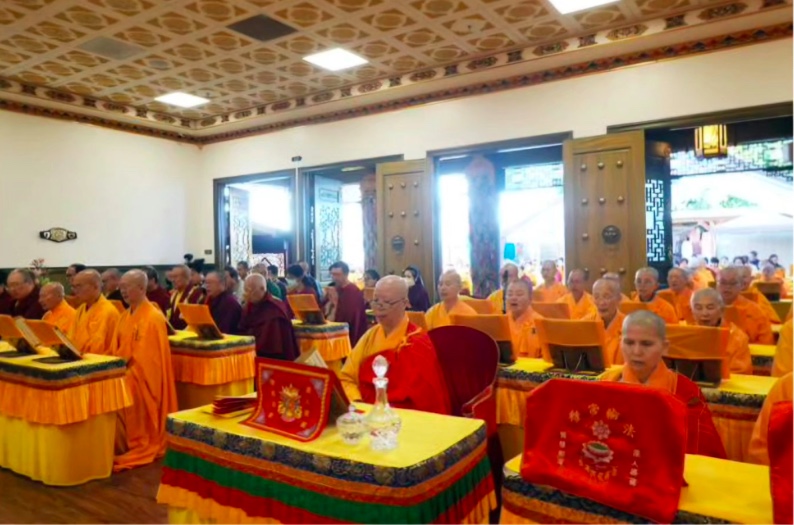
The event took place in the Mahavira Hall of the Temple and featured ten meditation sessions: five sitting and five walking meditation sessions. Each sitting meditation lasted thirty minutes and an hour, with walking meditation sessions interspersed to maintain balance and flow. This arrangement allowed practitioners to sustain a steady rhythm and deepen their daily mindfulness. Two key roles were essential to the success of the event: the host and the discipliners. The host guided participants through the schedule and explained Zen practices’ rules and key aspects. The discipliners, equipped with a disciplinary board, patrolled the venue to gently correct participants if they became drowsy, slouched, or caused unnecessary noise, ensuring the sanctity and focus of the practice were upheld.

Photo Courtesy: Benevolence Temple (The Benevolence Temple held one-day Zen sessions)

After attending the event, a university scholar shared that she traveled more than ten hours and took three flights to attend the blessing ceremony and participate in the grand event. Having never practiced group meditation before, she was initially worried that she would struggle to sit still for an extended period. However, the outcome was both unexpected and extraordinary.

Thanks to the supportive group atmosphere, nearly all participants completed all ten sessions, overcoming the physical discomfort of sore feet and backs. By the end of the day, many reported experiencing a profound sense of Dharma joy. Dharma Master Zheng Da expressed her delight with the positive feedback from attendees. She hinted that longer Zen retreats, ranging from three to seven days, may be organized to encourage deep meditation and personal growth.

Dharma Master Zheng Da also inspired the group with H.H. Dorje Chang Buddha III’s teachings: “No matter what Zen Dharma you practice, you cannot deviate from cultivation. That is why you must go online and learn Buddha Master’s teaching of ‘What Is Cultivation?’ Furthermore, you must carry out that teaching in your daily lives. Only then will your practice of Zen truly succeed.”

Photo Courtesy: Benevolence Temple (The walk session in the Benevolence Temple’s one-day Zen sessions)

In addition to the one-day Zen event, the group study of H.H. Dorje Chang Buddha III’s teachings offered clear guidance, helping disciples cultivate the correct views and understanding.
 
 
Published by Joseph T.

Soruce of the article : The Benevolence Temple Celebrates the Renunciation of the Shakyamuni Buddha and the Anniversary of the Temple

BRIEF INTRODUCTION TO H.H. DHARMA KING TRULSHIK

H.H. Dharma King Kyabje Trulshik Chokyi Lodro is one of the most accomplished masters of the Nyingma sect in the present age. He is also one of the few remaining great masters of Tibetan Buddhism who has real and extensive knowledge, real training, and true cultivation. He is a lineage holder of many important dharma lineages. He is a great dharma king who does not distinguish among the various sects of Buddhism. H.H. Dharma King Trulshik and the most magnificent modern dharma kings of Buddhism, such as the H.H. Dudjom Dharma King and H.H. Dharma King Dilgo Khyentse, have been masters and disciples of one another. H.H. Dharma King Trulshik also taught the dharma of many lineages to the 16th Karmapa. He is a personal master of H.H. the Dalai Lama as well as a master of the most recent reincarnation of the H.H. Dudjom Dharma King, H.H. Dharma King Dilgo Khyentse, and H.E. Dharma King Tulku Ugyen.

Many Rinpoches had different views concerning which great Bodhisattva H.H. Dharma King Trulshik was the incarnation of. Thus, the International Buddhism Sangha Association held an unprecedented Drawing Lots From a Golden Vase Ceremony to affirm the true reincarnated identity of H.H. Dharma King Trulshik and others. There were ten possible identities recognized by various rinpoches. One lot was drawn from among 120 lots to affirm the true reincarnated identity of H.H. Dharma King Trulshik. That drawing affirmed that H.H. Dharma King Trulshik is the nirmanakaya of Maitreya Bodhisattva, which is the reincarnated identity that H.H. Dorje Chang Buddha III recognized before that lot was drawn.

In history, H.H. Dharma King Trulshik incarnated as Thonmi Sambhota, who created the Tibetan written language. Later, he incarnated as the great translation master Bairotsana, who was one of the twenty-five major disciples of Guru Padmasambhava. H.H. Dharma King Trulshik will be the next Buddha of this Good Eon (Bhadra-kalpa) of one thousand Buddhas. At that time, all of his disciples who heard him expound the Buddha-dharma will attain accomplishment in the dharma.

The dharma king was born on September 10, 1924, the year of the wooden rat, which was the exact birthday of Guru Padmasambhava. He was born in Wengre Cave, which is a holy place of cultivation in southern Tibet. Many auspicious phenomena appeared at the time of his birth. The father of the dharma king, Dianjin Queda, was a practitioner of yoga. His mother, Jiangyang Wangmu, was a descendent of Zhangba Jialei, who was the first Drukpa Dharma King and founder of the magnificent Drukpa lineage.

The dharma king was extraordinary ever since childhood, especially with respect to his deep self-cultivation. When he was four years old, his master, Zhachu Rinpoche (who was a disciple H.H. Dharma King Trulshik personally taught in his previous life as Trulshik Dongak Lingpa), invited him to the Zhalongpu Monastery in the Latuo Xueka District. At that time and place, memories of his prior life spontaneously welled up in the mind of the dharma king. He recounted in detail past events of that prior lifetime. Zhachu Rinpoche had personally witnessed those past events of his former master. Zhachu Rinpoche wept as he orally corroborated each of those events without exception. Zhachu Rinpoche was truly astonished by this and firmly believed that this boy must be the incarnation of Trulshik Dongak Lingpa. After the rinpoche practiced the Selection of Karmic Affinity Dharma, he affirmed that the boy was undoubtedly the incarnation of Trulshik Dongak Lingpa.

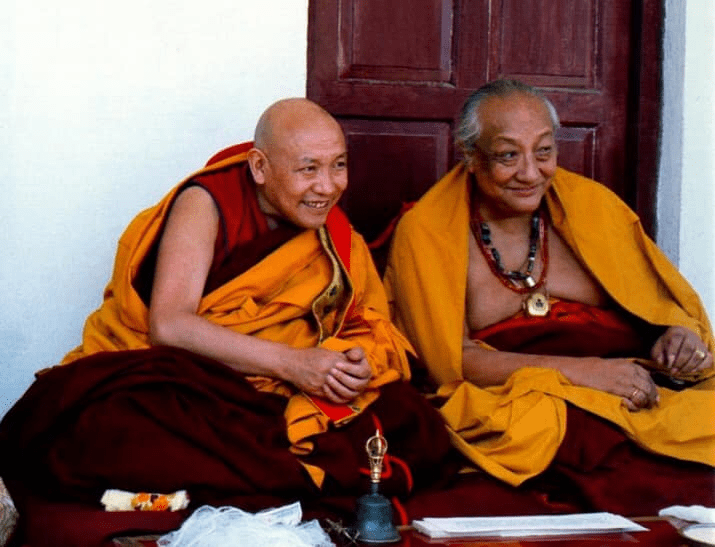
Dharma King Dilgo Khyentse Rinpoche (right) and his main Dharma heir, the Fifth Dharma King Trulshik Rinpoche (left)
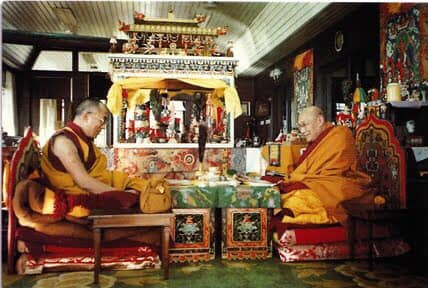
The Gelug sect’s Dalai Lama invited the Nyingma sect’s Dharma King Trulshik to transmit the supreme Dharma

At the Mindrolling Monastery, the dharma king engaged in extensive learning. He received all of the monk precepts from his precept masters Cuikenqiong Rinpoche and Mindrolling Kenqian Khyentse Norbu according to the “Formal Pronouncement on Precepts” lineage passed down from Laqian Qianba Lasa. Present-day dharma kings unanimously agree that H.H. Dharma King Trulshik is one of the most important lineage-holders of this lineage. H.H. Dharma King Trulshik holds three types of precepts that are on different levels: the Pratimoksa precepts, the Bodhisattva precepts, and the precepts for tantric masters. The dharma king is one who truly wears a golden precept robe. Not only does he abide by the precepts for monks, he also completely abides by all of the Hinayana, Mahayana, and Vajrayana precepts. That is why he deserves to be called a “holder of the Vajra Three Secrets Vows.” H.H. Dharma King Trulshik is the main transmitter of the monastic vows within the Nyingma lineage.

The dharma king has received teachings on the sutras and tantras, as well as other teachings. He has visited famous masters in many places to learn Buddha-dharma, including over thirty famous masters who belong to ancient and modern sects of esoteric Buddhism. The dharma king has studied all of the dharma teachings of these important lineages and has put them into practice. He still learns assiduously even after he completed a strict three-year retreat. Accepting the request of Zhachu Rinpoche, the dharma king became the khenpo of the Zhalong Dongga Qielin Monastery, where he is responsible for upholding, protecting, and spreading the dharma.

Throughout his whole life, the dharma king has wholeheartedly cultivated himself in retreat. Every day he abstains from speaking until 10:00 in the morning. Each year the dharma king goes into retreat in his own temple for as much as nine months. All of the great Tibetan rinpoches acknowledge that as a master of masters, the dharma king has the greatest abilities and power to clearly point out the way leading to realization of one’s original nature. That is why extremely virtuous masters send their capable disciples to the dharma king in order to seek teachings and empowerment.

H.H. Dharma King Trulshik has vast and profound learning. His practice is solid and flawless. He is unassuming and amiable. No one in today’s world can match his profound experience, training, and realization. Many practitioners of the various sects regard him as a venerable Dharma King Master with limitless wisdom and vast supernatural powers. H.H. Dharma King Trulshik has recognized the identities of the person who is the incarnation of H.H. Dharma King Dilgo Khyentse, the person who is the incarnation of H.E. Dharma King Tulku Ugyen, and persons who are incarnations of other important rinpoches. He has also transmitted dharma to and performed initiations for such people. The dharma king is a magnificent practitioner of the Great Perfection Dharma and a magnificent accomplished one in our current age. He is a model master of this century with disciples spread all over the world.

After H.H. Dharma King Trulshik saw who His Holiness Dorje Chang Buddha III Wan Ko Yeshe Norbu is through the limitless omniscience displayed in A Treasury of True BuddhaDharma, he stated that His Holiness Wan Ko Yeshe Norbu has reached the highest state of Buddhahood in the few-thousand-year history of Buddhism, having truly attained complete. Dharma King Trulshik wrote a respectful congratulation letter.

RESPECTFUL CONGRATULATIONS
His Holiness Buddha Vajradhara (Dorje Chang Buddha) Yangwo Wan Ko Yeshe Norbu:
I recently learned that the book about you, A Treasury of True BuddhaDharma, was published a long time ago. The content of that book includes
the traditional Tibetan five major vidyas and five minor vidyas. In terms of modern branches of learning, the book involves more than thirty different branches of learning. Thus, I entered samadhi and visualized the Three Jewels the Buddha, the dharma, and the sangha. I pervasively spread bodhicitta and
wished that all living beings would realize the supreme, absolute truth and
Buddhahood. May the propagation of A Treasury of True Buddha-Dharma be
the karmic condition whereby living beings in the three spheres leave the sufferings of reincarnation and obtain the fruit of wonderful happiness. It will become the cause whereby each sentient being who has descended into the abyss of the six realms of reincarnation leaves suffering and attains happiness.
I hereby specially convey my respectful congratulations!


Buddhist monk Ngawang Chokyi Lodro,
having the undeserved name of Khenpo
Zhalong Trulshik Shatrul
Written on the auspicious day of June 28, 2007

Link:https://peacelilysite.com/2025/01/16/brief-introduction-toh-h-dharma-king-trulshik/

Source: H.H. Dorje Chang Buddha III A TREASURY OF TRUE BUDDHA – DHARMA

The Meaning and Merits of “Life Release”

Embracing Compassion: The Day of Releasing Lives and the Teachings of H.H. Dorje Chang Buddha III

The practice of life release originates from Mahayana Buddhist scriptures and has been widely practiced in mainland China, Tibet, and also spread to Japan, Korea, Vietnam, and neighboring regions. The act of life release is rooted in the compassionate principle of equality among all beings and the karmic understanding of the cycle of birth and death. As the saying goes, “If you take half a pound from others, you will have to repay eight ounces.” Abstaining from killing while also practicing life release brings even greater merit, and there are countless historical accounts of miraculous responses and blessings resulting from such acts.

In Volume 4 of the Miscellaneous Treasures Sutra, there is a story about a novice monk and his teacher. The teacher foresaw that the novice monk would pass away within seven days and advised him to return to his family home, asking him to come back after seven days, without explaining why.

On his way home, the novice monk came across a broken pond, where water was flooding an anthill.

The ants were frantically trying to escape, but their speed was no match for the rushing water. Seeing that countless ants were about to drown, the novice monk used his robe to carry soil and blocked the breach in the pond, saving all the ants.

After seven days, the novice monk returned to his teacher. The teacher, upon seeing him alive, was astonished and asked what had happened during those days. Mistakenly thinking he was being accused of wrongdoing, the novice monk fearfully replied that he had done nothing. The teacher, being an Arhat, used his divine vision and discovered that the novice monk had performed a small yet significant act of kindness by saving the ants from drowning.

This single compassionate act altered the novice monk’s karmic fate, extending his lifespan and allowing him to live a long life until his natural passing.

The Profound Teachings Behind Life Release

The practice of releasing lives is deeply rooted in Buddhist scriptures:

  • The Chapter on the Practices and Vows of Samantabhadra states:
    “Living beings cherish their lives above all, and Buddhas cherish living beings above all. To save the lives of living beings is to fulfill the heartfelt wishes of the Buddhas.”
  • The Brahma Net Sutra on the Bodhisattva Precepts states: “If a disciple of the Buddha practices life release out of compassion, they should regard all men as their fathers and all women as their mothers, for in every life, they are born through them. Therefore, all beings in the six realms are like one’s own parents. To kill and eat them is akin to killing one’s parents or oneself. When witnessing the slaughter of animals, one should strive to protect and relieve them from their suffering. Furthermore, one should teach and explain the Bodhisattva Precepts, guiding and saving all sentient beings.”
  • The Sutra on Distinguishing the Origin of Good and Evil reveals:
    “The Buddha said: In this world, if one possesses a compassionate heart and refrains from killing, they will gain five blessings: longevity, physical well-being, freedom from harm, rebirth in the heavens, and a long life when returning to the human world. Those who live to a hundred years today owe it to their abstention from killing in past lives.”

These teachings emphasize that compassion is both a passive and active virtue. While refraining from killing is essential, taking proactive steps to save lives embodies the true spirit of Buddhist teachings.

October 29 marks the Day of Releasing Lives, a profound observance dedicated to the protection and liberation of living beings. This day calls for the nurturing of compassion, the accumulation of virtue, and the cultivation of good karma. Initiated in 2009 by H.H. Dorje Chang Buddha III, this practice symbolizes an enduring commitment to compassion and liberation. Following a major Buddhist event, H.H. Dorje Chang Buddha III designated this day as a global occasion for the compassionate release of captive lives, inspiring a tradition now embraced worldwide.

The 2024 Life Release Event: A Global Act of Compassion

This year, the H.H. Dorje Chang Buddha III Culture and Art Museum, in collaboration with the World Buddhism Association Headquarters, hosted a commemorative Dharma Assembly in Marina Del Rey, California. The event brought together esteemed holy gurus, eminent monks, and devout Buddhists from around the world.

Photo Courtesy: Joyce Lee | Vice President of World Buddhism Association Headquarters, Jiaozun Zhengda, presided over the Dharma Assembly on the Buddha-Stipulated Day of Releasing Lives.

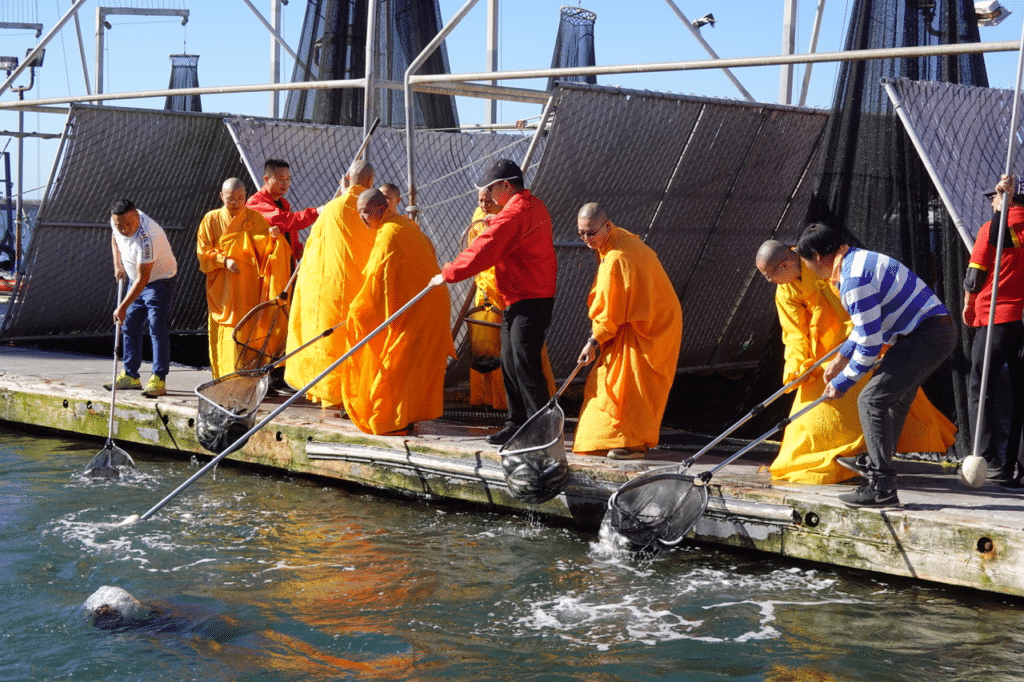
The gathering featured the release of thousands of fish back into the ocean, accompanied by the recitation of the Heart Sutra. Jiaozun Zhengda, Vice President of the World Buddhism Association Headquarters, led the prayers and delivered an inspiring address on the significance of the occasion. She emphasized the need for ongoing acts of compassion and the responsibility to protect living beings wherever and whenever they face suffering.

Jiaozun Zhengda explained that the practice of releasing lives arises naturally from the precept of refraining from killing. While refraining from harm is virtuous, actively saving lives elevates compassion to its highest form. This principle is at the heart of the teachings of Namo H.H. Dorje Chang Buddha III and Namo Shakyamuni Buddha.

Photo Courtesy: Joyce Lee | Hundreds of Buddhists from all over the world attended the Dharma Assembly of Releasing Lives.

Photo Courtesy: Joyce Lee | Participants released captive fish into the ocean

Participants shared profound reflections on the event. Watching the fish swim freely into the ocean became a moving symbol of resilience, freedom, and the boundless compassion of Buddhas and Bodhisattvas. For many, this practice reaffirmed their vows to live with kindness, respect all life, and emulate the selflessness of the Buddhas.

The Day of Releasing Lives is more than a symbolic gesture. It is a reminder that compassion knows no boundaries of time or space. Through the release of captive lives, Buddhists actively demonstrate their commitment to fostering a world of harmony and peace.

A Global Call for Compassion

As we observe the Day of Releasing Lives, let us remember that every act of compassion matters. By choosing to release lives, we contribute to a legacy of kindness that transforms our world. May this day inspire all of us to nurture compassion, protect life, and cultivate peace for the benefit of all beings.

For more information about the H.H. Dorje Chang Buddha III Culture and Art Museum and their compassionate initiatives, please visit https://www.wbahq.org/.

Link: https://peacelilysite.com/2024/11/07/the-meaning-and-merits-of-life-release/

Source: https://www.wbahq.org/reports-by-news-media/rm20241105/

#DorjeChangBuddhaIII #HHDorjeChangBuddhaIII  #Buddha Dipankara#FishRelease #Buddhism #HolyGurus#Rinpoches#Bodhisattva Avalokiteshvara#HolyMiraclesTemple#DvineTransformations #DharmaAssembly#ShakyamuniBuddha #H.H.DorjeChangBuddhaIIICultureandArtMuseum

Holy Miracles Temple: A Sanctuary of Compassion and Healing Amid Global Turmoil

Holy Miracles Temple, located at 1730 N. Raymond Ave., Pasadena, CA, serves as a sanctuary dedicated to teaching the true Dharma of the Tathagata, as transmitted by Namo H.H. Dorje Chang Buddha III and Shakyamuni Buddha, guiding disciples on their path to liberation and spiritual accomplishment. Grounded in the Buddha’s teachings and fueled by boundless compassion, the temple’s core mission is to selflessly serve humanity. Its hope is for people in America and across the globe to embrace Buddha Dharma, cultivating love for their country, fellow people, and the world. Through mutual support, peace, kindness, and auspiciousness, the temple envisions a strong nation with thriving citizens and a world brimming with joy and happiness.

In these challenging times, when suffering and catastrophe touch so many, Buddhism’s compassionate spirit calls us to extend blessings to all sentient beings. On October 13, 2024, the Holy Miracles Temple held a Blessing and Peace Dharma Assembly, a response to the unprecedented hardships the world faces today. Devoted Buddhist disciples gathered to honor the teachings of Namo Dorje Chang Buddha III, coming together to send prayers for healing and hope to those affected by natural disasters, conflicts, and upheavals. This assembly reaffirmed the Buddhist commitment to easing the suffering of all.

The event featured a solemn chanting of the Universal Gate Chapter of the Lotus Sutra, dedicated to Avalokitesvara Bodhisattva, the embodiment of compassion. The gathering was led by Abbess Ruzun Ruohui from Hua Zang Si Temple, who guided attendees through the prayers.

This year has been marked by profound global calamities. In the United States, Hurricane Helene ravaged Texas and Louisiana in August, displacing thousands and flooding communities. Just weeks later, Hurricane Milton unleashed further destruction in Florida and Georgia. Recovery efforts faced tremendous challenges as these back-to-back disasters left homes shattered and lives in turmoil.

In Asia, Typhoon Dindo devastated the Philippines, causing severe flooding and landslides across Luzon in September. Thousands of people were forced to evacuate as the typhoon submerged entire neighborhoods. Nepal, too, was struck by tragedy when a powerful earthquake hit in June, resulting in widespread destruction and loss of life in remote regions.

The war in Ukraine, continuing its escalation throughout 2024, inflicted further suffering on cities like Kyiv and Mariupol, leaving behind a deepening humanitarian crisis. Meanwhile, renewed violence in Syria once again brought bloodshed to war-torn cities such as Aleppo and Damascus, compounding the plight of its weary people.

Europe was not spared from disaster either, as record-breaking floods struck in July. Torrential rains overwhelmed parts of Germany and Belgium, causing rivers to overflow and submerging entire towns. Meanwhile, the United States’ western regions grappled with annual wildfires of increasing magnitude, destroying homes and forests alike.

During the Dharma Assembly at Holy Miracles Temple, attendees united in spirit and purpose. As the sacred verses of the Universal Gate Chapter resonated through the temple, the prayers reached out to those suffering from this year’s tragedies, seeking to bring healing and relief. Prayers were offered for the displaced, the injured, and those who had lost everything. In the face of conflict and war, the community gathered to extend peace, comfort, and hope to all those impacted.

This powerful assembly embodied the compassionate essence of Avalokitesvara Bodhisattva, radiating light and healing to all beings affected by suffering. It was a profound reminder that through shared compassion and collective action, we can create a world where all beings may find peace, healing, and joy.

Link:https://peacelilysite.com/2024/10/18/holy-miracles-temple-a-sanctuary-of-compassion-and-healing-amid-global-turmoil/

Source: https://cagazette.com/insights-from-the-blessing-and-peace-dharma-assembly-at-the-holy-miracles-temple/?fbclid=IwY2xjawGADEJleHRuA2FlbQIxMAABHSOFxdL9Y7OJSnH14qBxTQoBYe2QSzdXAI_yk56BTajnwGdAXcnXxCa7bQ_aem__GWuVw6xxEGleMzpPI9e5A

The Extraordinary Life of H.E. Xiazhu Qiuyang Rinpoche: A Master of Boundless Compassion and Wisdom

The most venerable H.E. Xiazhu Choying Rinpoche, also known as H.E. Xiazhu Qiuyang Rinpoche, is a highly accomplished Buddhist master from Guoluo, renowned for his spiritual achievements and mastery of Vajrayana teachings. Born in the winter of 1945, his birth was marked by extraordinary signs: thunder echoed across the sky, and colorful flowers blossomed spontaneously on the grasslands surrounding his birthplace. Many local herdsmen witnessed these rare and auspicious omens, heralding the arrival of an extraordinary being.

Renowned mantra master Regong, a revered monk, recognized the young child as the reincarnation of the venerable Chagailong Cichengdaji Rinpoche and the great master Naropa. From an early age, Rinpoche dedicated himself to the welfare of all sentient beings, living a life of simplicity and spiritual practice in the mountains. Throughout his life, H.E. Xiazhu Choying Rinpoche devoted himself to intense ascetic practice, receiving direct teachings from the supreme Vajrayogini and attaining profound realization. It is said that he could soar through the sky, using his monk robes as wings, a testament to his deep mastery of esoteric yoga.

At the age of fourteen, Rinpoche was ordained as a monk under the guidance of Xiari Huzuo Qintu Dannima. Over the years, he studied under more than 100 highly accomplished masters from all major Tibetan Buddhist schools, including:

  • H.H. the Tenth Panchen Lama and H.H. the Sixth Dharma King Gongtang Yongzeng from the Gelug sect.
  • H.H. Dodrupchen Rinpoche and Khenpo Mengse from the Nyingma sect.
  • Kanda Chiwa Gadan from the Sakya sect.
  • Lama Wangcai Kazhige from the Kagyu sect.
  • Jiana Bannan from the Jonang sect.

From these masters, H.E. Xiazhu Choying Rinpoche absorbed the essence of both exoteric and esoteric teachings. His spiritual journey led him to receive numerous secret mind-dharma teachings and unique empowerments, passed down without reservation, like water flowing freely from a vessel.

Rinpoche spent much of his life wandering through remote mountains and plains, sleeping in caves, eating cold rice and vegetables gathered from alms, and wearing discarded clothing. He lived humbly, indifferent to worldly praise or criticism, appearing at times like a wandering madman. For 25 years, he did not speak a single word, dedicating himself entirely to the practice of the Dharma, undisturbed by the distractions of the world. His rigorous practice took him to numerous sacred sites across Tibet, Qinghai, and India, where he engaged in solitary retreat, including seven years of intense meditation at a holy site in India.

Through these practices, Rinpoche achieved profound realization in the Dakini Dharma, the Great Perfection (Dzogchen) teachings, Kalachakra Vajra Dharma, and Green Tara Dharma. His deep connection with Vajrayogini from a young age allowed him to access highly secret dakini teachings. Buddhist masters of great virtue have recognized H.E. Xiazhu Choying Rinpoche as the true reincarnation of the great master Naropa, revered as the “venerable leader of 100,000 dakinis.”

In a historic event, the International Buddhism Sangha Association conducted an unprecedented Drawing Lots From a Golden Vase Ceremony, drawing one lot from 120 sealed lots. This ceremony affirmed that H.E. Xiazhu Choying Rinpoche is indeed the reincarnation of Patriarch Naropa, a recognition that had been previously confirmed by H.H. Dorje Chang Buddha III.

H.E. Xiazhu Choying Rinpoche has been praised by numerous revered masters, including H.H. the Tenth Panchen Lama, H.H. Dharma King Yongzeng, and H.H. Dharma King Jigme Phuntsok. Xiaridong Rinpoche, a master of the Yamantaka Dharma, described him as “a truly great master of the Dakini Dharma,” while H.H. Dharma King Jigme Phuntsok hailed him as “an extremely rare master who has perfected the Four Initiations Dharma.”

Despite his vast accomplishments, H.E. Xiazhu Choying Rinpoche remains humble and approachable, freely exercising his supernatural powers without attachment. Known for miraculous feats such as flying, multiplying his body, walking underwater, understanding multiple languages, foreseeing disasters and blessings, and reading people’s minds, Rinpoche is revered as “the unhindered rinpoche.” Clothing and personal items that Rinpoche has worn or used are said to be imbued with miraculous blessings. Many Tibetans have reported turning disasters into blessings, surviving dangerous situations, or recovering from serious illnesses after wearing or ingesting a small piece of his monk’s robe.

H.E. Xiazhu Choying Rinpoche’s legendary life and accomplishments have been widely recorded, including in books such as Holy Cultivation and Its Marvelous Fruits and Biographies of Ten Major Disciples of Dharma Kings. In Tibet, particularly in the Amdo region, almost everyone knows of his miraculous deeds. His life stands as a beacon of inspiration and a model of Dharma practice in this world of five defilements.

This image has an empty alt attribute; its file name is image-8.png

Upon reading A Treasury of True Buddha-Dharma, H.E. Xiazhu Choying Rinpoche immediately recognized H.H. Wan Ko Yeshe Norbu as the primordial Dorje Chang Buddha, the highest Buddha in Buddhism. His realization corroborated the recognition of other great holy dharma kings. H.E. Xiazhu Choying Rinpoche offered his heartfelt congratulations in a respectful letter, further acknowledging the sacred truth.

To the Most Revered and Holiest Wish-Fulfilling Jewel Dharma King:

I have learned that A Treasury of True Buddha-Dharma, is a sacred text about His Holiness, the supreme and most honored H.H. Dorje Chang Buddha III, is soon to be distributed worldwide. This book contains the highest, authentic Dharma that brings immense benefit to all sentient beings.

Master Dodrupchen, who is universally recognized as the second Guru Padmasambhava and the highest holy being within Tibetan esoteric Buddhism, expressed his astonishment in his formal congratulations. He praised the accomplishments of the Holiest Wan Ko Wish-Fulfilling Jewel Dharma King as truly extraordinary—unimaginable and miraculous, transcending the ordinary. These achievements express both the describable and indescribable absolute truth of the Buddha-Dharma.

We shall proclaim and praise the accomplishments of His Holiness throughout the Dharma realm. We express our deepest gratitude to His Holiness, the ancient Buddha, for His boundless and great compassion in coming to this world once again to benefit all sentient beings!

Xiazhu Qiuyang Rinpoche
May 1, 2007

▲那諾巴祖師轉世的夏珠秋楊敬賀第三世多杰羌佛成就之原函(楊宜翻攝自《多杰羌佛第三世》正法寶典)
▲Original congratulatory letter from Xiazhu Choying in Tibetan

#DorjeChangBuddhaIII #HHDorjeChangBuddhaIII  #MasterWanKoYee #Buddha#HuaZangSi#InternationalBuddhismSanghaAssociation#IBSA#WorldBuddhismPublishingLLC#WorldDharmaVoice #XiazhuQiuyangRinpoche #Tibetan #EsotericBuddhism

Link:https://peacelilysite.com/2024/10/16/the-extraordinary-life-of-h-e-xiazhu-qiuyang-rinpoche-a-master-of-boundless-compassion-and-wisdom/

Source: https://www.tpcdct.org/article/1327#detail

Dharma Assembly Celebrates the Birthday of Namo Dipankara Buddha at The Holy Miracles Temple

On Sunday, September 22, 2024, The Holy Miracles Temple in Pasadena hosted the grand “Dharma Assembly to Welcome the Birthday of Namo Dipankara Buddha.” This auspicious event was co-organized by the World Buddhism Association Headquarters, The Holy Miracles Temple, and the Saint Grong Lecture Hall. The assembly was led by the abbot of Hua Zang Si, Venerable Ru Hui Ru Zun, a Holy Virtuous One of Gold Button Level 1, who presided over the sacred ceremonies.

Namo Dipankara Buddha, a revered incarnation of Namo Dorje Chang Buddha, holds a special place in the hearts of Buddhist disciples. In ancient times, he prophesied that Shakyamuni Buddha would one day attain enlightenment and become a Buddha. The site of the “Dipankara Buddha Hall” at The Holy Miracles Temple is significant—it marks the location of the first-ever publication of The True Meaning of the Heart Sutra as Expounded by H.H. Dorje Chang Buddha III, where profound teachings of the Buddha were revealed.

A particularly memorable moment in this location occurred on March 7, 2014, during a Dharma assembly when a miraculous event unfolded. Buddha descended from the sky, manifesting in a divine form, blessing the gathering with three-colored nectar—a clear and undeniable testament to the authenticity of the teachings in Expounding the Absolute Truth through the Heart Sutra. Following this sacred event, the Dipankara Buddha Hall was constructed on this blessed site, where devotees from all directions come to light lamps and offer their reverence to the Buddha.

This year’s Dharma assembly began with great reverence in the Grand Hall, filled with the solemn chanting of Buddhist hymns. Under the guidance of Venerable Ru Hui Ru Zun and the monastic community, participants respectfully recited the Diamond Sutra, bowed to the Buddha, performed repentance, and conducted a grand offering before the Buddha. The assembly’s merits were dedicated to celebrating the Buddha’s birthday, with the intention to increase the blessings and wisdom of all beings, dispel ignorance and darkness, and bring forth prayers for world peace, national prosperity, and a harmonious society.

The Dharma assembly invited Venerable Ru Hui Ru Zun, the abbess of Hua Zang Si and a Holy Virtuous One, to preside over the ceremony

During an interview, Venerable Ru Hui Ru Zun shared the origin of the Buddha’s name: “The name ‘Namo Dipankara Buddha’ comes from the illumination that surrounded Him at birth, shining like a lamp. Today, we light lamps, chant scriptures, and offer prayers, hoping to bring the light of the Dharma to the world, and to bless humanity with peace and auspiciousness.”

The assembly also brought touching personal reflections. Ms. Tam, a long-time attendee, shared, “Every year, our family lights the annual offering lamp at the Dipankara Buddha Hall. It has brought us great blessings, and everything in our lives has been smooth and auspicious.” Benjamin Hong reflected on his family’s deeper connection to Buddhism: “When my uncle was diagnosed with cancer, our family sought ways to help him. This journey led us to encounter the true teachings of the Tathagata. Through the teachings of Namo Dorje Chang Buddha, we gained a profound understanding of what Buddhism truly is. It was this experience that helped our family through the toughest times and brought us to the path of Buddhism.”

At the conclusion of the Dharma assembly, Venerable Ru Hui Ru Zun blessed the congregation by sprinkling holy water for empowerment

This Dharma assembly beautifully honored the legacy of Namo Dipankara Buddha. It served as a living bridge between ancient wisdom and the contemporary aspirations of the Buddhist community, uniting all participants in a shared vision of enlightenment, peace, and harmony for the world.

Link:https://peacelilysite.com/2024/10/02/dharma-assembly-celebrates-the-birthday-of-namo-dipankara-buddha-at-the-holy-miracles-temple/

A Han Chinese Scholar’s Quest for the True Tibetan Dharma

The Extraordinary Journey of Losang Phuntsok Rinpoche

Losang Phuntsok Geshe, known by his Chinese name Xing Suzhi, was born in 1916 in Nanjing into a family deeply rooted in the Buddhist tradition. His spiritual journey began early; he embraced Buddhism at the age of nine and, by sixteen, had enrolled in the Sino-Tibetan Buddhist Institute in Chongqing, Sichuan. Here, he studied Tibetan, laying the foundation for his future studies in Tibet. That same year, he became the secretary to Master Taixu, one of the most prominent modern Buddhist scholars, who bestowed upon him the Dharma name Bison.

During his time at the Sino-Tibetan Buddhist Institute, Losang Phuntsok studied under Master Taixu and Master Fazun. His studies were deep and rigorous, focusing on key scriptures such as the Śūraṅgama Sūtra and Cheng Weishi Lun. He also diligently organized and recorded Master Taixu’s lectures. Both Master Taixu and Master Fazun held Tibetan esoteric Buddhism in high regard, especially the Amrita Dharma, a teaching said to have been revealed by the Buddha himself. This Dharma, they believed, was immensely powerful and rare, capable of revealing the true nature of reality, bestowing the six spiritual powers, and leading to liberation from the cycle of life and death. The Amrita blessing was also said to grant longevity, health, and the accumulation of merit and wisdom.

Inspired by these teachings, Losang Phuntsok embarked on a journey to Tibet in 1937, determined to seek the highest Vajrayana teachings, including the elusive Amrita Dharma. His journey was fraught with challenges, but he was resolute in his quest. He sought out eminent monks and scholars across the Kham and Tibetan regions, studying over 300 different Sakya teachings. His goal was to become a modern-day Tang Sanzang, the legendary monk who brought Buddhist teachings from India to China, and to bring the esoteric teachings of Tibet back to his homeland.

After seven years of intense study and practice, Losang Phuntsok Rinpoche achieved a historic milestone. In the first month of 1945, he passed the ten-thousand-person debate examination hosted by the Regent of Tibet at Drepung Monastery in Lhasa, becoming the first Han Chinese to obtain the highest degree in Tibetan Buddhism, the Lharampa Geshe. This degree, equivalent to a doctorate in Buddhist studies, is highly respected within Tibetan Buddhism and is recognized by both the government and the people.

Losang Phuntsok Rinpoche spent many years in Tibet, receiving over 600 empowerments and learning from many great masters. However, the Amrita Dharma, the teaching he had long sought, remained elusive. Many masters told him that this profound teaching was extremely difficult to find and that it might take many years for a great holy being to appear who could transmit it. Despite this, Losang Phuntsok Rinpoche remained undeterred. Over the decades, he traveled to Hong Kong, the United States, and other places around the world, translating and lecturing on scriptures, teaching disciples, and continuing his search for enlightened masters. He once served as the President of the American Vajrayana Buddhist Association.

In 1997, after years of searching, Losang Phuntsok Rinpoche’s efforts bore fruit. He formally became a disciple of H.H.  Dorje Chang Buddha III in Chengdu, recognizing Him as his root guru. H.H.  Dorje Chang Buddha III performed empowerments and transmitted teachings to him, manifesting the mandalas of the deities each time He transmitted a Dharma. Losang Phuntsok Rinpoche witnessed these sacred phenomena firsthand, which deeply moved him.

During an interview in Chengdu, he expressed his profound realization: “I have been practicing Buddhism for 60 years and have met over a hundred so-called great masters of Tibetan Buddhism. I also spent a long time with Chinese Buddhist masters like Master Taixu. I have received more than 600 empowerments from great masters like Fazun, but none of these empowerments have had the impact and blessing power on me like the ones I received today. The teachings and empowerments from the Master (H.H.  Dorje Chang Buddha III) are so effective that I can’t help but think: my 60 years of Buddhist practice are not as valuable as this one day. Sixty years have passed in vain, not as meaningful as today!”

In June 2000, during an extraordinarily auspicious moment that occurs only once in countless eons, Losang Phuntsok Rinpoche, the only living Han Chinese Lharampa Geshe celebrated worldwide and the President of the American Vajrayana Buddhist Association, participated in a highly significant Dharma assembly. He attended this event along with other world-renowned high monks and elders, including Elder Master Wuming, the President of the World Buddhist Sangha Council, and Elder Master Yizhao, the Dharma heir of the Venerable Xu Yun. This Dharma assembly was personally presided over by H.H.  Dorje Chang Buddha III, the highest Buddhist leader in the world today.

During the event, Losang Phuntsok Rinpoche not only witnessed the sacred phenomenon of the Amrita descending but also personally tasted the Amrita. He felt an unparalleled sense of comfort throughout his entire body. Deeply moved and excited, he expressed that at the age of 85, after spending more than a decade in Tibet and having taken many great masters as teachers, he had never been able to receive the Amrita. He never expected that his wish would finally be fulfilled upon meeting H.H.  Dorje Chang Buddha III. He personally witnessed two rays of red light entering the bowl and transforming into Amrita, fulfilling a wish that had eluded him during his many years of seeking in Tibet.

In February 2001, at the request of his Buddhist disciples, Losang Phuntsok Rinpoche once again taught the Lamrim (Stages of the Path to Enlightenment) by the great master Tsongkhapa of the Gelug school of Tibetan Buddhism and organized his lecture notes for future publication. When he completed the translation of the Lamrim and submitted it to H.H.  Dorje Chang Buddha III for review, H.H.  Dorje Chang Buddha III performed a Dharma practice on the spot, inviting the Dharma-protecting Bodhisattvas to the mandala. Losang Phuntsok Rinpoche personally requested guidance from the Dharma protectors, who responded that it would indeed be best for H.H.  Dorje Chang Buddha III to revise the text. Losang Phuntsok Rinpoche remarked that Dorje Chang Buddha III’s Dharma practice was so powerful that the Dharma-protecting Bodhisattvas appeared immediately, allowing him to seek their guidance directly with his own eyes. He acknowledged that no one else in the world possesses such remarkable spiritual realization.

The photo above shows Losang Phuntsok Geshe in Chengdu, Sichuan, taking refuge in H.H.Dorje Chang Buddha III as his master. The photo below shows H.H.Dorje Chang Buddha III performing an empowerment for Losang Phuntsok Geshe in the United States.
Master QinDing taking refuge in H.H.Dorje Chang Buddha III as his master

Great monks and virtuous masters do not wish to let their lives pass in vain. They understand the rarity of human life, the difficulty of pursuing the Dharma, and the challenge of attaining the path to liberation. For these great monks and virtuous masters, the Dharma is not merely empty Buddhist theory or superficial titles of lineage. They deeply understand that whoever can truly demonstrate supreme realization, manifesting responses across the three realms, mastering both the exoteric and esoteric teachings, and thoroughly comprehending the Five Vidyas, represents the true Dharma of the Tathagata. Therefore, they willingly bow down and take refuge in the true incarnation of the primordial Buddha, Vajradhara H.H. Dorje Chang Buddha III.

Link:https://peacelilysite.com/2024/08/09/a-han-chinese-scholars-quest-for-the-true-tibetan-dharma/

Source: https://www.sohu.com/a/680523900_121687414

In Commemoration of the Holy Birthday of Avalokitesvara Bodhisattva, Dharma Assembly Unites Buddhists in Pasadena

To honor the Holy Birthday of Avalokitesvara Bodhisattva, Buddhists and local residents converged at the Holy Miracles Temple in Pasadena, California, for the Avalokitesvara Bodhisattva Dharma Assembly. Held on March 17, 2024, within the Sakyamuni Buddha Hall, this event was a collaborative effort between the World Buddhism Association Headquarters, Holy Miracles Temple, and Sanger Mission.

Presided over by the Abbess of the Hua Zang Si Temple, Ruzun Ruohui, and jointly guided by Dharma Master JueHui and Dharma Master MiaoKong, the assembly brought together a congregation of holy gurus, eminent monks, dedicated monastics, and others. Their shared purpose was to pay homage to Avalokitesvara Bodhisattva, whose boundless compassion and loving kindness have been a beacon of hope for countless beings throughout the ages. 

In Commemoration of the Holy Birthday of Avalokitesvara Bodhisattva, Dharma Assembly Unites Buddhists in Pasadena

The Avalokitesvara Bodhisattva Dharma Assembly was held in the Sakyamuni Buddha Hall of Holy Miracles Temple.
Photo Courtesy: Joyce Lee

Avalokitesvara Bodhisattva, also known as Guan Shi Yin Bodhisattva in Chinese, is revered for profound compassion and unwavering commitment to alleviating the suffering of all sentient beings. According to Buddhist scriptures, Avalokitesvara Bodhisattva attained Buddhahood eons ago and is known as Zheng Fa Ming Ru Lai, the Correct Dharma Realization Tathagata. Through sacred vows and bodhicitta, the Correct Dharam Realization Tathagata manifests as a Bodhisattva to extend aid to those in need and save sentient beings from suffering. Avalokitesvara Bodhisattva expounded one of the most influential Buddha Sutras – “The Prajna Paramita Heart Sutra,” which encapsulates the profound wisdom of the Buddha, illustrating the meaning of prajna.

While honoring Avalokitesvara Bodhisattva’s great compassion, sovereign wisdom, profound power, and benevolence, the assembly also reflected on the significance of bodhicitta, as elucidated by H.H. Dorje Chang Buddha III in the Sutra – “What is Cultivation.” He imparted, “The broad meaning of bodhicitta encompasses all of the Mahayana Dharma related to saving living beings out of great compassion and the causes leading to attaining the stages of enlightenment of a Bodhisattva.” This essence of conduct rooted in compassion deeply resonated with the attendees, reinforcing their dedication to selflessness and enlightenment. 

The assembly witnessed the recitation of passages from “The Lotus Sutra’s Universal Gate Chapter on Avalokitesvara Bodhisattva,” a revered text extolling the virtues and profound wisdom of Avalokitesvara Bodhisattva. Participants engaged in practices such as meal offerings to the Buddhas, seeking blessings for happiness, auspiciousness, and the enhancement of fortune and wisdom. The gathering also collectively expressed their aspirations for the endurance of world peace, the cessation of calamities, while invoking prosperity, good health, and longevity for all.

As incense wafted through the temple and chants echoed in the halls, attendees were reminded of the profound teachings of compassion and empathy advocated by Avalokitesvara Bodhisattva. The ceremony served as a reminder of the transformative power of faith, uniting individuals from all walks of life in celebration of the Dharma.

Link:https://peacelilysite.com/2024/04/03/in-commemoration-of-the-holy-birthday-of-avalokitesvara-bodhisattva-dharma-assembly-unites-buddhists-in-pasadena/

Source: https://usreporter.com/in-commemoration-of-the-holy-birthday-of-avalokitesvara-bodhisattva-dharma-assembly-unites-buddhists-in-pasadena/?fbclid=IwAR1_ZsMbU5EVdHTB4vs3-N5rxvYPDAyp1yau1Q2yzlR7muGBUg8T34Df5ks_aem_AaJlydz4lJZkOOrnb9SbNs3AvRoEj8k7_mqFFoKYsQDZwiLLe6Rq426dYKN-i1Tm0LtTahh5Y8RLfTYXwOU31LBW

A Bhikkhuni Who Appears Once in a Century

Venerable Shi ZhengDa Jiaozun

Throughout the ages, in the pursuit of happiness, countless individuals have renounced worldly life to engage in spiritual practice. Monks and nuns who have shaved their heads and taken vows can be seen wandering in the secular world. People become monastics for various reasons, including pressure from material needs, family discord, social conflicts, life hardships, or a desire to seek liberation from the suffering of birth, aging, sickness, and death. Some renounce the worldly life to transcend desires, cultivate spiritual practices, and embark on the path to enlightenment. However, those who renounce a life of wealth, family, and worldly pleasures to become monastics are extremely rare.

Modern figures like Venerable Xuyun, Master Hongyi, Master Nenghai, and Master Longlian are typical examples of genuine monastics. Their renunciation was wholeheartedly directed towards the Buddha, without worldly attachments. When they made the decision to become monastics, their minds were solely focused on Buddha and Bodhisattvas, despite their flourishing family lives, prosperity, talents, and widespread respect. They left their homes without any attachments, not even informing their families. Suddenly, they abandoned their comfortable lives and became ascetics in the temples. Such individuals are rare, occurring perhaps once in several decades.

However, today, there is a Bhikshuni (Buddhist nun) who has renounced the world in an extraordinary way, captivating people’s hearts. She was originally known as Renbo Rinpoche, with the Dharma name “Awangdeji,” and held some reputation in Chinese Buddhist circles. She had centers in over twenty provinces in China, and her organization had a presence in Taiwan and Hong Kong. Wherever she went, male and female disciples welcomed her with reverence. Despite her prosperous personal business, she decided to renounce her worldly life.

Twenty years ago, she practiced the Sakya tradition but found no progress in her path. Seeking guidance, she turned to the profound teachings of the H.H. Dorje Chang Buddha III. Within a year, she completed her studies and realized that her previous practice was a common worldly path accessible to everyone, not true Buddhist teachings. In 2011, after rigorous examinations, she obtained certificates of realization that many other high lamas could not attain.

Her dedication, compassion, and influence attracted jealousy and rumors from some ordinary practitioners. However, Awangdeji Rinpoche bore no resentment, remaining calm and patient, even praising those who spread rumors. In response to societal criticisms, the International Buddhist Sangha Association sought an objective assessment from the United International World Buddhist Headquarters. After a solemn examination, she was praised by seventeen examiners for her moral virtues and realization.

During the examination, when Awangdeji Rinpoche’s consciousness soared, she personally saw Buddhas and Bodhisattvas, fulfilling a vow made to Avalokiteshvara. Overwhelmed with gratitude, she immediately renounced worldly life. Without her family’s knowledge, she underwent tonsure in Lianfeng Temple, Taiwan, adopting the Dharma name “Zhengda.” She relinquished all worldly wealth and family joy, untainted by the six dusts, transcending the ordinary and entering the realm of the holy.

On December 12th, 2012, a Assembly was held to bestow the initiation of “Selection Made in Dark Confinement from One-Hundred Dharmas to Choose the Door toward Enlightenment” upon Dharma Master Zhengda. This Assembly concluded that Dharma Master Zhengda was a reincarnated holy one and a trusted aide of the Tara. Her status of the dharma was extremely high, at the upper level representing the summit of esoteric Buddhism.
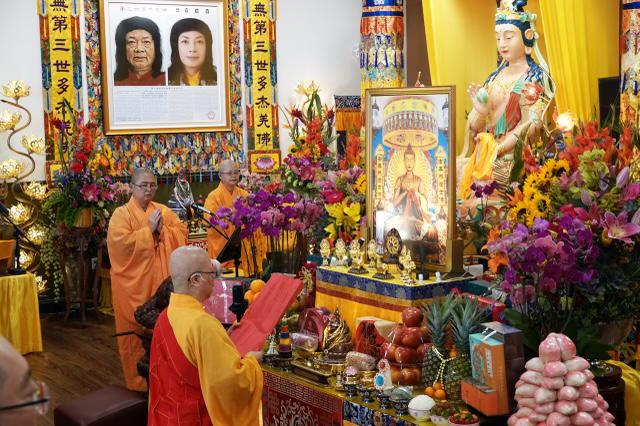
On May 25, 2013, Master Zhengda was honored with the Grand Cross of Humanitarian Merit by the Spanish Humanitarian Merit Association. This award, established and presented by the association, is specifically given to international figures who have made outstanding contributions to promoting world peace, advocating for humanitarian equality, and excelling in public administration, education, arts, charity, and other fields.

After receiving the sacred inner tantric initiation from H.H.  Dorje Chang Buddha III, she experienced a remarkable transformation, surpassing ordinary spiritual attainments and delving into profound realms. The International World Buddhist Headquarters at October 25th, 2019 officially acknowledges her as a JiaoZun (Golden Button Stage II), having successfully passed examination conducted and validated by about twenty buddhist masters and monastics. She stands as an embellishment to Buddhism, a virtuous teacher, and a refuge for sentient beings.

ZhengDa Jiaozun is currently the Vice President of the World Buddhist Headquarters, concurrently serving as the Honorary Chairman of the International Buddhist Sangha and the abbot of many temples worldwide. Presently, she resides at the Holy Miracle Temple in Los Angeles and the Benevolence Temple in Las Vegas.

A Bhikkhuni Who Appears Once in a Century

Link:https://peacelilysite.com/2024/02/01/a-bhikkhuni-who-appears-once-in-a-century/

#Buddha ##HHDorjeChangBuddhaIII #DorjeChangBuddhaIII #BuddhaDharma #MasterZhengDa #EsotericBuddhism#InternationalWorldBuddhistHeadquarters

The International Buddhist Headquarters hosted a Globally Renowned and Extensive Seminar titled “Buddhism, Buddhist Studies, and Buddhist Dharma: Distinguishing Right from Wrong”

In today’s world, where the distinction between authentic and counterfeit Buddhism has become blurred, and false teachings and deceptive individuals are proliferating, influential monks and virtuous figures advocated strongly for the International Buddhist Headquarters to organize a conference involving distinguished Buddhist institutions worldwide. The objective was to discern the genuine from the spurious and establish the truth. This conference was eventually convened on May 6th, 2000, in Taiwan and concluded on May 12th.

The International Buddhist Headquarters stands as the preeminent institution in the realm of Buddhism. Given the prevalent influence of biased and misguided individuals within the Buddhist community, and the dearth of accomplished practitioners who have genuinely practiced and realized the authentic Dharma, much of the teachings provided to followers remain confined to theoretical realms. While many profess expertise in Buddhism and Buddhist Studies, true exemplars of adept masters in the Buddhist teachings are seldom encountered. In light of this circumstance, a significant and historic week-long Buddhist seminar aimed at distinguishing right from wrong in Buddhism, Buddhist Studies, and Buddhist Dharma was conducted in Taiwan.

Representatives from diverse Buddhist organizations across the globe were extended invitations, including the International Buddhist Sangha Association, the American Buddhist Association, the United International Buddhist Association, the World Buddhist Sangha Association, the American Esoteric Buddhism Association, the International Diamond Sutra Association, and more. More than two thousand eminent monks and virtuous practitioners hailing from both Exoteric and Esoteric traditions participated in this event.

Delegates from 28 countries took part in this event, representing national-level Buddhist societies, associations, related temples, and Buddhist research institutions. More than two thousand esteemed monks from around the world attended this international conference. After thorough scrutiny and evaluation, several prominent figures came under serious examination. Notably, six individuals underwent open judgments and deliberations, with representatives from various nations engaging in discussions that ultimately led to resolutions.

The conclusions drawn from these deliberations affirmed that Li Hongzhi, Zhang Hongbao, Qinghai, and Song Qili are advocates of cults. Their interpretations of Buddhist teachings diverge entirely from the canonical sutras of Buddha. These individuals not only selectively extract passages and blur distinctions between right and wrong, but also display a deficiency in grasping fundamental principles and an absence of profound insight into the core Buddhist scriptures. Their teachings are entirely self-contrived, misleading the public, and lack substantial evidence of authentic accomplishment.

Moreover, subsequent to an evaluation and discussions revolving around recorded teachings and videos of Mr. Yi Yungao (comprising 2953 audio tapes and 137 video tapes), in addition to his written works, high-ranking monks from various nations concurred that Mr. Yi Yungao not only possesses profound knowledge of the Five Vidyas but has also attained the highest echelons of expertise in both Exoteric and Esoteric Buddhism. A unanimous consensus was reached, acknowledging Mr. Yi Yun Gao as the truly deserving Grand Dharma King.

However, it became evident from Mr. Yi’s own teachings that he modestly regards himself as an ordinary practitioner, akin to everyone else, merely a dedicated worker within the Sangha. His exceptional virtues and extensive erudition gained widespread agreement among the attendees. The conference officially conferred upon Mr. Yi Yun Gao the esteemed title of Authentic Buddhist Grand Master. Mr. Shen Jia Zhen’s teachings were found to be fundamentally aligned with the doctrines, and as such, he was bestowed with the title of “Good Knowledgeable Teacher.”

The conference approached its subject matter with a solemn and impartial stance, subjecting it to rigorous scrutiny and critical analysis in order to discern between genuine Buddhism and spurious doctrines. In a landscape populated by counterfeit monks and fabricated living Buddhas, peddling misleading Buddhist teachings that lead to a deprivation of wisdom and vitality, the conference sought to establish a clear demarcation between authenticity and deceit. The comprehensive assessment culminated in the resounding recognition of Mr. Yi Yungao as a bona fide Buddhist master of authentic teachings, earning him the highest accolades and cementing his status as a true Dharma King. The conference wholeheartedly acknowledged his profound accomplishments, recognizing him as a genuine benefactor to sentient beings, guiding them on the path to liberation.

In 2008, a significant revelation emerged when Master Yi Yungao, renowned as the Great Dharma King Wan Ko Yeshe Norbu, had his true identity unveiled within the pages of the treasure book titled “H.H. Dorje Chang Buddha III“. This revelation marked a pivotal moment as it confirmed that the Great Dharma King was, in fact, the third incarnation of the primordial and highest Buddha in the dharma realm, known as Dorje Chang Buddha. The authenticity of His Holiness’ identity was solidified through the endorsement of official written documents, which were issued by esteemed leaders, regent dharma kings, and eminent rinpoches from various major Buddhist sects across the globe.

The International Buddhist Headquarters hosted a Globally Renowned and Extensive Seminar titled “Buddhism, Buddhist Studies, and Buddhist Dharma: Distinguishing Right from Wrong”

Link:https://peacelilysite.com/2023/08/11/the-international-buddhist-headquarters-hosted-a-globally-renowned-and-extensive-seminar-titled-buddhism-buddhist-studies-and-buddhist-dharma-distinguishing-right-from-wrong/

#InternationalBuddhistHeadquarters#DorjeChangBuddhaIII#HHDorjeChangBuddhaIII#DorjeChangBuddha#Buddha#MasterWanKoYee #Yiyungao #GreatDharmaKingWanKoYesheNorbu #Taiwan #Buddhism #BuddhistStudies #BuddhistDharma

Source: https://cultivationdharma.com/cn/%E4%B9%89%E4%BA%91%E9%AB%98-%E6%AD%A3%E6%95%99%E9%82%AA%E6%95%99%E7%A0%94%E8%AE%A8%E4%BC%9A