In early Buddhism, an arhat (Sanskrit) or arahant (Pali) — “worthy one” or “perfected one” — was the highest ideal of a disciple of the Buddha. He or she was a person who had completed the path to enlightenment and achieved nirvana. In Chinese, the word for arhat is lohan or luohan.
“There is no more worldly existence for the wise one who, like the earth, resents nothing, who is firm as a high pillar and as pure as a deep pool free from mud. Calm is his thought, calm his speech, and calm his deed, who, truly knowing, is wholly freed, perfectly tranquil and wise.” [Verses 95 and 96; Acharya Buddharakkhita translation.]
In early scriptures, the Buddha is sometimes also called an arhat. Both an arhat and a Buddha were considered to be perfectly enlightened and purified of all defilements. One difference between an arhat and a Buddha was that a Buddha realized enlightenment on his own, while an arhat was guided to enlightenment by a teacher.
In the Sutta-pitaka, both the Buddha and arhats are described as being perfectly enlightened and free from fetters, and both achieve nirvana. But only the Buddha is the master of all masters, the world teacher, the one who opened the door for all others.
As time went on, some early schools of Buddhism proposed that an arhat (but not a Buddha) might retain some imperfections and impurities. Disagreement over the qualities of an arhat may have been the cause of early sectarian divisions.
The Arahant in Theravada Buddhism
Today’s Theravada Buddhism still defines the Pali word arahant as a perfectly enlightened and purified being. What, then, is the difference between an arahant and a Buddha?
Theravada teaches there is one Buddha in each age or eon, and this is the person who discovers the dharma and teaches it to the world. Other beings of that age or eon who realize enlightenment are arahants. The Buddha of the current age is, of course, Gautama Buddha, or the historical Buddha.
The Arhat in Mahayana Buddhism
Mahayana Buddhists may use the word arhat to refer to an enlightened being, or they may consider an arhat to be someone who is very far along the Path but who has not yet realized Buddhahood. Mahayana Buddhist sometimes use the word shravaka — “one who hears and proclaims” — as a synonym for arhat. Both words describe a very advanced practitioner worthy of respect.
Legends about sixteen, eighteen, or some other number of particular arhats can be found in Chinese and Tibetan Buddhism. It is said these were chosen by the Buddha from among his disciples to remain in the world and protect the dharma until the coming of Maitreya Buddha. These arhats are venerated in much the same way Christian saints are venerated.
Arhats and Bodhisattvas
Although the arhat or arahant remains the ideal of practice in Theravada, in Mahayana Buddhism the ideal of practice is the bodhisattva — the enlightened being who vows to bring all other beings to enlightenment.
Although bodhisattvas are associated with Mahayana, the term originated in early Buddhism and can be found in Theravada scripture as well. For example, we read in the Jataka Tales that before realizing Buddhahood, the one who would become the Buddha lived many lives as a bodhisattva, giving of himself for the sake of others.
The distinction between Theravada and Mahayana is not that Theravada is less concerned with the enlightenment of others. Rather, it has to do with a different understanding of the nature of enlightenment and the nature of the self; in Mahayana, individual enlightenment is a contradiction in terms.
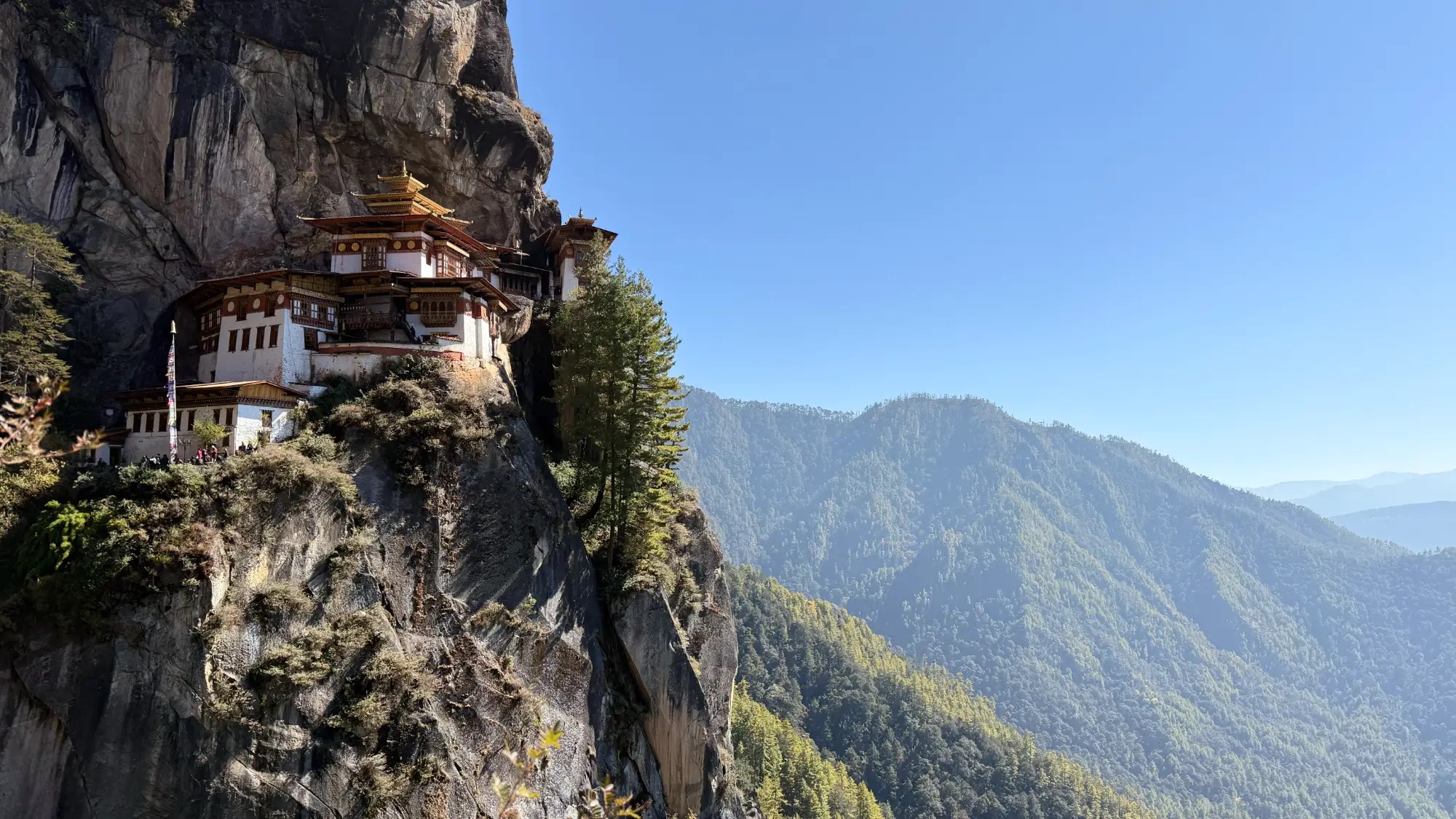
The goal of the ascent in sight: Taktsang Monastery is perched high on the steep cliff face
On a pilgrimage to holy places, one rarely follows a rigid plan. Rather, one engages with a flow of events. Our last days in Bhutan reminded us how valuable it is to let go of expectations. We learned that special doors often open exactly when one is ready to leave the original path.
Change of Plans in Punakha: Trusting the Flow of Things
The sixth day showed us this very clearly. Actually, we had a fixed plan: We wanted to drive from Punakha back to Paro. There, we had donated 3,000 butter lamps which we wanted to light ceremonially in a temple.
But then we received news on short notice that an audience with His Holiness the Je Khenpo, the highest religious head of the country, would be possible. Such an opportunity is a great blessing. However, there was a restriction: Our entire travel group was simply too large for this spontaneous audience.
So we had to split up in Punakha. One part of the group drove directly on to Paro, while the other part drove to Thimphu, where His Holiness the Je Khenpo was staying at the time. I traveled with this group.
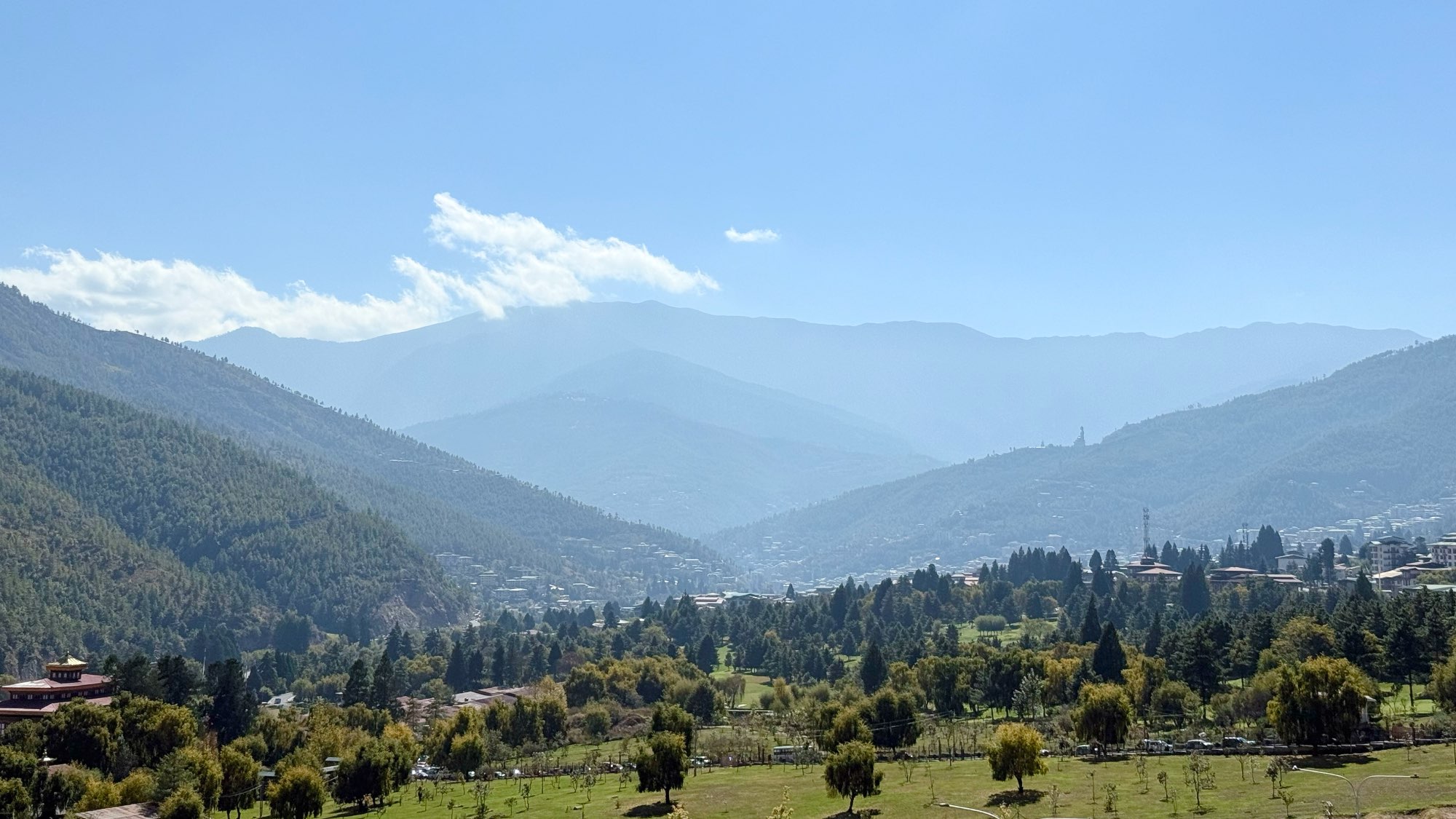
View of Thimphu with the Buddha Dordenma statue in the background
Thangton Dewachen Nunnery: Legacy of the Iron Bridge Monk
Arriving in Thimphu, we still had some time before the appointment. We visited the Thangton Dewachen Duthop Nunnery. It is the only one of its kind in the capital and goes back to the legendary Thangtong Gyalpo. He was a fascinating personality: A great Mahasiddha and at the same time an ingenious engineer who lived in the 15th century. He is famous as the “Iron Bridge Monk,” as he built dozens of suspension bridges made of iron chains throughout the Himalayas to allow pilgrims and travelers to cross raging rivers. Many of his constructions withstood the centuries. We were welcomed very warmly at this place: We were served tea in the courtyard of the monastery, and we could enjoy the peaceful atmosphere for a moment before we had to leave.
Visiting the Thangton Dewachen Duthop Nunnery
Kalachakra Initiation: Encounter with H.H. the Je Khenpo
After lunch, we made our way to the stadium. There, H.H. the Je Khenpo was leading the conclusion of the Kalachakra initiation. The crowds were immense. The stadium itself was packed to capacity, but that was far from enough. Countless people had also gathered on the grounds outside to partake in the event. It was a very impressive image. The ceremony was also being broadcast live on Bhutanese television. We initially had to wait before the gates until we were allowed into the stadium.
After some time, we were able to enter and were led to a separate waiting area inside the stadium. During this time, a chance but wonderful encounter occurred. We met the young Vairochana Rinpoche (Ngawang Jigme Jigten Wangchuk). He is a highly revered Tulku and the son of Her Royal Highness Princess Sonam Dechan Wangchuk. He is revered as the reincarnation of the great translator Vairochana from the 8th century, one of the most important disciples of Guru Padmasambhava.
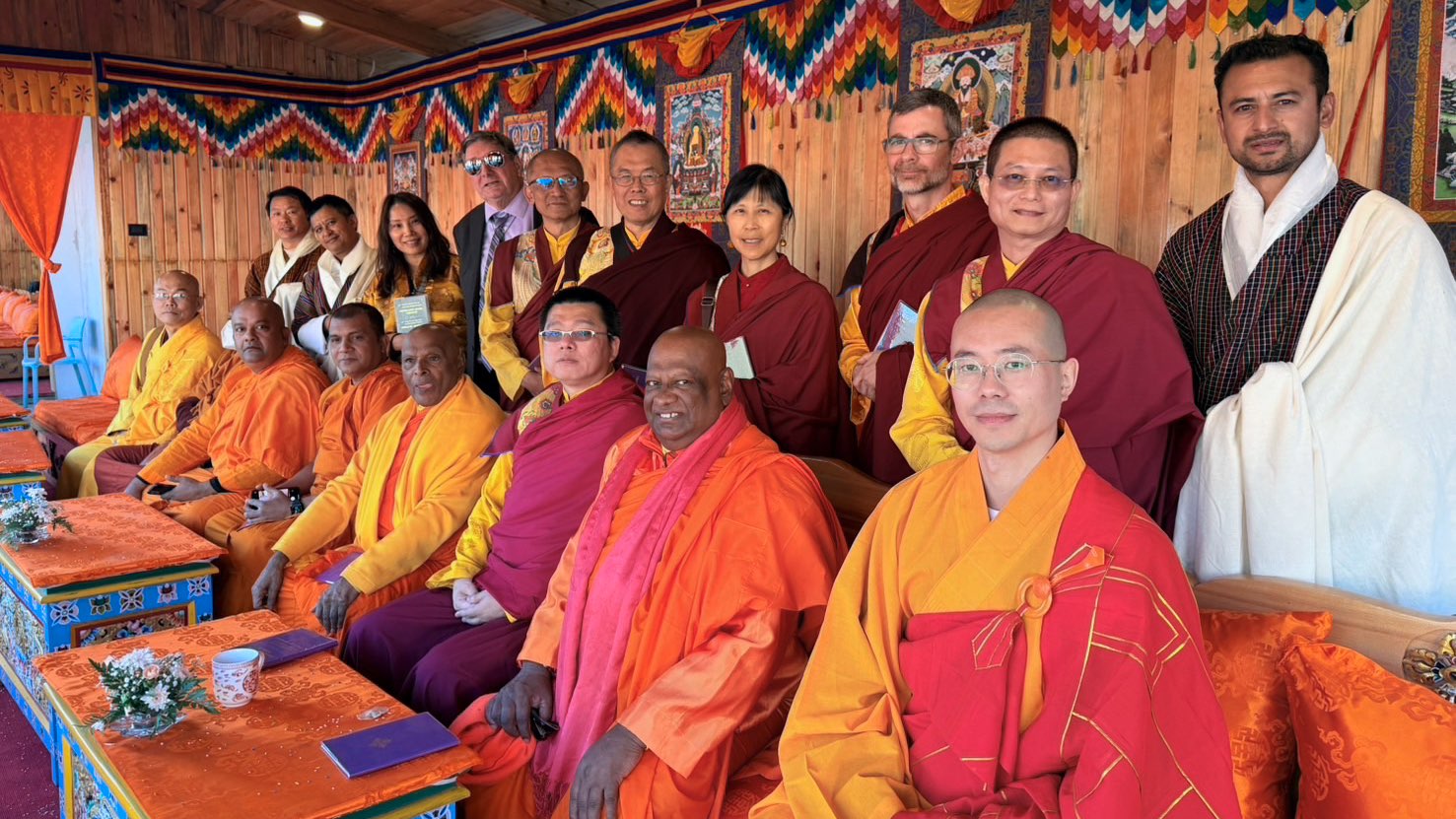
Following this, we were granted an audience with H.H. the Je Khenpo. Filled with gratitude, we presented him with a Khata (white scarf) as a token of our deep respect. In this special setting, we also had the opportunity to present His Holiness with information regarding the ‘Holy Heavenly Lake Buddhist Town’ project. Each of us then received a personal blessing, and upon our departure, he presented us with a text of the Amitabha Sadhana for our own practice.
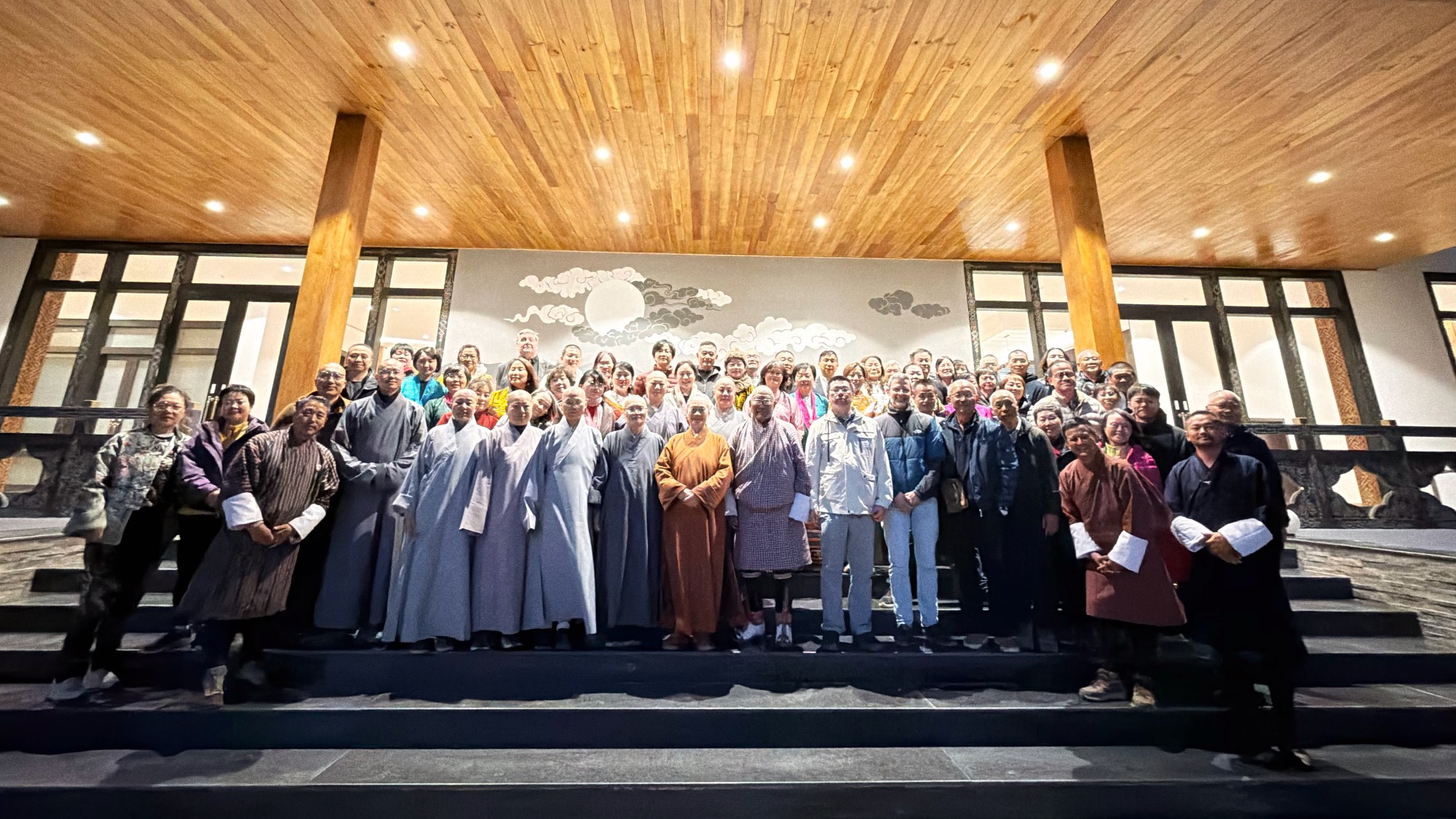
Our group after the audience with H.H. the Je Khenpo
After the meeting with the Je Khenpo, a further great honor was completely unexpectedly offered to us: Actually, we were supposed to meet the young Vairochana Rinpoche and the Queen Mother for an official audience afterwards. But when the Kalachakra initiation ended, thousands of people streamed out of the stadium at the same time. Traffic in Thimphu came to a complete standstill. There was no getting through, and we could not reach the agreed location in time. Such are the karmic conditions sometimes. But we did not quarrel with fate: After everything we had experienced that day and the blessing we were allowed to receive, we felt richly gifted.
The Tiger’s Nest: Ascent to Guru Rinpoche’s Cave
On the last day of our trip, November 15th, the arguably most famous landmark of Bhutan was on the agenda: Paro Taktsang, widely known as the Tiger’s Nest. It is not only architecturally deeply impressive, but one of the holiest sites in the entire Himalayas.
Paro Taktsang Monastery (Tiger’s Nest)
We set off very early to reach the base camp, the parking lot at 2,300 meters. From there, it is about 800 vertical meters up to the monastery, which sits at 3,120 meters. For visitors who do not quite trust themselves with the steep climb, there is generally the option to be carried by a horse or mule for the first part of the route. Our group, however, decided to cover the entire path on foot under our own power.
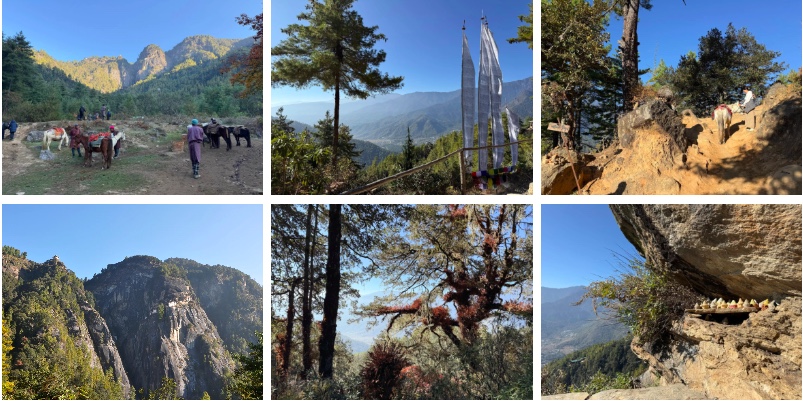
The ascent took just under three hours. The path is beautiful, but also demanding. It leads through a dense pine forest where rhododendrons grow and the trees are draped with moss. Again and again, prayer flags flutter in the wind. Halfway up, we took a short rest at a café. From there, you already have a first, breathtaking view of the monastery, which literally clings to the steep rock.
Impressions (in order): Resting horses at the starting point, fluttering prayer flags against the mountain backdrop, pack animals on the dusty trail, the first distant view of the cliffside monastery, the moss-covered mountain forest, and Tsa-Tsa offerings in a rock niche.
The history of this place is closely connected to Guru Rinpoche, the great Master Padmasambhava. He is revered by the Bhutanese as the “Second Buddha,” as he brought and firmly established Tantric Buddhism, the Vajrayana, in Bhutan in the 8th century. He manifested his supernatural powers and flew to this very spot on the back of a tigress to subdue a demon. Some say that the tigress was his tantric consort Yeshe Tsogyal in a transformed state. In the cave known as Taktsang Senge Samdup, around which the monastery was later built, he then meditated for exactly three years, three months, three weeks, and three days.
Once at the top, we had to hand in our cameras and bags at the entrance, as photography inside is strictly forbidden. We visited several small temples within the complex. In a special room that is guarded around the clock, I lit a butter lamp. This is the only place in the monastery where open fire is still permitted after a devastating fire destroyed large parts of the complex in the past. In Buddhism, lighting these lamps is a meritorious central ritual.
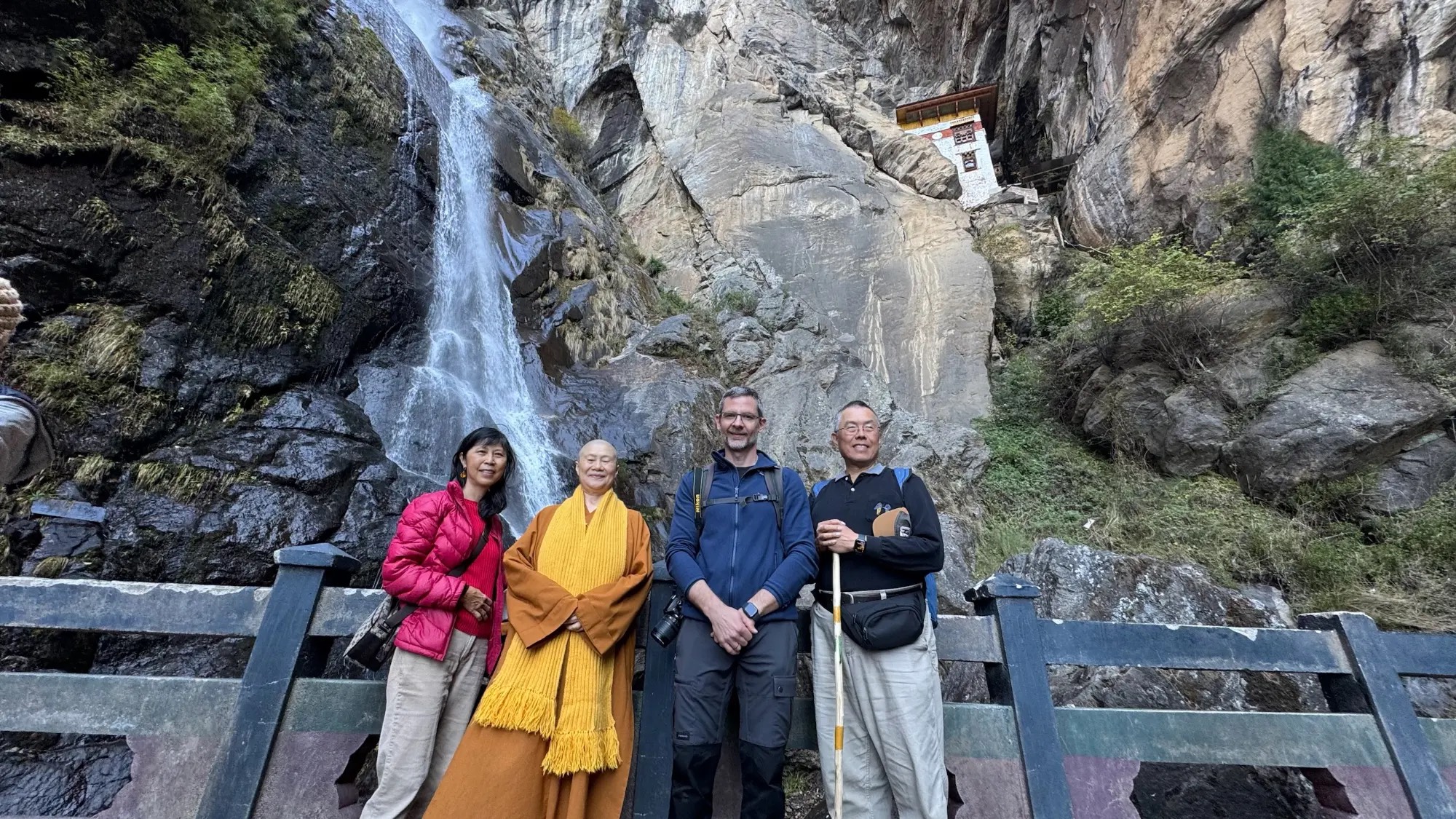
With Venerable Master Shi Zheng Da in front of the Taktsang Waterfall
Farewell in Paro: A Promise to Return
Back at the hotel in Paro, a special guest awaited us in the evening: Dasho Passang Dorji, the former Speaker of the National Assembly of Bhutan. He had been instrumental in organizing the official appointments and came by personally to apologize politely that the meeting with the King had not taken place due to the commotion. He promised us: “Next time I will arrange, this time the King and the Queen have been too busy.”
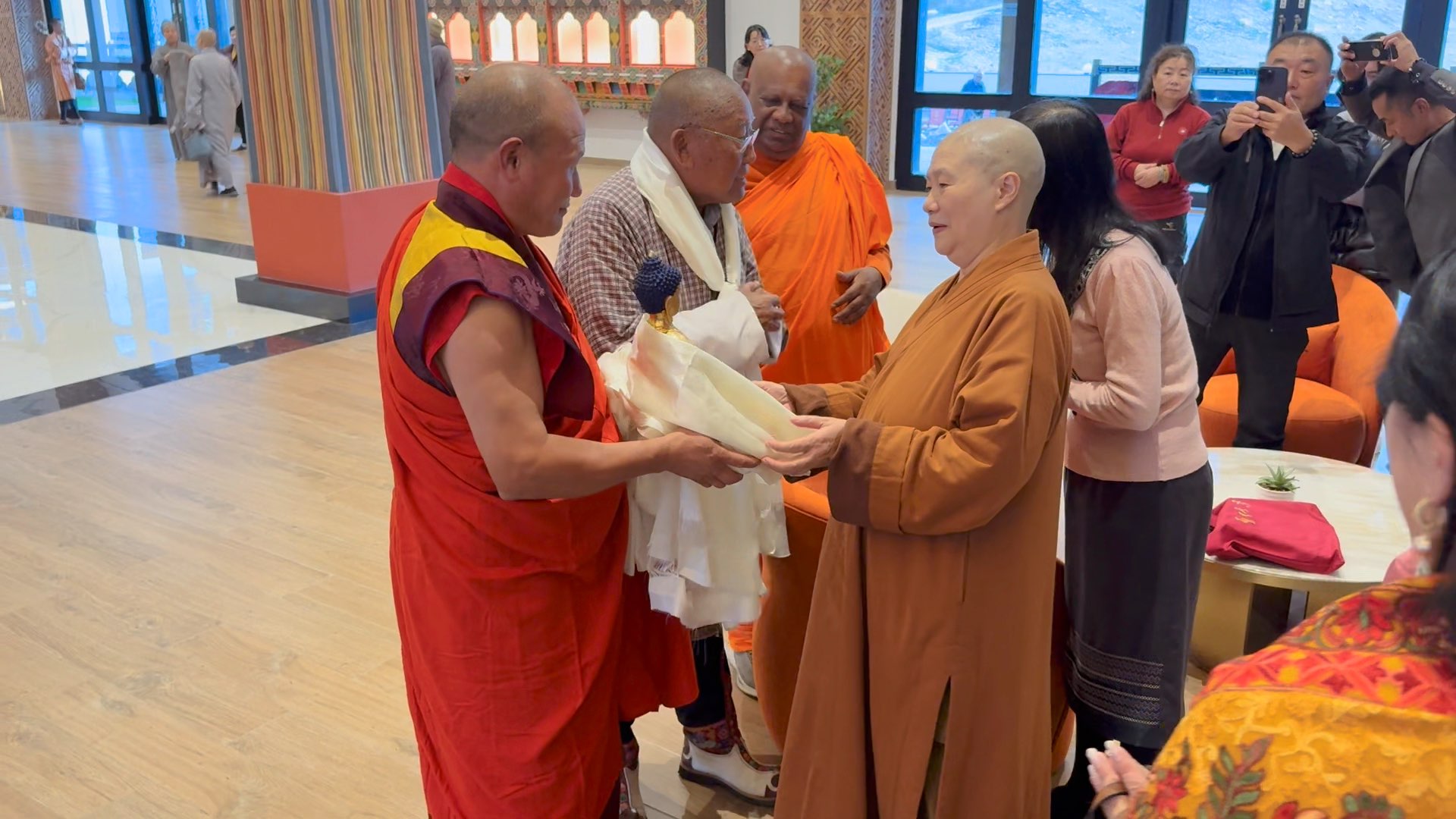
Exchange of gifts with Dasho Passang Dorji
In a very friendly atmosphere, an exchange of gifts took place. The Venerable Master Shi Zheng Da presented him with a special art object, a luminous three-dimensional picture of a Yun sculpture designed by H.H. Dorje Chang Buddha III. In return, he gave the Master a large golden Shakyamuni Buddha statue. It was a worthy moment of connection.
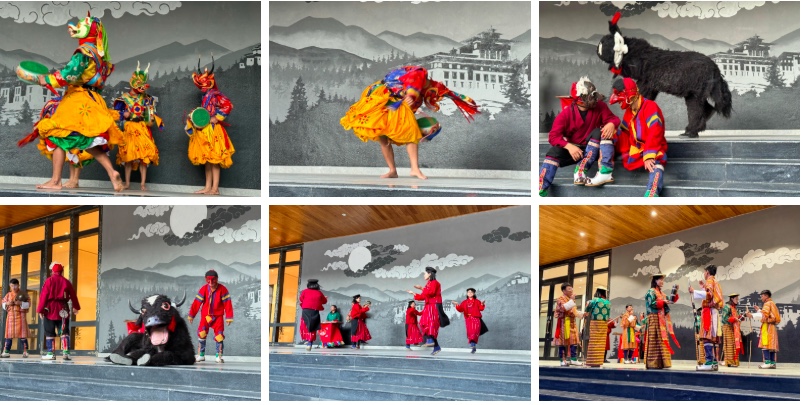
Scenes from the performance (in order): The famous Drametse Ngacham (Dance of the Drums), a solo dancer bowing deep, the performers of the yak scene, the humorous interaction of the yak with the audience, the women’s dance group in red garments, and finally a traditional performance with bows and arrows combining song and dance.
Afterwards, we watched a cultural performance together with Dasho Passang Dorji. There were traditional dances and songs whose gentle, flowing movements radiated great calm and peace. There were also humorous interludes, like the dance of a yak, where the performers visibly had fun. Even though I did not understand the language, the joy was contagious. After this show, we all gathered for a large group photo to capture this beautiful final evening.
Our entire group with Dasho Passang Dorji and our guides
The next morning, November 16th, it was time to say goodbye. From the hotel, we could look directly at the airport. We had arrived to make a contribution with our donation and our plans. But as I boarded the plane now, I felt that we ourselves were taking away far more than we had given. I took with me not only memories of the mighty mountains and venerable monasteries, but the feeling of a deep connection with our travel group and the people in Bhutan. I return with much inspiration and a heart full of gratitude for the blessing I was allowed to experience in this country.
In the Buddhist scriptures of China, a profound story is recorded—one that illuminates the immeasurable merit of a sincere offering.
Once, there was a poor girl who survived by begging. She often watched wealthy young ladies, accompanied by attendants, visit the temple to offer alms and perform good deeds. Seeing their generosity, she felt a deep yearning to cultivate merit but had nothing to give. Determined, she worked tirelessly to save whatever she could. After much effort, she managed to save a single coin. Though small in value, it represented all she had. With unwavering devotion, she took her humble offering to the temple.
The abbot, upon learning of her sincerity, was deeply moved. He gathered his disciples and announced, “Today, I will personally preside over the offering and pray for this devout laywoman!”
Not long after, an extraordinary turn of events unfolded.
After the queen of the land passed away, the grieving king sank into sorrow. To lift his spirits, his ministers organized a hunting expedition. As the royal party rode through the forest, the king noticed a shimmering light ahead. Curious, he approached and discovered a breathtakingly beautiful young woman. Though her clothes were tattered, she radiated an ethereal grace.
Captivated by her presence, the king brought her back to the palace. Before long, she became his new queen.
Overjoyed by her newfound fortune, she reflected on her past: “This must be the reward of my small act of generosity! I only donated one coin, yet it planted the seed for such incredible merit. Now that I have wealth, I should return to the temple to express my gratitude with a much grander offering!”
Determined to make a grand gesture, she dressed in the finest attire, adorned herself with jewels, and loaded dozens of carts with silver and gold for donation. As she approached the temple, she thought, “Before, when I gave only one coin, the abbot personally prayed for me. Now that I bring such vast riches, surely the reception will be even greater!”
Upon her arrival, she expected an elaborate welcome. Yet, to her surprise, only a few monks came to receive her offerings, and the rituals were conducted in the usual manner.
Perplexed, she approached an elderly monk and asked, “Why is it that when I was poor and donated a single coin, the abbot himself prayed for me? Yet today, when I bring such wealth, only a few monks perform the prayers?”
The monk smiled gently and replied, “At that time, your single coin was all you had. You gave it with pure devotion and joy, holding nothing back. Now, though you bring great wealth, it is but a fraction of your fortune, and your heart is tainted with pride. The true merit of an offering comes not from its size but from the sincerity of the giver’s heart.”
Shakyamuni Buddha taught that for a donation to generate immense benefit, it must possess three essential qualities:
Before Giving – A Joyful Heart True generosity begins with happiness. The donor should give not out of duty, pressure, or expectation of reward, but with a heart full of joy, seeing giving as an opportunity to cultivate virtue and compassion.
While Giving – A Clear and Sincere Mind The act of giving should be free from hesitation, regret, or pride. A pure offering is made with an open heart, solely for the benefit of others, without seeking recognition or return.
After Giving – A Sense of Fulfillment Once the offering is made, the giver should not feel regret or attachment. Instead, they should feel a deep sense of satisfaction, knowing they have planted seeds of merit for the future.
This story serves as a timeless lesson: It is not the amount we give that determines the merit of our offering, but the purity of our heart. A sincere and joyful offering—no matter how small—carries boundless blessings.
So the next time you give, remember: True generosity is not measured in gold or silver, but in the depth of your sincerity.
Within Tibetan Buddhism, the Jonang sect has been known around the world for the true practice of its followers. There currently are two dharma kings who are in charge of the dharma teachings of the Jonang sect. One of them is the head of the Zangwa Monastery, H.H. Dharma King Jigme Dorje. The other is H.H. Dharma King Ngagwang Pedma Namgyal Palzangpo of the Longshijia Monastery. There is also a young future sect leader, Jianyang Lezhu Rinpoche, who is vice-head of the Zangwa Monastery.
When Shakyamuni Buddha lived in the world, H.H. Dharma King Jigme Dorje Rinpoche was already a great Bodhisattva in that lifetime. H.H. Dharma King Jigme Dorje was born in 1944 accompanied by various amazing auspicious signs that cannot be fully described. As a child, he never did anything to upset his parents, such as crying or acting in a common, childish way. He was very much different from other children. The masters of a monastery, as well as the monastics and laypersons in that monastery who handled monastery matters, all praised the child as being the incarnation of a wonderful Bodhisattva who had come back to this world voluntarily. Later, he went to the headquarters of the Jonang sect, the Zangwa Monastery in Rangtang, where he worshipped the Buddhas. His uncle, the Sai Rinpoche by the name of Awang Genga Phuntsok who lived at the Zangwa Monastery, saw that this child was the incarnation of a holy being. In accordance with the dharma, Awang Genga Phuntsok Rinpoche recognized that the child was the true reincarnation of a rinpoche who had been the head of the Zangwa Monastery. In accordance with the dharma rules, Lama Danba Daji from Xiayan, Lama Aguoba from Hongtu, and others practiced the dharma, entered holy supernatural states, and confirmed the accuracy of Awang Genga Phuntsok Rinpoche’s conclusion. They then made their formal pronouncements concerning the identity of H.H. Jigme Dorje. Moreover, the International Buddhism Sangha Association held an unprecedented Drawing Lots From a Golden Vase Ceremony to affirm the true reincarnated identity of H.H. Dharma King Jigme Dorje and others. There were ten possible identities recognized by various rinpoches. One lot was drawn from among 120 lots to affirm the true reincarnated identity of H.H. Dharma King Jigme Dorje. That drawing affirmed that H.H. Dharma King Jigme Dorje is the incarnation of Shambhala King Suchandra, which is the reincarnated identity that H.H. Dorje Chang Buddha III recognized before that lot was drawn.
After the formal enthronement ceremony for H.H. Jigme Dorje Rinpoche was performed at Saige Monastery in Aba County and the celebration of the enthronement ceremony was performed at Zhuoge Monastery, the rinpoche returned to Zangwa Monastery. The intelligence of the rinpoche is extraordinary. He was able to thoroughly learn and recite the scriptures, treatises, and rituals without having to exert himself. He later served as a disciple under his root master, Awang Gongqiu Daji, who was the Vajra Master of the Zangwa Dazang Monastery and the 44th Kalachakra Dharma King of the Jonang sect. Under H.H. Awang Gongqiu Daji, the rinpoche learned and practiced the five preliminary practices of the Jonang sect and the generation and completion stages of the Kalachakra Vajra the Six Yogas. He reached perfect merit in every dharma he practiced.
When the rinpoche was eight years old, he succeeded to the throne of the head of the Zangwa Monastery. However, at this time, his uncle, the Sai Rinpoche, and H.H. Dharma King Awang Gongqiu Daji predicted to H.H. Jigme Dorje Rinpoche that changes in the world situation would occur that would be disadvantageous to Buddhism. They told the rinpoche to go back to Aba County and that in the future, when the world situation stabilizes, he should return to the Zangwa Monastery and teach the dharma. Afterward, the Sai Rinpoche passed away and later H.H. Dharma King Awang Gongqiu Daji passed away as well. H.H. Jigme Dorje Rinpoche then went to Aba County, where he requested and received the complete precepts from Lama Tujihua of Sai. He later served as a disciple under another root master, Lama Kesang, who is the nirmanakaya of the Eleven-Faced Kuan Yin Bodhisattva. Under Lama Kesang, the rinpoche learned all of the initiation and lineage teachings. During this time period, he both herded goats and cultivated himself in caves, tree holes, and other places while traveling from mountain to mountain. He realized the state of viewing all phenomena as equal and the state where the mind is not affected by the situation one encounters. Thus, he became a free and unhindered person of great accomplishment in the dharma. He then lived in a cave, where he continued his practice of the dharma.
After the restraints on religion were slightly eased, the supreme leader of the Jonang sect, H.H. Dharma King Yundan Sangbu of the Zangwa Monastery in Rangtang, twice dispatched people to the cave at the Zilang Monastery in Aba County (that was the cave in which Maji Lazun practiced the Xiduan Dharma) where the rinpoche was staying. H.H. Dharma King Yundan Sangbu did so based upon the formal pronouncements of certain great masters of the past. When those dispatched arrived, they invited H.H. Jigme Dorje Rinpoche to go to the Zangwa Monastery and lead the teaching of the Buddha-dharma. There was a third visit when H.H. Dharma King Yundan Sangbu himself went to that cave at the Zilang Monastery, bringing with him a kharda (white silk scarf). When the two venerable ones met, they praised each other. H.H. Dharma King Yundan Sangbu repeatedly urged H.H. Jigme Dorje Rinpoche to follow the formal pronouncements of those great masters of the past by going to the Zangwa Dazang Monastery, by leading the teaching of the Buddha-dharma of the Jonang sect at that monastery, and by being the monastery’s retreat lineage Vajra Master. H.H. Jigme Dorje Rinpoche then gave his response to the formal pronouncements of those three masters of the past (H.H. Dharma King Gongqiu Daji, the Sai Rinpoche, and Lama Kesang) that he must go to the Zangwa Monastery in Rangtang. He respectfully said to H.H. Dharma King Yundan Sangbu, “Your merit and cultivation are like those of my father. You are my master. I will carry out your instructions well!”
After H.H. Jigme Dorje Rinpoche returned to the Zangwa Monastery at Rangtang, he helped H.H. Dharma King Yundan Sangbu restore the monastery and build Buddhist statues. The rinpoche performed initiations and dharma transmissions at regular intervals and guided those on retreat. He perpetuated the dharma teachings of the Jonang sect in this human world and propagated such teachings around the world.
In accordance with the rules handed down by the historical masters, H.H. Dharma King Yundan Sangbu personally handed over to H.H. Jigme Dorje Rinpoche in 1998 certain precious objects passed down through the generations by past masters, such as a vajra bell, a vajra, and the writing called “Guiding Text You Will Know Its Meaning When You See It.” He also formally conferred upon H.H. Jigme Dorje Rinpoche the positions of 47th dharma throne holder of the Jonang Kalachakra lineage and 11th Vajra Master of the Zangwa Dazang Monastery. After H.H. Dharma King Yundan Sangbu passed away, H.H. Dharma King Jigme Dorje became the supreme leader of the Jonang sect.
After H.H. Dharma King Jigme Dorje saw who His Holiness Dorje Chang Buddha III Wan Ko Yeshe Norbu is through the limitless omniscience displayed in A Treasury of True BuddhaDharma, he stated that His Holiness Wan Ko Yeshe Norbu has reached the highest state of Buddhahood in the few-thousand-year history of Buddhism, having truly attained complete.
CONGRATULATIONS United International World Buddhism Association Headquarters: On behalf of the Jonang sect, I hereby respectfully congratulate H.H. Dorje Chang Buddha III Wan Ko Yeshe Norbu for directly propagating in this world the teachings of Buddhism. Such teachings have benefited countless living beings in their practice of the dharma and have caused countless living beings to obtain deep blessings and wisdom. The book A Treasury of True Buddha-Dharma especially shows this Buddha’s complete proficiency in exoteric and esoteric Buddhism and perfect mastery of the Five Vidyas. Such superlative accomplishments are truly unprecedented in the past few thousand years, outshining the accomplishments of all others, both ancient and modern. His Holiness is a shining paragon among Buddhas. May this inexhaustibly mighty light and power of compassion continue so that His Holiness forever teaches the dharma and forever remains in the world. I place my palms together and respectfully praise His Holiness.
I respectfully prostrate to H.H. Dorje Chang Buddha III, Wan Ko Yeshe Norbu! Supreme Dharma King of the Jonang Sect Jigme Dorje May 8, 2007
I really enjoy animated movies for their humor and cheerfulness. What better way to relax than to watch Garfield shovel down 450 pounds of lasagna? However, beneath the appearance of levity and simple fun, animation has its own unique way of addressing serious and abstract philosophical questions. Pixar’s Inside Out is an outstanding work in this regard. It made me ponder what makes myself, well, myself.
Inside Out is a masterpiece of animation that presents human emotions—specifically Joy, Sadness, Anger, Disgust, and Fear—as protagonists, rather than focusing solely on Riley Anderson, the girl these emotions reside in. Writing in The Guardian, Julian Baggini muses that the film “. . . reflects some of the most important truths about what it means to be an individual person. The first of these is that there isn’t actually a single, unified you at all. . . . [your brain] is made up of various different, often competing impulses. You are simply how it all comes together, the sum of your psychic parts.”This film heralds a gradual opening of popular Western media and culture to the idea of the “three marks of existence” in Buddhism: impermanence (anitya), no-self (anatman), and suffering (duhkha). It is a completely new way of articulating (to children, no less) a richer, more complex understanding of the human person.
In this story, the five emotions work together to look after Riley and manage her reactions to external stimuli inside “HQ”—her head. HQ is visually located in the “sky” of her mind and overlooks a vast labyrinth called Long-term Memory, where memories in the form of orbs are stored. Orbs of core memories, or formative experiences of Riley’s life, are stored in a central hub within HQ itself. Most memories (including the core ones) are touched by Joy so that they are bright gold and happy. Other memories are touched by Sadness (blue), Disgust (green), Fear (light purple), and Anger (red).
Anger prepares to make Riley react angrily. From video.disney.com
The external narrative—the one that audiences usually see in a movie—is simple, almost boring. Riley struggles with moving from Minnesota to San Francisco, making new friends at school, and coming to terms with losing her old life. The real action goes on inside her head. To Joy’s dismay, Sadness, who feels like she serves no beneficial purpose to Riley (in contrast to emotions like Disgust, who protects Riley from broccoli, or Fear, who compiles copious notes on possible risks to Riley’s everyday activities), starts touching the Memory Orbs, turning more and more of Riley’s memories blue. Later on, it is revealed that Riley needs Sadness to express her inner difficulties and articulate her distress, therefore serving a vital purpose for her well-being, but none of the other emotions at this stage can understand why.
By several twists of misfortune after Joy tries to stop Sadness from touching the orbs, they get lost in Riley’s various mental spaces outside of HQ, such as Imagination Land (complete with an Imaginary-boyfriend Generator), the Abyss of the Subconscious, and Dream Productions. With Joy and Sadness missing, Anger, Fear, and Disgust do their best to help Riley cope with her increasingly unhappy life. For example, befitting his purpose and personality, Anger argues that the only way for Riley to be happy again is to run away from her parents back to Minnesota. However, they just end up making her react to the world with burgeoning anger, fear, and disgust.
A resolution is reached when Joy realizes that Sadness needs to touch more of the Memory Orbs. As much as Joy wants to see Riley happy, she can’t be the emotional driver of every event. But in gratitude for her newly acknowledged importance, Sadness also invites Joy to touch the memories she is holding, so that Riley can feel meaning and happiness in the process of grieving. By the end of the movie, Riley’s Memory Orbs are no longer a simple mix of five colors: each ball is variously touched by the emotions, resulting in a beautiful array of “mixed emotions” and marking the beginning of growing up.
This, however, is just the first crack at the myth of the enduring, unified self. What the film also shows is that each of these parts is impermanent. Riley’s personality is represented by a series of islands that reflect what matters most to her: friendship, honesty, family, goofiness, and hockey. But as life becomes difficult, each of these in turns threatens to crumble. And that is how it is in the real world: as we grow and change, some of the things that matter most to us will endure, others will fall away, and new ones will come in their place.
In competition … Sadness, Fear, Anger, Disgust and Joy. Photograph: Courtesy Ev/Rex Shutterstock
The third key element in understanding the self is that what keeps this all together is memory. At first, it seems like the film is going to over-simplify this, presenting memories as little movies, experiences that are captured, stored, and played back. But as it progresses, it gets more complicated. It becomes clear that not only do many memories simply get lost—even ones that were once most precious—but others change their character as we do. For memories to do their work, they need to be nurtured and understood.
What it all adds up to is a picture of the self as something which coheres into a single narrative but which has nothing permanent and unchanging at its core. We are forever in flux, always in the process of growing out of what we once were into what we are to become next.
Not surprisingly, this animated movie is the most sophisticated children’s film in recent memory and has been critically applauded in many reviews. It turns traditional storytelling on its head: instead of telling us what the protagonist feels, it tells us what the emotions are making the protagonist feel. Of course, our brains aren’t populated by anthropomorphic or Platonic representations of concepts such as Joy or Sadness. Nevertheless, this children’s film is an example of meta-storytelling, in which the motivations for the narrative (usually the protagonist’s emotions or conflicts) are abstracted into their own story (the emotions’ adventures inside Riley’s head).
Baggini, like many other critics, observes that by being “made up” of the five emotions, the traditional fictional character has become a composite construction of various mental components, just like we are in the real world. He also notes that apart from deconstructing the myth of the unified self, Inside Out also presents these components as impermanent. HQ overlooks five islands attached to Long-term Memory that reflect fundamental aspects of Riley’s personality: friendship, honesty, family, goofiness, and hockey. But as the emotions struggle to manage Riley’s inner world, these islands crumble and fall away (for example, Friendship Island collapses after Anger makes Riley react furiously to her Minnesota friend’s apparent happiness despite her departure). However, by the end, new islands are formed: for example, the new Friendship Island now has a “friendly argument section,” indicating a collaboration between Joy and Anger.
Just as we see in real life, some of the things that “characterize” who we think ourselves to be endure—but others fall away, hopefully to be replaced by new, more complex and enriching “islands.” Baggini concludes: “What it all adds up to is a picture of the self as something which coheres into a single narrative but which has nothing permanent and unchanging at its core.” Our no-selves are forever in flux, engaged in a never-ending process of shedding what we once were and reforming into a new identity.
The ideas of no-self and cognitive impermanence should open up new avenues into exploring how a contemporary story (be it through the medium of live action or animation) can be told. There are no antagonists in Inside Out—the conflict (or the reason for the story to exist) all happens within, inside Riley’s head. The fundamental problems of the world, according to Buddhism, are also within, not “out there.” Nevertheless, understandably, there are philosophical differences between a Pixar film and 2,500 years of insight. The Buddhist explanation for the world’s unhappiness is much more complex. In Buddhist phenomenology, sentient beings are made up of the five skandhas, or aggregates (mind and matter being considered inseparable, unlike in Cartesian thought): form (rupa), sensation (vedana), perception (samjna), mental formations (samskara), and consciousness (vijnana). These aggregates become the subject of expanded commentary in the Abhidhamma literature of early Buddhism and the Mahayana and Vajrayana traditions. If Riley’s happiness depends on the interplay of her emotions, Buddhist liberation depends on the Buddhist insight of understanding the “empty” nature of the aggregates: that they are impermanent, composite, and interdependent.
I think the reason this can be conveyed in a children’s film is that, in many ways, kids are more receptive to this message than adults. Children change so rapidly that they might be able to understand the idea of impermanence more readily than adults, whose self-conception has often ossified. Kids have no problem imagining that they might grow up to be quite different, while adults assume they are stuck being the person they have turned out to be.
The best children’s films often serve a dual purpose. They help kids to grow up but they also remind adults of what they have lost by doing so. Inside Out succeeds brilliantly on both counts.
If there were any “villains” to be scripted in a Buddhist version of Inside Out, it would be the “three poisons” of greed, hatred, and delusion—the factors inhibiting our well-being and blocking our path to enlightenment. For now, it’s too big a question to ask how such concepts might be brought into an animated film, but the high stakes and existential conflict in the Buddhist teachings would make for a children’s story that is both immersive and educational.
When we think of iconic sculptures, the Discobolus, Michelangelo’s Moses, and the Laocoon and his Sons likely come to mind—captivating masterpieces that freeze moments in time with gripping intensity. However, the realm of Buddhist sculptures in ancient China offers a different narrative, one of profound serenity and peace that sets it apart from Western art.
CGTN’s latest film, Eternal Smiles, invites you to embark on a mesmerizing 60-minute exploration of China’s Buddhist sculptures. As you delve into the most renowned grottoes, you’ll witness a unique facet of statuary art that transcends time and space, offering a glimpse into a continuous eternity. The film provides a rare opportunity to experience the tranquility and harmony exuded by Buddhas and Bodhisattvas in these ancient works.
Guiding you along the Silk Road, Eternal Smiles unravels the fascinating journey of Buddhism to China. The film takes you to famous grottoes, temples, and historical sites, immersing you in a rich tapestry of stories that satisfy your curiosity about history, art, natural scenery, culture, and more.
Unlike the dramatic and intense narratives often found in Western sculptures, China’s Buddhist sculptures are a testament to serenity and peace. The film beautifully captures the essence of these timeless works of art, inviting viewers to appreciate the subtleties and spiritual depth embodied by Buddhas and Bodhisattvas.
Eternal Smiles is not merely a documentary; it’s a cinematic symphony that seamlessly weaves together history, art, and culture. Through stunning visuals and insightful narratives, the film offers a holistic experience that transcends the screen, transporting viewers to the heart of China’s Buddhist legacy.
Whether you’re a history buff, an art enthusiast, or someone seeking a peaceful escape, Eternal Smiles promises to be a visual feast for the curious soul. Join us on this cinematic journey to discover the beauty, serenity, and eternal smiles hidden within China’s Buddhist sculptures.
When Sakyamuni Buddha first established Buddhist theories, there was no dual character of Buddhist theories. There was only the sameness of theories and nature (the essence of everything). The theories in the Tripitaka expounded by the world-honored Sakyamuni Buddha came from the Buddha’s state of realization. They are a kind of explanation of the ways to realize the holy state and attain liberation and nirvana. They can be called objective writings. Such Buddhist theories were born from true holy realization. They are not groundless writings based on assumptions that arose from the level of consciousness. This is recorded in the Buddhist scriptures.
In the beginning, Buddhist theory and Buddha-dharma realization were one integral body. At first, a complete body of dharma theories and rituals were born from true realization of the Buddha-dharma holy state. Later, people attained the holy state of true realization from this complete body of dharma theories and rituals. Theory and dharma were in harmony. Theory was used to further the dharma. The dharma was manifested to further theory.
“The sect of theories and true holy realization” is in accord with the sutras and abhidharma. Those of this sect apply cognition based on correct views to directly understand cultivation, the nature of the mind, and ultimate reality. They truly realize holiness that transcends intelligence and theories. Moreover, they manifest their actual realization and thereby prove that they have attained the ultimate nirvana.
This sect uses the orthodox theories contained in the Tripitaka and esoteric scriptures as its foundation. However, its goal is not the useless speaking of theories. Those in this sect must manifest their holy state of realization.
However, as the karmic connection living beings had with the dharma changed and as a large amount of dharma and rituals were lost, Buddhism’s sameness of theories and nature (essence) imperceptibly and gradually generated a dual character. One aspect was the complete retention of theory and holy realization where each brought out the best in the other. The other aspect was pure theory that arose out of a fundamental separation from the holy state of realization. The advent of this dual character of Buddhist theories objectively caused Buddhism to form two main sects. No matter what the sect or school may be within Buddhism—whether it be Mahayana, Hinayana, exoteric or esoteric Buddhism—all sects or schools ultimately belong to one of these two main sects. The first is “the sect of theories and true holy realization.” The second is “the sect of theories, views, and understanding.” Of course, the theories I am referring to here are Buddhist theories based upon correct understanding and correct view. I am not bringing up a third category of misunderstandings and heretical views that go against the sutra teachings.
The purpose of cultivation and practice for this sect is to actually transcend, in both body and mind, the fetters of samsara. This sect has an integral lineage, integral teachings, and integral rituals. Those of this sect are able to manifest supernatural wisdom powers that transcend both the material and mental spheres. It is a sect that truly accords with the essence of the Tipitaka, the esoteric scriptures, and the various commentaries and treatises. This is the sect of perfect Buddha-dharma where theory and nature (essence) are in accord. This was the original characteristic of Buddhist theory. Such Buddha-dharma played a decisive role in the liberation and accomplishment of living beings. Included in this Buddha-dharma is the Buddha-dharma of Sakyamuni Buddha during the True Dharma Age, the Buddha-dharma transmitted by Guru Padmasambhava, the Buddha-dharma transmitted by Venerable Atisha, Master Marpa, Master Milarepa, Master Tsongkhapa, Master Nairatmya, Master Rigdzin Jigme Lingpa, Bodhidharma, Xuan-zang, Hui-neng, Master Xu-yun, and the Buddha-dharma transmitted by other truly holy beings and patriarchs throughout history. All such Buddha-dharma is the Buddha-dharma of “the sect of theories and true holy realization.” Unfortunately, at this present time on earth, this sect is very rare and very seldom seen. “The sect of theories, views, and understanding” has taken its place and become the mainstream.
“The sect of theories, views, and understanding” also uses the orthodox theories contained in the Tripitaka and esoteric scriptures as its foundation. Those of this sect apply cognition based on correct views to approach and directly understand the nature of the mind in the hope that in the end they will realize nirvana. The Buddha-dharma of this sect is only able to express theories and that which arises out of mental processes. Those in this sect do not have actual holy realization that they can display. Consequently, all they can do is use the realization states and achievements of patriarchs in earlier generations as cases in point. Most present-day Buddha-dharma belongs to this sect. This is a prevalent phenomenon in current Buddhism.
However, we must see that although the theories of this sect are also based on correct understanding and correct view, it is very difficult for this sect to produce complete liberation. It is easy for this sect to fall into meaningless intellectual frivolity. It is still a question as whether those of this sect can truly attain the liberation of ultimate nirvana. That is because it is extremely difficult to lead people into the state of holy beings by relying solely upon theories. Moreover, these theories were expressed by different people and therefore vary. For example, the views expressed in the prajna writings and Middle School (Madhyamaka) writings are not the same. The “other emptiness view” also has its own way of explaining things.
I will use the modern terms of “software” and “hardware” to give an analogy. Which one of these schools of theories is practical software that can attain the positive results that hardware can attain? It is very difficult to determine this by relying only on software itself. Only when the positive results of hardware are actually produced can it be shown whether a certain theory (software) is right or wrong. Furthermore, that which is called the dharma of Buddha-dharma should be dharma that transcends the ordinary and leads to liberation. Theories alone cannot express this extraordinariness.
This phenomenon of seeking liberation from theories and views alone is mainly the result of the loss of many dharma teachings and rituals in the course of passing down the Buddha-dharma. In the case of Tibetan esoteric dharma, there has not been much change in the theoretical part since the initial stage of esoteric dharma until now. The greatest change has been in the true realization part. When the patriarchs of Tibetan esoteric Buddhism transmitted dharma in the past, there were countless manifestations of supernatural realization powers. These astounding supernatural realization powers caused people of the world to regard Tibetan esoteric dharma as holy and special. Guru Padmasambhava and Venerable Atisha displayed a great many supernatural powers. Master Marpa practiced a dharma whereby he brought back to life animals that had already died. Patriarch Milarepa flew in the air and entered the horn of a bull to avoid hail. Guwen Rinpoche flew into the air and took with him his entire family, including the tent and domestic animals. Both of the 4th Dodrupchen Dharma Kings displayed wondrous realization powers, and so on and so forth. One can give endless examples of such holy realization powers.
The original special quality of the Buddha-dharma was that it was of “the sect of theories and true holy realization,” which manifests actual realization powers. However, with the arrival of the Dharma Ending Age, many dharmas are no longer whole. The practice of them will not produce realization powers. Much Buddha-dharma, especially the esoteric dharma, has begun to devolve toward “the sect of theories, views, and understanding.”
Take, for example, the colored sand used to form a mandala during an inner-tantric initiation in the holy form. During the time of Guru Padmasambhava, this inner-tantric initiation dharma required that certain things be done. On the surface of a large flat stone, colored sand would be used to form the shape of a mandala or a vajra seed character. A person would then apply holy realization powers, causing that design on the surface of the stone to penetrate the stone and form the same design on the sand in the mandala plate underneath that large flat stone. Such sand design in the mandala plate thereby became vajra sand that went through a stone.
However, at this present time, there is no integral dharma. People cannot produce holy realization powers through dharma practice. Thus, inner-tantric initiations in the holy form cannot be performed. The above-described process of using colored sand to form a mandala has already devolved into sprinkling colored sand directly into the mandala plate to form a mandala design. As such, there is not the slightest manifestation of holy power.
Another example is vajra pills used in inner-tantric initiations. Sixty or seventy years ago, most of the people of true and holy virtue within Tibetan esoteric Buddhism were able to make a vajra pill come to life by telekinetically making it shake or even move around. However, in present-day Tibetan esoteric dharma, a vajra pill is nothing more than a medicinal pill that is a symbolic expression of dharma.
Another example is secret-division initiations relating to gods of wealth. This is a dharma source of inner-tantric dharma in the holy sense. The practitioner receiving such an initiation will generate a holy stage right then and there in the mandala. Moreover, gold dollar treasures or a treasure-spitting mongoose made of three white things and roasted barley flour will turn over and jump into the air before the practitioner, demonstrating a holy state of physics not produced by humans. The practitioner receiving the initiation will right then and there ingest a “dharma mother seed.” Out of this practice of dharma, the god of wealth will naturally descend, thereby accomplishing the completion stage. However, this type of dharma has also been lost.
It is not just these few dharmas. Most inner-tantric initiation dharmas have already deteriorated. Accomplished ones who attained the rainbow body basically cannot be found, even in the Kathok Monastery, which was the monastery of Padmasambhava and the place where more people attained the rainbow body than anywhere else. In modern times, many dharma kings did not transform into the rainbow body and fly away at death. There are many people now who at every opportunity leave their handprints or footprints on stones to show their realization powers. However, such realization powers were not manifested under the observation of masters and witnesses there at the time. What credibility do they have?
In an interview, the famous Kasuo Rinpoche of the Longwu Monastery of the Geluk sect talked about the special societal circumstances that existed in Tibet during the fifties and sixties. As a result of those circumstances, a large number of sutras, treatises, and dharma manuals were burned. Many people of great virtue were unable to pass down integral dharma before they were forced to die. Those people of great virtue who fled to India did not take with them many dharma manuals. After that, at most only twenty or thirty percent of Tibetan esoteric dharma still remained in the world. Most such dharma has been lost forever.
It is because of this type of loss of dharma that most present-day Buddha-dharma does not produce people who can show actual realization powers. Candidly speaking, people do not understand dharma and get bogged down in hollow theories over a long period of time. Many people even misunderstand the Buddha-dharma as simply something to comprehend that is theoretical or mental in nature. Of course, they are apathetic to the matter of realization powers or even feel that it is very normal not to have realization powers. This way of thinking is actually very wrong. Theories can be used to distinguish the holy ones from the ordinary ones. However, the most important way to distinguish the genuine ones from the false ones is seeing who actually manifests holy realization powers.
Take, for example, emptiness. Even practitioners with a little knowledge are able to speak copiously about theories related to emptiness. However, are those well-organized and impressive theories, understandings, and views right or wrong in the end? This is something that understandings and views alone cannot determine. It is also something that no conscious experience born of causes and conditions can determine. Only when one abides in emptiness and true such-ness and generates supernatural wisdom powers can one truly know whether an understanding or view is right or wrong.
There was a time when Ananda had not yet realized holiness. The Arhats excluded him from the hall where they were assembling the sutras. After he realized true such-ness, returned to that hall, and stood outside its door, Venerable Mahakasyapa asked him to enter the door through the keyhole to prove that he had become enlightened. Ananda then entered the hall through the keyhole. Those who have realized emptiness and untied the knot must have supernatural holy powers enabling them to enter another dimension that ordinary human ability cannot reach. Additionally, they must have this “software accomplishment” in the form of actual and extraordinary holy powers. Only then can they prove whether a given “theory software” is correct and practical.
Thus, as for this issue, the difference between “the sect of theories, views, and understanding” and “the sect of theories and true holy realization” is that the former stops at theoretical understanding. Whether people of “the sect of theories, views, and understanding” actually realize and enter the holy state that is beyond consciousness and thereby attain liberation is something unknown. It is not that people of such sect feel secure and therefore do not manifest holy powers. Rather, they do not manifest holy powers born of enlightenment because the incomplete dharma of that sect has resulted in its followers being unable to realize such powers from their practice. “The sect of theories and true holy realization” also propagates correct dharma theories. However, it definitely does not stop at purely theoretical, quick, sharp, and incisive repartee on the dharma, nor does it get entangled with theories on understanding emptiness. Rather, by following integral dharma and rituals, the people of this sect truly realize the essence or nature of true such-ness, transcend the level of consciousness, untie the knot of suffering, attain holiness and the resulting structural transformation of body and mind, and actually reach the dimension of holiness that is beyond the cycle of reincarnation.
Although both “the sect of theories, views, and understanding” and “the sect of theories and true holy realization” strive for nirvana based upon orthodox Buddhist theories, nonetheless, due to the Buddha-dharma of each of these two sects, there are great differences in the time it takes to become accomplished and the level of accomplishment. Furthermore, because “the sect of theories, views, and understanding” is limited to purely theoretical understanding and inquiry, it is often very difficult for its followers to see things from the standpoint of the pure, liberated state of holiness in order to understand the original meaning of some super-mundane (other-worldly) dharmas. This leads them to easily adopt mistaken views and understandings. If they are slightly careless, they can even slide toward heretical views.
In this Dharma Ending Age, it is very rare to be able to learn the integral dharma of “the sect of theories and true holy realization.” Moreover, this sect is not something that is fixed. Rather, it is something that evolves. It is like those Buddha-dharmas I mentioned above. When the patriarchs transmitted Buddha-dharma, they were still part of “the sect of theories and true holy realization” in which theory and nature (essence) were one. At that time, there were numerous manifestations of true realization states. The mandala dharma rules were strict. There was an orderly distinction between what was inner-tantric, outer-tantric, and inner-tantric in the holy form. However, dharmas gradually became lost. Dharmas passed down to later generations devolved into the hollow theories of “the sect of theories, views, and understanding.”
Many people of great holiness and virtue think that because of the loss of Buddha-dharma “the sect of theories and true holy realization” composes only about one or two percent of Buddhism in the world today as compared with “the sect of theories, views, and understanding.” So-called “greatly virtuous ones” within Buddhism who have heretical understanding and views are cropping up everywhere. It is distressing to see this trend in present-day Buddhism.
This YouTube documentary by the BBC was done several years ago, but is worthy of another visit as it gives us a glimpse of the various forms of Buddhism and some of the great monuments and architectural expressions in the different cultures where it took root including our own.
In this fascinating documentary, historian Bettany Hughes travels to the seven wonders of the Buddhist world and offers a unique insight into one of the most ancient belief systems still practised today. Buddhism began 2,500 years ago when one man had an amazing internal revelation underneath a peepul tree in India. Today it is practised by over 350 million people worldwide, with numbers continuing to grow year on year. In an attempt to gain a better understanding of the different beliefs and practices that form the core of the Buddhist philosophy and investigate how Buddhism started and where it travelled to, Hughes visits some of the most spectacular monuments built by Buddhists across the globe. Her journey begins at the Mahabodhi Temple in India, where Buddhism was born; here Hughes examines the foundations of the belief system – the three jewels. At Nepal’s Boudhanath Stupa, she looks deeper into the concept of dharma – the teaching of Buddha, and at the Temple of the Tooth in Sri Lanka, Bettany explores karma, the idea that our intentional acts will be mirrored in the future. At Wat Pho Temple in Thailand, Hughes explores samsara, the endless cycle of birth and death that Buddhists seek to end by achieving enlightenment, before travelling to Angkor Wat in Cambodia to learn more about the practice of meditation.
Emperor Fu-Chien (337-385), also known as Fu-Jian, became increasingly interested in Buddhism. In 379, he conquered the city of Hsiang-yang and invited Tao-an to establish his renowned center for the translation of Buddhist scriptures and texts in the capital of Ch’ang-an, which Fu Chien fully supported. Tao-an, impressed by Kumarajiva’s spiritual, philosophical, and linguistic abilities, urged Fu Chien to invite him to Ch’ang-an. However, the warlord-emperor, in his aggressive manner, dispatched Lu Kuang with an army to conquer Kucha and capture Kumarajiva. Kucha fell to Lu Kuang, and Kumarajiva willingly accompanied the conquering general to Ch’ang-an in 383.
Then, a series of unexpected events occurred. Tao-an died in 385, and six months later, the Yao family attacked and conquered Ch’ang-an, killing Fu Chien. The new dynasty continued the policies of the previous rulers, such as preserving Tao-an’s translation center and promoting Buddhist studies, eagerly anticipating the arrival of Kumarajiva in the capital. Lu Kuang, upon hearing of the conquest of Ch’ang-an, halted his return and declared himself independent, establishing a state known as Later Liang with its center at Ku-tsang. Although Lu Kuang was not a Buddhist and did not care for spiritual matters, he recognized the political value of Kumarajiva.
Lu Kuang held Kumarajiva captive for sixteen years, subjecting him to numerous indignities while also using him as a military adviser. During this time, the rulers of Ch’ang-an pleaded for his release, but to no avail. Kumarajiva found this period of his life difficult and frustrating, as he was mocked for his beliefs and practices and could not pursue the work he felt destined to do. Despite this, he did not become passive or disheartened. Instead, he used this time to learn about China from the rugged soldiers who had traversed much of the country. He also quietly gathered texts to take with him to Ch’ang-an and thoroughly mastered the Chinese language.
Eventually, Yao Hsing, the second ruler of the new dynasty at Ch’ang-an, grew tired of fruitless negotiations with Lu Kuang and took a daring risk. In 401, his armies attacked and conquered Ku-tsang (in present-day Afghanistan). Kumarajiva was rescued unharmed, and in 402, he was welcomed into Ch’ang-an. He finally realized a dream he had conceived in his twenties, but it took until his fifties to come to fruition.
An artist’s impression of a translation session
Kumarajiva was warmly received by Yao Hsing, who bestowed upon him the title Teacher of the Nation. The fruitful phase of his life, which has profoundly influenced Chinese Buddhist tradition from the moment he entered Ch’ang-an to the present day, began with his arrival and lasted barely a decade. Within six days of taking up residence in his new home, he accepted the suggestion of a monk named Seng-jui, later one of his chief disciples, and began to translate a text on meditation, the Tso-ch’an san-mei ching. He found that the translation centre founded by Tao-an had been preserved and supported by Yao Hsing, and he marvelled at the quality of the work his predecessor had undertaken. He found himself surrounded by an enormous group of knowledgeable monks who were ready to continue the work of translation under his guidance. He rapidly reorganized the centre so that new translations could be made even while the accomplishments of the previous generation could be reviewed and revised. Within the next few years he translated almost fifty works in about three hundred volumes.
Like Tao-an, Kumarajiva thought that the ko-i or ‘matching the meaning’ method of translation, in which unfamiliar Sanskrit Buddhist concepts were replaced by well-known Chinese Taoist words, compromised Buddha’s teachings. A review of Tao-an’s work convinced him, however, that too strict an insistence on literal translation, sometimes requiring the creation of awkward neologisms, rendered beautiful texts obscure. His belief that a translation should accurately convey the tone and texture of a teaching inseparably from its content compelled him to adopt a new methodology for translation. He chose to emphasize the central theme of a text or treatise and to edit passages which would seem unnecessarily repetitive to Chinese readers. Once he had arranged the working force at his disposal to his satisfaction, he would read a text aloud, sentence by sentence, before a large congregation. Yao Hsing would often attend these sessions, and sometimes he held the original palm-leaf manuscript in his own hands while Kumarajiva explained it. After each sentence, Kumarajiva explained its meaning and offered an oral translation in Chinese. The congregation would comment on the results and suggest improvements. Meanwhile, a recorder would write down the approved translation, and later an editor would review the whole text for style and internal consistency. Finally, a calligrapher would correct the Chinese ideographs to be sure there were no ambiguities in transmission of the texts.
Kumarajiva’s influence was not limited to the so-called barbarous kingdoms of northern China. In 378 Hui-yuan, one of Tao-an’s chief disciples, had gone south and made his abode in a monastic community at Lu-shan, a mountain famous amongst Taoists, Confucians and Buddhists for its majesty and mystery. Within a few years, he became the informal leader of the Southern Chinese Buddhist community. Shortly after Kumarajiva’s arrival in Ch’ang-an in 402, Hui-yuan wrote to him and encouraged him to continue the work of Tao-an. A year later, hearing that Kumarajiva might return to Kucha, he wrote again, strongly urging him to remain in China. During the next few years the two monks exchanged letters on philosophical and monastic subjects, and eighteen of these exchanges survive. Hui-yuan enquired about many issues, but he was most interested in gaining a clear understanding of the dharmakaya, the highest vehicle of a Buddha. Kumarajiva distinguished between dharmakaya, the ultimate body of Buddha, and dharmadhatujakaya, the invisible body consciously evolved by a Bodhisattva to serve humanity in the world even after physical death. Thereby he showed how that which is ultimately real is reflected in subtle material form through one-pointed and universal consciousness. In these letters answering questions posed by a serious disciple of buddhadharma, one can glimpse something of Kumarajiva’s own profound insight and understanding. In general, he preferred to remain hidden behind the lustre of his translations and refrained from writing treatises setting out his own views.
Seng-jui is said to have rejoiced after attending a translation session with Kumarajiva, because for the first time he caught a glimmer of understanding of the enigmatic concept of shunyata. The collective work of Kumarajiva and his colleagues produced texts which were readable, comprehensible and inspiring. After a millennium and a half his translations are still read and studied, and they are often used as the basis for new translations into other languages, including English. Even though he translated a range of sutras and commentaries from a variety of Buddhist teachings, such as the Prajnaparamita literature, the Vimalakirti Sutra and the Surangama Sutra, his most famous and influential work was his powerful rendition of the Lotus Sutra, known in Sanskrit as the Saddharma Pundarika Sutra and in Chinese as Miao-fu lien-hua. In it one finds harmoniously combined Kumarajiva’s astounding linguistic facility and his profound grasp of the scope and depth of buddhadharma. Perhaps less obvious to the modern reader is the remarkable support Yao Hsing gave to this sort of project. Also, Kumarajiva never hesitated to point out the enormous support he received from knowledgeable and enthusiastic monks who worked together with an exemplary spirit of harmony and cooperation.
Golden copy of the “Universal Gateway”, Chapter 25 of the Lotus Sutra kept in Taiwan National Palace Museum. One of the many excellent works of Kumarajiva
Within just 11 years, Kumarajiva and his team translated 384 volumes, including sutras, commentaries, and other Buddhist texts. Since that time, his translations have been held in high regard by modern scholars due to the smooth flow of the work which conveys deeper meaning than just literal rendering. If it wasn’t for Kumarajiva, many of the great Mahayana texts may not have been preserved until today.
The major scriptures translated by Kumarajiva between 401-413 CE include:
Smaller Sukhavati-vguha (Amitabha Sutra) in 1 volume, 402 CE
Vajracchedika Prajnaparamita Sutra (Diamond Sutra) in 1 volume, 402-412 CE
Satyasiddhi Shastra, (Treatise on the Completion of Truth) in 20 volumes, 402-412 CE
Mahaprajnaparamita Upadesha (Treatise on the Great Perfection of Wisdom Sutra) in 100 volumes, 402-405 CE
Shatika-shastra (Treatise in One Hundred Verses) in 2 volumes, 404 CE
Sarvastivadin Vinaya (Ten-Category Vinaya) in 61 volumes, 404-409 CE
Panchavimshati Sahasrika Prajnaparamita Sutra (Perfection of Wisdom Sutra in Twenty-five Thousand Lines) in 27 volumes, 404 CE
Vimalakirti Nirdesha Sutra (Vimalakirti Sutra) in 3 volumes, 406 CE
Astasahasrika Prajnaparamita Sutra (Perfection of Wisdom Sutra) in 10 volumes, 408 CE
Madhyamaka-shastra (Treatise on the Middle Way) in 4 volumes, 409 CE
Dvadashamukha Shastra (Treatise on the Twelve Gates) in 1 volume, 409 CE
Maitreyavyakarana Sutra in 1 volume
Shurangama-samadhi Sutra in 2 volumes
Karunikaraja Prajnaparamita Sutra in 2 volumes
Brahmajala Sutra (Brahma Net Sutra) in 2 volumes
Saddharmapundarika Sutra (Lotus Sutra) in 8 volumes
Dasabhumikavibhasa in 17 volumes
Temple Dedicated for Kumarajiva in WuWei, China
Pagoda enshrining Kumarajiva‘s Tongue Relics
On his deathbed, Kumarajiva prophesied to his closest disciples that his cremation would serve as a criterion of his success as a translator. If he had made errors – a possibility he was always willing to acknowledge – his entire body would be consumed by the funeral flames. However, if he had not erred, then his tongue would remain untouched by the fire. His disciples testified that his tongue survived the cremation of his body unharmed. This precious tongue relic is now preserved at the Kumarajiva Temple, located in Wuwei, in northwest China’s Gansu Province. It is the only temple in the world named after Kumarajiva. Additionally, the Kumarajiva Pagoda, built in the 4th century, was an important structure on the Silk Road. The elegant 12-storey brick pagoda was destroyed during a great earthquake in 1927, but was later rebuilt.
The judgement of history concurs with Kumarajiva’s disciples: his work became the backbone of the grand organic edifice of Buddhist thought and teaching that arose in China, even as the buddhavachana began to wane in India. Kumarajiva gave his life to a sacred mission, the full significance of which his contemporaries could not fathom. However, they correctly sensed from the magnetic force of his presence that subsequent generations would benefit immensely from his selfless service.
Kumarajiva’s translations were instrumental in the development of Buddhism in China, as he was able to transmit the true meaning of Buddhism through his works, which contributed to the development of schools such as the Pure Land, Tian Tai, San Lun, and many others. His translated sutras were always considered central to their principal readings.
When his mother joined the monastery, it was said that Kumarajiva had already memorised many texts and sutras. Kumarajiva proceeded to learn the Dharma further and followed his mother into monastic life at the age of seven. When he was nine years old, mother and son undertook the arduous journey to India, eventually reaching the Kashmiri kingdom known to the Chinese as Chi-pin, which was probably his father’s native home. Bandhudatta, a renowned Buddhist teacher and cousin of the king, instructed Kumarajiva in the agamas (the nikayas of the Theravadin tradition). During the next two years Kumarajiva mastered these texts and was honoured by the king. Once he defeated several non-Buddhist teachers in a debate held before the ruler, and from this moment his reputation preceded him wherever he travelled. In addition to learning the scriptures and treatises of the Sarvastivadin school, Kumarajiva seized the opportunity afforded by his presence in India to study medicine, astronomy and astrology, exegetical and hermeneutical methods of exposition, logic and the applied sciences.
By the time Kumarajiva was twelve, he and his mother set out on the journey back to Kucha. The pace was leisurely, for every kingdom and principality along the way fêted and honoured him, and several urged him to take up residence as a teacher and adviser. As he was making his way through the mountains of the Yueh-chih region, he met an arhat who volunteered a prediction to his mother:
You must watch over and protect this novice. If by the time he reaches the age of thirty-five he has not abandoned the rules of religious discipline, he will become a great propagator of buddhadharma, enlightening countless people, and he will be the equal of Upagupta.
Upagupta was the fourth Indian patriarch after Buddha, famous for having converted the emperor Ashoka to the Buddhist way. Though Kumarajiva was forced by circumstances to break one vow late in life, he met the conditions of the prophecy and fulfilled the prediction.
Passing through Yueh-chih, Kumarajiva and his mother came to Kashgar, a Buddhist kingdom known for its excellent teachers and libraries. He settled there for a year and completed his studies of the Abhidharma and the texts revered by the Sarvastivadins. During this time he concentrated intently on Vedic literature and studied the most important systems of chanting the Vedas. Whilst he learnt a great deal about Hindu philosophical schools, he focussed upon the power of sound to affect the receptivity of consciousness to transcendental truths. The knowledge he gained later influenced his stirring translations of sutras and texts into Chinese. He also expanded his considerable grounding in Sanskrit and Pali and learnt more of the languages of Central Asia. On the advice of a monk, the king of Kashgar invited Kumarajiva to take the seat of honour and expound a sutra to a prestigious assembly which included the king himself. Kumarajiva did so, and as a result the monks of Kashgar were indirectly impelled to reform their previously lax monastic disciplines. At the same time, the king of Kucha heard of the high esteem in which Kumarajiva was held in Kashgar and sent a delegation to cement friendly relations between the two kingdoms.
While living in Kashgar, Kumarajiva met Sutyasoma, a prince of Yarkend (So-ch’e), perhaps as a result of his public discourse. Sutyasoma had renounced his royal inheritance and gone to Kashgar for spiritual instruction, and he was a revered teacher when he took Kumarajiva under his guidance. As a follower of Sarvastivadin doctrines, Kumarajiva held that the dharmas or ultimate constituents of existence are eternally real, whereas empirical phenomena which arise out of the momentary confluence of dharmas under karma are unreal. Sutyasoma adhered to the Mahayana view that all dharmas are themselves unreal; ontologically, dharmas are like empty space and assume distinct existence only in their momentary, ever-changing combinations. Although Kumarajiva initially found such teachings difficult to comprehend, Sutyasoma’s more universal application of Buddha’s doctrine of impermanence soon won him over to the Mahayana standpoint. Kumarajiva felt a tremendous sense of release and emancipation, declaring that he had been like a person who did not know what gold is and had previously taken brass for something wonderful.
Kumarajiva took up an intensive study of the sutras with the same enthusiasm he had brought to all his earlier training. He learnt the doctrines of the Madhyamika schools, memorized treatises by Nagarjuna and Aryadeva and rapidly assimilated Mahayana teachings. Just how fundamental a turning point Kumarajiva’s encounter with Sutyasoma was for his life is illustrated by his insistence that Bandhudatta, his first teacher in India, come to Kashgar. There Kumarajiva and Bandhudatta engaged in friendly but intensive debate, and eventually Bandhudatta was won over. During this time Sutyasoma foresaw something of the magnificent work Kumarajiva would undertake in China. Years after he left Kashgar, Kumarajiva recounted to his disciples in China what Sutyasoma once told him:
The sun of Buddha has gone into hiding behind the western mountains, but its lingering rays shine over the Northeast. These texts are destined for the lands of the Northeast. You must make sure that they are transmitted to them.
After spending a memorable year in Kashgar, Kumarajiva and his mother set out for Kucha. They stopped for a time in the kingdom of Wen-su and then moved on to their home. By the time Kumarajiva reached Kucha, his reputation had gone ahead of him as far as northern China. Monks from all over Central and East Asia gathered in Kucha to learn from him, even though he was only twenty years old and still officially a novice or shramanera. Within the year he was made a full monk in the Sangha and spent much of his time teaching others. For almost a decade he prepared himself for the mission to China which had been prophesied and which he felt was the central focus of his life work.’ This period lacked the peacefulness and prosperity that had marked his earlier years, for he witnessed the steady decline of the Kuchan state and heard reports of the incessant internal struggles which plagued northern China. Nonetheless, he worked quietly in the conviction that he was destined to go to the East one way or another.
Around this time, Jiva said to her son, “You should propagate the profound teachings of the Vaipulyasutras (the most important of the Mahayana sutras) in China. Its dissemination in the eastern countries will depend only on you. Does it matter that there will be no personal advantage for you (in this)?” To which he famously replied, “The teachings of the great master are there to serve (others) and to forget oneself (in the process). If one is able to spread the great conversion and awaken the blind masses, then, even if one’s body were burning in a red hot oven, one may suffer but feel no regret.” His mother, seeing the decline in Kucha’s fortunes and believing that she had done all she could for her son, exhorted him to follow unwaveringly the Bodhisattva Path and left to return to India. They never met again.
Kumarajiva stayed in Kucha and studied extensively the Pancavimsatika-Prajnaparamita and other Mahayana sutras and shastras. When he was first exposed to the Prajnaparamita texts, legend has it that Mara came to distract him by covering the pages so that they appeared blank. Ever more resolute when he discovered it was the devil’s work, Kumarajiva recited the sutras with vigour. Mara then spoke to him, declaring him already wise and questioned his need to read the sutras. Kumarajiva responded by telling him he was “a small devil” and to leave immediately. Reflecting the celebrated words of Buddha Shakyamuni, he declared, “My heart is (firm) like the earth; it is immutable.”
















 Peace LiLy