Guangsheng Temple — The Hidden Gem of Shanxi’s Ancient Treasures

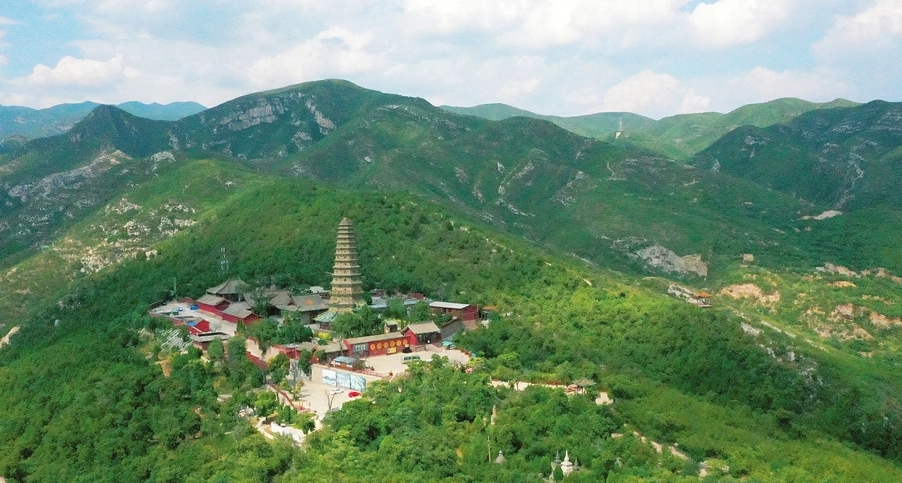
Shanxi is often called the cradle of Chinese civilization, a province with one of the richest collections of cultural and historical relics. Guangsheng Temple is part of that story. First built during the Eastern Han Dynasty (25–220 CE), it is one of the earliest Buddhist temples in China. Over the centuries, it has endured wars, fires, and devastating earthquakes, yet it still stands, its beauty renewed through reconstructions in the Yuan (1271–1368) and Ming (1368–1644) dynasties.

The temple complex is composed of three main parts:

  • The Upper Monastery — home to its most famous landmark, the glazed pagoda.
  • The Lower Monastery — housing grand halls and statues.
  • The Water God Temple — known for its remarkable Yuan Dynasty murals.

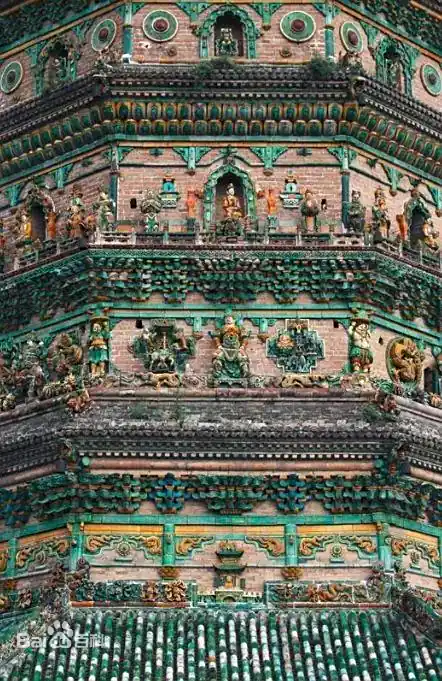
Rising in the upper monastery is the Flying Rainbow Pagoda (Feihongta), an octagonal, 13-story glazed brick tower reaching 47.31 meters high. Built in 1527 during the Ming Dynasty, it’s an explosion of color in the sunlight. The walls and roofs are covered in multi-colored glazed tiles — deep emerald, golden yellow, sapphire blue, and rich purples — that glisten like jewels, casting rainbow-like reflections on sunny days.

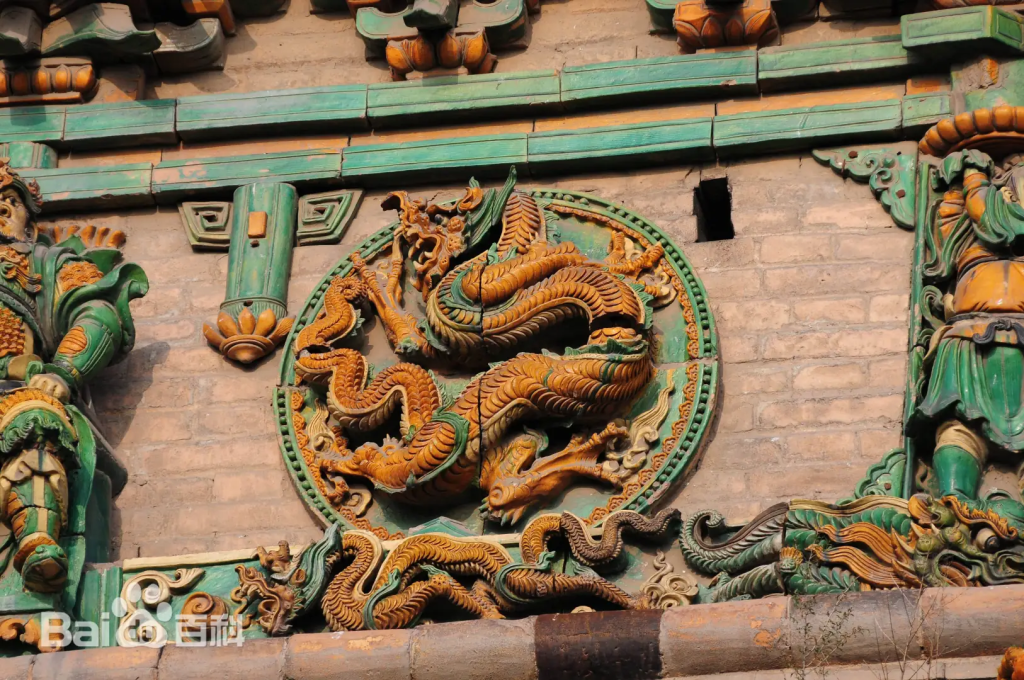
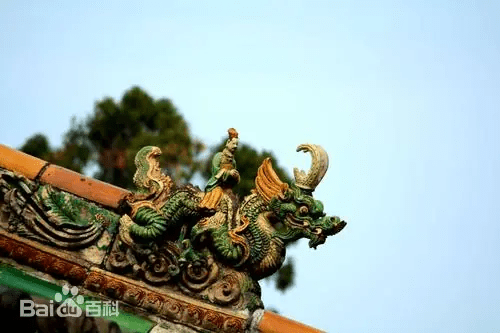
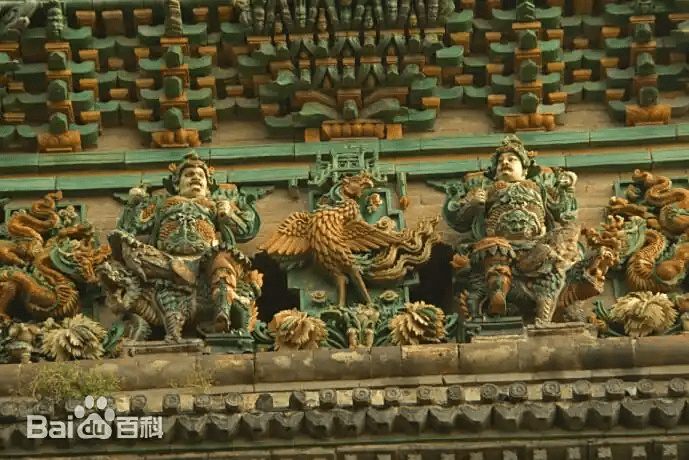
Every tier of the pagoda is adorned with intricate glazed reliefs — Buddhas in serene meditation, fierce guardian kings, bodhisattvas in flowing robes, mythical beasts, and dragons coiled in eternal motion. Inside, the foundation hall houses a five-meter-tall bronze statue of Sakyamuni Buddha, radiating quiet majesty.
This pagoda is not only beautiful — it’s a survivor. It withstood the catastrophic 1556 Shaanxi earthquake and the 1695 Pingyang earthquake, both exceeding magnitude 8.0. Its resilience is as awe-inspiring as its artistry. In 2018, it was recognized by the London-based World Record Certification as the tallest multicolored glazed pagoda in the world.

Murals of the Yuan Dynasty — Life Painted in Color

The temple’s murals are a vivid window into the Yuan Dynasty. In the Water God Temple, nearly 200 square meters of wall space is alive with color: scenes of divine processions, farmers at work, musicians playing, and children at play. One remarkable panel shows “Cuíwán” (捶丸) — a sport similar to golf — offering a glimpse into pastimes of the Yuan era.

The mural on the gable wall of the Great Hall of Sakyamuni Buddha in the lower monastery is equally stunning, painted with an expressive style that blends religious devotion with snapshots of daily life. Researchers prize these works for their artistry and for the wealth of cultural detail they reveal — clothing, architecture, social customs — all preserved in pigment for more than 700 years.

The Zhaocheng Buddhist Canon — A Literary Treasure

In 1930, during restoration work, the temple revealed another extraordinary surprise—a cache of ancient relics now preserved in the Shanxi Museum. These included Buddhist scriptures, statues, and ritual objects, some dating back hundreds of years earlier. Printed during the Yuan Dynasty, this monumental project took 24 years and the collaboration of countless monks and artisans to engrave the wooden printing blocks. The texts preserve Buddhist thought, philosophy, and art from centuries ago, making them one of China’s most precious Buddhist literary relics.

The discovery deepened Guangsheng Temple’s reputation as one of the great guardians of China’s Buddhist heritage.

Today, whether you approach as a pilgrim, an art lover, or simply a traveler drawn by curiosity, the moment you first see the rainbow-like shimmer of the Glazed Pagoda through the mountain mist is unforgettable. It is not merely a structure—it is a bridge between centuries, a beacon of faith, and a reminder that beauty, once created with devotion, can endure against time itself.

Link: https://peacelilysite.com/2025/08/15/guangsheng-temple-the-hidden-gem-of-shanxis-ancient-treasures/

Source: http://shanxi.chinadaily.com.cn/2022-05/06/c_748899.htm?utm_source=chatgpt.com
Dragon Boat Festival and Duanwu Jie

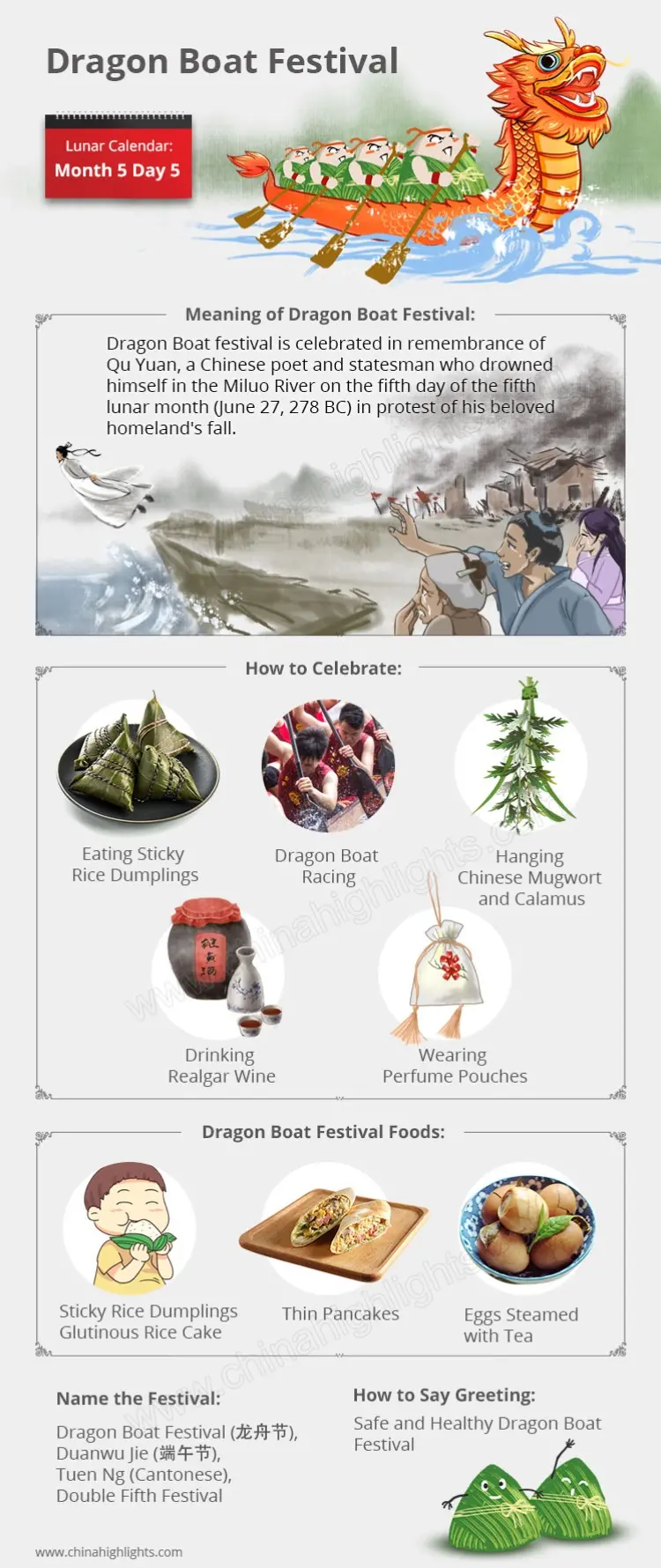
The Dragon Boat Festival, also known as Duanwu Jie, is one of the four major traditional Chinese festivals, alongside the Spring Festival, Tomb-Sweeping Day, and Mid-Autumn Festival. It is celebrated on the fifth day of the fifth month of the Chinese lunar calendar, which is why it is also called the “Double Fifth Festival” (Chongwu Jie, 重五节). On the Gregorian calendar, it usually falls in late May or early June.

In addition to Chinese mainland, many other Asian countries and regions also celebrate this festival. In Malaysia, Indonesia, Singapore, and Taiwan, China, it is known as Bak Chang Festival (‘Dumpling Festival’). Learn more facts about the Dragon Boat Festival

Why Is Dragon Boat Festival So Important?

Many believe that the Dragon Boat Festival is celebrated to commemorate the death of Qu Yuan, a renowned Chinese poet and minister known for his patriotism and profound contributions to classical poetry. He ultimately became a national hero.

However, historical evidence shows that the origins of the Dragon Boat Festival actually predate Qu Yuan’s death. The festival’s earliest roots are tied to the fifth lunar month, which the ancients considered the “month of poison.” As summer began, people were more prone to illness, and epidemics often spread. This made the month seem ominous, prompting ancient communities to adopt various practices to ward off disease and evil spirits.

Thus, the Dragon Boat Festival was originally observed as a traditional health and wellness festival. It was a time for people to carry out rituals and customs aimed at protecting themselves from illness and repelling harmful forces.

Dragon Boat Festival

Dragon Boat Festival Customs

The customs of the Dragon Boat Festival can generally be divided into two main categories. One centers on honoring dragons and historical heroes—most notably Qu Yuan—while the other focuses on warding off evil spirits and promoting health and well-being.

1. Honoring Heroes and Dragons

a. Eating Sticky Rice Dumplings

dragon boat festival celebration, eating sticky rice dumplings

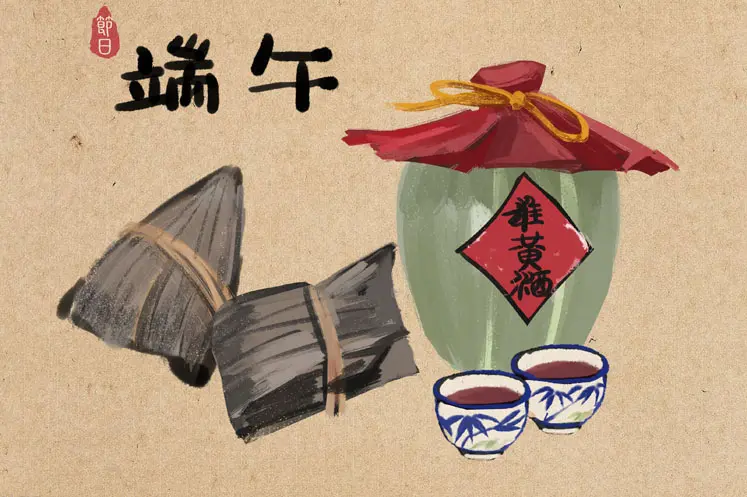
Zongzi (粽子, zòngzi) are the most iconic food of the Dragon Boat Festival. According to legend, after the patriotic poet Qu Yuan drowned himself in the river, local people threw lumps of rice into the water to prevent fish from eating his body. This evolved into the custom of making zongzi.

Traditionally, families would prepare and share homemade zongzi. Today, while some older generations still hand-make them, most people buy them from restaurants or bakeries.

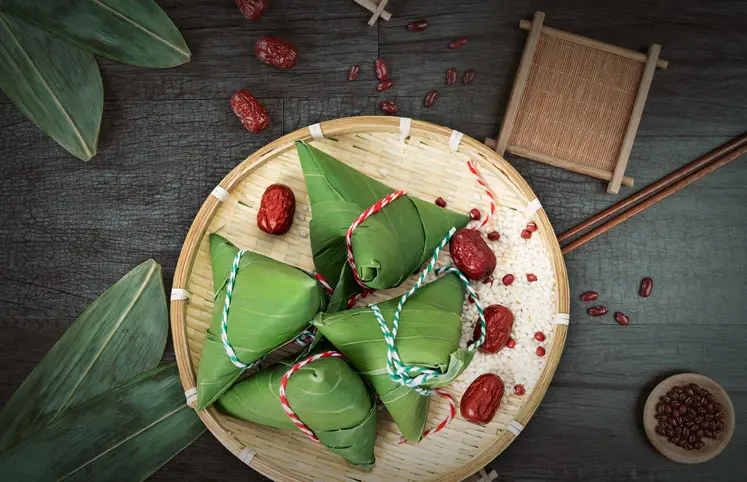
Zongzi are made with glutinous rice and often filled with meats, beans, or other ingredients. They are wrapped in bamboo or reed leaves into triangular or rectangular shapes and tied with soaked stalks or colorful silk cords. Flavors and fillings vary widely across different regions of China.

b. Participating or Watching Dragon Boat Races

dragon boat festival celebration, dragon boat race

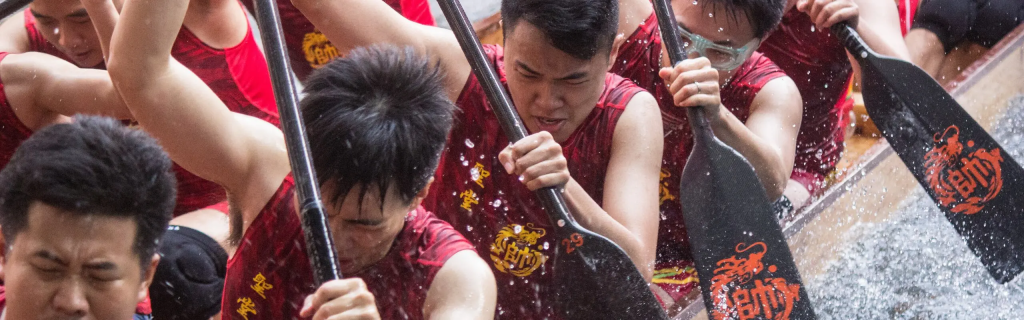
Dragon boat racing is the most exciting and prominent activity during the festival. The sport is said to have originated from people paddling out in boats to search for Qu Yuan’s body after his tragic death in 278 BCE.

Another theory suggests that the races originated more than 2,000 years ago as a ritual to worship the Dragon God or Water God.

The boats are traditionally carved and painted to resemble dragons. Depending on the region, each boat can carry 30 to 60 paddlers. Teams row in unison to the rhythm of pounding drums, creating a thrilling and energetic spectacle. Winning is believed to bring good luck and happiness for the year ahead.

Some of the most famous races take place in Hong Kong, Guangzhou, and Hangzhou.

2. Warding Off Evil and Promoting Health

a. Hanging Chinese Mugwort and Calamus

dragon boat festival celebration

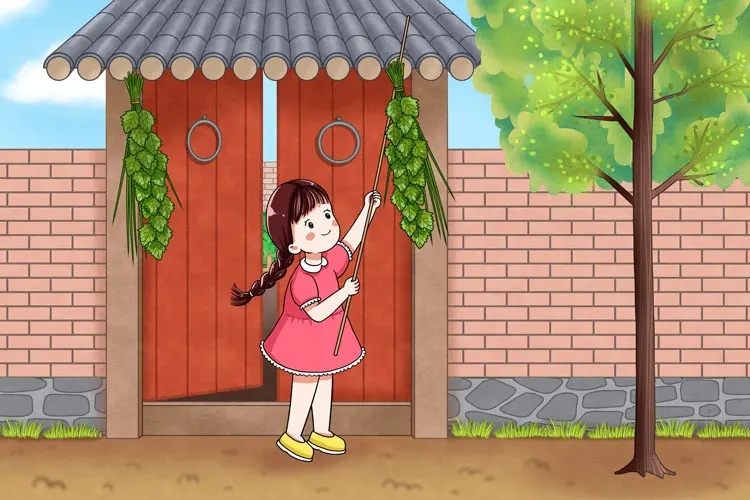
The festival coincides with the early summer season, a time when illnesses were historically more common. Mugwort and calamus are medicinal herbs used to prevent disease and repel pests. Their strong fragrances are believed to drive away flies, mosquitoes, and negative energies.

On the fifth day of the fifth lunar month, people clean their homes and hang these herbs on their doors to protect against illness and bring good luck.

b. Drinking Realgar Wine

dragon boat festival celebration,

A traditional saying goes: “Drinking realgar wine drives away disease and evil spirits.” Realgar wine is made from fermented grains and realgar, a red mineral (arsenic sulfide) once believed to be an all-purpose antidote.

Historically, people drank realgar wine to kill insects, detoxify the body, and protect against spiritual harm.

c. Wearing Perfume Pouches

dragon boat festival celebration,

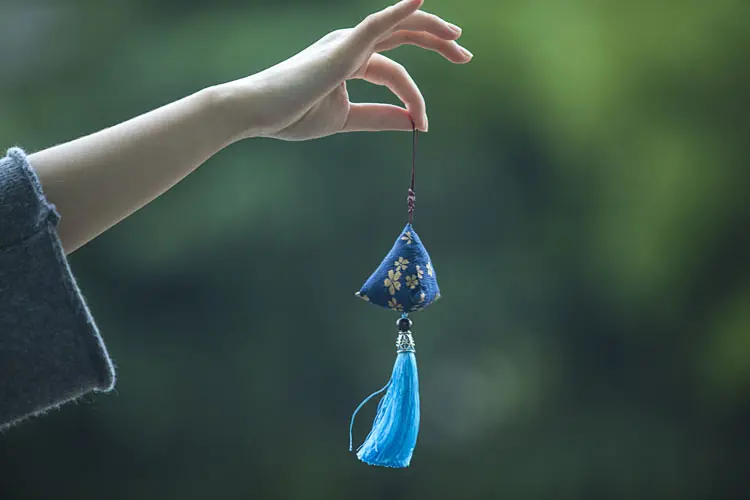
Before the festival, parents prepare small, colorful silk pouches filled with fragrant herbs or perfume for their children. These are either worn around the neck or pinned to clothing as ornaments.

Perfume pouches are believed to offer protection from evil spirits and disease, and are a cherished custom that blends health with artistry.

The Origins of the Dragon Boat Festival

There are many legends about the origin of the Dragon Boat Festival. The most popular ones are as follows:

Why Dragon Boat Festival Celebrated

The Death of Qu Yuan

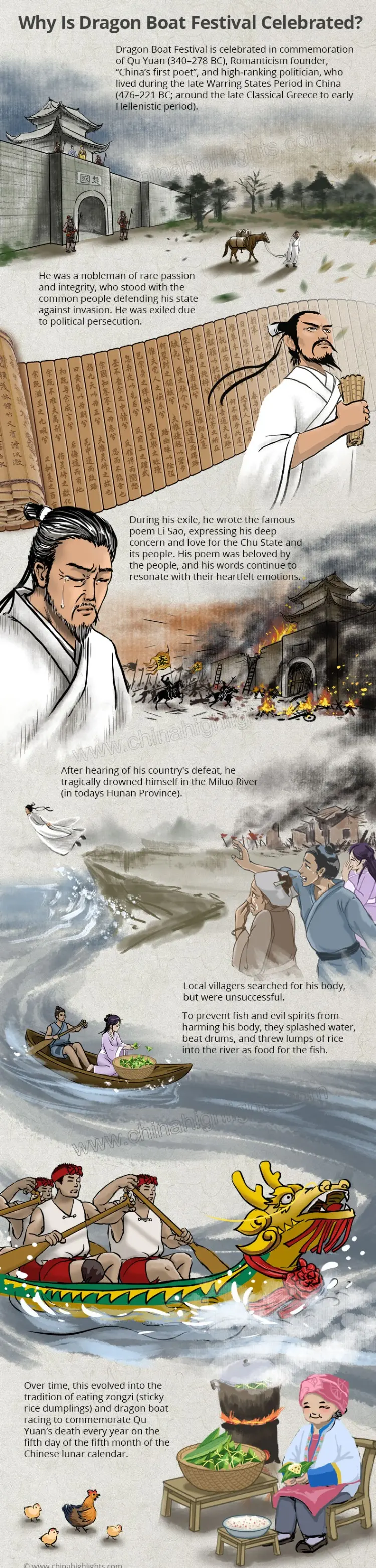
The most widely accepted origin of the Dragon Boat Festival is its commemoration of Qu Yuan (340–278 BCE), a patriotic poet and loyal official of the Chu State during the Warring States Period. When his beloved state fell to the Qin, Qu Yuan, devastated by the loss, drowned himself in the Miluo River on the fifth day of the fifth lunar month.

Local people, deeply moved by his patriotism, raced out in boats to rescue him or retrieve his body, but their efforts were in vain. To keep fish and evil spirits from disturbing his remains, they beat drums and threw rice dumplings into the river. These traditions evolved into the dragon boat races and the custom of eating zongzi that continue today.

The Unlucky Fifth Month

Another explanation for the origins of the Dragon Boat Festival relates to the traditional Chinese calendar and seasonal beliefs. Since ancient times, the fifth lunar month was considered an unlucky time and was even referred to as the “Month of Poison” (毒月). This was when the “Five Poisonous Creatures” (五毒 wǔ dú)—centipedes, scorpions, snakes, toads, and spiders—began to appear in greater numbers due to the warming weather. Disease, pestilence, and natural disasters were also more prevalent during this period.

The fifth day of the fifth month, or the “Double Fifth,” was seen as especially ominous. To protect themselves, people hung wormwood and calamus on their doorways and wore sachets of fragrant mugwort (xiāng bāo, 香包). The sword-like shape and pungent aroma of calamus were believed to repel both pests and evil spirits. For this reason, the Dragon Boat Festival is also sometimes referred to as the “Calamus Festival” (菖蒲节 Chāngpú Jié).

These rich and varied customs reflect the Dragon Boat Festival’s deep cultural significance, blending ancient health practices with heartfelt traditions of honor, protection, and community celebration.

Link:https://peacelilysite.com/2025/06/05/dragon-boat-festival-and-duanwu-jie/

Source: https://www.chinahighlights.com/festivals/dragon-boat-festival.htm

The Wisdom of the Empty Boat: Ancient Chinese Insight for Inner Peace

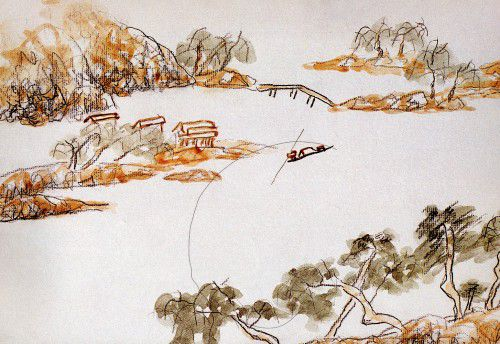
Chinese Painting by Henggong Yi

In the Mountain Tree chapter of the ancient Taoist classic Zhuangzi, there’s a simple yet profound story:

A man was crossing a river in a small boat when he noticed another boat drifting straight toward him. He shouted several times to warn the oncoming boat, but received no reply. Furious, he began cursing the other “reckless” person. But when the boats collided, he realized the other vessel was completely empty. In that moment, his anger vanished into thin air.

This story reveals a timeless truth: Often, what triggers our anger isn’t real harm but our judgment about the intention behind an event—our belief that someone shouldn’t have acted a certain way, or that people like that shouldn’t exist.

Imagine the same situation, but this time with a person steering the other boat. Most of us would react with outrage: “What’s wrong with you? Watch where you’re going!” A conflict would likely erupt. But when we know the boat is empty, we simply steer around it and move on.

This is beautifully explained in psychology by the ABC model:

  • A stands for the Activating event
  • B is our Belief about the event
  • C is the Consequence—our emotional response

It’s not the event itself that causes our reaction, but how we interpret it. Change your mindset, and your entire emotional response changes with it.

“The weak blame, the strong adjust, the wise let go.”
How you choose to interpret the world shapes the emotional and spiritual life you live.

Zhuangzi’s parable invites us to practice a mental shift: what if we saw others as “empty boats”? When a coworker unintentionally bumps into you, instead of assuming hostility, think, “Maybe they were just distracted.” When a friend speaks harshly, perhaps they’re struggling with something you don’t know. Instead of reacting with pain or revenge, consider that it may not have been personal.

Seeing others as “empty boats” helps us release resentment, practice compassion, and expand our emotional resilience. It allows us to heal ourselves faster, without getting trapped in cycles of blame and victimhood.

German philosopher Arthur Schopenhauer once said:

“To be angry at someone’s behavior is as foolish as being angry at a rock blocking your path.”
True wisdom lies in seeing through the illusion of control, and responding with tolerance rather than judgment.

When life doesn’t go our way, it’s easy to fall into the trap of self-pity: “Why is this happening to me?” But such thoughts only darken our mood and invite more misery.

The real shift happens when we stop blaming others and start examining our own mindset. By applying the “Empty Boat” perspective, we reduce conflict, soothe emotional storms, and gain a wider, calmer view of life. This isn’t just emotional regulation—it’s a deeper level of personal growth.

Zhuangzi also wrote:

“If a person can empty themselves and move through the world with humility, who can harm them?”

When we’re too attached to ego—too quick to feel offended, too focused on saving face—we inevitably clash with others. But if we release pride, prejudice, and the need to control, we become unshakable. No one can truly hurt us when we no longer take things personally.

Our mindset is the foundation of how we face adversity. Approach life with a peaceful, open heart, and life will respond in kind. Let go of the need for constant validation. Don’t let others’ words disturb your inner calm.

The journey of life is like sailing through mist—we never know what lies ahead. Complaining or getting angry doesn’t change reality; it only slows us down. But when we practice acceptance and face life with serenity, we go farther, and with greater ease.

Imagine all the unpleasant people or events in your life as “empty boats.” Let go of resentment and emotional baggage. You’ll find that forgiveness is not weakness, but a deep, penetrating wisdom. No longer a slave to your emotions, you become the true master of your mind.

May you carry an empty and serene heart, navigating life’s storms with grace, and holding on to peace amid the noise of the world.

Link: https://peacelilysite.com/2025/05/16/the-wisdom-of-the-empty-boat-ancient-chinese-insight-for-inner-peace/

Nezha: From Buddhist Origins to a Chinese Cultural Icon

Recently, the animated film Nezha 2 has become incredibly popular, reaching the top spot in global box office earnings for animated movies. While many believe Nezha is a character from Chinese mythology, his origins can actually be traced back to Buddhist scriptures.

Vaisravana

Nezha’s name first appeared in Vajrayana Buddhist texts, where he is associated with the role of a Dharma protector. He is described as the third son of Vaisravana, one of the Four Heavenly Kings. According to The Ritual of Vaisravana, “The Heavenly King’s third son, Prince Nezha, holds a pagoda and always follows the King.” His duty is to assist his father in safeguarding the Dharma, driving away evil forces, and protecting humanity. In The Mantra of the Dharma Protector Following the Northern Vaisravana Heavenly King, translated by the eminent Tang Dynasty monk Amoghavajra, Nezha is again referred to as Vaisravana’s third son. Other Buddhist texts from the Tang Dynasty, such as The Awakening of Faith in the Mahayana and The Lotus Sutra, also mention Nezha.

In Buddhism, Dharma protectors and yaksha deities often have fierce appearances, symbolizing their hatred of evil and fearless bravery. As a result, Nezha is typically depicted with a wrathful and intimidating image. As Buddhism spread to China, many Buddhist stories and figures gradually merged with local Chinese culture, giving rise to new belief systems. Over time, Nezha became integrated into Taoism and Chinese folk beliefs, forming a unique cultural phenomenon.

The story of Nezha is filled with many well-known and beloved episodes, such as his birth from a ball of flesh, cutting his flesh and bones to repay his parents, and being reborn from a lotus flower. Although this scene cannot be found in modern Buddhist scriptures, it became a popular topic among monks after the Song Dynasty. For example, Volume 1 of The Comprehensive Collection of Zen Verses on Ancient Cases mentions: “Prince Nezha offered his flesh to his mother and his bones to his father, then manifested his true form and used his divine power to preach to his parents.” This suggests that the story of Nezha sacrificing his flesh and bones likely originated from Buddhist texts. Although the exact cause and details are unclear, this story undoubtedly provided a prototype for later adaptations in folk literature.

As Buddhism spread throughout China, the assimilation of foreign religions by local culture and the evolution of folk beliefs gradually transformed Nezha’s image, steering it away from its original Buddhist context and toward a more Chinese identity. After the Tang Dynasty, the worship of Vaisravana (known as Bishamonten in Japan) reached its peak in China, gaining widespread recognition from both the imperial court and the common people. He was honored in official rituals and revered by many folk believers. Simultaneously, Li Jing, a prominent Tang Dynasty military general, became a popular figure of worship as a god of war. Renowned for his military campaigns against the Turks and Tuyuhun in the northwest, Li Jing was deified as early as the Tang Dynasty, with dedicated temples built in his honor during the Song Dynasty.

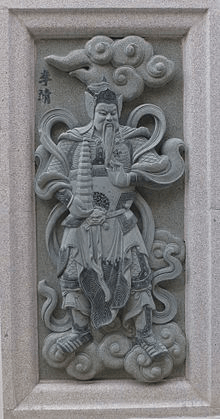
Li Jing’s temple wall statue

The broader and deeper the spread of a belief, the greater the possibility of its transformation and integration with other cultural elements. Over time, through public imagination and interpretation, the belief in Vaisravana merged with the worship of Li Jing, forming a new deity known as “Pagoda-Wielding Heavenly King Li” (Tuota Li Tianwang) by the Song Dynasty at the latest. From then on, Vaisravana took on the surname Li and became more secularized and localized within Chinese culture. Since Li Jing became identified with Vaisravana, it was only natural within folk beliefs to regard Nezha as Li Jing’s son. This marked Nezha’s departure from the cultural context of foreign religions and his integration into the Chinese pantheon.

This transformation made Nezha a more relatable and accessible figure, understood through the lens of native cultural concepts. As a result, Nezha’s story gained broader appeal, providing ample room for reinterpretation and adaptation in later generations.

Nezha holds an important place in ancient Chinese mythology. Under the influence of Taoism, he was endowed with more mythological attributes, portrayed as a young hero with powerful magical abilities who frequently battles demons and protects the people. His story further developed in classic literary works such as Journey to the West and Investiture of the Gods, where Nezha became a symbol of justice and courage.

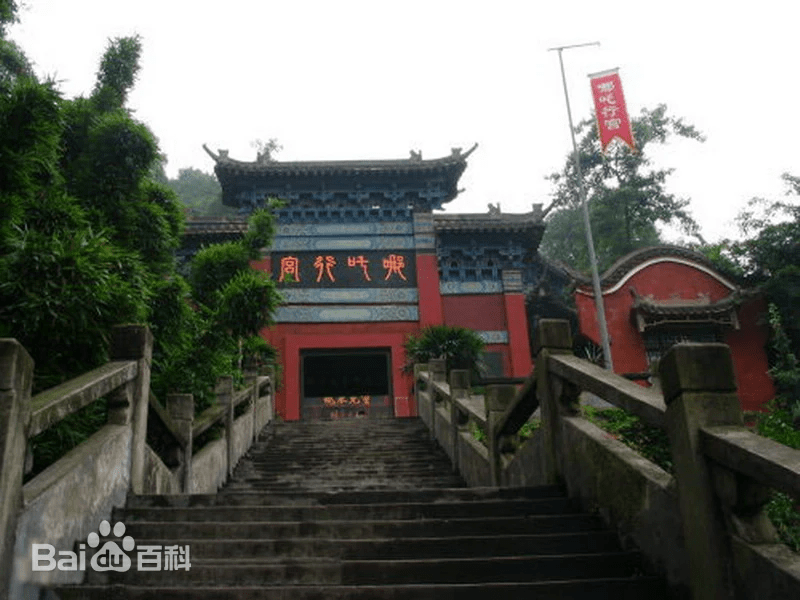
Nezha Temple in HeNan China

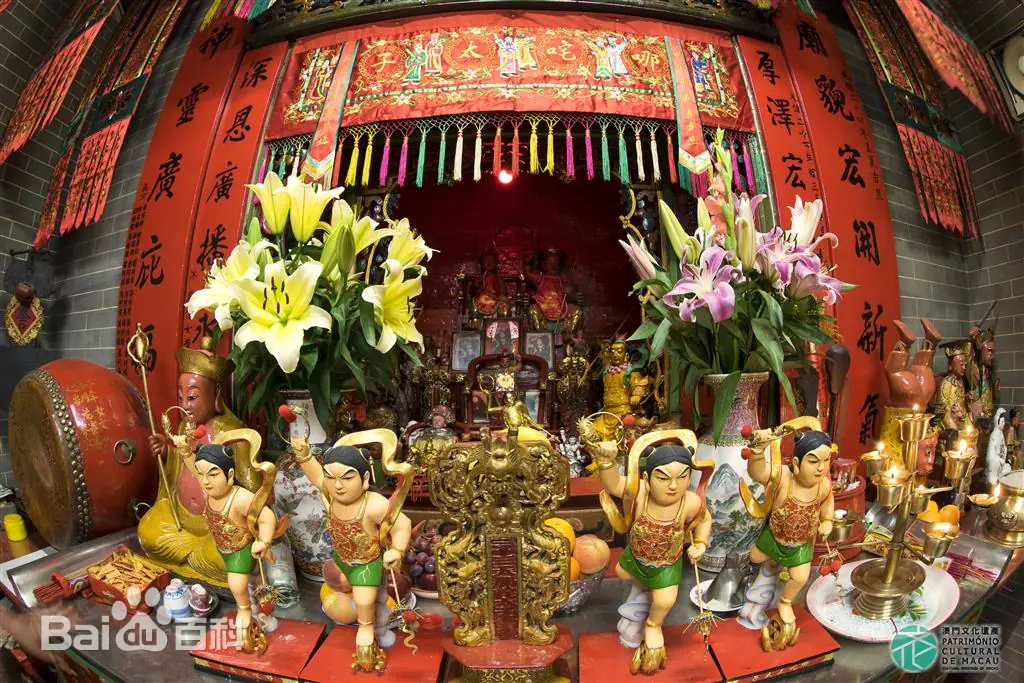
Folk worship activities for Nezha

Link:https://peacelilysite.com/2025/02/21/nezha-from-buddhist-origins-to-a-chinese-cultural-icon/