It is said that there are two ways to practice religion. One is to live apart from the ordinary everyday world as a monk, a nun or a holy one. Those who are sincere in this way have as their highest goal the direct experience of complete Truth — full Enlightenment.
The other way to practice religion is within the ordinary world. Those who are sincere in this way have as their highest goal the harmony of an undivided world, living peacefully under a perfectly wholesome ruler — a ‘King of the World’.
Once upon a time the Enlightenment Being was born and given the name ‘Clear-sighted’. As he grew up he developed ten rules of good government: absence of hidden ill will, absence of open hostility, harmlessness, self-control, patience, gentleness, charity, generosity, straightforwardness and goodness.
The people of the world began to notice the wholesomeness and fairness of Clear-sighted, who lived strictly according to these rules. Gradually those in his vicinity volunteered to live under his authority as king, rather than under the dishonest politicians of the time.
As his reputation spread, every king in the world came to Clear-sighted and said, “Come, oh lord, you are welcome, my kingdom is your kingdom, advise me how to rule in your name.”
Then Clear-sighted said, “Do not destroy life. Do not take what is not given. Do not behave wrongly in sexual desires. Do not speak falsely. Do not take alcohol that clouds the mind. My commands to the world are only these five. As long as these five are obeyed, my sixth rule is freedom for all to follow local customs and religions.”
After all the people on earth had come to live under his peaceful rule, he became known as Clear-sighted the Great, King of the World. His royal city, the capital of the whole world, was called Kusavati. It was a beautiful and prosperous city with four magnificent gates — one golden, one silver, one jade and one crystal.
Outside the gates, Kusavati was surrounded by seven rows of palm trees — a row with golden trunks and silver leaves and fruits; a row with silver trunks and golden leaves and fruits; a row with cat’s-eye trunks and crystal leaves and fruits; a row with crystal trunks and cat’s-eye leaves and fruits; a row with agate trunks and coral leaves and fruits; a row with coral trunks and agate leaves and fruits; and finally a row with trunks and leaves and fruits of every kind of jewel found in the world!
When breezes blew through these marvelous palms the sweet sounds of gentle music were heard throughout the city. This music was so enticing and pleasant that some of the citizens were enchanted into stopping their work and dancing for joy!
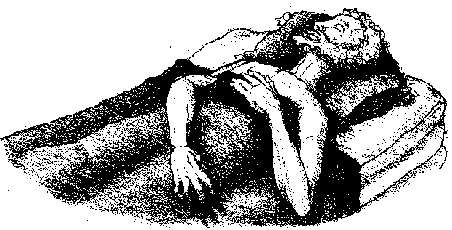
Clear-sighted the Great, King of the World, had a couch encrusted with jewels from the wonderful palms. After a long, righteous and peaceful reign, he lay on the rich couch for the last time. He knew that his end was near.
Of all his 84,000 queens, the one who loved him most was called, ‘Most-pleasant’. Sensing the state of his mind she said, “You rule over all the cities of the world, including this beautiful Kusavati with its four magnificent gates and seven rows of marvelous palms. Think about this and be happy!”
The King of the World said, “No, my dear queen don’t say that. Instead you should advise me to give up attachment to the cities of the world and all they contain.” Surprised she asked, “Why do you say this, my lord?” “Because today I will die,” he said.
Then Queen Most-pleasant started to cry, wiping away the tears as they flowed. And all the other 84,000 queens also broke into tears. And the king’s ministers and his whole court, both men and women, could not keep from weeping and sobbing. All eyes overflowed with tears.
But King Clear-sighted the Great said, “Your tears are useless. Be at peace.” Hearing this the wailing subsided and his subjects became silent. Then he said to Queen Most-pleasant, “Oh my queen, do not cry, do not lament. Anything that comes into being, whether it be a kingdom including the whole world, or just a tiny sesame seed — it cannot last forever. Anyone who comes into being, whether it be the King of the World, or the poorest petty thief — all must decay and die. Whatever is built up, falls apart. Whatever becomes, decays. The only true happiness is in the moment when becoming and decaying are not.”
In this way the Enlightenment Being got them to think about what most people don’t want to think about — that all things come to an end. He advised them to be generous and wholesome. Then the King of the World, like everyone else, died. He was reborn as a god in a heaven world, where in time, like everyone else, he died.
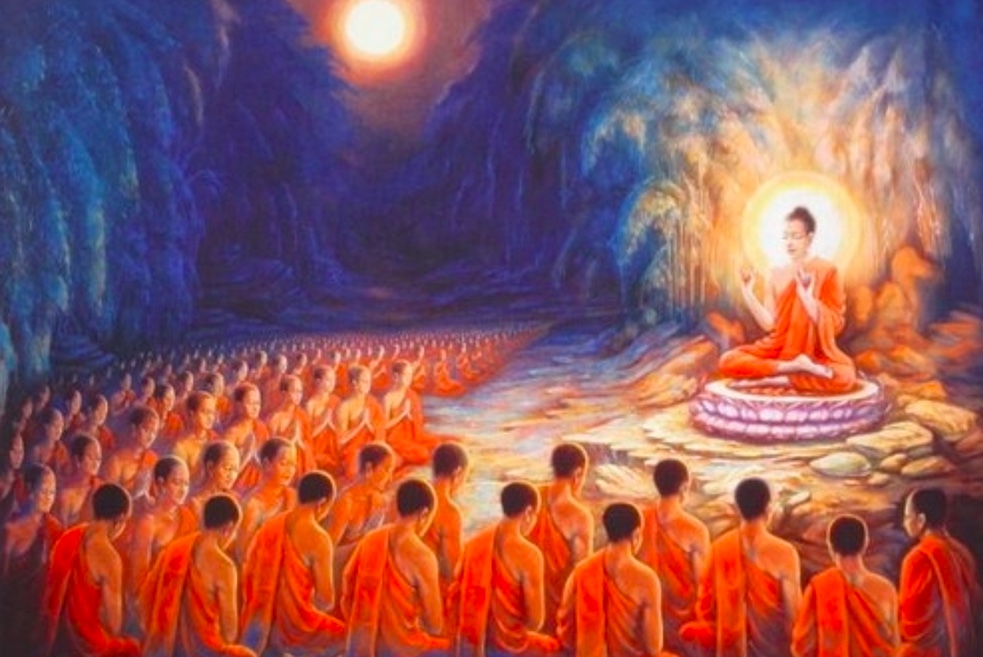
Once, in a quiet monastery nestled in the hills, the Buddha sat before his disciples. The evening sun painted the sky in hues of gold and crimson, and the air was filled with a profound stillness, broken only by the occasional rustling of leaves in the gentle breeze. The monks, eager for wisdom, sat in reverence as the Buddha began to speak.
“Monks,” the Buddha said, “in this world, there are many who come and go in our lives. Some pass by like the wind, leaving no trace, while others remain, their presence felt deeply in our hearts. Among those who remain, there is a rare kind of person, a true friend, who is like a shelter from life’s storms, a beacon of light in the darkest of times. Such a friend is endowed with seven precious qualities, and these qualities are worth cultivating, for a friend like this is rare indeed.”
The monks listened attentively as the Buddha continued, “Which seven qualities are these? First, a true friend gives what is hard to give. He does not withhold generosity, even when it is difficult. Whether it be his time, his effort, or his possessions, he offers them freely, without hesitation. This kind of giving is rare, for many are willing to give when it is convenient, but few give when it costs them something.”
The Buddha paused, letting his words sink in, then added, “Second, he does what is hard to do. A true friend will go beyond his comfort zone for the sake of his companion. He will stand by you when others shy away, face challenges with you, and make sacrifices when needed, not for his own gain, but for the sake of friendship.”
The monks reflected on this as the Buddha continued, “Third, he endures what is hard to endure. Life is not always easy. There are times of joy, but also times of suffering and hardship. A true friend remains steadfast during the difficult times. He does not flee when the winds of adversity blow; instead, he endures alongside you, bearing the weight of the struggle as if it were his own.”
Then, the Buddha smiled softly and said, “Fourth, he reveals his secrets to you. Trust is the foundation of true friendship. A true friend does not hide behind a mask or shield himself with falsehoods. He shares his heart with you, revealing his vulnerabilities, knowing that in doing so, the bond of trust between you will grow ever stronger.”
“Fifth,” the Buddha continued, “he keeps your secrets. Just as he trusts you with his, so too does he honor your trust. He safeguards what you confide in him, never betraying your confidence, never allowing the winds of gossip to carry away what you have entrusted to him.”
The Buddha’s voice softened as he spoke of the sixth quality. “When misfortunes strike, he doesn’t abandon you. Life is unpredictable, and at times, suffering may come upon you like a sudden storm. A true friend does not turn his back on you in these moments. He stands beside you, offering support, comfort, and strength. He is like a tree with deep roots, unshaken by the winds of fate.”
Finally, the Buddha said, “The seventh quality is this: When you’re down and out, he doesn’t look down on you. In times of failure or disgrace, when the world seems to turn its back on you, a true friend remains by your side, never judging, never scorning. He sees you not for your misfortune, but for who you truly are. His respect for you does not waver, even when you are at your lowest.”
The monks, inspired by these words, bowed their heads in gratitude as the Buddha’s voice grew gentle. “Such a friend, endowed with these seven qualities, is a rare and precious gift. He gives what is beautiful yet hard to give, does what is hard to do, and endures the bitter words that life may bring. His heart is open to you, and he protects your heart in turn. In the darkest of times, he will not leave you, and even when you falter, his love for you does not falter.”
The Buddha paused for a moment, letting the weight of his words fill the air before continuing, “To cultivate such a friendship is a blessing for both parties. A friend like this is not just a companion but a guide, a mirror that reflects your virtues and helps you grow. Such a bond nurtures the spirit and brings peace to the heart. Therefore, monks, seek to be such a friend. Cultivate these seven qualities within yourself, and you will draw others of similar virtue to your side.”
The monks looked at one another with renewed purpose, understanding now that friendship was not a simple matter of convenience or shared interests but a profound practice of giving, endurance, and trust. The Buddha’s words had opened their hearts to the deeper meaning of companionship, and they resolved to embody the qualities of a true friend in their own lives.
And so, as the evening deepened and the stars began to appear in the sky, the monks rose, filled with a sense of peace. They knew that in cultivating these seven qualities, they would not only find true friends but would become true friends themselves—vessels of compassion and wisdom in a world often marked by fleeting connections.
The Buddha smiled as he watched them depart, knowing that the seeds of his teaching had taken root in their hearts, and that in time, they would bear the fruits of deep and enduring friendships, blessed with the seven qualities of a true friend.
Losang Phuntsok Geshe, known by his Chinese name Xing Suzhi, was born in 1916 in Nanjing into a family deeply rooted in the Buddhist tradition. His spiritual journey began early; he embraced Buddhism at the age of nine and, by sixteen, had enrolled in the Sino-Tibetan Buddhist Institute in Chongqing, Sichuan. Here, he studied Tibetan, laying the foundation for his future studies in Tibet. That same year, he became the secretary to Master Taixu, one of the most prominent modern Buddhist scholars, who bestowed upon him the Dharma name Bison.
During his time at the Sino-Tibetan Buddhist Institute, Losang Phuntsok studied under Master Taixu and Master Fazun. His studies were deep and rigorous, focusing on key scriptures such as the Śūraṅgama Sūtra and Cheng Weishi Lun. He also diligently organized and recorded Master Taixu’s lectures. Both Master Taixu and Master Fazun held Tibetan esoteric Buddhism in high regard, especially the Amrita Dharma, a teaching said to have been revealed by the Buddha himself. This Dharma, they believed, was immensely powerful and rare, capable of revealing the true nature of reality, bestowing the six spiritual powers, and leading to liberation from the cycle of life and death. The Amrita blessing was also said to grant longevity, health, and the accumulation of merit and wisdom.
Inspired by these teachings, Losang Phuntsok embarked on a journey to Tibet in 1937, determined to seek the highest Vajrayana teachings, including the elusive Amrita Dharma. His journey was fraught with challenges, but he was resolute in his quest. He sought out eminent monks and scholars across the Kham and Tibetan regions, studying over 300 different Sakya teachings. His goal was to become a modern-day Tang Sanzang, the legendary monk who brought Buddhist teachings from India to China, and to bring the esoteric teachings of Tibet back to his homeland.
After seven years of intense study and practice, Losang Phuntsok Rinpoche achieved a historic milestone. In the first month of 1945, he passed the ten-thousand-person debate examination hosted by the Regent of Tibet at Drepung Monastery in Lhasa, becoming the first Han Chinese to obtain the highest degree in Tibetan Buddhism, the Lharampa Geshe. This degree, equivalent to a doctorate in Buddhist studies, is highly respected within Tibetan Buddhism and is recognized by both the government and the people.
Losang Phuntsok Rinpoche spent many years in Tibet, receiving over 600 empowerments and learning from many great masters. However, the Amrita Dharma, the teaching he had long sought, remained elusive. Many masters told him that this profound teaching was extremely difficult to find and that it might take many years for a great holy being to appear who could transmit it. Despite this, Losang Phuntsok Rinpoche remained undeterred. Over the decades, he traveled to Hong Kong, the United States, and other places around the world, translating and lecturing on scriptures, teaching disciples, and continuing his search for enlightened masters. He once served as the President of the American Vajrayana Buddhist Association.
In 1997, after years of searching, Losang Phuntsok Rinpoche’s efforts bore fruit. He formally became a disciple of H.H. Dorje Chang Buddha III in Chengdu, recognizing Him as his root guru. H.H. Dorje Chang Buddha III performed empowerments and transmitted teachings to him, manifesting the mandalas of the deities each time He transmitted a Dharma. Losang Phuntsok Rinpoche witnessed these sacred phenomena firsthand, which deeply moved him.
During an interview in Chengdu, he expressed his profound realization: “I have been practicing Buddhism for 60 years and have met over a hundred so-called great masters of Tibetan Buddhism. I also spent a long time with Chinese Buddhist masters like Master Taixu. I have received more than 600 empowerments from great masters like Fazun, but none of these empowerments have had the impact and blessing power on me like the ones I received today. The teachings and empowerments from the Master (H.H. Dorje Chang Buddha III) are so effective that I can’t help but think: my 60 years of Buddhist practice are not as valuable as this one day. Sixty years have passed in vain, not as meaningful as today!”
In June 2000, during an extraordinarily auspicious moment that occurs only once in countless eons, Losang Phuntsok Rinpoche, the only living Han Chinese Lharampa Geshe celebrated worldwide and the President of the American Vajrayana Buddhist Association, participated in a highly significant Dharma assembly. He attended this event along with other world-renowned high monks and elders, including Elder Master Wuming, the President of the World Buddhist Sangha Council, and Elder Master Yizhao, the Dharma heir of the Venerable Xu Yun. This Dharma assembly was personally presided over by H.H. Dorje Chang Buddha III, the highest Buddhist leader in the world today.
During the event, Losang Phuntsok Rinpoche not only witnessed the sacred phenomenon of the Amrita descending but also personally tasted the Amrita. He felt an unparalleled sense of comfort throughout his entire body. Deeply moved and excited, he expressed that at the age of 85, after spending more than a decade in Tibet and having taken many great masters as teachers, he had never been able to receive the Amrita. He never expected that his wish would finally be fulfilled upon meeting H.H. Dorje Chang Buddha III. He personally witnessed two rays of red light entering the bowl and transforming into Amrita, fulfilling a wish that had eluded him during his many years of seeking in Tibet.
In February 2001, at the request of his Buddhist disciples, Losang Phuntsok Rinpoche once again taught the Lamrim (Stages of the Path to Enlightenment) by the great master Tsongkhapa of the Gelug school of Tibetan Buddhism and organized his lecture notes for future publication. When he completed the translation of the Lamrim and submitted it to H.H. Dorje Chang Buddha III for review, H.H. Dorje Chang Buddha III performed a Dharma practice on the spot, inviting the Dharma-protecting Bodhisattvas to the mandala. Losang Phuntsok Rinpoche personally requested guidance from the Dharma protectors, who responded that it would indeed be best for H.H. Dorje Chang Buddha III to revise the text. Losang Phuntsok Rinpoche remarked that Dorje Chang Buddha III’s Dharma practice was so powerful that the Dharma-protecting Bodhisattvas appeared immediately, allowing him to seek their guidance directly with his own eyes. He acknowledged that no one else in the world possesses such remarkable spiritual realization.
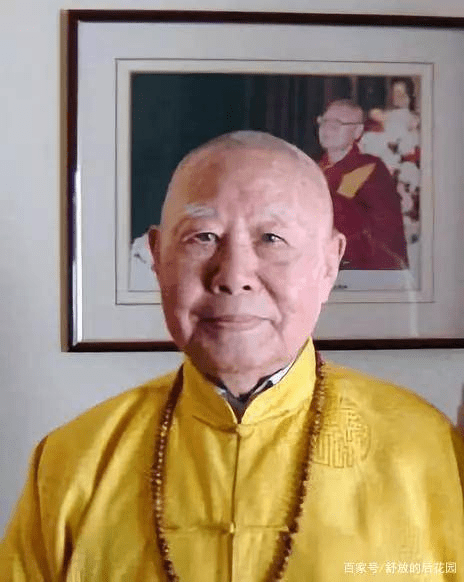
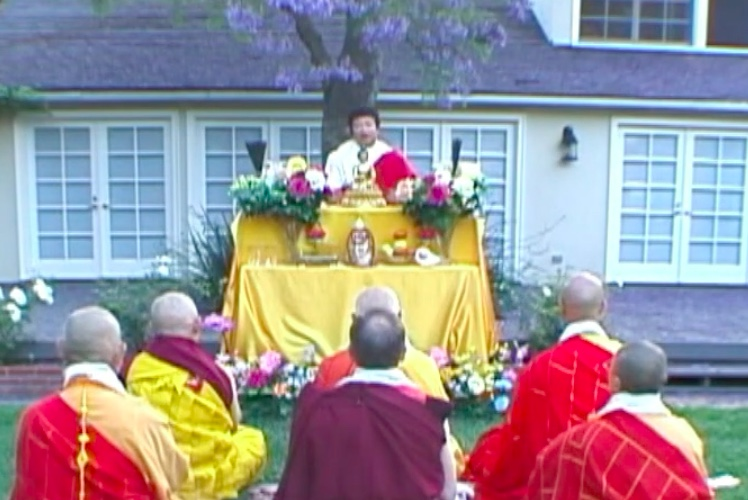
The photo above shows Losang Phuntsok Geshe in Chengdu, Sichuan, taking refuge in H.H.Dorje Chang Buddha III as his master. The photo below shows H.H.Dorje Chang Buddha III performing an empowerment for Losang Phuntsok Geshe in the United States.
Master QinDing taking refuge in H.H.Dorje Chang Buddha III as his master
Great monks and virtuous masters do not wish to let their lives pass in vain. They understand the rarity of human life, the difficulty of pursuing the Dharma, and the challenge of attaining the path to liberation. For these great monks and virtuous masters, the Dharma is not merely empty Buddhist theory or superficial titles of lineage. They deeply understand that whoever can truly demonstrate supreme realization, manifesting responses across the three realms, mastering both the exoteric and esoteric teachings, and thoroughly comprehending the Five Vidyas, represents the true Dharma of the Tathagata. Therefore, they willingly bow down and take refuge in the true incarnation of the primordial Buddha, Vajradhara H.H. Dorje Chang Buddha III.
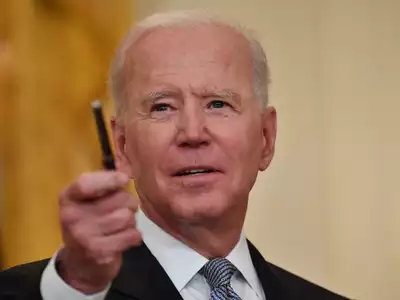
Vesak honors the Buddha’s birth, enlightenment and passing. On May 23, 2024, in recognition of the occasion, President Biden issued the following official statement from the White House:
“Jill and I extend our warmest wishes to Buddhists in the United States and around the world as they celebrate Vesak. As we honor the birth, passing, and enlightenment of Buddha, we recognize the American Buddhists who contribute so much to our communities and our country. For over 2,500 years, those who adhere to the Buddha’s teachings have enriched and strengthened this world we share. Vesak is a time to reflect on the Buddha’s teachings, including the need to work for peace and justice, and cultivate humility and compassion as we work together towards a brighter future.”
Representing President Biden at the Vesak ceremony was Second Gentleman Doug Emhoff, husband of Vice President Kamala Harris, whose opening remarks highlighted the significance of the Buddhist holiday.
“It’s important that we all come together,” Emhoff said. “One, to express our interconnectedness, our faith, our joy, but also to combat hate. Because the one and best way to combat hate is to do it together. Because we know in this room that there’s so much more that unites us than divides us.”
Emhoff said that as the “first Jewish White House principal, I always talk about finding joy in my own faith, even in the face of hate and anti-semitism. As we celebrate this event and celebrate our cultures coming together, let’s just keep that joy at all times.”
The event was coordinated by Wangmo Dixey, President of the International Buddhist Association of America (IBAA) and the Executive Director of Dharma College in Berkeley through the offices of Shekar Narasimhan, President of the Dharma Into Action Foundation.
Dixey noted that there are about 3,000 Buddhist temples in the United States, each representing the Theravada, Mahayana and Vajrayana traditions that trace back to the time of the Buddha. Jodo Shinshu Buddhism is part of the Mahayana tradition.
“Many elders have journeyed here to America, enriching our nation with their profound truth of reality,” Dixey told the gathering. “At the heart of the Buddha-Dharma is the conveyance of the truth of reality. It teaches the Four Noble Truths that we should understand suffering and identify its cause, and so find a path to the cessation of suffering and the way of life that embodies that this fundamental teaching illuminates a universal truth that remains timeless and profoundly relevant to the challenges we face in modernity. Central to these teachings is the practice of the Eightfold Noble Path, a guide to living, wisdom, ethical conduct and mental discipline.”
Before Emhoff and the Buddhist dignitaries lit a butter lamp in honor of Vesak, Dixey spoke about the lamp’s symbolism to light the way to world peace.
“Let us reimagine this light as a beacon of hope, a possibility for each of us to manifest harmony and well-being within ourselves and ultimately to become ambassadors of world peace,” she said. “This message originating in this room can resonate around the world, as so many look to America to lead with its profound commitment to true internal freedom. Imagine the power within us to illuminate the world, showing that wisdom and compassion are the ways to lead humanity. Let us remember that we have such great figures like the Buddha to remind us that enlightenment is possible, even in this lifetime.”
Dixey said “each of us carry the inspiration and spirit of Vesak into our everyday lives. May we embrace the beautiful qualities that the Buddha has shown us to build a brighter and kinder future for all Americans guided by the timeless quality of love, compassion and mutual understanding. By lighting this lamp today, we send a message of peace and harmony that will resonate throughout the world.”
After Emhoff lit the lamp, representatives from the various Buddhist traditions took turns lighting the lamp and chanting sutras. Rev. Harada spoke as part of the Mahayana tradition.
“Mahayana literally means ‘large vehicle’ like a big bus that carries many people,” Rev. Harada said. “Buddhism uses the metaphor of a vehicle to illustrate how it is a teaching that carries us from a life of delusion, ignorance and suffering to a life of awakening, wisdom and liberation. This large vehicle carries anyone and everyone regardless of race, gender, social status or sexual orientation.
“Our world is in great need of the teachings to awaken us to our own greed, anger and ignorance that bring suffering not only for ourselves, but to others,” he continued. “We are in great need of the teachings that urges us to listen to the Dharma to listen to others, to listen to our own inner voice. We are in great need of the teachings that urges us to live a life of a bodhisattva to work with the enlightenment of all beings.”
After the Vesak ceremony, there was a Buddhist peace march around the Washington Monument the evening of May 23 with leaders from various Buddhist traditions. The event was held in partnership with the Tzu Chi Foundation and listed Dharma College as a key collaborator.
It is hard to believe that anyone could possess all-encompassing wisdom. For us humans, dedicating a lifetime to mastering even one discipline is remarkable. How could someone be a philosopher, scientist, painter, sculptor, writer, doctor, and inventor all at once, mastering each within a few decades? This seems impossible by human standards. However, the Buddha’s vast and profound wisdom is genuinely real. Over 2,500 years ago, Siddhartha Gautama, the Buddha, invited anyone to ask him any question, promising a detailed answer. This is illustrated in the story of the Buddha teaching a cowherd, as recorded in the “Sutra of the Cowherd Parable.”
King Bimbisara of Magadha once invited the Buddha and 500 disciples to preach in his kingdom for three months. To provide them with fresh dairy products daily, the king arranged for cowherds to stay nearby. As the end of the three months approached, the king suggested the cowherds meet the Buddha. The cowherds, having heard of the Buddha’s wisdom, decided to test him with questions about cowherding. They reasoned that if he could answer these, he truly possessed all-encompassing wisdom.
Upon arriving at the Bamboo Grove, they were struck by the Buddha’s radiant presence. They saw him sitting under a tree, glowing like a golden mountain, radiating light like melted gold. Overwhelmed with joy, the cowherds discussed among themselves, “Regardless of whether the Shakyamuni possesses all-encompassing wisdom, anyone who sees him feels joy. His light is unparalleled, his appearance noble, and his presence exudes majesty. His radiance is clear and bright, his demeanor commanding respect, and his body adorned with the aura of virtue, making anyone who sees him feel immense joy.
If he indeed possesses all-encompassing wisdom, it must be due to his immeasurable merits. No worldly treasure can compare to the Buddha’s sublime and dignified presence, which brings great joy and pure faith to all who see him. It is clear that the Buddha must indeed possess all-encompassing wisdom.”
The shepherd thought about this and sat down to pay respects to the Buddha. They asked the Buddha, “What are the various methods a shepherd can use to ensure that the cattle thrive and reproduce well? And what conditions might prevent the cattle from growing properly and living peacefully?” The Buddha answered: There are eleven methods by which a shepherd can ensure the cattle’s well-being and reproduction. What are these eleven methods?
Understanding the Caretaker: Having a strong and capable caretaker who can protect and nourish the cattle, keeping them healthy and well-maintained. Similarly, a monk should be a respected and virtuous leader who can uphold the Dharma and guide beings toward good deeds.
Understanding Color: Knowing the colors of the cattle, such as black, white, or mixed. Similarly, a monk should understand that all phenomena in the world are composed of the four elements: earth, water, fire, and wind.
Understanding Appearance: Recognizing whether the cattle’s appearance is auspicious and whether they will be harmonious. A monk should similarly be able to discern whether someone’s actions indicate wisdom or ignorance.
Understanding Scraping: If insects bite the cattle and their blood is consumed, sores will develop. Scraping can remove these pests and promote the cattle’s well-being. Likewise, a monk should remove harmful views and misconceptions that corrupt their spiritual practice.
Understanding Wound Treatment: Applying medicine to prevent mosquito and fly bites and other injuries. Similarly, a monk should use correct Dharma teachings to protect themselves from delusions and negative emotions.
Understanding Smoke: Using smoke to drive away insects so the cattle can stay in a comfortable, insect-free shelter. Similarly, a monk should use the teaching of Dharma to lead beings to the state of emptiness and liberation.
Understanding Good Ways: Knowing the behavior and preferences of the cattle and how to keep them healthy. A monk should understand how to practice the Noble Eightfold Path to achieve Nirvana and avoid falling into the extreme paths of annihilation or eternalism.
Understanding the Right Place: Knowing how to provide a place where the cattle can live healthily and with minimal sickness. Similarly, a monk should practice and teach the Dharma to cultivate purity and increase good roots.
Understanding Good Routes: Knowing which paths are safe and which places are good for crossing rivers, avoiding places with waves and pests. Similarly, a monk should learn from knowledgeable teachers and adapt their teachings to the capacities of sentient beings.
Understanding Safe Places: Ensuring the cattle live in places free from predators and harmful creatures. Similarly, a monk should maintain mindfulness to avoid the harmful effects of negative emotions.
Understanding Milk Preservation: Ensuring that the mother cow’s milk is not consumed completely by the calf so that both the mother and the owner can benefit from it daily. Similarly, laypeople should use offerings such as clothing and food economically to benefit both the givers and receivers.
The cowherds, after hearing the Buddha’s teachings, thought, “We cowherds know only three or four methods, and our predecessors knew only five or six. Hearing the Buddha today is truly astonishing and unprecedented! The Buddha indeed possesses complete wisdom beyond doubt.”
This is described in the “Sutra of the Parable of the Cowherds.” From this, we understand that there are individuals with complete wisdom.
Today, due to the supreme and exceptional causes and conditions, the original primordial Buddha, Vajradhara has once again descended into the Saha World to manifest all-encompassing wisdom. H.H. Dorje Chang Buddha III once said: Within five years (from 1995 to 1999), if any sentient being asks ME any question, the answer should be given immediately without any hesitation. If there is any need to think about it, or if there is slight hesitation or any fabrication, or if the answer is not comprehensive, I will immediately step down from the Dharma throne and no longer be qualified to teach the Dharma.”
In the more than two thousand Dharma discourses spoken by the Buddha, He provided direct and comprehensive answers to various questions on practice and methods for His disciples. Sometimes, even before the disciples spoke, He would say, ‘I know what you want to ask. You don’t need to say anything; I will answer you directly.’ The disciples would nod in agreement. There was also Zeng Ruzhang, who studied stealth aircraft and asked why they can be invisible. Lobsang Zhenzhu Rinpoche once proposed to see Green Tara, and shortly after, a divine manifestation appeared, H.H. Dorje Chang Buddha III fulfilled his wish…
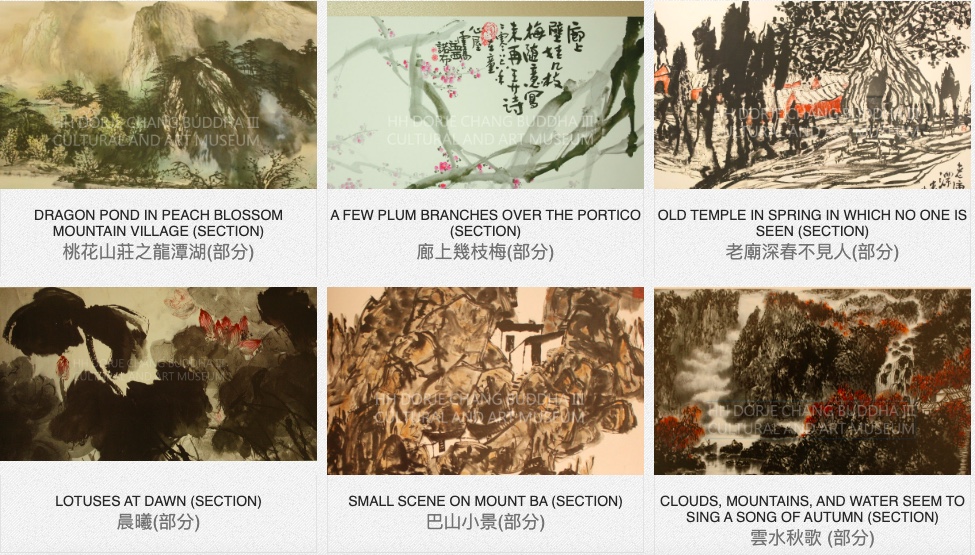
Step into the International Art Museum of America in San Francisco or the H.H. Dorje Chang Buddha III Culture and Art Museum in West Covina, and you will be able to appreciate world-class masterpieces of art. H.H. Dorje Chang Buddha III has created Chinese paintings, oil paintings, and various styles of calligraphy. In addition to mastering styles from existing schools of painting, such as Realism, Abstract, Line, and Impressionism, H.H. Dorje Chang Buddha III has independently developed sixteen unique schools of painting.
At the fourth session of the World Poets and Culture Conference held in Hungary in 1994, more than 5,600 experts and scholars representing 48 countries and regions unanimously approved conferring upon H.H. Dorje Chang Buddha III the title “Distinguished International Master,” which has an honorific status comparable to a head of state.
H.H. Dorje Chang Buddha III possesses extraordinary and saintly wisdom, perceiving the true essence of the universe and life. Whether it be within the various sects of Buddhism or in all worldly fields such as art, science, medicine, and philosophy, His accomplishments reach the highest level in every aspect, with unparalleled expertise and a unique status beyond any saint.”
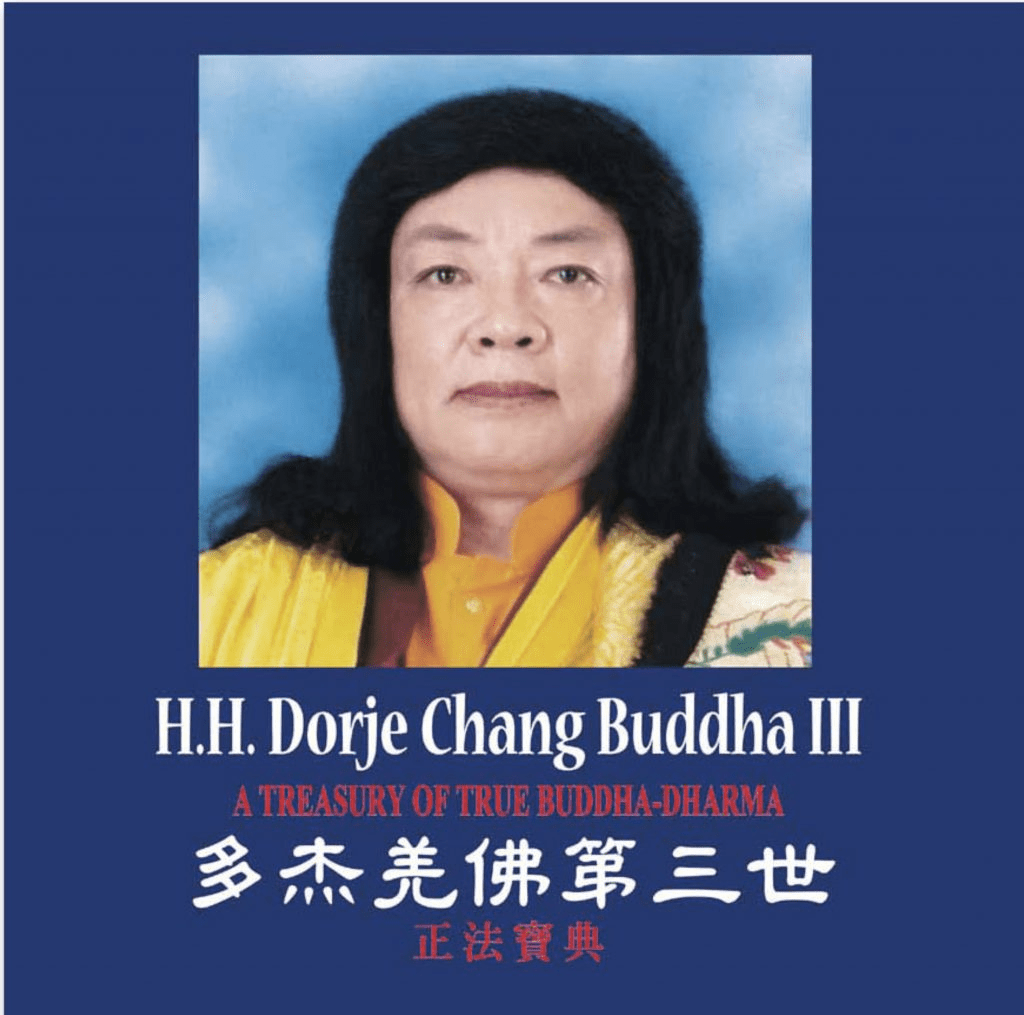
The treasure book, “H.H. Dorje Chang Buddha III,” stands as a testament to this statement. However, this book contains only a drop of water from the vast ocean of Buddha’s teachings and wisdom.
The video below showcases the boundless compassion and highlights the extraordinary accomplishments of H.H.Dorje Chang Buddha III. It was published by China Educational Channels TV and features interviews with Buddhist disciples from around the globe.
The speech given by the Venerable Rambo Tsemang at the 2024 Dharma ceremony in honor of the holy birthday of Namo Dorje Chang Buddha III on June 15, 2024, is published below.
Namo Dorje Chang Buddha III!
Namo Shakyamuni Buddha, Lord of Buddhism in the Saha World!
Namo Yuhua Shouzhi Wang Holy Mother the Great Mahasattva!
Namo all Buddhas in the ten directions, Vajra Beings, Bodhisattvas, Sky-goers, and Dharma Protectors!
Today, Buddhist disciples from all over the world have once again gathered here to commemorate the Holy Birthday and infinite merit of Namo Dorje Chang Buddha III. We want to express our gratitude to Namo Dorje Chang Buddha III for bringing to humanity His magnificent, unprecedented, and unsurpassed Buddha Dharma and accomplishment in the Five Vidyas.
I will summarize the questions that some of you have raised recently and share my personal thoughts for your reference.
First: Cultivation is the foundation for all Buddhists to attain liberation
Throughout the time that Namo Dorje Chang Buddha III propagated Dharma to save living beings, His Holiness the Buddha continuously reminded Buddhist disciples that cultivation is of utmost importance, and it is the only foundation for attaining liberation. In many audio recordings of expounded Dharmas, Namo Dorje Chang Buddha III taught many aspects of cultivation and emphasized that Buddhist disciples must practice cultivation at all times. Therefore, we must always remember the teachings of Namo Dorje Chang Buddha III by respectfully listening to the audio recordings of the Dharmas of His Holiness Dorje Chang Buddha III and reading the “Namo Dorje Chang Buddha III Complete Sutra Collection.” That is how we may learn correct knowledge and views and apply them in our own cultivation practice. This is very important for all Buddhist disciples. We must always remember that it is by practicing cultivation that we may accumulate good fortune and merit, stay away from dark karma, receive initiation to the highest Dharmas, and ultimately attain liberation from transmigration and cyclical birth and death. We must not pay lip service to practicing cultivation. Cultivation must be applied to every thought, word, and deed.
Some people tend to sway or regress from their cultivation whenever they encounter setbacks, but they should not be like that. We should know that during our transmigration since beginningless time, we have done so many bad deeds and taken on so much dark karma. All of our suffering and adversities are the effects of bad causes that we planted. By understanding this, we then understand that both good times and bad times are opportunities for us to practice our own cultivation. As our respected ancient elders said, “We do not evade bad retributions and face them with ease. We must be cautious with our every word and deed to plant good causes.”
Second: Actively Promote the “Namo Dorje Chang Buddha III Complete Sutra Collection”
Ever since Buddha Shakyamuni established Buddhism in our sahā world, the Sutras of the World Honored Buddha have enabled innumerable Buddhist disciples to attain liberation and accomplishment. The “Namo Dorje Chang Buddha III Complete Sutra Collection” is, once again, a collection of Dharmas expounded by a Buddha in this world. This Collection will certainly enable many more Buddhist disciples to attain liberation. Namo Buddha Shakyamuni’s Sutras have been the guidance that we have followed for more than 2,000 years. Upon that foundation, Namo Dorje Chang Buddha III used simple language to teach us the quintessence of Buddha Dharma, and the essentials for attaining liberation and accomplishment. Therefore, the “Namo Dorje Chang Buddha III Complete Sutra Collection” is and will be the fundamental guide for all Buddhist cultivators in the sahā world to attain liberation.
Since we have received this supreme Dharma treasure, the “Namo Dorje Chang Buddha III Complete Sutra Collection,” we should apply the four limitless states of mind and Bodhicitta to enable more people to learn the Sutra Collection. Namo Dorje Chang Buddha III taught us that we will accumulate the most abundant merit by propagating Dharma to benefit living beings and that more merit we have, the sooner we can attain Buddhahood. The best method to propagate Dharma now is to actively promote the “Namo Dorje Chang Buddha III Complete Sutra Collection.” This is the quickest way for us to accumulate merit.
Think about this: In the Diamond Sutra, Buddha Shakyamuni told Subhuti that if someone were to grasp just the four-line gatha of the Dharma and make it known and explain it in detail to living beings, this person’s merit would far exceed someone who were to fill the billion worlds of this universe with the seven jewels in almsgiving.
The four-line gatha is only about emptiness and Dharmakaya. The “Namo Dorje Chang Buddha III Complete Sutra Collection” comprises the truth about Dharmakāya, Saṃbhogakāya and Nirmāṇakāya, and how to attain realization states of the Three Bodies. Therefore, by promoting the “Namo Dorje Chang Buddha III Complete Sutra Collection,” not only will you enable others to understand the truth contained in the four-line gatha; you may even enable them to achieve abidance in the realization states described in that four-line gatha and become a holy person. Then your merit will increase even more. That’s why whenever you introduce one person to study the “Namo Dorje Chang Buddha III Complete Sutra Collection,” you will gain an increment of merit.
However, we must be clear that explaining the four-line gatha to others or promoting the Namo Dorje Chang Buddha III Complete Sutra Collection doesn’t mean that we as ordinary people would then quote Dharma out of context or randomly explain Dharma to others. In doing so, we would end up in the hell realm. We should guide living beings to study the Sutras and respectfully listen to the audio recordings of the Dharmas themselves, so that they can learn directly from His Holiness the Buddha. In this way, we can also increase our merit without incurring any sins.
Third: Make Effort to Protect the Dharma
There are many different ways to protect the Dharma, such as protecting organizations that propagate true Tathagata Dharma or supporting Buddhist cultivators who have correct knowledge and views and who practice in accordance with the Dharma. What I want to talk about here is how to protect the Dharma on the Internet.
In the current Internet era, Buddhist disciples make use of the Internet to propagate Buddha Dharma. However, evil demons also make use of the Internet to slander true Buddha Dharma. Therefore, if any one of us sees any evil deeds of slandering the Buddha or the Dharma, we must rebut those slander with correct knowledge and views.
There are two things that we must not misunderstand about protecting the Dharma.
First, it is seriously wrong to think that rebutting others is getting yourself tied up in matters of right and wrong. It is only with correct knowledge and views that you may understand Buddha Dharma, but some people understand Dharma incorrectly due to their incorrect knowledge and views. We must be very clear about this without any confusion: If a Buddhist disciple cannot differentiate between correct and incorrect knowledge and views, how can they properly understand the Dharma? If they cannot understand the Dharma, how can they attain accomplishment? Getting involved in matters of right and wrong usually refers to personal arguments about who’s right and who’s wrong as a result of attachments to self and to worldly phenomena. This is not the same as defending the correct meaning of the Dharma. The meaning of Dharma must be made clear.
Second: It is wrong to think, “I don’t want to do the work of protecting the Dharma, but I will make effort to practice forbearance and cultivate my conduct.” Actually, protecting the Dharma is an important aspect of cultivation. If you don’t protect Buddha Dharma, you are essentially a fake Buddhist who is not cultivating yourself. Therefore, it will be impossible for you to attain accomplishment. When cultivating ourselves, if anyone points out our shortcomings or wrongdoings, we should thank them, reflect upon ourselves, and do better in our cultivation. For whatever reasons, if someone insults us or attacks us, we should ignore those distractions and focus on cultivating ourselves with forbearance. But if the attacks are targeted toward the Buddha and Buddha Dharma, we must step up and fearlessly protect the Buddha and Buddha Dharma. Even if we don’t have enough abilities on our own, we can work with other Buddhists and discuss how to protect the Dharma together. If we don’t even protect the Buddha, if we don’t protect the integrity and benefit of Buddha Dharma, will Buddhas and Bodhisattvas receive us in the Buddha Lands? Will Dharma Protecting Bodhisattvas and deities help us?
All in all, if we want to attain liberation and accomplishment, we must cultivate ourselves. To cultivate ourselves, we must abide by the precepts, promote the “Namo Dorje Chang Buddha III Complete Sutra Collection,” and protect the Dharma. By doing these three things well, we can quickly eliminate our dark karma, accumulate merit, receive Buddha Dharma, and be liberated from transmigration forever! Throughout Buddhist history, all holy people who attained holy accomplishments were precept-abiding. They all propagated Dharma to benefit living beings. They all protected the Dharma. That’s how respected ancient elders attained accomplishment. These are also the things that we must do to attain accomplishment.
Here, I wish that all congregants and living beings fulfill their good wishes, have good fortune and wisdom, and attain accomplishment and liberation! I wish that the countries that you live in be prosperous and powerful, and that all people enjoy happiness. May there be peace in the world and the circumstances of all living beings be auspicious.
Finally, let us once again pay obeisance:
Namo Dorje Chang Buddha III!
Namo Shakyamuni Buddha, Lord of Buddhism in the Saha World!
Namo Yuhua Shouzhi Wang Holy Mother the Great Mahasattva!
Namo all Buddhas in the ten directions, Vajra Beings, Bodhisattvas, Sky-goers, and Dharma Protectors!
The “Ten Paths to Happiness” sutra, where an eight-year-old girl named Sumati asks Buddha ten profound questions. These questions explore essential aspects of human life and happiness, and Buddha provides insightful answers. This sutra is significant as it presents complex philosophical ideas in an accessible manner through the dialogue between Buddha and a child.
Thus have I heard. At one time, the Buddha was in the city of Rājagṛha, on the mountain of Gṛdhrakūṭa, along with a great assembly of bhikṣus, twelve hundred and fifty people in all. The bodhisattva-mahāsattvas there numbered ten thousand in all.
At that time in the city of Rājagṛha, there was a laywoman named Sumati, who was in her eighth year. Her appearance and features were upright, colorful, and beautiful, appearing so nice that those who saw her were happy. Already, she had approached and made offerings before innumerable buddhas of the past, planting good roots. When that maiden went to the place of the Tathāgata, she bowed her head at the feet of the Buddha, and then circled around him three full times to the right. Kneeling with palms joined, she spoke a gāthā:
Anuttarā Samyaksaṃbodhi Is a lamp for the entire world! Of the practices of a bodhisattva, I wish you would hear my questions!
The Buddha said to Sumati, “You may now ask questions as you like, and the answers will cut through your net of doubts.” At that time, Sumati went before the Buddha and spoke a gāthā to inquire:
How can one attain upright features And a body of wealth and nobility? Moreover, what causes and conditions Make kinship difficult to destroy?
How may one perceive oneself Receiving birth by transformation, Arising from a thousand-petaled lotus flower, And giving reverence to the bhagavāns face-to-face?
How is one able to attain realization Of supreme and sovereign superknowledge, And go off to innumerable lands To pay homage to the buddhas?
How can one attain blamelessness, So that others will have belief, Purely removing obstacles to the Dharma And forever departing from the deeds of Māra?
How is one able, at the end of life, To attain perception of the buddhas, Hear the speech of the pure Dharma, And not be subject to suffering?
Great compassionate supremely honored one, I merely wish you would speak of these for me!
At that time, the Buddha spoke to the maiden Sumati, saying, “Excellent, excellent! It is good that you are able to ask about such profound matters. Now listen carefully, listen carefully and well mindfully, and I will tell you.” Sumati then spoke, saying, “Just so, Bhagavān. We are joyfully wishing to hear it.”
The Buddha told Sumati, “A bodhisattva who accomplishes four dharmas receives an upright body. What are these four? [1] The first is not giving rise to a mind of hatred for bad friends. [2] The second is to abide in great kindness. [3] The third is to have profound delight in the correct Dharma. [4] The fourth is to create images of the Buddha.”
“Moreover, Sumati, a bodhisattva who accomplishes four dharmas will attain a body that is rich and noble. What are these four? [1] The first is that you should give timely gifts. [2] The second is to do so without a mind of disdain for others. [3] The third is to do so with happiness. [4] The fourth is to do so without expecting any reward.”
“Moreover, Sumati, a bodhisattva who accomplishes four dharmas will attain birth by transformation before the buddhas, seated upon a lotus flower. What are these four? [1] The first is to give flowers, fruit, and fine powdered incense as offerings to the Tathāgata and to the stūpas. [2] The second is not to tell lies or harm others. [3] The third is to make images of the Tathāgata placed within a lotus flower. [4] The fourth is to give rise to profound and pure faith in the bodhi of the buddhas.”
“Moreover, Sumati, a bodhisattva who accomplishes four dharmas may travel from one buddha-land to another buddha-land. What are these four? [1] The first is to not perceive others’ cultivation of goodness as obstruction or annoyance. [2] The second is to never hinder others when they are expounding the Dharma. [3] The third is to burn lamps and make offerings to the stūpas of the Tathāgata. [4] The fourth is to constantly strive to cultivate the dhyānas.”
“Moreover, Sumati, a bodhisattva accomplishes four dharmas for the station of blamelessness in the world. What are these four? [1] The first is to draw near to virtuous friends without a mind of flattery. [2] The second is to not have a mind of jealousy regarding others’ excellence in the Dharma. [3] The third is to always be happy when others receive honors and recognition. [4] The fourth is to not vainly criticize the practices of a bodhisattva.”
“Moreover, Sumati, a bodhisattva accomplishes four dharmas for his speech to be believed by others. What are these four? [1] The first is develop speech and cultivation always in unison. [2] The second is to not do evil things to virtuous friends. [3] The third is to not find faults in the Dharma one has heard. [4] The fourth is to not give rise to a mind of evil for one who speaks the Dharma.”
“Moreover, Sumati, a bodhisattva accomplishes four dharmas for being able to leave obstacles to the Dharma and quickly attain purity. What are these four? [1] The first is to accept the Threefold Discipline with profound conviction. [2] The second is that one does not give rise to slander for extremely profound sūtras. [3] The third is to perceive the newly-developed intention of a bodhisattva as the arising of the mind of omniscience. [4] The fourth is regarding sentient beings with great kindness and equanimity.”
“Moreover, Sumati, a bodhisattva accomplishes four dharmas for being apart from māras. What are these four? [1] The first is to fully know the equality of the nature of dharmas. [2] The second is to give rise to determination. [3] The third is to constantly strive to be mindful of the Buddha. [4] The fourth is to transfer over all good roots.”
“Moreover, Sumati, a bodhisattva accomplishes four dharmas so that at the end of life, the buddhas manifest before him. What are these four? [1] The first is to fulfill the wishes of others by giving what they are seeking. [2] The second is giving rise to profound faith and understanding of good dharmas. [3] The third is to give adornments to the bodhisattvas. [4] The fourth is to diligently make offerings to the Triple Gem.”
At that time, the maiden Sumati heard what the Buddha had spoken, and said, “Bhagavān, as the Buddha has spoken of the practices of a bodhisattva, so will I practice them! Bhagavān, among these forty practices, if there is one that is lacking or uncultivated, then this will be conflicting with the Buddha’s teachings and deceiving the Tathāgata.”
At that time, Venerable Mahāmaudgalyāyana spoke to Sumati, saying, “The practice of a bodhisattva is extremely difficult to carry out. You are now developing this extraordinary great aspiration. How will you attain accomplish mastery over this vow?”
Sumati replied, “Venerable, if my great aspiration is true and not void, able to bring these practices to complete fulfillment, then may the three thousand great thousand-worlds shake in six directions, and the heavens rain wondrous flowers, and may the drum of heaven sound of its own accord!” When this had been spoken, flowers fell from the sky like rain, and the drum of heaven sounded of its own accord, and the three thousand great thousand-worlds shook in six directions.
At this time, Sumati again addressed Maudgalyāyana, “From my true words, in a future era I will attain buddhahood, just as Śākyamuni, the Tathāgata. In my land there will be no deeds of Māra, and not even the words for evil destinies, or for women. If what I say is not fabrication, then may the bodies of those in the great assembly all take on a hue of gold!” After speaking this, the assembly took on a hue of gold. At that time, Venerable Mahāmaudgalyāyana then arose from his seat, bared his right shoulder, and bowed with his head at the Buddha’s feet. He spoke saying, “Bhagavān, from these things I have developed the mind of a bodhisattva and even that of the assembly of bodhisattva-mahāsattvas!”
At that time, Dharma Prince Mañjuśrī spoke to Sumati, saying, “In what dharma do you abide to make this sincere aspiration?” Sumati replied, saying, “Mañjuśrī, it is not proper to ask this. Why? This is because in the Dharma Realm there is nothing which abides.” He also asked, “Then what is Bodhi?” She answered, “The non-differentiation of dharmas is what is called Bodhi.” He also asked, “Then what is it that is called a bodhisattva?” She answered, “A bodhisattva is one who is aware that all dharmas are equal to the manifestation of empty space.” He also asked, “What is it that is called the practice of Bodhi?” She answered, “The practice of Bodhi is like a mirage, or like the echo of a valley.” He also asked, “With what underlying meaning do you say such things?” She answered, “In this I do not perceive even the slightest thing which may be underlying or manifest.”
He also asked, “If it is as you say, then all ordinary people would have Bodhi.” She answered, “You speak of Bodhi as being different from an ordinary person? You should not have this view. Why? These are all of the same characteristic of the Dharma Realm, to be neither grasped nor abandoned, with nothing to accomplish or destroy.” He again asked, “How many beings are able to fully understand your meaning?”
She answered, “Their number is like the number of illusory minds and mental functions. The illusion of sentient beings is already able to understand my meaning.” Mañjuśrī said, “Illusions are without basis, so how can there be such minds and mental dharmas?” She answered, “The Dharma Realm is also such, neither existing nor non-existing, and for the Tathāgata is it also such as this.”
At that time, Mañjuśrī addressed the Buddha, saying, “Bhagavān, this Sumati is extraordinary, even able to accomplish such dharma-patience!” The Buddha said, “Thusly, thusly! What she has spoken is sincere and true. In such a way, this maiden has long since developed the mind of Bodhi, throughout the past thirty eons, even developing the destiny of my supreme Bodhi, causing such abiding in the patience of the non-arising of dharmas.”
When we were young, our parents and elders all taught us not to lie. Many stories and fairy tales illustrate the consequences of lying, such as a child being eaten by a wolf or having a long nose like Pinocchio. Different cultures and religions praise honesty and disapprove of liars. However, most of us have told a lie at one time or another, often to gain an immediate benefit, without realizing that the long-term consequences of lying can be very costly. In Buddhism, one of the ten precepts is to abstain from lying.
There is a recorded story in a Buddhist sutra about Shakyamuni Buddha teaching his son to refrain from lying.
The Buddha’s son, Rahula, was quite mischievous in his youth. He often enjoyed playing pranks on others, using deceptive words to tease people. For instance, when someone came to see the Buddha, Rahula, knowing that the Buddha was not present, would intentionally mislead them about the Buddha’s whereabouts, causing them to search in vain for amusement.
When the Buddha learned of this, he asked Rahula to bring him some water to wash his feet. After washing his feet, the Buddha pointed to the water and asked Rahula, “Can this water be drunk?”
Rahula replied, “The water is dirty from washing feet; it cannot be drunk.”
The Buddha then asked, “Can this basin, used for washing feet, be used to hold food?”
Rahula replied, “No, it cannot. The basin is dirty and cannot be used to hold food.”
The Buddha sternly said, “You are like this water. The water was originally very clean, just as you were originally a prince, able to renounce the false glories of the world and become a monk. But if you do not diligently pursue the path, do not purify your body and mind, and do not speak carefully, the impurities of the three poisons will fill your heart, just like the clean water being soiled by washing dirty feet. You are like this basin. Although you have become a monk, if you do not practice precepts, concentration, and wisdom, and do not purify your body, speech, and mind, how can the food of the Great Path fill your heart?” After speaking, the Buddha kicked the basin, causing it to roll. Rahula was very frightened. The Buddha asked, “Are you afraid the basin will break?”
Rahula replied, “No, the basin is a coarse utensil; it doesn’t matter if it breaks.”
The Buddha said, “Rahula, you don’t cherish this basin, just as people will not cherish you. As a monk, if you do not uphold dignity and discipline, and speak deceitfully, the consequence is that no one will care for you or value you. When your life ends, you will not attain enlightenment, but will only increase your delusion.”
From then on, Rahula changed his mischievous ways, strictly observed the precepts, and diligently practiced the path.
According to the teachings of the Buddhist sutras, we should take a long-term view and consider the consequences of lying for both this life and future lives.
In this life, if we frequently lie, deceive, or slander others, we will inevitably face retaliation from those we have wronged. In the mundane world, most people are naturally inclined to protect themselves and have a tendency for “an eye for an eye” revenge, unless they are saints who have subdued their own minds. If we deceive others, the victims, unwilling to be deceived, will expose our misdeeds among people. As word spreads from one to ten and from ten to a hundred, our bad reputation will quickly become widespread. Our credibility will be utterly destroyed, and our trustworthiness will plummet. From then on, even if we speak the truth, it will be seen as a lie, and people will be wary of us to avoid being deceived. No one will trust us. In such a predicament, we will constantly feel the pain of isolation and helplessness. Our lives will shrink, and our careers will suffer as a result.
In future lives, under the influence of the dark karma of lying, one will inevitably fall into the three lower realms. When the bad karma diminishes and one is reborn as a human, the residual effects of lying will manifest in various speech-related congenital obstacles in both body and mind. These may include having an impaired tongue root, stuttering, or unclear speech. Additionally, there will be a habitual tendency to lie, and sometimes, even when one wishes to speak the truth, it will come out as a lie involuntarily. In interactions with others, one will frequently be slandered and deceived. Even when speaking the truth, people will not believe it. Moreover, even when preaching the true Dharma, others will be unwilling to listen.
Sister Sun Houfang has gone to the hospital for chemotherapy again. She suffers from leukemia, a disease that is almost a death sentence, but she has miraculously survived. She became a Buddhist disciple in July 2016 and often says, “Others with the same illness as mine have all died, but I am still alive. I want to thank Namo Dorje Chang Buddha III and all Buddhas and Bodhisattvas of the ten directions. I also want to bring those with affinity into Buddhism.” No one expected that her friends with affinity would be three Christian friends.
On April 28, 2017, I visited Sister Sun at the hospital again. She was having lunch, so we chatted briefly. I learned that she was scheduled to start chemotherapy medication the next day, and her wardmate, Wei Wenwen, was to be discharged in the afternoon. I sincerely invited them to our Tantric Buddhist Center the next morning to participate in a blessing ceremony. I hoped that through the blessing, they would receive good fortune and have their suffering alleviated. Sister Sun immediately agreed to delay her medication by a day, and Wei Wenwen also wanted to delay her discharge. At this moment, the patient in bed 6, Lu Shaohua, spoke up. She said she was a Christian and did not dare to believe in Buddhism, fearing it would be against her faith. She also mentioned, “A few days ago, I couldn’t sleep at night after arriving here. It was very uncomfortable, and no matter how much I recited the Bible, I couldn’t fall asleep. Ms. Sun suggested I recite the Buddha’s name instead, and after doing so, I was able to sleep.” I said, “That’s great! It shows you have a deep connection with Buddhism. Each of us has our own karmic reasons for our religious beliefs, but regardless of the religion, the key is the benefit we receive from it. In fact, many people don’t know that the Virgin Mary is an incarnation of Avalokitesvara Bodhisattva.”
In the Dharma audio teachings of H.H. Dorje Chang Buddha III, there is a story about hundreds of Christian Taiwanese indigenous people converting to Buddhism. This took place in 1995 when H.H. Dorje Chang Buddha III, visiting Taiwan under the guise of an art delegation, was greeted by the chief of the indigenous group, a devout Christian. (There is a video recording on youtube for this event https://www.youtube.com/watch?v=Qxdaug7x9IU)
H.H. Dorje Chang Buddha III asked, “Have you ever seen the Virgin Mary? If you haven’t, I can invite her to come, and you can meet her.”
The chief responded, “Can I? Even our priest has never seen her!” H.H. Dorje Chang Buddha III said, “If I let you see her, will you then take refuge in Buddhism?”
The chief replied, “That would depend on the Virgin Mary’s approval. We have taken vows and been baptized.” H.H. Dorje Chang Buddha III said, “Let’s do it this way: let the Virgin Mary tell you what to do, and you can follow her guidance. How about that?” The chief agreed, saying, “Okay!”
At this moment, the chief began to recite the Bible and use his inner power. His Holiness told the chief, “That won’t work.” Then, His Holiness performed a Dharma practice, and the Virgin Mary suddenly appeared standing on a cloud, several dozen feet high, astonishing the chief on the spot!
The Virgin Mary said to the chief, “My child, although I am your Holy Mother, I am also a servant of the Buddha. I am learning Buddhism. You should immediately take refuge before this supreme Buddha, who represents the true Dharma of the Tathagata in this world.”
Hearing this, the chief prostrated himself in full devotion and immediately took refuge. Later, all nine tribes of the indigenous group came to take refuge in His Holiness as their chief king.
Photos from video in youtube
In the Universal Gate chapter of the Lotus Sutra, the Buddha tells the world that Avalokitesvara Bodhisattva will manifest in various forms and save sentient beings according to their different karmic conditions. Any worldly being in danger will be delivered instantly upon calling her name. Therefore, Guanyin has been worshipped and revered by all classes of people. As a compassionate divinity with countless virtues and merits, she is endowed with transcendental power. The Bodhisattva excels in skillful means, allowing the Bodhisattva to appear in whatever form is needed by sentient beings.
After hearing my story, Lu Shaohua seemed to understand something and expressed a willingness to explore Buddhism.
On the morning of April 29, two Christians, accompanied by their families, came to our Tantric Buddhist Center. After everything was prepared, the blessing ceremony began. As we chanted the Heart Sutra, I heard intermittent crying from the crowd.
After the ceremony, I noticed tears still on their faces, but their complexions looked much better than when they first arrived. I asked them, “Did you all cry? How do you feel?” Wei Wenwen said, “I really enjoyed listening to the Heart Sutra. I felt very comfortable and happy here, and I didn’t want to leave.” Lu Shaohua also said, “As soon as I heard it, I couldn’t help but cry. I don’t know why, but it felt like meeting a family member.”
From that moment on, the three Christians—Wei Wenwen, Huang Youyou, and Lu Shaohua—began to listen to the extraordinary Dharma teachings of Namo Dorje Chang Buddha III. Through listening to the Dharma, they understood some principles of karma, realized the impermanence of life, and the illusory nature of dreams and bubbles. They expressed their determination to stop killing, to practice releasing living beings, and to diligently study and practice Buddhism. They even took home Buddha statues to venerate and vowed to take refuge in Buddhism.
Although Buddhism is the teaching of perfect liberation, Christianity is also a good teaching. When Christians shed tears upon hearing Buddhist scriptures and find peace in reciting the Buddha’s name, it indicates their inherent karmic connection to Buddhism. The differences in religious beliefs among sentient beings arise from their various karmic roots and blessings accumulated over countless eons. All good teachings should coexist harmoniously and tolerate each other without rejection, as true good teachings all aim to free sentient beings from suffering and bring them happiness.
Once, the Buddha was residing in the Jetavana Monastery in the kingdom of Śrāvastī, spreading his teachings. At that time, there was a prince of a celestial king named Pilu. One day, he flew down from the heavens to the Jetavana Monastery, prostrated himself at the Buddha’s feet, and, with hands folded in reverence, asked the Buddha: “In this world, people are constantly pursuing clothes, food, treasures, pleasures, official positions, and territories. Are there any treasures that pursue people in return?” The Buddha praised Prince Pilu: “You have asked a good question. Indeed, there are situations where territories, treasures, and pleasures pursue people.”
Prince Pilu asked again, “What does it mean for the causes and conditions that fulfill people’s wishes and bring complete satisfaction to always follow them?”
The Buddha replied, “All actions can be categorized into two types: doing good deeds, which brings blessings, and committing evil deeds, which results in calamities. Whether it is blessings or disasters, they always follow each person like a shadow.”
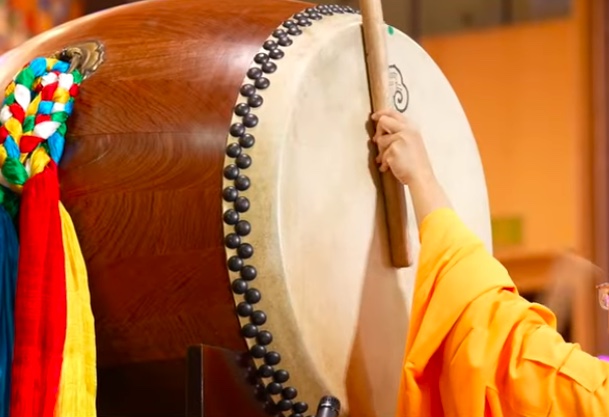
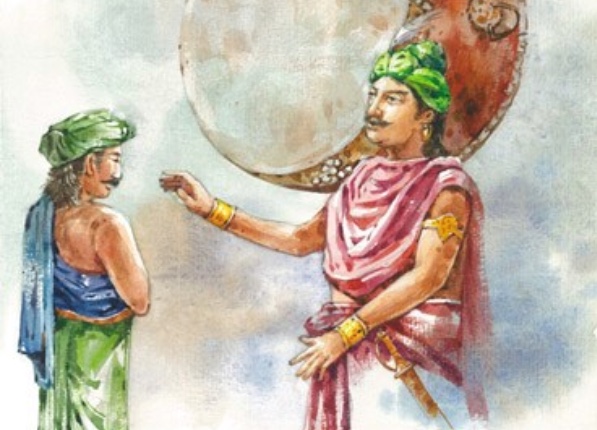
Prince Pilu said, “This is truly extraordinary! Just as the World-Honored One has taught, in my past life, I was once a king among humans. Because I was aware of the impermanence of life and had no attachment to material things, I wanted to practice generosity widely. One day, during a gathering of my ministers, I announced: ‘I want to make a great drum whose booming sound can spread for a hundred miles. Who can accomplish this task for me?’
However, the ministers all replied, ‘We are incapable of doing so!’ At that moment, a minister named Kuang Shang, who had always been loyal to the court and compassionate towards the people, stepped forward and said to the king, ‘I can accomplish this task, but it will require some funding.’
The king said, ‘Great! Whatever amount you need is not a problem.’ Thus, the treasury was opened, and a large sum of money was handed over to Kuang Shang.
Kuang Shang transported a carriage full of treasures to the gate of the royal palace and beat the drum to announce, “Today, our benevolent king, with great compassion, is distributing wealth to the world to relieve all those in poverty and distress, as well as to provide for the needs of practitioners. Anyone in need can come to the palace gate to receive these goods.”
The news quickly spread to neighboring countries. The poor, carrying their babies and bringing along the elderly and young, came in droves, filling all the roads leading to the city. People would often look up to the sky and exclaim, “Thank you, benevolent king! We, the poor people, finally have the chance to escape the days of hunger and cold!”
A year later, the king asked Kuang Shang, “Is the great drum completed?” The minister replied, “Your Majesty, it is done.” The king asked again, “Since it is finished, why haven’t I heard the drum sound?” Kuang Shang responded, “Please, Your Majesty, take a trip into the city tomorrow, and you will hear the sound of virtue resonating far and wide.”
The next day, the king’s procession entered the city, discovering it was crowded and bustling. The king exclaimed, “Why are there so many people in the city?” Kuang Shang answered, “Last year, Your Majesty ordered me to create a great drum, hoping its mighty sound would spread for miles, proclaiming Your Majesty’s benevolence. I thought that a drum made of dead wood and cowhide would not adequately convey the king’s virtue. After much deliberation, I decided to use the treasures Your Majesty entrusted to me to provide for the practitioners and relieve the poor and distressed. Since the announcement, people from neighboring countries have come, hoping for Your Majesty’s benevolence, like hungry children yearning for their compassionate mother.”
Upon hearing this, the king asked the nearby citizens, “Where have you come from?” The people respectfully bowed and replied, “We came from a hundred miles away.” Some said, “I came from two hundred miles away.” Others said, “I came from thousands of miles away.” Then, they all declared, “Wise and benevolent king! Your widespread generosity has brought joy to the people of the neighboring countries. Many have even moved their entire families here, seeking to live under your benevolent protection and hoping for a stable life henceforth.”
The king was very pleased and said, “Kuang Shang, you have done an excellent job! Previously, I was attached to fame, hoping that the great drum’s mighty sound would resonate far and wide. Now, I finally understand that the unrest in the country comes from the people’s unease. Just as a sick body needs medicine to be healed, I should provide remedies to address the people’s suffering. You, my minister, understood the hardships of the people and distributed food to help the poor and needy, allowing the people to live in peace and return their loyalty to me.” Thus, the king declared, “From now on, as long as it concerns the people’s needs, take care of it to the best of your ability without needing to consult me!”
After the king’s natural death, he was reborn in heaven as King Miao. After his life in heaven ended, he was reborn as a Cakravartin (Wheel-Turning) King on earth, always accompanied by seven treasures and surrounded by followers who protected him. Now, he has again been reborn in heaven as a prince of the heavenly king. All of this was because he strictly upheld pure precepts and compassionately aided all living beings, earning such blessings. If we follow the Buddha’s teachings and rectify our body, speech, and mind, we can all obtain such magnificent blessings.
The Buddha encouraged Prince Bilu, saying, “A person’s actions are like a shadow following the body, or an echo responding to a sound. For every cause, there is an effect, and retribution is certain!” Prince Bilu, after hearing the Buddha’s teaching, joyfully made obeisance and departed.
















 Peace LiLy