A Sheffield artist has been nominated for creating the world’s best street art in 2024.
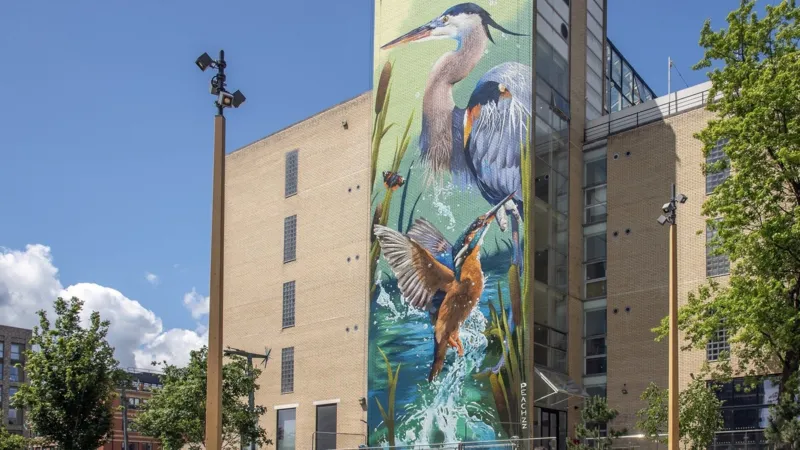
Megan Russell, who works under the name Peachzz, painted for up to 12 hours a day for 10 days in a row to create the 25-metre tall artwork in the city centre.
Reverie, depicting a heron and a kingfisher, has been nominated for “best mural in the world” in Street Art Cities’ best of 2024 awards.
She said working on the project, which overlooks Pounds Park, was the “biggest highlight of my career so far”.
“I had free reign to be as vibrant and bold as I wanted. It’s really refreshing when clients tell you that, it doesn’t happen often,” she said.
The wall, on the side of the Cubo building, overlooks Pounds Park
The piece, commissioned by Sheffield City Council, was voted the best of last June’s entries in Street Art Cities’ monthly competition.
“It’s just been crazy. When June’s votes came in, it blew my mind,” Megan said.
“It was an amazing feeling to have such support from Sheffield, and it also showed how much Sheffield is interested in street art.”
Now, it has been pooled with 50 other artworks, from countries including Argentina, Colombia, Russia, Spain and Denmark, for people to vote for the best of the year.
“Looking back 10 years ago, I would’ve never thought I could’ve reached this space where I am now,” she said.
‘An emotional January’
“I remember looking at those competitions and thinking I’d love to be nominated, and now I am. It’s unbelievable.”
The nomination came during “an emotional January” as Megan’s grandmother Iris Reynolds, who inspired her nickname, died on Tuesday.
“She was a super creative person and inspired me a lot into being an artist. She had an iPad and was following my artwork. She seemed really proud,” Megan said.
“She used to feed me tinned peaches and ice cream, and I ended up using Peachzz as an online pseudonym when I was young.
“I just never changed it, and people would call me it in person. It felt like it was a part of me.”
Megan started spray painting a decade ago in old industrial buildings in Sheffield and has been working professionally for about seven years.
Peachzz said her largest work to date – covering 225 square metres – took 10 consecutive days of painting to complete
This year, she is working on launching a street art festival, Lick Of Paint Fest, alongside fellow artist Alastair Flindall.
The graffiti and street art scene in Sheffield has “quietened down”, she said, so the festival hopes to give it a boost.
If Reverie comes in at, or near, the top in the Street Art Cities rankings, this would give the budding festival a platform, Megan said.
Voting takes place on Street Art Cities’ website and is open until the end of January.
“There are so many incredible artists that are up there. It’s an honour to be among such big names,” she added.
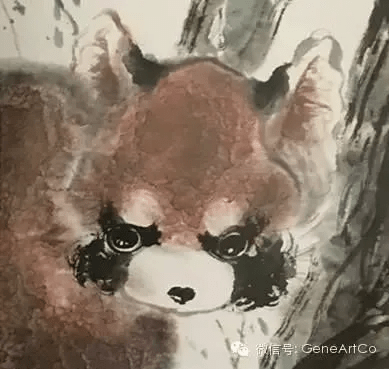
In this exquisite artwork, the slightly reddish small animal depicted is an extraordinarily rare and precious creature known as the red panda, also referred to as the small panda. H.H. Dorje Chang Buddha III, with His masterful artistic techniques, brings this delicate creature to life in a way that captivates the viewer’s heart.
The red panda, native to the eastern Himalayas and southwestern China, is known for its striking reddish-brown fur, bushy ringed tail, and expressive face. H.H. Dorje Chang Buddha III skillfully captures these natural features, emphasizing the panda’s endearing innocence and elegance. The slightly upturned tail, adorned with subtle yet distinct spots, adds a dynamic sense of movement and charm. This tail gracefully echoes the surrounding elements of nature, blending harmoniously with the drooping round leaves of the willow branches. The careful balance between the animal and its environment enhances the visual poetry of the piece.
A particularly remarkable aspect of this painting is the technique used to depict the panda’s face. H.H. Dorje Chang Buddha III employs a calligraphic brushstroke style, reminiscent of traditional Chinese ink painting, to portray the panda’s features with simplicity yet profound expressiveness. The crystal-clear, soulful eyes seem to glisten with life, while the velvety black fur is rendered with such fluidity and precision that it conveys both softness and texture.
Through masterful control of brush pressure, ink flow, and color layering, H.H. Dorje Chang Buddha III achieves a perfect balance of realism and artistic interpretation. Each stroke reveals deep insight into both the subject’s physical form and its spiritual essence, a hallmark of true artistic mastery.
The meticulous attention to detail and the profound artistic wisdom evident in this painting reflect H.H. Dorje Chang Buddha III’s extensive experience and unparalleled skill. This artwork is not merely a visual delight but a spiritual expression, reminding viewers of the beauty and fragility of life and the interconnectedness between all living beings and nature. It stands as a testament to the profound depth of both artistic technique and compassionate vision embodied in the works of H.H. Dorje Chang Buddha III.
Bamboo of Noble Integrity By Professor Yuhua Shouzhi Wang
Bamboo, as a plant with profound cultural significance, carries rich and diverse symbolism. It represents resilience, noble character, vitality, humility, modesty, harmony, and unity. With its graceful posture and vibrant green appearance, bamboo evokes a sense of freshness and refinement. Though its exterior is simple and unadorned, it embodies a noble inner quality. This unique temperament has made bamboo a symbol of integrity and uprightness. In ancient times, it often served as a metaphor in the writings of scholars and poets for individuals of high moral character and self-discipline.
For the Chinese, admiration for bamboo has endured throughout history. Countless poets and literati have celebrated its virtues, grouping it alongside plum blossoms, orchids, and chrysanthemums as one of the “Four Gentlemen,” embodying the character and aesthetic spirit of the Chinese people. Bamboo’s simplicity belies its profound cultural significance. In traditional Chinese culture, it is a symbol of auspiciousness and virtue, carrying layers of meaning that resonate deeply with the human spirit.
Professor Wang’s Chinese paintings of bamboo are a testament to her extraordinary ability to bring this cultural icon to life. Each stroke captures the essence of bamboo’s resilience and unyielding spirit while emphasizing its humility and integrity. Her works not only celebrate the elegant charm of bamboo but also evoke its vibrant vitality and enduring strength.
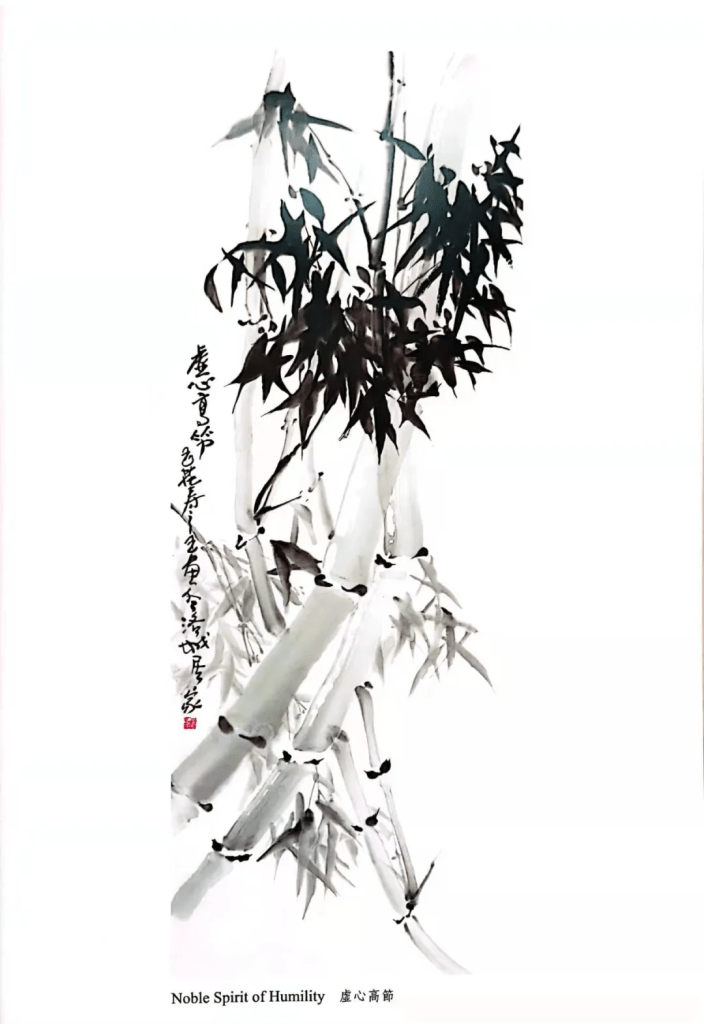
Professor Wang’s Artwork “Noble Spirit of Humility”
The artwork “Noble Spirit of Humility“ depicts a cluster of bamboo deep within a dense forest. Two tall and robust bamboo stalks stand prominently in the foreground, their lush branches and leaves rendered in bold ink. Behind them, a few smaller bamboo stalks, delicately painted in lighter ink, appear to lean on the larger ones, as if embraced by Mother Earth. Together, they form a unified group, advancing and retreating in harmony.
Look closely, and you’ll see their branches intertwine amidst the clouds, and their roots tightly clasp together underground. Neither torrential rain nor fierce winds can break them down. The bamboo’s unyielding resilience is vividly and profoundly brought to life.
Dr. Yuhua Shouzhi Wang was recognized and chronicled in the United States Congressional Record as “a great artist and sculptor,” and “treasure of the world.” In 2013, President George Christophides of the World Federation of UNESCO Clubs, Centers, and Associations (WFUCA) conferred the title “2013WFUCA” to one of her artworks.
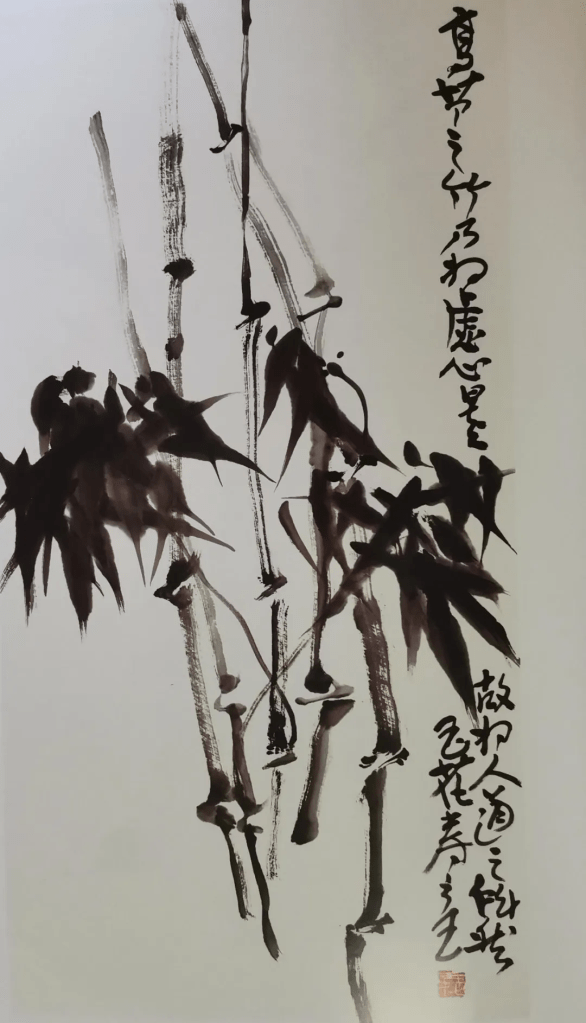
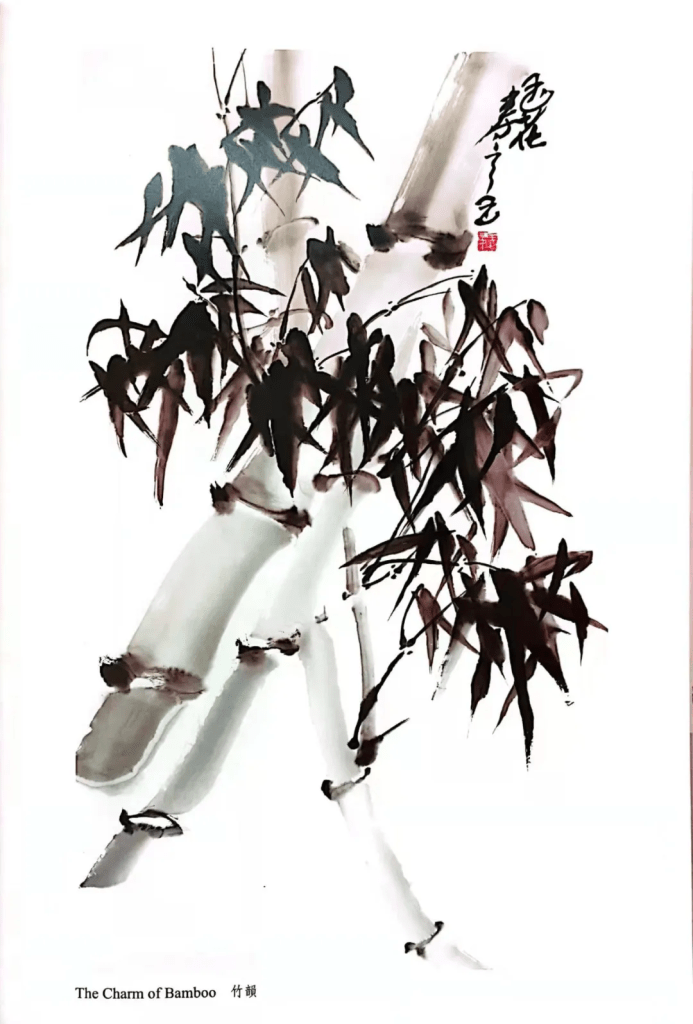
The artwork “The Charm of Bamboo” conveys the fresh and elegant essence of bamboo, exuding a gentle and harmonious beauty. It seems to remind us that in life and work, we should not only take responsibility but also foster an atmosphere of harmony and mutual respect. The use of varying ink tones, alternating between light and dark, strikes a balance of simplicity and ingenuity, greatly enhancing the dynamic energy of the piece.
Dr. Yuhua Shouzhi Wang’s bamboo paintings are truly exceptional. Through her art, she vividly conveys bamboo’s noble qualities, leaving viewers with a deep appreciation for this remarkable plant and its timeless symbolism. Her work serves as a bridge between nature and art, reminding us of the profound lessons we can draw from the natural world.
Professor Yu Hua Shouzhi Wang stands as a towering figure in the world of art, celebrated as the only artist in Asia to receive the prestigious title of International First-Class Artist. Her unparalleled achievements span an extraordinary range of artistic styles and subjects. Whether she’s creating landscapes, portraying flora and fauna, rendering animals and insects, or crafting intricate sculptures, Professor Wang’s creations are nothing short of masterpieces. Effortlessly bridging traditional Chinese painting with Western art, hyperrealism with surreal abstraction, she has achieved a level of artistic excellence that places her at the very pinnacle of her field.
One of Professor Wang’s most captivating works, Sparrows Singing on a Willow Tree, exemplifies her genius and profound connection with nature. The painting captures the graceful elegance of weeping willows, their slender branches gently drooping in an intricate, harmonious interplay. The composition exudes simplicity and refinement, with minimalistic lines that evoke the profound idea that “silence speaks louder than words.”
Despite its restrained use of color, this piece immerses the viewer in a vibrant world of subtlety and depth. The willow leaves are rendered in soft shades of pale yellow, light green, and muted ink tones, each leaf imbued with a carefree vitality. So vivid and dynamic are these details that one can almost sense the crisp freshness of the air. The leaves alone expand the painting’s spatial and emotional dimensions, drawing the viewer into an almost otherworldly tranquility. As one takes in the whole composition, it becomes evident that this work is rich in artistic flavor and showcases transcendent mastery of brushwork and ink technique.
On the right side of the painting, a lively gathering of sparrows perches on the willow branches. Each sparrow’s unique posture and expression are brought to life with remarkable precision, transforming them into endearing characters within the scene. They appear as if they are animated notes of a melody, harmonizing with the natural setting, or perhaps a group of playful children savoring their carefree moments after school. This idyllic scene evokes a serene joy and simplicity that resonates deeply with viewers.
Adding to the painting’s charm is a long inscription on the left side, written in elegant calligraphy: “Sketching in the garden at home.” This thoughtful addition not only complements the willow tree but also enhances the overall vitality of the piece. It provides insight into the painting’s creation—the place, and artist’s signature—and demonstrates Professor Wang’s extraordinary calligraphic skill. The inscription enriches the work’s narrative and aesthetic harmony, making it a testament to her multifaceted artistry.
Through this painting, it is clear that Professor Wang’s love for life and her compassionate nature are woven into every brushstroke. One can almost envision her peaceful afternoons spent in her garden, observing the interplay between the willow tree and the sparrows. The joyful spirit of the birds, carefree and unrestrained, reflects the tender care and connection Professor Wang shares with the natural world. A particularly charming detail is a small sparrow spreading its wings and gazing downward, as if greeting the artist or playfully seeking attention. The scene radiates a sense of love, harmony, and mutual understanding between the artist and her surroundings.
Sparrows Singing on a Willow Tree stands as a testament to Professor Wang’s exceptional artistry. The work is elegant and transcendent, with lifelike birds and an ethereal atmosphere that captivate the heart. From mood to color, composition to emotional resonance, the painting embodies her unique artistic style and extraordinary mastery. It is a work that not only delights the eyes but also uplifts the spirit, leaving an indelible impression on all who behold it.
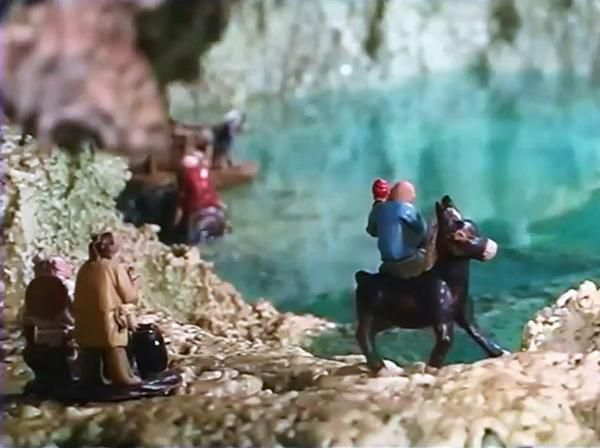
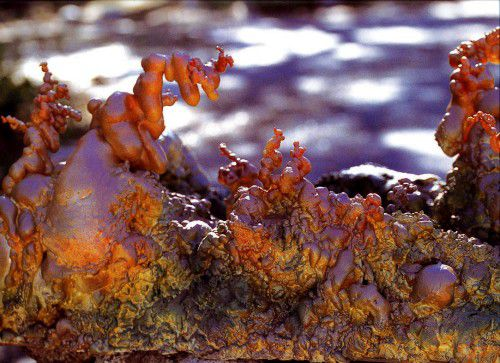
Amid the vibrant colors of mountains, rocks, canyons, and rivers lies a land shaped by tectonic shifts, creating countless graceful ridges and valleys. The limestone formations add a kaleidoscope of colors to the earth’s surface. In the valleys, there is a crystal-clear emerald hot spring, sparkling and serene. Shrouded in a faint mist, the scene resembles a silent dreamland, nurturing boundless hope and vitality in its tranquil beauty.
Perhaps responding to the aspirations of all beings, the world witnessed the emergence of a cultural giant embodying both philosophy and art. This visionary introduced a groundbreaking art form that symbolizes the truth of the universe: the sculptural art of H.H. Dorje Chang Buddha III. These magnificent and mysterious creations, enveloped in auspicious mist, exude an expansive breath that resonates with the cosmos.
This Yun Sculpture is an extraordinary creation by H.H. Dorje Chang Buddha III, a testament to the seamless fusion of artistic mastery and spiritual depth. Made from fiberglass-reinforced plastic—an unforgiving medium that hardens within moments—the work demands incredible precision. Yet, within this fleeting time frame, H.H. Dorje Chang Buddha III creates mountains, springs, peaks, and stones with unparalleled detail, capturing the essence of nature itself.
Every element appears as if naturally formed, devoid of any artificial touch. The brilliance lies not only in the execution but in the profound wisdom and authentic Buddha Dharma infused within the process. It feels as though time stretches infinitely during its creation, allowing for the sculpted forms and vivid colors to come alive with divine elegance.
This sublime work transcends human limitations, leaving viewers in awe of the spiritual and artistic depth it embodies. It stands as a testament to the boundless possibilities of enlightenment and creativity.
Yun Sculpture, a groundbreaking form of art stands unmatched in the annals of history. Since its inception, the world has borne witness to an artistic phenomenon that defies replication.
Unlike the sulfur-heavy hot springs of this earthly realm, this spring reflects the compassionate and gentle heart of a great artistic mind. It is as delicate as floral mist, as fleeting as morning dew, capturing the universe in its palm while transcending time and space.
This sacred spring of warmth and clarity carries a message of hope, embedding itself into the memory of life. It invites the steaming warmth and tears of repentance to wash away primal desires and inner shadows, extinguishing the fire of ignorance in the heart. In this way, springtime appears radiant, summer breezes refresh the soul, the autumn moon shines with unparalleled clarity, and winter snow unites heaven and earth in a crystal-pure sanctity.
The allure of Chinese ink painting lies in its ability to convey profound emotions and philosophies through simplicity and elegance. Blue Ice World, a remarkable creation by H.H. Dorje Chang Buddha III, exemplifies this artistic mastery. At first glance, its understated composition might suggest simplicity, but a closer examination—and especially any attempt to replicate it—reveals the unparalleled depth and complexity woven into every brushstroke.
In this ink-and-wash painting, the mountains, trees, and sky are unified through a harmonious tonal palette, creating an otherworldly, almost surreal charm. The work effortlessly blends the captivating theme with its palette, presenting a seamless interplay of form and color. Each stroke flows with such grace and precision that it feels like a natural extension of the artist’s spirit.
H.H. Dorje Chang Buddha III’s profound insight is evident in every aspect of the composition. With a keen, refined perception, He not only captured the soul of the scene but also brought it to life in a way that resonates deeply with viewers. Through dense brushstrokes and meticulous gradients, the painting achieves a striking sense of contrast. This dynamic quality imbues the piece with vitality, yet there is not the slightest trace of artifice.
The balance between realism and abstraction in Blue Ice World is a marvel in itself. The deliberate interplay between the tangible and the intangible creates a surprising and mesmerizing beauty, inviting viewers to explore both the external landscape and their inner world. Its sacred and dreamlike undertones leave a lasting impression, captivating all who have the privilege of experiencing it.
Blue Ice World is more than just a painting—it is a testament to the profound artistic vision and spiritual depth of H.H. Dorje Chang Buddha III. Through this masterpiece, He elevates Chinese ink painting to a realm where technique meets transcendence, leaving an indelible mark on the art world.
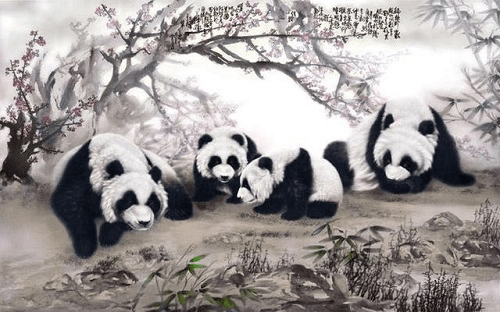
H.H. Dorje Chang Buddha III’s remarkable panda painting exemplifies a profound fusion of traditional Chinese painting and Western three-dimensional techniques, showcasing a unique mastery that elevates this artwork to an unparalleled realm. The Buddha meticulously captures the softness of the panda’s fur, detailing each hair with astonishing lifelikeness. The surrounding trees and scenery are equally vibrant, rendered with ink-splash techniques that lend a lively and enchanting quality, breathing life into the background. Every stroke in this artwork radiates a realism and elegance that words can scarcely convey.
In the foreground, delicate bamboo stalks contrast sharply with the misted backdrop, creating a powerful sense of spatial depth. This mist, drifting through the plum tree branches, draws the viewer’s gaze further into the forest, inviting them to immerse themselves in the crisp, refreshing atmosphere. With his seamless integration of artistic elements, H.H. Dorje Chang Buddha III achieves a captivating blend of classic beauty and dimensionality. The pandas, seemingly more beautiful and pristine than in life, appear freshly bathed in pure, clear waters—a vision of elegance and purity.
The painting’s harmony lies in the Buddha’s masterful approach of combining strength with gentleness, creating a scene of pandas at play, full of soft allure and charm. This balance exemplifies an artistic prowess beyond the reach of most artists. It is the interplay of surrounding elements, from mist to forest, that makes this panda masterpiece truly one of a kind.
Executed in the Kuangxi style—a hallmark of H.H. Dorje Chang Buddha III—this painting unites bold expressiveness with precision. This style combines vigorous, large-scale strokes that radiate energy with the delicate, fine brushwork of realism, resulting in an artwork that captures both elegance and raw intensity. The Buddha’s fusion of rough and refined strokes manifests as a work of art that is both dynamic and graceful, presenting a timeless visual experience that resonates deeply.
Art has the power to transcend boundaries, evoke emotions, and stir the soul. One such masterpiece is “Dragon Carp Frolicking in the Lotus Pond”, created by H.H. Dorje Chang Buddha III. This extraordinary painting, executed with ink and color on paper, seamlessly blends freehand brushwork with meticulous detail. It has been rightfully hailed as a world-class “treasure of unparalleled excellence” and a “divine masterpiece.” Experts agree that this work surpasses conventional artistic techniques, reaching a level of spiritual depth that few can replicate.
At first glance, the painting’s lotus leaves and carp, rendered with freehand techniques, captivate the viewer with their delicate yet vibrant forms. The wide, majestic leaves appear to breathe, their veins subtly flowing and shifting in unpredictable ways. Bold strokes define the water grasses, infusing the scene with a palpable sense of movement. This is a world that feels “drawn from life, yet elevated above it.”
The lotus pods are painted with a playful, almost fantastical touch, while the decaying lotus stems evoke a vivid realism. The carp glide effortlessly through varying depths of water, with natural ripples enhancing the impression of life in motion.
What makes “Dragon Carp Frolicking in the Lotus Pond” so compelling is the swirling energy that permeates the entire composition. Fish, water, lotus leaves, flowers, ripples, mist, and lotus roots all come together as one. Every element is in harmony, creating a profound sense of vitality. The interplay between stillness and motion is masterfully orchestrated, with tension and fluidity imbuing the painting with a life of its own. The spiritual resonance of the ink and brushstrokes is so powerful that it touches the soul, offering a rare glimpse into the artist’s mastery.
H.H. Dorje Chang Buddha III’s ability to manipulate ink and water produces endless visual effects, creating an atmosphere where life itself seems to flow through the brush. The dragon carp, swimming through the water with ease, symbolize the very essence of vitality.
Compared to past masters, who captured the beauty of carp but failed to unite the fish with the water, H.H. Dorje Chang Buddha III elevates his work to a higher realm. His brushwork achieves perfect harmony between the fish and water, with the two becoming one in a symbiotic relationship that enhances both their liveliness and texture.
Traditional Chinese ink painting often uses blank spaces to represent water’s stillness, while lines suggest movement. “Dragon Carp Frolicking in the Lotus Pond” takes this concept even further, incorporating the refraction of light through the water’s surface and depths.
The dynamic light waves, combined with the seamless interaction of the carp and the ever-changing water, create a breathtaking depiction of the concept “fish finding their element.”
The true brilliance of this work lies in its extraordinary attention to detail and the artist’s mastery of brush techniques. From the texture of the carp’s scales to the intricate interplay between fish and water, every detail contributes to the painting’s vibrant spirit. This level of craftsmanship goes beyond what other media, such as oil painting, can achieve, making “Dragon Carp Frolicking in the Lotus Pond” a unique artistic treasure. Its spiritual resonance and profound beauty leave a lasting impression.
This painting is not just a visual masterpiece; it is a profound experience that speaks to the heart, a testament to the transformative power of art.
In 2016, there was already an offer of 60 million USD to purchase this painting. However, H.H. Dorje Chang Buddha III declined the sale, considering that once it was owned by a private collector, the public would have little opportunity to appreciate it. Currently, “Dragon Carp Frolicking in the Lotus Pond” is permanently displayed in the Master Artist Fish Hall at the H.H. Dorje Chang Buddha IIICultural And Art Museum in Covina, California.
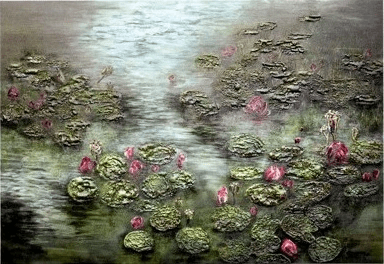
“Cang Ye Pao Hong” (Withered Leaves Scattering Red) is an extraordinary oil painting that belongs to the Thickly Layered Color School, a unique style originated by H.H. Dorje Chang Buddha III. This painting style is renowned for its bold, dynamic strokes and the use of layered, textured color blocks that create a deeply three-dimensional effect. The abstract, surreal use of color brings an unpredictable yet harmonious elegance, transforming the chaotic into a coherent and mesmerizing vision.
The meticulous process behind “Cang Ye Pao Hong” is just as awe-inspiring as the final result. According to the art museum where this work is displayed, the painting took six years to complete, with over 50 layers of paint carefully stacked on top of one another. Each layer was allowed to dry completely before the next was applied, ensuring a rich and vibrant interplay of colors. The outcome is a work of art that exudes an indescribable divine aura, blending both natural beauty and mystical energy.
You can find this masterpiece at the International Art Museum of America, located in downtown San Francisco. Upon first glance, “Cang Ye Pao Hong” commands attention, drawing viewers into deep contemplation. The withered lotus leaves, depicted in a strikingly realistic and three-dimensional manner, symbolize wisdom gained through life’s journey, while the vivid red lotuses appear to leap from the canvas, capturing the essence of “scattering red” with exceptional grace. The rippling water above, shimmering with light, symbolizes infinite hope, further enhancing the painting’s sense of serenity and renewal.
When observed up close, the painting reveals intricate details within the broader strokes, where subtle nuances emerge, demonstrating the remarkable precision and effortless flow that characterize the work. It evokes an ethereal sense of peace, with a balance of strength and gentleness, transcending the worldly and exuding both quiet elegance and boundless depth. It is truly a marvel of artistic mastery, offering a sense of tranquility and spiritual upliftment that words can hardly describe.
H.H. Dorje Chang Buddha III’s artistic genius extends far beyond this single painting. He has mastered all existing schools of painting, including Realism, Abstract, Impressionism, and more, while also founding sixteen entirely new schools of painting. These schools include the Chaoshi School, the Chouxiang Yunwei School, the Fangfa School, the Kuangxi School, and the Thickly Piled Patches of Color School, among others. What sets H.H. Dorje Chang Buddha III apart from any other artist in history is that He not only founded these distinct schools but developed each to a state of perfection, creating what is known as “The H.H. Dorje Chang Buddha III School of Multiple Styles.”
While many renowned artists dedicate their entire lives to mastering one artistic style or theme, H.H. Dorje Chang Buddha III’s unparalleled ability to create and perfect sixteen different painting schools is an accomplishment unmatched in art history. “Cang Ye Pao Hong” is a shining example of His profound artistic vision, showcasing a level of creativity and mastery that continues to inspire and astonish art lovers around the world. Through this work, we are invited to witness not just the beauty of nature but the boundless possibilities of artistic expression.
The President of the Royal Academy of Arts, Brendan Neiland (center), and the Vice President of the Royal Academy of Arts, John Wilkins (right), present the Young Artist Award to Hang Kung Yee (left)
Born in February 1988 in Chengdu, China—familiarly known as the “Land of Abundance”—Hang Kung Yee comes from a family deeply rooted in tradition and intellect. His lineage is remarkable: his great-grandfather was one of the “Four Sages” in fishing, woodcutting, farming, and studying, honored as the Sage of Learning. His grandfather, Feng Chi, was a celebrated scholar in Sichuan, renowned for his deep knowledge of classical texts and the principles of medicine and the I Ching. Carrying forward this intellectual legacy, his father, Professor YungaoYi(H.H.Dorje Chang Buddha III), is a world-renowned scholar, a grandmaster of prajna (wisdom), an acclaimed Chinese painter, and the founder of Yun sculpting. These extraordinary achievements have been recognized and certified by prestigious international organizations. His mother, Dr. Wang, Yuhua , is a distinguished professor at a top American university.
From a young age, Hang Kung Yee was immersed in an environment that cultivated both moral character and artistic appreciation. Influenced by his father’s teachings, he developed a passion for literature, calligraphy, and painting, particularly in the styles of the Song, Yuan, Ming, and Qing dynasties. He devoted himself to studying the works of great masters such as Bada Shanren, Shitao, Shen Zhou, and Nantian, as well as his father, Master Yun Gao Yi(H.H. Dorje Chang Buddha III). Despite his diligence, his early works lacked cohesion, but that changed when he sought his father’s guidance. Professor Yungao Yi(H.H. Dorje Chang Buddha III) imparted to him the profound teachings of Buddhist wisdom and prajna, unlocking a higher level of artistry within him.
Through these teachings, Hang Kung Yee’s wisdom flourished, and his artistic skill evolved rapidly. His brushwork soon embodied the refined charm of literati painting, infused with fresh, creative elements. In line with the insights of the artist Huang Binhong, who said, “Though the form may seem simple, the structure is strict; even if the form is not complete, the principle of the subject is always present,” Hang Kung’s work exemplifies precision beneath an effortless exterior.
His art reflects a unique duality: the intention is present, even when the brush has not yet touched the canvas; the spirit flows, even before the ink arrives. His strokes are casual yet deeply profound, imbued with a childlike purity and a profound sense of wonder. Modesty defines him—he never flaunts his talents, choosing instead to remain humble and continually learn. Even after moving to the United States, he kept his artistic abilities concealed, even from his peers.
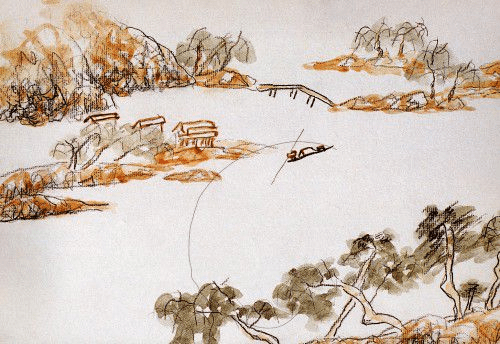
Chinese Ink painting: Western Lake
Chinese Ink Painting: Deep in the Mountains
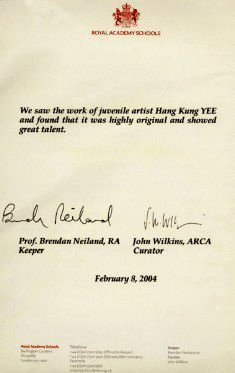
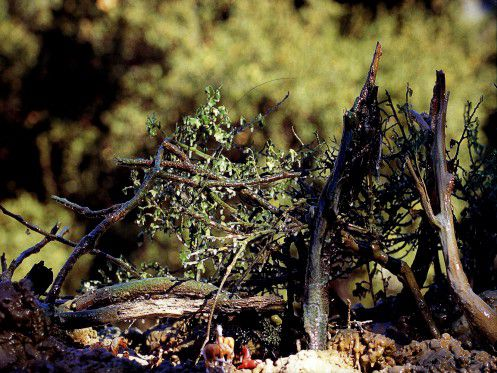
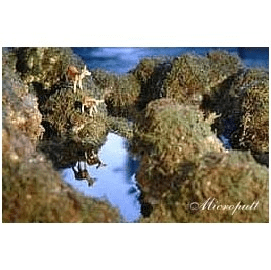
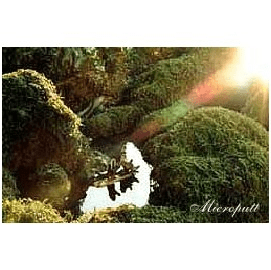
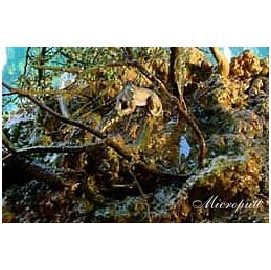
Hang Kung Yee’s true mastery shines in his landscape art and sculptures. His creations blend natural elements with refined craftsmanship, producing works that are indistinguishable from nature itself. His landscapes, though rooted in real life, transcend it, evoking a dreamlike quality as if imbued with the mystical winds of a far-off fairyland. When photographing his sculpted landscapes, one would easily mistake them for real scenery. Even the most discerning artists would struggle to differentiate between his works and actual nature captured in photographs. At the young age of fifteen, the young artist Hang Kung Yee published his first hardcover collection of landscape art. His artistic achievements were recognized by the highest authorities in the global art world, with the President and Artistic Director of the Royal Academy of Arts signing an evaluation document on February 8, 2004. The document stated, ‘The young artist Hang Kung Yee is extremely creative, showcasing exceptional talent.’ The news sent shockwaves through the international art community.
Landscape Art: The Lush Spring of Xishuangbanna
Landscape Art: “Dreamscape Melody of Lake and Sky”
Landscape Art: Mysterious Dream Lake
Mirror-like Lake
The Bond Between Humans and Animals in the Snowy Village of Banna
Rainbow Under the Morning Sun
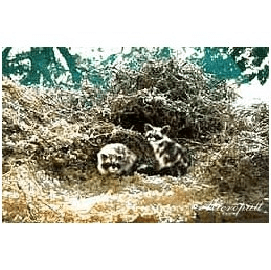
The Lion in the Swamp Forest
The Flower Marten in the Snow and Ice
Hang Kung Yee’s vision is to offer eternal beauty to humanity. His name, meaning “Eternity for the Public,” reflects this deep desire to share his creations with the world, hence his title “Hang Kung.” Ever humble, he downplays his expertise in art, attributing his rapid ascent into the higher realms of artistic mastery to his father’s guidance. He also speaks of his 12-year-old sister, Jinba Rinpoche, who, although not yet versed in art, will soon receive their father’s wisdom teachings, propelling her to artistic mastery in a matter of months.
For Hang Kung Yee, gratitude is central. He acknowledges the profound influence of his father, the support of fellow artists, the inspiration of nature, and the guidance of teachers and family members in shaping his artistic journey. Without these sources, he admits, he would never have reached his current artistic heights. As he continues to evolve, Hang Kung believes that art, much like his name, is boundless. “Yee” symbolizes the universal principles, while “Hang Kung” stands for “eternity for the public.” His aspiration is simple yet profound: to bring beauty, joy, and inspiration to all living beings through his art.














 Peace LiLy