Dazu Rock Carvings – The Last Monumental Works in the History of World Grotto Art

Detail of reclining Buddha, Parinirvana of Shakyamuni attended by bodhisattvas, Mt. Baoding, Southern Song Dynasty, Dazu, China, 102′ long (photo: Mulligan Stu, CC BY 2.0)

With a history spanning over 1,300 years, the Dazu Rock Carvings represents the pinnacle of grotto art worldwide from the ninth to the thirteenth century. The exquisite and varied cliff-side sculptures at Dazu caves provide outstanding proof of the harmonious fusion of Buddhism, Taoism, and Confucianism in civil. In 1999, the Dazu Rock Carvings was inscribed on the World Heritage List by UNESCO.

Enjoying a comparable reputation with the top four grottoes in China (Mogao Grottoes, Yungang Grottoes, Longmen Grottoes, and Maijishan Grottoes) and being rated as one of the eight grottoes in the world, the Dazu Rock Carvings (“大足石刻” in Chinese), also known as Dazu Caves or Dazu Grottoes, located 167km from the city center of Chongqing. It is the one and only UNESCO World Cultural Heritage Site in Chongqing municipality. The Dazu Rock Carvings consists of 75 cave temple sites, including more than 50,000 statues, being protected for their historical, artistic, and scientific values at different levels, representing the pinnacle of Chinese cave temple art between the 9th and 13th centuries. Among them, rock carvings of Baodingshan (宝顶山), Beishan (北山), Nanshan (南山), Shimenshan (石门山), and Shizhuanshan (石篆山) are exquisitely sculpted with the most distinctive style.

The Dazu Rock Carvings started in the early Tang Dynasty, went through the late Tang Dynasty and the Five Dynasties, and then experienced its golden time in the Northern and Southern Song Dynasty. At the time when cave art in northern China fell into decay, the Dazu Rock Carvings undoubtedly created another peak in the history of Chinese cave art, extending the history of Chinese cave art for more than 400 years. Since then, there have been no such large-scale rock carving events in China or even in the world. Therefore, the Dazu Rock Carvings are also known as the last monument and swan song in the history of the world’s grotto art.
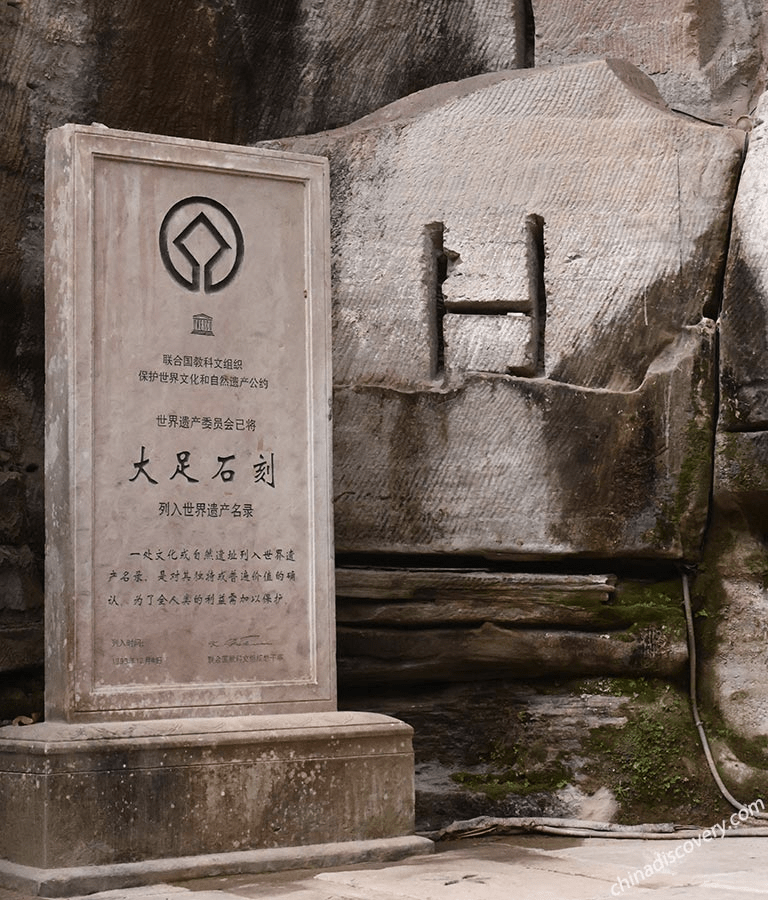
UNESCO Stele of the Dazu Rock Carvings

Differing from famous royal grottoes in the north, the religious cliff inscriptions in Dazu show distinctive features of nationalization, secularization, and everyday life, reflecting the remarkable development and changes in folk religious beliefs. Thus, the Dazu caves have the irreplaceable historical, artistic, scientific, and connoisseurship values of grottoes of the previous generations. Another highlight that has to be mentioned is that the statues there provide outstanding evidence of the harmonious synthesis of Tantric Buddhism, Taoism, and Confucianism. Visitors can see separate stone carvings as well as the unity caves reflecting the three religions’ confluence and ruling together. Moreover, thanks to the southern hinterland location of the Dazu Rock Carvings, this cultural heritage stays far away from man-made sabotage, retaining the integrity of the statues, the original characteristics and values of the period when the carvings were created.

Rock carvings in Dazu are mainly located across five mountains, each containing distinct sets of grottoes, among which the cliff-side sculptures on Baodingshan and Beishan are best known and considered to be the model of the late Chinese grottoes statue art. The pictures of the Dazu rock carvings that we commonly find online were mostly taken at the Baodingshan Scenic Area, which is also the must-visit site for a Dazu Rock Carvings tour.

Baodingshan Rock Carvings (Baodingshan Scenic Area)

Fifteen kilometers northeast from Dazu center, Baodingshan Rock Carvings was constructed by the famous monk Zhao Zhifeng in the Song Dynasty for more than 70 years. As one of the most famous Tantric Buddhist shrines in China, there is an old saying that goes like “Go North, climb the Emei Mountain; Go South, reach the Baoding Mountain.” The centerpiece of the Baodingshan rock carvings is the U-shaped Grant Buddha Bay, also known as Dafowan (“大佛湾” in Chinese). Nearly ten thousand statues are carved along the east, north, and south cliffs, which are approximately 500 meters in length and 8-25 meters high. Like a picture scroll with endless photographs, the content of Baodingshan rock carvings is mainly Buddhist scripture stories, each niche related to the other but not identical.
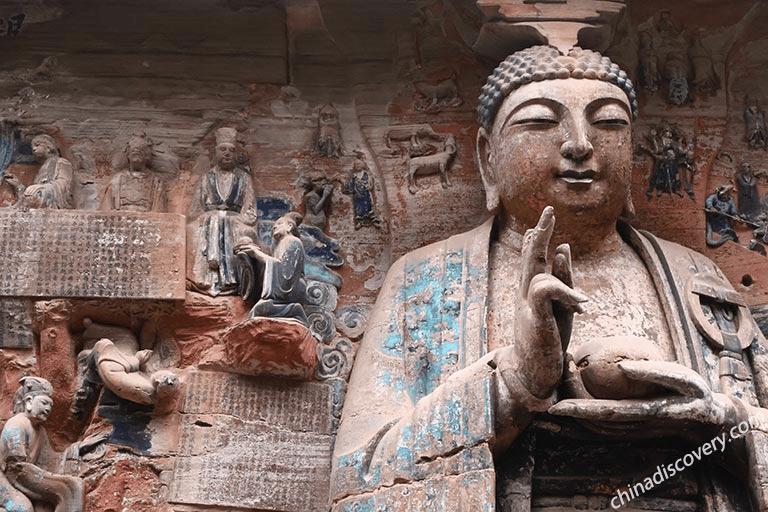
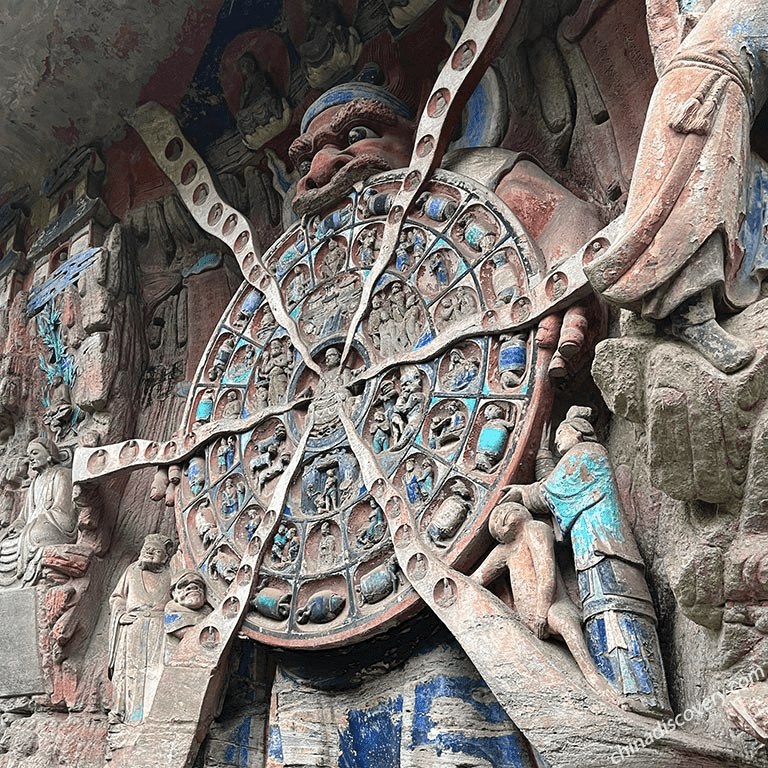
Dazu Rock Carvings – Buddhist Wheel of Life

Avalokitesvara with Thousand Hands

The Buddha statues at Baodingshan are novel in conception, skillful in carving, and rich in secular characters. Religious treasures come one after another, including the representative work – Niche of Sakyamuni Entering Nirvana, one of the wonders of Buddhist art in the world – Avalokitesvara with Thousand Hands, striking image of Buddhist Wheel of Life, scientific designs of Three Saints of Huayan School of Buddhism and Cave of Full Enlightment showed craftsmans’ ingenuity.

In addition, niche content and their expression approach are striving to visualize reality. For instance, Niche of Parental Love Sutra contains ten groups of carvings, including scenes like begging for a son, carrying a child, and going into labor, etc., depicting parental love in bringing up children with plots linking to each other as a picture-book. These carvings are vivid and impressive. They were the outcome after Buddhism had been localized in China.

The ox herding story

Located at the eastern end of the Great Buddha Bend, the ox herding tableau, shows a herdsman taming a disobedient ox—a traditional metaphor for the path to self-enlightenment and a popular theme among Ch’an Buddhist monks and painters in the Song Dynasty. The tableau is made up of eleven vignettes arranged horizontally along a 27-meter cliff wall.

Ox herding story (scene 1–2), Niche 30, Dafowan, Mt. Baoding, Dazu. Southern Song Dynasty (photos: G41rn8, CC BY-SA 4.0)

The first three vignettes each depict a lively interaction between a herdsman and an ox in a landscape setting. The herdsman represents the Buddhist practitioner while the ox refers to the practitioner’s potential to become a Buddha. As the ox turns its body away, the stocky herdsman uses force, grass, and a stick to tame the ox. The verses accompanying the scenes further recount these struggles. 

Herdsmen embracing in the ox herding story (scene 5), Niche 30, Dafowan, Mt. Baoding, Dazu. Southern Song Dynasty (photos: G41rn8, CC BY-SA 4.0)

In the fourth and fifth vignettes, the ox is finally brought under control. The herdsman, featuring a wide, joyful smile, wraps his arms around his fellow herdsman while holding on to the ox with the rope in his hands.

In addition to the uncanny quality of grottoes’ masterpieces at Grant Buddha Bay (Dafowan), there are also many highlights you can’t miss while visiting Baodingshan Scenic Area:

  • Watch a 4K film with English subtitles to learn about the history and development of Dazu rock carvings, and enjoy an 8D view of spectacular grottos at the dome theater
  • Take a leisure stroll at Dazu Rock Carvings Museum (大足石刻博物馆) to gain insights into the whole thread of world cave temple art and the basic characteristics of Dazu Rock Carvings
  • Visit Shengshou Temple (圣寿寺) to admire the exquisite temple architecture, which was rebuilt at the Ming and Qing Dynasties.
Shengshou Temple & Dazu Rock Carvings Museum

Beishan Rock Carvings

1.5km north to Longgang Town of Dazu, with an altitude of 545.5m, Beishan is also called Longgang Mountain in the past. Beishan Rock Carvings is the initial of Dazu Rock Carvings. They were first created by Wei Junjing, prefect of Changzhou, in 892 A.D. of the late Tang Dynasty. Until 1162 A.D. of the Southern Song Dynasty, the existing scale of Beishan Rock Carvings was formed, and it centered around Fowan. The rock carvings are numbered and divided into two sections: No.1 ~ No.100 are in the south section, while No.101 ~ No. 290 are in the north section. There are over 5,000 statues on a 500m long cliff, with a height of 7 to 10 meters. The grottoes are very dense, just like a hive, and all of them are delicate and carved with high sculpture skills.

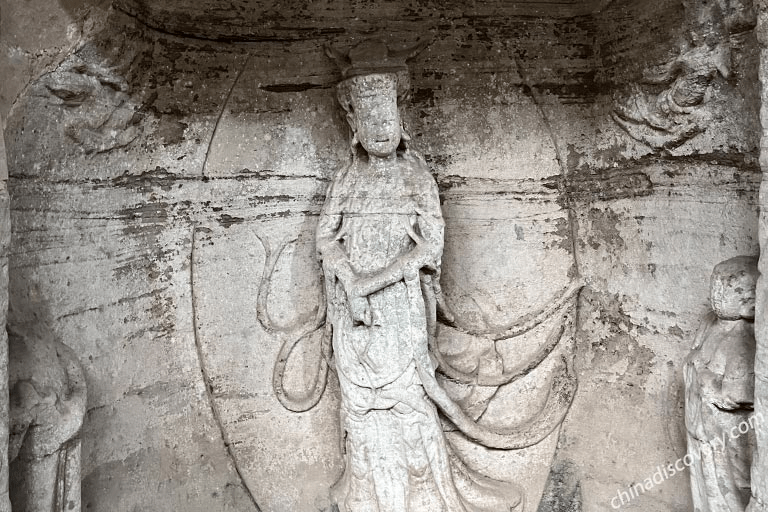
Avalokitesvara with a Rosary

The crowning jewels of Beishan rock carvings are the statues of Avalokitesvara. They are ornamental and artistic, with diverse looks and postures. The most emblematic ones are the Avalokitesvara with a RosaryAvalokitesvara Watching the Moon Reflection in the Water, and Thousand-armed and Thousand-eyed Avalokitesvara, etc.

Beishan rock carvings can be visited both during the day and at night. An additional visual experience is provided by the scenic spot’s usage of colored light to illuminate the stone statues. Besides, if you have enough time and stamina, don’t forget to follow the downhill trail to visit the Duobao Pagoda (多宝塔) to see the giant cliff statues of Beishan, the Two Buddhas of the North Pagoda.

Dazu Rock Carvings – The Last Monumental Works in the History of World Grotto Art

Link:https://peacelilysite.com/2024/01/04/dazu-rock-carvings-the-last-monumental-works-in-the-history-of-world-grotto-art/

#AvalokitesvarawithThousandHands #Shakymunibuddha #DazuRockCarvings #History #WorldGrottoArt #Buddhism #BuddhistArt #BuddhaStatue#Cave#TravelChina #ChineseCulture

Source:https://www.chinadiscovery.com/chongqing/dazu-rock-carvings.html, https://smarthistory.org/mt-baoding-dazu-rock-carvings/

Eternal Smiles: Unveiling the Serenity of China’s Buddhist Sculptures

DunHuang MoGao Caves

A Journey Along the Silk Road: Unraveling the Tapestry of Buddhism in China

When we think of iconic sculptures, the Discobolus, Michelangelo’s Moses, and the Laocoon and his Sons likely come to mind—captivating masterpieces that freeze moments in time with gripping intensity. However, the realm of Buddhist sculptures in ancient China offers a different narrative, one of profound serenity and peace that sets it apart from Western art.

CGTN’s latest film, Eternal Smiles, invites you to embark on a mesmerizing 60-minute exploration of China’s Buddhist sculptures. As you delve into the most renowned grottoes, you’ll witness a unique facet of statuary art that transcends time and space, offering a glimpse into a continuous eternity. The film provides a rare opportunity to experience the tranquility and harmony exuded by Buddhas and Bodhisattvas in these ancient works.

Guiding you along the Silk Road, Eternal Smiles unravels the fascinating journey of Buddhism to China. The film takes you to famous grottoes, temples, and historical sites, immersing you in a rich tapestry of stories that satisfy your curiosity about history, art, natural scenery, culture, and more.

Unlike the dramatic and intense narratives often found in Western sculptures, China’s Buddhist sculptures are a testament to serenity and peace. The film beautifully captures the essence of these timeless works of art, inviting viewers to appreciate the subtleties and spiritual depth embodied by Buddhas and Bodhisattvas.

Eternal Smiles is not merely a documentary; it’s a cinematic symphony that seamlessly weaves together history, art, and culture. Through stunning visuals and insightful narratives, the film offers a holistic experience that transcends the screen, transporting viewers to the heart of China’s Buddhist legacy.

Whether you’re a history buff, an art enthusiast, or someone seeking a peaceful escape, Eternal Smiles promises to be a visual feast for the curious soul. Join us on this cinematic journey to discover the beauty, serenity, and eternal smiles hidden within China’s Buddhist sculptures.

Eternal Smiles: Unveiling the Serenity of China’s Buddhist Sculptures

Link:https://peacelilysite.com/2023/12/29/eternal-smiles-unveiling-the-serenity-of-chinas-buddhist-sculptures/

#Buddhist #BuddhistSculptures #SilkRoad #Caves #DunhuangMogaoCaves

Harmony in Brushstrokes: Exploring the Subtleties of H.H. Dorje Chang Buddha III’s ‘Old Tree’

H.H.  Dorje Chang Buddha III ‘s traditional Chinese painting, “Old Tree,” stands as a masterpiece adorned with vibrant red plum blossoms. The depiction of a weathered old plum tree in a sea of ink unfolds a narrative of transformations—dense, light, dry, wet—unveiling the radiant beauty of its once youthful charm. The myriad red plum blossoms, seemingly engaged in a dance, cluster and clamor upon the branches, invoking an immediate sense of lively springtime. This painting is a testament to the profound artistic prowess encapsulated in H.H.  Dorje Chang Buddha III ‘s work.

Embedded within the Chinese cultural tradition is the notion of the common origin of calligraphy and painting. H.H.  Dorje Chang Buddha III  seamlessly incorporates calligraphic brushstrokes into painting, preserving the interconnected signs of brush and ink on the canvas. This approach transforms the expressive painting into a visual symphony, akin to calligraphy music. The technique of “flying white” in calligraphy, where white spaces delicately appear amidst smooth brushstrokes, takes on a purposeful role in painting. Originating as an imprint left by the speed of the brush, “flying white” becomes a unique brush and ink technique through profound aesthetic reflections.

“Flying white” becomes a vivid recorder of authentic emotions during the writing process. The brush swiftly glides over the paper, conveying passion and resonating with the engraving sensation found in seal carving. The depiction of the main trunk of the old plum tree in “Old Tree” superbly utilizes this technique. The contrast between subdued flying white and rich ink creates a musical and vivid rhythm of black, white, and gray within the composition.

The essence of a good painting lies in its “subtlety,” an intricate quality that goes beyond precision or meticulousness. For H.H.  Dorje Chang Buddha III , the process of painting is akin to flowing clouds and water—an expression of natural improvisation and delicate arrangement. As the ancients wisely said, “Add a little to Pan An’s beauty, and it becomes more; subtract a little, and it becomes less.” The subtle artistry in “Old Tree” showcases the artist’s profound insight into the delicate nuances of expression.

The quality of a work is deeply intertwined with the artist’s inherent cultivation, reaching a high realm based on the principle of “selflessness.” This term, often misunderstood, refers to losing oneself entirely in the painting process—where both mind and hand are forgotten. Artworks created in this state possess a power that transcends philosophical texts, offering a simple and clear depiction of inherent reality.

In real life, each person has unique perceptions and emotions, yet lacking rationality makes it challenging to transform these into creativity. True masters of art, exemplified by H.H.  Dorje Chang Buddha III , possess not only a sublime inner world and rationality but also the ability to keenly grasp fleeting sensations and transform them into robust vitality. Their ability to endure solitude, maintain genuine nobility, and leave traces of distinctive qualities results in the creation of genuinely original works of art. The great art masters, with a spiritual realm surpassing ordinary individuals, exhibit an otherworldly and extraordinary noble quality that defines their artistic genius. In “Old Tree,” we witness not just a painting but a symphony of artistry, capturing the essence of H.H.  Dorje Chang Buddha III ‘s profound mastery.

Harmony in Brushstrokes: Exploring the Subtleties of H.H. Dorje Chang Buddha III’s ‘Old Tree’

Link:https://peacelilysite.com/2023/12/29/harmony-in-brushstrokes-exploring-the-subtleties-of-h-h-dorje-chang-buddha-iiis-old-tree/

#DorjeChangBuddhaIII #HHDorjeChangBuddhaIII#DorjeChangBuddha#Art #ChinesePainting #InkPainting

Harbin Ice and Snow World – A Colorful Ice Disneyland

Steve222_11 2019

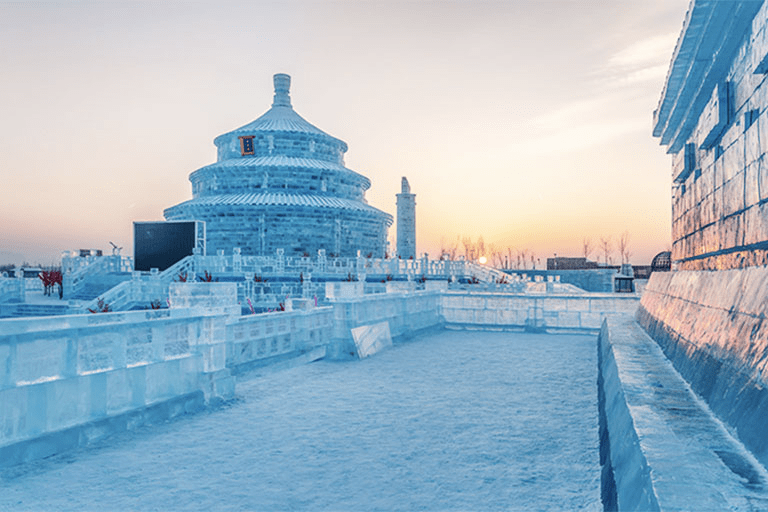
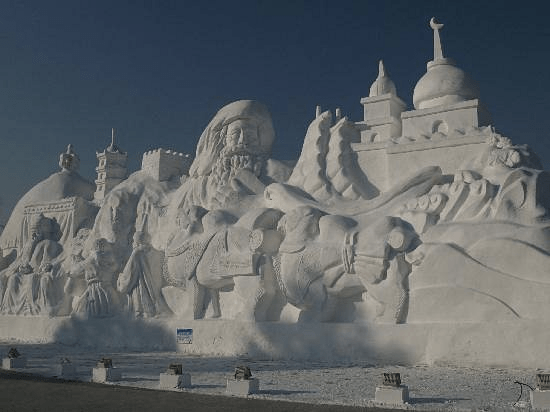
The Harbin Ice and Snow World stands as one of the largest ice and snow theme parks globally, encompassing an expansive area of 600,000 square meters. It not only serves as an irreplaceable landmark for Harbin City but has also become a renowned international ice and snow tourism brand. Boasting over 2,000 ice sculptures, landscapes, ice castles, rides, and stage shows, this man-made winter wonderland is often referred to as the “Disneyland of Ice and Snow.”

Aligned with the International Ice and Snow Festival of Harbin, the Harbin Ice and Snow World recently celebrated its 20th consecutive year. Unlike traditional construction materials, the park is crafted entirely from ice each winter, featuring delicate and intricate ice and snow sculptures designed under different themes annually. The night view of the park, adorned with vibrant lights accentuating the sculptures, is a mesmerizing spectacle.

The winter experience in Harbin is not limited to visual delights; it encompasses various cultural activities and winter sports. For those seeking relief from summer heat, an indoor ice and snow paradise awaits exploration.

Entering the Ice and Snow World, visitors are greeted by awe-inspiring sculptures, some towering over three stories high, showcasing intricate designs. The park transforms into a magical realm at night, as multicolored lights embedded in the ground illuminate the ice structures, creating a surreal kaleidoscope of colors against the dark night sky.

The exhibition within the park is a display of international ice engraving competitions, ice and snow LED lighting competitions, photography shows, oil painting exhibitions, and other forms of art themed around ice and snow. Marvel at award-winning works and iconic structures, such as those depicting scenes from popular games like Arena of Valor.

A visit to Harbin Ice and Snow World offers not only a feast for the eyes with illuminated sculptures and performances but also a chance to partake in diverse cultural activities and winter sports. The recreation area, spanning over 200,000 square meters, provides more than 20 options, including ice sports like skating, curling, sleighing, ice biking, and the thrilling 320-meter long ice slide. Snow sports enthusiasts can engage in skiing, snow football, snow circling, and the classic snowman and snowball-making activities.

Families can enjoy quality time together in the Parent-kid Paradise, fostering close contact with nature. Furthermore, the dazzling shows presented by skilled actors, combining dancing, acrobatics, and various art forms themed around ice and snow, promise to leave a lasting impression. Don’t miss the opportunity to dance with the actors at the Dream Stage, adding an interactive element to your visit. The Harbin Ice and Snow World is not merely a destination; it’s an immersive experience that seamlessly blends artistic excellence and technological marvels for visitors of all ages.

Harbin Ice and Snow World – A Colorful Ice Disneyland

Link:https://peacelilysite.com/2023/12/22/harbin-ice-and-snow-world-a-colorful-ice-disneyland/

#SnowIceFestival #TravelChina#Harbin#IceDisneyland#ChinaDiscovery #WinterWonderland

Source: https://www.chinadiscovery.com/heilongjiang/harbin/harbin-ice-snow-world.html

Maijishan Grottoes – Buddhist Treasure Well-preserved on Maiji Mountain Cliff

Maijishan Grottoes, also known as Maiji Mountain Grottoes or Maijishan Caves, is situated in Maiji District, Tianshui City, Gansu Province, in northwest China. Alongside the Longmen Grottoes, Yungang Grottoes, and Dunhuang Grottoes, it holds the esteemed title of being one of the “Four Greatest Grottoes in China.”

If the Mogao Caves are likened to a vast mural museum, the Maijishan Caves undoubtedly resemble an expansive sculpture museum. Boasting 10,632 clay sculptures, Maijishan is hailed as “the Oriental Sculpture Art Exhibition Hall.”

Much like the Parthenon temple in ancient Greece, the stone and clay carvings at Maijishan have been remarkably preserved since ancient times, earning it the moniker of “China’s Parthenon Temple.”

In contrast to the exotic sculptures found in the Mogao Caves, the sculptures in Maijishan are characterized by a more secular, human, and distinctly Chinese quality.

Unlike the exotic sculptures in Mogao Caves, the sculptures in Maijishan Caves are more secularized, human, and more Chinese

The name Maiji in Chinese translates to “piled sheaves of wheat,” reflecting the mountain’s appearance and the origin of its name. The Maijishan Grottoes were initially constructed in A.D. 384-417 and underwent subsequent expansions in dynasties such as Northern Zhou (A.D. 557-581) and Tang (A.D. 618-907). The site currently comprises 221 caves, 10,632 clay sculptures, and over 1300 square meters of murals, earning global acclaim for its exquisite clay sculpture art and recognition as the “Oriental Sculpture Art Exhibition Hall.”

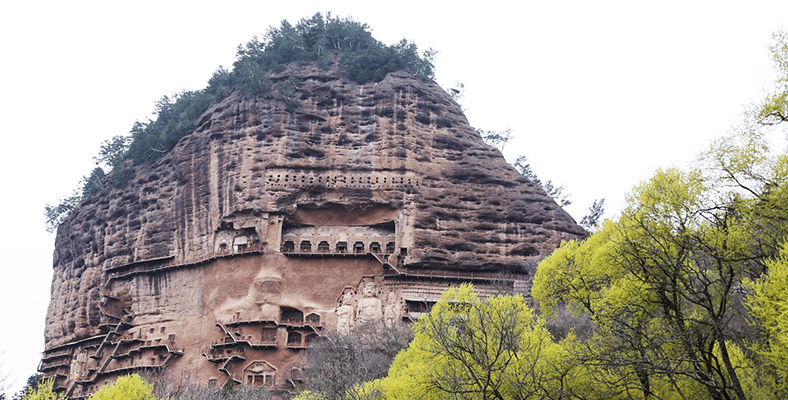
While Maijishan Grottoes may not be as renowned as the other three great grottoes, it stands out as the best-preserved among them. Carved into the steep cliff of the mountain, the caves were not easily accessible, thus escaping much of the destruction that plagued other sites throughout tumultuous periods in history. Today, visitors can marvel at Buddha sculptures and murals along a narrow path clinging to the cliff’s edge.

Marsman Rom, Wikimediia Commons

Shizao, Wikimedia Commons

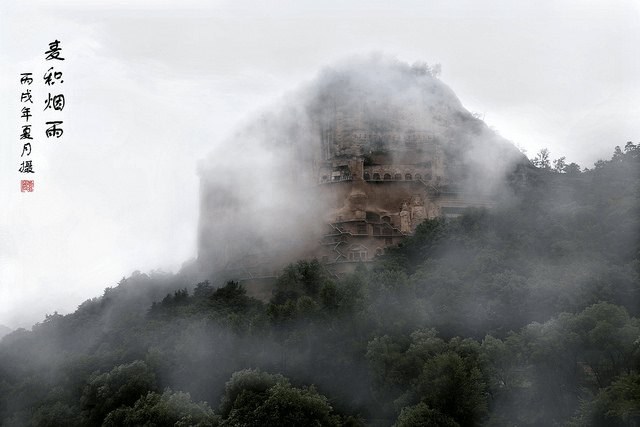
Maijishan in a sea of fog. ©Maijishan Grotto Art Institute and Global Heritage Fund

Located just a few miles south of the main road connecting China and Central Asia, Maijishan emerged as a hub of cross-cultural exchange, drawing hundreds of thousands of itinerants and serving as a historical canvas reflecting the art of 12 distinct dynasties. Indians, Mongols, Huns, Sogdians, Tibetans, Chinese, and others traversed its halls, leaving enduring imprints of their cultures in the form of art.

The mountain’s 194 grottoes stand as tangible evidence of this diverse influence, showcasing seven architectural variations, housing over 7,000 statues, and adorned with more than 100 square meters of murals. Everything within reflects a dedication to Buddhism, from depictions of Siddhartha’s birth to bodhisattvas engaged in meditation and scenes of new devotees arriving. While Maijishan’s physical features initially garnered attention, it is the heritage inscribed, painted, and sculpted onto the soft golden stone that solidified its place in the globalized consciousness of Buddhism, akin to Mount Sumeru, the sacred Buddhist mountain often considered the “mythical axis of the universe.”

The history of Maijishan, like the tales along ancient trade routes, commences with a journey. One account tells of the priest Hsüan-kao meditating at Maijishan, later joined by the shaman T’an-Hung. Together, they founded the mountain’s first monastic community, growing to nearly 300 people before their departure, marking a departure filled with religious fervor, and in T’an-Hung’s case, a morbidly poetic self-immolation in Cochin.

This semi-mythical origin, whether entirely factual or not, undeniably solidified Maijishan as a significant religious site for Chinese rulers. In the Fang-yü sheng-lan, a Sung Dynasty-era book, it is noted that Yao Hsing transformed the mountains, carving 1,000 cliffs and 10,000 images, transforming the cliffs into halls. A stele from 1222 attests to the site’s prominence, with 10,000 people praying there, empires granting land for farming, and seven kingdoms continuously contributing to its maintenance. Subsequent imperial decrees bestowed various names, including “Ching-nien ssu,” “Ying-chien kan ssu,” and “Jui-ying ssu,” before settling on the name Maijishan.

Examples of how brilliantly these works of art were once colored. Shizao, Wikimedia Commons

Differences between Maijishan’s Grottoes and Mogao’s

The Maijishan Grottoes and the Mogao Grottoes, both situated in Gansu Province along the Silk Road, offer distinct experiences, prompting consideration for visitors on a Silk Road journey. Despite being grottoes, they differ significantly, making a visit to both a worthwhile endeavor.

  1. The Maijishan Grottoes are renowned for their clay sculptures, whereas the Mogao Grottoes impress with expansive and beautiful murals. The arid climate in Dunhuang aids mural preservation, while the Maiji Mountain area, with more rainfall and looser mountain rock (clay), is conducive to sculpture carving.
  2. Sculptures in the Maijishan Caves are primarily plain clay pieces, while in the Mogao Caves, they are predominantly painted sculptures integrated with murals. Buddha statues in Maijishan exhibit a more secularized and daily-life-oriented character.
  3. The surrounding natural landscapes vary. Maijishan Caves, located in the Maiji Mountain Reserve area, offer a summer retreat with lush trees and springs, providing opportunities to explore diverse wildlife. In contrast, the Mogao Grottoes are situated in the Gobi Desert, surrounded by wild desert scenery.
  4. The Maiji Grottoes were carved into a steep 100-meter-high cliff face, requiring travelers to ascend the “floating plank road” for a more adventurous experience. In comparison, the Mogao Grottoes were carved into a 30-meter-high sandstone outcrop distributed over four floors.

The breathtaking Maiji Caves, carved into the steep cliffs of Maiji Mountain, stand about 100 meters (330 feet) above the ground, divided into East and West Cliffs. These caves, resembling honeycombs in hives, are interconnected by plank walkways suspended in the air from the cliff face.

Have you ever pondered how this feat was accomplished over a thousand years ago without modern machinery?

Legend has it that the Maijishan Grottoes were excavated at the expense of clearing all the woods near Maiji Mountain. Ancient people built wooden scaffolds from the mountain’s foot to the top, serving as precursors to the later generations’ “plank roads.”

During the Tang Dynasty (618–907), an earthquake divided Maiji Mountain into two cliffs, east and west. Over subsequent dynasties — Song, Yuan, Ming, and Qing — the Maijishan Grottoes underwent development, evolving into the cohesive complex seen today.

The Maijishan Caves stand as a testament to human wisdom and art along the Silk Road, embodying profound respect for Buddhism and an unending yearning for a better life.

Part of the Maiji Mountain Scenic Reserve area (including Xianren (‘Fairy’) Cliff, Shimen, Quxi, and Jieting Hot Spring), the Maijishan Grottoes boast diverse forests and a rich array of plants and animals.

While the Maijishan Grottoes can be visited year-round, the best time to explore the Maiji Mountain Scenic Reserve area is from July to October when the mountain, adorned with dense foliage, provides an ideal summer getaway.

Maijishan Grottoes – Buddhist Treasure Well-preserved on Maiji Mountain Cliff

Link:https://peacelilysite.com/2023/12/15/maijishan-grottoes-buddhist-treasure-well-preserved-on-maiji-mountain-cliff/

#MaijishanGrottoes #BuddhistTreasure #MaijiMountainCliff #Travel #China#Art#TravelChina

Source: https://globalheritagefund.org/2018/02/13/inside-the-lost-grottoes-of-maijishan/, https://www.chinadiscovery.com/gansu/maijishan-grottoes.html, https://www.chinahighlights.com/tianshui/attraction/mount-maiji-grottoes.htm

Unveiling Insights Through the Wild Fox Koan: Understanding the Law of Cause and Effect

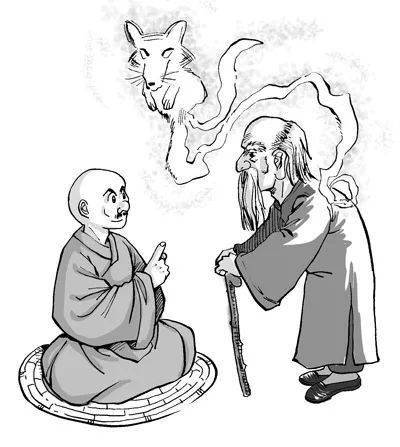
In the annals of Chinese Buddhist teachings, a narrative known as the “Wild Fox Koan” imparts profound insights into the principles of karma and its undeniable consequences.

According to legend, during the Tang Dynasty in China, Master Bai Zhang Huai Hai, a venerable monk and the third-generation disciple of the Sixth Patriarch Master Huineng, played a pivotal role in this story. During his sermons, he consistently noticed an unfamiliar old man attentively listening to his teachings on Buddhism. The mysterious visitor would only depart after the session concluded. One day, after another sermon, the old man lingered, prompting the puzzled monk to inquire, “Who is standing there without leaving? Who are you?”

Huaihai, curious, asked, “Do you have something on your mind?” The old man got straight to the point, confessing, “I am not a human; I am a wild fox on this mountain. Five hundred years ago, I was a monk and once gave a Dharma talk here. One day, a junior monk asked me if enlightened beings fall under the law of cause and effect. I replied, ‘They do not fall under cause and effect.’ Unfortunately, I gave the wrong answer and fell into the realm of a fox. Today, I want to ask a question in front of you, venerable teacher. Would you be willing to enlighten me?” Huaihai replied, “Please go ahead.” The old man asked, “Do enlightened beings fall under the law of cause and effect?” Huaihai responded, “They do not ignore cause and effect.” The old man paused for a moment, then prostrated himself, saying, “Teacher, I have attained enlightenment. I have now transcended the realm of the fox. I am beneath the big stone on the back mountain. I hope that you, as a monk, will bury me according to the proper rites.” After saying this, he disappeared without a trace.

Accompanied by monks, Master Huaihai went to the back mountain and found, under a large stone, a dead black fox. Master Huaihai instructed them to light torches and cremate the fox. They then chanted sutras together, performing rites to help the fox monk attain liberation.

The Fox Zen Master, due to a single mispronounced word, uttered a great falsehood, resulting in five hundred lifetimes as a wild fox. The principle of cause and effect is unfailing, as it does not discriminate between the ordinary and the saintly. Advanced practitioners maintain a profound reverence for the law of karma. Hence, there is the notion that bodhisattvas fear the cause, while ordinary beings fear the effect. A bodhisattva contemplates the emptiness and tranquility of all phenomena, harboring no attachment or grasping. Due to their wisdom, they do not give rise to undesirable consequences such as ignorance or darkness.

If one were to claim that a bodhisattva “transcends cause and effect,” it would imply an annihilationist view. It is only by “not obscuring cause and effect” that a bodhisattva, within the profound samadhi of deep prajna paramita, can attain the ultimate wisdom.

“To keep things secret, refrain from doing them unless by oneself.” This is a commonly heard phrase advising people to do good, implying that whatever one does, there will always be someone who knows. Moreover, secrets are bound to be exposed sooner or later. Therefore, it is essential to reflect on one’s actions regularly, ensuring they align with goodness. Never assume that no one is watching, as actions that go against the laws of cause and effect will eventually come to light.

Two other frequently heard sayings are: “Within three feet, there are gods” and “Every step leaves a mark.” These cautionary words remind individuals that every action leaves an imprint, and nothing done will vanish into oblivion over time. In the realm of cause and effect, if one sows seeds of negativity, they must ultimately bear the consequences, adhering to the principle of “unobscured cause and effect.”

During the Three Kingdoms period, the king of Su, Liu Bei, offered sagacious advice to his son, Liu Shan, before his passing, saying, “Do not commit small evils, and do not refrain from doing small acts of goodness.” This counsel underscores the importance of consistently engaging in virtuous deeds, regardless of their scale, while avoiding any participation in wrongdoing. The admonition implies that accumulating small wrongs over time can lead to significant consequences.

Conversely, it’s not uncommon to encounter individuals who, despite their kindness and numerous good deeds, face repeated disasters and misfortunes. Understanding why such outcomes occur can be challenging, leading to a lack of comprehension about the concept of doing good. Some may even develop biases, assuming that avoiding wrongdoing in this life is sufficient and that there’s no need to help others since there’s no apparent reward for good deeds. This perspective represents a clear form of biased and distorted understanding, lacking insight into the law of cause and effect and focusing on one aspect without considering the other.

Applying the concept of the threefold law of cause and effect, we realize that positive causes we sow may not yield immediate results. Karmic consequences from past lives need to be accounted for and repaid. We cannot solely judge our current situation based on what we see in this lifetime. Holding the belief that “I haven’t done anything wrong, so why is life more difficult for me than for others?” is a narrow perspective. Observing others who seemingly haven’t done much good yet are living well, we might not realize that they sowed positive causes in past lives—an aspect our ordinary eyes cannot perceive, akin to the monk descending to a fox in many lifetimes.

If the notion of avoiding wrongdoing but not engaging in virtuous deeds takes root, the future may only bring unbearable misery. Reflect on whether we’ve never taken a life. Insects, ants, cockroaches, spiders—all are living beings, and consciously or unconsciously, we’ve all caused harm to one at some point. Furthermore, injuring a life means we will have to repay in kind in future lives. Without cultivating positive causes in this life, how can we expect to have a good future?

Therefore, it is crucial to firmly believe in the universal truth of “cause and effect.” You reap what you sow—good actions bring good results, and harmful actions bring harm. It’s not a matter of if, but when the time comes!

Unveiling Insights Through the Wild Fox Koan: Understanding the Law of Cause and Effect

Link:https://peacelilysite.com/2023/12/14/unveiling-insights-through-the-wild-fox-koan-understanding-the-law-of-cause-and-effect/

#Buddhism #BuddistTeaching #ZenBuddhism #ZenKoan #LawofCauseandEffect#MasterBaiZhang HuaiHai #FoxKoan #WildFox #Liberation #Enligthen

Source: https://www.sohu.com/a/493514605_121124434,

Bridging Realms: Dr. Jim B. Tucker Explores Reincarnation

Bridging Realms: Dr. Jim B. Tucker Explores Reincarnation

In the intricate tapestry of human beliefs, the concept of reincarnation has woven itself through the fabric of traditional Asian cultures for centuries. However, this idea finds little resonance in Western cultures and often faces skepticism from the scientific community. Amidst this cultural and scientific dichotomy, a pioneering exploration is unfolding at the prestigious University of Virginia School of Medicine, led by Dr. Jim B. Tucker, a child psychiatrist with a unique perspective on life after death.

Born and raised in the southern United States, Dr. Tucker’s early life was immersed in the traditional beliefs of the American South. As he embarked on his academic journey, obtaining an undergraduate degree in psychology and specializing in child psychiatry, he encountered the notion of reincarnation with a healthy dose of skepticism. The clash between cultural beliefs, scientific inquiry, and personal skepticism set the stage for Dr. Tucker’s intriguing exploration into the mysteries of existence.

The documentary, highlighted on the Discovery Channel, explores the extensive and worldwide research conducted by Dr. Tucker. The film encapsulates the core of his studies, presenting interviews, case studies, and the profound implications of his findings. Through this visual medium, viewers are welcomed to observe the intersection of traditional beliefs, modern skepticism, and scientific exploration—all in the quest to unravel the mysteries of human existence.

Buddhism holds that life undergoes reincarnation through the six realms. After a person dies, if the karmic conditions accumulated in their past life mature, they may be reborn into the heavenly realm as a deity, or into the realm of asuras, or they may be reincarnated in the human realm. If negative karma, such as killing, deception, or greed, comes to fruition, the individual will inevitably fall into the hell realm and suffer, or they may be reborn in the realms of hungry ghosts or animals to endure suffering.

As for which realm one will be reborn into among the six, it depends on the karmic conditions of their virtuous and non-virtuous actions. Why does reincarnation occur? The fundamental reason lies in the attachment of sentient beings. Attachment gives rise to the confusion of karma, and from this confusion arises ignorance. Due to the endless causes and effects generated by ignorance, various positive and negative karmic forces are produced. It is these karmic forces that determine which realm of existence one will be reborn into.

Bridging Realms: Dr. Jim B. Tucker Explores Reincarnation

Link: https://peacelilysite.com/2023/12/08/bridging-realms-dr-jim-b-tucker-explores-reincarnation/

#Buddhism #KarmicCondition #SixRealm#Reincarnation

A Thanksgiving Reflection: Gratitude towards Our Parents

Embracing Filial Piety in a Modern World

In this season of gratitude, as we gather around tables adorned with festive feasts, it’s an opportune moment to reflect on the essence of filial piety, a cornerstone of Chinese culture. While tradition emphasizes putting parents first, the landscape of communication between generations has evolved, presenting new challenges.

In our pursuit of modernity, we often find a widening gap in understanding between parents and their children. This Thanksgiving, let’s draw inspiration from the timeless wisdom of Socrates, the ancient Greek philosopher.

Once Socrates noticed that Lamprocles was increasingly irritable with Xanthippe, his mother. Recognizing the need for a heart-to-heart conversation, Socrates decided to employ the Socratic method to enhance his son’s relationship with her.

Socrates initiated the dialogue by asking Lamprocles about the meaning of the term “ungrateful.” Lamprocles responded, noting that someone is considered ungrateful if they fail to express gratitude despite being treated well. Establishing this as common ground, Socrates delved deeper, questioning whether ingratitude might be acceptable towards enemies but not friends. Lamprocles rejected this notion, asserting that regardless of friendship or enmity, gratitude should be shown to anyone who has done a favor.

Photo by Berendey_Ivanov / Andrey_Kobysnyn on Pexels.com

Socrates then redirected the conversation toward the unparalleled favor bestowed by parents on their children. Emphasizing the sacrifices parents make, he highlighted the physical and emotional burdens mothers endure, risking their lives during childbirth. Despite this, Lamprocles remained unconvinced, citing his mother’s temper as a significant obstacle.

Socrates posed an intriguing question, asking whether it’s harder to bear with a mother’s ferocity than that of a wild beast. Lamprocles, acknowledging his mother’s intense demeanor, struggled to reconcile her actions with the lack of physical harm. Socrates, steering the conversation, questioned whether Lamprocles had ever been injured by his mother physically, and when the answer was negative, Socrates emphasized the reciprocal nature of their relationship.

The dialogue took an unexpected turn when Socrates compared listening to Xanthippe’s words to actors in tragedies hurling insults at each other. Lamprocles, distinguishing between real intent and theatrical performance, argued that his mother’s words were not mere make-believe. Socrates, unveiling his true intent, reminded Lamprocles that, despite Xanthippe’s anger, it was not devoid of good intentions but rooted in her love for him.

Socrates emphasized Xanthippe’s continuous care for Lamprocles during sickness, her prayers for his well-being, and her genuine desire to help him. He concluded that, ultimately, it is not the sharpness of words but the true underlying intentions that should concern us. Lamprocles, acknowledging his mother’s positive intentions, found solace in understanding that her bluster was akin to the actors’ staged conflicts.

In this heartfelt conversation, Socrates guided his son towards appreciating the true essence of gratitude and the underlying intentions of his mother’s actions. This Thanksgiving, let us draw inspiration from this wisdom, cherishing the imperfect yet unwavering love of our parents.

A Thanksgiving Reflection: Gratitude towards Our Parents

Link:https://peacelilysite.com/2023/11/17/a-thanksgiving-reflection-be-grateful-to-your-parents/

#ThanksgivingReflection #Grateful #Parents #Socrates

Source: https://donaldrobertson.name/2018/03/30/parenting-what-socrates-said/

Simplicity, Innocent Charm, and Natural Appearance

Minimal Brush Strokes Create Charming Paintings

It is often said that the essence of a high-quality painting lies in its incorporation of the calligraphic brushstrokes, the commanding presence reminiscent of engraved stone seals, a tonal quality derived from the artist’s mastery of literature, a stylistic expression emanating from the artist’s virtue, and a captivating allure that springs from the artist’s state of realization—this, indeed, is the true spirit of the painting.

In the International Art Museum of America, several paintings, executed with only a minimal number of strokes, possess the robust appeal akin to stone seal engravings. These artworks convey the artistic conception of returning to original purity and simplicity. With a liberated hand and mind, the artist applies their most refined skills, devoid of any lingering attachments, creating with minimal yet natural brushstrokes.

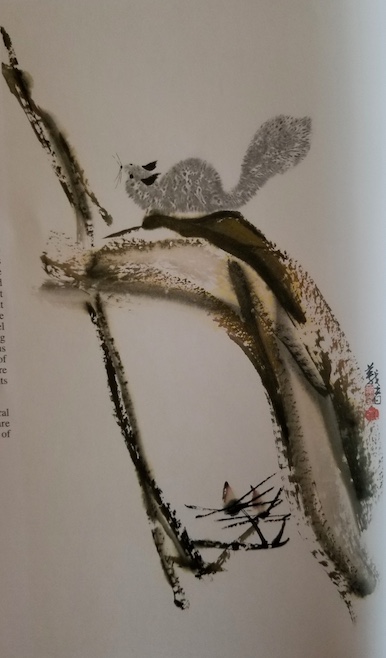
Za Chai Shi Gu (Brushwork Resembling Smashed Jade)

There is a phrase used in commenting upon Chinese paintings and calligraphy that related to smashed jade. This painting exemplifies that charming style of smashed jade.

The pine tree, rendered with just a few simple strokes, emanates a pervasive sense of strength across the entire painting. The exquisite and lively portrayal of the little squirrel employs a truly remarkable and mysterious technique, combining simplicity, innocent charm, a natural appearance, and authenticity into a harmonious whole.

Loquat

H.H. Dorje Chang Buddha III painted ‘Loquat’ in 2013. This painting achieves the skill of cherishing ink like gold in its conception, with no wasted or faulty strokes. With just a few strokes, it is high and lofty, vibrant and lively, containing an elegant and comforting sense of ease, as if the brush strokes were divinely inspired.

At the autumn auction of the New York Zhenguan International Auction Company on September 12, 2015, this painting ‘Loquat’ was auctioned for a staggering 10.2 million U.S. dollars.

Yi Chen Bu Ran (Immaculate)

With only a small number of strokes, a comforting and natural appeal appears vividly on paper. The style is neither overly cautious nor affected. A scholarly tone and an air of stone seals are revealed in the brushwork. This is a work of art with an attractiveness that stems from mature skills. The title “Immaculate” means that this painting is free of any trace of the mundane.

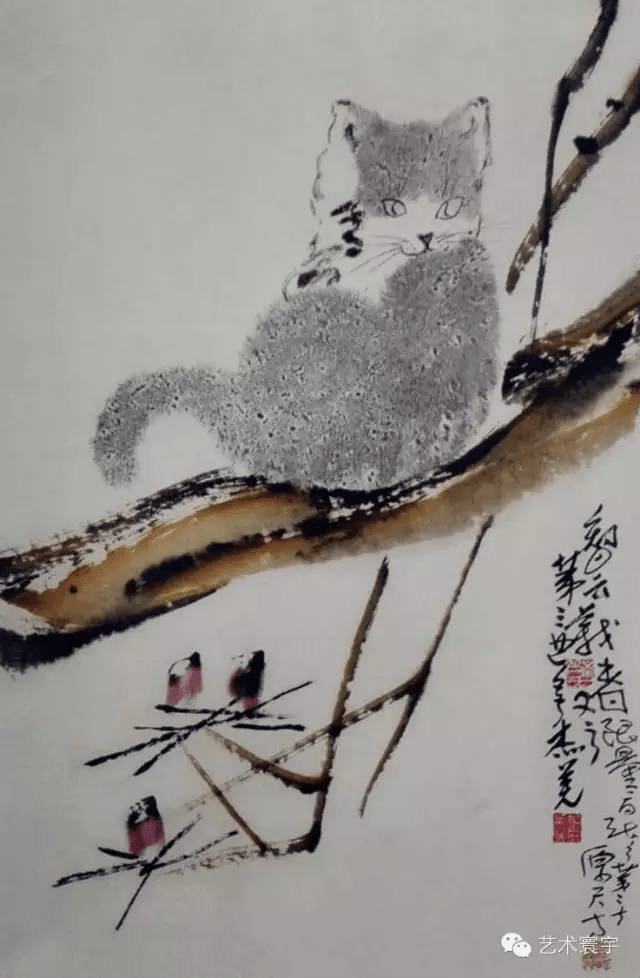
Cat of Unique Charm

In this painting, the cat is portrayed with a vibrant yet natural presence, achieved through the dynamic and captivating use of scattered ink. The entire artwork, painted with only a few brushstrokes, exudes the style of stone seals and an air of scholarly refinement. Both the form and spirit of the scene are skillfully captured. This work truly exemplifies masterful ink usage in a restrained manner.

One of the one hundred limited release copies of this small-scale, painting “Cat of Unique Charm” sold at auction for US$253,000, which is the highest per square foot selling price of any duplicate painting in the world. The prices of sold duplicate paintings by the most famous first-rate masters of art in the world cannot match the prices of sold duplicate paintings by H.H. Dorje Chang Buddha III.

Si Yu Sheng Hui (Resplendent Like Jade)

With just a few simple strokes, the entire painting is remarkably infused with a robust jade-like charm and an auspicious aura. Both the plantain tree and fruits exhibit a lack of mediocrity and were painted without the slightest mental attachment in the artist’s mind. They appear natural, elegant, and enchanting. This sentiment is succinctly captured in the accompanying short poem: “Unfurl the painting scroll, and the particularly fragrant scent of ink is released, permeating the viewer’s mind and intoxicating them to the core. Only a minimal number of strokes were applied. This exemplifies the regal art of using ink as sparingly as gold.”

H.H. Dorje Chang Buddha III, the artist behind these magnificent paintings, has crafted a pure and enchanting spiritual realm with his incredibly succinct brush and ink technique. Upon viewing, it evokes a sense of ethereality, akin to the moon reflected in water, and a freshness that pierces the heart, reminiscent of the sound produced when a piano key is pressed. This unique artistic essence, bridging the real and the virtual, transcends the ordinary, providing a natural and enlightening experience that often transports individuals into a realm of wonder.

Simplicity, Innocent Charm, and Natural Appearance

Link: https://peacelilysite.com/2023/11/10/simplicity-innocent-charm-and-natural-appearance/

#DorjeChangBuddhaIII #HHDorjeChangBuddhaIII##IAMA#InternationalArtMuseumofAmerica #Simplicity #InnocentCharm #Natural Appearance #StoneSeal

Autumn in Jiuzhaigou: A Colorful Paradise

Jiuzhaigou National Park is located in southwestern China in the north part of the Sichuan Province. The park covers an area of 280 square miles (720 sq km). It is a UNESCO World Heritage Site and a World Biosphere Reserve.

The elevation varies from 6,600 to 14,800 feet (2,000 to 4,500 m). The Jiuzhaigou valley falls within the Min Mountains and serves as the heart of the national park. The national park is renowned for its beautifully colored lakes, the numerous layered waterfalls, and peaks that are frequently snow-capped.

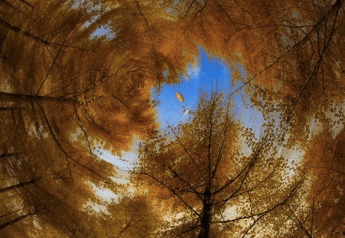
The autumn season in Jiuzhaigou is nothing short of a masterpiece, painted with a palette of vibrant colors. As mid-to-late October arrives, the transformation of the trees in Jiuzhaigou nears completion. The leaves change from a lush green to a brilliant gold, while others take on a stunning red hue that blankets the mountains.

The forest is ablaze with shades of red and yellow, creating a dazzling display that is reflected in the tranquil waters of the lake. The backdrop of a clear, clean blue sky enhances the refreshing atmosphere. Standing amidst this natural wonder, you can’t help but feel like you’ve stepped into a colorful paradise.

When autumn graces Jiuzhaigou, it feels as if you’ve entered a fairy tale world. The leaves compete in a brilliant display, reminiscent of flowers vying to bloom. But Jiuzhaigou is not just about the autumn leaves; it’s also about the countless streams that flow gracefully between the red and yellow leaves. These streams create a spectacular scene that is a rare sight to behold. In that moment, it feels as if all your worries and troubles simply melt away. In Jiuzhaigou, there is also the Five Flower Sea, which offers a 360-degree unobstructed view of breathtaking beauty.

Autumn in Jiuzhaigou is akin to a pot of warm and soothing wine that makes the earth’s cheeks blush and the eyes sparkle. As you stroll along the winding walkways, the warm sunlight bathes your face and body, gently warming your body and soul. The light dances through the valleys, casting a dazzling glow on the bright colors of the forest. The colorful mountains reflect in the calm water, creating a harmonious display of colors between the mountains and the water. It feels as if you’ve stepped into a dreamlike world. Every glance is met with stunning scenery, capturing your heart and leaving you in awe. The water’s surface, stirred by the autumn wind, shimmers with sparkling light and patchy colors, creating a captivating display of colorful rays of light cascading across the water.

If you wish to witness the sunrise in Jiuzhaigou during autumn, the best time is after 8:30 AM and before 5:00 PM for sunset. For those looking to capture the beauty of the “seas” (lakes) in Jiuzhaigou, the lighting is optimal during these times, ensuring that you can showcase the captivating colors of Jiuzhaigou’s “seas”.

Autumn in Jiuzhaigou: A Colorful Paradise

Link:https://peacelilysite.com/2023/11/03/autumn-in-jiuzhaigou-a-colorful-paradise/

#Autumn #Jiuzhaigou #NationalPark #ColorfulParadise #UNESCOWorldHeritageSite

Source: https://national-parks.org/china/jiuzhaigou all photos from website https://www.sohu.com/a/423494066_120065322, https://www.expatsholidays.com/14-unique-places-to-see-autumn-foliage-in-china