This painting’s arrangement is classically simple and straightforward. The brushwork conveys both simplicity and adeptness. Each lotus stem was painted with just one stroke from top to bottom. The important fact is that the artist dared to adopt an extremely plain and uncreative artistic conception, yet remarkably powerful, seasoned painting skills casually applied are reflected deep within this painting. This work also reveals the artist’s inner power based on her broadmindedness. Even more wonderful is the fact that no touchups whatsoever were added to the lotus stems to enhance their charm. Painting skills alone were relied upon to capture both the spirit and form of the stems,resulting in a very enuine-looking image. The seedpod, flower, and leaves are in complete concert with one another. The style is vivacious, elegant, free of conventionality, and wonderfully spellbinding.
Someone who does not believe in the difficulty of painting a lotus stem with just one stroke should try it himself. He will then know how very difficult it is. A work of this quality can only be successfully created by an artist who has reached great heights in painting and whose artistry is devoid of any trace of vulgarity. This is a precious painting in which the extraordinary can be seen within the seemingly ordinary. It is no wonder that Yu Hua Shouzhi Wang was praised by experts as “the unmatched master of lotus flower paintings from ancient times to now” when her artwork was exhibited in the United States Capitol.
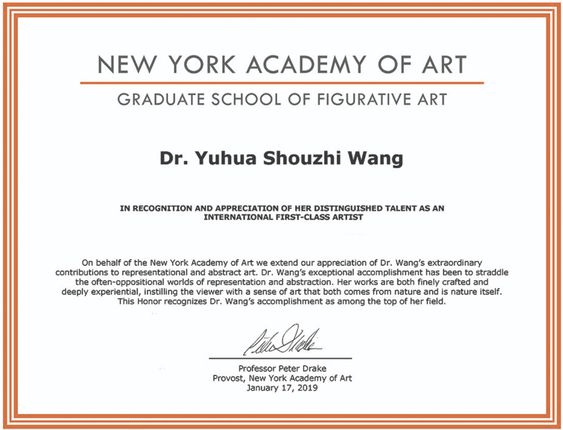
Dr. Yuhua Shouzhi Wang is the Lifetime Honorary Chairwoman of the International Art Museum of America. The museum has a dedicated gallery exhibiting her artworks. Her paintings encompass a broad range of styles and subject matters, including landscapes, animals, flowers, birds, and so forth, all of which have reached the summit of world class artistic excellence. Her artistic achievement has reached perfection at the summit of the “ten ultimate artistries.”
Professor Wang’s works have been exhibited and widely acclaimed in the United States, China, Asia, and Europe. In 2008, the United States Congress held an exhibition of the professor’s works, calling her art a “treasure of the world.” The U.S. Congressional Record chronicled the recognition that “her lotus flower paintings are unsurpassed and are extremely valuable.” Professor Yuhua Shouzhi Wang has also been critically acclaimed by news media that “she fuses vivacity, power, color, scholarly essence, quintessence of stone and bronze inscriptions, spirituality, erudition, and morality into oneness in her art. She is the foremost artist in the world.”
Professor Wang is a person of humility and noble morality. She is modest, unassuming, beneficent and genial. The characteristics of an artist’s paintings essentially reflect the character of the painter.
One day around nightfall, a monk was on his way back to the temple. Suddenly, lightning was striking and it was raining cats and dogs, the rain didn’t seem to be coming to a stop. He thought eagerly, “What should I do”. Just as he was becoming anxious, a manor was nearby. He ran towards it hoping to be warranted a night’s stay. The manor was enormous, and the servant saw the monk. After asked for the monk’s business there, the servant said, “My master has no affinity with monks. You will need to seek shelter elsewhere.“ The monk replied, “It is raining hard, and there is no other household nearby. If you just provide me a place to stay would be really appreciated.” “I cannot make the decision, let me go ask for my mater’s permission.” The servant went into the manor, and after he came back, he still refused the monk. The monk asked for the manor’s master’s name after the rejection, and without other options, he hurried back to the temple in the rain.
Three years later, the master of the manor married a concubine, he was very fond of her. One day, the concubine wanted to go to the temple for making offering, the master went with her. In the temple, the master of the manor saw his name written on a plate for meritorious deeds praying. The master was puzzled, and asked a little monk nearby for the reason of the plate. The little monk replied with a smile, “This is written by the head monk three years ago. There was a night that he hurried back to the temple in heavy rain, and said that there was an almsgiver that he did not build positive affinity with. So the head monk written the plate and chant the prayers for the almsgiver on daily basis to dedicate any merits back to him. Hopefully, their affinity can be transformed to positive. This is as much as I know, the head monk did not provide us with more detail.” When the manor of the master hear what the little monk said, he knew the story and he was regretful. At the end, he became a dedicated almsgiver of the temple.
This is a very inspiring story of an old monk, a story to transform “negative affinity”. This mundane world is big yet small, and people often run into each other. A person with great tolerance can understand the fact that “Great kindness and great enmity; others and me are no different.” In addition, the environment and how others treated ourselves should be a catalyst to encourage us. Kindness and enmity are all affinities to help us. On the other hand, those who are shallow and with narrow-minded will hinder themselves from positive affinity, and will aloof themselves from a future with prosperity. Indeed, to be able to act as the head monk’s heart of embracement might not be easy; however, ” Saints and sages have virtuous actions that we look up to, and have mindsets and actions that are legit and above-board. Though we are not yet at the same extent, but I try to be the same.”
The act of positive thoughts and action can really transform negative affinity. The act of giving is the cause of prosperity, and the action of greed is the cause of poverty. Instead of giving wealth to children, we should leave them with virtue. Have you not noticed? Wealth creates conflict of interest. There are countless incidents where sibling or parents sue each other for money. If our children are well educated and are virtuous, then it is unnecessary to leave them with money.
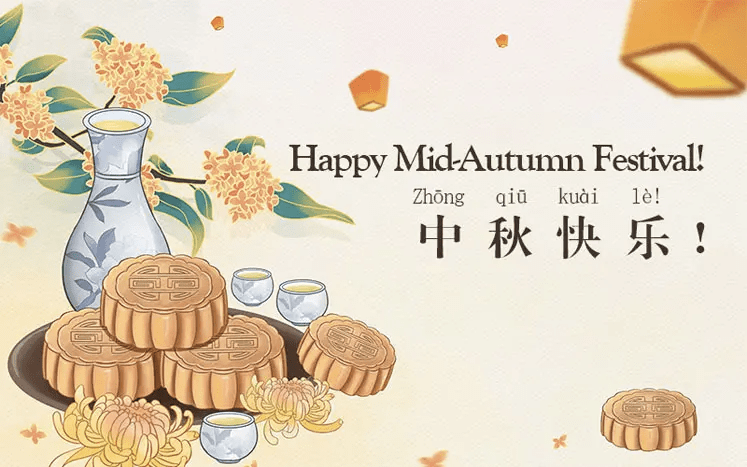
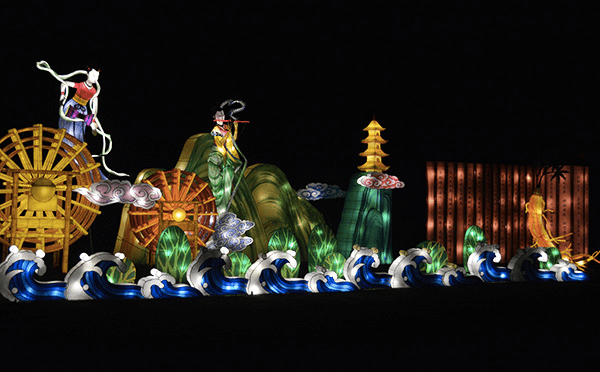
Mid-Autumn Festival, Zhongqiu Jie (中秋节) in Chinese, is also called the Moon Festival. It is the second most important festival in China after Chinese New Year. It is celebrated by many other Asian countries as well, such as Singapore, Malaysia, and the Philippines. This year the date of Mid-Autumn Festival is September 10th.
In China, Mid-Autumn Festival is a celebration of the rice harvest and many fruits. Ceremonies are held both to give thanks for the harvest and to encourage the harvest-giving light to return again in the coming year. It is also a reunion time for families, a little like Thanksgiving. Chinese people celebrate it by gathering for dinners, worshiping the moon, lighting paper lanterns, eating mooncakes, etc.
Mooncakes are the must-eat Mid-Autumn food in China. They are a traditional Chinese pastry. Chinese people see the roundness of mooncakes as a symbol of reunion and happiness.
There are many legends about Mid-Autumn Festival. The most popular stories are about Chang’e and the Jade Rabbit. The origin of the Mid-Autumn Festival is associated with the popular legend of Chang’e (嫦娥), the goddess of the moon…
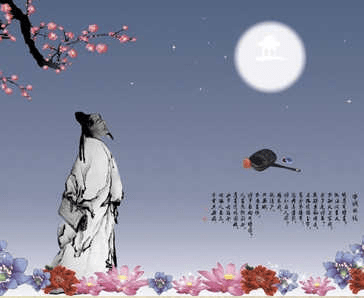
In Chinese history, many poems have been written about the moon. Here are the two I like the most. They not only vividly described the beauty of the moon, but are also philosophical explorations and ponderings on nature and life.
First one is written by SuShi, one of the most famous poet in ancient China, Song Dynasty.
How long will the full moon appear?
How long will the full moon appear?
Wine cup in hand, I ask the sky.
I do not know what time of the year
’Twould be tonight in the palace on high.
Riding the wind, there I would fly,
Yet I’m afraid the crystalline palace would be
Too high and cold for me.
I rise and dance, with my shadow I play.
On high as on earth, would it be as gay?
The moon goes round the mansions red
Through gauze-draped window soft to shed
Her light upon the sleepless bed.
Why then when people part, is the oft full and bright?
Men have sorrow and joy; they part or meet again;
The moon is bright or dim and she may wax or wane.
There has been nothing perfect since the olden days.
So let us wish that man
Will live long as he can!
Though miles apart, we’ll share the beauty she displays.
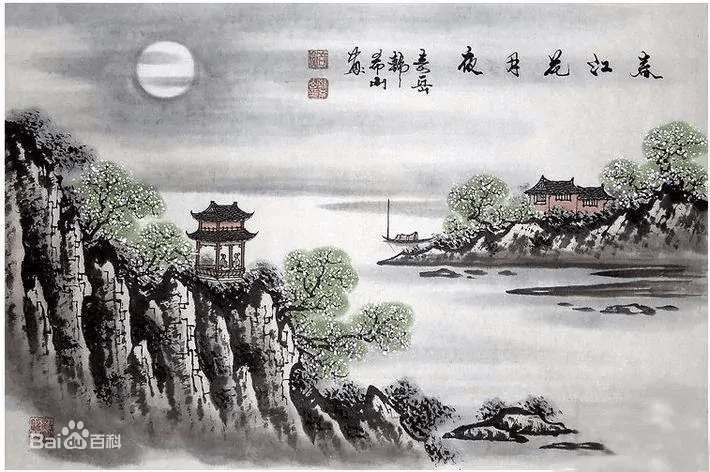
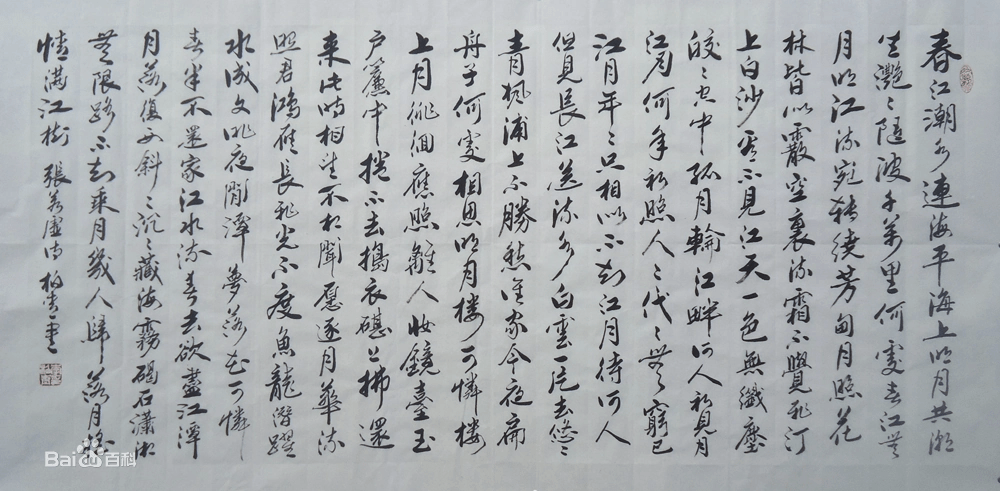
The second one, A Moonlit Night on the Spring River, was written by 张若虚 (Zhang Ruo Xu) in the Tang Dynasty. It superbly illustrates an amazingly beautiful night scene under the full moon, and many music pieces and dances are based on this outstanding poem.
A Moonlit Night on the Spring River
In spring the river rises as high as the sea, And with the river’s rise the moon uprises bright. She follows the rolling waves for ten thousand li, And where the river flows, there overflows her light.
The river winds around the fragrant islet(小岛) where The blooming flowers in her light all look like snow. You cannot tell her beams from hoar frost in the air, Nor from white sand upon Farewell Beach below.
No dust has stained the water blending with the skies; A lonely wheellike moon shines brilliant far and wide. Who by the riverside first saw the moon arise? When did the moon first see a man by riverside?
Ah, generations have come and past away; From year to year the moons look alike, old and new. We do not know tonight for whom she sheds her ray, But hear the river say to its water adieu.
Away, away is sailing a single cloud white; On Farewell Beach pine away maples green. Where is the wanderer sailing his boat tonight? Who, pining away, on the moonlit rails would learn?
Alas! The moon is lingering over the tower; It should have seen the dressing table of the fair. She rolls the curtain up and light comes in her bower; She washes but can’t wash away the moonbeams there.
She sees the moon, but her beloved is out of sight; She’d follow it to shine on her beloved one’s face. But message-bearing swans can’t fly out of moonlight, Nor can letter-sending fish leap out of their place.
Last night he dreamed that falling flowers would not stay. Alas! He can’t go home, although half spring has gone. The running water bearing spring will pass away; The moon declining over the pool will sink anon.
The moon declining sinks into a heavy mist; It’s a long way between southern rivers and eastern seas. How many can go home by moonlight who are missed? The sinking moon sheds yearning o’er riverside trees.
Chinese Calligraphy of the Poem
A Moonlit Night on the Spring River by Chinese Traditional Instruments
Pandas are a precious and rare animal, and thus are the emblem of the World Society for the Protection of Animals. Pandas are chubby, cute and charmingly naive, and their eyes seem to communicate a slight sadness. How can one not love these real-life teddy bears?
Many years ago, I visited the Panda Reserve area in SiChuan, China. There, I got the chance to see and touch these fluffy beasts up close(for a fee, of course)! So I wore a disposable cloth and hugged the panda. It was so warm and soft! Truly, an unforgettable experience. I was even given a piece of bamboo to taste. Very tender and juicy. Unfortunately, the panda though I was stealing its food, and to avoid hurting its feelings I let it eat the rest. This is without a doubt my go to destination after the pandemic!
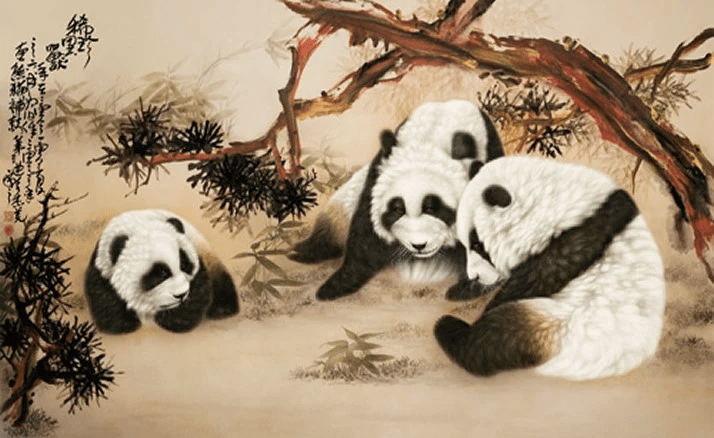
All over the world, there are many paintings of pandas. One time, I saw a chinese painting of Pandas at International Art Museum of America located at downtown San Francisco. The painting reminds me the soft, warm, fury touching feeling of the huge with the Panda. The three pandas look as if they were created by a magical heavenly brush. There is an extremely vivacious appeal, a deeply touching liveliness to these pandas.Pervading such paintings is an air of purity, cleanliness, and hopefulness. The three pandas in this painting all have innocent expressions and look vividly real. The scattered perspective technique of Chinese paintings was combined with the three-dimensional perspective technique of oil paintings. The colors are richly charming, and the layout is exquisite. Empty space and color are mutually complimentary in a fascinating way. The pandas and the surrounding scene blend into one harmonious image. These lifelike pandas painted in fine brushwork with meticulous attention to detail contrast perfectly with the surrounding scene painted in freehand brushwork. The painting style is plain, vigorous and mature. There is order within the seeming disorder and interesting juxtaposition between the real and the abstract. The achievement of using complimentary bold and delicate strokes in one painting, as H.H. Dorje Chang Buddha III does, sets His artistry apart from conventional artistry.
When I was a child, my parents always tell me “ Early to bed and early to rise, makes a man happy, healthy, and wise. In western countries, there are old sayings much like this one, such as ” Early birds get worms”. Sleeping early and getting up early is a very good habit. However I found out it is very difficult to pass down this good habit to my children. They have a million reasons to stay up late, academic and recreational. So I decided to find some scientific evidence to convince them.
The information I found surprised me. I realized that I myself should sleep and wake up even earlier.
Circadian rhythms and internal biological clock
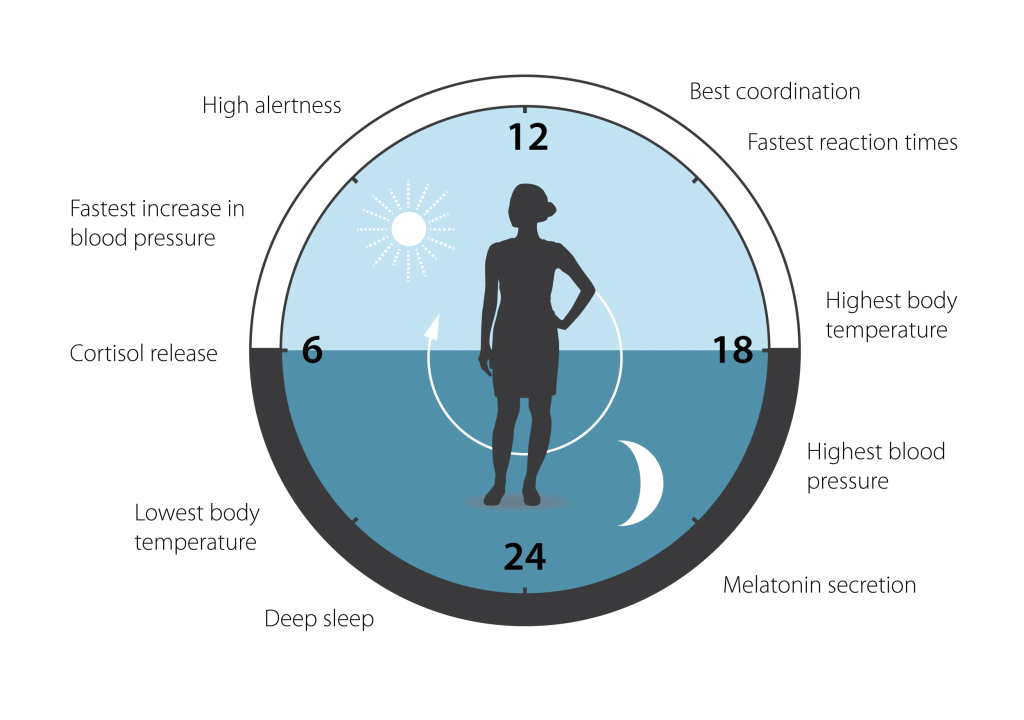
Three scientists won the 2017 Nobel Prize for their discoveries of molecular mechanisms that control circadian rhythms. Circadian rhythms are driven by an internal biological clock that anticipates day/night cycles to optimize the physiology and behavior of organisms.
“Chronobiology has an impact on many aspects of our physiology. For example, circadian clocks help to regulate sleep patterns, feeding behavior, hormone release, blood pressure and body temperature. Molecular clocks also play critical roles locally in many tissues. Ablation of clock genes in animal models results in arrhythmic production of hormones, such as corticosterone and insulin (Son et al., 2008). Clock genes also exert a profound influence on metabolism through the control of gluconeogenesis, insulin sensitivity and systemic oscillation of blood glucose (Panda, 2016). Sleep is vital for normal brain function and circadian dysfunction has been linked to sleep disorders, as well as depression, bipolar disorder, cognitive function, memory formation and some neurological diseases (Gerstner and Yin, 2010).”
The circadian clock has an impact on many aspects of our physiology. This clock helps to regulate sleep patterns, feeding behavior, hormone release, blood pressure and body temperature. A large proportion of our genes are regulated by the clock. From https://www.nobelprize.org/prizes/medicine/2017/advanced-information/
Body-Energy Clock in Chinese Medicine
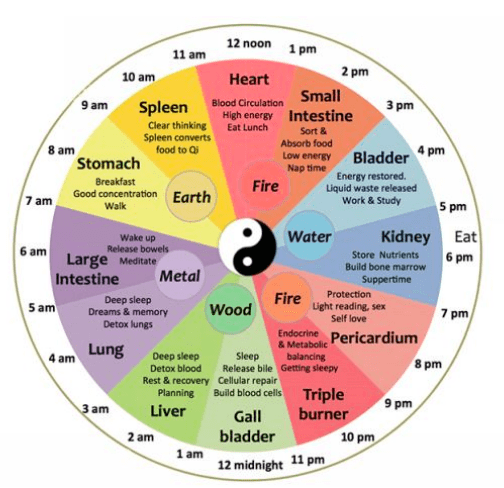
Observations that organisms adapt their physiology and behavior to the time of the day in a circadian fashion have been documented for a long time. Thousands years ago in Chinese Medicine, the body clock was already known. The 24 hour day was divided into 12 two-hour intervals of the Qi (vital force) moving through the organ system. The Body-Energy Clock is built upon the concept of the cyclical ebb and flow of energy throughout the body. During a 24-hour period(see the following diagram), Qi moves in two-hour intervals through the organ systems. During sleep, Qi draws inward to restore the body. This phase is completed between 1 and 3 a.m., when the liver cleanses the blood and performs a myriad of functions that set the stage for Qi moving outward again.
In the 12-hour period following the peak functioning of the liver—from 3 a.m. onward—energy cycles to the organs associated with daily activity, digestion and elimination: the lungs, large intestine, stomach/pancreas, heart, small intestine. By mid-afternoon, energy again moves inward to support internal organs associated with restoring and maintaining the system. The purpose is to move fluids and heat, as well as to filter and cleanse—by the pericardium, triple burner (coordinates water functions and temperature), bladder/kidneys and the liver. Understanding The Body-Energy Clock, could help you to better manage your Sleep, Meals, & Mood.
5 am to 7 am is the time of the Large Intestine, making it a perfect time to have a bowel movement and remove toxins from the day before. So that is the perfect time to get up. Waking up at this time, getting out of bed and moving around, will help your large intestine excrete the waste. Personally, I have discovered that I am prone to constipation if I get up later than this time.
7-9am is the time of the Stomach, so it is important to eat the biggest meal of the day here to optimize digestion and absorption. Warm meals that are high in nutrition are best in the morning. Therefore, if you get up early, you will have enough time to make and enjoy a hearty breakfast. If you get up late, and skip breakfast or just grab some easy treats, then you don’t get enough nutrition for your whole body. According to the body clock the stomach has it’s strongest time in the morning, it secretes a lot of digestive juices in the morning. A lot of people like to eat a big meal at dinner, which can cause the stomach to be overburdened and make the it unable to rest adequately during sleep.
From the Body-Energy Clock we can see the Gall Bladder is most active from 11 p.m. to 1 a.m. The Gall Bladder excretes bile and digest the good fats, it is working hard to repair damaged cells and build new ones. And this process is better processed when you are sleep.
1 a.m. to 3 a.m. is the most active time for the Liver. During this time, toxins are released from the body and fresh new blood is made. The liver is the main detoxifying organ in the body. Our body needs to be in the deep sleep stage, in order to give the liver its full energy capacity so it can do its proper job.
Melatonin Level
Melatonin is often referred to as the sleep hormone. Melatonin level plays an important role in our sleep-wake cycle. It is well-established that melatonin produced by the body plays a fundamental role in getting quality sleep. Scientist has discovered, our body start to increase melatonin secretion soon after the onset of darkness, peaks in the middle of the night, between 2 and 4 a.m., and gradually falls during the second half of the night. Thus most people have the experience that if they stay up too late, they have trouble falling asleep. After 4 a.m. Melatonin level start to decrease, so after 4 a.m. our sleep goes into a light, shallow and dreamy state. Falling asleep during 11 p.m. to 4 a.m., we can get better quality rest from sleeping.
There are many benefits for Going to bed early and getting up early. Here are some examples:
Early risers, whether young or old, have more positive emotions and a better sense of self-health.
Depression is a common mental illness that affects 264 million people worldwide, according to the latest data released on the World Health Organization’s website. A new study in the United States shows that for people who are accustomed to going to bed late, if they can go to bed an hour earlier, they can reduce the risk of depression by 23%.
Staying up late is also an important factor in gain weight, because staying up late can lead to endocrine disorders. If you rest on time, get up early and exercise properly, not only will you prevent excessive weight gain, but you will also be able to maintain a slim body. So, consider to be a early sleeper and early riser, if you wish to control your weight.
Multiple studies have shown that sleep deprivation is associated with increased risk of morbidity. Going to bed early and getting up early can enhance immunity and help fight colds and other viruses. It can also greatly reduce the risk of chronic diseases such as heart disease, kidney disease, high blood pressure, diabetes and stroke.
Study confirms that early sleepers and early risers score 30% higher on anagram tests than those who stay up late.
Here is a interesting video of a navy seal who likes to go to bed early and get up early. I hope you enjoy it, and be happy and healthy.
It was late January, just a few weeks before Chinese New Year, when we headed to Zhoushan in Zhejiang Province. It was bitterly cold and traveling to Mount Putuo (普陀) for a two-day visit was not good timing. COVID-19 was—and still is—running rampant around the world. Any kind of travel required constant and painstaking vigilance, including full compliance with stringent prevention measures in China. Nevertheless, our destination looked as beautiful as ever, a glimmering island in the great ocean, celebrated as the “Buddha-land in the sea.” (Haitian fogou 海天佛國)
Mount Putuo is very environmentally friendly. Except for public buses, no vehicles are allowed, so we had to leave our car at the wharf. Most residents simply cycle around for their daily errands, and even said bicycles are under a quota control. For visitors to move about, you can take a bus, cycle, or simply walk. Roads and pathways are well maintained, and there is a long road that connects all the temples on the island, big or small, affording a pleasant journey at one’s own pace.
It was warm and sunny with a gentle breeze by the time we reached the island in the early afternoon. As there were very few visitors, we could stroll around at our leisure, enjoying the sunlight’s embrace. “You are so lucky,” commented our trip’s docent. “It was so windy in the morning that the ferry service was about to be suspended. In a week, the entire mountain might be closed to prevent the chance of further infections, no matter how sporadic.” We were blessed with the good fortune of a joyful excursion.
Mount Putuo is classified by the Chinese government as an “AAAAA Grade Scenic Resort and Historic Site,” attracting about 10 million visitors each year under normal circumstances. Visitation, though down 40 per cent during the pandemic in 2020, has rebounded sharply; as of April, 2.8 million people had visited Mount Putuo, a fivefold increase. The effort to attract visitors is ongoing: the Putuo Mountain College of the Buddhist Academy of China was recently completed, and Guanyin Dharma Park opened last November.
Putuo is a Chinese transliteration of the Sanskrit Potalaka, which is mentioned in several Buddhist scriptures, including the Gandavyuha Sutra (added as the final sutra in the Avatamsaka Sutra). Potalaka is described as the holy residence of Avalokiteshvara, the bodhisattva of compassion. According to Guang Xing, Mount Putuo was identified as the mythical Potalaka mountain by Buddhist monks and Chinese literati (Guang 2011: 1-22). It has been the pilgrimage site of Avalokiteshvara for about a millennium, honored as one of the four sacred Buddhist mountains in Chinese Buddhism. We speak here of Guanyin, the feminine form of Avalokiteshvara popularized in Chinese Buddhism. We will return to Guanyin below. For now, we simply need to know that Mount Putuo’s status matches that of Mount Wutai (五台) for Manjushri, Mount Jiuhua (九華) for Kshitigarbha, and Mount Emei (峨眉) for Samantabhadra.
There seem to be three main demographics for visitors to Mount Putuo: sightseers, pilgrims, and students of Buddhism. The majority of sightseers are visitors who do not have much knowledge of Buddhism, nor much interest in its history, sutras, or temples. Nevertheless, everyone, regardless of background, recognizes this place as one expecting reverence and respect for the buddhas and bodhisattvas. When we worship and make our wishes before the famous 33-meter statue of Nanhai Guanyin, we are also introspecting, contemplating, and reflecting on the vicissitudes and travails of our lives.
The town nearby is neat and chic, full of activity and interesting souvenirs for tourists to commemorate their visit. Even in the winter, Mount Putuo is generously covered with greenery and vegetation, with a multitude of species including ancient camphor trees and the rare wild plants of Carpinus putoensis (普陀鵝耳櫟). They are one of the major treasures on Mount Putuo and monoecious. There are red and yellow variations coexisting, but they do not mature at the same time, so the pollination rate is extremely low. When the Sun is shining, the leaves of many trees turn golden in the backdrop of the Prussian blue sky, surrounded by the various temples. It is truly a picturesque sight.
Carpinus Putoensis Cheng. From baidu
The beautiful scenery, unique to Mount Putuo, is reminiscent of places I have visited in Japan. The connection between Mount Putuo and Japan can be traced back to the Tang dynasty (618–907), when a Japanese Zen and Tendai monk-pilgrim named Egaku (Chinese: 慧鍔; Hui’E) wanted to bring a statue of Guanyin from Mount Wutai to Japan. However, his voyage back via Mount Putuo was hampered by storms and waves despite several attempts. One day, Egaku had a dream in which he realized that the statue of Guanyin did not want to leave. He decided to enshrine it and built a simple hut near the Tidal Sound Cave. Immediately, his ship sailed through and he was able to return to Japan. This is the story of Guanyin “bu ken qu” or “unwilling to go,” and is the source of many folktales surrounding the establishment of temples and monasteries on Mount Putuo. Exchanges between Mount Putuo and Japan continued over many centuries.
Guanyin is the real protagonist linking Japan and China, with Guanyin known as Kannon or Kanzeon in Japan. Belief in this personification of compassion and benevolence has a long history in China. First introduced from India in the Western Han dynasty (202 BCE–9 CE), Avalokiteshvara was adapted and amalgamated into Chinese culture, most famously through the female figuration and her unique 32 transformations (Guang 2011: 1-22). Beginning in the Song dynasty (960–1279), the Chinese transformed the bodhisattva into the Goddess of Mercy, depicted in the feminine. (Minneapolis Institute of Art)
Belief in Guanyin has flourished in China ever since, going beyond even religious boundaries in everyday life (Guang 2011: 1-22). She is not confined to monastic life, as it is said in the Universal Gate chapter of the Lotus Sutra that any worldly being in danger will be delivered instantly on calling her name. Therefore, Guanyin has been worshipped and revered by all classes of people. As she is a compassionate divinity with countless virtues and merits, she is endowed with transcendental power. She excels in skilful means, allowing her to appear in whatever form needed by sentient beings. And that, in my opinion, is probably the reason behind the 32 forms in the Chinese tradition, including Guanyin Yangzhi (楊枝), or Willow Branch Guanyin. The Guanyin Yangzhi is only one example among many of her history-rich gender transitions.
Willow Branch Guanyin. From online source
We were able to visit a 2.5-meter-high, 2.2-meter-wide monument of Guanyin Yangzhi at a nunnery of the same name. The nunnery, situated at the foot of Putuo’s Western Xiangwang Peak, was built in 1608. The artistic style was pioneered by Yan Liben (閻立本), a famous figure painter in the Tang dynasty, while the stele’s engravings appeared during the Ming dynasty (1368–1644). Holding a tender willow branch in her right hand and a clear water vase in the left, Guanyin is luxuriously crowned with pearls and precious stones, dressed in sumptuously embroidered garments, and adorned with agate, amber, and pearls. She spreads dewdrops to all the world’s quarters to dispel suffering and pain.
Guanyin is replete with the marks of beauty, dignity, and calm. Except for her face, there are not many traditionally female features shown. Indeed, she appears tall and somehow mighty and masculine, standing on her bare feet. Her belly bulges out slightly, and she has large hands and feet. While beholding her, I could not help but think of the mural of Padmapani, another manifestation of Avalokiteshvara, at Ajanta Cave No.1, in India. Painted during the sixth century BCE, the bearer of the blue lotus is a male figure with a slender body. Both forms of Avalokiteshvara are crowned and bejewelled, have physically beautiful features, and appear composed and graceful.
Padmapani, Ajanta Cave 1. From alamy.com
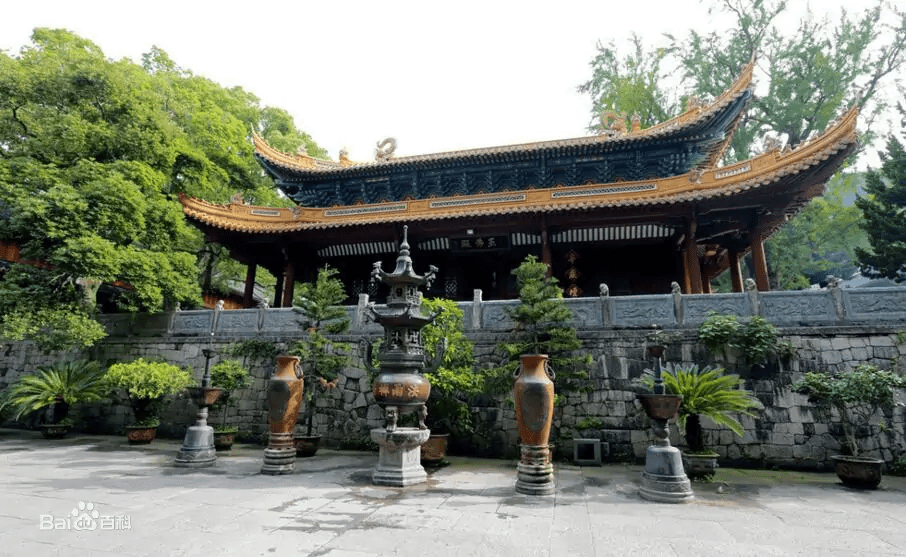
There are many temples on Mount Putuo, but the two most well known are Puji Temple (普濟寺) or the “front temple” (又稱前寺), and Huiji Temple (慧濟寺) on the peak of the mountain. They receive the most pilgrims, but Fayu Temple (法雨寺) is my personal favorite; when there is no pedestrian crowding, it has a gentle and soothing atmosphere. It is surrounded by towering ancient trees, suspending the visitor in time between past and present. From a distance, one can see that the gate to the monastery is unique, unlike those of other temples on Mount Putuo, which are painted in yellow ochre. Here it is light red in color: a soft, ambient hue that emphasizes an atmosphere of paradisical peace and bliss.
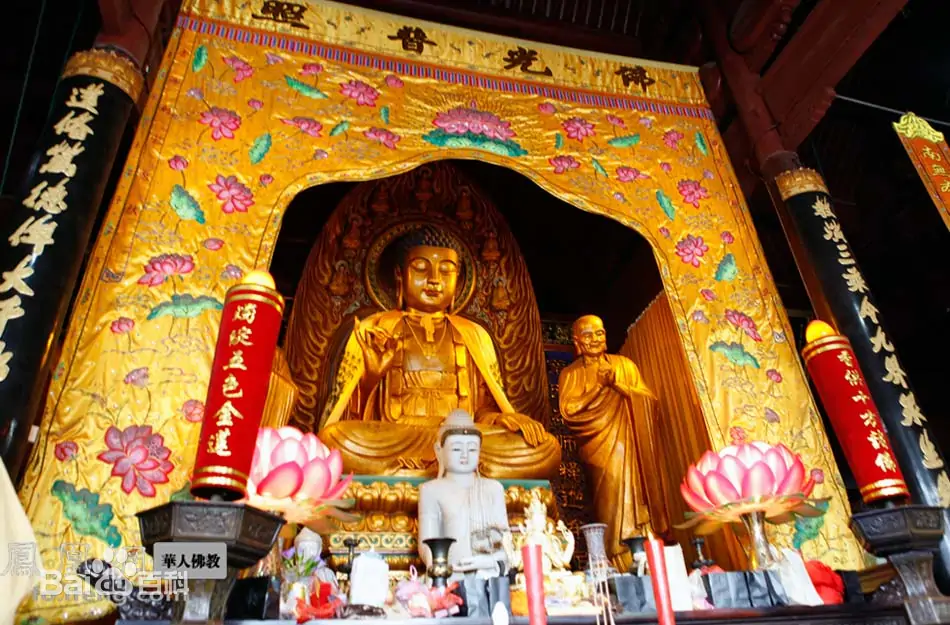
Upon entering and reaching the main hall of Nine Dragons, where a statue of Guanyin is enshrined, one feels a strong sense of sublime and resplendent majesty. Yuantong Hall of the Fayu Temple is renowned for its resplendent appearance and ingenious interior structure, with a large ball hanging from the ceiling of its dome surrounded by nine vertical rafters. Each rafter is carved with a dragon that rears its head in a scramble for the ball. This intricate layout is called the Bracket with Nine Coiling Dragons and is ascribed to Emperor Kangxi (康熙) (1654–1722), who used the materials of the former palace of the Ming dynasty in Nanjing to reconstruct an earlier monastery, Zhenhai Monastery, on Mount Putuo.
Fayu Temple. From the author
What strikes me most, however, is not Fayu Temple’s imperial heritage, but rather two great minds that made their mark here. Venerable Yinguang (印光) (1861–1940) was the 13th patriarch of the Pure Land tradition and the abbot of Fayu Temple for decades. Meanwhile, Ven. Hongyi (弘一) (1880–1942) wrote in traditional calligraphy Fayu Temple’s nameplate of “heavenly flowers and Dharma rain”—first devised by Emperor Kangxi. Li Shu Tong (李叔同) was Hongyi’s secular name. A wealthy and rakish young man, he was also an eclectic and learned scholar of high culture. He relinquished what he possessed and committed to living a monastic life. Fully devoted to promulgating Buddhism, he rose to become an eminent monk.
At some point, the two monastics met each other. It is said that Master Hongyi admired Master Yinguang and asked him to be his teacher. Humble and modest, Master Yinguang refused, but invited him to stay as long as he wanted. The two spent seven days together, studying, practicing, and meditating without a single word exchanged. They simply were, as minds think alike, without verbal obstructions, thoughts traveling and flowing effortlessly. How wonderful it is to exist together beyond words. But in the era of the Internet, we are bombarded with so many words and so much information that we lose our sense of their meaning, let alone their authenticity.
If we wish to be heard, we need to be sincere, candid, and heartfelt. “Guanyin” in Chinese means the Perceiver of Sounds, or “Guanshiyin,” the Perceiver of World’s Sounds. As chanted in the Universal Gate chapter of the Lotus Sutra: “Perceiver of the World’s Sounds, heavenly voice, the voice of the sea’s tide—magnificent, rich and harmonious surpassing all worldly sounds.” If we keep Guanyin in our hearts and call on her sincerely, she will always respond.
Mount Putuo is one of the four sacred mountains in Chinese Buddhism, lies in the East China Sea and incorporates the beauty of both mountain and sea, and honored as the Buddhist Land on the Sea. Its area is approximately 12.5 square kilometres (4.8 sq mi) and there are numerous famous temples. Mount Putuo has been a pilgrimage site for over a thousand years. After the Tang dynasty, Mount Putuo became a center of Avalokitasvara (Guanyin) worship.
In 863, a Japanese monk called Hui E aimed to carry a statue of Avalokitasvara from Mount Wutai to his country by ship. However, when the ship was passing through the sea nearby Mount Putuo, it was prevented by the stormy waves and hundreds of iron lotus flowers suddenly appeared on the sea, blocking the way. Monk Hui E believed that Avalokitasvara didn’t want to leave China. So he knelt down on the bow of the boat and silently prayed to the Bodhisattva Avalokitasvara for instructions. After a while, the iron lotus on the sea disappeared, and the boat drifted to the shore of Mount Putuo, where he built a temple in the purple bamboo forest to enshrine the statue of theBodhisattva. From that time, Mount Putuo got the spirit and became the bodhimanḍa of Bodhisattva Guanyin.
Traditionally there were three main temples: The Puji Temple (founded 10th cent.), the Fayu Temple (founded 1580 CE), and the Huiji Temple (founded 1793 CE). Today, there are more than 30 major temples located at Mount Putuo. In addition to these monasteries, there is the Institute of Buddhism, one of the largest Buddhist academic institutes in China.
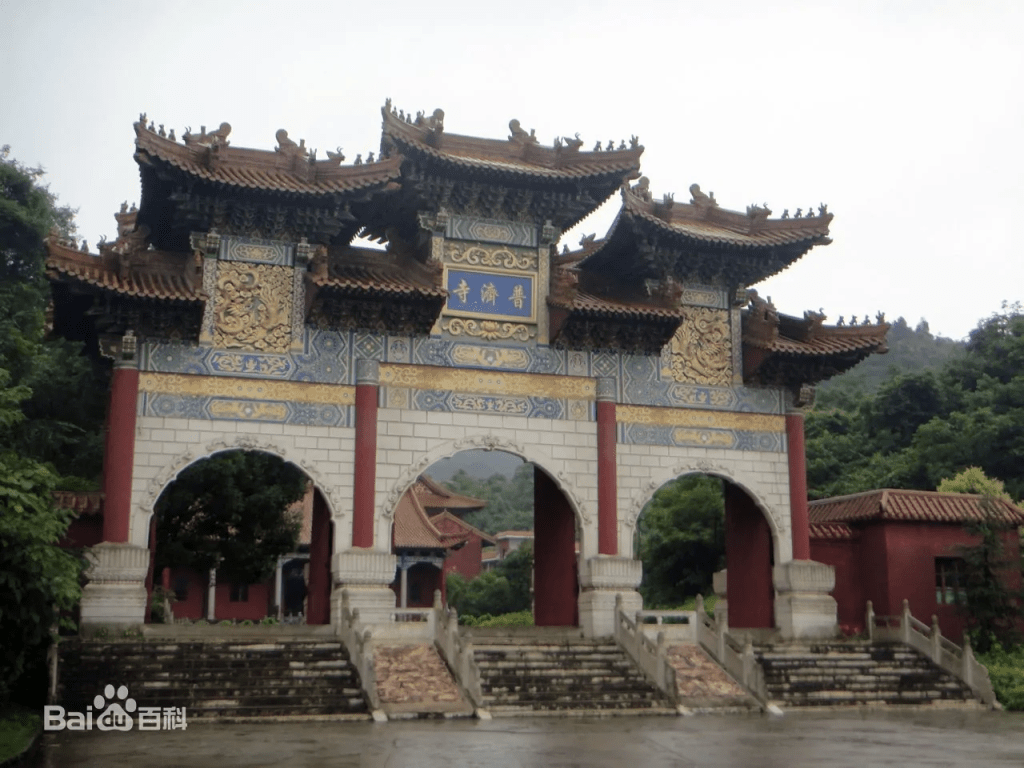
Puji Temple
Puji Temple is the main temple of Mount Putuo and all important Buddhist activities are held here. Covering an area of 37,019 square meters, it contains Grand Yuantong Palace, Hall of Heavenly Kings, Depository of Buddhist Sutras and 357 other buildings. Grand Yuantong Palace is the main hall which houses an 8-meter-high statue of Guanyin surrounded by 32 Bodhisattva with different costumes in a variety of poses on east and west walls. Haiyin Pond in Puji Temple was a free life pond full of spring water primitively and now a lotus pond. At the night of summer, the gorgeous lotus and bright moonlight compose an attractive scenery.
Puji Temple
Haiyin Pond in Puji Temple
Fayu Temple
Fayu Temple was built along the uphill with grand building groups and extraordinary manners. It got such a name in that you could see amazing relives of nine dragons are fighting for pearl on the screen wall before the gate of Halls of Heavenly Kings. Among the 294 halls of Fayu Temple, Nine Dragons Guanyin Palace(also called Grand Yuantong Palace), said to be a Buddhist Temple transported from the imperial palace of Ming Dynasty, acts as the most magnificent one. The highlighted part of this palace must be the Nine Dragons Caisson Ceiling. With unique shapes and vivid images, it enjoys high artist value and is listed in Three Treasures of Mount Putuo.
FaYu Temple
Delicate Carvings in Nine Dragons Screen Wall
Huiji Temple (惠济禅寺)
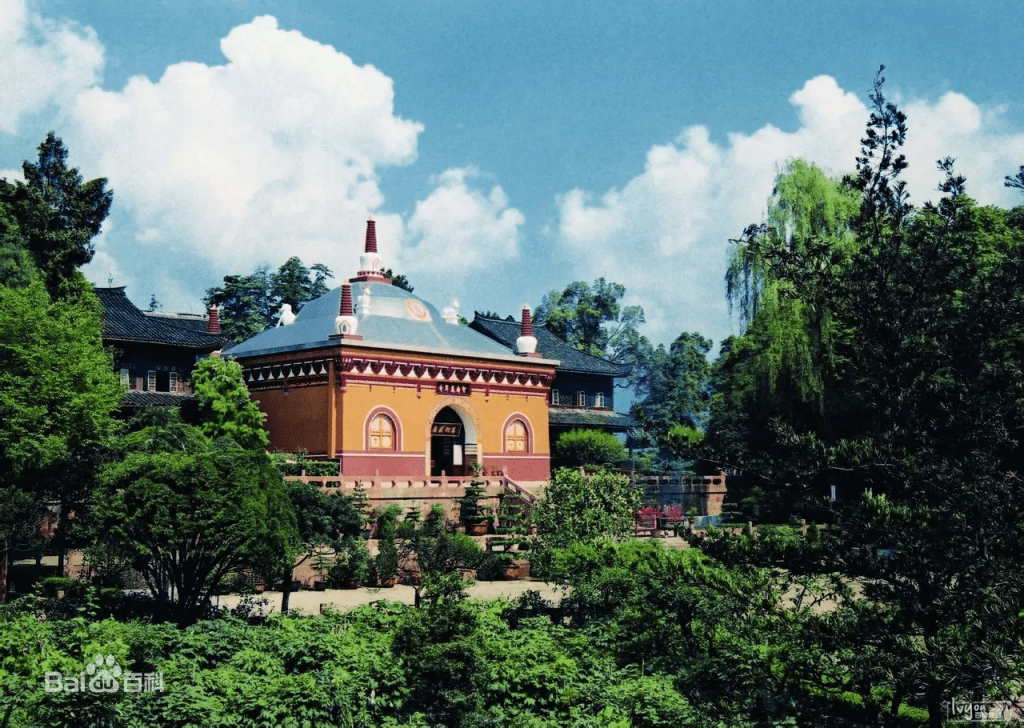
Huiji Temple is perched in Foding Mountain, the highest peak of Mount Putuo. The architecture of the whole temple is unique. It is located on the mountain and is arranged horizontally. The hall is spacious and magnificent. Hidden in a luxury forest, Huiji Temple features in peaceful environment. Standing at the peak of Mount Putuo, you can have a distant view of the mountains, sea, reefs, beaches and buildings. In the whole temple, statues, carvings and pictures of Guanyin can be found everywhere.
Grand Huiji Temple
Status of Guanyin Bodhisattva
Statue of Standing Nanhai Guanyin
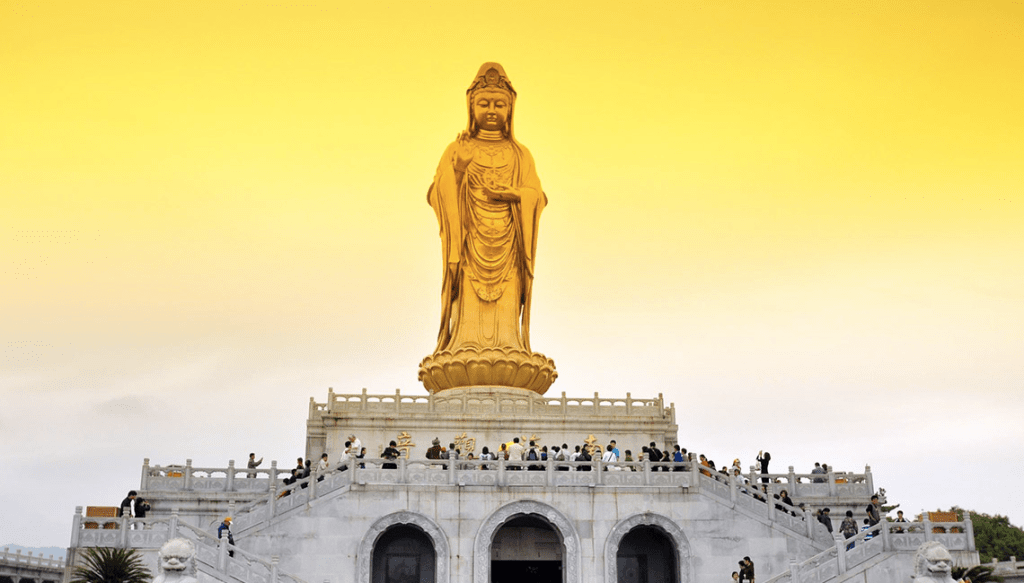
Standing in the south Shuangfeng Peak, Statue of Standing Nanhai Guanyin is the largest outdoor statue of Guanyin made from copper in Asia. With an 18-meter-high statue, 2-meter-high lotus and 13-meter-high foundation, the whole structure has two stories in its foundation. The first story displays elegant carvings, while the second story houses 500 statues of Guanyin in different poses. On the consecrating day at year 1997, a strange nature phenomenon happened. Before the consecrating ceremony, the sky was full of dark cloud and it seemed that it would rain soon. However, as the ceremony began, it became sunny as if two hands pushed aside the clouds. A beam of sunlight just casts on the Guanyin statue.
Statue of Nanhai Guanyin
Avalokitasvara, Guan Shi Yin in Chinese, means the Perceiver of World’s Sounds. The Lotus Sutra says: “Perceiver of the World’s Sounds, heavenly voice, the voice of the sea’s tide—magnificent, rich and harmonious surpassing all worldly sounds.” The bodhisattva always help all beings in danger and distress and is willing to bear the pain of all beings. There are many stories and folk tales about the bodhisattva’s infinite mercy and compassion.
If we hold the bodhisattva in our hearts and call on her sincerely, she will always respond. I had a personal experience. You can read my story here: Guan Shi Yin Bodhisattva saved my life。
Mount Emei is one of the “Four Famous Buddhist Mountains” in China. It has steep terrain and striking beautiful scenery. “Emei” is a term used to describe a woman’s beautiful eyebrows in an ancient book titled The Book of Songs. The main peak, Golden Summit of Wanfoding, is 3,099 meters above sea level, it is the crown of all other famous mountains in China.
Mount Emei (Emeishan) is an area of exceptional cultural significance as it is the place where Buddhism first became established on Chinese territory and from where it spread widely through the East. The first Buddhist temple built on the summit of Mount Emei was in the 1st century CE. It became the Guangxiang Temple, receiving its present royal name of Huazang in 1614. The addition of more than 30 other temples including the Wannian Temple founded in the 4th century containing the 7.85m high Puxian bronze Buddha of the 10th century, and garden temples including the Qingyin Pavilion complex of pavilions, towers and platforms dating from the early 6th century; the early 17th century Baoguo Temple and the Ligou Garden (Fuhu Temple) turned the mountain into one of Buddhism’s holiest sites.
Mount Emei Jinding Massive Statue of Bodhisattva Samantabhadra
On Mount Emei, the importance of the link between the tangible and intangible, the natural and the cultural, is uppermost. Mount Emei is a place of historical significance as one of the four holy lands of Chinese Buddhism. Buddhism was introduced into China in the 1st century CE via the south Silk Road from India to Mount Emei. Mount Emei is traditionally regarded as the bodhimaṇḍa, or place of enlightenment, of the iconic bodhisattva Samantabhadra (Puxian). In Buddhist sutra, it is recorded that Samantabhadra Bodhisattva rides a white elephant with six tusks. Therefore, the statues of Samantabhadra in the temples of Mount Emei mostly ride on white elephants. There is an Elephant Washing Pool in Mount Emei as well.
Samantabhadra Bodhisattva is associated with Buddhist practice and action. In the Āvataṃsaka-sūtra, the Buddha states that Samantabhadra Bodhisattva made ten great vows in his path to full Buddhahood:
To make abundant offerings. (e.g. give generously)
To repent misdeeds and evil karmas.
To rejoice in others’ merits and virtues.
To request the Buddhas to continue teaching.
To request the Buddhas to remain in the world.
To follow the teachings of the Buddhas at all times.
To accommodate and benefit all living beings.
To transfer all merits and virtues to benefit all beings.
The ten vows have become a common practice in East Asian Buddhism, particularly the tenth vow, with many Buddhists traditionally dedicating their merit and good works to all beings during Buddhist liturgies.
From ancient times to the present, there have been many eminent monks and great virtues in Mount Emei. The thirteenth patriarch of Emei Master Pu Guan, and abbot of JiuLaoDong XianFeng temple Master Guo Zhang, were all disciples of H.H.Dorje Chang Buddha III. They both received Great Dharma initiation from H.H.Dorje Chang Buddha III and reached liberation. At year 1998, Master Pu Guan passed away in the meditation posture having attained control over his life and death. Eight years after his passing, he still sits in a stupa in that meditation posture without having rotted at all. At year 2015, Master GuoZhang passed away at 108 years-old, at the Western Sichuan University Medical center. Doctor diagnosed the Master passed away. Unexpectedly, after a few hours, he was resurrected and opened his eyes, he then ordered his disciples to move him back to Jiewangting Temple to officially pass away. Eleven days after he passed away, local government officials visited Jiewangting Temple. They didn’t believe that the master was a profound practitioner. So he stabbed his body with needles, and blood spurted out.
Mount Emei is an area of striking scenic beauty. It is considered to be one of the most beautiful mountains in China.
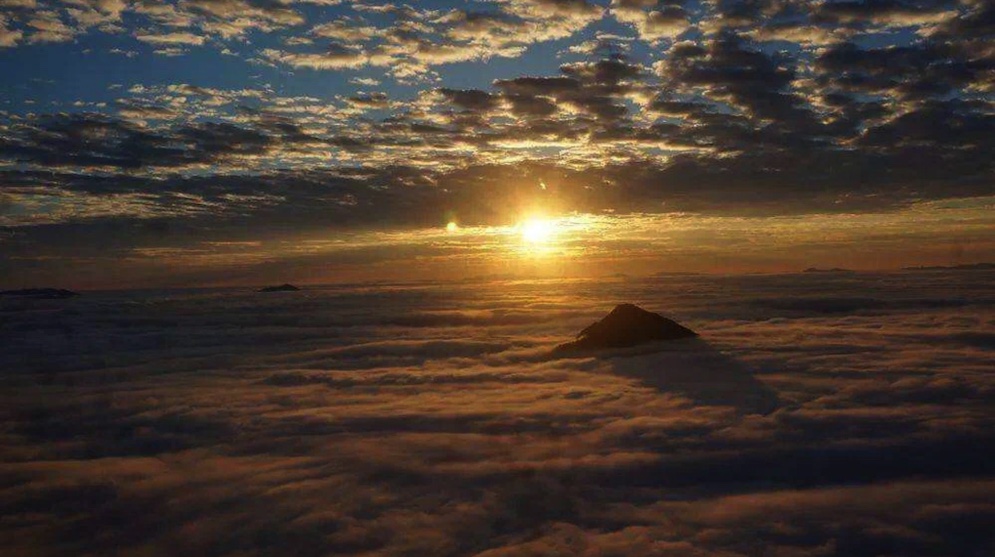
Amazing Scenery of Sun rise over clouds at Golden Summit of Mount Emei
Bill Porter (a.k.a. Red Pine) outside his home in California. Courtesy Andy Ferguson.
Bill Porter lived for three years in the early seventies as a Buddhist monk in Taiwan where he began his translations of poetry by the famous Chinese poet-recluse Cold Mountain. Porter’s mentor in this undertaking was the Buddhist scholar and translator John Blofield. After leaving monastic life, he married a Chinese woman and continued his translation work. Years later, Porter began the first of many long journeys in mainland China that he chronicled for radio audiences in Hong Kong and Taiwan. He produced over 1,100 short programs about different Chinese locales, embellishing his narratives with details from Chinese history and culture. In recent years he has focused on China’s great Zen monasteries, traveling to scores of the remaining abodes of famous ancient Zen teachers.
Porter’s main books of translation, published under the name Red Pine, include The Zen Teaching of Bodhidharma (North Point Press), The Zen Works of Stone House (Mercury House), The Clouds Should Know Me by Now: Buddhist Poet Monks of China (Wisdom Publications), and his latest, The Collected Songs of Cold Mountain (Copper Canyon). Road to Heaven: Encounters with Chinese Hermits (Mercury House) is published under the name Bill Porter because it is not a book of translation. This interview was conducted in Ukiah, California, north of San Francisco, by ANDY FERGUSON.
Tell me about your background and how you became interested in Buddhism.
My dad was a bank robber. He and his gang were knocking off banks in the South and worked their way north to the Michigan area. There they got in a shoot-out with police. All the robbers were killed except my dad, who was wounded in the knee and lost his kneecap. Then, of course, he went to prison. In the meantime, the family farm down South got sold and when Dad got out he used his portion to get into the hotel business in Texas. He then became a top hotel magnate and the family got very rich. So my childhood was one of wealth, with maids and big homes. First we lived in L.A., then later we lived near Coeur D’Alene in Idaho.
Dad bought Bing Crosby’s house. He liked Democratic Party politics and actually became head of the Democratic Party in California. He toyed with the idea of running for office, but he had this problem with his background, so he’d just get himself nominated for different offices and then turn down the nomination. Eleanor Roosevelt nominated my dad, Arnold Porter, to be President of the United States on national TV at the 1956 Democratic Convention. The Kennedy brothers, Ted and Robert, used to visit our house. John never came there, but when he was in the White House Dad used to get drunk and call him on the phone. He’d just do it to show off to us kids. My sister and brother and I went to fancy private schools, but even at a young age I hated it all. It was so phony, with everyone caught up in wealth and ego and power. It all seemed to me to be so hollow. Later, my dad divorced my mother and subsequently we lost everything. It all went into receivership. My sister and brother had a very difficult time learning to live without lots of money. But as for me, I was actually relieved when this happened. After some unsuccessful stints in junior college I served for three years in the Army as a clerk in a medical unit in Germany, and when I got out the GI Bill paid for my college education at UC Santa Barbara. When I encountered Buddhism, I didn’t have any problem understanding exactly what it was talking about. The whole thing was quite clear to me. After four years of college, I could have gone further into graduate school, but at that point all I wanted to do was become a Buddhist monk.
You’re recognized as an authority on Chinese religious culture not only among many Westerners, but among Chinese as well. For example, the head of the mainland Chinese Buddhist Association, Abbot Jing Hui of Bailin Monastery, has directed his head monk Minghai to translate your English book Road to Heaven: Encounters with Chinese Hermits into Chinese. Many Chinese learn about their traditions from you. In this case, your book is a window on the phenomenon of Chinese hermits. Talk about the perception of hermits in China and whether it is very different from our regard for them in the West.
The hermit tradition is actually one of the most important parts of Chinese society. We [in the West] almost always think of hermits as misanthropes, as people who want to step out of, and have nothing to do with, society—whereas in China the hermit has always been seeking the wisdom with which to guide society. My conversations with hermits in China led me to conclude that [for them] seclusion was like going to graduate school. Afterwards they can teach. Seclusion did not necessarily mean individual seclusion. It could also occur in a relatively secluded monastery. Persons who could “break the mold” and become teachers almost always required a period of seclusion for maturation. The Zen tradition represented one aspect of this tradition by producing these individuals en masse. You almost never hear of anybody who became a teacher by just working their way up through the ranks of an organization. This was true not only in Zen, but among other Buddhist schools such as Pure Land or T’ien-t’ai. It was true in Taoism as well. There was an awareness that to bring the teachings they had learned to fruition, individuals needed to be alone with them, and so Chinese hermits have been doing that. Nowadays, when I visit my hermit friends, I often find Chinese Communist officials visiting them too. One woman hermit I visited had six Communist officials in her hut, seeing if they could do anything to help her out. The Chinese previously maintained, and have recently revived, an awareness that these people were doing society a lot of good. They’re like a mountain stream that brings fresh water down into town. The water eventually reaches the town, no matter whether you pipe it down or it comes down as a spring.
Poet on a Mountain Top, Shen Chou (1427-1509), Album leaf mounted as a handscroll, ink on paper. The Nelson-Atkins Museum of Art, Kansas City, Missouri (Purchase: Nelson Trust).
In your book, Road to Heaven, it’s notable that at least one-half of the hermits you interviewed were women. How do you account for there being so many women hermits in China?
One of the reasons is because of the inequality between the sexes in China. It was a major decision for a family to allow a son to enter the clergy, since a son represented the parents’ social security. For daughters to marry out of the family, however, was expensive. It also represented a loss of labor to the family. Plus, the family had to make a big dowry payment. So it’s been easier for women to leave home to become hermits or enter religious orders for this reason. Sixty to seventy percent of the hermits I interviewed were women. It was very unlikely for a family to let a single son become a monk because he wanted to become one. If there was an extra son, however, it might be considered a good religious investment to let him become a monk.
You have a new book on the poetry of Cold Mountain out now. How did your interest in Cold Mountain come about and how did you come to translate his work?
I lived at a monastery in Taiwan run by Dharma Master Wuming, Chiang Kai-shek’s personal teacher. He gave me a copy of Cold Mountain poems that he had published. I liked them so much that I translated them myself. After I had done 150 of them, I wanted to publish them but didn’t know how to go about it. An Australian friend saw a lot of books on my bookshelf by John Blofield and said, “Why don’t you send them to him and ask him what to do with them?” So I did. John Blofield kindly answered my letter and we then began a relationship. Eventually I published three hundred of the poems and John Blofield provided the foreword for the book. Now, with my latest book, I’m revisiting those poems. It hadn’t occurred to me when I did the first book that when you translate a poem you have to write a poem.
I know that seems obvious, but it hadn’t really occurred to me. Now, after fifteen years, I feel I can translate a poem as a poem.
A hermit poet you’ve written about who had profound influence, not only in China, but also in Korea, was the Chinese Zen master Stone House. Can you talk about his place in the hermit tradition and why he came to have such a widespread influence?
Well, he was one of the exceptional Zen students who became a poet. Stone House had a genius for poetry that is unique. I’ve always said that he was the greatest of all the Chinese Buddhist poets. And although he was a hermit, he was a Zen teacher, too, and he taught individuals through his poetry. Stone House loved the hermit tradition, but managed to attract people to his hermitage just as if he was living downtown. He is a good example of how the hermit tradition affects society. By staying up on his mountain, he was able to affect the course of Zen in Korea. A prominent Korean monk came and studied with him at his hermitage and then took the robe and bowl of Stone House back to his country and established the Chogye Order, Korea’s main Zen tradition.
So Stone House was able to affect people by being a hermit, and his influence as a teacher was bound up in his skill as a poet. There were Zen masters in China who were his equal or even his superior in their Zen understanding, but nobody wrote a better poem.
What was it like to visit the place where Stone House lived?
One of the things I always try to do in China is “revisit the scene of the crime.” I go to the sites associated with figures that I admire. On one trip, I sought out the mountain where Stone House lived as a hermit. In the last five hundred years a road was actually built to the top of the mountain and now there’s a military electronic relay installation there. Within a few minutes after we arrived we were surrounded by the authorities there. But as soon as I whipped out my published translations of Stone House’s poems along with the original Chinese, the officer in charge told the soldiers to put away their guns. He then got out his machete and personally led me through the undergrowth to an old farmhouse made of rocks on the mountain. He said, “This is where those poems were written. When we moved here it used to be a little Buddhist temple.” There was a farmer living there who confirmed that this was where Stone House lived. The spring was still flowing right behind the hut, the only spring on the mountain. It was just remarkable to go to a site where someone you know lived a long time ago and find the same old hut there, with only a few bricks replaced or the roof having been repaired after falling in six or seven times since he lived there. That’s what I love to do in China. I love to visit these old places.
It sounds like the Chinese officer in charge was quite interested in helping you.
Even though there’s religious oppression going on in China, it is mainly a political oppression. It doesn’t have anything to do with the underlying cultural appreciation that remains with the people of China, even with the Communist Party officials at the local level. It goes to show that despite fifty years of Communist rule, the Chinese people themselves have an amazing appreciation for their own culture, their history, and the religions of China.
Cold Mountain (Hanshan) was a legendary master of Hermetic poetry and Zen practice, although there are few records about his life in the history. Yet his poems, more than three hundred pieces, miraculously survived. He lived in southeastern China during the Tang dynasty, approximately 1300 years ago. People said that Hanshan was the incarnation of Manjushri Bodhisattva. His poems are full of inner realization wisdom. I am really surprised that there are many English versions of his poems. There are even some podcasts to narrate the poems for the audience. I do hope that different cultures can learn from each other, adapting the good parts from each other. Let us work together to make the world a better place for all beings.
Based on the hundreds of poems he wrote on the walls of the cave where he made his home after leaving behind what he called “the dusty world” of getting, spending and delusion, so he could spend his life in the natural world with his heart and mind uninterrupted by such distractions, as his poem said : “with nothing to do I write poems on rock walls/trusting the current like an unmoored boat.” Hanshan found that he was often able to put an end to what he called “useless mixed-up thinking” and enjoy a good measure of peace and tranquility as a “person of nondoing” who wandered in the mountains, idly read a copy of an ancient sage, or played his humble lute on the precipice outside his cave.
Living a life unhindered by worldly concerns, much of Hanshan’s beautifully imagined poetry is filled with compassionate discernment, profound tranquility, and a quiet but compelling purity of unexpected insight. But that is not all. The hermit-poet known as Hanshan discovered that it is not as easy to leave the world behind as one might think. Decades of solitude and wandering brought forward other elements from the full depth of his humanity, and so his poems also express his loneliness, longing for a companion of the way, sorrow at the loss of friends, as well as an occasional biting critique of the many ways his fellow human beings created harm in the world, though it must be said that even in these poems there is a compassion that reveals Hanshan’s deepest longing for others to know the wholeness, serenity and peace he experienced within his tender and all too human heart.
Here are some poems translated by Gary Snyder
1.
Men ask the way to Cold Mountain Cold Mountain: there’s no through trail. In summer, ice doesn’t melt The rising sun blurs in swirling fog. How did I make it? My heart’s not the same as yours. If your heart was like mine You’d get it and be right here.
2.
Clambering up the Cold Mountain path, The Cold Mountain trail goes on and on: The long gorge choked with scree and boulders, The wide creek, the mist blurred grass. The moss is slippery, though there’s been no rain The pine sings, but there’s no wind. Who can leap the world’s ties And sit with me among the white clouds?
3.
In my first thirty years of life I roamed hundreds and thousands of miles. Walked by rivers through deep green grass Entered cities of boiling red dust. Tried drugs, but couldn’t make Immortal; Read books and wrote poems on history. Today I’m back at Cold Mountain: I’ll sleep by the creek and purify my ears.
4.
I can’t stand these bird songs Now I’ll go rest in my straw shack. The cherry flowers are scarlet The willow shoots up feathery. Morning sun drives over blue peaks Bright clouds wash green ponds. Who knows that I’m out of the dusty world Climbing the southern slope of Cold Mountain?
5.
There’s a naked bug at Cold Mountain With a white body and a black head. His hand holds two book scrolls, One the Way and one its Power. His shack’s got no pots or oven, He goes for a long walk with his shirt and pants askew. But he always carries the sword of wisdom: He means to cut down senseless craving.
Cold Mountain is a house Without beams or walls. The six doors left and right are open The hall is sky blue. The rooms all vacant and vague The east wall beats on the west wall At the center nothing. Borrowers don’t bother me In the cold I build a little fire When I’m hungry I boil up some greens. I’ve got no use for the kulak With his big barn and pasture – He just sets up a prison for himself. Once in he can’t get out. Think it over – You know it might happen to you.
7.
If I hide out at Cold Mountain Living off mountain plants and berries – All my lifetime, why worry? One follows his karma through. Days and months slip by like water, Time is like sparks knocked off flint. Go ahead and let the world change – I’m happy to sit among these cliffs.
8.
My home was at Cold Mountain from the start, Rambling among the hills, far from trouble. Gone, and a million things leave no trace Loosed, and it flows through galaxies A fountain of light, into the very mind – Not a thing, and yet it appears before me: Now I know the pearl of the Buddha nature Know its use: a boundless perfect sphere.














 Peace LiLy