Guangsheng Temple with Ancient Chinese Buddhist Buildings,Murals & Statues

As a cradle of Chinese culture, Shanxi is renowned for its abundance of cultural and historical treasures. While some iconic historical relics and monuments like the Great Wall, which stretches across the province, the Yungang Grottoes in Datong, and the Sakyamuni Pagoda in Yingxian, are at the top of tourists’ itineraries, there are also lesser-known “hidden gems” in terms of historical significance that are well worth exploring.

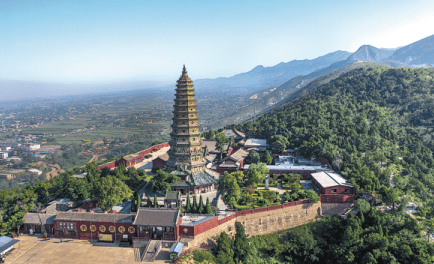
One such hidden gem is the Guangsheng Buddhist Temple, located in the Zhaocheng township of Hongtong county. The Guangsheng Temple is actually a complex that encompasses the upper monastery, the lower monastery, and the Water God Temple, situated on the slopes and foothills of Huoshan Mountain in Zhaocheng.

Founded in the first year (147) of the Jianhe reign of the Eastern Han Dynasty (25-220), the temple originally bore the name Julushe Temple. It later acquired its present name during the Tang Dynasty (618-907). While it suffered damage during an earthquake in the 7th year (1303) of the Dade reign of the Yuan Dynasty (1271-1368), subsequent restoration efforts took place over the years, preserving much of the architectural style from the Yuan Dynasty. Nestled against the mountains and overlooking a river, the temple is surrounded by ancient trees and boasts the Huoquan Spring gushing beneath the rocks at the foot of Huoshan Mountain, creating a serene and picturesque environment. The temple can be divided into three main sections: the upper temple, the lower temple, and the Water God Temple.

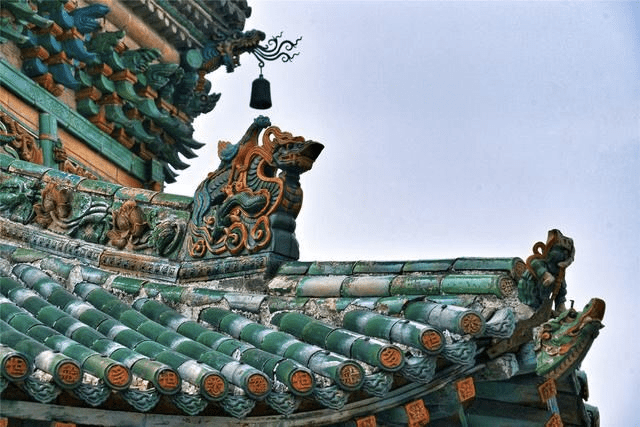
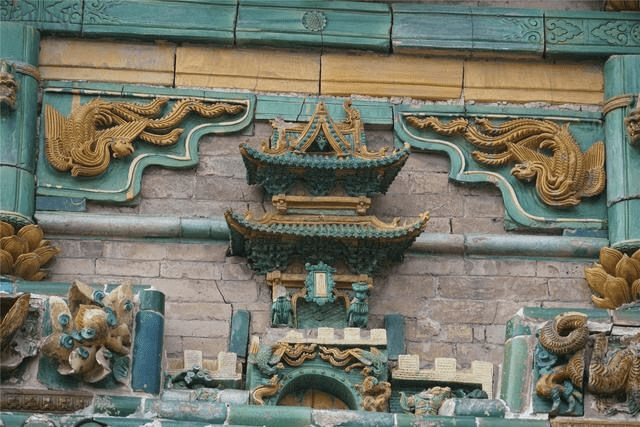
The upper temple, perched atop Huoshan Mountain amidst lush pine trees, is graced with ancient towers and adorned with colored glaze components, radiating magnificence and splendor. The lower temple, situated at the base of Huoshan Mountain, harmoniously blends with the mountain’s natural contours, creating an intriguing landscape with varying elevations. Adjacent to the lower temple is the Water God Temple, with connected walls. Here, one can find the Statue of Ying, an emperor of the Ming Dynasty, and renowned frescoes depicting Yuan Dramas, both of which are celebrated locally and internationally.

The upper temple complex comprises the temple gate, the Flying Rainbow Tower, the Amitabha Hall, the Great Hall, the Vairochana Hall, the Kwan-yin Hall, the Ksitigarbha Hall, as well as wing-rooms and corridors, among other features. The Temple Gate, situated at the entrance, is flanked by two guardian warriors. Just beyond the gate stands the impressive Flying Rainbow Tower, constructed from colored glaze bricks. Originally built during the Eastern Han Dynasty (25-220) and later restored in the Ming Dynasty (1368-1644), this thirteen-story tower soars to a height of 47.31 meters, featuring an octagonal plan. The tower is adorned with tri-colored glaze in yellow, green, and blue, creating a splendid and vibrant spectacle. Elaborate wooden square blocks and intricately carved designs of Buddha, Bodhisattvas, guardian warriors, flowers, birds, and animals adorn the eaves and pillars. Corridors encircle the first story, while the tower’s interior houses only the stairs leading to the tenth floor, showcasing remarkable architectural and artistic prowess.

Behind the tower lies the Amitabha Hall, a 5-bay wide, 4-bay long structure with a single-eaved gable and hip roof. Inside, the hall features three exquisite statues: Amitabha Buddha, Manjusri Bodhisattva, and Vajrapani Bodhisattva. These statues, masterpieces of the Ming Dynasty, are accompanied by frescoes adorning the eastern wall and screen wall. Additionally, the temple once housed 4,000 volumes of the Pingshui version of the Tripitaka during the Huangtong reign of the Jin Dynasty (1115-1234). These valuable volumes are now preserved in the Beijing Library and serve as a rare source for studying the history of Chinese printing.

The Great Hall, characterized by a 5-bay width, a single-eaved gable, and a hip roof, features three niches within for wooden statues of Sakyamuni, Manjusri, and Samantabhadra. These statues are meticulously crafted, possessing well-proportioned forms, a plump appearance, and an air of perfect serenity. In the Qing Dynasty, the hall was adorned with eighteen iron arhats along its two sides, along with statues of Kwan-yin and Amitabha Buddha on the rear niche wall.

The Vairochana Hall, spanning 5 bays in width with a hip roof, boasts an architectural style typical of the Yuan Dynasty, with two gables supported by substantial crawling beams. The altar within the hall features statues of three Buddhas and four Bodhisattvas, surrounded by wooden niches containing 35 iron statues. Notably, the back wall of the hall showcases frescoes depicting Sakyamuni and twelve Bodhisattvas of Perfect Enlightenment, regarded as exceptional examples of this art form.

The lower temple complex comprises the temple gate, front hall, back hall, the buttress hall, and other buildings, all constructed during the Yuan Dynasty. The temple gate stands impressively tall, measuring 3 bays in width and 3 bays in length, featuring a single-eaved gable and a hip roof. Canopies have been added to both the front and back eaves, lending it the appearance of a pavilion with double eaves. The front hall spans five bays in width and is supported by only two pillars that bear the weight of the entire structure. The back hall, dating back to the second year (1309) of the Zhida reign in the Yuan Dynasty, stretches 7 bays in width, featuring 9 purlins, 8 rafters, and a single-eaved overhanging gable roof. Within the hall, you’ll find the main statues of Amitabha Buddha, Sakyamuni Buddha, Bhaisajyaguru Buddha, Manjusri Bodhisattva, and Samantabhadra Bodhisattva, all crafted during the Yuan Dynasty. Sadly, the once-present frescoes on the walls were stolen and smuggled to other countries in 1928, and they are currently housed in the Naerson Museum in Texas, US. Notably, the fresco on the south wall documented the performances of Yuan Drama, serving as rare reference material for the study of Chinese dramas.
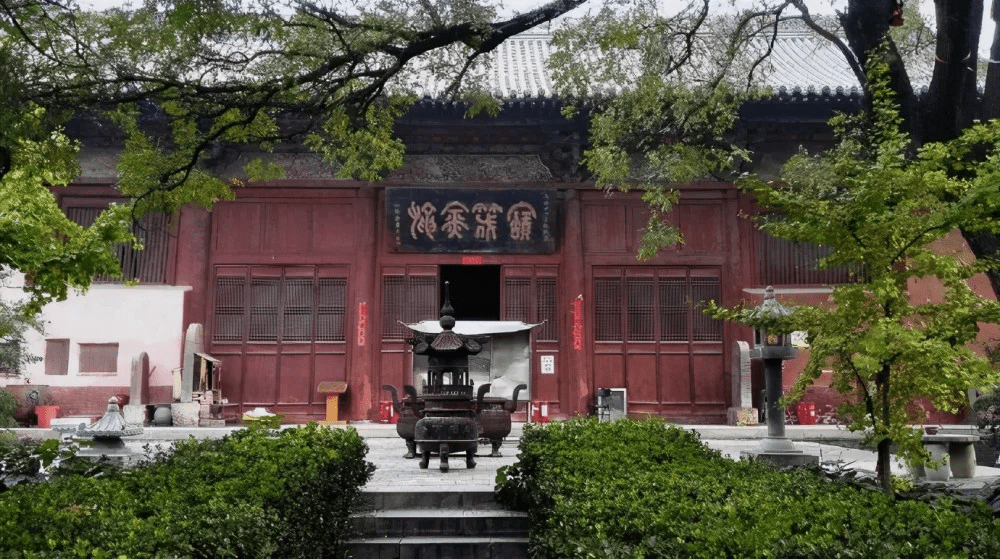
The lower temple complex photo from:Beijing Transportation University ancient architecture

The lower temple complex photo from: Beijing Transportation University ancient architecture

The Water God Temple comprises two courtyards: the front yard and the back yard, featuring key structures like the Temple Gate, the Door of Amenity, the Ming Ying King Hall, and wing-rooms of cave dwellings. The Ming Ying King Hall, measuring 5 bays in width and 5 bays in length, is enveloped by a cloister and crowned with a double-eaved gable hip roof. The interior beams follow a conventional style. Within the hall, you’ll find statues of Water God Ming Ying King and his eleven attendants. Their facial features, attire, and postures are all reflective of the Yuan style. The hall’s walls are adorned with frescoes depicting scenes of people praying for rain and other historical narratives, covering an area of 197 square meters. Notably, the eastern end of the south wall features vivid depictions of a comprehensive set of stage properties used by performers, including costumes, stage instruments, musical instruments, makeup, curtains, and the stage itself. The artwork is meticulously arranged, with a simple yet profound color palette, and the dramatis personae are depicted with great expressiveness. This fresco offers an authentic glimpse into the heyday of Yuan Drama and stands as a rare and outstanding example of Yuan fresco art in China.

Guangsheng Temple with Ancient Chinese Buddhist Buildings,Murals & Statues

Link: https://peacelilysite.com/2023/09/20/guangsheng-temple-with-ancient-chinese-buddhist-buildings%ef%bc%8cmurals-statues/

Source: http://shanxi.chinadaily.com.cn/2022-05/06/c_748899.htm, http://en.chinaculture.org/library/2008-02/15/content_34504.htm

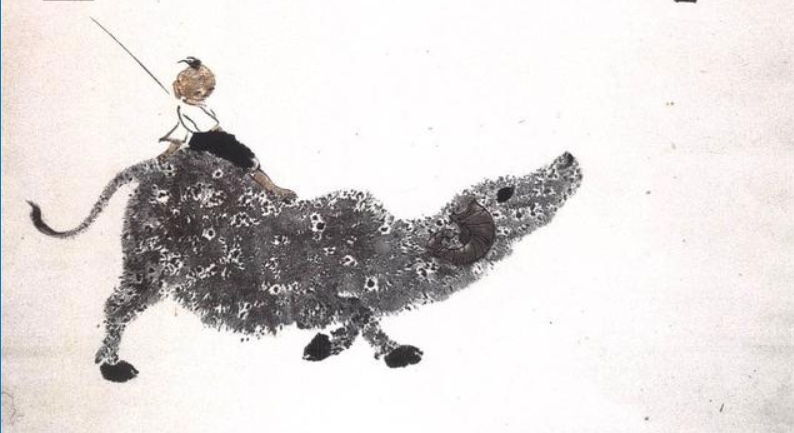
Niu Nian Tu (Year of the OX)

Artist: H.H. Dorje Chang Buddha III

At year February 2007, this Year of the Ox (by H.H. Dorje Chang Buddha III) painting was exhibited at an auction in the Hua Zang Si Temple in San Francisco. Even though I saw it online, when I saw this work in person that year, I was suddenly transported into a world of pure and poetic spirituality.

The ox strolled leisurely, Looking up to admire the scenery. On the ox’s back, a young herder, Humming a tune, Enjoying a unique sense of freedom. Though there was no verbal communication, There was mutual companionship, Dependence on each other.

Later, I saw this painting again at The International Art Museum of America in San Francisco. It was as if I were re-experiencing the long-lost joy of childhood innocence, and I couldn’t help but stop and admire this exquisite masterpiece.

The entire composition of the painting is concise: an ox, a flute, a young herder on the ox’s back, a few simple strokes representing tree branches, and a hint of green. The old ox was covered in glistening sweat, and no matter where or when, it remained calm, with steady steps and a high head, as if filled with determination and strength for the journey of life. The young herder reclined comfortably on the ox’s back, at ease and trusting that the old ox would take him where he wanted to go. Urban dwellers fortunate enough to witness such a rare and beautiful scene would find their tense hearts instantly relaxed.

In terms of technique, this Chinese painting exhibits remarkable simplicity, featuring an expansive and open composition coupled with unique and striking artistic techniques. The skillful use of white space within the artwork, thanks to clever design choices, not only avoids diminishing or dulling the image but also creates boundless room for the viewer’s imagination to roam. Additionally, the artist employed a scattered perspective technique to lend the painting a three-dimensional quality, skillfully using emptiness to convey form. The seamless integration of form and emptiness results in an exceptionally elegant layout.

This painting serves as a testament to the artist’s ability to convey the inherent charm of nature and capture the essence of a pure and childlike spirit, offering solace and enjoyment to its viewers. What is particularly astonishing is the meticulous application of ink at a minute level, portraying the oxen’s hairs in an array of intricate variations.

Although the painting does not depict the colors of early spring, mountains, valleys, or springs, they seem to be faintly visible on the canvas. It’s said that by calculating white as black and using emptiness as a form of depiction, the simplicity of the image leaves room for endless beauty and boundless imagination. This painting beautifully exemplifies the traditional Chinese cultural principle that ‘The Dao resides in simplicity.’ It evokes thoughts of the legendary tale of Laozi departing China on a green ox through the Hangu Gate in pursuit of Sakyamuni Buddha.

Having been in the hustle and bustle of the city for a long time, one longs for the tranquility of the countryside. But once in the quiet countryside, one can’t bear the loneliness and solitude. The restless heart can’t resist the temptation of the bustling world and constantly seeks outward under the pull of desire. When lost and falling into despair, one realizes that this is not the life one truly desires.

In reality, the ideal paradise is not far away; it resides in the inner tranquility and practicality of the present moment. Just like the young herder and the old ox in the painting, tranquility and boundless joy are always found in the present moment.

Niu Nian Tu (Year of the OX)

Link:https://peacelilysite.com/2023/09/15/niu-nian-tu-year-of-the-ox/

#DorjeChangBuddhaIII #HHDorjeChangBuddhaIII#DorjeChangBuddha#IAMA#InternationalArtMuseumofAmerica#HuaZangSi #SanFrancisco #YearofOX #ChinesePainting

Source: https://baijiahao.baidu.com/s?id=1760888707241544465

Tongli Ancient Water Town: A Poetic Dream of the Oriental Venice

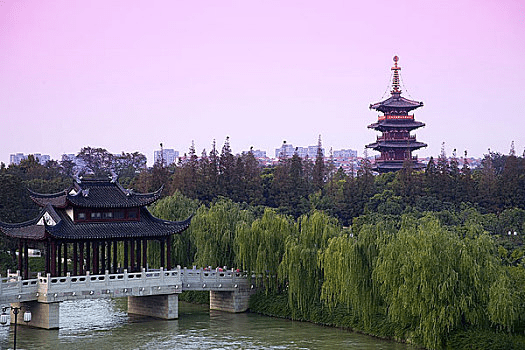
Photo from https://almostlanding.com/things-to-do-in-tongli-water-town-china/

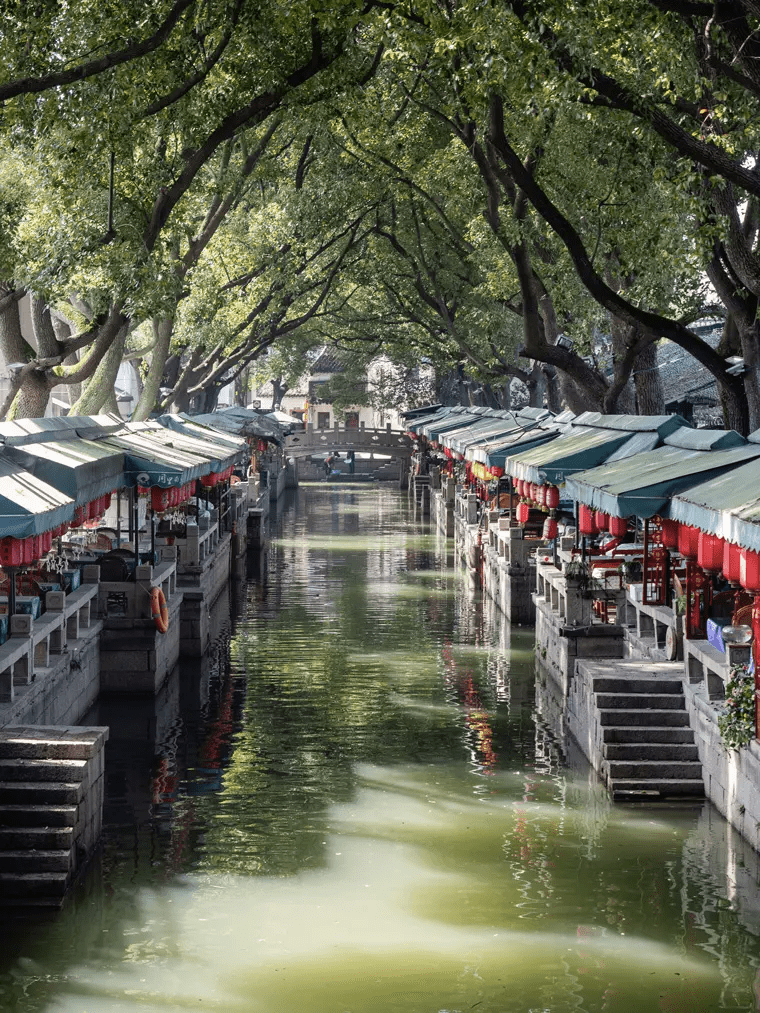
Tongli (同里), also called Tongli Water Town, in the southwest of Suzhou, is one of the “Top Six Ancient Towns in Jiangnan (Regions South of Yangtze River)” in China with a long history of over 1,000 years. Enjoying the advantageous location of being surrounded by water and linked by old stone bridges, Tongli is the symbol of water town in southern China. Therefore, it is regarded as the “Oriental Venice” as well as a “Natural Photo Studio” by people from the whole world and is titled the “National AAAAA Tourist Attraction”. Moreover, since it still well keeps a series of ancient structures from the Song, Yuan, Ming and Qing dynasties, like the “Retreat & Reflection Garden (退思园)” which is a World Cultural Heritage Site praised by many poets, Tongli is a perfect place to savor the authentic flavor of old water town in China and the real leisure life of the charming Jiangnan (江南) region.

Tongli was established in the Song Dynasty over 10 centuries ago and was first named Fu Tu (富土, Fertile Land). But it changed to be called as Tong Li (铜里) so not to be too extravagant. And later people finally changed its name again into the present Tongli (同里). According to the history, Tongli is a key place in the ancient Wu (吴) region, and since it could communicate with the outside world only by boat, there were few wars or turbulence. And then, it became an ideal place for people to escape from the social upheaval and settle down.

Highlights in Tongli

Retreat & Reflection Garden

Tuisi Garden, also known as Retreat & Reflection Garden, earned its place on the prestigious list of UNESCO World Cultural Heritage Sites. This exquisite garden was meticulously crafted between 1885 and 1887 by Ren Lansheng, a former government official who was dismissed due to corruption. Ren chose to name this sanctuary “Tui Si Yuan” to symbolize his personal journey of introspection.

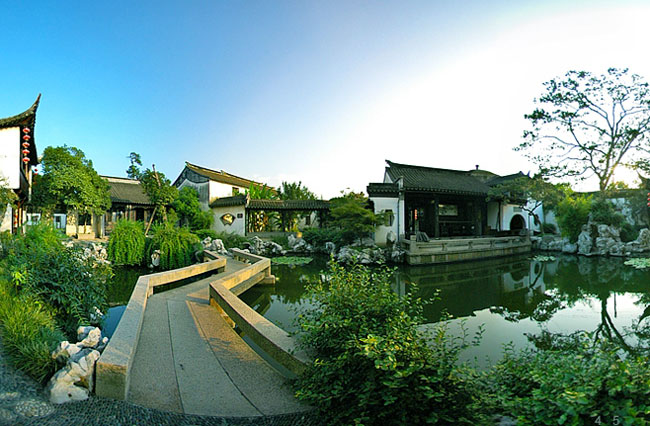
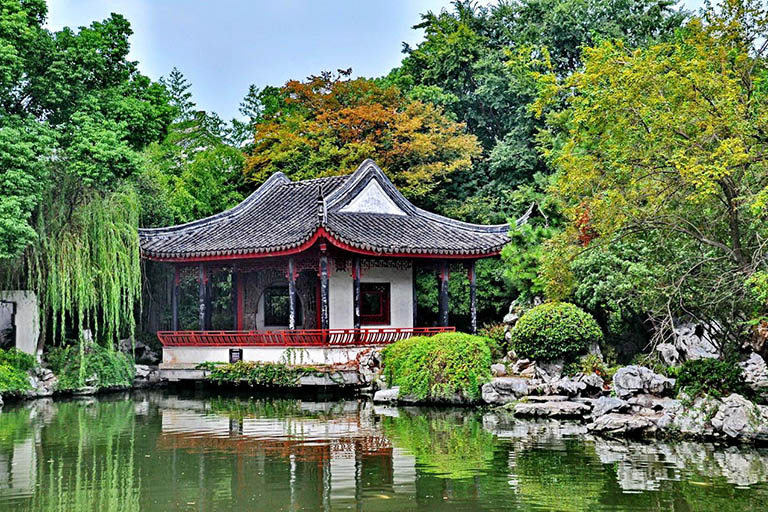
As you wander through Tuisi Garden, you’ll be transported to a bygone era, where historic wooden structures exude an ancient charm. However, what truly astonishes visitors is the enchanting water garden concealed within its confines. Here, pavilions, corridors, bridges, halls, houses, rockeries, pools, ancient trees, vibrant flowers, and charming fish coexist in perfect harmony, creating a secret oasis.

Whether you follow the stone-paved paths or stand atop pavilions nestled among the rockeries, you’ll be treated to breathtaking views of this natural and traditional garden. Such is its extraordinary beauty that a Tuisi Zhuang (Retreat & Reflection Villa) was recreated in a botanic garden in New York, USA, faithfully mirroring the essence of Tuisi Garden. This tribute stands as a testament to the global appreciation of Chinese garden artistry.

Secret Garden in Retreat & Reflection Garden

Tongli

Ancient Tuisi Garden in Spring

Gengle Hall

Gengle Hall (耕乐堂 or Happy Farming Hall), situated in the heart of Lujiadai (陆家埭), stands as a remarkable testament to ancient architecture within Tongli Water Town. Dating back to the Ming Dynasty, this building exemplifies the traditional residential-garden structure of its time, offering visitors a glimpse into the historical architecture of the region.

Within the residential section of Gengle Hall, one can admire an array of intricately carved root artworks, showcasing a variety of shapes including eagles, flowering trees, figures, lions, and more. As you explore this part of the hall, you’ll be immersed in a world of artistic craftsmanship.

Venturing into the water garden, you’ll be treated to crystal-clear pools teeming with vibrant red fish, picturesque stone bridges gracefully arching over the water, weathered yet charming old houses, and the backdrop of a serene blue sky. Every moment spent here promises a unique and captivating visual experience.

Tongli

Picturesque Scenery in the Garden of Gengle Hall

The Pearl Tower

The Pearl Tower (珍珠塔) in Tongli Water Town is not precisely a tower, but rather an opulent mansion. It is renowned for its association with the poignant love story known as the ‘Pearl Tower,’ which unfolds within the walls of this former official censor’s residence.

According to the tale, Fang Qing (方卿) and Chen Cuie (陈翠娥) shared a deep and passionate love, yet their union was fraught with the challenges posed by their disparate family backgrounds. Undaunted, Fang Qing worked tirelessly to attain the coveted title of ‘Number One Scholar’ and returned to his hometown with a sterling reputation. Finally, he and Cuie were able to overcome the obstacles and were wed.

When you visit the Pearl Tower, you’ll have the opportunity to marvel at the ancient architecture and the expansive water garden, allowing you to immerse yourself in the enchanting ambiance of this historic water town and experience the enduring romance of the famous love story.

Tongli

The Mansion of Pearl Tower

The Three Bridges

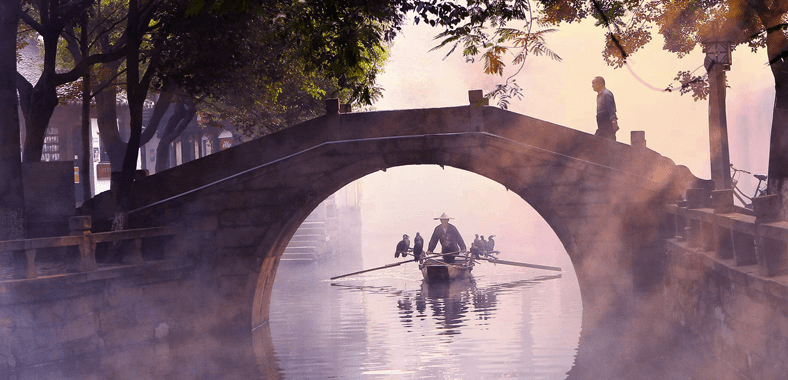
The Three Bridges (三桥) in Tongli, namely Taiping Bridge (太平桥), Jili Bridge (吉利桥), and Changqing Bridge (长庆桥), stand out as must-see attractions within Tongli Water Town. Together, they form a configuration resembling the Chinese character “品,” making the Three Bridges a cherished treasure of Tongli. As you stroll along these bridges, you’ll witness people walking above and boats gracefully gliding beneath, creating a dynamic and picturesque scene.

Particularly during festivals, these bridges come alive with activity, exuding a sense of bustling joy. Local residents consider it highly auspicious and joyous to traverse the Three Bridges, believing that it brings good fortune and improved health. You can embrace this tradition by walking across the Jili Bridge, Taiping Bridge, and Changqing Bridge in a continuous loop without turning back, in pursuit of greater blessings and well-being.

Besides, there are many other interesting places to visit in Tongli Water Town, like Jiayin Hall (嘉荫堂) with beautiful design and gauze-cap-like beam decorations, Chongben Hall (崇本堂) with exquisite sculptures, Mingqing Street (明清街) with various local food and shops, Luoxing Island (罗星洲) with fabulous natural scenery, etc. you can spend more time to discover deeper beauty of Tongli!

Amazing Activities in Tongli

You deserve to try the featured activities in Tongli to get the real fun and feel the authentic charm of this famous water town.

Rickshaw Tour

Let the local carter take you to appreciate Tongli Water Town with a distinct visual angle on the ancient rickshaw. Passing through the narrow lanes and admiring the centuries-old buildings, you can imagine yourself being the people living in Tongli in ancient times.

Boat Tour

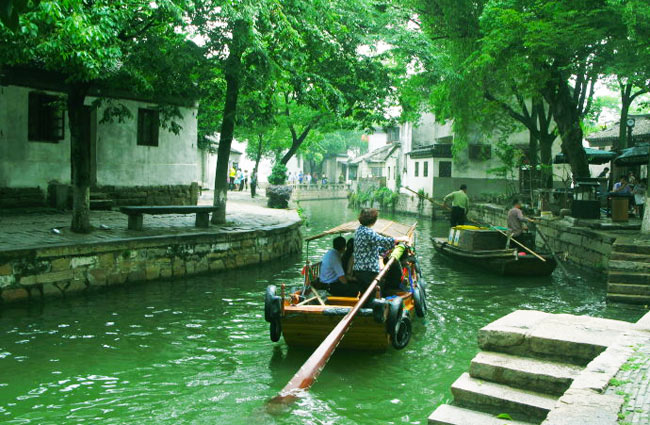
Take a sculling boat at the daytime to feel the excitement of watching the ancient buildings and people passing by, the brand-new practice of going through the old Chinese bridges. You can have the scene of ancient Tongli people communicating the outside by boat in your mind. (25 min, about CNY 90 / boat; 1-6 people / boat)

Tongli

Splendid Night View

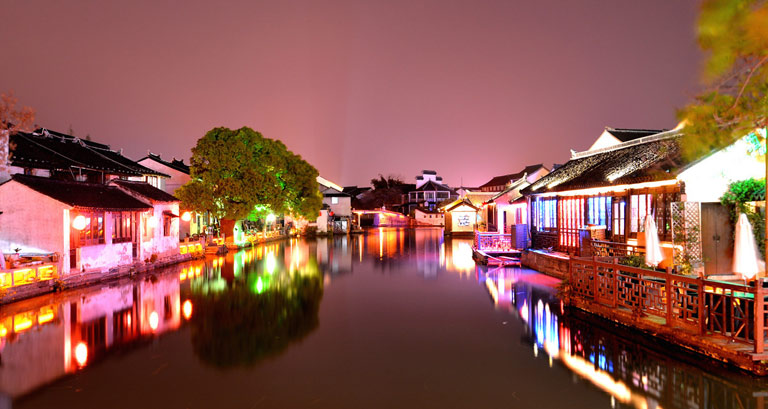
The night view of Tongli Water Town is splendid. With strings of red lanterns lighting along the river, gorgeous colorful flashes shining in the trees, sparkling lights curving the fancy lines of bridges and paths, the water town will make you immerse into its beauty.

TongliSplendid Night View in Tongli Water Town
Best Seasons to Visit Tongli

Tongli is an ideal destination to visit year-round, showcasing diverse landscapes in each season:

  • Spring: Tongli is at its most charming and poetic during this season, boasting moderate temperatures and a touch of misty rain to enhance its allure.
  • Summer: The summertime in Tongli is vibrant, with numerous local folk activities that offer a fantastic opportunity to immerse yourself in the rich folk culture of this renowned Chinese water town. Additionally, you can savor the mesmerizing night views as you wander along its scenic rivers and bridges.
  • Autumn: Tongli dons a fresh and crisp aura during autumn. The faint fragrance of sweet-scented osmanthus fills the air, transforming Tongli Water Town into a captivating young lady beneath the clear azure skies.
  • Winter: In the winter months, Tongli is tranquil, attracting fewer tourists. Particularly after a snowfall, the town adorns itself in pure white beauty, complemented by the soft glow of red lanterns lining the riverbanks.”

Tongli Ancient Water Town: A Poetic Dream of the Oriental Venice

Link:https://peacelilysite.com/2023/09/12/tongli-ancient-water-town-a-poetic-dream-of-the-oriental-venice/

Source: https://www.chinadiscovery.com/jiangsu/suzhou/tongli.html, https://almostlanding.com/things-to-do-in-tongli-water-town-china/

The cultural Heritage of Hanshan Temple

The cultural Heritage of Hanshan Temple

Hanshan Temple (寒山寺), which translates to Cold Mountain Temple, is situated in the Gusu District of Suzhou city. Originally named “Miaoli Puming Temple,” it dates back to the Liang Dynasty of the Southern Dynasties, specifically from A.D 502-519. Covering an area of approximately 13,000 square meters, the temple boasts a construction area exceeding 3,400 square meters.

During the Tang Dynasty’s Zhenguan period (A.D. 627-649), two prominent monks of the time, Hanshan and Xiqian, founded Hanshan Temple. Over its more than 1,300-year history, the temple has suffered five fires (some versions claim seven), with its most recent reconstruction occurring during the Guangxu period (A.D. 1875-1908) of the Qing Dynasty. Historically, Suzhou’s Hanshan Temple held a prestigious position among China’s top ten famous temples. Its fame extends beyond borders due to a poem composed by Zhang Ji, a Tang Dynasty poet, which is taught in Chinese primary schools. This poem is also included in the curriculum of Japanese schools, further elevating Hanshan Temple’s renown in Japan, attracting numerous Japanese visitors who come to pay their respects to the Buddha. The temple features numerous historic buildings and tablet inscriptions authored by calligraphers, making it a popular destination for those seeking peace and spiritual solace.

Hanshan Temple holds a distinguished place in China’s Buddhist history, chiefly because of the famous poem by Tang Dynasty poet Zhang Ji. This poem is part of the curriculum in primary schools in both China and Japan.

The Night Lodging at Maple Bridge
By Zhang Ji

月落乌啼霜满天
The moon sinks in the frosty sky and ravens caw far and near

江枫渔火对愁眠
Riverside maples and fishing lamps gloomily make me drowsy

姑苏城外寒山寺
From the Han-Shan temple siting at outside of the Gu-Su town

夜半钟声到客船
Come midnight bell rings as a passenger boat is arriving 

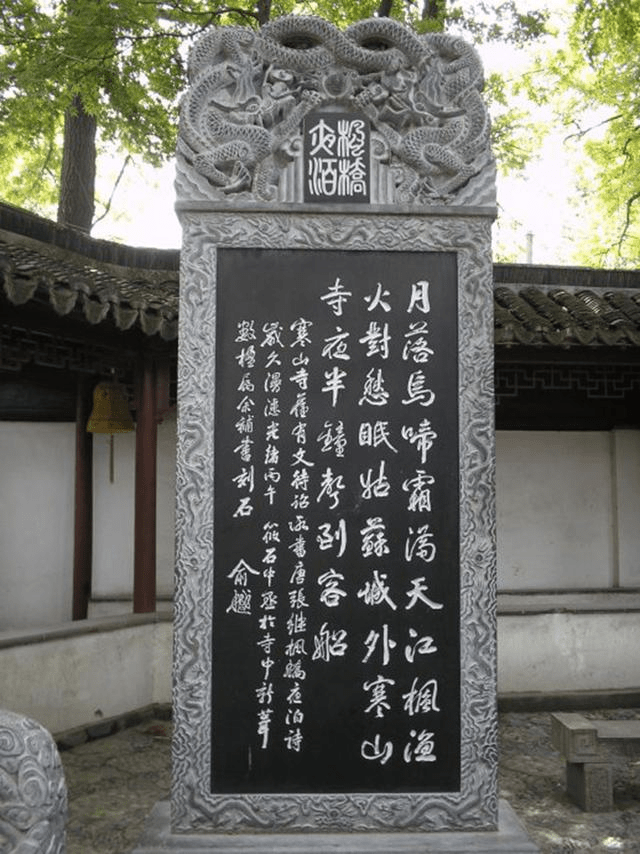
Apart from the legends of Hanshan and Shide, Hanshan Temple boasts a collection of treasures that have been cherished throughout its extensive history. Among these treasures, one of the most renowned is the poetic stele of ‘Night Mooring at Maple Bridge,’ crafted by the esteemed scholar and calligrapher Yu Yue during the late Qing Dynasty. It stands as an invaluable asset to Hanshan Temple.

It must be acknowledged that this piece of calligraphy represents the apex of ‘Night Mooring at Maple Bridge’ renditions throughout history. The lines of regular script flow seamlessly, displaying an inherent elegance and freshness, achieved with seemingly effortless brushwork. Engraved upon the stele, it emanates a subtle, age-old charm and an evocative poetic atmosphere. Each time I gaze upon this stele, it evokes a different emotional response within me. As I have delved into the art of calligraphy myself, I have even attempted to replicate ‘Night Mooring at Maple Bridge.’ While I deeply appreciate Yu Yue’s extraordinary skill and find it visually pleasing, there has always been a sensation of something missing, an ineffable aspect I couldn’t articulate. My pursuit has persisted, a continuous quest to discover calligraphic masterpieces that could genuinely satiate my aesthetic sensibilities, and this aspiration remains deeply rooted within me.

The other day, I had a sudden encounter with ‘Night Mooring at Maple Bridge,’ personally penned by H.H. Dorje Chang Buddha III, and it was as if I had stumbled upon a divine masterpiece! This artwork utilizes cursive script, showcasing the grandeur reminiscent of dragons and serpents, seasoned with masterful brushwork, conveying both a majestic ruggedness and a subtle elegance. What elevates its worth even further is its dynamic and ceaseless artistic allure, reaching monumental proportions. It can be aptly described as the highest sacred creation, far beyond the grasp of ordinary individuals. This represents the embodiment of the Five Vidyas, as expressed by the Buddhas and Bodhisattvas in the realm of Prajna, offering an extraordinary experience to those who behold it and serving as the ultimate exemplar for calligraphy enthusiasts like myself to aspire to emulate.

In this lifetime, I am profoundly fortunate to have encountered the authentic and unwavering Dharma of the Tathagata. The achievements of H.H. Dorje Chang Buddha III stand unparalleled on a global scale. When it comes to providing tangible evidence of wisdom and realization attained through proficiency in both exoteric and esoteric Buddhism, as well as mastery of the Five Vidyas, there is simply no one within the realm of Buddhism who can be mentioned in the same breath as His Holiness.

The Buddha’s criterion for measuring one’s level of accomplishment in the Buddha-dharma is rooted in the extent of proficiency in both exoteric and esoteric Buddhism, as well as the mastery of the Five Vidyas. However, throughout the history of Buddhism up to the present day, only H.H. Dorje Chang Buddha III Holiest Tathagata has truly and comprehensively demonstrated complete proficiency in exoteric and esoteric Buddhism, along with perfect mastery of the Five Vidyas. His Holiness unmistakably presents, for all to witness, a myriad of achievements that exemplify his complete proficiency in exoteric and esoteric Buddhism and his impeccable mastery of the Five Vidyas, as stipulated by the Buddha.

His Holiness, an ancient Buddha, holds the distinction of being the first being of holy virtue in history to genuinely manifest such lofty and all-encompassing realization. The undeniable proof of this is found in the numerous accomplishments single-handedly achieved by H.H. Dorje Chang Buddha III, as detailed within the thirty main categories listed in this book, “H.H. Dorje Chang Buddha III — A Treasury of True Buddha-Dharma.”

I earnestly pray that all sentient beings may embark upon the ‘vessel’ of liberation and achieve enlightenment.

The cultural Heritage of Hanshan Temple

Link:https://peacelilysite.com/2023/09/08/the-cultural-heritage-of-hanshan-temple/

#DorjeChangBuddhaIII #HHDorjeChangBuddhaIII  #HanShanTemple #ChineseCalligraphy #Buddhism #ExotericandEsotericBuddhism #AcientBuddha #TreasureBook #FiveVidyas

Source: https://blog.wenxuecity.com/myblog/77953/202108/16124.html, https://www.chinadiscovery.com/jiangsu/suzhou/hanshan-temple.html

The Shark and the Glass Wall

Impact of Habit Formation

During a research experiment a marine biologist placed a shark into a large holding tank and then released several small bait fish into the tank.

As you would expect, the shark quickly swam around the tank, attacked and ate the smaller fish.

The marine biologist then inserted a strong piece of clear fiberglass into the tank, creating two separate partitions. She then put the shark on one side of the fiberglass and a new set of bait fish on the other.

Again, the shark quickly attacked. This time, however, the shark slammed into the fiberglass divider and bounced off. Undeterred, the shark kept repeating this behavior every few minutes to no avail. Meanwhile, the bait fish swam around unharmed in the second partition. Eventually, about an hour into the experiment, the shark gave up.

This experiment was repeated several dozen times over the next few weeks. Each time, the shark got less aggressive and made fewer attempts to attack the bait fish, until eventually the shark got tired of hitting the fiberglass divider and simply stopped attacking altogether.

The marine biologist then removed the fiberglass divider, but the shark didn’t attack. The shark was trained to believe a barrier existed between it and the bait fish, so the bait fish swam wherever they wished, free from harm. This experiment illustrates that the formation of habits has a significant impact on biology.

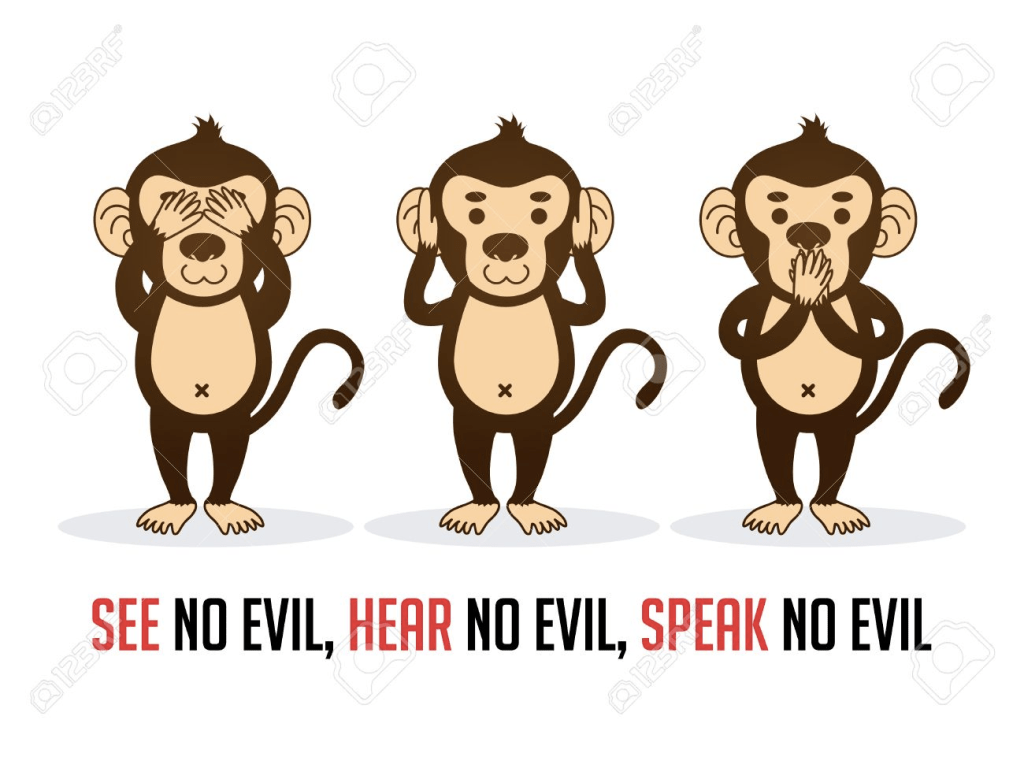
From 123RF

Humans are also creatures of habit, and habits become second nature. Human behavior is often governed by habits, and as long as something is done or said repeatedly, it gradually becomes a habit, and people start doing or saying it unconsciously. Some people constantly use foul language or lie, and it has become a habit for them. Therefore, changing these habits is not an easy task.

Buddhist practice places great emphasis on verbal karma (the consequences of one’s speech). If a person cultivates virtuous speech karma, they will speak kindly, offer comfort, encouragement, praise others, and even propagate the Dharma, thereby achieving immeasurable merit. On the other hand, if one engages in unwholesome speech karma, they will use hurtful and negative words, twist the truth, sow discord, and create a negative impact, thus planting the seeds of negative karma. Therefore, in our daily lives, we should be mindful of our speech. Speak when it’s necessary, and refrain from speaking when it’s not. In addition to refraining from false speech, divisive speech, and harsh speech, we should also avoid frivolous speech, which means not engaging in meaningless or idle chatter.

When we speak, we should naturally utter words that are meaningful, moral, or beneficial to others. However, in reality, this is often not the case. Whenever a small group of people gathers for casual conversation, they tend to talk about various things, cracking jokes to make others laugh, or uttering words that lack propriety, or even resorting to explicit or suggestive language, which can lead others to have improper thoughts. Some may use flattering or sweet talk to make themselves more likable. Engaging in such meaningless conversations can mislead others and lead them astray, which is truly a wrongdoing. Many individuals who were initially pure-minded may, under the influence of frivolous speech, become cunning and engage in inappropriate behavior.

A person who frequently engages in frivolous talk, no matter where they go, is often met with comments like, “Here comes that unserious person again,” and people tend to hold a kind of contemptuous attitude towards them. Frivolous speech can confuse and harm people’s moral values, so we should distance ourselves from it. For those who are practicing Buddhism, when they meet each other, they should ask questions like: “Have you been diligent in your practice lately? Are you focused in your recitation of the Buddha’s name? Have you made progress in meditation?” Encouraging and challenging each other in this way can help avoid complacency and steer clear of frivolous speech.

Photo by Oleksandr P on Pexels.com

The Buddhist scriptures state, “If a person can distance themselves from frivolous speech, they will earn the respect of those with wisdom. They will decisively answer any question, and because they have never engaged in falsehood, they will attain the most excellent virtues.”

Speaking is a crucial aspect of participating in social life. It not only affects the success or failure of one’s personal endeavors but also plays a significant role in the happiness of family life. It is hoped that everyone speaks with sincerity and cultivates good habits, which will contribute to a harmonious society and a fulfilling family life.

The Shark and the Glass Wall

Link:https://peacelilysite.com/2023/09/07/the-shark-and-the-glass-wall/

#Shark #Glass Wall #habit #Buddhism # BuddhistScriptures

Source: https://medium.com/@ways2capitalcsr/the-shark-and-the-glass-wall-75636de9834f

As I began to love Myself

Charlie Chaplin: More Than a Comedian – A Source of Wisdom and Inspiration

During my high school and college years, amidst the pressures of academics and the challenges of growing up, one name stood out as a constant source of laughter and profound insight into life – Charlie Chaplin. Beyond the laughter, Chaplin possessed a deep insight into the human condition. His films often depicted the struggles of the working class, the hardships of life, and the pursuit of happiness. Through his art, he conveyed powerful messages about empathy, resilience, and the importance of finding joy in the little things.

Little did I know then that the man behind the iconic Tramp character was not just an actor but also a writer, filmmaker, and a brilliant mind. One particular creation of his, the poem “As I Began To Love Myself,” has left an indelible mark on my heart, providing me with invaluable wisdom on how to live a better life.

“As I Began To Love Myself”

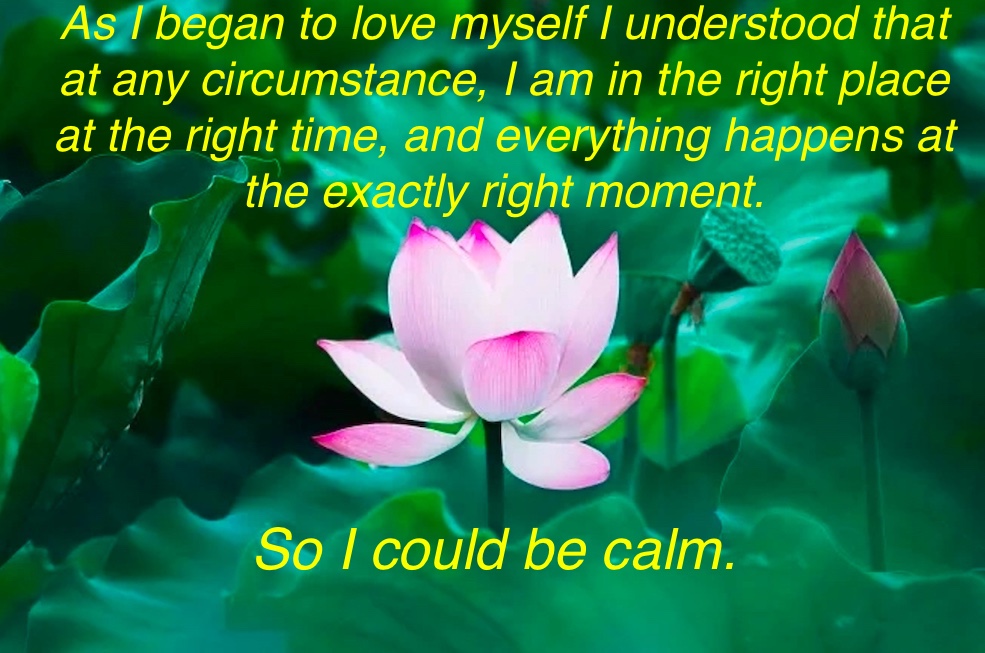
As I began to love myself I found that anguish and emotional suffering are only warning signs that I was living against my own truth.

Today, I know, this is “AUTHENTICITY”.

As I began to love myself I understood how much it can offend somebody As I try to force my desires on this person, even though I knew the time was not right and the person was not ready for it, and even though this person was me.

Today I call it “RESPECT”.

As I began to love myself I stopped craving for a different life, and I could see that everything that surrounded me was inviting me to grow.

Today I call it “Maturity”.

Today I call it “SELF-CONFIDENCE”.

As I began to love myself I quit stealing my own time, and I stopped designing huge projects for the future. Today, I only do what brings me joy and happiness, things I love to do and that make my heart cheer, and I do them in my own way and in my own rhythm.

Today I call it “SIMPLICITY”.

As I began to love myself I freed myself of anything that is no good for my health – food, people, things, situations, and everything that drew me down and away from myself.

At first, I called this attitude a healthy egoism.

Today I know it is “LOVE OF ONESELF”.

As I began to love myself I quit trying to always be right, and ever since I was wrong less of the time.

Today I discovered that is “MODESTY”.

As I began to love myself I refused to go on living in the past and worrying about the future. Now, I only live for the moment, where everything is happening.

Today I live each day, day by day, and I call it “FULFILLMENT”.

As I began to love myself I recognized that my mind can disturb me and it can make me sick. But as I connected it to my heart, my mind became a valuable ally.

Today I call this connection “WISDOM OF THE HEART”.

We no longer need to fear arguments, confrontations or any kind of problems with ourselves or others. Even stars collide, and out of their crashing, new worlds are born.

Today I know “THAT IS LIFE”!

Charlie Chaplin, the man who made us laugh and ponder life’s complexities, continues to inspire and guide us through his timeless wisdom. His poem, “As I Began To Love Myself,” encapsulates valuable life lessons about authenticity, respect, maturity, self-confidence, simplicity, love of oneself, modesty, fulfillment, and the wisdom of the heart. As we remember this iconic figure, let us carry his insights with us on our journey towards a better and more meaningful life, just as he did for me during my high school and college years. Charlie Chaplin wasn’t just an entertainer; he was a philosopher whose words and actions continue to resonate with us all.

Charlie Chaplin: More Than a Comedian – A Source of Wisdom and Inspiration

Link:https://peacelilysite.com/2023/09/07/as-i-began-to-love-myself/

#CharlieChaplin # Comedian #Wisdom #Inspiration #AsIbegantolovemyself

I have Attained A very Special and Sacred Assembly

The Dharma of Selection in Dark Confinement

In esoteric Buddhism, a multitude of Dharma categories exists. Among these, within the realm of decision by selection, “the Dharma of Selection in Dark Confinement” holds a prestigious position as an advanced and profound teaching. This particular Dharma surpasses other practices such as “the Dharma of Inquiry by a Flying Lot,” “the Dharma of Selection with Mani Stone,” “the Dharma of Lot Drawing from a Golden Vase,” and “the Dharma of Card Drawing Across the Curtain.” It even stands above the esteemed “Dharma of Vajra Selection,” second in rank only to “the Dharma of Divine Forecasting.”

It’s important to note that participating in the ceremony of “the Dharma of Selection in Dark Confinement” does not inherently imply a person’s high status or identity. The determination of one’s status relies on the outcomes of the selection process. The exceptional aspect of “the Dharma of Selection in Dark Confinement” lies in its ability to precisely unveil an individual’s true identity with absolute certainty.

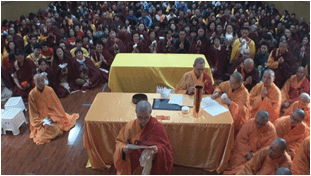
On December 12th, 2012, a remarkable opportunity graced my life as I attended a live assembly centered around this sacred teaching. The event took place within a magnificent edifice that now houses the H.H.Dorje Chang Buddha Culture and Art Museum. Illuminated against the night sky, the gathering attracted several hundred disciples. Led by an anonymous yet revered figure of great holiness and virtue, the ceremony aimed to bestow the initiation of “Selection Made in Dark Confinement from One-Hundred Dharmas to Choose the Door toward Enlightenment” upon Dharma Master Zhengda (Awang Deji Rinpoche).

The enigmatic spiritual leader entered the assembly hall donning a cone-shaped bamboo hat veiled in darkness, evoking the aura of a martial arts hero from cinematic lore. His countenance remained shrouded, a mystery to all. Swiftly, he proceeded into a petite Buddha hall, safeguarded by a group of rinpoches. The shroud of anonymity around his true identity remained impenetrable to everyone present.

H.H. Dorje Chang Buddha III, the figure whom everyone awaited with the utmost anticipation, graced the hall of the dharma assembly with His presence. The profound sense of blessedness and gratitude that welled up within me was immeasurable, as I had the privilege to worship and attentively listen to the Buddha from such a close vantage point. Furthermore, every attendant could witness to the remarkable transformation of His Holiness into a youthful appearance, an occurrence that transpired in October of that very year, 2012. (For more intricate details, refer to the “Truth about Reversing An Old Age Back to Youth“).


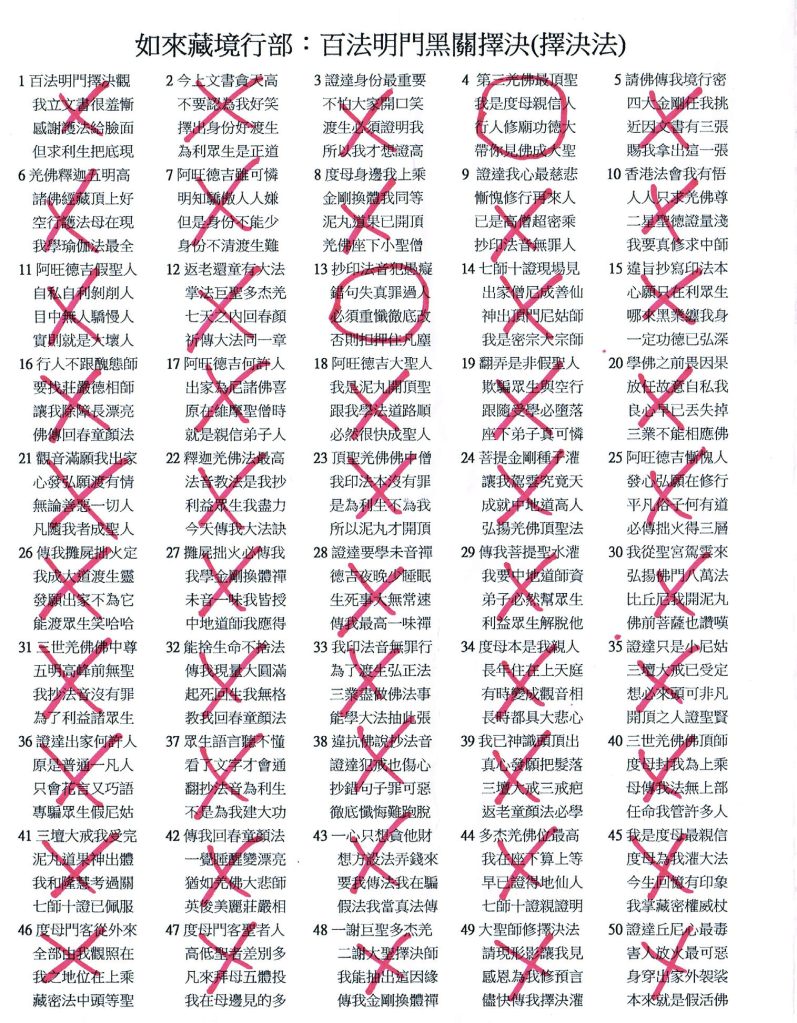
First, dharma masters presented a manuscript containing all one hundred letters of petition to this great holy and virtuous one who would practice the dharma for this dharma assembly. The great holy and virtuous one circled three of the one hundred letters of petition using a pen with red colored ink as the predictions made ahead of time for publishing at the conclusion of the dharma assembly. When the disciple who was subject to the decision by selection drew three letters of petition, the three circled ones would be verified that they all matched the letters of petition actually selected by the disciple. These three then represented this disciple’s correct karmic conditions at that time.
The other ninety-seven letters of petition did not match karmic conditions of the disciple receiving the initiation this time and were all crossed out, indicating they were at least irrelevant if not untrue.
Additionally, a required procedure was to make a seal on the spot. This was very rigorous and was done by dharma masters in person. An un-carved stone seal was rested on both of its ends and unsupported in the middle. With a strike by a hammer, the seal was broken into two pieces. The uneven face of one of the two pieces was ground slightly with sandpaper, while still preserving enough lines and contours from the break. A seal made this way could never be duplicated, even if you attempted to do it ten thousand times. Once the seal was made, it was used at the scene to stamp the one hundred letters of petition written by hand by the disciple. Every letter of petition was stamped so no one could make any falsification.


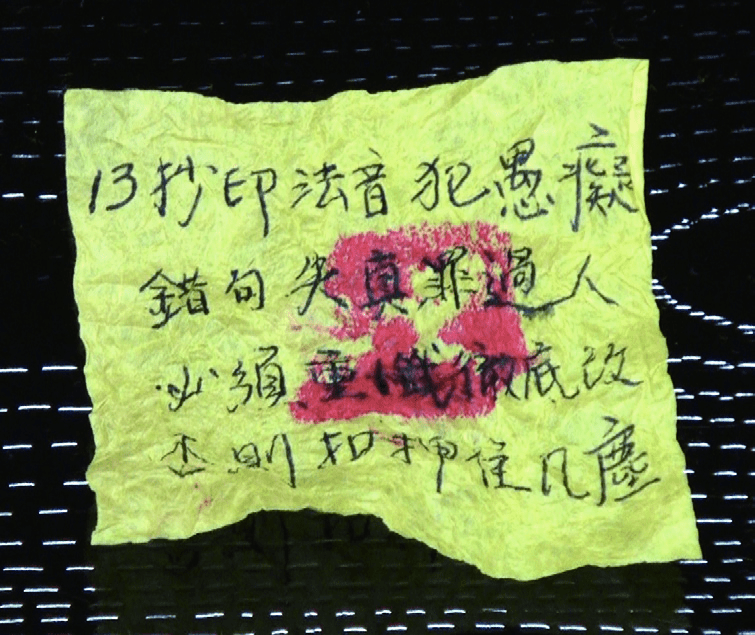
Dharma Master Zhengda drew three letters of petition by herself in complete darkness. Later with lights on, dharma masters opened them up to verify them. As expected, they all completely matched the three that were circled by the great holy and virtuous one earlier. Then the three were rolled and squeezed again into nubs in front of the public and put together with the other ninety-seven nubs with the same appearance. After mixing them together by shaking the golden vase, they were sent to the great holy and virtuous one for selection. In less than one minute, the great holy and virtuous one selected three. Dharma masters again opened them in public. They were the same ones that Dharma Master Zhengda had drawn earlier. Moreover, they were all stamped by the seal made on the spot.
To verify that the other ninety-seven pieces did not have the same contents, dharma masters opened them all to verify. They were all stamped with the seal made on the spot. Each one was read out by the dharma masters. There wasn’t any repetition at all. All were unique and agreed with the contents in the common manuscript. This fact proved that the Dharma of Selection in Dark Confinement conducted by the great holy and virtuous one was completely carried out by perfect holy realization.


These one hundred letters of petition were all written by the person undergoing the decision by selection, Dharma Master Zhengda. The most important fact was that Dharma Master Zhengda had to take an oath against severe consequences, in front of the offering table and before all people present, to all Buddhas and Bodhisattvas in the ten directions, the eight types of celestial beings, and deities in all heavens.


Her oath swore that these one hundred letters of petition were written by her and kept by her; all letters of petition were never touched by the great holy and virtuous one; the drawing of the three letters of petition was done by her in complete darkness without any visibility and were arbitrarily picked; and there was not any falsification from the beginning to the end. If what she said were false, she would definitely descend into the Vajra Hell to suffer forever without any chance of being saved.
This dharma assembly determined for certain Dharma Master Zhengda’s karmic conditions.

The numbers and contents of the three letters of petition selected were respectively:
No. 4: H.H. Dorje Chang Buddha III is the holiest. I am a trusted aide of the Tara. A cultivator building temples has great merit. You will be brought to see the Buddha and become a holy one.


No. 13: Transcribing and copying the recorded dharma lessons was a foolish violation. Making errors in sentences to cause the loss of true meanings made me a person of guilt. I must repent earnestly and correct completely. Otherwise the outcome would be being detained in the mundane world.

No. 69: The dharmas of Lamdre have many levels. The Dharma of Mud-Pill Lamdre is the highest. Having passed the exam proctored by seven monastic masters and ten witnesses, my status is at the summit of esoteric Buddhism.

The selections made by the Dharma of Selection in Dark Confinement concluded that Dharma Master Zhengda was a reincarnated holy one and a trusted aide of the Tara. Her status of the dharma was extremely high, at the upper level representing the summit of esoteric Buddhism.
H.H. Dorje Chang Buddha III conducted “the Dharma of Divine Forecast-ing’ using a golden vase for an anonymous great holy and virtuous one who did not reveal his identify. The forecast was repeated three times without discrepancy, proving its correctness. “The Dharma of Divine Forecasting” showed that this great holy and virtuous one possessed master’s qualifications at the middle level of holy realization with Three Sun-Moon Wheels. That represented a truly rare great holy and virtuous one. Even Dharma King Gar Tongstan who is the chairperson of the United International World Buddhism Association Headquarters, Kaichu Rinpoche, and Holy and Virtuous One La Zhen possessed just master’s qualifications represented by One Sun-Moon Wheel. Even Mozhi Rinpoche’s realization was only at the level of Two Sun-Moon Wheels. He surpassed the status of Mozhi Ripoche and truly deserved the title of great holy and virtuous one. To achieve the status of “Great Holy and Virtuous One,” one must possess master’s qualifications at the middle level of holy realization with Sun-Moon Wheels.
The United International World Buddhism Association Headquarters issued a document for receiving the certificate of Three Sun-Moon Wheels to the great holy and virtuous one on the spot. After the dharma assembly had ended, people were all very excited and thought that they would have the opportunity of paying respect to the great holv and virtuous one in person and knowing who He actually was.
However, the great holy and virtuous one did not leave his name and did not meet with people. He left quietly without accepting the document. People were very disappointed. So far no one knows who He really was. People only learned that this was a selfless great holy and virtuous one possessing master’s qualifications with Three Sun-Moon Wheels. The demeanor of a true Mahasattva and a true great holy and virtuous one was definitely not what those who chased fame and gain, those who faked being holy ones by boasting and self-promotion, and those dharma kings, venerable ones, and great dharma kings who used false initiations to cheat believers for money and property could even slightly resemble.
Master’s qualifications with Sun-Moon Wheels are very amazing and indicate the levels of realization and status of master’s qualifications.

The Dharma of Selection in Dark Confinement

Link:https://peacelilysite.com/2023/08/31/i-have-attained-a-very-special-and-sacred-assembly/

#Buddha ##HHDorjeChangBuddhaIII #DorjeChangBuddhaIII #BuddhaDharma #MasterZhengDa #H.H.DorjeChangBuddhacultureandartmuseum #EsotericBuddhism

Lessons from Orchids: Finding Serenity Amidst Life’s Challenges

Photo by Tayla Walsh on Pexels.com

In the tranquil solitude of a monastery, an old monk devoted his time to cultivating a pot of delicate orchids. Each day, he lavished care upon these tender blooms, diligently tending to their needs by watering and weeding them with unwavering dedication.

As a result of the old monk’s meticulous attention, the orchids flourished under his care, displaying an elegant and breathtaking beauty that mirrored his own inner peace.

One day, the old monk found himself with a commitment that required him to leave the monastery to meet with friends. In his absence, he entrusted the nurturing of the cherished orchids to a young monk. He handed over the responsibility, emphasizing the importance of their care.

With a sense of honor and respect for the elder monk’s teachings, the young monk embraced his duty wholeheartedly. He approached the task just as the old monk had, showing genuine care and tenderness towards the orchids. Under his watchful eye, the orchids continued to thrive and bloom.

However, fate took an unexpected turn. On a day when the young monk had diligently watered the orchids and positioned them on a windowsill to soak in the sunlight, a sudden and fierce rainstorm struck. Powerful winds knocked the orchids from their perch, causing them to shatter upon impact.

Upon his return, the young monk was met with the heartbreaking sight of the shattered remnants of the once-beautiful orchids. He was overwhelmed with sorrow, dreading the old monk’s reaction and fearing his reprimand for failing in his entrusted duty.

Several days later, the old monk returned to the monastery. The young monk gathered the courage to confess the unfortunate incident, ready to face whatever consequence may arise from his actions.

Surprisingly, the old monk responded with silence. This unexpected reaction left the young monk puzzled and uncertain. After a moment, the old monk’s serene countenance broke into a calm smile, and he uttered words that carried profound wisdom, “I don’t cultivate orchids to get angry.”

In that simple and sincere statement, the old monk revealed a profound truth about his serene attitude towards life. The cultivation of the orchids was not about breeding frustration or anger; rather, it represented a deeper pursuit—the nurturing of one’s character and inner qualities. The orchids, though precious, were symbolic of the journey to refine one’s life and embrace noble virtues.

Life, much like a bustling marketplace, presents us with an array of experiences, people, and emotions. Some individuals exhibit unwavering positivity and joy, while others grapple with restlessness and anxiety. Our perspectives differ, our thought processes vary, and as a consequence, our approaches to problem-solving diverge greatly.

So, how can we navigate the sea of life’s challenges and find solace amidst the chaos? The answer lies in the simple yet profound art of detachment. By relinquishing our attachments and embracing life’s imperfections, we can begin to comprehend the transient nature of all things. Just as clouds swiftly drift across the sky, life’s moments are fleeting and subject to the universal cycle of existence.

The key lies in cultivating a mindset of detachment and releasing the grip of selfish desires. In doing so, we can expand our hearts, broaden our perspectives, and uncover a sense of tranquility that transcends the storms of life. Through this journey of self-discovery, we can learn from the wisdom of the orchids and the serenity of the old monk—finding beauty not just in the blooms, but in the growth of our own souls.

Lessons from Orchids: Finding Serenity Amidst Life’s Challenges

Link:https://peacelilysite.com/2023/08/29/lessons-from-orchids-finding-serenity-amidst-lifes-challenges/

#Orchids #Serenity #Monk #BuddhistWisdom #BuddhistTeaching

Chinese Valentine’s Day

Qixi Festival when Niulang and Zhinu Meet Once a Year

Valentine’s Day, observed worldwide on February 14th, is a celebration dedicated to love, inspired by the legacy of Saint Valentine. This global festival serves as an emblem of affection and connection. Similarly, in China, a comparable event pays homage to an enamored couple.

Known as the Qixi Festival, also referred to as the Qiqiao Festival and colloquially named “Chinese Valentine’s Day” in Western culture, this festival possesses a captivating historical narrative. The Qixi Festival commemorates the age-old tale of Zhinu and Niulang. Zhinu, an ethereal weaver, and Niulang, a humble cowherd, compose this mesmerizing love story. According to legend, their love was thwarted by the Milky Way, allowing them a solitary annual reunion—on the night of Qixi.

The celestial pairing of Zhinu and Niulang is immortalized as radiant stars in the expanse of the galaxy. A passage connecting their realms materializes each year, expertly crafted by magpie birds in anticipation of their rendezvous.

The Qixi Festival, rooted in the Lunar Calendar, unfolds on the seventh day of the seventh month. Transitioning to the Gregorian calendar, this momentous occasion occupies the eighth month, specifically August. In the year 2023, the Qixi Festival is slated for celebration on Tuesday, August 22nd.

Buddhism offers a multifaceted lens through which to view human emotions and relationships. Rooted in the concept of the “Twelve Links of Dependent Origination,” Buddhism elucidates the cyclical nature of birth and death, attributing this cycle to ignorance and attachment. Humans, characterized as “sentient beings,” are intricately tied to these attachments. While Buddhism does not oppose love and marriage, it does caution against excessive attachment and an undue grasp on emotions, as they can impede the path to liberation.

Within Buddhism, emotions are not dismissed but embraced. Modern perceptions sometimes label Buddhism as detached and unfeeling. There’s a notion that embarking on a monastic journey necessitates forsaking family and worldly ties, an outlook perceived as callous. This misconception paints monastics as “heartless.”

Yet, the reality of Buddhism diverges from this stereotype. The monastic life, as envisioned by Buddhism, doesn’t mandate the abandonment of all emotions.

It’s essential to recognize the transient nature of the intense romantic love that often consumes us. Such love possesses a fleeting existence, its novelty waning with time. Buddhism offers intricate insights into this ephemeral sentiment, highlighting that all desires are impermanent and tinged with suffering, stemming from irrational attachments of sentient beings. An in-depth exploration of Buddhist teachings can foster a profound comprehension of these principles.

In the ebb and flow of relationships, cherish the connections when they emerge and gracefully embrace their absence when they dissipate. Buddhism advocates for mastering the art of detachment, discouraging the clutching onto emotions. This isn’t an endorsement of emotional callousness, but rather a perspective that perceives the unions and separations inherent in love and marriage as natural transitions dictated by circumstances. These transitions can be viewed as shared opportunities for growth, mutual enrichment, and learning—cornerstones of companionship on the journey to enlightenment.

Buddhism champions the elevation of emotions through the channels of compassion and wisdom. It fosters an environment where spouses treat each other with reverence and intimacy, colleagues extend assistance and forgiveness, and friends place a premium on their connections. This culminates in embodying “great compassion without attachment” and “great mercy as a shared essence.” In essence, personal love evolves into a universal compassion for all sentient beings—an embodiment of empathy that transcends the confines of the individual.

Chinese Valentine’s Day

Link:https://peacelilysite.com/2023/08/25/chinese-valentines-day/

#Valentine #ChineseCulture #QixiFestival#Buddhism #GreatCompassion

Source: https://economictimes.indiatimes.com/news/international/us/when-is-qixi-festival-2023-all-about-the-chinese-valentines-day-legend-of-lovers-zhinu-and-niulang/articleshow/102917179.cms?from=mdr

Fanjing Mount

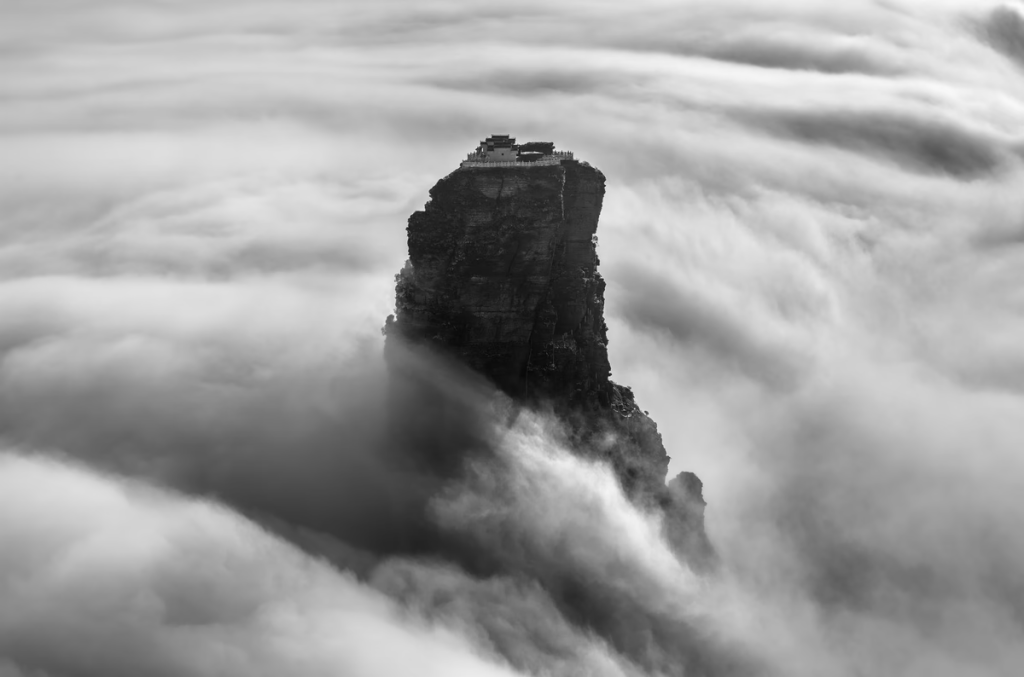
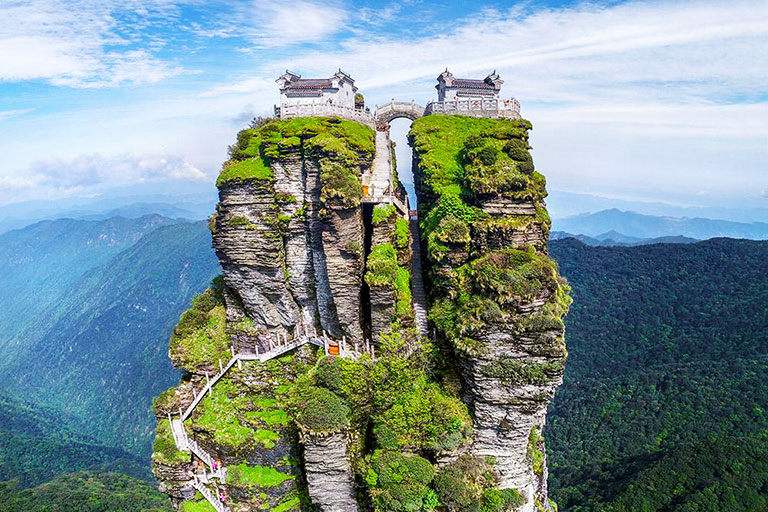
A view of the New Golden Summit, looking west. Costfoto / Barcroft Media via Getty

Clouds roll past the New Golden Summit on Mount Fanjing.  Clkraus / Shutterstock

Fanjingshan, also known as Mount Fanjing, is situated in the eastern part of Guizhou Province, China, within Tongren City. It is positioned approximately 248 kilometers away from Guiyang and 220 kilometers from Zhangjiajie. Mount Fanjing proudly claims the title of being the highest peak within the Wuling Mountains, with an impressive elevation of 2572 meters. The mountain stands adorned with primitive vegetation, its landscape characterized by majestic peaks, a continuous succession of towering summits, babbling streams interwoven with cascading waterfalls.

Moreover, Fanjingshan holds great spiritual significance as a revered Buddhist site. It’s widely believed among Buddhists that Fanjingshan is a place where spiritual enlightenment akin to that of Maitreya Buddha can be attained.

The appellation “Fanjing” finds its origins in “Fantian Jingtu,” a Buddhist term that translates to “Brahma’s Pure Land.” This hallowed mountain has been acclaimed as China’s Fifth Buddhist Mountain, a distinction following the likes of Mount Wutai in Shanxi Province, Mount Putuo in Zhejiang Province, Mount Emei in Sichuan Province, and Mount Jiuhua in Anhui Province. With a history spanning over 2000 years, embellished by extraordinary rock formations and abundant biodiversity, Mount Fanjing unveils itself as a serene, distinct haven. A sojourn to this tranquil expanse offers a revitalizing and spiritual respite from the bustling clamor of urban life.

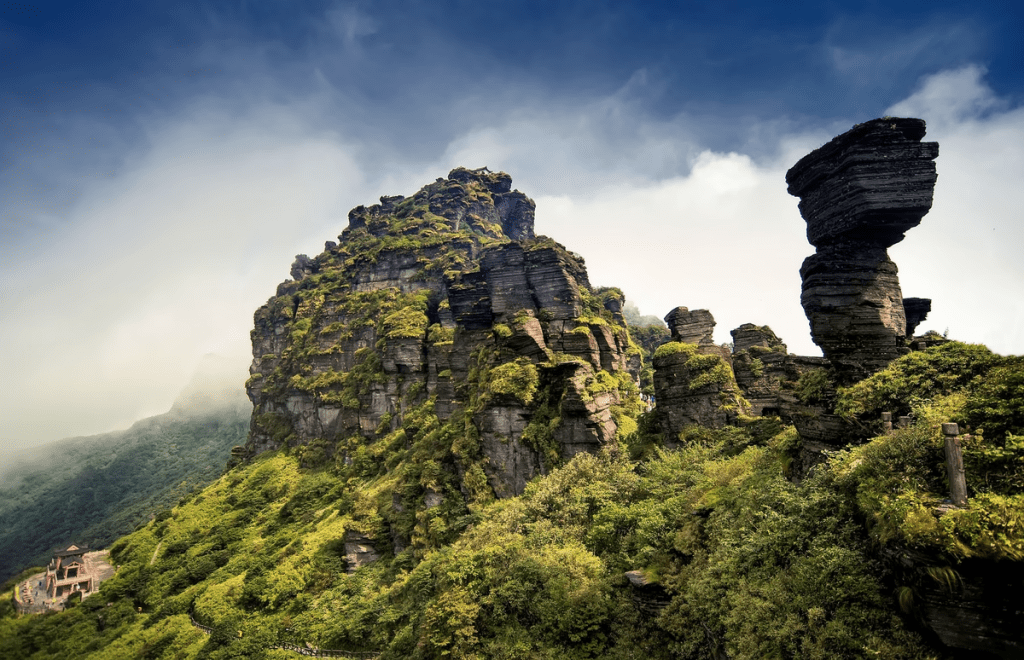
Unique geological landforms, including the “Mushroom Stone” at right. Sanyanwuji / Shutterstock

In geological terms, Mount Fanjing assumes the form of a “fold belt,” an arrangement akin to stacked layers of rock resembling an assemblage of intricate shapes, an occurrence seldom witnessed elsewhere. The Mushroom Stone serves as a prime exemplar, where layers of rock have taken on the semblance of a towering mushroom.

Throughout antiquity, Fanjing Mountain stood as a venerable hub of Buddhist culture within the Wuling Mountain range. Historical records attest to the proliferation of numerous Buddhist temples along its slopes, catering to pilgrims from around the world. Yet, during the 16th century in the Ming Dynasty, a substantial number of these temples met destruction, effectively suppressing Fanjing Mountain’s renown. The subsequent Qing Dynasty saw a revival of fortunes, with governmental initiatives aimed at temple reconstruction and expansion along the mountain’s pathway to the “Red Clouds Golden Summit.” Notable temples such as Cheng’en Temple and Baoguo Temple were erected. By 1896, the fifth phase of Fanjingshan Temple reconstruction reached its culmination, bestowing upon Fanjing Mountain an esteemed status in the global Buddhist sphere and solidifying its position as China’s “No. 5 Great Buddhist Mountain.”

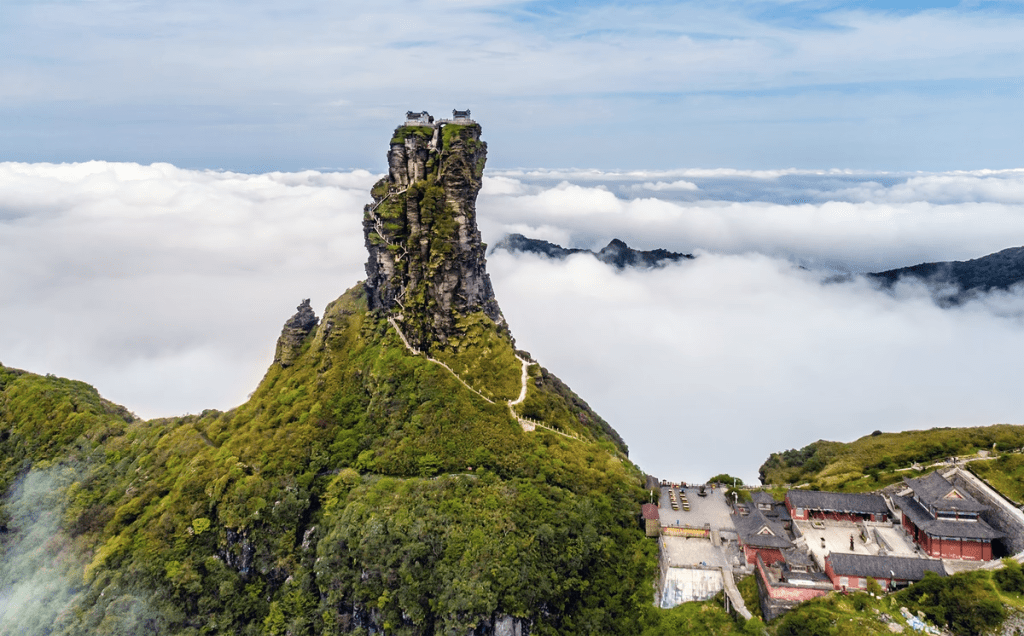
Mount Fanjing boasts three soaring summits that pierce the heavens – the Red Clouds Golden Summit (2336 meters), the Old Golden Summit (2493 meters), and the Phoenix Golden Summit (2572 meters). From these majestic pinnacles, visitors are treated to breathtaking panoramic vistas of Mount Fanjing’s expansive landscape. Crowning the preeminent “Red Clouds Golden Peak” stands the remarkable Fanjingshan Temple, perched at a daring elevation of 2,336 meters above sea level. Nestled atop the columnar peak, this temple’s elusive location beckons travelers to witness its ethereal presence firsthand and capture mesmerizing, novel photographs.

Fanjingshan Temple, encompassing the revered Temple of the Buddha (释迦殿) and the Maitreya Temple (弥勒殿), graces the summit of the “Red Clouds Golden Summit” (also known as the New Golden Summit) on Fanjing Mountain. The former is dedicated to the worship of Sakyamuni, symbolizing the present, while the latter venerates Maitreya, representing the future. These two temples trace their origins back to the Yongle period of the Ming Dynasty, over five centuries ago. Presently, they have been meticulously reconstructed to echo their original splendor, their structures fortified with iron tiles to withstand the mountain’s formidable winds. Each temple is embodied by a single hall, constructed from meticulously arranged stone pieces measuring 5.4 meters in width and 5.55 meters in depth. A bridge gracefully connects the two temples, spanning the depths of the Gold Sword Gorge.

For pilgrims journeying to Fanjingshan, the ascent involves ascending thousands of steps to initially reach the Temple of the Buddha on the southern facet. Subsequently, crossing the bridge leads to the Maitreya Temple on the northern side of the “Red Clouds Golden Summit.” This sequence mirrors the Buddhist concept of transition from the present (Sakyamuni) to the future (Maitreya). As the “Red Clouds Golden Summit” often finds itself enshrouded by mist and enveloped in sea of clouds, standing upon the terrace outside Fanjingshan Temple offers a surreal experience of gazing upon the world from above, capturing an otherworldly perspective amidst the natural elements.

Much like the iconic Avatar Hallelujah Mountain in Zhangjiajie National Forest Park, Fanjingshan stands as a towering pinnacle, slender and vertically oriented, evoking the image of a pencil standing upright on a desk. Scaling its summit requires ascending over 8,000 steps or opting for a cable car ride up from the road below. Most visitors opt for a full day to thoroughly explore this remarkable sacred mountain. Its attractions span a diverse range, encompassing the Red Cloud Golden Peak, Old Golden Summit, Ten-Thousand Sleeping Buddha, Mushroom Stone, Jiulong Pond, Fenghuang Mountain, Numerous Rolls of Books, and more.

Situated in the mountainous expanse of Guizhou Province, Fanjingshan falls within the ambit of a subtropical humid monsoon climate, distinctly marked by four seasons. Throughout the year, the average annual temperature oscillates between 13.1°C and 14.7°C. July witnesses the hottest days, with an average temperature hovering around 24°C, while January holds the chilliest nights, registering an average temperature of approximately 4.6°C. On the whole, Fanjingshan enjoys a temperate climate, graced by ample sunlight and rainfall. Summers remain moderate, and winters remain mild, with neither excessive heat nor biting cold. Rainfall predominantly occurs from May to October, while the frost-free period spans a generous 270 to 278 days annually.

The prime window to explore Mount Fanjing extends from March to November. For those seeking to capture stunning photographs, the early morning hours are particularly enchanting. The aftermath of rain unveils captivating spectacles, such as the Sea of Clouds, Zen Fog, Buddha Light, and breathtaking sunrises, which contribute to the mountain’s mystique and allure.

Fanjing Mount

Link: https://peacelilysite.com/2023/08/22/fanjing-mount/

#FanjingMount# MountFanjing #Zhangjiajie #Buddha #BuddhistTemple #MaitreyaBuddha #FanTieJingTu #China #Travel #TravelChina #GuiZhou

Source: https://www.chinadiscovery.com/guizhou/fanjingshan.html, https://www.theatlantic.com/photo/2019/04/a-photo-visit-to-mount-fanjing/586879/, https://www.chinadiscovery.com/guizhou/fanjingshan/fanjingshan-temple.html