This YouTube documentary by the BBC was done several years ago, but is worthy of another visit as it gives us a glimpse of the various forms of Buddhism and some of the great monuments and architectural expressions in the different cultures where it took root including our own.
In this fascinating documentary, historian Bettany Hughes travels to the seven wonders of the Buddhist world and offers a unique insight into one of the most ancient belief systems still practised today. Buddhism began 2,500 years ago when one man had an amazing internal revelation underneath a peepul tree in India. Today it is practised by over 350 million people worldwide, with numbers continuing to grow year on year. In an attempt to gain a better understanding of the different beliefs and practices that form the core of the Buddhist philosophy and investigate how Buddhism started and where it travelled to, Hughes visits some of the most spectacular monuments built by Buddhists across the globe. Her journey begins at the Mahabodhi Temple in India, where Buddhism was born; here Hughes examines the foundations of the belief system – the three jewels. At Nepal’s Boudhanath Stupa, she looks deeper into the concept of dharma – the teaching of Buddha, and at the Temple of the Tooth in Sri Lanka, Bettany explores karma, the idea that our intentional acts will be mirrored in the future. At Wat Pho Temple in Thailand, Hughes explores samsara, the endless cycle of birth and death that Buddhists seek to end by achieving enlightenment, before travelling to Angkor Wat in Cambodia to learn more about the practice of meditation.
The Buddha recounted this tale in response to a dispute between two monks, highlighting the destructive nature of harsh words. Gathering a large group in the monastery hall at Jetavana, he addressed them, saying:
“Monks and nuns, even animals suffer unhappiness due to harsh words. Allow me to share with you a story from ancient times, when bitter words caused a farmer to lose his fortune.”
Once, in a bygone era, the Future Buddha manifested as a bull and was gifted to a farmer. Overjoyed, the farmer named the young calf “Great Joy” and treated him like his own child. He provided the bull with the best rice and milk, fostering his growth. Great Joy flourished and became a mighty ox, black as the night sky and as radiant as the stars. Despite his immense strength, he remained gentle and obedient.
After years of tender care, Great Joy felt immense gratitude towards the farmer. He thought to himself, “The farmer has raised me with loving kindness and made great sacrifices for my well-being. He has even gone hungry at times to ensure I am well-fed. I must find a way to repay him for all his kindness!” The next morning, as the farmer brushed the bull, Great Joy spoke to him, saying, “Master, I have devised a plan to repay you for your many years of care.”
Pausing his brushing, the farmer gently placed his hand upon the bull’s large head and replied, “Great Joy, you already plow my fields, turn my well wheel, and carry heavy loads to and from the village. You work tirelessly, and there is no need for you to repay me. Do not trouble yourself with such matters.”
However, Great Joy was determined to execute his plan. “Master, please listen. I have a marvelous idea that will make you instantly wealthy. Journey to the town today and find a merchant who owns a vast herd of oxen. Make a bet with him for a thousand silver pieces, claiming that your bull is the mightiest in all of India. Wager that tomorrow morning, in the village square, your ox will draw a hundred carts overflowing with rocks, stones, and gravel!”
Skeptical, the farmer replied, “My dear friend, how could any ox in the world pull a hundred loaded carts? It has never been done before. The entire town will think I have gone mad.”
Unyielding, Great Joy persisted, “I possess the strength, and I will not let you down.”
“But what if you fail to pull such a heavy load? A thousand silver pieces comprise all I possess! If you lose, I will be left impoverished!”
Remaining steadfast, Great Joy reassured him, “I promise you, I will not let you down. I will not lose the wager, and you shall not lose your money.”
And so, the farmer followed the ox’s suggestion. He ventured to the village and positioned himself in the town square, where business transactions took place. Eventually, a wealthy merchant dressed in fine robes approached him. Seizing the opportunity, the farmer boldly proclaimed, “Did you know, gentlemen, that I am the owner of the strongest ox in the kingdom? I doubt there is a bull in all of India that can rival mine! In fact, my bull may be the largest and mightiest in the entire world!”
The crowd fell silent upon hearing his boast. All eyes turned towards the farmer. Finally, the wealthy merchant broke the silence and retorted, “It is widely known that I, sir, possess an entire herd of the world’s strongest oxen. What makes your single bull so exceptional?”
Realizing he had found the ideal opponent, the farmer promptly replied, “I have a bull capable of effortlessly pulling a hundred fully loaded carts!”
Mockingly, the merchant responded, “And where might this extraordinary bull be found? In the land of fairies and dreams?”
“He resides at my home,” answered the farmer confidently.
“Well, if you hold him in such high regard, let us make it a wager,” challenged the merchant.
“Certainly,” agreed the farmer. “I will bet you a thousand silver pieces that my bull can move one hundred carts fully loaded with rocks, stones, and gravel. Prepare the carts and meet me here in the village square at sunrise tomorrow morning.” With a firm handshake, the deal was sealed, and both parties made their preparations.
The following morning, before daybreak, the farmer fed Great Joy sweet milk and hay, bathed him, and brushed his coat until it shone. Speaking gentle and soothing words, just as he did every day, the farmer adorned the ox’s neck with a garland of flowers.
Great Joy knew the moment had arrived to prove himself.
At dawn, the farmer led Great Joy to the village square. Excited onlookers, including men, women, and children, filled the streets, eager to witness the outcome of this seemingly impossible bet. The farmer was astounded by the sight that greeted him—an unprecedented number of carts, each loaded to the brim with rocks. If any doubts lingered in the farmer’s mind, they were quickly replaced by certainty that he had been foolish to believe a mere animal’s promise.
Nevertheless, Great Joy stood proudly at the head of the line of carts, awaiting his harnessing. Magnificent and towering, his shoulders surpassing any other ox, he captured the awe of the crowd. Two men struggled to secure the heavy yoke upon his broad back, and then they attached the carts in a long chain.
Anxious, the farmer anticipated his impending humiliation before the townsfolk. Clutching the leather goad tightly, he muttered to himself, “I cannot afford to lose this wager. The ox has made a promise, but I am his master. I must ensure that he pulls the carts without fail. Ailee! I have risked my life savings on the word of a mere beast!” With determination, the farmer raised his goad and struck Great Joy forcefully, shouting, “Now, you beast, pull the carts! Pull! Pull, you rascal!”
Great Joy was taken aback by this treatment. He thought, “I am not a rascal! I am not a beast! He has never spoken to me like this before or used a whip on me. I will not move an inch!” Ignoring the lashes of the whip and the harsh words from his friend, Great Joy planted his hooves firmly, like the roots of four Banyan trees, and remained immobile.
Instantly, the crowd erupted in laughter and mockery, witnessing the farmer’s stubborn ox refusing to obey. Once again, the farmer struck Great Joy with the goad and cursed him, but the ox gazed straight ahead, disregarding the goad, the farmer, and the jeering crowd. In no time, the crowd began pelting both the farmer and the ox with mud and dung. Overwhelmed with shame, the farmer hung his head low and reluctantly handed over his entire savings to the merchant.
Jingling the coins in his hands, the merchant chuckled and said, “Whenever you wish to make another wager, seek me out! What ox could possibly pull a hundred loaded carts?” he laughed.
Despondent and penniless, the farmer unharnessed Great Joy from the line of carts and led him back home. The villagers taunted them along the way, hurling insults, rotten fruit, and mud. The farmer tied the ox to a stake and retreated inside his home, overcome with grief. “I am a pauper! It took me twenty years to earn that silver!” he wailed and moaned.
Hearing the farmer’s pained sobs from outside, Great Joy approached the window and inquired what was wrong. “I have lost all my money because of you!” the farmer bitterly exclaimed. “You promised me you wouldn’t let me down!”
Great Joy replied, “Ah, but master, it was you who let me down! Throughout all the time I have lived under your care, have I ever harmed anyone? Have I ever been clumsy or broken a pot? No. I have carried children gently on my back, even allowing the smallest of them to lead me. I have always done exactly as you asked.”
“Yes, I suppose you are right,” sniffed the farmer.
“Well, then, go once more to the town and bet the merchant double the silver. We shall meet him again in the square tomorrow morning at sunrise. But remember, treat me kindly as you always have, and I will treat you as I always have!”
Hurriedly, the farmer returned to town, found the merchant, and presented him with a new offer. Laughing at the prospect of making even more money, the merchant agreed to another wager.
At dawn the next morning, the village square mirrored the scene from the previous day. One hundred carts stood in a long line, each loaded with rocks. Once again, the streets were filled with eager spectators. Great Joy, bathed and brushed with a fresh garland around his neck, walked proudly alongside the farmer to the front of the carts. However, people chatted and joked, not taking the two participants seriously.
The weighty wooden yoke was placed upon Great Joy’s back, and the ropes were securely fastened. The farmer stood beside his ox, gently stroking his powerful shoulders. After a while, he leaned over and spoke softly into the bull’s ear, “Now, my fine fellow, my friend, pull the carts forward!”
Upon hearing these words, Great Joy seemed to grow in size. His muscles tensed, and he leaned against the ropes with all his might, causing them to tighten, cart by cart, until reaching the hundredth. Great Joy strained and pulled, taking one step and then another, each accompanied by a surge of momentum. Step by step, with unwavering determination, Great Joy continued his effort until the final cart stood exactly where the first one had started.
It was a sight to behold! Cheers and applause filled the air as flowers and money rained down upon the bull and the farmer. Great Joy, glistening with sweat, stood nobly and proudly in his place.
The merchant shook his head in disbelief but paid the two thousand silver coins as agreed. Children reached out to stroke the mighty ox, marveling at his remarkable perseverance. There was much celebration. Before the morning came to an end, the farmer and his faithful companion, Great Joy, trotted down the dusty road back home, where they lived happily and prosperously ever after.
Thus, the Buddha finished his lesson with the monks and nuns, sayingagain that harsh words please no one. And he spoke this verse in conclusion:
Speak only kind words: never be unkind.
For he who speaks gently, the ox moves the whole earth,
Jataka tales are fascinating narratives that shed light on the past lives of the Buddha. These captivating stories unveil the incarnations preceding Prince Siddhartha Gautama’s birth and illustrate the ways in which he accumulated virtuous karma through selfless acts of sacrifice.
Before his existence as Prince Siddhartha Gautama, the Buddha’s soul had already amassed immense virtue from numerous previous lifetimes, embodying various selfless beings.
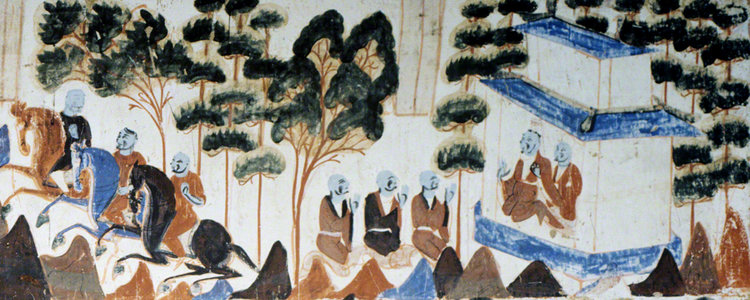
One remarkable representation of these Jataka tales can be found in a Dunhuang mural. Located on the eastern wall of Mogao Cave 428, this mural intricately portrays a renowned Jataka tale featuring Prince Mahasattva. The entire narrative is depicted across three registers, capturing the essence of the story within its captivating artwork.
Detail of the three princes paying their respects to the king and queen before they leave for the forest. First register, right section. Mogao Cave 428. Northern Zhou, 557-581 CE. Dunhuang. Image courtesy of the Dunhuang Academy.
The mural commences on the right-hand side of the first register, where a captivating scene unfolds. Three young men, their hands pressed together in a gesture of genuflection, kneel before a majestic blue pagoda. Inside the pagoda, two figures exuding regal aura can be identified as the king and queen, bidding a heartfelt farewell to their sons, the three young men.
As the story progresses, the mural transitions to subsequent scenes, unveiling the brothers’ journey into the forest for a hunting expedition. Within this vibrant forest setting, an array of deer and tigers roam, coexisting with the majestic presence of towering trees and majestic mountain ranges. The undulating mountains, adorned with a multitude of colors, gracefully assume a smaller scale compared to the trees, animals, and human figures, harmoniously framing each scene of the narrative.
Detail of the three princes hunting in the forest. First register, middle section. Mogao Cave 428. Northern Zhou, 557-581 CE. Dunhuang. Image courtesy of the Dunhuang Academy.
The story unfolds on the second register, commencing from the left-hand side. As the three brothers venture deeper into the forest, they eventually dismount from their horses, seeking respite at the foothills of towering mountains.
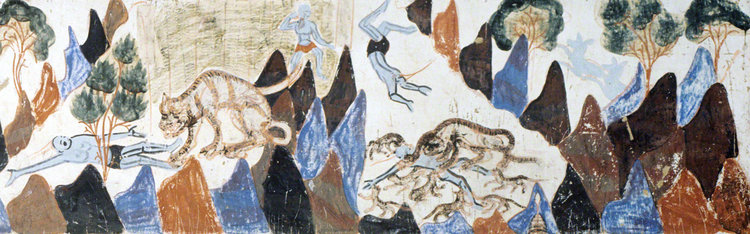
While taking a moment to rest, the brothers catch sight of a tigress accompanied by seven adorable cubs. The tigress is portrayed with her mouth agape, and her painted figure exudes a somber aura with limbs hanging low. Her gaze fixates upon the playful cubs frolicking around her, creating an illusion of impending maternal aggression, as if she were poised to devour her own offspring.
Detail of the starving tigress and her baby cubs. Second register, middle-left section. Mogao Cave 428. Northern Zhou, 557-581 CE. Dunhuang. Image courtesy of the Dunhuang Academy.
The brothers convene to discuss the matter of the tigress. Not wanting to watch a mother devour her own children, the brothers resolve to help her find food. However, there does not appear to be any food nearby.
Prince Mahasattva suddenly comes up with an idea. He keeps it to himself and tells his two brothers to leave the forest to find some food while he stays behind to watch over the tigers.
After his brothers leave, Prince Mahasattva strips off his clothes and lies down in front of the tigress, offering himself to the tigress. He decides to offer himself as food for the tigress so that she wouldn’t have to eat her own children.
The tigress sniffs at his body but makes no move to harm him even though she is starving.
When we offer help to someone and they are unable to accept what is offered, it’s a chance for us to feel good about having attempted goodness without losing anything. We can think to ourselves, well, we tried to help. In the case of Prince Mahasattva, he understood that good intentions alone would not save a life. It would take determined and complete self-sacrifice to save the tigers.
Realizing that the tigers will not eat him alive, Prince Mahasattva climbs to the edge of a cliff, cuts open his neck and throws himself off the ledge. With his neck bleeding profusely, his body drops in front of the tigress and her cubs. At Prince Mahasattva’s second attempt to offer his body, the tigers devour him as nourishment.
Detail of the Prince Mahasattva’s sacrifices to the tigers. Second register, right section. Mogao Cave 428. Northern Zhou, 557-581 CE. Dunhuang. Image courtesy of the Dunhuang Academy.
Snaking across and down the three registers, the story continues on the third register by beginning on the right-hand side again. Prince Mahasattva’s brothers return and they understand what happened in their absence when they see the bones left behind by the tigress and her cubs.
The brothers’ bodies contort across the scene in shock, anguish, and grief in reaction to the death of their third sibling.
Detail of the grieving brothers and their return to the palace. Third register. Mogao Cave 428. Northern Zhou, 557-581 CE. Dunhuang. Image courtesy of the Dunhuang Academy.
The two brothers practically fly back to the palace on their horses to tell the king about what happened to Prince Mahasattva.
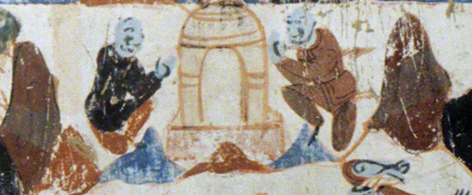
The story actually ends on the topmost right corner of this image, returning to the place where the two princes found their brother’s corpse. After reporting to the king, the family builds a stupa over Prince Mahasattva’s bones and hair to commemorate his selfless actions.
Detail of the brothers building a stupa over Prince Mahasattva’s remains. Third register. Mogao Cave 428. Northern Zhou, 557-581 CE. Dunhuang. Image courtesy of the Dunhuang Academy.
Many of the Mogao caves at Dunhuang have central pillars that take after the stupa form.
Scholars have theorized that worshippers could have circumambulated these central pillars inside the Mogao caves at Dunhuang as one would do around stupas in the open air.
The central pillar in Mogao Cave 428. Northern Zhou dynasty. 557-581 CE. Dunhuang. Image courtesy of the Dunhuang Academy.
From Kindness A Treasury of Buddhist wisdom for Children and Parents By Sarah Conover
Long ago, during the time of the Buddha, lived a boy named Chundaka. Chunda-as he was fondly called–was a happy and good youngster, but unable to learn to read or write. In comparison, Chunda’s older brother became quite knowledgeable, with a keen interest in Buddhism. When the older brother decided to lead a monk’s life, Chunda followed along. He sought to live near his brother; but secretly, he also hoped to work alongside the monks and learn about Buddhism.
“Why don’t you ask the Buddha if you can become a monk, too?” his brother encouraged. But Chunda had no confidence. “Brother, how can I?” Chunda sadly replied. “I can’t memorize, and I can’t read or write. I have no knowledge of scriptures, and I won’t be able to learn them. A monk must be able to teach others many things.” But his brother assured him that both riches and knowledge were meaningless to the Buddha.” He values only the compassion we have for one another and the ways to help all creatures suffer less. No one is as gentle and kind as he is. I know he will not disappoint you, Chunda. Go and hear for yourself,” prodded his brother hopefully.
So Chunda mustered all his courage. He bathed and purified himself. When he was certain he was quite ready, he approached the Buddha. The Buddha observed that this humble young man had an earnest and pure heart. He could see that Chunda would try his very best. The Buddha welcomed him as the newest monk in the community. The next morning, Ananda, head of all the monks, gave Chunda a small scripture to memorize, just 6 lines long. It was the first of hundreds that each monk was expected to learn by heart. But a week later, having tried his hardest, poor Chunda could still not recite it from beginning to end. Completely disheartened, he went back to the Buddha and admitted his failure.
But the Buddha was not greatly disappointed; he had total faith in Chunda’s good intentions. The Buddha and Chunda sat thoughtfully together in silence. An idea suddenly occurred to the Buddha. “Chunda, are you a hard worker?” asked the Buddha.”Do you think you can sweep the temple and keep it spotlessly clean?” “Oh yes, Buddha I’m a good worker, and I’m very good at sweeping. I just cannot seem to learn scripture.”
So the Buddha gave Chunda the task of keeping the temple perfectly clean. He was to hold no other job but temple sweeper. The Buddha then requested that Chunda speak two lines while sweeping: remove all dust, remove all dirt. But as soon as poor Chunda attempted his task, the words completely vanished from his mind. Luckily, Ananda overheard the Buddha’s instructions and could help Chunda remember them over and over again.
At last, a month later, Chunda had it learned by heart.”Remove all dust,” the monks heard Chunda whisper with the sweep of the broom. “Remove all dirt, he murmured with the return sweep. Behind Chunda’s back, the other monks snickered at his memory problem. More than a few took some pride in the extent of their learning. Day and night Chunda poured his heart into his work, repeating those six words again and again. Eventually, however, over time every monk couldn’t help but admire Chunda’s perseverance. They had never witnessed such single-minded determination. In time, the few words that the Buddha had given him to memorize became more and more meaningful to Chunda. His chores became a meditation upon the words.
Chunda’s curiosity deepened, and he suspected that the Buddha knew all along that these words were not as simple as they first appeared. “Did my teacher want me to sweep outer dust and dirt or inner dust and dirt?” he wondered. “What is inner dirt? How would one go about cleaning inner dirt?” he asked himself many times. Some months later, Chunda found the answers to these questions himself. While he worked, insight nudged its way into his heart. Once in awhile now, the monks saw Chunda thoughtfully pausing from his endless task, leaning against his broom and looking at the far off horizon. At last a day came when Chunda felt ready to discuss his thoughts with the Buddha. “Venerable sir” said Chundaka enthusiastically, “I think I finally understand the real meaning of the words you gave me.” “Please tell me what you understand,” encouraged the Buddha. “I believe that inner dust and dirt is a grasping, said Chunda. “If we don’t like something in our lives, we grasp for a different situation. But if we really like something that we have, then we also grasp because we don’t want it to change.” Chunda continued, “To look at life clearly, we must always see through this. We must sweep the dust and dirt away and keep our inner temple clean.” The Buddha smiled warmly at Chunda’s thoughtful words.
And so, as the years passed, Chunda swept and meditated and thought deeply. He found he did not have to memorize scriptures as the other monks did, for teachings seemed to arise from within. After a time, he became known as one of the wise and gentle teachers of Buddhism, affectionately called “Chundaka, the Broom Master.” He lived a long and happy life. And for many years people journeyed to the monastery from distant places, not just to hear from the learned monks, but to listen especially to Chundaka, the Broom Master. He was their favorite, loved for his very simple, yet very wise sayings.
Once, I had the privilege of listening to a pre-recorded dharma discourse by the esteemed H.H. Dorje Chang Buddha III. During this enlightening session, His Holiness shared a captivating story that left a profound impact on my mind. It was the tale of Kumarajiva, a legendary figure who demonstrated his profound inner realization by consuming needles. Intrigued by this extraordinary account, I felt compelled to delve further into the remarkable life of Kumarajiva.
Kumārajīva was a Buddhist monk, scholar, missionary and translator from the Kingdom of Kucha (present-day Aksu Prefecture, Xinjiang, China). Kumārajīva is seen as one of the greatest translators of Chinese Buddhism. According to Lu Cheng, Kumarajiva’s translations are “unparalleled either in terms of translation technique or degree of fidelity”.
Kumārajīva settled in Chang’an during the Sixteen Kingdoms era. He is mostly remembered for the prolific translation of Buddhist texts written in Sanskrit to Chinese he carried out during his later life.
At Chang’an, Kumārajīva was immediately introduced to the emperor Yao Xing, the court, and the Buddhist leaders. He was hailed as a great master from the Western regions, and immediately took up a very high position in Chinese Buddhist circles of the time, being given the title of National Teacher. Yao Xing looked upon him as his own teacher, and many young and old Chinese Buddhists flocked to him, learning both from his direct teachings and through his translation bureau activities.
Kumārajīva appeared to have a major influence on Emperor Yao Xing’s actions later on, as he avoided actions that may lead to many deaths, while trying to act gently toward his enemies. At his request, Kumārajīva translated many sutras into Chinese. Yao Xing also built many towers and temples.
Yao Hsing was so impressed with Kumarajiva’s political acumen, intellectual talent and spiritual depth that he was impelled to try a eugenic experiment. He insisted that Kumarajiva move out of the monastic community into a private house staffed by female attendants. Yao Hsing believed that the offspring of Kumarajiva and carefully selected maidens would be as brilliant and talented as their father. Although Kumarajiva was repelled by the experiment, he refused to jeopardize the welfare of the translation centre by refusing to obey his emperor. He complied with Yao Hsing’s orders but was concerned about the effect his actions might have on the monastic community. He likened himself to a lotus growing out of the mud and enjoined the monks to attend to the lotus and ignore the mud.
However, it is widely understood that monks are expected to adhere strictly to the rules and precepts, diligently purifying their bodies and minds while maintaining purity in their six senses. Deviating from these principles, particularly by engaging closely with women and disregarding the precepts, can hinder the attainment of positive outcomes. Consequently, doubts began to arise among the Sangha regarding Kumarajiva’s integrity, leading to a decline in the commitment of some disciples to uphold the essential Buddhist rules.
When Kumarajiva became aware of the troubling trend spreading among the monks, he could not afford to be complacent. In response, he summoned all his disciples to gather before him, determined to address the issue head-on.
Before the perplexed audience, Kumarajiva unveiled a bowl filled with silver needles, their sharpness and gleaming appearance catching everyone’s attention. The monks were left wondering about the purpose behind Kumarajiva’s display.
In a solemn tone, Kumarajiva addressed his disciples, saying, “Not every monk is qualified to enter into worldly attachments and establish households. If you can swallow these silver needles as I do, then I will consider granting you permission to marry and have children. However, if you are unable to do so, you must never attempt to follow in my footsteps.”
Having spoken these words, Kumarajiva proceeded to place each silver needle into his mouth, consuming the entire bowl with a composed ease. The supernatural power exhibited by Kumarajiva left the assembled monks awe-struck, their eyes widened in astonishment. In the end, they were all convinced by Kumarajiva’s demonstration, believing him to be the true successor endorsed by the Buddha.
With this act, Kumarajiva showcased the potency of the correct Buddha Dharma. Consequently, no one dared to criticize him from that point forward. Instead, they committed themselves to diligent practice, upholding the precepts, engaging in self-cultivation, and abandoning any fantasies of pursuing worldly desires.
The community perceived Kumarajiva’s actions as an exemplification of self-sacrifice in the pursuit of the Bodhisattva Ideal, despite the disappointment he experienced due to the children of Yao Hsing’s experiment falling short of his grand expectations.
The nectar formed a Dharma cloud along with more than 200 sariras of various colors at the time that On the Buddha’s Birthday in 2001, H.H. Dorje Chang Buddha III held Dharma assembly
By henghsing Gyatso Rinpoche
Although I am an ordinary RINPOCHE without any deep realization, nevertheless, I am very fortunate to have visited many Rinpoches. I have sought instruction from Great Dharma King Yangwo Yisinubu and from famous Rinpoches, such as Panchen Lama, Dalai Lama, Karmapa, Bo Mi Qiang Ba Luo Zhu, Dorje Losang, Dilgo Khyentse, Jiang Gong Kang Qin, Jiang Gong Kang Ce, Ga Wang, Zong Nan Jia Chu, Chuang Gu, Xia Ma, Hsi Jao, Bei Lu Qin Zhe, Tai Xi Du, Heng Sheng, Jia Cha, and Kalu. Especially with respect to nectar, I have a detailed understanding.
In general, nectar can be divided into five types: Most Precious Nectar, Great Precious Nectar, Long Life Nectar, Vajra Nectar, and Bodhi Nectar. These different types of nectar can also be divided into two different types: nectar that comes from sacred Dharma practice and nectar that comes from exoteric Dharma practice. There are several different types of nectar within the category of nectar that comes from sacred Dharma practice, depending upon the different manifestations of Dharma by each Buddha. Nectar resulting from exoteric practices is most prevalent in contemporary Vajrayana Buddhism. Basically, any Rinpoche can practice the Dharma to produce such nectar. Medicine or food is mostly used. Added to and mixed together with the medicine or food is sharira or a Dharma object that has been empowered. This is then made into powder to make pills. This powder is then empowered through practice of the Dharma and the recitation of mantras to become various types of nectar. Nectar that comes from exoteric Dharma practice is mostly used for empowerment, curing illnesses, and other reasons.
Nectar that comes from sacred Dharma practice is totally different from nectar that comes from exoteric, ordinary Dharma practice. The degree of empowerment from nectar that comes from sacred Dharma practice as compared with nectar that comes from exoteric Dharma practice is as different as ten thousand miles and one footstep. No words could adequately praise the nectar that comes from sacred Dharma practice. Ordinary Rinpoches and ordinary Dharma Kings who have been conferred such titles by the world cannot successfully practice the sacred Dharma to invoke nectar. Only those who are true Buddhas, or incarnations or transformations of Great Bodhisattvas, can successfully practice such Dharma. In the sacred Dharma practice to invoke nectar, the Dharma King conducting the practice will assemble over 100 Rinpoches to form a mandala. Gold, silver, and other precious items will be burnt as offerings. The Great Dharma King will then practice the holy Inner-Tantric Dharma to invoke the Buddhas and Bodhisattvas to bestow nectar from the realm of the Buddhas. The Buddhas will assemble in the sky or will enter the mandala area. This holy scene will be seen by all of the more than 100 Rinpoches in attendance.
White Bodhi Nectar
At this time, the Buddha who corresponds to the particular nectar that is being invoked will descend. The appearance of that particular Buddha and its bestowing of nectar can be seen. There will be the emission of light and the manifestation of supernormal states when the nectar descends into the bowl. This Dharma bowl must first be thoroughly washed and must be empty. There is absolutely nothing in this world which has the mysterious and changeable shape of the nectar that descends into the bowl. It is exactly as what is described in the book Know the True Doctrines. According to people of great virtue, only this type of sacred nectar is true nectar. According to Tibetan tantra, nectar is the holy material used for initiations. No matter what type of initiation is performed, nectar must be used. Especially for the supreme yoga initiations, true nectar is an absolutely indispensable material for the initiation Dharma water. True nectar represents the causative factor that raises one from the ordinary world to the realm of the Buddhas. If true nectar is not used as the basis for an initiation, such as when man-made nectar created from medicine is used to empower, then such initiation is not an Inner-Tantric Sacred Dharma Initiation. Therefore, according to tantra, nectar is fundamental for liberation. Determining whether a Dharma King is the incarnation of a Buddha or Great Bodhisattva mostly depends upon whether he or she has the depth of realization to successfully practice the nectar Dharma. Can he or she commune with the Buddhas and successfully invoke them to bestow nectar? Any explanation other than this, no matter how many times said, is merely empty talk. This includes explanations such as, “I am the heir to a certain spiritual legacy… Since childhood, I have been officially recognized as a Holy One and have been so for many lives…. I am a Dharma King recognized by a certain Great Rinpoche…I am the head of a certain great temple.” This only proves that they are Rinpoches according to worldly regulations and teachings. Of course, they can save living beings. However, such explanations definitely do not prove that they are able to represent the sacred essence of the supreme tantra. Nevertheless, one cannot dismiss such people. They are persons of great virtue. It is simply a matter of different levels of attainment.
When visiting Rinpoches, I would speak of this matter of the Buddhas bestowing true nectar. Some Rinpoches who do not have the ability to successfully invoke true nectar become quite unhappy when this subject is raised. I think that this is not a big problem. If you think that you are a Great and Holy Dharma King or a Great Rinpoche, then conduct a Nectar Dharma Assembly in order to prove that you are someone whom living beings can fall back upon. Let everybody see that you have the Buddha Dharma within you and that the Buddha Dharma is true. This is saving living beings! Otherwise, use empowered medicine as nectar and save living beings while cultivating yourself with a heart of humility!
I would like to raise the following question for everybody’s consideration. Are the Dharma Kings who successfully invoke the Buddhas to bestow nectar in front of everybody able to represent the Buddhas and Bodhisattvas or are the Dharma Kings who only speak empty words able to represent the Buddhas and Bodhisattvas? This question is worthy of deep consideration! I and many people of great virtue believe that those who can commune with the Buddhas and Bodhisattvas are definitely Great Dharma Kings. Those who can only reach ordinary states are ordinary Rinpoches!
Emperor Fu-Chien (337-385), also known as Fu-Jian, became increasingly interested in Buddhism. In 379, he conquered the city of Hsiang-yang and invited Tao-an to establish his renowned center for the translation of Buddhist scriptures and texts in the capital of Ch’ang-an, which Fu Chien fully supported. Tao-an, impressed by Kumarajiva’s spiritual, philosophical, and linguistic abilities, urged Fu Chien to invite him to Ch’ang-an. However, the warlord-emperor, in his aggressive manner, dispatched Lu Kuang with an army to conquer Kucha and capture Kumarajiva. Kucha fell to Lu Kuang, and Kumarajiva willingly accompanied the conquering general to Ch’ang-an in 383.
Then, a series of unexpected events occurred. Tao-an died in 385, and six months later, the Yao family attacked and conquered Ch’ang-an, killing Fu Chien. The new dynasty continued the policies of the previous rulers, such as preserving Tao-an’s translation center and promoting Buddhist studies, eagerly anticipating the arrival of Kumarajiva in the capital. Lu Kuang, upon hearing of the conquest of Ch’ang-an, halted his return and declared himself independent, establishing a state known as Later Liang with its center at Ku-tsang. Although Lu Kuang was not a Buddhist and did not care for spiritual matters, he recognized the political value of Kumarajiva.
Lu Kuang held Kumarajiva captive for sixteen years, subjecting him to numerous indignities while also using him as a military adviser. During this time, the rulers of Ch’ang-an pleaded for his release, but to no avail. Kumarajiva found this period of his life difficult and frustrating, as he was mocked for his beliefs and practices and could not pursue the work he felt destined to do. Despite this, he did not become passive or disheartened. Instead, he used this time to learn about China from the rugged soldiers who had traversed much of the country. He also quietly gathered texts to take with him to Ch’ang-an and thoroughly mastered the Chinese language.
Eventually, Yao Hsing, the second ruler of the new dynasty at Ch’ang-an, grew tired of fruitless negotiations with Lu Kuang and took a daring risk. In 401, his armies attacked and conquered Ku-tsang (in present-day Afghanistan). Kumarajiva was rescued unharmed, and in 402, he was welcomed into Ch’ang-an. He finally realized a dream he had conceived in his twenties, but it took until his fifties to come to fruition.
An artist’s impression of a translation session
Kumarajiva was warmly received by Yao Hsing, who bestowed upon him the title Teacher of the Nation. The fruitful phase of his life, which has profoundly influenced Chinese Buddhist tradition from the moment he entered Ch’ang-an to the present day, began with his arrival and lasted barely a decade. Within six days of taking up residence in his new home, he accepted the suggestion of a monk named Seng-jui, later one of his chief disciples, and began to translate a text on meditation, the Tso-ch’an san-mei ching. He found that the translation centre founded by Tao-an had been preserved and supported by Yao Hsing, and he marvelled at the quality of the work his predecessor had undertaken. He found himself surrounded by an enormous group of knowledgeable monks who were ready to continue the work of translation under his guidance. He rapidly reorganized the centre so that new translations could be made even while the accomplishments of the previous generation could be reviewed and revised. Within the next few years he translated almost fifty works in about three hundred volumes.
Like Tao-an, Kumarajiva thought that the ko-i or ‘matching the meaning’ method of translation, in which unfamiliar Sanskrit Buddhist concepts were replaced by well-known Chinese Taoist words, compromised Buddha’s teachings. A review of Tao-an’s work convinced him, however, that too strict an insistence on literal translation, sometimes requiring the creation of awkward neologisms, rendered beautiful texts obscure. His belief that a translation should accurately convey the tone and texture of a teaching inseparably from its content compelled him to adopt a new methodology for translation. He chose to emphasize the central theme of a text or treatise and to edit passages which would seem unnecessarily repetitive to Chinese readers. Once he had arranged the working force at his disposal to his satisfaction, he would read a text aloud, sentence by sentence, before a large congregation. Yao Hsing would often attend these sessions, and sometimes he held the original palm-leaf manuscript in his own hands while Kumarajiva explained it. After each sentence, Kumarajiva explained its meaning and offered an oral translation in Chinese. The congregation would comment on the results and suggest improvements. Meanwhile, a recorder would write down the approved translation, and later an editor would review the whole text for style and internal consistency. Finally, a calligrapher would correct the Chinese ideographs to be sure there were no ambiguities in transmission of the texts.
Kumarajiva’s influence was not limited to the so-called barbarous kingdoms of northern China. In 378 Hui-yuan, one of Tao-an’s chief disciples, had gone south and made his abode in a monastic community at Lu-shan, a mountain famous amongst Taoists, Confucians and Buddhists for its majesty and mystery. Within a few years, he became the informal leader of the Southern Chinese Buddhist community. Shortly after Kumarajiva’s arrival in Ch’ang-an in 402, Hui-yuan wrote to him and encouraged him to continue the work of Tao-an. A year later, hearing that Kumarajiva might return to Kucha, he wrote again, strongly urging him to remain in China. During the next few years the two monks exchanged letters on philosophical and monastic subjects, and eighteen of these exchanges survive. Hui-yuan enquired about many issues, but he was most interested in gaining a clear understanding of the dharmakaya, the highest vehicle of a Buddha. Kumarajiva distinguished between dharmakaya, the ultimate body of Buddha, and dharmadhatujakaya, the invisible body consciously evolved by a Bodhisattva to serve humanity in the world even after physical death. Thereby he showed how that which is ultimately real is reflected in subtle material form through one-pointed and universal consciousness. In these letters answering questions posed by a serious disciple of buddhadharma, one can glimpse something of Kumarajiva’s own profound insight and understanding. In general, he preferred to remain hidden behind the lustre of his translations and refrained from writing treatises setting out his own views.
Seng-jui is said to have rejoiced after attending a translation session with Kumarajiva, because for the first time he caught a glimmer of understanding of the enigmatic concept of shunyata. The collective work of Kumarajiva and his colleagues produced texts which were readable, comprehensible and inspiring. After a millennium and a half his translations are still read and studied, and they are often used as the basis for new translations into other languages, including English. Even though he translated a range of sutras and commentaries from a variety of Buddhist teachings, such as the Prajnaparamita literature, the Vimalakirti Sutra and the Surangama Sutra, his most famous and influential work was his powerful rendition of the Lotus Sutra, known in Sanskrit as the Saddharma Pundarika Sutra and in Chinese as Miao-fu lien-hua. In it one finds harmoniously combined Kumarajiva’s astounding linguistic facility and his profound grasp of the scope and depth of buddhadharma. Perhaps less obvious to the modern reader is the remarkable support Yao Hsing gave to this sort of project. Also, Kumarajiva never hesitated to point out the enormous support he received from knowledgeable and enthusiastic monks who worked together with an exemplary spirit of harmony and cooperation.
Golden copy of the “Universal Gateway”, Chapter 25 of the Lotus Sutra kept in Taiwan National Palace Museum. One of the many excellent works of Kumarajiva
Within just 11 years, Kumarajiva and his team translated 384 volumes, including sutras, commentaries, and other Buddhist texts. Since that time, his translations have been held in high regard by modern scholars due to the smooth flow of the work which conveys deeper meaning than just literal rendering. If it wasn’t for Kumarajiva, many of the great Mahayana texts may not have been preserved until today.
The major scriptures translated by Kumarajiva between 401-413 CE include:
Smaller Sukhavati-vguha (Amitabha Sutra) in 1 volume, 402 CE
Vajracchedika Prajnaparamita Sutra (Diamond Sutra) in 1 volume, 402-412 CE
Satyasiddhi Shastra, (Treatise on the Completion of Truth) in 20 volumes, 402-412 CE
Mahaprajnaparamita Upadesha (Treatise on the Great Perfection of Wisdom Sutra) in 100 volumes, 402-405 CE
Shatika-shastra (Treatise in One Hundred Verses) in 2 volumes, 404 CE
Sarvastivadin Vinaya (Ten-Category Vinaya) in 61 volumes, 404-409 CE
Panchavimshati Sahasrika Prajnaparamita Sutra (Perfection of Wisdom Sutra in Twenty-five Thousand Lines) in 27 volumes, 404 CE
Vimalakirti Nirdesha Sutra (Vimalakirti Sutra) in 3 volumes, 406 CE
Astasahasrika Prajnaparamita Sutra (Perfection of Wisdom Sutra) in 10 volumes, 408 CE
Madhyamaka-shastra (Treatise on the Middle Way) in 4 volumes, 409 CE
Dvadashamukha Shastra (Treatise on the Twelve Gates) in 1 volume, 409 CE
Maitreyavyakarana Sutra in 1 volume
Shurangama-samadhi Sutra in 2 volumes
Karunikaraja Prajnaparamita Sutra in 2 volumes
Brahmajala Sutra (Brahma Net Sutra) in 2 volumes
Saddharmapundarika Sutra (Lotus Sutra) in 8 volumes
Dasabhumikavibhasa in 17 volumes
Temple Dedicated for Kumarajiva in WuWei, China
Pagoda enshrining Kumarajiva‘s Tongue Relics
On his deathbed, Kumarajiva prophesied to his closest disciples that his cremation would serve as a criterion of his success as a translator. If he had made errors – a possibility he was always willing to acknowledge – his entire body would be consumed by the funeral flames. However, if he had not erred, then his tongue would remain untouched by the fire. His disciples testified that his tongue survived the cremation of his body unharmed. This precious tongue relic is now preserved at the Kumarajiva Temple, located in Wuwei, in northwest China’s Gansu Province. It is the only temple in the world named after Kumarajiva. Additionally, the Kumarajiva Pagoda, built in the 4th century, was an important structure on the Silk Road. The elegant 12-storey brick pagoda was destroyed during a great earthquake in 1927, but was later rebuilt.
The judgement of history concurs with Kumarajiva’s disciples: his work became the backbone of the grand organic edifice of Buddhist thought and teaching that arose in China, even as the buddhavachana began to wane in India. Kumarajiva gave his life to a sacred mission, the full significance of which his contemporaries could not fathom. However, they correctly sensed from the magnetic force of his presence that subsequent generations would benefit immensely from his selfless service.
Kumarajiva’s translations were instrumental in the development of Buddhism in China, as he was able to transmit the true meaning of Buddhism through his works, which contributed to the development of schools such as the Pure Land, Tian Tai, San Lun, and many others. His translated sutras were always considered central to their principal readings.
The Yungang Buddhist grottoes, a massive complex comprising 252 caves and niches with 51,000 statues carved into an area of 18,000 square meters, are a remarkable achievement of Buddhist cave art in China. Constructed from the mid-5th to early-6th century AD, the grottoes were influenced by Buddhist cave art from South and Central Asia but also incorporated distinct Chinese elements and local spirit. They played a crucial role among early Oriental Buddhist grottoes and had a far-reaching impact on Buddhist cave art in China and East Asia.
The five caves of Tanyao and their imperial patronage
The construction of Yungang began with five cave-temples, known today as caves 16 to 20, at the west end of the cliff. These caves were imperial commissions of the Northern Wei dynasty in around 460 C.E. The Northern Wei rulers, who belonged to the Tuoba clan from northern China, had recently unified northern China after centuries of political turmoil and established Buddhism as the state religion. The dynasty’s capital, Pingcheng, became a significant center for Buddhist religious and artistic expression.
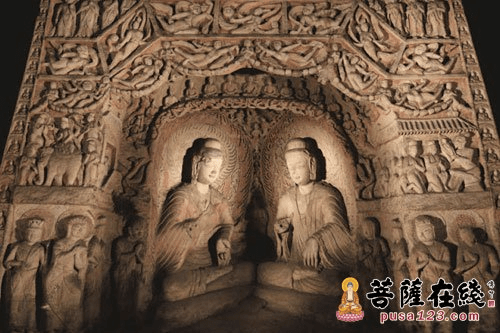
The five caves of Tanyao, created by Tan Yao, are classical masterpieces of the first peak of Chinese art, displaying a strict unity of layout and design. These caves each contain a colossal Buddha as the central icon, with Cave 20 housing a gigantic seated Buddha in a meditation posture and a standing attendant Buddha on one side. Another attendant Buddha likely existed on the other side, but it has been lost along with the cave’s exterior wall. The imperial patronage of these caves reflects the Northern Wei dynasty’s fusion of state power and religious devotion.
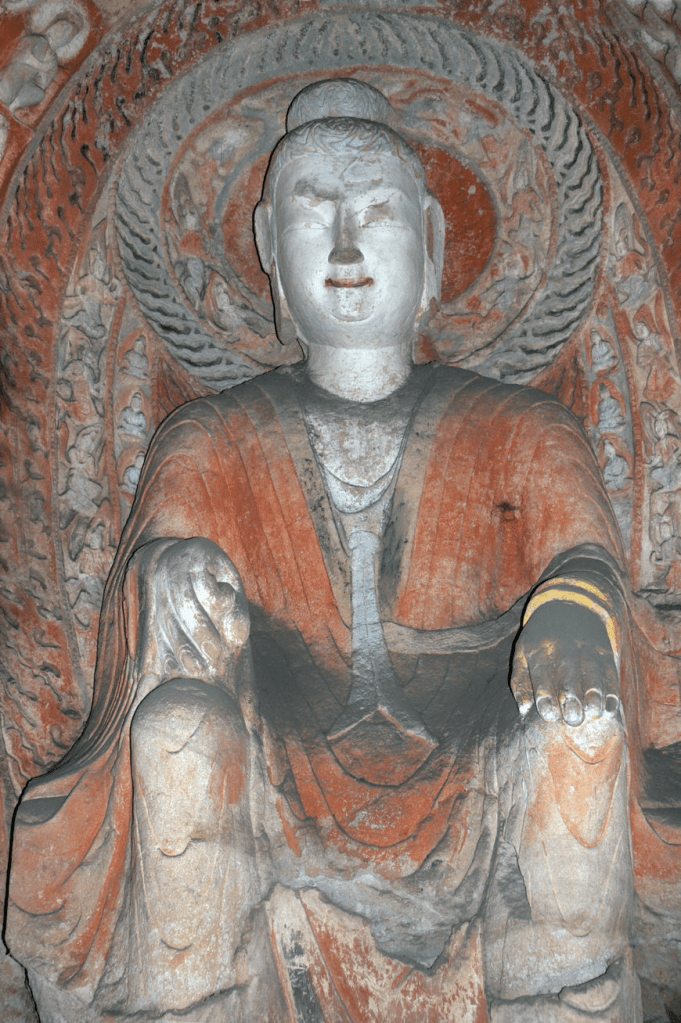
Buddha, Cave 20 at Yungang, Datong, China (photo: xiquinhosilva, CC BY 2.0)
The main Buddha measures roughly 13 meters in height. He has plump cheeks, a thick neck, elongated eyes, a sharply cut nose, slightly smiling lips, and broad shoulders, all of which produce a solemn appearance.
The well-preserved halo behind the main Buddha is composed of an outer band of flame patterns and two inner bands decorated with seven seated Buddhas of miniature size. The robe features zigzag patterns on the edge. The right shoulder of the main Buddha is left exposed, whereas the standing attendant Buddha on the east wall wears a robe that covers both shoulders with a high neckline.
Historical records recount that Tanyao, a renowned monk cleric with official ranks, advised Emperor Wencheng to undertake construction of five cave-temples (Caves 16–20) to commemorate the five founding emperors of the Northern Wei dynasty. Claiming that the emperor of Northern Wei was the living Buddha, this project declared the emperor’s political and spiritual legitimacy, and strengthened the rule of the imperial family.
Buddha (left) and attendant Buddha (right), Cave 20 at Yungang (photo: xiquinhosilva, CC BY 2.0)
The statues housed in the caves and niches are in good condition and all of the caves and statues have not suffered major damage from vandalism and/or natural disasters. Restoration and repair had been made on deficient parts of some statues in the past. All the necessary attributes demonstrating the Outstanding Universal Value of Yungang Grottoes are contained within the boundary of the property area. The buffer zone provides a necessary safe area for the conservation of the Grottoes, the setting and the historic environment. These measures have enabled the Yungang Grottoes to serve as one of the greatest ancient stone carving art treasure houses in the world.
The location, caves and statues of the Yungang Grottoes have retained their historic appearance. The eaves of wooden pavilions of the caves and the related historical remains have kept the distinctive character of the times when they were constructed. The daily maintenance and conservation intervention have been conducted following the conservation principle of minimal intervention in design, materials, methodology, techniques and craftsmanship.
The cross-legged Bodhisattva Maitreya, on the east wall of the antechamber of Cave 9, phase II, Yungang Grottoes, Datong, China (photo: G41rn8, CC BY-SA 4.0)
The paired caves and the major development at Yungang
Beginning roughly a decade after the initial commission, the imperial projects at Yungang advanced to a second phase that lasted from c. 470s until 494 C.E. In contrast to the monumental Buddha found in Cave 20, the interior of the second-phase cave-temples are decorated with reliefs that depict Buddhas, bodhisattvas, and other divine figures in various scales and configurations.
One of the most distinctive features developed in the second phase of construction are paired caves—two adjacent caves featuring a similar architectural plan and pictorial program. The paired cave-temple layout is understood to symbolically represent the reign of two coincident rulers: Emperor Xiaowen (471–499 C.E.) and Empress Dowager Wenming (442–490 C.E.). The use of paired cave-temples became another means to demonstrate the dynasty’s imperial power.
The paired Caves 5 and 6 are among the most lavishly decorated cave-temples at Yungang. Cave 6 has an antechamber and a square main chamber supported by a central pillar (see the full cave 6 in 3D). A square clerestory (window) is opened right above the passageway to the main chamber to let in light (although it is hard to see in photos or the 3D image).
In the main chamber of Cave 6, the east, south, and west walls are divided vertically into three main registers that include complex pictorial programs (the north wall features a large niche housing a trinity of Buddhas that are later repairs). We find seated Buddha figures and scenes from the Buddha’s life throughout the chamber. Depictions of the historical Buddha, who was believed to live in the Ganges River basin during the 6th century B.C.E., derived largely from Buddhist texts. The Buddha’s biography details the course of his life from birth to enlightenment, and eventually to nirvana, the final extinction. The life of the Buddha was among the most popular themes for artistic representation throughout the Buddhist world.
The First Sermon of the Buddha at Deer Park, Cave 6, Yungang, Datong, China
One scene from the Buddha’s life (at the southern end of the east wall) shows the First Sermon of the Buddha at Deer Park, identifiable by the depiction of a pair of deer on the Buddha’s throne. We see a canopied standing Buddha flanked by two standing bodhisattvas and a myriad of worshippers in the background. Just below the standing Buddha niche, a seated Buddha with his right hand raised (the fearless gesture) can be seen in a trapezoidal-shaped niche flanked by two five-story pagodas (just visible at the edges of the scene in the photograph). Worshippers either kneel in front of the throne or stand facing the Buddha on his two sides.
Rock-cut cave-temples
Rock-cut cave-temples first appeared in western India in the 1st century B.C.E. There are two basic types: apsidal-shaped (semicircular) chaitya (sanctuary, temple, or prayer hall in Indian religions) and vihāra caves where monks resided—both of which we find at places like the caves of Ajanta, India. Both types were transmitted eastwards to Central Asia up to the 5th century with modifications of the structures. At Yungang, the sanctuary type was further adapted into a square shape that houses a central pillar in the middle, as we find in Cave 6. At the same time, a number of architectural features find their precedents in Goguryeo tombs from present-day northeastern China and North Korea.
But what facilitated these different traditions coming together at Yungang?
Transmissions and transformations of artistic styles
Yungang was a hub where multiple artistic traditions of South Asia, Central Asia, and pre-Buddhist China synthesized into something new. This was made possible by the Silk Road, a network of ancient trade routes linking East Asia with the rest of Eurasia. Goods and ideas have been exchanged along the Silk Road since at least the second century B.C.E. Central to the economic, cultural, and religious interactions between different parts of Eurasia, the Silk Road tied the Northern Wei territory to the sacred heartland of Buddhism in South Asia, and to Central Asian kingdoms that promoted Buddhist teachings.
A primary factor facilitating the encounter of these varied traditions was the gathering of human resources and materials from different regions. In the 430s and 440s, the Northern Wei court issued decrees that relocated artisans and monks from its conquered lands to the capital city of Pingcheng. The concentration of people and craftsmanship in the capital led to the artistic flourishing of well-executed Buddhist monasteries, cave-temples, sculptures, and murals. Eminent monks who were active in Pingcheng had also engaged with religious activities in other urban centers such as Chang’an and Wuwei, and maintained close ties with Central Asian Buddhist communities.
Just as the form of the rock-cut cave-temples was adapted from earlier traditions in South Asia, statues and reliefs at Yungang exhibit strong stylistic and iconographic affinities with earlier Buddhist art traditions from northwestern India and Central Asia. For instance, the main colossal Buddha images in Caves 16 to 20 feature a round face, with a gentle, calm expression that creates an impression of sanctity, and a robe style that clings tightly to the body yet is rendered with schematic patterns. All of these features echo the aesthetics found in previous traditions, especially the Buddhist sculptures in Gandhara, a Buddhist center located in present-day northwest India and Pakistan.
Yungang art exerted influence, in turn, on Central Asian cave-temples starting in the later 6th century, such as Dunhuang, indicating that a dynamic exchange took place among the major cultural centers along the Silk Road.
An iconic form of the Buddha, 2nd–3rd century C.E., Kushan period, Gandhara, schist, 19.76 x 16.49 x 4.56 inches (The British Museum)
Sinicization reforms under the reign of Emperor Xiaowen
One of the new developments shown at Yungang that would have a long-lasting effect on Chinese Buddhist art was Sinicization, a process of adapting non-Chinese traditions into Han Chinese culture. In Cave 1, between the canopy of the central pillar and the ceiling we find intertwined dragons surrounding mountains that represent Mount Meru (the sacred mountain considered to be the center of the universe in Buddhist cosmology). The design shows strong influence of the pre-Buddhist Chinese tradition in two aspects. First, the dragons are depicted with typical Chinese conventions—a snake-like curving body with four legs. Mount Meru was not related to dragons in pre-Chinese Buddhist art traditions. The incorporation of dragons in the design reveals an integration of the motif’s symbolic reference to a spiritual life force in traditional Chinese beliefs.
Central pillar in Cave 1, c. 480s, Northern Wei, Yungang (photo: Zhangzhugang, CC BY-SA 3.0)
In Cave 6, we also see Sinicized traits in a new style of the Buddha’s monastic robe, which features loose drapery that falls around the body and clothes the Buddha entirely instead of the earlier style that clings closely to a partly exposed body. The new style finds parallel in the contemporary dress of court officials.
Overall, these new styles and motifs were a response to the political reform of Sinicization promoted by Emperor Xiaowen and Dowager Wenming during their reign in the Taihe era (477–499 C.E.). The reform aimed at legitimizing the Northern Wei regime, built by non-Chinese nomadic groups, as an imperial Chinese dynasty, and promoting a greater sense of conformity throughout the empire.
Buddha with Sinicized traits, Cave 6, Yungang, China (photo: Gisling, CC BY-SA 3.0)
The legacy of Yungang
Despite the move of the capital to Luoyang in 494 C.E., constructions at Yungang continued for another three decades. Cave-temples of this phase are much smaller in size than at the earlier western end of the complex. Over half a millennium later in the 13th century when Yungang was the capital of the Liao Dynasty, Yungang witnessed another era of glory, with restorations of the caves and installation of wooden structures attached to their façades. Yet it was only a temporary phenomenon. The site later stayed silent for centuries until its early 20th-century rediscovery along with other major cave-temples by foreigners on expeditions.
Modern scholarship about the history and the art of Yungang Cave-temples has continued to provide new information about the site. The most recent archaeological excavations at Yungang unearthed the remains of a monastery dated to the Northern Wei dynasty above the western section of the cliff. The well-preserved foundations of courtyards, the central stupa (a sepulchral monument that refers to the Buddha), residential cells for monks, and objects continue to enrich our understanding of the site as a significant religious center from the 5th century.
Here is one thing author Robert Wright and I agree on when it comes to Buddhist meditation: It’s really, really boring. At least, it’s boring in the beginning. But there is another thing we agree on, too. That initial meditative boredom is actually a door. It’s an opening that can lead us to something essential, and essentially true, that Buddhism has to teach us about being human.
Wright’s insight on this point is just one of the many truths in his delightfully personal, yet broadly important, new book Why Buddhism Is True.
The “true” in Wright’s title doesn’t refer to the traditional kinds of scriptural truths we think of when we think of religions and truth. Wright is explicitly not interested in the traditional aspects of Buddhism as a religion. The book, for example, makes no claims about reincarnation or Tibetan rainbow bodies or the like. Instead, Wright wants to focus on Buddhism’s diagnosis of the human condition. The part that is relevant to the here and now. It’s Buddhism’s take on our suffering, our anxiety and our general dis-ease that Wright wants to explore because that is where he sees its perspective lining up with scientific fields like evolutionary psychology and neurobiology.
To his credit, Wright is more than cognizant that exploring just these aspects of Buddhism means he is filtering out quite a bit of its history. As he reminds his readers:
“Two of the most common Western conceptions of Buddhism — that it’s atheistic and that it revolves around meditation — are wrong; most Asian Buddhists do believe in gods, though not an omnipotent creator God, and don’t meditate.”
Wright also acknowledges that even within this “scientific” Buddhism he is interested in, there are also enormous differences between various philosophical schools of thought, many with 1,000-year histories.
“I’m not getting into super-fine-grained parts of Buddhist psychology and philosophy,” he tells us.
“For example, the Abhidhamma Pitaka, a collection of early Buddhist texts, asserts that there are eighty-nine kinds of consciousness, twelve of which are unwholesome. You may be relieved to hear that this book will spend no time trying to evaluate that claim.”
I was happy to see Wright address these issues of history and interpretation head-on. No matter where Buddhism’s encounter with the West takes it, ignoring history doesn’t do anyone any good (I’ve tried to explore these issues myself here at 13.7 and elsewhere, including here and here).
But with those important caveats, Wright is then forceful in his main argument that “Buddhism’s diagnosis of the human predicament is fundamentally correct, and that its prescription is deeply valid and urgently important.”
To back up this claim, Wright leans heavily on evolutionary psychology, which he says, somewhat tongue-in-cheek, “is the study of how the human brain was designed — by natural selection — to mislead us, even enslave us.” That misleading and enslaving, however, is all in the service of getting our genes into the next generation. As he writes:
“Don’t get me wrong: natural selection has its virtues, and I’d rather be created by it than not be created at all — which, so far as I can tell, are the two options this universe offers.”
These lines give you hint of Wright’s tone throughout the book. He is very funny and uses his own experiences to drive to the book’s questions. In particular, it was his first experience at a week-long meditation intensive two decades ago that launched his journey into Buddhism and “contemplative practice” (i.e. meditation). His accounts of time spent on “the cushion” are full of self-effacing humor and real insights.
Wright’s main point is that evolution hardwires us with intense emotions that are in fact delusions. (He has discussed this in an interview with Fresh Air’s Terry Gross.) They developed as survival responses to the environments we evolved in and they were tuned to those environments. Now they just don’t make sense and need to be seen for what they are. As he puts it:
“These feelings — anxiety, despair, hatred, greed — … have elements of delusion, elements you’d be better off without. And if you think you would be better off, imagine how the whole world would be. After all, feelings like despair and hatred and greed can foster wars and atrocities. So if what I’m saying is true — if the basic sources of human suffering and human cruelty are indeed in large part the product of delusion — there is value in exposing this delusion to the light.”
According to Wright, Buddhism, at least its more contemplative side, offers specific insights into, and a path out of, these delusions. In particular, the direct experiences gained via contemplative practice can, he says, weaken the hold of these evolutionary once-needed delusions. In the process, Wright argues, we can all learn to wreak a little less havoc on ourselves and the rest of the world. As he puts it:
“There are other spiritual traditions that address the human predicament with insight and wisdom. But Buddhist meditation, along with its underlying philosophy, addresses that predicament in a strikingly direct and comprehensive way.”
That broad nonsectarian approach is an important part of Wright’s approach. Raised as a Southern Baptist, he left the church in his teens. But he doesn’t look back in anger. Perhaps that is why he isn’t arguing that people need to become a Buddhist to practice its truths. As he writes: “Asserting the validity of core Buddhist ideas doesn’t necessarily say anything, one way or the other, about other spiritual or philosophical traditions.” Later, he reminds us of the Dalai Lama’s admonition: “Don’t try to use what you learn from Buddhism to be a better Buddhist; use it to be a better whatever-you-already-are.”
Which takes me back to that whole meditation is boring (at least in the beginning) thing. One of the best parts of Wright’s book is its realism. No matter how many books you read on Buddhist insights into human beings, they won’t mean much unless you find yourself a regular practice. It’s the practice that counts. It’s the practice that slowly lets you see the delusion in our constant stream of desires and aversions. That is, after all, why they call it practice. Wright does an excellent job of unpacking this reality for his readers, demonstrating again and again how contemplative practice can lead to understanding and how understanding can lead to an important kind of freedom.
When his mother joined the monastery, it was said that Kumarajiva had already memorised many texts and sutras. Kumarajiva proceeded to learn the Dharma further and followed his mother into monastic life at the age of seven. When he was nine years old, mother and son undertook the arduous journey to India, eventually reaching the Kashmiri kingdom known to the Chinese as Chi-pin, which was probably his father’s native home. Bandhudatta, a renowned Buddhist teacher and cousin of the king, instructed Kumarajiva in the agamas (the nikayas of the Theravadin tradition). During the next two years Kumarajiva mastered these texts and was honoured by the king. Once he defeated several non-Buddhist teachers in a debate held before the ruler, and from this moment his reputation preceded him wherever he travelled. In addition to learning the scriptures and treatises of the Sarvastivadin school, Kumarajiva seized the opportunity afforded by his presence in India to study medicine, astronomy and astrology, exegetical and hermeneutical methods of exposition, logic and the applied sciences.
By the time Kumarajiva was twelve, he and his mother set out on the journey back to Kucha. The pace was leisurely, for every kingdom and principality along the way fêted and honoured him, and several urged him to take up residence as a teacher and adviser. As he was making his way through the mountains of the Yueh-chih region, he met an arhat who volunteered a prediction to his mother:
You must watch over and protect this novice. If by the time he reaches the age of thirty-five he has not abandoned the rules of religious discipline, he will become a great propagator of buddhadharma, enlightening countless people, and he will be the equal of Upagupta.
Upagupta was the fourth Indian patriarch after Buddha, famous for having converted the emperor Ashoka to the Buddhist way. Though Kumarajiva was forced by circumstances to break one vow late in life, he met the conditions of the prophecy and fulfilled the prediction.
Passing through Yueh-chih, Kumarajiva and his mother came to Kashgar, a Buddhist kingdom known for its excellent teachers and libraries. He settled there for a year and completed his studies of the Abhidharma and the texts revered by the Sarvastivadins. During this time he concentrated intently on Vedic literature and studied the most important systems of chanting the Vedas. Whilst he learnt a great deal about Hindu philosophical schools, he focussed upon the power of sound to affect the receptivity of consciousness to transcendental truths. The knowledge he gained later influenced his stirring translations of sutras and texts into Chinese. He also expanded his considerable grounding in Sanskrit and Pali and learnt more of the languages of Central Asia. On the advice of a monk, the king of Kashgar invited Kumarajiva to take the seat of honour and expound a sutra to a prestigious assembly which included the king himself. Kumarajiva did so, and as a result the monks of Kashgar were indirectly impelled to reform their previously lax monastic disciplines. At the same time, the king of Kucha heard of the high esteem in which Kumarajiva was held in Kashgar and sent a delegation to cement friendly relations between the two kingdoms.
While living in Kashgar, Kumarajiva met Sutyasoma, a prince of Yarkend (So-ch’e), perhaps as a result of his public discourse. Sutyasoma had renounced his royal inheritance and gone to Kashgar for spiritual instruction, and he was a revered teacher when he took Kumarajiva under his guidance. As a follower of Sarvastivadin doctrines, Kumarajiva held that the dharmas or ultimate constituents of existence are eternally real, whereas empirical phenomena which arise out of the momentary confluence of dharmas under karma are unreal. Sutyasoma adhered to the Mahayana view that all dharmas are themselves unreal; ontologically, dharmas are like empty space and assume distinct existence only in their momentary, ever-changing combinations. Although Kumarajiva initially found such teachings difficult to comprehend, Sutyasoma’s more universal application of Buddha’s doctrine of impermanence soon won him over to the Mahayana standpoint. Kumarajiva felt a tremendous sense of release and emancipation, declaring that he had been like a person who did not know what gold is and had previously taken brass for something wonderful.
Kumarajiva took up an intensive study of the sutras with the same enthusiasm he had brought to all his earlier training. He learnt the doctrines of the Madhyamika schools, memorized treatises by Nagarjuna and Aryadeva and rapidly assimilated Mahayana teachings. Just how fundamental a turning point Kumarajiva’s encounter with Sutyasoma was for his life is illustrated by his insistence that Bandhudatta, his first teacher in India, come to Kashgar. There Kumarajiva and Bandhudatta engaged in friendly but intensive debate, and eventually Bandhudatta was won over. During this time Sutyasoma foresaw something of the magnificent work Kumarajiva would undertake in China. Years after he left Kashgar, Kumarajiva recounted to his disciples in China what Sutyasoma once told him:
The sun of Buddha has gone into hiding behind the western mountains, but its lingering rays shine over the Northeast. These texts are destined for the lands of the Northeast. You must make sure that they are transmitted to them.
After spending a memorable year in Kashgar, Kumarajiva and his mother set out for Kucha. They stopped for a time in the kingdom of Wen-su and then moved on to their home. By the time Kumarajiva reached Kucha, his reputation had gone ahead of him as far as northern China. Monks from all over Central and East Asia gathered in Kucha to learn from him, even though he was only twenty years old and still officially a novice or shramanera. Within the year he was made a full monk in the Sangha and spent much of his time teaching others. For almost a decade he prepared himself for the mission to China which had been prophesied and which he felt was the central focus of his life work.’ This period lacked the peacefulness and prosperity that had marked his earlier years, for he witnessed the steady decline of the Kuchan state and heard reports of the incessant internal struggles which plagued northern China. Nonetheless, he worked quietly in the conviction that he was destined to go to the East one way or another.
Around this time, Jiva said to her son, “You should propagate the profound teachings of the Vaipulyasutras (the most important of the Mahayana sutras) in China. Its dissemination in the eastern countries will depend only on you. Does it matter that there will be no personal advantage for you (in this)?” To which he famously replied, “The teachings of the great master are there to serve (others) and to forget oneself (in the process). If one is able to spread the great conversion and awaken the blind masses, then, even if one’s body were burning in a red hot oven, one may suffer but feel no regret.” His mother, seeing the decline in Kucha’s fortunes and believing that she had done all she could for her son, exhorted him to follow unwaveringly the Bodhisattva Path and left to return to India. They never met again.
Kumarajiva stayed in Kucha and studied extensively the Pancavimsatika-Prajnaparamita and other Mahayana sutras and shastras. When he was first exposed to the Prajnaparamita texts, legend has it that Mara came to distract him by covering the pages so that they appeared blank. Ever more resolute when he discovered it was the devil’s work, Kumarajiva recited the sutras with vigour. Mara then spoke to him, declaring him already wise and questioned his need to read the sutras. Kumarajiva responded by telling him he was “a small devil” and to leave immediately. Reflecting the celebrated words of Buddha Shakyamuni, he declared, “My heart is (firm) like the earth; it is immutable.”