As a cradle of Chinese culture, Shanxi is renowned for its abundance of cultural and historical treasures. While some iconic historical relics and monuments like the Great Wall, which stretches across the province, the Yungang Grottoes in Datong, and the Sakyamuni Pagoda in Yingxian, are at the top of tourists’ itineraries, there are also lesser-known “hidden gems” in terms of historical significance that are well worth exploring.
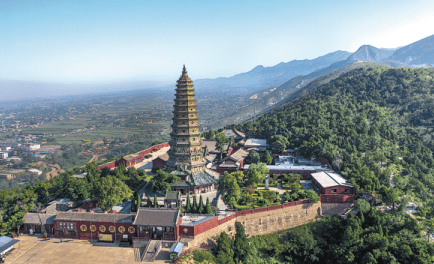
One such hidden gem is the Guangsheng Buddhist Temple, located in the Zhaocheng township of Hongtong county. The Guangsheng Temple is actually a complex that encompasses the upper monastery, the lower monastery, and the Water God Temple, situated on the slopes and foothills of Huoshan Mountain in Zhaocheng.
Founded in the first year (147) of the Jianhe reign of the Eastern Han Dynasty (25-220), the temple originally bore the name Julushe Temple. It later acquired its present name during the Tang Dynasty (618-907). While it suffered damage during an earthquake in the 7th year (1303) of the Dade reign of the Yuan Dynasty (1271-1368), subsequent restoration efforts took place over the years, preserving much of the architectural style from the Yuan Dynasty. Nestled against the mountains and overlooking a river, the temple is surrounded by ancient trees and boasts the Huoquan Spring gushing beneath the rocks at the foot of Huoshan Mountain, creating a serene and picturesque environment. The temple can be divided into three main sections: the upper temple, the lower temple, and the Water God Temple.
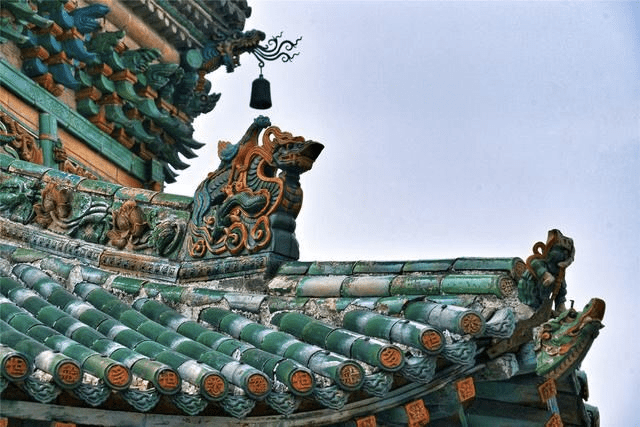
The upper temple, perched atop Huoshan Mountain amidst lush pine trees, is graced with ancient towers and adorned with colored glaze components, radiating magnificence and splendor. The lower temple, situated at the base of Huoshan Mountain, harmoniously blends with the mountain’s natural contours, creating an intriguing landscape with varying elevations. Adjacent to the lower temple is the Water God Temple, with connected walls. Here, one can find the Statue of Ying, an emperor of the Ming Dynasty, and renowned frescoes depicting Yuan Dramas, both of which are celebrated locally and internationally.
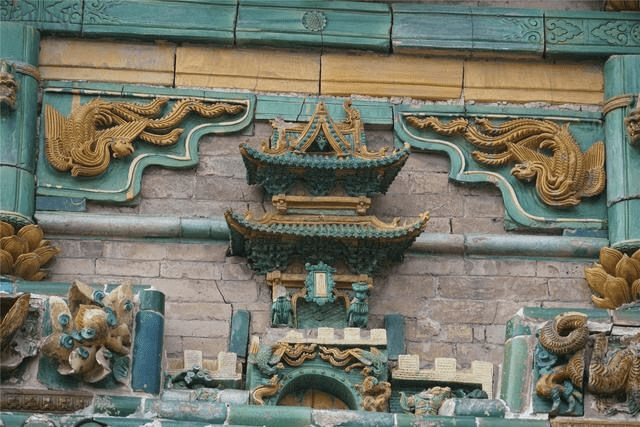
The upper temple complex comprises the temple gate, the Flying Rainbow Tower, the Amitabha Hall, the Great Hall, the Vairochana Hall, the Kwan-yin Hall, the Ksitigarbha Hall, as well as wing-rooms and corridors, among other features. The Temple Gate, situated at the entrance, is flanked by two guardian warriors. Just beyond the gate stands the impressive Flying Rainbow Tower, constructed from colored glaze bricks. Originally built during the Eastern Han Dynasty (25-220) and later restored in the Ming Dynasty (1368-1644), this thirteen-story tower soars to a height of 47.31 meters, featuring an octagonal plan. The tower is adorned with tri-colored glaze in yellow, green, and blue, creating a splendid and vibrant spectacle. Elaborate wooden square blocks and intricately carved designs of Buddha, Bodhisattvas, guardian warriors, flowers, birds, and animals adorn the eaves and pillars. Corridors encircle the first story, while the tower’s interior houses only the stairs leading to the tenth floor, showcasing remarkable architectural and artistic prowess.
Behind the tower lies the Amitabha Hall, a 5-bay wide, 4-bay long structure with a single-eaved gable and hip roof. Inside, the hall features three exquisite statues: Amitabha Buddha, Manjusri Bodhisattva, and Vajrapani Bodhisattva. These statues, masterpieces of the Ming Dynasty, are accompanied by frescoes adorning the eastern wall and screen wall. Additionally, the temple once housed 4,000 volumes of the Pingshui version of the Tripitaka during the Huangtong reign of the Jin Dynasty (1115-1234). These valuable volumes are now preserved in the Beijing Library and serve as a rare source for studying the history of Chinese printing.
The Great Hall, characterized by a 5-bay width, a single-eaved gable, and a hip roof, features three niches within for wooden statues of Sakyamuni, Manjusri, and Samantabhadra. These statues are meticulously crafted, possessing well-proportioned forms, a plump appearance, and an air of perfect serenity. In the Qing Dynasty, the hall was adorned with eighteen iron arhats along its two sides, along with statues of Kwan-yin and Amitabha Buddha on the rear niche wall.
The Vairochana Hall, spanning 5 bays in width with a hip roof, boasts an architectural style typical of the Yuan Dynasty, with two gables supported by substantial crawling beams. The altar within the hall features statues of three Buddhas and four Bodhisattvas, surrounded by wooden niches containing 35 iron statues. Notably, the back wall of the hall showcases frescoes depicting Sakyamuni and twelve Bodhisattvas of Perfect Enlightenment, regarded as exceptional examples of this art form.
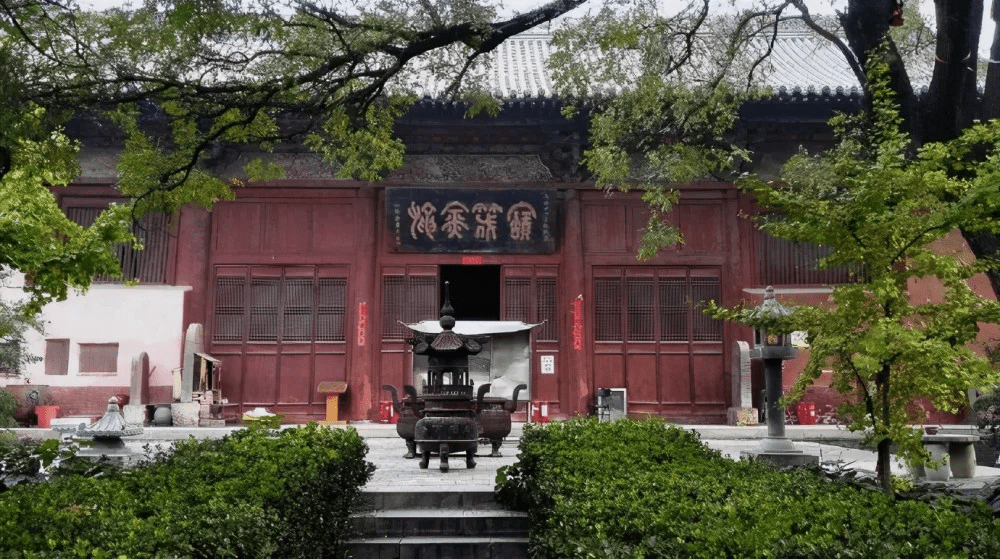
The lower temple complex comprises the temple gate, front hall, back hall, the buttress hall, and other buildings, all constructed during the Yuan Dynasty. The temple gate stands impressively tall, measuring 3 bays in width and 3 bays in length, featuring a single-eaved gable and a hip roof. Canopies have been added to both the front and back eaves, lending it the appearance of a pavilion with double eaves. The front hall spans five bays in width and is supported by only two pillars that bear the weight of the entire structure. The back hall, dating back to the second year (1309) of the Zhida reign in the Yuan Dynasty, stretches 7 bays in width, featuring 9 purlins, 8 rafters, and a single-eaved overhanging gable roof. Within the hall, you’ll find the main statues of Amitabha Buddha, Sakyamuni Buddha, Bhaisajyaguru Buddha, Manjusri Bodhisattva, and Samantabhadra Bodhisattva, all crafted during the Yuan Dynasty. Sadly, the once-present frescoes on the walls were stolen and smuggled to other countries in 1928, and they are currently housed in the Naerson Museum in Texas, US. Notably, the fresco on the south wall documented the performances of Yuan Drama, serving as rare reference material for the study of Chinese dramas.
The lower temple complex photo from:Beijing Transportation University ancient architectureThe lower temple complex photo from: Beijing Transportation University ancient architecture
The Water God Temple comprises two courtyards: the front yard and the back yard, featuring key structures like the Temple Gate, the Door of Amenity, the Ming Ying King Hall, and wing-rooms of cave dwellings. The Ming Ying King Hall, measuring 5 bays in width and 5 bays in length, is enveloped by a cloister and crowned with a double-eaved gable hip roof. The interior beams follow a conventional style. Within the hall, you’ll find statues of Water God Ming Ying King and his eleven attendants. Their facial features, attire, and postures are all reflective of the Yuan style. The hall’s walls are adorned with frescoes depicting scenes of people praying for rain and other historical narratives, covering an area of 197 square meters. Notably, the eastern end of the south wall features vivid depictions of a comprehensive set of stage properties used by performers, including costumes, stage instruments, musical instruments, makeup, curtains, and the stage itself. The artwork is meticulously arranged, with a simple yet profound color palette, and the dramatis personae are depicted with great expressiveness. This fresco offers an authentic glimpse into the heyday of Yuan Drama and stands as a rare and outstanding example of Yuan fresco art in China.
During a research experiment a marine biologist placed a shark into a large holding tank and then released several small bait fish into the tank.
As you would expect, the shark quickly swam around the tank, attacked and ate the smaller fish.
The marine biologist then inserted a strong piece of clear fiberglass into the tank, creating two separate partitions. She then put the shark on one side of the fiberglass and a new set of bait fish on the other.
Again, the shark quickly attacked. This time, however, the shark slammed into the fiberglass divider and bounced off. Undeterred, the shark kept repeating this behavior every few minutes to no avail. Meanwhile, the bait fish swam around unharmed in the second partition. Eventually, about an hour into the experiment, the shark gave up.
This experiment was repeated several dozen times over the next few weeks. Each time, the shark got less aggressive and made fewer attempts to attack the bait fish, until eventually the shark got tired of hitting the fiberglass divider and simply stopped attacking altogether.
The marine biologist then removed the fiberglass divider, but the shark didn’t attack. The shark was trained to believe a barrier existed between it and the bait fish, so the bait fish swam wherever they wished, free from harm. This experiment illustrates that the formation of habits has a significant impact on biology.
From 123RF
Humans are also creatures of habit, and habits become second nature. Human behavior is often governed by habits, and as long as something is done or said repeatedly, it gradually becomes a habit, and people start doing or saying it unconsciously. Some people constantly use foul language or lie, and it has become a habit for them. Therefore, changing these habits is not an easy task.
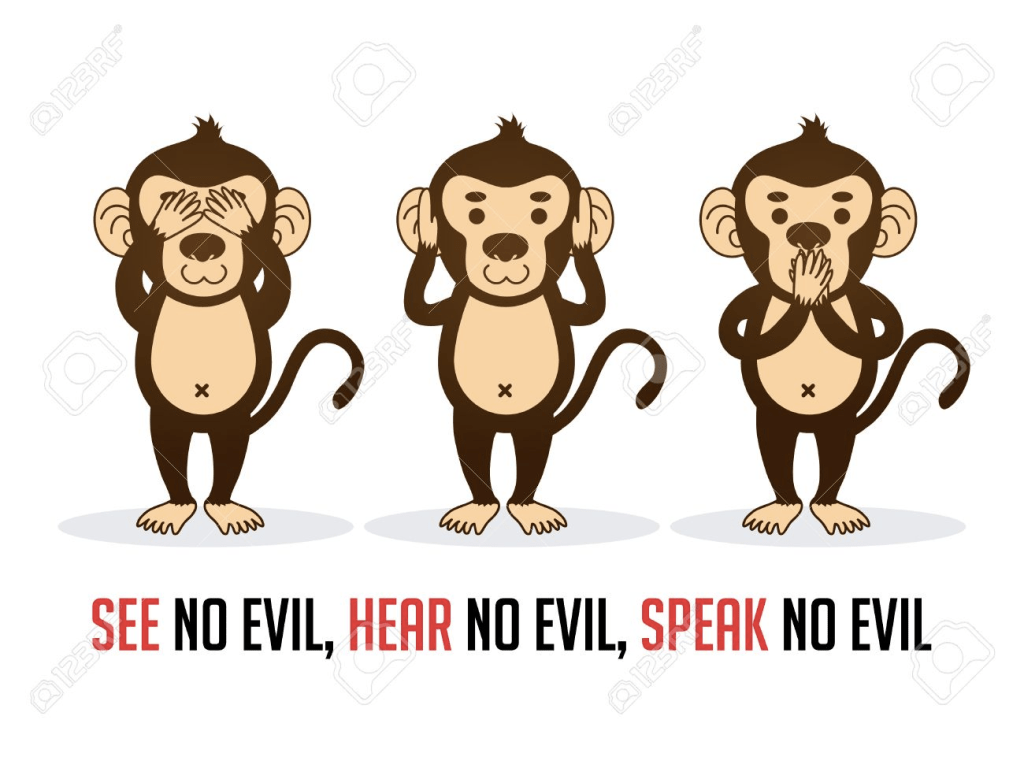
Buddhist practice places great emphasis on verbal karma (the consequences of one’s speech). If a person cultivates virtuous speech karma, they will speak kindly, offer comfort, encouragement, praise others, and even propagate the Dharma, thereby achieving immeasurable merit. On the other hand, if one engages in unwholesome speech karma, they will use hurtful and negative words, twist the truth, sow discord, and create a negative impact, thus planting the seeds of negative karma. Therefore, in our daily lives, we should be mindful of our speech. Speak when it’s necessary, and refrain from speaking when it’s not. In addition to refraining from false speech, divisive speech, and harsh speech, we should also avoid frivolous speech, which means not engaging in meaningless or idle chatter.
When we speak, we should naturally utter words that are meaningful, moral, or beneficial to others. However, in reality, this is often not the case. Whenever a small group of people gathers for casual conversation, they tend to talk about various things, cracking jokes to make others laugh, or uttering words that lack propriety, or even resorting to explicit or suggestive language, which can lead others to have improper thoughts. Some may use flattering or sweet talk to make themselves more likable. Engaging in such meaningless conversations can mislead others and lead them astray, which is truly a wrongdoing. Many individuals who were initially pure-minded may, under the influence of frivolous speech, become cunning and engage in inappropriate behavior.
A person who frequently engages in frivolous talk, no matter where they go, is often met with comments like, “Here comes that unserious person again,” and people tend to hold a kind of contemptuous attitude towards them. Frivolous speech can confuse and harm people’s moral values, so we should distance ourselves from it. For those who are practicing Buddhism, when they meet each other, they should ask questions like: “Have you been diligent in your practice lately? Are you focused in your recitation of the Buddha’s name? Have you made progress in meditation?” Encouraging and challenging each other in this way can help avoid complacency and steer clear of frivolous speech.
The Buddhist scriptures state, “If a person can distance themselves from frivolous speech, they will earn the respect of those with wisdom. They will decisively answer any question, and because they have never engaged in falsehood, they will attain the most excellent virtues.”
Speaking is a crucial aspect of participating in social life. It not only affects the success or failure of one’s personal endeavors but also plays a significant role in the happiness of family life. It is hoped that everyone speaks with sincerity and cultivates good habits, which will contribute to a harmonious society and a fulfilling family life.
In the tranquil solitude of a monastery, an old monk devoted his time to cultivating a pot of delicate orchids. Each day, he lavished care upon these tender blooms, diligently tending to their needs by watering and weeding them with unwavering dedication.
As a result of the old monk’s meticulous attention, the orchids flourished under his care, displaying an elegant and breathtaking beauty that mirrored his own inner peace.
One day, the old monk found himself with a commitment that required him to leave the monastery to meet with friends. In his absence, he entrusted the nurturing of the cherished orchids to a young monk. He handed over the responsibility, emphasizing the importance of their care.
With a sense of honor and respect for the elder monk’s teachings, the young monk embraced his duty wholeheartedly. He approached the task just as the old monk had, showing genuine care and tenderness towards the orchids. Under his watchful eye, the orchids continued to thrive and bloom.
However, fate took an unexpected turn. On a day when the young monk had diligently watered the orchids and positioned them on a windowsill to soak in the sunlight, a sudden and fierce rainstorm struck. Powerful winds knocked the orchids from their perch, causing them to shatter upon impact.
Upon his return, the young monk was met with the heartbreaking sight of the shattered remnants of the once-beautiful orchids. He was overwhelmed with sorrow, dreading the old monk’s reaction and fearing his reprimand for failing in his entrusted duty.
Several days later, the old monk returned to the monastery. The young monk gathered the courage to confess the unfortunate incident, ready to face whatever consequence may arise from his actions.
Surprisingly, the old monk responded with silence. This unexpected reaction left the young monk puzzled and uncertain. After a moment, the old monk’s serene countenance broke into a calm smile, and he uttered words that carried profound wisdom, “I don’t cultivate orchids to get angry.”
In that simple and sincere statement, the old monk revealed a profound truth about his serene attitude towards life. The cultivation of the orchids was not about breeding frustration or anger; rather, it represented a deeper pursuit—the nurturing of one’s character and inner qualities. The orchids, though precious, were symbolic of the journey to refine one’s life and embrace noble virtues.
Life, much like a bustling marketplace, presents us with an array of experiences, people, and emotions. Some individuals exhibit unwavering positivity and joy, while others grapple with restlessness and anxiety. Our perspectives differ, our thought processes vary, and as a consequence, our approaches to problem-solving diverge greatly.
So, how can we navigate the sea of life’s challenges and find solace amidst the chaos? The answer lies in the simple yet profound art of detachment. By relinquishing our attachments and embracing life’s imperfections, we can begin to comprehend the transient nature of all things. Just as clouds swiftly drift across the sky, life’s moments are fleeting and subject to the universal cycle of existence.
The key lies in cultivating a mindset of detachment and releasing the grip of selfish desires. In doing so, we can expand our hearts, broaden our perspectives, and uncover a sense of tranquility that transcends the storms of life. Through this journey of self-discovery, we can learn from the wisdom of the orchids and the serenity of the old monk—finding beauty not just in the blooms, but in the growth of our own souls.
Speaking of H.H. Dorje Chang Buddha III personally ordaining me, it is undoubtedly the most joyous event in my life. Sometimes, even in my nighttime dreams, laughter spontaneously escapes me. This occurrence represents the auspicious connection that has guided me from the worldly existence to embracing monkhood. The privilege of receiving ordination directly from the authentic chief Vajra-holder, undergoing head-shaving, and embarking on the path of a monk is not to be underestimated – it’s a journey that can’t be taken lightly.
Several years ago, I was granted the fortunate opportunity to become a disciple of H.H. Dorje Chang Buddha III. Initially, I perceived him as an approachable Dharma king. It wasn’t until this year (2007) that I serendipitously unveiled the truth. As circumstances matured, my aspiration to embrace monastic life grew stronger and stronger. Consequently, in collaboration with another senior practitioner, Hongxi Fazang, who shared the same intention, we formally petitioned the Dharma king for ordination. Astonishingly, His Holiness accepted our request and committed to ordain us.
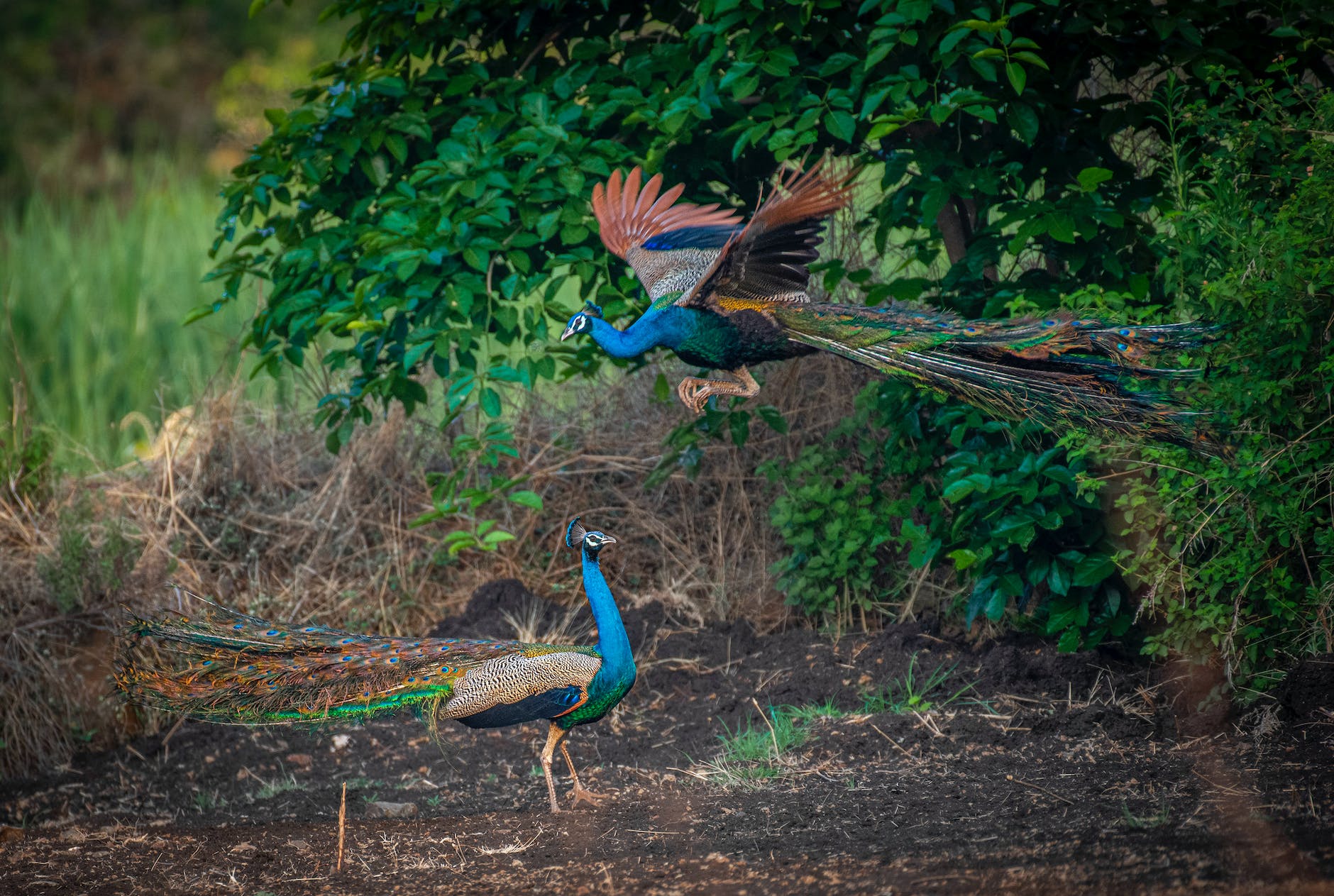
On the day of the ordination, a multitude of monks and masters were present. At six o’clock in the early morning, H.H. Dorje Chang Buddha III was immersed in a Dharma practice, assigning us our Dharma names. In that precise moment, two peacocks descended gracefully from the sky, performing an elegant dance to pay homage to His Holiness. Their graceful dance persisted for over thirty minutes, culminating in a gentle conclusion. The peacocks even ventured onto the car His Holiness was preparing to use that day, continuing their homage through dance. Amidst this spectacle, a guardian dog’s resounding bark spurred a sudden realization that this remarkable scene should be captured on film. Regrettably, by the time a camera was procured, the two peacocks had already ascended to the rooftop.
During the head-shaving process by the Buddha Master, a newly acquired, exceptionally sharp, and powerful electric razor was employed. The initial cut proceeded smoothly, but upon attempting the second cut, the hair refused to yield. No matter the effort expended with the electric razor, not a single strand of hair succumbed. In this juncture, the Buddha Master chanted the Vajra mantra, and with a rustling sound, the hair began to fall.
Upon the completion of the ordination, we approached the two venerable monks in attendance, requesting their blessings upon our Vajra pills. As one of these venerable holy monks extended his hand above my head to bestow his blessings, I experienced a sudden flood of realizations. This sensation defies verbal description – truly an inexplicable and miraculous encounter!
Naturally, what we perceive as miraculous are ordinary occurrences within the realm of H.H. Dorje Chang Buddha III. Such experiences are constantly present in his presence. When H.H. Dorje Chang Buddha III imparted ordination and empowerment upon individuals like Zhaxi Zhuoma Rinpoche, Bodhi Wentu Rinpoche, and others, corresponding miraculous phenomena also materialized.
In Taichung there is an elderly layman. All nine members of his family are devout Buddhists. They have followed and learned from a famous old monk for many years. However, what they hear from this old monk is completely theory. Each of them can talk about the sutras in a clear and logical fashion. However, none of them have real skills associated with the Buddha-dharma.
In the autumn of 1995 the Elder Dharma King happened to be in Taiwan propagating the dharma. The elderly layman requested instruction from the Elder Dharma King by saying, “This year I am already eighty-one years old. I do things in furtherance of Buddhism everyday. I have donated over one-half of my vast wealth. Nevertheless, I have never seen a real Buddha or Bodhisattva. The only knowledge I have of supernormal dharma powers comes from what I read in books. Why do the Buddhas and Bodhisattvas not come down to our house? May I ask the Elder Dharma King, what is the Buddha-dharma?”
When the Dharma King heard these words, he chanted “Wobamei!” He then said, “Layman, you all have not learned the Buddha-dharma. How could you have any true skills?” When all of the members of the layman’s family heard this, they felt quite surprised. With his brows tightly knit, the old layman said, “My entire family devoutly learns Buddhism and recites sutras. How is it that we are not learning the Buddha-dharma? Could it be said that these sutras are all false?”
The Elder Dharma King said, “It is true that all of you are reading sutras and learning Buddhism. Those sutras are genuine sutras and are dharma treasures. The knowledge concerning Buddhism which those old monks impart to all of you is also genuine knowledge. However, this is Buddhist studies. It is not the Buddha-dharma! In Esoteric Buddhism, Buddhist studies is called the exoteric teachings portion. This is what we are required to learn when we first enter Esoteric Buddhism. After we have learned the exoteric teachings portion and we have this foundation of theory, we must then enter into real, practical cultivation of our conduct, speech and thoughts. The process of putting this into practice is called cultivation of the Buddha-dharma.
“Take, for example, the practice whereby one invites the Buddhas and Bodhisattvas to bestow nectar. In theory, people think that this is simply reciting mantras, reciting passages from sutras and visualizing. In theory, people think that nectar is simply water which has been empowered by mantras. However, in the real practice of the Buddha-dharma, there is a special dharma method to invite the Buddhas to directly bestow true nectar from the sky. The shape of this nectar is unlike any other thing on this earth. It has unlimited power. It can cure all illnesses and can easily increase one’s life span! This is because this is the Buddha-dharma, not Buddhist studies.”
The old layman said, “I received the Kalachakra Vajra Initiation from the Dalai Lama!” Elder Dharma King Losang said, “Last year a Great Rinpoche wanted to introduce the Dalai Lama to me. I did not have any spare time. I wanted to do other things in furtherance of the Buddha-dharma. I did not meet him. I do not know much about him and will not comment on him. I do not have any right to inquire into that initiation. I hope that you are able to receive benefits from it.”
When the old layman and his family heard this, it was as if they had awakened from a big dream. Their eyes became teary, they knelt down on the ground and respectfully requested the Elder Dharma King to teach them the dharma. After a moment, the Elder Dharma King slowly said, “Today I will teach the dharma to your entire family. I will also teach the dharma to all living beings.” Following his words, a beam of red light emanated from in between his eyebrows which circled the room. The Elder Dharma King then said, “Do no evil. Do that which is good. Deeply study the sutras. This is Buddhist studies. Do no evil. Do that which is good. Recite the Buddha’s name with all your mind. This is the way to ascend to the Pure Land. Do no evil. Do that which is good. Deeply study the sutras. Esoteric initiations in which supernormal powers are manifested and which comply with Know the True Doctrine is the Buddha-dharma.”
After the old layman heard these words, he put his palms together and respectfully asked, “Other than Know the True Doctrine, what books should I read?” Dharma King Losang said, “With respect to Know the True Doctrine, it is enough if you understand its contents. The most important thing is that you read the books of Ah Wang Nuo Bu Pa Muand Great Dharma King Yangwo Yisinubu [H.H. Dorje Chang Buddha III]. The more you read such books the better. You must also live in accordance with the principles contained therein. This is the best method!”
The old layman said, “I will remember your words. I would like to ask another question. Does every Rinpoche have a mind which regards all things as equal?” The Elder Dharma King instructed, “The most difficult thing to attain in one’s cultivation and in one’s practice of the Buddha-dharma is a mind which regards all things as equal. Without such a mind, one will pursue fame, gain, riches, high government positions and occupation of other people’s land. One with a mind which regards all things as equal does not pursue such things.
“For example, some people want to cut apart my native place, Tibet. Actually, this way of thinking is a deviation from cultivation. Is this cultivation or is this fighting for something based upon personal desire? Tibetan people, Chinese people and people of every other race and ethnicity should all be considered our close family members who are on an equal footing! We should cause all of these people to unite so that they can live together in friendship and love and develop their common happiness. The Buddha taught us that all living beings have the Buddha nature and that we should treat them equally and with love. We should not desire government positions. Only by cutting off the concept of self, cutting off erroneous thinking and cutting off attachment to things of the world can one reach high spiritual states! This is the certain truth of the Buddha-dharma. We must love others equally in order that we may give rise to the four limitless states of mind. With the four limitless states of mind as our foundation, we will be able to enter into the state of the sacred bodhimind. If one cannot even renounce selfish desires and cannot even look after all living beings on an equal basis, then how can one enlighten oneself and enlighten others?”
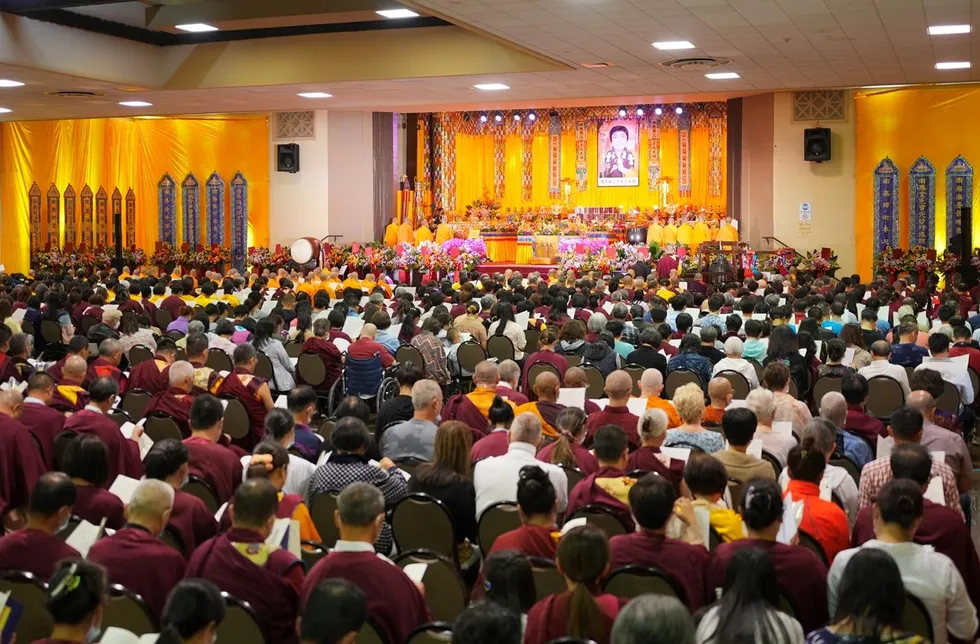
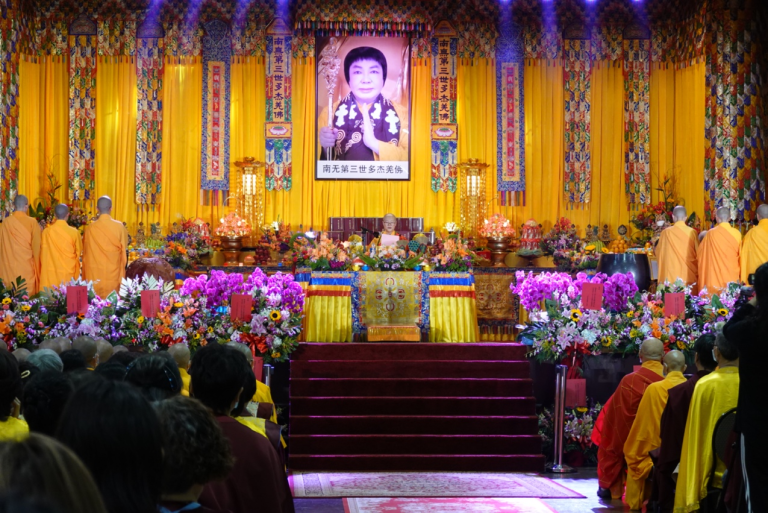
To honor the Holy Birthday of H.H. Dorje Chang Buddha III, revered as the Pope of Buddhism, several prominent Buddhist organizations including the World Buddhism Association Headquarters, Holy Miracles Temple, Hua Zang Si, Benevolence Temple, and the Sanger Mission, jointly organized a Grand Dharma Assembly in Glendale, California. The two-day event took place on June 30th and July 1st, 2023, at the Glendale Civic Auditorium and attracted over a thousand Buddhists from around the world.
June 30th marked the unveiling of the first three volumes of the “Namo Dorje Chang Buddha III Complete Sutra Collection”. The Dharma Assembly opened with a procession led by a group of nuns, chanting the Buddha’s name “Namo Dorje Chang Buddha III”. The “Namo Dorje Chang Buddha III Complete Sutra Collection” was gracefully displayed on a sacred sedan chair, carried by Holy Gurus Venerable Tsemang and Ruzun Bodi Wentu. In a display of reverence, all attendees of the Assembly humbly prostrated themselves, paying their respects to the Collection.
In the Dharma Assembly, Venerable Tsemang addressed the congregation, emphasizing the significance of the “Namo Dorje Chang Buddha III Complete Sutra Collection”: “We have undertaken the significant task of editing and publishing the first part of the ‘Namo Dorje Chang Buddha III Complete Sutra Collection.’ This endeavor not only expresses our profound gratitude and unwavering yearning for H.H. Dorje Chang Buddha III but, more importantly, will enable countless sentient beings to attain accomplishment and liberation through studying the Collection. We firmly believe that the ‘Namo Dorje Chang Buddha III Complete Sutra Collection’ will serve as the ultimate guide for all Buddhist disciples seeking accomplishment and liberation.
“The Collection encompasses the essence of the Tripitaka and the esoteric Buddhist scriptures. It covers Buddhist precepts, views, cultivation, and Dharma practices. It covers the whole spectrum of Buddhism regardless of whether it is Hinayana, Mahayana, or Vajrayana. Through the Collection, H.H. Dorje Chang Buddha III reveals the most direct and expedient path for sentient beings, Arhats, and Bodhisattvas to advance themselves. If we diligently study and practice the teachings on even a single volume of the Collection, while focusing on any one dharma-gate, we can be assured of attaining liberation.”
During this Age of Dharma Degeneration, H.H. Dorje Chang Buddha III descended to the earthly realm, exhibiting perfect mastery of Exoteric and Esoteric Buddhism, along with unparalleled expertise in the Five Vidyas. The Five Vidyas are what Buddhas and Bodhisattvas do to help living beings. Over the past 2,000 years, Buddhist teachings have encountered distortions and alterations due to mistranslation and misinterpretation of Buddha-dharma by Buddhist patriarchs, eminent monastics, and Buddhist scholars. Recognizing the distortions and errors that had infiltrated Buddhist teachings, H.H. Dorje Chang Buddha III corrected the mistakes present in the Buddhist teachings, restoring the authenticity, power, and purity of Buddha’s wisdom and views.
H.H. Dorje Chang Buddha III has bequeathed over two thousand audio recordings of imparted Dharmas and published invaluable Buddhist books, including “A Monk Expounds the Absolute Truth to a Layperson,” “Commentary on the Prajnaparamita Heart Sutra,” “The Essence of Buddha Dharma,” “Correcting the Treatises of Patriarch Bodhidharma,” “What Is Cultivation?,” “The Supreme and Unsurpassable Mahamudra of Liberation,” and “Learning From Buddha.” H.H. Dorje Chang Buddha III imparted the subtleties of Dharmas in colloquial language so that people living in the 21st century could easily comprehend. They serve as supreme treasures and indispensable resources for Buddhist disciples seeking to escape the sufferings of this world and attain enlightenment.
In response to the needs of Buddhist disciples, the Office of H.H. Dorje Chang Buddha III is working to transcribe audio recordings of Dharmas imparted by H.H. Dorje Chang Buddha III into extensive written texts, and the “Namo Dorje Chang Buddha III Complete Sutra Collection” is being meticulously compiled. The first three volumes of the Collection, consisting of “Dharma Imparted During the Trip to the East,” “Dharma Imparted During a Trip in Response to the Needs of Disciples,” and “Imparting the Absolute Truth through the Heart Sutra,” were released to commemorate this Holy Birthday of H.H. Dorje Chang Buddha III. The remaining volumes will be released and published in the future.
The Dharma Assembly continued July 1st, 2023, with participants representing Buddhist disciples all over the world presenting 108 offerings to Buddhas and Bodhisattvas. Under the solemn direction of Jiaozun Zhengda, the congregation recited the Buddhist Sutra “Sutra on Understanding and Realizing Definitive Truth”. The attendees offered heartfelt reverence to the Buddhas, engaged in prostrations, and prayed to the Buddhas and Bodhisattvas for blessings upon all sentient beings. The gathering collectively expressed their aspirations for the eradication of all global pandemics, the endurance of international peace and friendship, and the cessation of calamities, while invoking prosperity, good health, and longevity for all.
Venerable Pannavati Karuna, the Abbot of Heartwood Refuge monastery in North Carolina, led dozens of her students to attend the Dharma Assembly. In an interview, she said: “I was introduced to Buddha Master (H.H. Dorje Chang Buddha III) 18 years ago through Zhaxi Zhouma Rinpoche. I thought I had too many duties and responsibilities to follow His teachings. But I kept reading and pondering them through the years. I began to notice in my everyday life the truth and ability to live differently in the world. I had more integrity, clarity, joy for the first time and an understanding that enlightenment was possible if one follows the true teachings of Shakyamuni Buddha. Buddha Master imparted Dharmas and explained those teachings in a down to earth, understandable way without compromise. He even spoke African American slang. Sometimes translators had a difficult time translating it into English because they may not fully understand the slang. But I heard it and I understood what He meant. That is the marvelousness of a true Buddha in this world. He can speak the language in a way that you hear it, understand it, penetrate it, and realize it. He guided me towards the correct aspiration. The goal is not Buddhist studies, and realization cannot be explained by mere words, but it can be experienced. The true purpose of the Buddha Dharma is to awaken us to our Buddha-nature. His teachings point the way.”
Gongjue Tuji Rinpoche from Germany also shared his joyfulness after attending the Dharma Assembly. He said: “I am very happy to be here today on this very auspicious occasion. Because for us Westerners, it is very hard to get the teachings and Dharma from Buddha Master since most of us do not speak Chinese. I am very happy about this event today that we are finally getting the opportunity to get the Buddha Dharma in English language, and we will have direct access to it.”
The Dharma Assembly held in Glendale fostered unity and devotion among Buddhist practitioners from diverse backgrounds. With the release of the first volumes of “Namo Dorje Chang Buddha III Complete Sutra Collection”, the event left an indelible mark on the spiritual aspirations of attendees, inspiring them to pursue enlightenment and emulate the compassion and wisdom demonstrated by H.H. Dorje Chang Buddha III.
Father Francis Tiso, a Catholic Priest and renowned scholar of Tibetan Buddhism, shares the unforgettable story behind his riveting book Rainbow Body and Resurrection: Spiritual Attainment, the Dissolution of the Material Body, and the Case of Khenpo A Chö. Khenpo A Chö was a Tibetan monk who, through retreat, prayer, and meditation, prepared his body to turn into radiant light upon his own death. When Khenpo A Chö died, he achieved this phenomenon (it’s called the rainbow body), and in the year 2000, Father Tiso traveled to Tibet to report on its profound significance and how it connects to resurrection across other religions, including the resurrection of Jesus Christ. “They started calling me the Jesus Lama,” Father Tiso tells Wonderstruck’s Elizabeth Rovere, marking one of the many surprising and tender moments from his remarkable journey.
In Vajrayana traditions of Tibetan Buddhism, tangible matter is considered to be made up of five elements: space, air, fire, water, and earth. As described in Tibetan literary sources, including TheTibetan Book of the Dead, the elemental energies that make up the cosmos are understood to be undifferentiated from those that make up the human body. Therefore, the body is simultaneously an individual person and the cosmic whole.
Certain Buddhist meditation practices are meant to alter the gravitational field of these five elements that constitute the body, transforming them into the five radiant lights of the color spectrum. The Tibetan name given to this physical fluorescence is jalu, literally meaning, “rainbow body.” Rainbow body is also the name given to the transformation of the ordinary physical body as a result of years of specific disciplined practices.
Once upon a time in a remote village, nestled between the mountains, there lived a wise old monk named Master Sean. He was renowned for his ability to guide people in finding their inner voice, a skill that had been passed down through generations of monks in his lineage.
One day, a young man named Kaito arrived at the monastery seeking guidance from Master Sean. He had heard tales of the wise monk and hoped to learn the secret of listening to his inner voice. Master Sean welcomed Kaito with a warm smile and led him to a quiet room overlooking the monastery’s lush gardens.
Before we begin,” said the wise monk, “I want you to spend some time in silence, observing the garden and the creatures that inhabited it.” Kaito sat by the window watching the birds flip from branch to branch, the squirrel scamper across the grass, and the butterflies dance in the breeze. As he observed the harmony of nature, he felt a sense of peace wash over him.
After some time, Master Sean returned and asked Kaito what he had learned from his observations. Kaito replied, “I saw how each creature has its own rhythm and purpose and how they all coexist in harmony.” Master Sean nodded, pleased with Kaito’s insight.
“Now let me tell you a story,” he said, settling into a comfortable chair. “Once there was a young monk who lived in a monastery high in the mountains. He was diligent in his studies and meditation, but he struggled to hear his inner voice. One day, his master took him to a nearby cave where they found a small clear pool of water.”
The master instructed the young monk to gaze into the pool and describe what he saw. The young monk peered into the water and saw his own reflection, along with the reflections of the cave walls and the flickering light of their torches. The master then asked the young monk to close his eyes and listen to the sounds around him.
The young monk heard the gentle dripping of water, the distant echo of their voices, and the soft rustling of the wind outside the cave. Finally, the master told the young monk to open his eyes and look into the pool once more. This time, the young monk saw something different beneath the surface of the water. He could see a world of shimmering fish darting among the rocks and plants.
The master explained that the pool was a metaphor for the young monk’s mind. The surface reflections represented his thoughts and emotions, while the hidden world beneath symbolized his inner voice. To hear that voice, the young monk needed to learn to look beyond the surface distractions and listen deeply to the quiet whispers within.
Kaito listened intently to Master Sean’s story, feeling a spark of understanding ignite within him. He asked, “How can I learn to look beyond the surface and hear my inner voice?” Master Sean smiled and replied, “You must practice mindfulness and cultivate stillness in your mind. Just as the pool’s surface becomes calm and undisturbed, so too will your mind reveal its hidden depths when you learn to quiet your thoughts and emotions.”
Over the following weeks, Kaito practiced meditation and mindfulness under Master Sean’s guidance. He learned to observe his thoughts without judgment, allowing them to pass like clouds in the sky. Gradually, he began to hear the whispers of his inner voice, guiding him with wisdom and clarity.
As the story of Kaito and Master Sean comes to a close, let us reflect on the nature of happiness. Happiness, like the inner voice, is often found in the depths of our being, beyond the surface distractions of our thoughts and emotions. It is not a fleeting sensation or a temporary state, but rather a profound sense of contentment and inner peace that arises from living in harmony with our true selves.
To cultivate happiness, we must learn to listen to our inner voice, allowing it to guide us on our journey through life. By embracing mindfulness and stillness, we can quiet the noise of our minds and tune into the wisdom that resides within us. In doing so, we discover that happiness is not something to be pursued or acquired, but rather a natural state of being that emerges when we align ourselves with our deepest values and aspirations.
In the words of the ancient philosopher Lao Tzu, “Happiness is the absence of the striving for happiness.” May we all find the courage to let go of our endless pursuit of external validation and material success, and instead turn inward, seeking the happiness that lies within our own hearts and minds.
When Sakyamuni Buddha first established Buddhist theories, there was no dual character of Buddhist theories. There was only the sameness of theories and nature (the essence of everything). The theories in the Tripitaka expounded by the world-honored Sakyamuni Buddha came from the Buddha’s state of realization. They are a kind of explanation of the ways to realize the holy state and attain liberation and nirvana. They can be called objective writings. Such Buddhist theories were born from true holy realization. They are not groundless writings based on assumptions that arose from the level of consciousness. This is recorded in the Buddhist scriptures.
In the beginning, Buddhist theory and Buddha-dharma realization were one integral body. At first, a complete body of dharma theories and rituals were born from true realization of the Buddha-dharma holy state. Later, people attained the holy state of true realization from this complete body of dharma theories and rituals. Theory and dharma were in harmony. Theory was used to further the dharma. The dharma was manifested to further theory.
“The sect of theories and true holy realization” is in accord with the sutras and abhidharma. Those of this sect apply cognition based on correct views to directly understand cultivation, the nature of the mind, and ultimate reality. They truly realize holiness that transcends intelligence and theories. Moreover, they manifest their actual realization and thereby prove that they have attained the ultimate nirvana.
This sect uses the orthodox theories contained in the Tripitaka and esoteric scriptures as its foundation. However, its goal is not the useless speaking of theories. Those in this sect must manifest their holy state of realization.
However, as the karmic connection living beings had with the dharma changed and as a large amount of dharma and rituals were lost, Buddhism’s sameness of theories and nature (essence) imperceptibly and gradually generated a dual character. One aspect was the complete retention of theory and holy realization where each brought out the best in the other. The other aspect was pure theory that arose out of a fundamental separation from the holy state of realization. The advent of this dual character of Buddhist theories objectively caused Buddhism to form two main sects. No matter what the sect or school may be within Buddhism—whether it be Mahayana, Hinayana, exoteric or esoteric Buddhism—all sects or schools ultimately belong to one of these two main sects. The first is “the sect of theories and true holy realization.” The second is “the sect of theories, views, and understanding.” Of course, the theories I am referring to here are Buddhist theories based upon correct understanding and correct view. I am not bringing up a third category of misunderstandings and heretical views that go against the sutra teachings.
The purpose of cultivation and practice for this sect is to actually transcend, in both body and mind, the fetters of samsara. This sect has an integral lineage, integral teachings, and integral rituals. Those of this sect are able to manifest supernatural wisdom powers that transcend both the material and mental spheres. It is a sect that truly accords with the essence of the Tipitaka, the esoteric scriptures, and the various commentaries and treatises. This is the sect of perfect Buddha-dharma where theory and nature (essence) are in accord. This was the original characteristic of Buddhist theory. Such Buddha-dharma played a decisive role in the liberation and accomplishment of living beings. Included in this Buddha-dharma is the Buddha-dharma of Sakyamuni Buddha during the True Dharma Age, the Buddha-dharma transmitted by Guru Padmasambhava, the Buddha-dharma transmitted by Venerable Atisha, Master Marpa, Master Milarepa, Master Tsongkhapa, Master Nairatmya, Master Rigdzin Jigme Lingpa, Bodhidharma, Xuan-zang, Hui-neng, Master Xu-yun, and the Buddha-dharma transmitted by other truly holy beings and patriarchs throughout history. All such Buddha-dharma is the Buddha-dharma of “the sect of theories and true holy realization.” Unfortunately, at this present time on earth, this sect is very rare and very seldom seen. “The sect of theories, views, and understanding” has taken its place and become the mainstream.
“The sect of theories, views, and understanding” also uses the orthodox theories contained in the Tripitaka and esoteric scriptures as its foundation. Those of this sect apply cognition based on correct views to approach and directly understand the nature of the mind in the hope that in the end they will realize nirvana. The Buddha-dharma of this sect is only able to express theories and that which arises out of mental processes. Those in this sect do not have actual holy realization that they can display. Consequently, all they can do is use the realization states and achievements of patriarchs in earlier generations as cases in point. Most present-day Buddha-dharma belongs to this sect. This is a prevalent phenomenon in current Buddhism.
However, we must see that although the theories of this sect are also based on correct understanding and correct view, it is very difficult for this sect to produce complete liberation. It is easy for this sect to fall into meaningless intellectual frivolity. It is still a question as whether those of this sect can truly attain the liberation of ultimate nirvana. That is because it is extremely difficult to lead people into the state of holy beings by relying solely upon theories. Moreover, these theories were expressed by different people and therefore vary. For example, the views expressed in the prajna writings and Middle School (Madhyamaka) writings are not the same. The “other emptiness view” also has its own way of explaining things.
I will use the modern terms of “software” and “hardware” to give an analogy. Which one of these schools of theories is practical software that can attain the positive results that hardware can attain? It is very difficult to determine this by relying only on software itself. Only when the positive results of hardware are actually produced can it be shown whether a certain theory (software) is right or wrong. Furthermore, that which is called the dharma of Buddha-dharma should be dharma that transcends the ordinary and leads to liberation. Theories alone cannot express this extraordinariness.
This phenomenon of seeking liberation from theories and views alone is mainly the result of the loss of many dharma teachings and rituals in the course of passing down the Buddha-dharma. In the case of Tibetan esoteric dharma, there has not been much change in the theoretical part since the initial stage of esoteric dharma until now. The greatest change has been in the true realization part. When the patriarchs of Tibetan esoteric Buddhism transmitted dharma in the past, there were countless manifestations of supernatural realization powers. These astounding supernatural realization powers caused people of the world to regard Tibetan esoteric dharma as holy and special. Guru Padmasambhava and Venerable Atisha displayed a great many supernatural powers. Master Marpa practiced a dharma whereby he brought back to life animals that had already died. Patriarch Milarepa flew in the air and entered the horn of a bull to avoid hail. Guwen Rinpoche flew into the air and took with him his entire family, including the tent and domestic animals. Both of the 4th Dodrupchen Dharma Kings displayed wondrous realization powers, and so on and so forth. One can give endless examples of such holy realization powers.
The original special quality of the Buddha-dharma was that it was of “the sect of theories and true holy realization,” which manifests actual realization powers. However, with the arrival of the Dharma Ending Age, many dharmas are no longer whole. The practice of them will not produce realization powers. Much Buddha-dharma, especially the esoteric dharma, has begun to devolve toward “the sect of theories, views, and understanding.”
Take, for example, the colored sand used to form a mandala during an inner-tantric initiation in the holy form. During the time of Guru Padmasambhava, this inner-tantric initiation dharma required that certain things be done. On the surface of a large flat stone, colored sand would be used to form the shape of a mandala or a vajra seed character. A person would then apply holy realization powers, causing that design on the surface of the stone to penetrate the stone and form the same design on the sand in the mandala plate underneath that large flat stone. Such sand design in the mandala plate thereby became vajra sand that went through a stone.
However, at this present time, there is no integral dharma. People cannot produce holy realization powers through dharma practice. Thus, inner-tantric initiations in the holy form cannot be performed. The above-described process of using colored sand to form a mandala has already devolved into sprinkling colored sand directly into the mandala plate to form a mandala design. As such, there is not the slightest manifestation of holy power.
Another example is vajra pills used in inner-tantric initiations. Sixty or seventy years ago, most of the people of true and holy virtue within Tibetan esoteric Buddhism were able to make a vajra pill come to life by telekinetically making it shake or even move around. However, in present-day Tibetan esoteric dharma, a vajra pill is nothing more than a medicinal pill that is a symbolic expression of dharma.
Another example is secret-division initiations relating to gods of wealth. This is a dharma source of inner-tantric dharma in the holy sense. The practitioner receiving such an initiation will generate a holy stage right then and there in the mandala. Moreover, gold dollar treasures or a treasure-spitting mongoose made of three white things and roasted barley flour will turn over and jump into the air before the practitioner, demonstrating a holy state of physics not produced by humans. The practitioner receiving the initiation will right then and there ingest a “dharma mother seed.” Out of this practice of dharma, the god of wealth will naturally descend, thereby accomplishing the completion stage. However, this type of dharma has also been lost.
It is not just these few dharmas. Most inner-tantric initiation dharmas have already deteriorated. Accomplished ones who attained the rainbow body basically cannot be found, even in the Kathok Monastery, which was the monastery of Padmasambhava and the place where more people attained the rainbow body than anywhere else. In modern times, many dharma kings did not transform into the rainbow body and fly away at death. There are many people now who at every opportunity leave their handprints or footprints on stones to show their realization powers. However, such realization powers were not manifested under the observation of masters and witnesses there at the time. What credibility do they have?
In an interview, the famous Kasuo Rinpoche of the Longwu Monastery of the Geluk sect talked about the special societal circumstances that existed in Tibet during the fifties and sixties. As a result of those circumstances, a large number of sutras, treatises, and dharma manuals were burned. Many people of great virtue were unable to pass down integral dharma before they were forced to die. Those people of great virtue who fled to India did not take with them many dharma manuals. After that, at most only twenty or thirty percent of Tibetan esoteric dharma still remained in the world. Most such dharma has been lost forever.
It is because of this type of loss of dharma that most present-day Buddha-dharma does not produce people who can show actual realization powers. Candidly speaking, people do not understand dharma and get bogged down in hollow theories over a long period of time. Many people even misunderstand the Buddha-dharma as simply something to comprehend that is theoretical or mental in nature. Of course, they are apathetic to the matter of realization powers or even feel that it is very normal not to have realization powers. This way of thinking is actually very wrong. Theories can be used to distinguish the holy ones from the ordinary ones. However, the most important way to distinguish the genuine ones from the false ones is seeing who actually manifests holy realization powers.
Take, for example, emptiness. Even practitioners with a little knowledge are able to speak copiously about theories related to emptiness. However, are those well-organized and impressive theories, understandings, and views right or wrong in the end? This is something that understandings and views alone cannot determine. It is also something that no conscious experience born of causes and conditions can determine. Only when one abides in emptiness and true such-ness and generates supernatural wisdom powers can one truly know whether an understanding or view is right or wrong.
There was a time when Ananda had not yet realized holiness. The Arhats excluded him from the hall where they were assembling the sutras. After he realized true such-ness, returned to that hall, and stood outside its door, Venerable Mahakasyapa asked him to enter the door through the keyhole to prove that he had become enlightened. Ananda then entered the hall through the keyhole. Those who have realized emptiness and untied the knot must have supernatural holy powers enabling them to enter another dimension that ordinary human ability cannot reach. Additionally, they must have this “software accomplishment” in the form of actual and extraordinary holy powers. Only then can they prove whether a given “theory software” is correct and practical.
Thus, as for this issue, the difference between “the sect of theories, views, and understanding” and “the sect of theories and true holy realization” is that the former stops at theoretical understanding. Whether people of “the sect of theories, views, and understanding” actually realize and enter the holy state that is beyond consciousness and thereby attain liberation is something unknown. It is not that people of such sect feel secure and therefore do not manifest holy powers. Rather, they do not manifest holy powers born of enlightenment because the incomplete dharma of that sect has resulted in its followers being unable to realize such powers from their practice. “The sect of theories and true holy realization” also propagates correct dharma theories. However, it definitely does not stop at purely theoretical, quick, sharp, and incisive repartee on the dharma, nor does it get entangled with theories on understanding emptiness. Rather, by following integral dharma and rituals, the people of this sect truly realize the essence or nature of true such-ness, transcend the level of consciousness, untie the knot of suffering, attain holiness and the resulting structural transformation of body and mind, and actually reach the dimension of holiness that is beyond the cycle of reincarnation.
Although both “the sect of theories, views, and understanding” and “the sect of theories and true holy realization” strive for nirvana based upon orthodox Buddhist theories, nonetheless, due to the Buddha-dharma of each of these two sects, there are great differences in the time it takes to become accomplished and the level of accomplishment. Furthermore, because “the sect of theories, views, and understanding” is limited to purely theoretical understanding and inquiry, it is often very difficult for its followers to see things from the standpoint of the pure, liberated state of holiness in order to understand the original meaning of some super-mundane (other-worldly) dharmas. This leads them to easily adopt mistaken views and understandings. If they are slightly careless, they can even slide toward heretical views.
In this Dharma Ending Age, it is very rare to be able to learn the integral dharma of “the sect of theories and true holy realization.” Moreover, this sect is not something that is fixed. Rather, it is something that evolves. It is like those Buddha-dharmas I mentioned above. When the patriarchs transmitted Buddha-dharma, they were still part of “the sect of theories and true holy realization” in which theory and nature (essence) were one. At that time, there were numerous manifestations of true realization states. The mandala dharma rules were strict. There was an orderly distinction between what was inner-tantric, outer-tantric, and inner-tantric in the holy form. However, dharmas gradually became lost. Dharmas passed down to later generations devolved into the hollow theories of “the sect of theories, views, and understanding.”
Many people of great holiness and virtue think that because of the loss of Buddha-dharma “the sect of theories and true holy realization” composes only about one or two percent of Buddhism in the world today as compared with “the sect of theories, views, and understanding.” So-called “greatly virtuous ones” within Buddhism who have heretical understanding and views are cropping up everywhere. It is distressing to see this trend in present-day Buddhism.
From a young age, many of us were taught by our parents about the importance of cultivating good habits. Whether it was going to bed early, exercising regularly, or refraining from negative behaviors, these habits were instilled in us with the belief that they would pave the way for success and a fulfilling life. Charles Duhigg, in his influential book “The Power of Habit,” sheds light on the mechanisms of habit formation and transformation. Drawing from scientific discoveries and captivating narratives, Duhigg offers fresh insights into human nature’s capacity for profound change. In addition, religious teachings, such as those found in Buddhism, also emphasize the significance of good habits in leading a virtuous and enlightened life.
“The Power of Habit” explores the scientific foundations behind habit formation. Duhigg introduces the concept of the habit loop, consisting of cues, routines, and rewards, which shape our behaviors and become deeply ingrained in our lives. By comprehending this loop, we gain a better understanding of how habits are formed and how they can be consciously modified or replaced.
Duhigg highlights the power of keystone habits, pivotal behaviors that have the potential to ignite positive transformations in various aspects of our lives. Through real-life examples, such as the habits of Olympic swimmer Michael Phelps, Starbucks CEO Howard Schultz, and civil-rights icon Martin Luther King Jr., the book demonstrates how cultivating keystone habits can lead to remarkable achievements. These habits act as catalysts, triggering a chain reaction of positive changes in other areas of our lives.
In Buddhism, there is a strong emphasis on discipline and the cultivation of good habits. Buddhist monks and nuns follow a set of precepts—more than 200 rules—that guide their daily lives. These precepts serve as a framework for moral conduct, urging practitioners to refrain from harmful behaviors and cultivate virtuous habits. By adhering to these precepts, disciples develop good habits in all aspects of life, fostering mindfulness, compassion, and ethical behavior.
In the pre-recorded Dharma discourse delivered by H.H. Dorje Chang Buddha III, His Holiness expounded on the profound concept that habits can become second nature, highlighting the transformative potential of consistent practice. Through consistent meditation, individuals develop a habit of introspection and mindfulness, leading to increased concentration and ultimately enlightenment. Similarly, the habit of performing good deeds accumulates positive merits, shaping one’s character and promoting spiritual growth.
“The Power of Habit” by Charles Duhigg reveals the malleability of habits and their potential for transformative change. By understanding the science behind habit formation and exploring keystone habits, individuals can consciously shape their behaviors and make positive changes in their lives. Additionally, Buddhism provides valuable insights into the significance of good habits in fostering moral conduct and spiritual development. By embracing these teachings, we can harness the power of habits to lead more fulfilling, successful, and enlightened lives.