The Blessings of Faith: A Daughter’s Journey Through Her Mother’s Illness

My name is Li Xueping, and this is a story about love, faith, and the incredible blessings that come from practicing true Buddhism. It is a story that centers around my mother, Yang Yanshu, a gentle and kind-hearted woman who is now over ninety years old. Despite her age, she continues to inspire us with her warmth, frugality, and deep devotion to her family.

My mother has been a Buddhist for many years. Though she is illiterate, she memorized and recites the Heart Sutra daily with great sincerity. In our home, we’ve always honored Namo Guanshiyin Bodhisattva, and her faith has been a quiet but powerful force in our lives.

In October 2003, my sister and I accompanied our mother to listen to the Dharma discourses of Namo Dorje Chang Buddha III for fourteen consecutive days. During that time, my mother experienced a profound transformation—both physically and mentally. She was radiant with Dharma joy and gained deep faith in the supreme teachings. From then on, she diligently listened to discourses, practiced Buddhism daily, and her health remained remarkably stable. It was clear to us: the blessings of true Dharma had uplifted her life.

In June 2017, our lives were shaken when my mother was diagnosed with cervical cancer at a reputable hospital. She was in her eighties at the time, and the news was devastating. We decided against surgery and opted for conservative treatment with traditional Chinese medicine to minimize her suffering.

My siblings and I turned entirely to Buddhist practice. We recited The Supreme and Unsurpassable Mahamudra of Liberation, performed lamp offerings, and conducted life-releasing ceremonies. My mother, too, chanted Buddha’s names with devotion and repented for past wrongdoings. She often reflected with remorse: “I regret killing so many chickens in the past just for food. I committed great wrongs by taking lives.”

We knew from the Buddha’s teachings that killing brings severe karmic consequences, and while our efforts could not undo the past, we hoped to ease her suffering through sincere repentance and practice.

Wanting to seek deeper help, I applied for a U.S. visa and, in September 2017, traveled to the United States to personally report my mother’s situation to the great Namo Dorje Chang Buddha III. The Buddha responded with immense compassion: “I will perform a Dharma practice to bless her.”

I will never forget that moment. The Buddha, who treats all beings with equal kindness regardless of wealth or status, blessed my mother. Monastic disciples also provided her with precious Black Treasure Pills. Miraculously, her pain vanished, her complexion became rosy, and she regained peace and strength. The power of true Dharma had once again revealed itself.

An Unexpected Crisis and a Miraculous Return

In June 2018, while I was visiting my daughter in Belgium, I received an urgent call—my mother was critically ill. We feared I might not see her again. I flew back as quickly as possible, praying for blessings throughout the journey.
When I arrived home, I was astonished—my mother had survived.

My sister later told me that just before losing consciousness, my mother cried out:

“Namo Guanshiyin Bodhisattva, save me!”

Soon after, the ambulance arrived and took her to the hospital. After seven days of treatment, she was miraculously revived.

Shortly after, I faced a difficult decision. I had already planned to attend the Dharma Assembly Honoring the Holy Birthday of Namo Dorje Chang Buddha III in the United States. With my mother still recovering, and family responsibilities weighing on me, I hesitated. My husband even called me “unfilial” for wanting to leave.

But deep in my heart, I knew: this was the most important aspiration of my life. I prayed silently, asking for the Buddha’s blessings to keep my mother safe during my absence.

I attended the Great Life-Releasing Dharma Assembly at the H.H. Dorje Chang Buddha III Culture and Art Museum on June 21, 2018, and the next day, the rare and magnificent Holy Heavenly Lake Dharma Assembly. Surrounded by thousands of disciples from around the world, we chanted the holy name of the Buddha in unison. It was a moment of unimaginable spiritual joy.

On June 25, I had the honor of meeting Namo Dorje Chang Buddha III once again. I tearfully reported my mother’s condition, and the Buddha, in His great compassion, smiled and said, “Haha, good!”
That moment filled me with peace and hope.

When I returned home, I found my mother in excellent condition. Despite her diagnosis, she had never experienced unbearable pain, never lost her spirit, and continued her daily Buddhist recitations as usual. During Chinese New Year, even our relatives remarked in amazement: “She doesn’t look like someone with cancer at all!”

Her strength, peace, and recovery were nothing short of miraculous. We owe everything to the compassionate blessings of Namo Dorje Chang Buddha III, the Buddhas and Bodhisattvas of the ten directions, and the authentic Tathagata Dharma.

Through this journey, I have come to understand the impermanence of life, the inescapability of karma, and the painful cycle of birth, aging, sickness, and death. No one can escape their karmic debts. But through true Buddhist practice—guided by the teachings of Namo Dorje Chang Buddha III—we can walk a path toward healing, liberation, and lasting peace.

May all beings awaken to the true Dharma, cherish the opportunity to learn from a living Buddha, and attain the freedom of body and mind through genuine practice.

Link:https://peacelilysite.com/2025/07/15/the-blessings-of-faith-a-daughters-journey-through-her-mothers-illness/

Source: https://dharma-hhdorjechangbuddhaiii.org/a-mother-in-her-nineties-overcomes-the-pain-of-cancer-through-the-blessings-of-the-h-h-dorje-chang-buddha-iii/

#DorjeChangBuddhaIII #HHDorjeChangBuddhaIII #Buddha #Dharma

How to Face Unfounded Accusations and Grievances — A Lesson from the Buddha

More than 2,500 years ago, when Shakyamuni Buddha walked the earth, even He—an enlightened being of supreme virtue—was not immune to slander and false accusations. Yet, through profound wisdom and boundless compassion, the Buddha addressed these challenges with grace, setting an eternal example for all beings on how to face adversity.

One such episode is recorded in the sutras and remains deeply relevant in our modern world, where misunderstandings and grievances often escalate due to fear, anger, or ego.


One morning in Jetavana Monastery, as the Buddha and his monks were preparing to go on their daily alms round, a group of royal guards suddenly stormed in. They announced that they were under orders to search the monastery grounds for a female corpse.

The monks were shocked. Venerable Baddiya inquired further and discovered that the deceased was Sundari, a young woman known for her recent attendance at the Buddha’s teachings. She belonged to a large sect in the city of Savatthi.

Despite the monks’ firm belief that no such thing could happen in their peaceful community, the guards began their search. To the horror of all present, Sundari’s body was found hastily buried in a shallow pit—shockingly close to the Buddha’s own residence.


The body was taken away, and almost immediately, members of Sundari’s sect began parading through the streets of Savatthi, wailing and pointing fingers. They accused the monks—disciples of the Buddha—of rape and murder. Their shouts pierced the hearts of the city’s residents:

“Is this what compassion looks like? Is this the kindness preached by the monks of the Sakya clan?”

Faith began to waver. The once-revered monks were now questioned and ridiculed. Even devout followers hesitated. Doubts crept in like shadows.

But amidst this storm of falsehood, the Buddha remained calm. He instructed his disciples:

“Do not be disturbed. Do not feel shame for what you have not done. As long as we uphold the Dharma, the truth will reveal itself.”


Compassionate Action and the Power of Truth

While the Buddha taught patience, some of his lay supporters took discreet action. Visakha, a wise and generous patroness of the Sangha, consulted with Sariputta, one of the Buddha’s chief disciples. Together, they enlisted the help of Prince Jeta and hired a private investigator to uncover the truth.

Within seven days, the real story surfaced. Two men, drunk and arguing over their ill-gotten gains, confessed: they had been paid by Sundari’s sect leader to murder her and bury the body near the monastery—an act designed solely to discredit the Buddha and his followers.

The culprits were arrested. The truth was undeniable. King Pasenadi, deeply moved and ashamed that such injustice had occurred, visited Jetavana to publicly reaffirm his trust in the Sangha.

Yet the Buddha, ever compassionate, requested the king not to seek vengeance. He said:

“As long as jealousy and hatred exist in the human heart, such misdeeds will continue. Let us rise above them, not descend to their level.”

The people of Savatthi, now enlightened by the truth, restored their faith in the Buddha and the monastic community. What began as a moment of crisis ended as a testament to the strength of integrity and the enduring power of compassion.

This story serves as a profound reminder: when facing unjust accusations, our greatest protection lies in truth, patience, and inner peace.

We cannot control the words or actions of others, but we can choose how we respond. If we hold fast to our principles, walk the path with sincerity, and act from compassion rather than reaction, the light of truth will inevitably shine through the darkness of misunderstanding.

Link:https://peacelilysite.com/2025/05/23/how-to-face-unfounded-accusations-and-grievances-a-lesson-from-the-buddha/

The Power Of The Holy Vajra Needle

My name is Guang-Fen Fu. Since I was young, I have been physically weak and often ill. When I became an adult, my mother told me, “Daughter! You have had a weak constitution since you were young. Go and learn medicine. This will be good for your health, and you will not become weary through exerting too much physical strength.”

        In 1958, I began following a teacher to learn traditional Chinese medicine. Because my illnesses resulted from the power of karma accumulated through many lifetimes and eons, my illnesses did not decrease as my knowledge of medicine and my experience in practicing medicine grew. Disease constantly followed me wherever I went.

        In 1978 and the following few years, I suffered from a gastric ulcer in which most of my stomach hemorrhaged. During that time, I also discharged blood when going to the bathroom and vomited blood. In 1981, I had no choice but to undergo surgery to cut out most of my stomach. My health was even worse after the surgery. My food intake lessened, my face became pale, I spoke without any vigor, my spirit was weak, my movements were slow, and I often could not go to work.

        As a result of the care and assistance given to me by a friend, in 1987, I met my respected Buddha Master, H.H. Dorje Chang Buddha III Wan Ko Yeshe Norbu Holiest Tathagata. When His Holiness learned of my suffering from illness and my strained financial circumstances, His Holiness showed immense compassion and concern. His Holiness treated me with the holy vajra needle. H.H. Buddha Master asked me to show His Holiness the acupuncture point on my foot called Zu San Li. My respected Buddha Master then squatted down and applied that needle to me. After the needle was applied, my respected Buddha Master then said, “Pay attention! I will now apply my dharma power.”

        When my respected Buddha Master put his hands into a mudra before me, I immediately began to feel numbness, swelling, and pain. My whole body emitted heat, and I was slightly perspiring. When my respected Buddha Master heard me repeatedly scream in pain, His Holiness released his hands from that mudra. I instantly felt that the numbness, swelling, and pain I had just experienced had disappeared. The only thing I felt was a relaxed and comfortable feeling that my body had never before experienced. My respected Buddha Master then said, “This needle was used to open your energy channels and chakras. You are too anemic.”

        I had not yet become a Buddhist or learned Buddhism at that time. My respected Buddha Master treated me and all other living beings as his own family members, equally lending them a helping hand out of great compassion. In 1988, I knew that I wanted to convert to and learn Buddhism in order to leave suffering, attain happiness, and walk the path leading to accomplishment in the dharma and liberation from the cycle of reincarnation.

        After following H.H. Buddha Master, my health has improved day by day; my complexion is ruddy, my spirit is clear, my voice is resonant, and I walk with vigor. I gradually understood just how magnificent H.H. Buddha Master is. I also came to comprehend the realness of Buddha Dharma gradually. Those who see me now say, “You have totally changed in the last two years. You don’t look so frail as you did before.” What they found most difficult to believe is that I returned from my trip to the plateaus of Tibet and Qinghai, which are places that lack oxygen without any adverse health effects.

        Because I received H.H. Buddha Master’s teachings and empowerment, I advanced in the area of medicine. I took a countywide test and was the first to receive a certificate of qualification as a traditional Chinese medicine doctor. I took provincial and municipal tests and obtained certificates qualifying me as a “doctor-in-charge” who practices traditional Chinese medicine. The hospital put a sign up for me that read “expert outpatient service.” My patients have increased day by day. I have cured patients near and far of their difficult and complicated illnesses. As a result, I have a bit of fame in the local area where I live. Everything that I have is due to the teachings and empowerment that the Buddha Master bestowed upon me after I began learning Buddhism. The kindness and grace H.H. Buddha Master conferred upon me are as enormous as a mountain. Each and every bit of his kindness and grace is indelibly etched in my heart.

        I remember one day around the year 1989. Zi-Fang Liu, a disciple of my respected Buddha Master, went to the home of my respected Buddha Master in the Nanxin District of Xindu. She beseeched my respected Buddha Master to save her. She said that her illness had lasted many years, was acutely painful, and was about to collapse. She had been to all of the major hospitals in China and had spent a lot of money, all to no avail. I saw that her complexion was unnaturally dark and that her whole body was rigid. She constantly complained about her unbearable pain.

        Then, she suddenly fell to the ground and did not get up. She looked ghastly pale. My respected Buddha Master immediately treated her with the holy vajra needle in order to empower her. Because she was in a state of shock, she did not have any reaction when the needle was applied. After a short while, Sister Liu regained consciousness, stood up, and stated she was no longer in pain.

        Every time I saw the wonders of my respected Buddha Master’s holy vajra needle, I had an even greater desire to learn how to apply that holy needle. One day I said to my respected Buddha Master, “Respected Buddha Master, teach me how to apply that amazing needle so that I may cure more patients.” My respected Buddha Master said in a soft voice, “Guang-Fen, your powers are insufficient. Let’s put that matter aside for the time being.” One time I saw Hsi Jao Ken Ten Rinpoche, who is from Taiwan, also ask my respected Buddha Master to teach him how to apply that amazing needle. My respected Buddha Master replied, “Your powers are insufficient. Let’s put that matter aside for the time being.”

        I later learned that the source of the effectiveness of the holy vajra needle is my respected Buddha Master’s state of realization and virtue and the power of his merit. With a holy mind of enlightenment and great compassion, His Holiness assists living beings with physical illnesses, psychological illnesses, and living beings suffering due to the power of karma. Furthermore, His Holiness constantly and compassionately empowers living beings through his teachings, thereby enabling them to extricate themselves from suffering and find the key to curing and preventing disease.

        I have followed H.H. Buddha Master for more than ten years. I, Guang-Fen, have evolved from a person who did not understand anything about learning Buddhism and self-cultivation to a Buddhist disciple striving to integrate wisdom, compassion, and skillful means and a person striving to be selfless. Based upon empowerment from my respected Master’s practice and from the lineage of great masters throughout generations, a type of merit of the fruit of Buddhahood exerts its influence, causing Buddhist disciples to walk the path toward liberation and accomplishment in the dharma. With the incomparable kindness and empowerment of my respected Buddha Master, Buddhist disciples give rise to bodhicitta and strive to enlighten themselves and others. The compassion, care, and protection my respected Buddha Master bestows upon his disciples and all living beings cannot be described in words. To know what I am saying, you have to experience it yourself.

        I sincerely feel that the kindness and grace shown to me by my Buddha Master are difficult to repay. All I can do is resolve to be a disciple of the Buddha in all my future lives and devoutly and respectfully turn to and rely upon the eternal Buddha Master. Only a Buddha Master can lead Buddhist disciples out of the bitter sea of reincarnation and lead them toward liberation, accomplishment in the dharma, ending of the cycle of birth and death, becoming a Buddha, saving other living beings, undertaking the cause of the Buddhas and Bodhisattvas, and repaying the kindness of the Buddhas.

        This year I have passed sixty-five years of age. What I have written above is my own true personal experience. I have not lied. If what I wrote above contains lies, I am willing to descend into the Avici Hell (hell of uninterrupted suffering). If what I wrote above is true, I offer the merit of this writing to my magnificent Buddha Master, who is like my father and mother. I also dedicate such merit to all of my vajra Brothers and Sisters so that they attain enlightenment soon and to all sentient beings on the six paths of reincarnation. Amitabha!

Written and respectfully submitted by a Buddhist disciple,
Guang-Fen Fu

April 16, 2006

(This is a complete translation of the Chinese text that was initially written and signed by Guang-Fen Fu.)

Buddhist disciple Zhao Yusheng received a transmission of Buddha Dharma that is True and Real

I personally witnessed the special and wonderful passing of layman Zhao Yusheng

told by Ms Mao Meimei, September 2, 2017

Ms. Moh and Zhao Yusheng’s daughter

Amitabha! Dharma masters, rinpoches, and kind virtuous ones, my name is Mei Mei Moh. I will now talk about the magnificent process occurred when Layperson Zhao Yusheng passed away perfectly. To avoid missing something when I talk, I wrote my speech down earlier.

Zhao Yusheng was a disciple of Chen Baosheng and had learned the evil teaching from Chen Baosheng before. Every day, he chanted “supreme vajra master” and that one’s accomplishment all depends on the master and relies on the joy and pleasure of the master. Zhao Yusheng said that he helped Chen Baosheng hide the truth and create false information while working at the tile company. That caused the company to lose more than 800,000 yuan just last year. He said, “I also helped him make false propaganda to deceive people. My situation became worse and worse as I was learning from Chen Baosheng. I am bounded by sin and bad karmas. My body now has cancer and is in great pain and suffering.” Zhao Yusheng realized that he had been harmed by Chen Baosheng’s demonic dharma. He was able to meet H.H.  Dorje Chang Buddha III after his cancer had reached the terminal stage. When Zhao Yusheng saw His Holiness, the Buddha, he piously repented before the Buddha Master. The Buddha Master said that repenting or not is not important and it is important that one should cultivate oneself well and truly correct the evil and pursue goodness to benefit society and living beings. Zhao Yusheng repented wholeheartedly. He no longer wanted to be a rinpoche and completely stopped learning the evil teaching. He did not fear death and only wished to be reborn in the Buddha-land. He made the greatest vow. H.H.  Dorje Chang Buddha III saw his sincerity and the maturing of his karmic condition and transmitted the dharma to him. Amitabha Buddha was invited to manifest in person to touch his head and transmit the dharma to him. Brother Zhao Yusheng was also able to see the main gate of the Western Paradise of Ultimate Bliss at that time. Amitabha Buddha told the Brother that Namo Kuan Shi Yin Bodhisattva would come to receive him to go to a place in the 5th lotus stage in the Pure Land. After receiving the dharma transmission from Amitabha Buddha and returning to San Francisco, the Brother practiced the dharma all the time every day and did not want to talk much. Sister Zhao Chen, who is the Brother’s daughter and I waited day by day. We did not know which day Namo Kuan Shi Yin Bodhisattva would come to receive the Brother. I have a company at Washington DC to run, but I also wanted to see the Brother attaining accomplishment. That created a contradiction in my mind. Well, a day spent was like a year to me! Eventually I had to call to beseech instructions from the Buddha Master. The Buddha Master said, “He will not be reborn there for the time being. For Zhao Yusheng’s physical condition, the decisions from the doctors and nurses should always be followed.”

On the day before Brother Zhao’s perfect passing away, he and I sat on a bench outside. He told me, “Chen Baosheng is a demonic devil, demonic evildoer, person of sin, criminal of fraud, and swindler. Kuan Shi Yin Bodhisattva wanted me to expose his sinful acts and said that He will come tomorrow to receive me. I was told to manifest the dharma to let people know when I am received to leave. However, I am worried that I may be drowsy and forget to expose him when Kuan Shi Yin Bodhisattva comes to receive me tomorrow.” I told the Brother, “Don’t worry. You don’t worry. Namo Kuan Shi Yin Bodhisattva will definitely come to receive you, and you will not be drowsy.”

At about 2:30pm in the afternoon on August 24 in American time, I was taking a nap at the time. After going outside to the restroom by himself, Brother Zhao came in to wake me up. He told us that he was about to leave and we should sincerely learn the dharma from the Buddha Master so we will meet again in the Western Paradise of Ultimate Bliss. He was going to take a bath. At that time, we felt quite sad. Is this person who is alive now truly going to leave? We help him take out the clothing prepared for him earlier. After putting on his clothing, we smelled a kind of special fragrant scent from Brother Zhao’s body. Then, the Brother said, “I will now use my freedom from birth and death to prove that the Buddha-dharma of H.H.  Dorje Chang Buddha III is the holiest. Chen Baosheng is a demonic devil and demonic evildoer! He is an evil master, big swindler, and a person of sin!” He also said, “The true dharma of the Tathagata is at where our great Buddha Master, H.H.  Dorje Chang Buddha III, is. Okay, okay, I will stop now. Namo Kuan Shi Yin Bodhisattva has come to receive me!” After finishing speaking, Brother Zhao emitted light from his entire body.

I saw the extremely tall and great Kuan Shi Yin Bodhisattva, radiating strong and intense white light everywhere from His body. Surrounded by five-colored light, Namo Kuan Shi Yin Bodhisattva was extremely solemn and majestic, standing above the top of Brother Zhao’s head. At that time, I saw that Brother Zhao’s spiritual consciousness rushed out from the top of his head toward Kuan Shi Yin Bodhisattva and left in the sky! While watching, I suddenly was unable to see Kuan Shi Yin Bodhisattva and Brother Zhao. I hurriedly ran into the courtyard. At this time, my phone rang. I raised my head and saw that Brother Zhao left in the sky while stepping on white clouds and following Kuan Shi Yin Bodhisattva. I also saw that fragrant nectar was coming down from the trees in the yard! Dharma masters from Hua Zang Si came right at that time. When they arrived, they also saw that nectar was descending from the trees. The dharma masters also recorded the scene by video. This nectar was strange. It disappeared before touching the ground. I was not the only one seeing the event. An elder lady who is 92 years old and from Malaysia also saw that Kuan Shi Yin Bodhisattva received Brother Zhao Yusheng and brought him away! This holy manifestation is difficult to hear even in millions of kalpas.

I am grateful to H.H.  Dorje Chang Buddha III.

I am grateful to Namo Amitabha Buddha.

I am grateful to Namo Kuan Shi Yin Bodhisattva.

Thank you all.

Link:https://peacelilysite.com/2025/03/14/buddhist-disciple-zhao-yusheng-received-a-transmission-of-buddha-dharma-that-is-true-and-real/

HQ Announcement 20210101: An Impostor Will Not Dare To Practice These Eighteen Dharmas

The Headquarters would like to use this announcement to express our gratitude to Namo Dorje Chang Buddha III for the dependent origination of the Dharma impartment for a Shakya descendant, who is the Chairperson of a Buddhist University. This Dharma discourse has jolted and woken the karmic-obstructed Buddhists. Such an earth-shattering Dharma discourse has also destroyed the heresy that “Deluded thought makes you an ordinary person, an enlightened thought makes you a Buddha.” We are incredibly grateful to Namo Dorje Chang Buddha III.

Namo Dorje Chang Buddha III has imparted that since Shakyamuni Buddha entered nirvana, and Mara the Demon King vowed to have his descendants infiltrate the Sangha, those mara-monastics have been wearing sangha attires posing as monks and nuns and become evil masters. They have transgressed and desecrated the authentic Buddha Dharma. Therefore, today’s Buddhism is in a deteriorating and decadent state. Evildoers are rampant in Buddhist communities. They blatantly disregard and contradict Shakyamuni Buddha’s Doctrines, Precepts, and Dharma. Some mara-descendants become evil Dharma masters, and some sit on the Dharma King’s rostrum. Whether monastics or laymen, they all falsely claim to be great Bodhisattva or even Buddha.

They show the inflated and pretentious outside of being eminent monastics, Dharma masters, Dharma kings, or great virtuous laypeople. However, they are just ordinary people with frail bodies who fool and confuse those clueless Buddhist followers. They lie through their teeth without blinking, and their bloviations are merely an army of pompous phrases. They flash their fictitious holiness certificates and show little to no achievement in Five Vidyas. Furthermore, while pretending to be Buddhas or Bodhisattvas, these scoundrels have violated the precepts, eroded the Dharma, and deceived the public. Worse yet, some Bhikkhus and Bhikkhunis exhibit obscene, scandalous, and offensive behaviors and shamelessly post those videos on the web.

These evil masters and evildoers have wreaked havoc in the Buddhist communities. They have fooled millions of people into believing they were holy sages. In fact, whether an individual is a Tathagata, Bodhisattva, or Arahat, the Buddhas have established the Eighteen Kinds of Great Dharma for Holiness Selection and Confirmation. By way of them, all frauds will show their true colors easily. Any evil master, whether they sit on the Dharma king’s rostrum, a patriarch of a Buddhist lineage, a repository of sutras and treatises, or who can talk nineteen to the dozen, once put under the Dharma for confirmation, righteous or evil will reveal itself immediately. It is why the impostors dare not try any of the Eighteen Dharmas, because ordinary people will not be able to conduct any of these Dharmas successfully and will expose their frauds under the sun.

Buddhist disciples, if the truth is what you are after, these four points are essential to remember:

  1. You must not listen to this person’s empty talk on Sutra or Shastra.
  2. You must not solely trust this person’s superficial status as a lineage patriarch.
  3. You must not exclusively believe in this person’s fame and notoriety, such as a lineage-holder of a Buddhist sect.
  4. Tests must validate this individual; the Holy Test is the standard measure.

Otherwise, those who follow the impostors will most likely be deceived and ruined for good.

Whether a heavenly king, earthly deity, Bodhisattva, venerable, or Arahat, if the individual can conduct any of the Eighteen Dharmas and demonstrate the manifestation state according to the Dharma, this person is 100% a reincarnated Bodhisattva or Buddha. On the contrary, if this individual cannot practice any of these Dharmas, this person is certifiably ordinary, an impostor, and may even be a wicked con artist or scoundrel!

These Eighteen Dharmas are 1. Buddha Bestowing Holy Amritas (佛降甘露);2. Sending a Petition to Bodhisattva (送菩薩一表);3. Holy Fire Homa (勝義火供);4. Uncovering Terma with Direct Verification (現量伏藏);5. Knowing in Advance and Foretelling (先知預言);6. Establishing Mandala Through a Boulder (隔石建壇);7. Bodhi Holy Water (菩提聖水);8. Lifting Pestle onto Platform With One Hand (拿杵上座);9. Bodhi Path Sin Decrease and Merit Increase Dharma (菩提道損減增益法);10. Vajra Array (金剛陣);11. Grand Eight Winds Array (八風大陣);12. Vajra Pillar Adjudication (金剛柱擇決);13. Hanging Bowl to Ask the Truth ( 懸缽問真.);14. Moving Vajra Pill like Dancing on Ice ( 冰姿顯聖);15. Vajra Faman Holy Adjudication (金剛法曼擇決);16. Hayagriva Or Horse-Head Wisdom King Water Altar Bead Hexagram (馬頭明王水壇珠卦);17. Dharma Gate Peacock Feathers Adjudication (法門宮羽);18. Double Adjudications (雙應擇決). These Eighteen Dharmas determine the holy from the mundane and the good from the evil. Each Dharma has its own Bodhisattva, Buddha, Vajra, and Dharmapala as yidam, and each presents a different manifestation of the realization state.

For examples,

  1. Buddha Bestowing Amrita: The congregation witnesses the Buddha, an Equal Enlightenment Bodhisattva, or a Marvelous Enlightenment Bodhisattva practicing the Dharma to beseech the Buddha to appear in the sky and bestow holy amritas into an empty bowl.
  2. Sending a Petition to Bodhisattva: The congregation witnesses the Tremendous Holy Guru practicing the Dharma, and a Bodhisattva retrieves the petition in front of the public.
  3. Holy Fire Homa: The congregation witnesses the Bodhisattva, a Tremendous Holy Guru, practicing the Dharma. The blue Vajra Maternal Buddha appears in the sky, prancing and dancing in front of the disciples, and then emits flame from between the eyebrows and ignites the charcoals in the cauldron instantly. The flame’s temperature can reach more than a thousand degrees Celsius.
  4. Uncovering Terma with Direct Verification: The congregation participates and witnesses in person. See details on the March 19, 2019 edition of “Wangzha Shangzun Manifests Vajra Power, and Yuzun Uncovers Terma With Direct Verification at The Holy Miracles Temple” on Las Vegas Chinese News Network.
  5. Knowing in Advance and Foretelling: The Tremendous Holy Guru personally predicts the number of amrita pills he will hold in his hand. He then reaches and grabs a bunch of amrita pills. The pills are counted before the congregation, and the result will be the same as his prediction.
  6. Establishing Mandala Through a Boulder: The congregation witnesses the Tremendous Holy Guru or Great Holy Guru using colored sands to create a Mandala on top of a boulder. With a flick of the finger, the Mandala design penetrates through the boulder to the bottom of the boulder and onto an empty Mandala plate. The Mandala is thus established.
  7. Bodhi Holy Water: The holy water manifested by the Tremendous Holy Guru or a Great Holy Guru. The water can penetrate any vessel. And, when poured on a rostrum, the water will maneuver according to the direction given by the Bodhisattva, Tathagata, a Tremendous or Great Holy Guru.
  8. Lifting Pestle onto Platform With One Hand: It determines whether the participant’s physical condition is holy or mundane. Anybody can try, and everyone is treated equally. Lifting the vajra Pestle with one hand to determine the holiness level will instantly reveal the sacred or mundane.
  9. Bodhi Path Sin Decrease and Merit Increase Dharma: See Namo Dorje Chang Buddha III imparted Dharma “This is the Invincible Vajra Dharma to Enable Buddhist Practitioners to Achieve Accomplishment.” If an individual with such advanced cultivation conducts this Dharma successfully before the congregation, then this individual must be a Bodhisattva or a Buddha, a Tremendous Holy Guru.
  10. Vajra Array: It is a mighty formation that tests a person’s level or stage in Buddhist practice. The World Buddhism Association Headquarters has video recordings of the Vajra Array in real applications.
  11. Grand Eight Winds Array: No candidate can step across a thin vajra rope when the array is established. The World Buddhism Association Headquarters has videos of the Grand Eight Winds Array in real applications.
  12. Vajra Pillar Adjudication: The congregation will witness a peacock feather hanging in the air. The Tremendous Holy Guru stands about 10 meters away from it and submits inquiries to the vajra pillar. The truth will be revealed in front of the congregation.
  13. Hanging Bowl to Ask the Truth: The congregation witnesses the supernatural come-without-a-shadow-and-leave-without-a-trace Vajra descending to the Mandala. The Vajra will knock on the bowl to confirm adjudication.
  14. Moving Vajra Pill like Dancing on Ice: It is a holy inner-tantric initiation. The sacred manifestation goes beyond the entry-level vibration of the Vajra Pill. The Vajra Pill must twirl like dancing on a snow-capped mountain. It is more like ice figure skating than swing dancing. It can transform to be bigger or smaller, taller or shorter. It can levitate and spin around the bowl without touching its wall or even shows the image of a wrathful Vajra.
  15. Vajra Faman Holy Adjudication: The congregation witnesses Vajra sand forming into crowns of various fruition and realization stages that befit the ones to be validated above the heads of their visages.
  16. Hayagriva (Horse-Head) Wisdom King Water Altar Bead Hexagram: The congregation does a lottery to choose a candidate. The adjudication is unequivocally accurate. The Bodhi beads are placed on the water altar. See details on World Buddhism Association Headquarters Announcement No. 20200103.
  17. Dharma Gate Peacock Feathers Adjudication: The congregation witnesses that the presiding master stands from afar, and the disciple stands in front of the sacred peacock feathers and submits an inquiry. The peacock feathers will respond definitively to the question the disciple raises accordingly.
  18. Double Adjudications: It is a test that entails both the Lesser Eight Winds Array (八風小陣) and the Holy Divination of Manjushri Bodhisattva. All the candidates take part in this test individually, with everyone witnessing the result, which shows accurate and consistent answers between the two adjudications without discrepancy.

Among the above Eighteen Dharmas, some only a Buddha, an Equal Enlightenment Bodhisattva or a Marvelous Enlightenment Bodhisattva can practice, and others only a great Mahasattva or above can. One must be at least at the level of an Arahat to be able to practice these Dharmas. The only exception is Puji Vajra’s (普及金剛) Lifting Pestle onto Platform With One Hand. Anyone can attempt to lift the Vajra Pestle to determine their holiness level.

Although each Dharma has its yidam, these Eighteen Dharmas can differentiate the real from the fake and the righteous from the evil. We call them Demon-Revealing Mirrors. They are not actual mirrors but categories of great Dharmas. In concrete applications, only Lifting Pestle onto Platform With One Hand takes as little as requiring the candidate to lift the pestle off the ground for 8 seconds. For the other seventeen Dharmas, the self-proclaimed holy individual is asked to choose one and practice it in front of the congregation. Whether this individual is a divine being or a fake can be seen on the spot.

Besides, only a Buddha, an Equal Enlightenment Bodhisattva or a Marvelous Enlightenment Bodhisattva are qualified to conduct the Dharma of Buddha Bestowing Amrita, all Bodhisattvas of lesser stages do not have the power to practice the Dharma. Many people have personally participated in and witnessed these Eighteen Dharmas, which were genuinely extraordinary, remarkable and praiseworthy.

On May 15, a great Mahasattva and the anagarikas of the World Buddhism Association Headquarters conducted the Bodhi Path Sin Decrease and Merit Increase Dharma for a pious practitioner who made outstanding contributions to Buddhist work. The entire congregation successfully practiced the Dharma together. Everyone experienced and witnessed this wonderful, world-astounding, and miraculous event. With only one strike on the bell, the sound reverberated throughout the site and resonated for a long time. All attendants stood about four to five feet from the platform, and all eyes focused on the jar in the middle. The total number of Bodhi pills has increased by three. The blessed disciple, from now on, can take the merit-increasing Bodhi pills every month and is guaranteed to achieve accomplishment. The Shengzun brought some of the merit-increasing Bodhi pills and made offerings to Namo Dorje Chang Buddha III to celebrate His Holiness, the Buddha’s holy birthday. Namo Dorje Chang Buddha III praised and proclaimed, “Although you have successfully practiced this holy Dharma, you should persistently turn away from all evildoings, commit to doing good, and selflessly serve and benefit others with your body, speech, and mind.” The Shengzun bowed and replied, “This disciple shall faithfully obey and will practice in accordance with the Dharma.”

Please note that during a validation test, the first eight Dharmas are the type that the candidate must practice in person. They are to verify if this individual has attained sufficient cultivation accomplishment to complete any of these eight Dharmas. The first eight Dharmas must be practiced by this candidate and witnessed by the congregation. No substitution is allowed. From the ninth to the eighteenth Dharmas, the candidate can practice the Dharma by themself to reveal their stage of holy manifestation. However, a great reincarnated Bodhisattva can also conduct the Dharma to adjudicate this individual’s true nature as sacred or mundane. It is the same process as verifying which fruition level, bhumi (ground), or Bodhisattva stage someone’s holiness stage is. The process can also be applied to confirm if any Sutra, Vinaya, Shastra, and Dharma contains distorted, erroneous, and deluded views. For example, some sutras have different versions of translations and interpretations. And various sutras may contradict each other. It is the aftermath caused by mara-descendants, who have infiltrated the Sangha and corrupted Shakyamuni Buddha’s Sutrapitaka. The Buddha knew the tricks of these evildoers to distort and falsify the Tripitaka. Therefore, the Buddha imparted these Eighteen Dharmas to differentiate the authentic from the spurious and the righteous from the evil. These Eighteen Dharmas are necessary to distinguish the moral from the evil. And we will not be able to resolve the self-contradictory statements between sutras without these eighteen Dharmas.

For example, on a Sutra, it writes: “The period since I became a buddha would exceed this by umpteen nayutas and asamkhyas of kalpas. Since then, I have been residing in the sahā world, teaching the Dharma and inspiring sentient beings. I have also been leading and benefiting sentient beings in umpteen nayutas and asamkhyas of other worlds. “On another Sutra, it indicates that Shakyamuni Buddha had been “a royal prince for ten lifetimes, and through many kalpas to become a Ksanti-vadi-rsi,” and after that, Buddha Dipamkara gave the prediction that the prince would achieve enlightenment at the Assembly on the Gridhakuta Peak (aka the Vulture’s Peak). Another Sutra depicts that when Prince Siddhartha Gautama practiced asceticism on the bank of the Nairanjananadi (Phalgu River), He was unsure if He would achieve enlightenment. The prince placed a bowl on the Nairanjananadi and made a wish: “If I can be the Enlightened One, this bowl will float upstream.” The bowl indeed floated upstream, which foretold His Buddhahood. In addition, Sutrapitaka lectures and proclaims that all Dharma (phenomena) arise in dependence upon causality.

Nevertheless, the Buddha also made many prophecies in the sutras, seemingly indicating a self-contradictory fatalism. In addition, many versions of the same Sutra or Mantra contain many different lengths of wording. All the confusion and destruction were caused by the mara-descendants who executed the orders from the Demon King. Therefore, practicing any of the Eighteen Dharmas will provide adjudication clearly and irrefutably to verify if an individual is holy or evil.

One of the Eighteen Dharmas provides the most convenient and immediate adjudication. It can validate any individual to be genuine or a sham in a few seconds unconditionally. This Dharma is Lifting a Pestle Onto Platform With One Hand Using Vajra Hook, whose yidam is Puji Vajra. Anyone who volunteers to participate will use one hand to lift the pestle. It will instantly confirm the participant’s physical condition irrefutably according to their corresponding realization power. Those who reach level twelve and above are the entry-level holy person. Those who fail to reach above level eleven don’t have a holy physical condition and are 100% ordinary. See details in “By Age and Weight, The Good-Health-Man Weight Standards for Lifting Vajra Pestle With One Hand.”

Please note that women are not required to partake in Lifting Pestle Onto Platform With One Hand. The other seventeen Dharmas will validate them instead. However, all men – pious believers, eminent monks, great Dharma masters, the Ehrampa Geshis, Lharampa Geshis, great lamas, great rinpoches, great Dharma kings, generational patriarchs, or even ordinary Buddhists, are treated equally in front of the Dharma of Lifting Pestle Onto Platform With One Hand. By lifting the same vajra pestle, whether the candidate has a holy physical composition or simply an ordinary body, and whether they are genuine or sham, will be revealed. This Dharma will confirm that an ordinary person is just ordinary and a holy being is holy. Pompous grandees without dharma power will be just that. In as little as a few seconds, the truth will reveal itself. There is no freeloading at all. Therefore, the impostors dare not lift the pestle.

However, suppose a male master, who has been validated by one of the Eighteen Dharmas, is a humble Buddhist cultivator, teaches according to the Dharma, is discreet and unpretentious, and practices true Dharma but has some health issues. In that case, the validation requirements of the Dharma of Lifting the Pestle Onto Platform With One Hand do not apply to him. Therefore, all Buddhist disciples should heed that as long as your Dharma master follows the teachings of Namo Shakyamuni Buddha and abides by the Dharma imparted by Namo Dorje Chang Buddha III, you should approve your master. Your learning relies on the audio recordings of the Dharma imparted by His Holiness the Buddha, which is the standard and guiding principle of correct meaning. Besides, only a Tremendous Holy Guru of the World Buddhism Association Headquarters with dharma power can transmit a holy Dharma to you. Your master’s role is to assist you in following the authentic Dharma and walking on the correct Bodhi path. Therefore, the master does not need to have advanced dharma power. If the master abides by the Buddha’s doctrine, the disciples should respect and follow them.

The Headquarters has received some complaint letters that state xxx pretended to be a Buddha; xxx deceived their disciples and self-proclaimed as a great Bodhisattva or a Marvelous Enlightenment Bodhisattva; xxx Dharma master has a scandalous relationship with xxx Bhikkuni and they went to karaoke, drank alcohol and ate meat, etc. These are unsurprising because Shakyamuni Buddha already predicted that evil demons would increase in the Dharma Degeneration Age and authentic Dharma would be increasingly diluted and corrupted. These reports have fulfilled the Buddha’s prophecies. Evil and demonic elements have rampantly mixed with pure Buddhism, obscured authentic Buddha Dharma, disregarded the precepts and ordinance, and contradicted and counterfeited the teachings of Buddha Shakyamuni. Worst of all, a charlatan even declares that he was recognized and authenticated by Namo Dorje Chang Buddha III as a reincarnated Bodhisattva and Tathagata. We implored a reply from Namo Dorje Chang Buddha III yesterday about this.

Namo Dorje Chang Buddha III replied, “I am very humbled. What capacity do I have to confirm others to be holy being? Ever since I was young, I have never confirmed anyone to be a Buddha or Bodhisattva for two reasons. First, I am a common cultivator. Therefore, I can’t practice the Eighteen Dharmas. Although I did lift the grand pestle, it hurt my back and legs. I am so humbled. What credentials have I to confirm others to be sacred or not? Second. I am not a Tremendous Holy Guru. I don’t have the authority to confirm anybody to be Buddha or Bodhisattva. I only advocate for others to practice cultivation diligently, avoid evildoings, and commit to doing good. If anyone is arrogant, unbridled, and self-proclaimed to be sacred and trump as a holy king, if they are so shamelessly audacious, why would they not dare to conduct any of the Eighteen Dharmas to prove to Buddhist disciples that they are holy and not mundane? If they cannot do it, they must be an impostor!!!

The Holy Gurus at the Headquarters agree that His Holiness the Buddha’s words and deeds left us with contrite hearts. His Holiness the Buddha is the unsurpassed, complete and perfect Enlightened One. However, His Holiness the Buddha has maintained such humility and is without a shred of arrogance. Here are some facts. Namo Dorje Chang Buddha III has exhibited for all to see His Holiness the Buddha’s perfect mastery of the Five Vidyas. His Holiness the Buddha publicly lifted the pestle to surpass His base standard by 59 levels, which far exceeds the level of the King of Great Vajra Strength. Throughout history, His Holiness the Buddha is the only one who never accepted any offerings but voluntarily served the masses to let them learn from Buddha and practice cultivation.

It is confirmed that Namo Dorje Chang Buddha III has never recognized anyone as a Buddha or Bodhisattva. Those so-called Dharma kings, Bodhisattva impostors, and fake great Dharma masters don’t even qualify to dust the shoes for Namo Dorje Chang Buddha III. Nevertheless, the Headquarters has established Puji Vajra’s Dharma of Lifting a Pestle Onto Platform With One Hand Using a Vajra Hook. From the lightest “Ruzi Chu” (Beginner Pestle), to “Famen Chu” (Dharma Gate Pestle), to “World Strongman Pestle,” and to “Buddha Pestle,” which is one level above Bodhisattva’s King-of-Great-Vajra-Strength level, all are openly placed at the Headquarters’ temple. All virtuous and pious people are welcome to try.

If your master calls himself a holy being, you must discreetly observe him to see if he is a counterfeit or if he dares to lift the pestle to prove his realization state. Perhaps you should invite the self-enthroned great Bodhisattva to raise the pestle at the Headquarters’ temple. If he excuses himself, you should see if he will go to a gym to raise the barbell with one hand. If he does, you can inform us of the heaviest weight he can lift. We will check and confirm back to you if he surpasses his base standard or fails to reach it and whether he is holy or mundane. The result will give definitive adjudication. If our Headquarters’ 90-year-old Kaichu Jiaozun, who weighed 180 lbs, could lift the pestle off the ground, how can the self-proclaimed Bodhisattva, who professes to teach others to become divine, not raise the pestle of the same weight? Perhaps he cannot even lift the “Dharma Gate Pestle” or the lightest “Beginner Pestle,” can he? It proves that not only he is not holy, but he has also not even entered the “Dharma Gate.” That is to say, if someone cannot even walk across the door, he then must be counterfeit and is just an ordinary person. For he who cannot even lift the “Beginner Pestle,” if he is not mundane, what is he? Could he be called holy? Could he not be feeble and has a holy physique?

Look, no matter how glorious this person’s status is, should he pompously self-proclaim to be a Bodhisattva, you must see if this individual dares to take the test of “Lifting Pestle Onto Platform With One Hand”!! Of course, this invitation is for those mundane masters who pretend to be holy.

We must unequivocally warn Buddhist disciples not to believe in those fairy tales, such as a divine being stepping on a boulder and leaving a footprint or handprint. Those are hoaxes. It is outrageous blasphemy to compare the Bodhisattva and Tathagata to stonemasons. Consider this: Is a Bodhisattva or Tathagata with complete mastery of the Five Vidyas just a stone mason who processes stones? Isn’t it ridiculous?

Furthermore, throughout history, there has never been a holy being who stepped on a boulder and left a footprint for all to see. The foot impression or handprint on boulders you see were fabricated by the fake or his disciples, who secretly chiseled out the imprints in advance, then pompously and fictitiously advertised it as a holy remark. Any skeptical Buddhist can try to duplicate it, and you will find the truth. The Headquarters can confidently assert that the so-called lineage-holder, rumored to have stepped on a boulder and left a footprint, would not be able to lift the vajra pestle that the 90-year-old Kaichu Jiaozun lifted off the ground with one hand and surpassed his base by 26 levels. It is because this individual is a fake, an ordinary person without any accomplishment that goes beyond the commoners, let alone to be compared to the holy elder, Kaichu Jiaozun.

We wish to remind all Buddhists that only the masters whose Dharma attire shows the ranking remarks certified by the Holy Gurus via Dharma authentication are recognized. Otherwise, for those famous figures or ordinary Buddhists, who have not been validated by one of the Eighteen Dharmas, if they self-proclaim to be holy, you should reserve a question mark on them. Otherwise, in this Dharma Degeneration Age, you have probably already been cheated. The matter of fact is that you have yet to follow a genuine holy guru to learn from Buddha and cultivate yourself. You have gone astray and blindly believed in an evil master or a con artist. That will ruin your life forever and lead you toward the Three Evil Realms of reincarnation!

World Buddhism Association Headquarters

May 15, 2021

(Translated to English from Chinese by Sheila Lauly. English translation reviewed and edited by Eric Huang)

Link ref: HQ Announcement 20210101: An Impostor Will Not Dare To Practice These Eighteen Dharmas
When I say I’m a Buddhist

Professor Richard Gombrich, who dedicated 40 years of his life to studying Buddhism and Pali language at Oxford University, shares his understanding of Buddhism.

When I say I’m a Buddhist, it doesn’t mean I’m purer and nicer than others. But it means I have too much ignorance and mental defilement to remove. I need Buddhas’ wisdom.

When I say I’m a Buddhist, it doesn’t mean I have more wisdom than others. But it means I have been occupied by too much arrogance. I need to learn to be humble and to develop a broader perspective.

When I say I’m a Buddhist, it is not because I am better or worse than others, but because I understand all beings are equal.

When I say I’m a Buddhist, I know I only love those to my taste, but Buddha loves even people he does not like, guiding them to be full of wisdom and compassion. That’s why I choose to follow Buddha’s teachings!

When I say I’m a Buddhist, it is not with the goal of getting what’s in my interest. But for letting go of my personal clinging to all worldly desires.

When I say I am a Buddhist, it is not because I pursue a smooth life. But for the calm acceptance of impermanence, and be calm and confident like a king in any adverse circumstances.

When I say I am a Buddhist, I do not mean to manipulate others with the motivation of self-interest. But with good use of wisdom, to benefit self and others while being empathetic to all sentient beings.

When I say I am a Buddhist, it is not because I want to escape from the world and pursue nothingness. But to know everyday life is within Dharma, and to live in the present is to practice.When I say I am a Buddhist, it does not mean that my life will no longer experience setbacks.

But with the Dharma, setbacks are transformed into a cause for my growth.

When I say I am a Buddhist, my heart is filled with endless gratitude. Just thinking I was born as a human and have the ability to practice in this life, with the opportunity to meet wise teachers and hear the Buddha’s teachings, I am deeply moved by this unbelievable karmic affinity.

When I say I am a Buddhist, it is not because there is a God outside of me. But that I find the true Buddha-nature of my own heart.

Link:https://peacelilysite.com/2024/05/16/when-i-say-im-a-buddhist/

Source: https://buddhistbugs.blogspot.com/2018/07/when-i-say-im-buddhist.html

The Essence of Buddha’s Teachings: A Journey of Wisdom and Self-Discovery

In the tranquil setting of one afternoon, Sariputra and Maudhara, the first disciples of the Shakyamuni Buddha, introduce an ascetic named Tigaro to the profound teachings of enlightenment. Little did they know that this encounter would unveil a tapestry of insights and narratives, offering timeless wisdom that transcends doctrines and narrow beliefs.

Upon meeting the Buddha, Tigaro’s skepticism manifests through his query: “What exactly is your doctrine?” His disdain for theories is palpable as he voices his disbelief. However, the Buddha, with a serene countenance, responds with an unexpected question, challenging Tigaro’s perspective: “Then you don’t believe yourself? What about those who don’t believe in any theory? Do you believe in unbeliefism?” This exchange sets the stage for an enlightening discourse on the nature of truth and belief.

With a calm and understanding demeanor, the Buddha delves into his teachings, addressing the perils of rigid doctrines. He elucidates how attachment to perceived truths stifles freedom and engenders conflict. Through poignant storytelling, exemplified by the narrative of a young widower and his son, the Buddha illustrates the consequences of attachment and false perceptions.

In the heartrending tale, a young widower cherishes his 5-year-old son deeply. However, tragedy strikes when one day the father must depart on business, leaving his son alone. Bandits ravage the village on that very day, and upon his return, the widower discovers his home burned and his son presumed dead. Overwhelmed by grief, he cremates what he believes to be his son’s remains and carries the ashes with him daily, a poignant symbol of his attachment.

A month later, the son miraculously returns, only to find his father clinging to the ashes. Despite his son’s pleas and knocking on the door, the widower, consumed by his attachment to his perceived reality, remains oblivious. In a heartbreaking moment, the son departs once more, unable to break through his father’s delusion. The narrative poignantly illustrates the impermanence of existence and the tragedy of clinging to false perceptions.

The essence of Buddha’s teachings transcends philosophical abstraction. Rooted in direct experience and empirical truth, Buddhism offers a profound understanding of oneself and the world. The Buddha invites practitioners to explore the depths of their minds, guiding them toward liberation from suffering.

The Buddha employs a metaphorical finger pointing to the moon to elucidate the nature of his teachings. He emphasizes that his teachings serve as a guide, directing attention toward ultimate truth rather than being the truth itself. This analogy underscores the importance of experiencing reality directly, beyond the confines of doctrinal interpretations.

As Tigaro seeks guidance on overcoming painful feelings, the Buddha imparts practical wisdom. He elucidates the nature of feelings and their origins, offering a pathway to transcend suffering through awareness and understanding.

In the presence of disciples such as Sariputra and Maudhara, the Buddha’s teachings resonate as a beacon of wisdom and self-discovery. The narrative serves as an invitation to embark on a journey beyond doctrines and limiting beliefs, toward a profound understanding of reality. In embracing the impermanence of existence and cultivating awareness, individuals can unlock the profound truth that lies within—an eternal truth accessible to all who seek it with an open heart.

Link:https://peacelilysite.com/2024/03/14/the-essence-of-buddhas-teachings-a-journey-of-wisdom-and-self-discovery/

#ShakyamuniBuddha #Buddha #Buddhism

Mount Wuzhong – A Place Filled with Historical and Cultural Significance

Early distribution spot of Chinese Buddhism

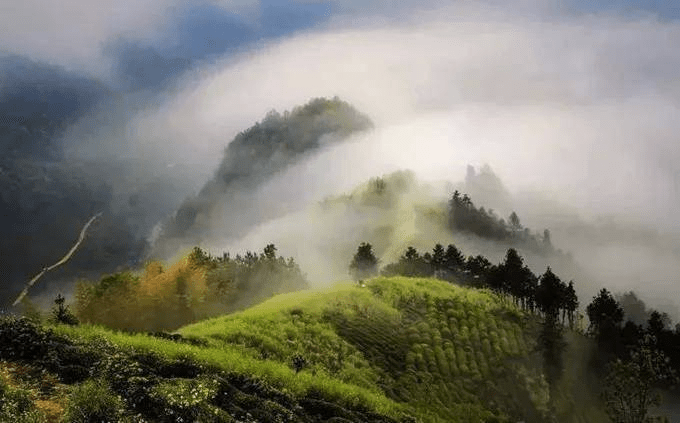
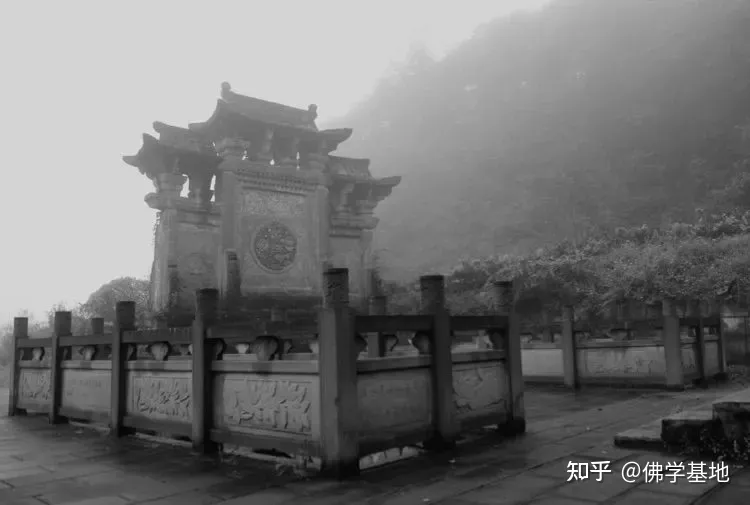
The Mount Wuzhong, also known as Misty Mountain and formerly referred to as Daguangming Mountain, Tiancheng Mountain, and Wushan, is a significant Buddhist pilgrimage site situated along the ancient Sichuan-to-India trade route, often referred to as the Southern Silk Road, within ancient China. It is located in Wushan Township, north of Dayi County, 25 kilometers from the county seat, and 80 kilometers from Chengdu. To its east lies Qinglong Mountain, to the south it connects with Daping, to the west it borders Wayao (also known as Baihushan), and to the north, it meets Longwo. The primary peak elevates to 1638 meters, with Jiulong Mountain and Jingang Mountain to the north and Hongyan Mountain to the west. Covering an expansive area of several square kilometers, it is aptly known as the “72 peaks” due to the constant presence of clouds and mist, hence earning its moniker as the “Misty Mountain.”

Historical records, such as the Ming Dynasty’s “Kaihuasi Stele Inscription” and the “Records of Misty Mountain,” reveal that as early as the Western Han Dynasty, Mount Wuzhong was renowned for its breathtaking natural beauty and mysterious wonders that left people in awe. It was described as a “land adorned in golden cloth and adorned with jade-like peaks, filled with endless wonders that inspired astonishment and amazement.” It was even considered “the place where the ancient Buddha Amitabha performed miracles.” In the 16th year of Emperor Ming of the Han Dynasty, responding to recommendations from the imperial court, Emperor Ming dispatched the courtier Fu Ying, accompanied by two distinguished monks from ancient India – the venerable monks Kashyapa Matanga and Zhu Falan – to establish a Buddhist temple on the mountain. Their mission was to propagate Buddhism and disseminate its teachings, thereby benefiting people far and wide with the nectar of Buddhist wisdom.

During the Ming Dynasty, Buddhism at Misty Mountain reached its zenith. The mountain boasted a total of seventy-two peaks, nine passes, and one hundred and eight winding paths, accommodating one hundred and eighty temples and forty-eight hermitages. According to the “Records of Misty Mountain,” it was described as a place “spanning dozens of square miles north of the two rivers and south of Longwo, with buildings scattered like black houses, without overcrowding.” “Monasteries and temples were as numerous as stars in the sky, surrounding the mountain from all sides, too numerous to count.” In modern terms, the total constructed area exceeded 400,000 square meters, equivalent to the size of a medium-sized city. During the Ming Zhengtong era, the emperor established the Dugang Institute at Misty Mountain, with the venerable monk Yuanxi serving as the official historian, overseeing all temple affairs. The temples at Misty Mountain were so prosperous and grand in scale during that period that a local saying emerged: “There are 25 thousand great monks, and the number of ordinary monks is beyond count.”

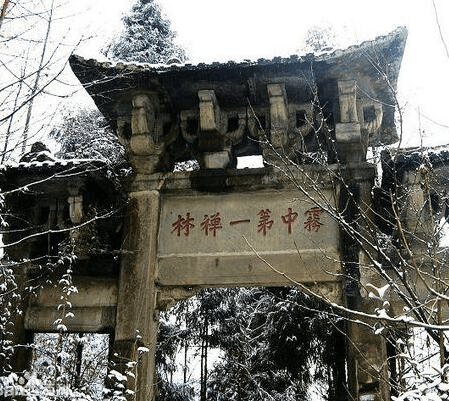
Eminent scholar Yang Sheng An, during his travels in Misty Mountain, inscribed a couplet on the “Heavenly Mountain” archway, proclaiming, “There is no match in the world; Misty Mountain is the number one.” With Yang Shen’s profound insight, he boldly asserted that Misty Mountain was unrivaled, and in the “Inscription of Kaihuasi temples at Misty Mountain,” he referred to this place as the “supreme stronghold of Chan (Zen) Buddhism.” This attests that during the Ming Dynasty, the prestige of Buddhism at Misty Mountain remained unmatched by other mountains in the region.

The Buddhist temple – KaihuaSi – established by the venerable monks Kashyapa Matanga and Zhu Falan was erected just six years after the White Horse Temple, often regarded as the first temple in Chinese Buddhist history. Therefore, it holds the distinction of being the second temple in the annals of Chinese Buddhism’s history and the first temple for the transmission of Buddhism from the south. Emperor Ming of the Han Dynasty bestowed upon it the name “Daguangming Puzhao Temple.”

KaiHuaSi Temple

Since the Han Dynasty, Mount Wuzhong has been home to renowned monks who have propagated and practiced the Buddhist teachings. During the Yonghe period of the Jin Dynasty, the esteemed Western monk Faxian revitalized Misty Mountain, renaming the temple as Tiancheng Mountain Xianying Temple. In the reign of Emperor Gaozong of the Tang Dynasty, two great masters, Sangha and Senghu, resided here and, by imperial decree, restored the original name of Daguangming Mountain Puzhao Temple. In the reign of Emperor Xiaozong of the Song Dynasty, Master Yuanze Laochang expanded and embellished the temple, bestowing it with splendor. During the reign of Emperor Xuanzong of the Ming Dynasty, Tibetan monks Pudashaye and Shigaba were once again appointed by imperial decree to rebuild the temple and requested the imperial name “KaiHuaSi at Misty Mountain.” This name has endured for the temple ever since.

Throughout its long history, Kaihuasi at Misty Mountain has withstood nearly two thousand years, bearing witness to the rise and fall of temple structures, yet it persists to this day. In this enduring history, one can discern the resilience of Buddhism, the steadfastness of human hearts, and the enduring nature of faith.

.

JiewangSi

In more recent times, two esteemed monks resided within the temples of Misty Mountain: Master PuGuan and Master Guozhang. Both were disciples of H.H. Dorje Chang Buddha III, receiving profound Dharma initiations from Him and achieving liberation. In 1998, Master Pu Guan passed away while in meditation, having attained mastery over his life and death. Remarkably, even eight years after his passing, his remains rest within a stupa, preserved in the meditation posture without any signs of decay.

Master Guozhang, a renowned Chinese Buddhist monk, embarked on his monastic journey at a young age on Mount Emei, one of China’s four famous Buddhist mountains. In his middle years, he ventured to Kangding in Tibet, where he received empowerment from the Supreme Vajradhara, H.H.  Dorje Chang Buddha III, who became his fundamental guru. Subsequently, he served as the abbot of Jiulao Cave on Mount Emei. Master Guozhang was celebrated for his unwavering commitment to monastic precepts, profound spiritual realization, and his extraordinary ability to tame wild animals on the mountain. Legends even spoke of his capacity to hear conversations between heavenly beings and humans.

In 1992, both Master Puguan and Master Guozhang were appointed to key positions at Misty Mountain’s Kaihuasi Temple by the government of Dayi County. Master Puguan assumed the role of abbot and oversaw Buddhist affairs within the mountain, while Master Guozhang was entrusted with overseeing the temple. Later on, Master Guozhang became the abbot of Jiewangting temple, which also located in the Misty Mountain.

Master Guo Zhang once shared with his disciples a remarkable experience: he received the Great Dharma initiation from H.H.  Dorje Chang Buddha III in Tibet when His Holiness was less than 5 years old.

In 2015, Master Guo Zhang passed away at the age of 108. Eleven days later, local government officials visited Jiewangting Temple and, doubting the profundity of the master’s practice, pierced his body with needles, causing blood to flow.

In China, there exists a saying that “famous temples produce famous tea since ancient times,” and the tea from Misty Mountain gained renown as early as the Tang and Song dynasties. Throughout history, the monks of Misty Mountain have often been involved in tea cultivation, using tea as sustenance, and blending Zen and tea culture. Within Misty Mountain’s expanse, ancient tea tree groves flourish, some so immense that it takes two people to encircle them. The tea leaves harvested from these trees emit a fragrant aroma and are considered the highest-quality Misty Mountain tea.

The fusion of Zen and tea culture embodies three virtues: “During Zen meditation, one stays awake all night, when one is full, tea aids in digestion, and tea is not consumed when not needed.” Tea serves to quench thirst, invigorate the senses, alleviate stress, purify the mind, nurture virtuous qualities, and has thus become an invaluable aid in Zen practice. The spiritual essence of Misty Mountain’s Zen and tea culture is encapsulated as “upright, pure, harmonious, and elegant,” with the purpose of “expressing gratitude, embracing inclusivity, sharing, and fostering connections.”

Mount Wuzhong – A Place Filled with Historical and Cultural Significance

Link:https://peacelilysite.com/2023/09/27/mount-wuzhong-a-place-filled-with-historical-and-cultural-significance/

Source: https://club.autohome.com.cn/bbs/thread/a3b8e453b0c45836/72821534-1.html, http://www.day.gov.cn/day/c140445/2021-01/14/content_d51260858d10469a94a004e1395bd9c6.shtml, http://www.lvyoudream.com/lvyougonglue/938/

The Best Buddhist Dharma to Rebirth at Paradise of Ultimate Bliss

Buddhist Devotee Hou Yushan Passed Away, Leaving a Legacy of Spiritual Journey

On June 1st, 2002 Buddhist disciple Hou Yushan peacefully passed away at his home in Los Angeles. Witnessed by his wife, Hou Li Qingqiu, the celestial realm appeared before him as Shakyamuni, Amitabha Buddha, and Avalokiteshvara, guiding him towards the ultimate state of bliss. Prior to his passing, Hou Yushan expressed his unwavering determination to learn Buddhism in this lifetime under the guidance of his master.

Hou Liqingqiu, a devoted practitioner of Chinese medicine in California, addressed over 20 monks who gathered in their home for a Buddhist practice session in honor of Hou Yushan. She shared the remarkable journey of her husband, stating that he had dedicated many years to the study of Buddhism. Diagnosed with lung cancer four years ago, Hou Yushan had endured arduous and prolonged treatments. However, his life took a transformative turn a year and a half ago when he and his wife attended the Yiyungao International Cultural Foundation, where they listened to the enlightening teachings of Master Yiyungao (H.H. Dorje Chang Buddha III).

Deeply inspired by the teachings on the pre-recorded dharma discourse, Hou Yushan developed profound admiration and sincerity towards Great Master Yi. He actively participated in the group cultivation programs of the foundation, he never missed an opportunity to listen to the pre-recorded dharma discourse. Despite the advice of others to focus on rest and recovery, Hou Yushan insisted on continuing his full-time volunteer work at the foundation, driven by his desire to meet Master Yun Gao Yi as soon as possible.

In February of year 2002, Hou Yushan and his wife sought refuge under the guidance of Great Master Yi Yungao (H.H. Dorje Chang Buddha III) through the American Master Yiyungao International Cultural Foundation, led by Lobsang Gyatso Rinpoche. Upon meeting the revered master, they were pleasantly surprised to find that their preconceived notions were far from reality. Master Yi was not the distant figure they had imagined, instead, he displayed approachability and warmth. With utmost sincerity, they sought empowerment to learn the Dharma, presenting their offerings. However, Master Yi, without even glancing at them, humbly declined their offerings, explaining that he could not set such a precedent. Nonetheless, Great Master Yi graciously provided them with the empowerment and transmission of the Dharma. Hou Yushan diligently practiced the teachings and swiftly progressed, experiencing a sudden disappearance of his cancer pains.

Hou Yushan’s wife Hou Liqingqiu shared the incredible experience with the monastery

On the auspicious occasion of Buddha Bathing Day in May 2002, Hou Yushan and Hou Liqingqiu had the opportunity to reunite with Master Yi Yungao (H.H. Dorje Chang Buddha III). When asked about his wishes, despite his terminal illness, Hou Yushan expressed his sole desire to learn how to attain a stable rebirth in the Land of Ultimate Bliss. In response, Master Yi advised him to adopt a different practice method, specifically the Pure Land School’s method of reciting Buddha, with a particular emphasis on Amitabha. Additionally, Master Yi imparted a secret handprint of rebirth, promising that through this method, Hou Yushan would soon witness the state of Amitabha and be guided by Buddhas and Bodhisattvas to the Paradise of Ultimate Bliss. The compassion demonstrated by the master was profound, as he called Hou Yushan to his side and secretly shared the sacred handprint with him. Hou Yushan experienced indescribable excitement and joy upon receiving this precious gift—the profound Great Dharma of the Supreme PureLand Buddha Dharma.

Ever since Hou Yushan received the transmission of Amitabha Dharma on the Buddha Bathing Festival, his wife has witnessed a remarkable transformation in his condition. Hou Liqingqiu, the wife saw golden rays of yellow and red light radiating from his head and back at any given time. As a result, all the cancer-related pains in his body have vanished, along with the swelling. He no longer required the morphine painkillers prescribed by the hospital.

One day, Hou Yushan asked his daughter Lily, who worked as an anesthetist in the hospital, about his complexion. Lily responded, saying, “Dad, your complexion is genuinely vibrant, and your spirits are high. One would never guess that you are a patient.” On the morning of May 25, Hou Yushan shared with his wife that during his Dharma practice the previous night, he entered a state of samaya and visited the Land of Ultimate Bliss. He described the indescribable beauty of the paradise, filled with captivating shades of red, green, and purple.

Hou Liqingqiu eagerly inquired, “Can you provide me with an analogy to illustrate its beauty?” After a moment of contemplation, Hou Yushan responded, “The Paradise of Ultimate Bliss surpasses any scenery in this world. Do you recall our visit to West Lake when we were young? In the early morning, the misty air and the colorful reflections on the lake created a breathtaking view. However, the beauty of the Paradise surpasses even that. Furthermore, the Buddha informed me that he would come to fetch me in seven days, urging me to proclaim to the world that the greatest Dharma in existence is with our master.”

On May 31, Hou Yushan carefully settled all family matters and left final words for his daughter. He advised her, “Do not hold your mother responsible for everything in her life. However, there is one thing you can admonish her for: if your mother ever strays from Buddhism and deviates from following Vajra Master (Master Yi Yungao – H.H. Dorje Chang Buddha III), remind her to earnestly practice under our Master Yungao’s guidance without hesitation.” Then, he turned to his wife, Hou Li Qingqiu, and earnestly said, “In your life, it doesn’t matter if you make other mistakes, but there is one thing you must not falter in: wholeheartedly follow the Vajra Master in dedicated practice. Your success lies solely in following his guidance, as his Dharma is the true path.”

Hou Yushan informed his wife that he would pass away that night and advised her, “Pay close attention tonight. At the moment of my passing, I fear I may fall into drowsiness and enter a demonic realm. Do not sleep, but remind me to visualize the Vajra Master above my head and Amitabha Buddha atop my head, while reciting the mantra wholeheartedly.” That night, in their seaside home, Hou Li Qingqiu had already foreseen that her husband, Hou Yushan, would depart to the Buddhist realm. Therefore, she set four alarms to ring at different times, once every hour. True to her premonition, at 6:15 a.m. on June 1st, Hou Yushan’s pulse and breathing slowed down. Hou Li Qingqiu shook his bed, and together they chanted, “Namo Vajra Guru! Namo Amitabha!” Hou Yushan held the secret handprint taught by Master Yi Yungao.

At that moment, Hou Li Qingqiu heard heavenly music, and Hou Yushan’s body emitted increasingly powerful golden light. She witnessed the appearance of Shakyamuni Buddha, Amitabha Buddha, Guanyin Bodhisattva, and other Buddhas and Bodhisattvas in the sky by the seaside. The merging rays of light grew more potent. After about five minutes, the Buddhas and Bodhisattvas, along with the celestial splendor, disappeared. It was then that she remembered to check Hou Yushan’s pulse, which had ceased along with his heartbeat.

Zhang Tianyou, the president of the American Master Yi Yungao International Cultural Foundation, was the first to arrive at Hou Yushan’s residence after his passing. He observed Hou Yushan, who appeared peacefully asleep, with no signs of pain on his face. Hou Yushan’s hands held the secret handprint from his previous life.

The incident deeply moved Long Hui, the chairman of the International Federation of Buddhist Monks and Nuns and the abbot of Huazang Temple. She continuously praised the greatness of Master Yi, stating that she often witnessed the suffering experienced by lung cancer patients at the end of their lives. However, the Pure Land method of reciting Buddha taught by Master Yi could transform a lung cancer patient’s condition within a month, filling their surroundings with auspicious golden light and relieving their pain. This would ultimately lead them to be reborn in the Land of Ultimate Bliss under the guidance of Buddhas and Bodhisattvas. Long Hui marveled at the tremendous power of Tathagata-rectification, beyond the capacity of words to express.

On the night before his passing, Hou Yushan personally prepared gifts and $5,000, and said to his wife, “The master never accepts offerings. He did not accept my offerings. Tonight, as I pass away, tomorrow you shall make the offerings and send them to the master. Please ensure he accepts them.” On June 1st, Hou Li Qingqiu faithfully followed her husband’s final instructions and sent the offering package to Yi Yungao, kneeling on the ground with tears in her eyes. She implored Master Yi to accept the offering, shouting loudly, “My supreme Buddha Vajra Master!” The master replied, “Do not address me as such, for I am not a Buddha. I am merely an ordinary practitioner, just like everyone else.” Hou Li Qingqiu explained that it was Hou Yushan’s testamentary offering, to which the master responded, “It seems there is no other way. These relics of Layman Hou shall be displayed in the temple and not for individual use.” The master immediately transferred $6,000 from his personal funds for Layman Hou’s burial expenses and informed the masters of two prominent temples to offer their support in accumulating merit for the deceased.

Photo from weixin.com

Buddhist Devotee Hou Yushan Passed Away, Leaving a Legacy of Spiritual Journey

Link: https://peacelilysite.com/2023/06/09/the-best-buddhist-dharma-to-rebirth-at-paradise-of-ultimate-bliss/

#DorjeChangBuddhaIII #HHDorjeChangBuddhaIII#DorjeChangBuddha #PureLand #Shakyamuni Buddha #AmitabhaBuddha #Avalokiteshvara #Cancer #ParadiseofUltimateBliss #MasterYiYungao #HouYunshan #Compassion #SupremeBuddhaDharma

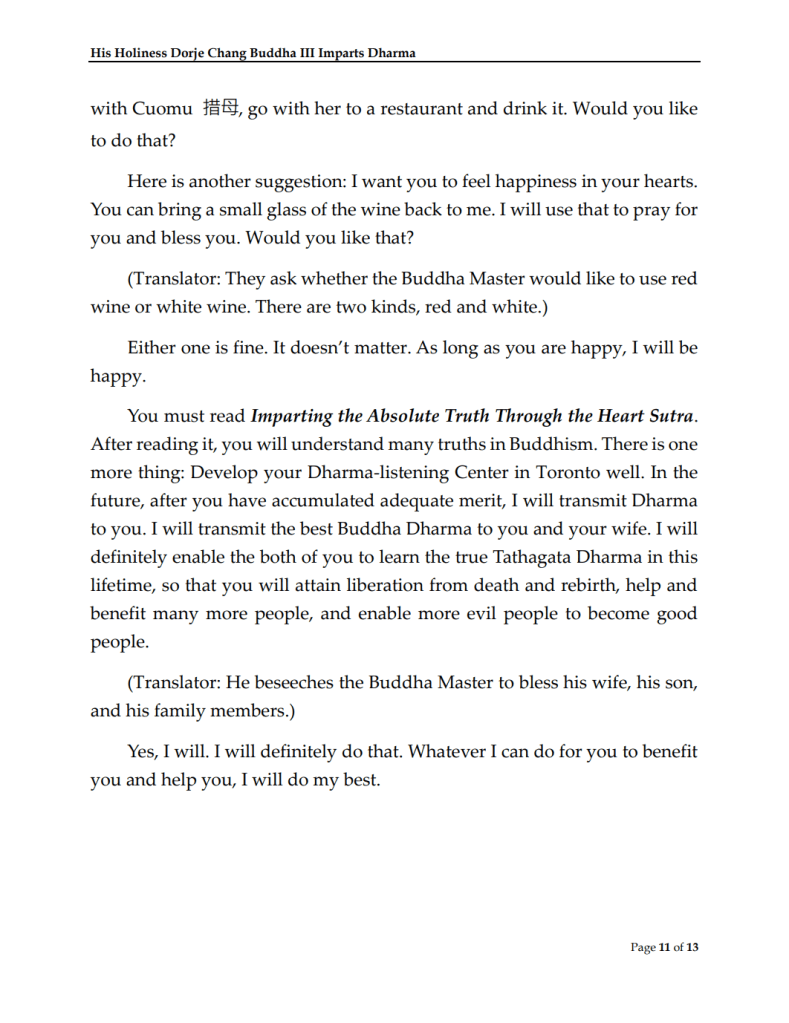
His Holiness Dorje Chang Buddha III Imparts Dharma In Response To A Westerner’s Questions

His Holiness Dorje Chang Buddha III Imparts Dharma In Response To A Westerner’s Questions

Link: https://peacelilysite.com/2023/03/31/his-holiness-dorje-chang-buddha-iii-imparts-dharma-in-response-to-a-westerners-questions/

#DorjeChangBuddhaIII #HHDorjeChangBuddhaIII#DorjeChangBuddha #DharmaDiscourse #Buddhist #