Your Yidam

The Yidam plays a crucial role in the daily practice of Buddhist disciples, especially for practitioners of Esoteric Buddhism. This article explains how you acquire a yidam and how your relationship with your yidam can develop.

The Buddha Master, H.H. Dorje Chang Buddha III, tells us that “your Yidam is the holy being presiding over the particular Dharma you decide to practice in order to attain accomplishment.” The Buddha Master also tells us we have to face our Yidam and the Dharma protectors of our Yidam. And you cannot hide from either your Yidam or the Dharma Protectors. You may wonder how you know who your Yidam is. As you advance in your practice, you may receive a particular Dharma of Selection and be told who your Yidam is. As I understand it, this is probably a being that you have already achieved some accomplishments with in past lives and you are already familiar with the Dharma associated with that Yidam. You do not practice more than one Yidam Dharma at a time. Many of us start this practice with Kuan Yin Bodhisattva as our Yidam and follow the “Vajra Yoga Perfection Dharma” that you can find in True Stories about a Holy Monk. You may be fortunate to receive other Yidam practices from authentic Dharma masters and rinpoches.  You would only do one yidam practice at a time, but you may also follow different Yidams throughout your spiritual career. I was told that if you cannot receive a Dharma of Selection, you may select the Yidam for whom you have the greatest affinity. In fact, you do not pick the Yidam, the Yidam actually picks you. You must keep your precepts and not hold any of the “128 Evil and Erroneous Views” in the Supreme and Unsurpassable Mahamudra of Liberation.

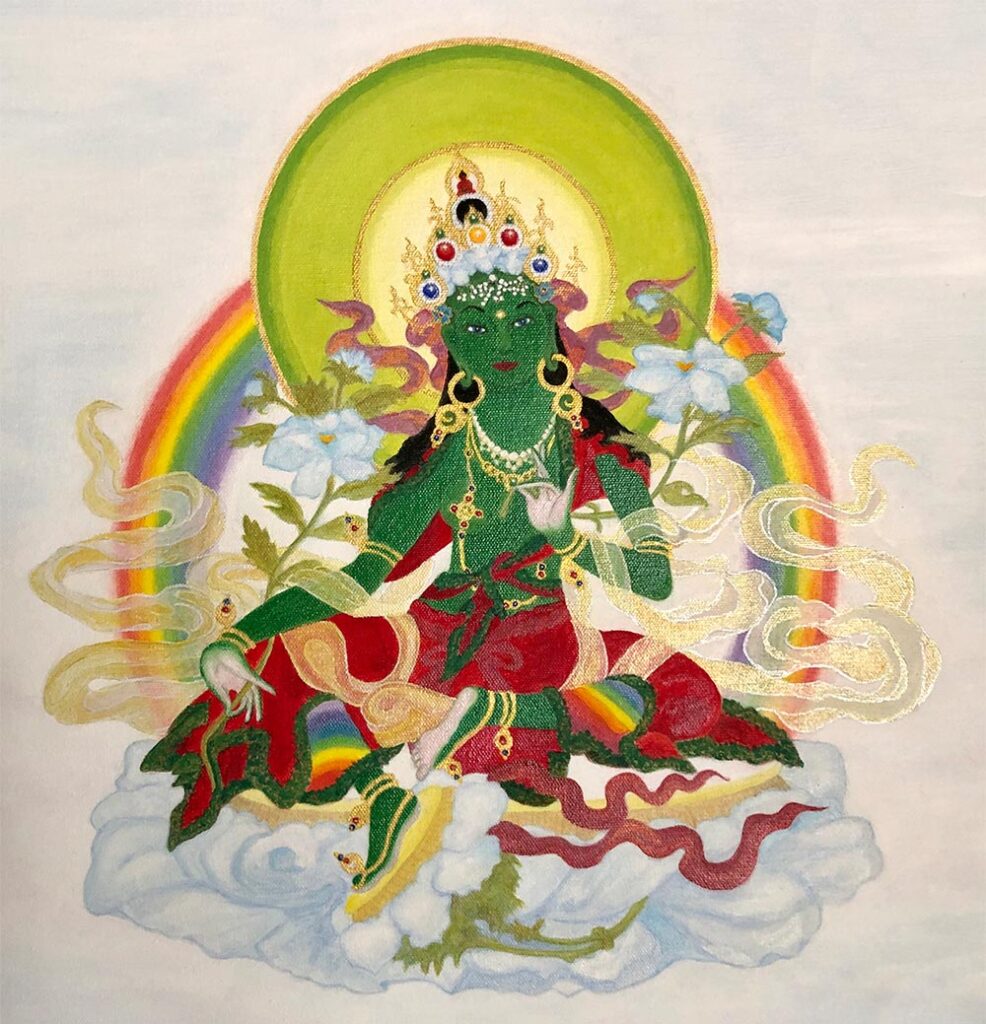
Painting of Green Tara by Zhaxi Zhuoma
Painting of Green Tara by Zhaxi Zhuoma.

Do not be frustrated if something is not clear. If you are not progressing in your Yidam practice, go back and reflect on your cultivation. You should be doing this three times per day anyhow. If you are not keeping the precepts or developing your bodhichitta, you cannot progress. If your cultivation is good, your Yidam may come and teach you what you need to know. I have had that happen as have several of my students.

Once I was not clear on how to visualize a particular mantra and my Yidam showed me how to do it. I have a student who does not live near California and who is unable to visit either the Buddha Master or me very often. He is a serious, sincere, and compassionate cultivator and does, however, have a very good relationship with his Yidam. She has helped him on many matters. I recently received an email from him telling me how much he had gained from his last trip to the Holy Vajrasana Temple and being able to study Expounding the Absolute Truth through the Heart Sutra. Even though he was only able to study this Dharma a short time this trip, he gained realizations which he didn’t get in all the previous years he had studied here. He said, “It made a deep impact on my life and I am very grateful that I was able to read even this little bit of it. Since then I was reflecting even more on how our daily lives relate to achieving accomplishment in the Dharma, how cultivation and Dharma practice need to go together. I often compared it with breathing, like inhaling and exhaling following one another and both are necessary to keep [your] life working. This morning I received an instruction from [my Yidam] on this topic while I was doing my Dharma practice which I would like to share with you.”

He went on to explain that his Yidam told him that he should see that cultivation is like collecting firewood. Doing a Dharma practice is like igniting a fire. If we have not collected enough wood (or any at all) the fire of wisdom cannot burn. So even a kind thought is like a dry twig which will fuel the fire. So, cultivating ourselves seriously and not slipping in any moment is like piling up a huge amount of firewood which will cause the fire to burn strongly and result in accomplishments.I was delighted. He said I could share the teaching as an example of how our Yidams do teach us, but we must do the practice and cultivate our behavior. The Buddha Master tells us in Learning from Buddha that if you learn one of the Mind Essences from the Supreme and Unsurpassable Mahamudra of Liberation “. . .to the point of proficiency and put it into practice, you need not worry about not being able to learn Buddha Dharma. Even if I, your Master, do not teach you, the Yidam will teach you.”

By Zhaxi Zhouma Rinpoche

Link:https://peacelilysite.com/2025/04/03/your-yidam/

Source: https://www.zhaxizhuoma.org/your-yidam/

A Life Well-Loved: Finding Strength in Softness and Wisdom in Time

After more than fifty years of experiencing life’s ups and downs, I have finally come to understand the profound importance of quieting down, reflecting, and learning how to truly love myself. It is only through self-love that we can genuinely love others.

“When I truly began to love myself, I started going to bed earlier and learned to enjoy exercise. I stopped getting lost in worries and anxieties. Instead, I became confident and pursued meaningful people and endeavors with passion. That was the moment my life truly began.”

Understanding another person is never easy. We must walk in their shoes, see the world through their eyes, and consider life from their perspective. Yet, this journey often brings sadness. But in that sadness, we discover clarity—we learn to focus on what truly matters.

Rather than wasting our time on trivial concerns and unfulfilling distractions, we should devote ourselves to nourishing pursuits: sleep, books, exercise, the beauty of nature, and, above all, the love we have for the world. When we consciously take control of our time, the tranquility of daily life emerges naturally, and anxiety fades away.

Kahlil Gibran once said, “If one day you stop searching for love and simply love; stop yearning for success and just do; stop pursuing empty growth and begin to cultivate your character, then your life will truly begin.” This wisdom reminds us that authentic living starts with our inner transformation.

Loving yourself means understanding that pain and emotional turmoil are often just reminders to live authentically. Unless it stems from physical illness, much of our suffering comes from misplaced values rather than objective reality. The things we cling to the most are often the very things that torment us, while those beyond our control are simply not worth our distress. True wisdom lies in knowing when to hold on and when to let go.

To be nurtured by others is a gift; to nurture others is an even greater act of cultivation.

May we have eyes that shine like stars, hearts as vast as the ocean, and lives that leave behind the fragrance of kindness wherever we go.

The Wisdom of Middle Age

Middle age teaches us the value of patience, restraint, and measured action. In our youth, we often equate eloquence with intelligence, only to later realize that true wisdom often lies in silence. As W. Somerset Maugham observed, “In a crowd, the quietest person is often the most powerful.”

In conversations, we should not rush to take center stage. Instead, we should listen more and speak less, exercising the grace of restraint. When others share, let us resist the urge to interrupt. When disagreements arise, let us not hastily refute. Instead of saying, “I think,” we can ask, “What do you think?” Instead of declaring, “You are wrong,” we can offer, “Perhaps there is another way to see this.” By replacing subjective judgment with open-minded awareness, we foster deeper understanding.

The world is not simply black and white. By speaking a beat slower and thinking a step faster, we cultivate clarity and wisdom in our lives.

In psychology, there is a concept called task separation: our emotions are our responsibility, while others’ reactions belong to them. The wisdom of softness lies in maintaining a gentle boundary between the two. It allows us to be vulnerable and to accept imperfection in ourselves and others. Harsh confrontation often leads to conflict, but a simple, “I understand your difficulties,” can resolve tensions effortlessly. As Alfred Adler wisely said, “True strength lies in the courage to expose one’s vulnerabilities.”

Try shifting from “I must win” to “We can solve this together.” Instead of “Why don’t you understand me?” consider, “Perhaps I need to express myself differently.” Softness is not weakness—it is a space that allows relationships to breathe and grow.

Kazuo Inamori once said, “What you hold in your heart is what you will encounter.” True generosity is not about calculated acts of kindness but instinctive goodwill. A small gesture—carrying a neighbor’s trash, offering a sincere compliment, or leaving a light on for a loved one—creates ripples that spread far beyond our immediate reach.

A generous heart does not tally whether kindness is repaid. As the Tao Te Ching states, “The more you give to others, the more you have yourself.” Every act of warmth we extend ultimately enriches our own lives.

As we journey through middle age, wisdom is cultivated through restraint. In youth, we may be like strong liquor—bold and fiery; with time, we become like fine tea—subtle yet deeply enriching. Speaking slowly allows us to reflect, gentleness fosters harmonious relationships, and generosity ensures lasting blessings.

These qualities of slow cultivation cannot be rushed or feigned. But with daily practice and yearly dedication, we will come to embody the depth of the old adage: “Still waters run deep.”

Link:https://peacelilysite.com/2025/04/02/a-life-well-loved-finding-strength-in-softness-and-wisdom-in-time/

Homage to H.H. Dorje Chang Buddha III Cultivators Should Become Buddhist Disciples in Holy Sense with Correct Faith and Real Cultivation

Many people say they have faith in Buddhism and therefore naturally regard themselves as Buddhists. However, these numerous Buddhists who regard themselves as having faith in Buddhism are at many levels and a mixture of true Buddhists and false ones and have all kinds of people in them. Among them, there are people who truly believe in Buddhism and have the correct faith, there are people who regard themselves as having the faith but really do not have the correct faith, some falsely claim to have the faith, and there are descendants of Mara Pipiyan who infiltrated into Buddhism to do damages. That is why the Buddhist world is full of chaos in this dharma-ending era. This situation requires true Buddhists and Buddhist disciples with the correct faith to open up their eyes to clearly distinguish what is true and what is false and determine what is right and what is wrong, in order to advance on the correct Bodhi path toward liberation and accomplishment without deviating aside.

Buddhist is a noun with broad meanings. Within the scope of this concept embodying a wide range of meanings, quite many people are really just “followers” or even “visitors paying the respect of burning incense.” Their knowledge about Buddhas and Bodhisattvas is just knowing the concept. They only have the so-called faith in Buddhism but have not taken refuge or made deep study or investigation. Basically, they are still invaded and corroded by the three poisons in their daily life, do things based on their own opinions, and do not cultivate or practice in accord with the Buddha’s teachings and warnings. When they go into temples to burn incense and pay respect, they beseech only rewards of good fortune in the current lifetime such as making big money in business, getting promotion or advancing to a position of power, happiness and harmony in family life, good health, and so on. Some of them cannot even tell the difference between Buddhism and Daoism and pay respect to deities and ghosts as well. That is absolutely a false faith in Buddhism without any understanding. Therefore, strictly speaking, such “Buddhist followers” really cannot be regarded as Buddhists.

There are also quite some Buddhists who, though having taken refuge in Buddhism, have not become clear about the approach of learning the absolute truth of Buddha-dharma and practice Buddha-dharma selectively as worldly ways. Some of them even have incorrect or evil knowledge and views. Their cultivation falls into superficiality and becomes a futile effort. They think that believing in Buddha’s existence and having taken refuge in Buddhism are the entirety of a Buddhist’s faith. Their faith in Buddhism is not a pure faith and is not an indestructibly firm faith. Their faith is a “faith that can be overpowered,” which can be easily shaken, overpowered, and abandoned. Their faith is an “intermittent faith.” They sometimes have faith and sometimes have doubt. A slight disturbance can cause them to generate doubt, enter into delusion, and lose confidence. Their faith has reversals and impediment and is not always clear and pure. This type of cause from such impure and contaminated faith definitely cannot bear wonderful fruit of accomplishment and liberation. This kind of faith has an extremely weak foundation and of course is not a true faith. Therefore, the refuge ceremony they have taken is just a formality and cannot represent a true faith in Buddhism.

One who does not have a true faith of course will not have a correct understanding and will not put the faith into action. Therefore, these people will not clearly believe in cause and effect and will not truly know impermanence, much less fear impermanence. Rather, they have deep and severe attachment to the self and always treat things related to them as important and having a higher priority than Buddhist work. They may even list conditions and offer deals to Buddhas and Bodhisattvas to ask Buddhas and Bodhisattvas to give them what they want first before doing Buddhist work. How can such cultivation and conduct receive protection and empowerment from Buddhas and Bodhisattvas? How can there be benefits and rewards from learning Buddhism to speak of? Thus, in today’s world, although countless people claim they have faith in Buddhism and cultivators of Buddhism are numerous and everywhere, very few of them can truly receive beneficial rewards. Instances of ending the cycle of birth and death are even rarer. Shouldn’t this situation cause the attention and vigilance of Buddhist disciples learning Buddhism?

The goal of believing in and learning Buddhism is for attaining liberation and accomplishment and becoming a holy one. Therefore, Buddhists questing for liberation and accomplishment should strive to plant and grow the cause of true faith to get the wonderful fruit of liberation and accomplishment and let themselves become veritable disciples of Buddhism with true faith and correct faith. Then, where does true and correct faith come from? Of course it comes from piously cultivating Buddhism through concrete steps. Buddhists with true and correct faith should believe in not only the Buddha’s real existence but also the Buddha’s teachings and precepts, develop strong power of vow from the inner mind to uphold, follow, and carry out the Buddha’s teaching, develop the power of determined faith to regard the principle of Buddha-dharma as the sole standard of selection and the guiding principle of conduct, and strictly and firmly act in accord with the teaching to generate the power of true faith from the inner mind. With such premise, we can establish the determination to cultivate Buddhism, clearly believe in cause and effect, diligently practice the ten actions of goodness and the four limited states of mind, and broadly cultivate the six paramitas through all acts. On the other hand, a person who is deeply plagued by heavy attachment to the self and only superficially obey Buddhas’ and Bodhisattvas’ teachings and precepts will never step onto the path of Bodhi toward liberation and accomplishment even after reading the Tripitaka exhaustively.

Therefore, disciples of Buddhism who truly intend to cultivate Buddhism to attain liberation and accomplishment have to become Buddhist disciples in the holy sense with true faith and real cultivation. Buddhist disciples in the holy sense are in true correspondence with the Buddha’s teaching and the purpose of learning Buddha-dharma and can thoroughly see the true such-ness of mind nature. Such is the meaning of the holy sense. To possess the status of the holy sense, Buddhist disciples must concurrently pursue progress in all three aspects of Buddhism. Only by advancing in all three aspects coherently as a whole can one be regarded as a Buddhist disciple in the holy sense. These three aspects are: the teaching of Buddhism, the study of Buddhism, and Buddha-dharma. Moreover, the three aspects must be combined perfectly to comprise one entity.

The teaching of Buddhism includes the Buddha’s teaching that has been transmitted through the time and historical facts about Buddhism. Among them, there are true events of the Buddha, historical backgrounds, records of the origin and propagation of Buddha-dharma, karmic conditions related to expounding specific dharmas, references and publications of the dharma expounded by the Buddha, rules of Buddhism, and so on. The study of Buddhism refers to Buddhist scriptures, the origin, development, and timeline of Buddhist sects and schools, and the principles and philosophy within Buddha-dharma; all are investigated theoretically using the method of academic research. Buddha-dharma is the special dharma gates transmitted from the Buddha that can enable cultivators transcend the mundane world and enter holiness, methods to lead one into the practice toward liberation and to break away from mundane attachments, including mantras, visualization, mudras, mandala, dharma instrument, the three secret practices of body, speech, and mind, and utilization of the power of siddhi (accomplishment) within the dharma sphere.

It is true that becoming a Buddhist disciple in the holy sense is not easy. However, that is the goal that every Buddhist disciple must pursue and also the only path of cultivating Buddhism toward liberation and accomplishment. Moreover, achieving that goal requires a pious devotion toward the Buddha, focusing the mind on goodness, and pure cultivation of one’s body, speech, and mind.

There is only one way to achieve that goal. That is, taking the dharmas of the Contemplating the Magnificence of Perfect Prerequisite Oceanic Mind Essence and the Most Magnificent Bodhi Dakini Oceanic Mind Essence in the Supreme and Unsurpassable Mahamudra of Liberation and What Is Cultivation expounded by H.H.  Dorje Chang Buddha III as the guiding compass for absolutely correct cultivation, earnestly learning from and studying the dharma Expounding the Absolute Truth through the Heart Sutra expounded by H.H. Dorje Chang Buddha III, and diligently listening to the recorded supreme dharma lessons expounded by H.H. Dorje Chang Buddha III.

Due to our rewards of good fortune accumulated through many lifetimes and eons, we live in this era with H.H.  Dorje Chang Buddha III’s presence. Additionally, we also have the magnificent karmic conditions that allow us to closely follow H.H.  Dorje Chang Buddha III in learning Buddhism. We can listen with our own ears the recorded dharma lessons expounded by H.H.  Dorje Chang Buddha III and respectfully beseech the treasure books with dharmas expounded by H.H. Dorje Chang Buddha III. Moreover, many Buddhist disciples among us have personally received initiations transmitted by H.H.  Dorje Chang Buddha III in person. How lucky and fortunate we are! What reason do we have for not diligently learning Buddhism and cultivating ourselves! We must make our vow to become a one-hundred-percent Buddhist cultivator with true faith and correct faith and strive to be Buddhist disciple in the holy sense with clear and pure cultivation. We must attain liberation and accomplishment in the current lifetime! Amitabha!

by   Zhengfa Hong

Link:https://peacelilysite.com/2025/02/27/homage-to-h-h-dorje-chang-buddha-iii-cultivators-should-become-buddhist-disciples-in-holy-sense-with-correct-faith-and-real-cultivation/

HQ Announcement 20210101: An Impostor Will Not Dare To Practice These Eighteen Dharmas

The Headquarters would like to use this announcement to express our gratitude to Namo Dorje Chang Buddha III for the dependent origination of the Dharma impartment for a Shakya descendant, who is the Chairperson of a Buddhist University. This Dharma discourse has jolted and woken the karmic-obstructed Buddhists. Such an earth-shattering Dharma discourse has also destroyed the heresy that “Deluded thought makes you an ordinary person, an enlightened thought makes you a Buddha.” We are incredibly grateful to Namo Dorje Chang Buddha III.

Namo Dorje Chang Buddha III has imparted that since Shakyamuni Buddha entered nirvana, and Mara the Demon King vowed to have his descendants infiltrate the Sangha, those mara-monastics have been wearing sangha attires posing as monks and nuns and become evil masters. They have transgressed and desecrated the authentic Buddha Dharma. Therefore, today’s Buddhism is in a deteriorating and decadent state. Evildoers are rampant in Buddhist communities. They blatantly disregard and contradict Shakyamuni Buddha’s Doctrines, Precepts, and Dharma. Some mara-descendants become evil Dharma masters, and some sit on the Dharma King’s rostrum. Whether monastics or laymen, they all falsely claim to be great Bodhisattva or even Buddha.

They show the inflated and pretentious outside of being eminent monastics, Dharma masters, Dharma kings, or great virtuous laypeople. However, they are just ordinary people with frail bodies who fool and confuse those clueless Buddhist followers. They lie through their teeth without blinking, and their bloviations are merely an army of pompous phrases. They flash their fictitious holiness certificates and show little to no achievement in Five Vidyas. Furthermore, while pretending to be Buddhas or Bodhisattvas, these scoundrels have violated the precepts, eroded the Dharma, and deceived the public. Worse yet, some Bhikkhus and Bhikkhunis exhibit obscene, scandalous, and offensive behaviors and shamelessly post those videos on the web.

These evil masters and evildoers have wreaked havoc in the Buddhist communities. They have fooled millions of people into believing they were holy sages. In fact, whether an individual is a Tathagata, Bodhisattva, or Arahat, the Buddhas have established the Eighteen Kinds of Great Dharma for Holiness Selection and Confirmation. By way of them, all frauds will show their true colors easily. Any evil master, whether they sit on the Dharma king’s rostrum, a patriarch of a Buddhist lineage, a repository of sutras and treatises, or who can talk nineteen to the dozen, once put under the Dharma for confirmation, righteous or evil will reveal itself immediately. It is why the impostors dare not try any of the Eighteen Dharmas, because ordinary people will not be able to conduct any of these Dharmas successfully and will expose their frauds under the sun.

Buddhist disciples, if the truth is what you are after, these four points are essential to remember:

  1. You must not listen to this person’s empty talk on Sutra or Shastra.
  2. You must not solely trust this person’s superficial status as a lineage patriarch.
  3. You must not exclusively believe in this person’s fame and notoriety, such as a lineage-holder of a Buddhist sect.
  4. Tests must validate this individual; the Holy Test is the standard measure.

Otherwise, those who follow the impostors will most likely be deceived and ruined for good.

Whether a heavenly king, earthly deity, Bodhisattva, venerable, or Arahat, if the individual can conduct any of the Eighteen Dharmas and demonstrate the manifestation state according to the Dharma, this person is 100% a reincarnated Bodhisattva or Buddha. On the contrary, if this individual cannot practice any of these Dharmas, this person is certifiably ordinary, an impostor, and may even be a wicked con artist or scoundrel!

These Eighteen Dharmas are 1. Buddha Bestowing Holy Amritas (佛降甘露);2. Sending a Petition to Bodhisattva (送菩薩一表);3. Holy Fire Homa (勝義火供);4. Uncovering Terma with Direct Verification (現量伏藏);5. Knowing in Advance and Foretelling (先知預言);6. Establishing Mandala Through a Boulder (隔石建壇);7. Bodhi Holy Water (菩提聖水);8. Lifting Pestle onto Platform With One Hand (拿杵上座);9. Bodhi Path Sin Decrease and Merit Increase Dharma (菩提道損減增益法);10. Vajra Array (金剛陣);11. Grand Eight Winds Array (八風大陣);12. Vajra Pillar Adjudication (金剛柱擇決);13. Hanging Bowl to Ask the Truth ( 懸缽問真.);14. Moving Vajra Pill like Dancing on Ice ( 冰姿顯聖);15. Vajra Faman Holy Adjudication (金剛法曼擇決);16. Hayagriva Or Horse-Head Wisdom King Water Altar Bead Hexagram (馬頭明王水壇珠卦);17. Dharma Gate Peacock Feathers Adjudication (法門宮羽);18. Double Adjudications (雙應擇決). These Eighteen Dharmas determine the holy from the mundane and the good from the evil. Each Dharma has its own Bodhisattva, Buddha, Vajra, and Dharmapala as yidam, and each presents a different manifestation of the realization state.

For examples,

  1. Buddha Bestowing Amrita: The congregation witnesses the Buddha, an Equal Enlightenment Bodhisattva, or a Marvelous Enlightenment Bodhisattva practicing the Dharma to beseech the Buddha to appear in the sky and bestow holy amritas into an empty bowl.
  2. Sending a Petition to Bodhisattva: The congregation witnesses the Tremendous Holy Guru practicing the Dharma, and a Bodhisattva retrieves the petition in front of the public.
  3. Holy Fire Homa: The congregation witnesses the Bodhisattva, a Tremendous Holy Guru, practicing the Dharma. The blue Vajra Maternal Buddha appears in the sky, prancing and dancing in front of the disciples, and then emits flame from between the eyebrows and ignites the charcoals in the cauldron instantly. The flame’s temperature can reach more than a thousand degrees Celsius.
  4. Uncovering Terma with Direct Verification: The congregation participates and witnesses in person. See details on the March 19, 2019 edition of “Wangzha Shangzun Manifests Vajra Power, and Yuzun Uncovers Terma With Direct Verification at The Holy Miracles Temple” on Las Vegas Chinese News Network.
  5. Knowing in Advance and Foretelling: The Tremendous Holy Guru personally predicts the number of amrita pills he will hold in his hand. He then reaches and grabs a bunch of amrita pills. The pills are counted before the congregation, and the result will be the same as his prediction.
  6. Establishing Mandala Through a Boulder: The congregation witnesses the Tremendous Holy Guru or Great Holy Guru using colored sands to create a Mandala on top of a boulder. With a flick of the finger, the Mandala design penetrates through the boulder to the bottom of the boulder and onto an empty Mandala plate. The Mandala is thus established.
  7. Bodhi Holy Water: The holy water manifested by the Tremendous Holy Guru or a Great Holy Guru. The water can penetrate any vessel. And, when poured on a rostrum, the water will maneuver according to the direction given by the Bodhisattva, Tathagata, a Tremendous or Great Holy Guru.
  8. Lifting Pestle onto Platform With One Hand: It determines whether the participant’s physical condition is holy or mundane. Anybody can try, and everyone is treated equally. Lifting the vajra Pestle with one hand to determine the holiness level will instantly reveal the sacred or mundane.
  9. Bodhi Path Sin Decrease and Merit Increase Dharma: See Namo Dorje Chang Buddha III imparted Dharma “This is the Invincible Vajra Dharma to Enable Buddhist Practitioners to Achieve Accomplishment.” If an individual with such advanced cultivation conducts this Dharma successfully before the congregation, then this individual must be a Bodhisattva or a Buddha, a Tremendous Holy Guru.
  10. Vajra Array: It is a mighty formation that tests a person’s level or stage in Buddhist practice. The World Buddhism Association Headquarters has video recordings of the Vajra Array in real applications.
  11. Grand Eight Winds Array: No candidate can step across a thin vajra rope when the array is established. The World Buddhism Association Headquarters has videos of the Grand Eight Winds Array in real applications.
  12. Vajra Pillar Adjudication: The congregation will witness a peacock feather hanging in the air. The Tremendous Holy Guru stands about 10 meters away from it and submits inquiries to the vajra pillar. The truth will be revealed in front of the congregation.
  13. Hanging Bowl to Ask the Truth: The congregation witnesses the supernatural come-without-a-shadow-and-leave-without-a-trace Vajra descending to the Mandala. The Vajra will knock on the bowl to confirm adjudication.
  14. Moving Vajra Pill like Dancing on Ice: It is a holy inner-tantric initiation. The sacred manifestation goes beyond the entry-level vibration of the Vajra Pill. The Vajra Pill must twirl like dancing on a snow-capped mountain. It is more like ice figure skating than swing dancing. It can transform to be bigger or smaller, taller or shorter. It can levitate and spin around the bowl without touching its wall or even shows the image of a wrathful Vajra.
  15. Vajra Faman Holy Adjudication: The congregation witnesses Vajra sand forming into crowns of various fruition and realization stages that befit the ones to be validated above the heads of their visages.
  16. Hayagriva (Horse-Head) Wisdom King Water Altar Bead Hexagram: The congregation does a lottery to choose a candidate. The adjudication is unequivocally accurate. The Bodhi beads are placed on the water altar. See details on World Buddhism Association Headquarters Announcement No. 20200103.
  17. Dharma Gate Peacock Feathers Adjudication: The congregation witnesses that the presiding master stands from afar, and the disciple stands in front of the sacred peacock feathers and submits an inquiry. The peacock feathers will respond definitively to the question the disciple raises accordingly.
  18. Double Adjudications: It is a test that entails both the Lesser Eight Winds Array (八風小陣) and the Holy Divination of Manjushri Bodhisattva. All the candidates take part in this test individually, with everyone witnessing the result, which shows accurate and consistent answers between the two adjudications without discrepancy.

Among the above Eighteen Dharmas, some only a Buddha, an Equal Enlightenment Bodhisattva or a Marvelous Enlightenment Bodhisattva can practice, and others only a great Mahasattva or above can. One must be at least at the level of an Arahat to be able to practice these Dharmas. The only exception is Puji Vajra’s (普及金剛) Lifting Pestle onto Platform With One Hand. Anyone can attempt to lift the Vajra Pestle to determine their holiness level.

Although each Dharma has its yidam, these Eighteen Dharmas can differentiate the real from the fake and the righteous from the evil. We call them Demon-Revealing Mirrors. They are not actual mirrors but categories of great Dharmas. In concrete applications, only Lifting Pestle onto Platform With One Hand takes as little as requiring the candidate to lift the pestle off the ground for 8 seconds. For the other seventeen Dharmas, the self-proclaimed holy individual is asked to choose one and practice it in front of the congregation. Whether this individual is a divine being or a fake can be seen on the spot.

Besides, only a Buddha, an Equal Enlightenment Bodhisattva or a Marvelous Enlightenment Bodhisattva are qualified to conduct the Dharma of Buddha Bestowing Amrita, all Bodhisattvas of lesser stages do not have the power to practice the Dharma. Many people have personally participated in and witnessed these Eighteen Dharmas, which were genuinely extraordinary, remarkable and praiseworthy.

On May 15, a great Mahasattva and the anagarikas of the World Buddhism Association Headquarters conducted the Bodhi Path Sin Decrease and Merit Increase Dharma for a pious practitioner who made outstanding contributions to Buddhist work. The entire congregation successfully practiced the Dharma together. Everyone experienced and witnessed this wonderful, world-astounding, and miraculous event. With only one strike on the bell, the sound reverberated throughout the site and resonated for a long time. All attendants stood about four to five feet from the platform, and all eyes focused on the jar in the middle. The total number of Bodhi pills has increased by three. The blessed disciple, from now on, can take the merit-increasing Bodhi pills every month and is guaranteed to achieve accomplishment. The Shengzun brought some of the merit-increasing Bodhi pills and made offerings to Namo Dorje Chang Buddha III to celebrate His Holiness, the Buddha’s holy birthday. Namo Dorje Chang Buddha III praised and proclaimed, “Although you have successfully practiced this holy Dharma, you should persistently turn away from all evildoings, commit to doing good, and selflessly serve and benefit others with your body, speech, and mind.” The Shengzun bowed and replied, “This disciple shall faithfully obey and will practice in accordance with the Dharma.”

Please note that during a validation test, the first eight Dharmas are the type that the candidate must practice in person. They are to verify if this individual has attained sufficient cultivation accomplishment to complete any of these eight Dharmas. The first eight Dharmas must be practiced by this candidate and witnessed by the congregation. No substitution is allowed. From the ninth to the eighteenth Dharmas, the candidate can practice the Dharma by themself to reveal their stage of holy manifestation. However, a great reincarnated Bodhisattva can also conduct the Dharma to adjudicate this individual’s true nature as sacred or mundane. It is the same process as verifying which fruition level, bhumi (ground), or Bodhisattva stage someone’s holiness stage is. The process can also be applied to confirm if any Sutra, Vinaya, Shastra, and Dharma contains distorted, erroneous, and deluded views. For example, some sutras have different versions of translations and interpretations. And various sutras may contradict each other. It is the aftermath caused by mara-descendants, who have infiltrated the Sangha and corrupted Shakyamuni Buddha’s Sutrapitaka. The Buddha knew the tricks of these evildoers to distort and falsify the Tripitaka. Therefore, the Buddha imparted these Eighteen Dharmas to differentiate the authentic from the spurious and the righteous from the evil. These Eighteen Dharmas are necessary to distinguish the moral from the evil. And we will not be able to resolve the self-contradictory statements between sutras without these eighteen Dharmas.

For example, on a Sutra, it writes: “The period since I became a buddha would exceed this by umpteen nayutas and asamkhyas of kalpas. Since then, I have been residing in the sahā world, teaching the Dharma and inspiring sentient beings. I have also been leading and benefiting sentient beings in umpteen nayutas and asamkhyas of other worlds. “On another Sutra, it indicates that Shakyamuni Buddha had been “a royal prince for ten lifetimes, and through many kalpas to become a Ksanti-vadi-rsi,” and after that, Buddha Dipamkara gave the prediction that the prince would achieve enlightenment at the Assembly on the Gridhakuta Peak (aka the Vulture’s Peak). Another Sutra depicts that when Prince Siddhartha Gautama practiced asceticism on the bank of the Nairanjananadi (Phalgu River), He was unsure if He would achieve enlightenment. The prince placed a bowl on the Nairanjananadi and made a wish: “If I can be the Enlightened One, this bowl will float upstream.” The bowl indeed floated upstream, which foretold His Buddhahood. In addition, Sutrapitaka lectures and proclaims that all Dharma (phenomena) arise in dependence upon causality.

Nevertheless, the Buddha also made many prophecies in the sutras, seemingly indicating a self-contradictory fatalism. In addition, many versions of the same Sutra or Mantra contain many different lengths of wording. All the confusion and destruction were caused by the mara-descendants who executed the orders from the Demon King. Therefore, practicing any of the Eighteen Dharmas will provide adjudication clearly and irrefutably to verify if an individual is holy or evil.

One of the Eighteen Dharmas provides the most convenient and immediate adjudication. It can validate any individual to be genuine or a sham in a few seconds unconditionally. This Dharma is Lifting a Pestle Onto Platform With One Hand Using Vajra Hook, whose yidam is Puji Vajra. Anyone who volunteers to participate will use one hand to lift the pestle. It will instantly confirm the participant’s physical condition irrefutably according to their corresponding realization power. Those who reach level twelve and above are the entry-level holy person. Those who fail to reach above level eleven don’t have a holy physical condition and are 100% ordinary. See details in “By Age and Weight, The Good-Health-Man Weight Standards for Lifting Vajra Pestle With One Hand.”

Please note that women are not required to partake in Lifting Pestle Onto Platform With One Hand. The other seventeen Dharmas will validate them instead. However, all men – pious believers, eminent monks, great Dharma masters, the Ehrampa Geshis, Lharampa Geshis, great lamas, great rinpoches, great Dharma kings, generational patriarchs, or even ordinary Buddhists, are treated equally in front of the Dharma of Lifting Pestle Onto Platform With One Hand. By lifting the same vajra pestle, whether the candidate has a holy physical composition or simply an ordinary body, and whether they are genuine or sham, will be revealed. This Dharma will confirm that an ordinary person is just ordinary and a holy being is holy. Pompous grandees without dharma power will be just that. In as little as a few seconds, the truth will reveal itself. There is no freeloading at all. Therefore, the impostors dare not lift the pestle.

However, suppose a male master, who has been validated by one of the Eighteen Dharmas, is a humble Buddhist cultivator, teaches according to the Dharma, is discreet and unpretentious, and practices true Dharma but has some health issues. In that case, the validation requirements of the Dharma of Lifting the Pestle Onto Platform With One Hand do not apply to him. Therefore, all Buddhist disciples should heed that as long as your Dharma master follows the teachings of Namo Shakyamuni Buddha and abides by the Dharma imparted by Namo Dorje Chang Buddha III, you should approve your master. Your learning relies on the audio recordings of the Dharma imparted by His Holiness the Buddha, which is the standard and guiding principle of correct meaning. Besides, only a Tremendous Holy Guru of the World Buddhism Association Headquarters with dharma power can transmit a holy Dharma to you. Your master’s role is to assist you in following the authentic Dharma and walking on the correct Bodhi path. Therefore, the master does not need to have advanced dharma power. If the master abides by the Buddha’s doctrine, the disciples should respect and follow them.

The Headquarters has received some complaint letters that state xxx pretended to be a Buddha; xxx deceived their disciples and self-proclaimed as a great Bodhisattva or a Marvelous Enlightenment Bodhisattva; xxx Dharma master has a scandalous relationship with xxx Bhikkuni and they went to karaoke, drank alcohol and ate meat, etc. These are unsurprising because Shakyamuni Buddha already predicted that evil demons would increase in the Dharma Degeneration Age and authentic Dharma would be increasingly diluted and corrupted. These reports have fulfilled the Buddha’s prophecies. Evil and demonic elements have rampantly mixed with pure Buddhism, obscured authentic Buddha Dharma, disregarded the precepts and ordinance, and contradicted and counterfeited the teachings of Buddha Shakyamuni. Worst of all, a charlatan even declares that he was recognized and authenticated by Namo Dorje Chang Buddha III as a reincarnated Bodhisattva and Tathagata. We implored a reply from Namo Dorje Chang Buddha III yesterday about this.

Namo Dorje Chang Buddha III replied, “I am very humbled. What capacity do I have to confirm others to be holy being? Ever since I was young, I have never confirmed anyone to be a Buddha or Bodhisattva for two reasons. First, I am a common cultivator. Therefore, I can’t practice the Eighteen Dharmas. Although I did lift the grand pestle, it hurt my back and legs. I am so humbled. What credentials have I to confirm others to be sacred or not? Second. I am not a Tremendous Holy Guru. I don’t have the authority to confirm anybody to be Buddha or Bodhisattva. I only advocate for others to practice cultivation diligently, avoid evildoings, and commit to doing good. If anyone is arrogant, unbridled, and self-proclaimed to be sacred and trump as a holy king, if they are so shamelessly audacious, why would they not dare to conduct any of the Eighteen Dharmas to prove to Buddhist disciples that they are holy and not mundane? If they cannot do it, they must be an impostor!!!

The Holy Gurus at the Headquarters agree that His Holiness the Buddha’s words and deeds left us with contrite hearts. His Holiness the Buddha is the unsurpassed, complete and perfect Enlightened One. However, His Holiness the Buddha has maintained such humility and is without a shred of arrogance. Here are some facts. Namo Dorje Chang Buddha III has exhibited for all to see His Holiness the Buddha’s perfect mastery of the Five Vidyas. His Holiness the Buddha publicly lifted the pestle to surpass His base standard by 59 levels, which far exceeds the level of the King of Great Vajra Strength. Throughout history, His Holiness the Buddha is the only one who never accepted any offerings but voluntarily served the masses to let them learn from Buddha and practice cultivation.

It is confirmed that Namo Dorje Chang Buddha III has never recognized anyone as a Buddha or Bodhisattva. Those so-called Dharma kings, Bodhisattva impostors, and fake great Dharma masters don’t even qualify to dust the shoes for Namo Dorje Chang Buddha III. Nevertheless, the Headquarters has established Puji Vajra’s Dharma of Lifting a Pestle Onto Platform With One Hand Using a Vajra Hook. From the lightest “Ruzi Chu” (Beginner Pestle), to “Famen Chu” (Dharma Gate Pestle), to “World Strongman Pestle,” and to “Buddha Pestle,” which is one level above Bodhisattva’s King-of-Great-Vajra-Strength level, all are openly placed at the Headquarters’ temple. All virtuous and pious people are welcome to try.

If your master calls himself a holy being, you must discreetly observe him to see if he is a counterfeit or if he dares to lift the pestle to prove his realization state. Perhaps you should invite the self-enthroned great Bodhisattva to raise the pestle at the Headquarters’ temple. If he excuses himself, you should see if he will go to a gym to raise the barbell with one hand. If he does, you can inform us of the heaviest weight he can lift. We will check and confirm back to you if he surpasses his base standard or fails to reach it and whether he is holy or mundane. The result will give definitive adjudication. If our Headquarters’ 90-year-old Kaichu Jiaozun, who weighed 180 lbs, could lift the pestle off the ground, how can the self-proclaimed Bodhisattva, who professes to teach others to become divine, not raise the pestle of the same weight? Perhaps he cannot even lift the “Dharma Gate Pestle” or the lightest “Beginner Pestle,” can he? It proves that not only he is not holy, but he has also not even entered the “Dharma Gate.” That is to say, if someone cannot even walk across the door, he then must be counterfeit and is just an ordinary person. For he who cannot even lift the “Beginner Pestle,” if he is not mundane, what is he? Could he be called holy? Could he not be feeble and has a holy physique?

Look, no matter how glorious this person’s status is, should he pompously self-proclaim to be a Bodhisattva, you must see if this individual dares to take the test of “Lifting Pestle Onto Platform With One Hand”!! Of course, this invitation is for those mundane masters who pretend to be holy.

We must unequivocally warn Buddhist disciples not to believe in those fairy tales, such as a divine being stepping on a boulder and leaving a footprint or handprint. Those are hoaxes. It is outrageous blasphemy to compare the Bodhisattva and Tathagata to stonemasons. Consider this: Is a Bodhisattva or Tathagata with complete mastery of the Five Vidyas just a stone mason who processes stones? Isn’t it ridiculous?

Furthermore, throughout history, there has never been a holy being who stepped on a boulder and left a footprint for all to see. The foot impression or handprint on boulders you see were fabricated by the fake or his disciples, who secretly chiseled out the imprints in advance, then pompously and fictitiously advertised it as a holy remark. Any skeptical Buddhist can try to duplicate it, and you will find the truth. The Headquarters can confidently assert that the so-called lineage-holder, rumored to have stepped on a boulder and left a footprint, would not be able to lift the vajra pestle that the 90-year-old Kaichu Jiaozun lifted off the ground with one hand and surpassed his base by 26 levels. It is because this individual is a fake, an ordinary person without any accomplishment that goes beyond the commoners, let alone to be compared to the holy elder, Kaichu Jiaozun.

We wish to remind all Buddhists that only the masters whose Dharma attire shows the ranking remarks certified by the Holy Gurus via Dharma authentication are recognized. Otherwise, for those famous figures or ordinary Buddhists, who have not been validated by one of the Eighteen Dharmas, if they self-proclaim to be holy, you should reserve a question mark on them. Otherwise, in this Dharma Degeneration Age, you have probably already been cheated. The matter of fact is that you have yet to follow a genuine holy guru to learn from Buddha and cultivate yourself. You have gone astray and blindly believed in an evil master or a con artist. That will ruin your life forever and lead you toward the Three Evil Realms of reincarnation!

World Buddhism Association Headquarters

May 15, 2021

(Translated to English from Chinese by Sheila Lauly. English translation reviewed and edited by Eric Huang)

Link ref: HQ Announcement 20210101: An Impostor Will Not Dare To Practice These Eighteen Dharmas
The Seven Treasures of True Wealth

In this world, which sentient being does not desire great wealth? Which of us does not seek blessings and fortune? But what truly defines wealth? Most people measure it by the amount of money they have, the assets they own—be it real estate, cars, or stocks. These tangible things may seem like wealth, but they are easy to lose.

Money and jewels cannot provide lasting security—they can be stolen by thieves.
Reputation and status cannot guarantee stability—enemies can destroy them.
Family and friends are not unshakable—they can change as people’s hearts do.
Illness, aging, and death remind us that the body itself is fragile and impermanent.
Fate and fortune cannot be relied upon—karma follows us, shaping our circumstances.

So, what is the true wealth that we can hold onto in this fleeting lifetime?

Over 2,500 years ago, Shakyamuni Buddha illuminated the path to real wealth—wealth that transcends the material and leads to lasting peace and wisdom. He shared the Seven Treasures of Life, invaluable treasures that guide us to inner fulfillment and enlightenment. These treasures cannot be stored in vaults or spent like gold and jewels. They are the true treasures that nurture the soul.

The Seven Treasures:

  1. The Treasure of Faith
    This is the deep trust a disciple places in the Buddha’s awakening. It is unwavering confidence in the truth of the Buddha’s enlightenment and teachings. Faith is the compass that keeps a person on the path of liberation, a guiding light through life’s trials.
  2. The Treasure of Integrity
    Integrity means living in alignment with one’s highest principles. It manifests as abstaining from harmful actions—whether through speech, thought, or deed. A person with integrity refrains from violence, stealing, falsehood, and indulgence in intoxicants. Integrity is the treasure of a life well-lived with honesty, respect, and compassion for all beings.
  3. The Treasure of Self-Respect
    This treasure is found in the heart of those who uphold their dignity and honor. Self-respect means feeling shame at the thought of misconduct and avoiding actions that degrade one’s character. A person who treasures self-respect lives with a deep sense of morality and avoids causing suffering.
  4. The Treasure of Responsibility
    This treasure reflects an understanding of the consequences of one’s actions. It is a profound sense of accountability for one’s choices, knowing that every action—whether good or bad—impacts oneself and others. Responsibility is driven by a genuine concern for well-being, not out of fear, but from love and care.
  5. The Treasure of Learning
    Learning is the treasure of an eager and inquisitive mind. It is the pursuit of wisdom through listening, reflecting, and studying the teachings. A disciple who treasures learning delves into the Dharma, growing in understanding, and cultivating insight that transforms their perception of life.
  6. The Treasure of Generosity
    This treasure resides in an open and giving heart. It is the joy of sharing wealth, time, and kindness without clinging to material things. A generous person delights in helping others and is always ready to support those in need. Generosity brings happiness both to the giver and the receiver, and it enriches the soul beyond measure.
  7. The Treasure of Wisdom
    Wisdom is the crown jewel of all treasures. It is the deep understanding of life’s impermanence and the realization that clinging to fleeting things leads only to suffering. With wisdom, one sees the world as it truly is, cultivating peace, detachment, and the ability to make decisions that lead to lasting happiness.

True Wealth Beyond Material Possessions

Shakyamuni Buddha shared these seven treasures with his disciples, emphasizing that true wealth is not measured by material abundance but by these inner riches. Whether man or woman, young or old, those who possess these treasures are truly wealthy. Their lives are meaningful, filled with purpose, and unshaken by the ups and downs of worldly fortunes.

So, what can we learn from these timeless teachings?

Cultivate faith and integrity,
Grow in generosity and wisdom,
Walk the path with responsibility and learning,
Always remembering the teachings of the Buddhas,
for they are the guideposts to inner peace, fulfillment, and the truest wealth.

Link:https://peacelilysite.com/2024/09/26/the-seven-treasures-of-true-wealth/

Source: https://wisdomtea.org/2024/09/13/treasure/

The Venerable Tsemang’s Speech at the 2024 Dharma Ceremony in Honor of the Holy Birthday of Namo Dorje Chang Buddha III

The speech given by the Venerable Rambo Tsemang at the 2024 Dharma ceremony in honor of the holy birthday of Namo Dorje Chang Buddha III on June 15, 2024, is published below.

Namo Dorje Chang Buddha III!

Namo Shakyamuni Buddha, Lord of Buddhism in the Saha World!

Namo Yuhua Shouzhi Wang Holy Mother the Great Mahasattva!

Namo all Buddhas in the ten directions, Vajra Beings, Bodhisattvas, Sky-goers, and Dharma Protectors!

Today, Buddhist disciples from all over the world have once again gathered here to commemorate the Holy Birthday and infinite merit of Namo Dorje Chang Buddha III. We want to express our gratitude to Namo Dorje Chang Buddha III for bringing to humanity His magnificent, unprecedented, and unsurpassed Buddha Dharma and accomplishment in the Five Vidyas.

I will summarize the questions that some of you have raised recently and share my personal thoughts for your reference.

First: Cultivation is the foundation for all Buddhists to attain liberation

Throughout the time that Namo Dorje Chang Buddha III propagated Dharma to save living beings, His Holiness the Buddha continuously reminded Buddhist disciples that cultivation is of utmost importance, and it is the only foundation for attaining liberation. In many audio recordings of expounded Dharmas, Namo Dorje Chang Buddha III taught many aspects of cultivation and emphasized that Buddhist disciples must practice cultivation at all times. Therefore, we must always remember the teachings of Namo Dorje Chang Buddha III by respectfully listening to the audio recordings of the Dharmas of His Holiness Dorje Chang Buddha III and reading the “Namo Dorje Chang Buddha III Complete Sutra Collection.” That is how we may learn correct knowledge and views and apply them in our own cultivation practice. This is very important for all Buddhist disciples. We must always remember that it is by practicing cultivation that we may accumulate good fortune and merit, stay away from dark karma, receive initiation to the highest Dharmas, and ultimately attain liberation from transmigration and cyclical birth and death. We must not pay lip service to practicing cultivation. Cultivation must be applied to every thought, word, and deed.

Some people tend to sway or regress from their cultivation whenever they encounter setbacks, but they should not be like that. We should know that during our transmigration since beginningless time, we have done so many bad deeds and taken on so much dark karma. All of our suffering and adversities are the effects of bad causes that we planted. By understanding this, we then understand that both good times and bad times are opportunities for us to practice our own cultivation. As our respected ancient elders said, “We do not evade bad retributions and face them with ease. We must be cautious with our every word and deed to plant good causes.”

Second: Actively Promote the “Namo Dorje Chang Buddha III Complete Sutra Collection”

Ever since Buddha Shakyamuni established Buddhism in our sahā world, the Sutras of the World Honored Buddha have enabled innumerable Buddhist disciples to attain liberation and accomplishment. The “Namo Dorje Chang Buddha III Complete Sutra Collection” is, once again, a collection of Dharmas expounded by a Buddha in this world. This Collection will certainly enable many more Buddhist disciples to attain liberation. Namo Buddha Shakyamuni’s Sutras have been the guidance that we have followed for more than 2,000 years. Upon that foundation, Namo Dorje Chang Buddha III used simple language to teach us the quintessence of Buddha Dharma, and the essentials for attaining liberation and accomplishment. Therefore, the “Namo Dorje Chang Buddha III Complete Sutra Collection” is and will be the fundamental guide for all Buddhist cultivators in the sahā world to attain liberation.

Since we have received this supreme Dharma treasure, the “Namo Dorje Chang Buddha III Complete Sutra Collection,” we should apply the four limitless states of mind and Bodhicitta to enable more people to learn the Sutra Collection. Namo Dorje Chang Buddha III taught us that we will accumulate the most abundant merit by propagating Dharma to benefit living beings and that more merit we have, the sooner we can attain Buddhahood. The best method to propagate Dharma now is to actively promote the “Namo Dorje Chang Buddha III Complete Sutra Collection.” This is the quickest way for us to accumulate merit.

Think about this: In the Diamond Sutra, Buddha Shakyamuni told Subhuti that if someone were to grasp just the four-line gatha of the Dharma and make it known and explain it in detail to living beings, this person’s merit would far exceed someone who were to fill the billion worlds of this universe with the seven jewels in almsgiving.

The four-line gatha is only about emptiness and Dharmakaya. The “Namo Dorje Chang Buddha III Complete Sutra Collection” comprises the truth about Dharmakāya, Saṃbhogakāya and Nirmāṇakāya, and how to attain realization states of the Three Bodies. Therefore, by promoting the “Namo Dorje Chang Buddha III Complete Sutra Collection,” not only will you enable others to understand the truth contained in the four-line gatha; you may even enable them to achieve abidance in the realization states described in that four-line gatha and become a holy person. Then your merit will increase even more. That’s why whenever you introduce one person to study the “Namo Dorje Chang Buddha III Complete Sutra Collection,” you will gain an increment of merit.

However, we must be clear that explaining the four-line gatha to others or promoting the Namo Dorje Chang Buddha III Complete Sutra Collection doesn’t mean that we as ordinary people would then quote Dharma out of context or randomly explain Dharma to others. In doing so, we would end up in the hell realm. We should guide living beings to study the Sutras and respectfully listen to the audio recordings of the Dharmas themselves, so that they can learn directly from His Holiness the Buddha. In this way, we can also increase our merit without incurring any sins.

Third: Make Effort to Protect the Dharma

There are many different ways to protect the Dharma, such as protecting organizations that propagate true Tathagata Dharma or supporting Buddhist cultivators who have correct knowledge and views and who practice in accordance with the Dharma. What I want to talk about here is how to protect the Dharma on the Internet.

In the current Internet era, Buddhist disciples make use of the Internet to propagate Buddha Dharma. However, evil demons also make use of the Internet to slander true Buddha Dharma. Therefore, if any one of us sees any evil deeds of slandering the Buddha or the Dharma, we must rebut those slander with correct knowledge and views.

There are two things that we must not misunderstand about protecting the Dharma.

First, it is seriously wrong to think that rebutting others is getting yourself tied up in matters of right and wrong. It is only with correct knowledge and views that you may understand Buddha Dharma, but some people understand Dharma incorrectly due to their incorrect knowledge and views. We must be very clear about this without any confusion: If a Buddhist disciple cannot differentiate between correct and incorrect knowledge and views, how can they properly understand the Dharma? If they cannot understand the Dharma, how can they attain accomplishment? Getting involved in matters of right and wrong usually refers to personal arguments about who’s right and who’s wrong as a result of attachments to self and to worldly phenomena. This is not the same as defending the correct meaning of the Dharma. The meaning of Dharma must be made clear.

Second: It is wrong to think, “I don’t want to do the work of protecting the Dharma, but I will make effort to practice forbearance and cultivate my conduct.” Actually, protecting the Dharma is an important aspect of cultivation. If you don’t protect Buddha Dharma, you are essentially a fake Buddhist who is not cultivating yourself. Therefore, it will be impossible for you to attain accomplishment. When cultivating ourselves, if anyone points out our shortcomings or wrongdoings, we should thank them, reflect upon ourselves, and do better in our cultivation. For whatever reasons, if someone insults us or attacks us, we should ignore those distractions and focus on cultivating ourselves with forbearance. But if the attacks are targeted toward the Buddha and Buddha Dharma, we must step up and fearlessly protect the Buddha and Buddha Dharma. Even if we don’t have enough abilities on our own, we can work with other Buddhists and discuss how to protect the Dharma together. If we don’t even protect the Buddha, if we don’t protect the integrity and benefit of Buddha Dharma, will Buddhas and Bodhisattvas receive us in the Buddha Lands? Will Dharma Protecting Bodhisattvas and deities help us?

All in all, if we want to attain liberation and accomplishment, we must cultivate ourselves. To cultivate ourselves, we must abide by the precepts, promote the “Namo Dorje Chang Buddha III Complete Sutra Collection,” and protect the Dharma. By doing these three things well, we can quickly eliminate our dark karma, accumulate merit, receive Buddha Dharma, and be liberated from transmigration forever! Throughout Buddhist history, all holy people who attained holy accomplishments were precept-abiding. They all propagated Dharma to benefit living beings. They all protected the Dharma. That’s how respected ancient elders attained accomplishment. These are also the things that we must do to attain accomplishment.

Here, I wish that all congregants and living beings fulfill their good wishes, have good fortune and wisdom, and attain accomplishment and liberation! I wish that the countries that you live in be prosperous and powerful, and that all people enjoy happiness. May there be peace in the world and the circumstances of all living beings be auspicious.

Finally, let us once again pay obeisance:

Namo Dorje Chang Buddha III!

Namo Shakyamuni Buddha, Lord of Buddhism in the Saha World!

Namo Yuhua Shouzhi Wang Holy Mother the Great Mahasattva!

Namo all Buddhas in the ten directions, Vajra Beings, Bodhisattvas, Sky-goers, and Dharma Protectors!

Link:https://peacelilysite.com/2024/07/16/the-venerable-tsemangs-speech-at-the-2024-dharma-ceremony-in-honor-of-the-holy-birthday-of-namo-dorje-chang-buddha-iii/

Source: https://www.wbahq.org/hq-announcements/a20240614/?fbclid=IwZXh0bgNhZW0CMTEAAR3S5bLrQRnl9bEBaeZv8BKQQUUSEhO2yYxjM3CA0pcsEuRP55Fty0j7FnU_aem_hrsVKsqIjNdZ5fe0TGYolw

Supernatural Powers in Buddhism

Do Buddhists advocate supernatural powers? Actually, this is not a matter of advocating or not advocating. Rather, supernatural powers are that which everyone who is accomplished in the dharma possesses. Such powers are the manifestation of realization achieved through cultivation. They are phenomena that exist in the course of cultivation but are not the goal of cultivation, which is liberation from the cycle of birth and death. They are by-products that arise during one’s practice. These by-products called supernatural phenomena naturally exist in all liberating paths within the Buddha-dharma. Becoming attached to these by-products and regarding them as the goal is heretical supernatural powers. Applying these by-products in a free and unattached way and regarding them as illusory is treating supernatural powers based on the correct Buddha-dharma view.

Sakyamuni Buddha manifested supernatural powers and also was against supernatural powers. Each of those two tacks reflects different underlying karmic conditions. To those with higher vehicle (Mahayana) faculties, the Buddha spoke of supernatural powers as enjoyment resulting from incredible realization and the free and unattached application of samadhi. Examples of this are in the Lotus Sutra, the Samyuktagama Sutra, and other sutras. To those practitioners with low faculties, the Buddha spoke of not being attached to supernatural powers in order to reach the goal of realizing emptiness. An example of this is in the Shurangama Sutra.

Anyone with low faculties who wants to become a Buddha must go through the stage of cultivation corresponding to those with high faculties. In one’s course of cultivation, this is analogous to going from one city to another city. If one does not travel along the pathway between the two cities, one will not reach that other city. When one is walking toward that other city, one will certainly see and encounter all of the phenomena that are on the way. This is like the supernatural phenomena that arise in the course of one’s cultivation when wisdom is being opened. If one does not experience such phenomena that arise during the cultivation process, then one will not reach the other shore of liberation. Because one has not traversed the path of the Buddha-dharma leading to liberation, one cannot encounter phenomena that occur while traversing that path. That is why such a person has not experienced the stage in the process whereby wisdom is opened and supernatural powers are realized. Thus, all Buddhist who become accomplished in the dharma must go through the stage of supernatural powers.

Is it true that the authentic Buddha-dharma does not speak of supernatural powers? If that were the case, then why did the great leader of Buddhism, Sakyamuni Buddha, manifest supernatural powers everywhere? Why did he even manifest great supernatural powers right before entering nirvana? What crazed and demonic person would dare say that Sakyamuni Buddha did not practice the true Buddha-dharma? Just think. If someone with great accomplishment in the dharma did not have any supernatural realization powers, what would be the difference between that person and an ordinary person who had not learned Buddhism?

Based on the Sutra, it is stated that one who attains liberation and becomes a Saint must possess six great supernormal powers or superknowledges (abhijna). These powers are as follows:

  1. Rddhi-saksatkriya: This power grants the ability to be anywhere or do anything at will, including extraordinary feats such as flying through the air and performing miraculous acts.
  2. Divyasrotra: This power enables the individual to hear sounds from any location, even those that are normally inaudible, such as the subtle sounds of ants walking or distant noises emanating from other realms. It is also referred to as clairaudience or “the divine ear.”
  3. Paracittajnana: With this power, one gains the ability to understand the thoughts and read the minds of other beings.
  4. Purvanivasanu-smrtijnana: This power allows the recollection of previous existences or past lives, both one’s own and those of others.
  5. Divyacakus: This power provides an instantaneous view of anything, regardless of its physical presence. It encompasses the ability to see events and occurrences in faraway places or even in other realms of existence. This power is also known as clairvoyance or “the divine eye.”

The sixth supernormal power, known as asavakkhaya, is unique to Buddhism and complements the other five powers. While individuals from non-Buddhist traditions can achieve the first five powers, their significance is not as profound as those attained by a Buddha due to the absence of complete enlightenment and wisdom. For instance, a Hindu practitioner remains bound by the world of Brahma, whereas a Buddhist practitioner is not limited in such a way. A Buddha’s powers are boundless. The sixth power refers to the understanding that one’s defilements have been extinguished and that liberation from the cycle of reincarnation has been attained. It represents the state of enlightenment. This is sometimes referred to as anasrava, which denotes the cessation of outflows or asravas. These powers are also known as the six superknowledges (abhijna) or supernatural cognitions.

The Dharma Protectors guard the use of these powers very closely. They will block the chakras of those unworthy to obtain these powers. Likewise they will untie the knots in the chakras of those cultivators who are worthy of such powers, causing the supernormal dharma powers of the buddhas and bodhisattvas to suddenly turn into light and enter the chakras. At that time, the mandala in each practitioner’s body will respond and will accept the powers. When your three karmas of body, speech, and mind unite into one body and correspond with the teachings, supernormal dharma powers will come into being. When your state of realization and state of virtue have reached the level where it is appropriate to obtain supernormal dharma powers, then as soon as you practice according to the dharma, supernormal dharma powers will appear. You cannot attain supernormal powers without proper moral discipline, concentration and wisdom. You must first be able to master the Dharma.

H.H. Dorje Chang Buddha III Wan Ko Yeshe Norbu Holiest Tathagata, is the highest ancient Buddha with complete proficiency in both exoteric and esoteric Buddhism and perfect mastery of the Five Vidyas. A portion of His Holiness’s realization powers is openly shown in this book A Treasury of True Buddha-Dharma for all to clearly see.

However, the clear and definite views expressed by His Holiness have enabled us to understand the principles and direction of cultivation. H.H. Dorje Chang Buddha III said the following:

“Not only did the Buddha speak a great deal about supernatural powers in the sutras, he also manifested supernatural powers. Such words and facts were directed at those who reached the higher vehicle (Mahayana) sambhogakaya state or nirmanakaya state. The Buddha also stated in the sutras that one must not become attached to supernatural powers. Such teachings were directed at those who were at the beginning stage of realizing their original nature and dharmakaya in order to protect them. If practitioners who are at the beginning stage of realizing the true nature or true-suchness of all phenomena become attached to supernatural powers, they will fall into that which is conditioned. They will then be practicing heresy. Thus, you should understand that supernatural powers are a reflection of the unhindered, unobstructed nature of Buddhas and great Bodhisattvas. Such powers are not that which beginning stage practitioners can possess and enjoy.”

May Buddha and Bodhisattva bestow their blessings upon all, guiding them towards liberation and enabling them to reside in the realm of ultimate bliss.

Supernatural Powers in Buddhism

Link:https://peacelilysite.com/2023/06/30/supernatural-powers-in-buddhism/

#DorjeChangBuddhaIII #HHDorjeChangBuddhaIII  #MasterWanKoYee #Buddha#Buddha-dharma #InternationalBuddhismSanghaAssociation#IBSA#WorldBuddhismPublishingLLC #Buddhist #DharmaProtectors #SupernaturalPowers #SakyamuniBuddha#Cultivation

Source: A Treasury of True Buddha-Dharma

Brief Introduction to Buddha Dharma

Brief Introduction to Buddha Dharma

The truth and the original nature of all conditioned and unconditioned phenomena in the universe are contained in the word Buddha-dharma. The Buddha-dharma is all causes and effects in the universe. To understand all causes and effects, yet not be controlled by cause and effect, is to realize liberation and the Buddha-dharma. No matter how many schools or sects there are, the Buddha-dharma has only one truth. It is the truth of the universe: the dharma of ending the cycle of birth and death!  The Buddha-dharma is the life order of another world and dimension.

However, this rather abstract definition does not tell us how we realize or learn the Buddha-dharma. In a series of dharma discourses on learning Buddhism released in January 2016, H.H. Dorje Chang Buddha III gives such a practical definition. It is the dharma that we practice in the vajrayana form of Buddhism. It is the preliminary, main, and ending practice in their totality. The true Buddha-dharma emphasizes real practice and skills and is not merely theoretical Buddhist studies. The holy manifestations or miracles described on this website and in the book H.H. Dorje Chang Buddha III are evidence that the true Buddha-dharma, as practiced by Shakyamuni Buddha and the accomplished ones of the past, still exists in the world and that very high levels of spiritual accomplishment are possible for those who follow a true vajra master.

H.H. Dorje Chang Buddha III has said: “After you enter the door of Buddhism, you must cultivate yourself according to the dharma. Your three karmas of body, speech, and mind must correspond with the teachings of the Master. Only then will you be able to become accomplished. Conduct that is not in accord with the teachings of the Buddhas and Bodhisattvas must be corrected through concrete actions. You must make your conduct accord with the teachings contained in the Tripitaka and the states of morality, concentration, and wisdom. Yet, correcting your words and conduct must be carried out within everyday worldly life. That is because everyday worldly life (worldly or secular dharma) is the Buddha-dharma. There is no Buddha-dharma to accomplish apart from worldly or secular dharma. That is why you must use all mundane or worldly experiences to improve your self-cultivation. You must use worldly experiences to perfect your realization and conduct. If your basic worldly conduct is not proper, it is of no use to speak in a high-sounding way about emptiness or to speak boastfully and wish wildly.”

However, we must have patience in learning the Buddha-dharma. You cannot completely understand the principles of the dharma in a brief period of time. You must go though the sequence of first hearing the principles from your vajra master, gradually acting in accordance with these principles, walking the correct path and so on. You must advance step my step. You cannot expect that your negative karmic obstructions that have formed over many past lives can be purified in just one day. The tantric dharma that we receive when correctly practiced will enable us to overcome our obstructions, purify our three karmas, and enable us to progress on this path. Do not waste time on activities that do not lead to liberation and becoming a Buddha. DO NOT WAST TIME!!!

Brief Introduction to Buddha Dharma

Link: https://peacelilysite.com/2023/02/17/brief-introduction-to-buddha-dharma/

#DorjeChangBuddhaIII # HHDorjeChangBuddhaIII  #Rinpoche #Buddha-dharma # Miracle #Liberation #Cultivation

Source: https://xuanfa.net/buddha-dharma/

A Famous Westminster Abbey Tombstone Inscription

By Linda Apple

A Famous Westminster Abbey Tombstone Inscription

There is a rather famous tombstone in Westminster Abbey. There’s nothing so special about it, except for its inscription. I believe that many people have heard of it.

“When I was young and free and my imagination had no limits, I dreamed of changing the world. As I grew older and wiser, I discovered the world would not change, so I shortened my sights somewhat and decided to change only my country. But it, too, seemed immovable. As I grew into my twilight years, in one last desperate attempt, I settled for changing only my family, those closest to me, but alas, they would have none of it. And now, as I lie on my deathbed, I suddenly realize: If I had only changed myself first, then by example I would have changed my family. From their inspiration and encouragement, I would then have been able to better my country, and  who knows, I may have even changed the world.”

It is said that many world dignitaries and celebrities were deeply moved when they saw these words Some people say that this is a teaching of life, some people say that it is a kind of introspection of the soul.

There are similar teachings and philosophies in Chinese traditional culture. The Great Learning is a compilation of Confucian teachings used to address deeply important social behavior. In The Great Learning says: “The ancients who wished to illustrate illustrious virtue throughout the kingdom, first ordered well their own States. Wishing to order well their States, they first regulated their families. Wishing to regulate their families, they first cultivated their persons.”

“From the Kings down to the mass of ordinary people, all must consider the cultivation of the person the root of everything besides. It cannot be, when the root is neglected, that what should spring from it will be well ordered.”

In Buddhism, self cultivation is heavily emphasized as well. The first thing for all buddhist disciples is constantly cultivating themselves. In What is Cultivation, His Holiness Dorje Chang Buddha III  provides detailed guidance on self-cultivation. Self-cultivation is the fundamental and essential in the learning of Buddhism. Through self-cultivation, one will not only live a happy life and contribute the best of oneself to the society, but also can reach enlightenment and liberation.

A Famous Westminster Abbey Tombstone Inscription

Link:https://peacelilysite.com/2022/10/14/a-famous-westminster-abbey-tombstone-inscription/

#WestminsterAbbey#TombstoneInscription#GreatLearning#ChineseCulture#Buddhism#DorjeChangBuddhaIII #HHDorjeChangBuddhaIII   #Buddha #Cultivation#Buddhist#SouthAfrica#Buddhist# ConfucianTeaching#ChineseTraditionalCulture

Source: http://wengu.tartarie.com/wg/wengu.php?l=Daxue&s=1

Achieving Nothing (No Thing)

Achieving Nothing (No Thing)

Once upon a time the Bodhisattva – the Enlightenment Being – was born into a high class family in northern India. When he grew up he gave up the ordinary desires of the everyday world and became a holy man. He went to the Himalayan Mountains where 500 other holy men became his followers.

He meditated throughout his long life. He gained supernatural powers – like flying through the air and understanding people’s thoughts without their speaking. These special powers impressed his 500 followers greatly.

One rainy season, the chief follower took 250 of the holy men into the hill country villages to collect salt and other necessities. It just so happened that this was the time when the master was about to die. The 250 who were still by his side realized this. So they asked him, “Oh most holy one, in your long life practicing goodness and meditation, what was your greatest achievement?”

Having difficulty speaking as he was dying, the last words of the Enlightenment Being were, “No Thing.” Then he was reborn in a heaven world.

Expecting to hear about some fantastic magical power, the 250 followers were disappointed. They said to each other. “After a long life practicing goodness and meditation. our poor master has achieved ‘nothing’.” Since they considered him a failure, they burned his body with no special ceremony, honors, or even respect.

When the chief follower returned he asked, “Where is the holy one?” “He has died,” they told him. “Did you ask him about his greatest achievement?” “Of course we did,” they answered. “And what did he say?” asked the chief follower. “He said he achieved ‘nothing’,” they replied, “so we didn’t celebrate his funeral with any special honors.”

Then the chief follower said, “You brothers did not understand the meaning of the teacher’s words. He achieved the great knowledge of ‘No Thing’. He realized that the names of things are not what they are. There is what there is, without being called ‘this thing’ or ‘that thing’. There is no ‘Thing’.” In this way the chief follower explained the wonderful achievement of their great master, but they still did not understand.

Meanwhile, from his heaven world, the reborn Enlightenment Being saw that his former chief follower’s words were not accepted. So he left the heaven world and appeared floating in the air above his former followers’ monastery. In praise of the chief follower’s wisdom he said, “The one who hears the Truth and understands automatically, is far better off than a hundred fools who spend a hundred years thinking and thinking and thinking.”

By preaching in this way, the Great Being encouraged the 500 holy men to continue seeking Truth. After lives spent in serious meditation, all 500 died and were reborn in the same heaven world with their former master.

The moral is: When the wise speak, listen!

Link: https://wisdomtea.org/2022/05/26/achieving-nothing-no-thing/