Vincent van Gogh, Qi Baishi, and H.H. Dorje Chang Buddha III Compared. Whose Artwork is the Best?

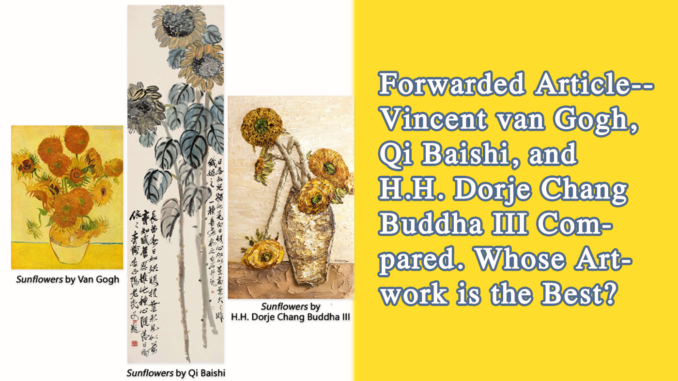
Forwarded Article-- Vincent van Gogh, Qi Baishi, and H.H. Dorje Chang Buddha III Compared. Whose Artwork is the Best?

Vincent van Gogh, Qi Baishi, and H.H. Dorje Chang Buddha III Compared. Whose Artwork is the Best?

Please see below the answer of whose work is the best amongVincent van Gogh, Qi Baishi, and H.H. Dorje Chang Buddha III

I have spent more than 60 years of my professional life in the field of painting. During the many decades of practice and experiences, I have come to know many famous painters. That is especially the case since I became the Head Consultant for authenticating paintings and calligraphy at the National Museum of China in Beijing. As an appraiser and authentication officer of paintings and calligraphy, the bulk of my work is to verify the authenticity of Eastern and Western paintings. I have reviewed tens of thousands of famous paintings, especially the rare and precious works of the maestro Vincent van Gogh of the Netherlands, and those of the champion of Eastern paintings, Qi Baishi of China.

Both Van Gogh and Qi Baishi were great world-renowned masters in art. One represented the apex of Western art and the other was a master of an extreme class in the field of Eastern paintings. Both artists had drawn from the essence of the classical traditions of their respective cultures. They created new styles of art and new ways of seeing the universe. They broke new grounds and became pioneers of new eras, each becoming a creative guru of his time, developing a distinct style of his own and leading new trends that inspired later generations. Their works reflect the different essences of the Eastern and Western traditions. To what extent can their works influence the artistic civilization of the world? What kind of artistry did they achieve that made them upright monuments in art history and admired by so many people?

Vincent van Gogh, Qi Baishi, and H.H. Dorje Chang Buddha III Compared. Whose Artwork is the Best?

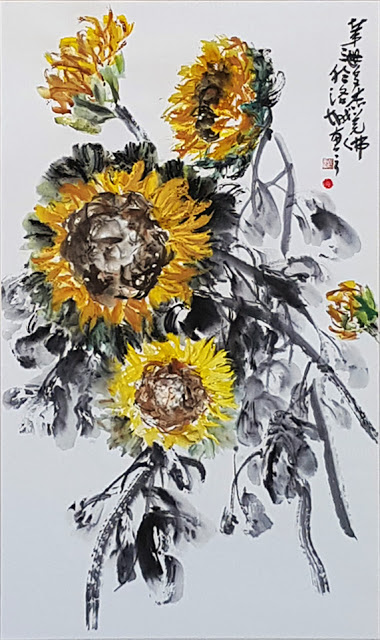
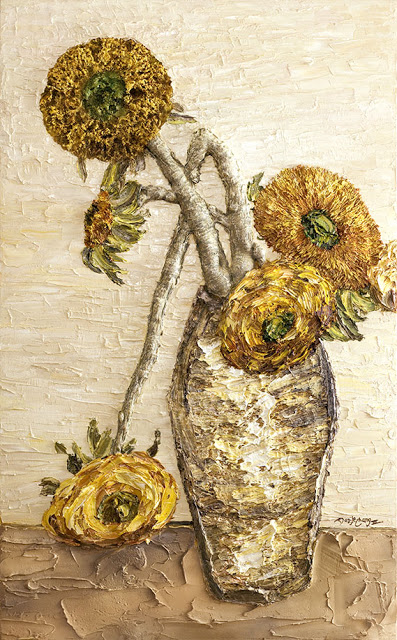
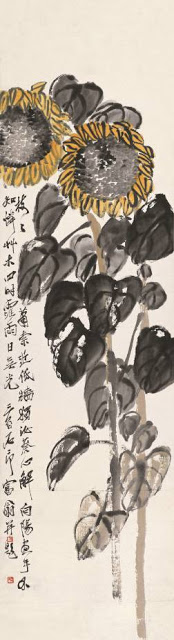
Some art critics compared the works of Van Gogh and Qi Baishi to see which of them reached a higher level of accomplishment. They concluded that both have their own merit, both are undefeated champions in the art and both reached the pinnacle of artistry. Recently, some art critics also brought up the oil painting Sunflowers and the ink-wash painting Sunflowers, both created by H.H. Dorje Chang Buddha III, and gave them rave reviews. They went on to compare the works by Vincent van Gogh and Qi Baishi with the works by H.H. Dorje Chang Buddha III, trying to establish which of the three artists is the champion of the champions. The result of comparing the works by Van Gogh, Qi Baishi and H.H Dorje Chang Buddha III is tremendously inspiring.

Ever since the Renaissance, Western artists had placed emphases on rational analysis and the realist portrayal of forms. They used light, texture and details to present the realistic, three-dimensional perspective. A few centuries later, Van Gogh rejected the monotony of such use of light and shadow and the realistic portrayal of figures.  He pioneered the movement of impressionism that suited him well by applying a mix of colorful, brilliant, splendid and vigorous brushstrokes. He became a great master of his time and his name was forever etched onto the monument of Western civilization and art.

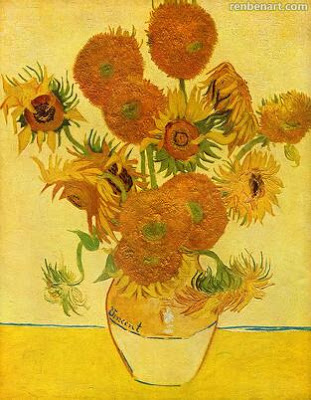
Whenever people think of Van Gogh, they think of his unique character, the sparkles in his eyes that emit lightning, his vigor and his incessant pursuit of inspiration in art without any regard to external hardships. Van Gogh was an artist by birth. He was of exceptional confidence and was somewhat neurotic. Having such traits, he pursued the art that he loved without any reservation or hesitation. He loved his works and regarded everything else with disdain. He preferred to be a loner in the world and did not care to make acquaintance of other painters of his time. His works are full of luminous colors, the brushstrokes are like rising winds and racing clouds in the sky. In his art, he depicted pasture, figures, flowers and other subject matters with brisk colors. Every brushstroke was transformed from his inner emotions. Such emotions were fully and colorfully captured in his Self-Portrait as well as in the transcendental Sunflowers that he painted. These works contain an animated spirit that is deeply moving.

From Van Gogh’s artistic spirit and intent, we can detect that he was profoundly knowledgeable about Chinese ink-wash paintings. Precisely because of this, while depicting forms and applying colors, he employed the skills of using the center tip of the brush and parallel brushstrokes. His Still Life with Bible was created with parallel brushstrokes. In his Self-Portrait, he portrayed his face filled with lines and plaques that are extraordinary. It is not hard for us to discover that he drew inspirations from the substance and essence of Chinese painting in those brushstrokes. That is why Van Gogh is such a distinguished, unparalleled artist of his time and his works are superior to those by the other Western oil painters such as Cezanne, Gauguin or Picasso of the same era.

Van Gogh’s artistic style was closely linked not only to Chinese civilization in the East, but also to the classical Renaissance art, Pointillism, German Expressionism, and Impressionism in the West. Toward the end of his life, he came into oneness with the universe and immersed himself in a carefree state of mind to “follow wherever nature might lead.” As such, he was no longer aware of his own existence. In his mind, there was only the art and the universe. “Following where the nature may lead” is the essence of the ideology of the Chinese philosopher Laozi. Van Gogh cut off his ear with a knife. He lost himself completely in painting. That was his unspoken resentment and rejection of the unfair treatment imposed on him by the society.

Qi Baishi was profoundly knowledgeable about impressionist, fauvist, and realist paintings. By adopting the essence of Western painting and incorporating the traditional spirit of Eastern art, he developed his unique style and became the master of Chinese painting of the twentieth century. His brushstrokes were solid and poised, evincing a sense of power that went all the way through the paper. Using sheep-hair brushes, he elicited calligraphic skills to create his paintings. Qi Baishi’s lines are bold and robust, embodying a forceful spirit that can move mountains. At the same time, these lines are flexible, sturdy and round, with similar qualities to the lines of wire-drawing. His compositions emerged naturally from the spontaneous movement of the brushes. Such compositions are accompanied by vigorous calligraphy resembling the strength, power and fluidity of stone inscriptions.

The artistic concept of spontaneously “following where nature may lead” is precisely derived from Laozi’s philosophy and the artistic civilization of the Chinese ethnicity. Qi Baishi favored the use of white space in his paintings. The white space in black-and-white Chinese ink-wash paintings is considered a solid color. Ink can be differentiated in nine shades (or five shades according to ancient Chinese text.) That is to say, the white of the paper per se and the black of the ink are all considered as colors. There is a sense of meticulous precision in the artworks by Qi Baishi. He depicted insects such as grasshoppers, mantises and butterflies in meticulous and vividly colorful ways. In some of his artworks, the artist was able to express his ideas by putting down just a few brushstrokes without any conscious intent, while arriving at a state of oblivion of his own existence.  Anything depicted by his brushes was vivid and vibrant, with the subject matter coming alive on the paper. There is an aura that moves our heart and soul. All in all, Qi Baishi’s paintings were executed with a confident brushwork that naturally achieved a kind of childlike charm.

Recently, some people compared the works by Van Gogh and Qi Baishi with the works by H.H. Dorje Chang Buddha III to see whose works are more superior and outstanding, or will have a broader and more far-reaching influence on later generations. I have viewed quite a lot of the artworks by Van Gogh, Qi Baishi and H.H. Dorje Chang Buddha III. I started the study and appreciation of the paintings by Qi Baishi under the enlightening guidance of my teacher when I was 9, and when I was 14, I began to study and appreciate the works by Van Gogh. It has since been several decades!

At the same time, since I have admired the art of H.H. Dorje Chang Buddha III for a long time, to satisfy my desire and wishes I flew from New York to San Francisco to visit the International Art Museum of America, and to Los Angeles to visit the H.H. Dorje Chang Buddha III Cultural and Art Museum in order to see their collections. I was profoundly impressed by the architecture of both museums which is grand and dignified. Both museums have a collection of the authentic works by H.H. Dorje Chang Buddha III. There are various artworks that are created with different kinds of material. Some are bold and forthright, some are charmingly meticulous and astounding. The oeuvre is not made up of just one single style.

Yet, the only artwork that was not available for viewing is the Sunflowers painted by H.H Dorje Chang Buddha III. When I hear that some art critics are comparing the works by Van Gogh and Qi Baishi with the works by H.H. Dorje Chang Buddha III, I naturally feel, from my experience of having studied the works by Van Gogh and Qi Baishi for a number of decades, that although their artistry are similar in levels, it is possible to say who is the best if we are just to compare the sunflowers painted by the three artists, when we include in the compositions, colors, brushwork, lines, vitality, spirit and so on. With all these elements in consideration, it is possible to do the comparison and conclude who painted the best, or in other words, whose works can bring the most joy and delight to people, or whose art will be most influential to the philosophy, artistic concept and entire civilization of this world.

Therefore, without any ambiguity, we concluded. In terms of character and morality, Van Gogh would be the last of the three. In terms of level of skills, Qi Baishi would also be ahead of Van Gogh, who is, however, already the cream of the crop in western civilization. Being the Buddha living in the current century, H.H. Dorje Chang Buddha III saves living beings with great loving compassion. He is not embodied in an ordinary being. Needless to say, the level of cultivation of the Buddha is superior to that of Van Gogh and Qi Baishi. In terms of creativity and painting skills, how can any ordinary being even hold a candle to the Buddha? In this way, the comparison result is immediately determined.

When those art critics carried out the detailed research of the Sunflowers by Van Gogh and Qi Baishi as well as H.H. Dorje Chang Buddha III, they copied the artworks by all three artists. After copying the works by Van Gogh and Qi Baishi, they felt deeply that through hands-on practice, they indeed gained more understanding of their works. It would not be easy but not so difficult either for one to really reach their artistic level. As for the Sunflowers by H.H. Dorje Chang Buddha III, they found it rather difficult to copy.  Even though they tried many times, they had a hard time just copying the form, let alone the spirit.

The Sunflowers by H.H. Dorje Chang Buddha III clearly show the artist’s solid foundation and prolific skills in the Eastern and Western painting traditions. They comprise the essences in both traditions and display a brushwork, sentiment and colors that are one of a kind. The color tones and brushstrokes are rich, dense, soothing and elegant. Lively brushwork paints an animated charm that is whole, evincing a miraculous and expansive spirit and aura as well as a strong vitality. As for the Sunflowers oil painting in which H.H. Dorje Chang Buddha III depicted some flowers inside a vase, the artistry is extraordinary and full of variations; the composition is simple yet abstruse. The flowers are natural and gracious, such that they give an impression of unpredictability, reaching a state of oneness with the universe and emanating a sharp animated spirit.

The ink-wash painting Sunflowers by H.H. Dorje Chang Buddha III has an uninhibited, natural, and spontaneous brushwork that is dense, bold, and robust, but also elegant and agile. It exhibits a charm that is like stone and bronze inscriptions. Overall, the whole painting manifests a harmonious and moving imagery, naturally emanating a lively vivaciousness and a carefree, spirited aura.

In comparing the works by Van Gogh of the Western civilization, Qi Baishi of the Eastern culture, and H.H. Dorje Chang Buddha III, we can see the artists are distinguished in their unique own ways owing to their different cultures. However, only the artist who can continue to influence the world two to three hundred years from now will be the everlasting monument.  There is a saying, “Talents emerge in every era and they all will each have 500 years of fame!”  For people of the present day, the one whose work you like the best would be the one that is the most extraordinary!

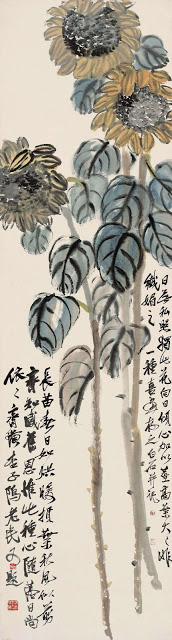
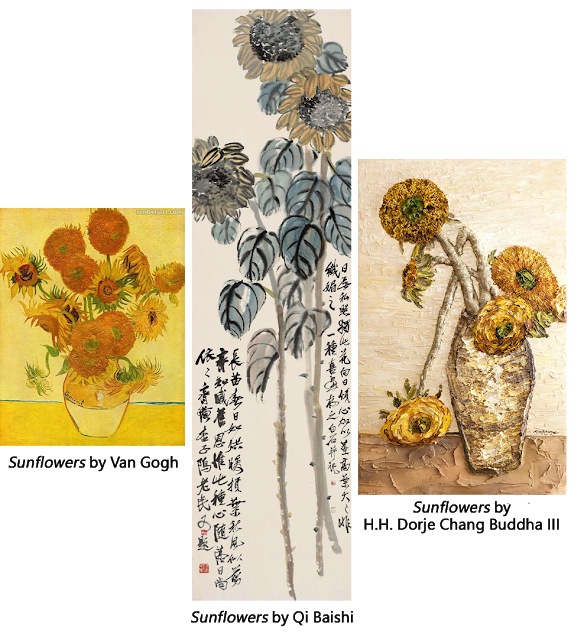
Please see the contrast of six paintings below:

Sunflowers by Van Gogh (1)
Sunflowers by Van Gogh (2)
Sunflowers by Qi Baishi (1)
Ink-wash Painting Sunflowers by H.H. Dorje Chang Buddha III
Oil Painting Sunflowers by H.H. Dorje Chang Buddha III

Jiguang Lin

October 26, 2018

Vincent van Gogh, Qi Baishi, and H.H. Dorje Chang Buddha III Compared. Whose Artwork is the Best?

Link: https://dharma-hhdorjechangbuddhaiii.org/vincent-van-gogh-qi-baishi-and-h-h-dorje-chang-buddha-iii-compared-whose-artwork-is-the-best/

#DorjeChangBuddhaIII #VincentVanGogh #QiBaishi #Art #ArtComparison #MasterArtists #ChinesePainting #WesternArt #ArtHistory #HighValueArt

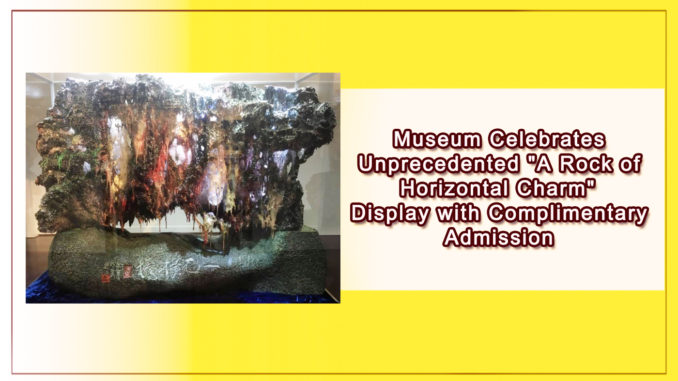
Museum Celebrates Unprecedented “A Rock of Horizontal Charm” Display with Complimentary Admission

West Covina, CA (PRWEB) June 01, 2017

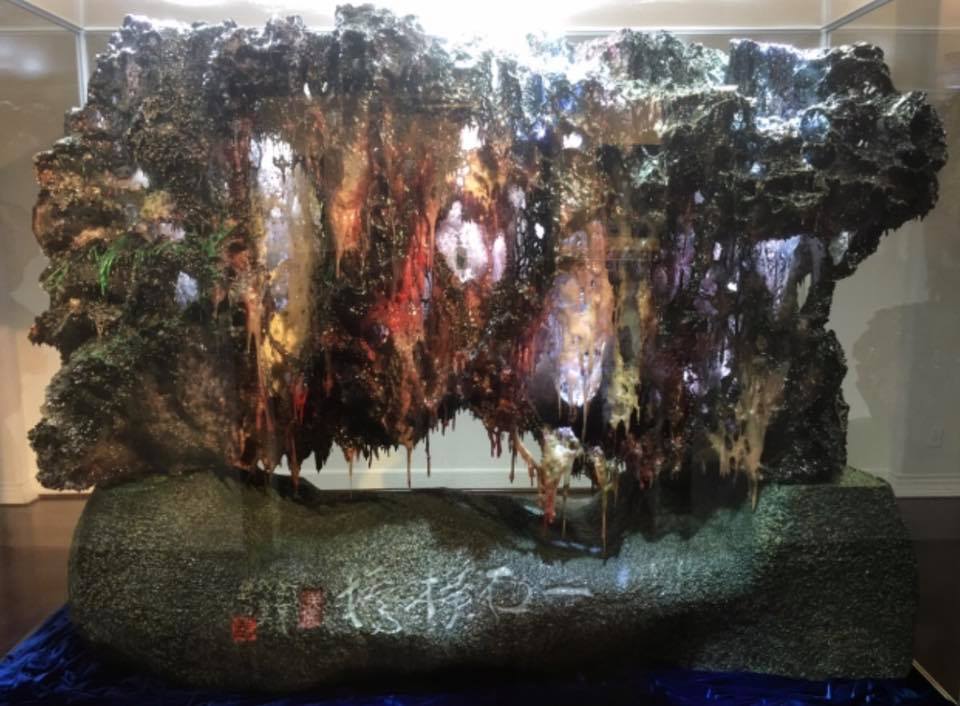
The H.H. Dorje Chang Buddha III Cultural and Art Museum is pleased to announce its exhibition of “A Rock of Horizontal Charm“, a masterpiece of Yun Sculpture that embodies the spirit of art in a truly dis-tinctive way. In honor of this extraordinary form of art, the museum is offering free admission to the public for a limited time.

“A Rock of Horizontal Charm” was created by the world-renowned and internationally-revered highest leader of Buddhism, H. H. Dorje Chang Buddha III. The Yun Sculpture is a piece of original artwork that expresses a unique set of qualities. Various art experts and professors who have viewed the sculpture art say it has surpassed natural beauty and represents a level of perfection that extends well beyond what can be described as superb craftsmanship or inspired artistry.

The H.H. Dorje Chang Buddha III Cultural and Art Museum is exhibiting A Rock of Horizontal Charm, an unparalleled masterpiece of Yun Sculpture. For a limited time, visitors can receive free admission to the museum and witness the unsurpassed natural beauty of the superb sculpture art first hand.

When viewed from different angles, the Yun Sculpture’s colors, structure, and atmosphere change completely, inexhaustibly transforming in unpredictable ways. Furthermore, it possesses multidimen-sional spatial structures that are complex yet delicate and intricate, and exquisite to the utmost. In addi-tion, its colors—kaleidoscopic and majestic, yet mature and assured—manifest a supernatural, visionary beauty. “A Rock of Horizontal Charm“, alone, is so endlessly variegated that it provides thousands of beautiful vistas.

The astounding beauty of this amazing sculpture art goes far beyond mere words. Therefore, it is no surprise that it has distinguished itself as the “emperor” of the four great Yun Sculptures. In fact, the creation of “A Rock of Horizontal Charm“ is considered to be a miracle in human history because no craftsman in the ancient or modern world—or even high technology—has been able to devise such ex-traordinary works of divine art. Consequently, this original artwork has been designated a “peerless treasure” that cannot be replicated, and the museum has named the room in which it is being displayed, Peerless Treasure.

“Even the “He Shi Bi (the Jade Disc of He) “, recorded in history as a treasure of monumental value, does not fit the title of ‘peerless treasure,’ since it is completely replicable—and if it can be replicated, it is not unique; if it is not unique, it is not peerless,” states the museum’s website. “In fact, any master sculptor’s magnum opus can be recreated; thus, only “A Rock of Horizontal Charm“ is the true peerless treasure.”

Despite an invitation to create an identical replica Yun Sculpture for a $50 million prize, no human sculpture master or technology has successfully duplicated “A Rock of Horizontal Charm“. From this, one can see how H.H. Dorje Chang Buddha lll’s artistic level has far exceeded the summit of sculptural art in human history.

The exhibit featuring “A Rock of Horizontal Charm“ will allow visitors to experience the divine charm of H.H. Dorje Chang Buddha lll’s original artwork in person. The unreplicatable sculpture exudes an inex-plicable amalgamation of color, motion, energy and spirit. “A Rock of Horizontal Charm“ has transcend-ed the category of highest human sculptural attainment and entered into the enjoyments of a mystical world.

Located in Covina in East Los Angeles, the H.H. Dorje Chang Buddha III Cultural and Art Museum is housed in a building with a 117-year history. The structure was renovated in 2014 and transformed into the cultural and art museum that occupies the space today. Since then, the museum’s world-class, un-matched treasures have attracted a steady stream of culture and art lovers from around the globe.

The mission of the cultural and art museum is to promote the exceptional accomplishments of an Amer-ican with outstanding talent—H.H. Dorje Chang Buddha III—by displaying his achievements in culture, literature, philosophy, art, science, technology, and other fields. Visitors to the museum can learn about the noble ethics and morality of H.H. Dorje Chang Buddha III and the holy character of this magnificent, selfless Buddha who altruistically contributes to society through his vast achievements and who advances world peace as well as the happiness of people. In addition, visitors can be guided by the teachings of H.H. Dorje Chang Buddha III and model themselves after him to elevate their own moral character and benefit the public.

For more information about “A Rock of Horizontal Charm“ or the cultural and art museum, visithttp://www.hhdcb3cam.org or call (626) 281-6378.

About H.H. Dorje Chang Buddha III
H.H. Dorje Chang Buddha III has been recognized by the most highly realized practitioners of Buddhism as the third incarnation of the original Buddha, Dorje Chang Buddha. His accomplishments transcend religion, healing and art. As the first in history to manifest real accomplishments in the five vidyas, He meets the highest standard of Buddhism. He is recognized for his devotion to a wide scope of cultural and religious activities, which enrich the lives of people from communities throughout the world. His Holiness has mastered 16 unique painting styles or schools, representing an unprecedented pioneering achievement in the history of art. Additionally, He is the pioneer of a new class of artwork that cannot be duplicated by any living being: Yun Sculpture. Experts predict that His paintings and sculptures will become increasingly valuable.

For the original version on PRWeb visit: http://www.prweb.com/releases/2017/06/prweb14390138.htm 

Link: https://dharma-hhdorjechangbuddhaiii.org/museum-celebrates-unprecedented-a-rock-of-horizontal-charm-display-with-complimentary-admission/

#DorjeChangBuddhaIII #HHDorjeChangBuddhaIIICulturalandArtMuseum #YunSculpture #RockOfHorizontalCharm #Art #ArtExhibition #SpiritualSculpture #ArtMuseum #SacredArt #PeerlessTreasure

The True Holy Vajra Pill and My Buddha Master

The True Holy Vajra Pill and My Buddha Master

The True Holy Vajra Pill and My Buddha Master

In Tibetan esoteric dharma, there are five types of precious pills. They are the Nectar Pill, the Long Life Pill, the Great Precious Pill, the Vajra Pill and the Supreme Precious Pill. Actually, these five types of pills are made from nectar bestowed by different Buddhas. There are also red pills and black pills made with Chinese herbs after the herbs are empowered through mantras, such as the red pills and white pills made by H.E. Tangtong Gyalpo. The Long Life Pill has the empowering effect of extending one’s lifespan. The Great Precious Pill can further one’s accomplishment in the dharma. The Vajra Pill can help dispel demons and increase longevity and good fortune. The Supreme Precious Pill can ensure accomplishment in the dharma. The five types of pills are crystallization of merit produced from the power of Buddha-dharma and the empowerment of Buddhas and Bodhisattvas. Basically, all great rinpoches have what they call precious pills. But most of them are of the ordinary type, not the holy precious type of pills. Holy precious pills and ordinary ones are two totally different concepts. I personally saw Nectar Pills made from nectar bestowed by Buddhas. I also personally saw true Vajra Pills and heard them chant mantras.
Certain famous rinpoches and dharma kings from the highest temples in Tibet have said that the Buddha-dharma that can enable a vajra pill to fly has not been seen in this world in three hundred years. This is a fact. There was a crazy yogi named Be Wa Ba who could manifest such power hundreds of years ago, but according to these respected rinpoches and dharma kings who have had contact with all of the well known dharma kings of recent times, this dharma had disappeared from this world.
I follow my Buddha Master, H.H. Dorje Chang Buddha III Wan Ko Yeshe Norbu Holiest Tathagata, and am constantly by His Holiness’s side. Therefore, I have experienced many magnificent and real manifestations of Buddha-dharma. Now I will tell everyone about my experience of the true Vajra Pill. When the holy vajra mantra and mudra are practiced, the Vajra Pill will jump and even transform into rainbow light and soar into the sky. I have also heard the Vajra Pill dance and chant mantras. I watched other people listen to the Vajra Pill sing songs.

I vow that the events reported here are true and happened as reported. If not, I am willing to bear the karmic retribution of the hell realms.

Amazing supernatural events preceded my first experience with the karmic affinity of the Vajra Pill. This happened in April, 2003. I traveled from San Francisco to Los Angeles to see H.H. Wan Ko Yeshe Norbu. During the trip I suddenly saw a colorful and large rainbow light appear in the sky. The rainbow completely surrounded the sun. There were also Sanskrit symbols in the sky. Just as the rainbow was fading from sight, I was able to take a picture of the bottom half of this light by focusing the camera below the sun. A dignified Buddha–Dorje Chang Buddha–appeared in the middle of the rainbow. This Buddha became my Buddha master, H.H. Wan Ko Yeshe Norbu, who was wearing a red robe and was sitting in the middle of the rainbow. The scene was awesome and extremely wonderful. The rainbow light appeared in the sky for several hours.

When I arrived, I was fortunate to immediately see my Buddha Master. A great lama obtained three true Vajra Pills and had respectfully given them to H.H. Wan Ko Yeshe Norbu Holiest Tathagata as an offering. The Buddha Master bestowed me with two of them. Unexpectedly the Vajra Pills in my hand started to jump. At that time the Vajra Pills jumped in my hand just as if they were alive. They not only jumped but one of them started to circle around and left my hand. It transformed into a dazzling bright red light and soared into the sky. At that time, I saw that the Buddha Master, who sat far away on the dais, had become a blue Buddha Vajradhara. The blue light was shining bright. The scene was very dignified. I was greatly astonished. This is when I first saw the true Vajra Pill and the true identity of my Buddha Master.

There was a very virtuous disciple who came from Australia. Because of a question I had asked H.H.Wan Ko Yeshe Norbu Holiest Tathagata about a dharma matter concerning mysterious power, the Holiest Tathagata said to me, “Bring your Vajra Pill to empower this disciple.” I took out the Vajra Pill. In order to prevent the Vajra Pill from escaping, this great layperson personally put the Vajra Pill in a small cup and sealed the cup with a piece of paper. The disciple put the cup to his ear and moved 15-20 feet away from the Holiest Tathagata. Several of us were sitting on the floor around H.H. Wan Ko Yeshe Norbu Holiest Tathagata. Then everyone started to chant mantras and practice dharma. Soon the Vajra Pill began to chant and sing Buddhist songs. This layperson was very moved. It is hard to believe that a tiny pill can actually sing Buddhist songs, but I have heard this myself. Actually, I did not hear Buddhist songs, but clearly heard the chanting of holy mantras. The sound came from this tiny BB sized pill that I personally held to my ear. It is truly unbelievable. In this world within the supreme Vajra Division of Esoteric Buddhism the Vajra Pill truly can be categorized into ordinary types and holy types. The Vajra Pill in my hand was living proof of the holy type.

Today I sincerely tell everyone my personal experience. My Buddha Master, H.H. Dorje Chang Buddha III Wan Ko Yeshe Norbu Holiest Tathagata is the supreme and highest Buddha. May all living beings have the good fortune to hear, learn, and practice the true Buddha-dharma and quickly attain enlightenment.

I, Buddhist disciple Zhaxi Zhuoma, sincerely vow and clearly write down these events to prove the existence of the true Buddha-dharma in the world today.

(The Chinese translation of this text follows.)

The True Holy Vajra Pill and My Buddha Master

Source: H.H. Dorje Chang Buddha III — A Treasury of True Buddha-Dharma, pp. 157–159.

Link:https://hhdorjechangbuddhaiiidharma.com/2025/11/24/the-true-holy-vajra-pill-and-my-buddha-master/

#DorjeChangBuddhaIII #DorjeChangBuddha #MasterWanKoYee #HolyVajraPill #BuddhaDharma #TrueDharma #BuddhistStories #DharmaBlessings #BuddhistCultivation #VajraPractice #BuddhistFaith #TheVirtueofHHDorjeChangBuddhaIIIandHolyOccurrences

The Supreme Buddha Dharma

Every Buddhist practitioner longs for achievement and liberation.
Hearing the true Buddha-Dharma is the key.
The following article is a genuine account written by a monastic bhikshu Huihai (慧海) who personally listened to the Dharma teachings of H.H. Dorje Chang Buddha III.

In this life, I am able to encounter my supreme and unsurpassable Buddha Master—this truly is the greatest blessing I have accumulated through many lives and countless eons!

The Buddha Master’s genuine and pure teachings, in the turbulent waves of today’s chaotic era, are the vessel that carries sentient beings to the shore of liberation. The Buddha Master’s profound and skillful instructions transcend religion, directly point to mind-transmission, accord with conditions and the Dharma-realm, and enlighten sentient beings to step onto the path of awakening.

As a disciple, whenever I am in the presence of the Buddha Master, my heart always feels immeasurably moved, deeply experiencing the holiness and greatness of the Buddha’s virtue

I remember it was in early September of 2005 that I had an audience with the Buddha Master. The Buddha Master said: “In the history of Tibet and the Han region, there were many practitioners who cultivated many Dharma methods, yet achieved very little in their entire lifetime. Only in their old age did they realize that they had seldom listened to true Dharma, which caused them not to understand the Buddha-principles, and thus they walked a deviated path.

Most of the ancestral masters through generations, most of the Buddhas and Bodhisattvas of the past, attained great accomplishment precisely because they listened to Dharma. Therefore, listening to Dharma is extremely important. Now, in this degenerate era, there is truly far too much false Dharma. You must listen to Dharma more, listen more to the Dharma I teach. Only by clearly understanding the Dharma sounds, learning the true Buddha-Dharma, and deeply applying it in actual practice, can the problem of birth and death be resolved. This is the most important, most important thing!”

I knelt and prostrated to the Buddha Master and said: “Your disciple is very grateful for the Buddha Master’s teachings, and I hope all sentient beings may hear and receive the Buddha’s Dharma sound and learn the true Buddha-Dharma.”

The Buddha Master sat for a moment and then went into the room. Several senior brothers and sisters happened to come out, each with joyful expressions on their faces. I asked them curiously: “I see all of you beaming with smiles—what joyful thing has happened?”

One senior brother said: “We just respectfully listened to a recording of a most supreme Dharma-sound.”

I said: “No wonder you are filled with Dharma joy. May I listen to this Dharma-sound recording?” The senior brother said: “This is a rarely accessible Dharma-sound. Permission must be requested before you can listen.”

At that moment, the Buddha Master came out from the room. I quickly reported: “I request Buddha Master’s permission—may I listen to that Dharma-sound recording?”

The Buddha Master smiled and said to me: “Of course you may. You certainly may listen. If even you, a monastic, cannot listen, then who else could?” I joyfully placed my palms together and prostrated to my kind Master, saying: “Thank you, Buddha Master.”


I went to the altar to pay respect to the Buddha, offered a khata and offerings, performed the pre-Dharma-listening rituals, and began to attentively and reverently listen to the Dharma. The Dharma-teaching that the Buddha Master expounded in the recording was unprecedented—unmatched in its sublimity.

Upon hearing this Dharma, I received tremendous blessing power; suddenly my obstructions opened, joy surged within me, like a spontaneous celestial empowerment pouring down, nectar filling me completely. The karmic forces of beginningless time all became like illusions. Such a supreme Dharma—how could it not be something that is difficult to encounter even in hundreds of thousands of eons?


What sentient beings find hard to see, I now see; what sentient beings have not heard, I have now heard. How could beings burdened by countless karmas possibly comprehend its wondrous principles?
After leaving the altar, I saw the Buddha Master and immediately knelt down in gratitude.

I said excitedly: “Buddha Master! How could this merely be a teaching or a Dharma-sound? This is fundamentally a great Dharma—an unsurpassable great Dharma!”

The Buddha Master looked at me and smiled: “Excellent! You received the blessing of Buddhas and Bodhisattvas and understood the Dharma I taught.”

I continued: “Buddha Master, this Dharma truly leaps directly and suddenly into the Tathāgata’s state! And truly, it requires no effort—you can attain it instantly.”
The Buddha Master said: “Indeed so.”

I further said: “This Dharma is truly magnificent. Indeed, everyone can practice it, but ordinary people will not understand it and will only regard it as an ordinary teaching.”

The Buddha Master said: “This is even easier than realizing mind and seeing one’s nature. Even those who realize mind and see their nature may not attain this state.”

My Buddha Master—the Supreme Protector, H.H. Dorje Chang Buddha III—expounds Dharma by observing sentient beings’ karmic conditions through the complete Buddha-wisdom. Every teaching is given for the liberation of Buddhist disciples and future beings. The Dharma principles revealed are tailored to each person’s capacity, deep yet simple. Though spoken casually, they unfailingly accord with the profound truths of the Buddhist Tripiṭaka and esoteric scriptures. Moreover, many penetrating and unique Dharma principles are not found in any sutras—they arise directly from the Buddha Master’s innate enlightened realization.


Since I drew close to the Buddha Master and respectfully listened to the Buddha Master’s Dharma-sounds, I have finally gained a complete understanding of the Tathāgata’s perfect and true teachings. The benefits I have received are far too many to express in words—far surpassing everything I had learned in Buddhism over the past decades.

Because Buddhist sutras have been transmitted in the world—especially after translation—they inevitably contain mistranslations or misinterpretations. Moreover, the classical literary language used in the scriptures is truly difficult for modern readers accustomed to vernacular style. The numerous technical terms in the sutras also pose a challenge for beginners entering the Buddhist path.

The Dharma-sounds taught by H.H. Dorje Chang Buddha III are the authentic Tathāgata true Dharma, explained through modern language and analogies, expressing principles in accordance with intrinsic nature, unfolding the stages of realization, and enlightening the ignorant. Those who listen can easily learn pure Buddha-Dharma and establish correct understanding and correct views. Therefore, it is most suitable for every practitioner in today’s world to rely on and cultivate.

The Dharma-sounds spoken by H.H. Dorje Chang Buddha III are a bright lamp illuminating the path of cultivation. They are the supreme Dharma-treasure that enables sentient beings to become Arhats, enables Arhats to become Bodhisattvas, and enables Bodhisattvas to become Buddhas—to attain accomplishment, liberation, realization, and sainthood.


I often feel this: whenever the Buddha Master expounds Dharma with perfect, lion-like sound, the Dharma-voice flows throughout the boundless space; humans and non-humans all receive its benefit; the Dharma assembly at Vulture Peak seems as if it has never dispersed—

Before my eyes it is as if scenes from ancient times appear again: the Buddha teaching under the Bodhi tree, when Bodhisattva-Mahāsattvas, monks, nuns, laymen, laywomen, along with heavenly beings, nāgas, humans, and non-humans—countless multitudes—surrounded Him, making offerings, honoring, respecting, and praising. Heavenly mandārava flowers rained down, scattering over the Buddha and the assembly…

In this degenerate age, as a disciple of the Buddha, I feel fortunate to have this rare Dharma affinity, able to personally hear the Dharma before the Buddha and practice the true Dharma. I sincerely pray:

May the Dharma Wheel of the supreme and great H.H. Dorje Chang Buddha III always turn, and may He abide in this world forever.

May all beings in the Dharma-realm hear the Dharma-sounds spoken by H.H. Dorje Chang Buddha III, increase in blessings and wisdom, forever leave all suffering and obtain happiness, and together realize Bodhi.


Disciple of the Buddha — Huihai

For the original Chinese speech, please click here. This English translation is by Linda Chang and is provided for reference only.

Link:https://peacelilysite.com/2025/11/21/the-supreme-buddha-dharma/

The Recognition of H.H. Dorje Chang Buddha III: Does a Buddha Need to Be Recognized?


The Recognition of H.H. Dorje Chang Buddha III: Does a Buddha Need to Be Recognized?

The Recognition of H.H. Dorje Chang Buddha III: Does a Buddha Need to Be Recognized?

Worldwide Recognition of H.H. Dorje Chang Buddha III by Eminent Buddhist Leaders

Recognitions and Congratulations to H.H. Dorje Chang Buddha III

When over a hundred great Dharma Kings, Regents, and Rinpoches from various Buddhist traditions throughout the world lawfully recognized, in accordance with Buddhist precepts, that Namo H.H. Dorje Chang Buddha III is the reincarnation of the ancient Buddha, Buddhist disciples around the globe rejoiced in celebration. The descent of Namo H.H. Dorje Chang Buddha III brings to the beings of this Dharma-ending age the correct and unerring True Dharma of the Tathagata that leads to liberation from the cycle of birth and death. How fortunate living beings are to personally hear the teachings of the Buddha — there is now hope for attaining enlightenment in this very lifetime!

Online Slander and Misunderstanding of H.H. Dorje Chang Buddha III’s Holy State

However, some people on the internet refuse to face the legitimate recognitions, the holy realization, and the perfect mastery of the Five Vidyās and teachings of H.H. Dorje Chang Buddha III with reason or correct understanding. Instead, they fabricate rumors, spread insults, slander, defamation, and false accusations — maliciously twisting facts, inventing lies, and making baseless claims. They use vulgar words, forge fake documents, false notices, and false statements, and even create distorted images and mocking content — doing everything they can to attack H.H. Dorje Chang Buddha III. Through their own words and actions, they merely expose their ignorance and lack of virtue.

Some say, “A Buddha or Bodhisattva is realized through practice, not by ‘recognition.’” “Shakyamuni Buddha didn’t need a certificate of recognition.” But their purpose is clear — to stop more people from learning the true Buddha Dharma and attaining liberation!

So, does a Buddha need recognition when descending into the world?

A Practice for the Benefit of Sentient Beings.

A Buddha is one of unsurpassed, perfect enlightenment and complete wisdom. The reason one is a Buddha lies in their realization and enlightenment — not because of any recognition by others. No matter how great a Dharma King, Regent, or Rinpoche may be, their level of realization is far inferior to that of a Buddha; thus, any recognition they offer to a Buddha would be, in essence, just a piece of paper of no value to the Buddha.

However, because sentient beings in this world often lack the wisdom to discern between true and false saints, between genuine Buddha Dharma and false teachings that imitate Buddhism, they may easily be misled by superficial appearances and deviant views. Therefore, for the benefit of sentient beings, by following the Buddhist tradition of formal recognition, those virtuous masters issued such recognitions that help people give rise to faith and thus be saved. This is an act of right knowledge and right view.

The Example of Master Padmasambhava and the Importance of Recognition

Master Padmasambhava

When Master Padmasambhava first went to Tibet to propagate the Dharma, he was not greeted with respectful welcoming crowds. Instead, the Tibetan people were terrified and shouted, “Quick! Drive out this sorcerer who performs strange magic without lineage transmission! Do not let him deceive us with his witchcraft!” They even lifted him up and threw him into a muddy pit. Later, Master Padmasambhava returned to India and asked two renowned masters to write letters of recognition. Only then did Buddhism begin to flourish in Tibet. In fact, those two masters later became Master Padmasambhava’s disciples.

Therefore, when Buddhas or Bodhisattvas reincarnate and manifest again in this world, undergoing recognition according to Buddhist rules is not for their own sake, but for the sake of helping sentient beings generate faith and thereby be liberated.

The Supreme Conduct and Realization of H.H. Dorje Chang Buddha III

Indeed, the realization and attainment of a Buddha or Bodhisattva come from their own cultivation and enlightenment. The realization, virtue, and attainment of all Buddhas and Bodhisattvas are the manifestation of their supreme enlightenment. The pure and flawless conduct of Namo H.H. Dorje Chang Buddha III, His mastery of both exoteric and esoteric teachings, His perfect command of the Five Vidyās, and His countless acts of liberating sentient beings — all fully demonstrate the enlightenment and realization of a true Buddha!

Therefore, I sincerely advise those who slander: repent sincerely before the Buddhas and Bodhisattvas, or karmic retribution will not spare you! At the same time, I compassionately remind all who truly wish to learn and practice Buddhism: we live in the Dharma ending age, when confusion prevails, and the nature of the demonic offspring is to destroy the Dharma and obstruct sentient beings from learning the true path. Kind-hearted beings, please open your eyes of wisdom, discern the true from the false, and do not be deceived by demonic forces — lest you miss the supreme Dharma opportunity that can bring you liberation from birth and death in this very lifetime!

Source: https://dharma-hhdorjechangbuddhaiii.org/the-recognition-of-h-h-dorje-chang-buddha-iii-does-a-buddha-need-to-be-recognized/

Link: https://hhdorjechangbuddhaiiidharma.com/2025/11/17/the-recognition-of-h-h-dorje-chang-buddha-iii-does-a-buddha-need-to-be-recognized/

#DorjeChangBuddhaIII #HHDorjeChangBuddhaIII #DorjeChangBuddha #TrueDharma #Buddhism #Vajradhara #LivingBuddha #BuddhistWisdom #BuddhaRecognition #ModernBuddhism

Ven. Junmai Baima Dorje Rinpoche:H.H. Dorje Chang Buddha III is the true Buddha Vajradhara, the teacher of both humans and celestial beings!

Ven. Junmai Baima Dorje Rinpoche is a nirmanakaya of Vajravarahi. He is the fourth Ven. Baima Dorje Rinpoche. Various auspicious signs manifested at the birth of the rinpoche. When the rinpoche was five years old, the national master of Bhutan, H.H. Dharma King Dilgo Khyentse, personally signed and issued a recognition certificate recognizing the identity of the rinpoche. H.H. Dharma King Penor and H.E. Dharma King Rabjam also personally wrote recognition certificates.

At the age of about three, the child rinpoche used two fingers to transform a small, thick Tibetan knife into the shape of a coil. After passing through many hands, that knife is now at Hua Zang Si in San Francisco, where a special place for that holy object has been established to display it for public worship and veneration. The rinpoche currently resides at the Shechen Monastery. He has received initiations from the esoteric lineage of H.H. the 10 th Panchen Lama and other persons of great holiness and virtue. The rinpoche benefits all living beings by applying the wisdom and realization of a Bodhisattva.

I respectfully honor the Three Bodies and Four Wisdoms of the Dharma King of the Three Spheres, H.H. Yangwo Wan Ko Yeshe Norbu:
We were fortunate to be able to read the book about the Buddha Vajradhara Dharma King, A Treasury of True Buddha-Dharma — A Collection of H.H. Yangwo Wan Ko Yeshe Norbu’s Accomplishments Manifesting Complete Proficiency in Exoteric and Esoteric Buddhism and Perfect Mastery of the Five Vidyas . We cannot describe how deeply astonished and moved we were. Those thirty main categories of accomplishments present a splendid sight that includes the cikitsvidya (healing vidya), silpakarmasthanavidya (craftsmanship vidya), sabdavidya (sound vidya), adhyatmavidya (inner realization vidya), and hetuvidya (causality or Buddhist logic vidya) in their holy sense. Such accomplishments have never been seen before in the history of Buddhism. A Treasury of True Buddha- Dharma is the highest Buddha-dharma treasure and manifests H.H. Great Dharma King’s supreme realization and virtue. H.H. Great Dharma King is the first holy being who used true realization to display fully in the dharma realm the teachings of the Buddha! H.H. Great Dharma King is the true Buddha Vajradhara, the teacher of both humans and celestial beings! In this Dharma-Ending Age, we are deeply happy that living beings in the earthly realm have the guidance of H.H. Great Dharma King.
May H.H. Great Dharma King forever live in the world and forever teach the dharma!

Junmai Baima Dorje
May 10. 2006

LinkL:https://peacelilysite.com/2025/11/17/ven-junmai-baima-dorje-rinpoche%ef%bc%9ah-h-dorje-chang-buddha-iii-is-the-true-buddha-vajradhara-the-teacher-of-both-humans-and-celestial-beings/

H.H. Dorje Chang Buddha III received Congratulatory Letter from Pengcuo Rinpoche


Most honorable H.H. Yangwo Wan Ko Yeshe Norbu Buddha Vajradhara Dharma King:

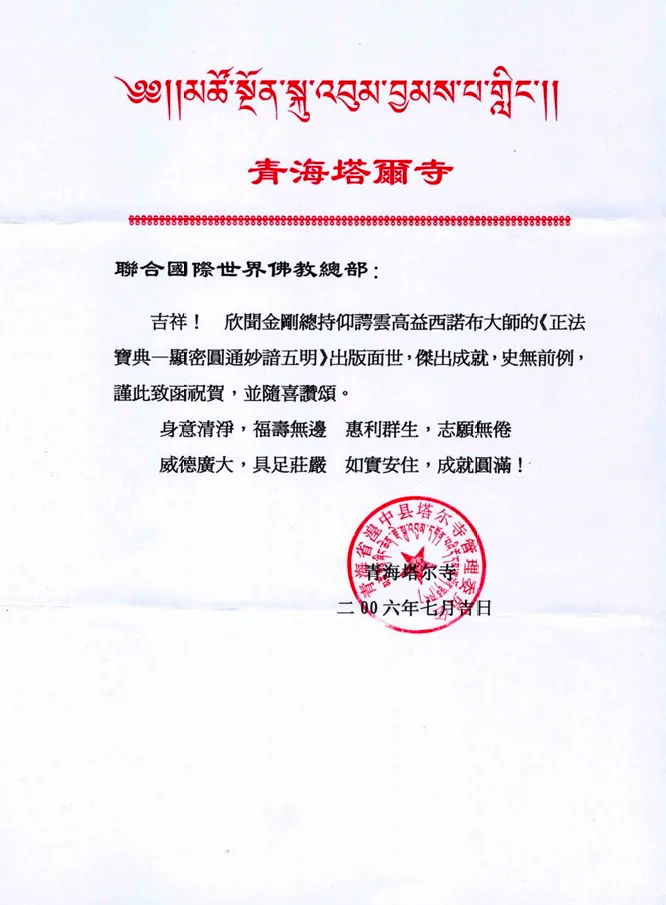
First, on behalf of all of the monks in our temple, I convey my warmest congratulations to H.H. Great Dharma King for the publication of A Treasury of True Buddha-Dharma — A Collection of H.H. Yangwo Wan Ko Yisinubu’s Accomplishments Manifesting Complete Proficiency in Exoteric and Esoteric Buddhism and Perfect Mastery of the Five Vidyas!

Since the time the world-honored Sakyamuni taught the dharma, there have been countless great Bodhisattvas and great masters who, having received the Buddha’s teachings, came to this earthly world of birth, aging, sickness, and death in order to expound and propagate the sutras and save living beings. However, a great wish of the Buddha was that accomplishments in the Five Vidyas be shown to living beings in order to lead living beings onto the path of Buddhist self-cultivation. In this regard, H.H. Great Dharma King is the greatest holy being in this earthly realm!

H.H. Great Dharma King possesses perfect compassion and wisdom. His Holiness does not shirk toil or hardship in the pursuit of teaching and edifying living beings. We should take H.H. Great Dharma King as our eternal model, forever propagate the dharma, and pervasively save sentient beings.

Pengcuo Rinpoche

July 5, 2006

Link:https://peacelilysite.com/2025/11/17/h-h-dorje-chang-buddha-iii-received-congratulatory-letter-from-pengcuo-rinpoche/

Compassion in Action: Life Release Day Observed Through Prayer, Education, and Service

November 4, 2025 San Francisco Post

Photo Courtesy: Hua Zang Si (Community members unite across California to honor the Life Release Day Designated by Buddha, transforming compassion into action through ceremonies, education, and charitable outreach.)

        Buddhist communities across California came together on October 29 to honor “The Life Release Day Designated by Buddha,” a global observance dedicated to compassion, the protection of life, and the collective aspiration for peace. 

        On the morning of October 29, 2025, the H.H. Dorje Chang Buddha III Cultural and Art Museum hosted a life release event at the Marina Del Rey harbor, drawing spiritual leaders and community members from across Southern California. The event was led by Venerable Master Ruzun Ruohui, Abbess of Hua Zang Si Temple and Hongfa Temple.

        Participants gathered in unity to chant praises and recite the  Great Compassion Mantra of Avalokiteshvara Bodhisattva. Venerable Master Ruzun Ruohui blessed the fish awaiting release with consecrated Dharma water, offering prayers that these sentient beings be freed from suffering and karmic obstructions. Upon release, the fish were returned to the ocean with the hope that they would find safety and live free from harm and predators. 

        The Life Release Day Designated by Buddha originated on October 29, 2009, when H.H. Dorje Chang Buddha III personally led His disciples in a life release ceremony following a significant Buddhist event. He compassionately declared this day as “Life Release Day” to promote the protection of life and the practice of compassion.

        The H.H. Dorje Chang Buddha III Cultural and Art Museum upholds the compassionate teachings of H.H. Dorje Chang Buddha III. The museum urges all sectors of society to transform empathy into action—promoting the safeguarding of life, the cessation of killing, and the daily practices of kindness as a fundamental way of living. Venerable Master Ruzun Ruohui emphasized that life release practices are not confined to specific days or locations. Whenever a life is in danger, we are called to act—to return it to a suitable environment, to grant it freedom, and to relieve it from fear.

        On October 29, 2025, San Francisco’s Hua Zang Si Temple also held a life release ceremony at San Rafael. Participants from diverse cultural backgrounds gathered to recite the Heart Sutra and the Great Compassion Mantra before gently releasing fish back to their natural habitat. Organizers emphasized that life release is not only a spiritual practice, but also a call to awaken society’s compassion and deepen our care for the sentient beings. 

Photo Courtesy: H.H. Dorje Chang Buddha III Cultural and Art Museum
Venerable Master Ruzun Ruohui blesses fish awaiting release with Dharma water during the Life Release Day ceremony at Marina Del Rey.

Photo Courtesy: H.H. Dorje Chang Buddha III Cultural and Art Museum
Upon release, the fish were returned to the ocean.

        To nurture compassion in the next generation, Hua Zang Si Temple held a Buddhist children’s story class on October 19. Through storytelling and interactive learning, the program guided young participants to understand the core values of “equality of all life” and “compassion without harm.” The initiative was warmly received by parents, who expressed deep appreciation for the temple’s commitment to meaningful and values-based education.

        On October 26, Macang Monastery in San Francisco held a special “Life Release Day Blessing and Food Donation Ceremony” in honor of the Life Release Day Designated by Buddha. Following collective sutra recitation and prayers by both monastics and lay practitioners, the temple donated food supplies to unhoused individuals and low-income families—embodying the Buddhist spirit of compassion and service to those in need.

        This year’s Life Release Day Designated by Buddha brought together Buddhist disciples and compassionate leaders from all walks of life through a range of activities—including life release ceremonies, prayer gatherings, educational outreach, and food donations. Participants were reminded that cultivation is not merely a slogan, but a continuous practice through every kind thought and virtuous deed.

A Buddhist Disciple’s Near-Death Experience: All That Remained Was the Name of H.H. Dorje Chang Buddha III

Facing Death and Awakening to the Holy Name of H.H. Dorje Chang Buddha III

A Buddhist Disciple’s Near-Death Experience: All That Remained Was the Name of H.H. Dorje Chang Buddha III

“Am I really going to die like this?”

At that moment, I felt as if I were rising from a cold, dark ocean or walking out of a long nightmare tunnel. The light before my eyes was so dazzling that it took me a while to recognize the blurred figures within it. Sitting beside me was my spouse, and standing there smiling was my daughter. As for myself—I was lying on a hospital bed.

A Buddhist Disciple’s Near-Death Experience All That Remained Was the Name of H.H. Dorje Chang Buddha III

My mind was completely blank. It felt as if my memory had been wiped clean; nothing remained but confusion and a faint, awkward sense of unease. I anxiously searched through my thoughts but found only helplessness and fear— until a familiar melody began to echo clearly in my mind — the holy name of H.H. Dorje Chang Buddha III, resonating like a chant from deep within my heart.

Gradually, my terrified heart began to calm. The holy name persisted—unyielding and unwavering—repeating again and again, washing over my pale and fragile memory. I thought to myself, This must be what people call a “near-death experience.”

My spouse and daughter helped piece together the fragments of my missing story.

A Buddhist Disciple’s Near-Death Experience All That Remained Was the Name of H.H. Dorje Chang Buddha III

We live in Shandong. I had come to Shenzhen to help my daughter take care of her child. One day, without any warning, I suddenly collapsed in silence. My family rushed me to the hospital, where I was diagnosed with a cerebral hemorrhage. The surgery was completed successfully. Upon hearing the news, my spouse immediately flew from Shandong to Shenzhen.

They continued to fill in the missing pieces of my story:

I had just taken refuge in May 2016 to become a Buddhist disciple. However, before I could properly begin my Buddhist studies, I went to Shenzhen in June 2017 to help my daughter. Fellow practitioners in Shandong kindly connected me with disciples in Shenzhen and encouraged me not to give up my practice.

Listening to the Dharma Discourses of H.H. Dorje Chang Buddha III

After arriving in Shenzhen, I actively reached out to my daughter’s neighbors, hoping to introduce them to Buddhism. My daughter and son-in-law supported me wholeheartedly; they even drove me and several neighbors to a Dharma center in Shenzhen to listen to the Dharma discourses of H.H. Dorje Chang Buddha III. Because that place was quite far, a Dharma sister later introduced me to another practitioner’s home nearby where I could listen to the teachings. Though we hadn’t known each other before, we grew close through our shared faith—everyone cared deeply about my practice and my health.

The Power of the Holy Name of H.H. Dorje Chang Buddha III

The Pope of Buddhism H.H. Dorje Chang Buddha III
The Pope of Buddhism H.H. Dorje Chang Buddha III

When I regained consciousness, I couldn’t remember anything from before. Strangely, the only thing that remained clear and loud in my mind was the sacred name:

Namo Dorje Chang Buddha III.

In the same hospital ward, other patients with similar conditions were not as fortunate. Many were left partially paralyzed, unable to walk steadily or care for themselves. Life had become fragile—so easily shattered.

Phrases like “Life is impermanent” and “Like a dream, like an illusion” surfaced in my mind. I was deeply afraid that I, too, would become disabled and burden my family. But thankfully, although surgery had taken part of my memory, my mind remained clear enough to hold onto that one holy name:

Namo Dorje Chang Buddha III.

Like a beam of light, that name illuminated the dark and uncertain path ahead.

Miraculously Blessed by Buddha

That single remaining memory gave me unwavering faith. I believed the Buddhas and Bodhisattvas were blessing me, allowing me to survive and turn a great disaster into something small.

I felt truly blessed to have entered the Buddhist path and firmly believed that the Buddhas and Bodhisattvas would not abandon me. As long as I kept believing and continued to study diligently, I would recover—because I still had much to do. I wanted to help more people enter the Dharma and listen to the true teachings of the Tathāgata. Holding that faith in my heart, I kept reciting the only words I could still remember:
Namo Dorje Chang Buddha III — again and again, without pause. Then, a miracle happened. I gradually recovered. About twenty days later, the doctor told me I could be discharged from the hospital.

The doctor said that in all his years of medical practice, he had never seen such a recovery. Patients with my condition almost always had some form of disability—but I could walk freely, with no trace of impairment.

After returning home to Shandong, I could even ride an electric bike to attend Dharma listening sessions and play ball again. My memory of the Dharma I had learned before also came back, and I rejoined my wonderful spiritual family with deep gratitude.

A Buddhist Disciple’s Near-Death Experience All That Remained Was the Name of H.H. Dorje Chang Buddha III

Awakening to Impermanence Through the Teachings of H.H. Dorje Chang Buddha III

After going through this life-and-death experience, I truly understood the impermanence of life. Now, whenever I listen to the Dharma discourses on Impermanence from my Buddha Master, I feel their truth penetrate deep into my heart. Every compassionate teaching from the Buddha Master is like nectar—healing medicine that saves lives.

Fellow practitioners, when illness strikes, we can only accept our karma; no matter how anxious our loved ones may be, there is little they can do. Yet when our bodies are healthy, we often waste our precious time in confusion, unaware that the chain of impermanence could seize us at any moment.

Do not waste this rare and precious opportunity to encounter the true Dharma of H.H. Dorje Chang Buddha III!

Cherish your blessings, study the Dharma diligently, and cultivate sincerely.

Liberation from life and death is attainable in this very lifetime!

Link: https://hhdorjechangbuddhaiiidharma.com/2025/11/09/a-buddhist-disciples-near-death-experience-all-that-remained-was-the-name-of-h-h-dorje-chang-buddha-iii/

#HHDorjeChangBuddhaIII #DorjeChangBuddhaIII #DorjeChangBuddha #BuddhistDiscipleStory #NearDeathExperience #BuddhismMiracle #BuddhaDharma #FaithAndGratitude #BuddhistAwakening #BuddhistMiracle #BuddhismRebirth #BuddhismFaith#BuddhaCompassion#DharmaBlessing #EnlightenmentExperience


Expounding the Absolute Truth Through the Heart Sutra

        This book by H.H. Dorje Chang Buddha III was released in Chinese in 2014 but is not yet available in English. It is based on a series of very famous discourses given in China in 1992, using the text, meaning, and principles of the Heart Sutra to transmit Dharma. It clearly explains the relationships between mind, Buddha, and living beings. It tells everyone what the absolute truth of Buddha-dharma and liberation is. Several years ago, His Holiness told a number of Western disciples that this is the only book you need to read to understand emptiness and become enlightened. This text is for acquiring prajna or transcendental wisdom, although it also teaches the importance of cultivating character.

        To stress how important this holy book is, we must remember that just before the Buddha left this world His Holiness told us that “. . . At all times, we must think about bringing auspiciousness, serenity, happiness, and peace to living beings and to the world, to the extent of giving our all and even our lives. I have already brought true Buddha Dharma to this world. Everyone who practices in accordance with The Supreme and Unsurpassable Mahamudra of Liberation and Expounding the Absolute Truth Through the Heart Sutra will surely attain liberation. That’s all. I wish all living beings happiness.”

Venerable Master Puguan’s Reflection After Listening to Expounding the Absolute Truth Through the Heart Sutra

Below is the heartfelt reflection of Venerable Master Puguan, the abbot of Kaihua Monastery on Mount Wuzhong—the first site of Southern Transmission Buddhism and the thirteenth-generation patriarch of Mount Emei—after listening to the Dharma discourses of Expounding the Absolute Truth Through the Heart Sutra spoken by H.H. Dorje Chang Buddha III.

Venerable Master Puguan said:

“No matter what words I use today, they cannot fully express the supreme joy and wonder in my heart.
My most magnificent and compassionate Buddha Master, the Great Dharma King Yangwo, once visited Mount Wuzhong in person. At that time, my junior Dharma brother, Dharma Master Guozhang, and I were on the third day of a Zen retreat with the four assemblies of disciples when suddenly the Dharma protector came and told me, ‘The greatest holy being has arrived! He is wearing white clothes. Quickly cancel the Chan session and lead everyone to greet Him with full ceremony!’

Dharma Master Guozhang also received the same message—that the highest Holy One had come. We immediately announced to all disciples that the Zen session was to be stopped, and we prepared the ceremonial welcome with drums and bells. Indeed, about ten minutes later, a group of dozens of people arrived at the foot of the mountain—it was my revered Master, the Great Dharma King Yangwo (H.H. Dorje Chang Buddha III).

When I supported my Master while walking toward the Bright Moon Pool, He gently took hold of my hand instead and said, ‘I am younger than you; you should not support me. It is I who should support you, the elder.’

At that moment, I felt deeply ashamed. How could a disciple ever deserve to be supported by his Master, the Great Dharma King?

Now, after listening to Expounding the Absolute Truth Through the Heart Sutra, I finally realize that what my Master said back then was the very expression of ultimate truth!
We practitioners must rely on our Master’s steadfast guidance, never letting go of His compassionate hand, until we are led to the pure Buddha-land of ultimate Nirvana. How could we ever imagine supporting our Master?

Having repeatedly listened to this Dharma discourse, I can only say that my Master has explained the very essence of all 600 volumes of the Prajnaparamita Sutras and the two essential provisions of precepts and practice. The Dharma He expounded is so profound that the deep will see its depth and the shallow will see its shallowness—it is wondrous beyond description, extraordinary within the ordinary. In truth, it is the supreme teaching of the ultimate truth since the beginning of time.

After listening to this unparalleled Dharma spoken by my Buddha Master, I was instantly and completely awakened—the bottom of the bucket had fallen out! Unfortunately, my age has deprived me of the condition to attain rainbow-body ascension, but I rejoice that I have realized the state of indestructible flesh body. After my parinirvana, this body can serve as evidence to the world that my Great Dharma King, my Buddha Master, is truly the Dharma King who unites all Buddhas of the ten directions.

When I think back on my earlier misunderstandings, I feel deeply ashamed. I once mistakenly believed that only Tibetan Esoteric Buddhism possessed the Great Dharma that enables enlightenment within one lifetime. Now that I have attained realization, I truly understand that the authentic Dharma of the Tathagata transcends all schools and sects.

In fact, the true Buddha Dharma is a wondrous treasure existing independently of any tradition. It is neither exclusive to nor absent from any particular school—because genuine Dharma is not governed by sects but by Buddhas and Bodhisattvas themselves. Wherever a Buddha or Bodhisattva manifests as a teacher, that school naturally possesses the Great Dharma.

When I recall my past cultivation at the Golden Summit of Mount Emei, I can only remain speechless in humility. Today, immersed in the bliss of Dharma joy, I can only pray:

May all Buddhas bless that the great karmic conditions of the Tathagata ripen soon.
May all sentient beings swiftly hear the teachings of my Buddha Master—the Mother of All Buddhas’ Dharmas, Expounding the Absolute Truth Through the Heart Sutra
so that their blessings and wisdom may swiftly and perfectly flourish,
attaining Bodhi and liberation in this very life,
and achieving freedom from life and death!

Namo Amitabha Buddha!
Namo Avalokiteshvara Bodhisattva!

Note: In 1998, Master Pu Guan passed away while in meditation, having attained mastery over his life and death. Remarkably, even eight years after his passing, his remains rest within a stupa, preserved in the meditation posture without any signs of decay.

The following is the English translation of Venerable Master Pu Guan’s Dharma discourse, rendered into English by Linda Chang. The original Chinese version is provided below.

普觀長老聽《藉心經說真諦》法音感言

下面是峨嵋山第十三代祖師、佛教南傳第一站霧中山開化寺方丈普觀老和尚聽 H.H. 第三世多杰羌佛說法《藉心經說真諦》法音後的感言,老和尚說:

我今天無論說出什麼樣的話,也代表不了我內心的喜悅殊勝,我最偉大的如佛恩師,仰諤大法王聖駕霧中山,當時我和我的師弟果章法師正在與四眾弟子打禪七的第三天,突然護法叫我說:「最偉大的巨聖德駕臨了,祂穿的是白衣服,趕快取消禪七,率領大眾大禮接駕吧!」這時果章師弟對我說,他接到護法的報告,有最大的聖德駕臨;我們當場宣布四眾弟子取消禪七,立刻擺駕擂鼓鳴鐘接駕,果然十分鐘後山下來了一隊幾十人,原來是我的恩師仰諤總持大法王駕到,當我攙扶恩師登上明月池的途中,師父反攙著我的手說:「我年輕,你不要攙扶我,應該我攙著你這位老人。」當時我深感慚愧,弟子怎能有資格讓大法王恩師攙扶呢?現在聽完《藉心經說真諦》以後,恩師說的才是一語道斷的真理哦!我們這些行人,就是要依靠恩師不鬆手地把我們攙扶著到究竟涅槃的佛土,我們哪裡有資格攙扶恩師啊!當我反覆聽到《藉心經說真諦》的開示說法般若心髓,我只能說講透了六百卷般若的心要和行修戒體二資糧,恩師的說法深者見深,淺者見淺,微妙至極,平中見奇,實在說來,是開天闢地第一義諦之無上說法。聽了恩師講說的法音無上大法以後,讓我頓然大徹大悟,桶底脫落,可惜我歲數太大,失掉化虹飛升的條件,但慶幸的是,我證到了肉身不壞的境界,今後圓寂後,可以為世人證明我大法王如佛恩師,才是十方諸佛的總匯法王。回想起當初錯誤的認識,深感羞慚,誤認為只有西藏密宗才有即身成佛的大法,現在我得到了,才真正瞭解如來的正法不是哪一宗有、哪一宗沒有,其實佛法是獨立在世外的妙寶,與密宗、顯宗沒有任何關係,任何一宗都有佛法,也沒有佛法,關鍵在於真正的佛法不是宗在掌管,而是佛菩薩在掌法,佛菩薩化身在哪一宗為師,哪一宗就有大法。想到當初我在峨嵋金頂的修持,只能無言以對,而今天處於法樂中的我,只能祈請諸佛加持,如來大事因緣早日成熟,眾生早日得聞恩師講說出諸佛之母法《藉心經說真諦》,福慧速猛圓滿,今生必證菩提聖道,生死自由!

南無阿彌陀佛!

南無觀世音菩薩!

Link:https://peacelilysite.com/2025/10/31/expounding-the-absolute-truth-through-the-heart-sutra/

Source: https://cabuddhists.org/en/expounding-the-absolute-truth-through-the-heart-sutra/buddhist-books/h-h-dorje-chang-buddha-iii-expounding-buddha-dharma/; https://www.wbahq.org/ch/dharma-discourses/sf-jxjszd/