Modern scientists suggest there may be multidimensional spacetime. The world we perceive in our daily lives consists of three dimensions of space—length, width, and height—plus one dimension of time, forming what we call four-dimensional spacetime.
For most people, it is nearly impossible to imagine what multidimensional space could be like. Even scientists struggle to describe how such realms might appear.
Yet once, while I was reading a Buddhist sutra, I felt as though I glimpsed something of this mysterious idea.
In the Vimalakirti Sutra, it is recorded that Manjushri Bodhisattva led 8,000 bodhisattvas, five hundred arhats, and countless heavenly beings to visit the ailing lay master Vimalakirti.
Vimalakirti lived in a small chamber. He invited everyone to enter. Miraculously, they all went inside, but the room did not grow any larger. No one felt crowded or obstructed, and everyone saw Vimalakirti sitting directly before them.
Manjushri and Vimalakirti engaged in profound dialogue about the Dharma. Later, Vimalakirti displayed astonishing spiritual powers, bringing seats, exquisite foods, and treasures from distant worlds into that same room.
It was absolutely astonishing—like witnessing the seamless merging of multiple dimensions.
Throughout Buddhist history, many great masters have demonstrated abilities that seem to transcend space and time.
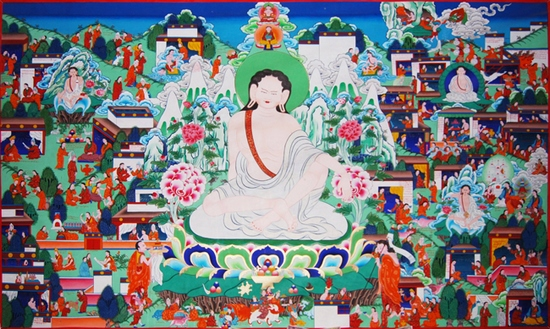
For example, there is the story of Milarepa, Tibet’s most renowned yogi. When he was welcoming his disciple Rechungpa back from India—where Rechungpa had traveled to collect scriptures—an incredible event took place.
Rechungpa carried the scriptures on his back as he crossed the vast grasslands. When he saw Milarepa waiting for him, he was overjoyed. Eagerly, he described how he had met the great master Tilopa. With visible pride, he declared:
“In the past, Tilopa did not transmit this Dharma to Master Marpa, but now he has passed it on to me!”
His words brimmed with arrogance.
As they walked together, Milarepa noticed a broken yak horn on the ground and asked Rechungpa to pick it up. Rechungpa couldn’t see the point and made excuses not to touch it. Silently, Milarepa bent down, picked it up himself, and carried it along.
Suddenly, the sky darkened. Thunder boomed, lightning flashed, and hailstones the size of eggs pounded them mercilessly. Rechungpa was battered and bruised.
When the storm finally ended, he looked around—Milarepa had vanished. Alarmed, he began calling out.
Then, Milarepa’s calm voice rose from the little yak horn at his feet:
“Why are you so flustered? Come in here and take shelter.”
Rechungpa stared in disbelief. The opening of the horn was barely larger than a fist. How could he possibly fit inside?
He bent down to look, and to his amazement, he saw an endless green meadow within—stretching as far as the eye could see. Milarepa sat serenely in meditation.
But no matter what he tried, Rechungpa could not enter.
In that instant, all his pride dissolved. Humility and awe took its place.
Milarepa finally emerged and said with a gentle smile, “Did you see? My little yak horn turned out to be quite useful after all.”
Even in our time, extraordinary manifestations still occur.
H.H. Dorje Chang Buddha III has demonstrated countless inconceivable displays of supreme Buddha Dharma.
Ruzun Ruo Hui, the abbess of Hua Zang Si (in San Francisco) shared one remarkable example in Interviews with Buddhist Disciples (Episode 78).
Around 1995, about a dozen people were gathered together in a room, respectfully listening to the recorded Dharma discourse Expounding the Absolute Truth through the Heart Sutra.
Halfway through, the entire house vanished. All the walls and structures simply disappeared, and everyone found themselves sitting under the open sky.
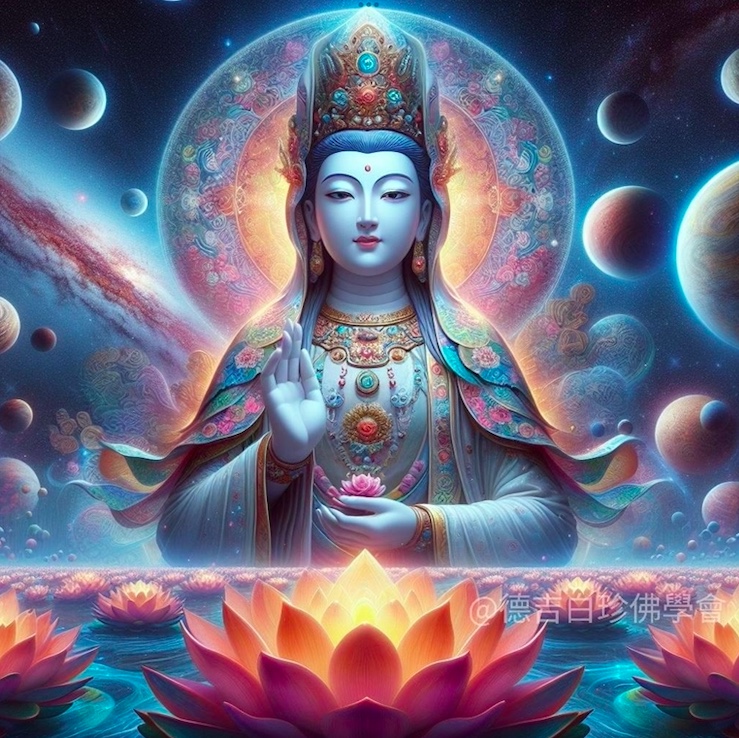
Above them, Avalokiteshvara Bodhisattva appeared, standing in the air, radiating boundless light while auspicious clouds billowed around.
For nearly an hour, Avalokiteshvara remained visible, bestowing blessings. No sounds of the street—no passing cars or footsteps—could be heard. The only sound was the voice of H.H. Dorje Chang Buddha III expounding the Dharma.
It was clear that everyone present had entered another dimension altogether.
Moments like these show us that the universe is far more profound than what our senses can grasp.
I believe Buddhism is deeply scientific—not superstition. Just because today’s scientists cannot yet explain these phenomena does not mean they are unscientific.
On the contrary, Buddhist wisdom offers an entirely different lens through which to explore reality. It can inspire modern science to uncover new methods and fresh insights to understand the universe’s deepest mysteries.
If we open our hearts and minds, perhaps Buddhist teachings will one day help humanity discover shortcuts to truths that today seem unimaginable.
H.H. Dorje Chang Buddha III Wan Ko Yeshe Norbu Holiest Tathagata is truly a Great Medicine King in this world. I speak not from hearsay, but from my own firsthand experience—His Holiness saved my life twice.
The First Miracle: A Life-Threatening Fall
The first incident occurred in 1994. One afternoon, I went to inspect a construction site. I stepped onto a sturdy board about 7 to 8 meters (23 to 26 feet) above the ground, commonly used for workers carrying heavy materials. As I walked across it, I suddenly felt an unseen force push me—I lost balance and fell.
My vision blurred; stars filled my eyes, and the world spun around me. I couldn’t see clearly and knew something was seriously wrong. In that critical moment, I began to recite the names of my Buddha Master, H.H. Dorje Chang Buddha III, and Avalokiteshvara Bodhisattva. I clung to their names with unwavering faith.
Soon, my mind became clearer, and I asked to be taken to my Buddha Master, the only one I believed could save me. When I arrived, I was in unbearable pain and couldn’t straighten my back. The Buddha Master immediately performed a dharma to bless me and then instructed others to take me to the Eighth Orthopedics Hospital.
X-rays revealed a serious fracture: my shoulder blade was broken into two pieces, with a gap the width of a finger. The broken bone was pressing into my lung, making breathing difficult. The doctors said I would need round-the-clock care from 18 people in three shifts for 21 days. Even with that, they warned, I would likely be permanently disabled.
But I had unwavering faith in the power of the Buddha Dharma. I quietly left the hospital without telling the doctors. The next morning, to my amazement, I could raise the injured arm. I immediately went to the Buddha Master’s residence to prostrate in gratitude. His Holiness told me to return to the hospital for another checkup.
The doctors were stunned. They had searched for me the previous night, assuming I had died. But the X-ray told a different story—the two broken pieces of my shoulder blade had fused perfectly, with no visible crack. I only felt a slight discomfort. I attended my company’s annual meeting the very next day and never needed any medication. Within a week, my arm had fully recovered and remains normal to this day.
The Second Miracle: On the Brink of Death
The second life-saving miracle happened on April 22, 2002. That afternoon, I was rushed to the emergency room at Sichuan Medical University Hospital due to a major obstruction in my cerebellum. My blood pressure was over 200, and my blood was so thick that it could barely be drawn.
The doctors believed I wouldn’t survive the night. They didn’t even admit me to a ward, but placed me on a bed in the hallway, fulfilling only a humanitarian gesture. My condition was critical: I had double vision, severe dizziness, and vomiting. I was issued five terminally ill notices. Two other patients in the hallway, both in better condition than me, died within a day.
In that dark hour, I knew only one hope remained—my Buddha Master. I silently and continuously recited His Holiness’s name, praying for his blessings. That night, my fellow disciples informed the Buddha Master, who was across the Pacific Ocean. His Holiness called and said with great compassion, “Don’t worry. I will bless you. I will now teach you a dharma. You will recover in three to five days.”
I followed the practice, and within three days—actually three days minus two hours—a true miracle unfolded. I stood up by myself and walked to the bathroom without assistance. My recovery progressed rapidly, and I was discharged from the hospital in just three weeks.
The doctors were baffled. Other patients whispered in disbelief, “Wasn’t he supposed to die? How is he already up and walking?” A doctoral research team from the university even followed up on my case for over two years. Despite their expertise, they were unable to explain my recovery using medical science. They simply called it a medical miracle.
A Life of Gratitude and Devotion
I have faced death twice—and both times, I was saved by the compassion and dharma power of my beloved Buddha Master, H.H. Dorje Chang Buddha III. His Holiness is not only the incarnation of an ancient Buddha, but truly a Great Medicine King who heals the body, mind, and soul.
As a humble and shame-filled practitioner who cannot even overcome my own karma, I make this vow before the world: I will forever follow my Buddha Master and cultivate the authentic and correct Buddha-dharma He teaches. I will strive to attain liberation from the cycle of birth and death, enlighten myself and others, and do my part to save sentient beings.
The two experiences I’ve shared are entirely true. If I have fabricated even one word, may I descend into Vajra Hell. If what I’ve said is genuine, may all the merit be dedicated to my most honored Buddha Master, H.H. Dorje Chang Buddha III. May His Holiness continue to turn the dharma wheel, remain in this world for countless kalpas, and bring salvation to innumerable living beings.
With deepest gratitude, Buddhist disciple Yihui Hengxing April 28, 2006
Dharma Master Yongding was a direct disciple of H.H. Dorje Chang Buddha III, personally taught by His Holiness. A monk of true cultivation and realization, Dharma Master Yongding lived a life of noble deeds and profound spiritual accomplishments. He embodied the virtues of the ancient enlightened monks—pure in conduct, boundless in compassion, and unwavering in his commitment to benefiting all sentient beings.
Before becoming a monk, Dharma Master Yongding was known as Li Xiangchen, a kind-hearted and widely respected man from Dayi County in Sichuan Province. His compassion and moral character were already legendary even in his youth.
During a catastrophic drought, in Li Xiangchen‘s hometown, one the region hadn’t seen in a hundred years—Buddhist and Daoist masters prayed for rain for months, but to no avail. Not a single drop of water could be found.
Then, one night, two villagers had the same dream. A divine being told them that only with the signature of a man named Li Xiangchen could rain be summoned. The two searched everywhere and eventually found him. After they delivered his signed name to the altar and burned the paper, a torrential rain fell instantly, ending the long drought. The event left villagers in awe and firmly established Li Xiangchen’s reputation as a man of virtue and divine affinity.
During China’s devastating three-year famine in the 1960s, emergency food rations were being distributed. When officials asked Li how much his household needed, he replied that his family still had food and didn’t need any. His wife, stunned by this answer, brought the official to their home. There, they found only two catties (a little over two pounds) of rice left.
When asked why he had lied, Li quietly responded,
“So many people are starving. I just can’t bring myself to eat while others go hungry. I only feel at peace if everyone can survive this together.” His selflessness deeply moved everyone who heard his words.
In another act of compassion, while working at the Jin Dongzi Reservoir where laborers received rice rations, Li Xiangchen gave all his rice to his struggling friend Pei Yinchang, who was raising two young children. When Pei noticed that Li was growing increasingly frail, he begged him to keep some rice for himself. Li refused.
Pei later visited the reservoir to learn how Li was surviving. The workers there told him, “Mr. Li survives by digging wild roots and vegetables to make porridge. No one knows what happened to his rice.” Pei was stunned and moved to tears.
Later on, Li Xiangchen began studying Buddhism under a master. He observed the precepts with great discipline and practiced with a heart of sincerity and humility. His compassion became so palpable that even animals responded to it.
One day, while walking down a mountain, a vicious dog leapt at him. Calmly, he said:“Go ahead and bite me. This is a matter of karmic cause and effect.” As the dog neared, just two or three feet away, it suddenly stopped, yelped, tucked its tail, and ran away.
After becoming a Buddhist, Li Xiangchen adopted a vegetarian lifestyle. On one occasion, his master encouraged him to eat a little meat because he appeared thin and weak. But Li simply smiled and ate only plain rice.
When asked later why he didn’t follow his master’s advice, he replied:
“Please tell my master: First, I deeply respect Him, but I carry heavy karmic debts and dare not eat meat. Second, if gaining the Dharma and achieving liberation requires me to disregard the lives of sentient beings, then I would rather not attain liberation—I’d rather fall into hell. Third, I cannot harm others just to benefit myself. If I did, I would no longer be a true practitioner.”
His integrity and compassion deeply touched his master, who later transmitted to him the sacred practice of the Four-Armed Avalokiteshvara (Chenrezig). Through dedicated practice, he reached a level of spiritual realization said to rival the great Milarepa himself.
In 1990, when his karmic conditions ripened, Li Xiangchen became a disciple of Namo Dorje Chang Buddha III. His Holiness personally expounded to him the profound meaning of Prajna (transcendent wisdom). As a result, he awakened great wisdom and thoroughly realized the state of Prajna.
His attainments became unfathomably profound. He could connect with Buddhas and Bodhisattvas and had deep spiritual communion with heavenly realms.
When the Dayi County government began construction of the Master Yi Yungao (H.H. Dorje Chang Buddha III) Museum in 1994, Dharma Master Yongding consulted with the Heavenly Emperor about the upcoming three months of weather. Every day, he wrote forecasts in the worksite dining hall—and for three full months, not a single forecast was wrong.
On another occasion, with a mere wave of his hand, he split a tree trunk a kilometer away. The tree was so thick it would take two people to encircle it. Witnesses were astounded.
Dharma Master Yongding lived by the principle that the Dharma must be obtained through a pure and selfless heart, without the slightest trace of falsehood. He placed the interests of all living beings before his own and upheld the precepts with unwavering resolve.
He was a true practitioner of great compassion, an exemplar of moral discipline, and a living model for all Buddhist disciples. His life reminds us that genuine realization comes not from words, but from the way we live, love, and serve others.
Namo Yuhua Shouzhi Wang Holy Mother the Great Mahasattva!
Namo all Buddhas in the ten directions, Vajra Beings, Bodhisattvas, Sky-goers, and Dharma Protectors!
Buddhist disciples from all over the world have once again gathered here. We give thanks and pay respects to Namo Dorje Chang Buddha III. We learn the “Namo Dorje Chang Buddha III Complete Sutra Collection,” which is the Dharma treasure that Namo Dorje Chang Buddha III bestowed upon humanity. We commemorate the Holy Birthday of Namo Dorje Chang Buddha III annually.
During this Dharma ending age, in which true Dharma diminishes, and evil forces prevail, it has been our tremendous good fortune to encounter the magnificent Namo Dorje Chang Buddha III, and learn the true Buddha Dharma that enable us to attain liberation from cyclical birth and death. Whatever questions arise in the course of learning from Buddha and practicing cultivation, we can find all the answers elucidated in the Dharmas expounded by Namo Dorje Chang Buddha III. These Dharmas are available in audio recordings and in published books. As a living being with utmost humility, I will share some of my experiences for everyone’s reference.
First: As Buddhist disciples, our goal is not to seek worldly fame or fortune. Our fundamental goal is to attain liberation! At any time and place, we must remember this goal and resolutely not deviate from it.
The Buddha taught us repeatedly that in order to attain liberation, we must start by cultivating our conduct. Practicing cultivation includes strictly abiding by the precepts and maintaining correct knowledge and views. Precepts are stipulated by the Buddhas. Correct knowledge and views can only come from the Buddhas: In the present era, you can only find them in the audio recordings of the Dharmas expounded by Namo Dorje Chang Buddha III. These Dharmas have been and will continue to be published in the “Namo Dorje Chang Buddha III Complete Sutra Collection.”
To attain liberation, we must also practice Dharma. Namo Dorje Chang Buddha III transmitted many Dharmas to us. These Dharma treasures are rafts that enable us to attain liberation. We must practice Dharma persistently and effortfully.
Second: As Buddhist disciples, our goal is to become arhats, Bodhisattvas, and eventually attain Buddhahood. Therefore, now that we are in our cultivation stage, we must be “sincere and truthful to Buddha, pious to Buddha Dharma, compassionate to living beings, and honest with ourselves.” It is by being sincere and truthful to Buddha that we can receive teachings. It is by being pious to Buddha Dharma that we can practice persistently and effortfully. It is by being compassionate to living beings that we can help them rather than hurt them. It is by being honest with ourselves that we can truly practice cultivation and accumulate merit.
Third: As Buddhist disciples, we must clearly understand and believe in causality. The Buddha’s descent into this world, and the Buddha’s entering Parinirvana were due to the shared karma and causality of all living beings. The arrival of the Dharma ending age was due to the shared karma and causality of all living beings. Yet our own causality is enabling us to learn from Buddha and practice cultivation to attain accomplishment and liberation!
As long as we respectfully listen to audio recordings of the Dharmas expounded by Namo Dorje Chang Buddha III; sincerely study the “Namo Dorje Chang Buddha III Complete Sutra Collection”; reflect upon our own conduct at all times; repent of our own sins; strictly abide by the precepts; matter-of-factly practice cultivation; diligently practice Dharma; propagate the Sutras of Namo Dorje Chang Buddha III; uphold and protect the teachings of Namo Dorje Chang Buddha III and Namo Shakyamuni Buddha; do all kinds of good deeds; and not do any bad deeds, then we will definitely attain liberation!
Not only are we going to attain liberation, but we must also propagate the magnificent true Buddha Dharma, so that more people may encounter and learn the Dharma expounded by Namo Dorje Chang Buddha III, and from which they can achieve perfect good fortune and wisdom, and attain liberation from cyclical birth and death!
Wishing that all congregants here today and all living beings fulfill their beneficent wishes, have good fortune and wisdom, and attain great liberation and accomplishment! Wishing that all countries be strong and prosperous, and all living beings safe and happy! May peace be on earth and may auspiciousness be with all living beings!
Once again, let us pay obeisance!
Namo Dorje Chang Buddha III!
Namo Shakyamuni Buddha!
Namo Yuhua Shouzhi Wang Holy Mother the Great Mahasattva! Namo all Buddhas in the ten directions, Vajra Beings, Bodhisattvas, Sky-goers, and Dharma Protectors!
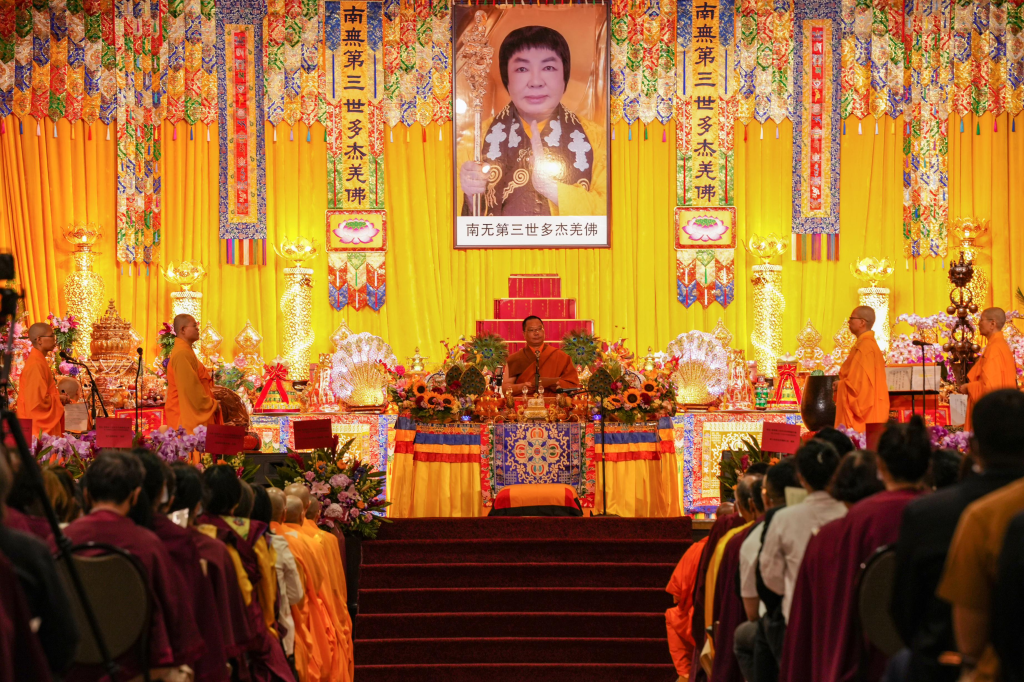
Photo Courtesy: Shawn Liu (A two-day Dharma Assembly at the Glendale Civic Auditorium drew over a thousand Buddhists globally to honor the Holy Birthday of H.H. Dorje Chang Buddha III.)
Glendale, CA — May 30-31, 2025 — In a profound expression of global devotion, more than a thousand Venerables, Dharma Masters, Rinpoches, and lay practitioners gathered at the Glendale Civic Auditorium in Los Angeles County to honor the Holy Birthday of H.H. Dorje Chang Buddha III, the Pope of Buddhism.
In the solemn Dharma Assembly, the spiritual sounds of bells, drums, and other Dharma instruments created an atmosphere of reverence throughout the venue. With participants from diverse cultural backgrounds and nationalities, the assembly highlighted unity through spiritual harmony. The rituals—including scripture recitation, invocations, and ceremonial offerings—provided a transformative spiritual experience for all attendees.
A momentous highlight of the event was the presentation of five newly published volumes of the Namo Dorje Chang Buddha III Complete Sutra Collection, symbolizing the growth of the True Buddha Dharma. The congregation celebrated the invaluable teachings expounded by H.H. Dorje Chang Buddha III, whose profound wisdom continues to inspire disciples in their pursuit of liberation.
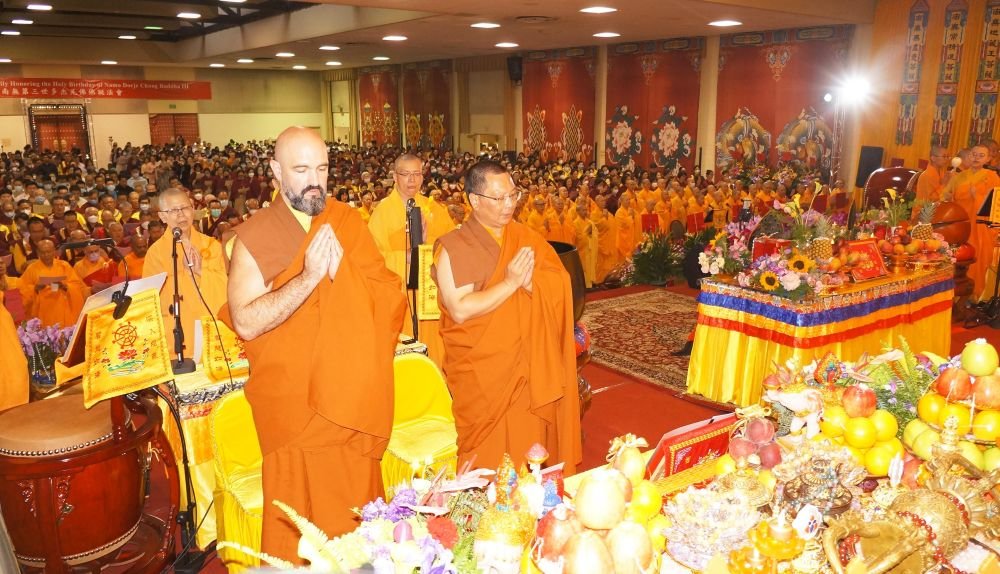
Speaking at the Dharma Assembly, Venerable Tsemang, Director of the Office of H.H. Dorje Chang Buddha III, emphasized that the ultimate goal of every Buddhist disciple is enlightenment and liberation. He noted that H.H. Dorje Chang Buddha III has expounded the authentic Buddha Dharma to guide sentient beings across the ocean of suffering, urging practitioners to uphold steadfast devotion, diligent study, ethical precepts, sincere practice, and deep introspection.
The event welcomed spiritual leaders, scholars, dignitaries, practitioners, and many non-religious individuals from around the globe, united by a shared respect for the compassionate wisdom of H.H. Dorje Chang Buddha III.
Photo Courtesy: Shawn Liu (Venerable Mozhi and Venerable Tsemang guided the congregation in the Dharma Assembly.)
Venerable Chadima, founder of the Nagananda International Institute for Buddhist Studies in Sri Lanka, offered heartfelt homage and shared his experiences of receiving teachings from H.H. Dorje Chang Buddha III.
Zhaxi Zhuoma Rinpoche, president of the Xuanfa Institute and abbot of the Holy Vajrasana Temple and Retreat Center, spoke about her journey of looking for an experience of Buddhism that was similar to the Buddhism in ancient times when Shakyamuni Buddha was here. After many years of searching, she described finding the same kind of experience when she met H.H. Dorje Chang Buddha III.
Ven. Bhikkhuni Dr. Pannavati, abbot of Heartwood Refuge Monastery in North Carolina, shared her joy in getting together with brothers and sisters in the Dharma who study under H.H. Dorje Chang Buddha III. She expressed that it felt as though they were one big family, despite coming from all corners of the world.
During the Dharma Assembly, participants respectfully chanted the Sutra on Understanding and Realizing Definitive Truth and made meal offerings to the Buddhas. Through religious rituals—Sutra recitation, invocation chanting, mantra practice, and devotion—attendees collectively prayed for the flourishing of the True Dharma, the swift liberation of all sentient beings, and the realization of lasting peace, prosperity, and happiness throughout the world.
To honor the occasion, the H.H. Dorje Chang Buddha III Cultural and Art Museum in Covina, CA, presented an exclusive Dharma recording expounded by H.H. Dorje Chang Buddha III, which had previously not been available to the public, alongside a life-release event dedicated to benefiting living beings.
Buddhist communities in Canada, Germany, Malaysia, China, Sri Lanka, Peru, Japan, Thailand and other countries and regions across the globe also commemorated this day with Dharma Assemblies, life-release ceremonies, charitable events, and educational aid initiatives. These activities illustrate the expansive reach of H.H. Dorje Chang Buddha III’s compassionate influence and the shared aspiration among all beings for enlightenment and liberation.
Photo Courtesy: Shawn Liu (Venerable Chandima, Venerable Pannavati, Buddhist professors and scholars from Sri Lanka, and others attended the Dharma Assembly to honor the Holy Birthday of H.H. Dorje Chang Buddha III.)
This worldwide commemoration not only showcases the deep unity of devotees in upholding the True Buddha Dharma but also reinforces the enduring spiritual inspiration of H.H. Dorje Chang Buddha III—a guiding light of compassion, wisdom, and boundless blessings for our world.
My revered Master, H.H. Dorje Chang Buddha III, is the incarnation of the ancient, supreme Buddha. Out of boundless compassion, His Holiness willingly bears worldly hardships and concerns to rescue sentient beings from suffering. His accomplishments across the Thirty Categories of the Five Vidyas have astounded the world and brought immeasurable blessings to countless lives. These works—each awe-inspiring in its own right—will soon be compiled into a book to benefit humanity. Yet even these remarkable achievements represent only a small fraction of His Holiness’s true realization.
Most people are unaware that the Buddha Master also possesses the highest and most profound esoteric Dharma. Because His Holiness operates with the enlightened mind of a Buddha and has attained the ultimate state in Buddhism, He was able to receive the rare and authentic vajra needle lineage—a powerful healing method.
I have personally witnessed numerous people with karmic connections to the Buddha Master be cured of serious illnesses, including cancer. Among them were:
Guangdong Yan and Zhiyong Luo, both diagnosed with nasopharyngeal carcinoma;
Zhuang Yan, who suffered from skin cancer;
Jingxing Wu, with a brain tumor;
And Lehui Xie, who endured decades of debilitating phlegm, inflammation, and migraines.
I know these individuals personally. I saw them healed. People from Hong Kong, Taiwan, and Malaysia who suffered from leukemia, AIDS, and strokes traveled to China to seek healing from the Buddha Master—and they, too, were cured.
This verse, from a poem written by the Buddha Master titled “To the Tune of Nian-Nu-Jiao,” perfectly captures that miraculous period:
“Three thousand suffering patients visited me, Day and night I cured them.”
And now, I wish to share my own experience. Over twenty years ago, I stood at death’s door, suffering from late-stage uterine cancer. It was the Buddha Master who brought me back to life through the sacred power of the Buddha-Dharma.
In August of 1985, I began experiencing continuous menstruation lasting over two weeks. At first, I assumed it was just an irregularity and sought treatment through Chinese medicine, but nothing improved. I turned to Western medicine, yet the bleeding continued endlessly. After more than two months, I was transferred from a local hospital to Sichuan Provincial Hospital, where a biopsy confirmed the devastating diagnosis: late-stage uterine cancer.
Professor Zhang, the attending physician, told my husband Hui Han Da—who is also a fellow disciple of the Buddha Master—“The cancer has already spread. Surgery is no longer an option. Take her home. Let her eat what she wants, go where she wishes, and spend her final days with loved ones.”
Refusing to give up, my husband took me to Huaxi Medical University Hospital. The diagnosis remained unchanged. Still determined, he took me to the China-Japan Friendship Hospital in Beijing, then to Peking Union Medical College Hospital, and finally to Suzhou University Hospital. Each hospital gave the same grim verdict: there was nothing more they could do.
As my condition worsened, I lost the ability to eat and became emaciated, reduced to just 79 pounds. My hematin level was a mere 3 grams—far below the normal 16 grams. In a desperate attempt to stop the bleeding, my husband brought me back to Huaxi Medical University Hospital. The doctor took one look at me and shook his head: “She has seven days left at most. Go home and prepare for her funeral.”
Back at home, lying in bed and feeling the nearness of death at only 36 years old, I told my husband through tears, “Before I die, could you please go to the Buddha Master and ask Him to help elevate my soul after I pass?” He replied, “The Buddha Master is currently traveling, spreading the Dharma and saving beings. I will go see His Holiness once He returns.” Silently, I prayed with all my heart to Avalokiteshvara Bodhisattva (Guan Yin), hoping the Buddha Master would come back soon.
The very next day, around noon, a miracle happened. The Buddha Master appeared at my bedside.
I tried to get up to prostrate, but I was too weak. His Holiness gently stopped me and told me to lie still. With immense compassion, the Buddha Master began to expound the profound truths of life and the universe, explaining the root cause of suffering—how beings are bound by karma born from delusion, which leads to the inevitable cycle of birth, aging, sickness, and death.
In a moment of deep reflection, I suddenly came to a painful realization: In order to make money through business, I had once helped others produce a type of beef by slaughtering more than a thousand yaks. Whether or not I had intentionally killed other living beings in the past, how many lifetimes would it take to repay the karmic debt from taking just those thousand lives?
Their blood had once flowed because of my actions—and now, my own blood flowed endlessly due to illness. It was then that I truly understood: this was karmic retribution. The causes I had planted were dark, and now I was receiving their bitter fruits. The more I contemplated this, the more fearful and remorseful I became. From the depths of my heart, I sincerely repented and prayed to the Buddha Master to elevate me to a higher realm after death.
The Buddha Master compassionately said to me:
“If you truly repent, change your ways, never again kill any living being, and resolve to learn Buddhism and cultivate yourself, I will block your negative karma and delay your retribution. Cancer is nothing formidable! I will heal you—and I will also save those yaks that you killed.”
Then and there, the Buddha Master treated me with the vajra needle—a holy object of profound lineage, part of a supreme Dharma that only a true Buddha can apply. The vajra needle is no ordinary tool; it acts according to the will of the Buddha Master. When instructed to send sensation to a specific part of the body, it obeys instantly. When told to stop, it immediately ceases. It was truly beyond anything I had ever imagined.
At the time, I was wearing both a sweater and a fur coat. His Holiness applied the needle through my clothing to an acupuncture point on my back. After releasing the needle, the Buddha Master formed various mudras (sacred hand gestures). As each mudra changed, the sensations from the needle also changed—sometimes weak, sometimes strong—spreading throughout my entire body. I felt tingling, pressure, and swelling sensations, almost too intense to endure.
Then the Buddha Master explained:“Illness arises when energy channels in the body are blocked. It’s like a machine clogged with old, dirty oil that needs to be cleaned. This treatment is cleansing and unblocking your channels. Now, with just my words, the sensations will stop.”
The moment His Holiness spoke, all sensations vanished instantly.
The second round of treatment brought even sharper sensations, again perfectly controlled by the Buddha Master. When His Holiness gave the command, the sensations stopped at once. After a third round of treatment, I felt completely at ease. The Buddha Master then said:
“Today I opened your energy channels. But for complete healing, I must prepare a medicine using the highest Buddha-Dharma methods.”
Soon after, the Buddha Master instructed my husband, Hui Han Da, and me to drive Him to a mountain village—the very place where those yaks had been slaughtered. There, in front of a large yak, the Buddha Master began preparing the medicine. My husband and I were both present.
As the Buddha Master began the ritual, a white mist suddenly appeared in the clear sky, drifting from west to east. The mist grew denser and denser until we couldn’t even see our hands before our faces. During that time, many auspicious and mysterious phenomena occurred. Once the preparation was complete, the Buddha Master had me drink the fragrant herbal liquid.
As soon as I drank it, I felt a surge of warmth fill my body, followed by a deep, refreshing coolness. I was completely rejuvenated—energetic, peaceful, and miraculously healed. The endless bleeding stopped. Overwhelmed with gratitude, I immediately prostrated before the Buddha Master, tears of joy flowing down my face.
From that day forward, I took no more medicine. My strength and body weight gradually returned to normal. One month later, a doctor from Sichuan Provincial Hospital called to follow up, assuming I had already passed away. I answered the phone myself and said:“I’m alive—and completely healed!”
He didn’t believe me and requested I come in for an examination. At the time, fellow disciple Guangdong Yan, who had also been cured by the Buddha Master of nasopharyngeal carcinoma, was visiting my home. We both agreed to go together.
The next day, we were re-examined. The test results showed not a single cancer cell in either of us. The doctors were stunned. They asked what medicine I had taken, who had treated me, and how I had recovered. I answered:“It was the Buddhas and Bodhisattvas who saved me.”
It has now been twenty-one years since the Buddha Master healed me. Ever since I began sincerely practicing the Buddha-Dharma under His Holiness’s guidance, my health has only improved. Recent physical exams show that all my health indicators are excellent. I now weigh 165 pounds, more than double my weight when I was sick.
Friends and family who saw me during my illness are astonished when they see me now. Many say I look like a completely different person.
The Buddha Master also performed special Buddhist rites to liberate the yaks whose lives were taken. The compassion and grace the Buddha Master has shown me and my entire family are immeasurable.
From this life onward, all I can do to repay His Holiness is to devote myself wholeheartedly to cultivation, do good for others, and strive to attain true realization in order to be worthy of the sacred blessings and infinite kindness of my most revered Buddha Master.
Buddhist disciple, Chi Lie Er (This is a complete translation of the Chinese text that follows originally written and signed by Chi Lie Er.)
The Profound Wisdom of the Holy Buddha Vimalakirti
The Vimalakirti Sutra stands as one of the most profound texts in Mahayana Buddhism, offering deep insight into wisdom, compassion, and the nature of illness. One of its most significant sections, the “Chapter on Illness,” presents a powerful dialogue between Manjushri and Vimalakirti, a lay Bodhisattva of extraordinary realization.
Vimalakirti, despite his unparalleled wisdom, feigns illness to teach a vital lesson. When Manjushri visits him and asks, “Aren’t you successful in your practice? If so, how can you be ill?” Vimalakirti responds, “I am ill because all sentient beings are ill.” This response redefines illness—not as a personal affliction but as an expression of universal suffering. His illness is a manifestation of his boundless compassion, mirroring the pain of all beings so that he may guide them toward liberation.
Manjushri Bodhisattva and other disciples visiting H.H. Vimalakirti
The dialogue between Vimalakirti and Manjushri unfolds into a deeper contemplation on suffering. When asked when his illness will be cured, Vimalakirti replies, “When the last sentient being is free from illness, then my illness will be cured.” This statement embodies the heart of Mahayana Buddhism—the vow to attain enlightenment not for oneself alone but for all beings. His words resonate with the self-sacrificial love found in other spiritual traditions, such as Jesus Christ’s willingness to bear humanity’s suffering.
Vimalakirti further explains, “From ignorance comes love, and thus my illness arises.” He reveals that suffering stems from attachment—attachment to family, possessions, ambitions, and even spiritual practice. Such attachments cloud the mind, giving rise to suffering. True liberation, he teaches, comes from transcending these attachments through wisdom and compassion.
The holy and venerable Vimalakirti is unique in Buddhist history, as he was an ancient Buddha who chose to manifest as a layperson rather than an ordained monk. During the time of Shakyamuni Buddha, he played a crucial role in teaching monastics and Bodhisattvas who struggled to develop Mahayana bodhicitta. His unparalleled wisdom and skillful means helped bridge the gap between monastic and lay practitioners, proving that profound realization is not limited to those in monastic robes.
In reality, Vimalakirti was the incarnation of the supreme Buddha Dorje Chang (Vajradhara), the primordial Buddha and master of all Buddhas. Yet, instead of taking a leadership role that might have caused sectarian divisions, he humbly chose to serve as a Bodhisattva assisting Shakyamuni Buddha. His teachings, recorded in the Vimalakirti-nirdesa Sutra, are regarded as sutras in their own right, carrying the weight of authentic Buddha-dharma.
The depth of Vimalakirti’s wisdom was so vast that even the most accomplished Bodhisattvas hesitated to engage him in dialogue. When Shakyamuni Buddha asked Maitreya Bodhisattva to inquire about Vimalakirti’s health, Maitreya declined, admitting that Vimalakirti had once humbled him with his superior insight. Ultimately, only Manjushri, the ancient Buddha and master of the seven Buddhas, dared to engage Vimalakirti in discourse.
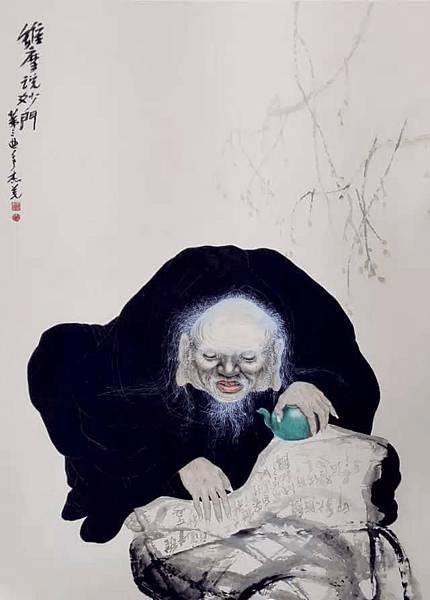
Chinese Ink painting Holy Master Vimalakirti by H.H. Dorje Chang Buddha III
Vimalakirti’s teachings were not limited to words alone—he also demonstrated his supreme realization through extraordinary miracles. In one instance, he used his boundless supernatural powers to bring the entire Buddha-land of Abhirati, including the Immovable Buddha (Aksobhya), into the human realm. Even the Immovable Buddha himself declared, “I did not do this; it was through the supernatural powers of Vimalakirti.” Such feats reveal that Vimalakirti’s realization surpassed that of all Bodhisattvas and was equal to that of Shakyamuni Buddha himself.
Shakyamuni Buddha himself affirmed the extraordinary status of Vimalakirti, stating, “One who makes offerings to that holy being should know that this is making offerings to the Buddhas. One who transcribes this sutra or keeps it in a room should know that the Tathagata exists in that room.” These words confirm that Vimalakirti was, in essence, a Buddha.
His teachings continue to inspire practitioners today, offering a profound perspective on suffering, wisdom, and compassion. His willingness to manifest illness as a teaching tool, his unparalleled debates with great Bodhisattvas, and his supernatural demonstrations all serve as timeless lessons in the path to enlightenment.
I follow H.H. Dorje Chang Buddha III and have ever since I first encountered His writings in an unusual little book titled True Stories About a Holy Monk thirteen years ago. Prior to that I studied and practiced Zen Buddhism and the shamanic arts for over fifteen years.
Although I knew this was an extraordinary teacher and holy person, none of us who followed this holy being knew who He was until a draft manuscript of a book about His accomplishments in this life was published and distributed to many of the leading Buddhist living in the world at that time. This happened around 2007. Many of the most highest accomplished Buddhist (not all were the most well known) recognized that this was a very special incarnation and wrote letters stating that fact which were included in the final version of the book that was published and presented to the Library of Congress and the world in a grand ceremony in April, 2008. Later that year and the next, I and a group of monks, nuns, and laypeople voluntarily traveled to all 50 states presenting the book to governors, librarians, tribal chiefs, and others and giving a talk on just who H.H. Dorje Chang Buddha III is and why He had come to America. You can read more about all these events on this website.
Many of the current Buddhist sects hold that Dorje Chang Buddha or Vajradhara Buddha was the originator of Buddhism as such. This is especially true in the vajrayana traditions. You will see this dark blue Buddha at the top of their lineage trees. Dorje Chang Buddha was the first samboghakaya manifestation of the formless Dharmakaya Buddha and was the teacher of all dharma to all the other Buddhas in the ten directions including Shakyamuni Buddha. Only one other time did Dorje Chang Buddha incarnate in this world and that was at the time of Shakyamuni Buddha to help teach Shakyamuni Buddha’s disciples. That was as the great holy venerable one, Honorable Vimalakirti. At that time, Shakyamuni Buddha praised Honorable Vimalakirti in the Vimalakirti-Nirdesa Sutra, ”People who make offerings to this person should know that they are making offerings to a Buddha. One who transcribes and learns this sutra should know that a Tathagata is right with him in the same room.” This statement means that, in addition to Shakyamuni Buddha, there was another Tathagata in this world at that time. Shakyamuni Buddha was not the only Buddha. You can read the teachings of Ven. Vimalakirti in the well-known sutra bearing His name. However, H.H. Dorje Chang Buddha III gave us this discourse, “The dharma I transmit is absolutely the dharma taught by the Buddha. However, I am not a Buddha. Neither am I a master. I am just a humble one propagating the true dharma of Tathagata, without distinguishing sects or schools. Any cultivator who has correct knowledge and views, even a very ordinary cultivator, is better than me. I should learn from them all. Therefore, my body, speech, and mind are just a humble structure.”
In 2008, I had the good fortune to have an interview in upstate New York with H.H. Penor Rinpoche, who had been the third supreme leader of the Nyingma Sect. He was one of the leaders who recognized H.H. Dorje Chang Buddha III. He told me that this was a very high being, much higher than he (Penor) was and it was very good that such a being should incarnate at this time in these dharma ending days and that He should reveal many miracles so that people would believe that the dharma still existed in this world. He also said that Dorje Chang had never before incarnated in Tibet and other wonderful things.
The fact is that H.H. Dorje Chang Buddha III’s mind practice is different from that of all other dharma kings, rinpoches, and dharma masters in the world. For example, He is truly completely proficient in exoteric and esoteric Buddhism and possesses perfect mastery of the five vidyas, while essentially no other people were able to accomplish that through history. More importantly, He is the only one who only benefits and helps all others and does not accept money or properties from other people. He has even announced that He would never accept offerings and would solely benefit others. Consequently, this fact causes other dharma kings, rinpoches, and great dharma masters of Buddhism to feel very embarrassed and depressed, because all these dharma kings, rinpoches, and dharma masters have to collect and accept offerings. Compared to H.H. Dorje Chang Buddha III’s deed of not accepting offerings, it became clear that they are at lower levels and are greedy for offerings from living beings. Therefore, they are very angry because H.H. Dorje Chang Buddha III ’s deed makes them unable to explain their acts.
H.H. Dorje Chang Buddha III did NOT proclaim himself to be a Buddha. However, He was recognized by many others as such and He did not deny the fact. H.H. Dorje Chang Buddha III has stated repeatedly that this is the era of Shakyamuni Buddha and that Shakyamuni Buddha is the supreme leader of Buddhism in the world today. H.H. Dorje Chang Buddha III only came to correct many of the mistranslations and erroneous views held by Buddhists and about Buddhism that exist in the world today. Please visit the website of the Office of H.H. Dorje Chang Buddha IIIwww.hhdcb3office.org, you will truly find out that H.H. Dorje Chang Buddha III is a truly great Buddha. He has demonstrated countless accomplishments in all five of the vidyas–the only way that a Buddha can be known. The five vidyas is an ancient concept that most Buddhist do not understand–I know I did not and it took me a long time to fully realize what was meant by the term.
Based on what I have seen and experienced, I do believe H.H. Dorje Chang Buddha III is a nirmanakaya Buddha. Please allow me to make a statement from the bottom of my heart that bears my responsibility to the law of cause and effect: From what I have learned from books and what I have ever seen in my current lifetime, I have never been aware of or seen anyone who surpassed the accomplishments of H.H. Dorje Chang Buddha III!
H.E. Dharma King Dumu Quji was conferred the title of “Buddha-Dharma National Master” by an emperor in the Ming Dynasty. The meaning of “Quji” is Dharma King. H.E. Dharma King Gongbao Dumu Quji XVIII is the Vajra Master of H.H. the 17 th Karmapa Great Jewel Dharma King. He performed the yidam dharma initiation for the 17 th Karmapa Great Jewel Dharma King. He is the only one of great holiness and virtue who cleansed through a ritual bathing the 17 th Karmapa and formally put the Great Jewel Dharma King robes onto the 17 th Karmapa. He did so at the respectful request of H.E. Tai Situ Rinpoche, who is one of the four great Dharma Princes. During the time H.H. Dharma King Gongbao Dumu Quji XVIII performed initiations for the Karmapa, he saw in a supernatural state the ancient, primordial Buddha—Dorje Chang Buddha—bless the Karmapa. That ancient Buddha manifested as H.H. Dorje Chang Buddha III. H.H. Dharma King Gongbao Dumu Quji XVIII wrote the following about this real experience: “H.H. Dorje Chang Buddha III is the highest refuge countless living beings can rely upon to attain liberation. I prostrate to H.H. Dorje Chang Buddha III.”
AFFIRMATION AND CONGRATULATIONS
With boundless gratitude, I prostrate to H.H. Dorje Chang Buddha III!
In this lifetime, I formally put the Great Jewel Dharma King robes on to the 17th Karmapa, Urgyen Trinley Dorje, and performed the yidam dharma initiation for him, which included transmitting dharma to him. A few days before I did that, I saw in a supernatural state the Buddha Vajradhara appear over the head of the Karmapa. The Buddha Vajradhara was radiating light that empowered the Karmapa. Very soon after that, the Buddha Vajradhara metamorphosed into one who was sitting down. He was wearing a yellow robe. His long hair was at shoulder level, and He looked dignified and imposing. Behind Him were high stones, a pool, rooms, red flowers, and green pines. Below Him was a wooden deck. At that time, I knew Dorje Chang Buddha had come to this world, but I did not see His exact whereabouts. During all these many years, I have constantly kept that scene in mind and have reviewed it.
I recently received the book H.H. Dorje Chang Buddha III. This was probably the result of being blessed by the twenty-one Taras. When I turned to page twenty-one and saw that holy image of H.H. Dorje Chang Buddha III, I was totally shocked. It was the exact image of Dorje Chang Buddha that I saw in that supernatural state. There was not the slightest difference between the two, including the setting that surrounded H.H. Dorje Chang Buddha III.
I now solemnly affirm and offer congratulations for the following: The karmic conditions of living beings to encounter dharma have matured, for they can now benefit from the brilliant wisdom of the Buddha as they had wished. H.H. Dorje Chang Buddha III is a precious book of true Buddha-dharma, a treasury that incorporates 84,000 dharma methods. It demonstrates accomplishments in the Five Vidyas unprecedented in the history of Buddhism. H.H. Dorje Chang Buddha III is the highest refuge countless living beings can rely upon to attain liberation.I prostrate to H.H. Dorje Chang Buddha III!
In the Tibetan region of Kham, the renowned 18th Do Mu Choktrul Rinpoche is a household name, widely revered for his immense compassion and kindness. Do Mu Rinpoche was born in 1945 in Palwug Village, near Babang Monastery in present-day Dege County, Sichuan Province, historically part of the Dege royal domain. His father, Chodro Yeshe Gyatso, was a prominent member of the Lukra Tsang family within the Dege royal lineage, and his mother, Genkyu Chudron, was the daughter of a key minister from the esteemed Lujang family of the Dege kingdom.
Before Rinpoche’s birth, his mother experienced an extraordinary vision: a bird appeared before her and presented her with a wisdom sword associated with Manjushri Bodhisattva. At the time of his birth, the household was bathed in an extraordinary radiance and auspicious energy. Remarkably, a bucket of milk in the home transformed into butter, and flowers bloomed profusely on the ground outside—a truly miraculous event.
At the age of three, the reincarnation search team from Dhonka Monastery identified him as the reincarnation of the previous Do Mu Choktrul Rinpoche. This recognition was later confirmed by the 16th Gyalwa Karmapa, Rangjung Dorje, who bestowed upon him the name Karma Shedrup Trinley Tenzin Palzangpo and granted him the empowerments of Amitayus and other teachings.
That same year, Rinpoche was ceremonially enthroned at Dhonka Monastery in a grand ceremony presided over by the 9th Sangye Nyenpa Rinpoche and the 8th Traleg Kyabgon Rinpoche. Following his enthronement, he began rigorous and specialized training under the guidance of dedicated spiritual masters.
In 1980, following the restoration of religious freedoms in China, Buddhist activities were officially permitted to resume.
In 1981, under Rinpoche’s leadership, Dhonka Monastery embarked on its reconstruction. Despite numerous challenges, the monastery was gradually restored to its former glory. Rinpoche personally led meditation retreats, upheld strict monastic discipline, delivered Dharma teachings, performed empowerments, and presided over Buddhist assemblies. His boundless compassion and tireless efforts brought immeasurable benefit to countless beings.
Throughout his life, Rinpoche’s Dharma activities remained uninterrupted, regardless of war or societal changes. Guided by profound wisdom and deep compassion, he tirelessly propagated the Buddha’s teachings across the Tibetan regions. Responding to requests from devotees in various areas, he traveled to remote mountain regions, often under arduous conditions, to conduct ordination ceremonies and share the Dharma. His footprints spanned the entirety of Kham and Tibet.
In recent years, auspicious connections enabled Han Chinese disciples to learn from Rinpoche as well. Cities such as Hong Kong, Beijing, Shanghai, Xiamen, Guangzhou, Shenzhen, and Huizhou became destinations for a steady stream of seekers coming to receive his teachings. Through his tireless efforts, Rinpoche brought the nectar of Dharma to both Han and Tibetan communities, profoundly benefiting countless beings.
Rinpoche exemplified the principle, “The Dharma exists in the world to awaken beings within it.” His compassionate wisdom was evident in numerous achievements, including the completion of Dhonka Monastery’s reconstruction, the establishment of retreat centers, the founding of Buddhist academies, the opening of nunneries, the initiation of charitable organizations, and the creation of the Karma Kagyu Research Institute. These efforts expanded the reach of Buddhism, integrating it into all aspects of life.
In addition to his spiritual leadership, Rinpoche also served as a government official, promoting the dissemination and practical application of Humanistic Buddhism. Through his work, he ensured that the teachings of the Dharma became an integral part of daily life, guiding people to treat one another with compassion, wisdom, and kindness.
H.H. Dharma King Kyabje Trulshik Chokyi Lodro is one of the most accomplished masters of the Nyingma sect in the present age. He is also one of the few remaining great masters of Tibetan Buddhism who has real and extensive knowledge, real training, and true cultivation. He is a lineage holder of many important dharma lineages. He is a great dharma king who does not distinguish among the various sects of Buddhism. H.H. Dharma King Trulshik and the most magnificent modern dharma kings of Buddhism, such as the H.H. Dudjom Dharma King and H.H. Dharma King Dilgo Khyentse, have been masters and disciples of one another. H.H. Dharma King Trulshik also taught the dharma of many lineages to the 16th Karmapa. He is a personal master of H.H. the Dalai Lama as well as a master of the most recent reincarnation of the H.H. Dudjom Dharma King, H.H. Dharma King Dilgo Khyentse, and H.E. Dharma King Tulku Ugyen.
Many Rinpoches had different views concerning which great Bodhisattva H.H. Dharma King Trulshik was the incarnation of. Thus, the International Buddhism Sangha Association held an unprecedented Drawing Lots From a Golden Vase Ceremony to affirm the true reincarnated identity of H.H. Dharma King Trulshik and others. There were ten possible identities recognized by various rinpoches. One lot was drawn from among 120 lots to affirm the true reincarnated identity of H.H. Dharma King Trulshik. That drawing affirmed that H.H. Dharma King Trulshik is the nirmanakaya of Maitreya Bodhisattva, which is the reincarnated identity that H.H. Dorje Chang Buddha III recognized before that lot was drawn.
In history, H.H. Dharma King Trulshik incarnated as Thonmi Sambhota, who created the Tibetan written language. Later, he incarnated as the great translation master Bairotsana, who was one of the twenty-five major disciples of Guru Padmasambhava. H.H. Dharma King Trulshik will be the next Buddha of this Good Eon (Bhadra-kalpa) of one thousand Buddhas. At that time, all of his disciples who heard him expound the Buddha-dharma will attain accomplishment in the dharma.
The dharma king was born on September 10, 1924, the year of the wooden rat, which was the exact birthday of Guru Padmasambhava. He was born in Wengre Cave, which is a holy place of cultivation in southern Tibet. Many auspicious phenomena appeared at the time of his birth. The father of the dharma king, Dianjin Queda, was a practitioner of yoga. His mother, Jiangyang Wangmu, was a descendent of Zhangba Jialei, who was the first Drukpa Dharma King and founder of the magnificent Drukpa lineage.
The dharma king was extraordinary ever since childhood, especially with respect to his deep self-cultivation. When he was four years old, his master, Zhachu Rinpoche (who was a disciple H.H. Dharma King Trulshik personally taught in his previous life as Trulshik Dongak Lingpa), invited him to the Zhalongpu Monastery in the Latuo Xueka District. At that time and place, memories of his prior life spontaneously welled up in the mind of the dharma king. He recounted in detail past events of that prior lifetime. Zhachu Rinpoche had personally witnessed those past events of his former master. Zhachu Rinpoche wept as he orally corroborated each of those events without exception. Zhachu Rinpoche was truly astonished by this and firmly believed that this boy must be the incarnation of Trulshik Dongak Lingpa. After the rinpoche practiced the Selection of Karmic Affinity Dharma, he affirmed that the boy was undoubtedly the incarnation of Trulshik Dongak Lingpa.
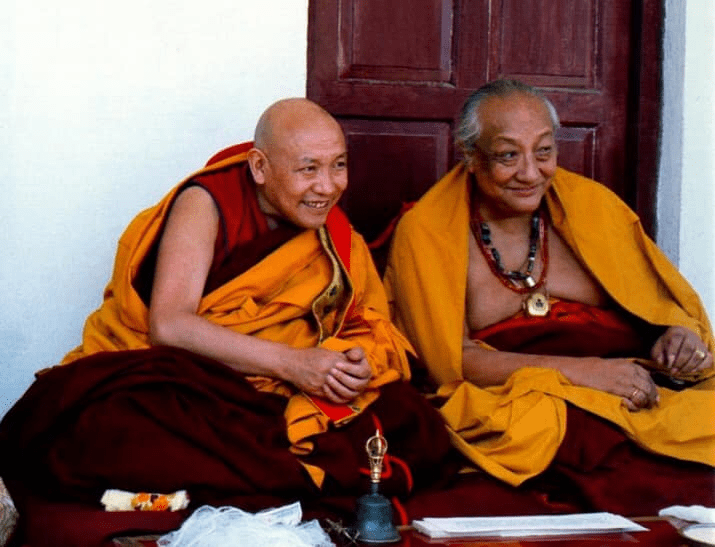
Dharma King Dilgo Khyentse Rinpoche (right) and his main Dharma heir, the Fifth Dharma King Trulshik Rinpoche (left)
The Gelug sect’s Dalai Lama invited the Nyingma sect’s Dharma King Trulshik to transmit the supreme Dharma
At the Mindrolling Monastery, the dharma king engaged in extensive learning. He received all of the monk precepts from his precept masters Cuikenqiong Rinpoche and Mindrolling Kenqian Khyentse Norbu according to the “Formal Pronouncement on Precepts” lineage passed down from Laqian Qianba Lasa. Present-day dharma kings unanimously agree that H.H. Dharma King Trulshik is one of the most important lineage-holders of this lineage. H.H. Dharma King Trulshik holds three types of precepts that are on different levels: the Pratimoksa precepts, the Bodhisattva precepts, and the precepts for tantric masters. The dharma king is one who truly wears a golden precept robe. Not only does he abide by the precepts for monks, he also completely abides by all of the Hinayana, Mahayana, and Vajrayana precepts. That is why he deserves to be called a “holder of the Vajra Three Secrets Vows.” H.H. Dharma King Trulshik is the main transmitter of the monastic vows within the Nyingma lineage.
The dharma king has received teachings on the sutras and tantras, as well as other teachings. He has visited famous masters in many places to learn Buddha-dharma, including over thirty famous masters who belong to ancient and modern sects of esoteric Buddhism. The dharma king has studied all of the dharma teachings of these important lineages and has put them into practice. He still learns assiduously even after he completed a strict three-year retreat. Accepting the request of Zhachu Rinpoche, the dharma king became the khenpo of the Zhalong Dongga Qielin Monastery, where he is responsible for upholding, protecting, and spreading the dharma.
Throughout his whole life, the dharma king has wholeheartedly cultivated himself in retreat. Every day he abstains from speaking until 10:00 in the morning. Each year the dharma king goes into retreat in his own temple for as much as nine months. All of the great Tibetan rinpoches acknowledge that as a master of masters, the dharma king has the greatest abilities and power to clearly point out the way leading to realization of one’s original nature. That is why extremely virtuous masters send their capable disciples to the dharma king in order to seek teachings and empowerment.
H.H. Dharma King Trulshik has vast and profound learning. His practice is solid and flawless. He is unassuming and amiable. No one in today’s world can match his profound experience, training, and realization. Many practitioners of the various sects regard him as a venerable Dharma King Master with limitless wisdom and vast supernatural powers. H.H. Dharma King Trulshik has recognized the identities of the person who is the incarnation of H.H. Dharma King Dilgo Khyentse, the person who is the incarnation of H.E. Dharma King Tulku Ugyen, and persons who are incarnations of other important rinpoches. He has also transmitted dharma to and performed initiations for such people. The dharma king is a magnificent practitioner of the Great Perfection Dharma and a magnificent accomplished one in our current age. He is a model master of this century with disciples spread all over the world.
After H.H. Dharma King Trulshik saw who His Holiness Dorje Chang Buddha III Wan Ko Yeshe Norbu is through the limitless omniscience displayed in A Treasury of True BuddhaDharma, he stated that His Holiness Wan Ko Yeshe Norbu has reached the highest state of Buddhahood in the few-thousand-year history of Buddhism, having truly attained complete. Dharma King Trulshik wrote a respectful congratulation letter.
RESPECTFUL CONGRATULATIONS His Holiness Buddha Vajradhara (Dorje Chang Buddha) Yangwo Wan Ko Yeshe Norbu: I recently learned that the book about you, A Treasury of True BuddhaDharma, was published a long time ago. The content of that book includes the traditional Tibetan five major vidyas and five minor vidyas. In terms of modern branches of learning, the book involves more than thirty different branches of learning. Thus, I entered samadhi and visualized the Three Jewels the Buddha, the dharma, and the sangha. I pervasively spread bodhicitta and wished that all living beings would realize the supreme, absolute truth and Buddhahood. May the propagation of A Treasury of True Buddha-Dharma be the karmic condition whereby living beings in the three spheres leave the sufferings of reincarnation and obtain the fruit of wonderful happiness. It will become the cause whereby each sentient being who has descended into the abyss of the six realms of reincarnation leaves suffering and attains happiness. I hereby specially convey my respectful congratulations!
Buddhist monk Ngawang Chokyi Lodro, having the undeserved name of Khenpo Zhalong Trulshik Shatrul Written on the auspicious day of June 28, 2007
















 Peace LiLy