The Yidam plays a crucial role in the daily practice of Buddhist disciples, especially for practitioners of Esoteric Buddhism. This article explains how you acquire a yidam and how your relationship with your yidam can develop.
The Buddha Master, H.H. Dorje Chang Buddha III, tells us that “your Yidam is the holy being presiding over the particular Dharma you decide to practice in order to attain accomplishment.” The Buddha Master also tells us we have to face our Yidam and the Dharma protectors of our Yidam. And you cannot hide from either your Yidam or the Dharma Protectors. You may wonder how you know who your Yidam is. As you advance in your practice, you may receive a particular Dharma of Selection and be told who your Yidam is. As I understand it, this is probably a being that you have already achieved some accomplishments with in past lives and you are already familiar with the Dharma associated with that Yidam. You do not practice more than one Yidam Dharma at a time. Many of us start this practice with Kuan Yin Bodhisattva as our Yidam and follow the “Vajra Yoga Perfection Dharma” that you can find in True Stories about a Holy Monk. You may be fortunate to receive other Yidam practices from authentic Dharma masters and rinpoches. You would only do one yidam practice at a time, but you may also follow different Yidams throughout your spiritual career. I was told that if you cannot receive a Dharma of Selection, you may select the Yidam for whom you have the greatest affinity. In fact, you do not pick the Yidam, the Yidam actually picks you. You must keep your precepts and not hold any of the “128 Evil and Erroneous Views” in the Supreme and Unsurpassable Mahamudra of Liberation.
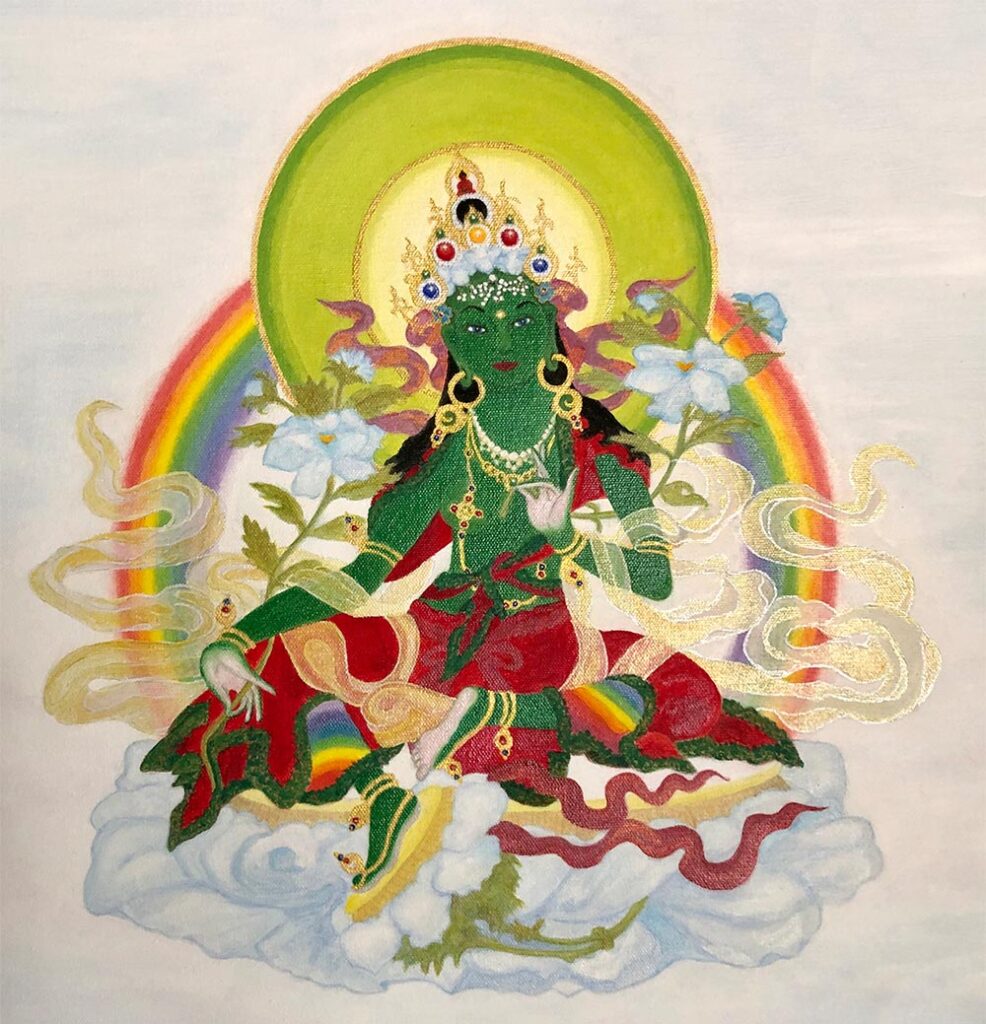
Painting of Green Tara by Zhaxi Zhuoma.
Do not be frustrated if something is not clear. If you are not progressing in your Yidam practice, go back and reflect on your cultivation. You should be doing this three times per day anyhow. If you are not keeping the precepts or developing your bodhichitta, you cannot progress. If your cultivation is good, your Yidam may come and teach you what you need to know. I have had that happen as have several of my students.
Once I was not clear on how to visualize a particular mantra and my Yidam showed me how to do it. I have a student who does not live near California and who is unable to visit either the Buddha Master or me very often. He is a serious, sincere, and compassionate cultivator and does, however, have a very good relationship with his Yidam. She has helped him on many matters. I recently received an email from him telling me how much he had gained from his last trip to the Holy Vajrasana Temple and being able to study Expounding the Absolute Truth through the Heart Sutra. Even though he was only able to study this Dharma a short time this trip, he gained realizations which he didn’t get in all the previous years he had studied here. He said, “It made a deep impact on my life and I am very grateful that I was able to read even this little bit of it. Since then I was reflecting even more on how our daily lives relate to achieving accomplishment in the Dharma, how cultivation and Dharma practice need to go together. I often compared it with breathing, like inhaling and exhaling following one another and both are necessary to keep [your] life working. This morning I received an instruction from [my Yidam] on this topic while I was doing my Dharma practice which I would like to share with you.”
He went on to explain that his Yidam told him that he should see that cultivation is like collecting firewood. Doing a Dharma practice is like igniting a fire. If we have not collected enough wood (or any at all) the fire of wisdom cannot burn. So even a kind thought is like a dry twig which will fuel the fire. So, cultivating ourselves seriously and not slipping in any moment is like piling up a huge amount of firewood which will cause the fire to burn strongly and result in accomplishments.I was delighted. He said I could share the teaching as an example of how our Yidams do teach us, but we must do the practice and cultivate our behavior. The Buddha Master tells us in Learning from Buddha that if you learn one of the Mind Essences from the Supreme and Unsurpassable Mahamudra of Liberation “. . .to the point of proficiency and put it into practice, you need not worry about not being able to learn Buddha Dharma. Even if I, your Master, do not teach you, the Yidam will teach you.”
Avalokiteshvara Bodhisattva, from beginningless eons, has been tirelessly saving countless sentient beings with his immense compassionate power. Despite his boundless efforts, he felt a sense of inadequacy. Thus, from the power of samadhi born of great compassion, he formed an immense compassionate force. This force, combined with the great compassionate power of Buddhas from the ten directions, resulted in a drop of green tear flowing from his eye, transforming into the infinitely majestic green female Bodhisattva, known as Green Tara. Due to this origin, Tara’s power to save is boundless and infinite.
Green Tara is revered as the Great Compassionate One and the Holy Savior Mother Buddha. The practice of the Green Tara ritual has a rich history that originated in India and later spread to China, Tibet, Japan, and beyond. The sacred roots of this practice trace back to Green Tara herself, who was initially the ancient Buddha Pravartaka and an incarnation of Avalokiteshvara Bodhisattva.
Chanting the Green Tara mantra even once, with focused contemplation of Tara’s sacred image, brings immense merit. Such merit is equivalent to chanting the names of seventy-two billion Buddhas and Bodhisattvas as numerous as the sands of the Ganges. Both the exoteric and esoteric traditions have extensive practices based on this ritual, and many practitioners have achieved great success and benefit from it.
Over time, the original texts and mandalas related to this profound practice have suffered from omissions and distortions in their transmission. For the past two hundred years, these deviations have increasingly moved away from the authentic regulations. In recent decades, the practice has nearly completely lost its true essence. Furthermore, the representations of Green Tara have deteriorated in form, lacking the dignity of the authentic appearance. This includes discrepancies in hand mudras, attire, and overall sacred depiction, resulting in a significant loss for the Buddhist community.
The Green Tara Perfect Practice Ritual and Thangka by H.H. Dorje Chang Buddha III
In response to these issues, H.H. Dorje Chang Buddha III transmitted the “Green Tara Perfect Practice Ritual” and personally supervised the creation of the Green Tara mandala thangka.
This three-dimensional thangka is not only lightweight and portable, making it easy to carry, but also presents the mandala clearly and vividly, ensuring that it remains etched in memory. Additionally, it possesses several extraordinary merits:
Authenticity and Compliance: The Green Tara mandala presented in the thangka fully complies with the regulations of the “Green Tara Perfect Practice Ritual.” This ensures that the practice remains true to its original form.
Historical and Miraculous Significance: Tara had already attained Buddhahood countless eons ago, her divine power is illustrious, and her sacred deeds are well-documented. Today, in the “Tara Hall” in Nethang, Tibet, the sacred statue of Tara once spoke to Atisha, instructing him, further propagating her holy name and Dharma power across China and Tibet. During the creation of this three-dimensional thangka, many miraculous occurrences were witnessed. For example, the sacred image of Tara, originally looking straight ahead, appeared differently in subsequent photographs taken from the same angle: one showed her looking up at the sky, while the other depicted her looking down at sentient beings. This clearly demonstrates Avalokiteshvara Bodhisattva’s extraordinary vow power: above, he shares the same compassionate force with all Buddhas and Bodhisattvas; below, he joins in compassionate aspiration with all sentient beings in the six realms. Additionally, when viewed from different angles, the main deity of Green Tara always faces the observer, and the seed syllables in the sky behind her follow her movement, appearing above her head. Furthermore, the colorful clouds, initially close to the sun and moon, seem to remain stationary while the sun and moon move vividly between the clouds from different perspectives.
Majestic and Unmatched Representation: The sacred image of Green Tara in the thangka is exceptionally majestic and perfect, unrivaled in both China and Tibet throughout history. The twenty Taras, each with different postures, exhibit supreme Dharma power, arranged behind the main deity, appearing and disappearing miraculously. Notably, standing in different positions reveals the Great Brahma Deva, the primary protector, initially as one, then suddenly as two, and then back to one again, a phenomenon unprecedented in history! Meanwhile, the Four Great Heavenly Kings and the Eight Dragon Kings remain unchanged. Additionally, Indra, the Four Great Heavenly Kings, and the retinue of the Eight Dragon Kings, wielding their divine weapons and instruments, surround and protect Tara with unmatched divine transformation. Visualizing this thangka makes the practice highly effective and rapidly fruitful.
Validation and Praise
Upon the completion of the “Green Tara Perfect Mandala Thangka,” Buddha Master specifically instructed disciples to bring all existing Green Tara statues of various materials from around the world to the Vajra Dharma Circle for public verification. They were to determine which one is the most orthodox and perfect thangka. The Vajra marbles immediately entered the mandala thangka, confirming that the Buddhas and Dharma protectors of the ten directions unanimously endorsed it.
Many of the seven classes of Buddhist disciples, upon practicing with this three-dimensional thangka, experienced unprecedented and unique realms. High monks, living Buddhas, and even Dharma Kings from around the world have all respectfully praised and recommended this rare and precious sacred image. In truth, among all the existing Green Tara images, none can compare to the perfection and majesty of this mandala thangka. Its blessing power is extraordinarily miraculous; a single glance imprints it deeply in the mind, leaving a lasting impression.
The Green Tara Perfect Practice Ritual and its accompanying thangka, as transmitted and supervised by H.H. Dorje Chang Buddha III, represent a revival of the authentic practice of Green Tara. This thangka not only restores the true essence of the practice but also enhances the spiritual experience for practitioners worldwide, offering unparalleled blessings and merits.
Dechen Shak-Dagsay is a Swiss-Tibetan musician and author. Over the past few decades, she has built a career in music by combining the Tibetan mantra transmissions passed down by her father, Ven. Dagsay Rinpoche, with innovative melodies and contemporary instrumental productions. She has also engaged in collaborative projects with other spirituality-inspired musicians. Having lived in Switzerland for most of her life, Dechen is one of the most prominent contemporary Tibetan singers in Europe today, and has also become globally recognized through various music awards, and for having performed songs from her albums Jewel and Day Tomorrow at Carnegie Hall in New York. Dechen is also the founder of the Dewa Che charity organization, which engages in social projects in Tibet.
Dechen’s newest album, emaho – The Story of Arya Tara, released in October 2021, is about the enlightened activity of the Vajrayana goddess Tara and contains a musical rendition of the “21 Praises of Tara.” BDG recently had a chance to speak with Dechen about her latest project.
BDG: You’ve sung about Tara on various albums before, but this new album is devoted specifically to her story. What do you find inspiring about this female buddha?
Dechen Shak-Dagsay: I have had a wish for many years now to share the extraordinary story of Goddess Arya Tara, the gentle-yet-indomitable princess who became a female buddha. The mythic story goes back many eons in ancient India, where she was called Princess Jhana-Chandra, which means Wisdom-Moon. In Tibetan, her name is Yischi Dawa, and it touches me profoundly that, out of a deep sense of compassion, she would not even eat breakfast before she had liberated hundreds of thousands of beings from samsara each day. She was a faithful disciple of her teacher Buddha Dundubhisvara, and her entire community admired her.
One day, the monks urged her to make an aspiration (vyakarana) to be reborn as a man in her next life in order to attain full enlightenment. The princess laughed at this sexist exhortation and replied: “There is no male, there is no female. To discriminate between male and female is the mind of a small being. There are neither men nor women, nor a self, nor beings.” She vowed to return again and again in a female form in order to help all beings from suffering and to reach enlightenment in female form. Therefore, her teacher, Dundubhisvara, gave her the name Tara, which means “Swift Liberator.”
Tara’s story reminds us every day that we are all equally beautiful beings blessed with great inner qualities, such as love, compassion, kindness, and clarity. These qualities are just waiting to be rediscovered and nurtured.
BDG: Your album emaho captures a profound thought: “What an amazing, wondrous moment when the mind awakens.” How does the music create a mood and ambience in which the listener can realize this moment for themselves?
DSD:Emaho is indeed not an ordinary word. It is found in ancient Tibetan spiritual texts and is an exclamation of joy and amazement when the obscured mind awakens and experiences the pure, clear, and bright shining light of the true nature of our mind.
Personally, I find that each of the eight pieces hold beautiful emaho moments for the listeners. As with all my previous albums, I received the texts for this exalted goddess from my dear father, Ven. Dagsay Rinpoche. It is a great blessing that Rinpoche gave me the transmissions for these beautiful “21 Praises of Tara,” which are practiced in all Tibetan traditions. I also had the privilege of working with Swiss producer Helge van Dyk, who also composed and produced the music of my two previous albums, Jewel and Day Tomorrow.
I said to Helge that I wished to represent the four enlightening activities of Tara in four musical pieces. I cannot thank Helge enough for creating the most sublime music to present the four skillful enlightening activities of Tara: the pacifying, enriching, magnetizing, and wrathful aspects.
When you listen to emaho – The Story of Arya Tara, my hope is that you will enter the wonderful, unique space and landscape of Tara’s buddha-field, and perceive her different fields of activities through the following musical compositions.
“emaho – an Amazing One” – “The Wisdom of Tara” – Tara’s magnetizing activities. Audio courtesy of VANDYKMUSIC
“emaho – an Amazing One” – Tara’s enriching activities. Audio courtesy of VANDYKMUSIC
“emaho – an Amazing One” – “Magic Pulse” (of Prayer Drumming) – Tara’s wrathful activities. Audio courtesy of VANDYKMUSIC
BDG: How do you think the spirit of emaho can help heal our fractured and hurting world, which is now immersed in COVID-19 and a range of other immense crises?
DSD: We generally believe in the great healing power of the Buddha’s teachings, especially when the world is going through a difficult time. We are still in a worldwide pandemic, and we constantly face threats of natural calamities and other crises.
The whole world has faced unprecedented challenges over the last two years, and we are still trying to find solutions for how to handle them. From a worldly point of view, these problems are simply devastating and are creating immense suffering for everyone. But from a Buddhist view, such challenges are exactly what we call “precious moments” for our minds to awaken and to encourage a total reset in our interior world and inner being. We call these moments precious because they allow us to open our hearts to the Buddha’s teachings, such as the Three Marks of Existence. Recalling them always has an instant healing effect on me:
• Impermanence (Skt: anitya): Nothing stays the same, everything is constantly changing.
• Whatever we experience is marked with some kind of suffering. As long as we identify ourselves with a sense of solid self, we will always suffer (dukkha).
• Everything around us and even our own person is empty of a self (anatman).
Dechen Shak-Dagsay. Image courtesy of VANDYKMUSIC
Together with Helge and other musicians, we created emaho in the hope that it will be a small contribution to helping us all through these troubled times together.
We hope to be able to bring calm and peace into people’s hearts. We will not be able to get rid of COVID-19, or the economic, social, and political fallout it has caused, but the music that carries the blessings of Arya Tara, the Swift Liberator, will help us all to overcome our fears, sadness, frustration, and pain to create some space in our hearts and to rebalance our minds. It is within this calm space that we will be able to tap into our innate beauty and strength. We all need this to transform our pain and negative thoughts, and to calmly face and embrace the difficult times ahead of us; to fully become aware of our own inner qualities.
The release of the new double album was followed by the release of my new book, Mantras, Musik & Magic Moments, in December 2021, in which I write about the healing aspects of the old Tibetan mantras, and why I chose music as a tool to reach people’s hearts. I also talk about how Tibetan healing symbols have carried sacred power for centuries. I began making mantra music about two decades ago, and I hope followers will enjoy this new perspective I am offering through my work.
BDG: Your music has been received very well worldwide and your profile has also been rising in Asia. Do you present your music as non-denominational and embracing of all Buddhist traditions, even while it expresses your Tibetan heritage?
DSD: Although I am very rooted in Tibetan or Vajrayana Buddhism, I embrace all Buddhist traditions. My dear father Dagsay Rinpoche, who lives in Chengdu, always reminded us that the essence of the Buddha’s teachings is non-violence and cultivating love and compassion for all beings. All Buddhist traditions, including the Tibetan heritage, are following this beautiful path. It is my wish to one day come to Asia to meet all my Asian friends and to perform my music in Asia together with the Jewel Ensemble.
In my third piece on disc two, called “Peace of Mind,” I sing a “Praise to the 21 Taras” in Chinese and in Tibetan. It is my deep wish to create a wonderful space of peace, respect, and reconciliation.
BDG: You’ve come together with various artists to create a fusion of music. These artists also tend to have a spiritual flavor to their work. How do you decide to work with an artist? How do you identify a potential collaboration?
DSD: Thank you for sensing what I see as a very special energy to our music. I am very thankful to Helge, who has a distinct talent in finding the right artists for a special collaboration that requires not only technical musical skills, but also an open heart that is fully inspired to play soulful music with us. He has carefully selected outstanding musicians to form the Jewel Ensemble, with whom we have played many concerts all around the world. I feel very privileged to have the following members of the Jewel Ensemble, as well as an extended ensemble that we shared the stage with when playing the Call for Peace concerts with the renowned Zurich Chamber Orchestra (ZKO).
I would like to take this opportunity to thank my Jewel Ensemble musicians and guest musicians from around the world for their beautiful contributions on emaho. It has been such an honor to work with all these outstanding artists, who committed their heartful work to this album.* I would like to thank BDG for opening the door to the story of Arya Tara. I would be very happy if this music finds its way across Asia, and I would like to thank all my musicians, my producer Helge, and my dear father Dagsay Rinpoche for letting me create such precious music. I hope it will help to remind people all around the world of their own inner strength and beauty.
Gongjue Tuji Rinpoche, who founded and leads the Xuanfa Dharmazentrum (Dharma Center) in Cologne, Germany. He is truly a sincere, humble, and dedicated buddhist disciple and totally devoted to our Buddha Master H.H. Dorje Chang Buddha III and his yidam.
In mid-February, after H.H. Dorje Chang Buddha III entered parinirvana, Gongjue Tuji Rinpoche had been visited by the Buddha. H.H. Dorje Chang Buddha III, reassured that Gongjue would be able to receive the inner-tantric initiation, His Holiness had promised that Gongjue’s yidam would make the arrangements. During Gongjue’s practice, his yidam Green Tara appeared and confirmed all this as Gonjue explains in this short video.
CLICK for an article of Gongjue Tuji Rinpoche received a powerful lesson from attending the June 2018 Dharma Assembly celebrating the birthday of H.H. Dorje Chang Buddha III.
CLICK for an article from Gongjue Tuji Rinpoche on his relationship with Green Tara and how She had helped his wife through a dangerous bout of cancer at year 2013. You will see that this is not the first or only time his yidam appeared and spoke to him.
On April 16, 2013, Karolin (Shown here with her daughter Julie), the young wife of Gongjue Tuji Rinpoche of the Xuanfa Dharmazentrum (Dharma Center) in Cologne, Germany was diagnosed with a rare and very dangerous form of thyroid cancer that can very rapidly metastasize throughout the body and is often fatal.
The decision to operate was made very quickly and on April 18, she had both her thyroid and other cancerous and non-cancerous lymph nodes in her throat removed. One of the most famous doctors in this area in all of Germany performed the surgery.
Before the surgery Gongjue Tuji gave Karolin one red vajra pill that he had as well as a Black Jewel Medicine Pill (Kazhuo Ande Pill) he had received from his master, Zhaxi Zhuoma Rinpoche.
Gongjue Tuji called to tell Zhaxi Zhuoma Rinpochethat the surgery went well, but he really wanted to report something else that happened. He is a very devout practitioner of Green Tara. His wife has not been very interested in Buddhism, but has encouraged Gongjue in his practice. Gongjue was waiting while his wife received a CT scan to see if they were too late and the cancer had spread to any other parts of her body. He was practicing his Green Tara Dharma and visualizing Green Tara as he often does and dedicating any merit from his practice to Karolin. Suddenly Green Tara started moving around the mandala that he visualized. He saw Her dance and heard Her laugh heartily, and She told him not to worry, that his wife “would get a second chance.” That is exactly what he had been praying for and the CT scan came out clean. He was very emotional and happy about this. Zhaxi Zhuoma Rinpoche and he both wept with joy as he explained what happened. He was uncertain if he could tell his wife about this and not violate his precepts. His master told him he should tell her and not tell her and let his joy be witness to what he saw. He should tell her about how wonderful the true Buddha-dharma is, but not tell her anything about the practice itself except in general terms.
A few nights later, again while practicing the Green Tara dharma, Gongjue Tuji was told in a very excited way: “Quick! Go and look outside. Go and look outside.” While he was moving the laundry drying rack in their living room in order to get to the door of the balcony, he was thinking to himself “Gongjue, you are becoming ridiculous,” but when he stepped outside on the balcony, he looked at the moon and there was a huge Buddha-light! Again he called his master to tell her that he was so joyous and happy that it was impossible to express his feelings in words, but he knew that Green Tara was giving her blessing. Two years earlier, Gongjue Tuji had taken a picture like the one shown in the slide show on the homepage of this website of the green being in the Buddha Light while he was visiting his master at the Xuanfa Institute in Sanger, California.
But this is not the end of the story. Zhaxi Zhuoma Rinpoche reported this matter to her Buddha Master, H.H. Dorje Chang Buddha III and He laughed and said this was very good and that He already knew about the matter. When she told Gongjue Tuji of this she received the following with an update of a second surgery Karolin had to have as they did not get everything the first time.
The second surgery went well, too. Even the nuclear medicine specialist who transferred Karolin to the hospital assisted the professor during the second surgery, which is very unusual. But he wanted to be sure that the surgeons remove everything this time. They only removed 15 more lymph nodes and not 30 as I mentioned in an e-mail before. Three of these 15 have been malign, the biggest measuring about one inch. Unfortunately the diagnose was even worse after the second histological result.
Days later, Karolin had a doctor’s appointment with her nuclear medicine specialist to discuss the results. The doctor was not very happy with the new diagnose. Karolin asked him about the tumor marker but he had not received the blood results yet from the hospital so he called the hospital to inquire about it. A normal value for this specific marker should not be higher than 5 for a healthy person. Karolin’s value before the first operation was about 1,500 and after the first operation it was still about 500. When the doctor was talking to the hospital he couldn’t believe what they said and asked a second time. The tumor marker value is now below 2!!! At first he was speechless and didn’t know what to say. Both, Karolin and the doctor, where almost moved to tears. He said that’s sensational! He would have never expected such a result after that diagnose.
When Gongjue Tuji Rinpoche got the news from his wife he said: “I can not express how happy and how grateful I am towards all the Buddhas and the Boddhisattvas, especially to the Green Tara. This would have never resulted that way without all the blessings and the support of the Buddhas and the Bodhisattvas. I am also very grateful to everybody who supported us in their thoughts and sent their blessings. ” This is just another example of the amazing power and results of practicing the true Buddha-dharma.
Green Tara (Jetsun Drolma) statue from the Gyantse Kumbum Pagoda, Pelkor Chode Monastery, Gyantse, Tibet
H.E. Tangtong Gyalpo Bodhisattva (1361-1485)
It is through the understanding and practice of the Buddha-dharma that one becomes a holy person–a living jewel. Sainthood in Buddhism has a somewhat different meaning than that held in Christianity although both refer to people who live an exceptionally holy life, are very compassionate, and can demonstrate certain “miracles.” In Buddhism it also means one who has become enlightened—been liberated from the cycle of reincarnation and all its related suffering. The Christian saint aspires to be born in the Christian heaven, but this is not the goal of a Buddhist. A Buddhist saint is one who has escaped samsara or existence all together and gone beyond what is possible in the heavenly realms. A Buddhist saint would live in the Dharma realms or wherever he choses to be to help living beings. A saint in Buddhism is one who, like the Buddha, has become enlightened and realized his or her original nature, possessing the skills and wisdom of a Buddha. They have gained control over life and death and are thus liberated from the cycle of reincarnation. This is true happiness!
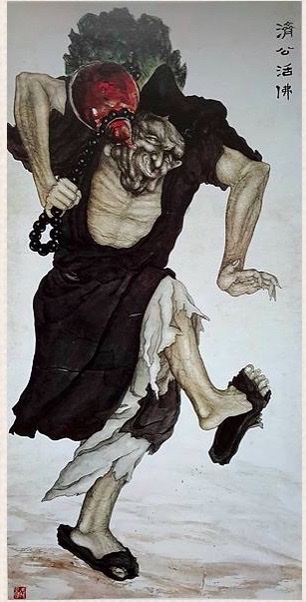
In Buddhism saints may not lead what is normally thought of as a “conventional” life. There are many examples of Buddhist saints who exhibited most unorthodox (“deliberate“) behavior. Examples of these kinds of happy, crazy saints are Han-shan and Shih-te, eccentric Ch’an (Zen) hermit-monks from Tang Dynasty, as well as Monk Ji-gong and Birdnest Roshi, but there are many others including the crazy yogis of Tibet like Padmasambhava, Virupa, Manjusrimitra, Tsang Nyon Heruka, and Tangtong Gyalpo. Saints can manifest in innumerable forms and may appear as humans or animals or live in other dimensions.
Japanese hanging scroll by Hashimoto Gaho of Han-shan and Shih-te (Kanzan and Fittoku), eccentric Ch’an (Zen) hermit-monks from Tang Dynasty, whose poetry is popular in the west.
It is important to know that one cannot fully understand what takes place on higher levels of the path. For example, those on the first Bodhisattva stage do not know about what takes place on the second Bodhisattva stage and so on up the path. Those on the second Bodhisattva stage see those on the first Bodhisattva stage as having impurities. Even those on the tenth Bodhisattva stage see those on the ninth Bodhisattva stage as having certain impurities. It is natural that the impurities and obscurations of those on the lower levels would be greater than those at the higher levels. Nevertheless, those who are kind and benefit others can guide and transform living beings no matter where they are on the path. However, ordinary beings and those at the lower levels of the path cannot possibly understand the behavior of true holy beings.
The key features of the various paths to becoming a holy being are summarized in the chart “The Way to Become a Holy Being or Saint.” It is useful to think of these paths as stages on the way to becoming a Buddha. It is interesting to note that the other world religions are also included as initial stages on the way to buddhahood in as much as they teach compassion, loving kindness, some aspects of morality, and discourage evil. Some also teach various forms of training the mind in meditation. Bodhisattvas do not only incarnate as Buddhists to help living being. The three pure precepts of Buddhism—cease evil, do good, and help others—can be practiced in many forms.
You must remember that ALL sentient beings are evolving toward the perfection of being a Buddha, whether they know it or not, and whether at the moment they may be very confused and behaving in foolish or even evil ways. This includes the minions of Mara and the demons of hell as well as the devas or gods in heaven.





 Peace LiLy