Dr. Jeff Walker’s Rising Stars: Transforming Arts Education Through Passion and Purpose

Matthew Kayser Contributor

Jeff Walker

In a world increasingly dominated by artificial intelligence and digital innovation, Dr. Jeff Walker, a retired neurosurgeon turned philanthropist, is on a mission to “keep the humans in the humanities.”  His Walker’s Rising Stars Scholarship Program, launched in 2003 in partnership with the Pinellas Education Foundation in Florida, has awarded over $970,000 to high school students excelling in Dance, Instrumental, Theater, Visual Arts, and Vocal Performance. 

Now, with a bold vision to expand the program nationally, Walker is poised to reshape arts education across the United States: “I want this to expand to cover the whole country and change arts education in high school and college,” says Walker, who has made it his mission to provide free education for all. 

Walker’s inspiration—rooted in personal tragedy, a love for the arts, and a deep commitment to education—drives a movement that empowers young artists to pursue their dreams without the crushing weight of student debt. 

His path to philanthropy was anything but conventional. A Duke-trained neurosurgeon who performed over 10,000 operations and established a major trauma center in Florida, Walker’s career was defined by precision and impact. 

Yet his drive to give back stems from a deeply personal experience at age five. “I had a tragic event, a near-drowning incident,” he recalls. His best friend didn’t know how to swim. Influenced by childhood media and misunderstanding the risks, he pushed him into the water. The outcome was devastating: his friend drowned, and Walker nearly did too. “I felt so guilty, blocked it out for 15 years,” he says. “I think I tried to overcompensate by helping people. It was something that took an incredibly long time for me to forgive myself for.” 

This tragedy instilled a lifelong mission to serve others—first through medicine and later through philanthropy. His medical journey began under the influence of his father, a dentist and university chairman, and his mother. “I scrubbed in on over 200 open-heart operations,” he says. But it was in medical school that he discovered neurosurgery, drawn to the brain as “what you are.” He completed his residency at Duke by 1985, laying the foundation for a career that blended science with service. 

Walker’s love for the arts, though not as a performer, also shaped his vision: “I played the piano when I was younger, very methodical, classical music,” he shares. A humbling moment came at 15 when a friend played a Beatles song effortlessly, revealing Walker’s limitations. “I couldn’t do that at all,” he admits. 

Yet, this experience underscored his belief in the arts as a universal force: “Every culture has their own dance, songs, music, symphonies, operas—the arts are a unifying factor,” he says. “There’s so much diversity in America today, and this brings everyone together.” 

In 2003, Walker channeled his passion for education and the arts into the Walker’s Rising Stars Scholarship Program, partnering with the Pinellas Education Foundation to support local high school students. The program, which awards scholarships for arts education, is a vibrant celebration of talent, culminating in an annual event at the Mahaffey Theater. 

“The kids get there at noon, we have lunch, they audition during the day, and then put on a show at night—three-minute acts, five categories, with the county jazz band. Families are cheering, it’s super fun,” he says. 

The program’s impact transcends financial support. After the show, students gather backstage, hugging and celebrating. “They’re all aspiring artists, and you can feel the love,” Walker says. 

As a father of four and grandfather of eight, Walker connects deeply with the pride parents feel at these events. “You’ve taken these kids to music, art, dance lessons for years, and to see them on stage as young adults—the pride and love bounce off the walls.” 

The scholarships address the broader student loan crisis, which Walker views as a significant burden on young people. “Every dollar is $1 the family doesn’t have to spend on education,” he says. 

Beyond financial relief, the program instills confidence and recognition. “It’s not easy to get on that stage, knowing hundreds of kids are vying for that spot,” Walker says. “The confidence they get is key.” 

He recalls a student letter that captures the program’s transformative power: “She wrote, ‘I was going to go to St. Pete College, but after winning this, I’m going to Manhattan School of Art.’ It’s a life-changing event.” 

Walker estimates that the program changes “about half the kids’ lives,” with alumni achieving remarkable success. “They’re making a living in the arts,” he says proudly. 

Walker’s inspiration for Rising Stars is grounded in his belief in education as a pathway to opportunity: “As a Duke-trained neurosurgeon, I went to school a long time, and I owe everything I have to my education,” he states. “In the end, when you look back on your life, it’s not what you get, it’s what you give.” 

This philosophy fuels his commitment to expanding arts education, particularly in public schools. “Education is the way out,” he says. “Through hard work and education, I still believe in the American Dream—you can be anything.” 

Walker also recognizes the challenges the arts face in an increasingly digital age. He trademarked the phrase “keep the humans in the humanities” to emphasize the need for genuine human creativity. “How do you combat that? You create a generation of talented singers, dancers, actors,” he explains. The program reinforces human expression and creativity during a time when automation is on the rise. 

Now, Walker has announced the national expansion of Rising Stars, choosing the prestigious Sundance Film Festival to unveil his plan. His goal: establish 1,000 program sites, each supported by a $4 million endowment that yields 5% annually to fund 25,000 students each year. “After four years, that’s 100,000 Rising Stars in college—enough to transform arts programs,” he calculates. 

The national rollout will replicate the local model, with auditions and performances administered through public school districts and education foundations. “Everything goes through the school district, the teachers,” Walker says, highlighting a grassroots approach. Local events will feed into regional, state, and national competitions—potentially televised to amplify awareness and participation. 

“This will bring every community together to support their young people,” he says, envisioning the program as a unifying force during divisive times. 

Walker also sees the initiative as a response to the underfunding of arts education. “In high school, the arts are underfunded,” he notes. “Everybody’s talking STEM these days, but an education in the arts is very difficult.” 

The program aims to uplift students pursuing creative careers, helping them gain recognition, validation, and the resources they need to thrive. “This program tells them, ‘You’re a great singer, artist, you’ve got talent,’” Walker says. “It gives them the confidence to pursue their dreams.” 

Scaling Rising Stars nationwide presents challenges, but Walker remains focused: “As a Duke-trained neurosurgeon, I didn’t get here by luck. We have a plan.” 

He’s connecting with artists’ unions and entertainment professionals to grow the network of supporters. To aid in funding, Walker has even developed a travel toothbrush—with proceeds directed toward scholarships—and is exploring other creative avenues to generate resources. “This is a generational project,” he says. “If you can’t get the generation behind it, it’s not going to happen.” 

Walker’s long-term goal is free college education for students in the arts—including room and board. “I envision a future where Rising Stars have their own dorms, live and perform together, support each other,” he says. “If a student’s parent gets sick and they can’t afford school, let’s have a concert to raise money so they don’t drop out.” 

For Walker, the legacy is not about awards but impact: “In 2035, if every Oscar, Emmy, or Tony category has a Rising Star, that’d make me happy,” he says. 

What brings him joy is the personal fulfillment: “At first, I thought it was about sitting in the front row, hearing nice things,” he reflects. “But it makes me happy inside. I’m a good person, and this brings fulfillment, self-satisfaction, and love for myself.” 

As Walker’s Rising Stars prepares to take the national stage, it stands as a powerful testament to one man’s belief in the power of art, education, and human connection to change lives and strengthen communities. 

Link:https://peacelilysite.com/2025/07/15/dr-jeff-walkers-rising-stars-transforming-arts-education-through-passion-and-purpose/

Source: https://www.usatoday.com/story/special/contributor-content/2025/07/09/dr-jeff-walkers-rising-stars-transforming-arts-education-through-passion-and-purpose/84524014007/

The Spiritual Journey of Superstar Jacky Cheung and the Masterpiece “Rare Supreme Chant”

Hong Kong’s superstar Jacky Cheung has achieved numerous successes in the entertainment industry and is widely recognized as a superstar. However, few people know about his dedication to studying Buddhism. Jacky Cheung’s master is H.H.  Dorje Chang Buddha III, an internationally acclaimed master in arts, philosophy, and culture. He was awarded the International Master of Arts and Culture by the World Cultural Conference, comprising experts from 48 countries and regions. Additionally, the Chinese government built a grand museum in his honor in Dayi County, Sichuan, highlighting his unique achievements and contributions.

Around 1995, at the earnest request of many disciples, including Jacky Cheung, H.H.  Dorje Chang Buddha III composed a unique masterpiece called “Rare Supreme Chant.” The lyrics, composition, singing, and chanting were all personally handled by the master.

The song’s melody is rich, and its sound changes are exquisite, ranging from powerful and resonant to gentle and intricate. It includes lion’s roars, sacred chants, deep contemplations, and even modern rock and rap elements. The singing techniques transcend traditional vocal resonance, harmonizing with the cosmic realm. This “Rare Supreme Chant” not only broadens the listener’s auditory experience, allowing them to hear various sounds, but also elevates the mind, nurtures moral strength, and purifies body and soul through the blessings of H.H.  Dorje Chang Buddha III’s voice.

According to those who provided musical accompaniment for H.H.  Dorje Chang Buddha III, his lyrics and melodies are filled with ancient charm and profound knowledge. His voice is versatile and spontaneous, making it difficult to complement with our limited cultural and musical expertise. While they believe his unaccompanied voice is superior, they fear that without accompaniment, the music might be too challenging for listeners to appreciate, thus missing the compassionate intention behind its creation. Despite these challenges, they made an effort to provide accompaniment, hoping listeners would understand and appreciate the master’s work. Listeners are encouraged to attentively enjoy and experience the profound benefits of the music.

The Great Bright Six Syllable Mantra is a very popular Buddhist song, with many audiotapes and CDs distributed worldwide. However, His Holiness’s rendition of the Great Bright Six Syllable Mantra is entirely different from all others I have heard. It is in a powerful vajra style, and at the end of the song, His Holiness uses the lion’s roar voice, with a bursting energy that seems to penetrate the universe and awaken all living beings.


The great bright six syllable mantra

The song “Guo Ping Chang” describes the scenery and feelings of His Holiness passing through Ping Chang (a place in Sichuan).

The sound of the flute sends me across Pingqiang, The boat docks at Wuyou, filled with lantern-lit halls. The spring breeze warmly welcomes visitors, Mist colors the dusk, but the mountains remain evergreen.

This song was sung in an opera style. It has four lines of lyrics, which the Buddha sang using four different Peking Opera styles. This fully demonstrates the Buddha’s profound vocal skills, leaving listeners deeply moved and with a lasting impression.

Passing through PingQiang

H.H.  Dorje Chang Buddha III, has even composed a unique masterpiece, in modern rock and rap style, the energetic and festive song “Chinese Dragon,” showcasing the dragon’s cultural significance. This song demonstrates the Buddha’s ability to effortlessly and masterfully handle any musical form.

Chinese Dragon

The Prajnaparamita Heart Sutra is a very important Buddhist scripture. The Buddha composed an elegant and beautiful yet powerful melody for this sutra. His voice is rich and clear, strong yet gentle, as if bringing the compassionate love of the Buddhas and Bodhisattvas to every sentient being.

The Prajnaparamita Heart Sutra

#DorjeChangBuddhaIII#HHDorjeChangBuddhaIII#Poetry#Vocal #Buddha #Buddhism #buddhist #Music#BuddhaDharma#MasterofOrientalArt#DistinguishedInternationalMaster

Link:https://peacelilysite.com/2024/07/11/the-spiritual-journey-of-superstar-jacky-cheung-and-the-masterpiece-rare-supreme-chant/

“An Amazing, Wondrous Moment”: Tibetan-born Musician and Artist Dechen Shak-Dagsay’s emaho

By Raymond Lam January 19, 2022

Dechen Shak-Dagsay is a Swiss-Tibetan musician and author. Over the past few decades, she has built a career in music by combining the Tibetan mantra transmissions passed down by her father, Ven. Dagsay Rinpoche, with innovative melodies and contemporary instrumental productions. She has also engaged in collaborative projects with other spirituality-inspired musicians. Having lived in Switzerland for most of her life, Dechen is one of the most prominent contemporary Tibetan singers in Europe today, and has also become globally recognized through various music awards, and for having performed songs from her albums Jewel and Day Tomorrow at Carnegie Hall in New York. Dechen is also the founder of the Dewa Che charity organization, which engages in social projects in Tibet.

Dechen’s newest album, emaho – The Story of Arya Tara, released in October 2021, is about the enlightened activity of the Vajrayana goddess Tara and contains a musical rendition of the “21 Praises of Tara.” BDG recently had a chance to speak with Dechen about her latest project.

BDG: You’ve sung about Tara on various albums before, but this new album is devoted specifically to her story. What do you find inspiring about this female buddha?

Dechen Shak-Dagsay: I have had a wish for many years now to share the extraordinary story of Goddess Arya Tara, the gentle-yet-indomitable princess who became a female buddha. The mythic story goes back many eons in ancient India, where she was called Princess Jhana-Chandra, which means Wisdom-Moon. In Tibetan, her name is Yischi Dawa, and it touches me profoundly that, out of a deep sense of compassion, she would not even eat breakfast before she had liberated hundreds of thousands of beings from samsara each day. She was a faithful disciple of her teacher Buddha Dundubhisvara, and her entire community admired her.

One day, the monks urged her to make an aspiration (vyakarana) to be reborn as a man in her next life in order to attain full enlightenment. The princess laughed at this sexist exhortation and replied: “There is no male, there is no female. To discriminate between male and female is the mind of a small being. There are neither men nor women, nor a self, nor beings.” She vowed to return again and again in a female form in order to help all beings from suffering and to reach enlightenment in female form. Therefore, her teacher, Dundubhisvara, gave her the name Tara, which means “Swift Liberator.”

Tara’s story reminds us every day that we are all equally beautiful beings blessed with great inner qualities, such as love, compassion, kindness, and clarity. These qualities are just waiting to be rediscovered and nurtured.

BDG: Your album emaho captures a profound thought: “What an amazing, wondrous moment when the mind awakens.” How does the music create a mood and ambience in which the listener can realize this moment for themselves?

DSD: Emaho is indeed not an ordinary word. It is found in ancient Tibetan spiritual texts and is an exclamation of joy and amazement when the obscured mind awakens and experiences the pure, clear, and bright shining light of the true nature of our mind.

Personally, I find that each of the eight pieces hold beautiful emaho moments for the listeners. As with all my previous albums, I received the texts for this exalted goddess from my dear father, Ven. Dagsay Rinpoche. It is a great blessing that Rinpoche gave me the transmissions for these beautiful “21 Praises of Tara,” which are practiced in all Tibetan traditions. I also had the privilege of working with Swiss producer Helge van Dyk, who also composed and produced the music of my two previous albums, Jewel and Day Tomorrow.

I said to Helge that I wished to represent the four enlightening activities of Tara in four musical pieces. I cannot thank Helge enough for creating the most sublime music to present the four skillful enlightening activities of Tara: the pacifying, enriching, magnetizing, and wrathful aspects.

When you listen to emaho – The Story of Arya Tara, my hope is that you will enter the wonderful, unique space and landscape of Tara’s buddha-field, and perceive her different fields of activities through the following musical compositions.

emaho – an Amazing One” – “The Wisdom of Tara” – Tara’s
magnetizing activities. Audio courtesy of VANDYKMUSIC
emaho – an Amazing One” –
Tara’s enriching activities. Audio courtesy of VANDYKMUSIC
emaho – an Amazing One” – “Magic Pulse” (of Prayer
Drumming) – Tara’s wrathful activities. Audio courtesy of VANDYKMUSIC

BDG: How do you think the spirit of emaho can help heal our fractured and hurting world, which is now immersed in COVID-19 and a range of other immense crises?

DSD: We generally believe in the great healing power of the Buddha’s teachings, especially when the world is going through a difficult time. We are still in a worldwide pandemic, and we constantly face threats of natural calamities and other crises.

The whole world has faced unprecedented challenges over the last two years, and we are still trying to find solutions for how to handle them. From a worldly point of view, these problems are simply devastating and are creating immense suffering for everyone. But from a Buddhist view, such challenges are exactly what we call “precious moments” for our minds to awaken and to encourage a total reset in our interior world and inner being. We call these moments precious because they allow us to open our hearts to the Buddha’s teachings, such as the Three Marks of Existence. Recalling them always has an instant healing effect on me:

• Impermanence (Skt: anitya): Nothing stays the same, everything is constantly changing.

• Whatever we experience is marked with some kind of suffering. As long as we identify ourselves with a sense of solid self, we will always suffer (dukkha).

• Everything around us and even our own person is empty of a self (anatman).

Dechen Shak-Dagsay. Image courtesy of VANDYKMUSIC

Together with Helge and other musicians, we created emaho in the hope that it will be a small contribution to helping us all through these troubled times together.

We hope to be able to bring calm and peace into people’s hearts. We will not be able to get rid of COVID-19, or the economic, social, and political fallout it has caused, but the music that carries the blessings of Arya Tara, the Swift Liberator, will help us all to overcome our fears, sadness, frustration, and pain to create some space in our hearts and to rebalance our minds. It is within this calm space that we will be able to tap into our innate beauty and strength. We all need this to transform our pain and negative thoughts, and to calmly face and embrace the difficult times ahead of us; to fully become aware of our own inner qualities.

The release of the new double album was followed by the release of my new book, Mantras, Musik & Magic Moments, in December 2021, in which I write about the healing aspects of the old Tibetan mantras, and why I chose music as a tool to reach people’s hearts. I also talk about how Tibetan healing symbols have carried sacred power for centuries. I began making mantra music about two decades ago, and I hope followers will enjoy this new perspective I am offering through my work.

BDG: Your music has been received very well worldwide and your profile has also been rising in Asia. Do you present your music as non-denominational and embracing of all Buddhist traditions, even while it expresses your Tibetan heritage?

DSD: Although I am very rooted in Tibetan or Vajrayana Buddhism, I embrace all Buddhist traditions. My dear father Dagsay Rinpoche, who lives in Chengdu, always reminded us that the essence of the Buddha’s teachings is non-violence and cultivating love and compassion for all beings. All Buddhist traditions, including the Tibetan heritage, are following this beautiful path. It is my wish to one day come to Asia to meet all my Asian friends and to perform my music in Asia together with the Jewel Ensemble.

In my third piece on disc two, called “Peace of Mind,” I sing a “Praise to the 21 Taras” in Chinese and in Tibetan. It is my deep wish to create a wonderful space of peace, respect, and reconciliation.

BDG: You’ve come together with various artists to create a fusion of music. These artists also tend to have a spiritual flavor to their work. How do you decide to work with an artist? How do you identify a potential collaboration?

DSD: Thank you for sensing what I see as a very special energy to our music. I am very thankful to Helge, who has a distinct talent in finding the right artists for a special collaboration that requires not only technical musical skills, but also an open heart that is fully inspired to play soulful music with us. He has carefully selected outstanding musicians to form the Jewel Ensemble, with whom we have played many concerts all around the world. I feel very privileged to have the following members of the Jewel Ensemble, as well as an extended ensemble that we shared the stage with when playing the Call for Peace concerts with the renowned Zurich Chamber Orchestra (ZKO).

I would like to take this opportunity to thank my Jewel Ensemble musicians and guest musicians from around the world for their beautiful contributions on emaho. It has been such an honor to work with all these outstanding artists, who committed their heartful work to this album.* I would like to thank BDG for opening the door to the story of Arya Tara. I would be very happy if this music finds its way across Asia, and I would like to thank all my musicians, my producer Helge, and my dear father Dagsay Rinpoche for letting me create such precious music. I hope it will help to remind people all around the world of their own inner strength and beauty.

Link:https://peacelilysite.com/2024/06/09/an-amazing-wondrous-moment-tibetan-born-musician-and-artist-dechen-shak-dagsays-emaho/

Source: https://www.buddhistdoor.net/features/an-amazing-wondrous-moment-tibetan-born-musician-and-artist-dechen-shak-dagsays-emaho/

Blessing — Laura Story

Blessing — Laura Story

I came across Laura Story’s song, Blessings, by chance, and found it to be very meaningful. Regardless of one’s religious beliefs, the inspiring and healing power of the song is undeniable.

Life can be unpredictable and at times throw us unexpected curveballs that can shake us to the core. Laura Story married her husband, Martin, and two years later, he was diagnosed with a brain tumor. This news came as a shock and changed their lives forever. They had to learn to navigate a new reality, one that included hospital visits, treatments, and uncertainties about the future.

During this time, Laura wrote the song “Blessings,” which became a hit and a source of comfort for many. Laura’s journey of faith and trust through her husband’s illness has been an inspiration to many. Her music and her story have touched the hearts of millions, reminding us that even in the midst of our trials, we can find hope and comfort in our belief.

We pray for blessings
We pray for peace
Comfort for family, protection while we sleep
We pray for healing, for prosperity
We pray for Your mighty hand to ease our suffering
All the while, You hear each spoken need
Yet love is way too much to give us lesser things

‘Cause what if your blessings come through raindrops
What if Your healing comes through tears
What if a thousand sleepless nights are what it takes to know You’re near
What if trials of this life are Your mercies in disguise

We pray for wisdom
Your voice to hear
We cry in anger when we cannot feel You near
We doubt your goodness, we doubt your love
As if every promise from Your Word is not enough
All the while, You hear each desperate plea
As long as we have faith to believe

When friends betray us
When darkness seems to win
We know that pain reminds this heart
That this is not our home

What if my greatest disappointments
Or the aching of this life
Is the revealing of a greater thirst this world can’t satisfy
What if trials of this life
The rain, the storms, the hardest nights
Are your mercies in disguise

Blessing — Laura Story

Link:https://peacelilysite.com/2023/03/02/blessing-laura-story/

#LauraStory #Song #Music#God #Blessing

Outstanding Mastery in Poetry and Music – H.H. Dorje Chang Buddha III

Outstanding Mastery in Poetry and Music – H.H. Dorje Chang Buddha III

 H.H. Dorje Chang Buddha III Wan Ko Yeshe Norbu Holiest Tathagata was awarded the title of “Master of Oriental Art” at year 1991. The representative presenting that award praised H.H. Dorje Chang Buddha III for restoring the 5,000 year old culture of China. In 1994, the 5,612 experts and scholars representing forty-eight countries and regions at the World Poets and Culture Congress unanimously named H.H. Dorje Chang Buddha III as a “Distinguished International Master.” However, H.H. Dorje Chang Buddha III did not want to accept such honors and continued making further contributions to mankind in a quiet and selfless manner.

 H.H. Dorje Chang Buddha III  is selfless and noble, and the first person in Buddhism to possess substantive holy realization power of a Buddha and perfectly flawless accomplishments at the pinnacle of the Five Vidyas. One of the Five Vidyas is called Sabdavidys (sound vidya), including literature, poems, music, drama, etc. Here are few examples of his mastery in this field.

The poems of this ancient Buddha H.H. Dorje Chang Buddha III, such as His qi jue poems (four-line poems with seven characters to a line and a strict tonal pattern and rhyme scheme) and qi lu poems (eight-line poems with seven characters to a line and a strict tonal pattern and rhyme scheme), retain the ancient poetic style and have reached a level on par with that of the ancient great poets. However, in the area of expressing philosophy, His Holiness’s poetry has surpassed the poetry of the ancient virtuous ones. It is self-evident that H.H. Wan Ko Yeshe Norbu Holiest Tathagata is truly the most outstanding master of Chinese poetry from ancient times to the present.

  After you are enraptured by poems of H.H. Dorje Chang Buddha IIIand reflect on His poetic style, you will discover that H.H. Dorje Chang Buddha III has reached the peak of perfection in both the hao fang and the wan yue styles. Those are the two major styles of the ci type of Chinese poetry. The hao fang style is bold and powerful, while the wan yue style is soft, elegant, and graceful.

  Take, for example, the bold and stirring ci type of poem entitled “To the Tune of Nian-Nu-Jiao.”(念奴嬌) It is an excellent poem due to its extensive and powerful spirit that moves the universe as well as its expansive and transcendent poetic perspective. You cannot find such an exceptional poem anywhere else in the world. In contrast, the ci type of poem entitled “To the Tune of Ye-Ban-Le”(夜半樂) has the feel of the enchanting moon on the Xiao and Xiang Rivers, the reflection of towering pagodas on the water, and the beautiful sound of a Chinese lute played under willow trees. How enrapturing, elegant, and charming that poem is!

  Actually, we lack the understanding to give an in-depth appraisal of the poetry of H.H. Dorje Chang Buddha III. However, we do know that writing poetry is a simple matter for this ancient Buddha and represents less than a drop of water in the vast ocean of His Holiness’s talents.

To the Tune of “Jiang Jun Song”

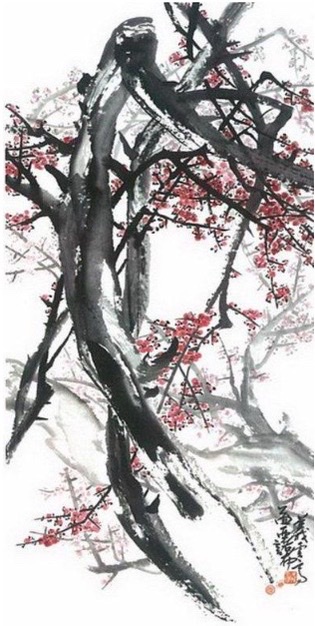
Plum Fragrance in the Holy Realm

Reveal her icy bearing and proud bones,

See how plum blossom commands the scene,

The crowd of beauties suddenly lacks color,

Seductive peach has lost its looks.

A few casual strokes,

So many eons of wind and dust.

The smoke and fire of the human world all disappears,

Leaving only a pure fragrance from the paper,

It wafts over me, awakening my mind.

The smile of the enchanted dream still remains,

Buddha Vajradhara has come

Three times to this world.

To this Buddha Land of merciful compassion

That great one has brought purity,

Feelings of the brush,

Traces of the brush,

One smile in the wind and dust,

Now the wind and dust,

So many eons of wind and dust.

To the Tune of “Jiang Jun Song”

Cold Harmony Heralds the Spring

I remember: myriad lofty peaks,

And scattered everywhere, sparkling gems of light,

The smile of cold fragrance,

Red plum trees hanging from the cliffs.

Unhurried, gentle,

Such feelings of tranquility.

Cliff walls and high valleys – where have they gone?

Now all I can see is a willow-like sway.

A few threads lightly float,

Moved by the west wind,

Suddenly I realize,

Cold clouds are heralding the spring,

And this contented mind,

Intoxicates the man,

Intoxicates the mind,

Self-possessed tranquility,

It seems like tranquility,

Such feelings of tranquility.

To the Tune of “Sheng Jun Tong”

A Painting on the Wall

This square wall

A vast, white space of nothing,

Ah, I see now,

A brilliant blaze in a grove of trees,

With not even a bird there.

Gaze in the distance,

Ai!

It is an ocean of self-nature in a garden,

With not even an insect there.

Ah, I see now,

There is no grove;

Ah, I see now,

There is no brilliant blaze,

Ai!

Where are the insects?

Ah, in fact,

Hanging on the wall,

A painting,

Colored ink,

Vermilion paste,

And a few brushstrokes,

Ah, in fact,

I am roaming in a dream,

From whence does the dream come?

Ah, do not cling to it,

There is no wall;

Ah, do not cling to it,

There is no painting.

Ai!

Roaming thoughts should not be,

Should not be.

To the Tune of “Ling Jun Hui”

Heralding Spring in the Wondrous

Realm

Dark figure of a tree,

Light, refined blossoms,

Bewitches a myriad peaks,

How many times has cold fragrance come?

The scent rises in your nose,

As a most cherished memory

Mysteriously reveals her graceful bearing,

She is here again to herald the spring.

It is in this way,

Plum greets the spring,

That parting will come soon matters not,

For now perfume wafts through the Wondrous Realm.

Photo by Tabitha Mort on Pexels.com

To the Tune of “Ying Ge Chun”

A Plum That Grows Tall and Strong

The herald of spring, where does she sleep?

Ah, cold harmony before the window,

Midnight dreams of branches beneath a drunken moon

Ah, she returns after roaming in vast space.

Roaming thoughts,

And a return to the great world.

Drifts of fragrance wind around pavilion and hall,

Returning emptiness,

As before, to the great world.

Open the window,

Graceful she stands,

There is a plum tree,

Growing tall and strong,

Growing tall and strong.

To the Tune of “Ying Ge Chun”

Strong Feelings in the Scroll

On the paper, this shade of pink,

Ah, who can guess its real color?

Next to her, all the flower queens are slaves,

Ah, alluring brows and vermilion ink songs.

Ah, she remains here in the painting,

Until the guest comes.

Tenderness everywhere heralds the dawn of spring,

Ah, the guest has gone,

Yet later will come again.

Ah, gaze in the distance,

Breaths of cold harmony,

Ah, the perfume of the plum,

Tenderness in the scroll,

Tenderness in the scroll.

To the Tune of “Pu Sa Mahn”

Mind Realm

One dark, one pale, a pair of buds grow on the

branches

Light green, dark green, samadhi nourishes the world

Following karma, you lightly dance and float,

Immutably still, yourself an ancient Buddha.

You ask about the color of the plum blossom?

It is learning contained in virtue.

Wait until it is plucked, and without bonds

Then freely hold it and turn it in your hands.

To the Tune of “Wang Hai Chao”

The Plum Greets All Beings

The frozen purity of a jade grove

The startled soul of space

Spreads out far to east and west.

Cold fragrance, down of pink,

And though only a single spray of blossoms,

Loveliness greater than any mood,

So time itself becomes a mulberry dream.

Look: wind and bone expressed in ink,

In ten-thousand ages it will never fade.

The compassion of an ancient Buddha,

Captivates all beings, and brings them to truth.

Color artistry, free and graceful,

Powerful brushstrokes crossing vast space,

An atmosphere of erudition,

These words and paintings, year after year,

Bring constant blessings,

The auspiciousness of plum blossoms.

Look: within is a mysterious power,

Which I offer to the ten-thousand ages,

From the brush, an elegant air.

Just look at delightful spring color,

And all beings will enter holiness.

Vocal Mastery

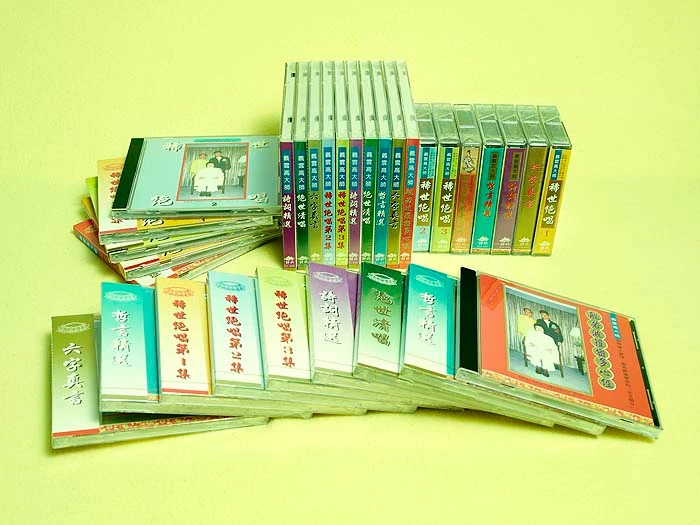
His Holiness is also a vocalist whose songs are unique masterpieces. Whether singing in a robust, resonant, stirring, and thunderous manner, or in a quietly elegant, floating, light, sweet, and captivating manner, His Holinesss vocal performances are marvelous and heavenly. His Holinesss songs and lyrics contain true Buddha-dharma. They teach goodness, impart wisdom, and benefit people. Moreover, H.H. Dorje Chang Buddha III composes the melody, writes the lyrics, and sings these songs all by Himself. There are many audiotapes and CDs of these songs. Even expert vocalists have sought the guidance of H.H. Dorje Chang Buddha III on singing. An example of this is a disciple of H.H. Dorje Chang Buddha III by the name of Jacky Cheung, who is known as a tremendous singer.

#DorjeChangBuddhaIII#HHDorjeChangBuddhaIII#Poetry#Vocal #Buddha #Buddhism #buddhist #Music#BuddhaDharma#MasterofOrientalArt#DistinguishedInternationalMaster

Outstanding Mastery in Poetry and Music – H.H. Dorje Chang Buddha III

Link: https://peacelilysite.com/2022/05/20/outstanding-mastery-in-poetry-and-music-h-h-dorje-chang-buddha-iii/

Soure: https://truebuddhas.org/en/classical-poetry-and-songs/